In a Major Privacy Victory, Seattle Mayor Orders Police to Dismantle Its Drone Program After Protests
By Trevor Timm | EFF | February 8, 2013
In an amazing victory for privacy advocates and drone activists, yesterday, Seattle’s mayor ordered the city’s police agency to cease trying to use surveillance drones and dismantle its drone program. The police will return the two drones they previously purchased with a Department of Homeland Security grant to the manufacturer.
EFF has been warning of the privacy dangers surveillance drones pose to US citizens for more than a year now. In May of last year, we urged concerned citizens to take their complaints to their local governments, given Congress has been slow to act on any privacy legislation. The events of Seattle proves this strategy can work and should serve as a blueprint for local activism across the country.
Back in early 2012, the Seattle city council was told that the Seattle police agency had obtained an authorization to fly drones from the Federal Aviation Administration (FAA). But they did not find out from the police; they found out from a reporter who called after the council after he saw Seattle’s name on the list obtained by EFF as part of our lawsuit against the FAA.
City council was understandably not happy, and the police agency was forced to appear before the council and apologize. It then vowed to work with the ACLU of Washington and the FAA to develop guidelines to make sure drones wouldn’t violate Seattle citizens’ privacy. But as long as the guidelines weren’t passed in a binding city ordinance, there’d be no way to enforce them.
After a townhall meeting held by police, in which citizens showed up in droves and angrily denounced the city’s plans, some reporters insinuated that city counsel members’ jobs could be on the line if they did not pass strict drone legislation protecting its citizens privacy.
Documents obtained by MuckRock and EFF in October as part of our 2012 drone census showed that the Seattle police were trying to buy two more drones despite the controversy. But that ended yesterday as the Mayor put a stop to the program completely.
Critics of the privacy protests said the participants were exaggerating the capabilities of the Seattle drones, given they would only fly for less than an hour at a time and are much smaller than the Predator drones the military flies overseas and Department of Homeland Security flies at home.
But while Seattle’s potential drones may not have been able to stay in the air for long, similar drones have already been developed and advertised by drone manufacturers with the capability to stay in the air for hours or days at a time. In fact, Lockheed Martin has been bragging about a drone that weights 13.2 pounds (well within the FAA’s weight limits) that can be recharged by a laser on the ground and stay in the air indefinitely.
Since the Seattle protests have heated up, similar complaints have been heard at local city counsels and state legislatures across the country. At least thirteen states are now considering legislation to restrict drone use to protect privacy, and there are also members of Congress on both sides of the aisle pushing the same thing.
Here in the Bay Area, we’ve experienced a similar situation. The Alameda County Sheriff’s Office tried to sneak through drone funding without a public hearing and told the county board of supervisors it only wanted to use the drone for emergency purposes. Yet in internal documents obtained by EFF and MuckRock as part of our 2012 drone census, the Sheriff’s Office said it wanted to use the drone for “suspicious persons” and “large crowd control disturbances.”
When EFF and ACLU held a press conference pointing out this discrepancy, the county backtracked and is now attempting to write privacy guidelines that could potentially be turned into binding law. We will keep you updated on further developments.
But regardless, it’s important that privacy advocates take the lesson from Seattle and apply it all over the country. This is an important privacy victory, and like we said back in May, local governments will listen to our concerns, so let’s make our voice heard.
The Black Panthers, Black History Month and “Domestic Terrorism”
By RON JACOBS | CounterPunch | February 8, 2013
Once again, it’s Black History Month in the United States. Since the inception of this celebration, its meaning has unfortunately been diminished as the myth of postracialism becomes gospel, even though it shares none of a gospel’s truths. In schools and libraries, well-meaning teachers and library workers create displays, bring in speakers, and teach lessons on the history of African-Americans. All too often, this means a look at the words of Martin Luther King, Jr., a discussion of the Emancipation Proclamation and maybe a lesson about Rosa Parks.
Only rarely, do students and library patrons get a look beyond these conventional topics that are usually taught in a manner that highlights white America’s tolerance and sense of fair play. This is why books like the recently released Black Against Empire: The History and Politics of the Black Panther Party are so important. They remove the pretense that the Black liberation movement in the United States was something everyone except the KKK and its allies supported. Books like this tell the truth. Blacks Against Empire does so concisely, engagingly and honestly.
Blacks Against Empire is a political history that is simultaneously objective and radical. Despite the efforts of historians to obfuscate and obliterate the party from history, describing it as a hate group and gun-obsessed when mentioning it at all, the fact is the Panthers legacy is unique and important to not only the history of Black America, but to the history of the entire United States. It is best described in the words of Mumia Abu Jamal: “we didn’t preach to the people, we worked with them. “The relationship between the primarily white New Left and Panthers is explored in a fair-minded and realistic manner, as is the relationship between the Panthers and other Third World revolutionary organizations both in the United States and around the world. The authors expand the narrative of the movement against the US war in Vietnam, showing clearly the early involvement of black organizations, especially that of the Student Nonviolent Coordinating Committee (SNCC). It was this organization that actually began resisting the draft, months before the predominantly white antiwar movement. Furthermore, as the authors make clear, opposition to the US war in Vietnam was one of the Black Panthers’ fundamental positions.
Like most revolutionary organizations the Panthers struggled with issues of gender and sexuality. While the participation of men in the breakfast programs sensitized them to the realities of child-rearing and associated aspects of human life (think of the film Salt of the Earth, when the women replace men on the picket lines and the men take over household tasks forcing them to see the relationship of domestic tasks to the capitalist dynamic), the living situations of many Panthers reinforced traditional gender roles.
Joshua Bloom and Waldo Martin Jr., the authors of Black Against Empire, have written a comprehensive and compelling history of the Black Panther Party. As close to complete as one text can possibly be, it is the book I would recommend to anyone wanting to read just one book about the Black Panthers. The book concludes with a chapter speculating as to why the Black Panthers developed when they did, why they commanded the support they did, and why their influence waned so quickly. Of course, the role of the government counterinsurgency program called COINTELPRO is discussed; the frameups, misinformation, jacketing and murders. In light of current concerns about domestic “terrorists”, one wonders if the Panthers would be considered drone assassination targets under the current Justice Department guidelines if they were around today? Other reasons provided by the authors for the Panthers’ demise borrow from the Italian Antonio Gramsci’s thoughts on revolutionary movements and end up asking more questions than they answer.
Back to Mumia Abu Jamal. One of the youngest Panthers in the nation, he continued his revolutionary activism and reportage long after the Black Panthers had become history. Indeed, his post-Panther trajectory could serve as a microcosm of many leftist revolutionaries who came of age during the Panthers’ heyday. He didn’t give up his radicalism while pursuing a career after the Party. Because of this, he ended up paying for his history and his refusal to compromise. He continues paying even today. For those who have forgotten (or never paid attention), Mumia has been on Pennsylvania’s death row for more than two decades. Accused and convicted of killing a Philadelphia policeman in a prosecution involving the sketchiest of evidence and numerous prosecutorial and judicial missteps, Mumia’s life and situation is the subject of a new feature film titled Long Distance Revolutionary.
When I was helping organize antiwar activities in the late 1990s and the 2000s, I learned that many of the younger radicals I was working with came to their politics after learning of Mumia’s case. Thanks in no small part to his eloquence and the support of popular musicians like Rage Against the Machine, these young people saw through the intense desire of the State to keep Jamal in prison and kill him. This understanding opened their eyes to the realities of the system and made them radical. As the film shows, this trajectory is similar to Jamal’s. Mumia is a political prisoner. The Panthers were a political organization. The story of both is a story that needs to be heard. The film is part biography, part commentary from supporters and Jamal himself, and part drama. The sum of these parts is a film that provokes and entertains.
The Black Panthers were bold. The Black Panthers were smart. The Black Panthers were anti-imperialists. The Black Panthers were revolutionaries. This book and this film remind us of that. They also remind us that this world, this nation, could use something with the Panthers appeal and power now.
Read this book, ask your library to buy it; watch this film. Black history isn’t just for black people. It’s for everyone who wants to understand the history of the United States.

Ron Jacobs is the author of The Way the Wind Blew: a History of the Weather Underground and Short Order Frame Up. Jacobs’ essay on Big Bill Broonzy is featured in CounterPunch’s collection on music, art and sex, Serpents in the Garden. His collection of essays and other musings titled Tripping Through the American Night is now available and his new novel is The Co-Conspirator’s Tale. He is a contributor to Hopeless: Barack Obama and the Politics of Illusion, published by AK Press. He can be reached at: ronj1955@gmail.com.
Farming Injustice
International day of action – February 9th
Palestinian farmers organisations and campaigners in Europe are this weekend taking action to call for an end to trade with Israeli agricultural export companies over their role in Israeli violations of Palestinian human rights. Read the call to action here.
In Gaza, Palestinian fishermen held a press conference and rally on February 6 to draw attention to Israel’s attacks on fishermen. Farmers and activists will march towards the buffer zones near the border with Israel on February 9 to protest Israel’s destruction of farmland and attacks on farmers.
In the West Bank, a conference and other actions will be held in Salfit to discuss a boycott of Israeli goods and resistance to Israel’s colonisation and systematically implemented restrictions on Palestinian agriculture.
All of the major Palestinian agricultural organisations have marked the day of action by publishing an appeal for action for the launching of campaigns against Israeli agricultural companies and an accompanying briefing, which aims to shed light on the role of Israeli agricultural companies in the destruction of of Palestinian agriculture.
Solidarity campaigners, trade unionists and NGOs across Europe are holding actions and launching campaigns against Israeli agricultural export companies such as Mehadrin and Arava, who export fresh produce from illegal Israeli settlements and are among the primary beneficiaries of the destruction of Palestinian agriculture.
There will be events, flash mobs and protests in more than 40 cities across 9 European countries including France, the UK, the Netherlands, Belgium, Sweden, Switzerland, Luxembourg, Germany and Italy. Campaigners are calling on governments to ban settlement trade and on retailers to adopt the position of the Co-Operative supermarket in the UK, which refuses to trade with any Israeli company that operates in settlements.
You can follow the actions on Twitter using the hashtag #FarmingInjustice.
Actions taking place across the world
Palestine
Dozens of Palestinian farmers and fishermen rallied in the Gaza seaport this week, launching several days of actions across the Strip to support boycotts of Israeli agricultural corporations.
Upcoming events will include a march by farmers, ending with the planting of olive trees, near the “buffer zone” around Gaza’s boundary with Israel on Saturday.
In the West Bank, a conference and other actions will be held in Salfit to discuss a boycott of Israeli goods and resistance to Israel’s colonisation and systematically implemented restrictions on Palestinian agriculture.
Also in the West Bank, the villagers of Madama, the centre for the Martyr Billal Najar from Burin and International Solidarity Movement activists will plant Olive trees on the land of Madama village where illegal settlers cut down hundreds of olive trees.
France
Activists in Montpellier occupied the customs offices to protest the import of produce from Israeli agricultural companies that operate in settlements on Thursday. Actions are planned in 14 other French cities on Saturday.
UK
Protests and actions are planned in more than XX cities as part of a new campaign to pressure major supermarket Sainsbury’s to end trade with any Israeli company that from settlements.
Belgium
Creative ‘Boycott Carnival’ action and demonstration in central Brussels
Sweden
Pickets at Coop-stores in Stockholm and Hässleholm as part of the campaign to pressure the supermarket to end trade with complicit Israeli companies
Netherlands
A creative protest action in the ‘Black Market’ Bazar, Beverwijk, at which goods from Israeli companies such as Mehadrin and Arava are often present
Luxembourg
Actions at supermarkets in several cities.
Italy
Actions and demonstrations in Rome and Trento
Actions are also planned in Germany and Switzerland, with more details to follow.
Related articles
Arad: Supplying water meters to Sussex while helping bleed Palestine dry
Corporate Watch | February 8, 2013
An Israeli company which supplies water infrastructure in Israel’s illegal settlements in the West Bank is gaining contracts to supply equipment to water companies in the UK. Israeli company Arad has gained a contract to provide Southern Water with £7.1 million worth of water meters annually for five years with the option to extend when the contract expires. The contract was signed in February 2010 and the meters are currently being installed. Arad is also providing pressure sensors to the Welsh water utility.
Arad has installed 3,200 water meters in the illegal Israeli settlement of Ariel and the Barkan settlement industrial zone. The water system is managed by the Mei Ariel Water Corporation.
Arad also develops water meters for the Israeli state owned company Mekorot. Mekorot has a near monopoly on water supply in Israel and also operates and develops water infrastructure in Area C of the West Bank, where Palestinians are forbidden to develop even basic water infrastructure.
Palestinians living in Area C, unable to access piped water due to the restrictions on building imposed by the Israeli Civil Administration, are often forced to fill up water tanks, transported by tractor, at Mekorot’s water facilities. These fenced water facilities are often situated beside Palestinian communities and draw water from occupied Palestinian territory.
Water is also used as a tool in the ethnic cleansing of Palestinian communities. Water is denied to these communities as a way to push them off the land on which they live and into urban centers so that their land can be expropriated by the settlements. For example Bedouin man from Khan Al Ahmar, where the entire community is currently under threat of home demolitions and relocation, told Corporate Watch, back in 2009, that he had to to drive a mobile water tank by tractor to Jericho and pay to have it filled up with water from Mekorot. This journey takes between half an hour and an hour. Despite the fact that the nearby settlement has several large water tanks, surrounded by strong fencing, the tents which the Bedouin live in have no access to running water and they are not allowed to use the water located right next to them. Corporate Watch visited Khan Al Ahmar in 2013 and this situation had not changed.
Arad has been awarded contracts in the US , Brazil and Canada and boasts that it has a large slice of the Spanish water ‘market’. However, the company is focussing its efforts on the UK. Arad’s website states that “The UK was targeted by Arad years ago as the preferred market for implementing its products and services including water management systems.” Arad’s efforts are being facilitated by the British-Israel Chamber of Commerce which named Arad Israeli company of the year in 2010.
The award of these contracts by Southern Water to a company which supplies water infrastructure in illegal settlements should never have occurred. It is of utmost importance that the movement for boycott, divestment and sanctions against Israeli apartheid, colonisation and militarism halts the expansion of this company which is profiting from one of the most fundamental facets of Israeli apartheid.
A first step towards this would be for people in Sussex to resist the introduction of Arad’s water meters in homes across the county.
Arad (www.arad.co.il) is listed on the Tel Aviv Stock Exchange. Arad’s listed addresses are:
ARAD Technologies Ltd.
HaCarmel 6, Industrial Area
Yokneam 20692
Israel
Tel: 972-4-9935222
Fax: 972-4-9935227
www.aradtec.com
Master Meter Inc.
101 Regency Parkway
Mansfield, TX 76063
USA
Tel: 817-842-8000
Fax: 817-842-8100
E-mail:info@mastermeter.com
www.mastermeter.com
Contazara S.A.
Ctra. Castellón A-68, km 5.5
50720 Zaragoza
Spain
Tel: 976-50-06-91
Fax: 976-50-06-54
www.contazara.es
Southern Water can be contacted here
Related articles
- Israeli water firm drying up Palestinian springs, says UN report (altahrir.wordpress.com)
- West Bank: Aid agencies tread gingerly in Area C (alethonews.wordpress.com)
Canadian natives and anti-nuclear activists halt train
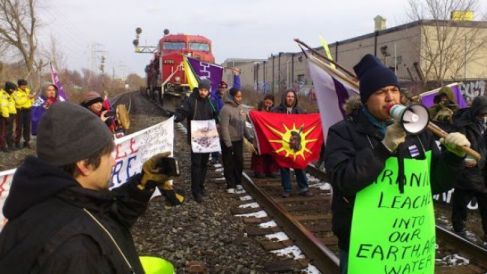
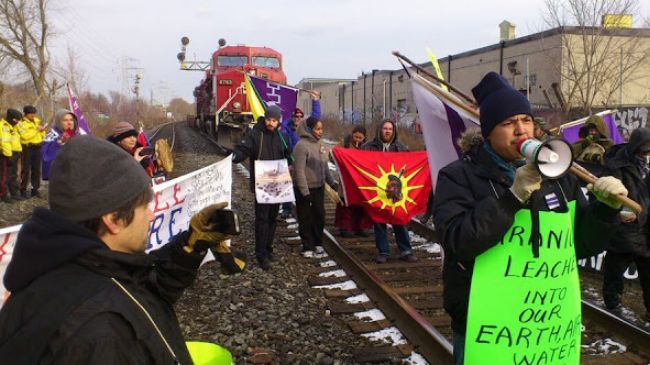
Protesters blocking a train near a nuclear processing facility in Toronto, Canada on February 3, 2013.
Press TV – February 6, 2013
Canadian natives and anti-nuclear activists have blocked a rail line, demanding the shutdown of a nuclear processing facility in the country.
The protesters, including the members of the Idle No More movement, blocked a train, on Sunday, near the General Electric-Hitachi nuclear plant in Toronto, after staging a demonstration at the facility and a march earlier.
“Uranium is stolen from indigenous lands and it leaks radiation all along the fuel chain,” said anti-nuclear activist Zach Ruiter.
Another protester from Serpent River First Nation said, “I’m here because uranium, it really affected my reserve back home,” and added, “It did a lot of damage to our river. We can’t use the river no more, we can’t fish in it. We can’t drink the water.”
Under a Canadian law, the government has the right to seize or sell land from the indigenous people to the private sector.
The aboriginal people say the government is using the law to force them flee their land.
Legal experts have called the law unconstitutional and a potentially genocidal piece of legislation that is intended to do away with the collective rights of Canada’s 1.2 million natives.
The Idle No More Movement was inspired by the six-week hunger strike of Attawapiskat Chief Theresa Spence, which began on December 11, 2012, as a protest against the violation of the rights of Canadian natives.
Eighth Annual Citgo-Venezuela Heating Oil Program Launched
Venezuelanalysis | February 4, 2013
 Last Thursday, at the Night of Peace Family Shelter in Baltimore, CITGO Petroleum Corporation President and CEO Alejandro Granado and Citizens Energy Corporation Chairman Joseph P. Kennedy II launched the eighth annual CITGO-Venezuela Heating Oil Program with the first heating oil delivery of this winter’s initiative.
The program, which began as a single donation in 2005 in response to the high prices of heating oil resulting from hurricanes Katrina and Rita, has grown well beyond its original scope. Today, it has become a humanitarian symbol of unity between the people of Venezuela and those in need in the United States.
This year, the program has a heightened sentiment as it comes at a time when Venezuelans and many in the world send their wishes for the health and prompt recuperation of President Hugo Chávez, who has supported this initiative since its creation eight years ago.
“The CITGO-Venezuela Heating Oil Program has been one of the most important energy assistance efforts in the United States. This year, as families across the Eastern Seaboard struggle to recover from the losses caused by Hurricane Sandy, this donation becomes even more significant,” said Granado. “This energy assistance program is an integral example of the humanitarian principles endorsed by the CITGO ultimate shareholder, Petróleos de Venezuela, S.A. (PDVSA), the national oil company of the Bolivarian Republic of Venezuela.”
Over the years, the program has helped more than 1.7 million people stay warm during the coldest months of winter by donating more than 200 million gallons of heating oil worth more than $400 million. It is estimated that this year the program will help more than 100,000 families in 25 states plus the District of Columbia, including members of more than 240 Native American communities and more than 200 homeless shelters.
“CITGO invests relatively more than any other major oil company in social responsibility projects. As a matter of fact, our percent of revenue spent in social programs has been five times more than those of other much larger, vertically-integrated competing global brands. It is a core principle of our business to use the strength of our resources to help people in need,” Granado said.
Since the program’s creation, CITGO has partnered with Citizens Energy Corporation, a non-profit organization created in 1979 by former U.S. Rep. Joseph P. Kennedy II. Citizens Energy Corporation, which has used successful ventures in the energy and health care industries to finance charitable programs in the U.S. and abroad, has provided energy assistance to families in need for more than 30 years.
“We are so grateful for this generous donation from the people of Venezuela and CITGO Petroleum Corporation. After eight years and more than 200 million gallons of heating oil distributed within the U.S., the burden of another difficult winter threatens the livelihood and safety of senior citizens and low-income families,” Kennedy said. “It is critical that we continue to support American families through this program. Thanks to this partnership, we will help more than 400,000 people stay warm and safe this winter.”
Kennedy emphasized the commitment CITGO has made to American communities. He said that he has approached major U.S. oil companies and oil-producing nations to ask them to assist the poor in bearing the burden of rising energy costs. “They all said no,” he said, “except for CITGO, President Chávez and the people of Venezuela.”
Congressman Elijah Cummings (MD), who also spoke during the event, reiterated the importance of helping those in need. “I commend CITGO and Citizens Energy Corporation for launching the Heating Oil Program this year. This program is literally life-saving for so many whose resources are already stretched thin in tough economic times. I stand with the many Baltimore and Washington recipients who thank both CITGO and Citizens for their commitment to helping our communities,” he said.
Echoing those sentiments, Claudia Salerno Caldera, Venezuela’s Vice Minister of Foreign Affairs for North America, addressed the plight of poor people and why humanitarian assistance is so vital. “The vision of social responsibility in the energy policy of the Bolivarian Republic of Venezuela has allowed us to assure that our profits benefit the neediest people in our country. Just as the government of President Hugo Chávez has made significant efforts in the fight against poverty and in the promotion of social justice in Venezuela, this program demonstrates that our commitment to the poor transcends all boundaries, ideological and geographical,” Salerno said.
Families struggling to pay for home heating oil can call Citizens Energy Corporation at 1-877-JOE-4-OIL (1-877-563-4645), to see if they are eligible for heating oil assistance. Once approved, the household will receive an authorization letter with details for arranging a one-time delivery of 100 free gallons of oil.
For more information about the program, click here.
Edited by Venezuelanalysis.com
CITGO, based in Houston, is a refiner, transporter and marketer of transportation fuels, lubricants, petrochemicals and other industrial products. The company is owned by PDV America, Inc., an indirect wholly owned subsidiary of Petróleos de Venezuela, S.A., the national oil company of the Bolivarian Republic of Venezuela. For more information visit www.citgo.com.
Beginning in 1979 with oil-trading ventures in Latin America and Africa, Citizens Energy has used revenues from commercial enterprises to channel millions of dollars into charitable programs in the U.S. and abroad. Whether heating the homes of the elderly and the poor, lowering the cost of prescription drugs for millions of Americans, or starting solar heating projects in Jamaica and Venezuela, Citizens Energy creates social ventures as innovative as the businesses that finance them. For more information, visit www.citizensenergy.com.
PICKING CABBAGE IN BEIT HANOUN
By Theresa in Gaza | Free Gaza Scotland | February 2, 2013
Today we went to Beit Hanoun to help the farmers to pick cabbage. Its sounds like boring hard work, especially as it was raining quite hard off and on while we were there but actually it was a really enjoyable and interesting day. When we arrived at the field we joined a group of young farm labourers who made the morning very enjoyable with their singing, laughing and joking as we worked quickly to gather as many cabbage in a short period of time as possible. The field we were working on was quite some distance from the fence, we only heard gunfire twice and didn’t feel directly targeted, the jeep only showing itself once on the treeline before stopping behind a small hill in the distance. We helped pile the motorized cart high with cabbage and chatted in the rain until the cars arrived to take us back into Beit Hanoun.
While we were chatting one of the farmers talked about his Grandmother and the stories she told him about her childhood here. We were stunned when he told us that she had talked about being able to go from Beit Hanoun to Hebron in only half an hour in those days. It was something we hadn’t thought about, when you are in Gaza everywhere in the West Bank seems like such a long way away but when you think about it it makes sense, it’s actually only around 40km. To get there today takes a minimum of 2 days with no stop, Beit Hanoun – Cairo-Round the Southern tip of the Sinai via Sharm El Sheikh to cross at Taba into Israel then on to Hebron. That is of course if you are a privileged International, for a Palestinian there are a whole new set of problems.
Beit Hanoun is an interesting town, it’s directly across the border from Sderot. A place I’ve heard of very often and met a couple of residents of but never had the chance to visit. The countryside here is gently rolling low hills and as you leave Beit Hanoun to reach the fields you see Sderot in the distance. Built right up to the border, mainly nestled in between two hills with some of the red roofed buildings of the town on top of one and a large army installation with radio towers on the other.
Being so close to Sderot has meant that Beit Hanoun comes under huge pressure with all houses within one and a half miles of the border bulldozed, mainly in 2009 and all of the citrus trees which used to cover this landscape destroyed in order to leave clear lines of sight for the Israeli Military. Every building facing Sderot shows serious damage from shelling bombing and gunfire, and across the town there are damaged houses. Why is it that I had never heard of Beit Hanoun before I came to Gaza and yet Sderot is on the lips of every Israeli and everyone who defends the Zionist policies of Israel, ingraining it on everyone’s conciseness? Perhaps because there are so many places in Gaza which have the same damage, the same experience of attack, destroyed homes and death due to Israeli Military action? Whereas Sderot is special, in Israel it is the one place which has seen regular rockets causing some structural damage and very occasional death. Is it too much to ask that the violent death or injury of a human being is treated with the same shock and grief whichever side of the border it’s on? That the damage to lives and property is judged by the same standards wherever they occur?
Related articles
- 75th Israeli Violation of truce: Palestinian Man Shot In Beit Hanoun (altahrir.wordpress.com)
- We Want it to Stop (alethonews.wordpress.com)
Stop EU funding of Israeli military companies and illegal settlements
Palestine Solidarity Campaign and International Solidarity Movement
Join and spread widely the latest EU-wide call to stop funding of Israeli military companies and illegal settlements:
As more and more of us become aware of the injustices against Palestinians denied their basic rights, the situation is becoming even more desperate on the ground. It has never been more important for us to make our elected representatives aware of the growing and unstoppable pressure for peace and justice.
The EU should be playing a leading role in implementing policies to ensure that Israel ends its illegal occupation and respect Palestinian human rights and international law. Instead, they are supporting Israel’s occupation by:
- allowing illegal settlement products to be traded in the UK and across Europe
- by using EU tax-payer money to fund Israeli military companies who are responsible for killing civilians and supporting Israel’s military occupation
It is time for actions, not words. Tell the EU to act today.
Read the full letter and sign the call here today: http://psc.iparl.com/lobby/96. Please spread widely.
Join and spread widely the call from Palestine to EU citizens to urge representatives to suspend trade agreements with Israel until it complies with international law, initiated by Palestinian grass-roots organizations recently:
Send letters to EU Prime Ministers and Foreign Ministers (in all EU languages!)
Send letters to Members of European Parliament (MEPs) (in all EU languages!)
Related articles
- Palestinians call for a boycott of Israeli diamonds (altahrir.wordpress.com)
- South African agricultural company cuts ties to Hadiklaim (alethonews.wordpress.com)
South African agricultural company cuts ties to Hadiklaim
BDS South Africa | January 31, 2013
Karsten Farms, a leading South African agricultural company backed by one of South Africa’s primary finance bodies, the Industrial Development Corporation (IDC), has severed its relations with the Israeli cooperative, Hadiklaim, and has also undertaken not to enter into any future relations with any Israeli entity complicit in the illegal Israeli Occupation of Palestine.
South African human rights organizations, lead by the Palestine Solidarity Alliance (PSA) and BDS South Africa, launched a consumer campaign against Karsten Farms due to its trade relations (in violation of the boycott of Israel) with Israel’s Hadiklaim – an Israeli company operating, against international law, in the illegal Israeli settlements.
This week, after almost 3 years of campaigning, in a letter to BDS South Africa via their lawyers, Werksmans Attorneys, Karsten Farms undertook: “Not to enter into any trade relations with Hadiklaim for the current harvest year of 2013 and not have any business relations with them [Hadiklaim] in the future.” In addition, and in a precedent-setting move, Karsten Farms also undertook: “Not to enter into any trade relations with any Israeli company and/or entity within the occupied/illegal settlement areas of Israel”.
Siphiwe Thusi of the Palestine Solidarity Alliance welcomed the news: “This is the first time that a South African company has taken the legally as well as ethically correct decision not to trade with Israeli companies complicit in the illegal Israeli Occupation of Palestine. Karsten Farms has indeed set a precedent for other South African businesses and companies to follow. This is a breakthrough not only for the boycott of Israel but also for ethical and good business practice.” Thusi added that “the call for the consumer boycott of Karstens products has now been called off by virtue of their legal undertakings” however he also cautioned that “the Palestine Solidarity Alliance and BDS South Africa will be monitoring the situation and if any new Israeli relations, even if via third parties, were to be formed, the boycott campaign against Karsten Farms would be re-launched, and intensified.”
Find the full statement here: http://tinyurl.com/avlzt7n
Related articles
- BDS Gaining Momentum (councillorpadraigmcshane.wordpress.com)
- The 9th Annual Israeli Apartheid Week 2013 (alethonews.wordpress.com)
- South Africa’s ruling ANC officially endorses Palestine’s boycott movement (alethonews.wordpress.com)
- South Lebanon: Israel Admits to Stealing Land in Adaisseh (alethonews.wordpress.com)
- Israel plans boycott of UN human rights review (alethonews.wordpress.com)
- Farming Injustice: End all Trade with Israeli Agricultural Companies (bdsmovement.net)
Featured Video

BRITAIN’S WARNING: PREPARE FOR WAR
or go to
Aletho News Archives – Video-Images
From the Archive
How Ukraine Tortured and Slaughtered Donbass
By Kit Klarenberg | Al Mayadeen | July 11, 2024
Almost immediately after the proxy war erupted, ISIS-tier footage of the torture and murder of Russians in Ukrainian custody emerged.
On July 6th, the New York Times published an astonishing investigation: In Ukraine, Killings of Surrendering Russians Divide an American-Led Unit. The article documents in grim detail how Chosen Company, an international volunteer battalion for Kiev, routinely executes Russian prisoners of war. It is the very first mainstream admission that this practice – a brazen breach of the Geneva Conventions, and a grave war crime – is widespread among Ukraine’s fighters, both foreign and homegrown. … continue
Blog Roll
 Aletho News
- Israel Demolishes Home Of Lebanese Journalist Whose Viral Film Exposed Pager Attack
- Record Oil, Empty Tanks: The UAE’s Miracle Recovery
- Burnham tackles Britain’s poverty with aggression in Yemen
- Peace in Ukraine: the easy way – or the hard way
- Trump & the Rrrrussians
- US taxpayer money laundered back through Ukraine – Musk
- Before COVID, an NIH lab chief proposed making a SARS-like bat virus more infectious
- Gates, Bourla on Trial in Netherlands Accused of ‘Great Reset’ Scheme at Vaccine Injury Hearing
- BRITAIN’S WARNING: PREPARE FOR WAR
- “Historic Russia”: The Land Putin Will Not Give Back
- If Americans Knew
- An error has occurred; the feed is probably down. Try again later.
- No Tricks Zone
- Two New Studies Find Thwaites Glacier Melt Cannot Be Driven By Human Activity Or A Warming Ocean
- E-Cars Reduce CO2 Emissions By Only 41% Compared To Internal Combustion Engine Vehicles
- Predictions Made By Renowned Climate Professor Over Past Decades Have Been Proven To Be Poor
- New Study Suggests Large Regions Of The Pacific Ocean Have Been Cooling For The Last 80 Years
- Germany’s Green Energy Debacle: High Energy Costs Force Kahla Porzellan to Close After 182 Years!
- New Study: 50 Years Of The Most Aggressive ‘Net Zero’ Policies Can Only Affect The Global Climate By 0.03°C
- US September “Heat” Was No Record…Many Records Set Decades Ago
- Latest European Green Energy Debacle; Portugal’s Largest Flagship Solar Park Insolvent!
- Green Energy Debacle: German Expert Professor Fritz Vahrenholt Warns Of Severe Economic And Social Consequences
- Two More Paleo Reconstructions Affirm Meters-Higher Sea Levels Across Ireland, Brazil 7000-6000 Years Ago

