Turkish protesters, angry at NATO missiles, attack German troops
Press TV – January 23, 2013
Turkish protesters have attacked German troops stationed in the Mediterranean port of Iskenderun to operate NATO’s Patriot missiles.
Members of the Turkish Youth Union (TGB), affiliated to the Turkey Workers’ Party, attacked the soldiers in the center of the city on Tuesday and tried to put sacks on their heads.
Turkish media quoted Iskendurun Prosecutors Office as saying that 14 activists have been arrested and 28 others charged with intentionally attempting to cause harm.
Also on Tuesday, Turkish protesters staged a rally in the capital Ankara to voice opposition to the deployment of NATO’s missile system and the presence of foreign troops in the country.
Over the past days, similar protests have been held in front of the German and US embassies.
German and Dutch missile batteries, as part of NATO’s mission, arrived in Turkey on Monday. The surface-to-air missiles will be deployed near the border with Syria.
The United States, another contributor to the NATO mission, has also begun deployment of two Patriot missile batteries at Incirlik Air Base in Turkey’s southeast.
Russia has frequently expressed opposition to the deployment of the missiles in Turkey, which Ankara claims is aimed to deterring any threat emanating from its southern neighbor, Syria.
Moscow says the threats facing Ankara have been exaggerated in order to justify NATO’s deployment of the advanced missiles along the Syrian border, adding that the measure would increase the “risk that these arms will be used.”
Related articles
- Turkish police arrest anti-Patriot missile protesters (alethonews.wordpress.com)
- Anti-Patriot protesters gather in front of German Embassy in Ankara (presstv.ir)
Greek metro workers defy court order to return to work
Press TV – January 22, 2013
Greek metro workers have defied a court order to return to work and have staged the sixth day of strikes over the government’s spending cuts.
Athens was without a metro service on Tuesday for four to five hours, which comes in continuation to the protest started on Thursday over the planned cuts to metro workers’ salaries.
A Greek court ruled against Athens Metro Workers’ Union’s planned strikes and permitted the government to use force to make personnel return to work.
Union officials call on the government to abolish the planned changes to the public sector’s pay scales, which comes as Athens implements measures to satisfy its eurozone creditors.
Reductions in public sector workers’ incomes have made it harder for Greeks to make ends meet.
“With these latest cuts, someone like me who earned 1,300 euros per month will end up clearing something like 700 euros,” Metro Workers’ Union Head Antonis Stamatopoulos said.
“We cannot live on what we earn,” he added.
Stamatopoulos said that apart from stopping the changes to the pay cuts, the only way the government could make them return to work would be through force.
“Civil mobilization? They can enforce it if they want. Maybe they should come here with tanks to force us back to work,” Stamatopoulos said.
Parliament introduced new austerity measures in December 2012, which eurozone finance ministers approved for bailout packages of 9.2 billion euros on Monday and 34.3 billion euros last month.
Europe plunged into financial crisis in early 2008. The worsening debt crisis has forced the EU governments to adopt harsh austerity measures and tough economic reforms, which have triggered massive protests in many European countries.
Mayoral Candidates Take Sides over St. Louis Veolia Contract
Saint Louis Palestine Solidarity Committee | January 22, 2013
On January 16, 2013 at City Hall in St. Louis, Missouri, a diverse group of 60 Palestinian rights organizers; environmental activists; workers; civil rights leaders; veterans; local business owners; students; members of the local Muslim, Christian, and Jewish communities; and other concerned citizens packed a meeting of the St. Louis Board of Estimate & Apportionment (E&A) to show opposition to a proposed city contract with Veolia Water. Two mayoral candidates on the 3-person board, which considers public contracts, took opposite sides over the contract, prompting the third member to call for a public hearing for testimonies from local citizens regarding Veolia.
Contract opponents lined the halls leading to the mayor’s office, citing Veolia’s abysmal record of poor environmental standards, labor abuses and involvement in human rights abuses in Palestine. Each held a sign stating “Say No to Veolia” followed by their personal reasons, which included: “I can’t ride their buses because I am Palestinian,” “I think all people deserve equal treatment,” “My tax dollars are not for corporate profit,” “They don’t have to drink our water,” “I love coffee.” The mayor’s office had to change the meeting venue at the last minute to accommodate the large public turnout.
The St. Louis Palestine Solidarity Committee (PSC) learned of the proposed $250,000 Veolia contract for a four-month consultation for the St. Louis Water Division in December 2012 after the story was leaked to the Riverfront Times. When the contract came up for approval, PSC organized in less than 24 hours a grassroots effort to tell the E&A Board, which is comprised of St. Louis City Mayor Francis Slay, Comptroller Darlene Green and President of the Board of Aldermen Lewis Reed (running for mayor against Slay), not to approve the contract without investigating Veolia’s record. At the December 19, 2012 meeting of the Board, the Board agreed they could not in good conscience vote to approve a contract with so many allegations outstanding.
Immediately, the PSC reached out to diverse communities to join the fight against Veolia, all under the coalition St. Louis Dump Veolia.
The contract was reintroduced last-minute to the January agenda by Mayor Slay, the contract’s chief proponent. Slay had received a trophy and award check for $15,000 from the President of Veolia Water in 2007, on behalf of the City. Following mass mobilization by the coalition, Mayor Slay decided one day before the January meeting to remove the contract from the agenda, delaying the vote for a second month.
In the presence of an uncharacteristically large audience and media presence, the two mayoral candidates Slay and Reed came head-to-head in tense disputes regarding agenda items, transforming the meeting into what some coined an “ad-hoc mayoral debate.” President Reed ended by praising the public showing and affirming his opposition to the Veolia contract, while Slay stressed that the public had misconceptions about the company.
Comptroller Green, who holds the deciding vote, said she hoped the public’s voices could be heard and asked for a public hearing. The PSC delivered and posted letters to Comptroller Green asking her to reject Veolia from the Palestinian Freedom Riders, Boycott from Within and the Civic Coalition for Palestinian Rights in Jerusalem.
Veolia has been a major focus of the global Boycott, Divestment and Sanctions (BDS) movement for Palestinian freedom and equality. The St. Louis campaign against Veolia may be the first time that a BDS campaign has entered mainstream political discourse and, perhaps, a mayoral race. Media coverage in the St. Louis Post-Dispatch, the Riverfront Times and St. Louis Public Radio acknowledge that Veolia’s contracts in Israel/Palestine have been instrumental in bringing the controversy out in the open.
The nationwide We Divest campaign targets Veolia for divestment from the holdings of financial services giant, TIAA-CREF. St. Louis-area resident and PSC member, Steve Tamari, is the lead filer for a nationwide, broad-based shareholders’ resolution calling for divestment from Veolia and other companies that profit from Israel’s human rights abuses. Individuals holding a CREF account are encouraged to sign on to the shareholders’ resolution and to vote in support of the resolution before or at the July 2013 annual meeting.
St. Louis Dump Veolia is committed to keeping up the pressure on City Hall until the Veolia contract is rejected once and for all. The PSC will be mobilizing residents to testify at the hearing, putting the Israeli occupation, and its corporate enablers, on trial for all to see.
The next E&A meeting will occur on Wednesday, February 20 at 2pm in St. Louis City Hall.
To follow developments and action items on the campaign, join the St. Louis Dump Veolia and Palestine Solidarity Committee Facebook pages, and follow@stlpsc on Twitter
Veolia Fact Sheet
December 18th, 2012 | Published in Latest News and Action Alerts, STL-PSC Blog
What is Veolia?
According to a story broken by the Riverfront Times, St. Louis city lawyers have been negotiating a contract with Veolia Water North America to guide cost-cutting. Veolia Water is a major subsidiary of Veolia Environnement, a Paris-based multinational corporation and the largest water privatization business in the world. Veolia is infamous for:
- Failure to make good on promised improvements
- Anti-labor practices
- Privatizing public resources
- Irresponsible to disastrous environmental practices
- Mismanagement
- Corruption, bribery, embezzlement, and fraud
- Supporting and profiting from segregation and discrimination in Palestine
Worldwide, consumers report that Veolia consistently charges high rates, provides poor service, causes staff turnover, discourages water conservation, and fails to implement promised improvements. Its history reveals consistent prioritization of private profit at the expense of the environment and public welfare.
Unless otherwise indicated, the following is based on extensive research and documentation on Veolia’s practices by Water for All, Polaris Institute, Global Exchange, Novato Friends of Locally Operated Wastewater, Public Citizen, Public Water Works, and Food & Water Watch (here, here, here, here, here).
What happened in Indianapolis?
In its proposal to the St. Louis Water Division, Veolia extensively references its work in Indianapolis as a successful model that could inform Veolia’s guidance in St. Louis. If Indianapolis is any indication of Veolia’s practices, then our city would do well to steer clear. Veolia claims that the contract was completed and “focused on building a collaborative environment with all of the project stakeholders (union, government and the community).” In fact the company’s 20-year contract with Indianapolis was terminated by the city less than halfway through, by which time the following had ensued:
- Non-union employees claimed that the company cut retirement plans, health care and other benefits, costing the workers more than $50 million over 25 years. Hundreds of employees, many organized under a strong union, found themselves in a pitched battle with the company to preserve benefits and hold Veolia to its promises.
- Veolia was sued for breaking state contract law, and for overcharging 250,000 residents.
- Because the company lacked proper safeguards, a typo by an employee caused a boil-water alert for more than a million people, closing local businesses and canceling school for 40,000 students.
- An independent review uncovered lax oversight of the city’s contract with Veolia.
- Consumer complaints more than doubled in the first 10 months of the contract.
- In a study of 100 large U.S. cities, Environmental Working Group ranked Indianapolis drinking water quality #90 (i.e. 11th-worst overall). St. Louis ranks #9 — among the best in the country.
In 2005, a federal grand jury subpoenaed four Veolia Indianapolis employees as part of an investigation into allegations that the utility falsified water quality reports. The probe began amid accusations by Indianapolis council members that the company had cut back on staffing, water testing, treatment chemicals and maintenance. Though Veolia was never charged, the corporation sustained multimillion-dollar losses and dug its way out of this hole by finagling concessions, including a 2007 contract amendment shifting at least $144 million in costs from Veolia to the city. Ignoring public outcry from consumers and state officials, the city then tried to raise rates by 35% to pay for these additional expenses and more expensive capital improvement projects.
In 2010, with infrastructure needs mounting and Veolia demanding more than the city could afford, Indianapolis canceled the contract more than 10 years early, for which they were forced to pay Veolia an additional $29 million. The nonprofit Citizens Energy Group took over, positioned to save the city more money than multinational Veolia was ever able to.
If Veolia gives Indianapolis as an example of a success story, what could a failure possibly look like?
New Orleans — an Environmental Disaster, and Other Cities
In 2001 in New Orleans, an electrical fire at a sewer treatment plant operated by Veolia caused operators to divert raw sewage into the Mississippi River for two hours. In 2001 and 2002, the plant released sewage into the river a total of 50 times, often violating water quality standards and resulting in more than $107,000 in fines. The city’s Sewerage and Water Board Director and staff made numerous, repeated and documented complaints about Veolia reducing staff to inadequate levels, neglecting preventive maintenance, failing to notify city officials of environmental violations, and other problems. Veolia has a long track record of failing to communicate with New Orleans in connection with the contract. In 2002, the board rejected Veolia’s bid for a new water/wastewater contract following public outrage.
In Richmond, CA in 2006, the city and Veolia were sued for dumping more than 17 million gallons of sewage into tributaries that empty into the San Francisco Bay. The Baykeeper watchdog group said Richmond had one of the highest spill rates in the state. The city had given a 20-year, $70 million contract to Veolia, which promised to cut costs and develop and implement an improvement plan for the sewer and storm water systems. By the time of the lawsuit four years later, the company had not even finished designing the plan, much less begun the renovations. Richmond settled the lawsuit out of court by agreeing to pay for multimillion-dollar improvements to reduce sewer spills. In addition, Richmond taxpayers had to shell out $500,000 annually for years to compensate residents and businesses for property damaged. Even after the lawsuits, the problem continues: Veolia’s Richmond plant had 22 spills dumping more than 2 million gallons of sewage during the first two months of 2008.
Lynn, MA ended a wastewater overflow plant contract with Veolia because the company failed to stay adequately bonded for the project. While company officials lauded the continuing contracts with water and wastewater treatment plants in the community, the town rapped the company for cutting costs by refusing to properly treat wastewater with chemicals. As a result, the town was blanketed in a stench.
Angleton, TX terminated a Veolia contract for non-performance and took the company to court, charging that it breached its contract by failing to maintain adequate staffing levels, not submitting capital project reports and charging improper expenses to the maintenance and repair tab picked up by the city.
In Atlanta, Veolia tried to maximize revenue simply by slashing the work force in half, contributing to boil-water orders, maintenance backlogs and other issue that ultimately led to dissolution of the contract.
In Sauget, IL, right across the river, a related Veolia subsidiary operated a hazardous waste incinerator for over 10 years without a clean air permit. In 2005, “the owners agreed to pay $150,000 for alleged air pollution violations.” As of 2008, the facility had been fined more than $3 million,” mostly related to small explosions and releasing toxic chemicals, including carcinogenic dioxins, into the air.
For more examples, see: Burlingame, CA; Wilmington, DE; Port Arthur, TX; Cranston, RI; and others.
Bribery, Corruption, Embezzlement, Fraud
Corruption, bribery, embezzlement, and fraud appear to part of Veolia’s corporate culture. The president of a Veolia subsidiary was convicted of bribing a New Orleans sewer board member to support renewal of its contract (see background above) in 2002. The same year, the mayor of Bridgeport, CT was convicted on 16 counts including taking kickbacks, bribes and extortion along with 8 other defendants a contract proposal from Veolia (then called Vivendi). A forensic audit in Rockland, MA led to contract termination amid embezzlement charges involving a sewer department official and a local company executive charged with embezzling more than US$300,000. Veolia disclosed accounting fraud in the U.S. from 2007-2010 amounting to $120 million. The scandal took place in their Gulf of Mexico Marine Services unit. These are small examples of a pattern of Veolia replicated around the country and world.
Would this contract privatize the city’s water? No — not yet. But the contract would position Veolia — which specializes in water privatization — as a “brain-trust” of management expertise in reducing costs. Many view Veolia and focusing on privatizing services through long-term monopoly contracts rather than through outright ownership. These types of “advisory” roles can serve as a backdoor avenue toward eventually privatizing municipal operations.
Supporting Apartheid and Segregation in Israel/Palestine
Veolia is involved in Israel’s systematic ethnic discrimination against the Palestinians in many ways:
An Israeli subsidiary, Veolia Water – Israel, operates a wastewater treatment plant located in an illegal Jewish-only settlement called Modiin Ilit, built on Palestinian land in the West Bank. The owners of the land on which this settlement was built have been violently driven out. Two unarmed Palestinians from the Palestinian village on which Modiin Ilit was built, have been killed as they protested nonviolently against the ongoing confiscation of their land and resources. Veolia continues to service the settlement.
An Israeli subsidiary of Veolia Transdev, Connex – Israel, operates buses on segregated roads through the occupied West Bank, including two bus lines that use road 443, which is built partially on confiscated land with portions closed entirely to Palestinians. A separate but unequal Palestinian road system is made up of low grade roads cut by checkpoints and physical barriers restricting Palestinian freedom of movement. Last year, Palestinian Freedom Riders attempted to board buses operating on their own land and were violently removed and arrested. Veolia is profiting from segregation and discrimination.
Another Israeli subsidiary, Veolia Environmental Services – Israel, supervises, consults for, and operates the Tovlan Landfill in the occupied Jordan Valley, collecting refuse from illegal settlements. Israel renders it almost impossible for Palestinians in the Jordan Valley to gain permits to build homes, toilets, wells, animal pens, or other vital infrastructure for local communities, which has forced almost all Palestinian families out, with those remaining living in dire conditions. Some are left with no alternative but to work on settlements that have taken their families’ land, for pay far below the minimum wage, unable to take bathroom breaks, and denied any rights to unionize. Veolia takes captured Palestinian land and natural resources to service the settlements exploiting or driving out Palestinians.
UN Special Rapporteur Richard Falk recently recommended that Veolia “should be boycotted, until they bring their operations into line with international human rights and humanitarian law and standards.” Veolia’s extensive profiting from Israel’s illegal practices have provoked global outcry, costing Veolia more than $12.5 billion in lost contracts to date. Recently, the Friends Fiduciary Corporation, which handles investments for hundreds of U.S. Quaker institutions, also divested from Veolia.
Veolia already in Financial Trouble
With public opinion shifting negatively around the world, Veolia is paying a price. After a 25-year contract, Veolia’s home city of Paris declined to renew its contract in 2009. Cities around the world have done the same. Veolia’s profit margin has plummeted since 2008 and the company lost more than half its market value in 2011. Veolia’s CEO pledged to sell $1.8 billion of assets and to stop operations in at least 37 countries. In September 2012, Veolia’s debt stood at more than $19.7 billion.
Now, Veolia is trying to bring its risky and immoral business to our backyard.
Related articles
- St. Louis Palestine Solidarity Committee Statement on Pending City Contract with Veolia Water (alethonews.wordpress.com)
- Veolia to end sponsorship of major UK photography exhibition (bdsmovement.net)
Turkish police arrest anti-Patriot missile protesters
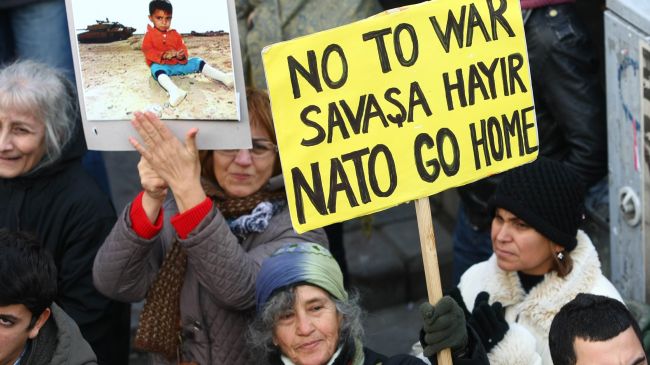
Turkish people protest the arrival of NATO’s Patriot missiles in the country. (File photo)
Press TV – January 21, 2013
Turkish police have arrested dozens of protesters who condemned the arrival of NATO’s Patriot surface-to-air missiles to be deployed near the border with Syria.
Police arrested 25 protesters on Monday after they tried to get through the barricades at Incirlik Air Force Base in the city of Adana, where US troops are assembling two Patriot missile batteries to be later deployed in Gaziantep near Syria’s border.
Protests were also held in Turkey’s capital city of Ankara outside the US embassy, where angry protesters condemned what they called Ankara’s interventionist policies towards Syria.
Earlier, two ships carrying two Patriot batteries each from Germany and the Netherlands anchored at the southwestern port of Iskenderun in Turkey, as part of a NATO-authorized operation to deploy the advanced armament along the border region.
The six batteries of the US-made missiles, effective against aircraft and short-range missiles, will be deployed in the southern city of Adana and the southeastern cities of Kahramanmaras and Gaziantep, along with 350 troops from each contributing country.
In December 2012, NATO approved Turkey’s request for the deployment of the Patriots in its territory. Germany’s Bundestag parliament approved the deployment – limited to one year – on December 14, 2012.
Each Patriot battery has an average of 12 missile launchers. NATO says the missile systems will be operational by early February.
Syria has censured the Turkish plan to deploy the Patriots along its border, calling it another act of provocation by the government of Turkish Prime Minister Recep Tayyip Erdogan.
‘Gate of Dignity’ built on lands of Beit Iksa north of Jerusalem
IMEMC News | January 18, 2013
The Palestinian village of Beit Iksa overlooking Jerusalem just built a new village they called Bab Al-Karama (Gate of Dignity) on their land behind the apartheid wall that Israel has built on their land and call on Palestinians and Internationals to join them in their popular struggle to hold on to their lands.
The wall Israel is building on the village land would leave 96% of the village land inaccessible and behind the segregation wall.
Over the past 24 hours, the villagers built a mosque and set up 5 tents for dwelling on their land behind the wall.
 The head of the Beit Iksa village council Mr. Kamal Hababa stated that idea of building this village extension is to protect their legally owned lands and to be the second such village built to protect from growing efforts at transforming Arab Jerusalem.
Already the threatened village land behind the wall is 7,411 dunums which amounts to half the total threatened lands of the eight Palestinian villages northwest of Jerusalem and 96% of the village land of Beit Iksa. Colonial Jewish only settlements built on Palestinian lands beyond the Green line in this area include Ramot, Neve Shmuel, Har Shmuel, and Givat Ze’ev.
The erection of Bab Al-Karama village comes shortly after Palestinian activists erected a village they called Bab Ashams to counter Israeli settlement construction in the area known as E1, located between Jerusalem and Jericho, which signals a new model in popular struggle against the ongoing expansion of the Israeli settlements in the West Bank.
Open Letter to Mark Duke, CEO of Walmart
Mike Duke, CEO
Walmart Corporation
Bentonville, Arkansas
Dear Mr. Duke,
Walmart, your gigantic company, is increasingly being challenged by your workers, government prosecutors, civil lawsuits, communities (that do not want a Walmart), taxpayers learning about your drain on government services and corporate welfare, and small businesses and groups working with unions such as SEIU and UFCW. Thus far, Walmart is successfully playing rope-a-dope, conceding little while expecting to wear down its opposition.
But you and your Board of Directors know what most shoppers and other people do not know – namely that these pressures are only going to increase. There is one policy announcement by your company that can “roll back” many of these pressures and relieve adverse public relations.
Walmart has about one million workers, give or take, in the U.S. who are making less per hour, adjusted for inflation, than workers made in 1968. This is remarkable for another reason – today’s Walmart worker, due to automation and other efficiencies, does the work of two Walmart workers from 40 years ago. A federal minimum wage, inflation-adjusted from 1968, would be $10.50 today. The present federal minimum wage is $7.25 – the lowest in major Western countries. In Western Europe and Ontario, where you have operations, you must currently adhere to minimum wages of $10.50 or more.
If you were to announce that Walmart is raising the wages of your one million laborers to $10.50, you would have a decisive impact on the momentum that is building this year for Congress to lift 30 million American workers to the level of workers in 1968, inflation adjusted. Imagine 30 million workers trying to pay their bills with wages below those of 1968, inflation adjusted, when, back then, overall worker productivity was half what it is today.
Raising your workers’ wages to a $10.50 minimum would cost your company less than $2 billion (deductible) on U.S. sales of more than $313 billion. Fewer Walmart workers would have to go on varieties of government relief. Some of that $2 billion would go to social security, and Medicare with more going back into purchases at Walmart. Employee turnover would diminish. If Walmart joins with many civic, charitable groups and unions to press Congress for legislation to catch up with 1968 for 30 million American workers, good things will happen. You and your fellow executives will feel better. Your public relations will improve. So will our economy.
Members of Congress, economists, workers and reporters know you can do this. After all, Walmart has to meet numerous safety nets in countries of Western Europe beyond a higher minimum wage, such as weeks of paid vacation and paid sick leave. Also, your top executives in Europe are paid far less than your $11,000 an hour plus benefits and perks.
Walmart watchers know that Walmart officials are worried about damaging disclosures, about Walmart problems such as foreign bribery in Mexico, which may become more numerous. Last year, during the Black Friday demonstrations, some of your workers and their supporters, raised the civil rights issue of Walmart’s retaliation for workers publically complaining about workplace harassment – pay, fair schedules and affordable health care. Such protests are only going to intensify in the future.
At a productive meeting with your government relations people in Washington, D.C. last year, I told them that Walmart was one billionaire away from a serious unionization drive, and I referred them to my political fiction book “Only the Super-Rich Can Save Us!” for a detailed step-by-step strategy that only awaits funding from one or two very rich, people.
You need to do something authentic that people can relate to – seventy percent of the people in polls support an inflation-adjusted minimum wage. So did Rick Santorum and even Mitt Romney, until he waffled during the primaries.
Your announcements this week about hiring 100,000 veterans in the next five years is less than what meets the eye. Twenty-thousand veterans hired each year is a tiny fraction of your workforce and if you are not doing that already, given your huge number of employees (1.4 million) and large annual turnovers, you should be ashamed.
Veterans would have to take a 50 percent or more pay cut from their military salaries – housing and food allowances, health care and other benefits – to work for Walmart. Indeed, the Congressional Budget Office recently estimated that the average active-duty service member receives Army benefits and compensation worth $99,000, which is much more than the prospect of a Walmart job paying less than $20,000 coupled with very limited health insurance.
Should you wish to discuss Walmart taking the lead in raising the minimum wage for its workers to catch up with 1968, please call me. It is better to anticipate than have to react to the looming dark clouds on Walmart’s horizon. Thank you for your considered response.
Sincerely yours,
Veolia Withdraws from California Water Contract Bidding
End the Occupation | January 11, 2013
Davis, California – The Davis Committee of Palestinian Rights (DCPR) is happy to report that Veolia Water North America has withdrawn as a prospective bidder on a $325 million dollar project that would provide treated water from the Sacramento River to residents of Woodland and Davis in Yolo County, California. The announcement came at the December 20, 2012 meeting of the Woodland-Davis Clean Water Agency (Water Agency), a joint powers authority between the University of California – Davis and the cities of Woodland and Davis. Veolia’s withdrawal followed efforts by citizens of Yolo County to prevent Veolia’s bidding due to the company’s involvement in the violation of Palestinian human rights.
Members of DCPR first contested the participation of Veolia Water as a prospective bidder in June 2011. Appearing before meetings of the Water Agency Board of Directors, DCPR provided substantial documentation of Veolia’s history of profiting from Israel’s illegal occupation and apartheid policies in Palestine, as well as the dissatisfaction of public agencies throughout the U.S. for Veolia’s mismanaged operations and poor performance, environmental permit violations and fines, and failure to make good on promised improvements.
On April 19th, 2012, DCPR testified before the Board charging that Veolia did not meet the Water Agency’s ethical criteria. Veolia’s involvement in the Jerusalem Light Rail Transit system, its operation of settler-only buses on segregated roads in the occupied West Bank for inhabitants of illegal Israeli settlements, and its operation of a landfill on land confiscated from Palestinians have been contested by Palestinians and international human rights activists throughout the last decade. Veolia has suffered the loss of more than $20 billion in contracts to date following this global outcry.
Within the U.S., the Friends Fiduciary Corporation, which handles investments for hundreds of U.S. Quaker institutions, recently divested from Veolia following requests by Quakers concerned about the violation of Palestinian rights. In December 2012 the City of St. Louis voted to suspend approval of a contract with Veolia Water until it completed an investigation of Veolia’s controversial labor, environmental, and human rights practices. There are ongoing campaigns protesting Veolia Transportation public contracts in Sonoma County and Los Angeles, CA; Baltimore, MD; Boston, MA; and beyond. The state-wide California Israel Divestment Campaign calls on CalPERS public pension system to divest from Veolia Environnement, Caterpillar and Elbit Systems.
Bids were initially due in December 2012, but following outcry from citizenry regarding the large impact of the project’s capital cost upon resident’s water bills, the City Council decided to postpone the due date and appoint a citizens’ advisory committee to investigate rate alternatives, revisit the water supply need-assessment, and consider other water procurement options. Veolia was the only company to withdraw from bidding.
CONTACT: Mikos Fabersunne, Davis Committee for Palestinian Rights, fabersunne@sbcglobal.net
Veolia Fact Sheet
December 18th, 2012 | Published in Latest News and Action Alerts, STL-PSC Blog
What is Veolia?
According to a story broken by the Riverfront Times, St. Louis city lawyers have been negotiating a contract with Veolia Water North America to guide cost-cutting. Veolia Water is a major subsidiary of Veolia Environnement, a Paris-based multinational corporation and the largest water privatization business in the world. Veolia is infamous for:
- Failure to make good on promised improvements
- Anti-labor practices
- Privatizing public resources
- Irresponsible to disastrous environmental practices
- Mismanagement
- Corruption, bribery, embezzlement, and fraud
- Supporting and profiting from segregation and discrimination in Palestine
Worldwide, consumers report that Veolia consistently charges high rates, provides poor service, causes staff turnover, discourages water conservation, and fails to implement promised improvements. Its history reveals consistent prioritization of private profit at the expense of the environment and public welfare.
Unless otherwise indicated, the following is based on extensive research and documentation on Veolia’s practices by Water for All, Polaris Institute, Global Exchange, Novato Friends of Locally Operated Wastewater, Public Citizen, Public Water Works, and Food & Water Watch (here, here, here, here, here).
What happened in Indianapolis?
In its proposal to the St. Louis Water Division, Veolia extensively references its work in Indianapolis as a successful model that could inform Veolia’s guidance in St. Louis. If Indianapolis is any indication of Veolia’s practices, then our city would do well to steer clear. Veolia claims that the contract was completed and “focused on building a collaborative environment with all of the project stakeholders (union, government and the community).” In fact the company’s 20-year contract with Indianapolis was terminated by the city less than halfway through, by which time the following had ensued:
- Non-union employees claimed that the company cut retirement plans, health care and other benefits, costing the workers more than $50 million over 25 years. Hundreds of employees, many organized under a strong union, found themselves in a pitched battle with the company to preserve benefits and hold Veolia to its promises.
- Veolia was sued for breaking state contract law, and for overcharging 250,000 residents.
- Because the company lacked proper safeguards, a typo by an employee caused a boil-water alert for more than a million people, closing local businesses and canceling school for 40,000 students.
- An independent review uncovered lax oversight of the city’s contract with Veolia.
- Consumer complaints more than doubled in the first 10 months of the contract.
- In a study of 100 large U.S. cities, Environmental Working Group ranked Indianapolis drinking water quality #90 (i.e. 11th-worst overall). St. Louis ranks #9 — among the best in the country.
In 2005, a federal grand jury subpoenaed four Veolia Indianapolis employees as part of an investigation into allegations that the utility falsified water quality reports. The probe began amid accusations by Indianapolis council members that the company had cut back on staffing, water testing, treatment chemicals and maintenance. Though Veolia was never charged, the corporation sustained multimillion-dollar losses and dug its way out of this hole by finagling concessions, including a 2007 contract amendment shifting at least $144 million in costs from Veolia to the city. Ignoring public outcry from consumers and state officials, the city then tried to raise rates by 35% to pay for these additional expenses and more expensive capital improvement projects.
In 2010, with infrastructure needs mounting and Veolia demanding more than the city could afford, Indianapolis canceled the contract more than 10 years early, for which they were forced to pay Veolia an additional $29 million. The nonprofit Citizens Energy Group took over, positioned to save the city more money than multinational Veolia was ever able to.
If Veolia gives Indianapolis as an example of a success story, what could a failure possibly look like?
New Orleans — an Environmental Disaster, and Other Cities
In 2001 in New Orleans, an electrical fire at a sewer treatment plant operated by Veolia caused operators to divert raw sewage into the Mississippi River for two hours. In 2001 and 2002, the plant released sewage into the river a total of 50 times, often violating water quality standards and resulting in more than $107,000 in fines. The city’s Sewerage and Water Board Director and staff made numerous, repeated and documented complaints about Veolia reducing staff to inadequate levels, neglecting preventive maintenance, failing to notify city officials of environmental violations, and other problems. Veolia has a long track record of failing to communicate with New Orleans in connection with the contract. In 2002, the board rejected Veolia’s bid for a new water/wastewater contract following public outrage.
In Richmond, CA in 2006, the city and Veolia were sued for dumping more than 17 million gallons of sewage into tributaries that empty into the San Francisco Bay. The Baykeeper watchdog group said Richmond had one of the highest spill rates in the state. The city had given a 20-year, $70 million contract to Veolia, which promised to cut costs and develop and implement an improvement plan for the sewer and storm water systems. By the time of the lawsuit four years later, the company had not even finished designing the plan, much less begun the renovations. Richmond settled the lawsuit out of court by agreeing to pay for multimillion-dollar improvements to reduce sewer spills. In addition, Richmond taxpayers had to shell out $500,000 annually for years to compensate residents and businesses for property damaged. Even after the lawsuits, the problem continues: Veolia’s Richmond plant had 22 spills dumping more than 2 million gallons of sewage during the first two months of 2008.
Lynn, MA ended a wastewater overflow plant contract with Veolia because the company failed to stay adequately bonded for the project. While company officials lauded the continuing contracts with water and wastewater treatment plants in the community, the town rapped the company for cutting costs by refusing to properly treat wastewater with chemicals. As a result, the town was blanketed in a stench.
Angleton, TX terminated a Veolia contract for non-performance and took the company to court, charging that it breached its contract by failing to maintain adequate staffing levels, not submitting capital project reports and charging improper expenses to the maintenance and repair tab picked up by the city.
In Atlanta, Veolia tried to maximize revenue simply by slashing the work force in half, contributing to boil-water orders, maintenance backlogs and other issue that ultimately led to dissolution of the contract.
In Sauget, IL, right across the river, a related Veolia subsidiary operated a hazardous waste incinerator for over 10 years without a clean air permit. In 2005, “the owners agreed to pay $150,000 for alleged air pollution violations.” As of 2008, the facility had been fined more than $3 million,” mostly related to small explosions and releasing toxic chemicals, including carcinogenic dioxins, into the air.
For more examples, see: Burlingame, CA; Wilmington, DE; Port Arthur, TX; Cranston, RI; and others.
Bribery, Corruption, Embezzlement, Fraud
Corruption, bribery, embezzlement, and fraud appear to part of Veolia’s corporate culture. The president of a Veolia subsidiary was convicted of bribing a New Orleans sewer board member to support renewal of its contract (see background above) in 2002. The same year, the mayor of Bridgeport, CT was convicted on 16 counts including taking kickbacks, bribes and extortion along with 8 other defendants a contract proposal from Veolia (then called Vivendi). A forensic audit in Rockland, MA led to contract termination amid embezzlement charges involving a sewer department official and a local company executive charged with embezzling more than US$300,000. Veolia disclosed accounting fraud in the U.S. from 2007-2010 amounting to $120 million. The scandal took place in their Gulf of Mexico Marine Services unit. These are small examples of a pattern of Veolia replicated around the country and world.
Would this contract privatize the city’s water? No — not yet. But the contract would position Veolia — which specializes in water privatization — as a “brain-trust” of management expertise in reducing costs. Many view Veolia and focusing on privatizing services through long-term monopoly contracts rather than through outright ownership. These types of “advisory” roles can serve as a backdoor avenue toward eventually privatizing municipal operations.
Supporting Apartheid and Segregation in Israel/Palestine
Veolia is involved in Israel’s systematic ethnic discrimination against the Palestinians in many ways:
An Israeli subsidiary, Veolia Water – Israel, operates a wastewater treatment plant located in an illegal Jewish-only settlement called Modiin Ilit, built on Palestinian land in the West Bank. The owners of the land on which this settlement was built have been violently driven out. Two unarmed Palestinians from the Palestinian village on which Modiin Ilit was built, have been killed as they protested nonviolently against the ongoing confiscation of their land and resources. Veolia continues to service the settlement.
An Israeli subsidiary of Veolia Transdev, Connex – Israel, operates buses on segregated roads through the occupied West Bank, including two bus lines that use road 443, which is built partially on confiscated land with portions closed entirely to Palestinians. A separate but unequal Palestinian road system is made up of low grade roads cut by checkpoints and physical barriers restricting Palestinian freedom of movement. Last year, Palestinian Freedom Riders attempted to board buses operating on their own land and were violently removed and arrested. Veolia is profiting from segregation and discrimination.
Another Israeli subsidiary, Veolia Environmental Services – Israel, supervises, consults for, and operates the Tovlan Landfill in the occupied Jordan Valley, collecting refuse from illegal settlements. Israel renders it almost impossible for Palestinians in the Jordan Valley to gain permits to build homes, toilets, wells, animal pens, or other vital infrastructure for local communities, which has forced almost all Palestinian families out, with those remaining living in dire conditions. Some are left with no alternative but to work on settlements that have taken their families’ land, for pay far below the minimum wage, unable to take bathroom breaks, and denied any rights to unionize. Veolia takes captured Palestinian land and natural resources to service the settlements exploiting or driving out Palestinians.
UN Special Rapporteur Richard Falk recently recommended that Veolia “should be boycotted, until they bring their operations into line with international human rights and humanitarian law and standards.” Veolia’s extensive profiting from Israel’s illegal practices have provoked global outcry, costing Veolia more than $12.5 billion in lost contracts to date. Recently, the Friends Fiduciary Corporation, which handles investments for hundreds of U.S. Quaker institutions, also divested from Veolia.
Veolia already in Financial Trouble
With public opinion shifting negatively around the world, Veolia is paying a price. After a 25-year contract, Veolia’s home city of Paris declined to renew its contract in 2009. Cities around the world have done the same. Veolia’s profit margin has plummeted since 2008 and the company lost more than half its market value in 2011. Veolia’s CEO pledged to sell $1.8 billion of assets and to stop operations in at least 37 countries. In September 2012, Veolia’s debt stood at more than $19.7 billion.
Now, Veolia is trying to bring its risky and immoral business to our backyard.
Related articles
- St. Louis Palestine Solidarity Committee Statement on Pending City Contract with Veolia Water (alethonews.wordpress.com)
- Veolia to end sponsorship of major UK photography exhibition (bdsmovement.net)
Israeli Soldiers Attack, Evict, Bab Al-Shams, Arrest Dozens
By Saed Bannoura | IMEMC News | January 13, 2013
On Saturday at dawn thousands of Israeli soldiers and policemen attacked the Bab Al-Shams Palestinian village, installed east of in occupied East Jerusalem, and forcibly removed dozens of activists loading them into buses.
The soldiers dragged several activists onto the ground, attacked reporters and journalists and declared the area a closed military zone, several injuries were reported.
The Israeli decision to evacuate the village came, on Saturday, through a direct order issued by Israeli Prime Minister, Benjamin Netanyahu, and his right-wing fundamentalist cabinet.
Israeli daily, Haaretz, reported that by midnight Saturday, the order was signed by Osnat Mandel, head of the Israeli High Court division of the Justice Ministry, under the claim that “the people and the tents must be removed due to security considerations”.
The Israeli Police said that the eviction order, issued by the court, prohibits the army from removing the tents, but orders the removal of the people staying there.
Also, the so-called Israeli Civil Administration Office, run by the occupation in the West bank, claimed that the Palestinian tent village “was installed on state land”.
But four Bedouin families living in the area confirmed that they own the land, and even showed deeds proving ownership.
Dr. Mustafa Barghouthi, secretary-general of the Palestinian National Initiative, who was also at the Palestinian village, stated that hundreds of Israeli soldiers invaded the village after surrounding it, and attacked the nonviolent activists camped there, and started kidnapping them.
The soldiers violently attacked the residents, including journalists, elderly and women, and dragged several residents onto the ground.
The soldiers repeatedly interrupted the work of local reporters, flashing their lights onto the camera, and pushing the reporters away, and dragged dozens of activists into buses that were brought by the army to the area.
On Saturday evening, Israeli Prime Minister, Benjamin Netanyahu, ordered the army “to remove the Palestinians and their supporters from the Palestinian outpost” that was installed on privately-owned Palestinian lands to send a message to Israel and the entire world that this land is the land of Palestine, and the Palestinian people have the right to inhabit it.
The army installed dozens of roadblocks around the area to prevent Palestinian traffic and surrounded the Bab Al-Shams camp where around 200 activists installed around 20 tents declaring the Bab Al-Shams Palestinian village, in the area where Israel illegally declared it intends to build thousands of homes for Jewish settlers, east of occupied east Jerusalem.
The Israeli decision to build the illegal settlements in the occupied state of Palestine came after the Palestinians managed to obtain an observer state status at the UN – General Assembly.
The Israeli decision was met with international condemnation, but the settler-led government of Benjamin Netanyahu, approved the illegal settlement project.
The so-called E1 settlement project aims at linking the Maale Adumim illegal settlement, where 35,000 reside, with occupied East Jerusalem, thus illegally confiscating Palestinian lands and blocking geographical continuity in the occupied West Bank.
This illegal Israeli project would divide the West Bank into two parts, and would completely isolate it from occupied East Jerusalem, an issue that would prevent the establishment of a viable Palestinian state.
Abdullah Abu Rahma, a Palestinian nonviolent activist from the West Bank village on Bil’in, who was also detained when the army attacked and evicted Bab Al-Shams, stated that this village is on private Palestinian land, and that the Palestinians are not invading anybody’s property, as they are establishing a village in the land of Palestine.
“We tied our hands, chained ourselves with each other to prevent the soldiers from removing us”, Abu Rahma said, “The Soldiers violently attacked us, beat us, and injured at least 10”
He added that there will be more nonviolent activities, and that the struggle for Bab Al-Shams, the nonviolent struggle for the liberation of Palestine will continue as the Palestinians are practicing their internationally-guaranteed right.
It is worth mentioning that the Palestine TV was live streaming from Bab Al-Shams, and the army repeatedly tried to interrupt the stream, pushing the reporters, and using large flashlight, pointing them against the camera to disrupt the images.

Wounded Journalist Hafeth Ibrahim
Related articles
- Palestinians Establish a new Village, Bab Alshams, in Area E1 (alethonews.wordpress.com)
Sicily blocks construction of US defense satellite base
Gazzetta del Sud | January 11, 2013
Palermo The region of Sicily on Friday moved to suspend US defense plans to construct a satellite communications system on the Italian island after activists blocked construction crews. The move, announced by Sicily Governor Rosario Crocetta, came after protestors blocked trucks and cranes overnight in the town of Niscemi and later clashed with police near an American military base.
Builders at the site, which is part of a global satellite defense network called the Mobile User Objective System (MUOS), had allegedly rushed construction in recent days, according to the Sicily governor. “The regional government finds this sudden rush to complete the project truly extraordinary,” said Crocetta. Opponents to the project say it will be an environmental nuisance and threatens world peace. Other bases participating in MUOS are in Australia, Hawaii and Virginia.
Israel Prepares To Evict “Bab Al-Shams” Palestinian Village
By Saed Bannoura | IMEMC News | January 12, 2013
 Dozens of Israeli soldiers and policemen are surrounding the new Palestinian village, Bab Al-Shams, preparing to evict and remove the newly installed Palestinian outpost, set-up on Palestinian lands east of occupied East Jerusalem.
The army declared the area as a “closed military zone”, and prevented dozens of activists and residents from reaching it, before handing the Palestinians at the outpost a military order demanding them to remove their outpost and leave the area.
Abdullah Abu Rahma, an activist of the Popular Committee Against the Wall and Settlements in Bil’in village near the central West bank city of Ramallah, stated that the soldiers said that they will use force should the activists refuse to leave the area.
Abu Rahma added that dozens of Israeli soldiers and policemen were deployed in the area, and appear to be preparing to remove it.
“We have nothing but our will and determination, it will not be easy to remove us, we will use our expertise and abilities to remain steadfast”, Abu Rahma said, “It will take at least 800 soldiers to remove the 200 activists currently camping here”.
The activist spent a cold night in the new village, but remained there despite the lack of sheets and warm covers, while several activists burnt some wood to provide as much heat as possible.
One of the activists told the Maan News Agency that despite the cold, “the general atmosphere is pleasant due to the presence of committed activists and friends”.
“We are here enjoying the magnificent view of hills and mountains, close to Jerusalem”, the activist said, “It’s cold, the tents can’t prevent the cold, but we are here to stay”.
Related article
Featured Video

Trita Parsi: Middle East Unraveling — Are We on the Path to World War?
or go to
Aletho News Archives – Video-Images
From the Archives
Why Saudi Ties to 9/11 Mean U.S. Ties to 9/11
By Kevin Ryan | Dig Within | September 27, 2015
Media interest in Saudi Arabian connections to the crimes of 9/11 has centered on calls for the release of the 28 missing pages from the Joint Congressional Inquiry’s report. However, those calls focus on the question of hijacker financing and omit the most interesting links between the 9/11 attacks and Saudi Arabia—links that implicate powerful people in the United States. Here are twenty examples. … continue
Blog Roll
 Aletho News
- Integrity Initiative: UK-funded network framed dissent as Russian disinformation for years
- ‘We don’t seek permission to defend our country’: Snippets from President Pezeshkian’s UNGA address
- NATO chief wants Europeans to fight American wars [for Israel]
- German chemicals giant reveals details of downsizing
- Refaat Al-Areer Was The Canary In The Coal Mine In Israel’s War On The Truth
- Israeli election committee bars candidate from Knesset race over Gaza war opposition
- French-Lebanese man files war crimes complaint over Israeli attacks
- Mahan Air Flight Lands in China Despite US Threat against Iranian Airlines
- US eyes $10bn fund to rebuild war-battered Gulf infrastructure
- Trump meets Rodríguez near Maduro’s prison as Venezuela’s oil flows to US
- If Americans Knew
- Caught on Tape: AIPAC CEO Boasted of Controlling Trump’s National Security Officials
- Why Hamas Attacked Israel in October 2023 – Israeli professor Ilan Pappé
- They see them, then kill them: Israeli quadcopters track, deliberately target civilians in Gaza
- Winter could turn Gaza’s treacherous, war-damaged buildings into deathtraps
- Majority of Democratic Voters Want to Prosecute Both Biden and Trump Administration Officials Over Gaza
- As Gaza languishes, world leaders gather at the UN – Daily Update
- Sanctions are collective punishment: immoral and self-defeating
- Phosphorus Munitions Fired by Israel Burn Groves, Orchards in Southern Lebanon
- Israel Carries Out New Ceasefire Violations Across Gaza
- AI – Emphasis on the ‘I’: Israel Is Funding AI Chatbot Propaganda
- No Tricks Zone
- New Study: Earth And Venus Surface Warmth Largely Explained By Convection And Lapse Rate, Not CO2 Or Radiation
- 2025 Nature Paper Claiming Worsening Global Drought Gets RETRACTED …Heavily Flawed
- New Study: ‘Global Drought Shows No Detectable Recent Acceleration Under Climate Warming’
- Economic Masterminds: German Socialists Suggest Taxing Productivity Gains Stemming From Using AI
- The South China Sea Has Not Been Cooperating With The Climate Change Narrative
- Energy Crisis: Germany Enters Heating Season With Historically Low Gas Reserve Fill Levels
- New Study: The Antarctic Ice Sheet Gained Mass From 2020-2024 Due To Staggering Snow And Ice Accumulation
- Study: Ocean Heating Rates From Thousands Of Years Ago ‘Dwarf’ Modern Ocean Heating Rates
- Climate Extremists Target, Attack Large-Scale Power Grid Infrastructure In Germany!
- New Study: Antarctic Ice Melt Has Contributed Less Than 1 Centimeter To Sea Level Rise In The Last 30 Years

