Palestinian anger at university construction on Islamic cemetery
MEMO | August 29, 2012
A Palestinian educational institution in Israel has called for a demonstration on Thursday in front of Sheikh Mo’nes Cemetery in Tel-Aviv to protest at what it says is “the violation” of those buried there. Israeli construction company Solel Bonei has started to bulldoze the cemetery to prepare the ground to build student halls of residence for Tel-Aviv University.
Iqraa Educational Institution has criticised the university’s project an act that violates human rights and academic principles. “How can students, Muslims or Jews, trust the university’s academic credentials when it is prepared to violate the sanctity of the dead?” it said in a press statement.
Researcher Ahmed Tobasi from Al-Tadamun Human Rights Organisation discovered the plans about a month ago. This led to a demonstration at the beginning of August organised by Al-Aqsa Foundation for Islamic Endowments and Heritage. The head of the Islamic Movement in Israel, Sheikh Raed Salah, joined many Palestinian activists in the protest. “The cemetery is being reduced in size from 20 acres to just 1.5 acres,” he said.
According to Sheikh Raed, Tel-Aviv University itself was originally built on the land of the Islamic cemetery after razing hundreds of graves and throwing out the bones of the dead. “Today, the university shows its determination to violate human rights by deciding to extend its premises at the expense of the remaining cemetery land.” It is absolutely shameful to teach students about human rights while you violate them, the Sheikh added.
The head of student activities at Iqraa, Mohammed Farhan, also criticised the university: “Its construction work in the cemetery violates its academic message and has aroused the anger of many international academic institutions.” The university, he pointed out, criticised the academic boycott by international universities but today had proved that it is far removed from academic and human values and is thus deserving of boycott action.
Farhan said that students will continue to protest against the university’s desecration of the Muslim cemetery. “Tel Aviv University has to respect the rights and feelings of the Arab students study therein.”
A lawyer acting on behalf of Al-Aqsa Foundation, Mohammed Ighbareyah, submitted a petition last week to the Israeli High Court demanding a court order to stop the construction. He described the work as a “dangerous escalation against Islamic sites which constitutes a severe violation of human rights by a university which considers itself remarkable among world academic institutions”. Legal efforts will continue, he said, until the construction of the students’ halls on the land of the Islamic cemetery is stopped.
Related articles
- Israel court approves TAU’s destruction of Palestinian cemetery (bikyamasr.com)
- Palestinian cemetery destroyed for new TAU dorms, shopping center (alethonews.wordpress.com)
- Israeli Eradication of History: Disappearing Mosques (alethonews.wordpress.com)
- Hamas and Aqsa foundation slam Israeli violations against Munis graveyard (occupiedpalestine.wordpress.com)
Quebec police arrest 19 protesting students as classes resume
Press TV – August 28, 2012
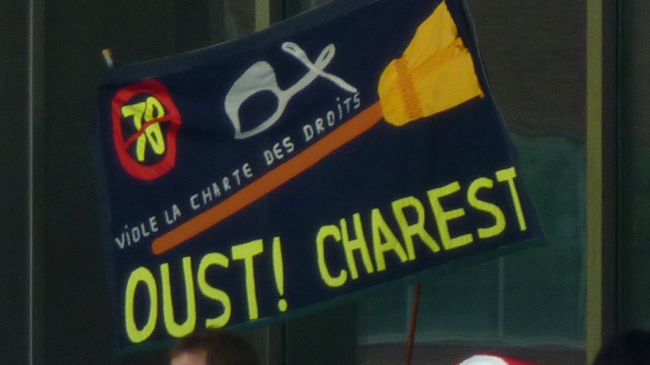 Canadian police have stormed the University of Quebec making 19 arrests, as angry students prevent the beginning of the new semester.
Police arrested 19 students Monday under the terms of Bill 78, which ordered a suspension of university classes back in May and their reinstatement in August even if the students planed to continue their strike. The bill also restricts the student demonstrations and imposes fines for those who impeded classes, starting at CAD 1,000.
The classes were supposed to resume this week, as the winter semester was suspended following massive months-long protests across Canada’s French-speaking province against proposed tuition fee hikes.
Some 2,000 students at the departments of anthropology and cinema voted to continue their protest and prevented the start of classes.
The recent protest comes ahead of next week’s provincial election, which will decide whether the province’s ruling Liberal Party, which insists on a plan to increase tuition fees by 82 percent, could be reelected.
The latest opinion poll shows that the separatist Parti Quebecois (PQ) led by Pauline Marois heading for a victory in the election to be held on September 4th. Marois is the protester’s favorite candidate and has been wearing the red square, the symbol of the demonstrators’ cause, on several public occasions.
If the separatist PQ is elected in the upcoming provincial election, it will consider holding a referendum on separation of Quebec from Canada.
Since February, students have been protesting against the hikes and the provincial government’s controversial anti-protest Bill 78. The protests later turned into a larger movement dubbed the “maple revolution,” which reveals deeper social unrest.
NAM Agrees on 688 Articles of Draft Statement: Sanctions, Palestine on Top
Al-Manar | August 28, 2012
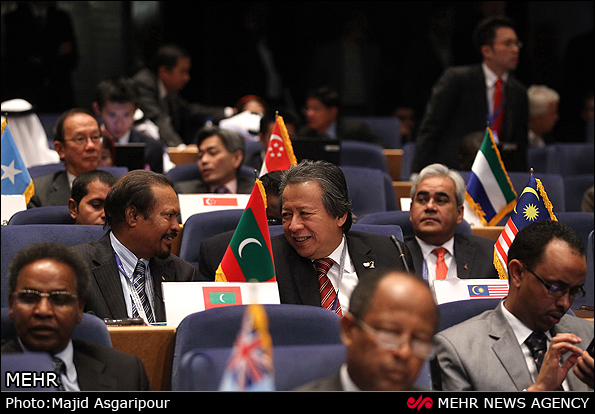 As preliminary meetings of the 16th Summit of the Non-Aligned Movement (NAM) continue in Tehran, participants reached an early agreement on 688 articles of the Summit’s draft closing statement.
Condemnation of “unilateral” actions — particularly sanctions on Iran and other nations — and a demand for a greater say in UN decision-making dominated NAM talks on Tuesday preparing for a Non-Aligned summit later this week.
Foreign ministers from NAM states were holding two days of discussions to prepare the ground for the summit, which will gather dozens of heads of state and government on Thursday and Friday.
According to the Agence France Presse, other issues to be covered included a call for the creation of a Palestinian state based on 1967 borders, and an appeal for nuclear disarmament, particularly in the Middle East, as a path to world peace, according to draft documents before the ministers.
Combating terrorism, and upholding human rights and development were also included.
A working document made available on Iran’s official NAM website said one of the general principles being upheld was strengthening solidarity with NAM members “living under colonial or alien domination or foreign occupation, and with those experiencing external threats of use of force, acts of aggression or unilateral coercive measures.”
Elsewhere, it called on members to refuse to follow “unilateral economic sanctions” on NAM states.
More than 50 foreign ministers were involved in the discussions, according to Iranian foreign ministry spokesman Ramin Mehmanparast. They were building on work done in the two preceding days by lower-ranking officials and experts.
Tehran’s summit is seen as a blow to US-led efforts to isolate it internationally.
The NAM is a 120-member organization founded in 1961, at the height of the Cold War, by nations considering themselves independent of the US-led Western bloc or the then-Soviet Union. It represents nearly two-thirds of the UN’s 193 member states, accounting for much of the developing world.
Overall, the NAM seeks greater accountability from the UN Security Council and a greater weight for the UN General Assembly — where it is strongly represented — in making global decisions.
UN chief Ban Ki-moon will be attending the Tehran summit, in a customary observer role, despite criticism from the United States and the Zionist entity.
Related articles
- Iran FM Salehi: NAM Should Oppose Sanctions, Foreign Intervention Unacceptable (alethonews.wordpress.com)
- Egyptian president to attend NAM summit in Tehran (alethonews.wordpress.com)
- Ban Ki-moon to attend NAM summit in Tehran: UN spokesman (alethonews.wordpress.com)
- Iran Opens Nonaligned Summit with Call for Nuclear Arms Ban (2012indyinfo.com)
Egyptian Minister Asks for Direct Flights between Tehran, Cairo
Fars News Agency | August 27, 2012
TEHRAN – Egypt’s Civil Aviation Minister Samir Embaby called for the start of direct flights between Tehran and Cairo due to the two nations’ enthusiasm for making reciprocal visits.
“The measure is necessary due to the eagerness of many Egyptian and Iranian people to make reciprocal visits,” Embaby was quoted by the Egyptian weekly, al-Youm al-Sabe’.
He also underlined that starting direct flights between the two countries would play a vital role for trade and economic ties between Iran and Egypt, and said the economic studies carried out in Iran indicate that 60% of Iranians like to visit different Egyptian cities, partly for religious tourism.
In relevant remarks in June, new Egyptian President Mohammad Mursi also underlined his enthusiasm for the further expansion of ties with Iran, and said relations between Tehran and Cairo will create a strategic balance in the region.
“The issue will create a strategic balance in the region,” Mursi told FNA in June, hours before the final results of the presidential election was announced.
Also in July, Iranian President Mahmoud Ahmadinejad and Mursi, in their first telephone conversation, conferred on the two Muslim countries’ ties and the Non-Aligned Movement (NAM) now underway in Tehran.
President Ahmadinejad said Tehran welcomes close interactions with the Egyptian government and nation, and attaches no limitations to the expansion of ties and cooperation with Cairo.
Ahmadinejad expressed Iran’s preparedness to transfer capabilities, achievements and experiences in various scientific, technological, industrial and economic fields to the Egyptian people.
Mursi is due to travel to Iran on August 30 to attend the NAM summit.
Related articles
- Egyptian president heads to China for investment talks (alethonews.wordpress.com)
- Egyptian president to attend NAM summit in Tehran (alethonews.wordpress.com)
- Ahmadinejad personally invites Morsi to attend Non-Aligned Movement summit in Tehran (alethonews.wordpress.com)
Echoes of the Past: Marikana, Cheap Labour and the 1946 Miners Strike
By Chris Webb | The Bullet | August 21, 2012
On August 4, 1946 over one thousand miners assembled in Market Square in Johannesburg, South Africa. No hall in the town was big enough to hold them, and no one would have rented one to them anyway. The miners were members of the African Mine Worker’s Union (AMWU), a non-European union which was formed five years earlier in order to address the 12 to 1 pay differential between white and black mineworkers. The gathering carried forward just one unanimous resolution: African miners would demand a minimum wage of ten shillings (about 1 Rand) per day. If the Transvaal Chamber of Mines did not meet this demand, all African mine workers would embark on a general strike immediately. Workers mounted the platform one after the other to testify: “When I think of how we left our homes in the reserves, our children naked and starving, we have nothing more to say. Every man must agree to strike on 12 August. It is better to die than go back with empty hands.” The progressive Guardian newspaper reported an old miner getting to his feet and addressing his comrades: “We on the mines are dead men already!”[1]

Mike Constable union-art.com

The massacre of 45 people, including 34 miners, at Marikana in the North West province is an inevitable outcome of a system of production and exploitation that has historically treated human life as cheap and disposable. If there is a central core – a stem in relation to which so many other events are branches – that runs through South African history, it is the demand for cheap labour for South Africa’s mines. “There is no industry of the size and prosperity of this that has managed its cheap labour policy so successfully,” wrote Ruth First in reference to the Chamber of Mines ability to pressure the government for policies that displaced Africans from their land and put them under the boot of mining bosses.[2]
Masters and Servants
Mechanisms such as poll and hut taxes, pass laws, Masters and Servants Acts and grinding rural poverty were all integral in ensuring a cheap and uninterrupted supply of labour for the mines. Pass laws were created in order to forge a society in which farm work or mining were the only viable employment options for the black population. And yet the low wages and dangerous work conditions kept many within the country away, forcing the Chamber of Mines to recruit labour from as far afield as Malawi and China throughout the nineteenth and twentieth centuries. Sordid deals between Portuguese East Africa and Apartheid South Africa ensured forced labour to be recruited for the mines and by 1929 there were 115,000 Mozambicans working underground. “It has been said,” wrote First in her study of migrant Mozambican miners, “that the wealth of Reef gold mines lies not in the richness of the strike but in the low costs of production kept down by cheap labour.”[3]
When AMWU was formed in 1941 black miners earned 70 Rand a year while white workers received 848 Rand. White miners had been organized for many years, but there was little solidarity between the two groups as evidenced by the 1922 Rand Rebellion led by the whites-only Mine Workers Union. White miners went on strike against management’s attempt at weakening the colour bar in order to facilitate the entry of cheaper black labour into skilled positions. Supported by the Communist Party of South Africa under the banner of “Unite and Fight for a White South Africa!” the rebellion was viciously crushed by the state leaving over 200 dead. The growth of non-European unions in the 1940s was dramatic and for the very first time the interests of African mineworkers were on the table. Their demands threatened the very foundations of the cheap labour system, and so in 1944 Prime Minister Jan Smuts tabled the War Measure 1425 preventing a gathering of 20 or more on mine property. Despite these difficulties the union pressed on and in 1946 they approached the Chamber of Mines with their demand for wage increases. A letter calling for last minute negotiations with the Chamber of Mines was, as usual, ignored.
By August 12th tens-of-thousands of black miners were on strike from the East to the West Rand. The state showed the utmost brutality, chasing workers down mineshafts with live ammunition and cracking down on potential sympathy strikes in the city of Johannesburg. By August 16th the state had bludgeoned 100,000 miners back to work and nine lay dead. Throughout the four-day strike hundreds of trade union leaders were arrested, with the central committee of the Communist Party and local ANC leaders arrested and tried for treason and sedition. The violence came on the cusp of the 1948 elections, which would see further repression and the beginning of the country’s anti-communist hysteria.

National Union of Mineworkers Poster on Fortieth Anniversary of 1946 Strike
While it did not succeed in its immediate aims, the strike was a watershed moment in South African politics and would forever change the consciousness of the labour movement. Thirty years later Monty Naicker, one of the leading figures in the South African Indian Congress, argued that the strike “transformed African politics overnight. It spelt the end of the compromising, concession-begging tendencies that dominated African politics. The timid opportunism and begging for favours disappeared.”[4] The Native Representative Council, formed by the state in 1937 to address the age old ‘native question,’ disbanded on August 15th and ANC president Dr. A.B. Xuma reiterated the demand for “recognition of African trade unions and adequate wages for African workers including mineworkers.”[5]
The 1946 mineworkers strike was the spark that ignited the anti-apartheid movement. The ANC Youth League’s 1949 Program of Action owes much to the militancy of these workers as does the Defiance Campaign of the 1950s and the emergence of the ANC’s armed wing Umkhonto we Sizwe (Spear of the Nation) in the 1960s. It is too early to say what sort of impact the current Lonmin strike will have on South African politics, but it seems unlikely that it will be as transformative as those of the past. The National Union of Mineworkers (NUM), arguably the heirs to the 1946 strike are currently engaged in a series of territorial disputes with the breakaway Association of Mineworkers and Construction Union (AMCU). Meanwhile COSATU’s muted response has echoed the ANC’s line of equal-culpability and half-mast public mourning. The increasingly incoherent South African Communist Party has called for the arrest of AMCU leaders with some of its so-called cadres defending the police action. Former ANC Youth League leader Julius Malema’s plea for miners to hold the line and form a more militant union reek of political opportunism.
Still Dependent on Cheap and Flexible Labour
What no one has dared to say, aside from the miners themselves, is that the mining industry remains dependent on cheap and flexible labour, much of it continuing to come from neighbouring countries. This has historically been the source of most miner’s grievances. A recent Bench Marks Foundation study of platinum mines in the North West province uncovered a number of factors linked to rising worker discontent in the region. Lonmin was singled out as a mine with high levels of fatalities, very poor living conditions for workers and unfulfilled community demands for employment. Perhaps most significant is the fact that almost a third of Lonmin’s workforce is employed through third party contractors.[6] This form of employment is not new in the mining industry. In fact, since minerals were discovered in the 19th century labour recruiters have scoured the southern half of the continent for workers. The continued presence of these ‘labour brokers’ on the mines and the ANC’s unwillingness to ban them – opting instead for a system of increasing regulation – is the bloody truth of South Africa’s so-called ‘regulated flexibility.’
There are a number other findings from the Bench Marks study that are worth mentioning as they illuminate some of the real grievances that have been lost amid photos of waving pangas. The number of fatalities at Lonmin has doubled since January 2011, and the company has consistently ignored community calls for employment, favouring contractors and migrant workers. A visit by the Bench Marks Foundation research team to Marikana revealed:
“A proliferation of shacks and informal settlements, the rapid deterioration of formal infra-structure and housing in Marikana itself, and the fact that a section of the township constructed by Lonmin did not have electricity for more than a month during the time of our last visit. At the RDP Township we found broken down drainage systems spilling directly into the river at three different points.”[7]
In fact, the study predicted further violent protests at Marikana in the coming year. The mass dismissal of 9,000 workers in May last year inflamed already tense relations between the community and the mine as dismissed workers lost their homes in the company’s housing scheme.
Once again, these facts are hardly new in the world of South African mining. Behind the squalid settlements that surround the mine shafts there are immense profits to be made. In recent years the platinum mining industry has prospered like no other thanks to the increased popularity of platinum jewellery and the use of the metal in vehicle exhaust systems in the United State and European countries. Production increased by 60 per cent between 1980 and 1994, while the price soared almost fivefold. The value of sales, almost all exported, thus increased to almost 12 per cent of total sales by the mining industry. The price rose so dramatically throughout the 1990s that it is on par with gold as the country’s leading mineral export.[8] South Africa’s platinum industry is the largest in the world and in 2011 reported total revenues of $13.3-billion, which is expected to increase by 15.8% over the next five years. Lonmin itself is one of the largest producers of platinum in the world, and the bulk of its tonnage comes from the Marikana mine. The company recorded revenues of $1.9-billion in 2011, an increase of 25.7%, the majority of which would come from the Marikana shafts.[9]
For risking mutilation and death underground workers at Marikana made only 4000 Rand, or $480 a month. As one miner told South Africa’s Mail and Guardian newspaper that, “It’s better to die than to work for that shit … I am not going to stop striking. We are going to protest until we get what we want. They have said nothing to us. Police can try and kill us but we won’t move.” These expressions of frustration and anger could be from 1922, 1946 or today. They are scathing indictments of an industry that continues to treat its workers as disposable and a state that upholds apartheid’s cheap labour policies.
Endnotes:
1. Monty Naicker, “The African Miners Strike of 1946,” 1976.
2. Ruth First, “The Gold of Migrant Labour,” Spearhead, 1962.
3. Ruth First, “The Gold of Migrant Labour,” Spearhead, 1962.
4. Monty Naicker, “The African Miners Strike of 1946,” 1976.
5. Dr. A.B. Xuma quoted in Monty Naicker, “The African Miners Strike of 1946.”
6. The Bench Marks Foundation, “Communities in the Platinum Minefields,” 2012.
7. The Bench Marks Foundation, “Communities in the Platinum Minefields,” 2012.
8. Charles Feinstein, “An Economic History of South Africa,” Cambridge: Cambridge University Press, 2005, 211.
9. Marketline Advantage Reports on South Africa’s Platinum Group Metals, 2011.
•
Chris Webb is a postgraduate student at York University, Toronto where he is researching labour restructuring in South African agriculture. He can be reached at christopherswebb_AT_yahoo.ca.
Related articles
- Striking South African miners defy Lonmin ultimatum (guardian.co.uk)
- South Africa tells Lonmin to drop threat to sack striking miners (guardian.co.uk)
Egyptian president to attend NAM summit in Tehran
Press TV – August 18, 2012
Egypt’s official news agency, MENA, said on Saturday that President Mohamed Morsi plans to attend the upcoming Non Aligned Movement (NAM) summit in Tehran.
Morsi’s trip to Tehran will be the first such visit since Iran and Egypt severed ties more than 30 years ago after Cairo signed the 1978 Camp David Accord with the Israeli regime and offered asylum to the deposed Iranian dictator, Mohammad Reza Pahlavi.
The 16th summit of the NAM member states will be held in the Iranian capital on August 26-31.
The Leader of the Islamic Revolution Ayatollah Seyyed Ali Khamenei will address the Tehran NAM summit.
United Nations Secretary General Ban Ki-moon is also expected to partake in the event during which the Islamic Republic will assume the rotating presidency of the movement for three years.
NAM, an international organization with 120 member states and 21 observer countries, is considered as not formally aligned with or against any major power bloc.
NAM’s purpose, as stated in the Havana Declaration of 1979, is to ensure “the national independence, sovereignty, territorial integrity and security of non-aligned countries.”
Related articles
- Iran plans to establish international NAM news agency (alethonews.wordpress.com)
- Ahmadinejad personally invites Morsi to attend Non-Aligned Movement summit in Tehran (alethonews.wordpress.com)
- Official: Almost 8,000 Diplomats to Attend NAM Summit in Tehran (english.farsnews.com)
- U.N. Chief’s Presence at Tehran Summit Sends Wrong Message, Says State Dep’t (cnsnews.com)
Khan Al Luban: Settlers invade again
18 August | International Solidarity Movement, West Bank
On Saturday August 11th 2012 the same events as three days earlier took place at Khan Al Luban. A group of four illegal settlers, from Mal´al Levona, armed with guns and wooden sticks came into Khan al Luban at 22:30 p.m. The settlers yet again broke into the house owned by Khalid al-Hamed Daraghani where international activists and the two sons of Khalid were staying.
When the settlers arrived Khalid’s sons and the international activists asked them to leave the property, but they refused and instead sat down near the spring on Daraghani’s land. After about half an hour two Israeli police cars arrived along with two military jeeps after having received a call from the settlers. A few minutes later two more military jeeps arrived at the scene. By then the Daraghani land was full of Israeli police, soldiers and security guards from the illegal settlement. The soldiers entered the house searching for weapons, but as usual they didn’t find anything.
Around midnight the soldiers, police, security personnel and settlers left the area, while Jamal, the oldest son of Khalid, and the international activists remained in the house. Throughout the night settlers stayed on patrol in the street near the Daraghani house, shouting and honking their car horns.
At 7:30 am the following morning, a border police car stopped near the Daraghani house on the road leading up to the illegal settlement of Mal´al Levona. The border policemen then proceeded to break into the house, aggressively asking for passports and other documents. Like the night before the house was searched and no bag, cigarette package or piece of clothing went unturned.
After a short dispute over a cigarette, Jamal was brutally pushed into one of the rooms by the police officers where he received several blows to the face before he was handcuffed and taken away. Jamal was taken to the police station of Binyamin, wrongly accused of having hit a soldier. He was released on bail the day after.
The continued pressure of the Israeli occupation forces and illegal settlers remain a constant threat during both days and nights in Khan al Luban.
Related articles
- Jewish Settlers Empty Palestinian Well, Flood Farmlands (alethonews.wordpress.com)
- Renegade Jewish Settlers (alethonews.wordpress.com)
- Ultimate goal of Israeli policies in Hebron: ethnic cleansing (alethonews.wordpress.com)
- Hebron: settler illegally enters Palestinian home (occupiedpalestine.wordpress.com)
- Report details Israeli violations and seizure of West Bank land (occupiedpalestine.wordpress.com)
Featured Video

Genocide-linked firm handles Britons’ NHS data
or go to
Aletho News Archives – Video-Images
Book Review
Book review: Boiling Point, How America Brought War to Ukraine
By Tim Kirby | Strategic Culture Foundation | November 14, 2026
Did Vladimir Putin just wake up one day on the wrong side of the bed and decide to invade Ukraine in February of 2022 or is there a lot more to this single decision that has been reshaping the 21st century geopolitical landscape?
Obviously, from the way that I just posed the question you can see that I am on the side that views the causes for the war in Ukraine to be very deep, long-term, historical and consciously nefarious, and most importantly, not from within the halls of the Kremlin. So it was a pleasure to take a look at the book “Boiling Point, How America Brought War to Ukraine” by author Stephen Kinzer, who like myself, also believes that the real reasons behind military conflicts around the world are not what CNN and the BBC have been telling you. The main thesis of this book was stated clearly by its creator; the war “may have been illegal, but it was definitely not unprovoked.” … continue
Blog Roll
 Aletho News
- The 10 Disease Renamings That Rescued the Vaccine
- NATO cancels 2027 leaders’ summit
- IAEA’s politicized use of safeguards undermines its impartiality: Russian envoy
- UK must be ready to strike Russian Arctic – ex-PM
- Fico’s Two Red Lines: Russian Energy and the Next Ukraine Loan
- Thousands rally for banned NATO-skeptic presidential candidate
- Ukraine Settlement and New European Security Architecture Must Go Hand in Hand – Kremlin
- Book review: Boiling Point, How America Brought War to Ukraine
- Israel Revives The ‘Iranian Assassination Threat Against Trump’ Deception In A Desperate Bid To Restart The War
- US rewrites history to dodge blame for illegal war on Iran: Foreign Ministry spokesperson
- If Americans Knew
- An error has occurred; the feed is probably down. Try again later.
- No Tricks Zone
- New Study: Barents Sea Temperatures Were Warmer And Sea Ice Less Extensive In The 1700s Than Today
- German Authorities Start Initiative To Evaluate Public Register For Climate “Disinformation” Spreaders!
- Zonal Asymmetry of Temperature Change in the Antarctic Circumpolar Current
- New Study: The Net Fossil Fuel Contribution To Rising Atmospheric CO2 Has Been Zero For 500 Years
- Germany’s Green Energy Transition Becoming Increasingly Expensive…Another 6 Trillion Euros!
- Sudden Stratospheric Warming, Powerful El Niño Combination May Lead To Extreme Europe Cold, Energy Crisis!
- Two New Studies Find Thwaites Glacier Melt Cannot Be Driven By Human Activity Or A Warming Ocean
- E-Cars Reduce CO2 Emissions By Only 41% Compared To Internal Combustion Engine Vehicles
- Predictions Made By Renowned Climate Professor Over Past Decades Have Been Proven To Be Poor
- New Study Suggests Large Regions Of The Pacific Ocean Have Been Cooling For The Last 80 Years

