One Killed, 37 Injured, by Israeli troops Gunfire in Gaza Land Day Protests
By Ghassan Bannoura | IMEMC News | March 30, 2012

(Reuters/Ammar Awad and Ronen Zvulun)
A Palestinian 20 year old youth was killed, 37 injured, among them a journalist when Israeli troops opened fire at Palestinian protesters marking land day in the Gaza Strip.
Palestinian sources reported that soldiers opened fire at protesters who marched up to the borders with Israel near Gaza city killing Mohamed Zakout, 20, and injuring 37 others. Among those injured were 3 in critical conditions and a local journalist.
In the West Bank Israeli troops injured 100 civilians including an American activist who marked land day in different parts of the West Bank today.
Marking the 36th anniversary of land day today Palestinians and their supporters marched for Jerusalem demanding an end to the Israeli occupation of the city. Protests were organized near the Israeli Lebanese borders as well as the borders with Jordan.
The Land day commemoration started in 1976, when Palestinian residents of the Galilee to the Negev protested Israel’s plan to expropriate thousands of dunams of land for security and settlement purposes. Israeli military and police attacked the protests leaving 6 killed, hundreds injured.
Related articles
- Scores Injured as Israeli Troops Attack West Bank land Day Protests (alethonews.wordpress.com)
- Palestinian lawmaker wounded in Land Day protest (alethonews.wordpress.com)
- MK Zoabi: Struggle for democracy is a struggle against Zionism (alethonews.wordpress.com)
- On the eve of Land Day: Al Quds anticipates the Global March (alethonews.wordpress.com)
MK Zoabi: Struggle for democracy is a struggle against Zionism
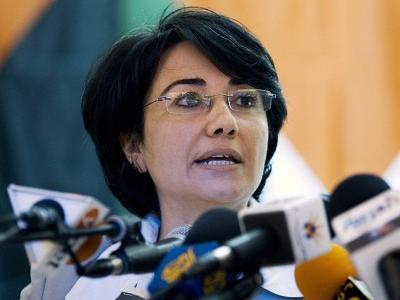
Haneen Zoabi, an MK from the Balad party, speaks to Elsa Rassbach about Land Day and her relationship as a Palestinian to Zionism and citizenship.
By Elsa Rassbach | +972 | March 29, 2012
 Since the 1980s, Palestinians have marked every March 30 with protests to celebrate Land Day. The day commemorates the first widespread struggle of Arab Israelis against processes of land confiscation intended to create Jewish majorities in certain communities. The marches and general strikes began in the Galilee in 1976, and resulted in the killings of six unarmed Arab citizens of Israel. Solidarity protests spread to the occupied West Bank, Gaza and the refugee camps in Lebanon. Since then, the day has marked the first common struggle for a Palestinian national cause following the founding of the State of Israel in 1948, an event Palestinians call the Nakba. This year on Land Day, worldwide Boycott, Divestment and Sanctions (BDS) activities will take place against Israeli policies, as well as the Global March to Jerusalem, which will call attention to the continuing Judaization and ethnic cleansing in the city that was supposed to be the multi-ethnic, multi-religious capital of a future Palestinian state.
Haneen Zoabi, 43, became a Knesset member in 2009, as the first Palestinian woman elected on an Arab party’s list. She is a member of the Balad party, which seeks to transform Israel into a democracy for all of its citizens, irrespective of national, ethnic or religious identity. Zoabi was born in Nazareth to a Muslim family. In 2010, she participated in the Gaza flotilla on board the Mavi Marmara. I spoke with her recently by Skype.
What does Land Day mean to you?
To me, Land Day is a day of ongoing and a continuous struggle around the issue of “land property.” This is still the crucial issue between us and the state. The core of the Zionist project is a continuous stealing of land from the Palestinians and transferring it to the Israeli Jews. Renaming the places, the junctions, the villages, the streets, and giving Jewish names to the landscape is part of this “confiscation.” It’s a way to steal from us and confiscate our historical relation with our homeland. This is the meaning of Ariel Sharon’s famous statement in the Knesset in 2002 when he said that the Palestinians inside Israel, whom he called “Israeli Arabs,” in effect have only temporary “rights in the land,” the land not yet confiscated, but “all the rights over the Land of Israel are Jewish rights.”
During the 63 years since 1948, Israel has confiscated 85 percent of our land and turned it over to the exclusive use of the Jews. It has developed and built 1,000 towns, cities and villages, all of them only for the Jews. And zero for the Palestinians. We live now on 2 percent of our land. We don’t even have permission to build our own houses on our own land and thus have no rights to use our land that hasn’t been confiscated.
How does Israel’s definition of itself as a “Jewish state” affect the Palestinian citizens of Israel?
The “Jewish state” is a state that has been established by Jews and is run by the Jews for the sake of the Jews – all at the expense of the Palestinians. It’s a racist definition. The state declares me to be an outsider in this land, though I’m the opposite. I’m the indigenous people. I didn’t immigrate to Israel; it was Israel that immigrated to me.
The State of Israel claims that it can be Jewish and democratic at the same time, as if there were no contradiction between the two. Any debate within Israel regarding the inherent contradiction between being a Jewish state and being a democratic state is considered no less than a “strategic threat.” If we are not Jewish and refuse to give up our rights, then obviously we present not just an alternative view, but something that contradicts the state’s very legitimacy: Zionism.
How you define your struggle as Palestinian citizens of Israel in relation to the struggle of the rest of the Palestinian people?
Our struggle has two components, as citizens and also as Palestinians. And unlike the state, we don’t see why both components — our citizenship and our nationality – should clash.
On the contrary, citizenship should be inclusive. We are fighting for normal citizenship with full recognition of our national rights as indigenous people that would include our history, our identity, our culture and our nationality.
My citizenship is conditioned by the Jews’ privileges. It’s even conditioned to my loyalty to these privileges! Therefore, there is no way to struggle for full equality and full citizenship without challenging the concept of “Jewish state.” To struggle for democracy in Israel is to struggle against Zionism. And this is what unifies our struggle with the wider Palestinian struggle. Racism, Oppression, Judaisation, Apartheid and Undemocracy inside Israel; Apartheid, Occupation, Oppression, and Judaisation in the West Bank and the Gaza Strip; and the denial of the right of return – all of these mechanisms of control serve the same ideological project: Zionism.
Nakba Day, the first intifada, the second intifada – all of these days are days of unity. But still our struggle is not united, because it lacks a unifying vision and a unifying framework of legitimacy. The Palestinian issue did not begin in 1967 and does not only concern the territories occupied in 1967. It concerns the entire Palestinian people, and even the wider Arab region.
After the Oslo Accords of 1993 defined the Palestinians inside Israel as an internal Israeli matter, we reformulated our national project in a manner that secures our reintegration into the Palestinian people and guarantees our place as an integral part of the Palestinian issue, both as part of the conflict and as part of the solution. Our demand for a “state of all its citizens” has put the Palestinians in Israel at the heart of the direct confrontation with the Zionist enterprise and has forced the “Jewish state” to admit the primacy that it grants to Jewish-Zionist values over democratic values, and to recognixe the impossibility of coexistence between the two.
This is the role we play.
Elsa Rassbach is a filmmaker and journalist from the United States, now based in Berlin. Her award-winning film, ”The Killing Floor,” an historical dramatic film about a union’s struggle against racism in the Chicago Stockyards, will be re-released this year.
Related articles
- On the eve of Land Day: Al Quds anticipates the Global March (alethonews.wordpress.com)
- Scores Injured as Israeli Troops Attack West Bank land Day Protests (alethonews.wordpress.com)
- Palestinian lawmaker wounded in Land Day protest (alethonews.wordpress.com)
- Palestinians in Israel – Book Review (alethonews.wordpress.com)
Rallies Worldwide to Mark the 9th Anniversary of the Disappearance of Aafia Siddiqui
Please also note that events scheduled for Saturday include a rally in New York at 12 noon, and a rally in Toronto (sisters only) at 6 pm. On Friday (March 30), there is also a rally in Fort Worth, Texas at 3.30 pm.
By Andy Worthington – 29.3.12
 On Saturday, outside the US Embassy in Grosvenor Square, London, I will be speaking at an event marking the ninth anniversary of the disappearance in Pakistan of Dr. Aafia Siddiqui, who vanished for five years and five months, and then mysteriously reappeared in Afghanistan in August 2008, where she was arrested, and then allegedly tried to shoot at the US soldiers who were holding her.
She was subsequently flown to New York, where, in September 2010, after a trial at which she did not appear to be well, although her mental health was not considered to be an issue worthy of scrutiny, she was sentenced to 86 years in prison, which she is serving in a notorious psychiatric prison, FMC Carswell, in Texas.
The rally outside the US Embassy, organized by the Justice for Aafia Coalition, takes place from 3 pm to 6 pm, and the speakers, and the timing of speeches, are as follows:
1500: Introduction
1510: Sultan Sabri (Croydon Muslim Association)
1520: Raza Karim
1530: Andy Worthington (journalist, author of The Guantánamo Files)
1540: Asif Hussain
1550: Raza Nadim (MPACUK – Muslim Public Affairs Committee)
1600: Sheikh Suliman Ghani (Imam, Tooting Islamic Centre)
1610: Anas Altikriti (Cordoba Foundation)
1620: Ken O’Keefe (anti-war activist)
1630: Statement of Support from the Haldane Society of Socialist Lawyers
1635: Joy Hurcombe (Save Shaker Aamer Campaign) reads out Statement of Support from Walter Wolfgang
1645: Omar Deghayes (former Guantánamo prisoner)
1655: Adnan Rashid (Hittin Institute)
1705: Sultana Parvin
1715: Uthman Lateef (Hittin Institute)
1725: Conclusion
I hope to see some of you down there, as the case of Aafia Siddiqui, which I have been following for many years, remains deeply troubling. My previous articles can be found here, and below is a re-cap of her story, drawn largely from an account of the website of the Justice for Aafia Coalition.
Please also note that other events scheduled for Saturday include a rally in New York at 12 noon, and a rally in Toronto (sisters only) at 6 pm. On Friday (March 30), there is also a rally in Sandton, South Africa at 2 pm, and another in Fort Worth, Texas at 3.30 pm.
The story of Aafia Siddiqui
Nine years ago, on March 30, 2003, Aafia Siddiqui, a Pakistani citizen, and a cognitive neuroscientist, disappeared in Karachi along with her three children, the youngest of whom, Suleman, was just a baby. For the next five years their whereabouts were unknown, and have never been publicly acknowledged by either the Pakistani or the US government, even though it seems clear that she was held in secret detention, where she was severely abused. Former Bagram prisoners have stated that a female prisoner was held in the prison, identified by the number “650,” and have said that they heard her horrific screams.
Following demands for her recovery by human rights organisations and the Pakistani public, Aafia resurfaced in Afghanistan in August 2008, framed with the attempted murder of US personnel. Transferred to the US, she was convicted in a shocking miscarriage of justice and was sentenced in September 2010 to 86 years in prison. She is currently held in isolation at FMC Carswell, Texas, a facility notoriously referred to as the “hospital of horrors.” She is denied any meaningful contact with her family and is unlikely to see her children again.
Whilst the two elder children were released in 2008 and 2010 respectively, the whereabouts of her youngest child, Suleman — only six months old at the time of the abduction — remain unknown, although it is believed that he may have been killed art the time of her initial capture. Most recently, disturbing reports have emerged that her health is deteriorating and there are serious concerns that she may have cancer.
To request Aafia Siddiqui’s repatriation to Pakistan, please contact the following officials in the US and Pakistani governments:
Eric Holder: Attorney General, U.S. Department of Justice, 950 Pennsylvania Avenue, NW Washington, DC 20530-0001, Tel: +1 202 353 1555, Email: AskDoJ@usdoj.gov
Hilary Clinton: Secretary of State, U.S. Department of State, 2201 C Street, N.W. Washington DC 20520, Tel: +1 202 647 4000, Fax: +1 202 261 8577, Email: questions@friendsofhillary.com
Mr. Asif Ali Zardari: President of Pakistan, President’s Secretariat, Islamabad, PAKISTAN, Tel 92 51 920 4801/921 4171, Fax 92 51 920 7458, Email: publicmail@president.gov.pk
Mr. Syed Yousaf Raza Gilani: Prime Minister of Pakistan, Prime Minister House, Islamabad, PAKISTAN, Fax: + 92 51 922 1596, Email: secretary@cabinet.gov.pk
Mr. Rehman Malik: Minister of Interior, Room No. 404, 4th Floor, R Block, Pak Secretariat, Islamabad, PAKISTAN, Tel: +92 51 921 2026, Fax: +92 51 920 2624, E-mail: minister@interior.gov.pk, ministry.interior@gmail.com, interior.complaintcell@gmail.com
Makhdoom Shah Mahmood Qureshi: Foreign Minister, Ministry of Foreign Affairs Islamabad, Pakistan, Tel: +92 51 921 0335, Fax: +92 51 920 7600, Email: smhq148@hotmail.com
You can also write to Aafia:
Aafia Siddiqui # 90279-054
FMC Carswell
Federal Medical Center
P.O. Box 27137
Fort Worth, TX 76127
U.S.A.
And to send a message of support to her family, email: support@justiceforaafia.org
Related articles
- Aafia’s lawyer seeks reversal of her conviction (nation.com.pk)
Scores Injured as Israeli Troops Attack West Bank land Day Protests
By George Rishmawi & Ghassan Bannoura | IMEMC | March 30, 2012
 Thousands of Palestinians marked land day, on Friday, Palestinian sources said that 100 civilians were injured when Israeli troops attacked protesters in Ramallah and Bethlehem cities.
Marking the 36th anniversary of land day today Palestinians and their supporters marched for Jerusalem demanding an end to the Israeli occupation of the city. Protests were organized near the Israeli Lebanese borders as well as the borders with Jordan.
The Land day commemoration started in 1976, when Palestinian residents of the Galilee to the Negev protested Israel’s plan to expropriate thousands of dunams of land for security and settlement purposes. Israeli military and police attacked the protests leaving 6 killed, hundreds injured.
Today After the midday prayers, people marched from Ramallah city, central West Bank, towards Qalandiya checkpoint that separates Ramallah from Jerusalem.
Troops fired tear gas and sound bombs then later used rubber-coated steel bullets. 80 Palestinians were injured. Witnesses told IMEMC that among those injured were two Palestinian medics.
In Bethlehem 20 residents were injured, seven were moved to hospitals, when soldiers fired tear gas and sound bombs at land day protesters. The marchers were first stopped by the Palestinian security forces however they managed to reach the gate of the wall separating Bethlehem from Jerusalem. As protestors reach the gate, youth threw rocks and firebombs at the wall and the nearby military tower.
“We are here to tell the Israeli occupation that Jerusalem is Palestinian and will never forget it.” One of the protesters told IMEMC.
Israeli troops responded by firing tear gas and sound bombs. A source from the Palestinian Red Cresent Society told IMEMC that one resident was hit with a tear gas canister in his back causing burns and bruises.
The wounded was identified as Yousef Sharqawi from Bethlehem. Another activist from the US was hit with a tear gas canister in his head and was transferred to the hospital for medical treatment. Field medics said his wound is moderate.
Photo of Land Day Protest in Bethlehem Today – by Ghassan Bannoura
Related articles
- On the eve of Land Day: Al Quds anticipates the Global March (alethonews.wordpress.com)
- Palestinian badly injured after Israelis fire tear gas at head (alethonews.wordpress.com)
- Israel Warns Against Global March to Jerusalem (alethonews.wordpress.com)
- 5 injured in West Bank demonstrations (alethonews.wordpress.com)
Palestinian lawmaker wounded in Land Day protest

Palestinian lawmaker Mustafa Barghouti
Press TV – March 30, 2012
Palestinian lawmaker Mustafa Barghouti has been injured by Israeli forces attacking peaceful demonstrations marking international Land Day, Press TV reports.
Barghouti was wounded on Friday in the city of al-Quds (Jerusalem) where he attended a Land Day rally.
Israeli forces opened fire on peaceful pro-Palestinian rallies across the occupied Palestinian territories, with clashes underway between Israeli troops and Palestinians in the occupied West Bank city of Qalandiya.
Earlier reports said at least two protesters were injured by Israeli troops and several others were arrested.
More demonstrations were planned for after the Friday Prayers across the West Bank and Gaza Strip as well as in East al-Quds (Jerusalem) despite Tel Aviv restricting access to al-Aqsa Mosque for the weekly prayers.
Pro-Palestinian rallies have been held near border areas in Lebanon and similar demonstrations are expected in Egypt, Jordan, and Syria where activists will also march towards the Palestinian borders.
The rallies, joined by international human rights activists, are part of an international campaign named Global March on al-Quds (Jerusalem), a peaceful international movement that also condemns the Israeli occupation of the holy city.
The event marks Land Day and the Israeli military’s deadly attack on Palestinians peacefully protesting Tel Aviv’s land policies in 1967.
The demonstrations have prompted Tel Aviv to deploy thousands of police and armed forces across the occupied Palestinian territories and around border areas near Lebanon and Jordan.
Related articles
- Marwan Barghouti: A Decade of Defiance (alethonews.wordpress.com)
- On the eve of Land Day: Al Quds anticipates the Global March (alethonews.wordpress.com)
- The Global March to Jerusalem, a brave and admirable attempt to awaken the world’s conscience (altahrir.wordpress.com)
- Israel Warns Against Global March to Jerusalem (alethonews.wordpress.com)
- American arms used to kill Palestinians; US complicit in Israeli crimes: Report (alethonews.wordpress.com)
On the eve of Land Day: Al Quds anticipates the Global March
29 March 2012 | International Solidarity Movement, West Bank
March 30 is Land Day in Palestine. The events of the day annually commemorate the events of 1976, when Israeli authorities seized massive quantities of land from Palestinian owners, and then killed several and injured dozens to crack down on the general strike called to protest the theft.
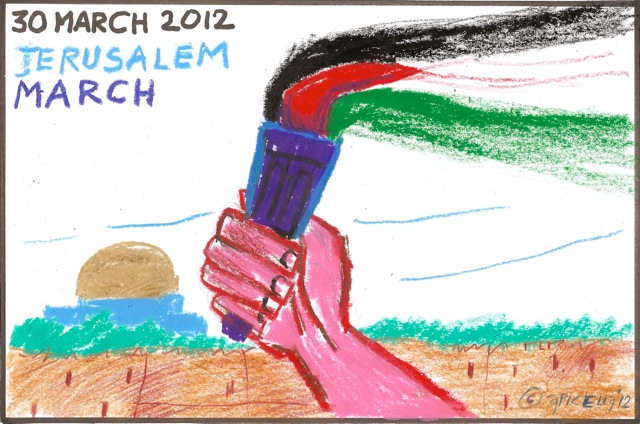
This year on Land Day, March 30, people from around Palestine and the world will march towards Al Quds (Jerusalem) to protest the theft in progress today: the isolation and ethnic cleansing taking place in Al Quds, as well as throughout occupied Palestine through illegal settlement activity. Marches are planned towards Al Quds from multiple points in the West Bank, Gaza, inside the Green Line, Jordan, Lebanon, Egypt, and Syria, as well as in Asia, North America, and Europe. The global march aims to highlight the colonization of Al Quds by Zionists and the refusal of access for Palestinians to the holy city.
According to multiple treaties and UN resolutions, Al Quds is recognized as the capital of a future Palestinian state. Israel seized control of the city in 1967. Al Quds has long been the center of religious, cultural, health, and commercial life for Palestinians, and an estimated 270,000 Palestinians reside in the eastern parts of the city (OCHA 2011).
The Palestinian population and presence in Al Quds is currently under extreme pressure from Israeli authorities and illegal settlers as the Zionist state seeks to take complete control of the city, drive out the Palestinian inhabitants, and eliminate any hope of its future as a Palestinian capital. This pressure is manifested in various ways:
Isolation
Fadwa Khader, an Al Quds resident and organizer of the Global March on Jerusalem remembers a time when Al Quds was “the most important place in Palestine.” Now, the apartheid wall and associated military closures prevent the majority of Palestinians from traveling to Al Quds for any reason. The city’s status as a center of Palestinian life is fading, due to its isolation from the rest of the West Bank. But material realities will not erase Al Quds’s place in the hearts of the Palestinian people. One needs only to view the multitude of images of Al Aqsa mosque in Palestinian homes, businesses, and streets to understand this.
Removal and Denial of Residency
In a systematic effort aimed at reducing the number of Palestinian residents of Al Quds, Israeli authorities seize any opportunity to rescind the residency permits of individuals, even those who are born and have lived their entire lives in the city. If Palestinian residents are known to have lived in the West Bank or abroad, even temporarily, they risk the withdrawal of their residency rights and may never be allowed into Al Quds again, even to visit family.
Fadi, whose name has been changed to protect his identity, is a Palestinian who resided in Jordan for example, has retained his Jerusalem IDs. Yet his children who were born in Jordan and whose mother is a Palestinian refugee, have been unable to attain their Jerusalem IDs. “My family’s history is in this city,” said Faid. “The lack of jobs, and the bleak future of Palestinians here forced me to seek these elsewhere. Now that I have returned and have brought my children with me, my children are unable to maneuver throughout the city as they are undocumented in their own father’s hometown. Israel refuses to recognize them as the children of a Jerusalemite, but we will remain here, even if that means that my children and wife live without an ID or any rights.” Fadi continued after a long silence and the evident hurt in his eyes. “This is our resistance to Zionism.”
This policy has the effect over time of reducing the Palestinian population in Al Quds and preventing residents from traveling or living elsewhere for fear of losing residency.
Pressure on existing residents
Fadwa Khader noted another component of Israel’s campaign for the complete colonization and ethnic cleansing of Al Quds: the application of pressure to Palestinian residents in order to drive them out of the city. One way this is manifested is in the denial of municipal services in the eastern parts of the city inhabited by Palestinians.
The residents here pay the same taxes as the Jewish residents of West Al Quds. Despite this, the municipality of Jerusalem does not provide adequate services to the Palestinian neighborhoods of the city. Ninety percent of the municipality’s sewer lines and paved roads and sidewalks are in West Al Quds (B’tselem). In some neighborhoods, cleaning services come only once every three days as opposed to three times a day in West Al Quds. n February the Wadi Hilweh Information Center reported the Jerusalem Municipality created a dump at the door of Palestinian neighborhoods.
Khader notes the dual nature of this denial of services: First, to make life in Al Quds miserable and untenable in an effort to convince existing residents to leave. Second, to demonstrate to the internationals that visit Al Quds that the Palestinian residents “don’t care about their neighborhoods” and live in filth.
Pressure is also applied to Palestinian resident through settlement of East Al Quds neighborhoods by extremist Israelis, evictions of Palestinian families, and demolitions of Palestinian homes. The neighborhoods of Sheikh Jarrah and Silwan have been particularly affected by this strategy. The goal of the Israeli authorities and Zionist activists is to forcibly settle Jews in East Al Quds through the seizure of land and homes and settlement of Israelis in these areas. In addition, home demolitions make life increasingly untenable for affected residents.
The Global March this Land Day will seek to highlight these issues and call for an end to Israeli Zionist settlement policy, access restrictions, occupation, and ethnic cleansing in Al Quds and throughout occupied Palestine.
Khader has a message for the international Palestine solidarity movement:
“We want to live in peace and liberty and to feel free. Can you imagine how we suffer and sacrifice for this dream?”
She noted that there can never be a real Palestinian state as long as the Israelis continue to steal land and water, to control borders, and to separate cities and villages of Palestine from each other.
Still, she is hopeful.
“We won’t give up hope. We believe in you (international solidarity activists). You are our voice outside of Palestine, calling for dignity, liberation, and an end to the occupation.”
Related articles
- PRESS RELEASE: Israel’s Criminal Policy in Al Quds (Jerusalem) (altahrir.wordpress.com)
Israel Warns Against Global March to Jerusalem
Israel forgets the fact that the United Nations declared Jerusalem to be an “International City” not owned by any one nation in 1947 due to its cultural importance to Christians, Jews, and Muslims. – Window Into Palestine
23 March 2012 / PNN
Israel issued a warning to the nearby Arab states if they allowed the global march to take place next Friday 30th March. Israel also stated that if anyone neared their borders, they would be accused of trespassing.
It claimed that the march is organized by “anti-Israeli parties” and said that this march won’t be allowed to reach Israel’s borders.
Political sources said that the Israeli government sent warning letters to governments including; Syria, Lebanon, Egypt, Jordan and Hamas’ in the West Bank and to the Palestinian authority, asking them to put a stop to the possible escalation of tension as a result of these marches.
Israeli military authorities put a “security plan” in place, to face the risk of the flow of protesters to the borders. The plan will be presented in a meeting of the Israeli government on Sunday, 25th March to implement it.
According to the Israeli correspondent of the Israeli official TV, this plan contains strategies to suppress the masses, which the Israeli military units in the Army and border guards have trained for.
Two months ago, the international committee of the Global March to Jerusalem began organizing the global march under the logo “Freedom for Jerusalem, No Occupation, No Ethnic Cleansing and Segregation, No for Judaising of Palestine, its land and holy sites.”
The committee chose 30th March to coincide with the anniversary of Palestinian “land day”; Palestine Land Day is a day celebrated by Palestinians on 30th March each year. The event marks the events of March, 1976, following the Israeli authority’s confiscation of thousands of dunums of private and public land in the majority of Palestinian areas, especially the Galilee. Following these events the Arab masses inside Palestine declared a general strike, confronting the Israeli authorities for the first time since the occupation of Palestine in 1948. The Israeli response was militant and violent, as the Israeli troops, backed up by tanks, entered Palestinian villages and re-occupied them, causing a number of martyrs and many wounded and detainees among the civilians.
The march will unite the efforts of Palestinians, Arabs, Muslims, Christians, Jews, and all citizens of conscience in the world to put an end to Israel’s disregard for international law through the continuing occupation of Jerusalem and Palestinian land.
Massive marches will be organized in Palestine, as well as from Asia, Africa and Europe to and in neighbouring countries to Palestine (Jordan, Egypt, Syria and Lebanon) and towards Jerusalem or to the nearest point possible according to the circumstances of each country and through the coordination between all groups and institutions of civil society taking part in the march, in coordination with the official and national bodies concerned.
Mass protests will also be organized in front of Israeli embassies in the capitals of different countries and in the main public squares in the big cities of the world, including the Arab and Muslim capitals and large cities.
Related articles
- Palestine Land Day: Demonstration at the Israeli Embassy (altahrir.wordpress.com)
- A call from Palestinians in Palestine to join the Global March to Jerusalem (alethonews.wordpress.com)
- Solidarity Rally with Global March to Jerusalem (altahrir.wordpress.com)
- Israel excitedly rejects cooperation with UN over settlements (alethonews.wordpress.com)
- World Civilian Coalition Gathers for Global March to Jerusalem (alethonews.wordpress.com)
Featured Video

Integrity Initiative: UK-funded network framed dissent as Russian disinformation for years
or go to
Aletho News Archives – Video-Images
From the Archives
Why Saudi Ties to 9/11 Mean U.S. Ties to 9/11
By Kevin Ryan | Dig Within | September 27, 2015
Media interest in Saudi Arabian connections to the crimes of 9/11 has centered on calls for the release of the 28 missing pages from the Joint Congressional Inquiry’s report. However, those calls focus on the question of hijacker financing and omit the most interesting links between the 9/11 attacks and Saudi Arabia—links that implicate powerful people in the United States. Here are twenty examples. … continue
Blog Roll
 Aletho News
- IAEA inspectors cannot return to Iran amid US threats: Russia
- Senate Rejects Iran War Powers Resolution Passed By House
- ‘We did not attack Pakistan with drones’: Afghan sources
- Iraqi Resistance faction links arms to sovereignty, questions US exit
- Cannon fodder no more… South Korea rejects Trump’s pressure to join his criminal war on Iran
- Neria Leiter Was A Legitimate Military Target
- Integrity Initiative: UK-funded network framed dissent as Russian disinformation for years
- ‘We don’t seek permission to defend our country’: Snippets from President Pezeshkian’s UNGA address
- NATO chief wants Europeans to fight American wars [for Israel]
- German chemicals giant reveals details of downsizing
- If Americans Knew
- Israel displaces hundreds of Palestinians amid wave of demolitions in West Bank
- Aid, reconstruction, and Israel’s history of obstruction in Gaza
- Trump administration digs an ever-deeper hole of complicity in genocide – Daily Update
- US-Israel $2.8 Billion Arms Deal, 40,000-Bomb Supply Faces New Gaza Complicity Accusations
- Caught on Tape: AIPAC CEO Boasted of Controlling Trump’s National Security Officials
- Why Hamas Attacked Israel in October 2023 – Israeli professor Ilan Pappé
- They see them, then kill them: Israeli quadcopters track, deliberately target civilians in Gaza
- Winter could turn Gaza’s treacherous, war-damaged buildings into deathtraps
- Majority of Democratic Voters Want to Prosecute Both Biden and Trump Administration Officials Over Gaza
- As Gaza languishes, world leaders gather at the UN – Daily Update
- No Tricks Zone
- New Study: Earth And Venus Surface Warmth Largely Explained By Convection And Lapse Rate, Not CO2 Or Radiation
- 2025 Nature Paper Claiming Worsening Global Drought Gets RETRACTED …Heavily Flawed
- New Study: ‘Global Drought Shows No Detectable Recent Acceleration Under Climate Warming’
- Economic Masterminds: German Socialists Suggest Taxing Productivity Gains Stemming From Using AI
- The South China Sea Has Not Been Cooperating With The Climate Change Narrative
- Energy Crisis: Germany Enters Heating Season With Historically Low Gas Reserve Fill Levels
- New Study: The Antarctic Ice Sheet Gained Mass From 2020-2024 Due To Staggering Snow And Ice Accumulation
- Study: Ocean Heating Rates From Thousands Of Years Ago ‘Dwarf’ Modern Ocean Heating Rates
- Climate Extremists Target, Attack Large-Scale Power Grid Infrastructure In Germany!
- New Study: Antarctic Ice Melt Has Contributed Less Than 1 Centimeter To Sea Level Rise In The Last 30 Years

