The History and Resurgence of Death Squads in Central America
By Annie Bird | Upside Down World | April 17, 2012

On March 24, in the Public Health Workers neighborhood in Guatemala City, community leaders and neighbors chatted in a regular gathering place in front of a local store. The relaxed Saturday night was broken up by gunfire, a massacre that killed health care union leader Ovidio Ortiz, along with Bildave Santos Barco, Fredy Leonel Estrada and Oscar Alexander Rodriguez.
Public health workers unions are a strong force in defense of public services and natural resources, and among the most outspoken critics of the abuses of transnational corporations in Guatemala.
Ovidio Ortiz, a life-long health union leader, community organizer and political activist, was apparently the main target in the massacre; he received 8 bullets.
U.S. Assistant Secretary of State’s Visit to Central America and the Return of Repressive States in Central America
The next day, Assistant Secretary of State for International Narcotics and Law Enforcement William Brownfield arrived in Central America on a two day trip, visiting Honduras and Guatemala. Brownfield’s trip is to promote the US’s “drug war” in the Central America, in close coordination with a government born of a military coup in Honduras, and in Guatemala, a government led since January 7, 2012 by President Otto Perez Molina, a former general accused of participation in genocide.
Politically motivated killings apparently by death squads have been growing over the past few years in Central America, and concern in Guatemala is heightened as the new administration has brought back to public office many of the same individuals directly implicated in the State repression and genocide of the 1980s.
Ex-General, now President Perez Molina is no stranger to death squads. According to declassified State Department and CIA documents, in 1994 while head of Military Intelligence, Perez Molina ran a secret torture center with over 300 political prisoners rounded up by military intelligence. An investigative journalist reported that Perez Molina was a CIA asset at the time.
Human rights activists reflect that the Public Health Workers neighborhood massacre appears to be one in a series of incidents indicating the return to the repressive State, what one Guatemala sociologist describes as the return of the three rights, the neoliberal right, the anti-communist right and the counterinsurgency right.
Criminal Network Death Squads Re-enter Politics
Like the death squads in the 1960s-70s, recent crimes in Guatemala appear to employ criminal networks, drug trafficking network hit men, to carry out violence against unions and communities organizing against abuses by transnational corporations, with the collusion or support of the military and police.
The return of the repressive state in Guatemala is part of a regional process that mixes drug war, anti-terrorism and anti-communist rhetoric and partners US security experts and agencies with repressive States, States made up of many of the same individuals responsible for crimes against humanity carried out just one generation ago with the assistance of US military advisors.
In Honduras, death squads targeting anti-coup activists have been operating across the country since the June 2009 military coup; human rights activists denounce over 300 politically motivated killings. In the Bajo Aguan region, since January 2010 death squad killings have been spearheaded by private security forces working for transnational palm oil corporations with the collaboration of police and the same Honduran military units that have received ongoing training from US military forces. As a result over 60 campesinos and journalists have been killed.
Killing Ovidio, Killing Democracy: Counterinsurgency Violence without the Violence
On September 2, 1993 Ovidio Ortiz helped lead public health workers in recovering a tract of land that the then-militarized Health Ministry had purchased in 1982. Though ostensibly purchased to build a hospital, years passed and public health workers worried the property would fall into the hands of military linked businesses, as has happened with other public lands purchased under military governments, such as a now cement mine on the South side of the city. So, they occupied the land and the union negotiated with the Health Ministry to facilitate access to housing lots for health workers.
Ever since Ovidio was elected either president or vice president of the neighborhood development committee; he was vice president when he was killed. He was also a member of the Executive Committee of the National Union of Health Care Workers of Guatemala, and the Conflict Resolution Secretary of the National Front for Struggle in Defense of Public Services and Natural Resources (FNL), an alliance of public health unions and community organizations. And, he was a political activist with the URNG party born from the URNG revolutionary movement.
Over the past decade, health workers have been the most outspoken defenders of public services, with a strong and public political identification with the Latin American “left,” emphasizing the importance of sovereignty, an end to North American hegemony in the region, and popular struggle.
Ovidio was killed just two days after the National Union of Health Workers signed a hard-fought collective agreement with the Health Ministry. The March 22, 2012 agreement was the product of difficult negotiations that involved months of work stops, protests and road blockades. Though most of the struggle took place during the previous presidential administration, on February 24, 2012 the FNL, comprised in large part of the health workers unions, froze the nation for five hours blocking the eight major highway intersections. Public health workers showed their strength, leaving no doubt they are a force to be reckoned with.
Shooting Sprees in Working Class Neighborhoods Spread Fear
Guatemalan human rights organizations observe that the Public Health Neighborhood massacre is also part of a trend of shooting sprees in meeting places like corner stores that began occurring in working class neighborhoods.
On January 15, 2012, in Zone 6 of Guatemala City, young people were reportedly kidnapped by a military patrol. A similar action is reported to have occurred again two weeks later in the El Mezquital settlement, when men dressed in black with ski masks again kidnapped young people.
Six days after the March 24, 2012 Public Health Workers Neighborhood massacre, on March 30, 2012, a passing car sprayed bullets on residents gathered in front of a neighborhood store in Zone 18 in northern Guatemala City, injuring 8.
8 FNL Energy Nationalization Movement Leaders Killed in 6 Months
The National Front for Struggle (FNL), an organization where Ovidio Ortiz held a leadership position, is among the most outspoken opponents of the abuses of transnational corporations in Guatemala, and has been a target of death squad killings. The FNL has led a struggle for the nationalization of electrical services in Guatemala, privatized in 1999, while denouncing illegal surcharges and other abuses by Union Fenosa, a Spanish distribution company that benefitted from the privatization.
Communities organized with the FNL in the Department of San Marcos were part of a movement to withhold payment for electrical services in protest of abuses, including non-compliance with court mandated refunds to clients.
Murders of FNL Members
- On October 24, 2009, Victor Galvez, a local leader in opposition to Union Fenosa and member of the Front in Defense of Natural Resources (FERNA), a San Marcos based organization that belongs to the FNL, was shot 32 times as he left his office in Malacatan, San Marcos.
- On December 15, 2009, Union Fenosa cut electrical services to entire townships of San Marcos, and a State of Emergency was declared in response to the resulting protests. Over the next few months, during the state of emergency, a further seven FNL activists were killed in San Marcos.
- On January 13, 2010 Evelinda Ramirez was shot and killed in the municipality of Ocos while driving to her home in nearby Chiquirines.
- On January 29, 2010, energy nationalization activist, member of the FNL and the Malacatan municipal workers union Pedro Garcia was shot and killed while driving home.
- On February 17, 2010 Octavio Roberlo, a principal leader of the FNL in San Marcos was shot 16 times from a passing car when he was closing up his store in the bus terminal.
- On March 21, 2010, Carlos Noel Maldonado Barrios, Leandro Maldonado, and Ana María Lorenzo Escobar, three community leaders active in the denouncements against Union Fenosa were brutally killed by gunshots and machete wounds in the municipality of Ocos.
- On March 22, 2011, during protests in reaction to Union Fenosa cutting electrical service to the town of Las Brisas in Ocos, Guatemalan soldiers shot and killed Santiago Gamboa, head of the local committee for the nationalization of energy, while injuring six others.
Drug Hitmen Working for Spanish and US Transnational Businesses?
Ocos and Malacatan in the department of San Marcos are towns renowned to be controlled by drug trafficking networks. Reportedly following the December 15, 2009 massive suspension of electrical services, including to medical centers, Union Fenosa moved their San Marcos offices to a building owned by one of San Marcos’ most infamous drug traffickers, which to local residents appeared to be a signal of an alliance between the Spanish electrical company and traffickers.
The 2009-2010 killings of FNL leaders and supporters in San Marcos were carried out in a way characteristic of drug hit men killings.
The municipality of Morales in Izabal is another area dominated by drug traffickers where unionists are being killed in an apparent alliance between transnational corporations and drug traffickers.
Del Monte Fresh Produce banana workers are organized into the SITRABI union. Del Monte Fresh Produce is charged with hiring some of Guatemala’s most important drug traffickers, including Mario Ponce (extradited to the US on drug charges in January 2012), to kidnap SITRABI leaders in 1999, at the same that Marvin Bush, the brother of Jeb and George Bush, sat on the Florida based Del Monte Fresh Produce board of directors.
Over the past year a new round of hit style killings of SITRABI unionists are terrorizing banana workers: Oscar Humberto Gonzalez Vasquez was killed on April 10, 2011; Idar Joel Hernandez Godoy was killed on May 26, 2011; on September 24, 2011 Henry Anibal Marroquin Orellana was killed; on October 16, 2011 Pablino Yaque Cervantes was killed; and most recently, Miguel Angel Gonzalez Ramirez was shot to death while holding his son.
Death Squad Denounced in Cement Plant Conflict with Swiss Investment
In 2007, indigenous communities denounced the emergence of a death squad in San Juan Sacatepequez, Guatemala, where 12 Kaqchiquel Maya communities are resisting the entry of a cement plant which will decimate their territory, a project promoted by a consortium of the Guatemalan cement monopoly Cementos Progreso, owned by the politically powerful Novella and Torrebiarte families, and by the Swiss cement giant Holchim.
Community activists report that the violent group emerged following the May 13, 2007 community consultation that rejected the cement companies’ presence in the municipality, claiming it is run by former military officers and known as El Escuadron (The Squad). It first began extorting local residents, generating a ‘security crisis’ and then began killing accused “gang members” they claimed were responsible for the extortion.
Community leaders resisting the cement plant were subject to constant threats and violent attacks, and subject to flawed and apparently malicious prosecution for killings apparently carried out by El Escuadron.
1960s-1980s Death Squads Grew from Criminal Networks and US Security Advisors
The United Nations sponsored Truth Commission, published in 1999, reported on atrocities committed during Guatemala’s 36 year civil war (1960-1996). US government documents declassified in the 1990s as a contribution to the Truth Commission demonstrate that in the mid-1960s a U.S. public safety advisor to Guatemala, John Longdon, pressed superiors over the need to set up covert operations centers, a safe house for coordination of security intelligence and the designation of a room in the National Palace, the starting point of the infamous “El Archivo” parallel intelligence center and nerve center for death squads.
In mid-1966, US Southern Command forwarded a request from the Guatemalan government to the US government for assistance in setting up kidnapping squads. A surge of death squad killings that began in 1966 resulted in thousands of deaths.
The UN Truth Commission found that the death squads of Guatemala’s ‘internal’ conflict were initially criminal groups made up of civilians whose actions were tolerated and covered up for by State authorities, which received logistical support from the military, responded to decisions made in the military command structure, and eventually incorporated military personnel.
Death squads that incorporated drug traffickers like Arnoldo Vargas, a member of the infamous 1980s ‘Mano Blanco’ squad and the first Guatemalan extradited to the US on drug charges in 1992, carried out politically motivated killings.
The Truth Commission’s description of the origins of Guatemalan death squads is disturbingly similar to the picture emerging in Guatemala and Honduras today.
Post Peace Process Police Forces and One Alleged CIA Asset
The military intelligence networks were restructured after the 1990s peace processes and have continued as criminal networks. They shied away from political killings, likely due to the strong international presence accompanying the peace processes. But these intelligence / criminal networks continued to infiltrate the States on all levels.
With the partial demobilizations of the militaries and creation of new National Civilian Police forces after the signing of the peace accords in El Salvador and Guatemala, which involved the large scale recycling of soldiers as police officers, a new generation of death squads was created in Central America.
In the early 1980s, Victor Rivera, a Venezuelan national and reported Central Intelligence Agency asset, came to the Ilopango Airforce base in El Salvador to work alongside the infamous Cuban American bomber and alleged former CIA asset Luis Posada Carriles in running Oliver North’s National Security Council covert operations that employed former Nicaraguan National Guardsmen who had been operating as criminal gangs in Guatemala in attacking the Sandinista government of Nicaragua, the “Contra supply operation.”
Rivera went on to become a security advisor to El Salvador’s post peace accord Vice Minister of Security, Hugo Barrera. Rivera assisted in the creation of an unofficial police unit that operated out of the office of a business owned by Barrera. When the “Police Analysis Unit” was implicated in the killing of a medical student, he fled to Guatemala in 1996.
In 1996, the same year as the signing of the peace accords, wealthy Guatemalans became concerned about a rash of kidnappings, and organizations like Madres Angustiadas (Anguished Mothers) and Friends Against Extortion and Kidnapping (FADES) were formed. They welcomed Victor Rivera who set up another special parallel police team, this one in Guatemala.
Adela Torrebiarte, a founder of Madres Angustiadas and member of the Novella-Torrebiarte family which owns Cementos Progreso involved in the mining conflict in San Juan Sacatequez, supported Rivera’s entry into Guatemala. The two reportedly were close over 12 years.
The United Nations peace process verification mission MINUGUA reported that in 1996 a covert anti-kidnapping commando operated out of the Presidential Palace, and was involved in the capture of kidnappers of the elderly Isabel Bonifasi de Botran (brutally murdered in the course of the kidnapping), and in the capture and forced disappearance of a member of the ORPA revolutionary movement involved in the kidnapping of Olga Novella of the Novella-Torrebiarte family.
In 1997, when Victor Rivera’s parallel security teams office was raided by police, Madres Angustiadas jumped to his defense claiming that he had helped them resolve kidnapping cases. On May 4, 2001 Adela Torrebiarte’s nephew, Juan Andres Torrebiarte Novella, was kidnapped, but was rescued on May 24. MINUGUA reported that four of his captors were severely tortured.
Social Cleansing or Organized Crime Violence?
While kidnappings were the topic of concern in the late 1990s, from 2001 to 2005 it was murder, gangs and social cleansing. The murder rate grew 40% from 2001 to 2005. A large number of killings of young people, apparently gang related and murder of street children by police and gangs was widely reported.
Investigations by the UN-backed special prosecutors unit CICIG demonstrated in 2010 that in 2004 a network of officials in the Ministry of Governance and Police used their positions to engage in a range of criminal activities, including murder, robbery and drug trafficking. In 2010, arrest warrants were issued for 18 officials involved, including the Director of the National Police Erwin Sperinsen and the Secretary of Governance Carlos Vielmann.
Though reporting focused on their role in the death squad killings of prison inmates and escapees, the breadth of activities that this network was allegedly involved in leads to the conclusion that the inmate killings were not simply about cleaning up society or “social cleansing” but related to other criminal activities the officials were involved in.
This leads one to question what other motives besides “cleaning up” society may have been behind the crisis of killings of young people in the early 2000s.
Guatemalan Death Squads Reemerge in the Public Eye
In 2006, questions about Veilmann’s, Sperinsen’s and Rivera’s activities began to surface after compromising information surfaced in the press that seemed to link them to questionable conduct related to the 2006 killing of three Central American parliamentarians, and the ensuing investigation of the crime. Two fled to Europe in 2007.
Victor Rivera was also suspected to have been in some way involved in the killings of the Central American Parliamentarians. Rivera visited four police officers detained as the material authors of the Parliamentarians’ murders in prison just hours before they were killed in a suspicious prison massacre, and a video was circulated of the officers threatening to bring down Rivera, essentially that they would not be his scapegoats, when they were first detained, illegally, by Rivera.
Then President Oscar Berger named Adela Torrebiarte, founder of Madres Angustiadas, as the new Secretary of Governance after Vielmann, and she kept Rivera on as an advisor.
However, shortly after Torrebiarte left the Ministry of Governance, Rivera was fired on March 30, 2008 and a week later, on April 7, 2008 he was murdered as he drove in Guatemala City.
CICIG’s investigations of Rivera’s murder identified drug kingpin Jorge “El Gordo” Paredes as a suspect. CICIG’s director described Paredes as a long-time associate of Rivera, and described one of two potential motives for Rivera’s murder as the consequence of a collaboration with Paredes that had gone bad. Parades was also implicated in the killing of the Central American Parliamentarians.
Former Police Director Arrested for 2009 Death Squad Killing
The most recent death squad scandal erupted on March 23, 2012 when Marlene Blanco, Director of the National Civil Police in 2008 and Assistant Secretary of Governance for Community Security in 2009, was arrested on charges of running a death squad that tortured and murdered suspects in the extortion and murder of bus drivers. She has been charged with three 2009 killings and is being held in prison.
A dramatic rash of killings of bus drivers began during the 2007 presidential campaign, won by Alvaro Colom, and continued during his presidency to be so dramatic that they were deemed to be a source of political instability.
Marlene Blanco’s brother, Orlando Blanco, was prominent in Colom’s administration as Secretary of Peace and is currently a congressman for Colom’s UNE party. Marlene Blanco’s arrest is the latest in a series of cases initiated against prominent figures or relatives of prominent figures in the outgoing administration, including a sister of the former First Lady in what seem to some to be a political vendetta by the ruling party against the outgoing UNE party, its stiffest competitor.
While some suspect that the case against Marlene Blanco may be politically motivated and promoted by current functionaries, the case has been investigated by CICIG, which has gained a great deal of legitimacy. The public prosecutor in charge of the case requested that the proceedings be reserved from the public
2012: New Police Forces in Central America – Restructuring Death Squads?
Sweeping police reform and the creation of new police forces is planned as part of the Regional Security Strategy backed by the US State Department.
In February 2012, a proposal for the creation of a tri-national police composed of Guatemala, Honduras and El Salvador emerged, and Brownfield promoted that initiative during his March 2012 tour. The tri-national force would be charged with controlling a 20 mile perimeter around borders of those nations, and would undoubtedly be trained in the Regional Security Strategy’s regional training center in Panama whose focus is training in border security and is run by US and Colombian security forces.
In January 2012, incoming Guatemalan president Otto Perez Molina named Adela Torrebiarte as the special commissioner in charge of police reform. Torrebiarte helped bring Victor Rivera to Guatemala in 1996, the reported CIA asset who had created some of the first parallel networks in the El Salvadoran police, and was suspected to be implicated in 2006 and 2007 death squad scandals.
Torrebiarte’s family business is suspected by indigenous rights activists in San Juan Sacatepequez to be implicated in the creation of death squads to facilitate the entry of a controversial cement plant in their communities.
She will now be in charge of reforming the Guatemalan police, and participate in the creation of a regional police force, with extensive US assistance.
We can expect that death squads will weather the reform, and probably even flourish.
(Annie Bird is co-director of Rights Action, since 1995, and has written extensively about Central American human rights issues, about the historic and on-going role of the USA in the region, and about global business and investors interests in the region. annie@rightsaction.org).
Related articles
- The roots of Bain Capital in El Salvador’s civil war (blacklistednews.com)
What Could Your Organization Do With Its Own Radio Station?
By Bruce A. Dixon | BAR | April 17, 2012
What could your not for profit organization, community or arts group, labor union, school, or local church do with its own fully operational low power FM radio station? This is not a rhetorical question, it’s a very practical one. Late in 2012, or early in 2013, the Federal Communications Commission will be accepting license applications to operate what could be hundreds of neighborhood FM radio stations in cities and towns across the country.
For most of the last two decades, the Philadelphia-based Prometheus Radio Project, which you can find on the web at http://www.prometheus.org has led this fight, partnering with local forces to bring the technical knowledge, and doing the watchdogging and advocacy on the national level that got the laws passed and appropriate regulations enacted. And now the licensing window is almost here. It’s a moment that’s been a long time coming. Corporate broadcasters, and even so-called public broadcasters have spent millions to hire lobbyists and rented congressmen and senators to deny the broadcast microphone to anything or anybody that is not, or isn’t owned by a greedy for-profit corporation.
Commercial radio has impoverished our music, by preventing local artists from reaching local audiences. Commercial radio has starved our communities of news by withdrawing corporate support for the gathering and broadcasting of original news, especially local news. Without local artists reaching local audiences, without local news and without the ability of people to listen to and lead their own local conversations, we are NOT communities, we are ONLY markets. Turning our collective relations into exclusively market-mediated relations is in fact the vision of the corporate America.
The fight for the rights of nonprofit community broadcasters to access the radio dial is nothing less than a fight for the rights of people to hear their own voices. It’s a fight for the right to own and operate media which recognizes and builds communities, where commercial media ignores communities, instead recognizing only markets to be delivered to its advertisers.
What could your organization do with its own low power FM radio station? Think about it. Low power FM stations will broadcast to an area 12 miles in diameter. We’re talking about neighborhood radio that binds actual neighbors together around their own needs, concerns and objectives, the same needs, concerns and objectives that caused you to form your local not for profit organization in the first place.
While individual nonprofit organizations can apply for station licenses, preference will be given to coalitions of two, three and more local organizations, because a wider base ensures more success both at fundraising and at the production of original programming for your local radio station. The minimum financial barriers to application and station startup are not terribly high, either, often in the low to mid single-digit thousands. Do your organization’s capacity-building and community building efforts a favor, and find out just what your organization could do with its very own low power FM radio station.
To find out more about this once in a liftetime opportunity, join Black Agenda Report and Prometheus Radio for a one hour informational conference call with Prometheus Radio on Thursday, April 26, at 9PM EST, 8PM CST. That’s Thursday evening, April 26 at 9PM Eastern, 8 PM Central and 6PM Pacific time. To obtain the number and code, email us at radio@blackagendareport.com
Bruce A. Dixon lives in Marietta GA, and is a member of the state committee of the Georgia Green Party. Contact him at bruce.dixon(at)blackagendareport.com.
Related articles
- FCC Decision on Local Community Radio Act a Boon for Communities (commondreams.org)
Air France accused of racism after banning non-Jew from flight
Al Akhbar | April 17, 2012
French activists participating in the Welcome to Palestine campaign over the weekend accused Air France of racism on Tuesday after the airline asked passengers if they were Jewish as part of a strategy to prevent the activists from boarding.
“The racism of Israel and Air France was brought in plain light on Sunday…It was proven that one had to declare themselves Jewish or holder of an Israeli passport to have the right to travel,” the French contingent of Welcome to Palestine 2012 said in a press release on their website.
The activists noted the case of a passenger named as Horia, who had successfully boarded the plane, but was then asked by an air hostess whether she was Jewish before the flight had taken off.
An Air France employee signed Horia’s response on an official document (see below), and was then allegedly told by Air France personnel that she was prohibited to travel to Tel Aviv, according to activists.
Coordinator for the French chapter of Welcome to Palestine 2012, Maximilien Shahshahani, told Al-Akhbar that Air France was colluding with Israel’s secret service, Shin Bet, in determining which activists were not permitted to board Sunday’s flight to Tel Aviv.
“Shin Bit shared a blacklist of names with Air France, but told the airline to double check [others not blacklisted] with a series of questions,” he said.
The questions were also asked of other passengers, Shahshahani said, who were not participating in the Welcome to Palestine campaign.
“We saw another passenger, to which the same questions were asked. The response to the second question was that they were Jewish. The passenger was extremely shocked by the nature of the questions,” he said.
Air France in a statement issued on its website said Israeli authorities demanded that the airline question one of the passengers, without detailing what kind of questions were asked.
“The Israeli authorities requested that one of the passengers be questioned. The answers did not satisfy the Israeli authorities, the passenger had to disembark the flight at their demand,” Air France said.
Hundreds of activists, mostly from Europe, were due to fly into Tel Aviv international airport on Sunday as part of a global campaign to raise awareness of the restriction of movement and travel for Palestinians brought by Israel’s military occupation.
But, as in 2011, Israel threatened airlines that they faced sanctions if they did not prevent activists from boarding their flights, providing them with a list of names.
“You are ordered not to board them [activists] on your flights to Israel. Failure to comply with this directive will result in sanctions against the airlines,” a stern statement from Israel’s Ministry of Interior to airlines, obtained by activists, read.
Dozens still managed to board flights to Israel, with the official website for the French contingent of Welcome to Palestine saying that 40 French activists were detained upon arrival.
Preparations for legal proceedings against Air France are underway, Shahshahani said.
Welcome to Palestine has become an annual campaign, which is part of a growing international movement to highlight the continued suffering of Palestinians living under Israeli occupation and Israel’s apartheid policies.

An alleged Air France document showing questions asked of a passenger boarding a flight to Israel on Sunday 15 April 2012. (Photo: Handout – Welcome to Palestine 2012)
Related articles
- Israel and Air France racism overt (altahrir.wordpress.com)
- Europe’s airlines enforce Israeli travel ban on activists hoping to repair Palestinian schools (altahrir.wordpress.com)
- ‘Flytilla’ for Palestine hit by arrests as Israel clamps down (alethonews.wordpress.com)
1,600 Palestinian prisoners begin open-ended hunger strike in Israeli jails
Press TV – April 17, 2012
About 1,600 Palestinian prisoners have begun an open-ended hunger strike in the Israeli jails across the occupied territories to protest imprisonment without charge and solitary confinement exercised by the Tel Aviv regime.
Palestinian prisoners began the hunger strike on Tuesday, April 17, which marks Palestinian Prisoners Day.
Meanwhile, thousands of people held demonstrations in towns and cities across the occupied West Bank and the Gaza Strip on Tuesday to express solidarity with the prisoners.
Qadura Fares, head of the Palestinian Prisoners Club, said, “We are united and undivided when it comes to prisoners, and we will stand by them until they get their demands.”
Fares made the remark in an address to a gathering in the northern West Bank city of Nablus on Tuesday.
In addition to the West Bank, about 2,000 people marched to the headquarters of the Red Cross in Gaza City and set up a tent in solidarity with the Palestinian hunger strikers.
The hunger strike in Israeli jails has begun as reports say the Tel Aviv regime is expected to release Palestinian prisoner Khader Adnan, who went on a hunger strike for 66 days in protest at being held without charge under an administrative detention order.
Adnan’s lawyer said the Palestinian inmate will be released later on Tuesday but it has not been clear exactly when or where he is scheduled to be freed.
The administrative detention, often implemented by the Israeli regime against the Palestinian population, is a sort of imprisonment without trial or charge, allowing regime forces to make arrests without formal charges for up to six months. However, the detention order can be renewed for indefinite periods of time.
According to an April 1, 2012 report published by the non-governmental Palestinian prisoner support and human rights association, Addameer, at least 4,610 “political” Palestinian prisoners are held in Israeli jails.
Related articles
- 1600 Detainees To Declare Hunger-Strike on April 17 (alethonews.wordpress.com)
Israeli soldiers assault cycling group in Jordan Valley
Ma’an – 15/04/2012
BETHLEHEM – Israeli forces assaulted a group of cyclists who were participating in a West Bank tour on Saturday, official news agency Wafa reported.
Footage appeared on Youtube which showed an Israeli commander hitting an international participant with the butt of his rifle, in an unprovoked attack.
Israeli forces can be seen physically assaulting cyclists in the video.
Soldiers stopped a group of around 250 participants near the Jericho village of al-Auja and refused to let them start a cycling tour, which was organized by youth group Sharek and officials from the al-Auja environmental center.
The tour planned to take participants on a 25 km journey through the Jordan Valley.
When participants protested against orders to stop cycling, soldiers used force against them, injuring several people.
The officer involved in the assault was identified as Shalom Eisner, the deputy commander of the Jordan Valley brigade.
An Israeli army spokeswoman described the incident as “very severe,” adding that Israeli GOC central command Nitzan Alon has ordered an investigation into the event.
~
Update – April 16th:
Rabbis For Violence, Brutality and Abuse

In recent years we have learned about a few sporadic Rabbis who promote peace, justice and humanism. But more often it seems, Israel’s prominent Rabbis are more openly enthusiastic about violence, brutality and abuse.
Ynet reports today that Israel leading rabbis rally to the aid of Lieutenant-Colonel Eisner, an IDF hooligan officer who attacked Danish peace activist yesterday.
Several prominent rabbis expressed their support for the religious Lieutenant-Colonel who was caught on camera brutally attacking a peace activist with his rifle. The Rabbis insist that the military’s decision to suspend the Lieutenant-Colonel was impetuous.
Lieutenant-Colonel Eisner expressed remorse over his action, saying that while he should not have flung his weapon at the activist, the video footage released depicted only “60 seconds out of a two-hour event.” This is indeed a winning Talmudic spin. Rather than dealing with factuality and truth of the matter, we are asked to engage with the ‘unknown’, the ‘missing footage’ so to say.
Rabbi Haim Drukman, who was Eisner’s mentor, described his former pupil as “a fine man, an idealist. He didn’t choose a military career because he needed a job – he is there to give his life for the security of the IDF “. Rabbi Druknam may be correct here, looking again at the footage, we must admit that the silent Danish peace activist seems indeed to threaten the IDF, the State of Israel, and the Jewish people in general.
Former Chief IDF Rabbi Avihai Ronski slammed the decision to suspend Eisner, who he described as “a highly ethical individual.” I guess that by now it is clear to most people that ‘ethics’ is a very relative notion in the Jews Only State.
I guess that the Israeli Rabbis are clever enough to discern a problem within the IDF’s attitude towards its hooligan officer. If Israel wants to maintain itself as the Jews only State, if Israel insists in maintaining its symptoms at the expense of the Palestinian indigenous population, then, its officers must be brutal and vile towards any from of resistance.
Sooner or later, Israel and its Rabbis will have to make a very painful decision. They will have to face the horrific moral and ethical consequences of maintaining a racist, nationalist and expansionist Jewish State.
~
More:

(photo: Hamzi Zbidat)
Related articles
- Bethlehem mayor to Israel: Allow our friends to visit (alethonews.wordpress.com)
1600 Detainees To Declare Hunger-Strike on April 17
By Saed Bannoura | IMEMC & Agencies | April 14, 2012
1600 Palestinian political prisoners, held by Israel, declared they will be starting an open-ended hunger strike on April 17th in protest of their illegal detention, and demanding basic rights.
Palestinian Minister of Detainees in the West Bank, Issa Qaraqe’, stated that the situation of the detainees in Israeli prisons is very difficult, and dangerous, especially amidst the ongoing Israeli violations and attacks against them.
Qaraqe’ added that the detainees are fighting a battle to defend their dignity and to improve their living conditions.
He further called for massive solidarity campaigns, and called for declaring April 17, Palestinian Prisoners Day, a day for solidarity and massive nonviolent protests in all parts of the occupied territories.
The Maan News Agency reported that a committee formed by the Israeli Prison Authority, headed by Yitzhak Gabai, visited a number of detention facilities, listened to the demands of the detainees, and “promised” to respond to these demands this coming week.
Some of the demands presented by the detainees are;
1. Ending Administrative Detention.
2. Ending Solitary Confinement.
3. Reinstating the right to education.
4. Halting all invasions targeting detainees’ rooms and sections.
5. Allowing family visitation, especially to detainees from the Gaza Strip.
6. Improving medical care to ailing detainees.
7. Halting the humiliation, and body-search of the families of the detainees.
8. Allowing the entry of books and newspapers.
9. Halting all sorts of penalties against the detainees.
Palestinian detainees in Israeli prisons are subject to harsh and illegal treatment that violates International Law and the Fourth Geneva Convention to which Israel is a signatory.
Palestinians started marking April 17 as the Palestinian Prisoners Day, on April 17, 1974, the day Israel released Mahmoud Bakr Hijazi, in the first ever prisoner-swap deal.
202 Palestinian detainees have died after being kidnapped by Israeli forces since 1967, following Israel’s occupation to the rest of Palestine (The West Bank, the Gaza Strip, East Jerusalem, and the Golan Heights).
Hundreds of detainees died after they were released suffering from serious illnesses and medical conditions resulting from extreme torture and abuse in Israeli prisons.
70 detainees died in prison due to extreme torture, 74 were executed by the soldiers after being arrested, 51 died due to the lack of medical treatment, 7 detainees died due to excessive force by soldiers and after being shot while in prison, former political prisoner, head of the census department at the Ministry of Detainees, Abdul-Nasser Farawna reported.
Related articles
- Thirty Palestinians killed by Israel in March, 300 imprisoned (alethonews.wordpress.com)
- Palestinian Detainees To Hold Hunger Strike (alethonews.wordpress.com)
- Minister of Detainees Calls for Boycott of Military Courts (alethonews.wordpress.com)
- Detained journalist boycotts Israeli military court (alethonews.wordpress.com)
- B’Tselem reports sharp increase in the numbers of Palestinians being held in administrative detention (alethonews.wordpress.com)
- Netanyahu Refuses EU Demands To Release Political Detainees (alethonews.wordpress.com)
Bethlehem mayor to Israel: Allow our friends to visit
Ma’an – 12/04/2012
BETHLEHEM – The mayor of Bethlehem on Tuesday urged Israel not to humiliate hundreds of tourists invited to a week-long tour of Palestine.
Some 25 Palestinian organizations have invited internationals to visit Palestine from April 15 – 21 and Mayor Victor Batarseh urged Israel to let them enter and not to humiliate them, at a news conference in Bethlehem.
“We demand our international friends have access to Bethlehem,” the mayor said. “It is our right to welcome visitors.”
Israel’s public security minister, Yitzhak Aharonovitch, said Tuesday that guests of the Welcome to Palestine initiative would be detained and deported, the Israeli news site Ynet reported.
“If they arrive in Israel they will be identified, removed from the plane, their entry into Israel will be prevented and they will be moved to a detention facility until they are flown out of Israel,” Aharonovitch said.
Israeli police spokesman Micky Rosenfeld told Ma’an on Wednesday that police were preparing for the visitors’ arrival and implementing measures inside and outside the airport. He did not elaborate.
Palestinian organizations have arranged a week-long program, starting Sunday, which includes helping to build a school in Bethlehem and day trips to Hebron, the Jordan Valley, Ramallah and Jerusalem.
All visitors to the West Bank must first pass Israeli border control and many arriving in Tel Aviv’s Ben Gurion airport do not tell Israeli security if they will be visiting Palestinian areas as this leads to interrogation and often deportation.
But the “Welcome to Palestine” campaign has asked its guests to be open about their plans to visit the West Bank.
Coordinator Abdul-Fatah Abu Srour told reporters in Bethlehem the participants are declaring their right to say they are coming to Palestine and “we are not hiding it, we are not going to lie about it.”
Organizer Mazim Qumsiyeh added: “We cannot understand why Israel wants people to lie about why they are coming.”
Qumsiyeh emphasized that the visitors were “normal average Europeans willing to visit people under occupation.”
“These are peaceful people that want to visit us here in Bethlehem and the Holy Land,” he added.
At least 1,500 people from over 15 countries have booked tickets to participate in the program, organizers say, adding that up to 2,000 could arrive. Most are flying in from Europe but visitors are also coming from Australia, New Zealand, the US and Canada.
The Welcome to Palestine campaign organized a similar program in July 2011 but Israel sent lists of participants to foreign airports who refused to let blacklisted passengers board. Over 120 participants who arrived in Ben Gurion airport were detained and deported by Israel.
Minister Aharonovitch told Israel’s Channel 1 on Wednesday that Israel would send blacklists to foreign airports again this week.
But Qumsiyeh said airlines had agreed not to cooperate with Israel’s blacklists after facing legal challenges over their refusal to let passengers board last year.
Another Welcome to Palestine organizer told reporters the initiative sent a message to European governments that Israel was “dismissing” their citizens’ freedoms.
Israel violates bilateral agreements by deporting Europeans, she said, noting that European countries allowed Israelis to enter freely.
“We reject all attempts to isolate us,” Abu Srour added
Related articles
- Israel demolishes buildings, pylons near Bethlehem (alethonews.wordpress.com)
- ‘Israel cannot legally ban pro-Palestinian activists bound for West Bank’ (altahrir.wordpress.com)
- Israel To Deny Entry To Pro-Palestinian Activists, Again (lezgetreal.com)
- Israeli police escort Harvard tour from Bethlehem village (alethonews.wordpress.com)
- #Airflotilla2 | Mission “Welcome to Palestine”: The detailed program (altahrir.wordpress.com)
Deir Yassin Day in London
By Paul Eisen* | Uprooted Palestinians | April 8, 2012
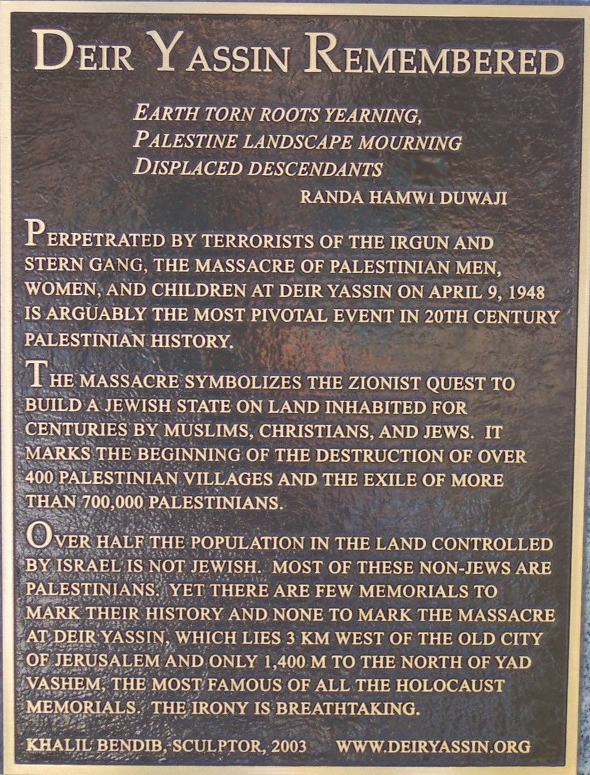 On April 23 in London, Deir Yassin Remembered and The General Union of Palestinian Students will be commemorating Deir Yassin Day 2012.
Deir Yassin Day commemorates the Deir Yassin massacre of April 9th 1948.
Not the only massacre at that time and by no means the worst, Deir Yassin signaled and has come to symbolise, the dispossession of the Palestinian people and their continuing exile.
April 23 is also the birthday of Miguel Cervantes creator of Don Quixote and of Roy Orbison creator of “Only the Lonely” – and a man who, just when you thought he could go no higher – up an octave he’d go. It’s also the birth- and death day of William Shakespeare – highly appropriate for a man known for his immaculate dramatic structure and pleasing endings.
But in England April 23rd is above all, St. George’s Day. St George is the patron Saint of England and strangely, St George was a Palestinian.
George hailed from the Palestinian town of Lydda, turned into an airport in 1948 and named Lod, and named again after the great ethnic-cleanser David Ben Gurion. Like Deir Yassin itself, the story of Lydda could serve as a template for all the expulsions and massacres of 1948.
At Deir Yassin the perpetrators massacred over a hundred villagers and burned their bodies. Others were loaded onto trucks and paraded through the streets of Jewish Jerusalem, then taken to a nearby quarry and shot. Orphaned children of Deir Yassin, dragged from under the bodies of their dead and dying relatives were taken and dumped, dazed and bleeding, in a Jerusalem alley.
At Lydda the Israelis massacred 426 men, women, and children; 176 slaughtered in the town’s main mosque and the remainder driven into exile. Forced to walk in the summer heat, they left behind them a trail of bodies – men, women and children. It was the Palestinians’ very own ‘Trail of Tears’.
And, just like at Deir Yassin, the town of Lydda was repopulated with Jewish immigrants, the name Hebraised to Lod and, like the name Deir Yassin, the name Lydda was wiped off the map.
At our commemoration DYR and GUPS will be joined by the Palestinian Delegation, the Palestinian community of the U.K. and many British and other supporters. We will also be joined by Abu Ashraf, now of Azaria but once of Deir Yassin – because in April 1948 Abu Ashraf lived in Deir Yassin and, on April 9th at the time of the massacre, was a few days short of his eighth birthday.
So, it’s fitting that our commemoration be held on April 23rd, St. George’s Day; in London, the capital of England, and led by Abu Ashraf of Deir Yassin.
* (With thanks to Stuart Littlewood)
Related articles
- | Remembering ongoing Zionist Apartheid +Anti-Palestinianism: Distinguishing ‘illegitimate victimisers’ from ‘victims!’ (truthaholics.wordpress.com)
- The Ethnic Cleansing of Palestine by Ilan Pappe (alethonews.wordpress.com)
German protesters slam US polices in Afghanistan, Middle East
Press TV – April 8, 2012
Tens of thousands of protesters have attended rallies in more than 70 cities across Germany to protest against the US-led war in Afghanistan as well as the proliferation of nuclear arms.
Hundreds of protesters also gathered in front of the US embassy in the capital Berlin on Saturday to voice opposition to US policies in Afghanistan and the Middle East.
Chanting slogans in support of the Nobel literature laureate Gunter Grass who criticized Israeli policies in the Middle East in his recent poem, the protesters demanded an end to war and violence.
“We are generally protesting an increase of violence, threats of violence and war. Central, it is the situation in Afghanistan and we demand an immediate withdrawal of all German troops from Afghanistan,” Ekkehard Lentz of Bremen Peace Forum said.
Meanwhile, several demonstrations were also held in front of a number of US military bases across the European country.
Protesters also thronged in front of a German military airbase in southwest Germany, which is home to at least 20 US nuclear warheads.
“More weapons are being produced throughout the world and more weapons are being traded than ever before. This indicates that we are to face much more terrible times,” Peter Sturtynski of Federal Committee for Peace Council said.
The traditional Easter marches continue throughout the weekend. Last year, more than 120,000 people joined the protests on the same occasion.
Related articles
- Art of Resistance – a comment on Günter Grass (alethonews.wordpress.com)
- War Is Terrorism. (radicalglasgowblog.blogspot.com)
Counter-Insurgency as Insurgency
The “99% Spring” Brings Co-optation into Full Bloom
By MIKE KING | CounterPunch | April 5, 2012
As the Occupy movement begins to come into full bloom across the country this Spring – with plans for massive days of action and demonstrations on May 1st, new campaigns for transit justice on both coasts, continued organizing against foreclosures and police violence, and a slight chance of a bank protest or two – there are several weeds sprouting in the prefigurative garden. Not least of which is the “99% Spring” campaign, led and funded by every corner of the modern Democratic Party machine. One might ask themselves “What is wrong with non-violent direct action?” or “How effective could the ‘Democratic Party machine’ actually be, anyway?” There is nothing inherently wrong with civil disobedience and it surely remains to be seen if this campaign can train 10,000 people let alone the 100,000 they plan to. The campaign director at MoveOn.org, Ilyse Hogue, an organization that seems to be the key player in the 99% Spring, has recently written in the Nation that “Occupy is Dead” and that the 99% Spring will succeed where Occupy has failed – while mimicking their slogans. What they lack in actual knowledge of Occupy’s health, they certainly make up for in co-optive obviousness. Fertilized by decades of expanding inequality, Occupy needs to bloom and transform in the coming months, without getting mired in conflict with the various failed institutions of the organizational Left. However, those flowers of resistance will have to rise above the weeds of a dying order, including the 99% Spring dandelions.
The organizations comprising this effort are a litany of individual trade unions, both trade federations, environmental groups, and a range of non-profits, including groups who have done very respectable work, such as Jobs with Justice. There likely isn’t unified intent on behalf of every actor in this campaign. In Oakland, I have heard of some local participants in the training having serious reservations about the effort, but are participating in it nonetheless. The (potential) intent of these organizations, or the people they will train who will choose to lie down and get arrested, over some other tactics, isn’t the issue. What matters is the effect of this effort in the existing political context of counter-insurgency, the dismissive, patronizing and divisive terms in which this is being put, and the timing – right before the presidential election. If successful, this will undoubtedly serve as a wedge over tactics, exacerbating the “good protester / bad protester” trope that is always used, and that we have heard in the last few months already – from liberal Mayors to Fox News and everywhere in between. This attempts to bring organizations with sordid histories into Occupy, who will invariably try to wrestle legitimacy from a popular, radical movement, into political groups that are reformist at best, wholly complicit with the current order at worst. Hogue has stated that the plans for this effort pre-dated the formation of the Occupy movement in the U.S. The original goal, likely, to generate systemically non-threatening actions to draw attention to inequality and injustice – not to stop it, but to gather votes for Democrats, who, ostensibly, address those issues. Now that the Occupy movement has already done that, inadvertently, they seek to employ the same campaign to contain and defang that movement while preserving their positions as mostly poverty pimps and lazy labor bureaucrats that think strikes have lost their usefulness.
The existing powers, who some of these same progressives have consistently stood against (from their political position), deeply need to weld a safety valve on Occupy. Homeland Security, who has been “advising” police and city governments nationally and who coordinated the mid-November 18-city raid on the Occupy movement, released an article this week entitled “The Occupy Movement: Rising Anarchy” which states:
“So far, Occupy protests in the United States exhibit a mostly peaceful nature. However, certain elements within Occupy that have been seen both here and abroad have the potential to inflict major damage to governments, people and the private sector. If not carefully monitored and mitigated, these elements pose a significant threat to modern democracies.”
The existing order needs an institutionalized, liberal super-hero-on-a-leash to be used (whether the organizations involved all intend to or not) disrupt, discredit and destroy, from the inside, those elements who organized the November 2nd General Strike in Oakland, the militant demonstrations against police violence in New York in recent weeks, or community-led, anti-capitalist efforts against foreclosures in Chicago, or those that set barricades aflame in Seattle on December 12, 2011, or the scores of lesser-reported militant action that have taken place in the last half-year, out of nowhere. They also want to suck in the tens of thousands of young people all over the country, hoping to be able to do the same thing in their cities, into a more palatable strategy. Those in power would like to see nothing more than for 100,000 people to be trained to chain themselves to local bank branches for 6-9 months, hooting about their “greedy side,” get disillusioned at how fruitless that is, and go back to playing video games and downloading pirated music after Obama’s re-election.
Counter-Insurgency by any other name
This is not primarily about tactics, it is about politics. MoveOn.org and reactionary unions are not spearheading this for no reason. Are we to believe that the same unions that discourage their members from taking non-violent direct action during labor disputes, have found both the time and the energy to do a solid favor for the radical Left, by resuscitating a movement they have mistakenly diagnosed as dead? This is primarily about co-option and division, about sucking in a large cross-section of Occupy into Obama’s reelection campaign, watering down it’s radical politics, and using these mass trainings as a groundwork to put forward 100,000 “good protesters” to overshadow the “bad protesters” (who actually take personal risks and/or have radical politics), to ease the State’s ongoing campaign to pick us off one by one. In the words of MoveOn.org’s own campaign director, it is unabashedly and overtly a campaign of clear co-optation. This is not a riding of the coattails of a hip social movement; this will be a form of counter-insurgency. This will be used to disrupt, divide, discredit and destroy the Occupy movement. The parameters of acceptable protest will be imposed, not by some local non-profit starving for funding or wanting to remain relevant, but by city officials, the police, the major media, Homeland Security, Chambers of Commerce, police front groups like “Stand for Oakland,” and on down the line.
The Occupy movement has broken with the Left’s long-standing, self-defeating tendencies of meaningless, police-choreographed marches, 1-day pageant strikes, movement discourse that thinks the logic of the lowest common denominator that wins elections will win social justice (99% frames not withstanding), and non-violent civil disobedience designed to curry favorable media attention that gets de-contextualized and buried in the sea on nonsense entertainment that is the media. This scares the hell out of capital and the State. 99% Spring is not part of some nefarious conspiracy theory with Homeland Security or “the illuminati.” 99% Spring is not Wall Street. But they sure as hell are doing their work, whether some of them want to realize that or not.
“Just Say, No” (to government-sponsored co-optation)
A New York lawyer and some folks from OWS have made an attempt to turn the direct democracy of Occupy into a representation democracy of elected “Occupy politicians” who would have a new-Constitutional Convention this July 4th weekend in Philadelphia, comprised of elected officials from the Occupy Movement (“rising anarchy,” be damned). In short time Occupy Wall Street, from which these charlatans emerged, publicly denounced this attempted event at a General Assembly, along with Occupy Philadelphia. We have (imperfect) emerging direct, democratic institutions in our cities that reflect the will of the movement. We should use them. We should address the Operation 99% Spring Co-optation initiative the same way that New York and Philadelphia dealt with the “new founding fathers.” It is time to weed out our garden, so that real, social justice efforts can bloom.
My knowledge of the Occupy movement is derived primarily from my experience in Oakland. We have seen counter-insurgent efforts of this type before: when Mayor Quan’s Block-by-Block campaign organization tried to set up a “peace camp” right before the raid of the second Occupy Oakland encampment; when the one singular thing reporters wanted to know from press contacts before the December 12th Port Shutdown was “How can we get the protesters to obey police orders?” or their myopic fixation on the property destruction that they consider “violence;” to Quan’s unheeded call for the “leaders of the Occupy movement” to condemn said “violence” (by which she means people carrying shields who were hit with projectiles and beaten, while groups of children were tear-gassed): or how permits, taken out behind Occupy Oakland’s back, were used to arrest people for possession of blankets in Oscar Grant Plaza – some of whom are facing prison time; to Quan’s use of non-profits as a palatable alternative to a violent, discredited, and costly movement in a press-release and subsequent “volunteer fair.” All of this counter-insurgent misrepresentation, baiting, discreditation, and divisiveness is wearying and something we need to get better at combating. It has also only been partially effective. An Oakland Tribune poll found that 94% of Oaklanders support Occupy Oakland, even after all of the efforts I outlined above. We shouldn’t find a false complacency in this. It should be noted that even though most of these were attempts at co-optation, most came from clearly demarcated enemies.
99% Spring is attempting to graft itself to Occupy and hollow it out from the inside out, imposing rigid norms of non-violence and deference to police authority, while watering down our politics and introducing well-funded and trained institutions that are either fully invested in, or dependent upon, the existing power structure – and have the resources, connections and will of self-preservation to navigate the Occupy ship into a doldrums from which it will never emerge. Despite the undemocratic and self-defeating norm of consensus, we, as an Occupy movement, still have a sense of what we came here to do. We didn’t come here to sign petitions or to get Obama reelected. We didn’t come here to “have a voice in the system”; we came here to flip it on its head. We will not be co-opted. We should not have our tactics determined by the Democratic Party. We should not let ourselves be undermined from within. We have the capacity to call the 99% Spring out for what it is – a deluded attempt by the Obama campaign to kill two birds with one stone, to take the hundreds of thousands in the street demanding real democracy (laying bare the utter failure of the Obama administration and the American State) and turn it into a vehicle to re-elect him. So that he can bomb Iran with impunity, or continue to deport more undocumented immigrants than any other president, or cover-up more massacres in Afghanistan, or think that half-baked rhetoric about inequality coupled with more tax breaks for businesses represents “Change we can believe in.”
The Occupy movement may not have the power to change the talking points of duplicitous, liberal Mayors. It may not have the capacity to change the preoccupations of the mainstream media. It certainly doesn’t have much say in the manner in which the police try to suppress it. But we do have control over what goes on in our own house. These people only become part of the Occupy movement if we let them continue to say that they are out of one side of their mouth, while the other side says we are directionless, un-strategic and “dead.” Every single Occupation that doesn’t want to turn into nothing more than an ample pool of chumps registering people to vote for the same Obama administration that has declared an all-out war against us, should bring forward a resolution at their General Assembly to condemn this clear attempt to destroy our movement. This isn’t about violence versus non-violence; this is about autonomy versus co-optation. History will not forgive us if we let the 99% Spring Trojan horse into out movement so that the injustices we rose up against can be perpetuated with our own sanction, in our own name.
Mike King is a PhD candidate at UC–Santa Cruz and an East Bay activist, currently writing a dissertation about counter-insurgency against Occupy Oakland. He can be reached at mking(at)ucsc.edu.
Related articles
- Infiltration to Disrupt, Divide and Misdirect Is Widespread in Occupy (Part I) (alethonews.wordpress.com)
- The 99% Spring aims to train 100,000 in direct action (dailykos.com)
Featured Video

BRITAIN’S WARNING: PREPARE FOR WAR
or go to
Aletho News Archives – Video-Images
From the Archive
How Ukraine Tortured and Slaughtered Donbass
By Kit Klarenberg | Al Mayadeen | July 11, 2024
Almost immediately after the proxy war erupted, ISIS-tier footage of the torture and murder of Russians in Ukrainian custody emerged.
On July 6th, the New York Times published an astonishing investigation: In Ukraine, Killings of Surrendering Russians Divide an American-Led Unit. The article documents in grim detail how Chosen Company, an international volunteer battalion for Kiev, routinely executes Russian prisoners of war. It is the very first mainstream admission that this practice – a brazen breach of the Geneva Conventions, and a grave war crime – is widespread among Ukraine’s fighters, both foreign and homegrown. … continue
Blog Roll
 Aletho News
- Pentagon designates Chinese cultural centers national security threat
- Israel Demolishes Home Of Lebanese Journalist Whose Viral Film Exposed Pager Attack
- Record Oil, Empty Tanks: The UAE’s Miracle Recovery
- Burnham tackles Britain’s poverty with aggression in Yemen
- Peace in Ukraine: the easy way – or the hard way
- Trump & the Rrrrussians
- US taxpayer money laundered back through Ukraine – Musk
- Before COVID, an NIH lab chief proposed making a SARS-like bat virus more infectious
- Gates, Bourla on Trial in Netherlands Accused of ‘Great Reset’ Scheme at Vaccine Injury Hearing
- BRITAIN’S WARNING: PREPARE FOR WAR
- If Americans Knew
- An error has occurred; the feed is probably down. Try again later.
- No Tricks Zone
- Two New Studies Find Thwaites Glacier Melt Cannot Be Driven By Human Activity Or A Warming Ocean
- E-Cars Reduce CO2 Emissions By Only 41% Compared To Internal Combustion Engine Vehicles
- Predictions Made By Renowned Climate Professor Over Past Decades Have Been Proven To Be Poor
- New Study Suggests Large Regions Of The Pacific Ocean Have Been Cooling For The Last 80 Years
- Germany’s Green Energy Debacle: High Energy Costs Force Kahla Porzellan to Close After 182 Years!
- New Study: 50 Years Of The Most Aggressive ‘Net Zero’ Policies Can Only Affect The Global Climate By 0.03°C
- US September “Heat” Was No Record…Many Records Set Decades Ago
- Latest European Green Energy Debacle; Portugal’s Largest Flagship Solar Park Insolvent!
- Green Energy Debacle: German Expert Professor Fritz Vahrenholt Warns Of Severe Economic And Social Consequences
- Two More Paleo Reconstructions Affirm Meters-Higher Sea Levels Across Ireland, Brazil 7000-6000 Years Ago

