RAMALLAH – Hana Shalabi said Sunday that she will continue her hunger strike despite an announcement by Israel’s Ofer military court that her prison time will be reduced by two months.
Lawyer Fadi Qawasmi visited Shalabi on Sunday at Hasharon prison and informed her of the court’s decision to reduce her imprisonment time by two months.
Shalabi told him that she would continue her hunger strike protest in order to achieve her demands to end administrative detention.
She has been on hunger strike for 18 days and her condition is said to have worsened recently.
Addameer prisoners society says that Shalabi was issued a 6-month administrative detention order on Feb. 23.
Ofer military court refused Qawasmi’s request to call witnesses to speak about the assault of Shalabi during her interrogation, he said.
Qawasmi also requested that a Shin Bet representative, the military commander who led the arrest and the soldier who carried out the strip search on Shalabi be called to the stand.
The court refused his demands.
Lawyer from the prisoners society Jawad Boulos said on Tuesday that Israeli court officials claimed that the reason for Shalabi’s administrative detention is because she is considered a threat to Israel’s security and safety of its people.
They also claimed that she planned military actions right after she was released.
Hana Shalabi, from the northern West Bank village Burqin, is being held without charge since her detention on Feb. 16. She announced her hunger strike immediately after soldiers seized her from the family’s Jenin-district home.
Shalabi was freed in October 2011 when Hamas secured the release of more than 1,000 Palestinians in Israeli jails in exchange for a captured Israeli soldier.
She had spent 25 months in administrative detention, under procedures that allow Israel to detain Palestinians for renewable terms of six months without pressing charges, using laws dating back to the British Mandate period.
Israel is holding 309 Palestinians in administrative detention, according to figures by prisoners rights group Addameer. There are currently six Palestinian woman in Israeli custody.
Student solidarity groups from more than twenty UK universities held Israeli Apartheid Week events last week, raising awareness of the apartheid analysis and building boycotts, divestment and sanctions (BDS) on campus. Coming towards the end of an academic year that has seen students’ unions across the country and the National Union of Students move to support BDS initiatives and many successful BDS campaigns, the week has been hailed as having taken the UK student movement for Palestine to new heights.
The week kicked off on the Monday with a national day of action, with campuses across the country organising mock checkpoints, street theatre and supermarket actions.
Focus on youth
Organisers chose to bring young activists from Palestine and South Africa as visiting speakers, resulting in energetic and action-focused panel discussions and providing students with the opportunity to hear about the latest developments in the Palestinian and South African youth movements.
In Scotland, five universities hosted talks by Adameer activist Murad Jadallah and Wassim Ghantous, a Palestinian youth activist currently active in the Belgian BDS movement. With students in Scotland especially active in organising solidarity for Khader Adnan, Murad’s talks on the work Adameer had been doing to support him were particularly well timed. The announcement that Adnan was to be released came shortly before one of the biggest public events was due to start.
Yara Sadi from the Who Profits from the Occupation? project spoke alongside local activists in Leicester, Leeds and Sheffield and Israeli BDS activist Leehee Rothschild visited the universities of Sussex, Warwick and Essex.
In London, the main panel discussion featured film maker Eyal Sivan, Palestinian BDS National Committee secretariat member Rafeef Ziadah, journalist Ben White and South African student leader Mbuyiseni Ndlozi. Mbuyiseni spoke passionately of the “potent gift of international solidarity” that contributed to the downfall of South African apartheid and must be developed further to support the Palestinian struggle against Israeli apartheid.
Mbuyiseni also spoke in Nottingham and alongside Ewa Jasiewicz at a meeting at Manchester Metropolitan University that launched a campaign against the university’s ties with Veolia, the French multinational that provides services to Israel’s illegal settlements.
At the University of Liverpool, the Guild of Students voted to adopt a range of policy motions in support of campaigns following presentations earlier in the week by the Corporate Watch research group about their newly released BDS book Targeting Israeli Apartheid.
On Friday, the week was rounded up with a series of social events. In London, a Beats Against Apartheid event was attended by over 600 students. It was the perfect energetic ending to an inspiring week with performances from hip-hop artists Lowkey, Mic Righteous, Awate and spoken word performers Rafeef Ziadah and Jody Mcintyre among many others.
Opposition and repression
Despite much fanfare in the Israeli media, the official ‘Voices for Israel’ delegation made little impact. Bizarrely, meetings at which they spoke were poorly publicised and there was almost no visible presence on campuses from the official delegation.
In contrast, local pro-Israel student activists attempted to intimidate IAW organisers, with students at LSE being pelted with water balloons as they staged a mock check point on campus and there were reports of confrontational behaviour in Birmingham, Nottingham and elsewhere.
Regardless of these attempts at intimidation, Israeli Apartheid Week has been widely successful and has continued its consistent growth across the UK. Indeed, the failure of pro-Israel activists to detract from our activities in any meaningful should be seen as a further sign that the debate on UK campuses is now happening very much on our terms.
For information on the Israeli Apartheid Week events that will take place elsewhere in the world in the coming weeks, check out the official Israeli Apartheid Week website.
This is Part I of a two part series on infiltration of Occupy and what the movement can do about limiting the damage of those who seek to destroy us from within. This first article describes public reports of infiltration as well as results of a survey and discussions with occupiers about this important issue. The second article will examine the history of political infiltration and steps we can take to address it.
In the first five months, the Occupy Movement has had major victories and has altered the debate about the economy. People in the power structure and who hold different political views are pushing back with a traditional tool – infiltration. Across the country, Occupies are struggling with disruption and division, attacks on key persons, escalation of tactics to property damage and police conflict as well as misuse of websites and social media.
As Part II of this discussion will show, infiltration is the norm in political movements in the United States. Occupy has many opponents likely to infiltrate to divide and destroy it beyond the usual law enforcement apparatus. Others include the corporations whose rule Occupy seeks to end, conservative right wing groups allied with corporate interests and other members of the power structure including non-profit organizations allied with either corporate-funded political party, especially the Democratic Party which would like Occupy to be their Tea Party rather than an independent movement critical of both parties.
On the very first day of the Occupation of Wall Street, we saw infiltration by the police. We were leaving Zuccotti Park and were stopped in traffic by the rear of the park. We saw an unmarked van open, in the front seat were two uniformed police and out of the back came two men dressed as occupiers wearing backpacks, sweatshirts, and jeans. They walked into Zuccotti Park and became part of the crowd.
In the first week of the Occupation of Freedom Plaza in Washington, DC we saw the impact of two right wing infiltrators. A peaceful protest was planned at the drone exhibit at the Smithsonian Institution. The plan was for a banner drop and a die-in under the drones. But, as protesters arrived at the museum two people ran out in front, threatening the security guards and causing them to pepper spray protesters and tourists. Patrick Howley, an assistant editor for the American Spectator, wrote a column bragging about his role as an agent provocateur. A few days later we uncovered the second infiltrator when he was urging people on Freedom Plaza to resist police with force.
There have been a handful of other reports around the country of infiltration. In Oakland, CopWatch filmed an Oakland police officer infiltrating. And, in another video CopWatch includes audio tape of an Oakland police chief, Howard Jordan, talking about how police departments all over the country infiltrate, not just to monitor protesters but to manipulate and direct them.
Los Angeles also had infiltrators from the right wing group, Free Republic. They posted on their webpage a call for infiltrators to block a vote concerning an offer from the City of Los Angeles for virtually free space for Occupy LA: “Need LA Freepers to show up to block this vote by the Occupy LA General Assembly. How brave are you?” In the end, the LA occupy decided not to accept the offer from the city, something also opposed by other elements in the encampment.
In New York, there were reports of infiltration. For example, a protester described how undercover police infiltrated a protest at Citibank and were the loudest and most disruptive protesters. Later at the station listening to the police the protester said in an interview: “It was a bit startling how inside their information was – how they were being paid to go to these protests and put us in situations where we’d be arrested and not be able to leave.”
Survey and Interviews of Occupiers Shows Common Tactics, Common Infiltrators
These scattered reports seem to be the tip of the iceberg. As a result of experiencing extreme divisive tactics and character assassination on Freedom Plaza against us we began to hear from occupiers across the country about similar incidents in their occupations. We decided to speak to and survey people about infiltration and have found similar stories around the country.
Recently we toured occupations on the west coast, where we spoke to many occupiers and have attended General Assemblies at Occupy Wall Street and Philadelphia. We heard stories in Arizona of someone with website administrative privileges deleting the live stream archive which included video that was to be used in defense of some who were arrested. In Lancaster, Pennsylvania someone took control of the email list, making it an announce-only list and when the police threatened to close the camp, that person put out a statement that the Lancaster occupiers had decided to go without any conflict. In fact, no such decision had been made and 30 occupiers had planned to risk arrest when the police tried to remove them. The false email resulted in no resistance.
Our west coast trip ended at the Occupy Olympia Solidarity Social Forum. We were able to survey 41 people representing 15 different occupations primarily on the west coast but including Missoula, MT and New Orleans, LA. Participants were questioned about 10 different behaviors. The most common behaviors, seen in roughly two-thirds of those surveyed and covering 12 of the 15 occupations, were:
Disruptions of the General Assemblies and attempts to divide the group: Individuals would interrupt General Assemblies with emergency items or sidetrack the agenda with their personal needs or issues. When proposals were presented to the General Assembly on principles for the occupation or plans to prevent division, individuals would question the authority of the writers of the proposal, launch personal attacks or question their abilities. There were frequent attacks on people who did the most work and were perceived as leaders. The anti-leadership views of many occupiers were used to essentially attack the most effective people. Sue Basko wrote about this in Los Angeles in a comment on a Chris Hedges article, writing that there was an “ongoing campaign of harassment and coercion against the Occupy LA participants and volunteers. Each day is a fresh set of victims.” She describes the use of Twitter, list serves and blogs to “defame and harass anyone giving their efforts to help Occupy LA.” This has included attacks on “social media workers, the website team, the lawyers (including me), the medics, the livestreamers, the writers, and on and on.” She also writes “there is the very strong belief that some among them are FBI or DHS agents placed there to start the group, egg it on, control it.” Conversations with others in Los Angles confirmed this report. Our experience in the area of personal attacks included outlandish lies calling us criminals and thieves and near daily email attacks since early December. We found that when we respond and correct lies, it does not stop them and have concluded that if someone has the intention to be a character assassin there is nothing you can do to stop them except to expose them. While that does not necessarily stop them, it at least gets those in the occupation who are not gullible to doubt the undocumented personal attacks.
Individuals who took over the website and/or social media and then removed them or hacked them and took control: As noted above, these networks have been used in personal attacks, as well as to send inaccurate messages to the media and other occupiers. One mistake made is to allow a large number of people to have administrative privileges on the website. Being an administrator allows people to erase critical information as occurred in Phoenix. In Washington, DC we have been removed as administrators of a Facebook page we created because we allowed people who turned out to be untrustworthy to have administrative privileges. Note, people can blog or post to Facebook or websites without being administrators.
Division over how money was being spent was an issue reported by 50% of respondents and in 12 out of 15 occupations, individuals persistently questioned transparency and use of funds. In General Assemblies in New York and Philadelphia we saw disruption by people who complained about money issues. In New York, an argument about access to free Metro Cards resulted in a 30 minute argument. In Philadelphia, it was a vague complaint about “where is the money?” We saw something similar at a 99%’s meeting in San Francisco where one of the questioners complained about missing money. And, we have seen the same in Washington, DC with false accusations of missing money. Sometimes these disruptors seem like homeless or emotionally disturbed individuals. They could be acting out their concerns or they could be encouraged by police to attend meetings to cause disruption and could be paid a small amount to do so. Whether paid or not, the impact is the same – it takes the Occupy off of its political agenda and turns people off to participating in the movement.
Finally, the issue of escalation of tactics to include property damage and conflict with police: The euphemism for this is “diversity of tactics.” In fact, there is great diversity within nonviolent tactics. This is really a debate between those who favor strategic nonviolence and those who favor property destruction and police conflict. In 11 of 15 occupations there were reports of verbal attacks on police and/or escalation of tactics from nonviolence to property destruction or violence. In one occupation, an individual took over the direct action working group and escalated the tactics used beyond what the group had agreed upon. In one occupy, the GA approved putting up a structure but agreed that if the police wanted it taken down they would promptly do so in order to prove the structure was temporary. When the structure was up, a handful of people refused to take it down causing a 10 hour police conflict and undermining public support for the occupy. In another occupation, because a minority of the occupy refused to adopt nonviolent strategies, a protest with the teacher union was cancelled preventing a major opportunity to expand the movement. When it comes to the issue of violence vs. property damage, it is particularly hard to tell whether the differences are political or instigated by infiltrators.
Participants were asked about attempts at co-optation by law enforcement, individuals or organizations affiliated with the Democratic Party and about suspected infiltration by right wing groups: 8 of the 15 occupations (41% of respondents) reported Democratic groups attempted to co-opt the occupation, using it to push or prevent a legislative agenda or using the occupation’s social media to change the times of protests or meetings. Far fewer reported suspicion or evidence of right wing infiltration (12% of respondents in four occupations), most stating that the corporate media provided poor or misleading coverage. The most common form of infiltration was by law enforcement agencies (49% of respondents; 11 of 15 occupations). Some respondents reported having video evidence, some reported law enforcement officers having more information than they had been given, police using names of occupiers when names had never been provided and some suspected police infiltration but had no proof.
Of course, there is a lot of suspicion, but people are rarely able to prove infiltration. These incidents could be people with real political disagreement within the Occupy, or they could be people who are emotionally disturbed, mentally ill or who bring other personal challenges with them. Or, it could be an infiltrator manipulating these people, playing on their fears and prejudices. This is not a simple issue, as we will discuss in Part II, it is best to judge people by their actions and not label them as infiltrators without direct proof.
Some may wonder why Democrats or groups closely affiliated with the Democrats like MoveOn, Campaign for America’s Future, Rebuild the Dream or unions like SEIU would want to infiltrate the Occupy (note: individuals who are Democrats, union, MoveOn or members of other groups are not the same as the leadership). Essentially, leaders of these groups see Occupy as the Democrats’ potential answer to the Tea Party. Occupiers do not see themselves that way, but these groups want the Occupy to adopt their strategy of working within the Democratic Party. In one example, Eric Lottke, a senior policy analyst for SEIU who has been involved in Occupy DC, appeared on a radio show with two other occupiers from Occupy Washington, DC and Occupy Oakland. Lottke said he was speaking as an occupier from Occupy DC and talked about ‘taking back Congress in 2012′, the need for an electoral strategy and gave the usual Democrat rhetoric about Obama needing more time. The two other guests said Lottke was completely out of step with most Occupiers who say we should not focus on electoral politics but instead should build an independent movement to challenge the corrupt system. We doubt the Occupy DC General Assembly agreed with Lottke’s pro-Democratic Party, pro-Obama views but Lottke had positioned himself to speak for them. Van Jones of Rebuild the Dream similarly was appearing in the media as if he were an occupy spokesperson claiming there will be 2000 “99% candidates” in 2012; again trying to push Occupy into Democratic electoral politics. These are just two examples of many Democratic Party operatives trying to send Occupy into Democratic Party politics despite the movement consistently describing itself as independent and non-electoral.
In Washington, DC we have seen some occupiers attacking the National Occupation of Washington, DC (www.NOWDC.org) scheduled for this April, while other occupiers have shown enthusiasm for it. Solidarity with NOW DC has been shown by 19 General Assemblies of occupations from around the country. InterOccupy classifies it as a national Occupy event. The attackers have been criticizing NOW DC by attacking the authors of this article. This attack is occurring at the same time that Democratic Party aligned groups have announced their own project which occurs at the same time as NOW DC, the “99%’s Spring.” Thus far the dividers have succeeded in preventing solidarity from the two DC occupations with the rest of the Occupy Movement. Is the timing a coincidence?
No doubt the information in this article is incomplete. We have only been able to survey and talk with people at about 20 occupies. We would very much like to hear from others around the country about experiences at their occupation as understanding these tactics is the first step to confronting and addressing them. (Send your comments to research@october2011.org.)
In Part II of this series we will focus on the history of government infiltration and destruction of political movements and political leaders and will examine steps that can be taken to minimize the damage from these tactics. One thing evident from the history: infiltration has been common in political movements for a century and the tactics of division, attacks on leaders, escalation of tactics, fights over money and misinformation to the public are common throughout that history.
Hanaa Shalabi is on hunger strike. She is a Palestinian female political prisoner from the village of Burgin near Jenin. She was kidnapped from her home on February 16, 2012 by Israeli Occupation Forces (IOF) in the middle of the night.
Hanna’s family was ordered outside the house, she was blindfolded and handcuffed. All cell phones and computers in the house were confiscated and a photograph of her brother hanging on the wall, who was killed by IOF in 2005, was torn up and stepped upon by one of the soldiers. Hanaa was also beaten and sexually harassed by the IOF.
Her attorney stated, “she is demanding the end of administrative detention and that the soldiers who beat her up and undressed her to carry out a body search be put on trial.”
Administrative detention is a procedure that allows the Israeli military to hold prisoners indefinitely on secret evidence without charging them or allowing them to stand trial. Hanaa was ordered to serve administrative detention for six months in the HaSharon prison. As of this writing, Hanaa has entered her 13th day of an open-ended hunger strike and is currently being held in solitary confinement. Latest reports indicate that Israeli prison officials have moved her to different prison to cut off any contact with the outside world.
This young lady has been in administrative detention before, totaling 2 1/2 years starting in March, 2009 where she served for 6 consecutive terms. Hanaa was among the freed Palestinian prisoners who were released in October 2011 under the prisoner exchange deal between Hamas and Israel. However, this time Israel has reneged and rearrested her as it did in previous prisoner exchange deals. For example, in November 1983, Palestinian prisoner Ziad Abu Ain was supposed to be part of a prisoner release deal, but was rearrested on the bus containing those who were about to be released.
I will never forget that prisoners ‘exchange deal of Thanksgiving Day 1983. My younger brother Samih was among the freed prisoners, after spending 18 months in an Israeli concentration camp in south Lebanon. He was kidnapped by IOF while visiting our family with his German wife and 5 year-old daughter, Carmen. Throughout his captivity, neither our mother, his wife, Carmen nor our oldest brother was permitted to visit him, even though he was being held merely 20 miles away.
While lobbying in the US to secure his release, Israeli officials first denied holding him, then they admitted he was in Ansar prison camp, held on terrorism charges. When I refuted their false allegation, I was told he has committed a crime in Germany. However, after German officials denied this false claim, the Israeli Attorney General arrogantly stated on public record that under Israeli law, Israel can prosecute people for committing a crime in different countries. This was a clear flagrant violation of international law and the sovereignty of Germany.
According to Ademeer, there are 25 members of the Palestine National Council, including the Speaker of the Parliament, who are among 5,000 Palestinians held captive in Israeli dungeons. This includes 6 women, 166 children and 320 “administrative detainees.”
According to Palestinian prisoner solidarity sites, over 20,000 administrative detention orders were issued since 2000 by the Israeli occupation authority. On February 24, 2012, the 320 Palestinian administrative detainees held captive without charge or trial declared a boycott of Israeli military courts. This boycott is to start on March 1 in protest of these sham courts that are used by the Israeli occupation army and Israeli intelligence as a cover for illegal detention based on “secret” files and lack of indictment.
One week after Hanaa’s kidnapping, her 67 year-old parents started an open-ended hunger strike in a tent set up in front of the family home in support of their daughter’s struggle for freedom and in protest of her illegal detention. Her father, Yahya Shalabi, promised that they will continue the hunger-strike until the release of their daughter and the abolition of administrative detention.
Hanaa Shalabi and her parents put themselves against overwhelming odds. They have the moral courage to challenge Israel’s injustice no matter what. This is a dignified family with deep conviction, who are standing firm and tall beyond anyone’s expectation. I know from experience that Israel does respond when its image and reputation is on the line. Therefore, I urge everyone who reads this to help in anyway then can to expose Israeli injustice.
The University of Paris 8 is traditionally one of the more left-wing third-level institutions in France. Alas, its current president Pascal Binczak is seeking to negate this legacy. Under pressure from the pro-Israel lobby, he recently banned a conference titled “Is Israel an apartheid state?” When students and academics organising the event defied him and vowed to proceed with the event on the university’s premises, he ordered the campus closed for two days this week, citing a risk to public safety.
His “fears” were unfounded. Moved to another venue at the last minute, the event passed off peacefully. The only discernible risk it posed was that attendees would increase their knowledge about Israel’s crimes against humanity, which explains why hawkish groups like CRIF (the self-declared “representative council” for French Jews) and the Simon Wiesenthal Center could not tolerate it.
CRIF was particularly exercised by the intended participation of Omar Barghouti, a coordinator of the Palestinian campaign for boycott, divestment and sanctions (BDS) against Israel. As it happened, Barghouti had to pre-record his contribution for delivery by video because of a scheduling issue (although he is hoping to be physically present for a public meeting against Zionist bullying in Paris tomorrow).
“Weapon of intellectual terror”
In his message, Barghouti argued that Zionist groups “recklessly and maliciously” accuse the BDS campaign of anti-Semitism. “This is a weapon of intellectual terror deployed by Israel and its lobby groups, especially in France and the US, to silence dissent and muzzle debate,” he said.
In an apparent rebuttal of comments made a few weeks ago by Norman Finkelstein, Barghouti took issue with claims that the BDS movement has a hidden agenda of seeking to destroy Israel. Stressing that the core aims of the movement include both an end to the 1967 occupation of the West Bank and Gaza and equal rights for Jews and Palestinians who hold Israeli citizenship, he said: “If equality and justice would destroy Israel, then what does that say about Israel? Did equality and justice destroy South Africa? Did they destroy Alabama? Of course, not.”
“Most important right”
Barghouti added that the “most important right” asserted by BDS activists is the right of Palestinian refugees to return to their homeland. About 50% of the 11 million Palestinians throughout the world live outside historic Palestine (which includes the present-day state of Israel).
Several hundred Francophone academics signed a letter over the past fortnight urging Binczak to lift the ban he imposed on the conference.
Julien Salingue, a graduate of Paris 8 who now teaches at Auvergne University, told me that while Binczak had the power to cancel the conference on public safety grounds he had acted in a “disputable manner” by trying to gain approval from his academic colleagues. Binczak had called a meeting of the Paris 8 administrative council to discuss the ban. The meeting was held without following the usual procedures such as inviting student representatives to attend.
In my own presentation to the conference, I lamented how the European Union’s Monitoring Center for Racism and Xenophobia had drawn up a “working definition” of anti-Semitism in 2005, with the aid of the Anti-Defamation League (a right-wing Zionist group) in New York. The definition stated that describing Israel as a “racist endeavor” amounted to anti-Semitism.
While this definition has never been formally approved by the EU’s governments, it has been invoked by Zionists in a bid to prevent a robust critique of Israel on campuses in several countries. Visiting Birmingham in England last year, I learned that the student’s union in the city’s university had decided that all speakers invited onto the campus must not say anything that contravenes the EU’s “working definition.” The decision was taken in response to one Palestine solidarity activist who likened Gaza to a concentration camp.
“Blackmail”
Among the many articulate and courageous people I met in Paris was Jean-Guy Greilsamer from the Union of French Jews for Peace (UJFP). He has written a letter to Brinczak, describing the accusations of anti-Semitism made by CRIF and similar groups as “blackmail.”
“In keeping with the Israeli strategy of conflating Zionism and Judaism, it takes hostage all Jewish citizens of every country in the world who oppose the commission of crimes in their name,” he added. “Conflating the terms ‘Jew’, ‘Zionist’ and ‘Israeli’ facilitates anti-Semitism. Doesn’t caving in to this blackmail amount to accepting the confusion and everything it implies? Is it not the policies of Israel and its defenders that constitute a threat to public order, not the conferences organized by academics who believe in law and justice?”
RAMALLAH – Khader Adnan is in a stable condition after undergoing surgery on his intestine after his 66 day hunger strike, a lawyer for the Palestinian detainees’ center said Tuesday.
Raed Mahamid said after visiting Adnan in Zeev hospital in northern Israeli town Safed that his condition is good, and he is recovering from the anesthesia used during the operation.
Adnan underwent surgery after reporting severe pain in his abdomen two days ago, caused by an intestinal blockage, after he went for two months without food.
Israeli officials announced last week that they intend to release Adnan on April 17, shortly before his administrative detention term was set to end, and would not renew the order.
In return, Adnan agreed to end his hunger strike, the longest ever held by a Palestinian prisoner.
Female prisoner Hana Shalabi, who is being held under the same regulations permitting detention without charge, started a hunger strike on Feb. 16 after she was re-arrested, despite being freed in a prisoner swap deal in October.
The annual conference of the Green Party of England and Wales this weekend passed a motion endorsing the Stop the JNF campaign and calling for the Jewish National Fund to have its charitable status revoked in the UK.
Motion passed at the Green Party of England and Wales Spring conference on 26th February 2012
The Green Party of England and Wales condemns the Jewish National Fund for its activities in excluding non-Jews from Israeli land and denounces the organisation for claiming to be an ecological agency.
The GPEW endorses the international call for action against the JNF and supports efforts to revoke its charitable status in the UK.
The GPEW will add its name to the list of signatories of the ‘Stop the JNF Campaign’.(http://www.stopthejnf.org/).
As I reported last week, the campaign against the JNF (led by the Palestinian BDS National Committee, the International Jewish Anti-Zionist Network and Scottish Palestine Solidarity Campaign) has been making impressive gains recently.
The Green Party has now followed the lead of the Scottish Green Party who made a similar move in October last year. The move is the latest blow to the JNF, which is accused by Palestinian citizens of Israel of ethnic cleansing and maintaining a system of land-apartheid that discriminates against non-Jews. The JNF describes itself as “the caretaker of the land of Israel, on behalf of its owners — Jewish people everywhere”.
In a major setback for Israeli efforts to suppress the boycott, divestment and sanctions (BDS) movement in the United States, a judge in Olympia, Washington today dismissed a lawsuit designed to force the Olympia Food Co-op to rescind its boycott of Israeli goods.
The judge ruled that the lawsuit, brought by opponents of the boycott, violated a Washington State law designed to prevent abusive lawsuits aimed at suppressing lawful public participation. The court said it would award the defendants attorneys’ fees, costs, and levy sanctions against the plaintiffs.
While the lawsuit was brought by several individuals against present and former members of the Olympia Food Co-op Board, it was planned in collusion with StandWithUs, a national anti-Palestinian organization, working with the Israeli government, an Electronic Intifada investigation revealed last September.
“SLAPP” lawsuit designed to chill free speech
The Center for Constitutional Rights (CCR), whose lawyers acted for the Olympia Food Co-op argued that the lawsuit was an example of “SLAPP” – Strategic Litigation Against Public Participation. In a statement this afternoon, CCR explained:
SLAPPs are lawsuits that target the constitutional rights of free speech and petition in connection with an issue of public concern Although many cases that qualify as SLAPPs are without legal merit, they can nonetheless effectively achieve their primary purpose: to chill public debate on specific issues. Defending against a SLAPP requires substantial money, time, and legal resources, and can divert attention away from the public issue and intimidate and silence other speakers. Washington State’s Anti-SLAPP statute was enacted in 2010 to deter such lawsuits.
Today, Thurston County Superior Court Judge Thomas McPhee told a packed courtroom he agreed with that analysis and dismissed the lawsuit, ordering the StandWithUs-backed plaintiffs to pay court costs and legal fees.
The judge also also upheld the constitutionality of Washington’s anti-SLAPP law, which the plaintiffs had challenged, CCR noted. Each of the defendants in the case could be entitled to receive up to $10,000 from the plaintiffs in addition to legal fees.
“We are pleased the Court found this case to be what it is – an attempt to chill free speech on a matter of public concern. This sends a message to those trying to silence support of Palestinian human rights to think twice before they bring a lawsuit,” CCR quoted Maria LaHood, a senior staff attorney as saying.
BDS is a national movement, judge finds
In attempting to overturn the Olympia Food Co-op’s boycott of Israeli goods, the plaintiffs had argued that the Co-op could only observe “nationally-recognized” boycotts, and that BDS did not fit that description.
According to live tweets of the judge’s statement by Anna-Marie Murano, on behalf of the Palestine Freedom Project the judge found that BDS was “nationally recognized.”
DaitoCrea, Japanese agent of the Israeli cosmetics firm, AHAVA, announced on their Webpage that it has ended all sales of AHAVA products for what it attributed to “financial reasons”. The Boycott Divestment and Sanctions (BDS) movement said that decision is the outcome of direct action and protests.
The company stopped all AHAVA sales starting on January 31, 2012. The victory was that of the persistent efforts of a 2-year campaign conducted by the BDS movement that calls for boycotting all Israeli products made in Israel’s illegal settlements in occupied Palestine.
The Forum added that its activists informed the firm, by direct action and advocacy, of the illegality of AHAVA goods and the suffering it inflicts on the Palestinian people.
An Executive at the DaitoCrea told the Palestine-Forum campaign that the company had no idea about the background of AHAVA when they started dealing with them, and had no idea about the location where AHAVA products are made.
AHAVA – Israel products are made in a settlement in the occupied Palestinian West Bank; settlements are illegal under International Law.
AHAVA uses Dead Sea minerals and resources while the Palestinians are kept out of the Dead Sea area due to Israel’s illegal policies.
The campaign informed the distributor that AHAVA labels their products as “Made In Israel” while in fact it is made in an illegal Israeli settlement in the occupied territories.
In May 2010, the campaign held a meeting with officials of the Japanese Ministry of Foreign Affairs and they stated that in is not appropriate for AHAVA to labels its goods as made in Israel while they are made in a settlement.
In 2010, the MUJI beauty products in Japan decided to cancel its plans to open stores in Israel for what they described as “financial reasons”. The BDS movement said that the decision was made after a seven-month campaign against opening the store.
THE BDS movement in different parts of the world is active on different levels, including the boycott of Israeli settlements goods, information about the illegal Israeli occupation, and on cultural and intellectual levels to raise awareness on the Israeli violations against the Palestinian people.
These violations affect every aspect of the life of the Palestinians, and deprive them from their rights in their homeland and their right to their natural resources.
High Noon is a 1952 morality play about people deciding whether or not to stand up to the forces of corruption and criminality. Scenes from it often come to mind, since I’ve repeatedly seen people around me facing up to analogous situations here in Oakland, at the docks and also in the plaza.
The setting for this movie is a western town around 1880, and the bad guy, Frank Miller, has just been released from prison. He’s a nasty, hands-on, in-charge figure who previously controlled everything that went on in the town. He’ll be returning on the noon train, and the townspeople will either have to stop him, or else resign themselves to living under his corrupt tyranny.
Such scenes were part of the real life of the screenwriter, Carl Foreman, formerly a member of the Communist Party. Being a leftwing activist was not easy. In the 1930′s he and his comrades walked picket lines under the threat of being clubbed or shot by police and company thugs. Although he was no longer a member of the Communist Party, he was nevertheless later targeted by the vengeful one-percenters and their Congressmen. In 1951, while he was writing the script for High Noon, he was summoned to appear before HUAC and name names. He refused and was therefore blacklisted by the Hollywood studio bosses. The movie was, Foreman later said, “a parable of what was happening in Hollywood.”
This movie, made in the early 1950s and set in a small frontier town of the previous century, presents a relatively simple world where solutions are uncomplicated. The characters are well-defined and the dialogue is concise. The answer to the question posed by the movie, as the theme song puts it, is “to shoot Frank Miller dead.”
Will Kane, the town marshal, is stuck with the task of dealing with Miller and his trio of gunslingers. It’ll be four against one, a very uneven fight, unless Kane can muster up a bunch of people to join him in the battle. It’s Sunday morning, so Kane goes to the church to interrupt the service to ask for volunteers. As he enters, the choir is singing “Battle Hymn of the Republic,” and they’re on the verse that goes: “He is sifting out the hearts of men before His judgement seat.” In the course of the movie, all the people in the town get sifted as they decide to fight or give in to the bad guy.
Life and art often follow the same script. I remember a scene here in the East Bay, shortly after the police had attacked antiwar protesters at the Port of Oakland, injuring fifty-nine people including demonstrators, longshoremen, and journalists. That was in April 2003. The message from the police, the shipping companies, and the mayor was very clear: “Don’t ever set foot in the port again! Don’t even think of it!”
Our 1st Amendment rights were at stake. A rally was held at the Oakland Plaza to protest the police violence. Each speaker spoke his or her piece, leading up to the last speaker, Sasha Wright, who said: “We’re thinking of returning to the Port to shut it down. If we do, how many of you would go with us?”
I stood there, thinking at the time how much this resembled a scene from High Noon, and was moved to see a substantial show of hands. Five weeks after the attack, on May 12, 2003, several hundred people marched back into the Port of Oakland and set up a picket line at the terminal where people had been attacked and injured. Thus the First Amendment rights of the community were reaffirmed; it was an amazing experience, an amazing day to be alive.
But that’s not at all how the movie script goes. When the protagonist Will Kane appeals to the townspeople, they find reasons to decline. They rationalize. Bad Guy Miller isn’t all that bad, they seem to conclude. They can reason with him, work things out. Some are afraid of him, while others actually seem to be in cahoots with him.
Will Kane is on his own. And because this is a 1950s western, the hero always wins, no matter what the odds. Then, after having won, he looks scornfully at the cowardly, opportunistic, and undeserving townspeople and leaves in disgust. That’s how it ends.
The ending seems simplistic, the weak part of an otherwise excellent script. In reality, there are often at least a few brave men and women who’ll join together in standing up to the bad guys, to the Frank Millers of this world. That I saw back in 2003, and again last fall (2011), when perhaps a hundred Occupiers linked arms at the Oakland Plaza on the morning of October 25th. And again that afternoon, and in the days that followed. People faced those dangers together, even though several were injured. Scott Olsen was injured critically.
Tens of thousands took part in the port shutdowns of November 2nd and December 12th — despite rumors and fears of more police violence.
Those actions energized rank-and-file workers in their struggles against the one percent, most notably the embattled dockworkers in the small town of Longview, Washington. ILWU Local 21 President Dan Coffman of Longview told Occupy Oakland, “You cannot believe what you people did [on November 2] for the inspiration of my union members who have been on the picket line for six months.”
The outcome of the battle on that relatively small stretch of waterfront on the Columbia River would probably determine the future of the longshore union on the West Coast. Both sides turned to allies. The union-busting shipping company EGT had the backing of the police, and the Obama Administration was sending the Coast Guard. This was the first time since 1970 that military units were intervening in a labor dispute. The dockworkers called out to other unions and also to Occupy for support in the upcoming showdown.
A struggle such as this isn’t won by a lone superhero; it takes large numbers of committed men and women. Although that may seem obvious, it’s easy to overlook the obvious. The myth of the superhero has been with us since Homer composed the Iliad; it survived the Middle Ages in stories of knights in white shining armor, and lived on to become a Hollywood cliché, particularly in Westerns. In today’s world it fits perfectly with the concept of capitalist individualism, justifying the huge salaries and bonuses of greedy CEOs at the expense of the 99%–the supposedly undeserving townspeople.
There are indeed a lot of real-life heroes in this world, but not every player is a hero, and Carl Foreman did an excellent job of portraying those who are not. They’re the town’s leading citizens, mostly well meaning people–but giving in to Frank Miller is the easy way out. We see plenty of them in Oakland, starting with the Mayor, a former Maoist who waffled back and forth, finally caving in to the 1%. In the weeks leading up to the West Coast Port shutdown of December 12, labor bureaucrats actually urged dock workers to cross picket lines. And even supposedly “leftist” journalists adopted the one-percenters’ talking points against Occupy. It’s in presenting those non-heroes, “leaders” who mislead, that Foreman’s script is at its best.
“If [Kane’s] not here when Miller comes in, my hunch is there won’t be any trouble, not one bit,” says a prominent citizen in Foreman’s movie script, and that’s essentially what a lot of liberals and labor bureaucrats have been saying of Occupy, first in December, and again this January regarding events up north in Longview.
Action in the movie focuses on the arrival of the 12 o’clock train, when Miller and his escort of gunslingers will make their move. In the Port of Longview, the focus was on a ship, which was about to arrive, escorted by the Coast Guard. Dockworkers had sent out a broad appeal for support, and Occupy and labor responded with caravans ready to rush to Longview to meet the present-day Frank Miller. Mostly they’d be from Seattle, Portland and other cities of that region; there would also be a contingent from Occupy Oakland.
“We can expect cold weather and cops,” Barucha Peller told a meeting in Oakland on the eve of our expected departure. Snow was reportedly on the ground in Longview. People shivered visibly at the very thought of going north to do battle in snow, slush and freezing rain, but nobody seemed to be backing out either. 150 from the Bay Area had so far signed up for the caravan, and the list was growing. Then, came the news: EGT, the shipping company, had given in and signed a contract that the dockworkers of Local 21 found acceptable.
The victory was won by the determination of a large number of courageous people who were willing to fight the battle. This suggests another possible ending to High Noon. In this scenario, as the hour approaches, a dozen or so of the townspeople head out to the train depot. Frank Miller sees them coming, gets back on the train, and sets out for parts unknown.
Daniel Borgström is an ex-Marine against the war, a veteran occupier. He writes about progressive actions. He can be reached at:daniel@borgstrom.com.
News emerged today that a Palestinian woman, Hana Yahya al-Shalabi is on hunger strike against her renewed “administrative detention” without charge or trial by Israel. Al-Shalabi spent more than two years in administrative detention, and had been freed last October as part of the prisoner exchange deal between Israel and Hamas.
On 17 February, al-Shalabi, who is 29, was once again arrested by Israeli occupation forces from her home near Jenin in the occupied West Bank and is again under detention without charge or trial.
Shalabi was arrested from her family home on 14 September 2009. At approximately 1:30 a.m. that morning, Israeli soldiers in 12 military jeeps surrounded her house in Burqin village, near the West Bank town of Jenin. The soldiers ordered Hana’s entire family outside of the house and demanded Hana give them her identity card. They then proceeded to conduct a thorough search of the family’s home. During the search, one of the soldiers forcibly removed framed pictures of Hana’s brother Samer, who was killed by the Israeli army in 2005, tore them apart and walked over the pieces in front of the entire family.
Shalabi was subjected to solitary confinement, abuse and sexual harassment during her interrogation and then ordered to be detained without charge or trial for six months.
That order was later renewed, however she was subsequently released as part of the prisoner deal in which Israel agreed to release 1,027 Palestinians in exchange for the return of an Israeli soldier who had been held in Gaza since 2006.
There are few crimes more despicable than stealing your neighbour’s water, and polluting what’s left, then watching him and his children suffer thirst, disease and ruin. Most of us would want nothing to do with the perpetrators of such evil.
British Water describes itself as the voice of the water industry. It talks about best practice and corporate responsibility, and lobbies governments and regulators on behalf of its members. No doubt it does a good job. It also has international ambitions including in the Middle East. So presumably it knows what’s going on water-wise in the Holy Land.
British Water should know, for example, that the 400-mile long structure known worldwide as Israel’s Apartheid Wall bites deep into the Palestinian West Bank dividing and isolating communities and stealing their lands and water.
If the wall was simply for security, as Israel claims, it would have been built along the internationally-recognised 1949 Armistice Green Line, although not even this is an official border. The wall’s purpose is plainly to annex plum Palestinian land and water resources for illegal Israeli settlements, and to that end it closely follows the line of the Western Aquifer.
In 2004 the International Court of Justice at The Hague ruled that the construction of the wall is “contrary to international law” and Israel must dismantle it and make reparation for damage caused. The ICJ also ruled that “all states are under an obligation not to recognise the illegal situation resulting from the construction of the wall and not to render aid or assistance in maintaining the situation created by such construction”.
But the wall marches on, aided by American tax dollars and America’s protective veto, so that Israel can wield complete control over the water resources it sees as necessary to the regime’s present and future needs. This makes the Palestinians, who sit on top of enough water to be self-sufficient, entirely dependent on Israel for God’s life-giver. Israel also consumes most of the water from the Jordan River despite only three per cent of the river falling within its pre-1967 borders. Palestinians now have no access to it whatsoever due to Israeli closures.
Most of the Coastal Aquifer, on which Gaza’s inhabitants rely for water, is contaminated by sewage and nitrates, and is unfit for human consumption. Children particularly are at great risk. The aquifer is depleted and in danger of collapse. The damage could take generations to reverse, say experts.
During Israel’s deadly assault on Gaza (Operation Cast Lead) in 2008-09 over 30km of water networks were damaged or destroyed in addition to 11 wells. A UN fact-finding mission (the Goldstone Report) considered the destruction “deliberate and systematic”. Proper repairs have been impossible these last three years because Israel blocks the import of spare parts.
“Thirsting for Justice” is an aptly-named campaign by the Emergency Water Sanitation and Hygiene group, a coalition of 30 Palestinian and European humanitarian organisations, including Oxfam. It calls on European governments to put pressure on Israel to respect international law and the Palestinians’ basic rights to water and sanitation.
Under the warped arrangements of the Interim Agreement on the West Bank and the Gaza Strip (1995) Palestinians are only allowed to extract 20 per cent of the “estimated potential” of the mountain aquifer beneath the West Bank. Israel not only takes the balance (80 per cent) but overdraws its sustainable yield often by more than 50 per cent. A Joint Water Committee was set up to implement the agreement but Israel was given veto power and the final say on decisions. As a result, a number of essential projects for Palestinians have been denied or delayed. To make up for part of the supply shortfall, Palestinians are forced to buy water from the Israeli national water company Mekorot, some of which is extracted from wells within the Palestinian West Bank. In other words they are having to buy their own water, and at inflated prices.
Oxfam, which is very active on the ground in Gaza, confirms that 90-95 per cent of water from Gaza’s only source, the Coastal Aquifer, is undrinkable. At the current rate the aquifer will be unusable by 2016 and the damage irreversible by 2020.
Gaza residents are restricted to an average of 91 litres of water per day compared to 280 litres used by Israelis. 100-150 litres a day are required to meet health needs, says the World Health Organisation. Marginalised Palestinian communities in the West Bank survive on less than 20 litres per capita per day, the minimum amount recommended by WHO to sustain life in an emergency.
Palestinians in Gaza and the West Bank are said to have full legal rights to nearly 750 million cubic metres of water but they have to make do with a trickle, or go without, while Israelis fill their swimming pools, sprinkle their lawns and wash their cars. In Bethlehem’s Aida refugee camp the water is turned off for days. When the street taps come on again, usually for a few hours, there’s a desperate scramble to refill domestic tanks and other containers before the next cut.
Haaretz last month reported the French parliament’s Foreign Affairs Committee findings on the geopolitical impact of water in confrontation zones like Israel-Palestine.
According to the report, water has become “a weapon serving the new apartheid. Some 450,000 Israeli settlers on the West Bank use more water than the 2.3 million Palestinians that live there. In times of drought, in contravention of international law, the [illegal] settlers get priority for water”.
Israel is waging a “water occupation” against the Palestinians, says the report accusing the Israelis of “systematically destroying wells that were dug by Palestinians on the West Bank” as well as deliberately bombing reservoirs in the Gaza Strip in 2008-09. Furthermore, “many water purification facilities planned by the Palestinian Water Ministry are being blocked by the Israeli administration.”
Head of the Palestinian Water Authority Shaddad Attili observed: “Palestinians need to be able to access and control our rightful share of water in accordance with international law. The Oslo Accords did not achieve this. Without water, and without ensuring Palestinian water rights, there can be no viable or sovereign Palestinian state.”
Not content with robbing the Palestinians of their water, the Israelis are in the habit of flooding Palestinian fields and villages with untreated sewage from their hilltop settlements.
Against this background British Water has decided to cooperate with MATIMOP, an Israeli government agency that has been ordered to enter into international agreements and “aggressively expand opportunities for Israel’s industry”.
Always eager to oblige, the UK Trade and Investment Department’s briefing on Environment Opportunities in Israel contains this advice: “Israeli companies are keen to form alliances with companies abroad, and this is where the UK can benefit. In addition, growing development and marketing costs compel Israeli environmental companies to seek cooperation with foreign partners. The UK are world leaders in many aspects of the environment and so the UK and Israel complement each other and have much to offer each other in this sector. Teaming up with Israeli environment companies will give UK companies access to innovation and entrepreneurial spirit. UK companies can also benefit by providing their experience in marketing and management for Israeli companies.”
British Water signed a Memorandum of Understanding with MATIMOP on 21 December, so close to the Christmas holidays that it went unnoticed here. The event was not even recorded on British Water’s website but it was proudly featured on the embassy of Israel site and treated by the Israeli press as a triumph. MATIMOP calls it “a strategic cooperation agreement”. Executive Director Israel Shamay said: “We are pleased to be working closer with British Water than we have worked with any foreign trade organisation before. The UK water sector is well respected internationally for its world-leading capabilities, solutions and services, making it the perfect partner to help commercialise and market Israeli innovation and R&D in this sector.”
British Water agreed the text for an announcement by the Embassy of Israel but didn’t release it themselves, apparently happy for Tel Aviv’s propaganda boys to take care of it. In the press release MATIMOP says: “Israel has been coping with water scarcity since its founding.” Yes, coping by thieving.
The Palestinians have been subjected to the longest and most brutal military occupation in modern times and are held prisoner within the fragmented remnants of their own country, unable to develop its resources or travel freely within it to find work, attend university, visit family, or worship at their holy places in Jerusalem. Is helping Israel to become a water superpower really the right thing for British Water to be doing?
British Water’s CEO David Neil-Gallacher was asked: “EU agreements require Israel to show “respect for human rights and democratic principles” and provide for the agreement to be suspended otherwise. Does the MATIMOP agreement include similar good behaviour conditions?”
His reply: “The agreement with MATIMOP is a Memorandum of Understanding. Both parties are professional organisations with admirable aims and objectives.”
Another question: “British Water will be aware that Israel illegally occupies its neighbour Palestine and has seized control of its water resources. The path of Israel’s 400-mile separation wall closely follows the line of the Western Aquifer and encloses key supplies. In 2004 the International Court of Justice ruled that the construction of the wall in the occupied territories, including East Jerusalem, is ‘contrary to international law’ and ‘all states are under an obligation not to recognise the illegal situation resulting from the construction of the wall and not to render aid or assistance in maintaining the situation created by such construction’. In the circumstances, should ethically-minded British companies allow themselves to become embroiled?”
Neil-Gallacher was unfazed: “I’m not sure what you mean by ’embroiled’ or ‘ethically-minded’. The aim of the MoU is for businesses to work together for the good of the global water industry. It’s no part of our role to exchange philosophical concepts with you. The arrangement with MATIMOP is one of commercial intent for the benefit of UK and Israeli companies.”
Finally, “is British Water being evenhanded in this Holy Land confrontation zone? Are you offering help to the Palestinian Water Authority? Have you responded positively to the sea-water desalination project for Gaza and other programmes for West Bank towns and villages?”
Neil-Gallacher: “We notify our member companies of potential commercial opportunities wherever they may arise, leaving them — as they’re best-qualified — to weigh the relative attractiveness of different markets.”
David Neil-Gallacher is also Director-General of Aqua Europa, which does the same sort of job on a Europe-wide basis. This was his parting shot:
“Regions of tension are bound to engender strong views and conflicting principles, and it’s usually notoriously difficult to discern unequivocal moral ascendancy on the part of any of those involved. In my dealings with our companies active in the region, however, I’ve never seen any evidence that they are lacking in principle or moral locus. British Water’s perspective has to be a commercial one. We do our best to conduct our activities in the best interests of our part of British industry and strictly within the requirements of the law.”
How will British Water avoid complicity with Israel’s endless oppression of the Palestinians and the deadly strife with its other neighbours in the region? Perhaps Neil-Gallacher should ask one of his own member companies, Veolia, what can happen if caught up in Israeli projects that violate international law. Veolia dumps Israeli waste on Palestinian land and is helping to build and run a tramway connecting Jerusalem with illegal Israeli settlements. The company must rue the day it crossed the line to fall foul of those nice folks at BDS — the Boycott-Divestment-Sanctions movement.
Almost immediately after the proxy war erupted, ISIS-tier footage of the torture and murder of Russians in Ukrainian custody emerged.
On July 6th, the New York Times published an astonishing investigation: In Ukraine, Killings of Surrendering Russians Divide an American-Led Unit. The article documents in grim detail how Chosen Company, an international volunteer battalion for Kiev, routinely executes Russian prisoners of war. It is the very first mainstream admission that this practice – a brazen breach of the Geneva Conventions, and a grave war crime – is widespread among Ukraine’s fighters, both foreign and homegrown. … continue
This site is provided as a research and reference tool. Although we make every reasonable effort to ensure that the information and data provided at this site are useful, accurate, and current, we cannot guarantee that the information and data provided here will be error-free. By using this site, you assume all responsibility for and risk arising from your use of and reliance upon the contents of this site.
This site and the information available through it do not, and are not intended to constitute legal advice. Should you require legal advice, you should consult your own attorney.
Nothing within this site or linked to by this site constitutes investment advice or medical advice.
Materials accessible from or added to this site by third parties, such as comments posted, are strictly the responsibility of the third party who added such materials or made them accessible and we neither endorse nor undertake to control, monitor, edit or assume responsibility for any such third-party material.
The posting of stories, commentaries, reports, documents and links (embedded or otherwise) on this site does not in any way, shape or form, implied or otherwise, necessarily express or suggest endorsement or support of any of such posted material or parts therein.
The word “alleged” is deemed to occur before the word “fraud.” Since the rule of law still applies. To peasants, at least.
Fair Use
This site contains copyrighted material the use of which has not always been specifically authorized by the copyright owner. We are making such material available in our efforts to advance understanding of environmental, political, human rights, economic, democracy, scientific, and social justice issues, etc. We believe this constitutes a ‘fair use’ of any such copyrighted material as provided for in section 107 of the US Copyright Law. In accordance with Title 17 U.S.C. Section 107, the material on this site is distributed without profit to those who have expressed a prior interest in receiving the included information for research and educational purposes. For more info go to: http://www.law.cornell.edu/uscode/17/107.shtml. If you wish to use copyrighted material from this site for purposes of your own that go beyond ‘fair use’, you must obtain permission from the copyright owner.
DMCA Contact
This is information for anyone that wishes to challenge our “fair use” of copyrighted material.
If you are a legal copyright holder or a designated agent for such and you believe that content residing on or accessible through our website infringes a copyright and falls outside the boundaries of “Fair Use”, please send a notice of infringement by contacting atheonews@gmail.com.
We will respond and take necessary action immediately.
If notice is given of an alleged copyright violation we will act expeditiously to remove or disable access to the material(s) in question.
All 3rd party material posted on this website is copyright the respective owners / authors. Aletho News makes no claim of copyright on such material.
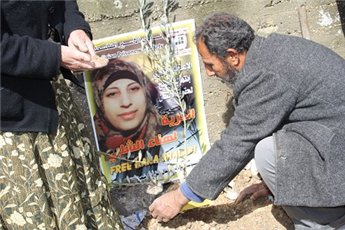
 News emerged today that a Palestinian woman, Hana Yahya al-Shalabi is on hunger strike against her renewed “administrative detention” without charge or trial by Israel. Al-Shalabi spent more than two years in administrative detention, and had been freed last October as part of the prisoner exchange deal between Israel and Hamas.
 Aletho News
