1921: Black Business District in Tulsa, Oklahoma, Attacked, Aerially Bombed and Razed, Victims Dumped in Mass Graves
Empire Slayer | May 16, 2015
An otherwise poor and uninformative documentary (funded by Pennsylvania Public Television and Corporation for Public Broadcasting) on the US bombing and burning alive of 11 residents, adults and children, of the MOVE house in Philadelphia, 1985, begins with one minute (10:30 to 11:30) on the rarely-mentioned 1921 onslaught, aerial bombing, and incineration of the “Black Wall Street” business district of Tulsa, Oklahoma, in 1921, by white mobs, including the KKK and government forces.
From the PPT, CPB doc:
May 31st, 1921, Tulsa, Oklahoma. The ‘Negro Wall Street’ district of the Greenwood neighborhood is bombed from the air.
Whites invade the enviable black business district, looting, burning, killing.
The police commandeer private planes. The 101st Airborne is flown in. A load of dynamite is dropped. 75 instantly killed. Hundreds of homes and businesses destroyed.
Four truckloads of bodies are shoveled into mass graves along the Arkansas river.
4,000 black men, women, and children arrested and placed in concentration camps, where they are required to carry ‘passes’.
The city quickly re-zones the neighborhood so that the railroad can be run through, thus completing the destruction of that neighborhood.
Wikipedia states that on May 31 and June 1, 1921:
… a group of white people attacked the black community of Tulsa, Oklahoma. It resulted in the Greenwood District, also known as ‘the Black Wall Street‘ and the wealthiest black community in the United States, being burned to the ground.
An estimated 10,000 blacks were left homeless, and 35 city blocks composed of 1,256 residences were destroyed by fire. The official count of the dead by the Oklahoma Department of Vital Statistics was 39, but other estimates of black fatalities vary from 55 to about 300.
The events of the riot were long omitted from local and state histories. “The Tulsa race riot of 1921 was rarely mentioned in history books, classrooms or even in private. Blacks and whites alike grew into middle age unaware of what had taken place.”
One official, the police chief, was found guilty of “failing to take proper precautions for protecting life and property, and for conspiring to free automobile thieves and collect rewards.”
“No legal records indicate that any other white official was ever charged of wrongdoing or even negligence.”
Black Wall Street neighborhood after the massacre and being razed:

Of the wider trend of this kind of violence in the US during that period, Pulitzer Prize-winning journalist Elliot G. Jaspin has documented in his book, Buried in Bitter Waters: The Hidden History of Racial Cleansing in America, that whites in the US, mainly in the period of about 1900 to about 1920, engaged in extraordinarily widespread, mass “racial cleansings” of large areas in which black people lived.
White terrorists would form mobs and drive out the black people, torturing and killing those who could not escape or refused to leave. The US government allowed the practice and did not punish or rectify it, and many of the cleansed counties remain entirely white today.
Records, like those from the Black Wall Street massacre, abound of harrowing escapes as white mobs fired at black civilians in their neighborhoods and burned down their houses, forcing people to flee through forests and creeks, hide in wells, or simply get on trains at gunpoint and go away.
Crucially, Jaspin also documents why this history is almost entirely unknown in the US: people either deny or try to explain away racial cleansings [and many other crimes of their society], through tactics such as using euphemisms, making excuses, or, the tactic perhaps most seen today, blaming the victims.
George Orwell wrote: “The nationalist not only does not disapprove of atrocities committed by his own side, but he has a remarkable capacity for not even hearing about them.”
Lynchings of black people were also a frequent occurrence during, before, and after this period.
Harvard scholar Garikai Chengu notes:
A lynching was a quintessential American public ritual that often took place in front of large crowds that sometimes numbered in the thousands. Historian Mark Gado notes that, “onlookers sometimes fired rifles and handguns hundreds of times into the corpse while people cheered and children played during the festivities”.
… in 1899 the Springfield Weekly described a lynching by chronicling how, “the Negro was deprived of his ears, fingers and genital parts of his body. He pleaded pitifully for his life while the mutilation was going on… before the body was cool, it was cut to pieces, the bones crushed into small bits… the Negro’s heart was cut into several pieces, as was also his liver… small pieces of bones went for 25 cents…”. Such graphic accounts were the norm in the South, and photos, were regularly taken of the lynched bodies on display and made into postcards that were sent all over the country.
Lynchings were sanctioned by the US government, as they were not prevented and went unpunished.
In the US today, Chengu continues, the:
… police state assassinates the Black victim twice. Once by way of lynching and again to assassinate the victim’s character so as to justify the public execution [blaming the victim].
Chauncey DeVega notes:
American Exceptionalism [the US state-worshiper’s version of “Our God is the One True God”] blinds those who share its gaze to uncomfortable facts and truths about their own country.
The burned to death images of the black body were a form of mass culture in 19th- and 20th-century America.
DeVega gives some samples of reports on how lynchings were carried out:
Two thousand people gathered for the killing, some taking a special excursion train from Atlanta for the purpose. The leaders of the lynching stripped Hose, chained him to a tree, stacked wood around him, and soaked everything in kerosene. The mob cut off Hose’s ears, fingers and genitals; they peeled the skin from his face. They watched, a newspaper reported, ”with unfeigning satisfaction” as the man’s veins ruptured from the heat and his blood hissed in the flames.
Another lynching:
“Great masses of humanity flew as swiftly as possible through the streets of the city in order to be present at the bridge when the hanging took place … the Negro was … taken to the City Hall … crowds of men, women and children turned and hastened to the lawn.
“On the way to the scene of the burning people on every hand took a hand in showing their feelings in the matter by striking the Negro with anything obtainable, some struck him with shovels, bricks, clubs, and others stabbed him and cut him until when he was strung up his body was a solid color of red, the blood of the many wounds inflicted covered him from head to foot.
“Dry goods boxes and all kinds of inflammable material were gathered, and it required but an instant to convert this into seething flames. When the Negro was first hoisted into the air his tongue protruded from his mouth and his face was besmeared with blood.
“Life was not extinct within the Negro’s body, although nearly so, when another chain was placed around his neck and thrown over the limb of a tree on the lawn, everybody trying to get to the Negro and have some part in his death. The infuriated mob then leaned the Negro, who was half alive and half dead, against the tree, he having just strength enough within his limbs to support him.
>“As rapidly as possible the Negro was then jerked into the air at which a shout from thousands of throats went up on the morning air and dry goods boxes, excelsior, wood and every other article that would burn was then in evidence, appearing as if by magic. A huge dry goods box was then produced and filled to the top with all of the material that had been secured.
“The Negro’s body was swaying in the air, and all of the time a noise as of thousands was heard and the Negro’s body was lowered into the box.” “No sooner had his body touched the box than people pressed forward, each eager to be the first to light the fire, matches were touched to the inflammable material and as smoke rapidly rose in the air, such a demonstration as of people gone mad was never heard before. Everybody pressed closer to get souvenirs of the affair. When they had finished with the Negro his body was mutilated.
“Fingers, ears, pieces of clothing, toes and other parts of the Negro’s body were cut off by members of the mob that had crowded to the scene as if by magic when the word that the Negro had been taken in charge by the mob was heralded over the city. As the smoke rose to the heavens, the mass of people, numbering in the neighborhood of 10,000 crowding the City Hall law and overflowing the square, hanging from the windows of buildings, viewing the scene from the tops of buildings and trees, set up a shout that was heard blocks away.”
In another lynching:
… fingers and toes were cut off, his teeth pulled out by pliers and finally he was castrated. It still wasn’t enough. Irwin was then burned alive in front of hundreds of onlookers (Brundage, p. 42).
DeVega continues that white torture and execution of blacks:
…was a ceremony … with distinct practices, that symbolically purged the black body from the white polity…
The rendering of spectacular violence against non-whites paid a psychological wage to white people that helped to create a type of social cement for White America, one that covered up its own intra-group tensions of class, religion, and gender. This racial logic continues in the present with a racially discriminatory criminal justice system, the murder by police of black and brown people, and how white Americans support such unfair treatment.
…
A 2001 report on the destruction of Black Wall Street “included the commission’s recommendations for some compensatory actions, most of which were not implemented by the state and city governments. The state passed legislation to establish some scholarships for descendants of survivors, economic development of Greenwood, and a memorial park to the victims in Tulsa. The latter was dedicated in 2010.”

Latest Amnesty International Ukraine War Crimes Report Fails the Test
By Roger Annis | The New Cold War | May 29, 2015
Amnesty International has issued a 33-page report on the treatment of captured combatants and of civilians caught in the crossfire of the civil war (‘Anti-Terrorist Operation’) that the governing regime in Kyiv launched in eastern Ukraine in April 2014. Titled, ‘ Breaking Bodies: Torture and Summary Killings in Eastern Ukraine‘, the report presents grave allegations against the Ukrainian government and against the defense forces of the Donetsk and Lugansk people’s republics. Allegations include forced and illegal detentions, prisoner abuse and torture, and summary executions.
The report has made headlines in Western mainstream press. One reason for that is its authorship. Amnesty International is a respected and renowned agency. But another reason is the nature of the report itself-it accuses both sides in the civil war with equal vigour.
That appeals to editors of Western publications who for the past year have systematically ignored or downplayed the documented accusations levied against the Ukrainian government and its armed forces and allied paramilitaries in earlier human rights reports. Those include the report of Human Rights Watch in October 2014 saying that Kyiv is using cluster weapons against civilian targets, and the lengthy reports in November 2014 and March 2015 of the Moscow-based Foundation for the Study of Democracy. The Human Rights Watch report concerning cluster weapons was corroborated by a separate and coincidental New York Times investigation and by later findings of inspectors of the Organisation for Security and Cooperation in Europe.
Is there any basis to Amnesty International’s equal treatment and equal blame against both sides? No there is not.
Firstly, Amnesty produces no numbers to back its equivalency treatment. It says these are difficult to ascertain. This may be true for arriving at very specific numbers. But given the volume of media and human rights reports documenting human rights violations and war crimes by Kyiv, and considering that the Ukrainian government controls more than 95 per cent of the territory of the country, it is a stretch, to say the least, to make an equivalency argument.
Secondly, the Amnesty report excludes reporting on the multiple documented cases of human rights atrocities throughout Ukraine, for example the massacre in Odessa on May 2, 2014 that saw more than 50 people killed by right-wing vigilantes. It makes no mention of the economic embargo and routine interruption of aid shipments imposed by Kyiv against the rebel territory, including cutting the pensions of seniors. Instead, the report selectively chooses the band of territory proximate to the actual combat zone in the southeast of Ukraine. As if documented human rights violations by the Ukraine government elsewhere in the country would have no bearing on its conduct in the war zone, a war zone, moreover, that Kyiv has created. As if the recent string of killings of journalists and politicians in Kyiv and other cities of the country are incidental.
The Amnesty report shows extreme bias against the rebel forces in Donetsk and Lugansk by its selective language. It calls them “separatists”, “the separatist side”, or “the self-styled Donetsk People’s Republic… and Luhansk People’s Republic”.
The term “separatist” is a pejorative, used to discredit those so labelled. Considering the changes to Ukrainian law in the past year which have made the advocacy of “separatism” in Ukraine a grave criminal act, not to speak of an invitation to vigilante violence and murder against anyone so accused, it is inconceivable that a human rights organization would so carelessly use the term.
Two additional reasons make Amnesty International’s use of the term a scandal. One, there is the small matter that it is not true. The leaders of the Donetsk and Lugansk republics as well as the advocates for political rights throughout eastern Ukraine have made it clear that they are receptive to any and all political options for the Donbas territory. The leaders of Donetsk and Lugansk signed the ceasefire agreement in Minsk, Belarus to this effect on February 12, 2015. Unfortunately, the Kyiv regime refuses to adhere to the clauses in that document, including the one that obliges it to negotiate forms of political autonomy (‘federalization’) with the rebel movement (a fact which the report by Amnesty omits mentioning).
Two, Amnesty International as well as the supporters of the governing regime in Kyiv throw around the term “separatist” (by which we can understand “political self-determination” or “secession”) as if it were some high crime. It is not. It is enshrined in international law. Many of the major countries of the NATO military alliance presently supporting Kyiv in its war have had perfectly legal “separatism” votes take place in their territories, including in Quebec, Canada in 1976 and 1995 and in Scotland, United Kingdom in 2015. Irony of ironies, modern, independent Ukraine itself was born of two “separatist” acts which made the country independent—the revolution of 1917-18 and the vote in 1991 to discontinue the Soviet Union.
While Amnesty has harsh language for the “separatists” of Donetsk and Lugansk, the extremist militias who are fighting alongside the regular Ukrainian army and committing no end of human rights atrocities are given kid-glove treatment. The Amnesty report calls the extreme-right militias that are waging cruel war in eastern Ukraine “volunteer militia formations”. This is the same, polite language used by Western media to minimize and obfuscate who it is, exactly, the NATO countries are backing in Ukraine, including with weapons and military training. (In recent months, the extremist paramilitaries have been incorporated into Ukraine’s National Guard in order to lessen embarrassment to their NATO country benefactors.)
Amnesty’s report commits another significant travesty in the field of human rights investigation by drawing an equivalency of responsibility between the national government in Kyiv and the rebel forces in eastern Ukraine. The two are not equivalent. Kyiv has sent its army against its own people, a violation of international convention and law. Kyiv is a member of the United Nations and is a signatory to all manner of international laws and conventions obliging it to protect the human and political rights of its citizens.
Kyiv has shelled and bombarded civilian targets on a scale far in excess of whatever shells from the opposite side have incidentally struck civilian targets. Last September, when the rebel side had huge military momentum in its favour, it declined to press its advantage and retake the city of Mariupol, saying the civil damage and civilian casualties that would result were unthinkable and would be unpardonable.
Of course, the rebel military should be subject to the same standards governing human and political rights as any government. Indeed, there is ample evidence, including in this latest report by Amnesty, that the governing powers in Donetsk and Lugansk are living up to their responsibilities. But to charge them with the same degree of responsibility as the internationally recognized government in Kyiv is to make a mockery of international law. How many judges would give a free pass to rights violations by a national government were it to argue, “Hey, you can’t accuse us of war crimes, we say that the other side committed them, too.”
The fact that Kyiv is able to perpetrate war crimes and massive rights violations against its civilian population while enjoying the vigorous backing of many of the major governments of the world and of much of mainstream media, while a leading, international human rights organization apparently turns a blind eye, is a very alarming sign of the deterioration of the regime of accountability for war crimes that the post-WW2 trials against officials of Nazi Germany established.
Lastly, in its hasty and all-too-brief summary of the human rights topic it is supposedly investigating, Amnesty leaves a gaping, unanswered question. It writes in the report, “The [Donetsk Peoples Republic] officially suspended prisoner exchanges on 5 April 2015, but even since that time it has released some prisoners on an ad hoc basis. Some have been released directly to relatives who picked them up from their places of detention, while others have been released after informal negotiations, including by priests and war veterans on both sides of the conflict.”
Now why did the DPR suspend prisoner exchanges? Left unsaid in the Amnesty report is that the decision was made by Donetsk officials because of Kyiv’s failure to implement the Minsk ceasefire agreement, specifically, its obligation to join in creating working groups to oversee implementation of all the agreement’s terms. Questions have also been raised about whether Kyiv is providing genuine prisoners of the conflict for exchange or whether it is emptying its jails of common prisoners, as it did following the first ceasefire agreement in September 2014 (New York Times report).
Overall, this report by Amnesty International is an example of the bad place where a human rights agency ends up when it promotes a “plague on both your houses” line in a conflict where feigned neutrality only obscures the human rights issues at stake.
Unfortunately, Amnesty’s “both sides are to blame” message will carry a great deal of weight and will be spread far and wide. It deserves vigorous response and challenge.
US government ordered to prepare Guantánamo force-feeding videos for release
Reprieve | May 29, 2015
An appeal court has today ordered the Obama Administration to redact 12 hours of secret Guantánamo force-feeding footage in preparation for its public release, rejecting the Administration’s argument that not one single frame should be seen by the public.
The classified videos, which show Guantánamo prisoner Abu Wa-‘el Dhiab being forcibly removed from his cell and force-fed by the US military, were ordered to be released to the public by federal Judge Gladys Kessler in October 2014, following a First Amendment intervention from 16 US press organizations in the abuse case Dhiab v Obama.
The Obama Administration defied Judge Kessler’s order to prepare the videos for release, complaining that the process was too much work and insisting that revealing even one frame from the videos posed a national security risk. Leaving the videos unredacted, the Administration took the case straight to D.C.’s federal Court of Appeals in an attempt to get the order overturned.
In a judgment handed down today, the Court of Appeals ruled that the Administration’s refusal to comply with the lower court’s order was wrong, and rejected its attempt to use the ‘burdensome’ task of redacting videos as a reason to circumvent the First Amendment.
The Obama Administration must now comply with Judge Kessler’s original order to redact the videotapes to address national security concerns, and submit the redacted tapes to her court for reconsideration ahead of their release.
Alka Pradhan, Reprieve US attorney for Mr Dhiab, said: “The Obama Administration’s defiance of Judge Kessler’s order suggests a basic contempt for both the court’s authority and our First Amendment rights, which the Circuit judges recognized.
“The Administration is fighting hard because once those videotapes are redacted, they are one step closer to public release – and the government is one step closer to being held accountable for their treatment of Guantanamo detainees. Yet the harder the Administration resists, the more they confirm that they have much wrongdoing to hide.
“It is time to stop running absurd arguments, and simply to do the right thing: expose and end the ongoing abuse of hunger-strikers at Guantanamo Bay.”
With Courage and Anguish, A Gaza Athlete Speaks Out
By Barbara Erickson | TimesWarp | May 28, 2015
His name is Iyad Abu Gharqoud; he is a soccer player and a resident of Gaza, and he speaks to us directly from The New York Times today, allowing us to hear his anguish— as well as his courage—in telling his own experience of Israeli oppression. This is a rare occurrence in the newspaper of record, and we should savor the moment.
It is true that Abu Gharqoud’s op-ed piece “FIFA Should Give Israel the Red Card,” appears in print only in the international edition, but it is also to be found online, with a reasonably prominent position on the World page. The essay, calling on FIFA to suspend Israel for its treatment of Palestinians, is notable for its ring of genuine feeling: his love of soccer, his grief at the suffering he has endured and witnessed and his fear of Israeli reprisals for this moment of speaking out.
The young athlete writes to us from Bureij, a refugee camp in the Gaza Strip, where his family has lived since they were driven from their home near Beersheba in 1948. He has found “great joy” in playing soccer, but as a professional he has come up against the fact that Palestinians under occupation live “at the whim of Israeli officials.”
His teams, Hilal al Quds and the Palestinian national team, are often held up at check points or prevented from traveling altogether; players, coaches and referees are denied travel rights, harassed and imprisoned; and two athletes were permanently maimed last year when Israeli border police shot them in their feet.
Abu Gharqoud writes of the special agony of Gaza, where Israel bombed soccer fields and recreation areas last summer, where four boys died under Israeli shells as they played soccer on a sandy beach and where Israeli missile fire killed eight soccer fans as they watched a televised World Cup game.
When he calls for FIFA to suspend Israel, his plea has the force of a moral argument. “I have been stopped at too many checkpoints, held for too many hours and suffered too long on account of my Palestinian nationality to be silent at this crucial moment,” he writes.
Here it becomes clear that he is taking a serious risk by speaking out. He goes on: “I have dedicated much of my life to excelling at the sport I love, but there are more important things in life than success on the soccer pitch.” In other words, he knows that Israel could choose to ruin his career for what he has told the world.
This is an antidote to the usual Times reports on Palestine/Israel, where we find official commentary taking the place of on-the-ground reality. Abu Gharqoud speaks with an authentic voice, and he gives us one small piece of the crushing Israeli occupation of Palestine.
Although he writes of soccer, he links its struggle under Israeli rule to the larger picture of occupation, to the “subjugation of the Palestinian people.” Two states or one, he writes, is not important. “Equality is.”
The article should point us to Israel’s repressive policies beyond the game of soccer. We could substitute almost any other endeavor in its place and find similar stories: in education, for instance, where schools are attacked with tear gas and students detained on the way to exams, in agriculture, where crops are destroyed and market produce left to rot at checkpoints.
In this piece, the Times has lifted the curtain to give us a brief view of the crushing effect of the Israeli occupation. Readers would benefit from more of this, but past experience warns that we should not expect a repeat any time soon.
Kiev’s Repression of Anti-Fascism in Odessa
By ERIC DRAITSER | CounterPunch | May 27, 2015
There is a common misconception in the West that there is only one war in Ukraine: a war between the anti-Kiev rebels of the East, and the US-backed government in Kiev. While this conflict, with all its attendant geopolitical and strategic implications has stolen the majority of the headlines, there is another war raging in the country – a war to crush all dissent and opposition to the fascist-oligarch consensus. For while in the West many so called analysts and leftists debate whether there is really fascism in Ukraine or whether it’s all just “Russian propaganda,” a brutal war of political repression is taking place.
The authorities and their fascist thug auxiliaries have carried out everything from physical intimidation, to politically motivated arrests, kidnappings, torture, and targeted assassinations. All of this has been done under the auspices of “national unity,” the convenient pretext that every oppressive regime from time immemorial has used to justify its actions. Were one to read the Western narrative on Ukraine, one could be forgiven for believing that the country’s discontent and outrage is restricted solely to the area collectively known as Donbass – the Donetsk and Lugansk People’s Republics as they have declared themselves. Indeed, there is good reason for the media to portray such a distorted picture; it legitimizes the false claim that all Ukraine’s problems are due to Russian meddling and covert militarization.
Instead, the reality is that anger and opposition to the US-backed oligarch-fascist coalition government in Kiev is deeply rooted and permeates much of Ukraine. In politically, economically, and culturally important cities such as Kharkov, Dnepropetrovsk, and Kherson, ghastly forms of political persecution are ongoing. However, nowhere is this repression more apparent than in the Black Sea port city of Odessa. And this is no accident.
Odessa: Center of Culture, Center of Resistance
For more than two centuries, Odessa has been the epicenter of multiculturalism in what is today called Ukraine, but what alternately was the Soviet Union and the Russian Empire. With its vibrant history of immigration and trade, Odessa has been the heart of internationalism and cultural, religious, and ethnic coexistence in the Russian-speaking world. Its significant populations of Russians, Jews, Ukrainians, Poles, Germans, Greeks, Tatars, Moldovans, Bulgarians and other ethnic and national identities made Odessa a truly international city, a cosmopolitan Black Sea port with French architecture, Ottoman influence, and rich Jewish and Russian/Soviet cultural history.
In many ways, Odessa was the quintessential Soviet city, one which, to a large extent, actually embodied the Soviet ideal enumerated in the state anthem – a city “united forever in friendship and labor.” And it is this spirit of multiculturalism and shared history which rejects the racist, chauvinist, fascist politics which now passes for standard political currency in “Democratic Ukraine.”
When in February 2014, the corrupt, though democratically elected, government of former President Viktor Yanukovich was ousted in a US-backed coup, the people of Odessa, just as in many other cities, began to organize counter-demonstrations against what they perceived to be a Western-sponsored oligarch-fascist alliance seizing power over their country. In the ensuing weeks and months, tens of thousands turned out into the streets to air their discontent, including massive rallies held in February, March, and April.
This inchoate movement against the new dispensation in Kiev, handpicked by the US and its European allies, culminated in two critical events: the establishment of an anti-Maidan movement calling for federalization and greater autonomy for the Odessa region, and the massacre at the Trade Unions House carried out by fascist thugs which resulted in the deaths of more than fifty anti-fascist activists and demonstrators. As a protest organizer and eyewitness recounted to this author, “That was the moment when everything changed, when we knew what Ukraine had really become.”
The brutality of the pogrom – an appropriate word considering the long and violent history of this region – could hardly be believed even by hardened anti-fascist activists. Bodies with bullet wounds found inside the burned out building, survivors beaten on the streets after their desperate escape from the flames, and myriad other horrific accounts demonstrate unequivocally that what the Western media dishonestly and disgracefully referred to as “clashes with pro-Russian demonstrators,” was in fact a massacre; one that forever changed the nature of resistance in Odessa, and throughout much of Ukraine.
No longer were protesters simply airing their grievances against an illegitimate government sponsored by foreigners. No longer were there demonstrations simply in favor of federalization and greater autonomy. Instead, the nature of the resistance shifted to one of truly anti-fascist character seeking to get the truth about Ukraine out to the world at large. Where once Odessa had been the site of peaceful demands for fairness, instead it became the site of a brutal government crackdown aimed at destroying any semblance of political protest or resistance. Indeed, May 2, 2014 was a watershed. That was the day that politics became resistance.
The Reality of the Repression
The May 2, 2014 massacre in Odessa is one of the few examples of political repression that actually garnered some attention internationally. However, there have been numerous other examples of Kiev’s brutal and illegal crackdown on dissent in the critical coastal city and throughout the country, most of which remain almost entirely unreported.
In recent weeks and months, the local authorities have engaged in politically motivated arrests of key journalists and bloggers who have presented a critical perspective on the developments in Odessa. Most prominent among them are the editors of the website infocenter-odessa.com, a locally oriented news site that has been fiercely critical of the Kiev regime and its local authorities.
In late 2014, the editor of the site, Yevgeny Anukhin, was arrested without any warrant while he was attempting to register his human rights organization with the authorities. According to various sources, the primary reasons for his arrest were his possession of video evidence of illegal shelling by Ukrainian military of a checkpoint in Kotovka, and data on his computer which included a compilation of names of political prisoners held without trial in Odessa. With no evidence or warrant, and in breach of standard legal procedures, he was arrested and charged with recruitment of insurgents against the Ukrainian state.
In May 2015, the new editor of infocenter-odessa.com Vitaly Didenko, a leftist, anti-fascist activist and journalist was also arrested on trumped up charges of drug possession which, according to multiple sources in Odessa, are entirely fabricated by the SBU (Security Service of Ukraine) secret police in order to create a pretext upon which to detain him. In the course of his arrest, Didenko was seriously injured, incurring several broken ribs and a broken arm. He is currently sitting in an Odessa jail, his case entirely ignored by Western media, including those organizations ostensibly committed to the protection of journalists.
Additionally, just this past weekend (May 24, 2015) there was yet another sickening display of political repression on the very spot of the May 2, 2014 massacre. Activists and ordinary Odessa citizens had been taking part in a memorial service for the victims of the tragedy when the demonstration was violently dispersed by armed men in either military or national guard uniforms (see here for photos). According to eyewitnesses, the military men instigated violence at the gathering and broke it up, all while both local police and OSCE monitors stood aside and watched. Naturally, this is par for the course in “Democratic Ukraine.”
Aside from journalists, a large number of activists have been detained, kidnapped, and/or tortured by Ukrainian authorities and their fascist goons. Key members of the Borotba (Struggle) leftist organization have been repeatedly harassed, arrested, and beaten by the police. One particularly infamous example was the detainment of Vladislav Wojciechowski, a member of Borotba and survivor of the May 2nd massacre. According to Borotba’s website, “During the search of the apartment where he lived, explosives were planted. Nazi “self-defense” paramilitaries participated in his arrest. Vladislav was beaten, and it is possible that a confession was beaten out of him under torture. Currently, he is in SBU custody.” He was ultimately charged with “terrorism” by the authorities after having been beaten and tortured by both Nazi goons and SBU agents.
Upon his release more than three months later in December 2014 in a “prisoner exchange” between Kiev and the eastern rebels, Wojciechowski defiantly stated, “I am very angry with the fascist government of Ukraine, which proved once again with its barbaric acts that it is willing to wade through corpses to defend its interests and those of the West. They failed to break me! And my will has become tempered steel. Now I’m even more convinced that it is impossible to save Ukraine without defeating fascism on its territory.” Wojciechowski was also the editor of the website 2May.org, a site dedicated to disseminating the truth about the Odessa massacre.
It should be noted though that Wojciechowski was arrested along with his comrades Pavel Shishman of the now outlawed Communist Party of Ukraine, and Nikolai Popov of the Communist Youth. These arrests should come as no surprise to observers of the political situation in Ukraine where all forms of leftist politics – the Communist party, Soviet symbols and names, etc. – have been outlawed and brutally repressed.
Kiev is not only engaged in an assault on political freedoms, but also a class war against the working class of Odessa and Ukraine generally. That the events leading up to the massacre took place at Kulikovo Field – a famous staging area for Soviet era demonstrations of working class politics – and the massacre itself took place in the adjacent Trade Unions House, there’s a symbolic resonance, the significance of which is not lost on the people of Odessa. It is the attempt to both erase the legacy of working class struggle and leftist politics, as well as the sacrifices of previous generations in a place where historical memory runs deep, and the scars of the past have yet to heel.
Aside from these shameful attacks on leftist formations, multicultural institutions too have been repressed under the pretext of “Russian separatism.” A multiethnic, multi-nationality organization known as the Popular Rada of Bessarabia (PRB) was founded in early April 2015 in order to push for regional autonomy and/or ethnic autonomy in response to the legal and extralegal attacks on minorities by the Kiev authorities. It was reported that within 24 hours of the founding congress, Ukraine’s SBU had detained the core leaders of the organization, including the Chair of the organization’s presidium Dmitry Zatuliveter whose whereabouts, according to this author’s latest information, remain unknown. Within two weeks 30 more PRB activists were arrested, including founding member Vera Shevchenko.
While the Western media and its armies of think tanks and propaganda mouthpieces steadfastly deny that an organization such as PRB can be anything other than “a project of Russian political consultants,” the reality is that such moves have been a reaction to repressive legislation and intimidation by the US-backed regime in Kiev which has done everything from outlawing the two most popular political parties of the Russian-speaking South and East (The Party of Regions and the Communist Party), to attempting to strip the Russian language of official status within Ukraine, a move interpreted by these groups as a direct threat against them and their regions where Russian, not Ukrainian, is the lingua franca.
As Senior Fellow at the Jamestown Foundation and former Radio Free Europe/Radio Liberty (read CIA front) contributor Vladimir Socor wrote last month in an article entitled Ukraine Defuses Pro-Russia Instigations in Odesa Province, “In the spirit of preventive action, Ukrainian law enforcement agencies have arrested some 20 members of a centrifugal organization in Odesa [sic] province.. The timely intervention also stopped the publicity bandwagon that had just started rolling from Moscow in support of the Odesa [sic] group.” Interestingly, the author deceptively frames his apologia for so called “preventive detention” as merely a “timely intervention,” conveniently glossing over the blatant illegality of the action by Kiev, which has eschewed the rule of law in favor of brute force and repression.
And what is the PRB’s great crime in the eyes of Mr. Socor and the US interests for which he speaks? As he directly states in the article with typical condescension:
[BPR’s program and manifesto] include demands for: greater representation of ethnic groups in the administration of Ukraine’s Odesa [sic] province; promotion of the ethnic groups’ cultural identities and schools; conferral of a “national-cultural special status” to Bessarabia; a free economic zone, with specific reference to local control over Ukraine’s Black Sea and Danube ports; no integration of Ukraine with the European Union, the “enslavement practices of which would ruin the region and its agriculture”; and reinstatement of Ukraine’s [recently abandoned] international status of nonalignment, or else: “In the event of Ukraine moving close to NATO [the North Atlantic Treaty Organization], we reserve the right to implement the self-determination of Bessarabia.”
A careful reading of these demands reveals that these are precisely the demands that any right-minded anti-imperialist position should espouse, including rejection of NATO integration, rejection of EU integration, rejection of opening up Ukraine’s agricultural sector to the likes of Monsanto and other Western corporations, and protection of ethnic, religious, and cultural minorities, among other things. While Socor writes of these demands derisively, the reality is that they constitute precisely the sort of program that is essential for defending both Ukraine’s sovereignty, and the rights of the people of Odessa and the region. But of course, for Socor, this is all just a Russian plot. Instead, he kneels to kiss the chocolate ring of Poroshenko… and perhaps other parts of Victoria Nuland and John Kerry, while vigorously cheer-leading further political repression.
A Message for the Left
The question facing leftists internationally is no longer whether they believe there are fascists in Ukraine, or whether they are an important part of the political establishment in the country; this is now impossible to refute. Rather, the challenge before the international left is whether it can overcome its deep-seated mistrust of Russia, and consequent inability to separate fact from fiction, and unwaveringly defend its comrades in Ukraine with the conviction and aplomb of its historical antecedents.
There is a whole history that is under assault, a whole people being oppressed, a leftist tradition being ground to dust under the heel of an imperialist agenda and comprador oligarch bourgeoisie. Some on the left choose to snicker derisively at this struggle, aligning themselves once again with the Empire just as they so often have in Libya, Syria, and elsewhere. And then there are those who, like this author, refuse to be cowed by the baseless slur of “Russian apologist” and “Putin puppet”; those of us who choose not to look away while our comrades in Ukraine are beaten, kidnapped, tortured, imprisoned, and disappeared.
For while they speak out in the face of reprisals, in the midst of brutal repression, under threat of prison and death, the least we can do is speak out from our comfortable chairs. Anything less is moral cowardice and utter betrayal.
Yemeni man to continue case against German government over role in US drone strikes
Reprieve | May 27, 2015
A German court has granted ‘immediate permission to appeal’ to a Yemeni man in his case seeking to expose and put an end to the German government’s role in the U.S. covert drone programme in Yemen.
Faisal bin Ali Jaber, an environmental engineer from Sana’a who had two relatives killed in a 2012 drone strike, had his evidence heard in a Cologne court today. Mr bin Ali Jaber – represented by international human rights charity Reprieve and its local partner the European Center for Human Rights (ECCHR) brought the case against Germany, following revelations that Ramstein air base is crucial to facilitating American covert drone strikes in Yemen.
Although the court ruled against Mr bin Ali Jaber in today’s hearing, it gave him immediate permission to appeal the decision, while the judges agreed with his assertion that it is ‘plausible’ Ramstein air base plays a key role in facilitating drone strikes in Yemen.
Mr Jaber lost his brother-in-law Salim, a preacher, and his nephew Waleed, a local police officer, to a US drone strike which hit the village of Khashamir on 29 August 2012. Salim often spoke out against extremism, and had used a sermon just days before he was killed to urge those present to reject Al Qaeda.
Faisal bin Ali Jaber said: “I had hoped that today the Court would restore Yemen’s faith in the West’s commitment to the rule of law, and that the German government would put a stop to its role in these illegal and immoral operations. It is shameful that they won’t even admit to the part they play in killing innocent civilians and terrorising entire communities. But we will not give up: it is – quite simply – a matter of life or death for us. I am of course disappointed by the outcome today, but remain grateful to the court for hearing my case and am pleased that they have encouraged me to appeal. This is just the beginning of our efforts and I will continue to place my faith in the justice system and the rule of law, to find a peaceful and sustainable way to keep myself and my family safe, and end the devastation brought to my country by drones.”
Kat Craig, Reprieve legal director which represents Mr bin Ali Jaber said: “Without Germany – and other Western allies – the U.S. could not fly the drones that kill innocent civilians like my client Faisal’s family in Yemen. For too long, the drone programme has been allowed to operate in the shadows – away from judicial and public scrutiny. Whilst we may have lost today, this hearing was an important step in the direction of greater transparency and accountability for the US and its allies in its illegal and immoral drone programme. We may not yet have achieved the end to Germany’s role in the illegal U.S. drone war in Yemen, but this simply means that we must redouble our efforts to support our clients in their attempts to end the death and suffering that drones bring in Yemen.”
Second senior Brotherhood official dies in prison
MEMO | May 26, 2015
Senior Muslim Brotherhood official and former parliamentarian Mohamed Falahji, 58, died in an Egyptian prison on Monday morning, Quds Press has reported.
Falahji is the second top leader of the movement to have died in prison as a result of maltreatment or lack of proper medical attention. His death brings the number of prisoners who have died in Egyptian prisons since the ouster of the freely-elected President Mohamed Morsi in August 2013 to 265.
The parliamentarian was arrested on 26 August, 2013 on charges of affiliation with a “terrorist” organisation, taking part in demonstrations and inciting violence. He was sent to Jamasah Prison, northern Egypt just over a month later. It was there that he started to experience a lot of pain.
After several calls by his family and appeals by his lawyer, he was transferred to the public hospital in Damietta last month. After examination, he was found to be suffering from kidney stones and inflammation of the gall bladder. He was sent back to prison without receiving any proper treatment.
Falahji’s death comes just a few days after former lawmaker and official in the Freedom and Justice Party Farid Ismail died of liver failure in a Cairo hospital. He was also 58 years old.
Isamil, who was sentenced to seven years in prison last year, was moved from jail in Al-Zagazig to Al-Aqrab Prison Hospital in Tora, south of Cairo, a few days before his death. He was in a coma for several days before he was pronounced dead by the authorities.
On 27 September, 2013, a Brotherhood official in Daqhaliyya, Safwat Khalil, 57, died of cancer in Al-Mansoura Prison. Several others at different leadership levels and members of the Islamic movement have also died in custody due to different diseases or in mysterious circumstances.
The Egyptian authorities insist that all prison inmates have access to proper medical treatment. They stress that they are following international standards and conventions in this regard.
According to Ahmed Mufreh, the director of the Egypt portfolio with NGO Al-Karama for Human Rights, 135 prisoners have died in Egyptian custody since Abdel Fattah Al-Sisi led the coup against Morsi in 2013.
Israeli court sentences Palestinian speaker to prison

Speaker of the Palestinian Legislative Council (PLC) Abdul Aziz Duwaik
Press TV – May 25, 2015
An Israeli military court has handed down a months-long prison term to the speaker of the Palestinian Legislative Council (PLC) and ordered him to pay more than a thousand dollars on charges on of delivering a speech at a pro-resistance celebration three years ago.
On Monday, the Ofer Court in northern Israel sentenced Abdul Aziz Duwaik to 12 months in jail and a fine of six thousand Israeli shekels (USD 1,550), Arabic-language Palestinian news agency Safa reported.
The Ahrar Center for Prisoner Studies and Human Rights condemned the verdict, demanding the immediate release of all Palestinian prisoners currently being held at Israeli detention facilities, the 67-year-old PLC speaker in particular.
Fuad al-Khafash, director of the Palestinian non-governmental organization (NGO), said the Tel Aviv regime has targeted the Palestinian parliament ever since the Palestinian resistance movement Hamas scored a landslide victory in Palestinian elections in 2006, preventing Palestinian lawmakers from serving their respective nation.
Khafash named Hassan Yousef, Mohammad al-Natsheh, Hassan al-Bourini, Mohammad Maher, Yousef Bader and Ezam Salhab as some of the Palestinian legislators that Israel holds captive in its jails.
Israeli soldiers abducted Duwaik in the occupied West Bank city of al-Khalil (Hebron) early on June 16, 2014. Palestinian sources said the senior Hamas official was taken away after his house in al-Khalil was stormed.
Meanwhile, Israeli forces have also arrested at least sixteen Palestinians, including a number of teenagers, during separate raids on a number of houses across the occupied West Bank.
Palestinian security sources, speaking on condition of anonymity, said Israeli military soldiers raided the town of Silwan, which lies on the edge of East al-Quds (Jerusalem) and al-Quds on Monday, and detained eleven Palestinians.
Israeli forces took away five other Palestinians from the entrance gate of the al-Aqsa Mosque compound in the occupied West Bank.
In recent months, Israeli forces have frequently raided the houses of Palestinians in the West Bank, arresting dozens of people, who are then transferred to Israeli prisons, where they are kept without any charges.
There have been many reports about the deteriorating health of Palestinian prisoners held inside Israeli jails.
More than 7,000 Palestinians are reportedly held in 17 Israeli prisons and detention camps. Moreover, 540 Palestinians are held without any trial under the so-called administrative detention, which is a sort of imprisonment without trial or charge that allows Israel to incarcerate Palestinians for up to six months. The detention order can be renewed for indefinite periods of time.
Israeli interrogators use ‘brutal’ methods to obtain false confessions

Ma’an – May 24, 2015
BETHLEHEM – Israeli interrogators are using “oppressive and brutal” methods to frighten Palestinian detainees and force them into confessing to attacks against Israel, a Palestinian official said Sunday.
Issa Qarage, who heads the Palestinian Authority prisoners’ affairs committee, made his comments during a visit to prisoners’ families in the northern West Bank village of Qusin in Nablus district, where he met with former detainee Noor Muhammad Hilmi Hamamrah, 15.
Hamamrah told him that during his interrogation in the Etzion detention center, Israeli interrogators had made him open his mouth while they used pincers to forcibly pry out part of his braces, causing bleeding.
An interrogator then told Hamamrah that he would pull out all of his teeth if he didn’t confess to throwing stones at Israeli vehicles, Qarage relayed.
Qarage said that the boy eventually made the confession.
Hamamrah was detained from his family home on April 15 at 3:00 a.m. and was taken in a military truck to the nearby Beitar Illit settlement where he was held for three hours before being taken to the detention center.
An Israeli prison spokesperson could not be reached for comment on Hamamrah’s account.
Prisoners’ rights group Addameer has long reported that treatment of Palestinian detainees by Israeli forces tantamount to torture is “widespread and systematic.”
In 2014, international rights group Defense for Children reported that 93 percent of children detained by Israeli forces were denied access to legal counsel, while others endured prolonged periods of solitary confinement for interrogation purposes, a practice that amounts to torture under international law.
“Fail to obey and we will break your legs”
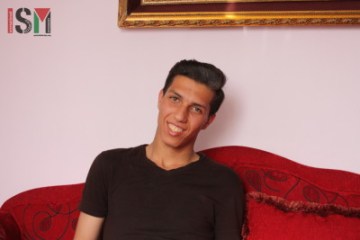
Baraa Kalaid Madhun in his home
International Solidarity Movement | May 24, 2015
Al Khalil, Occupied Palestine – On the 21st of May, a 16-year old Palestinian, Baraa Kalaid Madhun, was banned from his own home in Al Khalil (Hebron). Armed Israeli soldiers came to his house at 8 pm and told him to step outside. Allegedly stones had been thrown at the military base, which is adjacent to Baraa’s home, and the soldiers were accusing him of this incident.
For four hours the Israeli forces searched the house, whilst Baraa was held at gunpoint outside. They then told him that for the next 30 days, he was not allowed to be in his house between 6 in the evening and 11 in the morning. The logic behind this arrangement is based on the assumption that if during these 30 days no stones were thrown, then Baraa would be found guilty of the initial incident. The soldiers threatened to break his legs if he did not acknowledge these restrictions. Since then, armed Israeli soldiers have been searching his house each night, to see if he is there.
This latest incident is one of many. The family is constantly being harassed by the Israeli occupation forces. Baraa himself has already been arrested six times. During those previous arrests, the soldiers have been very violent, once even fracturing his shoulder.
Punishing Poland for US Crimes

By Nat Parry · Essential Opinion · May 19, 2015
It is one of the great ironies of the U.S.-led war on terror and post-Cold War transatlantic relations that democratic accountability and human rights protections at times seem stronger in the former Soviet bloc than they do in the United States. This lesson was driven home again last week when Poland paid a quarter of a million dollars to two terror suspects tortured by the CIA in a secret prison on Polish territory between 2002 and 2003.
Imposed by the European Court of Human Rights, the penalty issued against Poland prompted outrage among many Poles who felt they were being unfairly punished for American wrongdoing. “We might have to pay compensation even though our personnel did nothing wrong,” said Radoslaw Sikorski, Poland’s former foreign minister. Sikorski noted that Poland is the only country that has sought to hold accountable its own senior officials whose decisions allowed the CIA to commit human rights violations on its territory.
This lack of accountability also goes for the United States, which has failed to investigate or prosecute any of the senior officials who authorized the human rights violations at secret CIA prisons in Poland or anywhere else.
Of the 119 known detainees held in CIA black sites between 2001 and 2006, at least 39 were subjected to torture by CIA personnel, according to the U.S. Senate Intelligence Committee report on torture released last December. The two individuals tortured in Poland, Abu Zubaydah and Abd al-Rahim al-Nashiri, were eventually sent to Guantanamo Bay, where they have remained since 2006.
While al-Nashiri is currently on trial for allegedly orchestrating the 2000 bombing of the USS Cole, Abu Zubaydah is considered one of Guantanamo’s “forever prisoners,” with no charges or trial foreseen. Not even a preliminary ruling has been made on his case in nearly seven years. In a May 12, 2015 article, ProPublica noted that his case has been stalled “for 2,477 days and counting.”
As one of his lawyers, Helen Duffy, wrote in the Guardian last December following the long-delayed release of the Senate report’s executive summary, “Abu Zubaydah might now be described as exhibit A” in the CIA’s rendition and torture regime.
“He has the regrettable distinction of being the first victim of the CIA detention programme for whom, as the report makes clear, many of the torture (or ‘enhanced interrogation’) techniques were developed, and the only prisoner known to have been subject to all of them,” Duffy wrote.
The Senate report contains about 1,000 references to Abu Zubaydah specifically, and confirms the ECHR’s findings regarding the interrogation techniques that he endured.
Among these were “wallings” (being slammed repeatedly against a wall), sleep deprivation for up to 180 hours (usually nude and in stress positions), and waterboarding. The waterboarding of Abu Zubaydah, to which he was subjected 83 times in one month alone, was authorized at the highest levels of the U.S. government.
He was also subjected to extreme confinement.
“Over the course of the entire 20 day ‘aggressive phase of interrogation,’ Abu Zubaydah spent a total of 266 hours (11 days, 2 hours) in the large (coffin size) confinement box and 29 hours in a small confinement box, which had a width of 21 inches, a depth of 2.5 feet, and a height of 2.5 feet,” according to the Senate report. “The CIA interrogators told Abu Zubaydah that the only way he would leave the facility was in the coffin-shaped confinement box.”
Duffy notes that beyond Abu Zubaydah’s torture, the Senate report revealed how much misinformation was generated to justify his indefinite detention. Several of the CIA’s claims, in some cases reiterated long after they were known to be false, were repudiated point by point in the report.
For example, despite repeated assertions that Abu Zubaydah was “the third or fourth man in al-Qaida,” the report noted that the “CIA later concluded that Abu Zubaydah was not a member of al-Qaida.” It also refuted the government’s claims regarding his involvement in 9/11, that the interrogating team was “certain he was withholding information” and claims that his torture led to valuable actionable intelligence.
The case of Abu Zubaydah also led to the only prosecution to date in the United States associated with the CIA’s torture program – although not for anyone who was involved with his ill-treatment, but for the CIA whistleblower who first exposed it.
Selective Prosecution
In a 2007 interview with ABC News, former CIA officer John Kiriakou described the waterboarding of Abu Zubaydah and later allegedly provided to a journalist the name of a covert officer with the CIA’s Counterterrorism Center who worked on the operation to capture and interrogate Abu Zubaydah. For this offense, Kiriakou was charged under the 1917 Espionage Act and accepted a plea bargain for which he spent two years in prison.
The prosecution of Kiriakou was criticized at the time by some segments of the international community. The Parliamentary Assembly of the Organization for Security and Cooperation in Europe, for example, in a resolution adopted in 2012 “condemned the prosecution that U.S. authorities have initiated against former CIA agent John Kiriakou, who is accused of providing journalists details regarding the capture of Abu Zubaydah, an al-Qaeda suspect who is said to have been tortured in a secret CIA prison in Poland and is one of two individuals granted ‘victim status’ by prosecutors in Warsaw.”
Former U.S. Congressman Jim Moran (D-VA) said on the House floor on Nov. 17, 2012 that the government’s targeting of Kirakou represented a “selective prosecution.” He asked President Barack Obama to pardon Kiriakou and called the 15-year CIA veteran “an American hero.”
With Kiriakou out of prison after serving his term but the CIA’s torture victims still languishing in Gitmo with no end in sight, Poland has faced not only the political fallout for these policies but also the practical challenges of complying with the ECHR’s rulings considering the logistics of compensating individuals who are incarcerated – one a Palestinian and one a Saudi.
Nevertheless, “Poland is applying the ECHR’s decisions,” foreign ministry spokesman Marcin Wojciechowski said. “In the case of one person, the money was paid into a bank account indicated by his lawyers, in the case of the other, hit by international sanctions, we requested the creation of a judicial deposit,” he added.
In accordance with the ECHR ruling, Poland has also asked the United States to rule out the death penalty for the two men in line with an EU-wide ban on capital punishment, Wojciechowski told AFP.
Plausible Deniability
It irks many in Poland that their country is facing legal repercussions for the secret rendition and detention program which the CIA operated under then-President George W. Bush in several countries across the world after the 9/11 attacks. In Poland, the notion that the former Communist country would tolerate a secret CIA prison in which torture was being used was for years derided by the country’s politicians, journalists and the public as a crackpot conspiracy theory. Polish officials consistently denied the existence of any such prison.
But a string of revelations and political statements by Polish leaders acknowledged for the first time that the United States did indeed run a secret interrogation facility for terror suspects in 2002 and 2003 in a remote region of the country. In December 2014, Poland’s former President Aleksander Kwaśniewski officially admitted that a secret CIA prison had existed at an airbase where terror suspects were brought for interrogation, but he insisted that Warsaw had no knowledge of abuse happening at the site.
It appears now though that the denials of knowledge regarding torture may have been a case of willful ignorance or plausible deniability enforced by millions of dollars in cash payoffs. The Senate torture report revealed that despite initial threats by Poland to halt the transfer of terror suspects to the black site 11 years ago, the government became more “flexible” after the CIA started giving it large amounts of money. Reportedly, the CIA paid Polish officials as much as $50 million in cash to look the other way.
But according to Radoslaw Sikorski, Poland’s former foreign minister and now marshal of the lower house of the Parliament, the prison was set up out of friendship with the United States. He now concedes however that the covert relationship has proved detrimental to Poland.
“We have been embarrassed by it, but even so we do not apologize for having the closest possible security and intelligence relationship with the United States,” he said. “We might have to pay compensation even though our personnel did nothing wrong. You can imagine how Polish people feel about it.”
“This left bad feelings on our side,” said Tadeusz Chabiera, founder of the Euro-Atlantic Association think tank in Warsaw. “We are a small country that was badly treated by a great power.”
The regrets and feelings of betrayal being expressed in Poland follow a long-established pattern that goes back at least a decade. Signs of this frustration first emerged in 2004 during the U.S.-led occupation of Iraq, to which Poland committed 2,400 troops.
At the height of the Iraqi insurgency, David Ost reported in The Nation magazine on Sept. 16, 2004, “George W. Bush has managed to do what forty-five years of Communist rule could not: puncture the image of essential American goodness that has always been the United States’ key selling point.”
America’s Eroding Image
In Poland, as in many countries around the world, much of that positive image was restored following the election in 2008 of Barack Obama and the promise of change that he seemed to represent. But as the Pew Research Center reported in 2013, “pro-America sentiment is slipping.”
“The decline is in no way comparable to the collapse of U.S. standing in the first decade of this century,” according to Pew, which noted that at the time of the 2013 global survey, more than six-in-ten in Poland, France, Italy, and Spain had a favorable opinion of the U.S. “But the ‘Obama bounce’ in the global stature of the United States experienced in 2009 is clearly a thing of the past.”
It remains to be seen whether the recent developments on CIA torture will play any significant role in further eroding the image of the United States, but the incongruity of a small country like Poland bearing the brunt of liability for these illegal policies while no one in the United States answers for them should not be lost on any of the U.S.’s other allies.
In some of the countries that cooperated with the U.S. rendition program, the wheels of justice are still spinning, albeit slowly.
A criminal investigation is ongoing in Lithuania, where prosecutors are focusing on a possible illegal border crossing involving CIA prisoner Mustafa al-Hawsawi who was allegedly tortured at a Lithunian black site code-named Violet.
Meanwhile, calls are growing for authorities to conduct a comprehensive investigation into the existence of a CIA black site in Romania, with former Romanian President Ion Iliescu revealing last month that he had approved CIA requests to set up at least one secret prison where prisoners were subject to torture. Iliescu said he deeply regrets that decision.
Calls also continue for the United States to launch credible investigations into its own role, and to offer reparations to the victims of the rendition and torture program.
Coincidentally, the ECHR’s penalty against Poland was imposed the same week that the U.S. was urged by the United Nations to financially compensate victims of the U.S. torture regime and to prosecute the perpetrators of this abuse.
According to a report by the UN Human Rights Council’s Working Group on the Universal Periodic Review, issued on May 15, the U.S. should “ensure that all victims of torture and ill-treatment – whether still in U.S. custody or not – obtain redress and have an enforceable right to fair and adequate compensation and as full rehabilitation as possible, including medical and psychological assistance.”
Further, the U.S. should “ensure proper and transparent investigation and prosecution of individuals responsible for all allegations of torture and ill treatment, including those documented in the unclassified Senate summary on CIA activities published in 2014 and provide redress to victims.”
With a September deadline to respond to the UN’s recommendations, the Obama administration will have to make a stated commitment to the world by deciding which of the recommendations will be accepted, and which will be rejected.
When it comes to torture prosecutions and compensation, it is safe to say that the world will be watching.
Israeli Military Police Criminal Investigations Division “Smother Investigation For Years”
MPCID and the Military Prosecution refuse to do the bare minimum required in the investigation of the death of a protester: find out where the shooters stood
By Yossi Gurvitz | Yesh Din | May 18, 2015
This blog has dealt more than once with cases in which MPCID negligence and intentional delaying seemed so exceptional, that you had to wonder whether they involved negligence or a calculated attempt to disrupt the investigation. The case before us, that of Palestinian protester Bassem Abu Rahmeh, moves in the same trajectory.
The Abu Rahmeh case, discussed here previously, is really quite simple. On April 17th, 2009, Abu Rahmeh protested near the separation wall in his village, Bil’in, in the West Bank. (We note that at the time, the wall followed a route that in 2007 the HCJ ruled to change, but the IDF was in no hurry and changed it only in 2011.) Abu Rahmeh was unarmed, and did not employ any violence, and yet, at the moment he protested the security forces shooting another demonstrator, an Israeli security forces personnel in uniform fired an extended-range tear gas grenade (a grenade used to disperse demonstrators from a distance) directly at him. The grenade hit Abu Rahmeh in the chest, and quickly led to his death.
Note and this is important: these facts are not being disputed. Even so, six years and counting after Abu Rahmeh’s death, the IDF – through MPCID and the Military Prosecution – is still doing its best to avoid trying the man who shot him. To quote the appeal we submitted to the HCJ with B’Tselem in April 2015, “From the chain of events, it is evident that this is (at best) a case of severe negligence on part of the respondents, and contempt of a most severe case of killing an unarmed protester, who was protesting peacefully. Military and civil law enforcement entities have allowed the case of a killing of an innocent man to fall through the cracks time and again, requiring the court to intervene repeatedly… Abu Rahmeh was killed by IDF soldiers who – at best – shot him negligently, and the investigation of the responsibility for his death was smothered for years by the investigative and prosecutorial bodies’ inexcusable red-tape behavior”.
Here is the chain of events, in chronological order:
17.4.2009 – An Israeli security forces personnel in uniform shoots Abu Rahmeh. The shooting is documented by three separate video cameras.
Due to the investigation policy at the time – which was changed only in 2011 – MPCID does not automatically investigate in case of death, unless explicitly ordered to by the Military Prosecution. The latter refuses to order an investigation of this case.
28.3.10 – Ten months after Abu Rahmeh’s death, the Military Prosecution provides an unusual argument for its refusal to order an MPCID investigation: the possibility that the grenade hit the fence and then ricocheted at Abu Rahmeh; the chance that the fact that Abu Rahmeh was standing on a rock when he was shot caused him “to converge” with the grenade’s course.
A reasonable person might think this is precisely what an investigation is supposed to find, since an unarmed demonstrator was shot during a non-violent demonstration, but apparently reasonable persons need not apply for work at the Military Prosecution.
3.6.10 – In response to the Military Prosecution’s peculiar statement, human rights organizations Yesh Din and B’Tselem do their work for them, and send the prosecution an expert opinion based on forensic architecture. As noted, Abu Rahmeh’s death was documented by three separate cameras, and the experts used the three videos to build a simulation showing where the shooter stood. According to this expert opinion, we don’t know the shooter’s identity, but we know where he was standing.
11.7.10 – Based on the expert opinion – new evidence obtained 15 months after the shooting – the Prosecution orders an MPCID investigation.
28.6.11 – Nearly a year after an MPCID investigation it initiated and 26 months after the killing, the Chief of the IDF Ballistics Department informs MPCID that “the only way such ordnance reached the target is if it was fired directly”, rather than above or below the target. That is, MPCID’s expert contradicts the Military Prosecution’s position from March 2010. We learned this bit only after the investigation was closed.
3.2.13 – Chief of the IDF’s Photo Reconnaissance Department informs MPCID that IDF orders forbid shooting directly at persons with this ordnance, and recommends the MPCID reconstruct the scene to establish where each of the shooters stood at the time of the shooting. MPCID refrained from conducting this elementary investigation. The Chief’s opinion came almost four years after the killing of Abu Rahmeh and almost 20 months after the Chief of the IDF’s Ballistics Department rules that the tear gas canister was indisputably fired directly at Abu Rahmeh.
3.3.13 – Some three years after the beginning of the MPCID investigation, we petition (with B’Tselem) the HCJ, demanding the Military Prosecution conclude the unending investigation and serve indictments – at the very least for negligent manslaughter.
September 2013 – The Military Prosecution closes the investigation, claiming it is unable to determine who shot Abu Rahmeh.
29.10.13 – Given the Prosecution’s decision to close the case, the HCJ rules that our petition is no longer relevant, but rules that “we are of the opinion that if there is an appeal, it must be dealt with speedily, so as not to delay proceedings further”.
4.11.13 – We request the investigative materials for preparation of an appeal.
27.3.14 – Five months pass before we receive part of the materials – not all of it.
7.4.14 – We request the missing material. Ten days before the fifth anniversary of Abu Rahmeh’s death.
27.5.14 – The missing material arrives.
24.7.14 – We appeal, with B’Tselem, including an expert opinion responding to the IDF’s opinion.
Our demands in the appeal were fairly simple: there are three suspects who admitted to firing extended-range tear gas grenades, and we wanted MPCID to carry out a complimentary investigation and implement the Chief of the Photo Reconnaissance Department’s recommendation to reconstruct the scene of the shooting to determine where each suspect stood. According to the data we gave MPCID, this would be enough to determine the identity of the shooter who killed Bassem Abu Rahmeh.
Furthermore, during the investigation of one of the three soldiers, he said that he not only fired tear gas grenade but he also took photos of the incident, and since MPCID did not bother to locate those photos, we wanted them to make an effort to. Let’s consider this for a moment: the Military Police’s Criminal Investigative Division heard, during an investigation of a killing, about the existence of evidence – and made no effort to obtain it.
A third point made in the appeal is the commanders’ responsibility for Abu Rahmeh’s death. An extended-range gas grenade is to be used at range of 200 meters or more; the demonstrators were much closer. From the investigation files we received we learned that most of the soldiers suspected of firing tear gas grenades during the demonstration complained during the investigation that they did not receive proper training on using the weapons they used, and furthermore, that they complained about this to their commanders previously. MPCID did not bother to investigate the commanders about this matter. Given that the investigation meandered on for more than three years, it’s will to be difficult to claim it was for lack of time.
Although the HCJ ordered that in the event of an appeal against the decision to close the case “it must be dealt with speedily,” and although our appeal included rather simple and clear demands, eight months have passed without any response from the prosecution.
Therefore, at the end of March, 2015 – nearly six years after Bassem Abu Rahmeh was killed – we were forced to petition the HCJ again, this time demanding a decision on the appeal.
During these six years, the Military Prosecution did its best not to investigate a relatively simple case of a man killed; six years in which human rights organizations had to provide the Prosecution with the evidence it itself did not bother to collect. During these six years, against the recommendation of IDF officers, MPCID did not reconstruct the scene of the crime to determine who stood where. In these six years, the IDF’s official investigative bodies did their negligent best to prevent the trial of a man who killed a non-violent protestor.
But when MPCID and the Prosecution carry out an investigation so unwillingly and so negligently it can barely be called an investigation, they put the soldiers at risk. To avoid a situation in which soldiers are tried outside their country, the investigation of the crime they carried out must be thorough and swift. No reasonable person would call the farce carried out by MPCID and the prosecution in the Abu Rahmeh case thorough or swift. If this is how they handle an investigation of a death, how do they investigate lesser offenses?
Featured Video
BRITAIN’S WARNING: PREPARE FOR WAR
or go to
Aletho News Archives – Video-Images
From the Archives
British weapons and personnel doing much of the killing in Yemen
Press TV – June 18, 2019
A detailed report published by the Guardian newspaper has shown how Britain is massively contributing to Saudi Arabia’s devastating war on Yemen as it suggests that London is not only supplying the bombs that fall on Yemenis, but it provides the personnel and expertise that keep the war going.
The comprehensive report by Arron Merat published on Tuesday showed that Britain was doing much of the killing in Yemen as the country continues to provide Saudi Arabia with everything it needs to turn its southern impoverished neighbor into a graveyard.
“Every day Yemen is hit by British bombs – dropped by British planes that are flown by British-trained pilots and maintained and prepared inside Saudi Arabia by thousands of British contractors,” said Merat in the report. … continue
Blog Roll
 Aletho News
- Yemen denounces European Parliament’s ‘hypocritical’ push to blacklist Ansarullah
- Qalibaf: UAE’s UN bid aims to ‘clear the runway’ for ‘Greater Israel’, whitewash genocide
- Pakistan reopens Iran border after boosting security: Report
- Why are so many Brazilians voting for Flávio Bolsonaro?
- Democrats Put Anti-Russia Agenda Ahead of American Workers
- Elijah Magnier: Yemen’s Strikes Are Shattering Saudi Arabia’s Long-Term Strategy
- Pentagon designates Chinese cultural centers national security threat
- Israel Demolishes Home Of Lebanese Journalist Whose Viral Film Exposed Pager Attack
- Record Oil, Empty Tanks: The UAE’s Miracle Recovery
- Burnham tackles Britain’s poverty with aggression in Yemen
- If Americans Knew
- An error has occurred; the feed is probably down. Try again later.
- No Tricks Zone
- Sudden Stratospheric Warming, Powerful El Niño Combination May Lead To Extreme Europe Cold, Energy Crisis!
- Two New Studies Find Thwaites Glacier Melt Cannot Be Driven By Human Activity Or A Warming Ocean
- E-Cars Reduce CO2 Emissions By Only 41% Compared To Internal Combustion Engine Vehicles
- Predictions Made By Renowned Climate Professor Over Past Decades Have Been Proven To Be Poor
- New Study Suggests Large Regions Of The Pacific Ocean Have Been Cooling For The Last 80 Years
- Germany’s Green Energy Debacle: High Energy Costs Force Kahla Porzellan to Close After 182 Years!
- New Study: 50 Years Of The Most Aggressive ‘Net Zero’ Policies Can Only Affect The Global Climate By 0.03°C
- US September “Heat” Was No Record…Many Records Set Decades Ago
- Latest European Green Energy Debacle; Portugal’s Largest Flagship Solar Park Insolvent!
- Green Energy Debacle: German Expert Professor Fritz Vahrenholt Warns Of Severe Economic And Social Consequences

