US Muslim tortured in UAE for 106 days struggles to prove FBI hand
RT | March 18, 2015
A US citizen, who was put on a no-fly list, declared a threat to national security and tortured in an UAE prison after refusing to become an FBI informant, is having a hard time proving it happened at the behest of the US authorities, his lawyer told RT.
Yonas Fikre is an Eritrean born American citizen who immigrated as a refugee to the US when he was 13 from neighboring Sudan. He became a US citizen and in 2006 settled in Portland, Oregon. His problems began soon after 2010 when he went back to Khartoum, where he still had relatives, to start an electronics import business.
In Sudan he was summoned to the US Embassy on false pretenses and was told by two FBI agents from Oregon that they wanted to ask him a few questions about his mosque in Portland. When Fikre demanded a lawyer and hesitated to answer questions about people he had prayed at the mosque with but barely knew – the agents told him he was placed on a no-fly list. Although there was “absolutely no factual justification” for that, his lawyer, Thomas Nelson, told RT.
Fikre was told he would be taken off the list if he agreed to work for the FBI as an informant. He eventually agreed to answer their questions, but not work for the feds. A couple of weeks later, Fikre says he received a letter from one of the FBI agents, telling him threateningly: “While we hope to get your side of issues we keep hearing about, the choice is yours to make. The time to help yourself is now.”
Taking threats into account, he still managed to fly to his relatives in Sweden. He concluded that he was not in fact deemed a serious threat and the FBI agents had been bluffing, although he wondered whether had he flown to a close US ally such as Britain that this would also have been the case.
He got a chance to find that out after he went to the UAE, one of the US’s closet allies in the Middle East, and was suddenly arrested by the local police.
Fikre was held and tortured in UAE prison for 106 days from June to September 2011. During this time he was continually beaten and repeatedly asked about events in Portland, Oregon – the same questions that the FBI asked him earlier.
“During the torture he was always blindfolded, and so he could not see who was doing the interrogating and who else was in the room, although he was aware that there were others. With the exception that he could occasionally look underneath the blindfold and see pants, trousers, shoes and dress of that sort. Sometimes there was Western dress, sometimes there was Arabic dress,” his lawyer explained to RT.
After eventually being released – without any charges – Fikre managed to return to Sweden and over the next three years managed to prove that he had been tortured while in custody in the UAE, although he and his legal team are convinced they can not prove that this was at the behest of the US authorities.
“During the course of 3 years there, the Swedish authorities investigated what happened to him and they came to a conclusion that Yonas indeed had been tortured. Their problem was that they had a hard time proving that it was the FBI or the American authorities that instigated and performed the torturing. It was not a question of whether the torture occurred, it was a question of whether they can prove that the Americans were behind it,” he explained.
Although there is overwhelming circumstantial evidence, Thomas Nelson says they are having hard time proving the US authorities took part in the torture.
“It’s one of those difficult things because when the most powerful nation on earth wants to hide something, it can do it very easily. We have litigation going on here where, we’re going to try and chase down those avenues and to prove who was involved, what they did and how they did it,” Nelson said.
The lawyer added that legally one of the major problems lawyers face in issues like this is that it’s very difficult to bring a foreign state as a defendant into the United States court system. He also said that another reason that litigation against the US authorities has been unsuccessful is because the US has been “very effective in scaring and creating fear both in the judiciary and in the general public about Muslims.”
NYPD says cops won’t be sanctioned for altering Wikipedia entries
RT | March 17, 2015
Two veteran New York City cops discovered to have altered Wikipedia entries related to high-profile police brutality cases from police headquarters won’t be punished, according to the commissioner.
New York Police Department Commissioner Bill Bratton made the announcement Monday and said the two officers – whose names will not be released – do not currently work in the police headquarters, and are assigned to two different units.
“Two officers, who have been identified, were using department equipment to access Wikipedia and make entries,” NYPD commissioner Bill Bratton told reporters. “I don’t anticipate any punishment, quite frankly.”
The officers might be reprimanded for using their employer’s computers for unrelated work and are expected to be spoken to by Internal Affairs Bureau investigators.
The Wikipedia alterations were made to entries concerning some of the city’s most controversial police brutality cases, including Eric Garner, Sean Bell and Amadou Diallo, all of whom were killed by officers.
Mayor Bill de Blasio said at the same press conference “city computers” are “supposed to be for city business. This was not authorized business.”
Most NYPD computers don’t allow access to the internet, an anonymous source told DNAinfo. Currently, the NYPD doesn’t have a policy specific to Wikipedia, but it is in the process of reviewing its social media rules. Police officials told local news source DNAinfo that they did not direct the changes made to Wikipedia.
Since Wikipedia is publicly accessed and edited by volunteers, it is not appropriate for NYPD officers to edit references they believe are inaccurate. Wikipedia users have removed some of the changes to the entries.
Capital New York reported Friday that as many as 85 IP addresses registered at NYPD headquarters have logged hundreds of edits to Wikipedia entries on victims of police brutality, dating back 10 years.
The NYPD only maintains records that can trace computer use for one year, but they were able to uncover that the two veterans had made alterations on the “Death of Eric Garner” page on Wikipedia shortly after a Staten Island grand jury decided not to indict NYPD Officer Daniel Pantaleo for his death.
Garner, who was placed in a chokehold, was killed by police last year during an arrest that was captured on video by an onlooker. One of the edits altered “Garner raised both his arms in the air” to “Garner flailed his arms about as he spoke.”
Ukrainian police get ‘shoot-to-kill orders’ amid unrest over army hit & run killing of 8yo
RT | March 16, 2015
Police have reportedly been allowed to use live rounds as tensions flare in the eastern Ukrainian town of Konstantinovka, where an eight-year-old girl was killed in a hit-and-run accident by an Ukrainian forces’ armored vehicle.
Warning shots have already been heard in the city, according to some reports.
Following the incident on Monday, in which an armored vehicle has run over and killed an eight-year-old child, enraged people gathered in front of the military unit stationed in the local school building, demanding for the military to surrender those who were involved in the hit and run accident, Sputnik reported. The crowd has also reportedly set fire to the entrance of the dorms of the Ukrainian forces.
“In the evening, near the dorms occupied by security forces, several hundred local residents gathered. They shouted: ‘Fascists!’ And threw stones at the windows of the barracks, set fire to two cars of the National Guard and overturned the third. In response, security forces fired several shots into the air,” one eyewitness told Sputnik. One of the people from the crowd reportedly threw a Molotov cocktail at one of the dorm windows, starting a fire.
According to Popular Front deputy Anton Gerashchenko, shoot-to-kill orders are enforced in Konstantinovka, to stop those trying to “incite” the violence.
“If someone in Kostyantynivka uses arms to oppose the laws of the Ukrainian authorities, uses this accident (hit and run) for mass unrest, then we will fire one warning shot, and then will be shooting to kill. If there is no time to warn, we will be shooting to kill immediately,” said Gerashchenko. “No one is allowed to undermine the Ukrainian government with arms in their hands.”
Palestinian protesters honor Tristan Anderson on 6th anniversary of his shooting
International Solidarity Movement | March 16, 2015
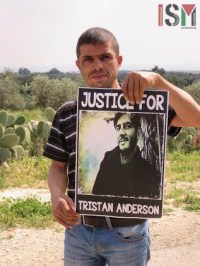 Ni’lin, Occupied Palestine – During last week’s Friday demonstration in Ni’lin the inhabitants of the village commemorated the anniversary of US activist Tristan Anderson’s shooting during a protest in the village six years ago. At the demonstration Israeli forces fired several hundred tear gas grenades and canisters, rubber-coated steel bullets, and two rounds of live ammunition at protesters.
The demonstration began from the village mosque after noon prayers, as villagers accompanied by international and Israeli activists marched down a road leading towards the Apartheid Wall. Palestinians from Ni’lin carried posters calling for justice for Tristan Anderson.
Tristan, who was volunteering with ISM at the time, was shot in the head with a high-velocity tear gas grenade by Israeli border police on March 13, 2009 after that week’s Friday demonstration in Ni’lin. The injury left him with permanent severe brain damage. He now suffers chronic pain, is blind on his right eye, paralyzed and requires 24-hour care. Tristan’s family is currently pursuing a civil lawsuit in court demanding that the Israeli government pay for the extensive care Tristan will need for the rest of his life.
As the protesters were walking towards the wall, which Israel illegally built on Ni’lin’s lands, Israeli forces fired several dozen rounds of tear gas to disperse the protestors. The Apartheid Wall annexed hundreds of dunums of Ni’lin’s land, which the village’s farmers can now no longer access.
After the initial military assault demonstrators spread out into the fields and Palestinian youth began throwing stones toward the army. The clashes went on for several hours, during which Israeli forces fired tear gas and rubber-coated steel bullets. Toward the end of the demonstration, as Israeli forces retreated back behind the apartheid wall, they increased the amount of tear gas fired and threw several stun grenades. Finally as some of the youths followed the soldiers to a hill overlooking the village, Israeli forces fired two rounds of live ammunition, though no one was hit or injured by the bullets. The protest ended when the Israeli occupation forces went back behind the Apartheid Wall and shot a few final rounds of tear gas.
Lithuania drops CIA prison inquiry
‘No parliament support’
RT | March 14, 2015
The Lithuanian legislature decided against a new inquiry into a secret US torture facility in the country, despite a damning US Senate report released three months ago which indicated its existence.
“No new inquest will be considered, because there is no longer sufficient support for it among parliament members,” Loreta Grauziniene, speaker of the Lithuanian parliament, told Reuters on Friday.
Allegations that the CIA set up and ran a secret detention center near the country’s capital of Vilnius between 2004 and 2006 were investigated in 2009 and 2010 by a parliamentary committee. The inquiry concluded the CIA did operate flights in and out of Lithuania, and that there may have been as many as two secret facilities for what the CIA termed “enhanced interrogations.” The committee added that such information could not be confirmed because US officials refused to cooperate.
When a heavily redacted US Senate report on secret CIA prisons came out in December 2014, it did not identify any countries by name. However, the descriptions of the facility identified as ‘Violet’ closely matched the Lithuanian parliament’s original report. Arvydas Anusauskas, the lawmaker who led the inquiry, told the media that the Senate report had made a “convincing case” that prisoners had been held in Lithuania. Prime Minister Algirdas Butkevicius expressed hope that there would be another parliamentary inquiry, and that information would be “shared and exchanged” this time around.
Former president Valdas Adamkus, however, insisted to the local media that he would continue to believe “there were no prisons or prisoners in Lithuania” until he saw “documents before my eyes” proving him wrong.
No further explanation was given for Friday’s decision to drop the inquiry. It comes as hundreds of US troops and vehicles deploy to Lithuania, Estonia and Latvia as a “deterrent” to alleged Russian aggression.
Human rights groups have criticized Lithuania’s complicity in the CIA’s secret detention program, as well as its reluctance to investigate claims by Guantanamo Bay detainees Abu Zubaydah and Mustafa al-Hawsawi of being held and tortured at the CIA facility in the country.
Read more:
Not so magnificent 7: nations ‘busted’ in redacted CIA terror report
Over 100 US armored vehicles roll into Latvia, NATO flexes muscles in Europe
NYPD accused of editing Wikipedia pages for Eric Garner death, other scandals
RT | March 13, 2015
The New York Police Department is reviewing reports that computers connected to the NYPD’s own network edited the Wikipedia pages for some of the more infamous recent events to involve the force, including the choking death of Eric Garner.
Wikipedia articles pertaining to at least three individuals who died as a result of altercations with the NYPD, including Garner, were edited out of the department’s 1 Police Plaza headquarters, Capital New York reported Friday.
According to publicly available records of the online encyclopedia’s revision history, computers connected to Internet Protocol (IP) addresses traced back by the paper to NYPD headquarters edited — and sometimes attempted to delete — entries on alleged instances of police brutality and articles critical of the force’s conduct.
Along with a page on Garner — the Staten Island man who died last July after being placed in a chokehold by NYPD officer Daniel Pantaleo — Wikipedia articles detailing no fewer than two others deaths involving the Big Apple’s boys in blue were altered by computers connected to the agency’s complex in downtown Manhattan, Kelly Weill reported for Capital New York this week.
Wikipedia pages for the NYPD’s so-called “stop-and-frisk” tactic, as well as recent scandals that have tarnished the force — such as the 2013 incident in which an undercover cop was caught up in a group beating on the West Side Highway — were edited from headquarters, Capital New York reported, along with the pages for Garner, Sean Bell and Amadou Diallo. Bell died in 2006 after undercover NYPD officers fired 50 times him and two other men, all unarmed, and Diallo was killed in 1999 when a cop mistook his wallet for a gun and opened fire.
Last December, someone connected through the NYPD’s network made multiple edits to the “Death of Eric Garner” page on Wikipedia, Weill reported, within hours of a grand jury’s decision not to charge NYPD Officer Pantaleo in the man’s death. “Garner raised both his arms in the air” was changed to “Garner flailed his arms about as he spoke,” Weill wrote, and “Use of the chokehold has been prohibited” was changed to “Use of the chokehold is legal, but has been prohibited.”
“Instances of the word ‘chokehold’ were replaced twice, once to ‘chokehold or headlock,’ and once to ‘respiratory distress,’” Weill reported, both times from the NYPD network.
With regards to the Bell shooting article, a user connected to the NYPD network initiated an effort to have the entry nixed altogether by filing a complaint on the website’s internal “Articles for deletion” page.
“He [Bell] was in the news for about two months, and now no one except Al Sharpton cares anymore. The police shoot people every day, and times with a lot more than 50 bullets. This incident is more news than notable,” the user wrote.
In 2006, according to Weill, a user of the NYPD network deleted 1,502 characters from the “scandals and corruption” section of Wikipedia’s “New York City Police Department” article. Two years later, another computer connected to the network deleted the entire “Allegations of police misconduct and the Civilian Complaint Review Board (CCRB)” and “Other incidents” sections from the main NYPD page.
Weill, an intern with Capital New York, wrote that there are more than 15,000 IP addresses registered to the NYPD, and information about them can easily be found online for free. A simple computer script programed in Python ran those addresses through Wikipedia, she said, and then flagged instances in which edits were made.
“The matter is under internal review,” NYPD spokeswoman Det. Cheryl Crispin told Capital New York in an email.
Read more – Grand jury doesn’t indict NYPD officer accused in chokehold death
Texas Representative Proposes Bill to Make Filming the Police Illegal for Everyone But MSM
By Jay Syrmopoulos | The Free Thought Project | March 12, 2015
Austin, Texas – On Tuesday, a bill was filed by Texas Representative Jason Villalba (R-Dallas), HB 2918, which would turn private citizens who film police into criminals.
The bill attempts to usurp citizens of the ability to hold law enforcement accountable for their actions by negating people’s ability to create an accurate and impartial record of police interactions.
If passed, the bill would amend the current “INTERFERENCE WITH PUBLIC DUTIES” statute (Sec. 38.15), to include language that only allows filming of police (within 25ft) by “news media.”
The term “news media” is then defined as such:
(A) a radio or television station that holds a license issued by the Federal Communications Commission;
(B) a newspaper that is qualified under Section 2051.044, Government Code, to publish legal notices or is a free newspaper of general circulation and that is published at least once a week and available and of interest to the general public in connection with the dissemination of news or public affairs; or
(C) a magazine that appears at a regular interval, that contains stories, articles, and essays by various writers, and that is available and of interest to the general public in connection with the dissemination of news or public affairs.
Notice that private citizens, and internet based sites are not listed as qualifying as “news media,” thus allowing the marginalization of anyone that is not part of the old corporate media structure. This also means that a citizen wouldn’t be able to record their own interaction with an officer.
The law is intentionally structured in this manner as a means of controlling the narrative of police-involved incidents. Traditional news outlets often rely almost solely on police talking points when running a story involving the police. It’s extremely rare for them to allow the victim’s version of events to be part of the narrative, especially when conflicting with that of the police.
If not for the alternative media on the ground in Ferguson, much of what was transpiring there would have never seen the light of day as corporate media would have just buried the story altogether.
The proposed legislation also ignores legal precedent, established in Glik v Cunniffe, where the court held that “a private citizen has the right to record video and audio of public officials in a public place.”
In that case the court went on to say:
“…we have previously recognized that the videotaping of public officials is an exercise of First Amendment liberties,” affirming Glik’s constitutional right to videotape public officials in public places.
The court went on to state that the right to film public officials in public places was clearly established a decade prior to the case, which would mean it was already established as early as 1997.
For some reason, Representative Villalba thinks that his authoritarian “wisdom” should replace that of the Founding Fathers.
What’s clear is that filming law enforcement in the commission of their duties has been established as “free speech” under the 1st Amendment of the Constitution.
The ability of citizens to hold officers accountable for their actions is not only protected “speech,” it’s also a necessary check on an out of control law enforcement apparatus. … Full article
Ferguson City Manager Resigns amid Racism Scandal
teleSUR | March 11, 2015
At a meeting Tuesday, Ferguson City Council voted unanimously to accept the resignation of City Manager John Shaw, effective immediately.
Shaw offered his resignation after a scathing report by the U.S. Justice Department found the city administration was guilty of a range of systemic racially-biased practices. Shaw, who was among several individuals heavily criticized in the report, joins three others who were fired after the release of the report.
The city manager is the highest-ranking, non-elected municipal official and oversees numerous departments, including the police.
Shaw’s resignation came after Ferguson Municipal Judge Ronald Brockmeyer, also criticized in the Justice Department report, resigned Monday. A Missouri state appeals court judge will take over all current and future cases assigned to Ferguson’s municipal courts.
The investigation by the Justice Department was triggered by the police killing of Michael Brown by white police officer, Darren Wilson. Wilson was never charged.
Among the reports findings, the Justice Department determined that the mostly white police force routinely targeted black people for arrests and ticketing, in part to raise revenue for the city through fines and fees.
The department also found officers had a pattern of using excessive force, illegally arresting people without cause, deploying attack dogs and tasers on unarmed people.
The Justice Department is expecting serious reform, though the Ferguson Mayor James Knowles has expressed some reservations about such changes. U.S. Attorney General Eric Holder has publicly stated that he is willing to dissolve the Ferguson police department if necessary.
The St. Louis suburb of Ferguson was the site of massive protests against police brutality and the disproportional deaths of black people at the hands of police across the United States.
Naked, unarmed black man shot dead by white metro Atlanta cop
RT | March 10, 2015
An African American man running and “crawling” naked through his apartment complex in suburban Atlanta was fatally shot Monday by a DeKalb County police officer. The unarmed man may have had mental health issues, authorities said.
The unidentified white DeKalb police officer responded to a call regarding a man, identified as Anthony Hill, 27, according to social media and confirmed by the Atlanta Journal Constitution, who was allegedly “acting deranged, knocking on doors and crawling around naked,” at The Heights apartment complex in Chamblee, Georgia, said Cedric Alexander, director of the county public safety department.
Despite being equipped with a stun gun and pepper spray, the officer fired two shots when Hill allegedly ran in his direction, ignoring calls to stop.
“The officer called him to stop while stepping backward, drew his weapon and fired two shots,” he said.
Hill, a resident of The Heights, died of the body wounds. Alexander said the investigation is in the hands of the Georgia Bureau of Investigation (GBI) as “a result of what’s going on currently across this country as it relates to police shootings.”
“No weapon was found,” Alexander said. “The GBI is going to take the point on this investigation.”
Alexander did not say the distance between Hill and the officer, a 7-year veteran of the police force, when the latter shot.
“I think in all fairness we need to wait and see what the outcome of the investigation is because I can’t tell you, beyond what I have told you so far, what kind of measures that officer may have taken,” he said.
The officer has been placed on administrative leave.
As for Hill, Alexander suggested the man may have had some mental health issues.
“I can only reasonably assume that if he was running around the apartment complex naked, I believe we can make the assumption there may have been some mental health experience that he might have been having,” Alexander said.
Alexander added that DeKalb County police officers do undergo some training to deal with the mentally ill, but he said there will be an examination to determine if additional instruction is warranted.
“That’s becoming more and more apparent,” Alexander said. “We have already, as many departments have begun to do, look at how to expand our mental health training when we find it certainly necessary to do so. Because it appears that we’re seeing more and more of these cases across the country in which police are engaging with those who appear to be in distress.”
Hill’s murder comes about a week after the suspicious DeKalb County police shooting of a 44-year-old Kevin Davis in Decatur.
READ MORE: Wisconsin officer who shot unarmed man was exonerated in previous fatal shooting
The Guardian’s Homan Square story was huge on the internet—but not in Chicago media
By Jackie Spinner | Columbia Journalism Review | March 4, 2015
CHICAGO, IL — On Election Day just over a week ago, as this city’s reporters and editors focused on whether the incumbent mayor with ties to the White House would win big or be forced into a historic run-off, an out-of-town newspaper produced a startling account of alleged abuse at a police facility called Homan Square.
The blockbuster story, published in The Guardian and written by Brooklyn-based journalist Spencer Ackerman, described the warehouse as the “domestic equivalent of a CIA black site,” where secretive police units operate and detainees are “disappeared,” with no access to lawyers or relatives and no immediate record of their whereabouts.
With its comparisons to war-on-terror practices and allegations of police brutality, the story landed big on the internet, with well more than 100,000 social shares and write-ups across the Web. The one place it didn’t get much traction: Chicago media.
The city’s two main dailies, the Chicago Tribune and Chicago Sun-Times, quickly reported that city police denied any wrongdoing in pieces that offered little original reporting. The CBS affiliate in Chicago also reported the police denial. The local papers and TV stations have since covered protests from groups demanding that the facility be shuttered.
But more than a week after the initial story, local enterprise reporting remains scant. The most notable examples are a few oddly framed stories, from the Tribune and public radio station WBEZ, suggesting that the focus on Homan Square is misplaced and that, according to local defense attorneys, abusive detentions and interrogations may actually be routine and widespread. If true, that would seem to be worth digging into—but the local coverage, especially in the Tribune, put as much emphasis on possible overreach by The Guardian as it did on police abuse. … Full article
The CIA Against Latin America, the Special Case of Ecuador
teleSUR | March 6, 2015
Imprisoned on various occasions and subjected to numerous interrogations, Dr. Jaime Galarza Zavala is one of the estimated 120 direct victims of the CIA’s record in Ecuador.
Persecuted by the CIA for his political organizing, Galarza described to teleSUR English that “they told me that I was working as a guerrilla in the Dominican Republic. I, to this day, have never visited the Dominican Republic. But they accused me of being a guerrilla leader in the Dominican Republic. And this was a common theme with various interrogations.”
He added that, “while they interrogated me, there was somebody that called every now and then from another room. Afterward, they told me that this person they were talking with was a gringo, a North American, who never presented himself to me. But he gave them instructions as to how to continue the interrogation,” said Galarza.
A fierce critic of U.S foreign policy in the region, Galarza recently published a book titled, “The CIA Against Latin America, the Special Case of Ecuador,” co-authored by Francisco Herrera Arauz.
In an interview with teleSUR English on CIA actions in Ecuador, Herrera said,“First, they destroyed our democracy. Second, they worked with undivided attention against our citizens. They persecuted our citizens for thinking differently. People were killed, injured, there are victims of this violence, there are families that were harmed, there are exiles, the honor of some people has been ruined, there are destroyed families, and all of this was caused by the CIA’s actions.”
Both authors have previously interviewed Philip Agee, the ex-CIA operations officer whose name became internationally known when he wrote the book “Inside the Company: CIA Diary” in 1975, detailing his time working in Ecuador, Uruguay, and Mexico from 1960 to 1968 and denouncing actions undertaken by the CIA during this period.
In his testimonies of that period, Agee said that when he operated in Ecuador from 1960 to 1963, the CIA oversaw: the overthrow of two presidents; the infiltration of various political parties and organizations; and the planting of bombs in front of churches and other emblematic sites to frame leftist groups; among other actions.
At an event celebrating the new book, Ecuador’s Foreign Minister Ricardo Patiño said, “These secret policies continue in Latin America today. Nothing that Philip Agee denounced as CIA actions in the past have been discarded by the espionage seen in the present.”
To raise public awareness of the atrocities committed within Ecuador and the long-term damage caused by CIA interventions throughout Latin America, Ecuador’s Foreign Ministry has printed and widely distributed copies of the book in Spanish and English.
‘Close, aggressive surveillance’: UK Special Forces back in Northern Ireland
RT | March 9, 2015
British Special Forces soldiers are once again operating in Northern Ireland, allegedly, to counter violent Republican groups including the Real IRA, according to intelligence sources.
Quoted in the Daily Star newspaper, they said up to 60 members of the Special Reconnaissance Regiment (SRR) are in the region.
One source told the paper that heightened dissident activity and the increased terror threat were linked to the approaching 100-year anniversary of the 1916 Easter Rising – a period of Irish history which remains highly emotive.
Another described the unit’s role as “close, aggressive surveillance.”
The SRR replaced an earlier unit known as 14 Intelligence Company. Its creation in 2005 saw the specialist close surveillance role developed during the Troubles expanded for the War on Terror.
The same year it was reported the SRR had been involved in the counter-terrorist operation which eventually led to the gunning down in Stockwell tube station of Jean Charles De Menezes, an innocent Brazilian worker.
The regiment, the only British Special Forces unit to recruit women and estimated to be composed of between 500 and 600 personnel, has been deployed in Iraq and Afghanistan.
In August 2014, the SRR was reported to be hunting Islamic State militants, including Jihadi John, later identified as West Londoner Mohammed Emwazi.
Its forerunner – known colloquially as “14 Int” – was limited to operating in Northern Ireland.
Recently, there have been a number of damaging revelations and legal cases about covert British operations during the period of the Troubles.
In 2013, a BBC documentary uncovered claims that a secret army unit called the MRF was hunting and killing IRA members, and in the course of doing so may also have killed a number of innocent civilians.
Alongside their combat role, the hand-picked members of the MRF also carried out surveillance. In some cases while disguised as meths-drinking vagrants, at other times while pretending to be garbage collectors.
In February this year, the case of the Hooded Men made headlines again when human rights lawyer Amal Clooney – who is the spouse of actor George Clooney and has represented WikiLeaks editor Julian Assange – joined the legal team of 11 individuals who claim to have suffered torture while in the custody of British security forces.
Of over 300 people rounded up in June 1971, twelve were selected for further interrogation. They were then subjected to stress positions, hooding, white noise and food, drink and sleep deprivation.
These methods were known as the Five Techniques and would later form the practical basis for the treatment of captives by the United States military and intelligence services during the War on Terror. They have become synonymous with the process known as extraordinary rendition.
In 1976, the men took their case to the European Court of Human Rights and won. The ruling was later overturned and it was subsequently ruled that while they had been subject to inhumane and degrading treatment, it did not constitute torture.
Featured Video
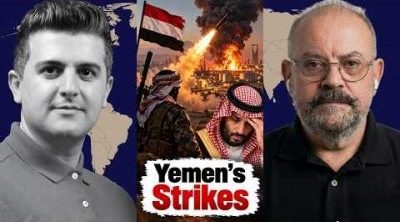
Elijah Magnier: Yemen’s strikes are shattering Saudi Arabia’s long-term strategy
or go to
Aletho News Archives – Video-Images
From the Archives
British weapons and personnel doing much of the killing in Yemen
Press TV – June 18, 2019
A detailed report published by the Guardian newspaper has shown how Britain is massively contributing to Saudi Arabia’s devastating war on Yemen as it suggests that London is not only supplying the bombs that fall on Yemenis, but it provides the personnel and expertise that keep the war going.
The comprehensive report by Arron Merat published on Tuesday showed that Britain was doing much of the killing in Yemen as the country continues to provide Saudi Arabia with everything it needs to turn its southern impoverished neighbor into a graveyard.
“Every day Yemen is hit by British bombs – dropped by British planes that are flown by British-trained pilots and maintained and prepared inside Saudi Arabia by thousands of British contractors,” said Merat in the report. … continue
Blog Roll
 Aletho News
- A West Bank War for Netanyahu’s Election Campaign, Could It Backfire?
- Yemen denounces European Parliament’s ‘hypocritical’ push to blacklist Ansarullah
- Qalibaf: UAE’s UN bid aims to ‘clear the runway’ for ‘Greater Israel’, whitewash genocide
- Pakistan reopens Iran border after boosting security: Report
- Why are so many Brazilians voting for Flávio Bolsonaro?
- Democrats Put Anti-Russia Agenda Ahead of American Workers
- Elijah Magnier: Yemen’s Strikes Are Shattering Saudi Arabia’s Long-Term Strategy
- Pentagon designates Chinese cultural centers national security threat
- Israel Demolishes Home Of Lebanese Journalist Whose Viral Film Exposed Pager Attack
- Record Oil, Empty Tanks: The UAE’s Miracle Recovery
- If Americans Knew
- An error has occurred; the feed is probably down. Try again later.
- No Tricks Zone
- Sudden Stratospheric Warming, Powerful El Niño Combination May Lead To Extreme Europe Cold, Energy Crisis!
- Two New Studies Find Thwaites Glacier Melt Cannot Be Driven By Human Activity Or A Warming Ocean
- E-Cars Reduce CO2 Emissions By Only 41% Compared To Internal Combustion Engine Vehicles
- Predictions Made By Renowned Climate Professor Over Past Decades Have Been Proven To Be Poor
- New Study Suggests Large Regions Of The Pacific Ocean Have Been Cooling For The Last 80 Years
- Germany’s Green Energy Debacle: High Energy Costs Force Kahla Porzellan to Close After 182 Years!
- New Study: 50 Years Of The Most Aggressive ‘Net Zero’ Policies Can Only Affect The Global Climate By 0.03°C
- US September “Heat” Was No Record…Many Records Set Decades Ago
- Latest European Green Energy Debacle; Portugal’s Largest Flagship Solar Park Insolvent!
- Green Energy Debacle: German Expert Professor Fritz Vahrenholt Warns Of Severe Economic And Social Consequences

