Nothing solidifies the establishment more than a seemingly raging debate between two wings of it in which they are both wrong. Not only wrong, but in their wrongness, helping to cover their joint iniquities, all the while engaging in simultaneous embrace and finger-pointing to convey the illusion of debate and choice.
Such is the case with the “debate” on whether torture “worked” following the release of the Select Committee on Intelligence report on the CIA’s “Detention and Interrogation Program.”
On the one side, we have among others Dianne Feinstein: “The big finding is that torture doesn’t work and shouldn’t be employed by our country” she told PBS. Similarly, a headline in the Hill tells us: “McCain: ‘I know from personal experience’ torture doesn’t work.”
Then, we have six former directors and deputy directors of the CIA claiming the “interrogation program” “saved thousands of lives” by helping to capture al-Qaeda members. On this score, the Intelligence Committee report seems to have the goods, quoting CIA emails. While the former CIA directors claim a string successes based on torture: “KSM [Khalid Sheik Muhammed] then led us to Riduan Isamuddin, aka Hambali, East Asia’s chief al Qaeda ally and the perpetrator of the 2002 Bali bombing in Indonesia — in which more than 200 people perished.” But the report quotes CIA officials internal emails: “Frankly, we stumbled onto Hambali.”
But that doesn’t mean Feinstein and McCain are right and that’s the end of story. The truth is that torture did work, but not the way its defenders claim. It worked to produce justifications for policies the establishment wanted, like the Iraq war. This is actually tacitly acknowledged in the report — or one should say, it’s buried in it. Footnote 857 of the report is about Ibn Shaykh al-Libi, who was captured in Afghanistan shortly after the U.S. invasion and was interrogated by the FBI. He told them all he knew, but then the CIA rendered him to the brutal Mubarak regime in Egypt, in effect outsourcing their torture. From the footnote:
“Ibn Shaykh al-Libi reported while in [censored: ‘Egyptian’] custody that Iraq was supporting al-Qa’ida and providing assistance with chemical and biological weapons. Some of this information was cited by Secretary Powell in his speech at the United Nations, and was used as a justification for the 2003 invasion of Iraq. Ibn Shaykh al-Libi recanted the claim after he was rendered to CIA custody on February [censored], 2003, claiming that he had been tortured by the [censored, likely ‘Egyptians’], and only told them what he assessed they wanted to hear. For more more details, see Volume III.” Of course, Volume III has not been made public.
So, while CIA head John Brennan now says it’s “unknowable” if torture lead to information that actually saved lives, it’s provable that torture lead to information that helped lead to war and destroyed lives.
Nor was al-Libi the only one tortured to try to make the case for war. Many have reported that CIA interrogators waterboarded two alleged top al Qaeda detainees repeatedly — Abu Zubaydah at least 83 times and Khalid Sheik Muhammed 183 times — but few give the exact timing and context: They were so tortured in August 2002 and March 2003 respectively — the beginning and end of the Bush administrations push for the invasion of Iraq.
This was somewhat acknowledged in the other Senate report on torture, released by the Armed Services Committee in 2008. It quoted Maj. Paul Burney, who worked as a psychiatrist at Guantanamo Bay prison: “A large part of the time we were focused on trying to establish a link between al-Qaeda and Iraq and we were not successful. The more frustrated people got in not being able to establish that link … there was more and more pressure to resort to measures that might produce more immediate results.” The GTMO Interrogation Control Element Chief, David Becker told the Armed Services Committee he was urged to use more aggressive techniques, being told at one point “the office of Deputy Secretary of Defense [Paul] Wolfowitz had called to express concerns about the insufficient intelligence production at GTMO.”
McClatchy reported Sen. Carl Levin, the chair of the Armed Services Committee, said at that time: “I think it’s obvious that the administration was scrambling then to try to find a connection, a link (between al Qaida and Iraq) … They made out links where they didn’t exist.” But now, Levin seems more muted, saying, in response to the release of the recent report, that false information leads to “time-consuming wild goose chases” — which is quite an understatement given the human horrors that have resulted from the invasion of Iraq.
So, contrary to the claim that torture helped save lives, torture helped build the case of lies for war that took thousands of U.S. lives and hundreds of thousands of Iraqi lives, helping to plunge the region into astounding violence, bringing al-Qaeda into Iraq, leading to the rise of ISIS and further bloody wars. As Arianna Huffington noted: “A perfect circle: Torture helps start Iraq War, which in turn gives us more people to torture. #happyhumanrightsday”
This oversight perhaps shouldn’t come as too big a shock given who’s calling the shots in Washington: Feinstein and McCain both voted for the Iraq war authorization in 2002, as did virtually everyone running foreign policy atop the Obama administration: VP Joe Biden, Pentagon heads Bill Gates and Chuck Hagel and Secs. of State Hillary Clinton and John Kerry.
Some have made an issue of videos of torture being destroyed — but it’s been widely assumed that they were destroyed simply because of the potentially graphic nature of the abuse. But there’s another distinct possibility: They were destroyed because of the questions they document being asked. Do the torturers ask: “Is there another terrorist attack?” Or do they compel: “Tell us that Iraq and Al-Qaeda are working together.”? The video evidence to answer that question has apparently been destroyed — with barely anyone raising the possibility of that being the reason.
Exploiting false information has been well understood within the government. Here’s a 2002 memo from the military’s Joint Personnel Recovery Agency to the Pentagon’s top lawyer — it debunks the “ticking time bomb” scenario and acknowledged how false information derived from torture can be useful:
“The requirement to obtain information from an uncooperative source as quickly as possible — in time to prevent, for example, an impending terrorist attack that could result in loss of life — has been forwarded as a compelling argument for the use of torture. … The error inherent in this line of thinking is the assumption that, through torture, the interrogator can extract reliable and accurate intelligence. History and a consideration of human behavior would appear to refute this assumption.” The document concludes: “The application of extreme physical and/or psychological duress (torture) has some serious operational deficits, most notably, the potential to result in unreliable information. This is not to say that the manipulation of the subject’s environment in an effort to dislocate their expectations and induce emotional responses is not effective. On the contrary, systematic manipulation of the subject’s environment is likely to result in a subject that can be exploited for intelligence information and other national strategic concerns.” [PDF]
So torture can result in the subject being “exploited” for various propaganda and strategic concerns. This memo should be well known but isn’t, largely because the two reporters for the Washington Post, Peter Finn and Joby Warrick, who wrote about in 2009 it managed to avoid the most crucial part of it in their story, as Jeff Kaye, a psychologist active in the anti-torture movement, has noted.
One reporter who has highlighted critical issues along these lines is Marcy Wheeler — noting as the recent report was being released: “The Debate about Torture We’re Not Having: Exploitation,” where she writes: “Some other things exploitation is used for — indeed the very things the torture we reverse-engineered for our own torture program was used for — are to help recruit double agents and to produce propaganda.” Her reporting also raises questions about how torture was used to push a whole host of policies, which would make us a virtual tortureocracy: CIA director “John Brennan has admitted to using information from the torture program in declarations he wrote for the FISA Court. This means that information derived from torture was used to scare [FISA judge] Colleen Kollar-Kotelly into approving the Internet dragnet in 2004.” (Disclosure: Wheeler writes a column for ExposeFacts.org, a project of the Institute for Public Accuracy, where I work.)
Many presumed critics of torture have been either intentionally or not obscured its connection to war making and other agendas. Teju Cole notes in an interview with the New York Times on Dec. 10 about that outlet: “The paper’s fabrications and support for the Iraq war is a generational shame that shouldn’t be too quickly forgotten. It should haunt us for a long time.” But his comments on the torture report betray a total lack of understanding of the connection between torture and the invasion of Iraq, ascribing to it the very human emotions of revenge rather than the more Machiavellian realities of policy making: “Let’s acknowledge torture for what it is: It is punishment, vengeance. It’s the kind of havoc you wreak on an enemy or bystander merely because your rage needs an outlet. It has vanishingly little to do with intelligence-gathering. It spreads grief, and though it intends to do so, it spreads even much more than it intends. It destroys the perpetrators too. Rage is not a precision weapon.”
But the rage of the general public — steered in large measure by major media — might have been useful in increased public acceptance of torture in the immediate aftermath of 9/11, but that’s not what makes decisions in the U.S. It’s decided by the machinations of a narrow set of elites who act in their interests as the utility of torture shows. The coverups for how war was made have grown so complex that critics like Teju Cole have been sucked into it.
Researchers for Human Rights Watch have done some good work in getting information on the al-Libi case, but Ken Roth, the head of the group doesn’t seem to take to heart the lessons of that case, writing that the CIA “forgot its own conclusions from 1989: inhumane interrogation was ‘counterproductive,’ yielded false answers’ in reference to a recent New York Times piece: “Report Portrays a Broken C.I.A. Devoted to a Failed Approach.” But it’s not that the CIA “forgot”– the torture regime is actually designed to produce false but useful information that can be used to justify hideous polices. Pretending it’s a “failed approach” is to exactly avoid telling the truth about the torture program just as everyone is claiming that they are telling the truth about it.
And there are arguably other utilities of torture for war makers, often portrayed only as costs to the society as a whole: It’s profitable to a few. It helps stifle dissent as a method of social control. It was likely especially effective at silencing the Arab and Muslim American community just as the U.S. was gearing up to invade Afghanistan and Iraq.
The recent report highlights a CIA memo that relayed instructions from the White House to apparently hide the program from then-Secretary of State Colin Powell. Powell could “blow his stack if he were to be briefed on what’s going on,” the email said. But when I questioned Powell on the connection between torture and war, he was remarkably defensive. His former chief of staff, Larry Wilkerson wrote in 2009 that the Bush administration’s “principal priority for intelligence was not aimed at pre-empting another terrorist attack on the U.S. but discovering a smoking gun linking Iraq and al-Qaeda.” Shortly after he wrote that, I questioned Colin Powell at the “media stakeout” as he left the CBS studios in DC:
Sam Husseini: General, can you talk about the al-Libi case and the link between torture and the production of tortured evidence for war?
Colin Powell: I don’t have any details on the al-Libi case.
SH: Can you tell us when you learned that some of the evidence that you used in front of the UN was based on torture? When did you learn that?
CP: I don’t know that. I don’t know what information you’re referring to. So I can’t answer.
SH: Your chief of staff, Wilkerson, has written about this.
CP: So what? [inaudible]
SH: So you’d think you’d know about it.
CP: The information I presented to the UN was vetted by the CIA. Every word came from the CIA and they stood behind all that information. I don’t know that any of them believe that torture was involved. I don’t know that in fact. A lot of speculation, particularly by people who never attended any of these meetings, but I’m not aware of it.
But my questioning was based on statements by Wilkerson, who was in the room. Presumably Powell has been waiting for the CIA to call him and tell him directly that torture was used to extract some of the information he used. See my piece “How Colin Powell Showed That Torture Works” and video.
This problem of torture yielding useful but false information was not unforeseeable. Professor As’ad AbuKhalil appeared on a news release for the Institute for Public Accuracy, where I work, the day after Powell’s notorious UN speech: “The Arab media is reporting that the Zakawi story was provided by Jordanian intelligence, which has a record of torture and inaccuracy.” Indeed, the utility of torture might also help further explain U.S. government ties to brutal regimes. Part of what the U.S. government derives from them is capacity to torture and kill. As professor Lisa Hajjar has noted, it was the Egyptian “Torturer in Chief” Omar Suiliman who got al-Libi to talk about a connection between Iraq and al-Qaeda — the U.S. torturers in Gitmo had apparently failed. Bob Woodward quotes former CIA head George Tenet: “We created the Jordanian intelligence service and now we own it.”
Of course such regimes sometimes fall in an out of favor, there can be little honor among thieves. Al-Libi himself was eventually turned over to Muammar Qaddafi, at a time when — to the bewilderment of many — the U.S. government was rather cordial with the former Libyan dictator. In 2009, a newspaper run by one of Qaddafi’s son’s claimed al-Libi committed suicide in his Libyan jail cell. Juan Cole wrote at the time: “The best refutation of Dick Cheney’s insistence that torture was necessary and useful in dealing with threats from al-Qaeda just died in a Libyan prison.”
But only if we insist on forgetting this case and the evidence that lies for war and torture are joined at the hip.
Sam Husseini is communications director for the Institute for Public Accuracy. He also founded VotePact.org, which encourages disenchanted Demorats and Republicans to team up. His website is: husseini.posthaven.com He’s on twitter: @samhusseini.
December 13, 2014
Posted by aletho |
Mainstream Media, Warmongering, Subjugation - Torture, Timeless or most popular, War Crimes | Central Intelligence Agency, CIA, Human rights, Joby Warrick, John Brennan, Peter Finn, United States, Washington Post |
Leave a comment
Whipping with cables. Prolonged solitary confinement. Other unspeakable acts, committed against citizens with official blessing. Use of “information” gathered by torture considered legitimate.
No, no, I don’t mean the Torture Report. I’m talking about Canada.
Let the other sordid drama play itself out in America. We’ve now learned more about “rectal feeding” (read: medically unjustified anal rape) than we ever wanted to know, and that’s just for starters. Did the authorities raid every prison for the criminally insane to swell CIA ranks? Far worse, we’re watching a desperate attempt to frame this whole series of vile acts as a period in (recent) history now thankfully ended. Don’t you go believing that fairytale, now.
Torture and other state-sanctioned violence against civilians continues. Gitmo persists, despite Obama’s promises. His drones are still killing and maiming civilians in far-off lands. American citizens can now be extra-judicially executed by Presidential decree. Due process, Obama’s Attorney General explains, doesn’t necessarily mean judicial process — just a convo in the Oval Office will satisfy Constitutional requirements. Recall also that Obama gave immunity to the creatures who enabled and committed state torture under his predecessor. They aren’t hurting any. The monstrous John Yoo, for one, who advocated for the legality of crushing the testicles of children, is now a well-paid professor in California. Dick Cheney is still making a fortune on the speaking circuit.
Well, as I said, let the U.S. be the U.S., that godawful prison-house, continuing on its downward spiral. But no one should imagine for one moment that it is alone in using torture as a routine implement of policy.
While the current Canadian government — particularly its former Paraguayan wing — is known for its open support of torture as a supposed information-gathering tool, the rot really set in under the previous Liberal administrations of Jean Chrétien and Paul Martin. Just ask a victim of “extraordinary rendition” like Maher Arar. Talk to others tortured and imprisoned thanks to the collegial complicity of CSIS with the secret police in Syria, Egypt and Sudan — Canadian citizens Muayyed Nureddin, Abdullah Almalki, Ahmad Abou El-Maati, and Abousfian Abdelrazik.
Or ask (if any remain alive) the Afghan detainees turned over by Canadian Forces to Afghan government torturers. Stephen Harper was willing to risk all the marbles there, and he successfully maintained his cover-up after all was said and done. CSIS was up to its neck in that one, too. Most of the documents will likely never be made public, despite an historic ruling by the then-Speaker of the House of Commons, Peter Milliken.
Then there is child soldier Omar Khadr, tortured (once again with CSIS complicity, this time after the fact) in Guantanamo. His only way out of that hellhole was to cop a plea. He’s sitting in a Canadian jail at the moment, while the Harper government continues to make his life miserable.
Is this torture thing just about national security? Not at all. Take the use of solitary confinement within Canada’s prison system. Prolonged solitary confinement is well-recognized as a form of torture. But Public Safety Minister Steven Blaney has now confirmed that it will continue to be imposed on mentally ill inmates, rejecting out of hand the key recommendation from the coroner’s inquest into the death of Ashley Smith.
Let us not be too smug, then, about the horrific revelations south of the border. Because, to put it bluntly, we torture too — and under Stephen Harper, torture has been officially and publicly sanctioned. Compliments of the season, everyone.
December 13, 2014
Posted by aletho |
Civil Liberties, Subjugation - Torture | Canada, Human rights, United States |
Leave a comment
On 10 December, Israeli soldiers prevented teachers from the Qurtuba School, elderly people, a disabled man, and both a doctor and an ill woman trying to reach the hospital from passing through Checkpoint 56 in Hebron. In some cases, they delayed people trying to pass through for one hour; in others, as much as three.
Checkpoint 56 has been subject to closure and restrictions by Israeli forces since it was burned from the inside nearly three weeks ago.
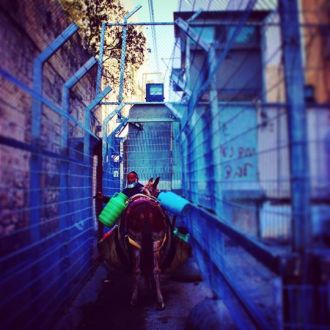 No one knows who is responsible for the burning of the checkpoint, and Israeli forces have not released footage.
Leading onto the small section of Shuhada Street on which Palestinians are allowed to walk, checkpoint 56 connects Bab iZaweyya, the commercial district in Palestinian Authority-governed H1, with the neighbourhood of Tel Rumeida in Israeli-controlled H2.
Checkpoint closure here demands that families living in Tel Rumeida and school children and teachers from the Qurtuba School walk an extra hour or that they walk a difficult route through the homes and gardens of other Palestinians to reach their homes. For the past week, Israeli soldiers and border police have permitted elderly people, teachers, children and ill people seeking medical treatment to pass the checkpoint.
When CPTers arrived at 11:00 a.m. on 12 December, one 60-year-old doctor told them that he had been at the checkpoint for two hours.
CPTers, ISMers, and those wishing to pass through the checkpoint, attempted to ascertain the reasoning behind this change, which was subjecting teachers leaving work, and older people of varying physical abilities to stand in the sun for hours. CPT and ISM stood in solidarity with the affected Palestinians and joined them in negotiating with soldiers to reopen the checkpoint.
At about 12:00 p.m., soldiers allowed individuals through the checkpoint one by one until approximately twenty minutes later when an elderly man arrived with a donkey, which initiated another arbitrary change in the ‘rules’ of occupation. The Israeli military again closed the checkpoint, and CPT was unable to gain an answer from the soldiers as to why this donkey appeared to necessitate another closure.
December 13, 2014
Posted by aletho |
Ethnic Cleansing, Racism, Zionism, Subjugation - Torture | Israeli settlement, Palestine, West Bank, Zionism |
Leave a comment
 Brazilian national Truth Commission’s report presented to President Dilma Rousseff moved her to tears as it published accounts of torture, killings and disappearances during two decades of military rule from 1964-85.
“I am very proud to be here, because the people here contributed to combat the violation of human rights,” Rousseff said during an emotional speech at the ceremony on Wednesday.
“We, who so love democracy, hope that the wide circulation of this report helps to reaffirm the priority that we must give to upholding democratic liberties. In this way, we must show our absolute aversion to authoritarian states and dictatorships of any kind,” President Rousseff said.
Rousseff is a former leftist guerrilla once imprisoned and tortured by the country’s military regime. The report has identified 377 people of committing “crimes against humanity”, 200 of whom are still alive.
“This is a key step in the right direction for Brazilians: knowing their history they can build a better society,” Rousseff tweeted on Wednesday.
The Brazilian leader has alluded to her past imprisonment and physical torture under the military dictatorship during the presidential campaigning this year.
“I have come up against hugely difficult situations in my life, including attacks which took me to the limit physically. Nothing knocked me out of my stride,” said Rousseff.
Hundreds of Brazilians were murdered and thousands were tortured by the Brazilian military rule but the Latin American nation has never put anyone on trial for the murder and widespread torture of political dissidents during its dictatorship.
In 1979 the Brazilian army pushed an amnesty law to shield themselves from future prosecutions through the Brazilian Congress.
The report released on Wednesday has identified Germany’s Volkswagen AG as one of several foreign companies that provided the Brazilian military with lists and accounts of union activists.
Brazil is seeking a permanent seat on the UN Security Council and was this week voted in with a majority to the Advisory Commission of the United Nations Relief Works Agency (UNRWA).
The vote marked the first time a Latin American country was admitted to the agency’s top consultative body, which advises on “key strategic decisions,” said the UNRWA.
December 12, 2014
Posted by aletho |
Subjugation - Torture, Timeless or most popular | Brazil, Latin America |
Leave a comment
While the media parsed the details of the Senate committee’s report on Central Intelligence Agency (CIA) torturing of detainees last decade, the Obama administration was fighting in court to prevent documents from another investigation into the spy agency’s program from being examined by a leading national newspaper.
The New York Times has sued in federal court to obtain thousands of pages from a U.S. Department of Justice probe into the torture of detainees by the CIA during the George W. Bush administration. The materials that the newspaper wants to see include “10 reports and memorandums totaling 1,719 pages — more than three times the number of pages in the Senate report,” wrote the Times’ Charlie Savage, who is a party to the lawsuit. The documents in question include transcripts of interviews by a special prosecutor with about 100 witnesses as well as documents explaining why no charges were ever filed.
The Justice probe into the CIA program was conducted by prosecutor John H. Durham, who spent four years delving into the controversy but ultimately recommended to Attorney General Eric Holder Jr. to not file charges against the agency or any of its employees or contractors. Holder followed Durham’s suggestion and refrained from going after the CIA.
The Justice Department filed court documents on the same day that the Senate Intelligence Committee released its 524-page report on the CIA’s rendition and torture program. It argued in its filing with the New York federal court that all of the pages requested by the Times should remain locked away “because disclosing them could affect the candor of law enforcement deliberations about whether to bring criminal charges,” according to Savage.
To Learn More:
U.S. Tells Court That Documents From Torture Investigation Should Remain Secret (by Charlie Savage, New York Times )
New York Times v. Department of Justice (U.S. District Court, Southern New York)
Judge Gives Obama Administration until December to Justify Withholding 2,100 Photos of U.S. Use of Torture in Iraq and Afghanistan (by Danny Biederman and Noel Brinkerhoff, AllGov )
Obama Refuses to Turn Over 9,400 CIA Torture and Interrogation Documents to Congress (by Noel Brinkerhoff, AllGov )
December 12, 2014
Posted by aletho |
Progressive Hypocrite, Subjugation - Torture |
Leave a comment
Reprieve | December 11, 2014
In the wake of a new report on US abuses post-9/11, calls have been renewed for the return of a British resident held without charge or trial at Guantanamo Bay for the past 13 years.
Shaker Aamer, a Londoner with a British wife and four British children, was captured and tortured by US forces in Afghanistan in 2001 before his rendition to Guantanamo Bay in 2002. His ordeal has included a litany of abuses similar to those described in the US Senate report on CIA torture, a portion of which was released this week. The details of CIA torture revealed in the report have provoked widespread condemnation.
As one of the first five prisoners taken to Bagram Air Force Base in late December 2001, Mr Aamer was forced to stay awake for nine days, beaten, denied food, and tied up in such a way as to risk strangling himself if he moved. Other times, he was forced to stand up for over 16 hours a day.
During his 13 years at Guantanamo Bay, Mr Aamer has been repeatedly subjected to physical violence – including regular beatings and “forcible cell extractions” (FCEs), at times as often as eight per day. He has also been forced into prolonged periods of solitary confinement, protracted sleep deprivation, manipulation of the temperature around him, and humiliating ‘genital searches.’
Earlier this year, Mr Aamer said: “The worst thing about torture is that you don’t know how to think, what to do, how to feel. You know you have your mind, but you don’t know how to react, which is horrible because you feel vulnerable. It’s terrible.”
The UK government has repeatedly stated that it wants Mr Aamer released from Guantanamo and returned to his family in London. Mr Aamer’s lawyer, Reprieve director Clive Stafford Smith believes that he is still imprisoned because of the evidence he might give around UK complicity in torture. He has said: “It is deeply suspicious that the UK won’t say why their friends in the US refuse to transfer Shaker home to London.”
Did Theresa May lobby Senate Committee on CIA report?
Home Secretary Theresa May was one of several UK officials who met with the Senate Select Committee on Intelligence (SSCI) ahead of the publication of its report on torture by the US and its allies, it’s emerged.
Documents unearthed by legal charity Reprieve reveal that from 2009, 24 meetings were held between UK Government officials or ministers and SSCI members. The Home Secretary met with the Committee in 2011 “in her capacity as Home Secretary”, while other UK Government visitors to the SSCI included former and current UK ambassadors to the US.
The SSCI began its formal inquiry into the CIA torture programme in 2009, and the timing of the UK meetings with the Committee have raised concerns that the UK may have attempted to influence the contents of the report.
Yesterday, Downing Street admitted that redactions were requested by the UK on “national security grounds” – an apparent shift from a claim made earlier this week, when the Prime Minister’s spokesman said there had been no such UK requests made.
December 12, 2014
Posted by aletho |
Deception, Subjugation - Torture | Human rights, UK, United States |
Leave a comment
No one shall be subjected to torture or to cruel, inhuman or degrading treatment or punishment.
— Article 5 of The Universal Declaration of Human Rights1
Anthony D. Romero, the executive director of the American Civil Liberties Union, which bills itself as “the nation’s premier defender of liberty and individual freedom,” wrote a controversial op-ed for the imperialist-touting New York Times.2 In essence, by specious circumlocution, the ACLU head parlayed to the favor of the decision-makers behind crimes against humanity, namely torture, such that they escape legal punishment on the pretext that it would serve as a deterrent to such illegality in the future.
In doing so, Romero raises the possibility that torture might be legal, or that there is uncertainty as to any illegality. Romero ignores the United Nations Convention against Torture, to which the US and 80 other states is a signatory.
Article 2 of this convention states:
1. Each State Party shall take effective legislative, administrative, judicial or other measures to prevent acts of torture in any territory under its jurisdiction.
2. No exceptional circumstances whatsoever, whether a state of war or a threat of war, internal political instability or any other public emergency, may be invoked as a justification of torture.
3. An order from a superior officer or a public authority may not be invoked as a justification of torture.
Physicians for Human Rights unequivocally state, “The prohibition of torture in international law is notable in that it is absolute, applying at all times and in all circumstances.”3 [emphasis added]
The Optional Protocol to the Convention against Torture, which allows for inspection of detention facilities, is unsigned by the US. This calls into question how adherence to international law can be enforced when the potential crime is hidden from independent scrutiny. It also calls into question the sincerity of a signature affixed to a statute signifying opposition to crimes against humanity.
Romero writes, “My organization and others have spent 13 years arguing for accountability for these crimes,” followed by the lament that now “… many of those responsible for torture can’t be prosecuted because the statute of limitations has run out.”
Romero is conveying a false message. Since torture is listed as a crime against humanity,4 and given that there are 54 signatory states to the Convention on the Non-Applicability of Statutory Limitations to War Crimes and Crimes Against Humanity and given that there are 122 signatories to the Rome Statute of the International Criminal Court, there is no statute of limitations applicable. Notably, or unremarkably, the US is not a signatory to these last two statutes.
However, in the US, there is no statute of limitations on crimes that are considered exceptionally heinous by society.5 USlegal.com provides a definition: “Heinous means hateful or shockingly evil.” I submit that heinous is an apt descriptor for torture.
Yet, Romero sees fit to praise Obama: “To his credit, Mr. Obama disavowed torture immediately after he took office, and his Justice Department withdrew the memorandums that had provided the foundation for the torture program.”
Is this disavowal deserving of credit? It is widely held that actions speak louder than words. Obama’s words have been rendered platitudinous and self-serving by his actions as torture has continued under his regime.6,7
The ACLU head notes, “But neither he [Obama] nor the Justice Department has shown any appetite for holding anyone accountable.… Mr. Obama is not inclined to pursue prosecutions — no matter how great the outrage, at home or abroad, over the disclosures — because of the political fallout.”
In other words, politics takes precedence over human rights and international law. Then again, Obama is on record as saying, “We need to look forward as opposed to looking backwards.”8 The illogic of this exculpatory mantra is revealed starkly on at least two levels: (1) it posits that we do not need to learn from our history, and (2) the same rationale could be applied to all designated enemies of the US.
Romero states, “Prosecutions would be preferable, but pardons may be the only viable and lasting way to close the Pandora’s box of torture once and for all.”
As already argued above, there is clarity that torture is a crime. Romero tenuously proffers an obfuscation of the prima facie crimes. Prosecutions are not only preferable, they must be demanded. Otherwise justice is held in abeyance, and a signal is sent that the US does not respect or adhere to international law, that future presidents and regime officials can commit heinous crimes safe in the knowledge that they will be pardoned to avoid “political fallout.”
This has farther-reaching significance for law. Law is based heavily in precedence. If US war criminals escape accountability, then why should non-US war criminals not be handled in a similar non-discriminatory manner? Or are US officials above the law?
Romero calls for Obama to “take ownership” of the decision. “If the choice is between a tacit pardon and a formal one, a formal one is better. An explicit pardon would lay down a marker, signaling to those considering torture in the future that they could be prosecuted.”
This is disingenuous. This is not the only choice. The clear and moral choice is whether to prosecute or not prosecute. Narrowing the choice to between a tacit pardon and a formal one is evading justice under the pretext of laying down a marker for future justice. On the contrary, an explicit pardon sends a message that those who torture for hyperempire, albeit prosecutable, will be pardoned … explicitly. Justice demands that torture be handled in an expeditious manner that forthrightly declares that heinous crimes will be prosecuted with the full force of the law and that such law triumphs political considerations. This sets a precedence that signals: justice will not be denied, any future transgressions will be punished.
December 12, 2014
Posted by aletho |
Progressive Hypocrite, Subjugation - Torture, Timeless or most popular | Obama, United States |
Leave a comment
A Sordid History
The sordid history of U.S. torture in the Middle East laid bare by the release of the Senate report is explained by some as “9-11 changed everything.” The truth, however, is that U.S. support for torture long pre-dates 2001.
The Vietnam War lasted more than 10 years and involved more than a half-million U.S. troops, and torture was a routine part of U.S. actions. Vietcong prisoners were thrown from helicopters to get others to talk, they were tortured with electric shocks, six-inch pegs were driven into their ears, and female prisoners were threatened with the death of their children.
In the Middle East, the most notorious torture regime was that of the Shah of Iran, installed by a CIA-coup in 1953. Operatives of his secret police, the SAVAK, were trained by the hundreds by the CIA at its headquarters in Langley, Va. In the 1970s, Jimmy Carter, now seen by many as a champion of human rights, personally approved continued CIA-SAVAK cooperation, on the grounds that the “intelligence” gained outweighed the “human rights abuses” that were occurring, an explanation that should sound familiar today.
The SAVAK is gone, but systematic torture continues in at least one more country in the region that receives massive U.S. support—Israel, which routinely tortures Palestinian political prisoners.
CIA support for torture in Latin America was equally extensive. In Chile, the CIA-supported coup which brought Augusto Pinochet to power brought with it the torture and murder of thousands of left-wing activists. The head of Chile’s secret police, the DINA, was a CIA asset. In 1975, DINA agents assassinated the former Chilean Ambassador Orlando Letelier and his 25-year-old American associate, Ronni Karpen Moffitt, in Washington, D.C., itself, but even that didn’t put a damper on U.S. support for the regime.
Throughout the 1980s, the U.S. provided training and support for the government in El Salvador, whose death squads routinely used torture as a means of suppressing opposition. The opposite happened in Nicaragua, where the U.S.-supported Contras routinely tortured Nicaraguans who resisted its attempts to overthrow the leftist Sandinista government.
In Venezuela, the secret police was called DISIP, and its head and chief torturer in the 1970s was CIA agent and notorious terrorist Luis Posada Carriles. Here the story of U.S. involvement with torture takes a different turn—the U.S. supported torture while it was happening but later used the false claim of potential torture to shield Posada from prosecution.
Posada and Orlando Bosch were the masterminds of the 1976 mid-air bombing of Cubana Flight 455, killing all on board. Both escaped justice in Venezuela, and in 2005 Posada entered the U.S. illegally. Venezuela, where Posada is still wanted on 73 counts of murder for the airplane bombing, filed an extradition request.
Nine years later, that request has neither been honored or even answered, but eventually, since Posada was a known terrorist and had entered the U.S. illegally, the U.S. government was forced to move to deport him. During those hearings, a man named Joaquin Chaffardet testified in Posada’s defense that if he were extradited to Venezuela, led at the time by Hugo Chávez, he would be tortured. Chaffardet offered no proof for this baseless allegation, and the U.S. government offered no witnesses to rebut him. Of course, Venezuela WAS known to torture prisoners—when Posada ran the DISIP and it was supported by the U.S.!
And who was Chaffardet? He was Posada’s associate at DISIP, a fellow torturer! Later, both left DISIP to form a private investigation firm, a firm that worked hand-in-glove with the CIA, and the same firm that employed the two people who actually put the bomb on the plane in 1976. Chaffardet was also indicted of having organized the prison break that sprung Posada from jail in Venezuela after the bombing. And on the basis of his testimony alone, the U.S. refused to extradite Posada to Venezuela, and allows him to live freely in Miami to this day.
The U.S. government’s attitude toward torture hasn’t changed in decades, nor has its willingness to see torturers pay for their crimes. In President Obama’s statement on the torture report, he asserted that torture is “against our values,” but pointedly failed to point out that it is also against the law. Just like police brutality serves a role internally at keeping people under control, so too torture serves a role internationally. Neither will end until the brutal system that employs them, capitalism and imperialism, are ended.
Colten Stokes, originally from Guatemala, is now a U.S. citizen working as a public employee active in his union.
December 12, 2014
Posted by aletho |
Deception, Subjugation - Torture, Timeless or most popular, War Crimes | United States |
Leave a comment
When news broke of the grand jury’s refusal to indict Eric Garner’s killer, Spike Lee told CNN interviewers that because the death was video recorded he remains hopeful that the U.S. Department of Justice investigation will produce the results thousands of protesters crave. Based on the Justice Department’s record, it is probably a vain hope.
The Garner killing is not the first one to be captured by cameras. The Justice Department had access to a video record of the police firing squad execution of Milton Hall in Saginaw, Michigan, but no charges were brought against the cops who shot 46 bullets at the 49-year-old homeless black man. The reason? In a statement, the Justice Department’s Civil Rights Division said: “…this tragic event does not present sufficient evidence of willful misconduct to give rise to a federal criminal prosecution of the police officers involved.”
Few who watch the police cruiser dashboard camera footage of the killing reach the same conclusion. That video is probably the best indication that if the Justice Department believes the evidence against Milton Hall’s killers is insufficient, then the bar is so high that there is no case that is likely to qualify for prosecution – including Eric Garner’s killing. While it is possible that public pressure might force Eric Holder to handle the Garner case differently, some legal analysts discount that possibility because they have bought into the Justice Department’s inaccurate and incomplete interpretation of the applicable federal law.
The law that authorizes federal criminal civil rights charges against police officers says that in a homicide case like Eric Garner’s or Milton Hall’s, a police officer can be guilty only if he not only violated the victim’s Fourth Amendment right to be free from excessive force, but the officer also “willfully” violated that right. In its explanation of why Milton Hall’s killers were not prosecuted, the Justice Department said: “Law enforcement actions based on fear, panic, misperception or even poor judgment do not constitute willful conduct prosecutable under the statute.” Implied in that statement is the belief that it would not be possible to get into the heads of the officers and extract private thoughts that might betray their intent to “willfully” violate a constitutional right.
To the great disappointment of those outraged by Milton Hall’s death, the Justice Department conveniently ignored what the courts have had to say about the “willfulness” requirement. Starting with the U.S. Supreme Court and ending with the Sixth Circuit Court of Appeals (which has jurisdiction over Milton Hall’s hometown) the courts have made it clear that the Justice Department is not required to engage in mind reading in order to hold the police accountable.
The Supreme Court said: “[t]he fact that the defendants may not have been thinking in constitutional terms is not material” to whether they satisfy the willfulness requirement. The Sixth Circuit explained that a jury: “need not, in order to convict, determine that [the accused] actually knew that it was a Constitutional right that they were violating…”
Not only is it unnecessary to prove that an officer was thinking specifically of trying to violate a victim’s Fourth Amendment rights, but the Supreme Court took the additional step of providing a much easier way to charge and convict police who kill. The court said: “[to] act willfully in the sense in which we use the word [is to] act in open defiance or reckless disregard of a constitutional requirement…”
It is therefore hard to imagine why charges cannot be brought when police officers fire dozens of bullets at a homeless man armed only with a pen knife; or when police use a choke hold to put a submissive man on the ground because he was alleged to be engaged in unauthorized cigarette sales. By almost anyone’s reckoning, such conduct should be regarded as “open defiance” or “reckless disregard” for the constitutional rights of the victims.
Will the Justice Department’s investigation result in the criminal prosecution of Eric Garner’s killers? It’s possible, but don’t hold your breath. With each new incident of unpunished police violence, it becomes more likely that concerned observers will conclude that African people born or living in America have no rights that the Justice Department is bound to respect.
Mark P. Fancher is the staff attorney for the ACLU of Michigan Racial Justice Project, which pursues justice for Milton Hall. He is also a member of the National Conference of Black Lawyers. He can be contacted at mfancher@comcast.net.
December 10, 2014
Posted by aletho |
Civil Liberties, Ethnic Cleansing, Racism, Zionism, Subjugation - Torture | Human rights, United States |
Leave a comment
Less than two weeks ago the United Nations Committee against Torture issued a report strongly criticizing the U.S. record on a number of issues, among them the extensive use of solitary confinement. While the U.S. uses long-term solitary more than any other country in the world, California uses it more than any other state. It’s one of the few places in the world where someone can be held indefinitely in solitary. This practice is designed to break the human spirit and is condemned as a form of torture under international law.
Despite these repeated condemnations by the U.N., the California Department of Corrections and Rehabilitation (CDCR) is harshening rather than easing its policies, currently with three new sets of regulations. The administration’s iron-fisted strategy is emerging: project the appearance of a reforming system while extending its reach, and restrict the ability of prisoners and their loved ones to organize for their rights.
First, the CDCR has instituted a “Step Down Program” ostensibly to create a pathway out of indefinite solitary. However, the program actually widens the net of who can be considered a threat and therefore eligible for placement in solitary. Recently adopted regulations replace the old language of “gang” with “Security Threat Group” (STG) and the previous list of a dozen identified gangs is now replaced with a dizzying list of over 1500 STGs. Under these new regulations, even family members and others outside the prisons can be designated as part of an STG. Given the fact that indefinite solitary is used disproportionately against people of color – in Pelican Bay, 85% of those in isolation are Latino – the language used to justify placement in solitary eerily mirrors the rhetoric of the federal government and its permanent state of war against its declared enemies, all of whom are people of color.
The CDCR promulgated a second set of rule changes last summer with sweeping new “obscenity” regulations governing mail going both in and out of prisons. The original proposal was to explicitly ban any “publications that indicate an association with groups that are oppositional to authority and society,” yet after coming under heavy criticism, CDCR decided to mask its Orwellian motives by hiding behind the above mentioned language of STGs. This ominous language violates First Amendment rights, and reveals a broader agenda: to censor writings that educate the public about what is actually occurring inside the prisons, and to stifle the intellectual and political education and organizing of prisoners themselves.
A third element of CDCR’s strategy of containment is the implementation of highly intimidating visiting procedures designed to keep family members away from their loved ones. Draconian new visiting regulations authorize the use of dogs and electronic drug detectors to indiscriminately search visitors for contraband, even though both methods are notoriously unreliable. These procedures effectively criminalize family members and deter them from visiting, especially in a period of a growing family-led movement against solitary.
The three new policies are also intended to extend CDCR’s reach beyond the prison walls. As an organizer and family member of a prisoner, I’m censored when sending letters to my brother, Sitawa N. Jamaa, subjected to gratuitous and intimidating searches during visits, and susceptible to being labeled an STG associate. These are all ways that CDCR is trying to keep me from knowing how my brother and others are doing, and to repress my organizing.
Taken individually, these regulations may seem to address unrelated issues. But given they are all coming down simultaneously – just a year after the last of a series of historic hunger strikes by people in California prisons has given rise to the highest level of self-organization and empowerment among imprisoned people since the 1970s – these regulations are nothing less than a systematic attempt to silence and retaliate against prisoners’ growing resistance. Over 30,000 prisoners participated in 2013’s strike, some for 60 days, risking their health and lives for an end to indefinite solitary. Prisoners’ family members and loved ones also took up leadership roles in political organizing in unprecedented ways. The movement to abolish solitary continues to gain momentum around the country.
The hunger strikes were a significant part of an ongoing national sea change regarding the use of solitary, as states are waking up to its dangers. Illinois, Maine and Mississippi have closed or drastically downsized their solitary units without any loss of institutional safety. New York and Arizona were recently forced to reduce their use of isolation, with Colorado and New Jersey following suit.
Yet California steadfastly remains an outlier seemingly impervious to change, led by an administration that relies on tired rhetoric about “the worst of the worst” to justify torture. People locked up in California have a decades-long history of fighting for the rights and dignity of prisoners, affirming their humanity in the face of inhumane conditions and demanding change. The U.N. report calls on this government to “ban prison regimes of solitary confinement such as those in super-maximum security detention facilities.” It’s time for California to listen.
Marie Levin is the sister of Sitawa N. Jamaa, a prisoner in solitary confinement at Tehachapi. She is a member of California Families Against Solitary Confinement (CFASC) and Prisoner Hunger Strike Solidarity Coalition (PHSS).
Mohamed Shehk is the Media and Communications Director of Critical Resistance, and also contributed to this piece.
December 10, 2014
Posted by aletho |
Subjugation - Torture, Timeless or most popular | California, California Department of Corrections and Rehabilitation, Human rights, United States |
Leave a comment
Kufr Qaddum, Occupied Palestine – Bashar, a journalist from Palestine TV, was shot in the left leg at Kufr Qaddum on Friday the 5th of December 2014.
The weekly demonstration aims to highlight the issue of the road that has been closed to Kafr Qaddum and demands for it to be reopened. The road is closed to Palestinians but connects several illegal Israeli settlements nearby. The road was once the Palestinians’ main route to the villages of Jit and Sarra, and to the city of Nablus. Residents of Kafr Qaddum and nearby villages must now use a 14 kilometer detour on badly paved roads through olive groves. This proves especially problematic in emergency situations when ambulances are trying to get patients to Nablus hospital. Kafr Qaddum villagers state that several people have died because of the longer ambulance trip.
Bashar has been going to the Kafr Qaddum demonstrations since they began four years ago. This particular one was a special demonstration in solidarity with Patrick, an Italian activist who was shot in the chest with a .22 caliber bullet the Friday before. The demonstration began peacefully with people holding Italian and Palestinian flags. A skunk water truck, a renowned demonstration repression technique, sprayed the people who were peacefully holding flags right at the beginning of the protest. Within ten minutes, Bashar had been shot in his left leg by an Israeli sniper.
The bullet used to shoot Bashar was an expanding bullet, often called a “dum-dum”. International law has declared their use illegal in war because they are so destructive. Bashar was shot by a sniper with a weapon that is only supposed to be used when soldiers are at mortal risk and skunk water, tear gas, rubber bullets, rubber coated steel bullets, and other nonlethal weapons have all proved ineffective. This is supposed to be the last weapon soldiers use before they shoot to kill with M16s. Witnesses say that Bashar was filming as he usually did when he was shot. He was no threat to the soldiers at all. Witnesses say that there were no people in front or behind him throwing stones.
Bashar was taken by ambulance to Nablus hospital. The X-ray showed that the dum-dum bullet did as it was designed to, breaking into many pieces when it entered his leg.

Bashar had an operation on the 6th of December, the day after he was shot, to take out most of the bullet fragments.
Doctors have decided to leavein some pieces for the time being because they are very close to veins and would be dangerous to remove. Bashar will be bed bound for two weeks until the decision is made, but his condition remains stable.
Within one week at Kufr Qaddum, three people were shot with lethal, live ammunition—two with .22 caliber bullets and one with a dum-dum. One was a journalist, another an international peace activist. None of them were any threat to the soldiers. So why, then, were they shot at? To create fear for all the people who are in solidarity with the Palestinians and who want to tell the world the story of what is happening here? To physically stop peaceful resistance using the most extreme repression techniques?
It will not work. Patrick and many other international, Palestinian and Israeli activists will continue to nonviolently resist the confiscation of their lands in Kufr Qaddum each week. Bashar will continue to report their stories to the world. The unnecessary use of violent repression techniques will only continue to delegitimize the illegal occupation of the Palestinian people.
December 10, 2014
Posted by aletho |
Ethnic Cleansing, Racism, Zionism, Full Spectrum Dominance, Solidarity and Activism, Subjugation - Torture | Human rights, Palestine, West Bank, Zionism |
Leave a comment
 On 8 December 2014, Israeli settlers attacked seventeen-year-old Palestinian boy, Moad Al Rajabi on his family land in Bani Naim, on the outskirts of Al-Khalil/Hebron. He was sitting with his father, Noah Al Rajabi, and two of his cousins when settler cars stopped nearby. As seven settlers exited the cars and came towards them, Noah ran away with his two nephews, believing that his son was also with him. He soon realised his son was not there, and turned to see seventeen-year-old Moad encircled by the settlers.
The seven were stabbing Moad, but fled as Noah ran back in a bid to rescue his son from the assault. Moad required hospitalization to treat the stab wounds, one of which penetrated to the bones in the hand; the other was on his thigh. He is now stable, and the hospital hopes to discharge him later today.
The Al Rajabi family has also suffered the violence of home demolition and the destruction of their livelihood by the Israeli military. In May 2012, Israeli forces destroyed the family’s dairy farm and home, which was on the land where Moad was stabbed yesterday. Commenting on the destruction of the caravan (mobile home) in which the family lived, an iron barn stabling cows, milking machines and other equipment worth over 8000 USD, Noah explained that the Israeli army not “only destroy[ed] my livelihood but also the livelihoods of three other families; our farm is our bread and butter.” The Al Rajabi family has continued to have financial difficulties ever since the demolition.
December 9, 2014
Posted by aletho |
Ethnic Cleansing, Racism, Zionism, Subjugation - Torture | Human rights, Israeli settlement, Palestine, West Bank, Zionism |
Leave a comment

 Aletho News
