Innocent Man Raided, Tased, Beaten, & Shot By a Corrupt SWAT Team who Lied to Get the Raid
By Matt Agorist | The Free Thought Project | December 18, 2014
Houston, TX — A completely innocent man was shot, tasered, brutally beaten, and had stun grenades thrown at him by vicious and incompetent SWAT officers. Then, those same officers tried to cover up their mistake by charging the victim, Chad Chadwick, with six criminal offenses including felony assault on a police officer.
This incident happened in 2011, but it has taken Chadwick three years and his entire life savings, to finally beat the charges that he was falsely accused of. Last month, a jury found Chad Chadwick not guilty of interfering with police. With tears in their eyes members of the jury offered the exonerated defendant comforting hugs, according to My Fox Houston.
“They tried to make me a convict. It broke me financially, bankrupted me. I used my life savings, not to mention, I lost my kids,” said Chadwick.
Chadwick had been drinking and went to sleep in his bathtub on the night of September 27, 2011, when police were given a tip from a friend of Chadwick’s who said they were concerned with his emotional well-being. So naturally the police responded by mobilizing a heavily militarized SWAT team.
“They came in did what they did, figured out that they messed up and now they are doing everything they can to cover it up. They treated a normal American citizen like an animal. It’s not right,” Chadwick said in an interview with FOX 26.
The SWAT team lied to the judge to get the warrant by telling the judge that Chadwick had hostages. “
They told a judge I had hostages. They lied to a judge and told him I had hostages in my apartment and they needed to enter,” said Chadwick.
When SWAT broke down his door without identifying themselves, they launched a stun grenade into his bathroom, according to Chadwick.
“While I had my hands up naked in the shower they shot me with a 40 millimeter non-lethal round,” said Chadwick.
Another stun grenade was fired.
“I turned away, the explosion went off, I opened my eyes the lights are out and here comes a shield with four or five guys behind it. They pinned me against the wall and proceeded to beat the crap out of me,” said Chadwick.
That’s when SWAT officers shot Chadwick at point blank range with a taser in the back of his head.
“They claimed I drew down with a shampoo bottle and a body wash bottle,” said Chadwick.
Tased, shot and with multiple SWAT officers smashing him into a corner with a shield, a brutal beating ensued.
“They grabbed me by my one hand that was out of the shower and grabbed me by my testicles slammed me on my face on the floor and proceeded to beat me more,” said Chadwick.
Chadwick was then hauled off to Ft. Bend County Jail with a fractured nose, bruised ribs and what’s proven to be permanent hearing loss. He was kept in an isolation cell for two full days. Remember, Chadwick has never broken a law; he had committed no crime.
“Instead of apologizing to this man and asking let us see what we can do to help you to make you whole again, they concocted criminal charges against this man, one after another, after another,” said activist Quanell X, who believes the prosecution of Chadwick was designed to fend off civil liability.
The SWAT team that took Chadwick into custody and testified against him was comprised of officers from Missouri City, Sugar Land, Stafford and the Ft. Bend County Sheriff’s Department. To this date, none of them have faced any disciplinary action.
According to FOX 26, Ft. Bend County District Attorney John Healy declined to comment on camera, but did say he stands by his decision to prosecute Chadwick, despite the multiple no-bills and not guilty verdict. Asked how much the case cost taxpayers, Healy said “I wasn’t keeping a tally.”
Chadwick is now pursuing a civil suit against the police agencies involved and they will most assuredly know how much money that will cost the taxpayers.
Cop Stops Fellow Cop From Choking a Handcuffed Man, She Was Then Beaten and Fired
By Cassandra Rules | The Free Thought Project | December 18, 2014
Buffalo, NY – While killer cops get sent on paid vacations, it’s hard to imagine what one has to do to actually be fired. It turns out, the answer is be a good cop.
Former Buffalo Police Officer, Cariol Horne is fighting for her pension since she was fired after 19 years on the force, over an incident in 2006 when she stopped a fellow officer from choking a handcuffed suspect.
Horne had received a call that Officer Gregory Kwiatkowski was at the scene of a domestic dispute and in need of assistance. When she arrived, she witnessed Kwiatkowski violently punching the handcuffed suspect in the face.
Horne and other officers on the scene removed the suspect from the house, but once outside Kwiatkowski pounced again, this time choking the handcuffed man. Believing Kwiatkowski to be out of out of control, Horne removed his arm from around the man’s neck.
“Gregory Kwiatkowski turned Neal Mack around and started choking him. So then I’m like, ‘Greg! You’re choking him,’ because I thought whatever happened in the house he was still upset about so when he didn’t stop choking him I just grabbed his arm from around Neal Mack’s neck,” Horne told WKBW.
Infuriated that she had crossed the thin blue line, Kwaitkowski then punched Horne in the face. The punch was so hard that Horne ended up having to have her bridge replaced. She was then injured again as officers dragged her away from trying to defend herself.
Here is where things get crazy.
The good cop, who was trying to stop abuse by her peer, was fired for “jumping on Officer Kwaitkowski’s back and/or striking him with her hands,” something that Kwaitkowski himself denied ever happening in a sworn statement.
The bad cop, who was choking a man and then punched his female co-worker in the face, kept his job. It wasn’t until he choked another officer at a district station house that he was forced to retire. He was already under investigation for punching another officer while he was off-duty at a local bar.
In May of this year Kwiatkowski and two other officers were indicted for civil rights violations against four black teenagers, just days before the statute of limitations was due to expire. One of the teens was also the son of a Buffalo police officer.
Kwaitkowski is accused of using excessive force while the victim was already under arrest. His fellow officers then shot at a handcuffed teenager with the teens own BB gun, after the boy was aready handcuffed and in the back seat of their police vehicle.
Imagine if just one of the officers who stood around watching Eric Garner’s life being taken had the courage Horne had.
Unfortunately, they would probably be in the same situation she is.
This incident is hardly isolated either. Earlier this month we brought you the story of a 20 year veteran of the CSU Monterey Bay police force who was given a notice of termination for choosing NOT to immediately resort to violent escalation during a confrontation with a suicidal student.
In almost every single video we see, there are other officers present and allowing it to happen. Sadly, with departments across the nation upholding their reputation of vilifying anyone who dares to cross the thin blue line, it’s no wonder there is such a shortage of police willing to speak out against the atrocities we have been witnessing.
While many police may choose this line of work because they want to be “heroic,” Horne is a true hero- and she does not regret her actions. Nobody ever said being a hero is easy.
Just something to think about.
Palestinian woman who stabbed Israeli settler was defending herself: official
Al-Akhbar | December 17, 2014
A Palestinian woman suspected of stabbing an Israeli settler on December 1 was defending herself after being harassed by the man, a Palestinian official claimed Tuesday.
Amal Jamal Taqatqa, 22, was shot and critically wounded by soldiers near Gush Etzion on December 1 after allegedly stabbing an Israeli settler.
The director of Bethlehem’s military liaison department told Ma’an news agency that officials requested an investigation into the shooting, but that it has been delayed due to the political atmosphere.
“Is it reasonable that 46 surveillance cameras in Gush Etzion settlement bloc have failed to document what really happened between Amal Taqatqa, 22, from Beit Fajjar and an Israeli settler who claimed that she attempted to stab him?” Khaled Qaddura said.
Taqatqa reportedly engaged in a hand-to-hand fight with the settler after he verbally abused her, causing a minor scratch to the settler’s neck, Qaddura said.
“At that point, the settlers asked an Israeli soldier who was in the area to shoot the girl, and the soldier immediately shot her in the chest. The girl fell to the ground then tried to get up and run away, but the soldier shot her again in the feet causing her to fall down again then he approached her and shot a last round,” the official added.
Taqatqa is still receiving medical treatment at Hadassah hospital and is in a stable condition.
Qaddura slammed Israel’s labeling of Taqarqa as a “terrorist”, noting that the term “terrorism” is used automatically when Israelis – whether civilians or soldiers – are injured.
He urged Palestinians who witness such incidents to film them or record the registration number of the military vehicles involved.
Unrest has gripped Jerusalem and the West Bank on an almost daily basis for the past five months, flaring up after a group of Zionist settlers kidnapped and burned a young Palestinian to death because of his ethnicity, and worsened by the deadly Israeli assault on the Gaza Strip in July and August.
(Ma’an, Al-Akhbar)
No donkeys allowed
International Solidarity Movement |December 17, 2014
Hebron, Occupied Palestine – Mohammad Saleh, a sixty-six-year-old Palestinian resident of Tel Rumeida, al-Khalil (Hebron), waited with his mule outside Shuhada checkpoint for nine hours over the course of two days. He spent four hours waiting before being allowed through on Monday (15/12/14) evening.
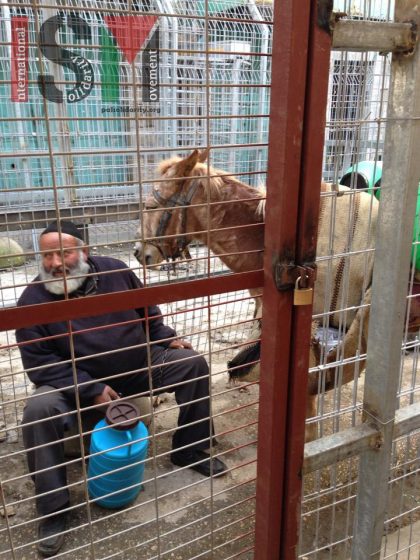
He then spent five hours Tuesday (16/12/14) attempting to cross in the opposite direction before eventually turning back, after being denied repeatedly by Israeli forces claiming that donkeys, mules, horses, and carts are not permitted to pass through the checkpoint.
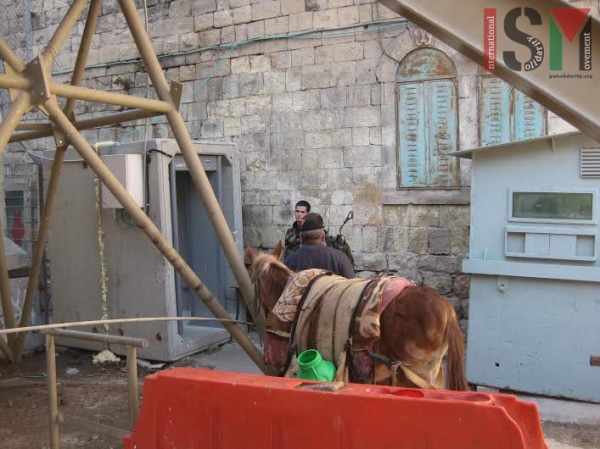
Shuhada checkpoint serves as the only clear passage between the H2 (Israeli-controlled) neighbourhood of Tel Rumeida and the H1 (Palestinian Authority-administered) neighbourhood of Bab Al-Zawiye, a route many Palestinians must traverse regularly in the course of their work and daily routines.
Mohammad arrived at the Bab Al-Zawiye side of the checkpoint at 13:40 on Mondayafternoon, his mule laden with empty milk jugs and saddlebags packed with various provisions. Israeli forces refused to let him through, claiming no animals were allowed past the checkpoint – a claim no one, including other international organisations at the scene as well as the Palestinian District Coordination Office for al-Khalil, had ever heard before.
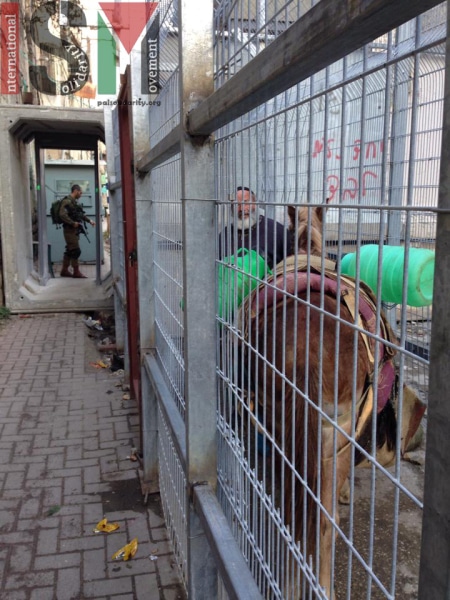
Mohammad explained that he had been allowed pass the checkpoint on Monday morning, with the promise that he would be let back through later in the day. When he returned, he found a new shift of soldiers and no one willing let him pass. The soldier manning the checkpoint claimed he needed permission from his commander to open the gate, which would allow Mohammad to pass with his mule.
An ISM volunteer at the scene later received a call explaining that the Israeli military’s new rule stated that horses, donkeys and mules were not permitted to pass through the checkpoint. No one, however, was able to explain why Mohammad had been allowed through that morning, but denied on his way home. “Look at my ID,” he told the soldier at one point, “I’m in your computer. I go through here all the time.”
He stayed waiting, sitting beside his mule on the cold concrete base of the fence, even as the afternoon turned into evening. The sky grew dark, though the lights from the checkpoint still illuminated the fences,
turnstiles, and barbed wire. Even the soldier seemed concerned, telling him to please go home, as it was cold and late and staying would not help him. But Mohammad had already made it clear he would not leave. About ten minutes later the soldier finally opened the gate, saying it was the “last time” that he would be allowed through. Although Mohammad heard the soldier’s message, it was clear he would not heed it. He intended to continue to resist, no matter what anyone told him.
Sure enough, the following morning he was once again standing outside the checkpoint, this time on the Tel Rumeida side, with full milk jugs tied to the back of his patient mule. The soldiers presented multiple reasons from denying him passage, from a prohibition on taking anything through the checkpoint too large to be carried through the turnstile, to the new rule against allowing donkeys, horses and mules through. ISM volunteers attempted to find a solution, offering to carry the milk jugs around the checkpoint and meet Mohammad and his mule on the other side. The Israeli soldiers manning the checkpoint rejected all suggestions.
“Is the donkey the problem or the milk the problem?” One ISM activist eventually inquired.
“The donkey’s the problem,” a soldier replied.
The animal could have easily passed through the metal detector; only last night ISM activists had witnessed the ludicrous sight of Mohammad’s mule strolling through the concrete structure, empty milk jugs banging against the corners of the gateway. The turnstile served as the only obstacle to the his passage – an obstacle the soldier could easily remove by opening the gate on the other side of the metal detector and letting the mule pass around the turnstile and into Bab Al-Zawiye.
After five hours of waiting, Mohammad’s comment seemed by far the most accurate. “The soldiers are the problem,” he had responded in Arabic.
Barring donkeys, mules, and horses and carts is only the latest in a string of frustrating, humiliating regulations imposed on the people living near the checkpoint, who must pass through to work, study, and shop for essentials such as fresh food. Just a few days earlier a group of elderly Palestinians, ill people, young children, and teachers at a local school had also been forced to wait, some for up to three hours, before being allowed through.
When Israeli forces shut down the checkpoint after it was burnt nearly a month ago , barring most people from passing through for over three weeks, the Palestinians were forced to adapt. Local people know ways around the checkpoint; several paths lead through local families’ yards and over the walls and rubble between Tel Rumeida and Bab Al-Zawiye. These “rabbit runs,” however, are entirely unsuited to traveling through with a mule – as well as for anyone sick, elderly, or carrying large heavy objects.
Since the attempted burning of the checkpoint, the Israeli military rebuilt it larger and with more obstacles for anyone traveling through. One side now has a metal detector, and both sides are equipped with vertical metal turnstiles which are a major impediment to anyone trying to move through with large baggage. Soldiers continue to use the burning of the checkpoint to justify collective punishment imposed on the entire Palestinian population – young and old, men and women, healthy and ill – who live or work near the Shuhada checkpoint.
Any Palestinian might be stopped while attempting pass through. Even with the checkpoint officially open, far too many are. Soldiers regularly search bags and make people remove their belts and empty their pockets before being allowed through. These everyday humiliations accompany frequent ID checks and detentions, serving as an inescapable reminder of the illegal Israeli occupation. Soldiers present at checkpoints routinely cite newly imposed rules and orders from superior officers as reasons for denying people passage, but whether someone passes easily through a checkpoint or must wait for hours often seems to be determined by nothing more than the soldiers’ caprice.
Many Palestinians must pass through Shuhada checkpoint multiple times in a day, carrying items as diverse as fresh vegetables, tubs of oil, and gas for cooking and heating their homes. During the hours ISM volunteers stood waiting with Mohammed, they witnessed multiple people struggle with the cumbersome design of the rebuilt checkpoint. One woman was carrying too many grocery bags to be able to fit into the turnstile. Someone on the other side of the turnstile had to reach a hand between the metal bars and move one bag through, returning it to the woman once she had passed. Another Palestinian, this time a young boy, needed the help of multiple passers-by over several minutes to figure out how to get two tubs of oil and a metal trolley through the turnstiles. Soldiers denied passage outright to boys who wanted to walk through the checkpoint with their bicycles.
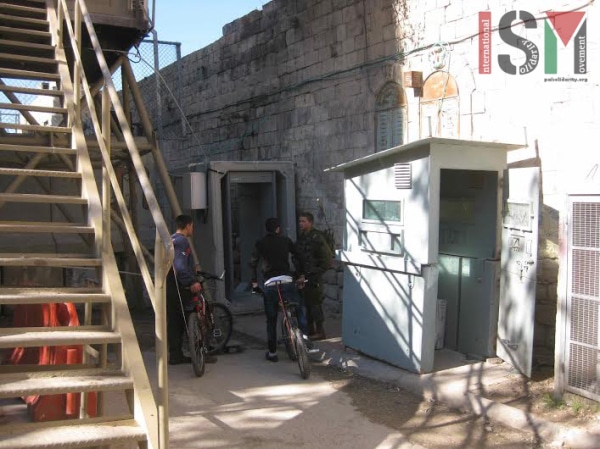
At one point on Monday night, a group of off-duty soldiers ran up Shuhada street and stopped near the checkpoint to rest, stretching and laughing, their easy freedom of movement a stark contrast to experiences of Palestinians struggling through Shuhada checkpoint. Almost all of Shuhada street has been closed off to Palestinians, reserved instead for the settlers and soldiers occupying H2. Even Palestinians who manage to get through the checkpoint must pursue long, circuitous routes between the surrounding areas of al-Khalil. Many, especially the elderly or disabled, are effectively barred from traveling to significant portions of the city their families have lived in for generations.
“I want to resist,” Mohammad told the ISM activists the first day they waited with him. He made sure the man translating said it twice, to make sure the ISM volunteers understood. “I want to resist,” he said, after over three long hours of waiting to be allowed through.
UN rights watchdog accuses Kiev forces of torture, inhumane treatment of civilians
RT | December 16, 2014

Azov battalion soldiers take an oath of allegiance to Ukraine in Kiev’s Sophia Square before being sent to the Donbass region. (RIA Novosti / Evgeny Kotenko)
Kiev-controlled volunteer battalions and the Ukrainian Security Service are involved in an increasing number of human rights violations including torture and forced disappearances of those suspected of “separatism,” according to a UN OHCHR report.
The report by the UN High Commissioner for Human Rights says that Kiev’s actions in eastern Ukraine to “restore order” have led to “arbitrary detentions, torture, and enforced disappearances of people suspected of ‘separatism and terrorism’. Most of such human rights violations appear to have been perpetrated by certain voluntary battalions or by the Security Service of Ukraine (SBU).”
The eighth OHCHR report on the human rights situation in Ukraine released on Monday added that the procedural rights of people have not always been observed, with reports of ill-treatment and reprisals upon release.
The report, which covers from November 1-30, says the Office of the Military Prosecutor has not taken any actions to investigate the “considerable” number of allegations of human rights violations, “including looting, arbitrary detention and ill-treatment by members of certain voluntary battalions such as Aidar, Azov, Slobozhanshchina and Shakhtarsk.”
For instance, OHCHR says that raids carried out by armed masked men in uniforms without insignia on 85 homes in the district of Krasnyi Lyman have led to a large number of forced disappearances. Those interviewed by UN staff reported being beaten and intimidated to “confess to participation in the armed groups.”

Recruits are sworn in for Azov Battalion in Kiev’s Sophia Square. (RIA Novosti / Evgeny Kotenko)
In another instance, the UN report cites an interview of a man who claims to have been arbitrarily detained by the Ukrainian Security Service (SBU) and kept incommunicado for two months in the SBU building in Kharkov.
Furthermore, the report notes that authorities are also lagging behind investigating more than 300 cases of shelling civilian areas.
“The indiscriminate shelling of built-up areas continued with over 100 incidents reported in November alone,”the report highlights.
In regards to a number of mass graves found in the conflict-torn eastern Ukraine, the report says that “no clear evidence of mass summary executions either by the armed groups or by the Ukrainian armed forces have been revealed to the public so far.”
The UN mission also blames anti-Kiev forces for human rights abuses, namely “killings, abductions, torture, ill-treatment, sexual violence, forced labour, ransom demands and extortion of money by the armed groups.”
The UN says that 4,707 people have died and another 10,322 have been wounded in the Ukraine conflict over the past nine months.
READ MORE: Russia calls for intl probe into Ukraine burials with signs of execution
Interview: Mexico Gov’t Claims on Disappeared Students Exposed
teleSUR | December 16, 2014
Explosive allegations were published in Proceso, one of Mexico’s leading news weeklies, this past Sunday, revealing strong evidence pointing to direct participation by federal authorities in the presumed killings of dozens of education students from the drug war-torn state of Guerrero.
The investigation also revealed that Mexican federal, state and municipal authorities were tracking the exact movements of the students on the same night of the massacre in question this past September 26 and that according to the government’s own documents, and in at least five clear instances, key testimony obtained by officials to sustain their version of the events was actually induced via illegal interrogation techniques that amounted to torture, which included electric shocks to testicles and extreme beatings.
The investigation’s revelations are not only a stark contrast with what has been officially maintained by the Peña Nieto administration, but also contradict most of what most mainstream news has reported from Mexico and beyond.
The Official Version
The official version of what happened on September 26, the night of the disappearance , largely emanates from a press conference that has by now become widely known and has even served as a reference point for a nation-wide movement that has been ongoing since soon after the presumed massacre occurred. That is because the Attorney General leading the press conference, Jesus Murillo Karam, mentioned that he was “tired” at the end of the hour-long conference. The #YaMeCanse Twitter hashtag arose almost as soon as the conference itself ended, and has actually served as the battle-cry for a nation-wide movement that has attracted international support and attention, including a day of protests which featured over 200 actions across the globe and cross-border protests, as previously reported by teleSUR English.
During the press conference, and reiterated through a variety of official accounts since that time, authorities have claimed that Iguala Mayor José Luis Abarca and his wife ordered local municipal police to attack several buses of the “normalistas” (students training to become teachers) on several occasions. The attacks wound up killing at least three people and disappearing 43 students. The Guerreros Unidos (Warriors United) drug gang was then given the 43 kidnapped students which went on to brutally assassinate, dismember, torture and burn the victims to death, again, according to official accounts, but disputed by the parents.
The ex-Mayor and his wife have since been detained in connection to the presumed massacre. Acting on a tip from the couple’s landlord in Itzapalapa, the “imperial couple,” as local media dubbed them, were considered by federal officials to be the main culprits behind the crime. The official allegation was that the couple acted in cahoots with a gang that had long suspected, close ties to the Mayor and his wife.
State Version Undermined
The investigation, which was penned by acclaimed Mexican investigative journalist Anabel Hernandez and the University of California at Berkeley-based journalist Steve Fisher, blows the lid off of official accounting in a number of ways, in alleging that: federal, state and local officials closely tracked, monitored and were quite aware of the whereabouts of both the killed, disappeared and presumably murdered education students; key testimonies obtained by officials were garnered through illegal torture techniques; federal police and soldiers from the military were present at the scene of the killings; the government has deliberately withheld this information in an attempt to maintain their own official accounting of the events in question.
The allegations also come during a time in which the government’s version of the events was already being questioned by other sources. A research team headed by a group of scientists from the National Autonomous University of Mexico, argued that the government claims that the Guerreros Unidos gang incinerated to death all 43 students lacked any “scientific explanation.”
In an extended interview via a three-way telephone call with the authors of the investigation with teleSUR English, Anabel Hernandez and Steve Fisher discussed and detailed their findings.
Journalists Discuss Disturbing Findings
The ever-passionate and expressive Hernandez is no stranger to explosive investigations and allegations, so much so that her home was raided by official authorities late last year. The award-winning and internationally acclaimed journalist has also been subjected to harrowing threatening acts, such as having found animal body parts at the doorstep of her home. In her latest investigation, however, Hernandez made the case that her co-authored findings starkly revealed that governmental responsibility for the presumed massacre is much higher than what has been previously admitted.
“The point is that we know that the federal police were there, we know that they knew when the students [were] abducted and we know that many of the testimonies that the PGR [Mexico’s Attorney General’s office] were obtained and acquired through torture techniques. But in Mexico, evidence obtained through torture is illegal,” Hernandez told teleSUR.
In contrast to the official version, which maintains that the federal government was unaware of the massacre, Hernandez and Fisher allege that federal police and military soldiers directly participated in the presumed massacre itself and were one of three levels of government closely monitoring the students whereabouts throughout the night of the presumed massacre.
According to Hernandez and Fisher’s accounting of the unedited Guerrero state report they obtained, which was drawn up for the Interior Ministry (SEGOB) and obtained by the magazine about a month and a half ago, students were monitored as soon as they left their school grounds at 5:59pm. Both federal and state police were monitoring the students while they traveled from the Chilpancingo-based Control, Computational and Communications Center (C4).
The article goes into further detail, noting that at 8pm, the federal and state police arrived to the highway where the students were fielding donations; at 9:21pm, a federal police chief – Luis Antonio Dorantes – was advised of the student’s arrival; and at 9:40pm the C4 center reported the first gunshots.
The report was also based on 12 videos recorded by surviving students on their cell phones, whereby one now publicly released video has audio clearly noting a surviving student yelling in distress: “The police are now coming, the federales are staying and they are going to want to screw us over!”
In sum, various levels of government were much more aware of the students and more present at key points throughout the evening in question, than what has been previously admitted.
Hernandez made it clear to teleSUR, however, that their investigation didn’t reveal whether or not the United Warriors gang were involved with the massacre. Fisher elaborated on this point: “We cannot say whether or not Guerreros Unidos was ultimately involved with this, or not, but we can say that the evidence we have acquired was that they were tortured [before their testimonies were given]. It is thus suspect that they could actually get proper testimonies considering the fact that they were tortured brutally, including electric shocks to testicles and extreme beatings.”
Hernandez added that other telltale signs of torture were uncovered in their investigation, including bruised ribs, blackened eyes and black-and-blue marks on the neck. Such findings were especially damning, Hernandez pointed out, considering that, “the attorney general’s version was based solely on testimony by presumed drug traffickers.”
Fisher spoke to this point, telling teleSUR that, “I would say that in any case where there is torture involved, it brings into question the entire investigation. It would be interesting to know why the PGR would base this very important investigation on, according to their own documents, information obtained through people that were brutally beaten and tortured.”
Hernandez and Fisher wrote that the Peña Nieto administration has withheld the information they reported on.
Soon after the disappearance of the education students, the Guerrero Attorney General’s office requested that the Mexican Federal Police, their investigation notes, hand over extensive documentation related to the potential participation of federal police agents, including the exact registries of when agents clocked in and out while on the job the night of the attack. However, the investigation added that since the Peña Nieto administration took over the investigation this past October 4, the requested documentation was never handed over to the Guerrero office.
“It is clear that the PGR has been manipulating the case, that the federal government has been manipulating the case, and that now, the official version of the case has been shown to not be trustworthy,” Hernandez passionately asserted during the extensive interview, adding that in subsequent conversations with government officials, none of their allegations were officially denied to either of the reporters.
Investigation Points to a Number of Implications
Considering the many contradictions between the investigation and official accounts , many questions can be asked. Since Mexican officials have long claimed that Warriors United was the group which took custody of the students from local police authorities who had initially detained them, have there been any false arrests among the 74-some people that have been rounded up since September 26?
The accused leader of Warriors United, Sidronio Casarrubias, is among the many detained, which include an array of local law enforcement officials. Casarrubias has since revealed to officials the kind of relationship he had with Abarca while he was mayor, but it is not clear whether or not he was among the five people tortured in Herandez and Fisher’s account.
“Warriors United has sewn a web of complicity with several mayors and above all with security officials,” Murillo previously told the press. “In Iguala, the complicity was between the authorities, the local police and the Warriors United,” Murillo added.
If there is one official acknowledgment which Hernandez and Fisher do not dispute, it is the systematic relationship that exists between drug cartels and the Mexican state. It is that very relationship which has served as a spark plug to a nation that has undertaken a significant amount of resistance since September 26.
Nation-wide Movement Continues to Wage Protest
The revelations by Herandez and Fisher come at a time that the nation’s ire was already raised to a feverish boiling point. In one of the largest countries and economies of Latin America. Mexico has witnessed near daily and nation-wide actions of resistance.
Since the disappearance of the “normalistas” on September 26, the country has been brimming with mass marches, candle-light vigils, university-campus and labor-union-led strikes, occupations of official and university buildings, riot police-led arrests of demonstrators, property destruction of official buildings, sit-ins, panels ruminating over the ills of narco-state violence and international bridge closings.
Most recently, at least 22 people were injured this past Sunday during protests in Chilpancingo, Guerrero which featured police opening fire on demonstrators. TeleSUR English reported that three parents of the forcibly disappeared, a journalist, a student from the National Autonomous University of Mexico, and a member of an education union were among those injured.
The violent law enforcement response to the protests, specifically that of Sunday’s occurrences, prompted the National Human rights Commission to demand that authorities conduct themselves within the law.
The disappearance clearly served as the catalyst for the movement’s inception, much of the country has long been weary of the systematic problem of disappearances and the eerie official impunity which has often surrounded them. Nothing less than some 22,000 disappearances, over the course of the last three years alone, account for official estimates. Other analysts estimate the actual total as being higher than that.
Mass Graves Point to Narco-State Crimes
The disappearances of the normalistas are emblematic of a long-running problem in Mexico: thousands upon thousands of cases of disappearances, many of whose investigations were found ‘inconclusive’ and long ago closed, exist throughout the country. Some estimates range as high as 24,000 disappearances having occurred since 2011 alone, the overwhelming amount of which were “unsolved” and/or “closed” cases.
In another case of official law enforcement involvement in a crime, 22 alleged kidnappers were summarily executed by Mexican soldiers in Tlatlaya in June 2014. A federal judge recently charged three soldiers with murder and four others with abuse of authority and other charges in relation to the massacre.
At least a dozen mass grave sites have been discovered since the time of the Ayatzinapa disappearances. Meanwhile, movement activists and organizers alike have alleged that many more mass grave sites exist than what has been officially acknowledged.
Regardless of the actual total of mass grave sites, their undisputed existence still point to a problem more familiar to locals and residents of the area: Guerrero is not only a drug war-torn state, but a complex nexus of corruption and corroboration between local, regional and state authorities and their allies in street gangs and powerful drug cartels. Even federal officials have since admitted that the disappeared students pointed to a larger, narco-state reality.
While the troubles of living under a narco-state is one which local residents of Guerrero have long been familiar, in the wake of what seemingly is a never-ending case of the disappearances of the Guerrero students, it has now become a reality with which the whole nation of Mexico, and well beyond, are becoming familiar with as well.
But now, in light of the explosive allegations revealed by Hernandez and Fisher, it will become yet a more complex reality with which the nation will have to come to grips and to which the government may have to provide yet more answers during tiring press conferences.
Israeli crimes continue in al-Quds
Israel continues its widespread crackdown on the Palestinian residents of East Jerusalem al-Quds. The rights groups have dubbed Israel’s crackdown an act of “collective punishment” against the Palestinian population.
More than 1,300 local residents have been arrested since summer, 40 percent of them children, according to the Palestinian Prisoners Club, an advocacy group.
Over the past weeks, the al-Aqsa Mosque has been the scene of clashes between Palestinian worshippers and Israeli settlers and troops.
Israel has tried over the past decades to change the demographic makeup of al-Quds by constructing illegal settlements, destroying historical sites and expelling the local Palestinian population.
BOMBSHELL INTERVIEW: Eric Garner’s Death a Retaliatory Move by NYPD
By Matt Agorist | Free Thought Project | December 15, 2014
New York, NY — The Free Thought Project has been given exclusive information as to why Eric Garner may have been killed by the NYPD. This new information paints an entirely different picture as to why police were harassing Garner that fateful day back in July.
The information comes from an interview that took place last Thursday with Benjamin Carr. Benjamin Carr is Eric Garner’s stepfather, who was in the media recently peacefully resolving a situation with an angry protester.
The brief clip, obtained exclusively by the Free Thought Project, is part of a much larger collection of video which is going to be part of a documentary on police misconduct, which is why the videographer who gave it to us, has placed a watermark over it.
In the interview, Carr tells us that police didn’t show up that day because Garner broke up a fight or sold loosey cigarettes; they were there because police had a history of harassing Garner.
Carr explains that police had actually stolen money from Garner, who subsequently planned to file charges against the NYPD for this theft. Police were there that day, Carr says, not to shake Garner down for selling smokes, but to retaliate against him for filing charges against them.
When the interviewer asks Carr if he thinks that the police singled out Garner because he was black, this is what he said,
“I wouldn’t really say [he was killed] because Eric was a black man. It’s due to the fact that they stole money from him and refused to give him his money, and he filed charges against them. This is why they had a vendetta against him.”
The Free Thought Project tried multiple times to confirm this complaint against the NYPD by reaching out to their Staten Island precinct. However, after being placed on hold by the NYPD for long periods of time, hung up on, and eventually ignored, we were unable to get a statement from them in regards to this case. The recordings of these calls will be put up on our Radio Show youtube channel for review.
However, we did confirm with a member of Garner’s family that Eric Garner was frequently harassed by these officers, and it goes much deeper than money. Garner had actually been sexually assaulted by the NYPD, on multiple occasions, according to our sources.
Of course, this sounds ridiculous. How would the NYPD sexually assault a man like Eric Garner, and why? But if we dig a little deeper we see that officer Daniel Pantaleo, the man who was responsible for Garner’s death, has been sued three times for violating the constitutional rights of other black males in the area, by performing humiliating strip searches and fondling the genitalia of his victims, some of them in public view.
The most recent of these lawsuits was just filed in November and comes from Kenneth Collins, who says in the lawsuit that he “was subjected to a degrading search of his private parts and genitals by the defendants.”
The NYPD paid out a settlement last year to two men who sued the city because Pantaleo forced them to strip naked in public as he “touched and searched their genital areas, or stood by while this was done in their presence.”
According to another lawsuit, victim Rylawn Walker, was charged with marijuana possession and underwent similar rights violations by Pantaleo. The charges were dismissed against Walker and the case sealed on a motion from prosecutors. His lawsuit against the NYPD stated that Walker “was committing no crime at that time and was not acting in a suspicious manner.”
Defense lawyer Michael Colihan summed up this atrocity when he wrote a letter in August 2014 to U.S. District Judge Edgardo Ramos. In his letter, Colihan said:
“To put it mildly, many police on Staten Island have been playing fast, loose and violently with the public they seem to have forgotten they are sworn to protect,” wrote Colihan. “After litigating about 200 of these civil rights matters in the Eastern and Southern Districts of New York since 1977, I have seen no interest by the managers of the New York City Police Department, or anyone employed by the city of New York, in doing anything to stop this.”
After knowing what the NYPD is capable of, these allegations by Benjamin Carr are not surprising in the least. In fact, just 2 months ago, an NYPD officer was actually caught on film stealing over $1,000 in cash from victim Lamard Joye, during a “stop and frisk.” The entire incident was caught on film and we were told that it’s “under internal investigation,” yet nothing has happened.
How many incidents like this one happen daily without consequences for the perpetrators?
Is it any surprise now, seeing why Garner reacted to police with such contempt and non-violent resistance? We are looking at a man being shaken down by people, who’ve allegedly sexually assaulted him multiple times, as well as stolen money from him. And from the video of the incident, it appears that they wished to cause him harm as well.
Would you have been as cordial if armed men with a history of stealing from you and feeling up your private parts, were there to do it all again?
Denver Cops Arrest Man who Exposed them Beating Man on Video While Promoting Cop who did the Beating
By Carlos Miller | PINAC | December 14, 2014
A man who video recorded Denver police repeatedly punching a man in the face, causing his head to bounce off the pavement, before tripping his pregnant wife and causing her to fall on her face – sparking an FBI investigation into the department – was arrested Thursday in what appears to be a case of retaliation.
After all, Denver police not only arrested him on what they called a “newly activated traffic warrant” from a nearby county after he had just left the FBI office with whom he is cooperating on the federal investigation, they refused to allow him to bond out of jail, even though the warrant was regarding a measly missed court date over failure to provide proof of insurance and registration during a traffic stop a few months ago.
Denver police are obviously upset that upset Levi Frasier managed to recover the footage from his Samsung tablet after they had deleted it, which led to them being investigated by the feds.
Not that it stopped them from promoting the cop, Charles “Chris” Jones IV, seen on video punching the suspect to sergeant earlier this month.

Denver police officer Charles “Chris” Jones IV was recently promoted to sergeant despite being under a federal investigation for beating a man on camera.
According to FOX 31:
Frasier was reportedly arrested after leaving the FBI office and before he arrived at FOX31 Denver studios for a schedule interview.
Frasier was not allowed to bond out and was spending the night in jail.
We emailed DPD for a comment and other clarifications after hours.
Cmdr. Matt Murray replied, “I would check with the jail. They could provide the most accurate information about why Mr. Frasier is in jail.”
Frasier is a key witness in an ongoing DPD internal affairs investigation. After recording an arrest on his electronic device, Frasier accused officers of seizing his Samsung tablet without a warrant and scrolling through his video files without permission.
Frasier reported that when the tablet was given back to him, the video was missing, but he restored it with a cloud application.
FOX 31 has been doing a great job on keeping up with this story, dedicating more than six minutes in the previous segment, which you can see below along with the latest segment on his arrest.
They also published a piece that cops have no legal right to seize phones and delete footage, something the mainstream media has always had trouble addressing:
In an exclusive interview with FOX31 Denver, Frasier said, “I didn’t give it to them at all. I went back to the van and grabbed it and as I was walking up — it was taken out of my hand.”
Frasier claimed Denver officers violated his civil rights and federal law when they searched his personal photos file without a court order.
Legal experts said Frasier has a right to be angry. Police cannot, except in rare circumstances, seize your mobile devices without a search warrant.
A June Supreme Court ruling, Riley v. California, greatly limits under what circumstances police can look into a persons cellphone or tablet digging for evidence.
“They crossed the line – absolutely!” said Flores’ attorney Benjamin Hartford.
The incident has prompted the Denver Police Department to turn on the Police PR Spin Machine by issuing a four-page release justifying the behavior of the cops in punching the suspect and tripping his wife, but also putting Frasier’s character into question because he has served time in prison years earlier.
But that letter led to the Citizen Oversight Board, whose seven members are appointed by the mayor and confirmed by the city council, to issue its own letter, criticizing the four-page press release, accusing them of lacking objectivity, an excerpt which you can read below, or read in its entirety by clicking here.
The press release also made statements to attack the credibility of the witness who came forward with the video. It stated that the witness has a criminal record, and listed several crimes that he was allegedly imprisoned for in another state. It stated that he was recently released after a “lengthy” prison sentence, and that the witness has “six aliases,” which occurs as a result of a legal name change or “the illegal use of someone else’s name or lying about one’s identity to the police.”
We strongly believe that it was not appropriate for the DPD to make these statements. There is already significant community concern and distrust of the DPD and IAB. Instead of thanking the witness who came forward to share information, the DPD publicly attacked his character. It is very likely that the DPD’s attacks on this witness will only reinforce fears in the community, and inhibit other members of the public from cooperating with DPD or IAB if they witness possible officer misconduct in the future.
We are aware that the stated purpose of IAB investigations is to fairly determine the facts so that decisions can be made about whether any officers engaged in misconduct. There should be no predetermined conclusions at the beginning of an IAB investigation. In this case, however, the DPD has publicly stated that the force was appropriate before IAB has even conducted its investigation. In the news story, the DPD Commander admitted that the Department had not yet viewed the witness’ full video of the use of force. Isn’t that a very important piece of evidence that would have to be viewed before deciding that repeatedly punching the man and tripping his pregnant girlfriend was appropriate?
Romania agreed to host CIA ‘black sites’ to be accepted into NATO – ex spy chief
RT | December 14, 2014
Romania allowed the CIA to use a number of sites on its territory, a former head of the country’s intelligence confessed. He added that Bucharest’s bid to join NATO at the time prevented it from asking the US about the purposes of the sites.
The sites in question were called “transit centers” and Romania was unaware of whether they were used for detention, Ioan Talpes, who headed Romania’s Foreign Intelligence Service from 2000 to 2004, told the daily Adevarul in a video interview posted online on Saturday.
“The Romanian side was not interested in what the Americans were doing, purposely to show them that they could trust us,” said Talpes.
AFP cited the interview, in which Talpes specifically stressed that at the time the decision was made, Bucharest was waiting to join NATO.
The ex-spy chief said talks on “sites that the Romanians would place at the disposal of CIA representatives” began after September 11, 2001.
“What is certain is that we were not aware of the presence of detainees,” Talpes insisted in the interview.
The US Senate report on torture, published earlier this week, revealed among other things that 119 people were captured and held in CIA detention sites hosted by other countries.
Although none of the countries were specifically named in the heavily redacted document, the list of those assumed to be mentioned includes Romania, Poland, Lithuania, Thailand and Afghanistan.
Romania’s president at the time, Ion Iliescu, denied earlier this week any knowledge of the so-called “black sites” in the country, AFP reports.
Prime Minister Victor Ponta said questions about the sites should be addressed to the Foreign Ministry, which hasn’t as yet commented on the issue.
Poland earlier confirmed that it housed a facility that was used to interrogate Al-Qaeda suspects between 2002 and 2003.
In July, the European Court of Human Rights (ECHR) ruled that Poland violated an international treaty to protect human rights by hosting secret CIA prisons.
ECHR also ordered Warsaw to pay €230,000 to two former secret facility detainees. Poland is appealing the decision.
The ruling, meanwhile, could serve as a precedent for other European states alleged to have hosted CIA prisons. Romania and Lithuania have similar cases filed against them with the ECHR.
READ MORE:
CIA torture far exceeded waterboarding, brought suspects ‘to point of death’
Featured Video

Elijah Magnier: Yemen’s strikes are shattering Saudi Arabia’s long-term strategy
or go to
Aletho News Archives – Video-Images
From the Archives
British weapons and personnel doing much of the killing in Yemen
Press TV – June 18, 2019
A detailed report published by the Guardian newspaper has shown how Britain is massively contributing to Saudi Arabia’s devastating war on Yemen as it suggests that London is not only supplying the bombs that fall on Yemenis, but it provides the personnel and expertise that keep the war going.
The comprehensive report by Arron Merat published on Tuesday showed that Britain was doing much of the killing in Yemen as the country continues to provide Saudi Arabia with everything it needs to turn its southern impoverished neighbor into a graveyard.
“Every day Yemen is hit by British bombs – dropped by British planes that are flown by British-trained pilots and maintained and prepared inside Saudi Arabia by thousands of British contractors,” said Merat in the report. … continue
Blog Roll
 Aletho News
- Netizens condemn Japanese drama for projecting Japan’s wartime atrocities onto Chinese characters
- Racist Seinfeld Dances for Joy as Bibi Unveils His New Map
- A West Bank War for Netanyahu’s Election Campaign, Could It Backfire?
- Yemen denounces European Parliament’s ‘hypocritical’ push to blacklist Ansarullah
- Qalibaf: UAE’s UN bid aims to ‘clear the runway’ for ‘Greater Israel’, whitewash genocide
- Pakistan reopens Iran border after boosting security: Report
- Why are so many Brazilians voting for Flávio Bolsonaro?
- Democrats Put Anti-Russia Agenda Ahead of American Workers
- Elijah Magnier: Yemen’s Strikes Are Shattering Saudi Arabia’s Long-Term Strategy
- Pentagon designates Chinese cultural centers national security threat
- If Americans Knew
- An error has occurred; the feed is probably down. Try again later.
- No Tricks Zone
- Sudden Stratospheric Warming, Powerful El Niño Combination May Lead To Extreme Europe Cold, Energy Crisis!
- Two New Studies Find Thwaites Glacier Melt Cannot Be Driven By Human Activity Or A Warming Ocean
- E-Cars Reduce CO2 Emissions By Only 41% Compared To Internal Combustion Engine Vehicles
- Predictions Made By Renowned Climate Professor Over Past Decades Have Been Proven To Be Poor
- New Study Suggests Large Regions Of The Pacific Ocean Have Been Cooling For The Last 80 Years
- Germany’s Green Energy Debacle: High Energy Costs Force Kahla Porzellan to Close After 182 Years!
- New Study: 50 Years Of The Most Aggressive ‘Net Zero’ Policies Can Only Affect The Global Climate By 0.03°C
- US September “Heat” Was No Record…Many Records Set Decades Ago
- Latest European Green Energy Debacle; Portugal’s Largest Flagship Solar Park Insolvent!
- Green Energy Debacle: German Expert Professor Fritz Vahrenholt Warns Of Severe Economic And Social Consequences

