Over 1.7 million Gazans isolated from the world after Israel, Egypt close crossings
Al-Akhbar | November 2, 2014
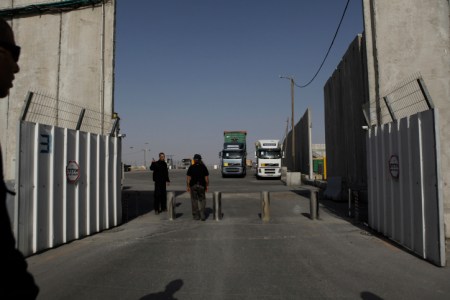
Gaza has become an open-air prison after Israel decided to close two border crossings with Gaza, the army said on Sunday, after a rocket allegedly fired from the Palestinian enclave struck its territory.
The Israeli blockade comes a week after Egypt closed its border with Gaza. With all borders closed, more than one and a half million people in Gaza are now isolated from the outside world. They are prisoners inside the 360 square kilometers that make up the coastal Strip.
“The crossing points for people and goods, Erez and Kerem Shalom, have been closed until further notice except for humanitarian aid,” an army spokeswoman said.
She said that the measure was taken after a rocket fired from Gaza hit Israeli-occupied Palestinian territory on Friday, without causing any casualties or damage.
There was no claim of responsibility from any armed faction in Gaza. A military spokeswoman said forces were still searching for debris.
The projectile struck harmlessly was the first to strike Israeli-occupied territory since September 16, and the second since the end of the Zionist state’s devastating 51-day assault on Gaza.
For 51 days this summer, Israel pounded the Gaza Strip – by air, land and sea – with the stated aim of ending rocket fire from the coastal enclave.
More than 2,160 Gazans, at least 505 of them children, were killed – and 11,000 injured – during seven weeks of unrelenting Israeli attacks in July and August.
The Israeli offensive ended on August 26 with the an Egypt-brokered cease-fire agreement.
However, Israel has violated the terms of the agreement repeatedly ever since.
The agreement calls for reopening Gaza’s border crossings with Israel after an eight-year blockade. Instead, Israel has further sealed the crossings.
The truce also stipulated that Israel would immediately expand the fishing zone off Gaza’s coast, allowing fishermen to sail as far as six nautical miles from shore, and would continue to expand the area gradually.
However, since the ceasefire was signed, Israeli forces have fired at several fishermen who they say have ventured beyond the newly-imposed limit of six nautical miles.
The head of the Gaza fishermen syndicate accused Israel of constantly violating the terms of the agreement.
“Since signing the truce, the Israeli army has violated (the agreement) eight times, arresting fishermen and destroying a giant fishing boat, in addition to firing at fishermen on a daily basis,” he said.
Besides the fishermen, Israeli forces have also fired at other civilians. On Wednesday, Israeli forces shot and injured a Palestinian man on the beach in the northern Gaza Strip.
Furthermore, Gaza is also littered with a large number of unexploded Israeli shells, one of which has recently killed 4-year-old Mohammed Sami Abu-Jrad from the northern Gaza city of Beit Hanoun.
Israel also agreed to allow construction material into Gaza. But two months after the war ended, no building material has entered Gaza due to Israel’s ongoing blockade.
Israel routinely bars the entry of building materials into the embattled coastal enclave on grounds that Palestinian resistance faction Hamas could use them to build underground tunnels or fortifications.
For years, the Gaza Strip has depended on construction materials smuggled into the territory through a network of tunnels linking it to Egypt’s Sinai Peninsula.
A recent crackdown on the tunnels by the Egyptian army, however, has effectively neutralized hundreds of tunnels, severely affecting Gaza’s construction sector.
Egypt leaves Gaza isolated
On Wednesday, Egypt began setting up a buffer zone along its border with the Gaza strip in a move which will see about 800 homes demolished.
It comes in the wake of a suicide car bombing which killed 30 Egyptian soldiers in Sinai last week, the deadliest attack on the military since ousting Egypt’s former president Mohammed Mursi.
Following the bombing, Egypt immediately closed the Rafah crossing into the Gaza Strip, the principal connection between Gaza’s 1.7 million people and the outside world.
In August, Egypt’s authorities have used an attack on the Egyptian military in Sinai as a pretext to start a campaign to destroy lifelines into Gaza. Over 120 tunnels were blown up or filled in.
More than just being the only way for some products to make it into the over 1.5 million Palestinians living in the strip, the Gaza tunnels have become a major source of income for the transporters of goods. Egypt has closed Gaza’s lifelines.
Since the beginning of 2014 until the end of May, Rafah crossing has been opened only 14 out of 120 days, limiting access to humanitarian cases and for other authorized travelers – including foreign nationals and visa holders.
(AFP, Reuters, Al-Akhbar)
UN Report: Israeli settlements have doubled in the last four years
MEMO | October 31, 2014
The number of Israeli settlements on occupied Palestinian land have doubled in the last 54 months, UN Commission on Human Rights member Cees Flinterman said today.
Flinterman presented the fourth stage of a report monitoring activity of Israel’s practices in Palestinian territory at a press conference held at the United Nations in Geneva.
He said: “We are concerned by the level of violence that settlers are using against Palestinian civilians and property owners in both the West Bank and East Jerusalem.”
The UN official asked Israel to halt settlement expansion on occupied Palestinian land adding: “We have yet to receive an official response from Israel in regards to the increased number of settlements in the West Bank.”
Flinterman also expressed his disappointment at the fact that the Israeli government refuses to recognise that torture is a crime. “The committee is greatly disappointed in Israel for not recognising that torture is a crime. The torture and mistreatment that Israel practices in detention centres is a serious problem and we call on Israel to address them within a year’s time.”
Nigel Rodley, president of the UN Commission on Human Rights, pointed out that the situation in the region has not changed despite the number of international efforts in the region; very few changes have been implemented. Rodley also pointed out that the UN Commission on Human Rights criticised the latest Israeli aggression against the Gaza Strip and called on Tel Aviv to conduct the necessary investigations into human rights violations.
The UN committee’s report stressed the need to investigate Israeli violations in the 2008, 2009, 2012 and 2014 wars on the Gaza Strip.
Antonio Buehler Found Not Guilty After Austin Cop Breaks Blue Code of Silence, Testifying on his Behalf
By Ben Keller | PINAC | October 29, 2014

From left to right, surprise witness Jermaine Hopkins, an Austin police officer who testified on Antonio Buehler’s behalf, attorney Millie Thompson and Antonio Buehler, who was found not guilty for a 2011 case where he was arrested for photographing Austin police.
Deliberations in the trial of Peaceful Streets Project founder Antonio Buehler lasted five hours before a Texas jury returned with a not guilty verdict Wednesday after an Austin police officer surprisingly testified on Buehler’s behalf – most likely losing his job in the process.
Buehler was on trial for an incident that occured on New Years Eve of 2012 where he witnessed Austin officers abusing the passenger of a vehicle during a routine DWI stop. The stop was being conducted by the now-infamous officers Patrick Oborski and Robert Snider when Buehler began taking pictures, sparking a verbal confrontation.
Buehler probed the officers with questions as he took pictures of the male officers holding the female passengers in a torture hold, known as the Strappado where her arms were cuffed behind her back and pulled upwards. Buehler can be heard in the video asking officers, “What are you doing?” Buehler described the hold as ‘being meant for causing extreme pain.”

The photo that got Antonio Buehler arrested
The verbal confrontation turned into a physical struggle as Oborski aggressively approached Buehler. Buehler put his hands in the air to show he wasn’t a threat to any of the officers. Buehler then began asking Oborski, “why are you touching me?”
Oborski then gave Buehler an unlawful order to put his hands behind his back. Buehler never did that. And Oborski then wrestled Buehler to the ground. Later that night, Antonio was booked into jail on felony charges claiming that Buehler spit in Oborski’s face, where he faced a potential 2-10 years in prison.
That, of course, never happened. But luckily, someone was filming across the street to prove that it never happened.
The biggest bombshell came when Oborski testified against himself. He testified to the jury that it was actually just a little bit of ‘spittle’ and that when Buehler was asking him questions that he had managed to somehow get a little ‘spittle’ on his face. This implies what Buehler and others have been saying for three years now. That Buehler never spit in that cop’s face. Oborski made it all up and tried to send him to prison for contempt of cop. The video is proof of that.
The gravity of this case carries many implications, not only about the character of the Austin Police Department throughout the ranks, but the trial also holds implications for a future civl lawsuit against Oborski. In Texas, it’s typically, according to most lawyers here, a tough row to hoe if you want to sue the government. Tort laws make it seemingly more difficult than most states.
But the judge in Buehler’s civil case allowed that Obroski can be sued in his personal capacity and that the claim Buehler filed against Oborski can go forward.
Surprise cop witness
There were a few surprises throughout this trial (perhaps well thought out by Buehler and his legal team). If any one is ever relentless about the notion that there really aren’t any good cops, it’s Buehler. But during this trial, Buehler surprised the prosecution with a star witness, Austin police officer Jermaine Hopkins, who was told by APD brass that if he testified, he would lose his job by October 30th, which is today.
Hopkins testified anyway, telling jurors that Buehler had broken no law and that his fellow officers had violated his Constitutional rights by arresting him.
Hopkins has a hearing tomorrow to determine his fate with the department. He said he sent Buehler an email after seeing his case and wanted to testify out of concern that Buehler’s rights were being violated.
Hopkins said in an interview with PINAC after the verdict that there are some good things about his department, but ultimately he has no regrets and that he did the right thing by testifying. He also said if he could change anything it would be “accountability at the administrative level.”
When asked by a bystander in the courtroom what his future holds, Hopkins said he is thinking about going to law school.
Another surprise occurred at the beginning of the trial when one juror asked to be released from the jury citing personal troubles. Buehler’s attorney, Millie Thompson said the juror was having symptoms of mental illness including paranoia and an inability to make a decision in a jury, because of fear from a group.
Although, the juror never specified to the court any particular group. Thompson said she didn’t object to the juror being dismissed. But she did object to the state’s request for a mistrial.
The Judge sided with Thompson and the trial went on with only five jurors.
The deciding jury was made up of two males and three females, one who worked as a writer for Beavis and Butthead. None were interested in commenting to PINAC or any other media outlet. But we caught up with Buehler and Hopkins outside the courtroom.
When asked after the trial what the future holds for Buehler’s activist group, Peaceful Streets Project, a group that films on duty cops, Buehler replied, “Hopefully, to grow it.”
But he also has three more charges to fight as well as a civil suit to pursue as he explains in the video.
Ben Keller resides in Austin, Texas, where much of his activism centers around advocating for parents lost in the CPS system. Ben believes in government accountability and thinks the public should have more access to court rooms. He is a volunteer for Peaceful Streets Project as well as other groups who shine light on government corruption. He studied English Literature and Philosophy at the University of Texas at Austin. He can be reached at BenKKeller@yahoo.com.
Torture in Israeli prisons: 200 methods used against Palestinian prisoners

Methods range between severe beatings, putting prisoners under cold water followed by hot water, cuffing or restraining them with their arms behind them and then tying them to a door or window for long periods of time, often lasting hours.
MEMO | October 29, 2014
Hundreds of torture methods used against Palestinian prisoners during interrogations conducted in Israeli prisoners have been observed by human rights organisations and prisoners’ rights associations.
A report by the United Nations lists around 200 methods of torture. The Israeli rights group B’Tselem listed around 105 torture methods. Regardless of the number, all these reports indicate a grave level of violations perpetrated against Palestinians following their arrest.
Fouad Khuffash, director of the Ahrar Centre for Prisoners’ Studies and Human Rights, suggests that torture can be divided into two categories; physical and psychological. Some believe that psychological torture is less harmful than physical torture, but the mental scars left by both can leave prisoners traumatised long after their release.
Khuffash adds: “Torture in Israeli prisons is systematic and starts from the moment a prisoner is arrested, not from the moment they begin interrogation. This is a premeditated and staged scenario that changes according to the case of the detainee and the nature of their file. Investigators alternate and play various roles assigned in advance to each investigator.”
Fahd Abu Al-Hajj, director of the Abu Jihad Centre for Prisoner Affairs at the University of Jerusalem, noted that there are 73 methods of interrogation considered to be the “most popular” in Israeli jails. These methods demonstrate the barbarism of the occupation and its lack of respect for basic standards of human rights, he stated.
He added: “Nothing evidences this more than the repeated death of prisoners under interrogation, the most recent of which was the death of the prisoner Raed Al-Jabari.”
Al-Hajj believes that the use of torture is systematic, adopted by the Israeli intelligence services and that no prisoner detained in any Israeli prison is spared.
He also explained that these methods range between severe beatings, putting prisoners under cold water followed by hot water, cuffing or restraining them with their arms behind them and then tying them to a door or window for long periods of time, often lasting hours. Prisoners are also made to sit on chairs and beaten with sticks until they lose consciousness. These beatings may target sensitive areas of their bodies which have the potential to leave long-term negative effects, sometimes leading to chronic diseases.
Forms of torture
Israeli human rights organisation B’Tselem acknowledged in its report that 105 torture methods are used against Palestinian detainees which are considered serious violations of human rights. A UN human rights committee described the torture in Israeli prisons as “crossing the line”, noting that Israel’s brutal methods of torture included breaking backs, pulling fingers apart and twisting testicles.
Israeli intelligence bases their torture of detainees on the so-called secret guidelines that were approved in 1987, after the outbreak of the first Intifada. These guidelines allow them to apply “moderate” physical and psychological pressure on prisoners. This gives a legal cover to the torture practiced by Israeli intelligence agents.
In the last 10 years, interrogators have decreased their use of torture, moving away from physical torture and instead used harsh psychological methods that can leave enduring scars, while continuing to use direct physical torture of varying degrees.
Mohammed Kilani, who has experienced many interrogations, noted that his solitary confinement which exceeded two months during which he was forced to remain chained to a chair, was the harshest method of torture he has suffered.
He also added that throughout the entire prison system across the globe, there exists no torture method that has not been thought of or used by the Israeli authorities at some point.
According to statistics, around 72 prisoners were killed as a result of torture in Israeli prisons since 1967, out of a total number of over 200 prisoners who died behind bars.
The first prisoner to die as a result of being tortured was Yousef Al-Jabali who died on January 4 1968 in a Nablus prison. Many prisoners have since followed him, such as Qassem Abu Akar, Ibrahim Al-Rai, Abdul Samad Harizat, Attia Za’anin, Mustafa Akkawi, and others, including the most recent, Raed Al-Jabari.
Israeli forces shoot Palestinian on beach as ceasefire violations in Gaza continue

Al-Akhbar | October 29, 2014
Israeli forces shot and injured a Palestinian man on the beach in the northern Gaza Strip on Wednesday, medical sources said.
Gaza’s health ministry spokesman Ashraf al-Qidra told Ma’an that a 27-year-old man was seriously injured after being shot in the thigh in Beit Lahiya.
The man, identified only by his initials “S.Gh.” was taken to Kamal Udwan hospital.
An Israeli army spokesman confirmed the incident, saying that two Palestinians had “approached the security fence” in the northern Gaza Strip.
Moreover, on Tuesday, 20-year-old Ibrahim Adli Asila, a Palestinian man from northern Gaza, died in Turkey of wounds he sustained in the recent Israeli offensive on the Gaza Strip.
For 51 days this summer, Israel pounded the Gaza Strip – by air, land and sea – with the stated aim of ending rocket fire from the coastal enclave.
More than 2,160 Gazans, mostly civilians, were killed – and 11,000 injured – during seven weeks of unrelenting Israeli attacks in July and August.
The Israeli offensive ended on August 26 with the an Egypt-brokered cease-fire agreement.
The truce calls for reopening Gaza’s border crossings with Israel, which, if implemented, would effectively end the latter’s years-long blockade of the embattled territory.
In addition, the sides agreed to hold further indirect meetings in Egypt to iron out further details of the truce. The meetings were postponed to November in the wake of a deadly attack on security forces in Egypt.
Gaza fishermen continue to suffer
The truce also stipulated that Israel would immediately expand the fishing zone off Gaza’s coast, allowing fishermen to sail as far as six nautical miles from shore, and would continue to expand the area gradually.
However, since the ceasefire was signed, Israeli forces have fired at several fishermen who they say have ventured beyond the newly-imposed limit of six nautical miles.
There have also been widespread reports of the Israeli navy opening fire at fishermen within those limits.
Last week, Israeli naval forces opened fire heavily on a group of Palestinian fishermen before detaining seven off the coast of Gaza City.
The head of the Gaza fishermen syndicate accused Israel of constantly violating the terms of the agreement.
“Since signing the truce, the Israeli army has violated (the agreement) eight times, arresting fishermen and destroying a giant fishing boat, in addition to firing at fishermen on a daily basis,” he said.
There are an estimated 4,000 fishermen in Gaza. According to a 2011 report by the International Committee of the Red Cross, 90 percent are poor, a 40 percent increase from 2008. This change is believed to be a direct result of Israeli limits on the fishing industry.
The eight-year Israeli blockade has severely crippled Gaza’s economy and contributed to the frequent humanitarian crises and hardship for Gaza residents.
Blocking building material
Israel also agreed to allow construction material into Gaza. But two months after the war ended, no building material has entered Gaza due to Israel’s ongoing blockade.
UN chief Ban Ki-moon said earlier this month during a visit to the Gaza Strip that the devastation he had seen was far worse than that caused in the previous Israel-Gaza conflict of winter 2008-2009.
“The destruction which I have seen while coming to here is beyond description. This is a much more serious destruction than what I saw in 2009.”
According to estimates based on preliminary information, as many as 80,000 Palestinians homes were damaged or destroyed during the days of hostilities, a higher figure than was previously thought.
Over 106,000 of Gaza’s 1.8 million residents have been displaced to UN shelters and host families, the UN says.
According to Palestinian Authority, rebuilding Gaza will cost $7.8 billion.
Israel routinely bars the entry of building materials into the embattled coastal enclave on grounds that Palestinian resistance faction Hamas could use them to build underground tunnels or fortifications.
For years, the Gaza Strip has depended on construction materials smuggled into the territory through a network of tunnels linking it to Egypt’s Sinai Peninsula.
A recent crackdown on the tunnels by the Egyptian army, however, has effectively neutralized hundreds of tunnels, severely affecting Gaza’s construction sector.
The threat of unexploded Israeli shells
The Gaza Strip is still littered with a large number of unexploded Israeli shells, one of which has recently killed 4-year-old Mohammed Sami Abu-Jrad from the northern Gaza city of Beit Hanoun.
Although Gaza police explosives teams have been working across the territory to destroy unexploded ordnance and prevent safety threats to locals, lack of proper equipment due to the seven-year Israeli siege as well as lack of resources more generally have hindered efforts.
Even before the most recent Israeli assault, unexploded ordnance from the 2008-9 and 2012 offensives was a major threat to Gazans.
A 2012 report published by the Office of the High Commissioner for Human Rights said that 111 civilians, 64 of whom were children, were casualties to unexploded ordnance between 2009 and 2012, reaching an average of four every month in 2012.
Watch groups have warned that the ordinance can be a particular threat to children, who often think the bombs are toys.
During the 50-day war, according to UN figures, at least 505 Palestinian children were killed.
The UN agency for Palestinian refugees said 138 UNRWA students were killed during the assault and UNRWA spokesperson Christopher Gunness said that an additional 814 UNRWA students were injured and 560 have become orphans due to the Israeli onslaught.
(Al-Akhbar, Ma’an, AFP)
Philly Cop Threatens to Beat Teen for Making Eye Contact
By Carlos Miller | PINAC | October 27, 2014
A Philadelphia cop was caught on video threatening to beat a teenager walking home from school because he had made eye contact with the officer.
“Big man, do we have a problem?” the cop asks. “Because I notice that you keep trying to make eye contact with me. Is there a problem?”
The teens’ response is inaudible.
“Okay, well keep fucking walking,” the cop says. “The next time you look me in my fucking eye, I’m gonna beat the shit out you!”
The video, uploaded to Facebook earlier this month, is only 12 seconds long, but it was enough for his department to discipline him. Or so they say.
The department didn’t go as far as providing his name to the local media who inquired about the officer, so there is a good chance he will receive a slap on the wrist, if anything.
According to NBC Philadelphia:
Police told NBC10 they were aware of the incident and the officer in the video will be disciplined for his actions. However, they also did not reveal when and where the incident occurred or what led to it.
According to a law enforcement source, the officer belongs to the 19th District.
A Philadelphia Police official, who did not want to be identified, also commented on the video.
“The video does not reflect well on the officer,” the official said. “I have no doubt he had good reason to be exasperated but you have to maintain your professional demeanor.”
It isn’t clear if the teen was giving the cop “dehumanizing stares,” which Miami-Dade police used to justify beating a teen who had been carrying a puppy on a beach last year.
Two journalists hit by Israeli rubber bullets while covering protest (VIDEO)
RT | October 28, 2014
An AP photographer and his Swiss colleague were hurt after Israeli border police fired a crowd control grenade at a group of journalists covering Palestinian protests in the West Bank.
The news agency’s Majdi Mohammed and Swiss freelance journalist Lazar Simeonov were injured during the Israeli forces’ suppression of protests, where they deployed rubber-coated bullets, stun grenades and tear gas.
The photographers were working in the West Bank town of Silwad, where Palestinians were protesting after the funeral of a 14-year-old boy, who was killed in an earlier clash with Israeli soldiers.
Mohammed told the Agency that as he was taking pictures, an armored car pulled up behind him and a border policeman stepped out and fired directly at him from a distance of 10 to 20 meters.
The officer fired a round that discharges a number of rubber-coated steel projectiles, which is basically a grenade designed to hurt small groups of people. Simeonov was injured by the same round.
“The impact was so strong that it made me fall to the ground,” Mohammed said. “The policeman aimed straight at us … even though we were clearly a group of media people and there were no protesters at all around us.”
Both journalists reported minor injuries and Simeonov’s camera was also damaged.
AP said it would lodge a protest with the Israeli government. John Daniszewski, AP’s senior managing editor for international news, said the incident showed “outrageous disregard for the safety of journalists” lawfully doing their jobs.
Israeli police spokesman, Micky Rosenfeld, said it was not immediately clear why the border patrol policeman had opened fire on the journalists. He added the police “dispersed hundreds of rioters,” some of whom threw firebombs and stones at the Israeli forces.
Nobel Peace Prize laureates call on Obama to release CIA torture report
RT | October 27, 2014
Twelve winners of the Nobel Peace Prize have urged fellow laureate, US President Barack Obama, to release a Senate report on the Central Intelligence Agency’s post-9/11 Rendition, Detention, and Interrogation Program, also known as the torture report.
The laureates revealed late Sunday an open letter that called for “full disclosure to the American people of the extent and use of torture and rendition by American soldiers, operatives, and contractors, as well as the authorization of torture and rendition by American officials.”
The letter, posted on TheCommunity.com, also asked for a concrete plan to close secret international “black site” prisons – used by the US to hide, hold, and interrogate post-9/11 detainees – as well as the US military prison at Guantanamo Bay, where many War on Terror captives languish with few or inconsistent legal maneuvers, if any at all, at their disposal.
The letter was signed by past Nobel winners José Ramos-Horta, Archbishop Desmond Tutu, F.W. De Klerk, Leymah Gbowee, Muhammad Yunus, John Hume, Bishop Carlos X. Belo, Betty Williams, Adolfo Perez Esquivel, Jody Williams, Oscar Arias Sanchez, and Mohammad ElBaradei.
“In recent decades, by accepting the flagrant use of torture and other violations of international law in the name of combating terrorism, American leaders have eroded the very freedoms and rights that generations of their young gave their lives to defend,” the laureates wrote.
“They have again set an example that will be followed by others; only now, it is one that will be used to justify the use of torture by regimes around the world, including against American soldiers in foreign lands. In losing their way, they have made us all vulnerable.”
The letter called on Obama, winner of the 2009 Nobel Peace Prize after less than a year in the White House, to follow principles of international law outlined in the UN Convention Against Torture and the Geneva Conventions.
The US Senate Intelligence Committee’s $40 million investigation into the CIA’s Rendition, Detention, and Interrogation Program – which was active from September 11, 2001 to 2006 – has found that the spy agency purposely deceived the US Justice Department to attain legal justification for the use of torture techniques, among other findings. The investigation and subsequent crafting of the report ran from March 2009 to December 2012.
Of that 6,000-page investigative report, the public will only see a 500-page, partially-redacted executive summary that is in the process of declassification.
According to sources familiar with the unreleased report, the CIA, and not top officials of the George W. Bush administration, are blamed for interrogation tactics that amount to torture based on international legal standards.
The report outlines 20 main conclusions about the CIA’s post-9/11 torture program which, according to the investigation, intentionally evaded White House, congressional, and intra-agency oversight.
~
You can join the laureates’ call by signing a petition to President Obama here.
Human Rights Defender Abdallah Abu Rahma receives guilty verdict from military court
International Solidarity Movement | October 21, 2014
Bil’in, Occupied Palestine – On October 21st, Human Rights Defender Abdallah Abu Rahma was found guilty by an Israeli military court of “disturbing a soldier”.
“Demonstrating against the occupation cannot be a criminal offence. Finding Abdallah guilty only shows that the [Israeli] military force is a tool to perpetuate the occupation.” Stated Gabi Lasky, lawyer of Abdallah Abu Rahma, to the International Solidarity Movement (ISM).

Abdallah spoke to the ISM about his recent conviction. “Yesterday the military court ruled that I was guilty, showing once again that they stand on the side of the occupation, and not that of truth and justice.
I was arrested on the 13th of May 2012 in front of Ofer Military prison at a demonstration commemorating the Nakba and in solidarity with the prisoners, many of whom were on hunger strike. I was imprisoned in Ofer for 16 months a year earlier, for my role in the non-violent demonstrations in my village, Bil’in, against the Apartheid wall and settlements built on our land.
This time when I was arrested I was held for a few hours and released on bail, I was not summoned to court until the beginning of 2013, following the success of the popular committees in the construction of the Palestinians villages Bab Al Shams and Bab Al Manatir.”
Abdallah Abu Rahmah is the coordinator of the Bil’in popular committee, which began popular demonstrations against the Apartheid wall and settlements in January 2005. The route of the Apartheid wall originally planned to separate the village form 50% of its agricultural land. As a result of the village’s continued popular struggle, the route was changed and 25% of the village land was effectively annexed by the wall to the illegal settlement of Modiin Elite.
Hundreds of protesters have been arrested and injured by Israeli forces in Bil’in since the popular struggle in the village began. In 2009 during a demonstration, Bassam Abu Rahmah was shot directly in the chest with a high velocity tear-gas projectile, dying of his wounds minutes later. On Januray 1st 2011, Jawaher Abu Rahmah died of poisoning after inhaling excessive amounts of tear gas during the weekly demonstration the previous day.
Obama considers [officially] allowing torture overseas

RT | October 20, 2014
The White House is reportedly wrestling over how to interpret a ban on “cruel, inhuman or degrading treatment” ahead of a meeting in Geneva next month concerning the United Nations charter on torture.
According to the New York Times, the Obama administration remains divided over what stance a Washington delegation will officially take at the UN-sponsored Committee Against Torture panel early next month in the Swiss city.
Although Barack Obama said before and after being elected to the White House that United States officials should never engage in torturous activity, Times national security journalist Charlie Savage reported on Sunday this week that administration officials might formally adopt another stance — one on par with the policies of Obama’s predecessor, George W. Bush — when the panel convenes in a couple of weeks.
The Times reported that the attorneys who answer to the president are conflicted over whether or not the White House should revisit the Bush administration’s interpretation of a UN treaty, the likes of which authorized the use of enhanced interrogation tactics, like waterboarding and sleep deprivation, on individuals detained by military and intelligence agencies in the aftermath of the September 11, 2001 terrorist attacks at facilities such as the Guantanamo Bay detention center and CIA so-called “black sites.”
The upcoming meeting will be the first one of Obama’s presidency, Savage acknowledged, presenting the commander-in-chief with a rare opportunity to speak of the UN Convention Against Torture, a treaty that since the 1980s has aimed to ensure prisoners the world over aren’t subjected to inhumane conditions.
In Sunday’s report, Savage wrote that Obama, then a US senator, spoke out adamantly against Pres. Bush when it was revealed in 2005 that his administration had been interpreting the UN treaty in a manner that they argued made it acceptable for CIA and Pentagon officials to disregard the prohibitions against torture if they weren’t on American soil.
Obama the president later condemned that reasoning with an executive order “ensuring lawful interrogations,” Savage added, although next month’s meeting may change that.
“But the Obama administration has never officially declared its position on the treaty, and now, President Obama’s legal team is debating whether to back away from his earlier view,” Savage wrote. “It is considering reaffirming the Bush administration’s position that the treaty imposes no legal obligation on the United States to bar cruelty outside its borders, according to officials who discussed the deliberations on the condition of anonymity.”
“State Department lawyers are said to be pushing to officially abandon the Bush-era interpretation,” Savage added, which would simply continue to let the 2009 Obama-signed executive order stand as Washington’s official word and further ensure that American officials are obligated to adhere to the torture treaty regardless of where in the world they are located.
Other attorneys, he added, have a different idea of what to do at next month’s meeting, however. “But military and intelligence lawyers are said to oppose accepting that the treaty imposes legal obligations on the United States’ actions abroad,” Savage wrote. “They say they need more time to study whether it would have operational impacts. They have also raised concerns that current or future wartime detainees abroad might invoke the treaty to sue American officials with claims of torture, although courts have repeatedly thrown out lawsuits brought by detainees held as terrorism suspects.”
Should those arguing on the latter side provoke, then the current administration could soon find itself agreeing with past policies that continue to be controversial nearly a decade after the Bush White House’s use of torture started to surface.
“Many foreign political leaders and non-governmental organizations have called for members of the Bush administration, including Bush himself, to face prosecution for allowing the abuse of detainees in US custody during the course of the US campaign against Islamic militant groups spurred by the 9/11 attacks,” Mark Hanrahan wrote for the International Business Times on Sunday. “The Bush administration, which launched the wars in Iraq and Afghanistan, had to contend with a number of allegations it allowed US officials to use torture against detainees during the course of its campaigns,” including the infamous Abu Ghraib prison scandal in Iraq.
If the Pentagon and CIA attorneys prevail, then Washington could once again interpret the UN treaty in a manner that allows those same torturous practices to be performed on detainees once against, as long as any such instances occur abroad.
Last week, McClatchy news service reported that a classified $40 million probe launched by the Senate to investigate the CIA’s Bush-era detention and interrogation program concludes without holding any administration officials responsible for the scandals at Abu Ghraib and other facilities that to this day remain a major scar on the presidency.
“This report is not about the White House. It’s not about the president. It’s not about criminal liability. It’s about the CIA’s actions or inactions,” a person familiar with the report told McClatchy. “It does not look at the Bush administration’s lawyers to see if they were trying to literally do an end run around justice and the law.”
Featured Video

Trita Parsi: Middle East Unraveling — Are We on the Path to World War?
or go to
Aletho News Archives – Video-Images
New Book
Trans agenda is ‘normalization of sadism’ – US author

RT | September 23, 2026
The US Democratic Party has embraced a transgender agenda that amounts to “the normalization of sadism,” author A.J. Rice has said, warning that radical trans policies would return if the party is allowed to regain power.
Speaking to RT’s America First host Scotty Nell Hughes about his new book, ‘The Curse of the Bearded Lady: How the Trans Mafia Whacked American Sanity’, Rice argued that activists have gained significant influence in schools, medicine, and corporate America while people who questioned the agenda have faced pressure to stay silent.
The author described the “trans mafia” as the sprawling network of people and institutions that have helped the movement gain influence. He singled out parts of academia, wealthy backers, and corporations, and stated that providers of transition-related treatment also have a financial incentive to keep young people in their care indefinitely.
Rice argued that the consequences of these policies ultimately fall on children who are being drawn toward gender-affirming medical treatments and on girls who are expected to share locker rooms or compete in sports with biological males.
He noted that while voters rejected the Democrats’ approach to gender in 2024, the party, which has been “captured by madness,” has since only doubled down and is seeking what is effectively “the normalization of sadism.” … Full report
Blog Roll
 Aletho News
- Integrity Initiative: UK-funded network framed dissent as Russian disinformation for years
- ‘We don’t seek permission to defend our country’: Snippets from President Pezeshkian’s UNGA address
- NATO chief wants Europeans to fight American wars [for Israel]
- German chemicals giant reveals details of downsizing
- Refaat Al-Areer Was The Canary In The Coal Mine In Israel’s War On The Truth
- Israeli election committee bars candidate from Knesset race over Gaza war opposition
- French-Lebanese man files war crimes complaint over Israeli attacks
- Mahan Air Flight Lands in China Despite US Threat against Iranian Airlines
- US eyes $10bn fund to rebuild war-battered Gulf infrastructure
- Trump meets Rodríguez near Maduro’s prison as Venezuela’s oil flows to US
- If Americans Knew
- Caught on Tape: AIPAC CEO Boasted of Controlling Trump’s National Security Officials
- Why Hamas Attacked Israel in October 2023 – Israeli professor Ilan Pappé
- They see them, then kill them: Israeli quadcopters track, deliberately target civilians in Gaza
- Winter could turn Gaza’s treacherous, war-damaged buildings into deathtraps
- Majority of Democratic Voters Want to Prosecute Both Biden and Trump Administration Officials Over Gaza
- As Gaza languishes, world leaders gather at the UN – Daily Update
- Sanctions are collective punishment: immoral and self-defeating
- Phosphorus Munitions Fired by Israel Burn Groves, Orchards in Southern Lebanon
- Israel Carries Out New Ceasefire Violations Across Gaza
- AI – Emphasis on the ‘I’: Israel Is Funding AI Chatbot Propaganda
- No Tricks Zone
- New Study: Earth And Venus Surface Warmth Largely Explained By Convection And Lapse Rate, Not CO2 Or Radiation
- 2025 Nature Paper Claiming Worsening Global Drought Gets RETRACTED …Heavily Flawed
- New Study: ‘Global Drought Shows No Detectable Recent Acceleration Under Climate Warming’
- Economic Masterminds: German Socialists Suggest Taxing Productivity Gains Stemming From Using AI
- The South China Sea Has Not Been Cooperating With The Climate Change Narrative
- Energy Crisis: Germany Enters Heating Season With Historically Low Gas Reserve Fill Levels
- New Study: The Antarctic Ice Sheet Gained Mass From 2020-2024 Due To Staggering Snow And Ice Accumulation
- Study: Ocean Heating Rates From Thousands Of Years Ago ‘Dwarf’ Modern Ocean Heating Rates
- Climate Extremists Target, Attack Large-Scale Power Grid Infrastructure In Germany!
- New Study: Antarctic Ice Melt Has Contributed Less Than 1 Centimeter To Sea Level Rise In The Last 30 Years

