The United States, Israel and the retreat of freedom
Ali Abunimah, The Electronic Intifada, 14 January 2010
The world is suffering from a “freedom recession” according to a new report from the American think tank Freedom House (“Freedom in the World 2010,” 12 January 2010).
Established in 1941, Freedom House markets itself as “an independent watchdog organization that supports democratic change, monitors the status of freedom around the world, and advocates for democracy and human rights.” Its board of directors, chaired by a former US deputy secretary of defense, is a who’s who of Democratic and Republican former US government officials, prominent neoconservatives and Israel lobby stalwarts such as Tom Dine, former executive director of AIPAC. In 2007, more than two-thirds of its $16 million budget came directly from the United States government.
Not surprisingly then, Freedom House’s report reveals more about the groupthink of the US establishment — especially with respect to its continued efforts to dominate the Middle East and ensure Israel’s supremacy — than it does about the countries surveyed.
Focusing on two categories of “freedom” — “civil liberties” and “political rights” — the report divides the world’s 194 countries into three groups: “free” (89), “partly free” (58), and “not free” (47).
Interestingly, Freedom House records “declines in freedom” in “countries that had registered positive trends in previous years, including Bahrain, Jordan, Kenya and Kyrgyzstan.” Jordan was one of only six countries to move from the “partly free” category to “not free.” What does it say about US “democracy promotion” that Jordan, Bahrain and Kyrgyzstan — major political and military operating bases for the “war on terror” and US-led occupations in Iraq and Afghanistan — have become less free as their dependence on the US has increased?
Sadly, while the report frets that “the most powerful authoritarian regimes [such as Russia and China] have become more repressive, more influential in the international arena, and more uncompromising,” it has nothing at all to say about the US role in restricting freedom and spreading mayhem around the world. Sometimes this is truly absurd as the report points to “continued terrorist and insurgent violence in Pakistan, Afghanistan, Iraq, Somalia and Yemen,” but fails to note that two of these countries are under direct US military occupation (Afghanistan and Iraq) while the US is intervening militarily in the other three. (The report presents a mixed picture for the US-occupied countries; both are “Not Free” but Iraq allegedly became more free during 2009 and Afghanistan less free.)
Rather than offer any introspection on the inverse relationship between US efforts at global domination on the one hand, and the spread of freedom on the other, the report’s overview essay concludes with a call for more vigorous intervention: “The United States and other democracies should take the initiative to meet the authoritarian challenge …”
Freedom House’s approach to Israel provides the starkest example of the abyss into which liberal thinking has fallen on the relationship between colonialism and freedom. Israel, we are told, “remains the only country in the [Middle East] region to hold a Freedom in the World designation of Free.” We are informed euphemistically that “The beginning of the year [2009] was marred by fierce fighting between the Israeli military and the Hamas movement in the Gaza Strip.”
There is no mention of the deliberate targeting by Israel of Gaza’s civilian infrastructure and the resulting massive destruction, and death and injury to thousands of Palestinian civilians. Nothing is said of the denial of fundamental political, civil and human rights, or freedom of movement, association and education to four million Palestinians living under Israeli military occupation and siege in the West Bank and Gaza Strip. There is no mention of the systematic discrimination, and social and political exclusion faced by 1.5 million Palestinian citizens of Israel, nor of the denial of the right of return of millions of Palestinian refugees.
There is an acknowledgment that “Hundreds of people were arrested during demonstrations against the Gaza conflict, and the parliamentary elections committee passed a measure banning two political parties from national elections, though the ban was quickly overturned by the Supreme Court.”
Despite this, on the tables accompanying the report, “Israel” receives the highest score of “1” for political rights, and a very respectable “2” for civil liberties — on a par with Italy and Japan. The overall impression is of minor glitches that could occur in any exemplary “Western” democracy.
Then on a separate table of “Disputed Territories” we find “Israeli-occupied territories” and “Palestinian Authority-administered territories” both listed. Both are given the designation “Not Free” and nearly the lowest scores for political rights and civil liberties. There is no narrative to explain who is responsible for this dire state of affairs. This convenient separation allows for all the ugly realities of what “free” Israel does in the occupied territories to be pushed out of sight and ignored.
But in what scheme can Israel be awarded freest of the free status when for two-thirds of its existence, since 1967, it has ruled directly over millions of disenfranchised Palestinians through violence and repression? The idea that the political regime in Israel’s pre-1967 boundaries can be looked at as a “democracy” even while the situation in the occupied territories can be criticized as undemocratic is very widespread among Israelis and American liberals.
Former US President Jimmy Carter has been excoriated (and recently forced to apologize) by the Israel lobby for calling the situation in the West Bank and Gaza Strip “apartheid.” Yet even he had simultaneously claimed that within its pre-1967 boundaries, “Israel is a wonderful democracy with equal treatment of all citizens whether Arab or Jew.” True, Palestinian citizens of Israel can vote and are accorded civil rights far wider than their Palestinian counterparts in the West Bank and Gaza Strip. But even Israeli Jews commonly concede that Palestinian citizens suffer systematic and severe disadvantage and total exclusion from key political decisions about the country.
Israeli Jewish leftists (a rapidly dwindling group) and Western liberal sympathizers tend to view Israel within its 1967 boundaries as a flawed democracy — perfectible with a reallocation of resources and less discrimination against non-Jews, even as they remain fully invested in maintaining Israel as a “Jewish state” with a Jewish demographic majority.
They view the 1967 occupation of the West Bank and Gaza Strip as the original sin that corrupted a purer Zionist vision, and thus remain fixated on the chimera of “ending the occupation” through a “two-state solution.” Once this nirvana is reached, so they believe, Israel can resume its destiny as a liberal democratic state among others.
But it is not just the discrimination and limited rights of Palestinian citizens and other non-Jews that undermine the claim that Israel — considered separately from the West Bank and Gaza Strip — is a democracy. Nor is it even that Israeli settler-citizens in the West Bank have full voting rights for the Israeli parliament while Palestinians in the same territory have none. It is that “Israel” and the “occupied territories” are two sides of the same coin.
Israel’s 1948 and subsequent ethnic cleansing of Palestinians, and ongoing repressive rule in the West Bank and Gaza Strip are not exceptional or temporary conditions. They are constitutive of the situation that allows Israeli Jews to currently claim they live in a (flawed) liberal democracy.
To be clear, the argument is not that conditions in Israel and the occupied territories are indistinguishable; rather it is that they form a single interdependent system. Israeli Jews can “freely” elect a Jewish government in Israel only because most Palestinians have already been ethnically cleansed. Thus the maintenance of this “liberal democratic” Jewish space depends directly on the permanent denial of fundamental rights to Palestinians.
Palestinian citizens of Israel — who form 20 percent of the population within Israel’s pre-1967 boundaries — are, as noted, accorded limited liberal rights. This helps boost Israel’s external image as a “wonderful democracy,” but if the exercise of these rights ever threatens Jewish domination, they are curtailed. Examples include the constant legal harassment of Palestinian members of the Knesset, and various legislative projects for loyalty oaths or to ban commemoration of the Nakba, the 1948 ethnic cleansing of 750,000 Palestinians. Overwhelming Israeli Jewish opposition to calls by Palestinians in Israel for the country to be a “state of all its citizens” is an indication that Israeli Jews value their own supremacy over democracy.
Israel has sometimes been described as an “ethnocracy” — a state where one ethnic group dominates and enjoys a wide range of liberal rights which are denied to others. But these liberal rights depend directly on the successful repression of the non-privileged ethnic group(s). As rebellions by the disenfranchised require ever greater levels of repression and violence to control, the repression must also be turned inwards.
In recent days, Israel extended for six months a ban on Sheikh Raed Salah, an Israeli citizen, and leader of the Northern Branch of the Islamic Movement in Israel, from traveling to Jerusalem, Israel’s ostensible capital, where he had been exercising his civil rights to campaign against Israeli efforts to “Judaize” the city. (Separately Salah was also sentenced to nine months in prison for allegedly assaulting a police officer during a 2007 demonstration; a conviction condemned as political persecution by other Palestinian leaders inside Israel.)
Such repression does not only affect non-Jews. The United Nations-commissioned Goldstone report noted “that actions of the Israeli government” within Israel, during and after Israel’s invasion of Gaza last winter, “including interrogation of political activists, repression of criticism and sources of potential criticism of Israeli military actions, in particular nongovernmental organizations, have contributed significantly to a political climate in which dissent with the government and its actions in the Occupied Territories is not tolerated.”
These means of “internal” repression resemble the movement bans, censorship and other forms of harassment that the South African apartheid regime began to deploy in its late stages against dissenting whites, eroding the “liberal democratic” space they had for so long enjoyed at the expense of the country’s black majority.
Maintaining a Jewish-controlled “liberal democratic” regime in Palestine/Israel is incompatible with the exercise of the inalienable rights of Palestinians. It emphatically depends on their permanent violation, especially the right of return. But the exercise of the inalienable rights of Palestinians — an end to discrimination against Palestinian citizens, dismantling the 1967 occupation regime, and the right of return for refugees — is fully compatible with Israeli Jews exercising the human, civil, political and cultural rights to which they are unquestionably entitled.
As a first step toward imagining and creating such a framework, we have to ditch the absurd idea reproduced by Freedom House, that Israeli Jews can epitomize perfect freedom while imposing perfect tyranny and dispossession on a greater number of human beings who belong to the same country.
Ali Abunimah is co-founder of The Electronic Intifada and author of One Country: A Bold Proposal to End the Israeli-Palestinian Impasse.
Meritocracy and Jewish kinship networks
By Philip Weiss | January 13, 2010
A lot of people are talking about David Brooks’s distastefully-smug column in the Times yesterday about Jewish achievement, in which he says that we are 2 percent of the U.S. population and 25 percent of this and that. And that we get all the patents in the Middle East while the Arabs smoke hookahs.
He asks how this can be, and talks about our incredible culture. I agree: it’s a helluva bookish culture. Though that same intellectual culture is going out the window now that the chief occupation of Jewish leadership is saying, Repeat after us, apartheid is democracy.
But I’d like to inject a realistic note here. How much of Jewish achievement reflects the fact that Jews look out for one another? When I had to get a partner on this website to keep it going, I was most comfortable getting another Jew. Years ago when I was at the Harvard Crimson newspaper, my Irish-Catholic friend Mary Ridge informed me that it was a “Jewish club”–we selected for our own kind; and the Crimson produced a lot of professional journalism talent. I have gotten most of my journalism work from Jewish bosses.
Jews have kinship networks as strong as other people’s, maybe more strong. All that Hollywood talent– producers are always aware of who is a Jew, and I am sure they feel more comfortable hiring Jews. Landsman. My parents liked the idea of my marrying a Jew because Jews are gemutlich, as my mom always says– family, kin. We know all the social cues, can finish one another’s sentences, etc.
And look at the New York Times, where Brooks works. Is it an expression of Jewish genius that most of the political columnists are Jewish? Tom Friedman, Nick Kristof, Paul Krugman, Frank Rich, David Brooks et al. Or does it maybe reflect the fact that a Jewish family has majority ownership of the newspaper and that most of the big editors have been Jewish and at some level, unconscious or otherwise, they favor Jews?
So I think some of the amazing record of Jewish achievement reflects discrimination; and Jews are powerful enough in this society that we ought to be conscious of that. Brooks has often praised the late sociologist E. Digby Baltzell, and Baltzell said as much about the last establishment; he said that WASPs favor other WASPs, and that it was hurting the American establishment.
I venture that the same thing is happening today in the Jewish portion of the establishment. We discriminate in favor of our own; and it’s doing a number on foreign policy.
What should be done about this? Jews in powerful positions should be aware of this, and seek greater diversity in their hiring.
Israeli deputy FM Danny Ayalon plays “the Great Dictator”
By Ein Katzenfreund | Aletho News | January 13, 2010
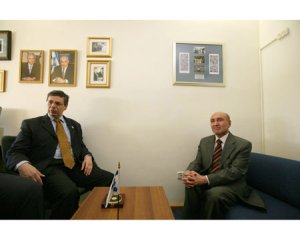 Daniel Ayalon looms over Turkey’s Ambassador in a photo-op set up by Israel’s Foreign Ministry

The Israeli government is convinced that the world does not understand the true nature of the regime of Tel-Aviv. The Israeli Foreign Ministry has therefore decided to clarify the true character of the regime in Tel Aviv to the world. To that end the Israeli deputy Foreign Minister, Daniel Ayalon, summoned the Turkish ambassador to Israel, Oguz Çelikkol, to give him a note of protest over an episode of the Turkish espionage drama Valley of the Wolves, and Turkish criticism of Israel. Israel News reports how the Israeli representative behaved:
“In accordance with orders from Lieberman, Ayalon meant to humiliate the ambassador. He called him into a room in his Knesset office and not to the Foreign Ministry in order to ‘reprimand’ him,” the article noted.
The reporters who arrived in order to cover the meeting on Monday had asked Ayalon and Celikkol to shake hands, however the former refused. “The important thing is that they see he’s sitting lower and we’re up high and that there’s only one flag, and you see we’re not smiling,” Ayalon muttered in Hebrew with the embarrassed Turkish envoy next to him.
This footage was then shown on the Israeli prime time news and Israeli newspapers ran front page stories with the picture showing the humiliation of the Turkish ambassador. Israeli Foreign Minister Avigdor Lieberman is reportedly very comfortable with the behavior of his deputy.
Of course the Turkish press covered the incident also, but from a different viewpoint.
In response Turkey summoned Israel’s ambassador to Ankara demanding Israel apologize, and Turkish Prime Minister Recep Tayyip Erdogan commented on the incident saying Israeli attitudes offending Turkey “will always get a response.” Erdogan likely knows that he can deal more harshly with Israel now because after this incident a harsh reply will not only be backed by the majority of the Islamic population of Turkey in solidarity with their suppressed Muslim brothers in Palestine, but also by the proud nationalists of the Turkish military.
It’s easy for the world to understand the Israeli message. This way of humiliating state guests is well known. Charlie Chaplin has shown in his well known film “The Great Dictator” ironically how Hitler tried to humiliate his guest by placing him on a specially low chair.
Israeli deputy FM Danny Ayalon has simply played Hitler’s role exactly. So the Israeli message is very clear: the Israeli government wants the world to know that it is acting as stupid as Hitler in his worst parody. To clarify that Danny Ayalon speaks for Israel as a whole, the Israeli flag was prominently placed on the table.
Meanwhile in Tehran nuclear physics scientist Massoud Ali-Mohammadi was murdered with a remotely controlled booby-trapped motorbike blast which pretty much looks like the work of assassinations trained by the Israeli Mossad.
The author manages a German language news blog at – http://www.mein-parteibuch.com/
American Jewish groups fight to protect Somali rights abuser from legal action
By Nathan Guttman | The Jewish Daily Forward | December 31, 2009
General Mohamed Ali Samatar, Former vice president and Prime minister of Somalia
Washington — American Jewish organizations that fought to establish the jurisdiction of U.S. courts for suits against terrorist groups are taking an opposite tack in suits involving human rights abuses.
Jewish groups have filed briefs siding with a former Somali official now living in Virginia who is alleged to bear responsibility for atrocities committed during his tenure.
The case’s outcome is expected to set a precedent on the vulnerability to human rights lawsuits of former and present officials of internationally recognized governments. But supporters of Israel fear the result could enable Palestinians who claim to be victims of Israel to pursue Israeli officials here.
The Supreme Court will hear oral arguments March 3 in the case of Yousuf v. Samantar, in which a group of Somalis is seeking financial damages from Mohamed Ali Samantar, Somalia’s former defense minister. He also served as prime minister from 1987 to 1990. Samantar was a top official in the regime of President Siad Barre, a socialist-leaning dictatorship that was denounced by international groups for its systematic use of torture and arbitrary arrests, and for the rape and murder of political rivals and dissidents.
Among the five Somalis suing Samantar are a student who was allegedly detained and raped 15 times by a military man, a former officer who alleges he survived a mass execution and a businessman who claims he was tortured for months by the regime Samantar helped lead. Two of the plaintiffs are now American citizens. The case was filed under the Torture Victim Protection Act.
The Supreme Court will rule on the plaintiffs’ right to pursue a civil lawsuit against Samantar. Pro-Israel activists, fearing a precedent that will allow others to pursue legal action against Israel for alleged war crimes — as has happened in Europe — have filed briefs opposing their suit.
“There will be a rash of lawsuits of this kind against Israel” if the court rules for the plaintiffs, warned Alyza Lewin, an attorney with the firm of Lewin & Lewin, which has filed a friend-of-the-court brief in favor of Samantar and against making foreign officials vulnerable to civil lawsuits. The brief was filed on behalf of four Jewish groups: the Zionist Organization of America, the Union of Orthodox Jewish Congregations of America, Agudath Israel of America, and the American Association of Jewish Lawyers and Jurists.
It is an unusual setting, one in which pro-Israel activists are siding with the Saudi government — which has also filed a brief on behalf of Samantar — while pitting themselves against international human-rights advocates. Furthermore, this battle also puts the Jewish community on the side of those seeking to limit international jurisdiction after years of fighting to broaden the ability to sue foreign entities in order to go after terror groups and their sponsoring states.
Samantar moved to dismiss the 2004 lawsuit on grounds of immunity provided under the Foreign Sovereign Immunities Act, which protects foreign governments in most cases from legal action in the United States. But in January 2009, the Fourth Circuit Court of Appeals reinstated the case, ruling that this immunity applies not to individuals but only to governments and their agencies. A Washington circuit court had previously reached the opposite conclusion. The Supreme Court’s ruling is expected to resolve the dueling decisions.
For Jewish communal officials, the Samantar case set off alarm bells. The Jewish groups that filed the brief cite more than 1,000 cases of lawsuits against Israeli officials around the world as part of an effort that Israeli leaders dub “lawfare” — a campaign to take Arab human-rights grievances against Israel to international courtrooms.
One of those recent cases was the December attempt to issue a criminal arrest warrant in Britain against Israeli opposition leader Tzipi Livni because of the role she played as foreign minister during last January’s Israeli military operation in Gaza.
In the United States, the law does not allow citizens to file similar criminal lawsuits against foreign officials. But in civil suits, it is an unsettled question whether the Foreign Sovereign Immunities Act, which protects governments, extends to individual government officials and former government officials who were acting in their authorized capacities at the time in question.
Lewin, of the law firm representing the four Jewish groups, says it should. “It would be tempting for us to say, wouldn’t it be nice to sue government officials in these cases, but the risks and the costs outweigh the benefits,” she said.
“You’d have the entire Middle East conflict here in the U.S.” if Samantar won, agreed Marc Stern, co-executive director of the American Jewish Congress. Stern, who also filed a brief on this issue, claimed that allowing civil suits would “require Israelis to recount in an American court years after the event why every rocket was fired and why each attack took place.”
A couple of Israeli officials already faced this threat in the United States.
In 2005, former chief of staff and current Cabinet minister Moshe Ya’alon was served with a civil suit while entering a Washington think tank he was attending as a visiting scholar, filed by families of victims from a 1996 Israeli shelling in Lebanon. A week earlier, Avi Dichter, former head of Israel’s General Security Service, had the same experience in New York. This lawsuit was on behalf of victims of an Israeli bombing in Gaza.
These lawsuits cannot lead to arrests, but they can cause significant financial liabilities to Israelis and eventually deter Israeli officials from visiting America, pro-Israel activists say.
Fighting to maintain immunity for foreign officials seems to place Jewish activists far from positions they have taken in the past. Supporters of Israel actively backed legislation that paved the way for relatives of terror victims to sue terror organizations and their sponsors in American courts. Over the years, these lawsuits have yielded several rulings against Hamas, Fatah and Iran for compensation reaching hundreds of millions of dollars.
Unlike the laws governing human-rights suits, the law empowering individuals to file civil suits against terror organizations and their state sponsors is specifically exempted from the Foreign Sovereign Immunities Act. But the terrorism law — also unlike the human-rights laws — clearly disallows suits against individuals.
The Anti-Defamation League, in a separate friend-of-the-court brief filed in the Samantar case, differed with the position taken by the AJCongress and the groups represented by Lewin. The ADL brief spoke of the need to strike a balance between the allowance of victims of severe human-rights violations overseas to seek remedy in American courts, and the need to “protect the ability of lower courts to dismiss meritless claims brought for political or other improper purposes.”
The Samantar case made some strange bedfellows in fighting to limit the scope of lawsuits against foreigners. Alongside the former Somali politician were not only the pro-Israel activists, but also the kingdom of Saudi Arabia. A brief filed by the Saudis reflects concerns similar to those of pro-Israel advocates — that this case could lead to an outpouring of lawsuits against former and current government officials. Citing numerous suits filed against Saudi Arabia after the 9/11 terror attacks, the brief states the kingdom’s “unique experience” and “strong interest” in the outcome of the case.
On the other side are human- rights groups, led by the Center for Justice & Accountability, representing the Somali citizens suing Samantar. “This case stands for the proposition that the U.S. cannot be a safe haven for human-rights abusers like Samantar,” said Pamela Merchant, the group’s executive director, “and we are confident that the Supreme Court will not allow U.S. law to be manipulated to undermine this principle.”
Both sides are waiting for the American government’s brief to be filed. While previous administrations have opposed expanding the ability to sue foreigners in the United States, senior Obama administration officials were supportive of this notion in their previous capacities.
Contact Nathan Guttman at guttman@forward.com
Two-state solution needed, and fast– for U.S. and Israel!
By Philip Weiss | January 4, 2010
A few weeks back I wrote that there are too many Jewish Israelis in the American press, and Lisa Goldman, a writer in Tel Aviv, called me an anti-Semite. I’ve been working on a big post responding to her charge, but in the meantime I was back at it again last night, when I said that the New York Review of Books should stop hiring so many Israeli writers.
How do I justify such national prejudice? Especially when I’m here in Israel, where I’m meeting a lot of amazing Israeli journos and intellectuals who have walked their talk and are trying to change their country?
I admit that it is a national prejudice on my part. It reflects these feelings: after the Iraq war, I woke up to the incredible conflation of American and Israeli interests that the neocons were pushing in the U.S. discourse. I found it extremely confusing when everyone from Tom Friedman to Bill Kristol was saying that a suicide bomber in Tel Aviv was a reason for us to invade Iraq. Those guys were themselves confused about which country they cared about more. At this time, too, Jeffrey Goldberg emerged as the most important Jewish journalist in the U.S., in some measure because he had spent time in Israel and served in the IDF. He has been replaced, or is starting to be replaced, by Gershom Gorenberg, an American-cum-Israeli, who has written for the New York Review of Books and the Weekly Standard too. Meanwhile the New York Times began printing Zev Chafets, a former Israeli gov’t spokesman, on American political trends, and the American Enterprise Institute was paying Dore Gold $98,000 a year as a scholar, notwithstanding the fact he is a former Israeli ambassador living in Jerusalem and churning out Islamophobia.
It never ends. Rahm Emanuel, who volunteered at an IDF base, became the White House chief of staff, and another Obama appointee announced that Israel is her homeland, and Harvard names as the new dean of the Law School, Martha Minow, who has published an article with an Israel co-author saying that Israel’s treatment of detainees is a model! (Sorry if that irritates; I just returned from a demonstration for Jamal Juma, who has been detained on flimsy grounds because he’s a human rights worker, and I’m reading the Goldstone report, which says that 750,000 Palestinians have been imprisoned during the Occupation, and Omar Barghouti told me at the demonstration that imprisonment has touched every Palestinian family–something Dean Minow didn’t mention.) Oh and after the Gaza war, the New York Review of Books offered itself as a forum for Israelis to hash over the war. Not a Palestinian in sight. The New York Times has an Israeli reporter in its Jerusalem bureau, and lately the Washington Post announced that its next Jerusalem correspondent would be someone who had worked at the Jerusalem Post. Then there’s the New Republic, which really is the new republic–of US and Israel. It has featured Benny Morris and Michael Oren, both Israelis, one an ambassador, explaining why Israel is so cool.
Can you see why I’m confused?
It is true that my real objection is to Zionism in the American discourse, but not all of these folks wear their Zionist ribbons on their chests, and it’s hard enough sorting out American writers’ agendas let alone Israelis’.
So yes, on this score, I admit, I’m a bit of a nativist. I apologize here to all my Israeli friends and promise to work on my issues. But the special relationship has hurt America in the Middle East and part of the price of disentangling that relationship may be some discrimination against Israelis in the American discourse. Separation, partition; call it what you will. But the U.S. and Israel need to be two states, not one.
Israel rejects bill allocating equal land to Jews and Arabs
By Jonathan Liss | Haaretz | January 3, 2010
The Ministerial Committee for Legislation on Sunday rejected a bill proposed by MK Ahmed Tibi (Ra’am-Ta’al) proposing that the state enforce equal allocation of land to Jews and Arabs.
“Yet again, the Israeli government has proven that it is avoiding the principle of civil equality,” Tibi said in response to the ruling. “The same government which approved the selection bill of [Jewish] MKs David Rotem and Israel Hasson, ignores Arabs’ rights, and hasn’t approved the building of a new Arab village since 1948. The government failed at the challenge I placed before it, and that saddens me.”
The bill’s authors stressed the importance of it in an explanation to the committee.
“Since the foundation of the state, the Israel Lands Administration is solely used as Jewish land administration. The director of the Israel Lands Administration has used all the tactics, with the help of the Jewish Agency, to allocate state land only to Jews. Despite the bitter attempt over the decades, not even one Arab town has been established since the state’s foundation. Therefore a bill must be passed which stipulates that the Israel Lands Administration will serve all the state’s citizens without discrimination on religion or nationality, and will promise an equal allocation of land to better the Arab population of Israel.”
Tibi’s proposal was intended to counter a bill passed two weeks ago which states that reception committees of Israeli communities can decide who will reside in their towns. One consequence of that bill is that Israeli Arabs would not be able to live in those towns if the reception committees decide so.
Jordan asks Canada to seize stolen artifacts on loan from Israel
January 2, 2010
Bethlehem – Ma’an/Agencies – Canada was asked to take custody of a series of scrolls and parchment fragments uncovered in the West Bank and currently on loan to Toronto from the Israel Antiquities Authority.
The ancient artifacts were seized from an East Jerusalem museum in 1967, when Israel occupied the West Bank and illegally annexed Jerusalem. Since the artifacts were uncovered while the area was under Jordanian control between 1948 and 1967, it is the Jordanian government that requested Canada step in and protect the artifacts.
Jordanian officials summoned the Canadian chargé d’affaires in Amman in late December, the Toronto daily newspaper the Globe and Mail reported.
According to the Canadian paper, Jordan cited the 1954 Hague Convention for the Protection of Cultural Property in the Event of Armed Conflict, to which both Jordan and Canada are signatories. On that basis, Jordan asked that Canada keep the scrolls until the international court can determine their rightful owner.
In April, two months before the exhibit of the Dead Sea Scrolls opened at Toronto’s Royal Ontario Museum, the Palestinian Authority’s Ministry of Tourism and Antiquities called on Canada to cancel the showing. “The exhibition would entail exhibiting or displaying artifacts removed from the Palestinian territories,” Hamdan Taha, director of the Palestinian Antiquities Department wrote in a letter to the Canadian Prime Minister signed by dozens of Palestinian officials, researchers and intellectuals.
In an article run by the Toronto Star last year, ROM director Tilliam Thorsell said “I do understand the Palestinians are making an issue of the ownership. But I’m quite certain the scrolls fall within the parameters of the law.”
Canada, as a signatory of the cited Hague convention, is legally required “to take into its custody cultural property imported into its territory either directly or indirectly from any occupied territory. This shall either be effected automatically upon the importation of the property or, failing this, at the request of the authorities of that territory.”
There is little indication that the country will take action, however, with officials failing to respond to the Palestinian requests in April. A Canadian Foreign Affairs rep told the Globe and Mail, “differences regarding ownership of the Dead Sea scrolls should be addressed by Israel, Jordan and the Palestinian Authority. It would not be appropriate for Canada to intervene as a third party.”
Rabbis to US Ambassador: Time to ‘Go Biblical’ with Arabs
By Gil Ronen | December 30, 2009
(IsraelNN.com) A delegation of the Rabbinical Congress for Peace (RCP) met with U.S. Ambassador to Israel, Mr. James Cunningham, today and called for a reassessment of the entire U.S. policy vis-à-vis the Israelis and Palestinians. The rabbis told Ambassador Cunningham that it was time to try the Biblical approach to the dispute over the Land of Israel.
“The past 17 years have proven without a shadow of a doubt that every square inch ceded by Israel to the Palestinians was transformed into a platform of hatred and terrorism,” RCP Director Rabbi Avrohom Shmuel Lewin told the ambassador. “In other words, the ‘land for peace’ formula in the Israel-Palestinian context, besides being a formula that goes against the Divine will, is ineffective, obsolete, and an exercise in futility. Most of all it is a dangerous policy that only leads to bloodshed and instability in the region and harms vital American interests in the region as well,” Lewin said.
‘Land for peace doesn’t work’
The delegation was headed by Rabbi Joseph Gerlitzky, Chairman of the RCP, who is also the Rabbi
of Central Tel Aviv where the US embassy is located. Rabbi Gerlitzky presented the ambassador with the Halachic (Jewish legal) ruling signed by over 350 prominent rabbis in Israel that it is forbidden to give up even one inch of territory controlled by Israel today because it will bring bloodshed and instability to the region.
“In the name of the overwhelming majority of rabbis in Israel,” he said, “we request of you Mr. Ambassador, to convey our Halachic message to President Barack Obama that it is time for a complete reversal and reassessment of U.S. policy in the Middle East. The ‘land for peace’ policy never worked and harms U.S. interests in the region and the world at large.”
 Left to right: Rabbi Sholom Gold, Mr. Marc Sievers of the US Embassy, Rabbi Dov Lior, Rabbi Joseph Gerlitzky, Ambassador James Cunningham, Rabbi Moshe Havlin, Rabbi Avrohom S. Lewin. The Rabbis handed the ambassador a Halachic Ruling signed by over 350 rabbis in Israel that forbids giving up land controlled by Israel today.
The ambassador was visibly moved by Rabbi Sholom Gold, a leading rabbi in Jerusalem, who described the suffering that the Jewish People have endured ever since the implementation of the Oslo Accords and the agreements that followed. “It’s all a play of words, there is no peace process,” he said. “From the day that we started conceding and withdrawing we did not have one day of rest and peace. Why should our enemies want to make peace with us when they see that with terrorism they get what they want? Even the U.S., Israel’s supposedly best friend, sides with them in demanding a freeze and evacuation of settlements. Is the triumph of Arab terror one of American interests?” Gold asked.
Going Biblical
Rabbi Dov Lior, the Rabbi of Kiryat Arba-Hevron, said: “G-d gave the US the power and influence to affect the rest of the world and supporting Israel is the key to America’s success.”
Ambassador Cunningham told the rabbis that he does not see how the problem can be solved “without taking into consideration the Palestinians,” to which Rabbi Gold remarked: “Ever since we started taking the Palestinians into consideration the situation only worsened.”
The ambassador asked the rabbis, “So what is your solution to the problem?”
Rabbi Gerlitzky replied: “You must switch the entire approach to the situation. We all believe in the Holy Bible and up until now we tried every formula except for that which is delineated in the Bible. Let’s try it and who knows, Mr. Ambassador, maybe this is your defining moment, that G-d Almighty has placed you in this capacity in order to precipitate a new course which will bring a true peace to the entire region.”
Buy an African baby; bomb some African villages
By Thomas C. Mountain
Online Journal
December 31, 2009
ASMARA, Eritrea — Did anyone ask movie star Angelina Jolie how much she paid for the Ethiopian baby she adopted? Or should I say how much she “donated,” most of which ended up in the hands of the national crime syndicate known as the Government of Ethiopia.
Just about anyone can buy a baby in Ethiopia these days, you know what I mean, “adopt”? It costs about $30,000. Cash. Some reports say over 3,000 were sold . . . adopted, last year alone.
It has turned into a major cash flow for the Godfathers of the Ethiopian “government.” Do the math, 3,000 times $30,000, in one year, and another London bank account or three is going to have to be set up to be stuffed chock full of some very sick money.
When you buy . . . adopt, a baby in Ethiopia there is a good chance that the baby isn’t an orphan, though it is usually standard language in all the sale/adoption papers that such is the case. With millions of Ethiopians famine stricken, selling babies has become a way to survive for some. Though of the $30,000 as little as $1,000 makes it through the hands of the Ethiopian mafia to the babies’ families.
If one has been reading the pages of this and other websites willing to publish what is really going on in Ethiopia, you will know that Ethiopia is committing genocide against the ethnic Somalis in the Ethiopian Ogaden. So why should selling babies come as a shock?
Angelina Jolie should come clean and tell us what she really “donated” to get her little Ethiopian girl. Somehow though I won’t hold my breath for Ms. Jolie just called for the USA to declare war and invade Sudan. Buy an African baby and then bomb some African villages, it just gets to be Hollyweird, doesn’t it?
The UN is even weirder though, with Ethiopia committing genocide in the Ogaden, the Security Council finally acted, passing sanctions against . . . next-door neighbor Eritrea.
The saying goes here in this part of Africa, “All roads to peace in the Horn of Africa run through Asmara [Eritrea] . . .” and there is one thing the USA and especially Hollywood is dead set against and that is peace breaking out in Africa.
With the UN there to enforce the Law of the Jungle, only the strong survive. And survivors, especially those that won’t kneel down at the masters feet, have to be made examples of. Or at least it has to look that way, and sanctions against Eritrea it must be. So buy a baby in Ethiopia and support genocide. And don’t forget to declare war and start bombing Sudan.
In the meantime, get busy and start enforcing the sanctions against Eritrea. Either that or better yet, make sure no one even hears about all of this, business as usual, you know, with none the wiser.
Stay tuned to Online Journal for more news from the Horn of Africa that the so-called Free Press in the West won’t touch.
Thomas C. Mountain, residing in Eritrea, was in a former life an educator, activist and alternative medicine practitioner in the USA. Email thomascmountain at yahoo.com.
The ‘war’ for legitimacy is a war Israel may never win
By Adam Horowitz | December 29, 2009
While there is no doubt that Israel holds military superiority over any possible armed force it might go to war with, there is another threat that Israel appears to have no response for – moral outrage. The Jerusalem Post covers a new report which outlines Israel’s true Achilles heal. From the article “Hubs of delegitimization“:
A new report by the Reut Institute, a Tel Aviv-based national security and socioeconomic policy think tank, maps out the “new battlefield” in which Israel finds the legitimacy of its very existence attacked by a wide array of organizations and individuals in global centers like London, Toronto, Brussels, Madrid and Berkeley.
The report, which also makes recommendations for possible remedies, is to be presented next week to Israeli diplomatic officials, and will also be presented at the Herzliya Conference in January. The report’s authors spent two weeks in London interviewing some 45 people, including members of Muslim groups and anti-Zionist Jewish organizations, and academics, journalists, pollsters, jurists, activists and politicians.
Beginning with Israel’s traditional strategic concept, conceived by David Ben-Gurion, which posits that to win its wars, the IDF would have to take the fight to its enemies, the Reut report posits that increasingly, Israel cannot “win” its wars in the traditional sense as it is not up against conventional Arab armies, and there is no decisive victory over an enemy army to be had.
While there is still a physical existential threat posed by certain enemies (including unconventional terrorism), the new front focuses its attack on Israel’s political legitimacy, painting Israel as a pariah state, exhausting Israeli society, burdening its economy, and mobilizing Israel’s Arab minority as an anchor in the struggle against the Jewish state.
The key concept for this “Resistance Network” is overstretching Israel along the fault lines of demography, democracy (binational state vs a state of the Jewish people), Jewish identity and territory.
What does it mean that Israel views challenges to racist demographic priorities and simple calls to democracy as an existential threat? It is also interesting to note that later in the article the think tank’s recommendations ape the Israel settler “price tag” strategy for dealing with opponents (“establish a ‘price tag’ for attacking Israel and punish boycotters”).
At least this report seems honest about the near impossible task at hand – trying to sell Israel’s apartheid system to a liberal international public. Often times when Israel’s supporters try this it comes off looking like a sad joke. Like this op-ed in today’s Haaretz, where an Israeli settler compares herself to Rosa Parks:
Despite the fury and the insult, let’s not turn to violence. There is a simple, natural solution that is full of life – continuing to build. That will perhaps embarrass the prime minister in front of U.S. President Barack Obama, but that’s precisely the point. A person with a manual cement mixer in Samaria can change history. Sometimes the man in the field can be a lot stronger than the great leaders. Just like Rosa Parks.
Arguments like this are going to make the Reut Institute’s work much harder.
“Israel”: US Consulate Car Tried to Run over Checkpoint Guard
25/12/2009 A dispute is rumbling between Israel and the US Consulate in occupied Jerusalem after a US diplomatic car allegedly tried running over an Israeli Defense Ministry security guard recently at an Israeli army checkpoint in the occupied West Bank. The car had been stopped after the occupants refused to present identification papers.
Israel is also furious that one of the consulate cars was found to have transported a Palestinian without permits between occupied Jerusalem and the West Bank.
The identification of American diplomats from the consulate at Israeli army checkpoints has been a major sticking point for several years.
In January 2008, the Civil Administration of “Judea and Samaria” filed complaints with the Foreign Ministry after both US Security Coordinator Lt.-Gen. Keith Dayton and then-consul-general Jacob Walles refused to roll down their windows or open their car doors and show identification papers at a checkpoint.
However, Israel’s ire reached a new level after an incident on November 13 in which a five-car convoy of consulate vehicles with diplomatic plates arrived at the Gilboa crossing.
According to a detailed official Israel Police description of the incident obtained exclusively by The Jerusalem Post, the drivers refused to identify themselves or open a window or door. The drivers, according to the report, purposely blocked the crossing, tried running over one of the Israeli security guards stationed there and made indecent gestures at female guards.
Following the incident, the head of the police’s Security Department convened a meeting on November 18 at police headquarters in occupied Jerusalem with the regional security officer at the consulate. Also present were officials from the Israeli Defense Ministry and the Foreign Ministry, and the regional security officer at the US Embassy in Tel Aviv, Dan Power.
According to a protocol of the meeting, obtained by the Post, Ben-Yishai said he assumed the drivers of the consulate vehicles had received permission to act the way they had. He said that in the future, if a diplomatic car did not stop and identify its passengers “immediately,” it would not be allowed to pass the checkpoint.
Ben-Yishai described additional violations by consulate workers, and referred to at least one case in which a female Palestinian without appropriate documentation was found in a diplomatic car. Defense officials told the Post that there had been other similar cases in the past. “We view this as an attempt to illegally transfer someone,” Ben-Yishai said, according to the official police protocol.
He added that police had filed a complaint with the Foreign Ministry and were conducting their own investigation to identify the driver who had tried running over the Israeli security guard.
A spokesperson from the consulate said that consulate policy was not to comment on internal meetings with Israeli officials.
“In regards to the checkpoints, we enter and exit from the West Bank many times a day through checkpoints controlled by the government of Israel without incident, and consulate officials and drivers always carefully follow the procedures that have been established and agreed to by US and Israeli governments for entering and exiting the West Bank,” the spokesperson said. “Any problems that have occurred with checkpoints have been a result of misunderstanding and miscommunication, and we are in regular contact with the government of Israel regarding those procedures to avoid miscommunications in the future.”
In response to the claim that the consulate cars had illegally transported Palestinians, the spokesperson said, “Any allegations that we are illegally transferring people are completely untrue, and as stated earlier, it is in our best interest that we follow the rules so that people who participate in US-funded programs can participate, and it would not be in our best interest to illegally transfer people.”
Featured Video

How Many More Gulf States Get Dragged Into Trump’s Iran War?
or go to
Aletho News Archives – Video-Images
Villains of Judea
David Wurmser
A shadowy neocon strategist spent 30 years maneuvering Washington toward war with Iran

José Niño Unfiltered | November 17, 2026
As American forces clash with Iran in 2026, a decades-long campaign orchestrated from the shadows of Washington has finally reached its climax. Earlier this year, foreign policy strategist David Wurmser openly called for Washington to let Israel start a war of aggression against Tehran, portraying the conflict as a historic reckoning akin to the Soviet collapse. For avid critics of American foreign policy, the current war represents the ultimate triumph of a shadowy Jewish operative who spent over 30 years advancing Israeli strategic priorities inside the highest echelons of the United States government.
Born in Switzerland, David Wurmser earned three degrees from Johns Hopkins University, including a doctorate. He spent 11 years in Navy Reserve intelligence and reached the rank of lieutenant commander. During that service, the Defense Intelligence Agency mobilized him for its Iraq Intelligence Task Force in 1994, 1996 and 1998.
Yet his defining partnership was personal as much as institutional. His Israeli born wife, Meyrav Wurmser, wrote her doctoral dissertation on Revisionist Zionism. In 1998, she cofounded the Middle East Media Research Institute, known as MEMRI, with Yigal Carmon, a former colonel in the Israeli military. Carmon served in Israel Defense Forces intelligence from 1968 to 1988. He later advised prime ministers Yitzhak Rabin and Yitzhak Shamir on counterterrorism.
During the mid-1990s, Wurmser moved seamlessly between Washington institutions and Jerusalem policy circles. … continue
Blog Roll
 Aletho News
- How CIA used Ukraine as a platform for covert war against Russia
- European Commission proposes new loan for Kiev
- How Many More Gulf States Get Dragged Into Trump’s Iran War? | Matt Bracken
- US-Iran escalation: The side effects and benefits of low intensity war
- Lebanon on the Brink: How Washington and Tel Aviv Turned the “Peace Process” into an Instrument of Pressure
- Before Laundering The Iran Dirty Bomb Hoax, Jake Tapper Was Israel’s Chief Propagandist For Genocide.
- Minuteman III Test at APEC Opening Aimed to Show US Remains a Dangerous Power – Ex-Pentagon Analyst
- Estonia’s border closure is collective punishment of ethnic Russians
- US Plan to Toughen Restrictions on Chip Exports to China After Nvidia Scandal – Reports
- Villains of Judea: David Wurmser
- If Americans Knew
- An error has occurred; the feed is probably down. Try again later.
- No Tricks Zone
- Argentina’s Perito Moreno Glacier Joins Antarctica and Arctic In Defying Doomsday Melt Claims
- New Study: Barents Sea Temperatures Were Warmer And Sea Ice Less Extensive In The 1700s Than Today
- German Authorities Start Initiative To Evaluate Public Register For Climate “Disinformation” Spreaders!
- Zonal Asymmetry of Temperature Change in the Antarctic Circumpolar Current
- New Study: The Net Fossil Fuel Contribution To Rising Atmospheric CO2 Has Been Zero For 500 Years
- Germany’s Green Energy Transition Becoming Increasingly Expensive…Another 6 Trillion Euros!
- Sudden Stratospheric Warming, Powerful El Niño Combination May Lead To Extreme Europe Cold, Energy Crisis!
- Two New Studies Find Thwaites Glacier Melt Cannot Be Driven By Human Activity Or A Warming Ocean
- E-Cars Reduce CO2 Emissions By Only 41% Compared To Internal Combustion Engine Vehicles
- Predictions Made By Renowned Climate Professor Over Past Decades Have Been Proven To Be Poor

