Israel accuses Turkish PM of anti Semitism
Press TV – January 26, 2010
Turkish PM Recep Tayyip Erdogan

Israel has accused Turkish Prime Minister Recep Tayyip Erdogan of inciting “anti-Semitism” by making remarks on the war crimes committed against the Palestinians in the Gaza Strip.
A new report prepared by the foreign ministry in Tel Aviv charges that although Erdogan stresses that anti-Semitism is “a crime against humanity,” he “indirectly incites and encourages” it in Turkey, the Israeli daily Haaretz reported.
“In our estimate, ever since his party took power, Erdogan has conducted an ongoing process of … fashioning a negative view of Israel in Turkish public opinion,” through endless talks of Palestinian suffering, repeatedly accusing Israel of war crimes and even “anti-Semitic expressions and incitement,” read the report.
The seven-page report written by the Center for Political Research has already been distributed to Israeli embassies and consulates abroad.
“For Erdogan and some of those around him,” the report claimed, “there is no distinction between ‘Israeli’ and ‘Jewish,’ and therefore, [their] anti-Israel fervor and criticism become anti-Jewish.”
“Turkey today, under the leadership of the AKP [Erdogan’s Justice and Development Party], is different from the Turkey with which Israel forged a strategic relationship in the early 1990s,” the report concluded.
Relations between Israel and Turkey began to deteriorate after Erdogan publicly slammed Israel over its late 2008 incursion into Gaza and charged the regime with committing “barbarian” acts against the Palestinian civilians.
Israeli Information Minister Slams All Reports on Gaza War as Anti-Semitic
By Jason Ditz | January 25, 2010
Just days before Israel is expected to release its own report on the January 2009 invasion of the Gaza Strip, Israeli Information Minister Yuli Edelstein declared that the UN report on the war, and every other report since the war ended, “are simply a type of anti-Semitism.”

Israeli Information Minister Yuli Edelstein
The UN’s report, also known as the Goldstone Report, successfully moved through the UN Human Rights Council in October. It faulted both Israel’s government and the Hamas government in the Gaza Strip for the massive civilian toll in the war.
Israel warned that any report which didn’t put the blame 100 percent on Hamas was inherently biased and declared that it showed the hypocrisy of the entire planet and a global bias against Israel. The US House of Representatives also condemned the report as “unfair” and called for the president to block its consideration.
But Minister Edelstein took the usual complaints of anti-semitism against the report to a new level, saying that there was a clear connection between criticism of the Israeli war effort and the Holocaust and that it amounted to just the latest conflict in “the battle against global anti-Semitism.”
Though Israel’s government has repeatedly canceled efforts to investigate the military’s actions in the war, their own report is said to be completed and will aim not at explaining the war so much as attacking the Goldstone Report, and the reports from various human rights groups on which the Goldstone Report was chiefly based.
The humanitarian myth
Richard Seymour, the author of The Liberal Defense of Murder, analyzes the propaganda manufactured to justify U.S. actions in Haiti after the earthquake.
January 25, 2010
WITHIN DAYS of Haiti suffering an earthquake registering 7.0 on the Richter scale, the U.S. government had sent thousands of 82nd Airborne troops and Marines, alongside the super-carrier USS Carl Vinson.
By this Sunday, a total of more than 20,000 U.S. troops were scheduled to be operating in Haiti, both on land and in the surrounding seas. “We are there for the long term,” explained Alejandro Wolff, the U.S. ambassador to the United Nations. The justification for sending troops is that there is a “security” crisis, which soldiers have to deal with in order to facilitate the distribution of aid.
The situation was and remains a needful one. The Haitian interior minister estimates that as many as 200,000 may have died as a result of the quake, and 2 million have been left homeless. Potable water is extremely scarce, and was so even before the quake. Only half a million have found the makeshift camps that provide some food and water, but have such poor sanitation that they are fostering diarrhea. Clinics are overwhelmed by the injured survivors, estimated to number a quarter of a million.
Since the arrival of the troops, however, several aid missions have been prevented from arriving at the airport in Port-au-Prince, that the U.S. has commandeered. France and Caribbean Community have both made their complaints public, as has Médecins Sans Frontières on five separate occasions. UN World Food Program flights were also turned away on two consecutive days. Benoit Leduc, MSF’s operations manager in Port-au-Prince, complained that U.S. military flights were being prioritized over aid flights. Now, U.S. ships have encircled Haiti in order to prevent refugees escaping and fleeing to the United States.
Not only has aid been obstructed and escape blocked, but what aid does arrive was at first not being delivered, and then only in small amounts. Some five days after the earthquake struck, BBC News reporter Nick Davis described how aid had just started “trickling through.” While aid was arriving in Haiti “in large amounts,” some “bottlenecks” prevented the bulk of it from being distributed.
Asked why the U.S. was not using its air power to deliver aid to areas unreachable by road, Defense Secretary Robert Gates maintained that this would result in riots. The writer Nelson Valdes has described how U.S. and UN authorities advised aid workers not to distribute relief independently, as they would be subject to “mob attacks.”
Eyewitnesses have repeatedly described how rescue workers are scarce on the ground, and relief nowhere to be seen. Hospitals that are functioning despite the wreckage complain of having no painkillers with which to operate on patients with serious injuries. Dr. Evan Lyon of Partners in Health explained that:
[I]n terms of supplies, in terms of surgeons, in terms of aid relief, the response has been incredibly slow. There are teams of surgeons that have been sent to places that were “more secure,” where they have 10 or 20 doctors and 10 patients. We have a thousand people on this campus who are triaged and ready for surgery, but we only have four working [operating rooms], without anesthesia and without pain medications. And we’re still struggling to get ourselves up to 24-hour care.
In effect, the U.S. has staged an invasion of Haiti, under the pretext of providing security for humanitarian aid, and in doing so has prevented the delivery of humanitarian aid. With Haitians in a desperate condition, and the UN-supervised government in dire straits, Washington has sent the International Monetary Fund to offer a $100 million loan, on the proviso that public wages be frozen.
The “security” operation, meanwhile, proceeds apace. As well as U.S. troops, thousands more UN police have been sent to Haiti. Already, UN troops, alongside the Haitian police, have been responsible for several killings, as they have opened fire on starving earthquake survivors who dared to try to retrieve the means of survival from shops and other locations. The US has also insisted that the Haitian government pass an emergency decree authorizing curfews and martial law. Secretary of State Hillary Clinton said that the decree “would give the government an enormous amount of authority, which in practice they would delegate to us.”
This process has been facilitated by a flood of alarmist and often racist reporting about “mobs,” “looters” and “gangs” causing a “security crisis.” A “security crisis” validates a repressive response.
The Haitian police have justified their brutal massacres of “looters”–those securing their right to life in desperate circumstances–by telling the media that thousands of prisoners have escaped from the country’s jails, and are running amok, posing a threat to vulnerable citizens. Police have been attempting to whip up fear among earthquake survivors, organising them into vigilantes to attack the escaped prisoners. However, as many as 80 percent of Haiti’s prisoners have never been charged with a crime. “Gangs”–in the vernacular of Washington, the White House press corps and Haiti’s business lobby, the Group of 184–happens to be a synonym for Lavalas activists.
For all the headlines, moreover, there is strikingly little actual violence taking place. Most of the stories of violence center on episodes of “looting,” and most such instances involve desperate people procuring the means of survival. Aid workers also contradict the image of mobs on the attack purveyed by the media and U.S. officials. Abi Weaver, spokesperson for the American Red Cross, confirmed that “we haven’t had any security issues at all.”
“There are no security issues,” said Dr. Evan Lyon. “We’ve been circulating throughout the city until 2:00 and 3:00 in the morning every night, evacuating patients, moving materials. There’s no UN guards. There’s no US military presence. There’s no Haitian police presence. And there’s also no violence. There is no insecurity.” In fact, Lt. Gen. Ken Keen, deputy commander of U.S. Southern Command, maintains that there is less violence in Haiti now than before the earthquake.
So if there is no insecurity, and if the US military intervention is actually obstructing aid, what becomes of the pretext for the invasion?
Humanitarian intervention
Notwithstanding this extraordinary performance, many American commentators actually approve of the U.S. response.
Jonathan Dobrer, of the American Jewish University in Bel Air, declared himself “almost sinfully proud of America.” Steven Cohen of Columbia University enthused on the liberal Huffington Post that “We Have Reason to be Proud of the American Response in Haiti.” New York Times op-ed contributor Jonathan M. Hansen called on the U.S. to go further, and use the Guantánamo gulag as a base for “humanitarian intervention” in Haiti.
Indeed, the label “humanitarian” is regularly applied to U.S. actions in Haiti. It is important to recall, therefore, that the overthrow of Haiti’s elected government in 2004 and the subsequent occupation was itself originally cast as a humanitarian intervention of sorts.
Aristide, so the story went, had governed incompetently, his rule characterized by such corruption and violence as to generate countrywide disturbances. In recognition of his inability to govern, he supposedly “resigned” and fled the country. Filling the gap created by the absence of legitimate authority, concerned members of the “international community” prevailed upon the United Nations to send troops into Haiti and facilitate the development of democratic institutions.
Matters are a little more prosaic and grubby than this uplifting scenario would suggest. The U.S. had begun cutting aid programs to Haiti when Aristide was elected with an overwhelming mandate for his second term in 2000. The result was that the national budget was cut in half, and gross domestic product shrank by a quarter in the ensuing period.
The pro-U.S. opposition group, Convergence Démocratique, declared that it would not accept the results and instead began to agitate against the incoming government. Paramilitary attacks, beginning in the summer of 2001, were carried out by former death squad members and organized criminals acting in association with Haiti’s business community. Former army personnel such as Guy Philippe, an admirer of Augusto Pinochet, were organized by the U.S. under the rubric of the Fronte pour la Libération et la Reconstruction Nationale (FLRN).
By February 2004, a full-blown insurgency had been launched, and had begun to take control of large parts of the country. None of the Lavalas rulers had military experience, and they were not prepared to arm and mobilize the population.
Aristide, far from being a violent or incompetent ruler as his critics suggest, was eventually defeated because he was not prepared to violently repress an opposition that was explicitly organizing for his overthrow. His administrations had actually been highly effective in a number of areas, despite considerable pressures from the U.S. and the Haitian ruling class.
Lavalas can be credited with reducing infant mortality from 125 to 110 per thousand live births, bringing illiteracy down from 65 percent to 45 percent and slowing the rate of new HIV infections. It was obliged by the U.S. to accept “structural adjustment” programs, but did what it could to soften the blow by maintaining subsidies, implementing some land reforms, and promulgating certain social programs. It legislated against the exploitation of children as unpaid servants in wealthy homes. It reformed the notoriously labyrinthine judiciary and put several death squad members on trial. It also managed to extract some taxes from the rich, in the face of strenuous resistance.
For these humanitarian accomplishments, Aristide had to go. Once the dregs of former genocidaires and the criminal fraternity had wrought sufficient destruction across the country, the U.S. Marine Corps abducted Aristide on September 29, 2004. The initial line given to the press by James Foley, the U.S. ambassador to Haiti, was that it was a rescue mission. The U.S. had stepped in, concerned for Aristide’s welfare, and he had resigned voluntarily.
As soon as Aristide got hold of a telephone, however, he informed every news outlet that would listen that he had been kidnapped by U.S. forces. He was not permitted to return to Haiti, and an occupation began under a UN mandate, enforced by MINUSTAH troops. A new regime was imposed that locked up political activists and priests, and thousands were killed either by MINUSTAH soldiers directly or by gangs operating under their authority. A study published in The Lancet found:
[D]uring the 22-month period of the U.S.-backed Interim Government, 8,000 people were murdered in the greater Port-au Prince area alone. Thirty-five thousand women and girls were raped or sexually assaulted, more than half of the victims were children…Those responsible for the human rights abuses include criminals, the police, United Nations peacekeepers and anti-Lavalas gangs.
Meanwhile, the democratic process that the UN was supposed to oversee has resulted in elections in which the country’s most popular political party, Lavalas, are not allowed to participate. The recent senatorial and congressional elections saw turnouts depressed to as little as 10 percent as a result. This shambolic process has made life easier for Haiti’s ruling class, and the multinationals operating in Haiti, but by no stretch of the imagination is it “humanitarian.”
The point of highlighting this background is to note that, contrary to some short-sighted commentary–like Jonathan Dobrer: “We come, we help, and we don’t stay”–the U.S. has a bloody recent history in Haiti and a well-defined set of goals in the country, including the desire to finish off Lavalas and create a benevolent investment climate for business.
The belief that the U.S. is behaving in a humanitarian manner in Haiti is at best myopic. At worst, it buys into the racist mythologies about Haiti that have been on prominent display in headlines and news copy for over a week now.
Paternalism and racism
The paternalistic assumptions behind the calls for ‘humanitarian intervention’ have sometimes been starkly expressed. Thus, the conservative columnist Eric Margolis lauds the history of American colonial rule in Haiti: “[T]he U.S. occupation is looked back on by many Haitians as their “golden age.” The Marine Corps proved a fair, efficient, honest administrator and builder. This era was the only time when things worked in Haiti.”
Purporting to oppose imperialism, Margolis insists that “genuine humanitarian intervention” is “different,” and calls for Haiti to be “temporarily administered by a great power like the U.S. or France.” He writes: “U.S. administration of Haiti may be necessary and the only recourse for this benighted nation that cannot seem to govern itself.”
Similarly, right-wing New York Times columnist David Brooks, decrying the supposed “progress-resistant cultural influences” that he maintains holds Haiti back, calls for the U.S. to “promote locally-led paternalism.” “We’re all supposed to politely respect each other’s cultures,” he complains. “But some cultures are more progress-resistant than others, and a horrible tragedy was just exacerbated by one of them.”
To overcome this cultural handicap, Brooks recommends finding gurus who would promote a culture of achievement and responsibility–as opposed to the irresponsible, chaotic, voodoo-ridden culture that he identifies as Haiti’s major problem.
It is unnecessary to dignify such caricatures by considering them as empirical hypotheses. However, it should be noted that neither author gives the slightest consideration to the persistent efforts of the U.S. government to frustrate the rise of popular, democratic movements such as Lavalas, nor to the IMF-imposed programs which saw real wages fall by 50 percent between 1980 and 1990, and which resulted in overpopulated slums and a failing rural economy.
Nor do they acknowledge the brutality of the UN occupation. While Margolis acknowledges that America’s colonial rule was “sometimes brutal,” his understatement is verging on euphemism when he omits to discuss the killing of 15,000 people as Haiti’s rebels, known as Cacos, were suppressed.
Nor does he mention the humiliating system of forced labor that was imposed on Haitians under U.S. rule, or the fact that the gendarmerie built up under U.S. occupation became the organized basis for later dictatorships that would blight Haiti. In short, both writers bring to bear astonishingly little understanding of the country whose fate they are discussing so cavalierly.
However, what is of interest in these caricatures is the genus of imperial ideology that they relate to. Margolis is an old-school conservative (he describes himself as an Eisenhower Republican). He recalls in his phrases the manifest-destinarianism of William McKinley, who argued that the conquest and colonization of the Philippines was justified since Filipinos “were unfit for self-government.”
In the imperial language of the U.S. and Europe in this period, self-government was conceived of either as a cultural state that only white people had achieved, or as a technology that only white people could use. Woodrow Wilson, the invader of Haiti, explained that the Philippines could not be given self-government by the United States, since “it is a form of character and not a form of constitution.” Self-government is a cultural state attained after a period of discipline that “gives people self-possession, self-master, the habit of order.”
For Wilson, only the “nobler races”–namely Europeans and white Americans–had achieved that state. Margolis would not be so explicitly racist, but his subtext is not the less subtle for that.
Brooks, though, is a neoconservative. As such, he brings to bear that tradition’s paternalism, its concern with developing good patriarchal families, and particularly its culturalist reading of social institutions.
In this view, government and other institutions reflect an accumulation of cultural practices that have survived through generations. Capitalism and liberal democracy are thus the result of cultural influences such as Judeo-Christian values. The ability to govern oneself as a society is also said to be a result of cultural attributes that are generally found to be lacking in America’s opponents. These discrete cultures do not necessarily correspond to older notions of ‘race’, but they perform an analogous function in permitting privileged U.S. commentators to applaud the conquest of other societies.
Thus, at the height of the Vietnam War, the “godfather” of neoconservatism, Irving Kristol, argued that it was correct for the U.S. to support a right-wing dictatorship since “South Vietnam, like South Korea, is barely capable of decent self-government under the very best of conditions.” Like the Black families that Daniel Patrick Moynihan famously diagnosed as suffering from a “tangle of pathologies,” these people lacked the exquisite cultural refinements that made white Americans so successful.
These are exceptionally explicit commentaries. Most of those lauding American actions are unlikely to be as cynical or brazen as Brooks and Margolis. Yet when 20,000 U.S. troops arrive in a wrecked island country, and begin obstructing aid and beefing up “security” while people die in the wreckage of thirst and starvation, only the willfully purblind or those trapped in the assumptions of the “civilizing mission,” could construe it as a “humanitarian intervention.”
Delaying aid for a photo-op
By Jesse Hagopian | January 25, 2010
|

EVERYTHING YOU need to know about the U.S. aid effort to assist Haiti in the wake of the catastrophic earthquake can be summed up by Secretary of State Hillary Clinton’s touchdown in Port-au-Prince on Saturday, January 16: they shut down the airport for three hours surrounding her arrival for “security” reasons, which meant that no aid flights could come in during those critical hours.
If there was one day when the Haitian people needed aid to flow all day long, that was the day, because the people trapped under the rubble on Tuesday evening couldn’t survive much beyond Saturday without water.
Defenders of Clinton will say that her disimpassioned, monotone, photo-op speech was needed to draw attention to the plight of the Haitians. But no one north of hell can defend her next move: according to airport personnel that I spoke to during my recent evacuation from Haiti, she paralyzed the airport later that same day to have a new outfit flown in from the Dominican Republic.
I am having a hard time readjusting to life back home after having survived the earthquake and witnessed so much death, so even typing those words is making my heart pound uncontrollably. I guess for America’s rulers, a new pantsuit is more valuable than the lives of poor, Black Haitians.
Unfortunately, Clinton’s model of diverting and delaying critical aid to the Haitian people, while emphasizing security, has become standard operating procedure.
Alain Joyandet, the French minister responsible for humanitarian relief in Haiti, charged the U.S. with treating this as a military operation rather than an aid mission. Mr. Joyandet told the Daily Telegraph that he had been involved in an argument with a U.S. commander in the airport’s control tower over the flight plan for a French evacuation flight, saying, “This is about helping Haiti, not about occupying Haiti.”
But with the U.S. occupying Iraq and Afghanistan, and funding the Israeli occupation of Palestine, it seems our government knows how to do little else when it comes to international affairs.
The day I left via Toussaint L’Ouverture International Airport, I saw lots of crates of food, water and medical supplies piled on the tarmac. But I didn’t see that aid being transported out of the airport to actually get to Haitians.
Undoubtedly, there has been some aid distributed, but because there was no serious effort to disperse that aid in the first four days after the quake, tens of thousands of people trapped under rubble have died needlessly because they couldn’t get a sip of water.
The Geneva-based organization Doctors Without Borders has been turned away from the airport numerous times to allow U.S. troops to land. A ring of U.S. warships surrounds Haiti to make sure that Haitians don’t escape the disaster and try to get to the United States.
The U.S. has taken control of Haiti’s main airport and seaport, and is in the process of deploying 18,000 U.S. troops to bolster the 9,000 UN troops already occupying the island nation–and as an eyewitness, I can tell you those troops are guarding their own compounds rather than distributing aid.
Media presents skewed image of Haiti rescue efforts
Why do we see Haitians begging for help but doing absolutely NOTHING to help themselves?!!
Why do they idly sit waiting for help to come (and I’m talking about the ones who were not injured, of course) or … “blocking the roads” instead of HELPING to clear them, HELPING to unload cargo ships and/or to clear port infrastructure from the debris.
BBC showed healthy men running around the collapsed house and doing absolutely NOTHING to save a living person under it who was lucky that the UN soldiers were nearby and just started … DIGGING! Nothing sophisticated but simply digging… I don’t understand…
Global Nomad responds:
I’ve been doing a lot of media interviews over the past five days and I can tell you that the media are not reporting facts per se – they are telling a story, and one they hope will catch their viewers’ attention. Many news outlets do some research, pick a couple of angles that grab attention, and then develop these angles specifically. So, in the Haiti context for example, the bulk of the media is really picking up on the violence/food-riot angle, on the delays-in-logistics-angle, on the involvement of foreign assistance (especially US military and search-and-rescue teams). They then build a story around these themes to show the viewer. Not necessarily a false story, but certainly not the full picture.
The question to ask is, why is the media showing pictures of foreign search and rescue teams, and not Haitian rescuers? Well, on a simple level, the media is playing to US/British/Australian audiences, who want to see their donations hard at work, so they want to see US/British/Australian rescue teams pulling people from rubble. These are the images that will stop people flipping the channel to see what else is on.
Here’s some facts from earlier today on foreign search and rescue teams. As of about 10pm Haiti time on Saturday, there were 1,200 foreign search and rescue personnel in Haiti, and about 100 sniffer dogs. Collectively over the days since the earthquake, they had pulled 83 people alive out of the rubble. That’s about on par for foreign SAR teams- a pretty normal figure following a major disaster.
I don’t know how much it costs to run a SAR team. I can assure you it’s expensive. The bill for 1,200 SAR personnel, complete with dogs, specialised equipment, transportation, lodging etc. will run into the hundreds of thousands of dollars per day.
Every life is precious. Every life saved is worth an investment. I’m not interested in making a judgement call about what dollar value you place on the life of a Haitian child pulled from the rubble after 8 hours of digging by one rescue team, as one was this afternoon. That life is a cause for celebration. Absolutely and unequivocably. Note however that a single team can spend hours and hours recovering a single person- or body. It’s no wonder the total number of lives saved is relatively small. Remember too that most of these teams don’t reach ground zero until 48 hours after the earthquake. Most urban burial situations have a window of 72 hours during which people trapped alive in rubble can be rescued. After that, most will be dead. And it’s an arithmetic curve- meaning, for every hour past the point of burial, a disproportionately small number of people will continue surviving.
Here’s the flip-side of the coin.
There are between three and five million Haitians living in the quake affected area. Somewhere between 50 and 150 thousand appear to have died. Uncounted tens of thousands were injured. Many of those injured- I would imagine also in the tens of thousands- would have been partially or completely buried at some point in the earthquake- hence receiving injuries. Those thousands of people had to be dug out by somebody.
As mentioned in my post, experience shows that the people who do the saving of lives are those people who in the first minutes and hours after a quake rush to their homes and their neighbours homes, and pull out friends and loved ones. They are the best to respond a) because they get there first before people die and b) because they know who to look for, and where. In the Bam earthquake in Iran in 2003, the buildings were made of mud-brick which crumbled to dust without leaving air-spaces. Anybody who wasn’t pulled from the rubble in the first few minutes suffocated. Locals saved thousands of lives, compared to the few dozen saved by international rescue teams.
I am in daily contact with several personal friends in Port-au-Prince in the course of my job. Yesterday they drove past a flattened school where dozens of Haitians were digging through the rubble with whatever they had available. Colleagues from our office in Port-au-Prince, within minutes of the quake hitting, were frantically trying to get home so they could rescue their loved ones. Haitians throughout the city have been working tirelessly since the quake hit to free people from the rubble. Their efforts will be credited with saving many thousands of lives.
Remember as well, four days on from the quake, that most rubble that can be dug through by hand will have been dug through – the rest requiring specialised equipment that local Haitians will not have access to. Most people who will survive the quake have already been pulled out; almost everybody else buried right now is either dead, or will shortly be dead. If people knew where their loved ones were buried at the time of the quake, they will have dug through those locations by now. So there is a lot less for local Haitians to do, while the small number of search and rescue personnel (for whom, I hasten to add, I do have a great deal of respect, and who risk their lives to save every life they recover) with their specialised equipment and training can tackle more complicated burial sites.
So my question really would be, why does our media chose to show pictures of Haitians sitting around and focus on foreigners digging through the rubble, when in fact this is an incredible distortion of the reality of what is happening, as you rightly alude to at the beginning of your comment?
I don’t doubt that there are some groups of men sitting around doing nothing, I hasten to add, or that there aren’t gangs making trouble for selfish gain, or that there aren’t some lazy people out there. But seeing a few shots of a few men sitting around is not indicative of what has generally been happening in Port-au-Prince since the quake, nor can we surmise that therefore a significant majority of Haitians are sitting around while their countryfolk are dying.
You’re absolutely right- there is a huge difference between victims and survivors. In any calamity there are both, and the media loves to show victims because it attracts attention, because humans have a warped tendancy to want to keep watching suffering. Survivors don’t get the same attention on our news media. However I can attest that there are vast numbers of survivors in Port-au-Prince right now based on the eye-witness accounts that I am getting across my desk regularly, and simply by looking at the magnitude of what has happened and the part that local Haitians have played in it versus the part that outsiders played. The majority of Haitians are working to pick up the pieces of their lives amidst the shock and violence of what they have just been through as best they can.
I close with an observation that the news cameras weren’t rolling in Port-au-Prince until 48 hours after the earthquake, but that the largest portion of the rescue and recovery efforts- carried out by local Haitians themselves- would have been completed during this time- indeed, during the first 12 hours. So we don’t see those pictures. Their contribution and the incredible bravery, sacrifice and drama of those moments, never made it into our living room. But this is the reality of what happened in Port-au-Prince, and not these 15-second snippets we see broken down for drama’s sake on our evening news bulletin.”
The myth of Haiti’s lawless streets
To withhold aid because of the ‘security situation’ is a miserable excuse for agencies’ failure to deliver desperately needed help
By Inigo Gilmore | The Guardian | January 20, 2010

A man carries an injured child in Port-au-Prince, Haiti, six days after the earthquake.
Photograph: Emiliano Larizza/Contrasto / eyevine
As a member of the media covering the tragedy in Haiti, it’s with a sense of alarm and astonishment that I’ve witnessed how some senior aid officials have argued for withholding aid of the utmost urgency because of sensational claims about violence and insecurity, which appear to be based more on fantasy than reality.
John O’Shea, who runs the well-known Irish aid agency Goal, has joined this chorus, telling the Guardian he couldn’t get his trucks from the Dominican Republic to Haiti because he had no guarantees his drivers wouldn’t be “macheted to death on the way down”. He added that Goal has no plans to deploy its much-needed doctors and nurses on the streets of Port-au-Prince.
From what I’ve observed, such chilling claims do not match the reality on the ground; and by trumpeting a distorted and sensational picture about the violence, some senior aid officials may be culpable of undermining the very aid effort they are supposed to be promoting. When I traveled into Haiti’s disaster zone last week from the Dominican Republic, I did so alone and on a bus, whose passengers were mostly Haitians, including some living in the US. Since then, whether on the road to Port-au-Prince or within the city, I have not witnessed anyone wielding a gun, a machete or a club of any kind. Nor have I witnessed an act of violence. (I have seen one badly wounded man who had been shot in circumstances which were unclear and who was eventually rescued by US soldiers after an American reporter sought help.)
Any violence is localised and sporadic; the situation is desperate yet not dangerous in general. Crucially, it’s not a war zone; it’s a disaster zone – and there appears to have been little attempt to distinguish carefully between destructive acts of criminality and the behaviour of starving people helping themselves to what they can forage. For Haitians and many of those trying to help them, the overriding sentiment is that a massive catastrophe on this scale shouldn’t have to wait for aid because blanket security is the absolute priority.
Moreover hundreds of journalists, volunteers from churches and private individuals have traveled in from the Dominican Republic, some of them bringing in desperately needed aid. From what I know, not a single person who has attempted to provide assistance to the people of Port-au-Prince, including medics, has run into any serious trouble.
En route to Port-au-Prince I met David Pierre-Louis, a 31-year-old Haitian-American, who had come to find his mother and bring much needed medical supplies. Happily, he found her alive and well, and later, she and a local nurse used the medicine David brought all the way from Seattle to set up a makeshift clinic on a street near her shattered home.
David, who runs a jazz club in Seattle, is now trying to fill the void by sending in his own medical supplies paid for by donations from the Haitian-American community and other concerned Americans. He told me:
“Haitians here cannot understand why they’re not getting help, especially as the way the violence is portrayed is not right. The people are unhappy that there’s been no assistance but do you see them rioting in the streets? No.
“People are hungry and needy and yet they’re being portrayed as savages. Aid is not getting there quick enough and that’s sad because the solution is right there and we have the power to do it.”
John O’Shea has shown in the past that his aid agency has the power to do it. Yet this time, while the Irish people have generously donated more than 1m euros to Goal for their Haiti operations, the agency has yet to swing into action. While announcing that they hope to start some limited food distribution in one location in Port-au-Prince, O’Shea is insisting on a change in the security situation first before their operation can be rolled out, medics and all.
There are some real security issues in Port-au-Prince but some of the more alarming images and incidents portrayed in the media must be seen for what they are, and in context. Reports about marauding, machete-wielding gangs taking over Port-au-Prince are very wide of the mark. The people are welcoming and helpful to those who come to help them and, if anything, go out of their way to ensure you are safe.
Last weekend, in the park near the destroyed presidential palace, which has become a makeshift refugee camp for tens of thousands, we meet three Cuban doctors and nurses. They were working alone, without an escort, and they were treating a large group of injured men women and children, who calmly waited their turn. That night, on the other side of the park, I saw a group of homeless queueing patiently to collect water in plastic containers. No one was harassing them, and there was no sign of any of the criminal gangs that supposedly now rule the streets.
I can see no reason why, with some concerted pressure and a little coordination, aid agencies like Goal cannot deploy securely into the heart of Port–au-Prince, with their clinics and food distribution outlets. With thousands of the injured living in close quarters at makeshift camps, the rapid deployment of medical care is still paramount.
Of all the disasters I’ve covered in recent years, the response to this has perhaps been the most perplexing, and disastrous in itself. From the Haitian perspective, if anyone is dragging their feet it’s the aid agencies. One thing is clear: if aid agencies do not quickly roll out a coordinated and comprehensive response, then not only will many more die, but the deteriorating security situation, which is being talked up so much, may perhaps become a self-fulfilling prophecy.
So John O’Shea, if you are reading this, I put down this challenge to you: if you are prepared, in the next few days, to bring an aid van or truck to the Dominican/Haitian border, I will travel with it into Port-au-Prince. I will even help you to distribute the aid.
The Haitian people need help now, not excuses.
US Security Company Offers to Perform “High Threat Terminations” and to Confront “Worker Unrest” in Haiti
Here we go: New Orleans 2.0
By Jeremy Scahill | Rebel Reports | January 18, 2010
We saw this type of Iraq-style disaster profiteering in New Orleans and you can expect to see a lot more of this in Haiti over the coming days, weeks and months. Private security companies are seeing big dollar signs in Haiti thanks in no small part to the media hype about “looters.” After Katrina, the number of private security companies registered (and unregistered) multiplied overnight. Banks, wealthy individuals, the US government all hired private security. I even encountered Israeli mercenaries operating an armed check-point outside of an elite gated community in New Orleans. They worked for a company called Instinctive Shooting International. (That is not a joke).
Now, it is kicking into full gear in Haiti. As we know, the member companies of the Orwellian-named mercenary trade association, the International Peace Operations Association, are offering their services in Haiti. But look for more stories like this one:
On January 15, a Florida based company called All Pro Legal Investigations registered the URL Haiti-Security.com. It is basically a copy of the company’s existing US website but is now targeted for business in Haiti, claiming the “purpose of this site is to act as a clearinghouse for information seekers on the state of security in Haiti.”
“All Protection and Security has made a commitment to the Haitian community and will provide professional security against any threat to prosperity in Haiti,” the site proclaims. “Job sites and supply convoys will be protected against looters and vandals. Workers will be protected against gang violence and intimidation. The people of Haiti will recover, with the help of the good people from the world over.”
The company boasts that it has run “Thousands of successful missions in Iraq & Afghanistan.” As for its personnel, “Each and every member of our team is a former Law Enforcement Officer or former Military service member,” the site claims. “If Operator experience, training and qualifications matter, choose All Protection & Security for your high-threat Haiti security needs.”
Among the services offered are: “High Threat terminations,” dealing with “worker unrest,” armed guards and “Armed Cargo Escorts.” Oh, and apparently they are currently hiring.
Inviting David Brooks to My Class
M. Shahid Alam | Pulse Media | January 17, 2010
On January 12, the New York Times carried an article by David Brooks on Jews and Israel. It so caught my eye, I decided to bring its conservative author to my class on the economic history of the Middle East. I sent my students the link to this article, asked them to read it carefully, and come to the next class prepared to discuss and dissect its contents.
My students recalled various parts of the NYT article but no one could explain its substance. They recalled David Brooks’ focus on the singular intellectual achievements of American Jews, the enviable record of Israeli Jews as innovators and entrepreneurs, the mobility of Israel’s innovators, etc. One student even spoke of what was not in the article or in the history of Jews – centuries of Jewish struggle to create a Jewish state in Palestine.
But they offered no comments about Brooks’ motivation. Why had he decided to brag about Jewish achievements, a temptation normally eschewed by urbane Jews. In my previous class, while discussing Edward Said’s critique of Orientalism, I had discussed how knowledge is suborned by power, how it is perverted by tribalism, and how Western writers had crafted their writings about the Middle East to serve the interests of colonial powers. Not surprisingly, this critique had not yet sunk in.
I coaxed my students, asking them directly to explore if David Brooks had an axe (or more than one) to grind. Was there an elephant in the room they had missed? What was the subtext of the op-ed?
At last, one student moved in the direction of the missing elephant. David Brooks had not mentioned the ‘aid’ that Israel had received from the United States. Did my class know how much? Several eyebrows rose when I informed my students that Israel currently receives close to $3 billion in annual grants from the US, not counting official loan guarantees and tax-deductible contributions by private charities. Since its creation, Israel has received more than $240 billion in grants from the US alone.
We had grasped the elephant’s ear, but what about the rest of it, its head, belly, trunks, tail and tusks. My students did not have a clue – or so it appeared to me.
My students did not understand – or perhaps they did not show it – that no discussion about Israel, especially in the NYT, could be innocent of political motives. Israel is a contested fact, a colonial-settler state, founded on ethnic cleansing, a state of the world’s Jews but not of its Arab population, which continues to marginalize the Palestinians it calls its ‘citizens,’ to dispossess them in the West Bank and East Jerusalem, and strangulate them in Gaza. Supported and coddled by the United States and other Western powers, Israel now faces growing protests from diverse segments of Western civil society. Churches, labor unions, professors, students and other activist groups are calling on corporations and governments to divest from, boycott and sanction Israel. As always, but now more than ever, advocates of Israel continue to manufacture myths, opinions, and ‘facts’ that can cover for its crimes against the Palestinians and other Arabs in its neighborhood.
Isn’t that what David Brooks was doing, I asked my class, by painting Jews and Israel in the colors of pure glory?
I saw a few nods of recognition. But one student demurred. ‘Doesn’t everyone glorify his own country. The US too had engaged in ethnic cleansing. What is the difference?”
There are two differences, I submitted. David Brooks is glorifying Israel but he is not Israeli. More to the point, he is glorifying Israel to cover up for Israel’s present and projected crimes against Palestinians. He is covering up for Israeli apartheid that exists here and now.
At this point, many in my class gasped at what they heard. It was a voice dredged from the past. It was a defense of genocide quite frequently advanced in the previous centuries when white settlers were exterminating natives in the Americas, Oceania and Africa. ‘We had done so much better with the land than the natives.” Occasionally, such repugnant ideas from the past, which we think we have buried forever, leak into the public discourse. Perhaps, it is good that they do, to remind us that the past is not dead.
David Brooks starts his article with statistics to show that the Jews “are a famously accomplished group.” Do we need to be convinced of the accomplishments of the Jews? Is there anyone who contests this? So why does Brooks feel the need to support this with statistics? “They make up 0.2 percent of the world population,” he informs us, “but 54 percent of the world chess champions, 27 percent of the Nobel physics laureates and 31 percent of the medicine laureates.” Just in case, these comparisons failed to clinch the point, David Brooks offers more comparative statistics.
Does Brooks wish to rub in the point? Or is he saying, Look at all the great things we have done for you Gentiles. We are indispensable. Don’t you criticize what we do? Don’t you go against us? Or does he feel so personally inadequate, this forces him to seek comfort not in Jewish accomplishments – as he claims – but in Jewish superiority?
Alas, the Jews in Israel have not matched the achievements of the Jews in the Diaspora. The Jewish state contains close to 40 percent of the world’s Jewish population, but very few of the Jewish Nobel laureates are Israelis. Only nine Israelis in sixty-one years have won the Nobel prize. If we exclude the three ‘Peace’ laureates – wouldn’t you, if you knew who they are – that leaves six. Only three of these six were born in Israel, and one was born there while his parents were visiting relatives in Tel Aviv. Hardly a great total. Ireland, with a smaller population, has six Nobel laureates.
David Brooks knows this. “The odd thing,” he writes, “is that Israel has not traditionally been strongest where the Jews in the Diaspora were strongest.” Why has Israel fallen short? Blame it on the Palestinians and the Arabs. “Instead of research and commerce, Israelis were forced to devote their energies to fighting and politics.” Brook’s intent would have been clear even without my italics.
That was in the past, however. Israel is now bubbling over with innovation and entrepreneurship. Tel Aviv is now “one of the world’s foremost entrepreneurial hot spots.” Once again, statistics are offered to establish Israel’s leadership in civilian research and development. Israel’s more ominous leadership in military technology is not mentioned.
Moreover – and this is David Brooks’ point – this technological success “is the fruition of the Zionist dream.” Then follows another piece of chauvinism. Israel was “not founded so stray settlers could sit among thousands of angry Palestinians in Hebron. It was founded so Jews would have a safe place to come together and create things for the world.”
David Brooks disguises Israel’s second round of colonial expansion that began in June 1967 as a diversion from the main goal of Zionism, a distraction created by ‘stray’ settlers in Hebron. The close to half a million Jewish settlers in East Jerusalem and the West Bank, supported, financed, and protected by the world’s fourth most powerful military are minimized as ‘stray’ settlers in Hebron, who are a problem only because they are surrounded by ‘angry’ Palestinians.
Israel was founded – David Brooks asserts, invoking the language of Zionism – so Jews could have a “safe place” and create “things for the world.” Has Israel been a safe place for Jews? Safer than the United States, Canada, Australia, New Zealand, or even the Arab world before the Zionist movement became official in 1917? Plausibly, the answer is, No.
One must also ask, What ‘things’ has Israel created for the world? What ‘things’ has Israel given to the Arab world, other than wars, massacres, ethnic cleansings, occupations, war crimes, and alibis to its rulers to create repressive regimes. What has it given to that other world – the Western world – that Brooks probably has in mind? It has jeopardized their strategic interests in the Islamicate. On more than one occasion, it has brought the United States close to nuclear collision with the Soviet Union. The most valuable ‘things’ that Israelis provide to Western powers, to the United States in particular as an occupying power in Iraq and Afghanistan, are the technology and tactics they have been perfecting while crushing the Palestinian resistance. But David Brooks cannot talk about this.
Then comes the coup de grace. This is the blow aimed close to Brook’s primary target – the Arabs. Jewish and Israeli superiority must finally be placed against the terrible paucity of Arab creativity. Arabs are asked to declare the patents they have registered in the United States. The astronomical gap between Arab and Israeli patents can have only one cause. The Arabs do not have the “tradition of free intellectual exchange and technical creativity (my italics).” In true Orientalist style, blame Arab failures on Arab culture.
Ironically, the two countries Brooks picks to make his point – Egypt and Saudi Arabia – are the closest Arab allies of the United States. The US never wags its finger at the despotic monarchy in Saudi Arabia or the repressive dictatorship that has controlled Egypt for decades. The United States can only strive to bring ‘democracy’ to its enemies.
Yet for all its triumphalism and crude claims of superiority, the NYT op-ed ends on a disappointing note. Israel’s innovators – the sons of Zionist dreamers – bring no commitment to Israel. Just a little instability, and they will vote with their feet. “American Jews used to keep a foothold in Israel in case things got bad here. Now Israelis keep a foothold in the U.S.” As remarkable as it is, Israel’s success is “also highly mobile.”
Is David Brooks the great friend of Israel that he must believe he is? All that any one has to do to destroy Israel’s economy, he writes, is “to foment enough instability so the entrepreneurs decide they had better move to Palo Alto, where many of them [Israelis] already have contacts and homes.”
What sad and strange thinking. Perhaps, this is what happens when a person is imprisoned inside the nightmare that was sold to the Jews as the great Zionist dream. Brooks confirms that this nightmare cannot be saved by Israel’s technological prowess. Apparently, Israel’s greatest success story – its cutting-edge technology companies – are also footloose. They could be heading for the exits at the first sign of instability.
Technological prowess will not save Jewish apartheid – nothing will. But Jews can shore their lives and build a more promising future for themselves by discovering their common humanity with the Arabs, by making amends to the Palestinians, and learning to give back to the Palestinians what they have taken from them over the past nine decades.
The Zionists are prisoners of a bad dream: they must first free themselves, break free from the prison in which they can only play the part of tormentors, if they and especially their Palestinian victims are to live normal lives.
–M. Shahid Alam is professor of economics at Northeastern University, Boston. He is author of Israeli Exceptionalism: The Destabilizing Logic of Zionism (Palgrave Macmillan: 2009). You can reach him at alqalam02760@yahoo.com.
Leading Israeli daily threatens to deploy ‘world Jewish capital’ against Turkey
By Philip Weiss | January 15, 2010
Everyone’s talking about Israel’s crazy-disgusting treatment of the Turkish ambassador, his deliberate humiliation by the Israeli deputy foreign minister in a juvenile stunt. Weirdly, some in Israeli media are rationalizing it, per BBC:
“We wonder in Israel why the world relates to us with contempt,” said a commentary in Ma’ariv – “and here is the answer: the pot calling the kettle black”. In Ha’aretz, another commentator said the Israeli apology would have little effect and that “the damage has already been done”. The most serious outcome of all, the writer said, was the “deep erosion in Turkish public opinion.”
…However, there was defiance in some quarters of the Israeli press. A commentator in the leading daily Yediot Aharonot said the Foreign Ministry had “done well” to put a dent in Turkish “incitement” and its “anti-Semite policy”. The writer said Israel had considerable leverage against Ankara, since “world Jewish capital” could boycott Turkey and exacerbate its “deteriorating” economic situation…
The United States, Israel and the retreat of freedom
Ali Abunimah, The Electronic Intifada, 14 January 2010
The world is suffering from a “freedom recession” according to a new report from the American think tank Freedom House (“Freedom in the World 2010,” 12 January 2010).
Established in 1941, Freedom House markets itself as “an independent watchdog organization that supports democratic change, monitors the status of freedom around the world, and advocates for democracy and human rights.” Its board of directors, chaired by a former US deputy secretary of defense, is a who’s who of Democratic and Republican former US government officials, prominent neoconservatives and Israel lobby stalwarts such as Tom Dine, former executive director of AIPAC. In 2007, more than two-thirds of its $16 million budget came directly from the United States government.
Not surprisingly then, Freedom House’s report reveals more about the groupthink of the US establishment — especially with respect to its continued efforts to dominate the Middle East and ensure Israel’s supremacy — than it does about the countries surveyed.
Focusing on two categories of “freedom” — “civil liberties” and “political rights” — the report divides the world’s 194 countries into three groups: “free” (89), “partly free” (58), and “not free” (47).
Interestingly, Freedom House records “declines in freedom” in “countries that had registered positive trends in previous years, including Bahrain, Jordan, Kenya and Kyrgyzstan.” Jordan was one of only six countries to move from the “partly free” category to “not free.” What does it say about US “democracy promotion” that Jordan, Bahrain and Kyrgyzstan — major political and military operating bases for the “war on terror” and US-led occupations in Iraq and Afghanistan — have become less free as their dependence on the US has increased?
Sadly, while the report frets that “the most powerful authoritarian regimes [such as Russia and China] have become more repressive, more influential in the international arena, and more uncompromising,” it has nothing at all to say about the US role in restricting freedom and spreading mayhem around the world. Sometimes this is truly absurd as the report points to “continued terrorist and insurgent violence in Pakistan, Afghanistan, Iraq, Somalia and Yemen,” but fails to note that two of these countries are under direct US military occupation (Afghanistan and Iraq) while the US is intervening militarily in the other three. (The report presents a mixed picture for the US-occupied countries; both are “Not Free” but Iraq allegedly became more free during 2009 and Afghanistan less free.)
Rather than offer any introspection on the inverse relationship between US efforts at global domination on the one hand, and the spread of freedom on the other, the report’s overview essay concludes with a call for more vigorous intervention: “The United States and other democracies should take the initiative to meet the authoritarian challenge …”
Freedom House’s approach to Israel provides the starkest example of the abyss into which liberal thinking has fallen on the relationship between colonialism and freedom. Israel, we are told, “remains the only country in the [Middle East] region to hold a Freedom in the World designation of Free.” We are informed euphemistically that “The beginning of the year [2009] was marred by fierce fighting between the Israeli military and the Hamas movement in the Gaza Strip.”
There is no mention of the deliberate targeting by Israel of Gaza’s civilian infrastructure and the resulting massive destruction, and death and injury to thousands of Palestinian civilians. Nothing is said of the denial of fundamental political, civil and human rights, or freedom of movement, association and education to four million Palestinians living under Israeli military occupation and siege in the West Bank and Gaza Strip. There is no mention of the systematic discrimination, and social and political exclusion faced by 1.5 million Palestinian citizens of Israel, nor of the denial of the right of return of millions of Palestinian refugees.
There is an acknowledgment that “Hundreds of people were arrested during demonstrations against the Gaza conflict, and the parliamentary elections committee passed a measure banning two political parties from national elections, though the ban was quickly overturned by the Supreme Court.”
Despite this, on the tables accompanying the report, “Israel” receives the highest score of “1” for political rights, and a very respectable “2” for civil liberties — on a par with Italy and Japan. The overall impression is of minor glitches that could occur in any exemplary “Western” democracy.
Then on a separate table of “Disputed Territories” we find “Israeli-occupied territories” and “Palestinian Authority-administered territories” both listed. Both are given the designation “Not Free” and nearly the lowest scores for political rights and civil liberties. There is no narrative to explain who is responsible for this dire state of affairs. This convenient separation allows for all the ugly realities of what “free” Israel does in the occupied territories to be pushed out of sight and ignored.
But in what scheme can Israel be awarded freest of the free status when for two-thirds of its existence, since 1967, it has ruled directly over millions of disenfranchised Palestinians through violence and repression? The idea that the political regime in Israel’s pre-1967 boundaries can be looked at as a “democracy” even while the situation in the occupied territories can be criticized as undemocratic is very widespread among Israelis and American liberals.
Former US President Jimmy Carter has been excoriated (and recently forced to apologize) by the Israel lobby for calling the situation in the West Bank and Gaza Strip “apartheid.” Yet even he had simultaneously claimed that within its pre-1967 boundaries, “Israel is a wonderful democracy with equal treatment of all citizens whether Arab or Jew.” True, Palestinian citizens of Israel can vote and are accorded civil rights far wider than their Palestinian counterparts in the West Bank and Gaza Strip. But even Israeli Jews commonly concede that Palestinian citizens suffer systematic and severe disadvantage and total exclusion from key political decisions about the country.
Israeli Jewish leftists (a rapidly dwindling group) and Western liberal sympathizers tend to view Israel within its 1967 boundaries as a flawed democracy — perfectible with a reallocation of resources and less discrimination against non-Jews, even as they remain fully invested in maintaining Israel as a “Jewish state” with a Jewish demographic majority.
They view the 1967 occupation of the West Bank and Gaza Strip as the original sin that corrupted a purer Zionist vision, and thus remain fixated on the chimera of “ending the occupation” through a “two-state solution.” Once this nirvana is reached, so they believe, Israel can resume its destiny as a liberal democratic state among others.
But it is not just the discrimination and limited rights of Palestinian citizens and other non-Jews that undermine the claim that Israel — considered separately from the West Bank and Gaza Strip — is a democracy. Nor is it even that Israeli settler-citizens in the West Bank have full voting rights for the Israeli parliament while Palestinians in the same territory have none. It is that “Israel” and the “occupied territories” are two sides of the same coin.
Israel’s 1948 and subsequent ethnic cleansing of Palestinians, and ongoing repressive rule in the West Bank and Gaza Strip are not exceptional or temporary conditions. They are constitutive of the situation that allows Israeli Jews to currently claim they live in a (flawed) liberal democracy.
To be clear, the argument is not that conditions in Israel and the occupied territories are indistinguishable; rather it is that they form a single interdependent system. Israeli Jews can “freely” elect a Jewish government in Israel only because most Palestinians have already been ethnically cleansed. Thus the maintenance of this “liberal democratic” Jewish space depends directly on the permanent denial of fundamental rights to Palestinians.
Palestinian citizens of Israel — who form 20 percent of the population within Israel’s pre-1967 boundaries — are, as noted, accorded limited liberal rights. This helps boost Israel’s external image as a “wonderful democracy,” but if the exercise of these rights ever threatens Jewish domination, they are curtailed. Examples include the constant legal harassment of Palestinian members of the Knesset, and various legislative projects for loyalty oaths or to ban commemoration of the Nakba, the 1948 ethnic cleansing of 750,000 Palestinians. Overwhelming Israeli Jewish opposition to calls by Palestinians in Israel for the country to be a “state of all its citizens” is an indication that Israeli Jews value their own supremacy over democracy.
Israel has sometimes been described as an “ethnocracy” — a state where one ethnic group dominates and enjoys a wide range of liberal rights which are denied to others. But these liberal rights depend directly on the successful repression of the non-privileged ethnic group(s). As rebellions by the disenfranchised require ever greater levels of repression and violence to control, the repression must also be turned inwards.
In recent days, Israel extended for six months a ban on Sheikh Raed Salah, an Israeli citizen, and leader of the Northern Branch of the Islamic Movement in Israel, from traveling to Jerusalem, Israel’s ostensible capital, where he had been exercising his civil rights to campaign against Israeli efforts to “Judaize” the city. (Separately Salah was also sentenced to nine months in prison for allegedly assaulting a police officer during a 2007 demonstration; a conviction condemned as political persecution by other Palestinian leaders inside Israel.)
Such repression does not only affect non-Jews. The United Nations-commissioned Goldstone report noted “that actions of the Israeli government” within Israel, during and after Israel’s invasion of Gaza last winter, “including interrogation of political activists, repression of criticism and sources of potential criticism of Israeli military actions, in particular nongovernmental organizations, have contributed significantly to a political climate in which dissent with the government and its actions in the Occupied Territories is not tolerated.”
These means of “internal” repression resemble the movement bans, censorship and other forms of harassment that the South African apartheid regime began to deploy in its late stages against dissenting whites, eroding the “liberal democratic” space they had for so long enjoyed at the expense of the country’s black majority.
Maintaining a Jewish-controlled “liberal democratic” regime in Palestine/Israel is incompatible with the exercise of the inalienable rights of Palestinians. It emphatically depends on their permanent violation, especially the right of return. But the exercise of the inalienable rights of Palestinians — an end to discrimination against Palestinian citizens, dismantling the 1967 occupation regime, and the right of return for refugees — is fully compatible with Israeli Jews exercising the human, civil, political and cultural rights to which they are unquestionably entitled.
As a first step toward imagining and creating such a framework, we have to ditch the absurd idea reproduced by Freedom House, that Israeli Jews can epitomize perfect freedom while imposing perfect tyranny and dispossession on a greater number of human beings who belong to the same country.
Ali Abunimah is co-founder of The Electronic Intifada and author of One Country: A Bold Proposal to End the Israeli-Palestinian Impasse.
Featured Video
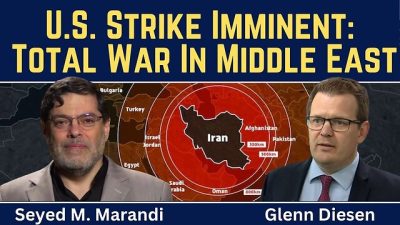
Seyed M. Marandi: Toward Total War in the Middle East
or go to
Aletho News Archives – Video-Images
From the Archives
The Geopolitics behind the War in Yemen (I)
By Mahdi Darius NAZEMROAYA | Strategic Culture Foundation | 30.03.2015
The United States and the Kingdom of Saudi Arabia became very uneasy when the Yemenese or Yemenite movement of the Houthi or Ansarallah (meaning the supporters of God in Arabic) gained control of Yemen’s capital, Sanaa/Sana, in September 2014. The US-supported Yemenite President Abd-Rabbuh Manṣour Al-Hadi was humiliatingly forced to share power with the Houthis and the coalition of northern Yemenese tribes that had helped them enter Sana. Al-Hadi declared that negotiations for a Yemeni national unity government would take place and his allies the US and Saudi Arabia tried to use a new national dialogue and mediated talks to co-opt and pacify the Houthis.
The truth has been turned on its head about the war in Yemen. The war and ousting of President Abd-Rabbuh Manṣour Al-Hadi in Yemen are not the results of «Houthi coup» in Yemen. It is the opposite. Al-Hadi was ousted, because with Saudi and US support he tried to backtrack on the power sharing agreements he had made and return Yemen to authoritarian rule. The ousting of President Al-Hadi by the Houthis and their political allies was an unexpected reaction to the takeover Al-Hadi was planning with Washington and the House of Saudi. … continue
Blog Roll
 Aletho News
- Pakistan-Iran talks secure LNG shipment to Islamabad through Hormuz
- Black Sea grain crisis puts global wheat supplies under pressure
- IRGC air defenses destroy another US MQ-1 drone over Strait of Hormuz
- Imran Khan’s entire immediate family detained in Pakistan ahead of mass protest demanding his release
- EU nation detains former presidential frontrunner
- Leaked: Britain’s Sham Conviction Of Hashim Thaci
- Seyed M. Marandi: U.S. Strike Imminent – Toward Total War in the Middle East
- Russia Voted Under Fire. Washington Is Loading the Tankers.
- 12 Things Your Oncologist Was Trained Not to Tell You
- Anthrax Attacks Paved Way for COVID-Era ‘Junk Drugs and Vaccines’
- If Americans Knew
- Israeli Attacks in Gaza Kill at Least Seven Palestinians Over Three Days, including Woman and Child
- Trump’s militarization of Washington DC as he pursues Israel’s war against Iran
- Why Israel Fears This Searing New Documentary
- Huckabee aide solicited cash gifts from Israelis
- This isn’t sci-fi, AI is already killing people
- ‘The Most Brutal Thing’: Investigation Reveals Execution of Elderly Woman in Rafah
- Inside Israel’s ‘soft’ ethnic cleansing plan for Gaza through the eyes of its victims
- New online database tracks pro-Israel political donations in the United States
- Israeli president pardons soldier convicted for killing wounded Palestinian
- Singer Ed Sheeran says his ‘heart broken’ by Gaza devastation, addresses Macklemore controversy
- No Tricks Zone
- 2025 Nature Paper Claiming Worsening Global Drought Gets RETRACTED …Heavily Flawed
- New Study: ‘Global Drought Shows No Detectable Recent Acceleration Under Climate Warming’
- Economic Masterminds: German Socialists Suggest Taxing Productivity Gains Stemming From Using AI
- The South China Sea Has Not Been Cooperating With The Climate Change Narrative
- Energy Crisis: Germany Enters Heating Season With Historically Low Gas Reserve Fill Levels
- New Study: The Antarctic Ice Sheet Gained Mass From 2020-2024 Due To Staggering Snow And Ice Accumulation
- Study: Ocean Heating Rates From Thousands Of Years Ago ‘Dwarf’ Modern Ocean Heating Rates
- Climate Extremists Target, Attack Large-Scale Power Grid Infrastructure In Germany!
- New Study: Antarctic Ice Melt Has Contributed Less Than 1 Centimeter To Sea Level Rise In The Last 30 Years
- Fear Of Debate: Alarmist German Climate Scientist Calls On Mainstream Media To Discredit Skeptic Voices
 Aletho News