On James Petras’ Twelve Reasons to Reject Obama
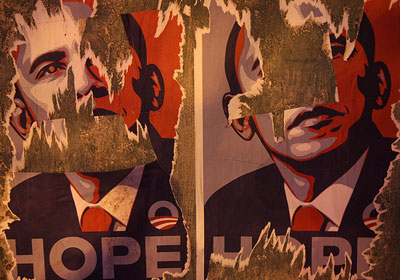
By James Petras | Axis of Logic | October 29, 2008
The presidential elections in the US, once again, provide an acid test of the integrity and consequential conduct of US intellectuals. If it is the duty and responsibility of the public intellectual to speak truth to power, the recent statements of most of our well-known and prestigious public pundits have failed miserably. Instead of highlighting, exposing and denouncing the reactionary foreign and domestic policies of Democratic Party candidate Senator Barack Obama, they have chosen to support him, ‘critically, offering as excuses that even ‘limited differences’ can result in positive outcomes,and that ‘Obama is the lesser evil’ and ‘creates an opportunity for a possibility of change.’
What makes these arguments untenable is the fact that Obama’s public pronouncements, his top policy advisers, and the likely policymakers in his government have openly defined a most bellicose foreign policy and a profoundly reactionary domestic economic policy totally in line with Paulson-Bush-Wall Street. On the major issues of war, peace, the economic crisis and the savaging of the US wage and salaried class, Obama promises to extend and deepen the policies which the majority of Americans reject and repudiate.
Twelve Reasons to Reject Obama
1. Obama publicly and repeatedly promises to escalate the US military intervention in Afghanistan, increasing the number of US troops, expanding their operations and engaging in systematic cross-border attacks. In other words, Obama is a greater warmonger than Bush.
2. Obama publicly has declared that his regime will extend the ‘war against terrorism’ by systematic, large-scale ground and air attacks on Pakistan, thus escalating the war to include villages, towns and cities deemed sympathetic to the Afghan resistance.
3. Obama opposes the withdrawal of US troops in Iraq in favor of redeployment; the relocation of US troops from combat zones to training and logistical positions, contingent on the military capability of the Iraqi Army to defeat the resistance. Obama opposes a clearly defined deadline to withdraw US forces from Iraq because US troops in Iraq are essential to pursuing his overall policies in the Middle East, which include military confrontations with Iran, Syria and Southern Lebanon.
4. Obama has declared his unconditional support for the position of the pro-Israel Lobby and the colonial expansionist and bellicose policies of the Jewish state. He has promised to back Israeli military attacks whatever the cost to the US. His abject servility to Israel was evident in his speech at the annual AIPAC conference in Washington 2008. Top advisers who have long and notorious links to the top echelons of the principle Zionist propaganda mills and the Presidents of the Leading Jewish American Organizations wrote the speech and formulate his Middle East policy.
5. Obama has promised to attack Iran if it continues to process uranium for its nuclear programs. Twice, just weeks before the elections, Obama’s running mate Joseph Biden spelled out a series of ‘points of conflict’ (including Iran, Afghanistan, Pakistan, Russia and North Korea) emphasizing that Obama ‘would respond forcefully’. Obama’s senior Middle East advisers include leading Zionists like Dennis Ross, closely linked to the ‘Bipartisan Policy Center’, which published a report serving as a blueprint for war with Iran. Obama’s proposed offer to negotiate with Iran is little more than a pretext for issuing an ultimatum to Iran to surrender its sovereignty or face massive military assault.
6. Obama unconditionally supports Israel’s expulsion of Palestinians and the expansion of Jewish settlements in the West Bank, the leading cause of Middle East hostility, warfare and the discredit of US policy in the region. With three dozen Israel-Firsters among his leading campaign organizers, top policy advisers, speech writers and among the likely candidates for cabinet positions, there is virtually no hope of ‘influencing from within’ or ‘applying popular pressure’ to change Obama’s slavish submission to the Zionist Power Configuration. By supporting Obama, the “progressive intellectuals” are, in effect, allies of his Zionist mentors.
7. On the domestic front, Obama’s key economic advisers have impeccable Wall Street credentials. He gave unquestioning and immediate endorsement to Treasury Secretary Paulson’s $700 billion dollar taxpayer bailout of the richest investment banks in the US. Obama has failed to challenge Paulson or the banks over the use of Federal funds for buyouts and acquisitions instead of loans and credit to producers and homeowners. Obama’s backing of Paulson and the Wall Street bailout is matched by his meager proposals to suspend mortgage foreclosures for a three-month period, pending re-negotiations of interest payments. Obama proposes to escalate transfers of government funds to mismanaged financial institutions and bankrupt capitalist corporations, in efforts to save failed capitalism rather than pursue any new large-scale, long-term public investment programs which will generate well-paid employment for workers.
1. Obama’s economic team has openly declared their embrace and practice of ‘free market’ ideology and opposition to any effort to engage in large-scale injections of government funds in publicly-owned productive activity and social services in the face of wide-spread private sector failure, corruption and collapse.
2. Obama embraces failed private sector health plans, run and controlled by corporate insurance companies, conservative medical and hospital associations and Big Pharma. He publicly rejects a universal national health program modeled after the successful Federal Medicare program in favor of inefficient, state-subsidized private for profit plans that are costly and beyond the means of over one third of US families.
3. Obama is and continues to be an advocate for Big Agro and its highly subsidized and profitable ethanol program, which has increased food prices for millions in the US and for hundreds of millions in the world.
4. Obama advocates continuing the criminal embargo on Cuba, hostile confrontation with Venezuela’s populist President Chavez and other Latin American reformers and the duplicitous policy of promoting protectionism at home and free market access to Latin America. His key policy advisers on Latin America propose cosmetic changes in style and diplomacy but unrelenting support for re-asserting US hegemony.
5. Obama has not proposed, nor do his free market advisers and billionaire financial backers envision, any comprehensive plan or strategy to get us out of the deepening recession. On the contrary, the course of piecemeal measures presented by Obama are internally inconsistent: Fiscal austerity is incompatible with job creation; bailing out Wall Street drains funds from productive investment; and pursuing new wars undermine domestic recovery.
CONCLUSION
The intellectuals who, in the name of ‘realism’, support a politician who publicly and openly embraces new wars, billionaire bailouts and for profit, private sector-run health programs are repudiating their own claims as ‘responsible critics’. They are what C. Wright Mills called ‘crackpot realists’, abdicating their responsibility as critical intellectuals. In purporting to support the ‘lesser evil’ they are promoting the ‘greater evil’: The continuation of four more years of deepening recession, colonial wars and popular alienation. Moreover, they are allies of the mass media, major parties and the legal system which has marginalized or outright excluded the alternative candidates, Ralph Nader and Cynthia McKinney, who do speak out and oppose the war, the pro-Wall Street bailouts and propose genuine large-scale public investment in the domestic economy, a universal single payer health program, sustainable and pro-environment economic policies and large-scale, long-term income redistributive policies.
What is crass and unacceptable is the argument of these intellectuals, (an insignificant pimple on the Democratic donkey’s rear-end) that for a single moment believe that their ‘critical support’ of the Obama political machine will open space for radical ideas. The Zionists and civilian militarists totally control Obama’s war policy in the Middle East: There will be no space for peace with Iran, Palestine, Pakistan, Afghanistan or Iraq. Wall Street controls the Obama’s financial policy: There will be no space for some Cambridge progressive to sneak in a handout for families losing their homes.
If the trade unions that have spent a hundred million dollars on each presidential campaign have failed to secure a single piece of progressive legislation in over 50 years, isn’t it delusional for our progressive ‘public intellectuals’ to imagine that they, in their splendid organizational isolation, can ‘pressure’ President Obama to renounce his advisers, backers and public defense of military escalation, to see his way to peace with Iran and to promote social justice for our workers and unemployed?
NY Times full-page ad demonstrates who is pushing for war against Iran
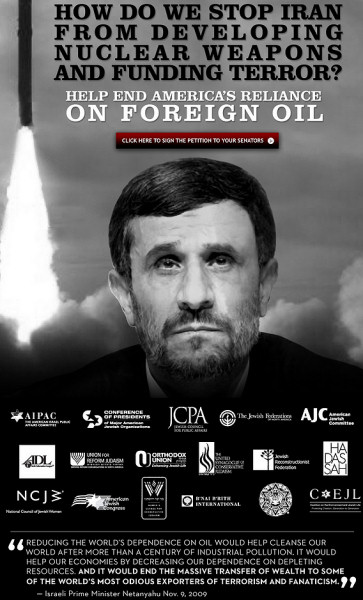
Also, the organizers say they’re actuated by fears of climate change, but why the Netanyahu quote and the emphasis on missiles?
And the NYTimes is still on message, Global Warming, Peak Oil and the War on Terror all seem to merge to support Zionism:
Letters to the International Herald Tribune – How to Fight Climate Change – NYTimes.com
The only way to effectively address climate change is for our leaders to make it an issue of national security: Emphasize the link between consumption of fossil fuels, especially foreign oil, and the rise of international terrorism. Once that link is clearly established, people will be willing to make an effort: The home-front will contribute to fighting against terrorism, which threatens every one of us. People will understand that there is no way to put a value on the lives of any of the nearly 3,000 people who perished in the Sept. 11 attacks, and that any effort is worth making to prevent recurrence of such a tragedy.
Update:
The Israel Lobby’s War on America’s Middle East Oil Dependence
By Maidhc Ó Cathail | The Passionate Attachment | October 26, 2012
See also:
US Jewish leaders push Obama to act on Iran
Jerusalem Post, September 10, 2009
Related efforts toward energy independence and war on Iran
- Obama uses Weekly Address to lobby for Israeli firm BrightSource (alethonews)
- Noam Chomsky: The Fate of Humanity Is at Stake — Why Are Romney and Obama Too Cowardly to Talk About What Really Matters? (alternet.org)
- Iran Underground Nuclear Plant Almost Finished, NY Times Says – Bloomberg (bloomberg.com)
- Earth Day in Israel: Apartheid Showing Through the Greenwash (alethonews)
Crazy Muslim conspiracy theories
By Glenn Greenwald | August 5, 2010

Rashad Hussain – Wikipedia
Politico‘s Laura Rozen points to this Times of India article, recounting how Rashad Hussain, the Obama administration’s envoy to the Muslim world, was angered and “shocked” yesterday when — as part of a tour of India to promote better relations with Muslims — “the head of a city-based Muslim institution [Akhtar Hasan Rizvi] slammed the US’ policies, not just in the Middle East, but towards Muslims everywhere”:
Rizvi held America responsible for many woes in the Muslim world. “You supplied arms to Iraq during the Iran-Iraq war, then invaded Iraq in the name of searching for weapons of mass destruction. You created the Taliban with the help of Pakistan. You have been backing Israel ever since its creation. First, right the wrongs that you have created if you want to establish peace in the world,” said Rizvi to applause from the students.
Shocked, Hussain who had earlier talked about the Obama administration’s resolve to partner with the Muslim world for winning hearts and minds, shot back: “I reject the conspiracy theories that are being floated” . . . . Hussain appeared so upset with Rizvi’s trenchant comments that he almost left the dais and wanted to walk out but the meeting’s conductor, Akhtar Chauhan, also director of the institute, requested him to stay back.
Are any of the accusations voiced by Rizvi actually “conspiracy theories,” or are they just all basic, undisputed facts? It certainly appears to me to be the latter. One of the favorite tactics of American political and media elites is to disparage the Muslim world as wallowing in “conspiracy theories” whenever they describe American actions in their part of the world. While there are undoubtedly some such theories in that part of the world and every other, this episode highlights that, more often that not, that claim is made to obfuscate basic truths and to deter those who would point them out.
The Real Reasons Why the US and India Demonize Pakistan’s ISI
By Shahid R. Siddiqi | Axis of Logic | July 31, 2010

Pakistan’s Inter Services Intelligence agency, or ISI as it is popularly known, is seen as their nemesis by those who have tried to undermine the security interests of the country one way or the other. It is no wonder then that in past few years the Americans unleashed a strong ISI-bashing campaign, with India following suit.
The Americans made no bones about their dislike for this agency, blaming it for working against their interests in Afghanistan. The Indians also see an ISI agent behind every rock in Kashmir and in Afghanistan where they are trying to dig their heels. They do not hesitate to pin on ISI the blame for the freedom struggle in Kashmir or for acts of terrorism by Indian extremists. Until recently the Karzai government dominated by the anti-Pakistan Northern Alliance also remained hostile to ISI.
Not too long ago, under intense American pressure the weak Zardari government made an unsuccessful attempt at neutralizing and subduing this agency in disregarding the existing sensitive regional security environment, by moving it out of the army’s control and placing it under the controversial and embattled Zardari loyalist interior minister – Rehman Malik. This did not succeed for a simple reason. The role of the ISI as the eyes and ears of the Pakistan’s military – the bedrock of country’s security, is critical particularly at a time when the country faces multiple threats to its security.
Washington’s darling in the Afghan-Soviet war
Ironically, this is the same ISI that was Washington’s darling during the 1980s when it was the master minding the jihad against invading Soviet forces in Afghanistan. The role that the ISI then played was congruent with American interests. The defeat of the Soviet Union would have meant realization of an American dream – avenging the humiliation of Vietnam. They held the ISI in high esteem for its competence and professionalism and gladly funneled arms and funds to the Afghan mujahedeen through it. The ISI strategized the resistance and organized and trained the mujahedeen fighters, working in close collaboration with the CIA and the mujahedeen leaders, forcing the Soviets to retreat.
But as soon as the Americans had negotiated a quid pro quo – Russian withdrawal from South America in exchange for safe Soviet exit from Afghanistan, they disappeared in the middle of the night leaving Afghanistan in a quandary. The political turmoil that followed created chaos and instability owing to the failure of mujahedeen leadership, presenting as a result a security nightmare for Pakistan.
Taliban-US-Pakistan relations and the Indian Threat
In this chaos a group of young Afghan religious students, many of them former fighters from the resistance, calling themselves Taliban (in Pushto language Taliban means students), swept through the country with popular support to establish their rule. Interested in keeping their presence alive, the Americans maintained contacts and supported them, ignoring their orthodox beliefs, their harsh rule and even the presence of Al Qaeda in their midst. This continued until it was time for the Americans to overthrow their government in order to serve the changing American interests.
While the Taliban government was in control, Pakistan too maintained friendly relations with them in the interest of keeping its western border secure, extending whatever support it could. The ISI played a role through the contacts it had developed during war against the Soviets.
In the wake of 9/11 things began to change. Having invaded Afghanistan in the name of war on terror, branding Taliban as brutes and their resistance as terrorism, the Americans wanted the Pakistani army and the ISI to join the war.
This posed a serious security concern for Pakistan. It could destabilize the Pak-Afghan border and strain relations with the Pashtun tribes on both sides of the Durand Line, the British drawn boundary that cut through the Pashtun region to divide British India and Afghanistan and which Pakistan had inherited. The fact that Pakistan’s border region, called Federally Administered Tribal Areas (FATA) is autonomous where the writ of the Pakistan Government does not prevail made matters more complex.
Pakistan’s military doctrine is based primarily on meeting the main threat from India on its eastern border while maintaining a peaceful border with Afghanistan in the west. A direct conflict with the Taliban would have forced Pakistan to divert its military assets from the eastern to the western front, thus thinning out its defenses against India. This was the last thing Pakistan wanted to do because of its unfavorable ratio of 1:4 against India in terms of conventional forces. Understandably, President Musharraf was unwilling to do America’s bidding.
U.S. projection of its military failures onto Pakistan
There always is a problem with powers that begin to act in imperialistic fashion. Their vision of the world becomes colored. They tend to believe that pursuit of their imperialist designs takes precedence over the national interests of those who cannot stand up to them, even if that means compromising their own national and security interests. America had also been behaving as one such imperial power and treated its smaller allies more like colonies. President Musharraf was threatened that in case of noncompliance with America’s wishes, “Pakistan would be bombed into the stone-age”. Musharraf was coerced into conceding to American demands.
Despite the state-of-the-art surveillance equipment and military hardware, the US and NATO forces failed to stop the Taliban fighters from moving back and forth into the unmarked Pak-Afghan border that passes through a treacherous mountainous region to regroup and strike on the invading foreign troops. The American commanders reacted by demanding that the Pakistan army engage these fighters and seal the border. Those with even the slightest knowledge of the area would know that the Americans were asking for the moon. This was physically impossible.
The Pakistan army’s operations failed. In the process it earned a severe backlash from the local tribes who resented army’s action against their kinsmen from across the border who sought refuge in their area, as it violated the old tribal custom of providing sanctuary to any one who asked for it, even if it was an enemy. The Pakistan army paid a heavy price. More soldiers died in this action than the combined number of casualties that the US and NATO troops have suffered in Afghanistan so far.
President Musharraf under advice of his army commanders and the intelligence community called off the action and resorted to persuasion instead. Through jirgas (assembly of tribal elders) an effort was made for the tribesmen to voluntarily stop the influx of Taliban fighters. It didn’t succeed either. This was not to the liking of the American commanders. They blamed the ISI for working against their interests.
Washington accuses the ISI of complicity with insurgents
Washington and the American media have frequently alleged that elements within ISI were maintaining contacts with the Taliban and attributed the failure of American troops in combating the Taliban to these contacts. Such allegations were also found to be part of the raw, unverified and even fabricated field reports ‘leaked’ in Afghanistan recently and splashed in the western media. The Americans have in the past also described the ISI to be out of control and demanded that the Pakistan government purge the agency of Taliban sympathizers.
This is ridiculous.
First, the ISI is a military organization operating under strict organizational control and discipline where officers are rotated in the normal course. It functions according to a defined mandate, unlike armed forces in some other countries and unlike the CIA which is known to be an invisible government on its own. Above all, Pakistan and its military are committed to weeding out religious extremism as a matter of state policy.
Second, if the American troops are so incapable of overcoming a rag tag army of Taliban and if the complicity of the ISI with the Taliban can be instrumental in changing the course of the American war, then it is a sad day for America as a super power and the strength of NATO forces becomes questionable.
Third, in the world of intelligence, contacts are kept even with the enemy and at all times. CIA keeps contacts within Russia and other hostile countries. Israel, the great American ‘ally’, spies on America itself. It is common for all intelligence agencies to do this in the security interests of their countries. Why then should America expect an exception to be made in case of ISI? Why should contacts that the ISI developed with the mujahedeen and the Taliban earlier, and which if it does still maintain, become a source of such great concern for the American administration?
Demanding that the ISI subordinate Pakistan security to U.S. interests.
It is strange that America expects the ISI to serve the American agenda instead of Pakistan’s interests first. One cannot forget that the Americans have a long history of abandonment of friends and allies and when they repeat this in Afghanistan citing their own national interest, despite their promises to the contrary, why should Pakistan be expected to be caught with pants down? Why should Pakistan’s military and intelligence agency be expected to abdicate their duty and not do what is necessary to ensure Pakistan’s security in the long term?
It has often been argued that America expects Pakistan to be actively engaged in the Afghan war in return for the military assistance it provides. The answer is quite simple. The American establishment is doing all that needs to be done in support of its own war and not for the love of Pakistan. The war is theirs, not Pakistan’s. Pakistan should do and is doing what is necessary and feasible, without jeopardizing its own security.
As for the assistance, the bulk of the $10 billion that America gave in the past and was branded as “aid” was in fact the reimbursement of expenses that Pakistan had already incurred in supporting the war effort. The rest was to meet Pakistan’s needs for operations in the border areas and for fighting terrorism that arose out of the war. The Americans still owe $35 billion to reimburse the losses Pakistan has incurred due to this war. As for the F16s that Pakistan is getting from the US, it pays for them, despite strict restrictions over their usage.
The Indian-Israeli attempt to destabilize Pakistan
While Americans had their issues with ISI, the Indians and Israelis began having their own. The agency exposed the growing Indian and Israeli confluence in Afghanistan to destabilize Pakistan. This happened right under the nose of the Americans and obviously not without their knowledge and consent. India having deployed its troops in the name of infra-structure development in league with Karzai government and with American funding and having established seven consulates along the sparsely populated Pak-Afghan border was engaged in heavily bribing the influential but ignorant and susceptible tribal leaders to spread disaffection among the local tribesmen against Pakistan.
Evidence was also unearthed by the ISI about how the Indians bought the loyalties of Tehrik-e-Taliban Pakistan (TTP), a grouping of Pakistani tribesmen from FATA and Uzbek fighters from previous wars who settled in the region. The TTP were influenced by the same orthodox religious beliefs as the Taliban in Afghanistan and were active in propagating them in their own areas. They were recruited to launch terror activities in the urban centers of Pakistan, including the capital Islamabad, and were funded, trained and equipped in Afghanistan jointly by the Indian, Israeli and Afghan intelligence agencies. A group from amongst them managed to gain control of Swat area adjoining FATA through coercion of the local population, which was later cleared by the Pakistan army after a major surgical intervention.
The ISI also laid bare strong physical evidence of Indian involvement in supporting insurgency in Balochistan by way of funding, training and equipping misguided and disgruntled Baloch elements grouped under various names including the Balochistan Liberation Army that was led by the fugitive grandson of the notable Bugti tribal chief – Akbar Bugti. His comings and goings in the Indian consulate at Kandahar and the Indian intelligence HQ in Delhi were photographed and his communications intercepted. Numerous training camps in the wilderness of Balochistan were detected where Indian trainers imparted training in guerilla warfare and the use of sophisticated weapons, which otherwise could not be available to the Baloch tribesmen. The flow of massive funds from Afghan border areas to the insurgents was detected that was traced back to the Indian consulates.
Summary and conclusion
The objective of the TTP, and behind the scenes that of the Indians and the Israelis, was to make the world believe that Pakistan was under threat of capitulating to terrorist and insurgent elements who were about to take control of Pakistan’s nuclear assets. Their goal: to denuclearize Pakistan through foreign intervention.
These efforts have not succeeded. Undoubtedly, the army and the ISI played a crucial role in foiling the plots of subversion in Balochistan and the Pashtun region and exposing the foreign hands involved, including those of CIA, RAW, Mossad, RAMA and MI6. Terrorism may not yet be eliminated but Pakistan faces no existential threat.
It should be no surprise to the Americans, Indians and the Israelis they find in ISI an adversary to reckon with. It is also not surprising that the ISI is in their perception, a rogue organization, for it has stood between them and Pakistan’s national security interests. Their frustration and ire, therefore, is understandable.
The Sinking of the Cheonan and Its Political Uses
By GREGORY ELICH | July 28, 2010
Much has been written about the sinking of the South Korean corvette Cheonan, and the evidence is widely regarded as clearly pointing to North Korean culpability. In the Western press, the case has generally been presented as solid and the evidence irrefutable. The tragedy is seen as one more example of North Korean perfidy. Yet, doubts persist.
Following the sinking of the corvette Cheonan on March 26, the government of South Korea established the Joint Military-Civilian Investigation Group (JIG) to investigate and determine the cause of the sinking. Two months later, on May 20, the group completed its report and issued a press release outlining its conclusions. In its press release, the JIG firmly announced, “The evidence points overwhelmingly to the conclusion that the torpedo was fired by a North Korean submarine. There is no other plausible explanation.”
The JIG concluded that the Cheonan was sunk by a “shockwave and bubble effect” from an explosion set off by a homing torpedo, which caused “significant upward bending” of the center keel. A bubble jet effect is created when an explosion takes place underwater and creates a dramatic change in pressure, resulting in the formation of a strong column of water that strikes its target with great power. In addition to the upward bending of the stern and bow sections at the point of severance, the JIG found “water pressure and bubble effects” on the bottom of the hull, and the ship’s wires had been cut with no sign of heat.
Furthermore, survivors reported “that they heard a near-simultaneous explosion once or twice,” water splashed on the face of a sailor at the port-side, and a sentry stationed on the shore observed a “pillar of white flash” rising about 100 meters for two to three seconds. No fragmentation or burn injuries were found on the bodies of the sailors who were killed, and seismic waves were detected at eleven stations. (1)
 All of this evidence is consistent with the JIG’s conclusion that a shockwave and bubble jet effect from a exploding torpedo was the cause of Cheonan’s sinking. (2) As further damning evidence, components of a torpedo were brought up by a two fishing trawlers in the proximity of the site of the sinking. The components appeared to match that of a diagram the South Korean military had in its possession of the North Korean CHT-02D torpedo. Inside the propulsion system of the torpedo were written with blue magic marker ink the Hangul characters for “1 beon” (number 1 ). This was similar to a North Korean training torpedo that the South Korean Navy had obtained seven years before, in which there was written “4 ho” (unit 4). According to one expert on North Korea, “North Korea does not frequently use the term beon.” (3) However, it cannot be said that infrequent usage rules out the possibility.
The evidence appeared inarguable, yet from the first it was apparent that there was a troubling lack of transparency in the JIG’s approach, typified by the secrecy surrounding the investigation. The report itself remains concealed, and the public is expected to accept on faith that the JIG’s conclusions and brief explanations are backed by the evidence.
Various alternative causes of the sinking were briefly addressed by the South Korean Ministry of Defense. (4) The possibility of a floating contact mine was rightly dismissed due to the lack of signs of a contact explosion. However, most modern non-contact mines rely on creating a shockwave and bubble jet effect to sink ships. In general, the Ministry of Defense considers the possibility of a sea mine having caused the explosion as “unlikely,” given the maritime conditions and fast currents in the shallow waters around Baengnyeong Island where the Cheonan sank. Moored mines are rarely used in deeper waters, where currents and swells are stronger than they are closer to shore. According to Retired Rear Admiral Chris Bennet of the South African Navy, “Their major use is therefore limited almost exclusively to coastal or territorial waters.” (5) In other words, it is in areas such as around Baengnyeong Island where moored mines are best suited. But the South Korean Navy’s “detailed search” of the seabed failed to locate the anchor that a moored mine would have needed. No details were given to indicate the extent of the search beyond that one phrase.
Bottom mines rest on the seabed and are ideally suited for deployment in shallow waters, but the JIG dismissed the possibility of such a mine striking the Cheonan because it “cannot split a ship when detonated at a depth of 47 meters.” That was the depth of water at the location where the torpedo components were retrieved. However, when it sank, the Cheonan had been sailing in waters that were no deeper than 30 to 40 meters. (6) According to the Robert S. Strauss Center for International Security and Law, “bottom mines tend to work in relatively shallow water (less than 164 feet).” That translates into just under 50 meters, well within the range necessary to have struck the Cheonan. (7) However, the JIG calculates the distance of the explosion as just three meters from the Cheonan’s gas turbine engine. (8) If the JIG’s calculation of the explosion distance is correct, then that would preclude the possibility of a bottom mine.
There is another type of mine, one which the JIG did not address in its summary of findings. That is the rising mine, which is similar to a bottom mine in that it sits on the seabed. Where it differs is that it contains an acoustic sensor, and when a ship approaches, the mine is programmed to float upwards and explode at a set distance beneath the hull. In essence, the result would be the same as a non-contact torpedo, creating a bubble jet effect. In shallow water, such mines tend not to be moored, hence there would be no anchor. (9) There is also the torpedo mine, which when detecting an approaching ship, opens up and fires a torpedo at its target. (10) This possibility, too, was not mentioned in the JIG’s summary.
The centerpiece of the case against North Korea is without doubt the torpedo fragments retrieved by trawlers. At the JIG press conference announcing the results of its investigation, a diagram said to be that of the CHT-02D was displayed. It was not until over one month later, after critics had pointed to discrepancies between the diagram and the torpedo fragments, that the JIG admitted that it had shown a diagram of the wrong torpedo, the PT-97W. This was said to have been caused by a “mix-up by a staff member while preparing for the presentation.” (11) That such a mistake could be made is indicative of a careless attitude concerning evidence.
This was not the only point of confusion. One day before the JIG’s final results were announced, a Korean government official was quoted as saying that investigators had determined that North Korea sank the Cheonan with a Chinese-made torpedo, as Chinese characters were written on the torpedo fragments collected from the site. It was said that the torpedo was thought to be a YU-3G, the type North Korea had imported from China more than twenty years ago. (12) One day later, nothing more was said of the matter, and now it was claimed that the torpedo fragments originated from a CHT-02D, with a Korean word written in blue ink. It is true that at one time Hanja (Chinese) characters were incorporated into general usage in Korea, but that practice has long since passed, and not since 1949 have they been used in North Korea. (13) Because the JIG’s report remains shrouded in secrecy, it is impossible to know whether or not Chinese characters were truly found on torpedo fragments. If so, that would be at variance with a report that U.S. intelligence had traced the propulsion system on the found torpedo to its manufacture two years ago at a North Korean factory. (14)
It should also be mentioned that the information South Korea had on the CHT-02D was obtained from an export catalogue, as the weapon is among those that North Korea sells abroad. In other words, the torpedo apparently has buyers, and therefore the source of manufacture does not automatically correspond to ownership. So, was the torpedo a Chinese-made YU-3G or a North Korean-made CHT-02D? Or perhaps something else altogether? It is a CHT-02D, the JIG now asserts, without addressing the discrepancy in its claims.
Traces of RDX, a high explosive chemical commonly used in torpedoes and mines, were found on the Choenan’s smokestack, stern, and in sand taken from the seabed. South Korean Defense Minister Kim Tae-young dismissed speculation that the RDX was residue from naval drills that had been conducted in the past in the area. Although one South Korean government source claimed that RDX is not used in mines, this was contradicted by the Defense Minister (15). Indeed, RDX has been used in naval mines since the Second World War. (16)
While the presence of RDX would be consistent with a torpedo attack, it cannot on its own be considered as proof of that. Consider that when Canadian authorities intercepted the Princess Easwary as it was transporting illegal immigrants, swabs taken from the ship showed traces of RDX. No torpedo or mine had struck the Princess Easwary. Its past history of gun-running meant that the mere presence of explosives had been enough to leave a residue. (17) The Cheonan, as a military vessel, routinely carried explosives and engaged in naval exercises. Among the Cheonan’s armaments were six Mark 46 torpedoes, two Otobreda 76 mm guns, two 40 mm Bofors guns, and twelve Mark 9 depth charges. (18) Both torpedoes and depth charges utilize RDX, and the bursting charge of projectiles fired by Bofors contain RDX. (19) Certainly, explosions from test-fired depth charges would have spread RDX around rather liberally.
It is a striking anomaly that none of the 58 surviving sailors of the Cheonan witnessed a rising pillar of water, without which it is difficult to imagine that a bubble jet effect explosion could have taken place. (20) Perhaps all of those on deck perished during the incident. That might account for this oddity, although it does seem unlikely, given that most of the casualties were said to be of those who were below deck. There is, of course, the shore-based witness, but one would feel more comfortable with his veracity were it backed by other witnesses. Indeed, the Korean organization People’s Solidarity for Participatory Democracy reports that survivors who spoke at the JIG press conference said they saw no pillar of water. They included port-side lookouts, who would have been hard-pressed to miss such a significant sight. (21)
The recovery of torpedo fragments in the vicinity of Cheonan’s sinking appears persuasive. It is a strong point in support of the South Korean government’s argument. Yet, it is not such an unusual event for torpedoes and components of torpedoes to be found underwater. All sorts of things get dumped at sea, including, it seems, dangerous weaponry. A live torpedo was inadvertently pulled up in a fishing net more than two years ago off the British coast, as was one off the coast of Rhode Island in 1985. (22) In a survey covering the period of March 2002 through February 2003, the British Royal Navy reported that “at least 15 items of explosives ordinance or their components had been recovered in the nets of fishing vessels operating in coastal waters around the British Isles.” Among the ordinance recovered were “torpedo components.” It was also noted that some items had been “dispersed from their original dumping or loss positions by water movements.” Oceanographic factors “can lead to quite substantial movements of large munitions.” In the 15-year period ending in 2000, German fisherman reported to officials in Lower Saxony having found a total of more than 11 tons of munitions, while Dutch fisherman net an average of ten explosives per year. (23) The torpedo recovered by South Korea may have been associated with the sinking of Cheonan, but it could also have been dumped at sea, or test fired during military exercises at some point in the past.
It should also be noted that the Cheonan was sunk in disputed waters. After the Korean War, the U.S. unilaterally drew the Yellow Sea border between the two Koreas with a line that curved sharply northward to North Korea’s disadvantage, rather than in a straight line, as existed with the East Sea border and which would have been common practice. (24) The area has been the site of periodic naval clashes between the two Koreas, and it is not unusual for North Korean vessels to cross over this line that it does not recognize.
The JIG did conduct a simulation to demonstrate how a bubble jet effect would have impacted a ship’s hull. It is an indication of the predetermined approach the JIG adopted that the simulation was not completed until after its report was finished and results were announced. Although a bubble jet effect is capable of severing a ship in two, the JIG’s simulation failed to do more than deform and cause a small break in the hull. (25)
Two Korean-American physicists, Seung-Hun Lee and J.J. Suh, are of the opinion that a bubble jet would have resulted in the hull being deformed in a concave shape at the point of severance, rather than the sharply angular shape seen in the Cheonan. This suggested to them that the pattern is “more consistent with a collision with a hard object.” (26)
What tied the recovered torpedo fragments to the sinking of the Cheonan was not only its proximity to the site of the sinking, but also a chemical analysis of adhered substances on both the torpedo and the Cheonan’s hull that were shown to be identical. (27) The physicists managed to obtain a copy of one section of the JIG’s secret report, in which it was stated that the compounds were a result of an explosion. These compounds were indeed the same on both the torpedo and the ship, the physicists concluded, but the data were not consistent with the conclusion that they had formed during an explosion. The samples, they asserted, “have nothing to do with any explosion, but are most likely aluminum that has rusted after exposure to moisture or water for a long time.” Korean-Canadian geologist Panseok Yang determined that the spectroscopic analysis of the compounds reported by the JIG closely matched that of gibbsite, a mineral formed under intense weathering conditions, and often found in clay deposits. (28)
When a South Korean congresswoman asked the JIG to release its samples, only two out of the three were made available. The JIG claimed that they had used up all of the third sample, yet the spectroscopic and X-ray analyses done are non-destructive. Seung-Hun Lee and Panseok Yang observed that either the JIG had completely mishandled the samples or they were intentionally hiding them. (29)
The South Korean Ministry of Defense rejected their conclusions, pointing out that the physicists’ laboratory tests did not fully replicate conditions during an explosion, and were thus invalid. (30) The physicists argued that their results were “consistent with previous scientific studies.” In their experiments they had scaled down both the weight of the explosive and the weight of the water in a metal container to retain the proportion equivalent to that of a torpedo. Full access to the JIG’s data and objective analysis would do much to bring us closer to the truth, whichever direction it leads, but Seung-Hun Lee finds that the JIG’s report contains “several serious self-contradicting aspects and their interpretations have serious flaws, to say the least.” (31)
The propulsion unit of the torpedo was severely corroded, an apparent result of the coat of paint having been burnt away by the heat of the explosion. It seems odd that the “number 1” written in Korean by a blue magic marker would survive intact. The boiling point for ink is less than half that of paint, so it would be more vulnerable to loss. (32) One cannot be sure that the handwriting was not added later by South Korean military officials for enhanced dramatic effect when presenting their evidence.
In the opinion of Seung-Hun Lee, “The government is lying when they said this was found underwater. I think this is something that was pulled out of a warehouse of old materials to show to the press.” (33)
It seems that the JIG’s investigation was something of a rush job, intended to be completed in time to give a boost to the South Korean ruling party in local elections. Among the members of the JIG were a small number of representatives from the opposition Democratic Party, one of whom, Shin Sang-cheol, felt disappointed that members of the team were not given briefing materials or basic information such as the navigation course record and other data. What struck Shin was that the investigation began with the premise that there had been a torpedo attack, and during his time on the team no effort was made to examine other possibilities. (34)
With the South Korean military’s mind made up before it began, little effort needed to be wasted on analysis. According to one anonymous South Korean military source, “If you leave out the time spent moving the torpedo, removing water and dust, and writing a report, the whole examination [of the torpedo components] only lasted about three days. The government has invited distrust by being excessively greedy.” In that span of time, the JIG was not able to even determine how long the torpedo had been corroding underwater. (35)
Shin Sang-cheol was quickly booted out of the JIG for not singing the same tune as the military authorities. With years of experience as a ship navigator and as a shipbuilding inspector at various Korean shipyards, he was not entirely without expertise. He sent a letter to U.S. Secretary of State Hilary Clinton, in which he included maritime maps of the waters around Baengnyeong Island. These, he pointed out, are marked by shallow waters and rock fields. It was his contention that the Cheonan had run aground, backed out, and then collided with some object. Among the indications Shin cited as evidence were deep scratches on the hull and propeller blades bent forward; that is, toward the direction of the point where the ship split in two, rather than away from it. Perhaps not surprisingly, Shin is being sued for libel by the South Korean military. (36)
Shin’s theory, however, does not seem particularly more convincing than that of the South Korean military. The JIG ruled out the possibility of running aground as the ship’s sonar remained undamaged. Shin counters, correctly, that a hull can run aground at one point while another is unaffected. But it could be that the ship’s propellers were damaged when the stern hit bottom after the Cheonan split in two. Or indeed, the damage to them may have resulted from some previous incident. It is far from certain that Shin’s theory accounts for what actually happened to the Cheonan. The JIG’s summary points out that there are no signs of collision on the Cheonan, and the hull damage does appear more consistent with that of an external explosion than of a collision. But the possibility of a collision did merit consideration. Actually, what is perplexing is that none of the various explanations that have been put forward quite seem to fit the totality of evidence.
One’s already low level of confidence in the South Korean military’s sincerity was undermined when it was revealed that it had deliberately fudged initial reports on the sinking of the Cheonan. The Naval Operations Command reported that the sinking occurred at 9:15 PM (which was later corrected to 9:22 PM) and that there was the sound of an explosion. The Joint Chiefs, however, altered the time to 9:45 PM and omitted mention of an explosion in order to cover up their slow responsiveness. Then the Ministry of Defense botched the release of thermal observation device recordings by using those from thirteen minutes after the sinking, while ignoring recordings taken from just three minutes afterward. Furthermore, when a South Korean vessel in the vicinity of the Cheonan reported that it had fired at an unidentified object, it was instructed by the Fleet to report the object as “a flock of birds.” It was also eventually revealed that the on-duty Chairman of the Joint Chiefs of Staff was drunk that night, and only arrived at command control headquarters at 10:42 PM, where he managed to stay awake at a meeting for ten minutes before falling asleep. (37)
That high-ranking military officers would so causally lie and distort facts during a moment of crisis does not encourage confidence in their reliability to objectively analyze data and come to a considered conclusion in the investigation into the sinking of the Cheonan. Certainly not when political pressure to reach a predetermined conclusion would have been so intense. Interestingly, the investigators who probed into the military’s mishandling of its initial response to the sinking of the Cheonan revealed only a portion of the problems they had found. Information which they considered militarily sensitive was excluded. (38) That would seem to imply that additional distortions or misrepresentations had taken place.
The South Korean military believes that it was a North Korean Yono (Salmon) class midget submarine that fired a torpedo at Cheonan. Of limited range, midget submarines must be ferried and launched by larger submarines. They can operate in shallow waters, unlike their larger counterparts. Even so, the waters around the sinking were too shallow even for a midget submarine, so it is thought that it had to have been operating from much farther away, in deeper waters. South Korea did track the departure of a Yono-class submarine and its mother ship from a North Korean port days before the sinking of Cheonan, as well as their return to base days after the incident. For the JIG, that constituted direct evidence of North Korean responsibility, although logically speaking, this is not in fact direct causal proof any more than a man would be proven guilty of murder simply because he was away from his home at the moment the murder took place. The most that could be said of the submarine tracking is that it is suggestive of a possible connection.
Oddly, the Cheonan’s sonar failed to detect anything unusual, but a South Korean military source pointed out that the ship’s sonar “is an old model with a limited range, so there’s a strong possibility that it failed to detect the torpedo which was launched from far away.” (39) That may be true, but one must add that sooner or later a torpedo fired from long-range distance would approach closely enough to be detected. Kim Jong-dae, editor-in-chief of D&D, a defense journal, observes, “A submarine is supposed to be difficult to detect militarily, but most torpedoes can be detected. It is doubtful they would have been completely unable to detect the launch.” (40)
No one would call the JIG’s investigation a model of transparency. It was led by South Korea, who chose the nations that would participate: the U.S., Great Britain, Australia and Sweden. On the Multinational Combined Intelligence Task Force, Canada replaced Sweden. Aside from Sweden, what all of these nations share is a uniformly hostile attitude towards North Korea. Sweden, according to CBS News, was “a reluctant partner in blaming the North Koreans.” (41)
Unquestionably, the South Korean government is sincere in its belief that a North Korean submarine fired a torpedo at the Cheonan. But in one sense that is the problem. So convinced was the JIG, that the team had a set of blinders on during the investigation, so that only one outcome was possible. And nothing would seem amiss if, whether knowingly or blindly, evidence was fudged or ignored to strengthen that case, as that would not change the overall facts as the team perceived it.
The report itself remains secret, and all requests for it to be made public have been rejected. A copy did go to U.S. Secretary of State Hillary Clinton, who pronounced the evidence against North Korea “overwhelming.” If the evidence is truly so convincing, it would only help South Korea’s case for it to be made publicly known. Or could it be the case that the evidence falls short of Clinton’s assessment? South Korean legislators have not seen the report, nor have they been given access to even partial information of relevance. Assemblyman Choi Moon-soon of the opposition Democratic Party comments, “We asked for very basic information – interviews with surviving sailors, communication records, the reason the ship was out there.” But no information was forthcoming from the government. (42)
North Korea vehemently denies the accusations being made against it. As the accused, North Korea is an interested party. It feels it has the right to see the evidence supporting the charges. North Korea asked on two occasions to send its own inspection team to operate under the joint control of both South and North Korea in order to conduct an investigation, but their requests were turned down by the South Korean government. North Korea sent a similar suggestion to the United Nations, only to be rebuffed by the United States, who indicated that the case against North Korea was already proven. Instead, the U.S. pushed hard for the strongest language in a UN Security Council statement, and attempted to browbeat China into going along. China, though, held firm in the interests of peace, ensuring that a more moderate UN statement resulted. With the U.S. and South Korea committed to taking a hard line, even North Korea’s proposal to reopen talks on denuclearization was snubbed.
China, which has received a modicum of information from South Korea, remains unconvinced. “I have to say the majority of Chinese policymakers and academics feel that the Cheonan report does not hold water,” remarks international studies scholar Zhu Feng. (43)
In order to bolster its case, South Korea agreed to allow a team of Russian naval military experts to visit and analyze the evidence. For the first time, there would be an objective assessment of evidence. There was good cooperation during the visit, and then the Russians returned home where they spent several weeks in analyzing the data. Russia, however, was in a delicate position when it came to publicizing its determinations. Openly backing Seoul would only encourage attempts by the U.S. to ratchet up tensions in the region, whereas dissenting from the JIG’s conclusion could strain relations with South Korea, an important trading partner. So it was not surprising when it was announced that Russia would not publicize its own report.
There have been, however, various leaks and comments made to the media which give a fair indication of the Russian team’s evaluation of the evidence, clearly regarded as inconclusive. Russia did supply its report to the U.S. and China, but not to the South Koreans, apparently in a bid to avoid antagonizing them. But it did not take long for South Korea to be apprised of the results, no doubt by the U.S. Whereupon the Russian ambassador was called to the South Korean Ministry of Foreign Affairs, where he received a heated reception.
According to a South Korean diplomatic source, “The Russian investigation team’s primary interest was in whether North Korea, which had been unable to produce its own torpedoes until 1995, suddenly was able to attack the Cheonan with a state-of-the-art bubble jet torpedo.” It has been pointed out that this technology is possessed only by a small number of countries, and the weapon has been successfully used only in test firings on stationary targets. The Russian team came to the conclusion that the recovered torpedo did not sink the Cheonan, nor indeed had any bubble jet torpedo done so. As that was the primary focus of their investigation, they did not offer a concrete cause, other than to suggest various proposed scenarios, such as a mine explosion after maneuvering problems. (44)
If a North Korean source speaking on condition of anonymity in Hanoi is to be believed, Russia informed North Korean officials that it did not trust the results of the JIG investigation. “The Russian delegation said if the truth is revealed, then South Korea and the United States could be caught in an awkward position,” an apparent reference to the manipulation of evidence. (45)
Yet there was still much that the Russian team was unable to determine. It sent requests for further information, but so far South Korea has failed to respond. “We still have some questions regarding the results of this work to which we have not received clear answers,” Naval Commander Vladimir Vysotsky said. Whether or not answers would be supplied, he added, “doesn’t depend on us.” (46)
It is interesting to compare the U.S. response to Cheonan’s sinking with its reaction to the Israeli attack on a ship bringing aid to the Gaza Strip, in which unarmed civilians were shot dead by soldiers storming the boat. Whereas in the case of the Cheonan, culpability remains uncertain and evidence is contradictory, there was no ambiguity about the Israeli action. It was an unprovoked attack on a ship operating in international waters. There was no question as to who attacked the ship. In response to that incident, U.S. officials worked behind the scenes to prevent the UN Security Council from giving the go-ahead for an investigation into the attack. U.S. officials argued that instead Israel should investigate its own action. U.S. Ambassador Alejandro Wolff saved his harsh criticism for those who had been delivering aid, calling their effort “neither appropriate nor responsible.” (47) Punishment for Israel is swift in coming. The proposed U.S. 2011 budget calls for $3 billion in aid to be provided to Israel. (48)
Contrast that with U.S. plans for North Korea. That nation may be right when it claims that it had nothing to do with the Cheonan’s fate. But who needs an ironclad case when there are geopolitical goals to be achieved? The U.S. and South Korea launched large-scale joint military exercises in the East Sea, including the aircraft carrier USS George Washington, and for the first time U.S. F-22 stealth fighters flew in Korean airspace. The war games were clearly intended to be intimidating.
There are plans afoot for the possible deployment of an advanced airborne communications network on the Korean Peninsula, which would enable U.S. troops to overcome the limitations of communication in the mountainous terrain prevalent in North Korea. (49) Also on the U.S. drawing board is an expansion of psychological warfare against North Korea, including the use of internet technology, leaflets and radio broadcasts. (50)
More importantly, as political commentator Stephen Gowans puts it in a nice turn of phrase, “The United States has announced that it is adding a new tranche to the Himalaya of sanctions it has built up since 1950 against North Korea.” (51) The U.S. State Department and Department of Treasury plan to expand the list of businesses and organizations subject to sanctions, and to freeze bank accounts, work with various foreign governments to stop North Korean trading companies from doing business on the allegation that they are involved in illegal operations, impose travel restrictions, and implement a host of other measures. (52) Approximately 100 bank accounts linked to North Korea are to be frozen. “The U.S. has continued to consult the banks and will likely induce them to quietly close the accounts,” a diplomatic source revealed. (53)
The assertion that the accounts are linked to illegal operations is reminiscent of similar efforts by the George W. Bush Administration, when North Korean accounts engaged in legitimate business were closed and banks throughout the world were threatened with harsh financial consequences if they continued to allow North Korea to conduct normal international financial operations. All that was done under the unproven (and in some cases clearly dis-proven) contention that the accounts were connected with illegal activities. The intent was to dry up North Korea’s access to foreign currency, and thus its ability to import essential items such as food, spare parts and machinery.
Indeed, even before June the U.S already began freezing North Korean accounts held in foreign banks around the world. According to an unnamed diplomatic source, “The moves should be interpreted as a part of new sanctions on the North to hold it responsible for the sinking of the Cheonan.” U.S. diplomat Robert Einhorn plans to visit a number of countries in an attempt to pressure them to enforce sanctions against North Korea. (54) It is not difficult to imagine the effect on the people of North Korea. Already existing sanctions have caused a shortage of raw materials, says Korean economic analyst Cho Boo Hyung, which has led to reduced output. And a decrease in food production will trigger negative economic growth. Cho feels that sanctions could produce another famine in North Korea, comparable to that of the 1990s. (55)
President Lee Myung-bak of South Korea has also seized the opportunity presented by Cheonan’s sinking to further his goals. As a long-time opponent of the Sunshine Policy of his two predecessors, Lee never hid his ambition to dismantle all of the progress that had been made in recent years with relations between the two Koreas. No sooner had Lee taken office than he announced that he had no intention of observing the agreement signed by former President Roh Moo-hyun that set up a joint fishing area in the disputed waters at the Northern Limit Line, and which included measures to discourage military clashes there. Several economic agreements that had been reached were put on hold.
Once the JIG had announced the results of its investigation, Lee outlined a new policy with his northern neighbor. “From this moment,” he said, “no North Korean ship will be allowed to make passage through any of the shipping lanes in the waters under our control, which has been allowed by the Inter-Korean Agreement on Maritime Transportation.” In addition, “Trade and exchanges between the Republic of Korea and North Korea will also be suspended.” Relations between the two Koreas have deteriorated to their lowest point since the period of military dictatorships in South Korea, and U.S. sanctions will only exacerbate tensions.
Did a North Korean submarine fire a torpedo at the Cheonan? I do not know. It would have been foolhardy for the North Korean government to order such a strike. It had nothing to gain, and absolutely everything to lose by such an act. It may be that a rogue commander ordered the attack as revenge for an incident near Daecheong Island the previous November, when South Korean ships chased a North Korean patrol boat, firing on it and sending it up in flames, thereby causing the deaths of several sailors. That attack, incidentally, failed to elicit any concern whatsoever from the same U.S. officials who so sternly pontificate on the unacceptability of allowing the sinking of Cheonan to go unpunished.
It appears to me that the most likely cause of Cheonan’s sad fate was having had the ill fortune to inadvertently sail into the path of a rising sea mine. Given the fast-moving currents in those waters, it may be that over time a rising mine had gradually migrated from where it had been initially deposited, so that its position was unexpected. That is just speculation, of course, and other possibilities exist. A broad-based international investigation needs to take place, and its results made fully public. The 46 sailors who lost their lives when the Cheonan sank deserve the truth, whatever it may be. As do the peoples of both Koreas, whose future is intertwined in so many ways. But geopolitical considerations guarantee that no such international probe will take place. Tensions are likely to remain high as long as President Lee remains in office. No conceivable change in U.S. administrations will bring about an improvement in the security environment on the Korean Peninsula, but the 2012 election in South Korea might. That is something to hope for.
Gregory Elich is on the Board of Directors of the Jasenovac Research Institute and on the Advisory Board of the Korea Truth Commission. He is the author of the book Strange Liberators: Militarism, Mayhem, and the Pursuit of Profit.
NOTES
(1) “Investigation Result on the Sinking of ROKS ‘Cheonan’,” Ministry of National Defense, Republic of Korea, May 20, 2010.
(2) The video at this site illustrates the impact of a bubble jet effect explosion on ships:
http://www.youtube.com/watch?v=_oUNt47G-08
(3) “Questions Raised Following Cheonan Announcement,” Hankyoreh (Seoul), May 21, 2010.
(4) “Investigation Result on the Sinking of ROKS ‘Cheonan’,” Ministry of National Defense, Republic of Korea, May 20, 2010. Much later, a video, photographs, diagrams and further details were appended to the May 20 press release.
(5) Chris Bennet, “Mine Warfare at Sea,” African Security Review, Vol. 7, No. 5, 1998.
(6) “How Did N. Korea Sink the Cheonan?”, Chosun Ilbo (Seoul), May 22, 2010.
(7) “Strait of Hormuz: Assessing Threats to Energy Security in the Persian Gulf,” The Robert S. Strauss Center for International Security and Law.
(8) “Investigation Result on the Sinking of ROKS ‘Cheonan’,” Ministry of National Defense, Republic of Korea, May 20, 2010.
(9) http://www.navweaps.com/index_tech/tech-068.htm
(10) http://www.freepatentsonline.com/3811379.html
(11) “Cheonan Investigators Presented Wrong Torpedo Diagram,” Chosun Ilbo (Seoul), June 30, 2010. Kim Deok-hyun, “Investigators Admit Using Wrong Blueprint to Show N. Korean Torpedo That Attacked Cheonan,” Yonhap (Seoul), June 29, 2010.
(12) “N. Korea Used Chinese-Made Torpedo in Attack on S. Korean Ship: Source,” Yonhap (Seoul), May 19, 2010.
(13) http://en.wikipedia.org/wiki/Hanja
(14) “U.S. Pinpoints Where Torpedo that Sank the Cheonan was Made,” Chosun Ilbo, July 23, 2010. “NK Torpedo Produced in Gaecheon 2 Years Ago: Sankei,” Korea Times, July 22, 2010.
(15) Chang Jae-soon, “Defense Chief Confirms Explosive Chemical Found in Sunken Ship,” Yonhap (Seoul), May 10, 2010. “Torpedo Explosive Detected in Sunken Ship: Official,” Yonhap, May 7, 2010.
(16) http://www.answers.com/topic/explosive-material Jung Sung-ki, “Defense Chief Confirms Explosive Residue Found on Sunken Ship,” Korea Times, May 10, 2010.
(17) Walter Jayawardhana, “Canadian Authorities Tell Immigration and Refugee Board that LTTE Ship Contained Traces of High Explosives Like RDX,” LankaWeb, November 25, 2009.
“Canadian Officials Find Three More Traces of Explosives on Tamil Ship,” Colombo Times, November 24, 2009.
(18) http://en.wikipedia.org/wiki/ROKS_Cheonan_(PCC-772)
(19) http://www.answers.com/topic/explosive-material http://www.wwiiequipment.com/
http://www.janes.com/articles/Janes-Ammunition-Handbook/
(20) Jung Sung-ki, “Investigators Point to Air Bubble,” Korea Times, April 25, 2010.
(21) Junghye Kwak, Huisun Kim, Taeho Lee, “The PSPD’s Stance on the Naval Vessel Cheonan Sinking,” People’s Solidarity for Participatory Democracy Issue Report IR-20100601, Seoul.
(22) “Navy Detonates Torpedo Caught in Fishing Nets,” Defence News, January 29, 2008.
“Navy Detonates Torpedo Caught in Fishing Nets,” UPI, December 18, 1985.
(23) J. Beddington and A.J. Freng, “Munitions Dumped at Sea: A Literature Review,” Imperial College London, June 2005.
(24) http://en.wikipedia.org/wiki/Northern_Limit_Line
(25) Seunghun Lee, J.J. Suh, “Rush to Judgment: Inconsistencies in South Korea’s Cheonan Report,” The Asia-Pacific Journal: Japan Focus, July 12, 2010.
(26) Seunghun Lee, J.J. Suh, “Rush to Judgment: Inconsistencies in South Korea’s Cheonan Report,” The Asia-Pacific Journal: Japan Focus, July 12, 2010.
(27) “Investigation Result on the Sinking of ROKS ‘Cheonan‘,” Ministry of National Defense, Republic of Korea, May 20, 2010. Specifically mentioned in the detailed section appended to the May 20 press release.
(287) Seunghun Lee, J.J. Suh, “Rush to Judgment: Inconsistencies in South Korea’s Cheonan Report,” The Asia-Pacific Journal: Japan Focus, July 12, 2010.
Seung-Hun Lee, “Comments on the Section ‘Adsorbed Material Analysis’ of the Cheonan Report Made by the South Korean Civil and Military Joint Investigative Group (CIV-MIL JIG),”
http://arxiv.org/vc/arxiv/papers/1006/1006.0680v2.pdf
Seung-Hun Lee, Panseok Yang, “Were the ‘Critical Evidence’ Presented in the South Korean Official Cheonan Report Fabricated?”
(29) Seung-Hun Lee, Panseok Yang, “Were the ‘Critical Evidence’ Presented in the South Korean Official Cheonan Report Fabricated?“,
(30) Shin Joo Hyun, “Ministry of Defense Responds to Cheonan Claims,” Daily NK, June 23, 2010.
(31) Seung-Hun Lee, “Comments on the Section ‘Adsorbed Material Analysis’ of the Cheonan Report Made by the South Korean Civil and Military Joint Investigative Group (CIV-MIL JIG),”
(32) Seunghun Lee, J.J. Suh, “Rush to Judgment: Inconsistencies in South Korea’s Cheonan Report,” The Asia-Pacific Journal: Japan Focus, July 12, 2010.
(33) Barbara Demick, “Doubts Surface on North Korea’s Role in Ship Sinking,” Los Angeles Times, July 23, 2010
(34) Junghye Kwak, Huisun Kim, Taeho Lee, “The PSPD’s Stance on the Naval Vessel Cheonan Sinking,” People’s Solidarity for Participatory Democracy Issue Report IR-20100601, Seoul.
(35) Lee Yong-inn, “Questions Linger 100 Days after the Cheonan Sinking,” Hankyoreh (Seoul), July 3, 2010.
(36) S.C. Shin, “Letter to Hillary Clinton, U.S. Secretary of State for PCC-722 Cheonan,” May 26, 2010.For a clear view of the Cheonan’s propellers.
(37) “Cheonan Probe Says Military Made Grave Errors,” Dong-A Ilbo (Seoul), June 11, 2010.
“Uncovering the Truth About the Cheonan,” Hankyoreh (Seoul), June 11, 2010. “Wide-Ranging Incompetence and Cover-ups Took Place Night of Cheonan Sinking, Audit Reveals,”
Hankyoreh (Seoul), June 11, 2010.
(38) Ser Myo-ja, “Military Found Inept, Lying in Responding to Cheonan,” JoongAng Ilbo (Seoul), June 11, 2010.
(39) “How Did N. Korea Sink the Cheonan?”, Chosun Ilbo (Seoul), May 22, 2010.
(40) “Questions Raised Following Cheonan Announcement,” Hankyoreh (Seoul), May 11, 2010.
(41) “South Korea to Unveil Evidence of North Sinking Navy Ship,” CBS News, May 19, 2010.
(42) Barbara Demick, “Doubts Surface on North Korea’s Role in Ship Sinking,” Los Angeles Times, July 23, 2010.
(43) Sunny Lee, “China Has Different View on Cheonan,” Korea Times (Seoul), July 18, 2010.
(44) Lee Yeong-in, “Government Protests Russia’s Conflicting Cheonan Finding,” Hankyoreh (Seoul), July 10, 2010.
(45) Yoo Jee-ho, “N. Korea Warns ‘Physical Response’ Against South – U.S. Military Drills,” Yonhap (Seoul), July 23, 2010.
(46) “Russian Specialists Have Questions on S. Korean Corvette’s Sinking – Navy Commander,” Interfax (Moscow), July 24, 2010.
“Russian Experts Unable to Give Answers on Cheonan Sinking – Navy Commander,” RIA Novosti (Moscow), July 24, 2010.
(47) Colum Lynch and Debbi Wilgoren, “U.N. Calls for Impartial Probe of Israeli Raid,” Washington Post, June 1, 2010.
(48) Danielle Kurtzleben, “Despite Rift, Israel Gets More U.S. Aid Than Iraq,” U.S. and World News Report, July 6, 2010.
(49) Jung Sung-ki, “US to Deploy Airborne Network in South Korea,” Korea Times (Seoul), July 2, 2010.
(50) Michael Sheridan, “Clinton to Wage Digital War on Kim for Sinking Ship,” Sunday Times (London), May 23, 2010.
(51) Stephen Gowans, “The Real Story on North Korea and its Healthcare,” What’s Left, July 21, 2010.
(52) “U.S. to Impose Sanctions on N. Korea in 2 Weeks,” Chosun Ilbo (Seoul), July 23, 2010.
(53) “US to Freeze 100 N. Korean Bank Accounts,” Dong-A Ilbo (Seoul), July 23, 2010.
(54) Kang Chan-ho and Ser Myo-ja, “U.S. Froze North Korean Bank Accounts Since June,” JoongAng Ilbo (Seoul), July 23, 2010.
(55) Steve Herman, “Sanctions Expected to Harm North Korean Economy,” Voice of America, July 23, 2010.
Featured Video

Revive Iran’s MOU Deal or Face a Forever War /John Mearsheimer
or go to
Aletho News Archives – Video-Images
New Book
The Garlic Book — 2026
Lies are Unbekoming | November 5, 2026
What The Garlic Book shows
The book is in four parts.
 Part One, The Record, treats the history of garlic as evidence. From the clay garlic bulb placed in an Egyptian grave nearly six thousand years ago, through the Ebers Papyrus, through Hippocrates, Dioscorides, Pliny and Galen, the Arab physicians under Avicenna, the medieval herbals, Culpeper, and the plague years, to the last era in which Western physicians prescribed garlic as a matter of course, which ran from 1850 to 1945. It closes with the living traditions that never stopped using it, and with the folklore of charms, vampires and the evil eye.
Part Two, The Chemistry and the Evidence, sets out what is known about why a clove has no smell until it is cut, and why the order of crush, rest and heat changes the medicine. It then reads the clinical evidence against the historical record — bacteria, blood and vessels, cancer epidemiology, metals and fatigue — and names the trials that went against garlic as directly as the trials that went for it, including the 2007 Stanford trial funded by the US National Institutes of Health which found that raw garlic, garlic powder and aged garlic extract moved LDL cholesterol no more than placebo did. It then turns to onion, garlic’s closest relative, and reads the newer evidence published since 2015, before closing with the whole of the record through the terrain lens.
Part Three, Why Medicine Set It Aside, asks the question directly. One chapter contrasts the pharmaceutical model of isolating a single active compound with the folk model of combining whole plants, and reports what the garlic evidence says about which model works better. One chapter examines the economics of research on a plant that cannot be patented. One chapter — Fire Cider — tells the story of a folk preparation whose name was taken into a United States trademark by a Massachusetts company in 2012, and won back by three herbalists in 2014 who documented forty years of prior use through Rosemary Gladstar and her students into the older tradition.
Part Four, Garlic in Practice, is the working manual — the kitchen pharmacy, traditional uses by body system, a full chapter on safety and interactions, and a complaint-by-complaint practical guide. The book closes with The Trial That Was Never Run — a one-chapter reading of the whole evidential architecture.
At the back: two appendices (a traditional list of uses, and a preparation quick-reference), a full bibliography, and a live index.
Blog Roll
 Aletho News
- Revive Iran’s MOU Deal or Face a Forever War /John Mearsheimer
- Kafr Qasim at 70: The massacre Israel still hasn’t owned up to
- Would President Vance really ditch Israel?
- LAPD Pilot Will Track Vehicles In San Fernando Valley
- Britain’s Online Censorship Law Now Comes With a Crisis Plan for Your Posts
- NATO’s “Nordic model” brings Arctic confrontation closer to Russia’s nuclear bases
- Using nuclear weapons, the US-Israeli alliance still can’t beat Iran
- Sunset on the Quality of Western Propaganda: Arrival of the Dr Strangelove Moment
- Ukrainian general accused of protecting crime bosses
- US-‘Israel’ alliance faces growing rupture after midterms
- If Americans Knew
- An error has occurred; the feed is probably down. Try again later.
- No Tricks Zone
- New Study: The Net Fossil Fuel Contribution To Rising Atmospheric CO2 Has Been Zero For 500 Years
- Germany’s Green Energy Transition Becoming Increasingly Expensive…Another 6 Trillion Euros!
- Sudden Stratospheric Warming, Powerful El Niño Combination May Lead To Extreme Europe Cold, Energy Crisis!
- Two New Studies Find Thwaites Glacier Melt Cannot Be Driven By Human Activity Or A Warming Ocean
- E-Cars Reduce CO2 Emissions By Only 41% Compared To Internal Combustion Engine Vehicles
- Predictions Made By Renowned Climate Professor Over Past Decades Have Been Proven To Be Poor
- New Study Suggests Large Regions Of The Pacific Ocean Have Been Cooling For The Last 80 Years
- Germany’s Green Energy Debacle: High Energy Costs Force Kahla Porzellan to Close After 182 Years!
- New Study: 50 Years Of The Most Aggressive ‘Net Zero’ Policies Can Only Affect The Global Climate By 0.03°C
- US September “Heat” Was No Record…Many Records Set Decades Ago

