THE DESTABILIZING LOGIC OF ZIONISM
Book Review By Sam Bahour | March 18, 2010

Zionism’s Invented State
Israeli Exceptionalism: The Destabilizing Logic of Zionism arrived in the mail shortly after I completed sending a thank you note to two other authors and friends, Kathleen and Bill Christison. The Christison’s had just released their newest title, Palestine in Pieces: Graphic Perspectives on the Israeli Occupation (Pluto Press) and I felt that they deserved a huge thank you for encapsulating their eyewitness report of Israeli military dispossession and occupation in the warped ideological framework of Zionism. I felt such a framing depicted a high sense of rarely found political maturity on behalf of American analysts. Israeli Exceptionalism was a natural next read for it peeled the onion of Zionism to reveal how deeply flawed this ideology was and is and how it has become a destabilizing factor which puts people of the region—and arguably beyond—in serious jeopardy.
Israeli Exceptionalism is not only a must read, it is a must think about book. To add intellectual spice, every chapter starts with a few quotes of prominent individuals related to the topic at hand. Reading these quotes alone speak volumes of the human tragedy, in thought and lives, that Zionism evoked.
Author M. Shahid Alam, a non-Arab, professor of economics at Northeastern University in Boston does a fascinating job of creating a repository of references on Zionism by way of narrative and footnotes. Although I think of myself as well-read on the topic, I attest that I learned much from Israeli Exceptionalism, not only in terms of identifying new references, but also in terms of analysis and context.
It was not the first time I have read the word “exceptionalism” in relation to Israel. New York Times columnist Roger Cohen recently wrote that Israel “lives in a perpetual state of exceptionalism.” (New York Times, Oct. 16, 2009). However, Professor Alam explored this Israeli phenomenon on a deeper level of its underlying ideology to shed light on why this abnormal state seems to be unable to come to terms with modern day realities. The book addresses three principal forms of Israeli exceptionalism: 1) the “divine right” of Jews, 2) “Israeli achievements,” which at first glance seem impressive, and 3) the Jews’ “uniquely tragic history.” Alam explains that, “In order to secure itself against these “unique” threats to its existence, Israel claims exemption from the demands of international laws.” Sadly, so long as Israel resists permitting international law to be its reference point, despite the fact that Israel’s own birth is owed to the same body of law, the only alternative Israel allows for is the age-old Law of the Jungle—the law of might is right.
Throughout the book the author uses a new term, “Islamicate,” which this writer, a secular Palestinian, found a sober source of food for thought, especially given the state of global and regional affairs today. As a foil for his historical review of the development of Zionism, its trials and tribulations, and the existence of Israel, the author gives us the Islmicate—the Muslim world, or the “Islamic heartland”—which forces the reader to see the larger context of the Israeli-Palestinian conflict. Given the events of 9/11 and all that proceeded it, including the shift from a Cold War paradigm to a War on Terror one, this backdrop is a key framing for the analysis. However, the author speaks at some length of the Arab nationalist movement which unsuccessfully attempted to face off with Israel, but skips the depth of the secular Palestinian national movement that broke away from official Arab nationalism leadership and kept the Palestinian struggle for freedom and impendence alive all these years, albeit under threat today from an Islamist trend in the region. That noted, Alam is correct when he ended the book by saying, “The Islamicate world today is not what it was during World War I. It is noticeably less inclined to let foreigners draw their maps for them.”
The thesis of the book is that “The Zionist movement in Palestine has generated endemic violence between Jewish settlers and Palestinians. Since 1948, this violence has repeatedly pitted Israel against the Palestinians and its neighbors. It has dragged Western societies, especially the United States, into ever widening and deepening conflicts with the Islamicate.” Professor Alam argues that “the history of these ever-expanding circles of conflict and instability was contained in the Zionist idea itself.”
This approach to understanding Zionism and Israel —the notion that an all-encompassing plan has and is guiding Israel—is a constant source of debate between myself and many Israeli friends. I argue that a macro plan, one that has a guiding thrust to force the realization of the original Zionist myth that Palestine was a “land with no people for a people with no land” is in place and motivating many on the Israeli side. Many Israelis argue that this notion gives too much credit to their society and leadership and contend that minimal planning, chance, luck, and near total haphazardness have brought them to their precarious state of affairs. After a careful reading of Israeli Exceptionalism I tend to believe that the truth is somewhere in the middle. Like the founders of Zionism, Israel’s current leadership is too politically savvy to try and micromanage the future. Instead it provides an overall framework and lets its constantly adapting organizations—the World Zionist Organization, then Israel—deal with the required, real-time maneuvering based on the ever-changing realities and interests of the moment.
Professor Alam carefully follows the intertwining interrelationships among many seemingly disparate movements that have, collectively, driven the State of Israel—the exclusionist ideology of Zionism, interests of shifting global powers, anti-Semitism, Christian Zionism, Jewish Diaspora, the Israeli lobby, and the clout ascertained by serving the short term political interests of individual western leaders. Although the text is heavily footnoted, the author’s many insights prompt the reader to want to learn more and corroborate some of the information provided: particularly in the chapter devoted to “Jewish Factors in Zionist Success,” for example, where the author’s historical portrayal of Jewish influence in the service of Zionism/Israel around the world suggests much more of a monolithic dynamic among these communities than I tend to find plausible. For example, and Alam also makes mention of this aspect of Jewish Diaspora: “Jews of 19th century Germany founded the Reform movement, rejecting the idea of a Jewish nation … The Reform movement of those days was a compromise between total apostasy (assimilation) and orthodoxy.” (Ami Isseroff, Opposition of Reform Judaism to Zionism – A History, August 12, 2005). Given such strong trends within world Jewry that opposed Zionism for considerable periods in the movement’s history, Alam’s monolithic view seems tendentious. I would claim that superior organization and dynamic leadership among committed Zionists is what led to the “success” of Zionism, more so than any natural Jewish leaning toward a desire for an exclusionist state, with all that that means for others. A significant minority of Jews alive today in fact continue to oppose Zionism on the grounds that it is very “un-Jewish.”
Meantime, the book chronicles the emergence of an influential trend of Jewish-only exceptionalism long before the horrific misery of Jews after WWII, and as a matter of fact, even before the recognized founder of Zionism, Theodore Herzl, wrote The Jewish State (a book I re-read annually.) However, Alam correctly notes that “Israel’s creation and survival are anomalies” and that, after nearly 100 years of Zionist/Israeli exclusionism evinced in a policy of ethnic cleansing of Palestinians, “It would appear that Israel’s demographic constraints are binding: and these constraints may well determine the ultimate destiny of this exclusionary colonialism.” “The tragedy of Zionism,” proclaims Alam, “is written into its design; its end is contained in its beginning.” That may be true for many –isms of this world, some which have already collapsed of their own weight.
A Zionist friend and writer, Bernard Avishai, recently wrote in his latest book, “Israel is a society where institutional discrimination against individuals for an accident of birth or a profession of faith has been so routine it is hardly noticed—not, at least, by Jews.” (The Hebrew Republic, Harcourt, pg. 25). Another Zionist, albeit of a completely different school of thought, Israel’s current Minister of Defense, Ehud Barak, was quoted earlier this month as saying “If, and as long as between the Jordan and the sea, there is only one political entity, named Israel, it will end up being either non-Jewish or non-democratic … If the Palestinians vote in elections, it is a binational state, and if they don’t, it is an apartheid state.” These words coming from across the Zionist spectrum should not be taken lightly. Remember: apartheid is a crime against humanity!
Professor Alam states that “at first, Zionists did not seek to conceal the colonial character of their movement…concealment was not necessary in the age of high imperialism and triumphant racism.” The United Nations General Assembly Resolution 3379, adopted on November 10, 1975 by a vote of 72 to 35 (with 32 abstentions), “determine[d] that Zionism is a form of racism and racial discrimination”. The resolution was revoked by Resolution 46/86 on December 16, 1991. In the history of the UN, this is the only resolution that has ever been revoked. As a Palestinian experiencing the real-time impact of the racialist policies of a Zionist-motivated Israeli state, I believe that revoking this resolution was a mistake because it only postponed the inevitable day of reckoning when Israel would have to look at itself in the mirror and accept what it found there as real. Reading Israeli Exceptionalism can help us to understand how such historical oddities evolve.
Another Israeli friend, Deb Reich, a non-Zionist but someone who has lived—sometimes painfully—the Zionist reality, expressed it rather succinctly when I asked her about Zionism. She said, “I have come to believe that lecturing people about their badness is the last thing on earth that can solve our problems and will rarely change their behavior one iota; in fact, it can make them more stubborn. I know that we have no choice but to try to hold people accountable for their actions in terms of both the intended and unintended consequences for others, because without accountability there is chaos; but at the same time, if we want positive change, then we MUST open a window for people on how they can redeem themselves, and redeem the situation. That endeavor is what leadership is supposed to be about.”
Understanding history is one thing, but being able to come to terms with it and survive it is something materially different:, just ask Palestinians living today. Is turning back the clock of history doable or even desirable today? Left to the tools of our day—international law, compensation, and hopefully reconciliation—will history correct itself in the future with the emergence of smarter generations of Israelis and Palestinians? Can we Palestinians survive as a people to see that day? These are questions we ponder daily while under the influence of Israeli occupation and dispossession.
Professor Alam believes that the tide of Zionism will begin to turn when the banana republics of the Middle East begin to fall and are “replaced by Islamist governments” at which time “it may become difficult for the United States to maintain its presence in the region.” I beg for the international community to uphold their obligations under international law and resolve this conflict before that day.
Israeli Exceptionalism : The Destabilizing Logic of Zionism
by M. Shahid Alam
Palgrave Macmillan, 272 pp., £55.00
Despite Hope, No Change in Faith Based Initiatives
Obama’s Delay In Changing Bush Rules On Religion Funding Sparks Political Speculation, Protest

By Joesph L. Conn | March 2010
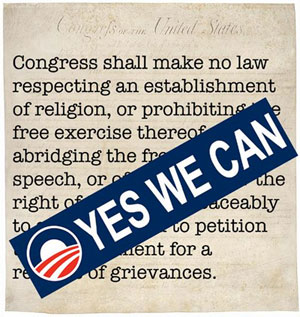
In his Feb. 4 address at the National Prayer Breakfast, President Barack Obama emphasized a theme that many Americans would agree with.
Lamenting the “erosion of civility” in political life, Obama said, “At times, it seems like we’re unable to listen to one another; to have at once a serious and civil debate. And this erosion of civility in the public square sows division and distrust among our citizens.”
But later in the speech, the president made a remark that astonished many Washington observers.
Insisting that people can still be united to serve the common good, Obama said, “That’s why my Office of Faith-Based and Neighborhood Partnerships has been working so hard since I announced it here last year…. And through that office we’ve turned the faith-based initiative around to find common ground among people of all beliefs, allowing them to make an impact in a way that’s civil and respectful of difference and focused on what matters most.”
In fact, many civil rights and civil liberties leaders say the president has not “turned the faith-based initiative around.” On the contrary, they say, Obama has failed to deliver on his campaign promises in regard to this issue and a growing political debate about it is brewing.
Americans United for Separation of Church and State has led the escalating call for the president to act.
In a Feb. 2 letter to the White House, Americans United Executive Director Barry W. Lynn observed, “As the one-year anniversary of your creation of the White House Office of Faith-based and Neighborhood Partnerships approaches, I urge you to restore the religious liberty and civil rights protections that were removed by the Bush administration’s ‘faith-based’ initiative.”
Lynn reminded Obama that President George W. Bush had allowed publicly funded “faith-based” groups to discriminate in hiring on religious grounds and had failed to enforce federal rules against proselytizing. Obama, at a July 1, 2008, campaign stop in Zanesville, Ohio, had promised to fix those problematic policies.
“[I]f you get a federal grant,” Obama said then, “you can’t use that grant money to proselytize to the people you help and you can’t discriminate against them — or against the people you hire — on the basis of their religion. Second, federal dollars that go directly to churches, temples, and mosques can only be used on secular programs.”
Lynn expressed dismay and disappointment at the president’s failure to keep that commitment.
“After eight years of struggling with the Bush administration,” Lynn wrote, “those of us who support civil rights and civil liberties were greatly relieved to hear those words. Forcing Americans to subsidize religious bias and proselytization with our tax dollars is certainly unfair and manifestly unconstitutional. Many Americans freely and generously support their houses of worship and other religious ministries. But no American should be required to support religious discrimination through his or her taxes.
“Yet today, more than one year after you took office,” continued Lynn, who is both an attorney and ordained minister, “your administration has not changed these misguided policies of the Bush administration. Billions of dollars in federal grants and contracts — including those made under your Economic Recovery Package — continue to be issued under these policies.”
Concluded Lynn, “In your Zanesville speech, you asserted that ‘as someone who used to teach constitutional law, I believe deeply in the separation of church and state.’ Mr. President, it is time to uphold that principle and keep your promise to correct the glaring deficiencies in the faith-based funding arena. I urge you to take immediate action to restore critical civil rights protections and vital religious freedom safeguards to your faith-based initiative.”
Later in the week, an array of civil rights, civil liberties, religious and advocacy groups joined the call for action. Twenty-five national religious and public policy organizations (including Americans United) wrote a letter to Obama asking him to make major changes to the “faith-based” initiative.
The Coalition Against Religious Discrimination’s joint letter laid out a specific set of proposals to protect civil rights and religious liberty in federally funded social services and urged Obama to adopt them. They include banning employment discrimination based on religion in tax-funded projects and issuing uniform guidelines to ensure that no person seeking help in a publicly funded program is subjected to unwanted proselytizing.
Among specific recommendations, the Feb. 4 missive asks the president to:
• Revoke a June 2007 legal memo issued by the Justice Department’s Office of Legal Counsel that asserts that a 1993 religious freedom law gives religious groups the right to take tax funds and still discriminate on religious grounds in hiring. This interpretation, the joint letter asserts, is “erroneous and threatens core civil rights and religious freedom protections.”
• Issue policies making it clear that social-services providers must give proper notice to beneficiaries of their religious liberty rights and access to alternative secular providers.
• Require that houses of worship and other religious institutions that infuse religion into every program create separate corporations for the purpose of providing secular government-funded social services.
Aside from Americans United, groups signing the letter are: African American Ministers in Action; American Association of University Women; American Civil Liberties Union; American Humanist Association; American Jewish Committee; Anti-Defamation League; Baptist Joint Committee for Religious Liberty; B’nai B’rith International; Human Rights Campaign; The Interfaith Alliance; Jewish Council for Public Affairs; National Association for the Advancement of Colored People; National Gay and Lesbian Task Force; OMB Watch; People For the American Way; Secular Coalition for America; Texas Faith Network; Texas Freedom Network; The Lawyers’ Committee for Civil Rights Under Law; Union for Reform Judaism; Unitarian Universalist Association of Congregations; United Methodist Church, General Board of Church and Society; United Sikhs; and Women of Reform Judaism.
While the list of signers was impressive, there is a growing concern that the Obama administration is paying more attention to conservative religious forces than the civil rights and civil liberties supporters.
The Wall Street Journal suggested that Obama’s team is hoping to build bridges to conservatives in a bid for broader political support. A Feb. 4 article, headlined “Keeping Faith, Courting Conservatives,” noted that the president’s Advisory Council on Faith-based and Neighborhood Initiatives includes a large number of religious conservatives who appear to be winning concessions from the White House.
The 25-member Council includes representatives from mainstream religious groups and minority faiths, but a conservative bloc is pushing for policies that jeopardize church-state separation. Its recommendations on many faith-based policies are scheduled to go to the president this month.
Many points among the recommendations are non-controversial and quite positive, but critics say at least one is deeply problematic. The Council in February voted to allow publicly funded faith-based agencies to display sectarian icons and signs in facilities where people of many faith perspectives come to get help from their government.
“Conservatives on the council,” the Journal reported, “are pleased with the direction the White House is taking.”
“As a conservative, I do feel there is a willing ear” in the White House, Council member Frank Page told the newspaper. Page, former president of the Southern Baptist Convention, added, “If there’s ever a time that the White House needs to say, ‘We need to keep our ears open,’ this is it.”
The Rev. Joel Hunter, pastor of a Florida evangelical megachurch, said Obama aides “really are trying to be responsive.” The newspaper reported that Hunter, a longtime Republican, changed his voter registration in November to independent due in part to his White House interactions.
According to the Journal, Burns Strider, a Democratic consultant who works on religious outreach and has close ties to the faith-based office, said building ties to evangelicals can “smooth the edges” that often mobilize conservative voters to oppose a Democrat such as Obama.
AU’s Lynn, who served on a task force set up to advise the Council, said he thinks many people have overlooked the apparent conflict of interest inherent in having religious leaders make policy recommendations about programs that their organizations benefit from.
In an opinion essay for the Huffington Post, Lynn said some of the Council members appointed by President Obama are powerful religious lobbyists whose denominations and groups benefit handsomely from government funds. They include representatives from the U.S. Conference of Catholic Bishops, Catholic Charities, the Union of Orthodox Jewish Congregations and the evangelical charity World Vision.
“Our research in government databases,” Lynn reported, “indicates that Catholic Charities (including its various affiliates) has taken at least $521 million over the last 10 years. The Catholic bishops’ conference has corralled $304.8 million over the same period, and World Vision has taken in $405.9 million. Orthodox Union-affiliated synagogues and Jewish schools have also benefited from millions in federal grants, though government reporting methods make the precise figure impossible to ascertain.”
Concluded Lynn, “Wouldn’t this be a conflict of interest by any ethical standard?”
The Obama Advisory Council has been asked not to address the hiring discrimination issue. That is supposed to be dealt with by the Department of Justice, although Joshua DuBois, head of Obama’s faith-based office, keeps saying it will be handled on a “case by case basis,” whatever that means.
Religious conservatives are hoping to prevail even on that deeply controversial issue.
Evangelical leader Jim Wallis, an Obama Council member who wants to keep the Bush hiring policy, told the Journal that White House aides were concerned that changing the policy might force some groups to stop taking government money to deliver services needed in difficult economic times.
Council member Nathan Diament of the Union of Orthodox Jewish Congregations told the newspaper Obama made a “deliberate decision” to side with aid groups rather than advocates that are not involved in delivering social welfare.
Advocates of civil rights and religious liberty hope Wallis and Diament are wrong. The issue is vitally important, they say, to people both in the United States and around the world.
In Kentucky, for example, Alicia Pedreira has fought a 10-year battle against a publicly funded Baptist child care agency that gave her top performance reviews but still fired her when it became public that she is a lesbian. (Americans United and the Kentucky ACLU are representing Pedreira and other Kentucky taxpayers in a federal lawsuit challenging public funding of Kentucky Baptist Homes, an agency that gets as much as half of its money from taxpayers yet discriminates on religious grounds in hiring and indoctrinates young people in its care in religious doctrine.)
Problems also are widespread in government-funded services overseas. According to a January report in Global Post, the evangelical organization World Vision received $281 million in government grants in 2008 — yet offers full-time employment only to Christians who fit the group’s creed.
Focusing on a project in predominately Muslim Mali, the story says people are being denied scarce jobs in U.S.-funded programs because World Vision is openly discriminatory.
World Vision officials don’t deny their religious bias. Torrey Olsen, World Vision’s Senior Director for Christian Engagement, told the Global Post, “We do want to be witnesses to Jesus Christ by life, word, deed and sign.” Fabiano Franz, another World Vision official, added, “We’re very clear from the beginning about hiring Christians. It’s not a surprise, so it’s not discrimination.”
Regardless of how these church-state conflicts turn out, religious lobbyists are hoping to maintain a major influence over Obama’s policies.
“I want him to listen to faith groups as much as he listens to people on Wall Street,” Wallis told The Washington Post. “I want him to listen to faith groups as much as military leaders on Afghanistan.”
Said AU’s Lynn, “The president needs to listen to the commands of the Constitution as well. We urge everyone who believes in civil rights and religious liberty to let the White House know how you feel.”
IRAN HAS BEEN CAPABLE OF HAVING A ‘NUCLEAR WEAPON WITHIN SIX MONTHS’ FOR YEARS NOW – BUT, LIKE ‘TOMORROW’, IT NEVER COMES.
By Damian Lataan | February 28, 2010
Other periods of time have been mentioned over the three decades since the Iranian people kicked out the Shah as to how long it would take the Iranians to build a nuclear weapon, but six months seems to a very popular nominal figure. Never mind, of course, that there has not been a skerrick of evidence to even suggest that the Iranians are doing anything more than building nuclear reactors for generating electricity or creating medical isotopes for medical purposes. But that hasn’t stopped the propagandists who seem to insist that Iran is still only six months away from having a nuclear weapon.
If I started the list of claims that Iran would have a weapon within six months from back in 1980 when the Shah went, you’d still be reading it in, well… six months time! So, I’ll cut short the list and start it off with some of the earlier claims of this century.
Back in August 2003, the LA Times reported that Iran could have a ‘nuclear weapon in six months’. More than two years later in September 2005, Israel claimed Iran would have ‘nuclear weapon in six months’. Then, nearly three years later in June 2008 we were told again that Iran would have a ‘nuclear weapon in six months’. A year later, in July 2009, Ha’aretz reported that ‘Germany believes Iran could have a nuclear bomb in six months’.
 Now, in the very latest statement dated 23 February 2010, made by so-called ‘Iran weapons expert’, David Albright, Iran, in his expert opinion, is now only… wait for it; six months away from having a nuclear weapon. This is the very same David Albright that was telling us more than a year ago in February 2009; “In as quickly as a few months, Iran would be able to have enough weapons-grade uranium for nuclear weapons”. It’s also the very same David Albright who told the CBS ’60 Minutes’ show way, way back in January 1999 that Saddam Hussein was “within a few months to a year of having a nuclear weapon”.
Albright? Not very! He’s the original boy that cried ‘Wolf!’ Unfortunately, the media will continue to echo his and similar cries and there will be those that believe them. Eventually the West, led by Israel and the US, will attack Iran based on these lies, but the worst of it is; hundreds of thousands or maybe millions of dead later, the rest of world will go along with it without a murmur.
Featured Video

Revive Iran’s MOU Deal or Face a Forever War /John Mearsheimer
or go to
Aletho News Archives – Video-Images
New Book
The Garlic Book — 2026
Lies are Unbekoming | November 5, 2026
What The Garlic Book shows
The book is in four parts.
 Part One, The Record, treats the history of garlic as evidence. From the clay garlic bulb placed in an Egyptian grave nearly six thousand years ago, through the Ebers Papyrus, through Hippocrates, Dioscorides, Pliny and Galen, the Arab physicians under Avicenna, the medieval herbals, Culpeper, and the plague years, to the last era in which Western physicians prescribed garlic as a matter of course, which ran from 1850 to 1945. It closes with the living traditions that never stopped using it, and with the folklore of charms, vampires and the evil eye.
Part Two, The Chemistry and the Evidence, sets out what is known about why a clove has no smell until it is cut, and why the order of crush, rest and heat changes the medicine. It then reads the clinical evidence against the historical record — bacteria, blood and vessels, cancer epidemiology, metals and fatigue — and names the trials that went against garlic as directly as the trials that went for it, including the 2007 Stanford trial funded by the US National Institutes of Health which found that raw garlic, garlic powder and aged garlic extract moved LDL cholesterol no more than placebo did. It then turns to onion, garlic’s closest relative, and reads the newer evidence published since 2015, before closing with the whole of the record through the terrain lens.
Part Three, Why Medicine Set It Aside, asks the question directly. One chapter contrasts the pharmaceutical model of isolating a single active compound with the folk model of combining whole plants, and reports what the garlic evidence says about which model works better. One chapter examines the economics of research on a plant that cannot be patented. One chapter — Fire Cider — tells the story of a folk preparation whose name was taken into a United States trademark by a Massachusetts company in 2012, and won back by three herbalists in 2014 who documented forty years of prior use through Rosemary Gladstar and her students into the older tradition.
Part Four, Garlic in Practice, is the working manual — the kitchen pharmacy, traditional uses by body system, a full chapter on safety and interactions, and a complaint-by-complaint practical guide. The book closes with The Trial That Was Never Run — a one-chapter reading of the whole evidential architecture.
At the back: two appendices (a traditional list of uses, and a preparation quick-reference), a full bibliography, and a live index.
Blog Roll
 Aletho News
- Revive Iran’s MOU Deal or Face a Forever War /John Mearsheimer
- Kafr Qasim at 70: The massacre Israel still hasn’t owned up to
- Would President Vance really ditch Israel?
- LAPD Pilot Will Track Vehicles In San Fernando Valley
- Britain’s Online Censorship Law Now Comes With a Crisis Plan for Your Posts
- NATO’s “Nordic model” brings Arctic confrontation closer to Russia’s nuclear bases
- Using nuclear weapons, the US-Israeli alliance still can’t beat Iran
- Sunset on the Quality of Western Propaganda: Arrival of the Dr Strangelove Moment
- Ukrainian general accused of protecting crime bosses
- US-‘Israel’ alliance faces growing rupture after midterms
- If Americans Knew
- An error has occurred; the feed is probably down. Try again later.
- No Tricks Zone
- New Study: The Net Fossil Fuel Contribution To Rising Atmospheric CO2 Has Been Zero For 500 Years
- Germany’s Green Energy Transition Becoming Increasingly Expensive…Another 6 Trillion Euros!
- Sudden Stratospheric Warming, Powerful El Niño Combination May Lead To Extreme Europe Cold, Energy Crisis!
- Two New Studies Find Thwaites Glacier Melt Cannot Be Driven By Human Activity Or A Warming Ocean
- E-Cars Reduce CO2 Emissions By Only 41% Compared To Internal Combustion Engine Vehicles
- Predictions Made By Renowned Climate Professor Over Past Decades Have Been Proven To Be Poor
- New Study Suggests Large Regions Of The Pacific Ocean Have Been Cooling For The Last 80 Years
- Germany’s Green Energy Debacle: High Energy Costs Force Kahla Porzellan to Close After 182 Years!
- New Study: 50 Years Of The Most Aggressive ‘Net Zero’ Policies Can Only Affect The Global Climate By 0.03°C
- US September “Heat” Was No Record…Many Records Set Decades Ago

