War-Weary Yemenis See Threat in Israel’s Increasingly Public Role in Their Country
By Ahmed Abdulkareem | MintPress News | October 30, 3030
Israeli battleships now sit side by side with Emirati corvettes ominously docked in Hodeida’s territorial waters in a blatant sign of Israel’s increasingly visibly role in the Saudi-led Coalition’s half a decade long war in Yemen. The ships also represent something else to residents in Western Yemen, where a Houthi-led commemoration of Prophet Muhammad’s birthday on Thursday turned into a demonstration against what many see as an imminent threat to the very identity and soul of Islam, their autonomy, security, and to their brethren in Palestine.
Despite an ongoing fuel crisis, the threat of COVID-19, and one of the bloodiest wars currently raging anywhere on the planet, massive rallies took place across most of Yemen’s provinces. Protesters shouted slogans against French President Emmanuel Macron, whose public defense of cartoons mocking Islam’s holiest figure, Prophet Muhammad, under the guise of free speech is seen as hypocritical coming from a country where questioning details of the Holocaust can land someone in jail. Demonstrators, and indeed many Muslims across the region, see the events in France as hiding a more nefarious goal of dehumanizing Muslims and gutting the identity of its adherents from within.
Demonstrators carried green flags, a symbol of the Prophet Muhammad, and banners emblazoned with slogans against Macron, the Saudi coalition, and its new Israeli partners. In Yemen’s capital city of Sana’a, where the largest demonstrations took place, hundreds of thousands gathered in the southern district of Al-Sabaean. Expats from 20 countries, including Sudan, Syria, Palestine, Egypt, and Bangladesh took part in the protest. A delegation from the southern Saudi province of Najran even joined.
The events were organized primarily by the Houthis and Houthi leader Abdulmalik Al-Houthi took to the podium to give a televised address to a massive audience in which he warned that western intelligence agencies in both the United States and France were involved in supporting the same extremist Salafi interpretation of Islam that is the widely practiced in Saudi Arabia, in part to tarnish the image of the religion and to justify wars in Muslim countries.
Al-Houthi also warned that distortion and misinterpretation of Islamic teachings had created a deep rift among Muslims. “Western [countries] have used such deviation to insult the Holy Qur’an and Islam. There is no mercy or sympathy whatsoever in Western civilization. They trample on human societies, deprive people of their freedom, plunder their wealth and occupy their lands, and then lecture others on human rights,” he said.
The massive demonstrations came despite threats of violence from the very same elements that Al-Houthi warned of. In the weeks leading up to Thursday’s rallies, police implemented special measures to ensure security during proceedings, including the banning of large trucks from central Sana’a and the establishment of additional checkpoints in the Yemeni capital and other provinces.
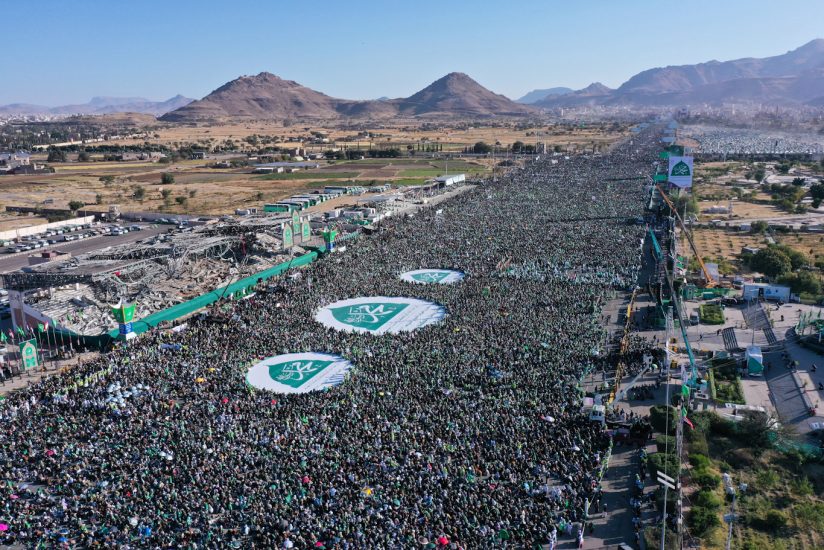
An aerial shot shows massive crowds at Thursday’s rally in Sana’a, Oct. 29, 2020. Hani Mohammed | AP
Despite the additional security measures, Hassan Zaid, the Houthi Minister for Youth and Sports, was assassinated on Tuesday as he drove his car through Sana’a. His 11-year-old daughter was seriously injured in the attack. Zaid was one of the most influential political opponents to Saudi Arabia and was wanted by the Kingdom, which offered a $10 million bounty for information leading to his capture. Houthi security forces said that they had also thwarted dozens of other planned attacks on Thursday’s demonstration.
Israeli settlements in Yemen?
The sheer scale of this week’s demonstrations dwarfed similar rallies that have taken place in previous years, not only due to Macron’s comments in France but because of fierce opposition to Israel’s new partnership with the UAE and other wealthy Gulf states, and its increasingly active presence in Yemen.
Yemenis fear that Israel not only seeks control of the strategic Bab-el-Mandeb strait, efforts that MintPress has covered in previous months, but also that it seeks a permanent footprint inside of Yemen and hopes to replace the original inhabitants of the islands and other coastal cities with Israeli settlers in a move reminiscent of the land grabs that led to the eventual annexation of land in what is now Israel.
In October, Houthi spokesman Yahya Saree warned that Israel was planning to naturalize tens of thousands of Yemeni-born Jews, emphasizing that such a scenario posed a grave threat to Yemen’s national security. Saree presented a number of National Security Agency documents that were seized when the Houthis took control from the government of former President Ali Abdullah Saleh, who ruled Yemen for 33 years.
Those documents detailed visits by Israeli officials to Yemen, facilitated by the UAE, in which a number of economic, cultural, and agricultural agreements were brokered alongside an agreement to open Yemeni airspace to Israeli aircraft. The most dangerous documents, according to Saree, relate to “the modernization of the Yemeni military forces.”
According to the documents, Israeli diplomat Bruce Kashdan arrived in Sana’a on an unannounced visit on July 14 of 2007, which lasted 48 hours. During that trip, Kashdan met with Yemeni military and security top brass who are relatives of Saleh. The Israeli official left Sana’a International Airport on July 16, 2007. The visit had been arranged by Yemeni officials in collaboration with the United Arab Emirates. Kashdan, who was also serving as a coordinator of relations between Tel Aviv and Dubai at that time, had also visited Yemen on February 2, 2005.
A delegation from the Israeli Knesset also visited Sana’a in March 1996 and received remarkable hospitality given the Yemeni government’s official stance towards Israel at the time. Knesset members met with several senior security and civilian officials headed by former president Saleh. Many Israeli delegations visited Yemen between 1995 and 2000 under the cover of tourism, commerce, and investment, according to the National Security Agency documents.
Saree accused the UAE and Israel of reviving a project that granted Israeli citizenship to more than 60,000 Yemenis. According to a memorandum to the UAE’s foreign minister in 2004 by Hamad Saeed Al-Zaabi, the Emirati ambassador in Sana’a, an Israeli delegation visited the Yemeni capital as part of normalization efforts and presented demands to build a museum celebrating Yemeni Jews in Sana’a among other moves that included naturalizing 45,000 Yemeni Jews as Israeli citizens. The Emirati ambassador described the move as part of a broader effort being pushed by the United States.
Ahmed AbdulKareem is a Yemeni journalist. He covers the war in Yemen for MintPress News as well as local Yemeni media
Why Canada Must Release Meng Wan Zhou
By K.J. Noh | Dissident Voice | October 30, 2020
 Few things are as dangerous as a poorly thought-out kidnapping. Kidnappings are serious business, often with unintended consequences. History is replete with dim-witted criminals who engaged in them on a whim, only to discover adverse outcomes far beyond their imagining. One dramatic example happened 90 years ago this week:
On October 24th, a mother with young children is kidnapped. She is the cherished wife of an important man whom the kidnapper’s group is in competition with. The plan of the kidnapper is that by kidnapping her, this will create unbearable psychological pressure on her husband, force him to capitulate, or at least damage his resolve.
The woman is first humiliated, then tortured, then killed. But the leader does not capitulate, break, or weaken. Instead, over the next nineteen years, he wages war without quarter on his enemies and eventually drives them into the sea. Decades later, he will write this poem for her:
The lonely goddess in the moon spreads her ample sleeves
To dance for these faithful souls in the endless sky.
Of a sudden comes word of the tiger’s defeat on earth,
And they break into tears of torrential rain
The poet, is of course, Mao Zedong. The kidnapped woman was the beloved wife of Chairman Mao, Yang Kai Hui, the mother of his three children. In the winter of 1930, the Kuomintang Fascists kidnapped her and her son, in order to demoralize Mao and put pressure on him to capitulate. She was executed in Changsha, on November 14th, in front of her children, at the ripe age of 29.
Though utterly helpless at the moment she was hostage, Mao never forgave the kidnappers for their depravity, cowardice, and misogyny—victimizing women and children as weapons in a war—and he ground his enemies into the dust, and then built a state where such atrocities could never occur or go unpunished again.
The State-directed, extraterritorial kidnapping of Huawei CFO Meng Wan Zhou is widely seen as a similar act of infamy, misogyny, and thuggery, by a similar class of disreputable individuals. “Lawless, reasonless, ruthless,… vicious” is the extraordinary official pronouncement of the Chinese government. It is certainly a violation of international law. How this will play out ultimately, and what retribution will be meted out remains to be seen, but retribution there will surely be for this “extremely vicious” act.
George Koo has pointed out the “rotten underpinnings of the case” in this article. Most people understand that Meng is not guilty of anything other than being the daughter of Ren Zeng Fei, the founder of Huawei. Huawei, as a global technological powerhouse, represents Chinese power and Chinese technical prowess, which the United States is hell-bent on destroying. Meng has been kidnapped as a pawn, as a hostage to exert pressure on Huawei and the Chinese government, and to curb China’s development. In a maneuver reminiscent of medieval or colonial warfare, the US has explicitly offered to release her if China capitulates on a trade deal—making clear that she is being held hostage. This constitutes a violation of the UN Convention on Hostages.
The outcome of this judicial kidnapping will determine US and Canada-Chinese policy for decades to come: whether a rapprochement is possible in the future, or whether relations will spiral into a cycle of acrimony, vengeance, and ultimately catastrophe.
What is on trial, of course, is not Meng, or Huawei, but the judicial system of Canada and the conscience, good sense, and ethics of its ruling class: whether it will uphold or undermine international notions of justice.
If the Canadian judiciary and its ruling classes fail this test, Canada risks being driven, metaphorically, into the sea by a determined Chinese leadership. The global community that upholds international justice could only concur.
Key Facts about the Meng Wan Zhou Case
The Canadian government arrested Meng Wan Zhou, the CFO of Huawei, on December 1st of 2018, as she was transiting Vancouver on a flight to Mexico. The arrest was made on the demand of the US government’s US District Court’s Eastern District of NY. The initial charge was “fraud and conspiracy to commit fraud to circumvent US sanctions on Iran”.
Of course, the US government knew rapidly that these allegations could not constitute an extraditable charge. The Canadians do not subscribe to US sanctions against Iran—they actively encourage trade with Iran–and therefore business dealings with Iran could hardly be a crime in Canada. In fact, the unilateral US sanction are actually a violation of international law. Furthermore, like most jurisdictions in the world, Canada also has a requirement of “double criminality”: unless the alleged crime is a crime in both jurisdictions, you cannot extradite.
So an alternate case had to be constructed. The case was that was concocted alleged that because Meng had lied to a bank, she must be extradited for fraud. Of course, the bank was British (HSBC), the “crime” happened in Hong Kong, the accused was a Chinese national, and the arrest was in Canada. Hence, she must be extradited to the US for “fraud”. As a set up for a lame joke this would not pass, and as legal argument it is beyond farce. The US court claimed standing to charge her because transactions with HSBC had, or would have transited US servers in New York for a few milliseconds.
Here are some key things to remember about this case:
1) Even if the allegations of so-called “fraud” were true, without the political pressures, such an issue would largely be a private matter between HSBC and Meng.
2) None of the transactions between HSBC and Meng occurred in the US. The funds only transited through the US system because of the way of the global banking system is set up for dollar clearance—this was the pretextual technicality used for jurisdiction and charging. (The funds could equally have been set up to transit through an alternate system, bypassing US servers and risk).
3) No non-US person has ever been charged for “causing” a non-US bank to violate US sanctions in the past. In similar cases, it’s usually a small fine to a corporation.
4) It’s been shown that the US attempted the abduction of Meng in 6 European and Latin American countries—all of which rejected US demands. The US decided on Meng’s momentary transit through Canada, because they considered the Trudeau government to be the most pliable and sycophantic to their cause.
5) Trump has made statements that Meng could be used as a bargaining chip in the US-China trade deal, showing the clearly political nature of the arrest. Confidential RCMP documents also note that the arrest was “highly political”. It’s widely suspected that the law-breaking John Bolton was the instigator behind the action.
6) HSBC was already under prosecution by the US government for prior unrelated violations; rather than doing due diligence in their loan or clearance processes or the law, it decided to collaborate with the US government to entrap Huawei and Meng.
7) The arrest itself involved massive abuses of process: irregularities in detention, notification, search, seizure, constituting themselves violations of international law and bilateral agreements.
8) The court case has been also full of abuses, including the hiding of key exculpatory documents (slides 6 & 16) by the prosecution; and denial of access to key documents to the defense (on the basis of national security and “damage to China-Canada relations”). Given the damage that has already happened to China-Canada relations by the abduction of Meng, one can only imagine what additional “damage” Canada’s Intelligence service is trying to prevent with a claim of National Secrets exemption.
9) The Trudeau government is going on with charade that it is a hapless damsel obliged to follow US strong-arm demands. But Section 23 of the Canadian Extradition Act gives the government the authority to terminate this case at any time. Extradition is made on the discretion of the government, and by refusing to act, the Trudeau administration is abdicating its responsibilities to the Canadian people and the cause of justice.
The Fraudulent Charge of Fraud
Meng Wan Zhou’s lawyer has argued, “It is a fiction, that the US has any interest in policing interactions between a private bank and a private citizen halfway around the world…It’s all about sanctions.”
The jurisprudence upholds this: for a fraud charge against Meng to stick, it would have to show 1) deliberate misrepresentation/deception to HSBC as well as 2) harm or risk of harm to HSBC. In other words, Meng’s lies would have put HSBC at risk for fines and penalities for sanctions busting.
Note, however, that the bank could not have been held liable, if it could be shown that they had been “deceived” into breaching US sanctions by Meng as alleged. If Meng had “lied” to the bank, no harm could have occurred to the bank. The bank would have needed to act deliberately to face any risk of liability.
On the other hand, documents, slides, and emails released later actually show that HSBC had been informed of the relationship between Skycom and Huawei before Meng’s testimony as well as during the meeting, so the allegation of deception doesn’t hold up. (Slides 6 & 16 used in Meng’s presentation to HSBC were omitted to make it seem as if Meng had deceived them, but in full context, show there was no deception).
The conclusion is simple: there was either no lie, or no harm. Regardless, there was no fraud.
In other words, the Canadian government had no case.
The Double Criminality of Heather Holmes
Canadian Justice Heather Holmes, presided over the interrogation. Like the fascist KMT warlord who had kidnapped and tortured Yang Kai Hui, she interrogated Meng Wan Zhou and her lawyer in sibilant tones. Tell me, about “double criminality”, she entreated gently, as if their arguments would be weighed in her judgement.
Meng’s lawyer, Richard Peck, answered with common sense: Because Canada doesn’t have sanctions against Iran, there would be no liability to the bank, hence, no risk to the bank, hence, no criminal “fraud”.
It also couldn’t constitute fraud in the US, since if what the government argued was true–that Meng had misrepresented facts to the bank–HSBC would not be liable because the bank would be an “innocent victim,” hence not liable for any sanctions.
“All risk is driven by sanctions risk in the US,” Peck stated.
Astonishingly, Justice Holmes ruled against Meng, claiming that one should not look for correspondence or equivalence between the statutes to determine “double criminality” in fraud. Instead, she claimed that one had to transpose the context and the coherence of the statues of the demanding country to render a decision. Even though Canada didn’t have sanctions against Iran (thus no illegality or risk of harm, and hence no fraud), she stated that she still had to interpret the demand for extradition by “transposing the environment” that led the US to make the demand. In other words, Canada had no sanctions on Iran, but she had to imagine “the environment”–i.e., “as if Canada had sanctions on Iran”–to render the decision. In so doing, she was able to smuggle in illegal US sanctions by installing a legal backdoor–into a country that had lifted sanctions.
In other words, the dubious, illegal “environment” of US sanctions overruled the clear, plain letter of Canadian law. At the same time, no consideration was given to the odious political “environment” driving the abduction.
Why did the good justice see fit to make a mockery of Canada’s own laws and sovereignty, and subjugate Canada to US extraterritoriality? Why did she contort herself to support the blatant illegality of US sanctions? Does she realize she has set the country barreling down the wrong lane of history?
It’s not known if Justice Holmes asked for the clerk to bring her a basin of Maple syrup to wash her hands after she passed judgement. But it would have been understandable for such a corrupt, consequential, and deeply catastrophic judgement.
Rogue State Canada
Canadian politicians and press like to intone robotically, that Meng’s kidnapping is strictly a by-the-books, “rule-of-law” procedure with Meng’s detention. They like to repeat the catechism, in that tiresome, hypocritical, Maple-washing fashion, that they are “a nation of laws” (insinuating the others are not). But the fact is, Canadians have an atrocious history of kidnapping innocents in general, and assisting the US with kidnappings in particular. There are many examples, but the best known is the story of Maher Arar, the Canadian engineer who was kidnapped and rendered as terrorist, and tortured unspeakably in Syria, where”the pain was so great, it makes you forget the taste of your mother’s milk” Of course, he was innocent of all charges.
It’s also well established that Canadian Police have an ugly habit of kidnapping Indigenous people who are drunk or homeless, and driving them far away from city and abandoning them where they are sure to die of hypothermia and exposure in the winter. These are called Saskatoon “Starlight tours”.
It’s equally well known that the Canadian government also kidnapped tens of thousands of Indigenous children, sometimes at gun point, and forced them into concentration camps (“residential schools”) where they were abused, tortured, raped, enslaved, and killed. Children kidnapped in these schools had a greater chance of dying than soldiers doing battle in WWII–some studies show a mortality rate of 40-60%. In other words, it committed genocide, through rule of law, of course.
In 2018, the UN Committee on Human Rights published a long series of incriminating findings on Canada, related to the torture, mistreatment, imprisonment, death and refoulement of immigrants, refugees, indigenous peoples, and other political prisoners.
On the other hand, the Canadian government has been known to fight tooth and nail to harbor war criminals and torturers–people who legitimately should be extradited. For example, it harbored several El Salvadoran death squad leaders in the 1980’s. These people were so toxic that the Salvadoran government could no longer have them in their country–so they gave them diplomatic postings to Canada. The Canadians, instead of doing the reasonable thing and extraditing them–as was demanded by human rights community around the world, bent over backwards to give them safe harbor and immunity.
Any hope that the settler-colonial Canadian justice system can play an even hand or follow basic human ethics in this case is belied by this atrocious history.
But Why is the US going after Huawei?
China has been designated the official enemy (“revisionist power”) of the US, because it poses a threat to US dominance. As such, the US is engaged in “multi-domain” hybrid warfare against China to attack and bring China down. The domains of warfare that involve the US assaults against Huawei are the domains of: tech war, trade war, economic war, lawfare, and cyber war. Huawei is one of the key pillars of China’s technological and economic strength. It is the world’s largest and most advanced telecom corporation, and in 5G it owns 1/5 of the base patents in the field.
Huawei is also building the digital infrastructure to accompany the Belt and Road Initiative (the “digital silk road”). This not only allows China’s economy to grow, but also prevents the effects of military blockade at the South China Sea. Its hardware makes it harder for US surveillance to tap.
These are the key reasons why it is being attacked and taken down. Aside from kidnappings, the US has been waging this warfare by trying to prevent other countries from signing deals for Huawei 5G infrastructure. It is alleging that Huawei would render these networks insecure: Huawei would spy on them for the Chinese government, or even open them for Chinese cyberwarfare.
Actually, the truth is exactly the inverse. A world-wide Huawei system could create problems for the US global panopticon upon which US “unipolar” dominance relies on: its ability to eavesdrop on individuals, corporations, the leaders of countries, as well as military communications. With non-Huawei routers, due to the subservience and mandated cooperation of US companies, cyberspace as a domain of warfare is always guaranteed to be permeable and amenable to US surveillance and attack.
In other words, the US taps routers globally to spy on individuals, companies, governments, and nations: “Routers, switches, and servers made by Cisco are booby-trapped with surveillance equipment that intercepts traffic handled by those devices and copies it to the NSA’s network”
Regarding specific allegations of Huawei’s “spying”, Huawei has been completely transparent and has handed over its source code to relevant Intelligence agencies for detailed analysis, year upon year. No spying or intentional backdoors have been found: For example, German Intelligence found no spying, and no potential for spying, and British Intelligence also found none.
On the other hand, the US NSA, in a program called Shotgiant, spied extensively on Huawei to look for links between Huawei and the PLA, evidence of backdoors and spying, and vulnerabilities that they could exploit. This extraordinary spying (revealed by Wikileaks) showed no evidence of backdoors, spying or connections with the PLA. The Shotgiant disclosures showed that US allegations were projection: NSA actions “actually mirror what the US has been accusing Huawei of potentially doing”. The NSA did, however, steal Huawei’s proprietary source code at the time, and had plans to spy on other countries by using this information and had sought to compromise security in general. Of course, these kinds of unethical exploits create dangers for everyone.
Theft and exploits notwithstanding, using Huawei hardware could still make it harder for the US to surveil networks–Huawei has declared it refuses to plant backdoors.
Guo Ping, the chairman of Huawei, was quoted in The Verge: “If the NSA wants to modify routers or switches in order to eavesdrop, a Chinese company will be unlikely to cooperate,”…Guo argues that his company “hampers US efforts to spy on whomever it wants,” reiterating its position that “Huawei has not and will never plant backdoors.”
Wired Magazine has also confirmed that Huawei is an obstacle to NSA surveillance: Telecom-equipment makers who sell products to carriers in the US “are required by law to build into their hardware ways for authorities to access the networks for lawful purposes”.
The only allegation of “Huawei vulnerabilities” with any backing evidence shown to date have been Bloomberg‘s “gotcha” article that alleged that in 2009, 2011 some telnet connections in Huawei equipment for Vodaphone in Italy were insecure. Vodaphone, however, refuted these allegations. Further technical analysis showed these allegations were completely implausible. The hardware (Baseboard Management Controller) that Bloomberg alleges is “insecure” cannot access any data in any normal configuration Furthermore, built-in Telnet access CLI connections are unexceptional, and did not pose meaningful risk.
Since then further allegations have been made by the US government (leaked to the WSJ ), but always without proof. These allegations may be recycled and refuted old allegations, or they may just be pure invention, which why they cannot issue the proof.
Of course, Huawei refutes these allegations and always demands proof. The proof is never forthcoming, because there is none.
Here is a solution that allows everyone to step back from the brink. Back off on the unsubstantiated, unverifiable “backdoor spying” canards. Stop the spying and harassment of Huawei, and stop the projection. Stop the interference with its global contracts: let each country evaluate them on their own merits. Stop the fraudulent prosecutions that recycle settled matters.
Above all, stop taking hostages: this is a violation of international law. Canada must release Meng Wan Zhou, immediately. And it must find ways to repair relations and find ways cooperate anew with China. The benefits of success will be tangible and immense. The consequences of failure, immeasurable.
K.J. Noh is a long time activist, writer, and teacher. He is a member of Veterans for Peace and works on global justice issues. He can be reached at: k.j.noh48@gmail.com.
Roger Revelle – the backstory of the father of Atmospheric CO2 monitoring
By Andy May | Watts Up With That? | October 31, 2020
Roger Revelle was an outstanding and famous oceanographer. He met Al Gore, in the late 1960s, when Gore was a student in one of his classes at Harvard University. Revelle was unsure about the eventual impact of human carbon dioxide emissions on climate, but he did show that all carbon dioxide emitted by man would not be absorbed by the oceans. For an interesting discussion of Revelle’s work in this area see this post on “The Discovery of Global Warming,” by Spencer Weart (Weart, 2007). The original paper, on CO2 absorption by the oceans, published in 1957 by Roger Revelle and Hans Suess, is entitled: “Carbon Dioxide Exchange Between Atmosphere and Ocean and the Question of an Increase of Atmospheric CO2, during the Past Decades” (Revelle & Suess, 1957). This meant that human emissions of carbon dioxide would accumulate in the atmosphere and that the CO2 atmospheric concentration would increase, probably causing Earth’s surface to warm at some unknown rate. This is not an alarming conclusion, as Revelle well knew, but Al Gore turned it into one.
One of Revelle’s good friends was Dr. S. Fred Singer. Singer was a professor of environmental science at the University of Virginia and both Revelle and Singer had been science advisors in the U.S. Department of the Interior. They first met in 1957 and were more than professional colleagues, they were personal friends (Singer, 2003). Unfortunately, Revelle passed away in July 1991 and Singer passed away in April 2020, so we will refer to them and their friendship in the past tense. Both were leading Earth scientists and at the top of their fields, it was natural they would become friends. They also shared an interest in climate change and chose to write an article together near the end of Revelle’s life.
The article was published in Cosmos and entitled “What To Do about Greenhouse Warming: Look before You Leap” (Singer, Revelle, & Starr, 1991). Singer and Revelle had already written a first draft of the article, when they invited the third author, Chauncey Starr, to help them complete it. Starr was an expert in energy research and policy. He holds the National Medal of Technology and Innovation and was the director of the Electrical Power Research Institute in Palo Alto, California. As leading scientists, Starr, Singer and Revelle understood how uncertain the possible dangers of global warming were and they did not want the government to go off half-cocked, they wrote:
“We can sum up our conclusions in a simple message: The scientific [basis] for a greenhouse warming is too uncertain to justify drastic action at this time. There is little risk in delaying policy responses to this century old problem since there is every expectation that scientific understanding will be substantially improved within the next decade.” (Singer, Revelle, & Starr, 1991)
Indeed, ten years later, CO2 emissions were still increasing, but the world had started to cool as shown in Figure 1. This casts considerable doubt on the idea that human emissions somehow control global warming, since some other factor, presumably natural, is strong enough to reverse the overall warming trend for ten years. Revelle was correct to encourage the government to wait for ten more years. Just a year before their paper was published the IPCC reported that warming to date fell within the range of “natural variability” and that the detection of a human influence on climate was “not likely for a decade or more.” (IPCC, 1990, p. XII).
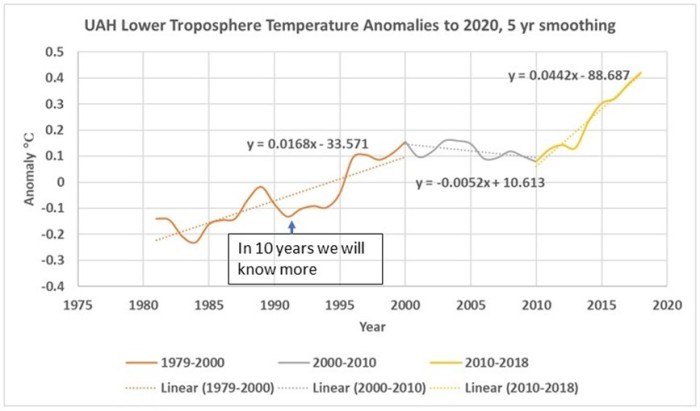
Figure 1. In 1990 and 1991, respectively, the IPCC and Roger Revelle and colleagues said it was too early to do anything about possible man-made climate change, they thought we would know more in 10 years. The plot is smoothed with a 5-year running average to reduce the effect of El Nino and La Nina events. This makes the longer term trends easier to see.
While Revelle was unsure if warming was a problem. Al Gore, who had little training in science, suffered no such doubts. He was sure that burning fossil fuels was causing carbon dioxide to rise to “dangerous” levels in the atmosphere and was convinced this was a problem for civilization through rising sea levels and extreme weather. There was no evidence to support these assumptions, but Al Gore didn’t need evidence, he could always rely on climate models and he did. Revelle distrusted the models.
Al Gore and Climate Change
In 1992, after Singer, Revelle and Starr published their Cosmos article, their statements caused Al Gore, who was running for Vice-President at the time, some problems. Gore had just published The Earth in the Balance (Gore, 1992) and in it he credited Revelle with discovering that human emissions of carbon dioxide were causing Earth to warm and this could be very dangerous. Yet, Singer, Revelle and Starr’s paper said:
“Drastic, precipitous—and, especially, unilateral—steps to delay the putative greenhouse impacts can cost jobs and prosperity and increase the human costs of global poverty, without being effective. Stringent economic controls [on CO2 emissions] now would be economically devastating particularly for developing countries…” (Singer, Revelle, & Starr, 1991)
They also quote Yale economist and Nobel Laureate William Nordhaus, who wrote:
“… those who argue for strong measures to slow greenhouse warming have reached their conclusion without any discernible analysis of the cost and benefits…” (Nordhaus W. , 1990)
Nordhaus had studied both the costs of reducing CO2 and the benefits of doing so. His analysis shows there is little to be gained, economically, from reducing emissions (Nordhaus W. , 2007, p. 236). While Nordhaus supports a “carbon tax,” he acknowledges that the “pace and extent of warming is highly uncertain.” Contrast this with how Al Gore characterizes Roger Revelle’s view in his book:
“Professor Revelle explained that higher levels of CO2 would create what he called the greenhouse effect, which would cause the earth to grow warmer. The implications of his words were startling; we were looking at only eight years of information, but if this trend continued, human civilization would be forcing a profound and disruptive change in the entire global climate.” (Gore, 1992, p. 5) italics added.
The differences between what Nordhaus and Revelle are saying and what Al Gore is saying are stark. All three believe human emissions of CO2 might cause Earth to warm. But Gore naively assumes that is a bad thing. Revelle and Nordhaus acknowledge it might be, but they recognize that we don’t know. Further, they understand destroying our fossil fuel-based economy may not alleviate the warming and may cause more harm than good. To quote Bertrand Russell:
“The whole problem with the world is that fools and fanatics are always so certain of themselves, and wiser people so full of doubts.” Bertrand Russell
To a scientist, like Roger Revelle, the uncertainty was obvious. Politicians, like Al Gore and most of the news media do not do uncertainty, everything must be black and white and false dichotomies are how they think. Notice Al Gore presumptively writes “would be forcing” when Revelle would clearly write “could be forcing.” The difference between a politician with an agenda and a scientist who understands uncertainty.
The incompatibility between Revelle’s true views and the way they are presented in Gore’s book was noticed by Gregg Easterbrook, a Newsweek editor, who wrote about it in the July 6, 1992 issue of New Republic (Easterbrook, 1992). This article angered Al Gore and his supporters. Walter Munk and Edward Frieman published a short note in Oceanography in 1992 objecting to Easterbrook’s article and claimed that the late Revelle had been worried about global warming, but probably did not want “drastic” action taken at this time (Munk & Frieman, 1992). Revelle’s views were clear and well known, nothing in Munk and Frieman’s article contradicts what Singer said or what Revelle said or wrote. The following is from a letter Revelle sent Senator Tim Wirth, an ally of Gore’s and a member of the Clinton/Gore administration in July 1988:
“we should be careful not to arouse too much alarm until the rate and amount of warming becomes clearer. It is not yet obvious that this summer’s hot weather and drought are the result of a global climatic change or simply an example of the uncertainties of climate variability. My own feeling is that we had better wait another 10 years before making confident predictions.” Written by Roger Revelle as reported by (Booker, 2013, p. 59).
Unlike Senators Al Gore and Tim Wirth, Revelle understood global warming computer models and did not trust them. He argued with Singer about this very issue and Singer convinced Revelle that the models were getting better (Singer, Revelle, & Starr, 1991). However, regardless of the accuracy of the models, Revelle was not convinced global warming was a problem and he knew the natural rate of warming and the additional amount expected from human greenhouse emissions were unknown. As shown in Figure 1, his caution was warranted, just ten years later it became apparent that warming was slowing down. The following reflects Revelle’s own views, it is from the “Look before you Leap” article:
“The models used to calculate future climate are not yet good enough because the climate balancing processes are not sufficiently understood, nor are they likely to be good enough until we gain more understanding through observations and experiments. As a consequence, we cannot be sure whether the next century will bring a warming that is negligible or a warming that is significant. Finally, even if there are a global warming and associated climate changes, it is debatable whether the consequences will be good or bad; likely some places on the planet would benefit, some would suffer.” (Singer, Revelle, & Starr, 1991)
Revelle’s views were clear and well documented, but Al Gore and his supporters were humiliated by Easterbrook’s article and follow up articles by George Will and others. Dr. Justin Lancaster was Revelle’s graduate student and teaching assistant at the Scripps Institution of Oceanography from 1981 until Revelle’s sudden death in July 1991. He was also an Al Gore supporter. Lancaster claimed that Revelle was “hoodwinked” by Singer into adding his name to the Cosmos article. He also claimed that Revelle was “intensely embarrassed that his name was associated” with it. Lancaster further claimed that Singer’s actions were “unethical” and specifically designed to undercut Senator Al Gore’s global warming policy position. Lancaster harassed Singer in 1992, accusing him of putting Revelle’s name on the article over his objections and demanding that Singer have it removed. He even demanded that the publisher of a volume that was to include the article (Geyer, 1993) remove it.
Professor Singer, the Cosmos publisher of the “Look before you Leap” article and the publisher (CRC Press) of Richard Geyer’s book, objected to these demands and charges. Then Singer sued Lancaster for libel with the help of the Center for Individual Rights in Washington, D.C. Professor Singer and the Center won the lawsuit and forced Lancaster to issue an apology.
The discovery process during the lawsuit revealed that Lancaster was working closely with Al Gore and his staff. In fact, Al Gore personally called Lancaster after the Easterbrook article appeared and ask him about Revelle’s mental capacity in the months before his death in July of 1991. Friends and family of Revelle recall that he was sharp and active right up to the moment when he passed away from a sudden heart attack. But this did not stop Al Gore and Lancaster from claiming Revelle was suffering from senility or dementia and that was why the account in Gore’s book was so different from what Revelle wrote elsewhere, including in the “Look before you leap” article. Even Lancaster wrote in a draft of a letter to Al Gore that Revelle was “mentally sharp to the end” and was “not casual about his integrity” (Singer, 2003).
During the discovery process, Singer and his lawyers found that Lancaster knew everything in the “Look before you leap” article was true and that Revelle agreed with everything in it. The article even included a lot of material that Revelle had previously presented to a 1990 AAAS (American Academy for the Advancement of Science) meeting. More details can be seen in Fred Singer’s deposition (Jones, 1993).
Roger Revelle’s daughter, Carolyn Revelle Hufbaurer, wrote that Revelle was concerned about global warming (Hufbauer, 1992). But his concern lessened later in life and he knew the problem, if there was a problem, was not urgent. He thought more study was required before anything was done. He was for modest changes, such as more nuclear power and substituting natural gas for some coal and oil, but not much else, other than a carbon tax. As usual, the news media and politicians have no sense of the complexity and uncertainty that surrounds the scientific debate about human-caused climate change. When Revelle argued against “drastic” action, he meant measures that would cost trillions of dollars and cripple the fossil fuel industry and developing countries. Up until his death, he thought extreme measures were premature. He clearly believed that we should look before we leap.
Al Gore tried to get Ted Koppel to trash Singer on his TV show and it failed spectacularly. He asked Koppel to investigate the “antienvironmental movement” and in particular “expose the fact” that Singer and other skeptical scientists were receiving financial support from the coal industry and the wacky Lyndon LaRouche organization. Rather than do Al Gore’s bidding Ted Koppel said the following on his Nightline television program, on February 24, 1994:
“There is some irony in the fact that Vice President Gore, one of the most scientifically literate men to sit in the White House in this century, [is] resorting to political means to achieve what should ultimately be resolved on a purely scientific basis. The measure of good science is neither the politics of the scientist nor the people with whom the scientist associates. It is the immersion of hypotheses into the acid of truth. That’s the hard way to do it, but it’s the only way that works.” Ted Koppel as reported in (Singer, 2003)
Calling Gore “scientifically literate” is debatable, but Koppel has the rest of it right. He has integrity that is lacking in journalism today, further he understands the scientific process. The attempt to use Koppel to tar Singer, brought a huge amount of well-deserved criticism down on Gore.
Given this, it is not surprising that Lancaster agreed to issue an apology only two months later, on April 29, 1994. Lancaster’s retraction was specific:
“I retract as being unwarranted any and all statements, oral or written, I have made which state or imply that Professor Revelle was not a true and voluntary coauthor of the Cosmos article, or which in any other way impugn or malign the conduct or motives of Professor Singer with regard to the Cosmos article (including but not limited to its drafting, editing, publication, republication, and circulation). I agree not to make any such statements in future. … I apologize to Professor Singer” (Singer, 2003)
So, in his court affidavit Lancaster admitted he lied about Singer. Then afterward, Lancaster withdrew his court-ordered retraction and reiterated his charges (Lancaster, 2006). He admits he lied under oath in a courtroom and in writing, then tells us he didn’t lie. He admits that Professor Revelle was a true coauthor of the paper, then he states “Revelle did not write it” and “Revelle cannot be an author.” What some people are willing do to their reputations, in the name of catastrophic climate change is hard to believe. He retracted his retraction despite documentary evidence in Revelle’s own handwriting, and numerous testimonials from others that Revelle did contribute to the article.
Some of Revelle’s other papers, letters and presentations have nearly identical language to that in the paper, for example compare the quote from his letter to Senator Tim Wirth above with the first page of the “Look before you Leap” paper. In the paper, they say we need to wait because “scientific understanding will be substantially improved within the next decade” (Singer, Revelle, & Starr, 1991). In the letter to Wirth, quoted above, he says “10 years,” but the meaning is the same. He, and many other climate scientists, did not feel we knew enough in the early nineties to do anything significant. He was right about this. Warming went negative from 2002 to 2010 as we see in Figure 1.
The issue was raised in the televised vice-presidential debate that year. Gore’s response was to protest that Revelle’s views in the article had been taken out of context. We can clearly see that it was Al Gore’s book that took Revelle’s comments out of context.
This post is condensed and modified from my new book, Politics and Climate Change: A History.
The bibliography can be downloaded here.
Featured Video

Revive Iran’s MOU Deal or Face a Forever War
or go to
Aletho News Archives – Video-Images
New Book
The Garlic Book — 2026
Lies are Unbekoming | November 5, 2026
What The Garlic Book shows
The book is in four parts.
 Part One, The Record, treats the history of garlic as evidence. From the clay garlic bulb placed in an Egyptian grave nearly six thousand years ago, through the Ebers Papyrus, through Hippocrates, Dioscorides, Pliny and Galen, the Arab physicians under Avicenna, the medieval herbals, Culpeper, and the plague years, to the last era in which Western physicians prescribed garlic as a matter of course, which ran from 1850 to 1945. It closes with the living traditions that never stopped using it, and with the folklore of charms, vampires and the evil eye.
Part Two, The Chemistry and the Evidence, sets out what is known about why a clove has no smell until it is cut, and why the order of crush, rest and heat changes the medicine. It then reads the clinical evidence against the historical record — bacteria, blood and vessels, cancer epidemiology, metals and fatigue — and names the trials that went against garlic as directly as the trials that went for it, including the 2007 Stanford trial funded by the US National Institutes of Health which found that raw garlic, garlic powder and aged garlic extract moved LDL cholesterol no more than placebo did. It then turns to onion, garlic’s closest relative, and reads the newer evidence published since 2015, before closing with the whole of the record through the terrain lens.
Part Three, Why Medicine Set It Aside, asks the question directly. One chapter contrasts the pharmaceutical model of isolating a single active compound with the folk model of combining whole plants, and reports what the garlic evidence says about which model works better. One chapter examines the economics of research on a plant that cannot be patented. One chapter — Fire Cider — tells the story of a folk preparation whose name was taken into a United States trademark by a Massachusetts company in 2012, and won back by three herbalists in 2014 who documented forty years of prior use through Rosemary Gladstar and her students into the older tradition.
Part Four, Garlic in Practice, is the working manual — the kitchen pharmacy, traditional uses by body system, a full chapter on safety and interactions, and a complaint-by-complaint practical guide. The book closes with The Trial That Was Never Run — a one-chapter reading of the whole evidential architecture.
At the back: two appendices (a traditional list of uses, and a preparation quick-reference), a full bibliography, and a live index.
Blog Roll
 Aletho News
- The Endgame: When the CIA Proxy War Runs Out of Ukrainians!
- Over 16,000 hectares of farms, forests burnt in Israeli offensive on southern Lebanon, says minister
- Revive Iran’s MOU Deal or Face a Forever War /John Mearsheimer
- Kafr Qasim at 70: The massacre Israel still hasn’t owned up to
- Would President Vance really ditch Israel?
- LAPD Pilot Will Track Vehicles In San Fernando Valley
- Britain’s Online Censorship Law Now Comes With a Crisis Plan for Your Posts
- NATO’s “Nordic model” brings Arctic confrontation closer to Russia’s nuclear bases
- Using nuclear weapons, the US-Israeli alliance still can’t beat Iran
- Sunset on the Quality of Western Propaganda: Arrival of the Dr Strangelove Moment
- If Americans Knew
- Supermajority of Jewish Americans think Israel and AIPAC drive antisemitism
- Trump must end the war today and fire all top officials connected to it
- Exported to Israel as pets, Dutch dogs used to torture Palestinians
- World Medical Association shields Israeli doctors complicit in Palestinian prisoner torture: Report:
- The Pentagon Needs More Ammo for the Iran War. Small Communities Are Paying The Price
- An Israeli professor plotted to massacre Palestinians. Social media rejoiced
- DAILY UPDATE: Latest essential news on Palestine, Israel, & region
- Gaza: Israel denies treatment and dignity to children left amputees by its genocide
- Will Democratic leaders challenge US military ties to Israel?
- DAILY UPDATE: Latest essential news on Palestine, Israel, & region
- No Tricks Zone
- New Study: The Net Fossil Fuel Contribution To Rising Atmospheric CO2 Has Been Zero For 500 Years
- Germany’s Green Energy Transition Becoming Increasingly Expensive…Another 6 Trillion Euros!
- Sudden Stratospheric Warming, Powerful El Niño Combination May Lead To Extreme Europe Cold, Energy Crisis!
- Two New Studies Find Thwaites Glacier Melt Cannot Be Driven By Human Activity Or A Warming Ocean
- E-Cars Reduce CO2 Emissions By Only 41% Compared To Internal Combustion Engine Vehicles
- Predictions Made By Renowned Climate Professor Over Past Decades Have Been Proven To Be Poor
- New Study Suggests Large Regions Of The Pacific Ocean Have Been Cooling For The Last 80 Years
- Germany’s Green Energy Debacle: High Energy Costs Force Kahla Porzellan to Close After 182 Years!
- New Study: 50 Years Of The Most Aggressive ‘Net Zero’ Policies Can Only Affect The Global Climate By 0.03°C
- US September “Heat” Was No Record…Many Records Set Decades Ago

