Trump-Kushner “Peace” Plan ignores elephants in the room: Israel created this mess
The Trump-Kushner ‘Peace’ Plan is slick and businesslike, with an aura of objectivity and balance – but it’s exactly the opposite, and something about it stinks.

Israeli PM Benjamin Netanyahu and US President Donald Trump are always accompanied by their shared comfort animal, the elephant in the room (Photo-collage by If Americans Knew)
By Kathryn Shihadah – If Americans Knew – February 21, 2020
There is a giant herd of elephants circling the Trump-Kushner Peace Plan, and they’re not going away. The fragrance of pachyderms is unmistakable, but Trump administration, the Netanyahu government, and Israel partisans have decades of experience in ignoring whatever is inconvenient to their agendas.
That unmistakable throng of elephants is the disenfranchisement and subjugation of the Palestinian people that has gone for a hundred years, and is presently so flagrant that numerous human rights organizations and experts have called it apartheid.
And while the Trump administration claims it wants a future of peace, this Plan will not bring peace.
Because, elephants.
 Elephants from the get-go
Shortly after the Plan’s release, Kushner boasted on Fox & Friends, “This is an 80 page proposal, with a map. Never been done before.” Pachyderm prints are on every page (and the map), starting with the very first sentence:
“Israelis and Palestinians have both suffered greatly from their long-standing and seemingly interminable conflict.”
To start the document with this statement is to ignore a fundamental truth: the creation of Israel – the Zionist project – wreaked havoc on the people of Palestine, and continues to do so today.
Yes, both sides have suffered, but only one side has lost its homeland, lived under decades of injustice and oppression, and is being slowly starved and poisoned.
“Since 1946, there have been close to 700 United Nations General Assembly resolutions and over 100 United Nations Security Council resolutions in connection with this conflict.”
Missing factoid: Almost every one of the 800+ resolutions (Kushner left out 45 UN Human Rights Council resolutions) connected with this conflict, was critical of Israeli policies and actions that defied international law.
“These resolutions have not brought about peace.”
The resolutions have not brought about peace because (elephant alert) Israel has defied every one of them.
Elephants in basic assumptions: Palestinians “need” the Plan
The basic premise on which the Trump-Kushner Plan is based shows disdain for fundamental facts:
Palestinian society is languishing because of Israel’s policies – not some deficiency in Palestinians or their leadership.
Blaming Palestinian resistance
“For comprehensive peace to be achieved, it is up to the Palestinian people to make clear that they reject the ideologies of destruction, terror and conflict.”
Palestinian people aren’t committed to conflict – they are committed to resistance against occupation and apartheid (resistance is legal, but occupation and apartheid are illegal). For comprehensive peace to be achieved, Israel must abandon the elephants of discrimination and violence, and adhere to international law.
Blaming Palestinian backwardness
“The economic plan will empower the Palestinian people to build the society that they have aspired to establish for generations. It will allow Palestinians to realize a better future and pursue their dreams…By developing property and contract rights, the rule of law, anti-corruption measures, capital markets, a pro-growth tax structure, and a low-tariff scheme with reduced trade barriers, this initiative envisions policy reforms coupled with strategic infrastructure investments that will improve the business environment and stimulate private-sector growth.”
This suggests that the Palestinian people have been unable to build a great society because they lack a pro-growth tax structure and other first-world, art-of-the-deal schemes. While Kushner’s words dazzle, they ignore the myriad, incessant turmoil and economic hardship created by occupation, apartheid, and blockade. Israel has initiated wars, withheld food and medicine, and traumatized generations of Palestinians.
A 2016 publication by the UN Conference on Trade and Development (UNCTAD) noted:
The relationship between the Israeli economy and that of the Occupied Palestinian Territory remains that of two dissimilar and unequal economies, whereby the large, dominant economy practices policies that keep the small economy weak and dependent…depriving the Palestinian people of their ability to produce and, in the process, cultivating a dependence on the Israeli economy and donor aid.
Without the occupation, the Palestinian economy could easily produce twice the GDP it currently generates, while the chronic trade and budget deficits, as well as poverty and unemployment, could recede and the economic dependence on Israel could end.
Blaming Palestinian ineptness/laziness
“This Vision has been developed to reduce over time the Palestinians’ dependence on aid from the international community.”
Palestinians have been aid-dependent because farmers have been restricted access to their fields, fishermen the sea, and workers their jobs; Israel has collected taxes on behalf of the Palestinian Authority (PA), and then refused to hand funds over; Israel denies access to needed medicines, building supplies, and parts to repair crucial equipment like power plants and flour mills; and Israel has often destroyed or confiscated items that were donated to the Palestinian people.
UNCTAD reported in 2019 that between 2000 and 2017, Israel’s occupation of the West Bank cost the Palestinian people approximately $47.7 billion – over $2.5 billion a year. As Israel controls agriculture (more below), exports, natural resources, and tourism, it deliberately siphons money away from the Palestinian economy and into its own coffers.
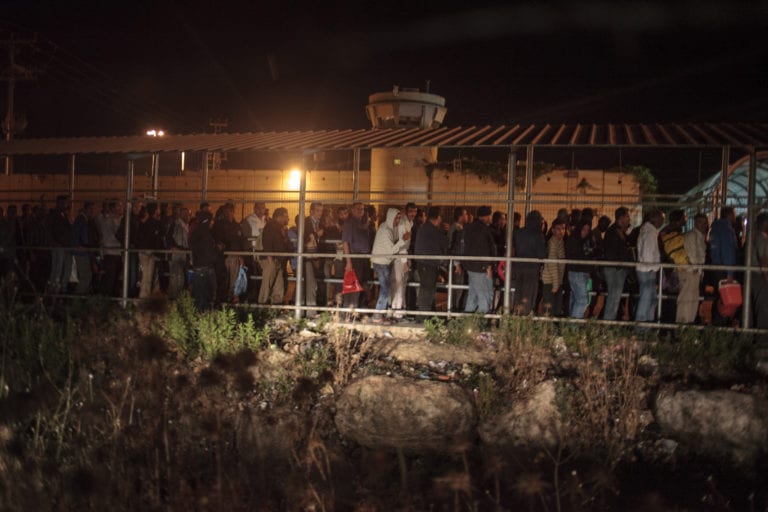
The way to reduce Palestinians’ dependence on aid is to free them from occupation and blockade so they can work and produce, instead of standing at checkpoints and fighting a system that is stacked against them.
Blaming Hamas
“Gaza has tremendous potential but is currently held hostage by…terrorist organizations committed to Israel’s destruction… [that are] fueling a war machine of thousands of rockets and missiles, dozens of terror tunnels and other lethal capabilities… Gaza is run by terrorists who provoke confrontations that lead to more destruction and suffering for the people of Gaza…
As a result of Hamas’ terror and misrule, the people of Gaza suffer from massive unemployment, widespread poverty, drastic shortages of electricity and potable water, and other problems that threaten to precipitate a wholesale humanitarian crisis.”
While Hamas’ rule leaves much to be desired, Hamas is not the cause of Gaza’s humanitarian crisis. Gaza is under a brutal blockade because its people dare to resist the de facto occupation of their land. Some militants shoot mostly-homemade rockets toward Israel in defiance – these “lethal” rockets (which began after Israeli violence) have killed about 50 Israelis in 19 years, while Israel’s army (the most powerful in the Middle East) has killed over 7,000 Gazan Palestinians in the same time period and at least 461 West Bankers and East Jerusalemites.
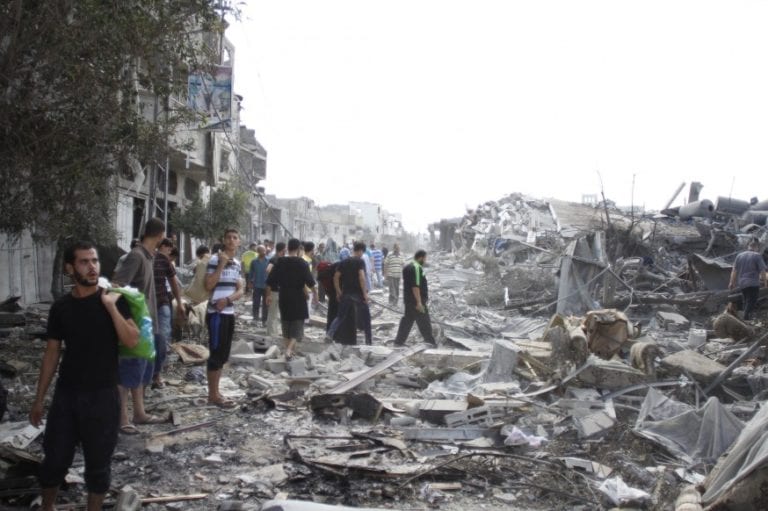
In the rush to demonize Hamas, Israel and its supporters (including Jared Kushner) once again disregard inconvenient facts: Hamas’ efforts are nothing more or less than resistance against oppressive, illegal Israeli policies; Hamas operations have been restrained; and – contrary to Israeli hype – its actions are not provocations but responses to Israeli provocation (not the least of which is the catastrophic blockade); Hamas has on multiple occasions offered long-term ceasefire deals, to which Israel has responded with violence; and most brokered ceasefires (79%) have been broken by Israel.
Hamas and other resistance groups’ actions have been less deadly than Israel’s by a large margin. Witness these statistics from Israeli human rights organization, B’Tselem:
“Peacetime,” Sept 2000 – Dec 2008
- 136 Israelis killed (14 by rockets)
- 3,000 Gazans killed
Israeli incursion into Gaza, 2008-9 (“to stop rockets”)
- 9 Israelis killed (4 by rockets)
- 1400 Palestinians killed
“Peacetime,” 2009-2012
- 3 Israelis killed (by rockets)
- 291 Palestinians killed
Israeli incursion into Gaza, 2012 (“to stop rockets”)
- 6 Israelis killed (by rockets)
- 174 Palestinians killed
“Peacetime,” 2012-14
- 1 Israeli killed (not by a rocket)
- 27 Palestinians killed
Israeli incursion into Gaza, 2014 (“to stop rockets”)
- 72 Israelis killed (17 by rockets)
- 2,200 Palestinians killed
Gaza/Israel since 2014
- 5 Israelis killed (1 by Gazan sniper, 4 by rockets)
- over 400 Gazans killed (most by Israeli snipers)
It is perhaps not surprising that multiple human rights organizations have placed the blame for the humanitarian crisis squarely on Israel’s shoulders.
For a Timeline of deaths in the conflict go here.
Elephants in basic expectations of the “Peace” Plan
Basic expectations of the Kushner Plan are unsound, blatantly partisan, and tell only the convenient parts of the story:
There will be no population transfer
“Peace should not demand the uprooting of people – Arab or Jew – from their homes. Such a construct, which is more likely to lead to civil unrest, runs counter to the idea of co-existence.”
This is a handy position to take after Israel has illegally transferred 600,000 Jews onto West Bank and East Jerusalem land stolen from Palestinians. “No population transfer” would have been a useful policy in 1948, to stop the Zionist army from depopulating hundreds of Palestinian villages and exiling 750,000 Palestinians, and then refusing to allow them to return. Transfer of population into occupied territory has been against international law since the Fourth Geneva Convention was ratified in 1949.
The transfer of Israeli Jews from their settlements back to Israel (also stolen) no doubt would cause “civil unrest,” but it was a grave error to position them in someone else’s land to begin with.
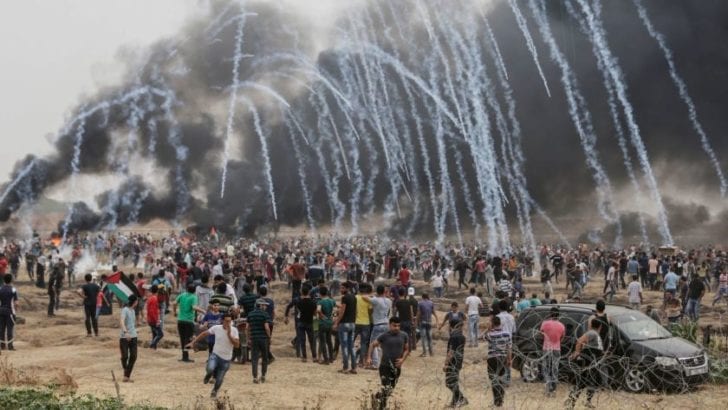
As an aside, when Palestinians participated in civil unrest circa 1939, protesting British rule and the population transfer of Jews into Palestine, they were brutally suppressed. In 1987, Israeli soldiers employed “force, might, and beatings,” in addition to live ammunition to subdue unarmed demonstrations against the occupation. The Great March of Return in Gaza, a massive and ongoing peaceful protest, has been answered with sniper fire. When Palestinians are the ones with grievances, no attempt is made to appease and avoid civil unrest.
Israel will sacrifice historical claims
“This Vision provides for the transfer of sizable territory by the State of Israel [to the Palestinians] – territory to which Israel has asserted valid legal and historical claims, and which are part of the ancestral homeland of the Jewish people — which must be considered a significant concession.”
This statement completely ignores Palestinians’ legal and historical claims to the land – their ancestral homeland. And while the claim of Jewish Israelis is based on a religious document and a short-lived mini kingdom 3,000 years ago, Palestinians have lived on the land recently enough to have Ottoman-era ownership records and deeds. Meanwhile, Israel controls all of the land. A large number of Palestinians have expressed willingness to settle for just 22% of what was once theirs. Is this not a significant concession on the part of Palestinians?
Of course, resolving a problem with these complexities isn’t easy, but no resolution will be valid when the arbiter is disingenuous.
Normalization as a starting point
“Since the moment of its establishment, the State of Israel has not known a single day of peace with all of its neighbors…The United States will strongly encourage Arab countries to begin to normalize their relations with the State of Israel…These countries are expected to end any boycott of the State of Israel and oppose the Boycott, Divestment, and Sanctions (commonly referred to as BDS) movement and any other effort to boycott the State of Israel.”
The statement that “Israel has not known a single day of peace with all of its neighbors” provokes another elephant alert: Israel started or caused its wars (Israel launched the Six Day War, the 1973 war was waged by countries trying to regain land that Israel had unlawfully taken over, and Israel has invaded Lebanon several times). In addition, both Jordan and Egypt recognized Israel long ago.
Ordering Arab neighbors to normalize relations with Israel in the current environment overlooks the legitimate reasons for the global BDS movement: Israel’s noncompliance with international law (not anti-Semitism).
Conflict with Israel’s neighbors was inevitable since the state was created on land belonging to another people group, who were pushed out to become a burden on their neighbors.
First Israel must make the appropriate changes. Then its neighbors – and the world – may consider normalizing relations.
Elephants in the education plan
“The [education] initiative will empower the Palestinian people to realize their ambitions. Through new data-driven, outcomes-based education options at home, expanded online education platforms, increased vocational and technical training… students can fulfill their academic goals and be prepared for the workforce.”
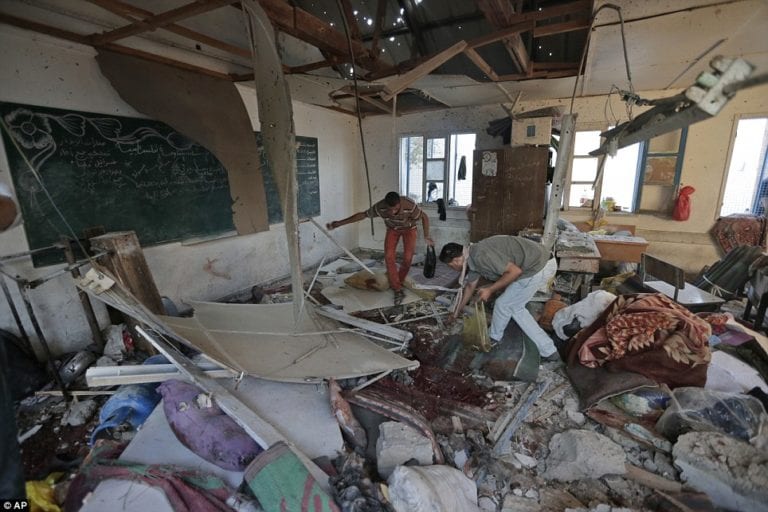
Again, the Trump-Kushner plan neglects the true reason why Palestinians can’t “realize their ambitions.” Under occupation, students often can’t get past checkpoints in time for classes; school days are regularly interrupted by Israeli military tear gas attacks or invasions, followed by arrests of students and/or teachers; a huge number of students have been traumatized by Israeli violence.
Against the odds, Palestinians have among the highest literacy rates in the world, and Gaza has one of the highest rates of PhD holders per capita in the world.
“While Palestinians have among the highest graduation rates in the region, many Palestinian schools are stretched beyond their capacity, with too few teachers and classrooms to support their students.”
In this statement, the Plan glosses over the fact that Palestinian students are succeeding at an impressive rate under impossible conditions. Their academic achievements should lead to a prosperous society, but it does not – because of the elephants.
The statement also fails to mention that overcrowding is due to Israeli forces’ regular practice of demolishing and refusing building permits for West Bank schools. In Gaza, over half of the schools were damaged during an Israeli assault in 2014 – and many are still not rebuilt, since Israel regularly blocks the delivery of construction materials.
“Unfortunately, Palestinians currently experience one of the highest youth-unemployment rates in the world… By providing the Palestinian public sector with policy advice on best practices, encouraging private-sector attention to this problem, and promoting a comprehensive strategy to empower youth and women, more women and youth will join the Palestinian labor force.”
Senior Advisor Kushner is under the impression that Palestinians can’t flip their graduates into successful careers because they need foreign billionaires to give them advice. This is the height of arrogance.
Elephants in the agriculture plan
“While agriculture accounts for approximately eight percent of Palestinian employment, this sector has not met its potential due to limited access of Palestinian farmers to land, water, and technology. An improved business environment in the West Bank and Gaza and access to more land will create an enormous opportunity for farmers to expand their operations.”
Why in the world would Palestinian farmers have “limited access” to their own land? It’s a simple question with a simple answer: Israel has built a wall that separates farmers from much of their farmland. The International Court of Justice declared the wall illegal in 2004 (when it was less than half built) and ordered it torn down. In spite of this, Israel has continued construction along a route that effectively severs Palestinians from the nearly 10% of West Bank land – much of it agricultural – that lies outside the wall.

A 2016 publication by the UN Conference on Trade and Development (UNCTAD) noted some of the measurable effects of the occupation on Palestinian agriculture:
Since the onset of the occupation in 1967, the Palestinian people have lost access to more than 60 per cent of West Bank land and two thirds of its grazing land. In Gaza, half of the cultivable area and 85 per cent of fishery resources are inaccessible to Palestinian producers…
The UN Conference on Trade and Development (UNCTAD) reports that inside the wall, the Israeli expropriation for expanding illegal Israeli settlements and Jewish-only roads “includ[es] the most fertile and best grazing land.”
For those Palestinians who are able to access their land during the harvest season, much or all of their crops can be lost “due to violence and threats by settlers” – who are aided and abetted by the Israeli military.
Up to 1 million olive trees and 2.5 million fruit trees have been uprooted since 1967, many due to illegal Israeli settlement expansion and the construction of the wall, others as a form of vandalism.
All told, the occupation caused a drop in agricultural sector from over half of the Palestinian GDP prior to 1967, to just 6% by 2012.
In addition, Israeli military and illegal settlers destroy or vandalize infrastructure, buildings, and water systems, and the Israeli government restricts the import of fertilizers, seedlings, and certain types of livestock, ensuring “that most of the advantages present in the Israeli agricultural sector are beyond the reach of Palestinian farmers.”
Again, the assistance Palestinians need is not advice from billionaires, but freedom from Israeli domination and oppression.
Elephants in the water and wastewater plan
“The parties [must] recognize mutual water rights… [s]hared aquifers… and jointly seek to provide easily available, reasonably priced water to both parties.”
The wording in this statement suggests that Israel and the Palestinians endure roughly equal water hardship and suffer from exorbitant prices.
In reality, one of the “parties” already has more than enough water, the other too little, too expensive, and too toxic. Again, UNCTAD spells out the cause:
Palestinian farmers are denied the right to construct wells to meet the growing demand for water, even when that water originates almost entirely in the West Bank… [O]rganizations, such as Oxfam, report that Palestinian assets, including sources of water, have often been vandalized by Israeli settlers…
Environmental degradation is also caused by settlers, through the discharge of untreated wastewater into nearby wadis and release of solid domestic and industrial waste from settlements onto Palestinian lands. In addition, several incidents of dumping of hazardous and toxic waste in the West Bank have been documented.
Israel confiscates 82% of Palestinian groundwater for its own use or that of its settlers, piping it efficiently to Israelis, but avoiding Palestinian villages. Many poor Palestinian families spend up to 40% of their meagre income on trucked-in, high-priced water.
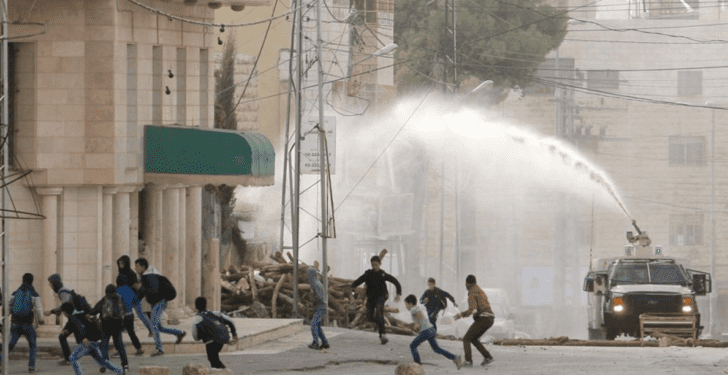
In addition, the Israeli military routinely destroys Palestinians’ own water pipes and wells. And as a variation on the theme, the Israeli military uses skunk water to break up protests or as collective punishment. (some US police forces have imported the product).
In Gaza, the situation is even more dire, with 97% of its water unfit for human consumption, thanks in great part to Israeli restrictions on import of supplies needed for wastewater treatment.
Elephants in the healthcare plan
“The [healthcare] program will provide new resources and incentives to transform the Palestinian healthcare sector and ensure the Palestinian people have access to the care they need within the West Bank and Gaza. This program will rapidly increase the capacity of Palestinian hospitals by ensuring that they have the supplies, medicines, vaccines, and equipment to provide top-quality care and protect against health emergencies.”
Once again, the Kushner Plan insinuates that Palestinians lack proper health care because they lack enlightenment or competence.
In reality, the healthcare sector in Gaza is in disarray because hospitals have been bombed, medicines and equipment have been withheld by the blockade, and huge numbers of critically wounded people seek medical help – many with devastating injuries from Israeli weapons that are likely illegal. Over the years, the Israeli military has shown a pattern of denying Palestinian women in labor permission to go to the hospital; Israeli soldiers chase away ambulances (even from small children), ultimately leaving Palestinians to die.
To top it off, the Trump administration recently cut off aid to hospitals in East Jerusalem.
These are some of the factors that have caused an infant mortality rate in the Palestinian territories of 18.8 per 1,000 births (in Israel mortality is 3.7/1,000), and an average life expectancy for Palestinians of 74 (vs. 83 for Israelis).
Elephants in the sports and athletics plan
“[S]ports and athletics can help Palestinian youth foster new ties…and Palestinian teams can be a source of entertainment and pride for all Palestinians. This project will expand options for competitive, healthy activities for Palestinians through the construction of public athletic facilities in the West Bank and Gaza. This project seeks to inspire the next generation of Palestinian athletes dreaming to be on, and training for, future Palestinian teams competing on the world stage.”
Sports and competition are already in the hearts of Palestinians – they don’t need Jared Kushner to inspire them. What they do need is an end to the occupation that denies them permits to participate in events, holds them back from competing in the Olympics, and maims their bodies. Even children playing soccer on the beach are unsafe under Israeli oppression.

Elephants in the transportation plan
“[Palestinians face] transportation challenges. The lack of ports has raised the costs of Palestinian economic activity. Though the State of Palestine will include Gaza, security challenges make the building of a port in Gaza problematic for the foreseeable future.”
This notion is illegal according to the UN Convention on the Law of the Sea. Gaza has 25 miles of shoreline, but the Israeli-American coalition would forbid Palestinians from building a port. This is not how self-determination and sovereignty work. The Plan would essentially enforce the devastating, 13-year-old, illegal blockade, and license the now 53-year de facto occupation, as Israel would control all Palestinian imports and exports.
Conclusion
“Generations of Palestinians have lived without knowing peace, and the West Bank and Gaza have fallen into a protracted crisis.”
Did Palestinian bad luck cause them to “fall” into a “protracted crisis”? No, Palestinians have had a protracted crisis forced upon them – by Israel. They have resisted in every way they know how, but to no avail.
Reading the Kushner Plan, one would never know that the devastation, the desolation within Palestinian society was created by Israel. In 181 pages and a map, there is no acknowledgement that the Zionist project brought great injustice to generations of Palestinians.
“Yet the Palestinian story will not end here. The Palestinian people continue their historic endeavor to build a better future for their children.”
Correct: Palestinians have endeavored for generations to build a future that includes justice, freedom, and equality – and they have no intention of giving up.
“If implemented, Peace to Prosperity will empower the Palestinian people to build the society that they have aspired to establish for generations. “
Incorrect: Palestinians don’t need a plan imposed on them by Western businessmen – they need justice, freedom, and equality, which Israel has steadfastly withheld.
“Ultimately, however, the power to unlock it lies in the hands of the Palestinian people. Only through peace can the Palestinians achieve prosperity.”
A better statement might be, “Only through justice can there be peace and prosperity. Israel and the US have the power to bring justice.”
“While the vision is ambitious, it is achievable. The future of the Palestinians is one of huge promise and potential. The Palestinian story does not end here. Their story is just being written.”
The story is just being written…by a partisan, privileged group that has nothing but disdain for the Palestinian people. They promise no peace, only more elephants.
Syria and “Transitional Justice”

By Helena Cobban | Just World News | February 12, 2020
Almost from the beginning of the US-supported regime-change project in Syria, US policymakers have incorporated several kinds of planning for what is called “transitional justice” into their pursuit of the project. Transitional justice (TJ) is a field that came into great vogue in the mid-1990s, after two key developments in the post-Soviet world: (1) the UN Security Council’s creation of a special International Criminal Tribunal for the Former Yugoslavia (ICTY) and (2) the agreement of the African National Congress in South Africa to negotiate an end to the Apartheid system– but with the proviso that the most heinous of the rights violators of the Apartheid era all ‘fess up to all their actions in a specially created Truth and Reconciliation Commission (TRC); and if those confessions were deemed full and heartfelt, then the perpetrators could escape prosecution for their actions.
From the early 1990s, these two approaches to TJ were in tension with each other; and that tension has lain at the heart of the rapidly burgeoning field of TJ projects ever since.
For its part, the prosecutorial/criminal-justice approach claimed descent from, crucially, the two US-dominated international courts established immediately after WW-II, in Nuremberg, and Tokyo. (The above photo is of Herman Goering on the stand, in Nuremberg.) The creation of ICTY was followed, two years later, by the Security Council’s creation of a parallel special court for Rwanda; and meantime, a broad movement emerged to press for the establishment by treaty among nations of a permanent “International Criminal Court” (ICC) which could hold accountable perpetrators of the worst forms of atrocities– described as war crimes, crimes against humanity, and genocide– in a criminal proceeding. In 1998, 120 governments adopted the “Rome Treaty” that established and set the rules for this court. In 2002, the requisite 60 countries had ratified the Rome Treaty and the ICC came into existence, headquartered in The Hague.
I have reflected at length in many earlier writings (including this 2006 book and these earlier articles: 1, 2) on some of the shortcomings of the ICC and the criminal-justice approach it adopts to dealing with the aftermath of atrocities. Suffice it here to note the following:
- The United States is not a member of the ICC; but all the presidents since 2002 have on occasion sought to use the investigative, international arrest, and prosecutorial powers of the ICC, or to threaten their use, against political figures around the world they are opposed to.
- The whole prosecutions movement since the creation of ICTY has claimed descent (and therefore a strong degree of legitimacy) from the whole Nuremberg/Tokyo Trials legacy. But all the “modern” international courts have omitted from their actual charge-sheets one of the key acts– perhaps the key act– prosecuted at Nuremberg and Tokyo: the crime of aggression, that is, the act of launching an aggressive war. The Rome Treaty listed the crime of aggression as potentially on the ICC’s docket, but its signatories have failed to reach agreement on how to define it and thus it has not in practice been chargeable.
- In March 2003, eight months after the ICC formally came into existence, the United States launched a massive, quite unjustified (and militarily successful) war of regime change in Iraq– a war that UN Secretary-General Kofi Annan later admitted lacked any legitimacy.
- One of the early acts of the “Coalition Provisional Authority” through which the US military ruled Iraq after the invasion was to establish a special tribunal to try former president Saddam Hussein and his top associates. After the CPA set up an Iraqi government (though still under its own control), this government adopted the trial plan, renaming the body the Supreme Iraqi Criminal Tribunal. Saddam was captured by US soldiers in late 2003 and sent for trial by the SICT; in November 2006, it sentenced him to death. He was held in a prison inside the US military’s “Camp Justice.” On December 30, 2006 he was taken to a scaffold earlier than the Americans had planned by a group that included SICT officials and members of Shiite militias. There, he was hanged to the jubilation of many of the witnesses, who also circulated cellphone videos of the event. Saddam’s very unseemly execution capped off a trial that had been marred throughout by grave irregularities.
This political background should be borne in mind when considering the legitimacy (or even, the utility) of any plans to use prosecutorial TJ mechanisms in connection with US-led regime-change projects in the present era– in Syria, Venezuela, or anywhere else.
In June 2019, Max Blumenthal and Ben Norton published a broad and detailed description in The Grayzone of the work of several organizations that have as their mission the collection of evidence of war crimes and other atrocities committed in Syria and to some extent also Iraq, and the compilation of this evidence into forms that can help (or even spur) the prosecution of alleged perpetrators by international courts.
Most of these organizations are funded by Western governments. Most were also, like the Syrian Network for Human Rights, founded at, or shortly after, the time that Secretary of State Hillary of Clinton and Pres. Barack Obama committed Washington to full support of the regime-change project in Syria. Other such organizations include:
- the “Commission for International Justice and Accountability”, an organization founded by an enterprising Canadian investigator called Bill Wiley, that has received funding from Canada, the EU, numerous European countries, and the United States. CIJA got a massive boost in visibility in the United States after the New Yorker published a serious of materials about it written by Ben Taub. In this one, Taub breathlessly described how, “At an undisclosed location in Western Europe, a group called the Commission for International Justice and Accountability (CIJA) is gathering evidence of war crimes perpetrated by the Syrian government… “
- The Syria Justice and Accountability Center (SJAC), which states explicitly on its website that it was founded in 2012 by the “Group of Friends of the Syrian People”– that is, the coalition of governments united in their project to overthrow the Syruian government. On its website, SJAC states that it was founded in The Hague and moved in 2016 to Washington DC, where it “is currently registered as a nonprofit corporation.” However, no organization of its name comes up in standard searches of nonprofits, while SJAC is currently listed as a project of the old cold-war organization, IREX.

Chart from p.50 of the Day After Project’s report
During their early years in existence, these organizations had as their goal the collection, preservation, and organization of materials that could, after the opposition’s overthrow of the government, serve in a war-crimes court as evidence of the organization by Syrian government officials of broad patterns of gross abuse.
The work of these documentation organizations was also inspired by “The Day After Project”, a project the federally funded U.S. Institute of Peace launched in late 2011 to plan for what decisionmakers in Washington all confidently expected would be the imminent fall of the Assad government. The Day After Project’s final report (PDF) was launched in August 2012, ostensibly by the all-Syrian group of 45 individuals who co-authored it. It contained a lengthy section on “Transitional Justice”, complete with a complex organogram showing how all the proposed parts of this project should be managed.
That was still the heyday of the thinking in official Washington that “Assad will fall any day now!” Washington– like Paris, Ankara, Doha, and other anti-Assad capitals– was full of very busy, Ahmad Chalabi-style Syrian exiles (often being handsomely paid by their Qatari, Saudi, or Emirati backers) who had managed to persuade themselves and numerous “locals” in those Western countries that any day now they would be riding into Damascus to take over the whole Syrian government. Well, in March 2003, Ahmad Chalabi did at least manage to get back to Baghdad in the wake of the US invasion of the country– though once he arrived, it was patently clear he had never enjoyed anything like the degree of popular backing within Iraqi society that he had long claimed to have. Regarding Syria, the earnest bands of exiles who were making detailed plans for their own imminent return “home” never even made it. They were unable to persuade a US government and public that had already been badly duped once, back in 2003, that the claimed “sins” of the Syrian government were bad enough to warrant a full-scale U.S. invasion– especially one that this time around (unlike in 2003) threatened to trigger a serious global showdown with a now more confident and capable Russia.
Yes, under Obama and Clinton, Washington did give the anti-Assad fighters some serious shipments of arms, along with strong political backing; and they and the Israelis did from time to time launch one-off strikes against Syrian military bases. But Obama and Clinton never signed off on a full-throated military campaign against Assad; and the anti-Assad rebels proved quite incapable of actually persuading enough Syrians to come over to their side, to win. The sides settled into a very lengthy and draining stalemate, during which the government side slowly proved able– with the help from international allies on whom it was quite legitimately able to call– to retake parts of Syria that had earlier been taken over by the foreign-armed (and increasingly jihadi-controlled) rebels.
Today, nine years into the conflict in Syria, there is no hope at all of the opposition seizing Damascus. And within the anti-Assad camp itself, extremist jihadis affiliated with either ISIS or Al-Qaeda long ago took over control, snuffing out the hopes of the Washington establishment that “moderate rebels” of the kind now firmly ensconced in Western think-tanks can ever become a significant force inside Syria. All the plans that those “moderate rebels” had made for the imminent establishment of an anti-Assad “special war-crimes court” like the one that earlier tried Saddam Hussein, or for other mechanisms of post-victory “transitional justice”, have to them a quality that is either robotic or slightly other-worldly.
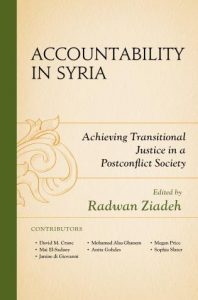 Last week I went to the launch at a Qatari-funded think-tank called the Arab Center of Washington of a book called Accountability in Syria: Achieving Transitional Justice in a Postconflict Society. I guess the Qatari funding has been running a bit low, because there were no free copies of the book being handed out, and only one sample copy that attendees could take a glance at. It costs $90. Rush right over to the link above to buy your copy!
The three panelists were: the book’s editor, Radwan Ziadeh, a longtime regime-change advocate whose only listed professional achievement is his longtime gig as a “Senior Fellow” at the Arab Center; Mai el-Saadany, a US-trained Syrian-American lawyer who now works at the Tahrir Institute for Middle East Policy; and Mohammed Alaa Ghanem, who until recently was Government Relations Director and Senior Political Adviser for the Syrian American Council, one of Washington DC’s principal regime-change organizations. Ghanem, who still has a (presumably nicely funded) affiliation with the UAE-funded Atlantic Council, is now doing a Master’s degree in international affairs at Columbia.
At one level, it was kind of a sad event. When Ziadeh started talking, he recounted that work on the book had started back in 2015– at a time when it may have been possible for regime-change advocates still to imagine that one day soon, just possibly, they could seize power in Damascus. (Hence, the reference in the book’s sub-title to a “Postconflict society.”) Poignantly, he spoke about how back then, “Aleppo”–actually, just that small portion of East Aleppo that the opposition still controlled– was becoming a center of evacuation, and how Ma’aret al-Numaan, in the opposition fighters’ Idlib redoubt, was a center of evacuation today.
In both instances, as the government regained control of terrain previously held by the jihadi extremists, the government allowed the opposition fighters and any civilians who chose to leave, to do so, and indeed, facilitated their departure. This is in notable contrast to the bloodthirsty actions the jihadi oppositionists have always taken toward the residents and defenders of areas that they’ve overtaken. But the video footage of desperate civilians fleeing in advance of the Syrian army’s arrival always looks pretty heart-wrenching.
(The videos widely circulated in the west notably do not depict the civilians who stay in the areas being brought back under Syrian government control– or, the earlier presence and activities of any of the jihadi fighters, some of whom who are Syrian and many of whom are not, who had controlled these areas so brutally over the preceding few years.)
When Mai el-Saadany spoke she stated confidently that, “The time for justice is now… We can’t afford to wait until the conflict ends.” She said that both the International Criminal Court and the UN’s doctrine of “Responsibility To Protect” (R2P) had proven useless in protecting Syria’s people; but that even without those tools there were three “accountability tools” the Syrian oppositionists could use: Documentation; a couple of different UN inquiry/documentation mechanisms; and prosecutions outside Syria, such as the one brought against two former Syrian officials by a court in Germany, last October.
When she talked about documentation, el-Saadany singled out for special praise the efforts of a group called Bellingcat–and of The New York Times.
For his part, Ghanem focused on the contribution he had made to the Accountability in Syria book, in which he looked at what he described as the “sectarian cleansing” that he saw the Syrian government as undertaking in formerly opposition-held areas over which it regained control. He accused “the Assad regime” of being dominated by Alawites and of engaging in “sectarian cleansing or demographic engineering” against “communities” in these areas, though he did not name these “communities.” He said he had been very proud to have gotten reference to this phenomenon included in the “Caesar Act”— a US sanctions measure against Syria that was signed into law in late December.
The most interesting part of this sad gathering came toward the end ( at 1h24m on the video.) A questioner had asked how the panelists thought that the kinds of “accountability”mechanisms they favored could be applied to other perpetrators of atrocities in Syria, “such as in the Turkish-controlled areas, or the SDF”, in addition to the government. At that point, Ziadeh almost completely lost it. The other two panelists, much better qualified and better prepared professionals than he, had both expressed their support for the idea that all accused perpetrators of significant atrocities, whatever their political alignment, should be subjected to the same accountability measures. (This is, after all, a key tenet to the whole field of transitional justice… Heck, in South Africa’s Truth and Reconciliation Commission, even some of the excesses of the ANC came under the same kind of scrutiny as the gross tortures of the Apartheid regime.)
Ziadeh argued that only the “Assad regime” should be addressed by any accountability mechanisms. “The Syrian government– it became not a rogue state, but deep sectarian militias, that has no regard for the life of any Syrian” he said. “It’s impossible to think of having a political settlement with this kind of militia in control of Syria… What’s the end answer? No Syrians nor anyone else have any answer for that… There is nothing to talk about! There is nothing to leverage or negotiate about. I am very pessimistic. There is no soon, any hope of a political settlement of the conflict.”
The other two panelists hewed more closely to the standard TJ script. Both argued that, while there is no “false equivalence” between the violations committed by the “Assad regime” and those committed by other parties, still, all violators should be held accountable.
Ghanem had earlier argued that accountability-seeking mechanisms could be used as “leverage” for the Syrian opposition in a future negotiated settlement. The relationship between pressure for “accountability” and momentum toward negotiations is a complex–and, as I demonstrated in this recent article, “Syria: Peacemaking or prosecutions?”, often an inverse–one. (When I wrote that piece, in early November, the prospects for reaching a negotiated political transition in Syria seemed greater than they do today.)
One misapprehension into which all three of the panelists at the Arab Center event seemed to have fallen was to conflate the idea of “accountability” almost completely with the path of criminal prosecutions. But as anyone who has studied the TJ field knows, there are numerous other mechanisms that have been used to enact accountability other than Western-style courts of law. South Africa’s TRC was one such mechanism. It was widely (and correctly) lauded for helping enable South Africans to make the transition from a deepseated system of colonial expropriation and Apartheid to a much more inclusive system that enabled the “White” colonists to remain in the country on a basis of political equality with its indigenes– and to achieve this without triggering a massive new race war between those two sides (though the transition was accompanied by very lethal fighting between the two major Black African political forces.)
The main premise of the TRC was that as part of the transition to political equality, it was necessary to draw a line under the violence of the past and to offer a full amnesty from prosecutions for all the perpetrators of that violence provided they (a) had stopped committing it; and (b) provided a full description of the violent acts they had committed, such as could help bring a degree of legal and emotional “closure” to survivors of the violence and others bereaved by it or otherwise affected by it.
The exact terms of the TRC’s “deal” with former perpetrators were painstakingly negotiated among the parties to the transition– principally, the Apartheid era’s ruling National Party and the anti-Apartheid African National Congress (ANC). The Apartheid government possessed overwhelming military and socioeconomic force throughout the whole of South Africa; and it would never have agreed to end Apartheid and transition to a one-person-one-vote system in South Africa if its leaders had not been offered an amnesty. If there had been no TRC, the whole of Southern Africa might still be riven with terrible conflicts, to this day. The “offer” of amnesty was backed up by the existence in the country of a fairly well-functioning judicial system. But the main factor motivating perpetrators to come forward and participate in the often riveting public hearings that the TRC held all around the country was the desire most of them felt to allow their families, their communities, and their country to move forward.
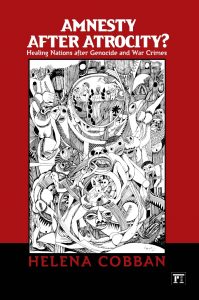 In my 2006 book, Amnesty After Atrocity? Healing Nations after Genocide and War Crimes, I looked at the effectiveness of South Africa’s TRC and compared it with the very different post-conflict mechanisms that, in that same period of 1992-94, had been adopted by Mozambique and post-genocide Rwanda. Those two other cases effectively “bracketed” what the South Africans agreed to do. In Rwanda, the post-genocide government was heavily inclined towards prosecutorialism, supporting both the creation and work of a UN-established International Criminal Tribunal for Rwanda (ICTR) and the use of a very broad campaign of national-level prosecutions of suspected genocidaires. In Mozambique, by contrast, an extremely lengthy and ugly civil war was brought to an end in 1992 when the two main parties to it, the ruling Frelimo movement and the opposition Renamo, were brought together in a negotiation conducted by a Vatican-sponsored peace group and agreed to end their combat on the basis of a blanket amnesty for previous perpetrators of violence from both sides. The United Nations then stepped in with a broad program for demilitarization, demobilization, and reintegration into their home societies of the former fighters from both sides (DDR).
Intense inter-group conflict of any kind of course inflicts massive damage on a country’s economy, including its most basic infrastructure, so societies emerging from such conflicts have numerous, extremely pressing human and economic needs. In this context, the relative costs– and therefore, also opportunity costs– of the TJ mechanisms used are definitely a factor. I used public documentation to calculate the costs of these mechanisms as follows (p.209):
- Each case completed at the ICTR : $42,300,000
- Each amnesty application at the TRC: $4,290
- Each case in Rwanda’s planned “local-style” gacaca courts (projected): $581
- Mozambique: each former fighter demobilized/reintegrated: $1,075
- South Africa: each former fighter demobilized/reintegrated: $1,066.
In that concluding chapter of the book, I presented (pp.212-13) a critique of the degree of “accountability” that advocates of prosecutorialism judge that their favored approach provides, noting that the kind of personal “accountability” required of perpetrators by a court of law is very thin indeed compared with, for example, that required in TRC or other similar mechanisms.
I also presented (p.241) a list of nine “meta-tasks” that, based on my previous analysis in the book– and on my own experience of having lived and worked in an area wracked by civil conflict, during the first six years of Lebanon’s civil war– I concluded that societies recovering from grave inter-group conflict need to undertake. It runs as follows:
Top rank (all of equal urgency):
-
- Establish rigorous mechanisms to guard against any relapse back into conflict and violence.
- Actively promote reconciliation across all inter-group divisions.
- Build an equality-based domestic democratic order that allows for nonviolent resolution of internal differences and respects and enforces human rights.
- Restore the moral systems appropriate to an era of peace.
- Reintegrate former combatants from all the previously fighting parties into the new society.
- Start restoring and upgrading the community’s physical and institutional infrastructure.
- Start righting the distributional injustices of the past.
Second rank (of somewhat less urgency):
-
- Promote psychological healing for all those affected by the violence and the atrocities, restoring dignity to them. (If the top-rank tasks are all addressed, those moves will anyway do much to achieve this; but it will probably need continuing attention.)
- Establish such records of the facts as are needed to meet victims’ needs (death certificates; identification of the burial sites; etc) and to start to build a record for history.
In the real world, decisions on what to do with individuals accused of having committed grave infractions nearly always get made in the context of a negotiation over the nature and terms of a major societal transition to a new political order. “String ’em all up on the lamp-posts!” or “Line ’em all up and shoot them!” are versions of one notable, non-negotiated type of such decision– and a type that notably doesn’t augur well for the political tone of the new order. In Syria, the way that ISIS or the bunch of Al-Qaeda-affiliated jihadis who currently control Idlib treat accused government supporters who fall under their sway definitely falls into this category.
Negotiating an end to a conflict– or acting with restraint in the event no negotiation proves possible– nearly always augurs a better outcome. At the end of WW-II, in the Asian theater, the Japanese Emperor was able to negotiate surrender terms on fairly favorable terms that ensured his dynasty’s continuation in office (and his own exculpation from responsibility for any of Japan’s preceding war crimes)–but in return for allowing the Americans and their allies to set up an international criminal tribunal to try certain Japanese decisionmakers, and numerous other concessions. In Germany, there was no negotiated end to the fighting; and the Russian, French, and British leaders (whose peoples had suffered most gravely from the Nazis’ actions) were all baying for extreme retribution. But the US public was relatively distant from the battlefield. That allowed Secretary of War Henry Stimson and President Harry Truman– both of whom were also aware of the disastrous sequelae of the punitive approach the victorious Allies had imposed on post-WW-I Germany– to argue for, and implement, the much more restrained approach to post-war justice that the Nuremberg trials represented.
Recent developments in Syria make the prospect of a negotiated end to the country’s lengthy civil war seem more remote today than they did a few months ago. The country’s 22 million people have been held in the vice of this conflict, and victim to the wiles of numerous outside actors and interveners much more than to those of any domestic actors, for nine long years. (This was also, interestingly, the case in Mozambique. Much of the terrible violence that Renamo used in its campaign to control as many Mozambicans as possible as a way of pressuring and overthrowing the Frelimo government had been organized and underwritten by South Africa’s Apartheid. The intra-Mozambican negotiations that brought an end to the war only made progress after a weakened South Africa started to withdraw that support.)
Throughout the first six years of Syria’s civil war, the determination of the United States and several allied governments (Turkey, Qatar, the Saudis, the UAE) to accept nothing less than the complete overthrow of the Assad government stymied all attempts by the United Nations and others to attain a negotiated end to the war. After Pres. Trump assumed office, he was less devoted to total “regime change” than Pres. Obama had been… and since late 2018 or so, the UAE has pulled back from its focus on regime change. Turkey also, from the Astana Agreement of September 2018 on, was clearly exploring some kind of “regional super-powers mega-deal” with Russia and Iran, that could help ramp down, or even bring to a negotiated end, Syria’s civil war.
More recently, though, Trump has pulled back from his fondness for a pullback from Syria. And perhaps he has started to see US military involvement in Syria as helping to serve his broader campaign of “maximum pressure” against Iran? Turkey has also pulled back from its commitment to Astana and is currently squaring up for a possibly broader military clash with Syrian government forces?
So the prospect for a negotiated settlement to the Syrian civil war has receded some. But it has certainly not disappeared completely. If nine years of slogging fighting– accompanied by terrible, unspeakable atrocities being suffered by people from all “sides”–has not succeeded in bringing about a “decisive” victory for any side, then surely an end to this war that is negotiated in some way is the only reasonable path, and the only path that can draw a line under the suffering of the past nine years? A viable negotiating forum has already been established by the United Nations. Let us hope it can complete its work as soon as possible, and that as part of this process the negotiators can find a list of mutually acceptable ways to deal with the whole range of transitional justice issues. And these, as noted above, go considerably further than the kinds of war-crimes trials so beloved by the Western media.
Putin questions America’s creepy collection of Russian DNA for possible bio-weapons program
The US Air Force is trying collect samples of ethnic Russian DNA. If history is a guide, the purposes of this new US program are highly nefarious.

By Adam Garrie | The Duran | November 1, 2017
In recent months, the US Air Force has issued calls for ethnic Russians to provide DNA samples for a mysterious “research” program. US Air Force Captain Beau Downey claimed that the samples were required for “locomotor studies to identify various biomarkers associated with trauma.”.
Downey further stated,
“The request (by the research centre) did not specify where the samples should be received from, but to continue the study, similar samples were required. Since the supplier originally provided samples from Russia, suitable for the initial group of diseases, the control group of the samples should also be of Russian origin.
The goal is the integrity of the study, not the origin (of the samples)”
However, given the fact that the US military has attempted to obtain Russian DNA samples without the permission of the Russian government and furthermore, given the low state of Russia-US relations, many are questioning whether the sought samples are intended to be part of a biogenetic weapons program.
Biogenetic weapons are defined as biological agents designed to inflict debilitating diseases or other internal bodily afflictions on a specific group of people, based on a shared genetic code.
While it is unclear if such a weapon has ever successfully been developed, the US and Israel have in the past, attempted to create such a devastating bio-genetic weapon.
In the late 1990s, it was reported that Israel had successfully created a biogenetic weapon which was specifically designed to target Arabs and only Arabs.
An archived press clipping from 1998 reports,
“According to a Jerusalem Post report quoting the London-based Foreign Report, Israel has successfully developed what is being called an ‘ethnic-bullet’, which will target only Arabs. The report quotes an ‘unconfirmed report’ which originated in South Africa, which details how Israeli scientists have made a biological weapon tailor made to attack targets with the Arab genetic system. Long-term studies of Iraqi Jews was credited with providing the genetic code needed to target Arabs. According to the report, the ethnic-bullet program was originally developed for use in Apartheid South Africa for use against blacks. Scientist in both countries worked together towards the development of the Israeli program. Israeli officials declined to confirm the existence of the ‘ethnic bullet,’ but one told the newsletter: ‘We have a basket full of strategic surprises which we will not hesitate to use if we feel that the State of Israel is under serious threat”.
The popular US based technology magazine Wired, also ran a story on Israel’s biogenetic weapons program in 1998. The story reads,
“ISRAEL IS REPORTEDLY developing a biological weapon that would harm Arabs while leaving Jews unaffected, according to a report in London’s Sunday Times. The report, citing Israeli military and western intelligence sources, says that scientists are trying to identify distinctive genes carried by Arabs to create a genetically modified bacterium or virus.
The ‘ethno-bomb’ is reportedly Israel’s response to the threat that Iraq may be just weeks away from completing its own biological weapons.
The ‘ethno-bomb’ program is based at Israel’s Nes Tziyona research facility. Scientists are trying to use viruses and bacteria to alter DNA inside living cells and attack only those cells bearing Arabic genes.
The task is very complex because both Arabs and Jews are Semitic peoples. But according to the report, the Israelis have succeeded in isolating particular characteristics of certain Arabs, ‘particularly the Iraqi people.’
Dedi Zucker, a member of the Israeli parliament, denounced the research in the Sunday Times. ‘Morally, based on our history, and our tradition and our experience, such a weapon is monstrous and should be denied.’
Last month, Foreign Report claimed that Israel was following in the ignominious footsteps of apartheid-era research, in their supposed efforts to develop an “ethnic bullet.”
A year later, a report from Reuters citing British scientists, confirmed that such a biogenetic weapon was possible given the advanced state of genetic mapping, although the report neither confirmed nor denied the existence of an Arab killing Israel biogenetic weapon.
Russians are therefore clearly worried that the US military intends to collect samples of Russian DNA in order to engineer a biogenetic weapon similar to the ones Israel is said to have created in the 1990s. The fact that genetic mapping technology has advanced even further since the 1990s, makes this fear all the more magnified.
In the 1980s, the Soviet Union feared that the AIDS virus was created in a US military bio-weapons lab in Fort Detrick, Maryland. While the story was dismissed by the US as geo-political propaganda, many black Africans and African-Americans continue to believe that the CIA had a hand in either creating or weaponising the AIDS virus. To this day, AIDS continues to disproportionately effect black men across the globe.
The notion that AIDS was part of a CIA experiment aimed at population modification, was spoken of widely in the 1980s. The American musician Frank Zappa even wrote a musical about the alleged phenomenon called ‘Thing Fish’.
In the year 2000, the neocon think-thank that would provide the George W. Bush administration with many important advisers, the Project for the New American Century published a report which spoke of the desirability of weaponising genetically mapped biological agents for use in 21st century warfare. This was one of the factors leading to Russia banning the export of domestic DNA samples in 2007, as was reported in Russian mainstream media at the time.
While exporting Russian DNA samples remains illegal in most circumstances, the US military is still keen on flaunting Russian law.
President Vladimir Putin has responded to the latest attempts by the US military to collect Russian DNA samples in the following way,
“Do you know that biological material is being collected all over the country, from different ethnic groups and people living in different geographical regions of the Russian Federation? The question is – why is it being done? It’s being done purposefully and professionally. We are a kind of object of great interest.
Let them do what they want, and we must do what we must”.
The latter part of Putin’s statement derives from the Melian Dialogue of the Athenian historian Thucydides. In his History of the Peloponnesian War, Thucydides recounts Athenian envoys trying to convince the small island of Melos to surrender its sovereignty or be destroyed. The dialogue includes a famous line which is usually translated as “The strong do as they will and the weak submit as they must”.
Putin therefore is suggesting that no matter what the US has in store for Russia, the leadership of the Russian Federation is able and willing to take defensive matters in any scenario. The seemingly cautious statement from Putin, is actually incredibly forceful when read carefully.
Based on past experiences, the US is not operating under innocent intentions and therefore, Russia should not take any chances.
Israeli policy of assassinations cannot terrorize Palestinians to accept Trump’s deal: Nakhala

Secretary-General of the Palestinian Islamic Jihad resistance movement Ziad al-Nakhala speaks during a televised speech broadcast live from Gaza City on February 19, 2020.
Press TV – February 19, 2020
The secretary-general of the Palestinian Islamic Jihad resistance movement says the Tel Aviv regime’s plan to return to “the policy of assassinations” against distinguished figures of Palestinian resistance groups in the Gaza Strip cannot terrorize Palestinians to acknowledge US President Donald Trump’s so-called deal of the century on the decades-old Israeli-Palestinian conflict.
“The policy of assassinations will not make the Palestinian people give up their rights, nor will it manage to break up the resistance front. We will respond to any assassination in time, and any act of aggression against our people in the Gaza Strip will be met with resistance that the occupation [Israel] has not experienced before,” Ziad al-Nakhala said in a televised speech broadcast live from Gaza City on Wednesday afternoon.
He added, “The threats of enemy leaders will not intimidate us, nor will make us accept what they have crafted and called the deal of the century. They will not make us relinquish our historical rights in Palestinian lands and al-Quds (Jerusalem).”
‘Oslo Accords bore nothing for Palestinians other than humiliation’
Nakhala also censured the Oslo Accords signed between the Palestine Liberation Organization (PLO) and the Israeli regime more than two decades ago, stating that the set of agreements brought nothing for Palestinians other than humiliation, shame and delusions.
“We presented our history as well as our children, and sacrificed them on the altar of delusion of peace. We reaped nothing other than despair that was represented by the deal of the century,” he pointed out.
The Oslo Accords — consisting of Oslo I and Oslo II accords — were signed by the late chairman of the PLO, Yasser Arafat, and former Israeli Prime Minister Yitzhak Rabin, respectively in Washington DC, in 1993 and Egypt in 1995. The purported goal of the accords was to achieve peace based on the United Nations Security Council resolutions 242 and 338, and to realize the right of the Palestinian people to self-determination.
The senior Palestinian official also lambasted some Arab and Muslim countries for supporting and acknowledging Trump’s proposal in the eye of the international community.
Nakhala then called upon all Palestinian resistance movements to join forces, and tirelessly protect Jerusalem al-Quds and the Palestinian cause from liquidation.
‘The US decision to declare al-Quds as the capital of Israel was not surprising, given that America is the sponsor of the Zionist project ever since its inception (back in 1948). It is a full partner to this project, and is in fact spearheading the Western project in our region,” he underscored.
On January 28, Trump unveiled his so-called deal of the century, negotiated with Israel but without the Palestinians.
Palestinian leaders, who severed all ties with Washington in late 2017 after Trump controversially recognized Jerusalem al-Quds as the capital of the Israeli regime, immediately rejected the plan, with President Mahmoud Abbas saying it “belongs to the dustbin of history.”
Palestinian leaders say the deal is a colonial plan to unilaterally control historic Palestine in its entirety and remove Palestinians from their homeland, adding that it heavily favors Israel and would deny them a viable independent state.
Dresden Terror Bombing, Like Hiroshima, a Maniacal Warning to Moscow

By Finian Cunningham | Strategic Culture Foundation | February 17, 2020
This weekend 75 years ago, the German city of Dresden was razed to the ground by British and American aerial bombardment. At least 25,000 mainly civilians were destroyed in raid after raid by over 1,200 heavy bombers, indiscriminately dropping high explosives and incendiaries. It took seven years just to clear the rubble.
The destruction of Dresden, a world-famous cultural center of Baroque majesty, has been long dogged by controversy. Official British and American military accounts claim it was necessary to hasten the collapse of the Third Reich; with a reasoning that resonates with US claims for dropping the atomic bombs on the Japanese cities of Hiroshima and Nagasaki in August 1945.
Critics say, however, that the mass bombing of Dresden was immaterial in the effort to defeat Nazi Germany. It was a wanton act of terror – a war crime – carried out by the British and Americans. Critics point out that most of the industrial and military targets on the outskirts of the beautiful city were largely left untouched by the bombing. British wartime leader Winston Churchill is even said to have expressed misgivings about the morality of this and other indiscriminate bombing of German civilian centers.
Ardent advocates of the terror-bombing campaign said it would exhaust German morale. A classic case of ends justifying means, no matter how vile the means.
There were also claims at the time that the damage to Nazi communication and transport lines would aid the advancing Soviet Red Army.
But there is good reason to believe that the rationale for the obliteration of Dresden was for an altogether more sinister reason. It wasn’t so much an act of terror aimed at Nazi Germany, but rather a show of maniacal power to the Soviet Union.
A British Royal Air Force memo on the Dresden operation noted that it would “show the Russians when they arrive what Bomber Command can do.” (See caption 17 in this linked photo essay.)
By mid-February 1945, the front lines of the Western and Eastern allied forces were such that the American and British ground troops had not yet entered Germany territory, while the Soviet Red Army had crossed the Oder River and were a mere 70 kilometers from Berlin, the seat of the Third Reich. Such was the keen advance of the Soviets that the Western allies were concerned that the Red Army might take all of German territory.
Rather than aiding Soviet forces from the mass bombing of Dresden, Leipzig and other cities in the German east, it seems plausible that, as the above British RAF memo indicates, the Western allies were intent on demonstrating a shockingly brutal, raw power to Moscow. Not just military power, but a will power to use any means necessary to defeat enemies.
There is a direct analogy here with the subsequent atomic bombing of Japan. At the Potsdam conference in July 1945 following the defeat of Nazi Germany and the carve-up of Berlin, giving the Western allies shared control of the German capital way beyond their final front lines, the American president Harry Truman relished the ability to drop a sinister hint to Josef Stalin about a newly acquired secret weapon – the A-bomb.
As with the earlier British and American bombing of Dresden and other German cities, there was arguably little military justification for dropping the atomic weapons on Hiroshima and Nagasaki on August 6 and 9. Like Dresden, the military significance of those cities was dubious. The death of 200,000 civilians from the atomic inferno was not a military necessity for defeating imperial Japan, as Truman’s top generals MacArthur and Eisenhower were advising him against.
So if the bombing of Hiroshima or Nagasaki was unnecessary from a military point of view to end the Pacific War, why was it done?
As with Dresden, the point was a monstrous display of terror by Western powers to let the Soviet Union know that nothing would be off-limits in the postwar geopolitical stand-off that was anticipated and which became the Cold War.
When the A-bombs were dropped on Japan, Stalin was said to have been frozen by reports of the awesome new destructive power. The Soviet Union was not to develop its A-bomb until 1949.
The terror unleashed at Hiroshima and Nagasaki seems to have had the intended effect of halting Soviet Red Army advances that were being made into the Korean Peninsula and onwards to Japan. The American troop lines were relatively remote by comparison with their Soviet counterparts, yet after the A-bombing the US was catapulted to take over both Asian-Pacific territories in the postwar period. Not unlike the precocious territorial gains that were acquired by the Western allies in defeated Nazi Germany.
Thus the moral controversies about the British and American bombing of German and Japanese cities goes way beyond arguments about the right or wrong of mass murder for the supposed purpose of ending wars. That moral hazard is difficult enough. But even more fiendish is a bigger picture; one in which the cold, calculated use of terror and genocide is not about ending war, but rather to simply exert geopolitical power against a perceived rival in the postwar era. Terror for terror sake, evil for evil sake.
A final note: it has become fashionable to falsify the Soviet victory over Nazi Germany by claiming that the Red Army became an occupying tyranny in eastern Europe after the war’s end. Suffice to say that if the Soviets committed even a fraction of the crimes that were actually carried out by the Americans and British from their aerial bombing of civilians in both Germany and Japan, one would never hear the end of deafening Western condemnations against Moscow to this day, and for decades to come.
Karl Marx and Jewish Power
By Laurent Guyénot • Unz Review • February 17, 2020
In a recent article, I explored the influence of Freud’s Jewishness on the formation, reception and propagation of his psychoanalytical theory. I wish now to do the same for Karl Marx (1818-1883). In contrast to Freud’s, Marx’s Jewishness is seldom considered an important factor. If you type “Freud Jewish” as key-words on Amazon.com, you will be suggested a dozen books dealing specifically with Freud’s Jewishness, whereas “Marx Jewish” will yield no result except Marx’s own essays “On the Jewish Question”, and a discussion of them, with precious little about Marx’s own Jewish background and connections.
Even in the literature exposing the role of Jews in the Bolshevik revolution in Russia and other revolutionary movements of the twentieth century, such as Alexander Solzhenitsyn’s two-volume 200 Years Together, a contextualized analysis of Marx’s Jewishness is lacking.
One obvious reason is that Marx was not Jewish: he had been baptized a Lutheran at the age of six. Yet to claim that baptism had washed away all traces of Jewishness would be absurd, and particularly ironic in the case of a person who insisted that religion was an inessential part of Jewishness (as we shall see).
My purpose here is to examine Marx’s contribution to Jewish empowerment, and, ultimately, to the historical movement toward Jewish global domination that made a major breakthrough a century exactly after the Communist Manifesto (1848).
I must say in preamble that the question is not: Did Marx deliberately conspire with other Jews to advance the Jewish global agenda, while pretending to emancipate Gentile proletarians? Jewishness doesn’t necessarily work that way. It could be defined as the inability to distinguish between the interest of peoples, and the interest of the chosen people, between what is good for mankind and what is good for the Jews. As a rule, Jews who believe they are working for the salvation of the world while thinking Jewishly are advancing Jewish power one way or another. This applies, of course, to Jewish thinkers who believe that Jews have a mission to guide mankind toward perpetual peace, like Theodore Kaufman, who in 1941 believed that the first step to that goal was to “sterilize all Germans” (his interview with the Canadian Jewish Chronicles), or like David Ben-Gurion, who in 1962 believed that the next step was to make Jerusalem the “seat of the Supreme Court of Mankind, to settle all controversies among the federated continents, as prophesied by Isaiah.”[1] But it also applies to Jewish thinkers who do not publicly identify as Jews and are even critical of Jews, yet whose worldview is profoundly biblical, that is, both materialistic and prophetic. It is a question of inherited cognitive pattern, rather than deliberate intention. That being said, in Marx’s case, there is evidence of intellectual dishonesty, concealment and deception, as we shall see.
Marx’s prophecy and Bakunin’s foresight
According to Karl Popper, “the heart of the Marxian argument … consists of a historical prophecy, combined with an implicit appeal to the following moral law: Help to bring about the inevitable!”[2] There is no doubt that Marx’s prophecy of a messianic transformation of the world was profoundly Jewish in inspiration. What distinguishes Marx’s prophetic vision from the biblical project is that its explicit goal (as we shall see) is the international dictatorship of a cosmopolitan proletariat, not of Jewry. Yet, as Mikhail Bakunin warned in Statism and Anarchy (1873), Marx’s proletarian state “is a lie behind which the despotism of a ruling minority is concealed.” Behind the expression “scientific socialism”, Marx could only mean “the highly despotic government of the masses by a new and very small aristocracy of real or pretended scientists.”[3] That centralized state, according to Marxist doxa, will be a transitional stage before true socialism; it will “wither away”, according to Engels’ expression. To this, Bakunin replies “that no dictatorship can have any other objective than to perpetuate itself, and that it can engender and nurture only slavery in the people who endure it.” Bakunin suspected that if Marx had his way, German Jews like him would end up ruling the communist state.
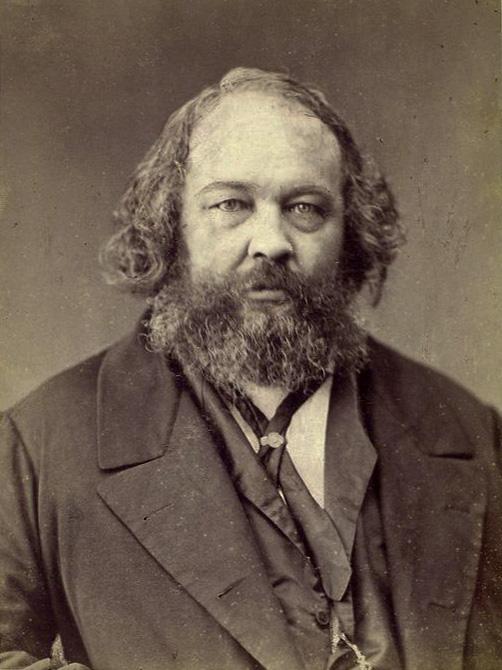
Bakunin photographed by Nadar
Indeed, Marx’s revolutionary prophecy appealed particularly to non-proletarian German Jews. Fritz Kahn hailed him as more than a prophet in Die Juden als Rasse und Kulturvolk (1920): “in 1848, for the second time, the star of Bethlehem was raised to the firmament … and it rose again above the rooftops of Judea: Marx.”[4]
If Marx was the Messiah in 1848, then Benjamin Disraeli could be called his prophet. In his novel Coningsby, published in 1844, the Jewish character Sidonia—“a cross between Lionel de Rothschild and Disraeli himself,” according to Disraeli’s biographer[5]—declared:
“That mighty revolution which is at this moment preparing in Germany, and which will be, in fact, a second and greater Reformation, and of which so little is as yet known in England, is entirely developing under the auspices of Jews, who almost monopolise the professorial chairs of Germany.”
Four years after these words were written, the Communist Manifesto was published and, almost simultaneously, the revolution broke out in Germany, as Disraeli had predicted . Jews did play a major role in the 1848 revolution, as Amos Elon has shown in his book The Pity of It All: A History of Jews in Germany 1743-1933. “80 percent of all Jewish journalists, doctors, and other professionals” supported the revolution. The most prominent were Ludwig Bamberger in Mainz, Ferdinand Lassalle in Dusseldorf, Gabriel Riesser in Hamburg, Johan Jacoby in Koeningsberg, Aron Bernstein in Berlin, Herman Jellinek in Vienna, Moritz Harmann in Prague, and Sigismund Asch in Breslau. “All over the country,” Elon writes, “rabbis in their sermons greeted the revolution as a truly messianic event.” The Jewish magazine Der Orient praised “the heroic Maccabean battle of our brethren on the barricades of Berlin,” and raved, “The savior from whom we have prayed has appeared. The fatherland has given him to us. The messiah is freedom.” The Jewish scholar Leopold Zunz, founder of academic Judaic Studies (Wissenschaft des Judentums),
“described what was happening in specifically biblical terms shot through with the Messianic political view which saw revolutionary politics as the fulfillment of biblical promise. Haranguing the Berlin students from the barricades, Zunz portrayed Metternich [Chancellor of the Austrian Empire] as Haman and hoped that ‘perhaps by Purim, Amalek [meaning the Prussian king Friedrich Wilhelm IV] will be beaten.’”[6]
After the failure of the revolution, many revolutionaries exiled themselves to London, where they were known as the Forty-Eighters. Marx settled there for the rest of his life, “living encased in his own, largely German, world, formed by his family and a small group of intimate friends and political associates,” according to Isaac Berlin.[7] Apart from Engels, Marx’s friends and associates were, in fact, almost all Jewish. Marx’s influence, which had been small in the 1848 revolution, would then develop, thanks to what Bakunin would call in 1872, in an unpublished “Lettre au Journal La Liberté de Bruxelles,” his “remarkable genius of intrigue,” adding:
“he also has in his service a numerous corps of agents, hierarchically organized and acting secretly under his direct orders; a kind of socialist and literary freemasonry in which his compatriots, the German Jews and others, occupy a considerable place and deploy a zeal worthy of a better cause.”
Bakunin was particularly intrigued by Marx’s insistence on the centralization of all banking activity. The Communist Manifesto not only proclaims the abolition of private banks, but: “Centralisation of credit in the hands of the State, by means of a national bank with State capital and an exclusive monopoly.” In another unpublished editorial of 1872, Bakunin wrote:
“this Jewish world is today, for the most part, at the disposal of Marx on the one hand, and of Rothschild on the other. I am convinced that the Rothschilds, on their side, appreciate the merits of Marx and that Marx, on his side, feels an instinctual attraction and a great respect for the Rothschilds. / This may seem strange. What can there be in common between socialism and a major bank? The point is that Marx’s communism wants a strong centralization of the state, and where there is centralisation of the state, there must necessarily be a central bank, and where such a bank exists, the parasitic nation of the Jews, speculating with the Labour of the people, will always thrive.”[8]
Having succeeded to get Bakunin and his “anti-authoritarian” followers expelled from the International Workingmen’s Association (the First International), Marx transferred its General Council from London to New York—the city that would soon become the Western capital of Jewry, where another German Jew, Leon Braunstein aka Trotsky, would be preparing the Bolshevik revolution, with the financial support of Wall Street Jewish bankers like Jacob Schiff.[9]
The Jewish Question in nineteenth-century Germany
 In order to understand Marx’s hidden agenda, the best is to start with his first two significant articles, published in 1844 in the Deutsch-Französische Jahrbücher, four years before the Communist Manifesto. Their topic was the “Jewish Question”. Before we present what Marx had to say about it, we must recall the context.
The “Jewish Question” is the question of the possibility and means of Jewish assimilation. The problem, as it was commonly formulated from the end of the eighteenth century, was that Jews considered themselves, and were considered, as aliens in the European nations among which they lived. One solution was to transform Jewishness from a nationality into a religion compatible with the secular values of modern nations. Moses Mendelssohn (1729–1786) paved the way in Germany for a “Reform Judaism” that defined itself as purely religious and renounced nationalist aspirations. On the basis of this new pact, Napoleon granted political emancipation to the Jews in France, and was hailed as a liberator by German Jews when he invaded the German principalities. Although Jewish emancipation underwent a setback in Prussia when he withdrew in defeat, it was complete by 1848.
 However, the assumption that Jewishness was a matter of private religion created a new problem for the Jewish community, aggravated by residual forms of segregation: for many secular and educated Jews, Judaism had little appeal as a religion, and converting to Christianity seemed the logical continuation of their conversion to the Enlightenment. Half the Jews of Berlin converted to Protestantism or Catholicism in the late eighteenth and early nineteenth century.
Karl Marx’s family falls in that category. His father Herschel Levi, though the son and brother of rabbis, became a Lutheran in order to practice law in the Prussian courts, and had his six children and his wife baptized in 1824, when Karl was six years old. Another famous case is Heinrich Heine (1797–1856), who conceived of his baptism in 1825 (one year after Marx) as the “entrance ticket to European civilization.”[10] Marx met Heine, a generation his elder, shortly after his arrival in Paris in 1843, and the two men met frequently until Marx moved to London in 1849. It is believed that their conversations had a formative influence on both men. Heine may in fact have introduced Communism to Marx, for he wrote in 1842, one year before meeting Marx:
“Though Communism is at present little talked about, vegetating in forgotten attics on miserable straw pallets, it is nevertheless the dismal hero destined to play a great, if transitory role in the modern tragedy… There will then be only one shepherd with an iron crook and one identically shorn, identically bleating human herd.”[11]

Heine with Marx and his wife Jenny
The dissolution of Jewish identity into a religious faith led to a reaction in the form of a Jewish nationalist movement that would ultimately morph into Zionism. It was the German Jewish historian Heinrich Graetz (1817-1891), almost the same age as Marx, who gave the first impetus to a new Jewish national consciousness with his multivolume History of the Jewish People, published in 1853 . Marx first met Heinrich Graetz in the summer 1874, while “taking the waters” at Carlsbad in Bohemia. The two following summers, they coordinated their vacations there. We do not know what they talked about, but, as Shlomo Avineri comments, “a more dramatic prefiguration of the encounter between Zion and Kremlin could not be imagined.”[12]
Graetz reawakened the national consciousness of European Jews such as Moses Hess (1812-1875), author in 1862 of Rome and Jerusalem: The Last National Question, which in turn impressed Theodor Herzl. According to Hess, the efforts of the Jews to merge with a nationality other than their own are doomed to failure. “We shall always remain strangers among the nations,” for “the Jews are something more than mere ‘followers of a religion,’ namely, they are a race brotherhood, a nation.”[13]
Interestingly, before his conversion to Jewish nationalism, Moses Hess (originally Moritz) was a pre-Marxist communist. He was the founder of the Rheinische Zeitung, for which Marx served as Paris correspondent in 1842-43 . Hess had a strong influence on both Engels and Marx.[14] Marx borrowed from Hess’ 1845 essay on “The Essence of Money” his concept of economic alienation.[15] Hess always remained close to Marx; in 1869, at Marx’s request, he even penned an article slandering Bakunin, accusing him to be an “agent provocateur” of the Russian government.[16]
Marx’s response to Bruno Bauer
Marx’s essays on the Jewish Question were critical reviews of two works by Bruno Bauer (1809-1882), a leading figure of the Young Hegelians: a book titled Die Judenfrage (1842), and a follow-up article on “The Capacity of Present-day Jews and Christians to Become Free.”[17]
Bauer’s approach to the question of Jewish assimilation was innovative. For him, the religious nature of Judaism is the problem, not the solution. He argued that Jews cannot be emancipated politically without first being emancipated religiously, because the Jews’ resistance to assimilation is based on the commandment of the Torah to live permanently in separation from other people. The essence of their religion is their claim to be the chosen people, and that prevents them from even respecting other peoples.
“Jews as such can not amalgamate with peoples and associate their fate with theirs. As Jews, they must wait for a particular future, allotted to them alone, the chosen people, and assuring them the dominion of the world.”
Therefore, there can be no emancipation of the Jews. A Jew can emancipate himself only by ceasing to be a Jew, because his true alienation is his Jewishness.
Bauer was the first since Voltaire to point at the toxic influence of the Tanakh as the key to the Jewish Question. Christians could obviously never reach that conclusion, but even secular thinkers who subscribed to the new science of “higher criticism” (pioneered by David Strauss’ Life of Jesus, 1835) generally looked away from the xenophobia of the Tanakh. “One even screams at betrayal of the human race when the critics try to examine the essence of the Jew as a Jew,” noted Bauer.
In his critical reviews, Marx does not argue against Bauer’s point that Jewish religion is opposed to assimilation. Rather, he denies altogether that Jewishness is a matter of religion.
“Let us consider the actual, worldly Jew—not the Sabbath Jew, as Bauer does, but the everyday Jew. Let us not look for the secret of the Jew in his religion, but let us look for the secret of his religion in the real Jew.”
Since Marx downplays the religious definition of Jewishness, it would be expected that he opt for the second term of the alternative and define Jewishness as a nationality, as will his friend Hess twenty years later. But he doesn’t. Instead, Marx posits, for the first time, his dogma that religion belongs to the cultural “superstructure” of society, while the real “infrastructure” is economic. The essence of the Jew, he writes, is not his religion, but his love of money:
“What is the secular basis of Judaism? Practical need, self-interest. What is the worldly religion of the Jew? Huckstering. What is his worldly God? Money.”
Marx redefines Jewish religion as the cult of money: “Money is the jealous god of Israel, in face of which no other god may exist.” He does the same for Jewish nationality, in one short sentence: “The chimerical nationality of the Jew is the nationality of the merchant, of the man of money in general.” It follows naturally, according to Marx, that if you abolish money you will solve the Jewish question:
“Very well then! Emancipation from huckstering and money, consequently from practical, real Judaism, would be the self-emancipation of our time. An organization of society which would abolish the preconditions for huckstering, and therefore the possibility of huckstering, would make the Jew impossible. His religious consciousness would be dissipated like a thin haze in the real, vital air of society.”
Jews will be emancipated when all men will be emancipated, for there is no other emancipation than emancipation from money.
Marx makes the radical claim that love of money and economic alienation came to the world from the Jews. He equates economic alienation to Jewish influence:
“the practical Jewish spirit has become the practical spirit of the Christian nations. The Jews have emancipated themselves insofar as the Christians have become Jews. … The Jew is perpetually created by civil society from its own entrails. … The god of the Jews has become secularized and has become the god of the world”
And so, “In the final analysis, the emancipation of the Jews is the emancipation of mankind from Judaism.” That sounds terribly anti-Semitic, from today’s standards. Because of these essays on the Jewish Question, Marx’s biographers have been more concerned by the question, “Was Marx an anti-Semite?” (see Edmund Silberner’s 1949 book of that title) than by the issue of his Jewish background, environment, and mindset. This is best illustrated by this article by Michael Ezra, “Karl Marx’s Radical Antisemitism.”
 But in the context of the time, Marx’s view of the Jews as money worshippers was rather banal. It was almost unanimously shared among socialists, as Hal Draper reminds us in “Marx and the Economic-Jew Stereotype.”[18] It was especially common among revolutionary Jews as well as among Zionists who were generally socialists. Moses Hess himself, for instance, wrote in “The Essence of Money”: “The Jews, who in the natural history of the social animal-world had the world-historic mission of developing the beast of prey out of humanity have now finally completed their mission’s work.”
What Marx did was to push the stereotype to its limit: he made the love of money not just an attribute of some Jews, but the very essence of the Jews. But by doing so, he was in effect dissolving the Jewish question into a socio-economic question: the Jew becomes the archetypal bourgeois. By this sleight of hand, Marx eliminated the Jewish question once and for all. He would never come back to it.[19]
In fact, never again would Marx target specifically Jewish financiers. Nesta Webster draws attention to that anomaly in her World Revolution: The Plot Against Civilization (1921):
“The period of 1820 onwards became, as Sombart [Werner Sombart, The Jews and Modern Capitalism, 1911)] calls it, ‘the age of the Rothschilds,’ so that by the middle of the century it was a common dictum, ‘There is only one power in Europe, and that is Rothschild.’ Now how is it conceivable that a man who set out honestly to denounce Capitalism should have avoided all reference to its principal authors? Yet even in the section of his book dealing with the origins of Industrial Capitalism, where Marx refers to the great financiers, the stock-jobbing and speculation in shares, and what he describes as ‘the modern sovereignty of finance,’ he never once indicates the Jews as the leading financiers, or the Rothschilds as the super-capitalists of the world.”[20]
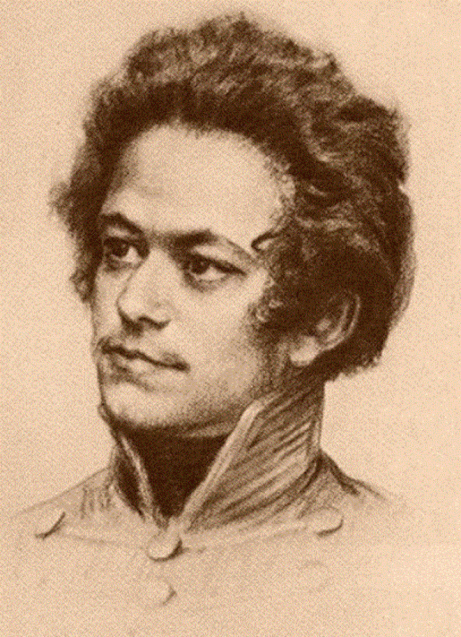
Young Karl Marx
By reducing Jewishness to capitalism, Marx was also overlooking another side of Jewish influence in the world: the revolution. The strong involvement of Jews in revolutionary movements would not become fully apparent to the world before 1848, but Marx, being himself a German Jewish revolutionary, could not be unaware of it. He could not be ignorant of the fact that Jews loved not only money, but also the revolution. Jewish revolutionary activity is one form of resistance to assimilation, especially when it calls for the destruction of the nations in the name of internationalism. By simply ignoring it, Marx was, at the very least, concealing the role of his own Jewishness in his revolutionary enterprise, while at the same time removing in advance all suspicion of his Jewish sympathies.
I believe Marx’s treatment of the Jewish question set the standard of his subsequent method. First, Marx misrepresents the arguments of his adversaries, often turning them upside down before proceeding to criticize them. For example Marx pretends that Bauer sees Jewishness as a religious faith, but that was not Bauer’s point. Rather, Bauer showed that defining Jewishness as a religion or ethnicity makes no big difference, because either way, the essence of Jewishness is separateness. Being religious only worsens the xenophobic nature of Jewishness, because it makes separateness a divine commandment rather than simply an ancestral habit. Secondly, Marx dismisses the complexity of things, in order to focus exclusively on a single and often secondary aspect of reality, making it look two-dimensional. Defining Jewishness as the love of money is obviously inadequate for anyone who has reflected even superficially on the question. Either Marx believes what he says, and that tells a lot about his intellectual ability, or he doesn’t—which is more likely—, and that tells a lot about his intellectual honesty. With the same reductionism Marx will claim in 1848, in the Communist Manifesto (Engels credited this insight to Marx alone), that, “The history of all hitherto existing society is the history of class struggles.” It is obvious to any (non-Marxist) historian that class struggles fall far behind ethnic struggles in the forces shaping history, even in modern times. Even an internationalist socialist like Bakunin could only be puzzled by Marx’s total ignorance of this fact:
“Marx completely ignores a most important element in the historic development of humanity, that is, the temperament and particular character of each race and each people, a temperament and a character which are themselves the natural product of a multitude of ethnological, climatological, economic, and historic causes, but which exercise, even apart from and independent of the economic conditions of each country, a considerable influence on its destinies and even on the development of its economic forces.”[21]
Coming from someone who grew up in a Jewish home and, despite his baptism, evolved in a mostly Jewish circle, counting among his friends zealot Jewish nationalists, I find it unbelievable that Marx’s ignorance of the national factor was sincere. Or perhaps, it must be considered very typical of Jewish discourse targeted at Gentiles. In that sense, Marx’s internationalism confirms Bauer’s remark that Jews consider only their own nationality as real:
“According to their fundamental representation, they wanted to be absolutely the people, the unique people, that is to say the people beside whom other peoples did not have the right to be a people. Any other people was, in comparison with them, not really a people; as the chosen people they were the only true people, the people who were to be All and take the world.”
Proudhon and the socialist movement before Marx
Having examined how Marx positioned himself on the background of the Jewish question, we can now do the same with the social question that occupied socialist thinkers.
At the time when Marx and Engels joined the movement, the most influential socialist theorist was Pierre-Joseph Proudhon (1809-1865), of nine years Marx’s elder. There is no better way to understand the originality of Marx’s economic ideas than by comparing them to Proudhon’s. (Proudhon’s work is accessible to English readers through Iain McKay’s anthology: Property is Theft! A Pierre-Joseph Proudhon Anthology, AK Press, 2011. McKay’s 82-page introductory chapters, including one on “Proudhon and Marx,” can be read here).
Proudhon’s book Qu’est-ce que la propriété? (What is Property? An Inquiry into the Principle of Right and of Government) published in 1840, had a huge echo and became a cornerstone of the European socialist movement. Proudhon was the first to use the expression “scientific socialism”, meaning a society ruled by a scientific government, one whose sovereignty rests upon justice and reason, rather than sheer will. His book was a critic of previous theories of economy (then called “political economy”) developed in Great Britain by Adam Smith (1723-1790) and David Ricardo (1772-1823). As explained by McKay, “It was Proudhon who first located surplus value production within the workplace, recognizing that the worker was hired by a capitalist who then appropriates their product in return for a less than equivalent amount of wages” (McKay 66).

A portrait of Proudhon by his friend Gustave Courbet (1865)
Proudhon’s thought was in constant evolution, and therefore not totally consistent from beginning to end, even in terminology. Nevertheless, if we want to summarize it, we shall say that Proudhon advocated a decentralized, self-managed, federal, bottom-up socialism, which he called “anarchism”. His vision was based on an organic model of society, the basic cell of which was the patriarchal family, while the “commune” was the fundamental unit of democratic sovereignty. In contrast, “governmental power is mechanical” and fundamentally inhuman (Confession of a Revolutionary, McKay 404).
Proudhon consistently spoke against projects of state socialism. For him, state ownership of the means of production was the continuation of capitalism with the state as the new boss. Nationalization would simply make a nation of wage-workers, and Proudhon viewed the condition of the wage-worker as little better than slavery. State control also kills competition, and Proudhon considered that “competition is as essential to labour as division”; it is “the vital force which animates the collective being” (System of Economic Contradictions, McKay 197 and 207).
Although he called himself a revolutionary, Proudhon was a reformist and a democrat. He recommended that workers gain political and economic emancipation by organizing themselves in “clubs”, cooperatives and associations for mutual credit, by electing representatives, and by exercising pressure and influence onto the state.
Proudhon’s central formula, “Property is theft,” is often misunderstood. Proudhon was attacking the capitalistic property of the means of production. Whereas the French constitution of 1793 defined property as “the right to enjoy the fruit of one’s labor,” capitalist property is, according to Proudhon, “the right to enjoy and dispose at will of another’s goods—the fruit of another’s industry and labour” (What is Property? McKay 124). In fact, Proudhon formulates a thesis and an antithesis. While claiming that “property is theft,” he devotes long pages to the apology of the small owner, whether artisan or peasant, whose property is based on use, what he calls “possession”. “Individual possession is the condition of social life. … Suppress property while maintaining possession, and, by this simple modification of the principle, you will revolutionize law, government, economy, and institutions” (What is Property? McKay 137). Proudhon encouraged mutualist forms of possession, but he condemned communism, which called for the complete abolition of private property: “Communism is oppression and slavery” (What is Property? McKay 132). Proudhon’s ideal was less the abolition of private property than its fair distribution.
Marx’s hijacking of the Proudhonian legacy
In The Holy Family, published in 1845, Marx and Engels praised Proudhon’s book What is Property?
“Proudhon makes a critical investigation — the first resolute, ruthless, and at the same time scientific investigation — of the basis of political economy, private property. This is the great scientific advance he made, an advance which revolutionizes political economy and for the first time makes a real science of political economy possible.”
“Proudhon was the first to draw attention to the fact that the sum of the wages of the individual workers, even if each individual labour be paid for completely, does not pay for the collective power objectified in its product, that therefore the worker is not paid as a part of the collective labour power.”
But the praises of Marx and Engels for Proudhon suddenly ceased in 1846. Two reasons can be conjectured. First, in 1846, Proudhon rejected Marx’s invitation to become his correspondent in Paris. In his answer, Proudhon criticizes Marx’s will to forge a unifying dogma:
“Let us seek together, if you will, for the laws of society, the manner in which these laws are manifested, the progress of our efforts to discover them. But for God’s sake, after having demolished all a priori dogmatisms, let us not in turn dream of making our own, of indoctrinating the people; … let us show the world an example of learned and insightful tolerance, but since we are in the lead, let us not set ourselves up as leaders of a new intolerance; let us not be the apostles of a new religion, one that makes itself a religion or reason, a religion of logic. We should welcome and encourage all protestations. Let us get rid of all divisiveness, all mysticism. Let us never consider a question exhausted, and when we do get down to our last argument, let’s start again, if need be, with wit and irony! I will join your organization on that condition—or else not!”
Proudhon also expressed reservations on the idea of violent revolution: “Our proletariat has a great thirst for science, which would be very poorly served if you only brought them blood to drink” (“Letter to Karl Marx,” McKay 163-165).
The second reason for Marx’s about-face regarding Proudhon was the Frenchman’s publication of Philosophie de la Misère (or System of Economic Contradictions), in which he developed new conceptual tools to understand the structure of the capitalist world. Marx, who had announced in 1846 a book of economy, was taken by surprise. He responded with a pamphlet in French, Misère de la philosophie, which Proudhon would describe as “a tissue of vulgarity, of calumny, of falsification and of plagiarism,” written by “the tapeworm of socialism” (McKay 70). McKay agrees:
“While, undoubtedly, Marx makes some valid criticisms of Proudhon, the book is full of distortions. His aim was to dismiss Proudhon as being the ideologist of the petit-bourgeois and he obviously thought all means were applicable to achieve that goal. So we find Marx arbitrarily arranging quotations from Proudhon’s book, often out of context and even tampered with, to confirm his own views. This allows him to impute to Proudhon ideas the Frenchman did not hold (often explicitly rejects!) in order to attack him. Marx even suggests that his own opinion is the opposite of Proudhon’s when, in fact, he is simply repeating the Frenchman’s thoughts. He takes the Frenchman’s sarcastic comments at face value, his metaphors and abstractions literally. And, above all else, Marx seeks to ridicule him.” (McKay 70-71)
Twenty years later, and two years after Proudhon’s death, the most essential concepts of Marx’s Capital: A Critique of Political Economy, would be borrowed from Proudhon, without any credit given him . When Marx writes that, “property turns out to be the right, on the part of the capitalist, to appropriate the unpaid labour of others or its product, and the impossibility, on the part of the worker, of appropriating his own product” (Capital, vol. 1, quoted in McKay 66), he is repeating what Proudhon wrote 27 years earlier in What is Property?
In 1867, when Marx published the first volume of Das Kapital, Proudhon’s notoriety and influence still far exceeded Marx’s in Europe. The International Workingmen’s Association (the First International) had been founded in 1864 by Proudhon’s followers, who called themselves mutualists and anti-authoritarians. Mikhail Bakunin (1814-1876), who became Marx’s strongest opponent within the International after Proudhon’s death, considered his own ideas as “Proudhonism widely developed and pushed right to its final consequences” (as quoted in McKay 46), although he criticized the Proudhonians’ attachment to hereditary property. At the Geneva Congress of 1866, the Proudhonians prevailed and convinced the Congress to vote unanimously in favor of working towards the suppression of salaried status through the development of co-operatives. Marxism had almost no influence on the French Commune of 1871, which was predominantly inspired by Proudhon’s ideas of decentralized federations of communes and workers’ associations.
The intensity of Marx’s will to supplant Proudhon can be seen in a letter to Engels dated July 20, 1870, at the dawn of the Franco-Prussian War, a war in which Marx saw the opportunity to get the upper hand over his rival:
“The French need a thrashing. If the Prussians win, the centralisation of the state power will be useful for the centralisation of the German working class. German predominance would also shift the centre of gravity of the workers’ movement in Western Europe from France to Germany, and one has only to compare the movement in the two countries from 1866 till now to see that the German working class is superior to the French both theoretically and organisationally. Their predominance over the French on the world stage would also mean the predominance of our theory over Proudhon’s, etc.”
The outcome of the war gave entire satisfaction to Marx.
The Communist Manifesto, a monopolist’s dream
Although Marx’s economic theory is largely plagiarized from Proudhon, his solutions are the exact opposite. That is because Marx’s project doesn’t proceed from his economic theories. According to Karl Jaspers, Marx’s approach “is one of vindication, not investigation, but it is a vindication of something proclaimed as the perfect truth with the conviction not of the scientist but of the believer.” British historian Paul Johnson concurs and, after quoting from the apocalyptic and “Luciferian” poetry of Marx’s youth, he concludes that,
“Marx’s concept of a Doomsday … was always in Marx’s mind, and as a political economist he worked backwards from it, seeking the evidence that made it inevitable, rather than forward to it, from objectively examined data.”[22]
Therefore, Marx’s theoretical sum published in 1867, Das Kapital, is almost irrelevant to understand his program, laid out in 1848 with Friedrich Engels in the Manifesto of the Communist Party. “The theory of the Communists,” we read there, “may be summed up in the single sentence: Abolition of private property.” As if responding to protests by the Proudhonians, they add:
“We Communists have been reproached with the desire of abolishing the right of personally acquiring property as the fruit of a man’s own labour, which property is alleged to be the groundwork of all personal freedom, activity and independence. / Hard-won, self-acquired, self-earned property! Do you mean the property of the petty artisan and of the small peasant, a form of property that preceded the bourgeois form? There is no need to abolish that; the development of industry has to a great extent already destroyed it, and is still destroying it daily.”
Abolition of private property naturally includes “abolition of all rights of inheritance,” especially since the Manifesto also proclaims the “abolition of the family,” seen as a bourgeois institution “based … on capital, on private gain.” Nations will disappear too, because “the working men have no country”; capitalism “has stripped him of every trace of national character.”
The current epoch “has simplified class antagonisms. Society as a whole is more and more splitting up into two great hostile camps, into two great classes directly facing each other—Bourgeoisie and Proletariat.” Engels adds in a footnote to the 1888 English edition that, “By bourgeoisie is meant the class of modern capitalists, owners of the means of social production and employers of wage labour.” Marx and Engels await the complete disappearance of “the lower strata of the middle class—the small tradespeople, shopkeepers, and retired tradesmen generally, the handicraftsmen and peasants—all these sink gradually into the proletariat.” The bourgeoisie, on the other hand, “has concentrated property in a few hands.”
Marx and Engels predict that this concentration of wealth in ever fewer hands, and the corresponding increase in misery among the growing working class, will intensify class warfare, and lead inevitably to the violent revolution of the proletariat. The Communists “openly proclaim that their goals cannot be reached except through the violent overthrow of the entire social order of the past.” After the failure of the 1848 revolution in Germany, Marx wrote that, “there is only one way in which the murderous death agonies of the old society and the bloody birth throes of the new society can be shortened, simplified and concentrated, and that way is revolutionary terror.”
The goal of the revolution is to establish the “dictatorship of the proletariat,” as a transition toward the abolition of all classes. This stage is necessary for the proletariat to defend itself against a counter-revolution and to bring about the classless society. Although the expression “dictatorship of the proletariat” doesn’t appear until 1852, the idea is clearly stated in the Manifesto:
“The proletariat will use its political supremacy to wrest, by degree, all capital from the bourgeoisie, to centralise all instruments of production in the hands of the State, i.e., of the proletariat organised as the ruling class; and to increase the total productive forces as rapidly as possible.”
The first thing to note is that Marx and Engels have no intention to appease the antagonism between the proletarians and the bourgeois, by improving the condition of workingmen. On the contrary, they hope that the conflict will intensify to the point of turning into a bloody civil war. For that, the misery of the working class must increase. We should remember here that tearing apart the social fabric of nations by exacerbating social, racial, generational or gender tensions is a strategy that Jewish intellectuals have used to this day.
Secondly, Marx and Engels have no intention to stop or even resist the progress of capitalism. On the contrary, they call for the total disappearance of the social and economic structures that preceded it, and look forward to its most extreme development, when all the means of production have fallen into a few hands. For only then, they claim, the new world can be born. Capitalism contains the seeds of its own destruction, but capitalism must first reach its full maturity, which is the monopoly of a few billionaires.
Obviously, monopolists can support wholeheartedly that goal. Should they fear the next step, the revolution and the appropriation of all capitals and all means of production by the state? Not necessarily, as Bakunin argued in 1872, and as Antony Sutton explained in more detail in Wall Street and the Bolshevik Revolution (2001):
“one barrier to mature understanding of recent history is the notion that all capitalists are the bitter and unswerving enemies of all Marxists and socialists. This erroneous idea originated with Karl Marx and was undoubtedly useful to his purposes. In fact, the idea is nonsense. There has been a continuing, albeit concealed, alliance between international political capitalists and international revolutionary socialists — to their mutual benefit. This alliance has gone unobserved largely because historians — with a few notable exceptions — have an unconscious Marxian bias and are thus locked into the impossibility of any such alliance existing. The open-minded reader should bear two clues in mind: monopoly capitalists are the bitter enemies of laissez-faire entrepreneurs; and, given the weaknesses of socialist central planning, the totalitarian socialist state is a perfect captive market for monopoly capitalists, if an alliance can be made with the socialist powerbrokers. Suppose — and it is only hypothesis at this point — that American monopoly capitalists were able to reduce a planned socialist Russia [or Germany] to the status of a captive technical colony? Would not this be the logical twentieth-century internationalist extension of the Morgan railroad monopolies and the Rockefeller petroleum trust of the late nineteenth century?”
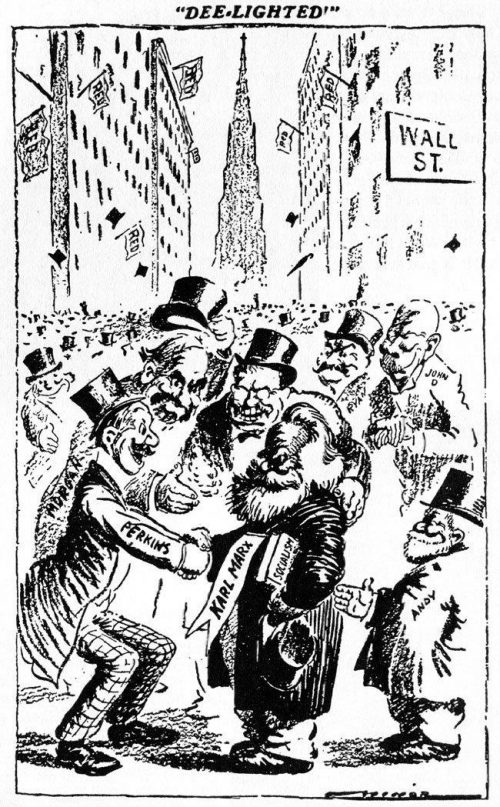
Marx being congratulated by Wall Street bankers (1911 cartoon reproduced by Sutton)
Sutton sees no Jewish conspiracy in this collusion between the Bank and the Revolution. But documents relative to the failed Russian revolution of 1905 show that there is another dimension to that unnatural alliance, as explained in this article by Alexandros Papagoergiou. In 1904, Russian Prime Minister Sergei Witte was tasked to secure a huge foreign loan to stabilize Russian public finances. He tells in his memoirs that, after turning down the offer of the Jewish banks headed by the Rothschilds, because it was conditioned on “legal measures tending to improve the conditions of the Jews in Russia,” he was able to raise the enormous amount of 2,250,000,000 francs via “Christian Banks”.[23] Revolutionary riots started soon after. A report of the Russian Foreign Minister to Tsar Nicholas II notes that it happened “just at the time when our government tried to realize a considerable foreign loan without the participation of the Rothschilds and just in time for preventing the carrying out of this financial operation; the panic provoked among the buyers and holders of Russian loans could not fail to give additional advantages to the Jewish bankers and capitalists who openly and knowingly speculated upon the fall of the Russian rates.” According to the report, the revolutionaries “are in possession of great quantities of arms which are imported from abroad, and of very considerable financial means,” which had been collected by Anglo-Jewish capitalists “under the leadership of Lord Rothschild, … for the officially alleged purpose of helping Russian Jews who suffered from pogroms.”[24]
Marxism vs Zionism: the dialectical pliers
Jewish movements seem to be working history through dialectical antagonisms that ultimately advance the Big Project. The capacity of the Jewish community to present itself either as a religion or as a nationality, depending on the circumstances, is the prime example. After gaining political emancipation in the name of religious freedom in the first part of the 19th century, European Jews were in the position to reclaim their special nationhood. For a few decades, reformed rabbis would ostensibly oppose Jewish nationalism, proclaiming in the 1885 Pittsburgh Conference: “We consider ourselves no longer a nation, but a religion community.”[25] Yet the same Pittsburgh Conference saw no contradiction in adopting the theory of German rabbi Kaufman Kohler, that “Israel, the suffering Messiah of the centuries, shall at the end of days become the triumphant Messiah of the nations,”[26] which amounts to say that Israel is not an ordinary nation, but the super-nation. In the 20th century, any trace of a contradiction between Reformed Judaism and Zionism was removed.
The early collaboration between Marx and Hess and the late encounter between Marx and Graetz both prefigure another dialectical opposition between Communism (the International revolution aimed at destroying Christian nations) and Zionism (the national project aimed at building the Jewish nation). Both movements developed in the same milieu. Chaim Weizmann recounts in his autobiography (Trial and Error, 1949) that in early twentieth-century Russia, revolutionary communists and revolutionary Zionists belonged to the same milieu. Weizmann’s brother Schmuel was a communist, and that was not a source of family discord. These divisions were relative and changeable; many Zionists were Marxists, and vice versa. The borderline was all the more vague that the Communist Bund, born the same year as Zionism (1897), inscribed in its revolutionary agenda the right of the Jews to found a secular Yiddish-speaking nation. As Gilad Atzmon recently wrote, the Bund was “also an attempt to prevent Jews from joining the ‘Hellenic’ route by offering Jews a tribal path within the context of a future Soviet revolution.”
But the most important thing to note is that, from the early days, Jewish revolutionary activity provided Zionists with a diplomatic argument in favor of their alternative program for the Jews. Herzl mentions in his diary (June 4, 1900) that “intensifying Jewish Socialist activities” was a way to “stir up the desire among the European governments to exert pressure on Turkey to take in the Jews” (Palestine was then under Ottoman control). He hawked Zionism as a solution to the problem of Jewish revolutionary subversion when meeting Kaiser Wilhelm II in 1898, and again when meeting Russian ministers in St. Petersburg in 1903.[27] The next generation of Zionists continued the stratagem. Churchill, who spoke with one voice with Chaim Weizmann,[28] dramatized the opposition between the “good Jews” (Zionists) and the “bad Jews” (communists) in his 1920 article “Zionism versus Bolshevism: A struggle for the soul of the Jewish people.” He referred to Bolshevism as “this world-wide conspiracy for the overthrow of civilization” and to Zionism as the solution “especially in harmony with the truest interests of the British Empire.” (Churchill’s later alliance with Stalin proves that his Zionism was stronger than his anti-communism.)
In the aftermath of World War II, the rivalry between the Communist and the Capitalist worlds remained the indispensable context for the creation and expansion of Israel. That explains why Roosevelt’s administration, largely controlled by Jews, helped Stalin conquer half of Europe and thwarted all attempts to stop him. Curtis Dall, Roosevelt’s son-in-law, has revealed a secret diplomatic channel demonstrating that the White House went out of its way to give the USSR all the time and the armament necessary to invade Central Europe.[29] Thus the Second World War was completed with the determined aim of laying the foundations for the Cold War, that is, a highly explosive polarization of the world that would prove crucial for Project Zion. In fact, during this whole period, it is almost impossible to distinguish, among the Jewish advisors of Roosevelt and Truman on foreign policy, the pro-Communists from the pro-Zionists, as David Martin remarks in The Assassination of James Forrestal. A case in point is David Niles (Neyhus), who was guilty of spying for the Soviets while advising Roosevelt, but then played a key role in Truman’s support of the U.N. Partition Plan and the recognition of Israel.[30]
The Cold War proved instrumental when Nasser, Israel’s most formidable enemy, was pushed into the communist camp in 1955, setting off an intense Zionist campaign to present him as a danger to the stability of the Middle East, and to present Israel, by contrast, as the only reliable ally in the region. The Cold War was also the crucial context for Israel’s defeat of Egypt in 1967 and Israel’s annexation of territories stolen from Egypt, Syria and Lebanon.
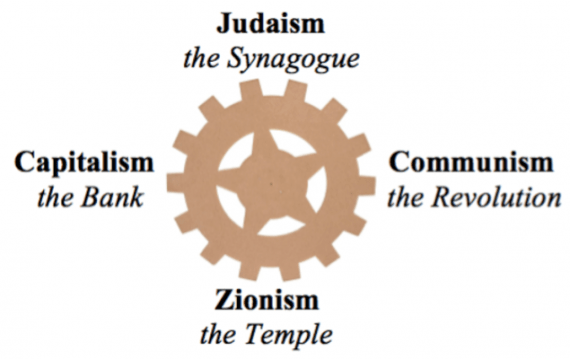
Yahweh’s dialectical machinery
Laurent Guyénot, Ph.D., has recently edited some of his Unz Review articles in book form, under the title Our God is Your God Too, But He Has Chosen Us: Essays on Jewish Power. He is also the author of From Yahweh to Zion: Jealous God, Chosen People, Promised Land … Clash of Civilizations, 2018, and JFK-9/11: 50 years of Deep State, Progressive Press, 2014.
Notes
[1] David Ben-Gurion and Amram Duchovny, David Ben-Gurion, In His Own Words, Fleet Press Corp., 1969, p. 116. Ben-Gurion’s prophecy appeared in the magazine Look on January 16, 1962, reproductions of which can be found on Internet.
[2] Karl Popper, Unended Quest: An Intellectual Autobiography (1976), Routledge, 2002, books.google.com
[3] Bakunin, Statism and Anarchy, trans. Marshall S. Shatz, Cambridge UP, 1990, pp. 538-545.
[4] Quoted in Alexandre Soljénitsyne, Deux siècles ensemble (1795–1995), tome I: Juifs et Russes avant la Révolution, Fayard, 2003, tome 1, p. 269.
[5] Robert Blake, Disraeli (1966), Faber Finds, 2010, p. 202.
[6] Amos Elon, The Pity of It All: A History of Jews in Germany 1743-1933, Metropolitan Books, 2002, pp. 153, 157, 163-164.
[7] Isaac Berlin, Karl Marx: His Life and Environment, 1939, 2nd ed, 1948, p. 17.
[8] Aux compagnons de la Fédération des sections internationales du Jura, quoted in Henri Arvon, Les Juifs et l’Idéologie, PUF, 1978, p. 50. Partial quote in Francis Wheen , Karl Marx, Fourth Estate, 1999, p. 340.
[9] Antony Sutton, Wall Street and the Bolshevik Revolution (1976), Clairview Books, 2011.
[10] Quoted in Kevin MacDonald, Separation and Its Discontents: Toward an Evolutionary Theory of Anti-Semitism, Praeger, 1998, kindle 2013, k. 4732–4877.
[11] Amos Elon, The Pity of It All, op; cit., p. 146.
[12] Shlomo Avineri, Karl Marx: Philosophy and Revolution, Yale UP, 2019, pp. 171-172.
[13] Moses Hess, Rome and Jerusalem: A Study in Jewish Nationalism, 1918 (archive.org).
[14] Sydney Hook, “Karl Marx and Moses Hess,” 1934.
[15] Shlomo Avineri , Moses Hess: Prophet of Communism and Zionism, 1985.
[16] Read Bakunin’s response to Hess’s article, “Aux citoyens rédacteurs du Réveil”
[17] French translation, Bruno Bauer, La Question juive (1843), Union générale d’Éditions, 1968, on
[18] Hal Draper, “Marx and the Economic-Jew Stereotype,” from Karl Marx’s Theory of Revolution, Vol.1: State and Bureaucracy, Monthly Review, New York 1977, pp. 591-608. Read also Gary Ruchwarger, “Marx and the Jewish Question: A Response to Julius Carlebach,” Marxist Perspectives, Fall 1979, pp. 19-38.
[19] I am aware that another “anti-Semitic” article, unsigned and titled “The Russian Loan” (New York Daily Tribune, January 4, 1856), has been attributed to Marx by his daughter, but I find Marx’s authorship dubious. See the discussion on its authenticity here.
[20] Nesta Webster, World Revolution: The Plot Against Civilization, 1921 , on archive.org, pp. 95-96.
[21] “Lettre au Journal La Liberté de Bruxelles,” October 5, 1872.
[22] Paul Johnson, Intellectuals: From Marx and Tolstoy to Sartre and Chomsky (1990), HarperCollins, 2007.
[23] The Memoirs of Count Witte, Doubleday, Page & Co, 1921, on archive.org, pp. 292-294.
[24] Quoted in Boris Brasol, The World at the Cross Roads, 1923, on archive.org, pp. 74-78.
[25] Quoted in Alfred Lilienthal, What Price Israel? (1953), Infinity Publishing, 2003, p. 14.
[26] Kaufmnann Kohler, Jewish Theology, Systematically and Historically Considered, Macmillan, 1918 (www.gutenberg.org), p. 290.
[27] The Complete Diaries of Theodor Herzl, edited by Raphael Patai, Herzl Press & Thomas Yoseloff, 1960, vol. 1 , pp. 362–363, 378–379, and vol. 3, p. 960.
[28] Martin Gilbert, Churchill and the Jews: A Lifelong Friendship, Henry Holt & Company, 2007.
[29] Curtis Dall, FDR: My Exploited Father-in-Law, Christian Crusade Publications, 1968 , pp. 146–157.
[30] David Martin, The Assassination of James Forrestal, McCabe Publishing, 2017, pp. 57-65. On Nile’s influence in the U.N. vote, see Alfred Lilienthal, What Price Israel ? (1953), 50th Anniversary Edition, Infinity Publishing, 2003, p. 50.
Human Activity in China and India Dominates the Greening of Earth, NASA Study Shows

Over the last two decades, the Earth has seen an increase in foliage around the planet, measured in average leaf area per year on plants and trees. NASA satellite data shows that China and India are leading the increase in greening. The effect stems mainly from ambitious tree planting programs in China and intensive agriculture in both countries.
Credits: NASA Earth Observatory
NASA | February 11, 2019
The world is literally a greener place than it was 20 years ago, and data from NASA satellites has revealed a counterintuitive source for much of this new foliage: China and India. A new study shows that the two emerging countries with the world’s biggest populations are leading the increase in greening on land. The effect stems mainly from ambitious tree planting programs in China and intensive agriculture in both countries.
The greening phenomenon was first detected using satellite data in the mid-1990s by Ranga Myneni of Boston University and colleagues, but they did not know whether human activity was one of its chief, direct causes. This new insight was made possible by a nearly 20-year-long data record from a NASA instrument orbiting the Earth on two satellites. It’s called the Moderate Resolution Imaging Spectroradiometer, or MODIS, and its high-resolution data provides very accurate information, helping researchers work out details of what’s happening with Earth’s vegetation, down to the level of 500 meters, or about 1,600 feet, on the ground.
The world is a greener place than it was 20 years ago, as shown on this map, where areas with the greatest increase in foliage are indicated in dark green. Data from a NASA instrument orbiting Earth aboard two satellites show that human activity in China and India dominate this greening of the planet.
Taken all together, the greening of the planet over the last two decades represents an increase in leaf area on plants and trees equivalent to the area covered by all the Amazon rainforests. There are now more than two million square miles of extra green leaf area per year, compared to the early 2000s – a 5% increase.
“China and India account for one-third of the greening, but contain only 9% of the planet’s land area covered in vegetation – a surprising finding, considering the general notion of land degradation in populous countries from overexploitation,” said Chi Chen of the Department of Earth and Environment at Boston University, in Massachusetts, and lead author of the study.
An advantage of the MODIS satellite sensor is the intensive coverage it provides, both in space and time: MODIS has captured as many as four shots of every place on Earth, every day for the last 20 years.
“This long-term data lets us dig deeper,” said Rama Nemani, a research scientist at NASA’s Ames Research Center, in California’s Silicon Valley, and a co-author of the new work. “When the greening of the Earth was first observed, we thought it was due to a warmer, wetter climate and fertilization from the added carbon dioxide in the atmosphere, leading to more leaf growth in northern forests, for instance. Now, with the MODIS data that lets us understand the phenomenon at really small scales, we see that humans are also contributing.”
China’s outsized contribution to the global greening trend comes in large part (42%) from programs to conserve and expand forests. These were developed in an effort to reduce the effects of soil erosion, air pollution and climate change. Another 32% there – and 82% of the greening seen in India – comes from intensive cultivation of food crops.
Land area used to grow crops is comparable in China and India – more than 770,000 square miles – and has not changed much since the early 2000s. Yet these regions have greatly increased both their annual total green leaf area and their food production. This was achieved through multiple cropping practices, where a field is replanted to produce another harvest several times a year. Production of grains, vegetables, fruits and more have increased by about 35-40% since 2000 to feed their large populations.
How the greening trend may change in the future depends on numerous factors, both on a global scale and the local human level. For example, increased food production in India is facilitated by groundwater irrigation. If the groundwater is depleted, this trend may change.
“But, now that we know direct human influence is a key driver of the greening Earth, we need to factor this into our climate models,” Nemani said. “This will help scientists make better predictions about the behavior of different Earth systems, which will help countries make better decisions about how and when to take action.”
The researchers point out that the gain in greenness seen around the world and dominated by India and China does not offset the damage from loss of natural vegetation in tropical regions, such as Brazil and Indonesia. The consequences for sustainability and biodiversity in those ecosystems remain.
Overall, Nemani sees a positive message in the new findings. “Once people realize there’s a problem, they tend to fix it,” he said. “In the 70s and 80s in India and China, the situation around vegetation loss wasn’t good; in the 90s, people realized it; and today things have improved. Humans are incredibly resilient. That’s what we see in the satellite data.”
This research was published online, Feb. 11, 2019, in the journal Nature Sustainability.

Credits: NASA Earth Observatory
The Zionist War without End

By Jeremy Salt | Palestine Chronicle | February 12, 2020
A reiteration of the war on Palestine, on the Arab world, on the Muslim world, on international law and human rights. There is no other way to describe the Trump-Kushner-Netanyahu ‘deal.’
Media comment centers on the last opportunity for the Palestinians. Will they take the scraps they are offered, or will they miss yet another opportunity to have something taken away from them?
This was the line used over decades by the glib Irish-born Zionist ‘foreign minister,’ Aubrey (Abba) Eban. The Palestinians never miss an opportunity to miss an opportunity, he said many times.
In fact, if anyone has never missed an opportunity to miss an opportunity it is the Zionists. They could have chosen to live with the Palestinians instead. They could have accepted their return after 1948. They could have handed back the land they seized in 1967. They could have honestly engaged with the so-called ‘peace process.’ They could have ended the blockade of Gaza. They could have stopped seizing and settling the land of another people. They could have agreed to share Al Quds. They could have stopped their murders and assassination.
What they could have done they never did. Instead, they headed in the opposite direction, financed, armed, protected and encouraged by the most powerful nation in the world.
A vulgarian property developer who once made ads for Pizza Hut has now told his zionist settler sidekick that he can have Palestine with the lot. Nothing is missed out, not Jerusalem, not the Jordan Valley and not the illegal settlements – the ‘outposts’ – as well as the legal ones, so says Netanyahu. All are completely illegal, of course, as is the presence of every settler on occupied land.
This demented agreement was put together by the plastic-faced Jared Kushner, who said, seriously apparently, that he read all of 25 books to get a handle on the situation. By comparison, Trump is unlikely to have read one so no wonder that he thinks his son-in-law is a genius.
This ‘deal’ – a deal without wheels – is being taken seriously in the mainstream media. In a way, of course, it has to be taken seriously as the Zionists have the weaponry to do whatever they want, no matter how mad, rapacious or destructive of their own interests in the long term.
And this is something the media seems to have missed. For whom, really, is this plan the last opportunity? The assumption is that it is the Palestinians but have Trump and Kushner noticed that while the Palestinians do not have the weapons, they have the numbers, that already the Muslim-Christian population of Palestine between the Mediterranean and the Jordan river is already greater than the Jewish population.
Silly to ask, but have either of these two taken into account the Muslim hinterland, the Muslim population of the Middle East and North Africa (close to 600 million) and the world Muslim population (about 1.8 billion)?
By comparison, the Jewish population of occupied Palestine is less than seven million. Far from trying to settle into the Muslim world, over more than seven decades it has done nothing but antagonize it. Like a spoilt child, it then complains that no one likes it, that the real reason for Muslim loathing of the Zionist state is anti-semitism, and not its racist, murderous and thieving behavior.
This is the game played endlessly by the Zionist lobby around the world. It hides behind the symbols of the religion it has hijacked. The Star of David flies from the pennants of the tanks that shell apartment buildings in Gaza and is inscribed on the wings of the planes that destroy entire families with missiles.
It is scrawled triumphantly on the walls of the West Bank. This is the Israel that the lobbyists and the rabbis defended behind their accusations against Jeremy Corbyn. It is he who wanted to end these horrors and they, behind their lies and false accusations of antisemitism against Corbyn and the entire Labor Party wanted to leave the Zionist state free to continue them. It is they who are the racists and anti-Arab Semites, not Jeremy Corbyn.
Palestine remains part of Arab and Islamic history and identity and remains an Arab and Muslim cause whatever the exasperation felt at Arab governments and the bungled and/or collaborationist policies of the Palestinian leadership.
By themselves, the Palestinians had no hope of resisting the Zionist takeover of their land. Zionism was an imperial project and the Zionist state was sequentially backed by the two mightiest empires on the planet, first Britain and then the United States. No small group of people anywhere would have been able to resist their power.
The greater danger to Israel always lay in the surrounding Arab and Muslim world. George Habash, the founder of the PFLP (Popular Front for the Liberation of Palestine) was writing in the 1950s that the road to the liberation of Palestine ran through the Arab world and this remains as true today as it was then, although the statement has to be qualified by adding “and the Muslim world.”
Israel understood this just as well as George Habash and knew that if it were to survive in the long term, the Arab world had to be fragmented, subverted, dominated and kept off balance permanently. This was the sine qua non of Israel’s existence. The ties that bound states together, that bound the region together and connected it with the wider Islamic world had to be broken.
It was not just armies and states that had to be broken but the Arab national idea and the Arab world as a presence in history and a place on the map. It would have to be what Israel and the US wanted it to be. It would have to be remade.
Towards this end, the zionists were looking for weak links in the chain of Arab states even in the 1930s. They thought they had found the weakest in Lebanon, where they hoped to set up a puppet Christian government. Not only did this not work but since the rise of Hezb0llah, the weakest link in the chain has turned into one of the strongest.
The Yinon Plan of the 1980s set out the strategy in full. All Middle Eastern states were to be subjected to ethnoreligious or tribal division. This broad script was fine-tuned by Netanyahu and the Zionists inside the US administration in the 1990s.
Iraq was the first of seven states targeted for destruction. The destruction through two wars and a decade of sanctions was enormous but the political strategy failed. The Kurdish state-in-being, planned by the US and Israel as a new center for strategic operations in the Middle East, has collapsed. The Shia-dominated government in Baghdad maintains good relations with Iran and following the assassination of Qasim Soleimani the Iraqi parliament demanded the complete withdrawal of US forces. Millions of people marched through the streets of Iraq’s cities as they did in Iran to mourn the murder of this outstanding military commander. Anti-American feeling in Iraq is at an all-time high.
The war in Syria was designed to bring down the axis of resistance (Iran, Syria, and Hezbollah) at its central arch but that has failed, too. Syria, its people, and its military have resisted the most determined attempt ever made to destroy an Arab government.
Always popular, Bashar al Assad is now more popular than ever, as the army, backed by Russian airpower, drives the takfiri terrorists from their last redoubt in Idlib province. Syrian cities have been shattered, perhaps half a million people have been killed but the US-Israeli political strategy in Syria has failed too.
For anyone who has been watching closely enough, the wheel of history, once turning in Israel’s favor, has been slowly turning against it for decades. Israel came close to defeat in the first week of the 1973 war. It drove the PLO out of Lebanon only to awaken a far more powerful enemy, Hezbollah. In every war it has fought or operation it has launched, the remorseless use of airpower has been critical. Nevertheless, even with air cover its foot soldiers were driven out of southern Lebanon in 2000 and, outfought by Hezbollah’s part-time soldiers, humiliated again when they returned in 2006.
Hezbollah and Iran have been working for decades on how to neutralize Israel’s air power. If – or once – they succeed in doing this, Israel is going to be in deep trouble on the battlefield.
Threatened repeatedly with destruction by the US and Israel, Iran has had to develop a new range of missiles capable of causing devastation to US bases, aircraft and warships in the region. The retaliation which followed the murder of Qasim Soleimani was an example. The Americans failed to stop even one of the Iranian missiles directed against two of its bases in Iraq.
Aircraft were destroyed in their hangars and while no soldiers were killed – so the US government says – dozens suffered severe brain injuries, apparently from concussion, with a number being flown to Germany for emergency treatment. Iran says the casualties were far greater than the US is prepared to admit.
Hezbollah has its own stocks of missiles, far greater in number and sophistication than in 2006, and has its targets already worked out for when the next war comes. As Israel’s military commanders are making clear, the next war is a question of ‘when’ and not ‘if.’ They are warning the civilian population to be prepared for the unprecedented scale of the casualties they are going to suffer.
So, for whom is the bell really tolling now, the Palestinians or the Zionists? Gideon Levy writes that the Kushner-Trump deal is likely to trigger a third nakba. This is incorrect, as there has only been one nakba, continuing now for more than seven decades.
David Hearst, writing in Middle East Eye, thinks all the Palestinians have to sit tight, because, between the Mediterranean and the Jordan River, they are going to win the war of numbers, if they haven’t won it already. By implication, once the war of numbers is won, the war itself is won. The Zionist state will see reason and turn itself into the secular democratic state the Palestinians always wanted, with equal rights for all. Given that they would be the majority, they would have to be the dominant element in any freely-elected government. The Zionist dream-nightmare would be over.
This is not likely to happen. Zionism is an extreme ideology and the politicians running the Zionist state now are the most extreme since its foundation. They are not going to surrender because of demographics. They will simply try harder to overcome the problem. They still want all the Palestinians out of Palestine or at the very least reduced to an inconsequential ethnic remnant. Between the apartheid state and the democratic state, this is their preferred solution.
What they need is another war enabling them to strike down their external enemies and simultaneously solve the ‘Palestine problem’ once and for all. If (or rather when) such a war does break out, Hezbollah will swamp the Zionist state with missiles in such numbers as to overwhelm its defense systems.
The Palestinians will be determined to stay put but in the fog of war, while the world is looking elsewhere, at missile attacks on US bases and soaring oil prices following the closure of the Strait of Hormuz, perhaps they can again be terrorized into leaving. Even the most steadfast Palestinians have families to protect and if they won’t go then the level of terror only has to be increased until they do. This is the evil calculus applied before and likely to be applied again once the opportunity arises or, more accurately, can be created.
Who wants such a war? Not the Palestinians, and not Hezbollah or Iran although they have had no option but to prepare for it. Who has set up the conditions for such a war, decade after decade to the point where it has to be regarded as inevitable unless ‘the Arabs’ and the Muslims really are the useless orientals of the western imagination, there to be kicked around endlessly? Israel has, by its disgraceful behavior.
So has the US and so has the ‘west’ in general, its governments, its media and its institutions (where has the UN Secretary-General, the moral guardian of peace in the world, been during the eight atrocious years of war on Syria? Hiding in a cupboard?). It is ‘the west’ generically which created Israel, and has allowed it to get away with wars, ethnic cleansing, massacres, assassination and occupation generation after generation.
Perhaps a shattering setback is all that will bring this utterly dangerous state to its senses. Of course, there is always the possibility that it will go completely off the edge and use its nuclear weapons, turning the central lands of the Middle East into a wasteland but at least taking its enemies down with it in the most pyrrhic of victories. These are grim possibilities but they have to be taken seriously.
– Jeremy Salt taught at the University of Melbourne, at Bosporus University in Istanbul and Bilkent University in Ankara for many years, specializing in the modern history of the Middle East. Among his recent publications is his 2008 book, The Unmaking of the Middle East. A History of Western Disorder in Arab Lands (University of California Press).
‘Ahuman Manifesto’: The Final Solution to Climate Change
By Robert Bradley Jr. | Master Resource | February 10, 2020
“This book is a delightful provocation and invitation: to imagine a world without humans and to think of what we can do to get there. It is an urgent call for action.”
― Christine Daigle, Professor of Philosophy, Brock University, Canada
Here you go: the “final solution” to climate change. This book is a glimpse of where the climate road to serfdom ends. (And it is not, I repeat not, a Babylon Bee satire.)
The Ahuman Manifesto: Activism for the End of the Anthropocene” by Patricia MacCormack (Bloomsbury Academic: 2020) is self-described as follows:
We are in the midst of a growing ecological crisis. Developing technologies and cultural interventions are throwing the status of “human” into question.
It is against this context that Patricia MacCormack delivers her expert justification for the “ahuman.” An alternative to “posthuman” thought, the term paves the way for thinking that doesn’t dissolve into nihilism and despair, but actively embraces issues like human extinction, vegan abolition, atheist occultism, death studies, a refusal of identity politics, deep ecology, and the apocalypse as an optimistic beginning.
In order to suggest vitalistic, perhaps even optimistic, ways to negotiate some of the difficulties in thinking and acting in the world, this book explores five key contemporary themes:
· Identity
· Spirituality
· Art
· Death
· The apocalypseCollapsing activism, artistic practice and affirmative ethics, while introducing some radical contemporary ideas and addressing specifically modern phenomena like death cults, intersectional identity politics and capitalist enslavement of human and nonhuman organisms to the point of ‘zombiedom’, The Ahuman Manifesto navigates the ways in which we must compose the human differently, specifically beyond nihilism and post- and trans-humanism and outside human privilege. This is so that we can actively think and live viscerally, with connectivity (actual not virtual), and with passion and grace, toward a new world.
Four positive pre-publication reviews are shared:
“Patricia MacCormack goes relentessly beyond ‘just’ deconstructing anthropocentrism and dismantling multispecies extinction caused by human dominance in the Anthropocene. The manifesto is not only theorizing, but compassionately calling for direct abolitionist action for the other at the expense of the (human) self. Trembling with joyful energy and critically affirmative insights, this manifesto encourages us to engage in ahuman arts & activist practices, inspired by queer feminist (secular) spirituality, and death activism.” ―Nina Lykke, Professor of Gender Studies, Linköping University, Sweden
“This beautiful book is both a passionate, insightful meditation on the world we actually live in, and a radical call to action. Is it even possible for us to stop being human, to let multiple beings flourish without reducing them to means for our own selfish ends? Reading this book, thinking with it and about it, and responding openly to it, is absolutely essential.” ―Steven Shaviro, DeRoy Professor of English, Wayne State University, USA
“Patricia MacCormack’s splendid refusal to nuance her intent in The Ahuman Manifesto will both intrigue and infuriate. As a vegan abolitionist/extinctionist, she provides an unrelenting and exacting take down of the violent self-interest of the human species, and offers a call to ethical action best described as eating the Anthropocene.” ―Margrit Shildrick, Guest Professor of Gender and Knowledge Production, Stockholm University, Sweden
“This book is a delightful provocation and invitation: to imagine a world without humans and to think of what we can do to get there. It is an urgent call for action. A joyful, lucid, fiercely intelligent call to readers to hope and work for a future not for themselves, but for the thriving of all nonhuman life. Engaging with this book will be a transformative experience. One cannot see the world or oneself in the same way after reading it.” ―Christine Daigle, Professor of Philosophy and Director of the Posthumanism Research Institute, Brock University, Canada
A writeup by Alisair Ryder in Cambridge News, “‘The only solution for climate change is letting the human race become extinct,’” describes the book and author as follows:
Patricia MacCormack, a professor of continental philosophy at Anglia Ruskin University, has just released her new book The Ahuman Manifesto, which will officially be launched in Cambridge today (Wednesday, February 5).
The book argues that due to the damage done to other living creatures on Earth, we should start gradually phasing out reproduction. But rather than offering a bleak look at the future of humanity, it has generated discussion due to its joyful and optimistic tone, as it sets out a positive view for the future of Earth – without mankind.
It also touches on several hot-button topics, from religion and veganism to the concept of identity politics, tying these into how the creation of a hierarchal world among humans has left us blind to the destruction we are causing to our habitat and other forms of life.
Speaking to CambridgeshireLive, Professor MacCormack outlined how she came to this point of view, and how these ideas are not as provocative as they may initially sound.
She said: “I arrived at this idea from a couple of directions. I was introduced to philosophy due to my interest in feminism and queer theory, so reproductive rights have long been an interest to me – this led me to learn more about animal rights, which is when I became vegan.
“The basic premise of the book is that we’re in the age of the Anthropocene, humanity has caused mass problems and one of them is creating this hierarchal world where white, male, heterosexual and able-bodied people are succeeding, and people of different races, genders, sexualities and those with disabilities are struggling to get that.
“This is where the idea of dismantling identity politics comes in – they deserve rights not because of what they are, but because they are.
“The book also argues that we need to dismantle religion, and other overriding powers like the church of capitalism or the cult of self, as it makes people act upon enforced rules rather than respond thoughtfully to the situations in front of them.”
The central argument in The Ahuman Manifesto can be boiled down to this: mankind is already enslaved to the point of “zombiedom” by capitalism, and because of the damage this has caused, phasing out reproduction is the only way to repair the damage done to the world.
Additionally, humanity has to see it isn’t the single living dominant force – but first, it needs to dismantle an established hierarchy amongst itself. This argument has not received as much disagreement as you might expect.
Professor MacCormack continued: “Everyone’s okay with the ideas in the book until they’re told they’d have to act on it. There is a lot of agreement that these changes might work for the world, but when it imposes on people, it becomes proactive.
“Many people are surprised it’s so joyful and it has this radical compassion, which cares for the world. It’s not about our death, so much as it’s about celebrating the tools that exist to care for a decelerating Earth.
“People wonder why I don’t think humans are exceptional, dominant beings – but when I ask them why they think that, I never get a good answer back. The way we perceive the world isn’t the only one, we never think about animal life.
“Even Extinction Rebellion only focus on the effect this will have on human life when climate change is something that will affect every living being on the planet.
This worldview of hopelessness, victimization, and human-hate is truly the end of the road to serfdom. It is the final solution with all of humankind, not just one race or creed, in the balance.
Featured Video
Nima R. Alkhorshid: US military bombs multiple targets on Iran’s Qeshm Island
or go to
Aletho News Archives – Video-Images
From the Archives
British Intel Tried to Make N Irish Gang ‘Shoot Up’ School, Documentary Claims
Sputnik – 23.02.2019
A new documentary, based on an interview with a self-confessed member of the Glennane Gang, gives some insights into allegations that British military intelligence was behind a shocking murder plot to cause the situation in Northern Ireland to “spiral out of control”.
In a documentary, Unquiet Graves: The Story of the Glennane Gang, John Weir, a former officer from the Royal Ulster Constabulary (RUC), alleges that British intelligence tried to persuade paramilitary group Ulster Volunteer Force (UVF) to attack a Catholic primary school at Belleeks in County Armagh.
Weir claimed that the UVF was urged to kill children and teachers in retaliation for the 1976 Kingsmill massacre, in which gunmen stopped a minibus carrying twelve workmen and shot them; only one person survived despite having been shot 18 times.
“The plan that was decided on was to shoot up a school in Belleeks”, he said, adding that the British intelligence plot was to make the situation in Northern Ireland “spiral out of control”. … continue
Blog Roll
 Aletho News
- Zelensky’s Critics Vanish Into Ukrainian Secret Prisons – Source
- Nima R. Alkhorshid: U.S. Military Bombs Multiple Targets on Iran’s Qeshm Island
- Iran-Linked Ships Spotted Hovering over Subsea Cables: Report
- New attack on Iran could devastate ‘Israel’, IOF general warns
- Nuclear deterrence: The US-Israeli military aggression against Iran made the unthinkable legitimate
- U.S. Midterms – a Referendum on Israel and Zionist Power
- Twice as many Canadian Jews serve in Israeli military as Canada’s armed forces: Report
- Thousands of Syrian troops set to join Saudi war on Yemen
- Jared Kushner’s Diplomacy for Hire
- Russia backs Tehran’s conditions in talks with US, Iran’s envoy says
- If Americans Knew
- An error has occurred; the feed is probably down. Try again later.
- No Tricks Zone
- Zonal Asymmetry of Temperature Change in the Antarctic Circumpolar Current
- New Study: The Net Fossil Fuel Contribution To Rising Atmospheric CO2 Has Been Zero For 500 Years
- Germany’s Green Energy Transition Becoming Increasingly Expensive…Another 6 Trillion Euros!
- Sudden Stratospheric Warming, Powerful El Niño Combination May Lead To Extreme Europe Cold, Energy Crisis!
- Two New Studies Find Thwaites Glacier Melt Cannot Be Driven By Human Activity Or A Warming Ocean
- E-Cars Reduce CO2 Emissions By Only 41% Compared To Internal Combustion Engine Vehicles
- Predictions Made By Renowned Climate Professor Over Past Decades Have Been Proven To Be Poor
- New Study Suggests Large Regions Of The Pacific Ocean Have Been Cooling For The Last 80 Years
- Germany’s Green Energy Debacle: High Energy Costs Force Kahla Porzellan to Close After 182 Years!
- New Study: 50 Years Of The Most Aggressive ‘Net Zero’ Policies Can Only Affect The Global Climate By 0.03°C

