Karl Marx and Jewish Power
By Laurent Guyénot • Unz Review • February 17, 2020
In a recent article, I explored the influence of Freud’s Jewishness on the formation, reception and propagation of his psychoanalytical theory. I wish now to do the same for Karl Marx (1818-1883). In contrast to Freud’s, Marx’s Jewishness is seldom considered an important factor. If you type “Freud Jewish” as key-words on Amazon.com, you will be suggested a dozen books dealing specifically with Freud’s Jewishness, whereas “Marx Jewish” will yield no result except Marx’s own essays “On the Jewish Question”, and a discussion of them, with precious little about Marx’s own Jewish background and connections.
Even in the literature exposing the role of Jews in the Bolshevik revolution in Russia and other revolutionary movements of the twentieth century, such as Alexander Solzhenitsyn’s two-volume 200 Years Together, a contextualized analysis of Marx’s Jewishness is lacking.
One obvious reason is that Marx was not Jewish: he had been baptized a Lutheran at the age of six. Yet to claim that baptism had washed away all traces of Jewishness would be absurd, and particularly ironic in the case of a person who insisted that religion was an inessential part of Jewishness (as we shall see).
My purpose here is to examine Marx’s contribution to Jewish empowerment, and, ultimately, to the historical movement toward Jewish global domination that made a major breakthrough a century exactly after the Communist Manifesto (1848).
I must say in preamble that the question is not: Did Marx deliberately conspire with other Jews to advance the Jewish global agenda, while pretending to emancipate Gentile proletarians? Jewishness doesn’t necessarily work that way. It could be defined as the inability to distinguish between the interest of peoples, and the interest of the chosen people, between what is good for mankind and what is good for the Jews. As a rule, Jews who believe they are working for the salvation of the world while thinking Jewishly are advancing Jewish power one way or another. This applies, of course, to Jewish thinkers who believe that Jews have a mission to guide mankind toward perpetual peace, like Theodore Kaufman, who in 1941 believed that the first step to that goal was to “sterilize all Germans” (his interview with the Canadian Jewish Chronicles), or like David Ben-Gurion, who in 1962 believed that the next step was to make Jerusalem the “seat of the Supreme Court of Mankind, to settle all controversies among the federated continents, as prophesied by Isaiah.”[1] But it also applies to Jewish thinkers who do not publicly identify as Jews and are even critical of Jews, yet whose worldview is profoundly biblical, that is, both materialistic and prophetic. It is a question of inherited cognitive pattern, rather than deliberate intention. That being said, in Marx’s case, there is evidence of intellectual dishonesty, concealment and deception, as we shall see.
Marx’s prophecy and Bakunin’s foresight
According to Karl Popper, “the heart of the Marxian argument … consists of a historical prophecy, combined with an implicit appeal to the following moral law: Help to bring about the inevitable!”[2] There is no doubt that Marx’s prophecy of a messianic transformation of the world was profoundly Jewish in inspiration. What distinguishes Marx’s prophetic vision from the biblical project is that its explicit goal (as we shall see) is the international dictatorship of a cosmopolitan proletariat, not of Jewry. Yet, as Mikhail Bakunin warned in Statism and Anarchy (1873), Marx’s proletarian state “is a lie behind which the despotism of a ruling minority is concealed.” Behind the expression “scientific socialism”, Marx could only mean “the highly despotic government of the masses by a new and very small aristocracy of real or pretended scientists.”[3] That centralized state, according to Marxist doxa, will be a transitional stage before true socialism; it will “wither away”, according to Engels’ expression. To this, Bakunin replies “that no dictatorship can have any other objective than to perpetuate itself, and that it can engender and nurture only slavery in the people who endure it.” Bakunin suspected that if Marx had his way, German Jews like him would end up ruling the communist state.
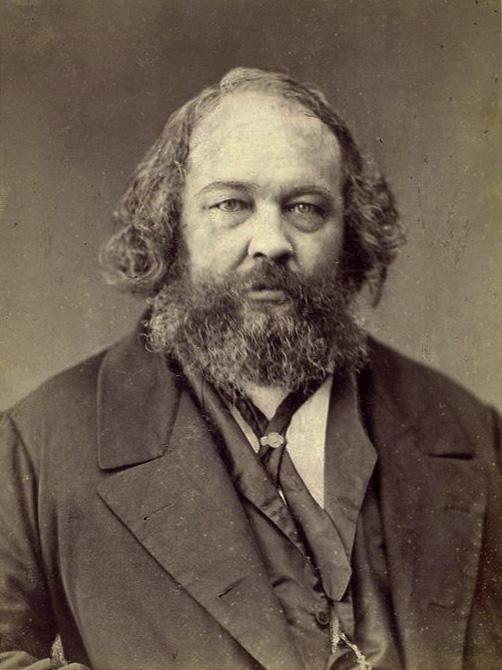
Bakunin photographed by Nadar
Indeed, Marx’s revolutionary prophecy appealed particularly to non-proletarian German Jews. Fritz Kahn hailed him as more than a prophet in Die Juden als Rasse und Kulturvolk (1920): “in 1848, for the second time, the star of Bethlehem was raised to the firmament … and it rose again above the rooftops of Judea: Marx.”[4]
If Marx was the Messiah in 1848, then Benjamin Disraeli could be called his prophet. In his novel Coningsby, published in 1844, the Jewish character Sidonia—“a cross between Lionel de Rothschild and Disraeli himself,” according to Disraeli’s biographer[5]—declared:
“That mighty revolution which is at this moment preparing in Germany, and which will be, in fact, a second and greater Reformation, and of which so little is as yet known in England, is entirely developing under the auspices of Jews, who almost monopolise the professorial chairs of Germany.”
Four years after these words were written, the Communist Manifesto was published and, almost simultaneously, the revolution broke out in Germany, as Disraeli had predicted . Jews did play a major role in the 1848 revolution, as Amos Elon has shown in his book The Pity of It All: A History of Jews in Germany 1743-1933. “80 percent of all Jewish journalists, doctors, and other professionals” supported the revolution. The most prominent were Ludwig Bamberger in Mainz, Ferdinand Lassalle in Dusseldorf, Gabriel Riesser in Hamburg, Johan Jacoby in Koeningsberg, Aron Bernstein in Berlin, Herman Jellinek in Vienna, Moritz Harmann in Prague, and Sigismund Asch in Breslau. “All over the country,” Elon writes, “rabbis in their sermons greeted the revolution as a truly messianic event.” The Jewish magazine Der Orient praised “the heroic Maccabean battle of our brethren on the barricades of Berlin,” and raved, “The savior from whom we have prayed has appeared. The fatherland has given him to us. The messiah is freedom.” The Jewish scholar Leopold Zunz, founder of academic Judaic Studies (Wissenschaft des Judentums),
“described what was happening in specifically biblical terms shot through with the Messianic political view which saw revolutionary politics as the fulfillment of biblical promise. Haranguing the Berlin students from the barricades, Zunz portrayed Metternich [Chancellor of the Austrian Empire] as Haman and hoped that ‘perhaps by Purim, Amalek [meaning the Prussian king Friedrich Wilhelm IV] will be beaten.’”[6]
After the failure of the revolution, many revolutionaries exiled themselves to London, where they were known as the Forty-Eighters. Marx settled there for the rest of his life, “living encased in his own, largely German, world, formed by his family and a small group of intimate friends and political associates,” according to Isaac Berlin.[7] Apart from Engels, Marx’s friends and associates were, in fact, almost all Jewish. Marx’s influence, which had been small in the 1848 revolution, would then develop, thanks to what Bakunin would call in 1872, in an unpublished “Lettre au Journal La Liberté de Bruxelles,” his “remarkable genius of intrigue,” adding:
“he also has in his service a numerous corps of agents, hierarchically organized and acting secretly under his direct orders; a kind of socialist and literary freemasonry in which his compatriots, the German Jews and others, occupy a considerable place and deploy a zeal worthy of a better cause.”
Bakunin was particularly intrigued by Marx’s insistence on the centralization of all banking activity. The Communist Manifesto not only proclaims the abolition of private banks, but: “Centralisation of credit in the hands of the State, by means of a national bank with State capital and an exclusive monopoly.” In another unpublished editorial of 1872, Bakunin wrote:
“this Jewish world is today, for the most part, at the disposal of Marx on the one hand, and of Rothschild on the other. I am convinced that the Rothschilds, on their side, appreciate the merits of Marx and that Marx, on his side, feels an instinctual attraction and a great respect for the Rothschilds. / This may seem strange. What can there be in common between socialism and a major bank? The point is that Marx’s communism wants a strong centralization of the state, and where there is centralisation of the state, there must necessarily be a central bank, and where such a bank exists, the parasitic nation of the Jews, speculating with the Labour of the people, will always thrive.”[8]
Having succeeded to get Bakunin and his “anti-authoritarian” followers expelled from the International Workingmen’s Association (the First International), Marx transferred its General Council from London to New York—the city that would soon become the Western capital of Jewry, where another German Jew, Leon Braunstein aka Trotsky, would be preparing the Bolshevik revolution, with the financial support of Wall Street Jewish bankers like Jacob Schiff.[9]
The Jewish Question in nineteenth-century Germany
 In order to understand Marx’s hidden agenda, the best is to start with his first two significant articles, published in 1844 in the Deutsch-Französische Jahrbücher, four years before the Communist Manifesto. Their topic was the “Jewish Question”. Before we present what Marx had to say about it, we must recall the context.
The “Jewish Question” is the question of the possibility and means of Jewish assimilation. The problem, as it was commonly formulated from the end of the eighteenth century, was that Jews considered themselves, and were considered, as aliens in the European nations among which they lived. One solution was to transform Jewishness from a nationality into a religion compatible with the secular values of modern nations. Moses Mendelssohn (1729–1786) paved the way in Germany for a “Reform Judaism” that defined itself as purely religious and renounced nationalist aspirations. On the basis of this new pact, Napoleon granted political emancipation to the Jews in France, and was hailed as a liberator by German Jews when he invaded the German principalities. Although Jewish emancipation underwent a setback in Prussia when he withdrew in defeat, it was complete by 1848.
 However, the assumption that Jewishness was a matter of private religion created a new problem for the Jewish community, aggravated by residual forms of segregation: for many secular and educated Jews, Judaism had little appeal as a religion, and converting to Christianity seemed the logical continuation of their conversion to the Enlightenment. Half the Jews of Berlin converted to Protestantism or Catholicism in the late eighteenth and early nineteenth century.
Karl Marx’s family falls in that category. His father Herschel Levi, though the son and brother of rabbis, became a Lutheran in order to practice law in the Prussian courts, and had his six children and his wife baptized in 1824, when Karl was six years old. Another famous case is Heinrich Heine (1797–1856), who conceived of his baptism in 1825 (one year after Marx) as the “entrance ticket to European civilization.”[10] Marx met Heine, a generation his elder, shortly after his arrival in Paris in 1843, and the two men met frequently until Marx moved to London in 1849. It is believed that their conversations had a formative influence on both men. Heine may in fact have introduced Communism to Marx, for he wrote in 1842, one year before meeting Marx:
“Though Communism is at present little talked about, vegetating in forgotten attics on miserable straw pallets, it is nevertheless the dismal hero destined to play a great, if transitory role in the modern tragedy… There will then be only one shepherd with an iron crook and one identically shorn, identically bleating human herd.”[11]

Heine with Marx and his wife Jenny
The dissolution of Jewish identity into a religious faith led to a reaction in the form of a Jewish nationalist movement that would ultimately morph into Zionism. It was the German Jewish historian Heinrich Graetz (1817-1891), almost the same age as Marx, who gave the first impetus to a new Jewish national consciousness with his multivolume History of the Jewish People, published in 1853 . Marx first met Heinrich Graetz in the summer 1874, while “taking the waters” at Carlsbad in Bohemia. The two following summers, they coordinated their vacations there. We do not know what they talked about, but, as Shlomo Avineri comments, “a more dramatic prefiguration of the encounter between Zion and Kremlin could not be imagined.”[12]
Graetz reawakened the national consciousness of European Jews such as Moses Hess (1812-1875), author in 1862 of Rome and Jerusalem: The Last National Question, which in turn impressed Theodor Herzl. According to Hess, the efforts of the Jews to merge with a nationality other than their own are doomed to failure. “We shall always remain strangers among the nations,” for “the Jews are something more than mere ‘followers of a religion,’ namely, they are a race brotherhood, a nation.”[13]
Interestingly, before his conversion to Jewish nationalism, Moses Hess (originally Moritz) was a pre-Marxist communist. He was the founder of the Rheinische Zeitung, for which Marx served as Paris correspondent in 1842-43 . Hess had a strong influence on both Engels and Marx.[14] Marx borrowed from Hess’ 1845 essay on “The Essence of Money” his concept of economic alienation.[15] Hess always remained close to Marx; in 1869, at Marx’s request, he even penned an article slandering Bakunin, accusing him to be an “agent provocateur” of the Russian government.[16]
Marx’s response to Bruno Bauer
Marx’s essays on the Jewish Question were critical reviews of two works by Bruno Bauer (1809-1882), a leading figure of the Young Hegelians: a book titled Die Judenfrage (1842), and a follow-up article on “The Capacity of Present-day Jews and Christians to Become Free.”[17]
Bauer’s approach to the question of Jewish assimilation was innovative. For him, the religious nature of Judaism is the problem, not the solution. He argued that Jews cannot be emancipated politically without first being emancipated religiously, because the Jews’ resistance to assimilation is based on the commandment of the Torah to live permanently in separation from other people. The essence of their religion is their claim to be the chosen people, and that prevents them from even respecting other peoples.
“Jews as such can not amalgamate with peoples and associate their fate with theirs. As Jews, they must wait for a particular future, allotted to them alone, the chosen people, and assuring them the dominion of the world.”
Therefore, there can be no emancipation of the Jews. A Jew can emancipate himself only by ceasing to be a Jew, because his true alienation is his Jewishness.
Bauer was the first since Voltaire to point at the toxic influence of the Tanakh as the key to the Jewish Question. Christians could obviously never reach that conclusion, but even secular thinkers who subscribed to the new science of “higher criticism” (pioneered by David Strauss’ Life of Jesus, 1835) generally looked away from the xenophobia of the Tanakh. “One even screams at betrayal of the human race when the critics try to examine the essence of the Jew as a Jew,” noted Bauer.
In his critical reviews, Marx does not argue against Bauer’s point that Jewish religion is opposed to assimilation. Rather, he denies altogether that Jewishness is a matter of religion.
“Let us consider the actual, worldly Jew—not the Sabbath Jew, as Bauer does, but the everyday Jew. Let us not look for the secret of the Jew in his religion, but let us look for the secret of his religion in the real Jew.”
Since Marx downplays the religious definition of Jewishness, it would be expected that he opt for the second term of the alternative and define Jewishness as a nationality, as will his friend Hess twenty years later. But he doesn’t. Instead, Marx posits, for the first time, his dogma that religion belongs to the cultural “superstructure” of society, while the real “infrastructure” is economic. The essence of the Jew, he writes, is not his religion, but his love of money:
“What is the secular basis of Judaism? Practical need, self-interest. What is the worldly religion of the Jew? Huckstering. What is his worldly God? Money.”
Marx redefines Jewish religion as the cult of money: “Money is the jealous god of Israel, in face of which no other god may exist.” He does the same for Jewish nationality, in one short sentence: “The chimerical nationality of the Jew is the nationality of the merchant, of the man of money in general.” It follows naturally, according to Marx, that if you abolish money you will solve the Jewish question:
“Very well then! Emancipation from huckstering and money, consequently from practical, real Judaism, would be the self-emancipation of our time. An organization of society which would abolish the preconditions for huckstering, and therefore the possibility of huckstering, would make the Jew impossible. His religious consciousness would be dissipated like a thin haze in the real, vital air of society.”
Jews will be emancipated when all men will be emancipated, for there is no other emancipation than emancipation from money.
Marx makes the radical claim that love of money and economic alienation came to the world from the Jews. He equates economic alienation to Jewish influence:
“the practical Jewish spirit has become the practical spirit of the Christian nations. The Jews have emancipated themselves insofar as the Christians have become Jews. … The Jew is perpetually created by civil society from its own entrails. … The god of the Jews has become secularized and has become the god of the world”
And so, “In the final analysis, the emancipation of the Jews is the emancipation of mankind from Judaism.” That sounds terribly anti-Semitic, from today’s standards. Because of these essays on the Jewish Question, Marx’s biographers have been more concerned by the question, “Was Marx an anti-Semite?” (see Edmund Silberner’s 1949 book of that title) than by the issue of his Jewish background, environment, and mindset. This is best illustrated by this article by Michael Ezra, “Karl Marx’s Radical Antisemitism.”
 But in the context of the time, Marx’s view of the Jews as money worshippers was rather banal. It was almost unanimously shared among socialists, as Hal Draper reminds us in “Marx and the Economic-Jew Stereotype.”[18] It was especially common among revolutionary Jews as well as among Zionists who were generally socialists. Moses Hess himself, for instance, wrote in “The Essence of Money”: “The Jews, who in the natural history of the social animal-world had the world-historic mission of developing the beast of prey out of humanity have now finally completed their mission’s work.”
What Marx did was to push the stereotype to its limit: he made the love of money not just an attribute of some Jews, but the very essence of the Jews. But by doing so, he was in effect dissolving the Jewish question into a socio-economic question: the Jew becomes the archetypal bourgeois. By this sleight of hand, Marx eliminated the Jewish question once and for all. He would never come back to it.[19]
In fact, never again would Marx target specifically Jewish financiers. Nesta Webster draws attention to that anomaly in her World Revolution: The Plot Against Civilization (1921):
“The period of 1820 onwards became, as Sombart [Werner Sombart, The Jews and Modern Capitalism, 1911)] calls it, ‘the age of the Rothschilds,’ so that by the middle of the century it was a common dictum, ‘There is only one power in Europe, and that is Rothschild.’ Now how is it conceivable that a man who set out honestly to denounce Capitalism should have avoided all reference to its principal authors? Yet even in the section of his book dealing with the origins of Industrial Capitalism, where Marx refers to the great financiers, the stock-jobbing and speculation in shares, and what he describes as ‘the modern sovereignty of finance,’ he never once indicates the Jews as the leading financiers, or the Rothschilds as the super-capitalists of the world.”[20]
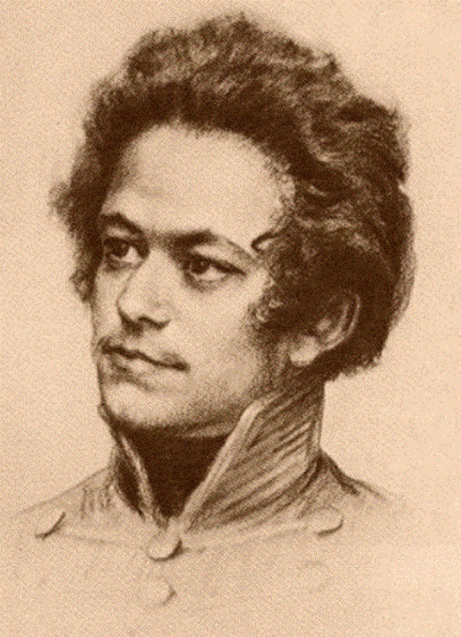
Young Karl Marx
By reducing Jewishness to capitalism, Marx was also overlooking another side of Jewish influence in the world: the revolution. The strong involvement of Jews in revolutionary movements would not become fully apparent to the world before 1848, but Marx, being himself a German Jewish revolutionary, could not be unaware of it. He could not be ignorant of the fact that Jews loved not only money, but also the revolution. Jewish revolutionary activity is one form of resistance to assimilation, especially when it calls for the destruction of the nations in the name of internationalism. By simply ignoring it, Marx was, at the very least, concealing the role of his own Jewishness in his revolutionary enterprise, while at the same time removing in advance all suspicion of his Jewish sympathies.
I believe Marx’s treatment of the Jewish question set the standard of his subsequent method. First, Marx misrepresents the arguments of his adversaries, often turning them upside down before proceeding to criticize them. For example Marx pretends that Bauer sees Jewishness as a religious faith, but that was not Bauer’s point. Rather, Bauer showed that defining Jewishness as a religion or ethnicity makes no big difference, because either way, the essence of Jewishness is separateness. Being religious only worsens the xenophobic nature of Jewishness, because it makes separateness a divine commandment rather than simply an ancestral habit. Secondly, Marx dismisses the complexity of things, in order to focus exclusively on a single and often secondary aspect of reality, making it look two-dimensional. Defining Jewishness as the love of money is obviously inadequate for anyone who has reflected even superficially on the question. Either Marx believes what he says, and that tells a lot about his intellectual ability, or he doesn’t—which is more likely—, and that tells a lot about his intellectual honesty. With the same reductionism Marx will claim in 1848, in the Communist Manifesto (Engels credited this insight to Marx alone), that, “The history of all hitherto existing society is the history of class struggles.” It is obvious to any (non-Marxist) historian that class struggles fall far behind ethnic struggles in the forces shaping history, even in modern times. Even an internationalist socialist like Bakunin could only be puzzled by Marx’s total ignorance of this fact:
“Marx completely ignores a most important element in the historic development of humanity, that is, the temperament and particular character of each race and each people, a temperament and a character which are themselves the natural product of a multitude of ethnological, climatological, economic, and historic causes, but which exercise, even apart from and independent of the economic conditions of each country, a considerable influence on its destinies and even on the development of its economic forces.”[21]
Coming from someone who grew up in a Jewish home and, despite his baptism, evolved in a mostly Jewish circle, counting among his friends zealot Jewish nationalists, I find it unbelievable that Marx’s ignorance of the national factor was sincere. Or perhaps, it must be considered very typical of Jewish discourse targeted at Gentiles. In that sense, Marx’s internationalism confirms Bauer’s remark that Jews consider only their own nationality as real:
“According to their fundamental representation, they wanted to be absolutely the people, the unique people, that is to say the people beside whom other peoples did not have the right to be a people. Any other people was, in comparison with them, not really a people; as the chosen people they were the only true people, the people who were to be All and take the world.”
Proudhon and the socialist movement before Marx
Having examined how Marx positioned himself on the background of the Jewish question, we can now do the same with the social question that occupied socialist thinkers.
At the time when Marx and Engels joined the movement, the most influential socialist theorist was Pierre-Joseph Proudhon (1809-1865), of nine years Marx’s elder. There is no better way to understand the originality of Marx’s economic ideas than by comparing them to Proudhon’s. (Proudhon’s work is accessible to English readers through Iain McKay’s anthology: Property is Theft! A Pierre-Joseph Proudhon Anthology, AK Press, 2011. McKay’s 82-page introductory chapters, including one on “Proudhon and Marx,” can be read here).
Proudhon’s book Qu’est-ce que la propriété? (What is Property? An Inquiry into the Principle of Right and of Government) published in 1840, had a huge echo and became a cornerstone of the European socialist movement. Proudhon was the first to use the expression “scientific socialism”, meaning a society ruled by a scientific government, one whose sovereignty rests upon justice and reason, rather than sheer will. His book was a critic of previous theories of economy (then called “political economy”) developed in Great Britain by Adam Smith (1723-1790) and David Ricardo (1772-1823). As explained by McKay, “It was Proudhon who first located surplus value production within the workplace, recognizing that the worker was hired by a capitalist who then appropriates their product in return for a less than equivalent amount of wages” (McKay 66).

A portrait of Proudhon by his friend Gustave Courbet (1865)
Proudhon’s thought was in constant evolution, and therefore not totally consistent from beginning to end, even in terminology. Nevertheless, if we want to summarize it, we shall say that Proudhon advocated a decentralized, self-managed, federal, bottom-up socialism, which he called “anarchism”. His vision was based on an organic model of society, the basic cell of which was the patriarchal family, while the “commune” was the fundamental unit of democratic sovereignty. In contrast, “governmental power is mechanical” and fundamentally inhuman (Confession of a Revolutionary, McKay 404).
Proudhon consistently spoke against projects of state socialism. For him, state ownership of the means of production was the continuation of capitalism with the state as the new boss. Nationalization would simply make a nation of wage-workers, and Proudhon viewed the condition of the wage-worker as little better than slavery. State control also kills competition, and Proudhon considered that “competition is as essential to labour as division”; it is “the vital force which animates the collective being” (System of Economic Contradictions, McKay 197 and 207).
Although he called himself a revolutionary, Proudhon was a reformist and a democrat. He recommended that workers gain political and economic emancipation by organizing themselves in “clubs”, cooperatives and associations for mutual credit, by electing representatives, and by exercising pressure and influence onto the state.
Proudhon’s central formula, “Property is theft,” is often misunderstood. Proudhon was attacking the capitalistic property of the means of production. Whereas the French constitution of 1793 defined property as “the right to enjoy the fruit of one’s labor,” capitalist property is, according to Proudhon, “the right to enjoy and dispose at will of another’s goods—the fruit of another’s industry and labour” (What is Property? McKay 124). In fact, Proudhon formulates a thesis and an antithesis. While claiming that “property is theft,” he devotes long pages to the apology of the small owner, whether artisan or peasant, whose property is based on use, what he calls “possession”. “Individual possession is the condition of social life. … Suppress property while maintaining possession, and, by this simple modification of the principle, you will revolutionize law, government, economy, and institutions” (What is Property? McKay 137). Proudhon encouraged mutualist forms of possession, but he condemned communism, which called for the complete abolition of private property: “Communism is oppression and slavery” (What is Property? McKay 132). Proudhon’s ideal was less the abolition of private property than its fair distribution.
Marx’s hijacking of the Proudhonian legacy
In The Holy Family, published in 1845, Marx and Engels praised Proudhon’s book What is Property?
“Proudhon makes a critical investigation — the first resolute, ruthless, and at the same time scientific investigation — of the basis of political economy, private property. This is the great scientific advance he made, an advance which revolutionizes political economy and for the first time makes a real science of political economy possible.”
“Proudhon was the first to draw attention to the fact that the sum of the wages of the individual workers, even if each individual labour be paid for completely, does not pay for the collective power objectified in its product, that therefore the worker is not paid as a part of the collective labour power.”
But the praises of Marx and Engels for Proudhon suddenly ceased in 1846. Two reasons can be conjectured. First, in 1846, Proudhon rejected Marx’s invitation to become his correspondent in Paris. In his answer, Proudhon criticizes Marx’s will to forge a unifying dogma:
“Let us seek together, if you will, for the laws of society, the manner in which these laws are manifested, the progress of our efforts to discover them. But for God’s sake, after having demolished all a priori dogmatisms, let us not in turn dream of making our own, of indoctrinating the people; … let us show the world an example of learned and insightful tolerance, but since we are in the lead, let us not set ourselves up as leaders of a new intolerance; let us not be the apostles of a new religion, one that makes itself a religion or reason, a religion of logic. We should welcome and encourage all protestations. Let us get rid of all divisiveness, all mysticism. Let us never consider a question exhausted, and when we do get down to our last argument, let’s start again, if need be, with wit and irony! I will join your organization on that condition—or else not!”
Proudhon also expressed reservations on the idea of violent revolution: “Our proletariat has a great thirst for science, which would be very poorly served if you only brought them blood to drink” (“Letter to Karl Marx,” McKay 163-165).
The second reason for Marx’s about-face regarding Proudhon was the Frenchman’s publication of Philosophie de la Misère (or System of Economic Contradictions), in which he developed new conceptual tools to understand the structure of the capitalist world. Marx, who had announced in 1846 a book of economy, was taken by surprise. He responded with a pamphlet in French, Misère de la philosophie, which Proudhon would describe as “a tissue of vulgarity, of calumny, of falsification and of plagiarism,” written by “the tapeworm of socialism” (McKay 70). McKay agrees:
“While, undoubtedly, Marx makes some valid criticisms of Proudhon, the book is full of distortions. His aim was to dismiss Proudhon as being the ideologist of the petit-bourgeois and he obviously thought all means were applicable to achieve that goal. So we find Marx arbitrarily arranging quotations from Proudhon’s book, often out of context and even tampered with, to confirm his own views. This allows him to impute to Proudhon ideas the Frenchman did not hold (often explicitly rejects!) in order to attack him. Marx even suggests that his own opinion is the opposite of Proudhon’s when, in fact, he is simply repeating the Frenchman’s thoughts. He takes the Frenchman’s sarcastic comments at face value, his metaphors and abstractions literally. And, above all else, Marx seeks to ridicule him.” (McKay 70-71)
Twenty years later, and two years after Proudhon’s death, the most essential concepts of Marx’s Capital: A Critique of Political Economy, would be borrowed from Proudhon, without any credit given him . When Marx writes that, “property turns out to be the right, on the part of the capitalist, to appropriate the unpaid labour of others or its product, and the impossibility, on the part of the worker, of appropriating his own product” (Capital, vol. 1, quoted in McKay 66), he is repeating what Proudhon wrote 27 years earlier in What is Property?
In 1867, when Marx published the first volume of Das Kapital, Proudhon’s notoriety and influence still far exceeded Marx’s in Europe. The International Workingmen’s Association (the First International) had been founded in 1864 by Proudhon’s followers, who called themselves mutualists and anti-authoritarians. Mikhail Bakunin (1814-1876), who became Marx’s strongest opponent within the International after Proudhon’s death, considered his own ideas as “Proudhonism widely developed and pushed right to its final consequences” (as quoted in McKay 46), although he criticized the Proudhonians’ attachment to hereditary property. At the Geneva Congress of 1866, the Proudhonians prevailed and convinced the Congress to vote unanimously in favor of working towards the suppression of salaried status through the development of co-operatives. Marxism had almost no influence on the French Commune of 1871, which was predominantly inspired by Proudhon’s ideas of decentralized federations of communes and workers’ associations.
The intensity of Marx’s will to supplant Proudhon can be seen in a letter to Engels dated July 20, 1870, at the dawn of the Franco-Prussian War, a war in which Marx saw the opportunity to get the upper hand over his rival:
“The French need a thrashing. If the Prussians win, the centralisation of the state power will be useful for the centralisation of the German working class. German predominance would also shift the centre of gravity of the workers’ movement in Western Europe from France to Germany, and one has only to compare the movement in the two countries from 1866 till now to see that the German working class is superior to the French both theoretically and organisationally. Their predominance over the French on the world stage would also mean the predominance of our theory over Proudhon’s, etc.”
The outcome of the war gave entire satisfaction to Marx.
The Communist Manifesto, a monopolist’s dream
Although Marx’s economic theory is largely plagiarized from Proudhon, his solutions are the exact opposite. That is because Marx’s project doesn’t proceed from his economic theories. According to Karl Jaspers, Marx’s approach “is one of vindication, not investigation, but it is a vindication of something proclaimed as the perfect truth with the conviction not of the scientist but of the believer.” British historian Paul Johnson concurs and, after quoting from the apocalyptic and “Luciferian” poetry of Marx’s youth, he concludes that,
“Marx’s concept of a Doomsday … was always in Marx’s mind, and as a political economist he worked backwards from it, seeking the evidence that made it inevitable, rather than forward to it, from objectively examined data.”[22]
Therefore, Marx’s theoretical sum published in 1867, Das Kapital, is almost irrelevant to understand his program, laid out in 1848 with Friedrich Engels in the Manifesto of the Communist Party. “The theory of the Communists,” we read there, “may be summed up in the single sentence: Abolition of private property.” As if responding to protests by the Proudhonians, they add:
“We Communists have been reproached with the desire of abolishing the right of personally acquiring property as the fruit of a man’s own labour, which property is alleged to be the groundwork of all personal freedom, activity and independence. / Hard-won, self-acquired, self-earned property! Do you mean the property of the petty artisan and of the small peasant, a form of property that preceded the bourgeois form? There is no need to abolish that; the development of industry has to a great extent already destroyed it, and is still destroying it daily.”
Abolition of private property naturally includes “abolition of all rights of inheritance,” especially since the Manifesto also proclaims the “abolition of the family,” seen as a bourgeois institution “based … on capital, on private gain.” Nations will disappear too, because “the working men have no country”; capitalism “has stripped him of every trace of national character.”
The current epoch “has simplified class antagonisms. Society as a whole is more and more splitting up into two great hostile camps, into two great classes directly facing each other—Bourgeoisie and Proletariat.” Engels adds in a footnote to the 1888 English edition that, “By bourgeoisie is meant the class of modern capitalists, owners of the means of social production and employers of wage labour.” Marx and Engels await the complete disappearance of “the lower strata of the middle class—the small tradespeople, shopkeepers, and retired tradesmen generally, the handicraftsmen and peasants—all these sink gradually into the proletariat.” The bourgeoisie, on the other hand, “has concentrated property in a few hands.”
Marx and Engels predict that this concentration of wealth in ever fewer hands, and the corresponding increase in misery among the growing working class, will intensify class warfare, and lead inevitably to the violent revolution of the proletariat. The Communists “openly proclaim that their goals cannot be reached except through the violent overthrow of the entire social order of the past.” After the failure of the 1848 revolution in Germany, Marx wrote that, “there is only one way in which the murderous death agonies of the old society and the bloody birth throes of the new society can be shortened, simplified and concentrated, and that way is revolutionary terror.”
The goal of the revolution is to establish the “dictatorship of the proletariat,” as a transition toward the abolition of all classes. This stage is necessary for the proletariat to defend itself against a counter-revolution and to bring about the classless society. Although the expression “dictatorship of the proletariat” doesn’t appear until 1852, the idea is clearly stated in the Manifesto:
“The proletariat will use its political supremacy to wrest, by degree, all capital from the bourgeoisie, to centralise all instruments of production in the hands of the State, i.e., of the proletariat organised as the ruling class; and to increase the total productive forces as rapidly as possible.”
The first thing to note is that Marx and Engels have no intention to appease the antagonism between the proletarians and the bourgeois, by improving the condition of workingmen. On the contrary, they hope that the conflict will intensify to the point of turning into a bloody civil war. For that, the misery of the working class must increase. We should remember here that tearing apart the social fabric of nations by exacerbating social, racial, generational or gender tensions is a strategy that Jewish intellectuals have used to this day.
Secondly, Marx and Engels have no intention to stop or even resist the progress of capitalism. On the contrary, they call for the total disappearance of the social and economic structures that preceded it, and look forward to its most extreme development, when all the means of production have fallen into a few hands. For only then, they claim, the new world can be born. Capitalism contains the seeds of its own destruction, but capitalism must first reach its full maturity, which is the monopoly of a few billionaires.
Obviously, monopolists can support wholeheartedly that goal. Should they fear the next step, the revolution and the appropriation of all capitals and all means of production by the state? Not necessarily, as Bakunin argued in 1872, and as Antony Sutton explained in more detail in Wall Street and the Bolshevik Revolution (2001):
“one barrier to mature understanding of recent history is the notion that all capitalists are the bitter and unswerving enemies of all Marxists and socialists. This erroneous idea originated with Karl Marx and was undoubtedly useful to his purposes. In fact, the idea is nonsense. There has been a continuing, albeit concealed, alliance between international political capitalists and international revolutionary socialists — to their mutual benefit. This alliance has gone unobserved largely because historians — with a few notable exceptions — have an unconscious Marxian bias and are thus locked into the impossibility of any such alliance existing. The open-minded reader should bear two clues in mind: monopoly capitalists are the bitter enemies of laissez-faire entrepreneurs; and, given the weaknesses of socialist central planning, the totalitarian socialist state is a perfect captive market for monopoly capitalists, if an alliance can be made with the socialist powerbrokers. Suppose — and it is only hypothesis at this point — that American monopoly capitalists were able to reduce a planned socialist Russia [or Germany] to the status of a captive technical colony? Would not this be the logical twentieth-century internationalist extension of the Morgan railroad monopolies and the Rockefeller petroleum trust of the late nineteenth century?”
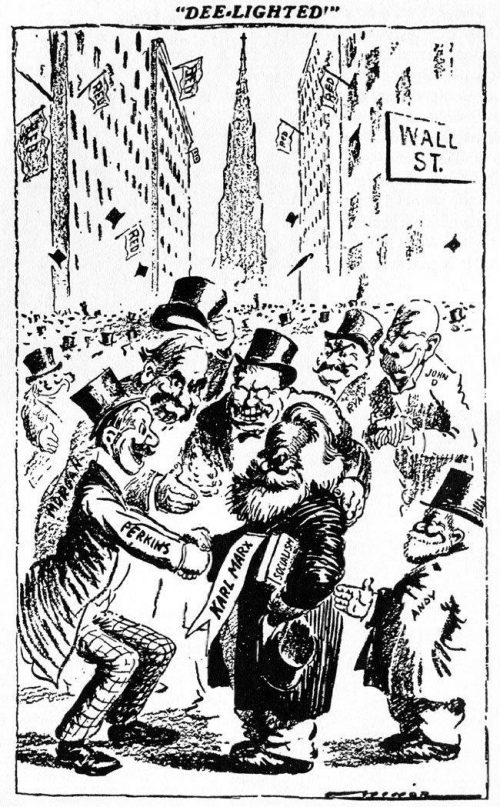
Marx being congratulated by Wall Street bankers (1911 cartoon reproduced by Sutton)
Sutton sees no Jewish conspiracy in this collusion between the Bank and the Revolution. But documents relative to the failed Russian revolution of 1905 show that there is another dimension to that unnatural alliance, as explained in this article by Alexandros Papagoergiou. In 1904, Russian Prime Minister Sergei Witte was tasked to secure a huge foreign loan to stabilize Russian public finances. He tells in his memoirs that, after turning down the offer of the Jewish banks headed by the Rothschilds, because it was conditioned on “legal measures tending to improve the conditions of the Jews in Russia,” he was able to raise the enormous amount of 2,250,000,000 francs via “Christian Banks”.[23] Revolutionary riots started soon after. A report of the Russian Foreign Minister to Tsar Nicholas II notes that it happened “just at the time when our government tried to realize a considerable foreign loan without the participation of the Rothschilds and just in time for preventing the carrying out of this financial operation; the panic provoked among the buyers and holders of Russian loans could not fail to give additional advantages to the Jewish bankers and capitalists who openly and knowingly speculated upon the fall of the Russian rates.” According to the report, the revolutionaries “are in possession of great quantities of arms which are imported from abroad, and of very considerable financial means,” which had been collected by Anglo-Jewish capitalists “under the leadership of Lord Rothschild, … for the officially alleged purpose of helping Russian Jews who suffered from pogroms.”[24]
Marxism vs Zionism: the dialectical pliers
Jewish movements seem to be working history through dialectical antagonisms that ultimately advance the Big Project. The capacity of the Jewish community to present itself either as a religion or as a nationality, depending on the circumstances, is the prime example. After gaining political emancipation in the name of religious freedom in the first part of the 19th century, European Jews were in the position to reclaim their special nationhood. For a few decades, reformed rabbis would ostensibly oppose Jewish nationalism, proclaiming in the 1885 Pittsburgh Conference: “We consider ourselves no longer a nation, but a religion community.”[25] Yet the same Pittsburgh Conference saw no contradiction in adopting the theory of German rabbi Kaufman Kohler, that “Israel, the suffering Messiah of the centuries, shall at the end of days become the triumphant Messiah of the nations,”[26] which amounts to say that Israel is not an ordinary nation, but the super-nation. In the 20th century, any trace of a contradiction between Reformed Judaism and Zionism was removed.
The early collaboration between Marx and Hess and the late encounter between Marx and Graetz both prefigure another dialectical opposition between Communism (the International revolution aimed at destroying Christian nations) and Zionism (the national project aimed at building the Jewish nation). Both movements developed in the same milieu. Chaim Weizmann recounts in his autobiography (Trial and Error, 1949) that in early twentieth-century Russia, revolutionary communists and revolutionary Zionists belonged to the same milieu. Weizmann’s brother Schmuel was a communist, and that was not a source of family discord. These divisions were relative and changeable; many Zionists were Marxists, and vice versa. The borderline was all the more vague that the Communist Bund, born the same year as Zionism (1897), inscribed in its revolutionary agenda the right of the Jews to found a secular Yiddish-speaking nation. As Gilad Atzmon recently wrote, the Bund was “also an attempt to prevent Jews from joining the ‘Hellenic’ route by offering Jews a tribal path within the context of a future Soviet revolution.”
But the most important thing to note is that, from the early days, Jewish revolutionary activity provided Zionists with a diplomatic argument in favor of their alternative program for the Jews. Herzl mentions in his diary (June 4, 1900) that “intensifying Jewish Socialist activities” was a way to “stir up the desire among the European governments to exert pressure on Turkey to take in the Jews” (Palestine was then under Ottoman control). He hawked Zionism as a solution to the problem of Jewish revolutionary subversion when meeting Kaiser Wilhelm II in 1898, and again when meeting Russian ministers in St. Petersburg in 1903.[27] The next generation of Zionists continued the stratagem. Churchill, who spoke with one voice with Chaim Weizmann,[28] dramatized the opposition between the “good Jews” (Zionists) and the “bad Jews” (communists) in his 1920 article “Zionism versus Bolshevism: A struggle for the soul of the Jewish people.” He referred to Bolshevism as “this world-wide conspiracy for the overthrow of civilization” and to Zionism as the solution “especially in harmony with the truest interests of the British Empire.” (Churchill’s later alliance with Stalin proves that his Zionism was stronger than his anti-communism.)
In the aftermath of World War II, the rivalry between the Communist and the Capitalist worlds remained the indispensable context for the creation and expansion of Israel. That explains why Roosevelt’s administration, largely controlled by Jews, helped Stalin conquer half of Europe and thwarted all attempts to stop him. Curtis Dall, Roosevelt’s son-in-law, has revealed a secret diplomatic channel demonstrating that the White House went out of its way to give the USSR all the time and the armament necessary to invade Central Europe.[29] Thus the Second World War was completed with the determined aim of laying the foundations for the Cold War, that is, a highly explosive polarization of the world that would prove crucial for Project Zion. In fact, during this whole period, it is almost impossible to distinguish, among the Jewish advisors of Roosevelt and Truman on foreign policy, the pro-Communists from the pro-Zionists, as David Martin remarks in The Assassination of James Forrestal. A case in point is David Niles (Neyhus), who was guilty of spying for the Soviets while advising Roosevelt, but then played a key role in Truman’s support of the U.N. Partition Plan and the recognition of Israel.[30]
The Cold War proved instrumental when Nasser, Israel’s most formidable enemy, was pushed into the communist camp in 1955, setting off an intense Zionist campaign to present him as a danger to the stability of the Middle East, and to present Israel, by contrast, as the only reliable ally in the region. The Cold War was also the crucial context for Israel’s defeat of Egypt in 1967 and Israel’s annexation of territories stolen from Egypt, Syria and Lebanon.
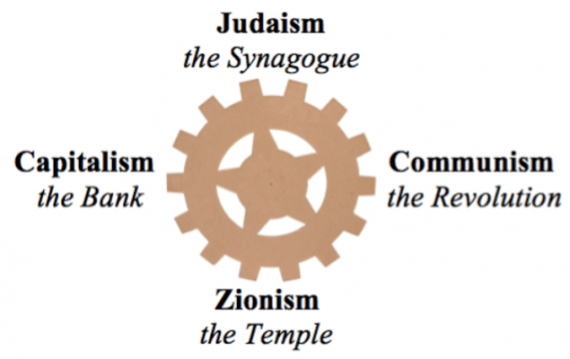
Yahweh’s dialectical machinery
Laurent Guyénot, Ph.D., has recently edited some of his Unz Review articles in book form, under the title Our God is Your God Too, But He Has Chosen Us: Essays on Jewish Power. He is also the author of From Yahweh to Zion: Jealous God, Chosen People, Promised Land … Clash of Civilizations, 2018, and JFK-9/11: 50 years of Deep State, Progressive Press, 2014.
Notes
[1] David Ben-Gurion and Amram Duchovny, David Ben-Gurion, In His Own Words, Fleet Press Corp., 1969, p. 116. Ben-Gurion’s prophecy appeared in the magazine Look on January 16, 1962, reproductions of which can be found on Internet.
[2] Karl Popper, Unended Quest: An Intellectual Autobiography (1976), Routledge, 2002, books.google.com
[3] Bakunin, Statism and Anarchy, trans. Marshall S. Shatz, Cambridge UP, 1990, pp. 538-545.
[4] Quoted in Alexandre Soljénitsyne, Deux siècles ensemble (1795–1995), tome I: Juifs et Russes avant la Révolution, Fayard, 2003, tome 1, p. 269.
[5] Robert Blake, Disraeli (1966), Faber Finds, 2010, p. 202.
[6] Amos Elon, The Pity of It All: A History of Jews in Germany 1743-1933, Metropolitan Books, 2002, pp. 153, 157, 163-164.
[7] Isaac Berlin, Karl Marx: His Life and Environment, 1939, 2nd ed, 1948, p. 17.
[8] Aux compagnons de la Fédération des sections internationales du Jura, quoted in Henri Arvon, Les Juifs et l’Idéologie, PUF, 1978, p. 50. Partial quote in Francis Wheen , Karl Marx, Fourth Estate, 1999, p. 340.
[9] Antony Sutton, Wall Street and the Bolshevik Revolution (1976), Clairview Books, 2011.
[10] Quoted in Kevin MacDonald, Separation and Its Discontents: Toward an Evolutionary Theory of Anti-Semitism, Praeger, 1998, kindle 2013, k. 4732–4877.
[11] Amos Elon, The Pity of It All, op; cit., p. 146.
[12] Shlomo Avineri, Karl Marx: Philosophy and Revolution, Yale UP, 2019, pp. 171-172.
[13] Moses Hess, Rome and Jerusalem: A Study in Jewish Nationalism, 1918 (archive.org).
[14] Sydney Hook, “Karl Marx and Moses Hess,” 1934.
[15] Shlomo Avineri , Moses Hess: Prophet of Communism and Zionism, 1985.
[16] Read Bakunin’s response to Hess’s article, “Aux citoyens rédacteurs du Réveil”
[17] French translation, Bruno Bauer, La Question juive (1843), Union générale d’Éditions, 1968, on
[18] Hal Draper, “Marx and the Economic-Jew Stereotype,” from Karl Marx’s Theory of Revolution, Vol.1: State and Bureaucracy, Monthly Review, New York 1977, pp. 591-608. Read also Gary Ruchwarger, “Marx and the Jewish Question: A Response to Julius Carlebach,” Marxist Perspectives, Fall 1979, pp. 19-38.
[19] I am aware that another “anti-Semitic” article, unsigned and titled “The Russian Loan” (New York Daily Tribune, January 4, 1856), has been attributed to Marx by his daughter, but I find Marx’s authorship dubious. See the discussion on its authenticity here.
[20] Nesta Webster, World Revolution: The Plot Against Civilization, 1921 , on archive.org, pp. 95-96.
[21] “Lettre au Journal La Liberté de Bruxelles,” October 5, 1872.
[22] Paul Johnson, Intellectuals: From Marx and Tolstoy to Sartre and Chomsky (1990), HarperCollins, 2007.
[23] The Memoirs of Count Witte, Doubleday, Page & Co, 1921, on archive.org, pp. 292-294.
[24] Quoted in Boris Brasol, The World at the Cross Roads, 1923, on archive.org, pp. 74-78.
[25] Quoted in Alfred Lilienthal, What Price Israel? (1953), Infinity Publishing, 2003, p. 14.
[26] Kaufmnann Kohler, Jewish Theology, Systematically and Historically Considered, Macmillan, 1918 (www.gutenberg.org), p. 290.
[27] The Complete Diaries of Theodor Herzl, edited by Raphael Patai, Herzl Press & Thomas Yoseloff, 1960, vol. 1 , pp. 362–363, 378–379, and vol. 3, p. 960.
[28] Martin Gilbert, Churchill and the Jews: A Lifelong Friendship, Henry Holt & Company, 2007.
[29] Curtis Dall, FDR: My Exploited Father-in-Law, Christian Crusade Publications, 1968 , pp. 146–157.
[30] David Martin, The Assassination of James Forrestal, McCabe Publishing, 2017, pp. 57-65. On Nile’s influence in the U.N. vote, see Alfred Lilienthal, What Price Israel ? (1953), 50th Anniversary Edition, Infinity Publishing, 2003, p. 50.
Human Activity in China and India Dominates the Greening of Earth, NASA Study Shows

Over the last two decades, the Earth has seen an increase in foliage around the planet, measured in average leaf area per year on plants and trees. NASA satellite data shows that China and India are leading the increase in greening. The effect stems mainly from ambitious tree planting programs in China and intensive agriculture in both countries.
Credits: NASA Earth Observatory
NASA | February 11, 2019
The world is literally a greener place than it was 20 years ago, and data from NASA satellites has revealed a counterintuitive source for much of this new foliage: China and India. A new study shows that the two emerging countries with the world’s biggest populations are leading the increase in greening on land. The effect stems mainly from ambitious tree planting programs in China and intensive agriculture in both countries.
The greening phenomenon was first detected using satellite data in the mid-1990s by Ranga Myneni of Boston University and colleagues, but they did not know whether human activity was one of its chief, direct causes. This new insight was made possible by a nearly 20-year-long data record from a NASA instrument orbiting the Earth on two satellites. It’s called the Moderate Resolution Imaging Spectroradiometer, or MODIS, and its high-resolution data provides very accurate information, helping researchers work out details of what’s happening with Earth’s vegetation, down to the level of 500 meters, or about 1,600 feet, on the ground.
The world is a greener place than it was 20 years ago, as shown on this map, where areas with the greatest increase in foliage are indicated in dark green. Data from a NASA instrument orbiting Earth aboard two satellites show that human activity in China and India dominate this greening of the planet.
Taken all together, the greening of the planet over the last two decades represents an increase in leaf area on plants and trees equivalent to the area covered by all the Amazon rainforests. There are now more than two million square miles of extra green leaf area per year, compared to the early 2000s – a 5% increase.
“China and India account for one-third of the greening, but contain only 9% of the planet’s land area covered in vegetation – a surprising finding, considering the general notion of land degradation in populous countries from overexploitation,” said Chi Chen of the Department of Earth and Environment at Boston University, in Massachusetts, and lead author of the study.
An advantage of the MODIS satellite sensor is the intensive coverage it provides, both in space and time: MODIS has captured as many as four shots of every place on Earth, every day for the last 20 years.
“This long-term data lets us dig deeper,” said Rama Nemani, a research scientist at NASA’s Ames Research Center, in California’s Silicon Valley, and a co-author of the new work. “When the greening of the Earth was first observed, we thought it was due to a warmer, wetter climate and fertilization from the added carbon dioxide in the atmosphere, leading to more leaf growth in northern forests, for instance. Now, with the MODIS data that lets us understand the phenomenon at really small scales, we see that humans are also contributing.”
China’s outsized contribution to the global greening trend comes in large part (42%) from programs to conserve and expand forests. These were developed in an effort to reduce the effects of soil erosion, air pollution and climate change. Another 32% there – and 82% of the greening seen in India – comes from intensive cultivation of food crops.
Land area used to grow crops is comparable in China and India – more than 770,000 square miles – and has not changed much since the early 2000s. Yet these regions have greatly increased both their annual total green leaf area and their food production. This was achieved through multiple cropping practices, where a field is replanted to produce another harvest several times a year. Production of grains, vegetables, fruits and more have increased by about 35-40% since 2000 to feed their large populations.
How the greening trend may change in the future depends on numerous factors, both on a global scale and the local human level. For example, increased food production in India is facilitated by groundwater irrigation. If the groundwater is depleted, this trend may change.
“But, now that we know direct human influence is a key driver of the greening Earth, we need to factor this into our climate models,” Nemani said. “This will help scientists make better predictions about the behavior of different Earth systems, which will help countries make better decisions about how and when to take action.”
The researchers point out that the gain in greenness seen around the world and dominated by India and China does not offset the damage from loss of natural vegetation in tropical regions, such as Brazil and Indonesia. The consequences for sustainability and biodiversity in those ecosystems remain.
Overall, Nemani sees a positive message in the new findings. “Once people realize there’s a problem, they tend to fix it,” he said. “In the 70s and 80s in India and China, the situation around vegetation loss wasn’t good; in the 90s, people realized it; and today things have improved. Humans are incredibly resilient. That’s what we see in the satellite data.”
This research was published online, Feb. 11, 2019, in the journal Nature Sustainability.

Credits: NASA Earth Observatory
The Zionist War without End

By Jeremy Salt | Palestine Chronicle | February 12, 2020
A reiteration of the war on Palestine, on the Arab world, on the Muslim world, on international law and human rights. There is no other way to describe the Trump-Kushner-Netanyahu ‘deal.’
Media comment centers on the last opportunity for the Palestinians. Will they take the scraps they are offered, or will they miss yet another opportunity to have something taken away from them?
This was the line used over decades by the glib Irish-born Zionist ‘foreign minister,’ Aubrey (Abba) Eban. The Palestinians never miss an opportunity to miss an opportunity, he said many times.
In fact, if anyone has never missed an opportunity to miss an opportunity it is the Zionists. They could have chosen to live with the Palestinians instead. They could have accepted their return after 1948. They could have handed back the land they seized in 1967. They could have honestly engaged with the so-called ‘peace process.’ They could have ended the blockade of Gaza. They could have stopped seizing and settling the land of another people. They could have agreed to share Al Quds. They could have stopped their murders and assassination.
What they could have done they never did. Instead, they headed in the opposite direction, financed, armed, protected and encouraged by the most powerful nation in the world.
A vulgarian property developer who once made ads for Pizza Hut has now told his zionist settler sidekick that he can have Palestine with the lot. Nothing is missed out, not Jerusalem, not the Jordan Valley and not the illegal settlements – the ‘outposts’ – as well as the legal ones, so says Netanyahu. All are completely illegal, of course, as is the presence of every settler on occupied land.
This demented agreement was put together by the plastic-faced Jared Kushner, who said, seriously apparently, that he read all of 25 books to get a handle on the situation. By comparison, Trump is unlikely to have read one so no wonder that he thinks his son-in-law is a genius.
This ‘deal’ – a deal without wheels – is being taken seriously in the mainstream media. In a way, of course, it has to be taken seriously as the Zionists have the weaponry to do whatever they want, no matter how mad, rapacious or destructive of their own interests in the long term.
And this is something the media seems to have missed. For whom, really, is this plan the last opportunity? The assumption is that it is the Palestinians but have Trump and Kushner noticed that while the Palestinians do not have the weapons, they have the numbers, that already the Muslim-Christian population of Palestine between the Mediterranean and the Jordan river is already greater than the Jewish population.
Silly to ask, but have either of these two taken into account the Muslim hinterland, the Muslim population of the Middle East and North Africa (close to 600 million) and the world Muslim population (about 1.8 billion)?
By comparison, the Jewish population of occupied Palestine is less than seven million. Far from trying to settle into the Muslim world, over more than seven decades it has done nothing but antagonize it. Like a spoilt child, it then complains that no one likes it, that the real reason for Muslim loathing of the Zionist state is anti-semitism, and not its racist, murderous and thieving behavior.
This is the game played endlessly by the Zionist lobby around the world. It hides behind the symbols of the religion it has hijacked. The Star of David flies from the pennants of the tanks that shell apartment buildings in Gaza and is inscribed on the wings of the planes that destroy entire families with missiles.
It is scrawled triumphantly on the walls of the West Bank. This is the Israel that the lobbyists and the rabbis defended behind their accusations against Jeremy Corbyn. It is he who wanted to end these horrors and they, behind their lies and false accusations of antisemitism against Corbyn and the entire Labor Party wanted to leave the Zionist state free to continue them. It is they who are the racists and anti-Arab Semites, not Jeremy Corbyn.
Palestine remains part of Arab and Islamic history and identity and remains an Arab and Muslim cause whatever the exasperation felt at Arab governments and the bungled and/or collaborationist policies of the Palestinian leadership.
By themselves, the Palestinians had no hope of resisting the Zionist takeover of their land. Zionism was an imperial project and the Zionist state was sequentially backed by the two mightiest empires on the planet, first Britain and then the United States. No small group of people anywhere would have been able to resist their power.
The greater danger to Israel always lay in the surrounding Arab and Muslim world. George Habash, the founder of the PFLP (Popular Front for the Liberation of Palestine) was writing in the 1950s that the road to the liberation of Palestine ran through the Arab world and this remains as true today as it was then, although the statement has to be qualified by adding “and the Muslim world.”
Israel understood this just as well as George Habash and knew that if it were to survive in the long term, the Arab world had to be fragmented, subverted, dominated and kept off balance permanently. This was the sine qua non of Israel’s existence. The ties that bound states together, that bound the region together and connected it with the wider Islamic world had to be broken.
It was not just armies and states that had to be broken but the Arab national idea and the Arab world as a presence in history and a place on the map. It would have to be what Israel and the US wanted it to be. It would have to be remade.
Towards this end, the zionists were looking for weak links in the chain of Arab states even in the 1930s. They thought they had found the weakest in Lebanon, where they hoped to set up a puppet Christian government. Not only did this not work but since the rise of Hezb0llah, the weakest link in the chain has turned into one of the strongest.
The Yinon Plan of the 1980s set out the strategy in full. All Middle Eastern states were to be subjected to ethnoreligious or tribal division. This broad script was fine-tuned by Netanyahu and the Zionists inside the US administration in the 1990s.
Iraq was the first of seven states targeted for destruction. The destruction through two wars and a decade of sanctions was enormous but the political strategy failed. The Kurdish state-in-being, planned by the US and Israel as a new center for strategic operations in the Middle East, has collapsed. The Shia-dominated government in Baghdad maintains good relations with Iran and following the assassination of Qasim Soleimani the Iraqi parliament demanded the complete withdrawal of US forces. Millions of people marched through the streets of Iraq’s cities as they did in Iran to mourn the murder of this outstanding military commander. Anti-American feeling in Iraq is at an all-time high.
The war in Syria was designed to bring down the axis of resistance (Iran, Syria, and Hezbollah) at its central arch but that has failed, too. Syria, its people, and its military have resisted the most determined attempt ever made to destroy an Arab government.
Always popular, Bashar al Assad is now more popular than ever, as the army, backed by Russian airpower, drives the takfiri terrorists from their last redoubt in Idlib province. Syrian cities have been shattered, perhaps half a million people have been killed but the US-Israeli political strategy in Syria has failed too.
For anyone who has been watching closely enough, the wheel of history, once turning in Israel’s favor, has been slowly turning against it for decades. Israel came close to defeat in the first week of the 1973 war. It drove the PLO out of Lebanon only to awaken a far more powerful enemy, Hezbollah. In every war it has fought or operation it has launched, the remorseless use of airpower has been critical. Nevertheless, even with air cover its foot soldiers were driven out of southern Lebanon in 2000 and, outfought by Hezbollah’s part-time soldiers, humiliated again when they returned in 2006.
Hezbollah and Iran have been working for decades on how to neutralize Israel’s air power. If – or once – they succeed in doing this, Israel is going to be in deep trouble on the battlefield.
Threatened repeatedly with destruction by the US and Israel, Iran has had to develop a new range of missiles capable of causing devastation to US bases, aircraft and warships in the region. The retaliation which followed the murder of Qasim Soleimani was an example. The Americans failed to stop even one of the Iranian missiles directed against two of its bases in Iraq.
Aircraft were destroyed in their hangars and while no soldiers were killed – so the US government says – dozens suffered severe brain injuries, apparently from concussion, with a number being flown to Germany for emergency treatment. Iran says the casualties were far greater than the US is prepared to admit.
Hezbollah has its own stocks of missiles, far greater in number and sophistication than in 2006, and has its targets already worked out for when the next war comes. As Israel’s military commanders are making clear, the next war is a question of ‘when’ and not ‘if.’ They are warning the civilian population to be prepared for the unprecedented scale of the casualties they are going to suffer.
So, for whom is the bell really tolling now, the Palestinians or the Zionists? Gideon Levy writes that the Kushner-Trump deal is likely to trigger a third nakba. This is incorrect, as there has only been one nakba, continuing now for more than seven decades.
David Hearst, writing in Middle East Eye, thinks all the Palestinians have to sit tight, because, between the Mediterranean and the Jordan River, they are going to win the war of numbers, if they haven’t won it already. By implication, once the war of numbers is won, the war itself is won. The Zionist state will see reason and turn itself into the secular democratic state the Palestinians always wanted, with equal rights for all. Given that they would be the majority, they would have to be the dominant element in any freely-elected government. The Zionist dream-nightmare would be over.
This is not likely to happen. Zionism is an extreme ideology and the politicians running the Zionist state now are the most extreme since its foundation. They are not going to surrender because of demographics. They will simply try harder to overcome the problem. They still want all the Palestinians out of Palestine or at the very least reduced to an inconsequential ethnic remnant. Between the apartheid state and the democratic state, this is their preferred solution.
What they need is another war enabling them to strike down their external enemies and simultaneously solve the ‘Palestine problem’ once and for all. If (or rather when) such a war does break out, Hezbollah will swamp the Zionist state with missiles in such numbers as to overwhelm its defense systems.
The Palestinians will be determined to stay put but in the fog of war, while the world is looking elsewhere, at missile attacks on US bases and soaring oil prices following the closure of the Strait of Hormuz, perhaps they can again be terrorized into leaving. Even the most steadfast Palestinians have families to protect and if they won’t go then the level of terror only has to be increased until they do. This is the evil calculus applied before and likely to be applied again once the opportunity arises or, more accurately, can be created.
Who wants such a war? Not the Palestinians, and not Hezbollah or Iran although they have had no option but to prepare for it. Who has set up the conditions for such a war, decade after decade to the point where it has to be regarded as inevitable unless ‘the Arabs’ and the Muslims really are the useless orientals of the western imagination, there to be kicked around endlessly? Israel has, by its disgraceful behavior.
So has the US and so has the ‘west’ in general, its governments, its media and its institutions (where has the UN Secretary-General, the moral guardian of peace in the world, been during the eight atrocious years of war on Syria? Hiding in a cupboard?). It is ‘the west’ generically which created Israel, and has allowed it to get away with wars, ethnic cleansing, massacres, assassination and occupation generation after generation.
Perhaps a shattering setback is all that will bring this utterly dangerous state to its senses. Of course, there is always the possibility that it will go completely off the edge and use its nuclear weapons, turning the central lands of the Middle East into a wasteland but at least taking its enemies down with it in the most pyrrhic of victories. These are grim possibilities but they have to be taken seriously.
– Jeremy Salt taught at the University of Melbourne, at Bosporus University in Istanbul and Bilkent University in Ankara for many years, specializing in the modern history of the Middle East. Among his recent publications is his 2008 book, The Unmaking of the Middle East. A History of Western Disorder in Arab Lands (University of California Press).
‘Ahuman Manifesto’: The Final Solution to Climate Change
By Robert Bradley Jr. | Master Resource | February 10, 2020
“This book is a delightful provocation and invitation: to imagine a world without humans and to think of what we can do to get there. It is an urgent call for action.”
― Christine Daigle, Professor of Philosophy, Brock University, Canada
Here you go: the “final solution” to climate change. This book is a glimpse of where the climate road to serfdom ends. (And it is not, I repeat not, a Babylon Bee satire.)
The Ahuman Manifesto: Activism for the End of the Anthropocene” by Patricia MacCormack (Bloomsbury Academic: 2020) is self-described as follows:
We are in the midst of a growing ecological crisis. Developing technologies and cultural interventions are throwing the status of “human” into question.
It is against this context that Patricia MacCormack delivers her expert justification for the “ahuman.” An alternative to “posthuman” thought, the term paves the way for thinking that doesn’t dissolve into nihilism and despair, but actively embraces issues like human extinction, vegan abolition, atheist occultism, death studies, a refusal of identity politics, deep ecology, and the apocalypse as an optimistic beginning.
In order to suggest vitalistic, perhaps even optimistic, ways to negotiate some of the difficulties in thinking and acting in the world, this book explores five key contemporary themes:
· Identity
· Spirituality
· Art
· Death
· The apocalypseCollapsing activism, artistic practice and affirmative ethics, while introducing some radical contemporary ideas and addressing specifically modern phenomena like death cults, intersectional identity politics and capitalist enslavement of human and nonhuman organisms to the point of ‘zombiedom’, The Ahuman Manifesto navigates the ways in which we must compose the human differently, specifically beyond nihilism and post- and trans-humanism and outside human privilege. This is so that we can actively think and live viscerally, with connectivity (actual not virtual), and with passion and grace, toward a new world.
Four positive pre-publication reviews are shared:
“Patricia MacCormack goes relentessly beyond ‘just’ deconstructing anthropocentrism and dismantling multispecies extinction caused by human dominance in the Anthropocene. The manifesto is not only theorizing, but compassionately calling for direct abolitionist action for the other at the expense of the (human) self. Trembling with joyful energy and critically affirmative insights, this manifesto encourages us to engage in ahuman arts & activist practices, inspired by queer feminist (secular) spirituality, and death activism.” ―Nina Lykke, Professor of Gender Studies, Linköping University, Sweden
“This beautiful book is both a passionate, insightful meditation on the world we actually live in, and a radical call to action. Is it even possible for us to stop being human, to let multiple beings flourish without reducing them to means for our own selfish ends? Reading this book, thinking with it and about it, and responding openly to it, is absolutely essential.” ―Steven Shaviro, DeRoy Professor of English, Wayne State University, USA
“Patricia MacCormack’s splendid refusal to nuance her intent in The Ahuman Manifesto will both intrigue and infuriate. As a vegan abolitionist/extinctionist, she provides an unrelenting and exacting take down of the violent self-interest of the human species, and offers a call to ethical action best described as eating the Anthropocene.” ―Margrit Shildrick, Guest Professor of Gender and Knowledge Production, Stockholm University, Sweden
“This book is a delightful provocation and invitation: to imagine a world without humans and to think of what we can do to get there. It is an urgent call for action. A joyful, lucid, fiercely intelligent call to readers to hope and work for a future not for themselves, but for the thriving of all nonhuman life. Engaging with this book will be a transformative experience. One cannot see the world or oneself in the same way after reading it.” ―Christine Daigle, Professor of Philosophy and Director of the Posthumanism Research Institute, Brock University, Canada
A writeup by Alisair Ryder in Cambridge News, “‘The only solution for climate change is letting the human race become extinct,’” describes the book and author as follows:
Patricia MacCormack, a professor of continental philosophy at Anglia Ruskin University, has just released her new book The Ahuman Manifesto, which will officially be launched in Cambridge today (Wednesday, February 5).
The book argues that due to the damage done to other living creatures on Earth, we should start gradually phasing out reproduction. But rather than offering a bleak look at the future of humanity, it has generated discussion due to its joyful and optimistic tone, as it sets out a positive view for the future of Earth – without mankind.
It also touches on several hot-button topics, from religion and veganism to the concept of identity politics, tying these into how the creation of a hierarchal world among humans has left us blind to the destruction we are causing to our habitat and other forms of life.
Speaking to CambridgeshireLive, Professor MacCormack outlined how she came to this point of view, and how these ideas are not as provocative as they may initially sound.
She said: “I arrived at this idea from a couple of directions. I was introduced to philosophy due to my interest in feminism and queer theory, so reproductive rights have long been an interest to me – this led me to learn more about animal rights, which is when I became vegan.
“The basic premise of the book is that we’re in the age of the Anthropocene, humanity has caused mass problems and one of them is creating this hierarchal world where white, male, heterosexual and able-bodied people are succeeding, and people of different races, genders, sexualities and those with disabilities are struggling to get that.
“This is where the idea of dismantling identity politics comes in – they deserve rights not because of what they are, but because they are.
“The book also argues that we need to dismantle religion, and other overriding powers like the church of capitalism or the cult of self, as it makes people act upon enforced rules rather than respond thoughtfully to the situations in front of them.”
The central argument in The Ahuman Manifesto can be boiled down to this: mankind is already enslaved to the point of “zombiedom” by capitalism, and because of the damage this has caused, phasing out reproduction is the only way to repair the damage done to the world.
Additionally, humanity has to see it isn’t the single living dominant force – but first, it needs to dismantle an established hierarchy amongst itself. This argument has not received as much disagreement as you might expect.
Professor MacCormack continued: “Everyone’s okay with the ideas in the book until they’re told they’d have to act on it. There is a lot of agreement that these changes might work for the world, but when it imposes on people, it becomes proactive.
“Many people are surprised it’s so joyful and it has this radical compassion, which cares for the world. It’s not about our death, so much as it’s about celebrating the tools that exist to care for a decelerating Earth.
“People wonder why I don’t think humans are exceptional, dominant beings – but when I ask them why they think that, I never get a good answer back. The way we perceive the world isn’t the only one, we never think about animal life.
“Even Extinction Rebellion only focus on the effect this will have on human life when climate change is something that will affect every living being on the planet.
This worldview of hopelessness, victimization, and human-hate is truly the end of the road to serfdom. It is the final solution with all of humankind, not just one race or creed, in the balance.
Palestinians in Israel are the next target for the deal of the century
![Women in Gaza come together to protest against Trump's 'peace deal' on 5 February 2020 [Mohammad Asad/Middle East Monitor]](https://i0.wp.com/www.middleeastmonitor.com/wp-content/uploads/2020/02/Women-in-Gaza-protest-against-US-peace-deal2.jpg?resize=1200%2C800&quality=85&strip=all&ssl=1)
Women in Gaza come together to protest against Trump’s ‘peace deal’ on 5 February 2020 [Mohammad Asad/Middle East Monitor]
MEMO | February 6, 2020
Israelis of all political persuasions welcomed the Trump “peace plan”, but the Palestinian citizens of the self-styled Jewish state are angry because the deal refers to land and population swaps between Israel and Palestinian Authority territory. This confirms that Israel wants to displace them, fulfilling right wing aspirations.
Arab members of the Israeli parliament have said that they will not agree to the deal of the century and its explicit annexation proposal. Nevertheless, the right-wing Israeli government now has a green light to strip citizenship from hundreds of thousands of Palestinians living in the “Triangle” in northern Israel.
It is clear that Trump’s plan is not just about taking more of the Palestinian land occupied in 1967, but that it also wants to “transfer” Palestinians from the areas occupied in 1948. Israel wants to “swap” the area with the PA; protests against this are not, therefore, simply in solidarity with the Palestinians in the West Bank and Gaza Strip, and the refugees in the diaspora. There is also a conspiracy against their existence in Israel.
The Palestinians in Israel have held crisis talks about the implications of the deal, especially for those in the Triangle, which is a predominantly Arab area in Israel, near the West Bank, divided into the Northern Triangle and the towns of Kafr Qara, Ar’ara, Baqa Al-Gharbiyye and Umm Al-Fahm, and the Southern Triangle, which includes Qalansawe, Tayibe, Kafr Qasim, Tira, Kafr Bara and Jaljulia. It is a stronghold of the Islamic movement in Israel, led by Sheikh Raed Salah.
The part of the Triangle mentioned in the Trump plan covers 350 square kilometres. The area threatened by the swap proposal covers more than 42,000 acres, inhabited by 300,000 Palestinians, who make up 20 per cent of the total Palestinian population inside Israel and have Israeli citizenship. These villages are thus a source of demographic concern for Israel due to the steadily increasing population, which is expected to reach 500,000 in the next five years, tipping the demographic balance in favour of the Palestinian Arabs.
The Triangle is more conservative in nature than the more integrated Arab regions in Israel. Swapping the land and population out of Israel will see the loss of those who best preserve traditional Palestinian identity. Local political groups believe that the land and population swap is an extension of previous efforts by Israel to liquidate the Palestinian issue; Israel wants more land but without the people of Palestine on it. It is not the first time that the Israelis have sought to transfer the largest number of Triangle residents and the least amount of land. Such a move will not only hit the Palestinians directly involved, but also their extended families and social connections, many of which will be severed.
Efforts to Judaise the Triangle areas to provide Israel with some strategic depth have included a belt of settlements on the outskirts of the Arab towns. This has caused anxiety among the Palestinians, with almost daily attacks by settlers against them and their properties. There is also a fear that another massacre like that at Kafr Qasem in 1956 is on the cards in order to make the local population leave of their own accord.
A plan developed by the late Prime Minister Ariel Sharon, called the “Seven Stars” project, tried to change the demographic nature of the Triangle. A Jewish majority was to be created by establishing religious centres, hemming-in Umm Al-Fahm so that it could not be developed further, and linking the area to settlements in the West Bank. This would also have seen the removal of the so-called Green “Armistice” Line of 1949 dividing the Palestinian territories occupied in 1948 from those occupied in 1967. The latter were supposed to form the “State of Palestine” according to the international consensus. Sharon’s project did not get beyond the discussion stage.
It is clear that Israel is seeking to buy enough time to impose a fait accompli on the ground by getting Knesset approval for the deal. Although the Arab MKs have the third largest coalition with 12 seats, their chances of thwarting the vote on the plan are almost non-existent in light of the general agreement within Israel to implement Trump’s plan.
Israelis have declared the Palestinian-Israeli population growth as a “demographic time bomb”. With a falling birth rate among Israeli Jews, the fear is that Palestinians will outnumber them across historic Palestine within the next ten years.
Land swaps to defuse this “threat” to the “Jewishness” of the state of Israel have been mooted before, of course. Post-1967, Israel’s policies in the newly-occupied territories have included the annexation of Jerusalem, still unrecognised by most countries in the world; land confiscation; house demolitions and the removal of residency rights.
In 1982 a secret document called for the Interior Ministry to crack down on the Palestinians and push them to leave their land. This was picked up by the racist General Rehavam Ze’evi in 1988, and notorious Rabbi Meir Kahane, who called for Umm Al-Fahm to be attacked as a means of provoking its residents.
By 2004, former Defence Minister Avigdor Lieberman was proposing the swap of minor Israeli settlements in the West Bank with Arab villages and towns in the Triangle, based on similar agreements made post-World War Two in different parts of the world. Donald Trump’s “peace plan” is in many ways simply a US-endorsed Judaisation project giving Israel everything that it wants, for now. Its aims and objectives mirror those of earlier schemes.
Israeli security agencies are also concerned about the growing influence and activities of the Islamic movement within the “Jewish state”, particularly in the Triangle, as its ideas are similar to those of the Muslim Brotherhood. The movement also mobilises volunteers against Israeli violations at Al-Aqsa Mosque. The fear is that the conflict will spill over into serious clashes between Palestinian Muslims and religious Jews.
The timing of the release of the deal of the century helped Benjamin Netanyahu, who faces yet another general election next month — the third in less than a year — as well as indictments for corruption. The deal is a bit of a lifeline for the Israeli Prime Minister. Nevertheless, approval and implementation of its terms may be postponed until after the election, giving the Arab MKs time to try to prevent the displacement of citizens from the Triangle.
Palestinians within Israel believe that the Trump “peace plan” is anything but peaceful, and will lead to violence. In fulfilling the aims and aspirations of the Israeli far-right, it looks set to entrench even further Israel’s status as an apartheid state, with the indigenous people facing ever more discriminatory legislation and displacement. It remains to be seen if they can prevent the implementation of the plan, at least the land swap clause, which seeks to rob so many people of their citizenship and transfer them against their will.
READ ALSO:
The PA will opt for losing Palestine if it means keeping its ‘authority’
Featured Video

Houthis Don’t Have to Conquer Saudi Arabia to Make It Pay
or go to
Aletho News Archives – Video-Images
From the Archives
A Lesser “Grade” of Human
By Michael Hoffman | Revelation of the Method | January 3, 2024
Will the more than 100 Iranians killed by terrorist bombs today be mourned in the West as victims of terrorism? Certainly not. Allied doctrine has it that the killing of Israeli or American civilians is a crime of cosmic proportions, while shedding the blood of “enemy” women and children is perfectly acceptable; indeed commendable.
The West does not memorialize the hundreds of thousands of civilians bombed by the U.S. in Serbia, Iraq, Afghanistan and every major German city 1943-1945. America’s fire-bombing of the city of Tokyo by General Curtis LeMay in March 1945 was followed by Harry Truman’s atomic incineration of Hiroshima and Nagasaki in August of that year. Truman never had a moment of doubt or regret over the murder of more than a 100,000 Asian children, mothers and non-combatant boys and men. It was business as usual for the “noble” Allies during the “Good War.”
In the West human rights signifies passionate concern only for civilians designated as truly human: Israelis first, then Americans and British, followed by their satraps.
This inhumanity is the legacy of Talmudic ideology, beginning with tractate Sanhedrin 57a from 400 A.D., concerning liability for capital punishment: “If a Jew murders a gentile, he is exempt.”
This teaching of contempt was reiterated in the dogma of Chabad Lubavitch founder Rabbi Shneur Zalman in the 18th century. … continue
Blog Roll
 Aletho News
- Houthis Don’t Have to Conquer Saudi Arabia to Make It Pay
- MOE: Nearly 22,000 Students and Education Workers Killed
- Guterres in Islamabad: Genocide, cowardice, and the cage of Imran Khan
- Johnson, Marandi say Yemen holds upper hand over Saudi Arabia
- False flags won’t save aggressors, Iran FM spokesman says
- The Makkah Pact Enters Into Force: The End of American Dominance or Its New Form?
- NATO’s top generals gather in Kiev
- EU’s continuing expansion – greater threat to Russia
- US Senator Murphy says Pentagon denied him entry to US base in Qatar
- Israel expands “incitement” charge to target Palestinian education and memory
- If Americans Knew
- Three Years of Genocide: How America’s Israel-First Media Filtered Out the Truth
- Israeli war chief briefs ministers on potential war against Palestinian Authority
- New Report: Israel Killed nearly 21,000 Palestinian Students and Education Workers in Past Three Years
- Israel’s flailing chatbot army
- Five Palestinians Killed, Others Injured by Israeli Fire in Gaza
- Israel is rewriting the Palestinian curriculum in East Jerusalem to erase Palestinian identity
- Three years of genocide: Israel turned prisons into killing grounds and torture sites
- Three years of genocide. Words fail. Daily Update
- ‘I’d rather die than go back’: A Palestinian teen’s 10-month nightmare in Israeli jail
- How Jared Kushner’s firm’s investment in an Israeli company could be a major conflict of interest
- No Tricks Zone
- US September “Heat” Was No Record…Many Records Set Decades Ago
- Latest European Green Energy Debacle; Portugal’s Largest Flagship Solar Park Insolvent!
- Green Energy Debacle: German Expert Professor Fritz Vahrenholt Warns Of Severe Economic And Social Consequences
- Two More Paleo Reconstructions Affirm Meters-Higher Sea Levels Across Ireland, Brazil 7000-6000 Years Ago
- New Study: Earth And Venus Surface Warmth Largely Explained By Convection And Lapse Rate, Not CO2 Or Radiation
- 2025 Nature Paper Claiming Worsening Global Drought Gets RETRACTED …Heavily Flawed
- New Study: ‘Global Drought Shows No Detectable Recent Acceleration Under Climate Warming’
- Economic Masterminds: German Socialists Suggest Taxing Productivity Gains Stemming From Using AI
- The South China Sea Has Not Been Cooperating With The Climate Change Narrative
- Energy Crisis: Germany Enters Heating Season With Historically Low Gas Reserve Fill Levels

