So read the headline in The Washington Post, Aug. 18, 2011.
The story quoted President Barack Obama directly:
“The future of Syria must be determined by its people, but President Bashar al-Assad is standing in their way. … the time has come for President Assad to step aside.”
France’s Nicolas Sarkozy and Britain’s David Cameron signed on to the Obama ultimatum: Assad must go!
Seven years and 500,000 dead Syrians later, it is Obama, Sarkozy and Cameron who are gone. Assad still rules in Damascus, and the 2,000 Americans in Syria are coming home. Soon, says President Donald Trump.
But we cannot “leave now,” insists Sen. Lindsey Graham, or “the Kurds are going to get slaughtered.”
Question: Who plunged us into a Syrian civil war, and so managed our intervention that were we to go home after seven years our enemies will be victorious and our allies will “get slaughtered”?
Seventeen years ago, the U.S. invaded Afghanistan to oust the Taliban for granting sanctuary to al-Qaida and Osama bin Laden.
U.S. diplomat Zalmay Khalilzad is today negotiating for peace talks with that same Taliban. Yet, according to former CIA director Mike Morell, writing in The Washington Post today, the “remnants of al-Qaeda work closely” with today’s Taliban.
It would appear that 17 years of fighting in Afghanistan has left us with these alternatives: Stay there, and fight a forever war to keep the Taliban out of Kabul, or withdraw and let the Taliban overrun the place.
Who got us into this debacle?
After Trump flew into Iraq over Christmas but failed to meet with its president, the Iraqi Parliament, calling this a “U.S. disregard for other nations’ sovereignty” and a national insult, began debating whether to expel the 5,000 U.S. troops still in their country.
George W. Bush launched Operation Iraq Freedom to strip Saddam Hussein of WMD he did not have and to convert Iraq into a democracy and Western bastion in the Arab and Islamic world.
Fifteen years later, Iraqis are debating our expulsion.
Muqtada al-Sadr, the cleric with American blood on his hands from the fighting of a decade ago, is leading the charge to have us booted out. He heads the party with the largest number of members in the parliament.
Consider Yemen. For three years, the U.S. has supported with planes, precision-guided munitions, air-to-air refueling and targeting information, a Saudi war on Houthi rebels that degenerated into one of the worst humanitarian disasters of the 21st century.
Belatedly, Congress is moving to cut off U.S. support for this war. Crown Prince Mohammed bin Salman, its architect, has been condemned by Congress for complicity in the murder of journalist Jamal Khashoggi in the consulate in Istanbul. And the U.S. is seeking a truce in the fighting.
Who got us into this war? And what have years of killing Yemenis, in which we have been collaborators, done to make Americans safer?
Consider Libya. In 2011, the U.S. attacked the forces of dictator Moammar Gadhafi and helped to effect his ouster, which led to his murder.
Told of news reports of Gadhafi’s death, Secretary of State Hillary Clinton joked, “We came, we saw, he died.”
The Libyan conflict has since produced tens of thousands of dead. The output of Libya’s crucial oil industry has collapsed to a fraction of what it was. In 2016, Obama said that not preparing for a post-Gadhafi Libya was probably the “worst mistake” of his presidency.
The price of all these interventions for the United States?
Some 7,000 dead, 40,000 wounded and trillions of dollars.
For the Arab and Muslim world, the cost has been far greater. Hundreds of thousands of dead in Afghanistan, Iraq, Syria, Yemen, and Libya, civilian and soldier alike, pogroms against Christians, massacres, and millions uprooted and driven from their homes.
How has all this invading, bombing and killing made the Middle East a better place or Americans more secure? One May 2018 poll of young people in the Middle East and North Africa found that more of them felt that Russia was a closer partner than was the United States of America.
The fruits of American intervention?
We are told ISIS is not dead but alive in the hearts of tens of thousands of Muslims, that if we leave Syria and Afghanistan, our enemies will take over and our friends will be massacred, and that if we stop helping Saudis and Emiratis kill Houthis in Yemen, Iran will notch a victory.
In his decision to leave Syria and withdraw half of the 14,000 troops in Afghanistan, Trump enraged our foreign policy elites, though millions of Americans cannot get out of there soon enough.
In Monday’s editorial celebrating major figures of foreign policy in the past half-century, The New York Times wrote, “As these leaders pass from the scene, it will be left to a new generation to find a way forward from the wreckage Mr. Trump has already created.”
Correction: Make that “the wreckage Mr. Trump inherited.”
Patrick J. Buchanan is the author of “Nixon’s White House Wars: The Battles That Made and Broke a President and Divided America Forever.”
American journalism has become in its mainstream exponents a compendium of half-truths and out-and-out lies. The public, though poorly informed on most issues as a result, has generally figured out that it is being hoodwinked and trust in the Fourth Estate has plummeted over the past twenty years. The skepticism about what is being reported has enabled President Donald Trump and other politicians to evade serious questions about policy by claiming that what is being reported is little more than “fake news.”
No news is more fake than the reporting in the U.S. media that relates to the state of Israel. Former Illinois congressman Paul Findley in his seminal bookThey Dare to Speak Out: People and Institutions Confront Israel’s Lobby observed that nearly all the foreign press correspondents working out of Israel are Jewish while most of the editors that they report to at news desks are also Jews, guaranteeing that the articles that eventually surface in the newspapers will be carefully constructed to minimize any criticism of the Jewish state. The same goes for television news, particularly on cable news stations like CNN.
A particularly galling aspect of the sanitization of news reports regarding Israel is the underlying assumption that Israelis share American values and interests, to include freedom and democracy. This leads to the perception that Israelis are just like Americans with Israel’s enemies being America’s enemies. Given that, it is natural to believe that the United States and Israel are permanent allies and friends and that it is in the U.S. interest to do whatever is necessary to support Israel, including providing billions of dollars in aid to a country that is already wealthy as well as unlimited political cover in international bodies like the United Nations.
That bogus but nevertheless seemingly eternal bond is essentially the point from which a December 26th op-ed in The New York Times departs. The piece is by one of the Times’ resident opinion writers Bret Stephens and is entitled Donald Trump is Bad for Israel.
Stephens gets to the point rather quickly, claiming that “The president has abruptly undermined Israel’s security following a phone call with an Islamist strongman in Turkey. So much for the idea, common on the right, that this is the most pro-Israel administration ever. I write this as someone who supported Trump moving the U.S. Embassy in Israel from Tel Aviv to Jerusalem, and who praised his decision to withdraw from the Iran nuclear deal as courageous and correct. I also would have opposed the president’s decision to remove U.S. forces from Syria under nearly any circumstances. Contrary to the invidious myth that neoconservatives always put Israel first, the reasons for staying in Syria have everything to do with core U.S. interests. Among them: Keeping ISIS beaten, keeping faith with the Kurds, maintaining leverage in Syria and preventing Russia and Iran from consolidating their grip on the Levant.”
The beauty of Stephens overwrought prose is that the careful reader might realize from the git-go that the argument being promoted makes no sense. Bret has a big heart for the Kurds but the Palestinians are invisible in his piece while his knowledge of other developments in the Middle East is superficial. First of all, the phone call with Turkey’s President Recep Tayyip Erdogan had nothing to do with “undermining Israel’s security.” It concerned the northern border of Syria, which Turkey shares, and arrangements for working with the Kurds, which is a vital interest for both Ankara and Washington. And it might be added that from a U.S. national security point of view Turkey is an essential partner for the United States in the region while Israel is not, no matter what it pretends to be.
Stephens then goes on to demonstrate what he claims to be a libel, that for him and other neocons Israel always comes first, an odd assertion given the fact that he spends 80% of his article discussing what is or isn’t good for Israel. He supports the U.S. Embassy move to Jerusalem, the end of the nuclear agreement with Iran, both of which were applauded in Israel but which are extremely damaging to American interests. He attacks the planned withdrawal from Syria because it is a “core interest” for the U.S., which is complete nonsense.
Contrary to Stephens’ no evidence assertion, Russia and Iran have neither the resources nor the desire to “consolidate[e] their grip on the Levant” while it is the United States that has no right and no real interest to “maintain leverage” on Syria by invading and occupying the country. But, of course, invading and occupying are practices that Israel is good at, so Stephens’ brain fart on the issue can perhaps be attributed to confusion over whose bad policies he was defending. Stephens also demonstrates confusion over his insistence that the U.S. must “resist foreign aggressors… the Russians and Iranians in Syria in this decade,” suggesting that he is unaware that both nations are providing assistance at the request of the legitimate government in Damascus. It is the U.S. and Israel that are the aggressors in Syria.
Stephens then looks at the situation from the “Israeli standpoint,” which, presumably, is easy for him to do as that is how he looks at everything given the fact that he is far more concerned about Israel’s interests than those of the United States. Indeed, all of his opinions are based on the assumption that U.S. policy should be supportive of a rightwing Israeli government, that of Prime Minister Benjamin Netanyahu who has recently been indicted for corruption and has called for an early election to subvert the process.
Bret finally comes to the point, writing that “What Israel most needs from the U.S. today is what it needed at its birth in 1948: an America committed to defending the liberal-international order against totalitarian enemies, as opposed to one that conducts a purely transactional foreign policy based on the needs of the moment or the whims of a president.”
Stephens then expands on what it means to be liberal-international: “It means we should oppose militant religious fundamentalism, whether it is Wahhabis in Riyadh or Khomeinists in Tehran or Muslim Brothers in Cairo and Ankara. It means we should advocate human rights, civil liberties, and democratic institutions, in that order.”
Bret also throws America’s two most recent presidents under the bus in his jeremiad, saying “During the eight years of the Obama presidency, I thought U.S. policy toward Israel — the hectoring, the incompetent diplomatic interventions, the moral equivocations, the Iran deal, the backstabbing at the U.N. — couldn’t get worse. As with so much else, Donald Trump succeeds in making his predecessors look good.” He then asks “Is any of this good for Israel?” and he answers “no.”
Bret Stephens in his complaining reveals himself to be undeniably all about Israel, but consider what he is actually saying. He claims to be against “militant religious fundamentalism,” but isn’t that what Israeli Zionism is all about, with more than a dash of racism and fanaticism thrown in for good measure? One Israeli Chief Rabbi has called black people “monkeys” while another has declared that gentiles cannot live in Israel. Right-wing religious fundamentalist parties currently are in power with Netanyahu and are policy making for the Israeli Government: Shas, Jewish Home, and United Torah Judaism. None of them could be regarded as a moderating influence on their thuggish serial financial lawbreaker Prime Minister.
And isn’t Israel’s record on human rights and civil liberties among the worst in the world? Here is the Human Rights Watch’s assessment of Israel:
“Israel maintains entrenched discriminatory systems that treat Palestinians unequally. Its 50-year occupation of the West Bank and Gaza involves systematic rights abuses, including collective punishment, routine use of excessive lethal force, and prolonged administrative detention without charge or trial for hundreds. It builds and supports illegal settlements in the occupied West Bank, expropriating Palestinian land and imposing burdens on Palestinians but not on settlers, restricting their access to basic services and making it nearly impossible for them to build in much of the West Bank without risking demolition. Israel’s decade-long closure of Gaza, supported by Egypt, severely restricts the movement of people and goods, with devastating humanitarian impact.”
Israel, if one is considering the entire population under its rule, is among the most undemocratic states that chooses to call itself democratic. Much of the population living in lands that Israel claims cannot vote, they have no freedom of movement in their homeland, and they have no right of return to homes that they were forced to abandon. Israeli army snipers blithely shoot unarmed demonstrators while Netanyahu’s government kills, beats and imprisons children. And the Jewish state does not even operate very democratically even inside Israel itself, with special rights for Jewish citizens and areas and whole towns where Muslims or Christians are not allowed to buy property or reside.
It is time for American Jews like Bret Stephens to come to the realization that not everything that is good for Israel is good for the U.S. The strategic interests of the two countries, if they were openly discussed in either the media or in congress, would be seen to be often in direct conflict. Somehow in Stephens’ twisted mind the 1948 theft of Palestinian lands and the imposition of an apartheid system to control the people is in some way representative of a liberal world order.
If one were to suggest that Stephens should move to Israel since his primary loyalty clearly lies there, there would be accusations of anti-Semitism, but in a sense, it is far better to have him stick around blathering from the pulpit of The New York Times. When he writes so ineptly about how Donald Trump Is Bad for Israel the real message that comes through loud and clear is how bad Israel is for America.
Philip M. Giraldi, Ph.D., is Executive Director of the Council for the National Interest, a 501(c)3 tax deductible educational foundation that seeks a more interests-based U.S. foreign policy in the Middle East. Website is www.councilforthenationalinterest.org, address is P.O. Box 2157, Purcellville VA 20134 and its email is inform@cnionline.org.
Israel’s ambassador to Britain, Shlomo Argov, was shot and mortally wounded in 1982, giving Menachem Begin’s government the excuse needed to invade Lebanon and drive the Palestine Liberation Organisation (PLO) out of Beirut.
The UK National Archives has refused a request by a Sputnik reporter — made under the Freedom of Information Act — to reveal what happened to the terrorists who attacked Mr. Argov.
Mr. Argov, 52, was leaving a diplomatic function at the Dorchester Hotel in Park Lane, central London, when a gunmen approached him and fired two shots.
He was hit in the head, went into a coma for three months and later lost his sight.
Mr. Argov was transferred to Hadassah University Hospital in Jerusalem. His death in 2003 was blamed on the injuries he received that fateful night in London.
The gunman — Hussein Ahmad Ghassan Said — was shot and injured by a police officer who was acting as Mr. Argov’s bodyguard and he was arrested, along with two other men who fled the scene in a car, which was chased through the streets of London.
Said and the two other men, who had links to the Palestinian extremist Abu Nidal Organisation, were convicted of attempted murder and jailed for life in March 1983.
The file on Hussein Ahmad Ghassan Said, Marwan Al-Banna and Nauoff Nagib Meflehel al-Rosan at the National Archives is marked as “closed until 2077”.
The file covers the events of January 1982-December 1984.
Although the terrorists were from Abu Nidal Organisation and not Yasser Arafat’s PLO, the Israeli government retaliated by launching Operation Peace for Galilee, a full-scale invasion of Lebanon.
The Israelis occupied parts of Beirut and in September 1982 their Falangist allies massacred hundreds of Palestinian civilians in the Sabra and Shatila refugee camps while Israeli troops led by future prime minister Ariel Sharon turned a blind eye.
Israeli forces only left in 1985.
But what of the three men whose actions triggered these horrific events?
Said was a Jordanian national while al-Banna was Abu Nidal’s cousin and al-Rosan was a colonel in Saddam Hussain’s Iraqi intelligence agency.
The Abu Nidal Organization the PLO were enemies and ironically al-Banna and al-Rosan were also under orders to kill the PLO’s London representative, Nabil Ramlawi, but were arrested before they could get to him.
Said, al-Banna and al-Rosan were jailed for life at the Central Criminal Court in London and given minimum terms of between 30 and 35 years.
Two of them were reportedly later transferred to high security hospitals in the UK after becoming mentally ill.
In 1999 the respected Israeli newspaper Ha’aretz published an article claiming MI5 had knew about the plot.
Lord Alton, a former Liberal MP, tried to raise the issue in the House of Lords but was rebuffed when Lord Williams of Mostyn, a Home Office minister, refused to comment “on the operations of the security and intelligence agencies.”
The Independent newspaper also claimed a convicted murderer, and Liverpool police informer, Ronald Waldron, said he had given a “hot” warning of the plot to kill Argov.
“I gave them everything, the group’s whole list of targets. I told them that they were planning to kill Argov. They knew that Argov was on the list, but they still left him with one bodyguard, completely exposed to the assassins’ bullets. That was really a crime,” Waldron told The Independent.
In the intervening years Said, al-Banna and al-Rosan have vanished.
Are they still in jail? Are they in psychiatric hospitals? Have they been deported to Jordan or Iraq?
Or were they released and given political asylum in Britain?
A Sputnik reporter submitted a request under the Freedom of Information Act in September.
But earlier this month this request was refused by the National Archives, after “consultation with the Ministry of Justice”.
They said they were unable to open the file because it was exempt from the Freedom of Information Act under various grounds.
“When these exemptions apply, we are required to consider whether it is in the public interest to release this information and we regret to say, after very careful consideration, we do not think there is a public interest in doing so. These exemptions apply because we considered that the factors in favour of release are outweighed by the factors against releasing this information into the public domain at this time,” said the National Archives in a statement to Sputnik.
So what were the exemptions?
Sections 23 and 24 both cover “national security”.
“It is in the public interest that our security bodies can operate effectively in the interests of the United Kingdom, without disclosing information that may assist those determined to undermine the security of the United Kingdom and its citizens,” said the National Archives statement.
So perhaps the Israeli press were right and MI5 were privy to the plot and failed to stop it, or even allowed it to happen?
Another exemption was “law enforcement”.
“The Metropolitan Police Service has a duty to protect life and property, which would not include the release of information that would prejudice law enforcement,” said the National Archives statement.
But Mr. Argov is dead and his three attackers were jailed after a trial at the Old Bailey so what information could possibly be released that would “prejudice law enforcement”?
Unless one or all of the three attackers had been a police informant and was perhaps released early in a secret deal?
Another exemption was “physical and mental health”.
The Ministry of Justice’s “duty to openness and transparency under the FOI Act must not be fulfilled in such a way as to undermine public confidence that the right to privacy of victim’s families will be upheld, and must be balanced against its parallel duties to protect them from further harm, shock and distress.”
Sputnik has tried to contact Mr. Argov’s son, Gideon, a venture capitalist who lives in Boston, but without success.
The final exemption is “third party personal data”.
“The exemption applies because the document contains the personal information of one or more identifiable individuals reasonably assumed still to be living. These individuals have a reasonable expectation of privacy, which would not include the release of this information into the public domain during their lifetime,” says the National Archives statement.
But numerous files have been released by the National Archives containing personal information about individuals who are still alive.
The violent overthrow of Haiti’s President Jean-Bertrand Aristide in 1991 and 2004 coups has ripped aside the democratic pretensions of US and the other major powers.
In 1990, Haiti -the poorest nation in the Western Hemisphere- brought to power Aristide, its first elected president. In September 1991, Jean-Bertrand Aristide was deposed in a bloody military coup orchestrated by the US. He was eventually returned to power by US intervention, only to be overthrown yet again in 2004.
This Press TV production is a chronicle of US destabilization campaign in Haiti and brings us up to today, 11 years on from the coup. It reveals how behind the scenes the world’s imperial powers still use cunning mechanisms to keep Haiti in their pockets and impede its national sovereignty and democracy.
Don’t forget to visit our website for more fascinating documentaries from PressTV:
A German-French joint statement on Friday regarding Ukraine condemned Russia and demanded the immediate release of the sailors detained following the so-called Kerch incident in November. Moscow hit back in equally strong language summarily rejecting the Franco-German demand.
The Franco-German motivation in provoking Russia remains unclear. Maybe, a combination of circumstances would be at play. There is frustration in Berlin and Paris that 2018 is ending with Moscow rather comfortably ensconced in the Ukraine situation. Ukraine is de facto divided into two separate nations with the one in Donbass under Moscow’s tutelage. Crimea’s annexation by Russia has become irreversible, too. In sum, the February 2014 coup in Kiev has turned out to be a disaster for the Western powers – by the idiom of steak cuts, Moscow got the best cuts, including the Porterhouse (Crimea).
By the way, Moscow announced on December 28 the completion of construction of a 60-kilometre fence on Crimea’s border with Ukraine.
The West, on the other hand, is saddled with a residual Ukraine that is more of a long-term liability – politically, militarily and financially. In geopolitical terms, the West’s tensions with Russia have become hopelessly complicated and the Black Sea, in particular, has turned into a contested region. In the Barack Obama era, the turn of events in 2014 might have had a greater logic insofar as the regime change in Ukraine (sponsored originally by the European Union and navigated to its climax by the US) became a pivotal moment in post-Cold War big-power politics.
It cemented the US’ transatlantic leadership, gave NATO a new sense of direction with Russia cast as “enemy”, thwarted (from the American perspective) Moscow’s predatorial diplomatic incursions into Europe, and galvanized Ukraine’s induction into the western alliance system, thereby taking a big leap forward in the US strategy to encircle Russia.
However, the best-laid plans under Obama have gone awry. To be sure, the Russian intervention in Syria in September 2015 would have been partly at least attributable to the tensions building up in Moscow’s ties with the West, with the Kremlin assessing that without a toehold in Syria, an effective Russian presence in the Mediterranean would be unsustainable. In turn, Russia forcefully reversed the tide of the Syrian conflict, weaned Turkey away from the western camp, forged a veritable alliance with Iran and established a permanent politico-military presence on the Middle Eastern landscape.
More importantly, Hillary Clinton failed to win the 2016 US presidential election to carry forward Obama’s Ukraine agenda to its logical conclusion of containment of Russia. Donald Trump, on the contrary, takes no real interest in a concerted Western strategy over Ukraine and it is even debatable whether he sees US interests at stake in Ukraine. Thus, despite the covert axis working actively – even proactively – between the Pentagon under James Mattis (who used to be a NATO commander himself) and the hardliners among the allies in Europe, Trump has remained disinterested in turning Ukraine into a flashpoint against Russia. Trump’s support for Kiev has been by far sub-optimal.
Conceivably, Mattis’ ouster as US defence secretary will demoralize the hardliners amongst the US’ European allies. Their sense of vulnerability vis-à-vis the resurgent Russia is only increasing. Indeed, Trump’s announcement on the withdrawal from Syria has also stunned them, as they fear the spectre of a triumphalist Russia on the march.
For both Germany and France, a piquant situation also arises because the US withdrawal from Syria will expose their own covert military intervention in Syria without any UN mandate, lacking legitimacy under international law. Ironically, there is danger that without Russian acquiescence, a cover-up of the war crimes committed by the German and French forces in Syria may get exposed in the coming period, causing huge discomfort to their carefully cultivated image as the paragon of the liberal international order. Reports in the Russian press have hinted that Moscow is in a position to expose the German and French war crimes in Syria.
Therefore, the German-French joint statement can be seen against the backdrop of the inflection point in Russia’s relations with Europe. What complicates matters is that German politics is in turmoil. Ukraine, no doubt, puts a dark spot on Merkel’s foreign-policy legacy, because she took a big hand personally to queer the pitch of the regime change in Kiev in 2014, but is today helplessly watching Ukraine’s steady degradation.
What are the options available with Paris and Berlin over Ukraine vis-à-vis Russia? The faultlines in their relations with Trump seriously weaken their capacity to cope with Russian resurgence. Besides, the resilience of the Franco-German axis in the post-Merkel European scenario itself remains to be seen. Although France is slated to assume the rotating presidency of the EU in January, the French President Emmanuel Macron’s political standing to lead Europe is far from convincing.
Paradoxically, the sanctions against Russia have deprived the European powers of the ability to leverage their influence with Moscow. Russia has survived the sanctions. According to a statement by the Russian energy minister Alexander Novak last week, Moscow got a windfall of additional income to the tune of $100 billion thanks to the OPEC+ matrix through the past two-year period. On the other hand, the success of the “Swamp” in Washington in blocking Trump’s plans to improve relations with Russia has only guaranteed that the Russian-American relations are in free fall. It seems unlikely that Trump will succeed in turning around the US-Russian relations in the coming two years of his presidential term. To be sure, if the Trump administration goes ahead with the jettisoning of the Intermediate-Range Nuclear Treaty, European security will take a serious knock. All in all, as the 30th anniversary of the collapse of the Berlin Wall approaches in next year, it seems that the victors and losers of the Cold War remain indeterminate.
Brexit has exposed Ireland as much as it has exposed Britain. In the on and off deal between the UK and the EU, the future of the Irish border, and therefore the future of Ireland, is being decided by faceless bureaucrats in Britain and Brussels. This is yet more proof – if any more proof was needed – of Ireland’s dependent status. After the Irish banking disaster, this is the latest ignominy “Independent Ireland” must bear.
While the subjugation of Ireland by its powerful neighbors is nothing new – the almost cheerful acceptance of this current state of affairs by “rebel Ireland” is something new.
For decades now the Sinn Féin party has been the face of “rebel Ireland”. It fought British rule in the north. And openly defied the comprador capitalists in the south. But today it cheers on Brussels as the latter decides the fate of Ireland. Today Sinn Féin criticizes anyone who wishes to exit the European Union. Today – irony of ironies – Sinn Féin is the Unionist Party par excellence. In the most smug way, it is now loyal to the prevailing Empire.
The Irish words “sinn féin” mean “ourselves”, or in political terms, “ourselves alone” – as opposed to “ourselves following the orders of others”. So in contemporary terms, the words “sinn féin” best describe those arguing for Brexit. While those wishing to remain in the EU are anything but “sinn féin”. Following this semantic line, Ireland’s Sinn Féin party, by defending the EU and mocking Brexit, has turned the meaning of “sinn féin” on its head.
What explains this un-sinn féin like politics within Sinn Fèin? In a few words: out of date Irish nationalism. Rebel Ireland has always been blinded by Britain. It could never see around Britain. For much of history this blindness was logical. For centuries Britain was the rising Empire. And up until recently, it was the greatest Empire the world had ever seen.
Over the centuries, in its struggle against this British behemoth, rebel Ireland has sought the assistance of imperial Spain (1601), imperial France (1798) and imperial Germany (1916). All this was justifiable back then because the British juggernaut was mercilessly crushing Ireland. And right up until the fall of Margaret Thatcher (1990) Britain continued to crush Ireland.
This crushing narrative, however, changed dramatically around the year 2000 and caught the rebel Irish off guard. As imperial Britain faded away and became “America’s poodle” – imperial Europe started to flex its muscles. The crush then was originating in the EU rather than in the UK. Regardless, the Irish rebels continued to focus their ire on Britain. They completely ignored the sinister nature of imperial Europe. The rebel Irish love of Europe was about to become a love of pain – a pain they embrace today.
If the Sinn Féin party could’ve taken its eyes off Britain around 2000 – if it looked at the big European picture – it would’ve seen the writing on the EU Wall. The Single European Act (1987), the Maastricht Treaty (1992), the European Central Bank (1998), the Euro (1999) and the Lisbon Treaty (2007) all pointed to a Europe hostile towards social and international justice.
Considering the fact that the “EU” was, from the get go, a right wing unification of Germany and France – the imperialist nature of contemporary Europe should not be news to anyone. But unfortunately it is – even to left wing Irish rebels. The thought that the EU represents a more menacing threat to Ireland than the UK, seems to be a thought too far for Sinn Féin.
Facts, such as the following, don’t seem to register in the Sinn Féin view of Europe: the EU is a neoliberal nightmare (the primacy of the market is written into the EU constitution), the EU is a bank robber (the bailout of Germany), the EU is a wage robber (the austerity), the EU hates Africa (fortress Europe), the EU is anti-Venezuela, anti-Palestine, and anti-Russia (pro CIA/Zionist/Latin fascism), the EU’s military industrial complex is determined by EUCOM, etc..
But does Sinn Féin know the meaning of EUCOM? Does anyone in Europe know the meaning of EUCOM? The United States European Command and its attack dogs -NATO and AFRICOM – are embedded deep within the EU.
Its time Irish nationalism updated its understanding of Europe. Ireland is no longer living in the 17th, 18th or 19th centuries: Europe isn’t automatically the gateway to freedom. Although the EU is trying to turn the clock back to the 17th, 18th and 19th centuries. Radical inequality is bolstering Europe’s monarchies, aristocracies and crusading armies. Does 21st century Sinn Féin really think that this retrograde monster is reformable?
Just when Britain is redefining itself for the better, “rebel” Ireland has the gall to lecture the British on the goodness of EU backwardness. It is blind to the fact that Brexit plus Jeremy Corbyn equals the best chance for “socialism” right now in Europe. Corbyn will thrive in an independent Britain, whereas in the EU he will be in a free market straitjacket. All of which begs the question: does Ireland’s “rebels” really want anything to do with socialism?
Brexit is exposing the poverty of the rebel Irish vision. Knee jerk worship of Europe, and knee jerk hatred of Britain, has today turned the great Irish rebellion on its head. The Empire has changed its position. A more sophisticated vision would see that the imperialism south of today’s Irish border is more virulent than the traditional kind north of the border.
The Irish border must go. First and foremost, however, the Irish fight is against foreign rule. And that comes in many guises. If Brussels gets its way, Ireland is facing another century or two of foreign rule or just simply foreign annihilation. On the other hand, if Brexit gets its way, there’s a real chance that foreign rule in Ireland may unravel. A weaker EU and a more inward looking Britain (not forgetting the real possibility of a more socialist Britain) would give most meaning to the Irish words “sinn féin”.
Attempts by Arab states to mend ties with Damascus serve to bolster the Syrian government’s victories on the ground and may well see the West changing its attitude towards the country, Middle East experts have told RT.
The first sign of a thaw between Syria and its Arab neighbors came earlier in December when Sudanese President Omar Bashir visited Damascus. It was followed by Wednesday’s report that the Arab League may readmit Syria into the 22-member bloc sometime next year, and the announcement by the UAE on Thursday that it’s reopening its embassy in the Syrian capital.
Damascus was kicked out of the Arab League in 2011 as President Bashar Assad was accused of atrocities against his people. Saudi Arabia, the UAE and other Arab states have been actively pushing for the removal of Assad from power during the years of the deadly war, and had been slammed by Damascus on numerous occasions for their support of armed extremists fighting against the Assad government.
Yet, the desire for rapprochement with Damascus now “is not a manifestation of brotherly love to [Syrian president Bashar] Assad,” Sergey Balmasov, of the Institute of the Middle East, believes. Those moves are dictated by the situation on the ground, where Damascus now controls most of the country’s territory.
“They are now thinking: ‘Well, we couldn’t remove Assad and we lost a lot of money on it, but we’ll lose even more if we keep not recognizing him.”
A similar stance was shared by Middle East expert Andrey Ontikov, who said that for the Arab states it’s now “obvious that they’d have to deal with Assad and the current Syrian authorities in any case as they’ll keep playing an important role in the political life of the country.”
Saudi Arabia, UAE and others simply remembered that “when one can’t cope with the problem it’s easier for him to tame it by acting [within] the existing circumstances,” he added.
Yet by mending ties and “bringing their money into Syria, the Gulf States may achieve what they couldn’t do militarily,” Balmasov cautioned.
Syria had previously rejected Arab assistance in post-war reconstruction, saying that the country shouldn’t be rebuilt by those who worked to destroy it. But this may well change, as Damascus may well need any and all help to rebuild the ravaged country. Balmasov pointed out that, with their investment, Arab states might also seek to diminish Iran’s influence in the country.
It’s also no coincidence that the Arab League began moving towards Syria shortly after US President Donald Trump announced the withdrawal of American troops, as now there is a “real chance of the Syrian government taking control of almost all of the country’s territory,” Konstantin Truevtsev, of the Center for Arabic Studies, said.
After the Americans depart, those areas in northern Syria will fall under the control of the Kurds, who “would have no other way than to find common ground with Damascus,” Ontikov pointed out. “It’s just a question of time.”
Syrian government forces are already on the outskirts of the city of Manbij in the province of Aleppo, which makes the prospects of a Turkish military operation against the Kurds “very doubtful,” Truevtsev added.
Another reason for the current rapprochement was that “the Arab leaders have perfect understanding that Trump isn’t going to lock horns with [Russia’s President Vladimir] Putin over Syria,” Balmasov said. “It’s just war of words and nothing more.”
“Already now nobody is talking about regime change in Syria… The West has long ago removed the issue of Assad leaving power from the agenda,” Truevtsev pointed out.
Eventual stabilization of the situation in Syria is also “of prime importance” to Europe because of the refugee issue, Ontikov noted. And because of this “the West should give up on its unilateral sanctions against Damascus and take part in the post war reconstruction of Syria without insisting on the completion of the political process in the country. The work must begin now.”
There is a great uproar over the recent decision by US President Trump to pull US troops out of Syria, announcing his reason for doing so is that ISIS, the so-called Islamic State, has largely been defeated. What lies behind the decision and more important, what was behind the surprise emergence of ISIS across Syria in 2014 brings the spotlight to yet-classified documents of the Obama term. If the reorganized Justice Department is compelled to make these documents public in lawsuits or Freedom of Information requests, it could rock organizations such as the CIA and many in the Obama camp.
In 2010 the US Administration under President Barack Obama developed a top secret blueprint for the most ambitious and far-ranging series of US-backed regime change across the Islamic Middle East since World War I and the Anglo-French Sykes-Picot agreement. It was to set off a wave of wars and chaos, of failed states and floods of war refugees unimaginable to the most cynical veteran diplomat, and beyond the belief of most lay persons in the world.
In August, 2010, six months before Tunisia’s Jasmine Revolution was launched by the Washington NGOs including the NED, the Soros Foundations, Freedom House and others, President Obama signed Presidential Study Directive-11 (PDS-11), ordering Washington government agencies to prepare for “change.” The change was to be a radical policy calling for Washington’s backing for the secret fundamentalist Islamic Muslim Brotherhood sect across the Middle East Muslim world, and with it, the unleashing of a reign of terror that would change the entire world.
According to US Congressional testimony of Peter Hoekstra, former Chairman of the US House of Representatives Permanent Select Committee on Intelligence, the Obama Administration PSD-11 directive–as of March 2017 still classified Top Secret–“ordered a government-wide reassessment of prospects for political reform in the Middle East and of the Muslim Brotherhood’s role in the process.”
A Grandiose Task Force
To draft the contents of PSD-11, a top secret task force was established within the Obama National Security Council (NSC), headed by Dennis Ross, Samantha Power, Gayle Smith, Ben Rhodes and Michael McFaul.
The PSD-11 Task Force members were remarkable in many regards. Samantha Power, who would go on to become Obama’s UN Ambassador and lead the demonizing of Russia after the CIA’s Ukraine Color Revolution coup in 2014, was to play an instrumental role in convincing President Obama that Libya’s Mohammar Qaddafi must be militarily removed for what she called “humanitarian reasons.” Dennis Ross, accused by Palestinian opponents of being “more pro-Israeli than the Israelis,” co-founded the American Israel Public Affairs Committee (AIPAC)-sponsored Washington Institute for Near East Policy (WINEP). He was Special Assistant to President Obama and Senior Director at the NSC for the Middle East, the Persian Gulf, Afghanistan, Pakistan and South Asia when he was part of the PSD-11 task force.
Gayle Smith would later go on in 2015 to head the USAID, the CIA-linked State Department agency that funneled US taxpayer millions to finance the NGOs of the Arab Spring and other Color Revolution regime changes. Michael McFaul, who once described himself as a “specialist on democracy, anti-dictator movements, revolutions,” was later named Obama’s Ambassador to Moscow where he coordinated opposition protests against Putin.
The Top Secret PSD-11 report that the Task Force drew up was partially revealed in a series of legal Freedom of Information Act requests to the State Department. Released official documents revealed that the NSC Task Force had concluded that the Muslim Brotherhood was a “viable movement” for the US Government to support throughout North Africa and the Middle East. A resulting Presidential directive ordered American diplomats to make contacts with top Muslim Brotherhood leaders and gave active support to the organization’s drive for power in key nations like Egypt, Libya, Tunisia and Syria, at the 2011 outset of the “Arab Spring.” The PDS-11 secret paper came to the bizarre conclusion that the Muslim Brotherhood’s brand of political Islam, combined with its fervent nationalism, could lead to “reform and stability.” It was a lie, a lie well known to the Obama PSD-11 Task Force members.
The True Muslim Brotherhood
The Muslim Brotherhood or Ikhwan–Arabic for The Brotherhood–is a secret masonic-like organization with a covert or underground terrorist arm and a public facade of “peaceful doing of charity.” It was founded in Egypt in 1928 by Hassan al-Banna who developed the cult’s guiding motto. The credo of his Society of Muslim Brothers was incorporated into a chant of six short phrases:
Allah is our goal; The Prophet is our Leader; The Qur’an is our Constitution; Jihad is our Way; Death in the service of Allah is the loftiest of our wishes; Allah is Great, Allah is Great.
Al-Banna created a secret or hidden arm of the Ikhwan in Egypt and later worldwide, known as the Special Section (al-nizam al-khass), or, as it was referred to by the British in Egypt, the Secret Apparatus (al-jihaz al-sirri). That was the military wing of the Brotherhood, in effect, the “assassination bureau.” Al-Banna taught his recruits, exclusively male, that “Jihad is an obligation of every Muslim.” He preached the nobility of “Death in the Service of Allah,” and wrote, Allah grants a “noble life to that nation which knows how to die a noble death.” He preached a death cult in which “Victory can only come with the mastery of the ‘Art of Death.’” For the Brotherhood that “mastery” was perfected in the killing of “infidels” in Jihad or Holy War in the name of Allah. The infidels could be other Muslims such as Shi’ite or Sufi who did not follow Al-Banna’s strict Sunni practice, or Christians.
Hasan Al-Banna called for adoption of the very strict Islamic Shari’a law, the complete segregation of male and female students, with a separate curriculum for girls, a prohibition of dancing, and a call for Islamic states to eventually unify in a Caliphate.
During World War II, leading Muslim Brotherhood figures spent exile from British-controlled Egypt by fleeing to Berlin where, among others, Al Banna’s close Muslim brotherhood ally, Amin al-Husseini, the Grand Mufti of Jerusalem, worked intimately with the SS and Heinrich Himmler to create special Muslim Brotherhood terror units of the SS, so-called Handschar SS, to kill Soviet soldiers and Jews. In the 1950’s the CIA discovered the Nazi Muslim Brotherhood recruits in exile in postwar Munich and decided they could be “useful.”
Virtually every major Jihadist terrorist organization and leader has come out of the Muslim Brotherhood. Osama bin Laden, who worked for the CIA in Pakistan recruiting Jihadist Mujahideen to fight the Soviets in Afghanistan, was a Muslim Brotherhood member who was recruited by the CIA and Saudi Intelligence head Prince Turki al-Faisal, to create what came to be called Al Qaeda. Other known terrorist members of the Ikhwan were Al Qaeda’s Ayman Al-Zawahiri, and the blind Sheik Omar Abdul-Rahman who recently died in a US prison serving time for his role in the 1993 World Trade Center bombing. Sheikh Omar was accused of conspiring to assassinate Egypt’s Mubarak and masterminding the Muslim Brotherhood assassination of Anwar Sadat in addition to the bombing of the World Trade Center.
The members of the Obama Administration National Security Council PSD-11 Task Force that recommended a US Government embrace of the terrorist Muslim Brotherhood in Islamic countries of the Arab Middle East, knew very well who they were dealing with. Since the 1950’s the CIA had worked with the Ikhwan around the world. Al Qaeda in Afghanistan, Al Qaeda in Iraq and in Syria, al Nusra Front in Syria, as well as the so-called Islamic State or ISIS all were created out of Muslim Brotherhood networks, changing names as a chameleon lizard changes color to suit its surroundings.
The origins of Al Qaeda in Iraq and Syria and later of ISIS , the murderous wars and chaos sweeping across the Arab Middle East and into Western Europe since 2010, could all be directly traced back to those Washington Obama policies, their so-called Arab Spring, coming from that August 2010 PSD-11 Presidential Task Force directive. This is what threatens to come out with declassification of US Justice Department files in the coming months. Some in Washington speak of treason, a strong word.
“Nation states must today be prepared to give up their sovereignty”, according to German Chancellor Angela Merkel, who told an audience in Berlin that sovereign nation states must not listen to the will of their citizens when it comes to questions of immigration, borders, or even sovereignty.
No this wasn’t something Adolf Hitler said many decades ago, this is what German Chancellor Angela Merkel told attendants at an event by the Konrad Adenauer Foundation in Berlin. Merkel has announced she won’t seek re-election in 2021 and it is clear she is attempting to push the globalist agenda to its disturbing conclusion before she stands down.
“In an orderly fashion of course,” Merkel joked, attempting to lighten the mood. But Merkel has always had a tin ear for comedy and she soon launched into a dark speech condemning those in her own party who think Germany should have listened to the will of its citizens and refused to sign the controversial UN migration pact:
“There were [politicians] who believed that they could decide when these agreements are no longer valid because they are representing The People”.
“[But] the people are individuals who are living in a country, they are not a group who define themselves as the [German] people,” she stressed.
Merkel has previously accused critics of the UN Global Compact for Safe and Orderly Migration of not being patriotic, saying “That is not patriotism, because patriotism is when you include others in German interests and accept win-win situations”.
Her words echo recent comments by the deeply unpopular French President Emmanuel Macron who stated in a Remembrance Day speech that “patriotism is the exact opposite of nationalism [because] nationalism is treason.”
The French president’s words were deeply unpopular with the French population and his approval rating nosedived even further after the comments.
Macron, whose lack of leadership is proving unable to deal with growing protests in France, told the Bundestag that France and Germany should be at the center of the emerging New World Order.
“The Franco-German couple [has]the obligation not to let the world slip into chaos and to guide it on the road to peace”.
“Europe must be stronger… and win more sovereignty,” he went on to demand, just like Merkel, that EU member states surrender national sovereignty to Brussels over “foreign affairs, migration, and development” as well as giving “an increasing part of our budgets and even fiscal resources”.
One thing that characterizes dogmatists is a lack of originality. You buy into the dogma and that’s it. Your worldview is complete—and so are your rationalizations, defensive pronouncements and complaints.
I have been an opponent of the Zionist dogma for almost fifty years (wow!) because it (1) denies Palestinians their civil and communal rights; (2) corrupts many Jews with a siren song of racially based nationalism; (3) undermines the concepts of international law and human rights and (4) seduces the U.S. government into supporting Zionist ethnic nationalist ambitions.
During the last twenty years I have noticed that the arguments used by the Zionists to defend their policies and practices have been quite consistent. This can’t be because they are convincing, since they are clearly losing the battle for public opinion. It may be that being a dogmatist simply robs you of any originality and flexibility.
Recently I was again struck by this consistency when I read a brief piece published on 12 December 2018 in the New York Times(NYT) by David Harris, chief executive officer of American Jewish Committee. The piece, entitled “Why Anti-Zionism Is Malign” (“malign” here meaning malevolent) was written in reaction to an earlier (7 December 2018) NYT editorial column by Michelle Goldberg entitled “Anti-Zionism Is Not Anti-Semitism”.
The Harris piece lays out some of the basic Zionist arguments in defense of Israel and their complaints about opposition positions. That being so, I thought it presented a good opportunity to briefly run through these points and, not for the first time or the last, debunk each in turn. So here goes.
Arguments and Counter-Arguments
Argument One: Anti-Zionists are really anti-Semites.
For anyone with an accurate historical view of anti-Zionism and an accurate definition of historical anti-Semitism, Harris’s assertion is hard to understand. From the historical perspective it is comparing apples and oranges. The only way to merge the two is by realigning reality.
Zionism is a political dogma that insists on an exclusively Jewish state in Palestine. It operates like a political party line. Anti-Semitism is the age-old prejudice against Jews as Jews. The way the Zionists attempt to realign the world so that the two different concepts merge is by making the false claim that the State of Israel represents every Jew on the planet. If you buy into that claim, it seems to follow that anyone who is critical of Israel must also be critical of Jews per se.
In her December 7 column Michelle Goldberg called this proposition into question when she noted that “There’s a long history of Jewish anti-Zionism or non-Zionism, both secular and religious,” and this testifies to the fact that “it’s entirely possible to oppose Jewish ethno-nationalism without being a bigot.” Harris and his “committee” claimed to be “outraged” by this fact-based claim.
Argument Two: “To deny the Jewish people, of all the peoples on earth, the right to self-determination surely is discriminatory.”
One big problem here: many anti-Zionists do not actually deny Jews of the “right of self-determination.” What they really stipulate is that the Jews (or any other people) should not realize self-determination through racist policies, that in this case, deny another people (the Palestinians) of self-determination. This is one of the Zionists’ moral blindspots—the inability to see, or care about, the real consequences of their actions and ends. The use of the phrase “of all peoples on earth” implies a sense of exceptionalism that (as in so many other cases past and present) excuses all manner of crimes through the process of special pleading.
Argument Three: “To single out Israel, the only liberal democracy in the Middle East, for demonization and isolation, while ignoring egregious human rights violators aplenty, once again smacks of anti-Jewish hatred.”
There are three parts to this claim: (1) that Israel is “the only liberal democracy in the Middle East”; (2) that it is being singled out for demonization and isolation while others are ignored; and (3) this process must be an expression of “anti-Jewish hatred”. Basically, there is a lot of whining going on here.
Alas, Israel is not a liberal democracy. It has always been the case that its ideologically driven aim is to give full political and civil rights to Israeli Jews only, and to this end it has used democratic facades to hide the truth. As a consequence, Israel has worked itself into an apartheid state status—an apartheid is a crime against humanity under international law.
The belated realization of this fact by “liberal Zionists” has created a lot of angst. If liberal Jews are increasingly alienated by Israeli behavior, just how liberal can that country be?
As to the use of the term “demonization”: it simply does not apply. The bases for criticizing Israel are drawn from the standards of International law and the universal declaration of human rights. There is no wild mud slinging here. The charges of Israeli racism are fact based.
To complain that those critical of Israel aren’t equally critical of others reminds one of the little kid who, when caught being really bad says, ‘Hey, what about those other guys’? As if catching him in the act, while not simultaneously chasing after others, somehow taints the accusation that the kid is a delinquent.
There is also the fact that if anti-Zionists appear to treat Israel differently, it is because the Zionist state has earned its special place of blame. How so? Agents of the Zionist state have worked for decades, and all too successfully, to arrange U.S. and other Western support of racist and illegal expansionist Israeli policies and practices. As Michelle Goldberg again suggests, the result is the corruption of “fundamental American [and other Western] values” and, one might add, the waste of billions of dollars in tax-payer money. That being the case, the Zionists deserve “special scrutiny”.
Argument Four: The Israelis have always wanted peace. However, their “efforts to forge a peace deal with the Palestinians” have been “spurned time and again” for over 70 years.”
This is an ideologically skewed version of the “peace process.” It is, of course, true that both parties have made repeated peace proposals. However, those made by Israel would have always resulted in an unsustainable Palestinian mini-state, essentially disarmed, economically under the thumb of Israel, and open to incursions by its powerful and paranoid neighbor. This might appear to Zionists such as David Harris as a good faith effort at peace—his questionable view of reality could make it seem that way—but no Palestinian could agree to what would be a surrender of their national rights.
Conclusion
Zionist presentations of their case, at least to the general public, almost always come in the form of knee-jerk reactions to various forms of criticism. This was certainly the case of David Harris’s presentation, written out of “outrage” at the rather mild criticism of Zionist positions offered by Michelle Goldberg (herself Jewish).
Harris offers no new ideas, no compromises, and certainly no mea culpas. Under the circumstances the confused and uncertain reader might approach the seeming impasse of argument and counter-argument this way: it is perhaps not an issue of what is “real.” Dogmatists of every sort have a hard time assessing objective reality. It is more a question of what sort of a world do we want to be “real”? Are the notions of international law and human rights a better or worst basis for our world than ethnocentric nationalism and religious exclusivity? We know the Zionist answer to this question and just how sensitive they are to any challenges. What then is your preference?
Lawrence Davidson is professor of history at West Chester University in West Chester, PA.
What: Israel waged a three-week military offensive against the Gaza Strip, killing almost 1,400 Palestinians and wounding thousands more.
Where: The Gaza Strip
When: 27 Dec 2008 – 18 Jan 2009
What happened?
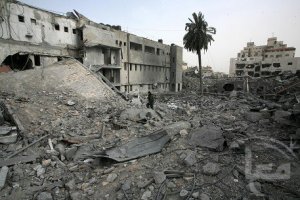
On 27 December 2008, Israel launched a massive military offensive against the Palestinians in the Gaza Strip. The Strip had been placed under an Israeli-led siege a year earlier, subjecting the 360 square-kilometre-enclave to a land, air and sea blockade. Codenamed Operation Cast Lead, this offensive began at 11am on a Saturday morning, with Israeli Air Force jets firing on targets across the territory. Ynetreported at the time that “80 jets, warplanes and helicopters dropped over 100 bombs on dozens of targets [during] the initial strike.” Among the targets were the small fishing port and the main police compound in Gaza City.
Aerial campaign
Throughout the first week of the assault, Israel relied on aerial attacks to pound Gaza. A report by the Palestinian Centre for Human Rights for the week 24–31 December 2008 (cited in the United Nations Fact-Finding Mission on the Gaza Conflict, sometimes known as the Goldstone Report) found that Israel “launched at least 300 air and sea strikes against the Gaza Strip. These strikes targeted 37 houses; 67 security and training sites; 20 workshops; 25 public and private institutions; seven mosques; and three educational institutions.”
Police stations in particular came under deliberate attack across the Strip. The “Arafat City” police headquarters in Gaza City, as well as three other stations, were attacked within the first few minutes of the assault on 27 December. The UN report states that, over the course of Israel’s military operations, 248 members of the Gaza police force were killed, which means that more than one out of every six fatalities was a police officer.
Israel’s Defence Minister at the time, Ehud Barak, claimed that there were three objectives for launching the offensive: “Dealing Hamas [which, since winning the 2006 Palestinian elections, had governed the Gaza Strip] a forceful blow; fundamentally changing the situation in Gaza; and bringing the rocket attacks against Israeli citizens to a halt.” Barak ordered a “special situation on the home front” for all Israeli communities within a 13-mile radius of the nominal border of the coastal enclave, which was quickly expanded to include the southern Israeli cities of Ashdod and Ashkelon.
Israel also drafted around 6,700 army reservists, in case it decided to widen the operation. Given that the assault was launched during election season, all contenders halted their campaigns in a show of support for then Israeli Prime Minister Ehud Olmert, who had also launched a war on Lebanon just two years earlier.
On the eighth day of the war – 3 January 2009 — Israel launched a ground invasion of Gaza. Israeli infantry entered the enclave from the north, supported by artillery fire and fighter jets. The Palestinians in Gaza, it must be remembered, have no artillery or other heavy weapons, no tanks, no air force and no navy. They faced the full might of one of the world’s strongest and best equipped armed forces.
The UN report details how Israel tried to cut the Strip in two – bisecting the territory from Karni (Al-Muntar) Crossing in the east, through Al-Nuseirat south of Gaza City, to the coast – before focusing troops in the north. For a further five days the northern towns of Al-Atatra and Beit Lahia came under heavy attack, with the UN report detailing “[Israel’s] alleged use of human shields, the alleged widespread mistreatment of civilians, including detentions, and transfers of large numbers to Israeli prisons in unlawful circumstances.”
Israel’s use of chemical weapons
In the later stages of the war, reports began to surface claiming that Israel had used white phosphorous — a chemical which creates a smokescreen for offensives but which causes severe burns and organ failure — during its attack on the people of Gaza.
Israel initially denied these reports, but investigations by several human rights organisations documented evidence to the contrary. A 2009 Amnesty International report found that “Israeli forces made extensive use of white phosphorus, often launched from 155mm artillery shells, in residential areas, causing death and injuries to civilians.” Among the targets were the UN Relief and Works Agency (UNRWA) headquarters and Al-Quds Hospital in Gaza City; an UNRWA primary school in Beit Lahia, north of Jabalia; and numerous residential areas.
Amnesty explained that:
[quote] “White phosphorus is extremely dangerous for humans as it causes deep burns through muscle and down to the bone, continuing to burn until deprived of oxygen. It can contaminate other parts of the body, or even people treating the injuries, poisoning and irreparably damaging internal organs.”
The rights organisation added: “Although using white phosphorus as an obscurant is not forbidden under international humanitarian law, air-bursting white phosphorus artillery shells over densely populated areas of Gaza violated the requirement to take necessary precautions to protect civilians.”
Human Rights Watch (HRW) agreed with Amnesty’s assessment, claiming that the manner in which Israel used the chemical could constitute a war crime. HRW’s “Rain of Fire” report argued that while “white phosphorus munitions did not kill the most civilians in Gaza […] their use in densely populated neighbourhoods […] violated international humanitarian law (the laws of war), which requires taking all feasible precautions to avoid civilian harm and prohibits indiscriminate attacks.”
On 8 January 2009, the UN Security Council approved resolution 1860 calling for a ceasefire in the Strip by a 14-0 margin. The United States abstained in the vote. The resolution called for an “immediate, durable and fully respected ceasefire, leading to the full withdrawal of Israeli forces from Gaza.” It condemned “all violence and hostilities directed against civilians and all acts of terrorism”, calling for “the unimpeded provision and distribution throughout Gaza of humanitarian assistance, including of food, fuel and medical treatment.”
Both Israel and Hamas declared the resolution invalid. The war continued for another 10 days, only coming to a close after a brutal 22 days. “The ferocity of the attack was unprecedented in the more than six-decade-old conflict between Israelis and Palestinians,” the Institute for Middle East Understanding (IMEU) observed.
According to figures from Israeli human rights organisation B’Tselem, 1,390 Palestinians were killed by Israeli forces in the Gaza Strip during Operation Cast Lead. Among those killed were 344 minors and 110 women. B’Tselem estimates that 759 of those killed in Gaza were Palestinians who did not take part in hostilities, and yet were still killed by Israeli forces.
What happened next?
Donald Macintyre, former Jerusalem bureau chief for the Independent, said in his book Gaza: Preparing for Dawn that following Operation Cast Lead, “It was impossible to ascribe ‘victory’ to either side.” He argued that Israel’s “bellicose pre-war talk of ‘crushing’ or ‘removing’ Hamas” proved to be “little more” than talk, while Hamas leader Ismail Haniyeh’s claim of victory was “at least as hollow”.
Gaza, however, has never recovered from the 2008 war. While acknowledging that its economy was already being strangled by the siege, the UN report found that Israel’s military operation “destroyed a substantial part of the Gaza Strip’s economic infrastructure and its capacity to support decent livelihoods for families.” The figures speak for themselves: 700 businesses were damaged or destroyed, with direct losses totalling approximately $140 million; the agricultural sector suffered direct losses worth $170 million; and over 3,354 houses were completely destroyed, with a further 11,112 partially damaged, according to figures from the United Nations Development Programme (UNDP). A separate UN report estimated the cost of Gaza’s losses and damage at $1.1 billion.
In the years since, Israel’s siege of the Strip has prevented the reconstruction of infrastructure destroyed during its 2008 offensive. To add insult to injury, Gaza has also since been the target of two more wars at the hands of Israel: the 2012 war, dubbed Operation Pillar of Defence, and the 2014 war, dubbed Operation Protective Edge. Almost 4,000 Palestinians were killed during these three offensives. Today, 54 per cent of Gaza’s almost 2 million-strong population is unemployed, while 53 per cent live under the poverty line in what has been described as one of the worst humanitarian situations in the world.
A decade later, Israel continues to shirk responsibility for its actions. Earlier this month, an Israeli court ruled against Izzeldin Abuelaish, a Palestinian doctor who lost three of his daughters during an Israeli air strike on his home in Jabalia, in the north of the Strip. Abuelaish’s story was made famous after he discovered that his children — 13-year-old Bessan, 15-year-old Mayar and 20-year-old Aya – had been killed while he was speaking to an Israeli TV channel; his suffering was broadcast live across the country and later shared widely around the world. Despite Abuelaish’s grief and the international attention his story received, the court still ruled that Israel bore no responsibility for the girls’ deaths, instead calling it an “unfortunate side effect” of the war.
Stephen Cohen and I are branded “Russian dupes” and “Putin agents,” because we object to the highly orchestrated and false portrayal of Russia as a threat to the West, a portrayal that is leading to war. The purpose of this orchestration is to prevent President Trump or any future president from reducing the dangerous tensions between nuclear powers that have accumulated since the Clinton regime. The military/security complex has resurrected its Cold War enemy so necessary for its outsized budget and power and intends to keep Russia as The Enemy. The Democrats have an interest in the vilification of Russia as “Russiagate” explains Hillary’s loss of the 2016 Presidential election and gives Democrats hope of removing President Trump from office. The media lacks independence, knowledge, and integrity and is the tool used by the military/security complex to control explanations, a prostitution of the media that has made the term “presstitutes” an accurate description. As strategic and Russian studies are largely funded by the military/security complex, the universities are also complicit in the march toward nuclear war. Republicans are as dependent as Democrats on funding from the military/security complex and the Israel Lobby.
All of this self-serving is driving America and its vassals to war with Russia, which might also mean with China. The war would be nuclear and be the end of the West, an act of self-genocide. The US national security establishment is so crazed that Trump’s efforts to get off the war track and onto a peace track are characterized as treason and a threat to US national security. (See for example)
The Russians are aware that the accusations and demonization that they experience are fabrications. They no longer see the problem as one of misunderstandings that diplomacy can overcome. What they see now is the West preparing its populations for war. It is this perception for which the West is solely responsible that makes the situation today far more dangerous than it ever was during the long Cold War.
In his just published book, War With Russia? (reviewed here), Stephen Cohen documents the creation of the “Russian threat” that serves a few material interests at the expense of life on earth.
In the article linked below, Cohen asks if it is more important to impeach Trump than to avoid nuclear war.
By Ali Salaam | American Herald Tribune | July 31, 2017
The New York Times, owned by the Zionist Jewish supremacist Ochs-Sulzberger family, has no problem with Iraqi suffering as long as Iran is not the one behind it.
The Iraq War was a genocide of the Iraqi people by Zionist supremacists in the Bush administration. Over 1 million innocent people were killed based on a lie. American soldiers died in an Israeli war and now an average of 22 soldiers commit suicide every day because their consciences cannot cope with the fact they committed crimes in an illegal war that served no purpose other than to benefit Israel, not America.
Benjamin Netanyahu, Prime Minister of the Zionist regime, once said “We are benefiting from one thing, and that is the attack on the Twin Towers and Pentagon, and the American struggle in Iraq.”
Paul Wolfowitz had his sights on Iraq since his time in the first Bush administration. Former Israeli official and Bush administration official Richard Perle had his eyes on Iraq since at least his authorship of the Clean Break white paper. The Zionist regime had their eyes on Iraq since the 1980s when strategist Oded Yinon wrote his white paper in support of dividing the Arab-Muslim world along ethnic and sectarian lines. The global Zionist lobby has had their eyes on Iraq since Theodor Herzl stated that Eretz Israel’s true borders go from the Nile River in Egypt to the Euphrates River in Iraq. … continue
This site is provided as a research and reference tool. Although we make every reasonable effort to ensure that the information and data provided at this site are useful, accurate, and current, we cannot guarantee that the information and data provided here will be error-free. By using this site, you assume all responsibility for and risk arising from your use of and reliance upon the contents of this site.
This site and the information available through it do not, and are not intended to constitute legal advice. Should you require legal advice, you should consult your own attorney.
Nothing within this site or linked to by this site constitutes investment advice or medical advice.
Materials accessible from or added to this site by third parties, such as comments posted, are strictly the responsibility of the third party who added such materials or made them accessible and we neither endorse nor undertake to control, monitor, edit or assume responsibility for any such third-party material.
The posting of stories, commentaries, reports, documents and links (embedded or otherwise) on this site does not in any way, shape or form, implied or otherwise, necessarily express or suggest endorsement or support of any of such posted material or parts therein.
The word “alleged” is deemed to occur before the word “fraud.” Since the rule of law still applies. To peasants, at least.
Fair Use
This site contains copyrighted material the use of which has not always been specifically authorized by the copyright owner. We are making such material available in our efforts to advance understanding of environmental, political, human rights, economic, democracy, scientific, and social justice issues, etc. We believe this constitutes a ‘fair use’ of any such copyrighted material as provided for in section 107 of the US Copyright Law. In accordance with Title 17 U.S.C. Section 107, the material on this site is distributed without profit to those who have expressed a prior interest in receiving the included information for research and educational purposes. For more info go to: http://www.law.cornell.edu/uscode/17/107.shtml. If you wish to use copyrighted material from this site for purposes of your own that go beyond ‘fair use’, you must obtain permission from the copyright owner.
DMCA Contact
This is information for anyone that wishes to challenge our “fair use” of copyrighted material.
If you are a legal copyright holder or a designated agent for such and you believe that content residing on or accessible through our website infringes a copyright and falls outside the boundaries of “Fair Use”, please send a notice of infringement by contacting atheonews@gmail.com.
We will respond and take necessary action immediately.
If notice is given of an alleged copyright violation we will act expeditiously to remove or disable access to the material(s) in question.
All 3rd party material posted on this website is copyright the respective owners / authors. Aletho News makes no claim of copyright on such material.


 Aletho News
