This Remembrance Day will doubtless see strenuous efforts by some to justify the fruitless bloodbath that was the First World War. Revisionist commentators have long attempted to rehabilitate the conflict as necessary and just, but the arguments do not stand up. It does no service to the memory of the dead to allow any illusions in the justice or necessity of war, particularly so when the precedents will be used to argue for the next ‘necessary’ conflict. From the causes of the war, to its prosecution and its results, here are the counter-arguments to ten common pro-war ploys.
1 The war was fought in defence of democracy.
This is contradicted by the basic facts. Germany had universal manhood suffrage while in Britain, including Ireland, some 40% of men still did not qualify for the vote. In Germany also, there were attempts to justify the war on the grounds that it was being fought to defend civilised values against a repressive, militaristic state, in the form of Russian autocracy.
2 Britain went to war due to a treaty obligation to defend the neutrality of Belgium.
There was no clear and accepted obligation on Britain to do this, and, in fact, before the Belgian issue appeared, the war party in the cabinet was already pushing for British intervention on the entirely different ground that there were naval obligations to France. These obligations had been developed in secret arrangements between the military of both countries, and were never subject to any kind of democratic accountability. The Germans even offered guarantees over Belgian integrity, which the British government refused to consider at all.
3 German aggression was the driving force for war.
However aggressive the German leadership may have been in 1914, the British establishment was at least as determined to take the opportunity to go to war with its imperial rival. At one point the Foreign Office even seized on imaginary German incursions into France to justify a British declaration of war on Germany. The declaration letter had to be retrieved from the German ambassador and rewritten when it was discovered that the stories were false. The enthusiasm of the British ruling class for war undermines any justification for it based on German aggression.
4 Germany had started a naval arms race with Britain.
Imperialist competition between the two states over markets and resources preceded the arms race in the fifteen years before the war. Britain’s naval power was the vital element in its ability to restrict German access to markets and resources across the world. Unless Britain was willing to allow Germany to expand economically, the logic of capitalist competition meant that Germany was bound to challenge British naval supremacy. The latent violence of the leading imperial nation is always the context for aggressive challenges to the status quo on the part of rising powers.
5 German imperialism was uniquely vicious and had to be challenged.
The atrocities committed against the Herrero people in Namibia were indeed terrible crimes, but were hardly unique compared to the horrors committed by all those involved in the rubber industry in the Belgian Congo, to take but one example. Also, European opinion had only a few years before 1914 been horrified by the brutality of another colonial power when it was engaged in ruthlessly expanding its dominance over independent states in Africa. This was Britain in its wars of aggression against the Boer states in South Africa, during which concentration camps were first used in order to control a civilian population.
6 Public opinion was united in favour of the war, as shown by images of cheering crowds in 1914.
It is now usually admitted that the degree of enthusiasm for the war was strictly limited, and the evidence is that the crowds who gathered at the outbreak of war were by no means united in martial enthusiasm. In fact sizeable and widespread anti-war demonstrations occurred in both Britain and Germany. Had the leaderships of Labour and Socialist parties across Europe not caved into demands to support their national ruling classes in going to war, it is quite possible that the conflict could have been stopped in its tracks.
7 The morale of British troops fighting on the Western Front remained intact to the end of the war.
While Britain may not have suffered quite the same scale of mutinies as in the German and French armies, at times there were whole stretches of the front where troops became so unreliable that generals did not dare order them into combat. The evidence for widespread cynicism about war strategies, contempt for the military leadership, and grave doubts about the purpose of the war, cannot be wished away by the revisionists. In so far as soldiers carried on willingly fighting the war, the explanation needs to be sought in the habituation to obedience, as well as the threat of court-martial executions. There is no need to invoke either fervid nationalism or any kind of deep psychological blood-lust as explanations.
8 The military leadership, notably General Haig, was not a bunch of incompetent ‘donkeys’.
Attempts to rehabilitate the likes of General Haig founder on some of the basic facts about the tactics he relentlessly employed. Repeated infantry attacks on opposing trenches consistently failed to gain any clear advantage, while causing colossal casualties. On the first day of the battle of the Somme, 1st July 1916, 57,000 troops out of 120,000 were killed or wounded. Despite continuing carnage on an incredible scale, Haig carried on ordering further attacks. When any hope of a breakthrough against the German lines was clearly lost, the purpose of the battle was shifted to attrition pure and simple. The plan now was to kill more German troops than the British lost. Since there was no way of reliably measuring the casualties on the other side, Haig relied on estimating it through the losses of his own side. On this basis he began to be angered when the army suffered too few losses, as when he complained that one division in September had lost under a thousand men. There can be no defence for this kind of disregard of human life.
9 The end of the war saw the triumph of liberal capitalism, against collapsing autocratic Empires.
In fact all states involved in the war were deeply destabilised. Even the United States, whose involvement was the most limited, experienced the ‘Red Summer’ of 1919, with unprecedented labour revolts, such as the Seattle general strike, alongside savage repression of socialists and black Americans. Britain saw the beginning of the Irish war of independence, and increasing unrest in India, which marks, in effect, the point at which the Empire began to unravel. Domestically, there was also a wave of radical working-class unrest, particularly in the ‘Red Clydeside’, which culminated in troops being sent into Glasgow to impose martial law.
10 The war achieved anything worthwhile whatsoever.
The war opened up a period of endemic economic dislocation, and outright crisis. In Britain there was a decade of industrial decline and high unemployment even before the Great Depression. In effect, it was only the Second World War which brought the major capitalist powers out of the slump. The First World War saw the point at which capitalism became addicted to war and to a permanent arms economy. The war demonstrated the capacity of capitalism to create industrialised waste, carnage and destruction on a colossal scale. The remembrance of the war is appropriately a time for mourning the horror, the loss and the waste of it all, but it should also provoke a determination to resist our rulers’ insistence on promoting war to further their interests. War can achieve nothing other than to create the conditions for further wars.
Popular opinion has, ever since its ending, remembered the First World War as a time of horrendous and futile misery and slaughter, as epitomising political and military leaders’ incompetence and callous disregard for human life. That popular judgement, which has helped turn common opinion against war in general, was correct, and we must not let the war mongers dismiss this instance of the wisdom of ordinary people.
The specifics for General Haig’s murderous rage can be found in Adam Hochschild, To End All Wars (Pan 2013), p.209 – reviewed on this site by Lindsey German.
Those in the war industry and the business of commemorating the dead have little time for peace, even as they supposedly celebrate it. For them, peace is the enemy as much as armed opposing combatants, if not more so. Dr Brendan Nelson of the Australian War Memorial is every bit the propagandist in this regard, encased in armour of permanent reminder: Do not forget the sacrifice; do not forget the slaughter. The issue is how war, not peace, is commemorated.
That theme was repeated, for the most part, in Paris on November 11. US President Donald Trump spoke of “our sacred obligation to memorialise our fallen heroes.” French President Emmanuel Macron marked the 100th anniversary of the Great War by having a dig at nationalism, calling it a “betrayal of patriotism” (is there a difference?). The nationalists, he warned, were getting busy, these “old demons coming back to wreak chaos and death”. The intellectuals (and here, he alluded to Julien Benda’s 1927 classic, La trahison des clercs) were at risk of capitulating.
But Macron, rather slyly, was hoping that the French obsession with universal values would somehow render his message less parochial: to be French was to be an internationalist, not a tunnel-visioned, rabid nationalist. The soldiers who perished in the Great War did so in the defence of France’s “universal values” in order to repudiate the “selfishness of nationals only looking after their own interests.” Much room for disagreement on that score, and Marine Le Pen would have been a suitable corrective.
The peace activities of the Great War, asphyxiated, smothered and derided in texts and official narratives, are rarely discussed in the mass marketed solemnity of commemorations. The writings of those prophets who warned that any adventurism such as what transpired in 1914 would be met with immeasurable suffering are also conspicuously absent. Jean de Bloc, whose magisterial multi-volume The Future of War appeared in 1898 in Russian, found it “impossible” that Europe’s leaders would embark on a conflict against each other; to do so would “cause humanity a great moral evil… civil order will be threatened by new theories of social revolution”. The end would be catastrophic. “How many flourishing countries will be turned into wilderness and rich cities into ruins! How many tears will be shed, how many will be left in beggary!”
These sceptics were the enlightened ones, scorned for not having the sense of fun that comes with joining battle and being butchered in the name of some vague patriotic sentiment. If human beings are animals at play, then play to the death, if need be – the rational ones were sidelined, persecuted and hounded. They are the party poopers.
Prior to the first shots of the guns of August in 1914, Europe had witnessed a slew of meetings and activities associated with the theme of peace. From 1889, pacifists were busy with Universal Peace Congresses, while the Inter-parliamentary Union made a stab at efforts and ideas to reduce national tensions. The Hague Peace Conferences of 1899 and 1907, with one scheduled to take place in 1915, suggested a certain sensibility, even as the military machinery of Europe was getting ominously more lethal. At the very least, the political classes were playing at peace.
The 1,200 women who gathered at The Hague in 1915 as part of the Women’s International League for Peace and Freedom feature as sane if forgotten voices before the murderous machine truly got going. Their work involved attendees from 12 countries and the passing of 20 resolutions on war. They worked to convince those engaged in the murderous machine about the folly and were dismissed accordingly as cranks and nuisances.
The peace movement was sundered by the patriotic diseases that engulfed the continent, and such organisations as the International Peace Bureau failed to reach a consensus on how best to quell warring aggressions. In January 1915, its Berne meeting was characterised by division, best exemplified by a resolution denouncing Germany and Australia for egregious breaches of international law. The vote was divided evenly, and unity was destroyed.
While monuments to the war makers and fallen soldiers dot the town squares of the combatant nations, lingering like morbid call cards for failed militarism, there are virtually none in the service of peace. The tenaciously wise and farsighted Austrian noblewoman Bertha von Suttner, the first woman to win the Nobel Peace Prize in 1905 and suspect the motives of governments behind the Hague Peace conferences, hardly figures in commemorative statuary. Nor does Rosa Luxemburg, who began a twelve-month sentence in Berlin’s Barnimstrasse Womens’ Prison on February 18, 1915 for “inciting public disobedience”.
Her crime, committed during the words of her famous Fechenheim address, was to call upon German workers to refuse shooting their French counterparts should war break out. “Victory or defeat?” she would sadly reflect in her anti-war tract, The Junius Pamphlet (1915) written whilst in confinement. “Thus sounds the slogan of the ruling militarism in all the warring countries, and, like an echo, the Social Democratic leaders have taken it up.”
As Adam Hochschild sourly noted in 2014, those who refuse to fight or barrack for war are ignored by the commemorative classes. “America’s politicians still praise Iraq War veterans to the skies, but what senator has a kind word to say about the hundreds of thousands who marched and demonstrated before the invasion was even launched to try to stop our soldiers from risking their lives in the first place?”
Events conspicuously against the spirit of killing and maiming opponents, such as that which took place during the short lived Christmas Truce of 1914, have only been remembered – and tolerated – because of their public relations quality. These events sell chocolates and cakes; they draw people to sites and commodities. The truce signalled no revolution; it did not challenge the war planners. “It’s safe to celebrate,” commented Hochschild, “because it threatened nothing.” The sovereignty of war, the institution of state-sanctioned killing, remained, as it still does, though selling peace can be lucrative when the shells have stopped falling.
The obscenity here is that conflict, most notably that of the First World War, was meant to be cathartic, a brief bit of masculine cleansing that would end by the arbitrarily designated time of Christmas. It was advertised as a picnic, a brief testosterone outing which would see men return intact. Foolishly, such figures as HG Wells saw it as “the war to end war”, so get it over and done with, minimal fuss and all. (To be fair to Wells, he found disgust and despair subsequently, reflecting upon this in The Bulpington of Blup in 1932.)
This was, truly, as the title of Margaret MacMillan’s work goes, the war that ended peace, and we should not forget the political and military classes, instrumental in dashing off soldiers to their death, who engineered it with coldness and ignorance. Foolishness and demagoguery tend to hold hands all too often, distant from that most moving sentiment expressed by the jailed US socialist activist and presidential candidate Eugene V. Debs. “I have no country to fight for; my country is the earth; and I am a citizen of the world.”
Binoy Kampmark was a Commonwealth Scholar at Selwyn College, Cambridge. He lectures at RMIT University, Melbourne and can be reached at: bkampmark@gmail.com.
Naturalist Sir David Attenborough definitely presents this short documentary on the migration of the Skeptic. This spoof was originally used to open QED 2018.
Written by Matt White, Michael Marshall, and Mike Hall
Directed by Matt White
Edited by Deniz Kavalali
VFX by Joe Pavlo
Audio post-production by Offset Audio
Featuring Adam Diggle as the voice of Sir David Attenborough
What was World War One about? How did it start? Who won? And what did they win? Now, 100 years after those final shots rang out, these questions still puzzle historians and laymen alike. But as we shall see, this confusion is not a happenstance of history, but the wool that has been pulled over our eyes to stop us from seeing what WWI really was. This is the story of WWI that you didn’t read in the history books. This is The WWI Conspiracy.
For those with limited bandwidth, CLICK HERE to download a smaller, lower file size version of this episode.
For those interested in audio quality, CLICK HERE for the highest-quality version of this episode (WARNING: very large download).
TRANSCRIPT
INTRODUCTION
November 11, 1918.
All across the Western front, the clocks that were lucky enough to escape the four years of shelling chimed the eleventh hour. And with that the First World War came to an end.
From 10 o’clock to 11 — the hour for the cessation of hostilities — the opposed batteries simply raised hell. Not even the artillery prelude to our advance into the Argonne had anything on it. To attempt an advance was out of the question. It was not a barrage. It was a deluge.
[…]
Nothing quite so electrical in effect as the sudden stop that came at 11 A. M. has ever occurred to me. It was 10:60 precisely and — the roar stopped like a motor car hitting a wall. The resulting quiet was uncanny in comparison. From somewhere far below ground, Germans began to appear. They clambered to the parapets and began to shout wildly. They threw their rifles, hats, bandoleers, bayonets and trench knives toward us. They began to sing.
And just like that, it was over. Four years of the bloodiest carnage the world had ever seen came to a stop as sudden and bewildering as its start. And the world vowed “Never again.”
Each year, we lay the wreath. We hear “The Last Post.” We mouth the words “never again” like an incantation. But what does it mean? To answer this question, we have to understand what WWI was.
WWI was an explosion, a breaking point in history. In the smoldering shell hole of that great cataclysm lay the industrial-era optimism of never-ending progress. Old verities about the glory of war lay strewn around the battlefields of that “Great War” like a fallen soldier left to die in No Man’s Land, and along with it lay all the broken dreams of a world order that had been blown apart. Whether we know it or not, we here in the 21st century are still living in the crater of that explosion, the victims of a First World War that we are only now beginning to understand.
What was World War One about? How did it start? Who won? And what did they win? Now, 100 years after those final shots rang out, these questions still puzzle historians and laymen alike. But as we shall see, this confusion is not a happenstance of history, but the wool that has been pulled over our eyes to stop us from seeing what WWI really was.
This is the story of WWI that you didn’t read in the history books. This is The WWI Conspiracy.
PART ONE – TO START A WAR
June 28, 1914.
The Archduke Franz Ferdinand, heir to the Austro-Hungarian throne, and his wife Sophie are in Sarajevo for a military inspection. In retrospect, it’s a risky provocation, like tossing a match into a powder keg. Serbian nationalism is rising, the Balkans are in a tumult of diplomatic crises and regional wars, and tensions between the kingdom of Serbia and the Austro-Hungarian Empire are set to spill over.
But despite warnings and ill omens, the royal couple’s security is extremely lax. They board an open-top sports car and proceed in a six-car motorcade along a pre-announced route. After an inspection of the military barracks, they head toward the Town Hall for a scheduled reception by the Mayor. The visit is going ahead exactly as planned and precisely on schedule.
And then the bomb goes off.
As we now know, the motorcade was a death trap. Six assassins lined the royal couple’s route that morning, armed with bombs and pistols. The first two failed to act, but the third, Nedeljko Čabrinović, panicked and threw his bomb onto the folded back cover of the Archduke’s convertible. It bounced off onto the street, exploding under the next car in the convoy. Franz Ferdinand and his wife, unscathed, were rushed on to the Town Hall, passing the other assassins along the route too quickly for them to act.
Having narrowly escaped death, the Archduke called off the rest of his scheduled itinerary to visit the wounded from the bombing at the hospital. By a remarkable twist of fate, the driver took the couple down the wrong route, and, when ordered to reverse, stopped the car directly in front of the delicatessen where would-be assassin Gavrilo Princip had gone after having failing in his mission along the motorcade. There, one and a half metres in front of Princip, was the Archduke and his wife. He took two shots, killing both of them.
Yes, even the official history books—the books written and published by the “winners”—record that the First World War started as the result of a conspiracy. After all it was—as all freshman history students are taught—the conspiracy to assassinate the Archduke Franz Ferdinand that led to the outbreak of war.
That story, the official story of the origins of World War I, is familiar enough by now: In 1914, Europe was an interlocking clockwork of alliances and military mobilization plans that, once set in motion, ticked inevitably toward all out warfare. The assassination of the Archduke was merely the excuse to set that clockwork in motion, and the resulting “July crisis” of diplomatic and military escalations led with perfect predictability to continental and, eventually, global war. In this carefully sanitized version of history, World War I starts in Sarajevo on June 28, 1914.
But this official history leaves out so much of the real story about the build up to war that it amounts to a lie. But it does get one thing right: The First World War was the result of a conspiracy.
To understand this conspiracy we must turn not to Sarajevo and the conclave of Serbian nationalists plotting their assassination in the summer of 1914, but to a chilly drawing room in London in the winter of 1891. There, three of the most important men of the age—men whose names are but dimly remembered today—are taking the first concrete steps toward forming a secret society that they have been discussing amongst themselves for years. The group that springs from this meeting will go on to leverage the wealth and power of its members to shape the course of history and, 23 years later, will drive the world into the first truly global war.
Their plan reads like outlandish historical fiction. They will form a secret organization dedicated to the “extension of British rule throughout the world” and “the ultimate recovery of the United States of America as an integral part of a British Empire.” The group is to be structured along the lines of a religious brotherhood (the Jesuit order is repeatedly invoked as a model) divided into two circles: an inner circle, called “The Society of the Elect,” who are to direct the activity of the larger, outer circle, dubbed “The Association of Helpers” who are not to know of the inner circle’s existence.
“British rule” and “inner circles” and “secret societies.” If presented with this plan today, many would say it was the work of an imaginative comic book writer. But the three men who gathered in London that winter afternoon in 1891 were no mere comic book writers; they were among the wealthiest and most influential men in British society, and they had access to the resources and the contacts to make that dream into a reality.
Present at the meeting that day: William T. Stead, famed newspaper editor whose Pall Mall Gazette broke ground as a pioneer of tabloid journalism and whose Review of Reviews was enormously influential throughout the English-speaking world; Reginald Brett, later known as Lord Esher, an historian and politician who became friend, confidant and advisor to Queen Victoria, King Edward VII, and King George V, and who was known as one of the primary powers-behind-the-throne of his era; and Cecil Rhodes, the enormously wealthy diamond magnate whose exploits in South Africa and ambition to transform the African continent would earn him the nickname of “Colossus” by the satirists of the day.
But Rhodes’ ambition was no laughing matter. If anyone in the world had the power and ability to form such a group at the time, it was Cecil Rhodes.
Richard Grove, historical researcher and author, TragedyAndHope.com.
RICHARD GROVE: Cecil Rhodes also was from Britain. He was educated at Oxford, but he only went to Oxford after he went to South Africa. He had an older brother he follows into South Africa. The older brother was working in the diamond mines, and by the time Rhodes gets there he’s got a set up, and his brother says “I’m gonna go off and dig in the gold mines. They just found gold!” And so he leaves Cecil Rhodes, his younger brother—who’s, like, in his 20s—with this whole diamond mining operation. Rhodes then goes to Oxford, comes back down to South Africa with the help of Lord Rothschild, who had funding efforts behind De Beers and taking advantage of that situation. And from there they start to use what—there’s no other term than “slave labor,” which then turns in later to the apartheid policy of South Africa.
GERRY DOCHERTY: Well, Rhodes was particularly important because in many ways, at the end of the 19th century, he seriously epitomized where capitalism was [and] where wealth really lay.
DOCHERTY: Rhodes had the money and he had the contacts. He was a great Rothschild man and his mining wealth was literally uncountable. He wanted to associate himself with Oxford because Oxford gave him the kudos of the university of knowledge, of that kind of power.
And in fact that was centered in a very secretive place called “All Souls College.” Still you’ll find many references to All Souls College and “people behind the curtain” and such phrases—”power behind thrones.” Rhodes was centrally important in actually putting money up in order to begin to gather together like-minded people of great influence.
Rhodes was not shy about his ambitions, and his intention to form such a group were known to many. Throughout his short life, Rhodes discussed his intentions openly with many of his associates, who, unsurprisingly, happened to be among the most influential figures in British society at that time.
More remarkably, this secret society—which was to wield its power behind the throne—was not a secret at all. The New York Times even published an article discussing the founding of the group in the April 9, 1902, edition of the paper, shortly after Rhodes’ death.
The article, headlined “Mr. Rhodes’s Ideal of Anglo-Saxon Greatness” and carrying the remarkable sub-head “He Believed a Wealthy Secret Society Should Work to Secure the World’s Peace and a British-American Federation,” summarized this sensational plan by noting that Rhodes’ “idea for the development of the English-speaking race was the foundation of ‘a society copied, as to organization, from the Jesuits.’” Noting that his vision involved uniting “the United States Assembly and our House of Commons to achieve “the peace of the world,” the article quotes Rhodes as saying: “The only thing feasible to carry out this idea is a secret society gradually absorbing the wealth of the world.”
This idea is laid down in black and white in a series of wills that Rhodes wrote throughout his life, wills that not only laid out his plan to create such a society and provided the funds to do so, but, even more remarkably, were collected in a volume published after his death by co-conspirator William T. Stead.
GROVE: Rhodes also left his his great deal of money—not having any children, not having married, dying at a young age—left it in a very well-known last will and testament, of which there were several different editions naming different benefactors, naming different executors.
So in 1902 Cecil Rhodes dies. There’s a book published that contains his last will and testament. The guy who wrote the book, William T. Stead, was in charge of a British publication called The Review of Reviews. He was part of Rhodes’ Round Table group. He at one time was an executor for the will, and in that will it says that he laments the loss of America from the British Empire and that they should formulate a secret society with the specific aim of bringing America back into the Empire. He talks about this a few different times throughout the will, then he names all the countries that they need to include in this list to have world domination, to have an English-speaking union, to have British race as the enforced culture on all countries around the world.
The will contains the goal. The goal is amended over a series of years and supported and used to gain support. And then by the time he dies in 1902 there’s funding, there’s a plan, there’s an agenda, there’s working groups and it all launches and then takes hold. And then not too long later, you’ve got World War one and then from that you’ve got World War two and then you’ve got a century of control and slavery that really could have been prevented.
When, at the time of Rhodes’ death in 1902, this “secret” society decided to partially reveal itself, it did so under the cloak of peace. It was only because they desired world peace, they insisted, that they had created their group in the first place, and only for the noblest of reasons that they aimed to “gradually absorb the wealth of the world.”
But contrary to this pacific public image, from its very beginnings the group was interested primarily in war. In fact, one of the first steps taken by this “Rhodes Round Table” (as it was known by some) was to maneuver the British Empire into war in South Africa. This “Boer War” of 1899-1902 would serve a dual purpose: it would unite the disparate republics and colonies of South Africa into a single unit under British imperial control, and, not incidentally, it would bring the rich gold deposits of the Transvaal Republic into the orbit of the Rothschild/Rhodes-controlled British South Africa Company.
The war was, by the group’s own admission, entirely its doing. The point man for the operation was Sir Alfred Milner, a close associate of Rhodes and a member of the secret society’s inner circle who was then the governor of the British Cape Colony. Although largely forgotten today, Alfred Milner (later “1st Viscount Milner”) was perhaps the most important single figure in Britain at the dawn of the 20th century. From Rhodes’ death in 1902, he became the unofficial head of the roundtable group and directed its operations, leveraging the vast wealth and influence of the group’s exclusive membership to his own ends.
With Milner, there was no compunction or moral hand-wringing about the methods used to bring about those ends. In a letter to Lord Roberts, Milner casually confessed to having engineered the Boer War: “I precipitated the crisis, which was inevitable, before it was too late. It is not very agreeable, and in many eyes, not a very creditable piece of business to have been largely instrumental in bringing about a war.”
When Rhodes’ co-conspirator and fellow secret society inner circle member William Stead objected to war in South Africa, Rhodes told him: “You will support Milner in any measure that he may take short of war. I make no such limitation. I support Milner absolutely without reserve. If he says peace, I say peace; if he says war, I say war. Whatever happens, I say ditto to Milner.”
The Boer War, involving unimaginable brutality—including the death of 26,000 women and children in the world’s first (British) concentration camps—ended as Rhodes and his associates intended: with the formerly separate pieces of South Africa being united under British control. Perhaps even more importantly from the perspective of the secret society, it left Alfred Milner as High Commission of the new South African Civil Service, a position from which he would cultivate a team of bright, young, largely Oxford-educated men who would go on to serve the group and its ends.
And from the end of the Boer War onward, those ends increasingly centered around the task of eliminating what Milner and the Round Table perceived as the single greatest threat to the British Empire: Germany.
DOCHERTY: So in the start it was influence—people who could influence politics, people who had the money to influence statesmen—and the dream. The dream of actually crushing Germany. This was a basic mindset of this group as it gathered together.
Germany. In 1871, the formerly separate states of modern-day Germany united into a single empire under the rule of Willhelm I. The consolidation and industrialization of a united Germany had fundamentally changed the balance of power in Europe. By the dawn of the 20th century, the British Empire found itself dealing not with its traditional French enemies or its long-standing Russian rivals for supremacy over Europe, but the upstart German Empire. Economically, technologically, even militarily: if the trends continued, it would not be long before Germany began to rival and even surpass the British Empire.
For Alfred Milner and the group he had formed around him out of the old Rhodes Round Table society, it was obvious what had to be done: to change France and Russia from enemies into friends as a way of isolating, and, eventually, crushing Germany.
PETER HOF: Yes, well from the British perspective, Germany, after their unification in 1871, they became very strong very quickly. And over time this worried the British more and more, and they began to think that Germany represented a challenge to their world hegemony. And slowly but surely they came to the decision that Germany must be confronted just as they had come to the same decision with regard to other countries; Spain and Portugal and especially France and now Germany.
German finished goods were marginally better than those from Britain, they were building ships that were marginally better than those of Britain, and all of this. The British elite very slowly came to the decision that that Germany needed to be confronted while it was still possible to do so. It might not be possible to do so if they waited too long. And so this was how the indecision crystallize.
I think that Britain might possibly have accepted the German ascendance, but they had something that that was was close at hand, and that was the Franco-Russian Alliance. And they thought if they could hook in with that alliance, then they had the possibility of defeating Germany quickly and without too much trouble. And that is basically what they did.
But crafting an alliance with two of Britain’s biggest rivals and turning public opinion against one of its dearest continental friends was no mean feat. To do so would require nothing less than for Milner and his group to seize control of the press, the military and all the diplomatic machinery of the British Empire. And so that’s exactly what they did.
The first major coup occurred in 1899, while Milner was still in South Africa launching the Boer War. That year, the Milner Group ousted Donald Mackenzie Wallace, the director of the foreign department at The Times, and installed their man, Ignatius Valentine Chirol. Chirol, a former employee of the Foreign Office with inside access to officials there, not only helped to ensure that one of the most influential press organs of the Empire would spin all international events for the benefit of the secret society, but he helped to prepare his close personal friend, Charles Hardinge, to take on the crucial post of Ambassador to Russia in 1904, and, in 1906, the even more important post of Permanent Under-Secretary at the Foreign Office.
With Hardinge, Milner’s Group had a foot in the door at the British Foreign Office. But they needed more than just their foot in that door if they were to bring about their war with Germany. In order to finish the coup, they needed to install one of their own as Foreign Secretary. And, with the appointment of Edward Grey as Foreign Secretary in December of 1905, that’s precisely what happened.
Sir Edward Grey was a valuable and trusted ally of the Milner Group. He shared their anti-German sentiment and, in his important position of Foreign Secretary, showed no compunction at all about using secret agreements and unacknowledged alliances to further set the stage for war with Germany.
HOF: He became a foreign secretary in 1905, I believe, and the foreign secretary in in in France was of course Delcassé. And Delcassé was very much an anti-German. He was very passionate about the recovery of Alsace-Lorraine, and so he and the King hit it off very well together. And Edward Grey shared this anti-German feeling with the king—as I explained in my book how he how he came to have that attitude about Germany. But in any case, he had the same attitude with the king. They worked very well together. And Edward Grey very freely acknowledged the heavy role that the King I played in British foreign policy and he said that this was not a problem because he and the King were in agreement on most issues and so they worked with very well together.
The pieces were already beginning to fall into place for Milner and his associates. With Edward Grey as foreign secretary, Hardinge as his unusually influential undersecretary, Rhodes’ co-conspirator Lord Esher installed as deputy Governor of Windsor Castle where he had the ear of the king, and the king himself—whose unusual, hands-on approach to foreign diplomacy and whose wife’s own hatred of the Germans dovetailed perfectly with the group’s aims—the diplomatic stage was set for the formation of the Triple Entente between France, Russia and Great Britain. With France to the west and Russia to the east, England’s secret diplomacy had forged the two pincers of a German-crushing vise.
All that was needed was an event that the group could spin to its advantage to prepare the population for war against their former German allies. Time and again throughout the decade leading up to the “Great War,” the group’s influential agents in the British press tried to turn every international incident into another example of German hostility.
When the Russo-Japanese War broke out, rumours swirled in London that it was in fact the Germans that had stirred up the hostilities. The theory went that Germany, in a bid to ignite conflict between Russia and England, who had recently concluded an alliance with the Japanese, had fanned the flames of war between Russia and Japan. The truth, of course, was almost precisely the opposite. Lord Lansdowne had conducted secret negotiations with Japan before signing a formal treaty in January 1902. Having exhausted their reserves building up their military, Japan turned to Cecil Rhodes’ co-conspirator Lord Nathan Rothschild to finance the war itself. Denying the Russian navy access to the Suez canal and high-quality coal, which they did provide to the Japanese, the British did everything they could to ensure that the Japanese would crush the Russian fleet, effectively removing their main European competitor for the Far East. The Japanese navy was even constructed in Britain, but these facts did not find their way into the Milner-controlled press.
When the Russians “accidentally” fired on British fishing trawlers in the North Sea in 1904, killing three fishermen and wounding several more, the British public was outraged. Rather than whip up the outrage, however, The Times and other mouthpieces of the secret society instead tried to paper over the incident. Meanwhile, the British Foreign Office outrageously tried to blame the incident on the Germans, kicking off a bitter press war between Britain and Germany.
The most dangerous provocations of the period centered around Morocco, when France—emboldened by secret military assurances from the British and backed up by the British press—engaged in a series of provocations, repeatedly breaking assurances to Germany that Morocco would remain free and open to German trade. At each step, Milner’s acolytes, both in government and in the British press, cheered on the French and demonized any and every response from the Germans, real or imagined.
DOCHERTY: Given that we’re living in a world of territorial aggrandizement, there was a concocted incident over Morocco, and the allegation that Germany was secretly trying to take over the British/French influence on Morocco. And that literally was nonsense, but it was blown up into an incident and people were were told “Prepare! You had better prepare yourself for the possibility of war because we will not be dictated to by that Kaiser person over in Berlin!”
One of the incidents —which I would need to make reference to to get the date perfectly right—referred to a threat. Well, it was portrayed as a threat—it was no more of a threat than a fly would be if it came into your room at the present moment—of a gun boat sitting off the coast of Africa. And it was purported that this was a sign that in fact Germany was going to have a deep water port and they were going to use it as a springboard to interrupt British shipping. When we researched it, Jim and I discovered that the size of that so-called gunboat was physically smaller than the king of England’s royal yacht. What? But history has portrayed this as a massive threat to to the British Empire and it’s “masculinity,” if you like—because that’s how they saw themselves.
Ultimately, the Moroccan crises passed without warfare because, despite the best efforts of Milner and his associates, cooler heads prevailed. Likewise the Balkans descended into warfare in the years prior to 1914, but Europe as a whole didn’t descend with them. But, as we well know, the members of the Round Table in the British government, in the press, in the military, in finance, in industry, and in other positions of power and influence eventually got their wish: Franz Ferdinand was assassinated and within a month the trap of diplomatic alliances and secret military compacts that had been so carefully set was sprung. Europe was at war.
In retrospect, the machinations that led to war are a master class in how power really operates in society. The military compacts that committed Britain—and, ultimately, the world—to war had nothing to do with elected parliaments or representative democracy. When Conservative Prime Minister Arthur Balfour resigned in 1905, deft political manipulations ensured that members of the Round Table, including Herbert Henry Asquith, Edward Grey and Richard Haldane—three men who Liberal leader Henry Campbell-Bannerman privately accused of “Milner worship”—seamlessly slid into key posts in the new Liberal government and carried on the strategy of German encirclement without missing a step.
In fact, the details of Britain’s military commitments to Russia and France, and even the negotiations themselves, were deliberately kept hidden from Members of Parliament and even members of the cabinet who were not part of the secret society. It wasn’t until November 1911, a full six years into the negotiations, that the cabinet of Prime Minister Herbert Henry Asquith started to learn the details of these agreements, agreements that had been repeatedly and officially denied in the press and in Parliament.
This is how the cabal functioned: efficiently, quietly and, convinced of the righteousness of their cause, completely uncaring about how they achieved their ends. It is to this clique, not to the doings of any conspiracy in Sarajevo, that we can attribute the real origins of the First World War, with the nine million dead soldiers and seven million dead civilians that lay piled in its wake.
But for this cabal, 1914 was just the start of the story. In keeping with their ultimate vision of a united Anglo-American world order, the jewel in the crown of the Milner Group was to embroil the United States in the war; to unite Britain and America in their conquest of the German foe.
Across the Atlantic, the next chapter in this hidden history was just getting underway…
Republican Sen. Chuck Grassley of Iowa made a dramatic announcement this month that almost nobody in America paid any attention to. Grassley released a statement saying that four years ago, he asked the Intelligence Community Inspector General to release two “Congressional Notifications” written by former CIA Director John Brennan and former Director of National Intelligence James Clapper.
Grassley had had his requests to declassify the documents ignored repeatedly throughout the last two years of the Obama administration. He decided to try again because all of the Obama people at the CIA and DNI are gone now. This time, his request was approved.
So what was the information that was finally declassified? It was written confirmation that John Brennan ordered CIA hackers to intercept the emails of all potential or possible intelligence community whistleblowers who may have been trying to contact the Congressional oversight committees, specifically to the Senate Select Committee on Intelligence and the Senate Judiciary Committee.
Simply put, Brennan ordered his people to hack into the Senate email system—again. Grassley is the longtime chairman of Judiciary Committee, and he was understandably appalled.
First, let me explain what a Congressional Notification is. The CIA is required by law to inform the Congressional oversight committees whenever one of its officers, agents, or administrators breaks the law, when an operation requires Congressional approval because it is a “covert action” program, or whenever something happens at the CIA that’s potentially controversial and the Agency wants to save itself the embarrassment of explaining itself to Congress later.
Brennan apparently ordered his officers to spy on the Senate. Remember, back in 2014 his officers spied on Intelligence Community investigators while they were writing the Senate Torture Report. This time, he decided to inform Congress.
But Brennan and Clapper classified the notification. It was like a taunt. “Sure, I’m spying on Congress, which is illegal. But it’s classified, so what are you going to do about it?”
Grassley went through the proper channels. And even though Brennan and Clapper essentially gave him the middle finger, he didn’t say anything until the documents were finally declassified. He’s a bigger man than I.
John Brennan, left, and James Clapper. (LBJ Library / Flickr)
I think Grassley missed an opportunity here, though.
First, it’s my own opinion that John Brennan belongs in prison. He has flouted U.S. national security laws with impunity for years. That’s unacceptable. In these declassified notifications, he’s confessing to hacking into the Senate’s computer system. That’s a violation of a whole host of laws, from illegal use of a government computer to wire fraud to espionage. There ought to be a price to pay for it, especially in light of the fact that Brennan was the leading force behind the prosecutions of eight national security whistleblowers during the Obama administration, almost three times the number of whistleblowers charged under the Espionage Act by all previous presidents combined.
Second, it’s a crime, a felony, to overclassify government information. Most Americans have no idea that that’s the case. Of course, nobody has ever been charged with it. But it’s a serious problem, and it’s antithetical to transparency. The CIA Inspector General said of the notifications, “I could see no reason to withhold declassification of these documents. They contained no information that could be construed as sources and methods.” That’s an admission that the notifications were improperly classified in the first place.
Grassley added, “There is a strong public interest in (the notifications’s) content. I do not believe they need to be classified at all, and they should be released in their entirety.”
Grassley went so far as to call out Brennan and Clapper by name. “What sources or methods would be jeopardized by the declassification of these notifications? After four-and-a-half years of bureaucratic foot-dragging, led by Brennan and Clapper, we finally have the answer: None.”
So why weren’t they declassified four years ago? Remember, it’s illegal to classify a crime. And it’s illegal to classify something solely for the purpose of preventing embarrassment to the CIA. Yet those were the very reasons for classifying the documents in the first place. It was because Brennan and Clapper think they’re somehow special cases. (Recall that it was Clapper who lied directly to the Senate Intelligence Committee about intercepting the communications of American citizens. He also did that with impunity.)
Brennan and Clapper think the law doesn’t apply to them. But it does. Without the rule of law, we have chaos in our country. The law has to apply equally to all Americans. Brennan and Clapper need to learn that lesson the hard way. They broke the law. They ought to be prosecuted for it.
John Kiriakou is a former CIA counterterrorism officer and a former senior investigator with the Senate Foreign Relations Committee. John became the sixth whistleblower indicted by the Obama administration under the Espionage Act—a law designed to punish spies. He served 23 months in prison as a result of his attempts to oppose the Bush administration’s torture program.
JORDAN PETERSON is a professor at the University of Toronto, a clinical psychologist and the author of the million-plus selling ’12 Rules for Life’, a Number 1 bestseller. He rose to international prominence in 2016, after criticising the Canadian government’s enactment of Bill C-16.
THE psychologist and internet celebrity has been touted as ‘the most influential public intellectual in the Western world right now’, with contentious views on gender, political correctness. A culture warrior, who has no truck with “white privilege”, “cultural appropriation” and a range of other ideas associated with social justice movements.
Today I heard a black historian on NPR say that the “civil war” was fought in order to establish a framework for human rights.
He also said that black civil rights achieved by the war were overturned by the rollback of Reconstruction, put back in place by the 1964 Civil Rights Act, and was now being overturned again by Trump’s response to the caravan from Honduras.
As best as I could tell, this was an Identity Politics explanation of history with all of its contradictions and factual errors.
Identity Politics is based on the accusation that the white male is a racist and a misogynist. This is inconsistent with the belief that Washington, totally in the hands of white males, chose to fight a bloody civil war in order to bring human rights to black slaves. If white males are this idealistic and willing to make such a sacrifice for blacks, how is it that the white males are racists?
The black historian can’t have it both ways.
Moreover, how would the black historian explain how it possibly can be that the same Union army that fought to bring human rights to black slaves immediately on war’s end was sent under the same generals, Sherman and Sheridan, to slaughter the Plains Indians. Why did the Union army fight for human rights for blacks and against human rights for native American Indians?
As every competent historian knows, there was no “civil war.” A civil war is when two sides fight for control of the government. The southern states had seceded and formed their own country. The Confederacy had no interest in controlling Washington. The war happened because Lincoln invaded the Confederacy. The Confederacy fought because they were invaded. The North fought to maintain the Union, as Lincoln said repeatedly. The South seceded because the Northern majority in Congress passed a tariff that benefited the North at the expense of the South. Lincoln guaranteed the South permanent protection of slavery if they would stay in the Union, but did not offer to repeal the tariff. Historians have studied the diaries and letters of soldiers on both sides, and can’t find anyone who was fighting over slavery. Lincoln said that blacks were not sufficiently developed to live in society with whites. His plan was to send them back to Africa, which might have happened, as the North didn’t want them, if Lincoln had not been assassinated.
Under the Reconstruction that the North imposed on the South, the South was divided into five military districts in which civil rights for whites were scant and their property was stolen by carpetbaggers and scalawags as whites lacked the protection of law and self-government. The vindictive Union simply reversed the roles of black and white to the extent that they were able.
As Lawrence Stratton and I show in our book, The New Color Line, despite the 1964 Civil Rights Act’s prohibition of racial quotas, the Equal Employment Opportunity Commission established quotas as the EEOC’s method of enforcement. A quota regime is a grant of privilege to those “preferred minorities” favored by the quota system, and privilege is a violation of the 14th Amendment’s requirement of equality under the law.
Everything I have said in this short essay is factual and can be easily ascertained. But we have a black historian on NPR who thinks whites are racists but fought and died in order to bring human rights to imported blacks but not to native Indians, and who has no idea of the oppressiveness of Reconstruction (sometimes called Radical Reconstruction) or the violation of the 14th Amendment and the intent of Congress by the EEOC.
As I have emphasized over the years, Americans live in a matrix of misinformation in which facts, and history itself, are disappearing. Emotion, not reason, rules. We now have a mob, Antifa, that has introduced physical violence into politics. Those who control the explanations denounce Trump and Tucker Carlson, not Antifa’s violence.
NATO carried out a 78-day campaign of airstrikes against Yugoslavia in 1999 after accusing Belgrade of committing war crimes in Kosovo. The strikes left up to 5,700 civilians dead, and contaminated part of southern Serbia with radiation from the depleted uranium rounds used by the alliance.
The Serbian government-designated Commission Investigating the Effects of NATO’s 1999 Bombing of the Federal Republic of Yugoslavia has provided Sputnik with important information about some of its preliminary findings.
Speaking to Sputnik Serbian, commission head Dr. Darko Laketic explained that in the course of visits to cities, towns and municipalities affected by the NATO bombings, the commission has been able to establish what appears to be evidence of a link between the depleted uranium rounds dropped in these areas and a rise in cancer incidence.
According to the physician, in the city of Vranje, southern Serbia, out of 40 people who came into direct contact with soil contaminated by depleted uranium, ten have died, with “the majority of the deaths caused by malignant neoplasms.”
“Many people who have been to the affected areas suffer from the symptoms of erythema and ulcerous eruptions of an unknown etiology on their skin,” Dr. Laketic added.
Commission members have already visited Vranje, Pancevo and Novi Sad, and plan to visit Kragujevac, with all of these areas facing heavy NATO bombing in 1999. “These are our priority regions. We are collecting medical and statistical data from medical institutions in these areas and interviewing people who have come into contact with contaminated soil,” Laketic explained.
The doctor noted that in the village of Borovac, another area struck by NATO bombs, three residents, or one percent of the village’s total population, are suffering from malignant brain damage.
Dr. Laketic noted that an increase in oncological diseases has also been observed in Pcinjski District, and said that this was particularly significant, since the area’s population is younger than the Serbian average.
The commission is now working on the creation of a large, systematized database.
“We are investigating the effects of toxic substances. Our task is to establish the causal links between [NATO’s] actions and illnesses. Having established them, we will receive weighty arguments for organized efforts in the detection, prevention and treatment of cancer at its early stages in those regions where it is necessary,” the doctor said.
According to Dr. Laketic, in addition to depleted uranium, other toxic substances released during NATO’s bombardment, such as chlorine, benzene, and polychlorinated biphenyls are also proven to cause illness, including malignant neoplasms which can lay dormant for five, ten or even twenty years after a person first comes in contact with them.
Established in June, the commission hopes to complete its first preliminary report by 2020. Dr. Laketic will report on the status of his team’s investigation in the Serbian National Assembly in December.
According to openly available data, in the late 1990s, the average Serbian death rate from oncological illnesses hovered between 9,000 and 12,000 people per year. By 2014, however, the figure doubled to 22,000, with the number of newly diagnosed cancer patients reaching 40,000.
Some medical doctors and scientists have attributed the jump in cancer rates to NATO’s use of depleted uranium rounds during its bombing, and have pointed to the rise in leukemia and lymphoma, cancer types affecting tissue most sensitive to ionizing radiation. Other experts have maintained that there yet to be conclusive proof of a relationship between cancer rates and the depleted uranium rounds, since cancers have been growing across Serbia, while depleted uranium rounds were dropped primarily in southern Serbia. According to World Cancer Research Fund statistics, Serbia is 18th in the world in total incidence of cancers, with 307.9 cases per 100,000 residents reported in 2018.
The Jerusalem District Court ruled yesterday that Jews worldwide who faced discrimination or came under attack because of their religion could file for damages in Israeli court even if they are not nationals, Yedioth Ahronoth newspaper reported.
Judge Moshe Drori based the ruling on the controversial “Nation-State law” which stipulates that “Israel as the Nation State of the Jewish People, according to which the Jewish State is responsible for ensuring the well-being of its citizens and of those of Jewish origin who were affected by anti-Semitism”.
The paper said the ruling was passed during a case filed on behalf of two Jewish American women who were held hostages by men affiliated with the Palestinian Liberation Organisation (PLO) when they hijacked the Italian cruise ship Achille Lauro in 1985.
According to the paper, this is the second time that Drori has used the “Nation-State law” to issue such rulings. In September, he ruled that Palestinian resistance movement Hamas must compensate a man who was injured in one of the movement’s activities.
A $25 million study on the effects of cellphone radiation on rats found clear evidence of tumors. But the Food and Drug Administration, which had requested the study in the first place, is casting doubt on its conclusions. RT America’s Dan Cohen has the details.
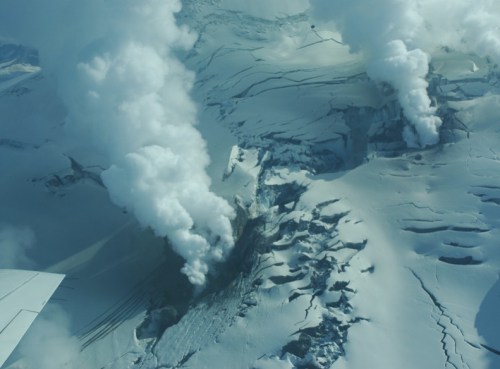
Recent research shows that the volume of volcanic CO2 currently being emitted into Earth’s atmosphere is far greater than previously calculated, challenging the validity of the man-made global warming theory.
Figure 1.) Volcanic gas emissions breakthrough overlying fractured and partially melted glacial ice sheet. (Image credits: Christina Neal, AVO/USGS)
The cornerstone principle of the global warming theory, anthropogenic global warming (AGW), is built on the premise that significant increases of modern era human-induced CO2 emissions have acted to unnaturally warm Earth’s atmosphere.
A warmed atmosphere that directly, or in some cases indirectly fuels anomalous environmental disasters such as ocean warming, alteration of ocean chemistry, polar ice sheet melting, global sea level rise, coral bleaching and most importantly dramatic changes in climate.
There are numerous major problems with the AGW principle.
Identification of Volcanic vs. Man-made CO2
Natural volcanic and man-made CO2 emissions have the exact same and very distinctive carbon isotopic fingerprint.
It is therefore scientifically impossible to distinguish the difference between volcanic CO2 and human-induced CO2 from the burning of fossil fuels (see here).
This major problem with the AGW principle has been rationalized away by consensus climate scientists who insist, based on supposedly reliable research, that volcanic emissions are minuscule in comparison to human-induced CO2 emissions (Gerlach 1991).
Terrance Gerlach’s volcanic CO2 calculation was based on just 7 actively erupting land volcanoes and three actively erupting ocean floor hydrothermal vents (seafloor hot geysers).
Utilizing gas emission data from this very limited number of volcanic features, Gerlach estimated that the volume of natural volcanic CO2 emissions is 100 to 150 times less than the volume of man-made CO2 emissions from the burning of fossil fuels and therefore of no consequence.
To put this calculation process into perspective, the Earth is home to 1,500 land volcanoes and 900,000 seafloor volcanoes/hydrothermal vents.
By sampling just an extremely small percent of these volcanic features it is impossible to imagine that the calculation is correct.
Especially knowing that volcanic activity varies greatly from area to area, volcano to volcano, and through time. Utilizing just 0.001 percent (10/901,500) of Earth’s volcanic features to calculate volcanic CO2 emissions does not inspire confidence in the resulting value.
Non-Erupting Volcanoes Can Emit Massive Amounts of CO2 into Earth’s Atmosphere
Recent geological research by the University of Leeds and others proves that non-erupting volcanoes can emit massive amounts of CO2 into Earth’s atmosphere and oceans. The Gerlach calculation and all follow-up calculations utilized volcanic CO2 rates from actively erupting volcanoes.
Lost in the numerous recent media articles concerning the argument of when, or if Iceland’s Katla Volcanowill erupt is the discovery that this non-erupting subglacial volcano is currently emitting staggering amounts of CO2 into Earth’s atmosphere!
Researchers from the University of Leeds who studied the Katla Volcano said this.
“We discovered that Katla volcano in Iceland is a globally important source of atmospheric carbon dioxide (CO2) in spite of being previously assumed to be a minor gas emitter. Volcanoes are a key natural source of atmospheric CO2 but estimates of the total global amount of CO2 that volcanoes emit are based on only a small number of active volcanoes. Very few volcanoes which are covered by glacial ice have been measured for gas emissions, probably because they tend to be difficult to access and often do not have obvious degassing vents. Through high‐precision airborne measurements and atmospheric dispersion modeling, we show that Katla, a highly hazardous subglacial volcano which last erupted 100 years ago, is one of the largest volcanic sources of CO2 on Earth, releasing up to 5% of total global volcanic emissions. This is significant in the context of a growing awareness that natural CO2 sources have to be more accurately quantified in climate assessments and we recommend urgent investigations of other subglacial volcanoes worldwide.”(see here)
The Number of Volcanoes Emitting CO2 into the Atmosphere at Any One Time
The calculation of the total yearly volume of volcanic CO2 emitted into the atmosphere is based on the presumption that very few volcanoes are erupting at any one time.
Scientists from various worldwide volcano research institutions, most notably the United States Geological Survey, have estimated this number to be 20.
This very low number has been challenged by many scientists including those at NASA.
A multinational team led by NASA has initiated a high-resolution satellite CO2 monitoring project (see here). This project is focused on determining how many geological features are emitting CO2 at any one time.
This project may eventually give scientists a better idea of how many land volcanoes are emitting CO2 at any one time.
However, it is doubtful the project will properly record ocean CO2 emissions from Earth’s 900,000 deep ocean floor and very difficult to monitor volcanic features.
In any case, this project is certainly a step forward towards achieving a better understanding of the climate influence of volcanic CO2 emissions.
The Amount of CO2 and heat infused into Earth’s Oceans by Seafloor Geological Features
About 71% of Earth’s surface is covered by oceans making it a water, not land, planet. For many years now, scientists have contended that the nearly one million geological features present in these vast ocean regions have played a minimal role in heating and chemically charging ocean seawater.
Instead of contending that man-made atmospheric CO2 was the root cause of changes to our oceans.
Recent research has proven that the contentions of these scientists are far from 100% proven. To the contrary, it has become clear that geological heat flow and chemically charged heated fluid flow into our oceans is far more influential than previously thought and possibly the root cause of changes to our oceans.
One example is that geological features are warming Earth’s oceans and causing El Nino’s and La Nina’s (see here, here, and here). Warmed seawater is not capable of holding as much CO2 as cold water.
So, the geologically warming of seawater indirectly leads to a large amount of CO2 being released from oceans and emitted into the atmosphere.
Recent research shows that seafloor geological features also directly emit large amounts of CO2 into our oceans and atmosphere(see here, here,here, and Figure 2).
In summary, the volume of volcanic CO2 being emitted into the Earth’s atmosphere has not been accurately assessed.
Numerous research studies and articles conducted/written by qualified scientists concur with this contention (see here, here, and here).
In a geological time frame, Earth has gone through many periods of increased volcanism. These volcanic periods resulted in; major plant and animal extinction events (see here, here, and here), the end of glacial eras (see here) and the dramatic alteration of Earth’s climate (see here).
All indications are that Earth is currently experiencing another period of strong volcanic activity which is acting to infuse CO2 into our atmosphere thereby challenging the validity of the global warming theory.
Clearly, its time to put on hold all environmental action plans based on the cornerstone AGW principle of the global warming theory until additional geological CO2 emission research is conducted.
James Edward Kamis is a retired professional Geologist with 42 years of experience, a B.S. in Geology from Northern Illinois University (1973), an M.S. in geology from Idaho State University (1977), and a longtime member of AAPG who has always been fascinated by the connection between Geology and Climate. More than 14 years of research/observation have convinced him that the Earth’s Heat Flow Engine, which drives the outer crustal plates, is an important driver of the Earth’s climate as per his Plate Climatology Theory.
Censored Al Jazeera documentary exposing the Israel lobby in the U.S.
If Americans Knew | November 2, 2018
Part 1 of 4
The documentary was never broadcast by Al Jazeera due to pressure from some Jewish groups and individuals. It was eventually leaked to a few groups, which posted some short clips. On November 2nd the first two parts finally became available to the public.
Former Pfizer chief toxicologist Helmut Sterz presents a critical examination of the development, approval, and global rollout of mRNA COVID-19 vaccines—particularly those produced by Pfizer/BioNTech. The Vaccine Mafia details the failure of pharmaceutical companies, regulatory authorities, politicians, and international organizations to follow established scientific and ethical standards during the pandemic. Drawing on the author’s decades of experience in pharmaceutical toxicology, Sterz reveals the many ways the vaccines’ inadequate or omitted preclinical safety testing put the world’s population at risk.
Sterz demonstrates how “emergency” approvals allowed manufacturers to bypass long-standing international guidelines governing toxicity testing, especially with regard to reproductive and cancer risks. They also allowed governments and health authorities to ignore or conceal evidence of serious adverse effects that occurred, including myocarditis, reproductive harm, and other long-term health risks.
This site is provided as a research and reference tool. Although we make every reasonable effort to ensure that the information and data provided at this site are useful, accurate, and current, we cannot guarantee that the information and data provided here will be error-free. By using this site, you assume all responsibility for and risk arising from your use of and reliance upon the contents of this site.
This site and the information available through it do not, and are not intended to constitute legal advice. Should you require legal advice, you should consult your own attorney.
Nothing within this site or linked to by this site constitutes investment advice or medical advice.
Materials accessible from or added to this site by third parties, such as comments posted, are strictly the responsibility of the third party who added such materials or made them accessible and we neither endorse nor undertake to control, monitor, edit or assume responsibility for any such third-party material.
The posting of stories, commentaries, reports, documents and links (embedded or otherwise) on this site does not in any way, shape or form, implied or otherwise, necessarily express or suggest endorsement or support of any of such posted material or parts therein.
The word “alleged” is deemed to occur before the word “fraud.” Since the rule of law still applies. To peasants, at least.
Fair Use
This site contains copyrighted material the use of which has not always been specifically authorized by the copyright owner. We are making such material available in our efforts to advance understanding of environmental, political, human rights, economic, democracy, scientific, and social justice issues, etc. We believe this constitutes a ‘fair use’ of any such copyrighted material as provided for in section 107 of the US Copyright Law. In accordance with Title 17 U.S.C. Section 107, the material on this site is distributed without profit to those who have expressed a prior interest in receiving the included information for research and educational purposes. For more info go to: http://www.law.cornell.edu/uscode/17/107.shtml. If you wish to use copyrighted material from this site for purposes of your own that go beyond ‘fair use’, you must obtain permission from the copyright owner.
DMCA Contact
This is information for anyone that wishes to challenge our “fair use” of copyrighted material.
If you are a legal copyright holder or a designated agent for such and you believe that content residing on or accessible through our website infringes a copyright and falls outside the boundaries of “Fair Use”, please send a notice of infringement by contacting atheonews@gmail.com.
We will respond and take necessary action immediately.
If notice is given of an alleged copyright violation we will act expeditiously to remove or disable access to the material(s) in question.
All 3rd party material posted on this website is copyright the respective owners / authors. Aletho News makes no claim of copyright on such material.


 Aletho News

