US-British Threats Against Russia Have a Long History
By T.J. COLES and Matthew ALFORD | CounterPunch | November 6, 2018
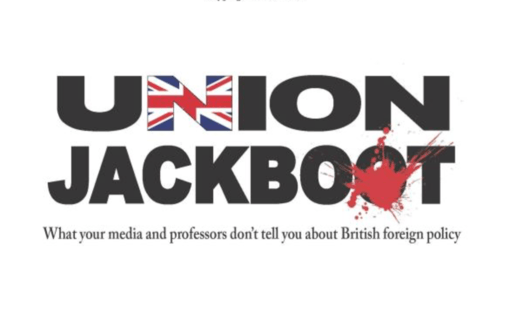
In their new book Union Jackboot: What Your Media and Professors Don’t Tell You About British Foreign Policy (Até Books), doctors T.J. Coles and Matthew Alford debate the rationale of Anglo-American policy towards Russia.
Alford: There seems to be a consensus that we need a strong military because Russia is on the rise. What do you think about that rationale?
Coles: There’s no consensus, except among European and American elites. Europe and America are not the world.
There are a lot of issues to consider with regards to Russia. Is it a threat? If so to whom? What kind of threat is Russia? So let’s consider these questions carefully. As far as the British establishment is concerned, Russia is an ideological threat because it is a major power with a substantial population. It’s also self-reliant where oil and gas is concerned, unlike Britain. So there’s lots of potential for Russian political ideology to undermine Britain’s status. In fact, there are European Council on Foreign Relations papers saying that Putin’s Russia presents an “ideological alternative” to the EU.[i] And that’s dangerous.
Britain, or more accurately its policymaking elites, have considered Russia a significant enemy for over a century. Under the Tsar, the so-called Great Game was a battle for strategic resources, trading routes, and so on. The historian Lawrence James calls this period the first Cold War, which went “hot” with the Crimean War (1853-56).[ii] Britain had a mixed relationship with the Tsars because, on the one hand, theirs’ were repressive regimes and Britain tended to favour repressive regimes, hence their brief alliance with Russia’s enemy, the Ottomans. On the other hand, Russia was a strategic threat to Britain’s imperial interests, and thus the Crimean War (1853-56).
When the Bolsheviks took over Russia, beginning 1917, the relationship became much less ambiguous – Russians, and especially Bolsheviks, were clearly the enemy. Their ideology posed a threat internally. So Winston Churchill, who began as a Liberal and became a Conservative, considered the Labour Party, which was formed in 1900, as basically a front for Bolsheviks.[iii] That shows the level of paranoia among elites. The Labour Party, at least at the beginning, was a genuine, working man’s political organisation – women couldn’t vote then, remember. So by associating this progressive, grassroots party representing the working classes as an ideological ally or even puppet of the brutal Bolshevik regime, the Tories had an excuse to undermine the power of organised, working people. So you had the Zinoviev letter in 1924, which we now know was a literal conspiracy between the secret services and elements of the Tory party to fabricate a link between Labour and Moscow. And it famously cost Labour the general election, since the right-wing, privately-owned media ran with the story as though it was real. It’s an early example of fake news.[iv]
That’s the ideological threat that Russia has posed, historically. But where there’s a threat, there’s an opportunity. The British elites exploited the “threat” then and as they do today by associating organised labour with evil Bolshevism and, in doing so, alienate the lower classes from their own political interests. Suddenly, we’ve all got to be scared of Russia, just like in 1917. And let’s not forget that Britain used chemical weapons – M-Devices, which induced vomiting – against the Bolsheviks. Chemical weapons were “the right medicine for the Bolshevist,” in Churchill’s words. This was in 1919, as part of the Allied invasion of Russia in support of the White Army. [v]
So if we’re talking about the historical balance of forces and cause and effect, Britain not Russia initiated the use of chemical weapons against others. But this history is typically inverted to say that Russia poses a threat to the West, hence all the talk about Novichok, the Skripals, and Dawn Sturgess, the civilian who supposedly came into contact with Novichok and died in hospital a few days later.
The next question: What sort of threat is Russia? According to the US Army War College, since the collapse of the Soviet Union and since pro-US, pro-“free market” President Boris Yeltsin resigned in 1999, Russia has pursued so-called economic nationalism. And the US doesn’t like this because markets suddenly get closed and taxes are raised against US corporations.[vi] That’s the real threat. But you can’t tell the public that: that we hate Russia because they aren’t doing what we say. If you look through the military documents, you can find almost nothing about security threats against the US in terms of Russian expansion, except in the sense that “security” means operational freedom. You can find references to Russia’s nuclear weapons, though, which are described as defensive, designed “to counter US forces and weapons systems.”[vii] Try finding that on the BBC. I should mention that even “defensive” nukes can be launched accidentally.
The real goal with regards to Russia is maintaining US economic hegemony and the culture of open “free markets” that goes with it, while at the same time being protectionist in real life. (US protectionism didn’t start under Trump, by the way.) Liberal media like the New York Times run sarcastic articles about Russian state oil and gas being a front for Putin and his cronies. And yes, that may be true. But what threat is Russia to the US if it has a corrupt government? The threat is closing its markets to the US. The US is committed to what its military calls Full Spectrum Dominance. So the world needs to be run in a US-led neoliberal order, in the words of the US military, “to protect US interests and investment.”[viii] But this cannot be done if you have “economic nationalism,” like China had until the “reforms” of the ‘70s and ‘80s, and still has today to some extent. Russia and China aren’t military threats. The global population on the whole knows this, even though the domestic US and British media say the opposite.
Alford: What about military threats?
Coles: The best sources you can get are the US military records. Straight from the horse’s mouth. The military plans for war and defence. They have contingencies for when political situations change. So they know what they’re talking about. There’s a massive divide between reality, as understood from the military records, and media and political rhetoric. Assessments by the US Army War College, for instance, said years ago that any moves by NATO to support a Western-backed government in Ukraine would provoke Russia into annexing Crimea. They don’t talk about Russia spontaneously invading Ukraine and annexing it, which is the image we get from the media. The documents talk about Russia reacting to NATO provocation.[ix]
If you look at a map, you see Russia surrounded by hostile NATO forces. The media don’t discuss this dangerous and provocative situation, except the occasional mention of, say, US-British-Polish war-gaming on the border with Russia. When they do mention it, they say it’s for “containment,” the containment of Russia. But to contain something, the given thing has to be expanding. But the US military – like the annual threat assessments to Congress – say that Russia’s not expanding, except when provoked. So at the moment as part of its NATO mission, the UK is training Polish and Ukrainian armed forces, has deployed troops in Poland and Estonia, and is conducting military exercises with them.[x]
Imagine if Scotland ceded from the UK and the Russians were on our border conducting military exercises, supposedly to deter a British invasion of Scotland. That’s what we’re doing in Ukraine. Britain’s moves are extremely dangerous. In the 1980s, the UK as part of NATO conducted the exercise, Operation Able Archer, which envisaged troop build-ups between NATO and the Warsaw Pact countries. Now-declassified records show that the Russians briefly mistook this exercise for a real-world scenario. That could have escalated into nuclear war. This is very serious.[xi]
But the biggest player is the USA. It’s using the threat of force and a global architecture of hi-tech militarism to shape a neoliberal order. Britain is slavishly following its lead. I doubt that Britain would position forces near Russia were it not for the USA. Successive US administrations have or are building a missile system in Europe and Turkey. They say it’s to deter Iran from firing Scud missiles at Europe. But it’s pointed at Russia. It’s a radar system based in Romania and Turkey, with a battery of Patriot missiles based in Poland. The stationing of missiles there provoked Russia into moving its mobile nuclear weapons up to the border in its Kaliningrad exclave, as it warned it would do in 2008.[xii] Try to find any coverage of that in the media, except for a few articles in the print media here or there. If Western media were interested in survival, there would be regular headlines: “NATO provoking Russia.”
But the situation in Ukraine is really the tipping point. Consider the equivalent. Imagine if Russia was conducting military exercises with Canada or Mexico, and building bases there. How would the US react? It would be considered an extreme threat, a violation of the UN Charter, which prohibits threats against sovereign states.
Alford: So we’ve extended NATO to pretty much the Russian border? But there’s a hard border there. Everyone knows we’re never going to attack Russia, both for reasons of morality and self-preservation. So maybe this situation is safer than you imply.
Coles: There’s no morality involved. States are abstract, amorphous entities comprised of dominant minorities and subjugated majorities who are conditioned to believe that they are relatively free and prosperous. The elites of those states act both in their self-interests – career, peer-pressure, kickbacks, and so on – and in the interests of their class, which is of course tied to international relations because their class thrives on profiting from resource exploitation. So you can’t talk about morality in this context. Only individuals can behave morally. The state is made up of individuals, of course, but they’re acting against the interests of the majority. As we speak, they are acting immorally– or at least amorally – but creating the geopolitical conditions that imperil each and every one of us.
As for invasion, we’re not going to invade Russia. This isn’t 1918. Russia has nuclear weapons and can deter an invasion. But that’s not the point. Do we want to de-escalate an already tense geopolitical situation or make it worse to the point where an accident happens? So while it’s not about invading Russia directly, the issue is about attacking what are called Russia’s “national interests.” Russia’s “national interests” are the same as the elites’ of the UK. National interest doesn’t mean the interests of the public. It means the interests of the policy-making establishment and the corporations. For example, the Theresa May government sacrificed its own credibility to ensure that its Brexit White Paper (2018) appeased both the interests of the food and manufacturing industries that want a soft Brexit – easy trade with the EU – and the financial services sector which wants a hard Brexit – freedom from EU regulation. Everyone else be damned. That’s the “national interest.”
So for its real “national interest,” Russia wants to keep Ukraine in its sphere of influence because its oil and gas to Europe pass through Ukraine. About 80% of Russia’s export economy is in the oil and gas sector. It’s already had serious political tensions with Ukraine, which on several occasions hasn’t paid its energy bills, so Russia has cut supplies. If Europe can bump Ukraine into its own sphere of influence it has more leverage over Russia. This is practically admitted in Parliamentary discussions by Foreign Office ministers, and so forth.[xiii] Again, omitted by the media. Also, remember that plenty of ethnic Russians live in eastern Ukraine. In addition, Russia has a naval base in Crimea. That’s not to excuse its illegal action in annexing Ukraine, it’s to highlight the realpolitik missing in the media’s coverage of the situation.
T. J. Coles is a postdoctoral researcher at Plymouth University’s Cognition Institute and the author of several books.
Matthew Alford teaches at Bath University in the UK and has also written several books. Their latest is Union Jackboot (Até Books).
SOURCES
[i] Mark Leonard and Nicu Popescu (2007) ‘A Power Audit of EU-Russia Relations’ European Council on Foreign Relations, Policy Paper, p. 1.
[ii] ‘Anglo-Russian relations were severely strained; what was in effect a cold war lasted from the late 1820s to the beginning of the next century’. The Crimean War seems to have set a precedent for today. James writes:
[It] was an imperial war, the only one fought by Britain against a European power during the nineteenth century, although some would have regarded Russia as essentially an Asiatic power. No territory was at stake; the war was undertaken solely to guarantee British naval supremacy in the Mediterranean and, indirectly, to forestall any threat to India which might have followed Russia replacing Britain as the dominant power in the Middle East.
Lawrence James (1997) The Rise and Fall of the British Empire London: Abacus, pp. 180-82.
[iii] Churchill said in 1920:
All these strikes and rumours of strikes and threats of strikes and loss and suffering caused by them; all this talk of revolution and “direct action” have deeply offended most of the British people. There is a growing feeling that a considerable section of organized Labour is trying to tyrannize over the whole public and to bully them into submission, not by argument, not by recognized political measures, but by brute force …
But if we can do little for Russia [under the Bolsheviks], we can do much for Britain. We do not want any of these experiments here …
Whether it is the Irish murder gang or the Egyptian vengeance society, or the seditious extremists in India, or the arch-traitors we have at home, they will feel the weight of the British arm.
Winston Churchill (1920) Bolshevism and Imperial Sedition. Speech to United Wards Club. London: The International Churchill Society.
[iv] The fake letter says:
A settlement of relations between the two countries [UK and Russia] will assist in the revolutionising of the international and British proletariat, … [and] make it possible for us to extend and develop the propaganda and ideas of Leninism in England and the colonies.
It also says that ‘British workmen’ have ‘inclinations to compromise’ and that rapprochement will eventually lead to domestic ‘[a]rmed warfare’. It was leaked by the services to the Conservative party and then to the media. Richard Norton-Taylor (1999) ‘Zinoviev letter was dirty trick by MI6’ Guardian and Louise Jury (1999) ‘Official Zinoviev letter was forged’ Independent. For media coverage at the time, see James Curran and Jean Seaton (1997) Power without ResponsibilityLondon: Routledge, p. 52.
[v] Paul F. Walker (2017) ‘A Century of Chemical Warfare: Building a World Free of Chemical Weapons’ Conference: One Hundred Years of Chemical Warfare: Research, Deployment, Consequences pp. 379-400 and Giles Milton (2013) Russian Roulette: A Deadly Game: How British Spies Thwarted Lenin’s Global Plot London: Hodder, eBook.
[vi] ‘The Russian Federation has shown repeatedly that common values play almost no role in its consideration of its trading partners’, meaning the US and EU. ‘It often builds relationships with countries that most openly thwart Western values of free markets and democracy’, notably Iran and Venezuela. ‘In this regard, the Russian Federation behaves like “Russia Incorporated.” It uses its re-nationalized industries to further its wealth and influence, the latter often at the expense of the EU and the U.S.’. Colonel Richard J. Anderson (2008) ‘A History of President Putin’s Campaign to Re-Nationalize Industry and the Implications for Russian Reform and Foreign Policy’ Senior Service College, US Army War College, Pennsylvania: Carlisle Barracks, p. 52.
[vii] Daniel R. Coats (2017) Statement for the Record: Worldwide Threat Assessment of the US Intelligence CommunitySenate Select Committee on Intelligence, Washington, DC: Office of the Director of National Intelligence, pp. 18-19.
[viii] US Space Command (1997) Vision for 2020 Colorado: Peterson Air Force Base.
[ix]The document also says: ‘a replay of the West-sponsored coup against pro-Russian elites could result in a split, or indeed multiple splits, of the failed Ukraine, which would open a door for NATO intervention’.Pavel K. Baev (2011) ‘Russia’s security relations with the United States: Futures planned and unplanned’ in Stephen J. Blank (ed.) Russian Nuclear Weapons: Past, Present, and Future Strategic Studies Institute Pennsylvania: Carlisle Barracks, p. 170.
[x] Forces Network (2016) ‘British troops to deploy to Poland’.
[xi] For example, Nate Jones, Thomas Blanton and Christian F. Ostermann (2016) ‘Able Archer 83: The Secret History’ Nuclear Proliferation International History Project Washington, DC: Woodrow Wilson International Center for Scholars.
[xii] It was reported in the ultra-right, neo-con press at the time that:
[Russian] President Dmitri Medvedev announced in his first state-of-the-nation address plans to deploy the short-range SS-26 (“Iskander”) missiles in the Russian exclave of Kaliningrad if the U.S. goes ahead with its European Ballistic Missile Defense System (BMDS). Medvedev told parliament that the deployment would “neutralize” U.S. plans for a missile defense shield based in Poland and the Czech Republic [now in Romania), which the U.S. claims as vital in defending against missile attacks from ‘rogue states’ such as Iran.
Neil Leslie (2008) ‘The Kaliningrad Missile Crisis’ The New Atlanticist, available at atlanticcouncil.org.
[xiii] For example, a Parliamentary inquiry into British-Russian relations says of the newly-imposed US-British ally in Ukraine:
President Poroshenko’s Government is more openly committed to economic reform and anti-corruption than any previous Ukrainian Administration. The reform agenda has made considerable progress and has enjoyed some successes including police reform, liberalisation of the energy market and the launch of an online platform for government procurement …
The annexation of Crimea also resulted in a ban on importing products from Crimea, on investing in or providing services linked to tourism and on exporting certain goods for use in the transport, telecoms and energy sectors.
House of Commons Foreign Affairs Committee (2017) The United Kingdom’s relations with Russia Seventh report of session 2016-17, HC 120 London: Stationary Office, pp. 28, 31.
Pipe Bombs: Frantic Denunciations of the False Flag Concept
By Prof. Graeme McQueen | Global Research | November 1, 2018
Onto the 24-hour reality show that is U.S. politics, 15 package bombs recently made their entrance.
The devices were sent to vocal opponents of Mr. Trump, most of them prominent members of the Democratic Party. The incident became public on October 25, less than two weeks before the November 6 elections that mark the middle of Trump’s first term.
Now, it is an interesting question as to whether the designated perpetrator, Cesar Sayoc, is a lone wolf terrorist or a patsy acting on behalf of larger forces. I am encouraged to see researchers exploring the second possibility. But my focus in this article is different.
The suggestion that the package bomb incidents might be false flag attacks—attacks by opponents of Trump deceptively imputing the attacks to his supporters to discredit them before the elections—was rapidly put forth. Among the fastest off the mark were right-wing pundits, so it was easy enough for various “liberals” (whatever this term means today in the U.S.) to characterize the false flag suggestion as a variety of right-wing conspiracy theory, and as both intellectually ridiculous and morally disgusting. The evident aim has been to stigmatize the concept and drive it from responsible political discourse.
Among the most prominent of the denunciations appeared in CNN and The New York Times.
The article by CNN Editor-at-large Chris Cillizza’s was entitled, “Debunking the despicable ‘false flag’ theory on the mail bombs.” He quoted Rush Limbaugh’s claim that a “Democratic operative” could be responsible for the attacks in order to make it look as if “the Republicans are a bunch of insane lunatics.” Cillizza noted that although we may be tempted to dismiss such “conspiracy crap” without comment, we must not. To refuse to comment on it is “to let it fester.” We must publicly challenge it. His article, it seems, was meant to be a model of such debunking.
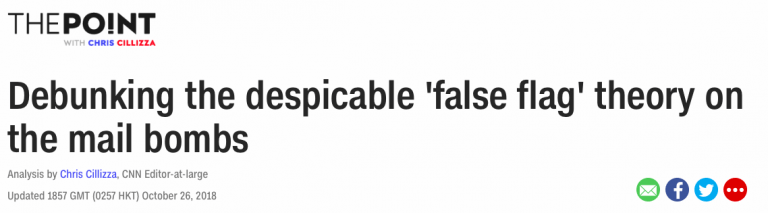
Screengrab from CNN
It was not a good model.
Cillizza concentrated on what he believed to be the logistical impossibilities in Limbaugh’s scenario. He named two steps in the scenario:
1. “Someone or someones who wanted to help Democrats—and the media, I guess, somehow?—would send a series of pipe bombs to prominent Democrats across the country.”
2. “Then Democrats or the media or, again, someone, would have to have coordinated with the state and local police—not to mention federal authorities—so that law enforcement said that these were functional bombs (even though, again, according to this theory, they weren’t).”
He feels that simply to have named these steps is to have shown how ridiculous the hypothesis is.
Really?
There is nothing impossible about Step 1. Surely Cillizza is not saying that the faction of the U.S. intelligence community hostile to Trump—nicely represented by James Clapper and John Brennan, two recipients of the package bombs—is incapable of fashioning a few clumsy devices and sending them through the mail? The material in the 2001 anthrax envelopes was much more sophisticated and difficult to acquire than the non-functional “pipe bombs,” yet the U.S. intelligence community remains a prime suspect in these attacks.
As for the purpose in sending out such bombs, one of the first questions we ask when confronted by a violent event of this sort is, Cui bono? Who benefits? I cannot see how Trump and his supporters benefit, whereas the benefit to mainstream Democrats—of the Clinton variety, no threat to the established order—is obvious. They get to claim the status of nonviolent, sane victim.
What about Cillizza’s Step 2? I confess I am defeated by his prose. I do not know what he is trying to say. But let me speculate that he is claiming this conspiracy theory involves too many people (various levels of police, for example) and that it involves an impossibly complex deception—policing agencies portraying inoperative devices as operative.
Once again we might fruitfully examine the anthrax attacks. There was an impressive amount of coordination involved in these attacks. As far as policing was concerned, this was mainly achieved by the FBI chasing away other levels of police while keeping strict control over its own personnel when they wandered too near the truth.
But the coordination in the anthrax case went far beyond policing. Media were deeply implicated. The media faithfully set out the story they were handed by authorities: the attacks appeared to have been carried out by al-Qaeda, with a strong possibility of Iraqi involvement. This story was successfully propagated, for example, through a wide variety of newspapers, from The New York Times and Washington Post to the Guardian. By the end of 2001—less than four months after the attacks began—Homeland Security, the FBI and the White House had been forced to admit that neither al-Qaeda, nor Iraq, nor domestic Muslims, appeared to have had anything to do with these attacks. Instead, they came from the heart of the US Military-Industrial-Intelligence community. As to who, precisely, in this community carried out the attacks, there remains disagreement; but even a sketchy familiarity with the anthrax attacks knocks out Cillizza’s Step 2 objections.
A useful rule of thumb is that if a thing has happened it is possible. We know a violent, coordinated and complex false flag attack is possible in the U.S. because it happened.
But if this was the best CNN could do, what about The New York Times? Kevin Roose produced a piece somewhat longer, although not much more thoughtful, than the CNN editor’s.
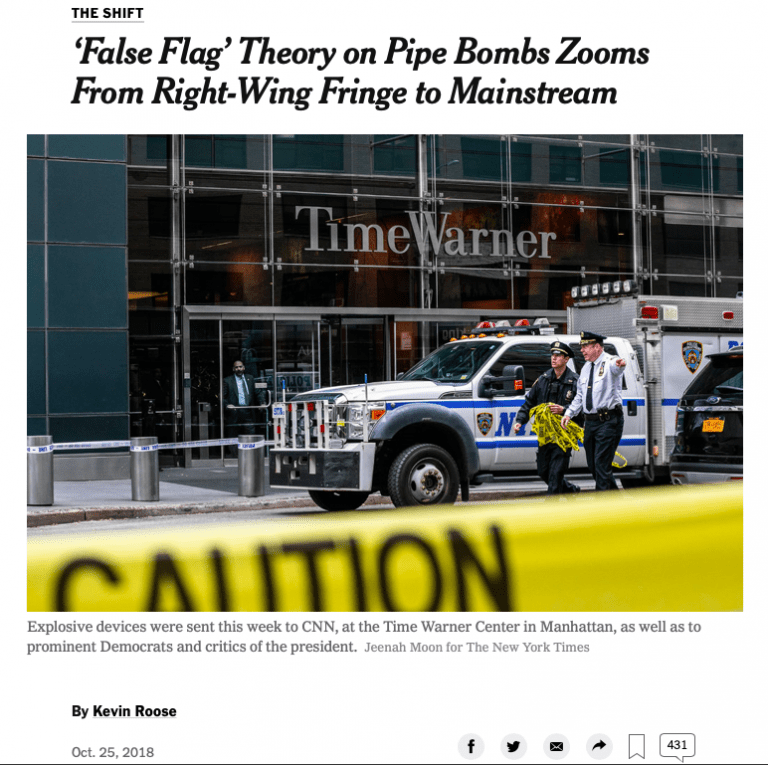
Screengrab from The New York Times
Roose let us have it with the old chestnut, “conspiratorial thinking has always been with us”, and then proceeded to dance lightly from the grassy knoll to the moon landing to 9/11 without troubling us with sources, evidence or other bothersome material.
If you are like me you will find yourself, in an increasingly bad mood, asking: has this young fellow carefully researched all of these incidents? Has he, in fact, carefully researched a single one of them?
Like the CNN editor, Roose spends his time countering claims that the package bombs sent to prominent enemies of Mr. Trump might have been sent by people wanting to discredit Trump and his allies. He places these “conspiracy theorists” on the political right and associates them with Trump’s presidency. More than this, he uses, and explains, the term “false flag” and tries hard to discredit it. “False flag philosophy—the idea that powerful groups stage threats and tragic events to advance their agendas—is now a bizarrely common element of national news stories.”
This statement is a sign of progress in the opening of the American mind. We should celebrate the good news that the concept of false flag is common in political discourse, common enough that The New York Times feels a need to discredit it. This achievement came through much labour by many people over many years.
That Roose finds the concept “bizarre” is, of course, to be regretted, but this merely testifies to his naivety and his poor knowledge of false flag attacks, of which there have been plenty in human history (see Sources).
As a matter of fact, the particular type of false flag attack being discussed in the present case, where Group A attacks itself and blames Group B, is centuries old. In China it used to be called the Stratagem of Wounded Flesh (see Sources).
The notion that the false flag concept and the conspiracy concept are the exclusive property of the political right is absurd. They are ideas available to, and used by, all those who genuinely care about what is going on around them and wish to have an adequate intellectual toolbox. I am not on the political right and I am not a supporter of Rush Limbaugh, Ann Coulter and the like, but I do not for that reason choose to shut down my brain.
Although we may not want to admit it, repetition is half the battle in public fights and debates. Let us use the term “false flag” repeatedly and ensure that it remains where it apparently is at the moment: in the center of U.S. political discourse.
***
Graeme MacQueen is the former director of the Centre for Peace Studies at McMaster University. He is a member of the 9/11 Consensus Panel, former co-editor of the Journal of 9/11 Studies, and an organizer of the 2011 Toronto Hearings, the results of which have been published in book form as The 9/11 Toronto Report. He is a Research Associate of the Centre for Research on Globalization (CRG)
Sources
1. The CNN article is as follows:
Chris Cillizza, “Debunking the despicable ‘false flag’ theory on the mail bombs”, CNN, Octo. 25, 2018
https://www.cnn.com/2018/10/25/politics/false-flag-theory-mail-bombs-cnn-democrats/index.html
2. The NYT article is:
Kevin Roose, “‘False Flag’ Theory on Pipe Bombs Zooms From Right-Wing Fringe to Mainstream,” The New York Times, Oct. 25, 2018.
3. Most comments on the anthrax attacks in this essay are based on my book, The 2001 Anthrax Deception: The Case for a Domestic Conspiracy. Clarity Press, 2014.
https://www.claritypress.com/MacQueen.html
But see also FBI whistleblower Richard Lambert’s lawsuit, paragraphs 50 ff.:
4. For examples of false flags, see the collection by Washington’s blog:
https://www.globalresearch.ca/53-admitted-false-flag-attacks/5432931
5. The Wounded Flesh Stratagem can be found at least as early as the 14th century CE in the novel, Romance of the Three Kingdoms (San Guo Yan Yi). It can also be found as one among many stratagems in the later compilation, Thirty-six Stratagems. The Wikipedia article on the latter text offers an interpretative translation of ku rou ji: “inflict injury on oneself to win the enemy’s trust”. If the pipe bomb case is an instance of ku rou ji, the enemy of the perpetrators would be the U.S. population itself.
https://en.wikipedia.org/wiki/Thirty-Six_Stratagems
Copyright © Prof. Graeme McQueen, Global Research, 2018
Read more: The 9/11 Anniversary: Conspiracy Theory or Critical Thinking?
Narrative Divergence and Degrees of Blessed Freedom
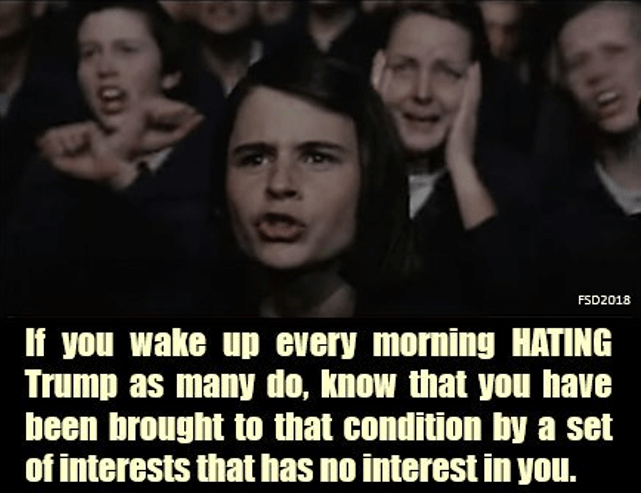
By Norman Ball | Full Spectrum Domino | November 1, 2018
Today in America, a tug of war rages between two competing visions of the public interest. One vision is indicative of direct democracy as evidenced by the mammoth and spontaneous Trump rallies. The other is the same ole’ top-down imposition orchestrated by managed democracy‘s “invisible rulers”. Look at the obligatory apparatchiks at Obama ‘rallies’. No comparison.
The first vision is both subversive and organic, deriving its strength from the economic populism (Make America Great Again – MAGA) that Donald Trump has so effectively cultivated in his role as anti-establishment outsider. (I’ve suggested elsewhere Trump is supported in this ‘populist crusade’ by an America-First subset of the elite intent on trade normalization and re-industrialization. The plot thickens.)
The second vision is overwhelmingly reactionary, roughly comprising the establishment parties (Democrats and ‘RINO’ Republicans), the Trumanite Military-Industrial-Surveillance-Media-Complex, the US Chamber of Commerce (multinational corporatism), the Council on Foreign Relations (CFR) and a relative latecomer: Antifa foot soldiers dedicated mostly to Open Society Foundation paychecks. Soon, full employment will hire these Bolshe-vistas away.
Too bad so many decent moderate and left-leaning Americans are effectively caught in the dissonant headlights of the second vision’s media-propagated, out-sized fear of Trumpism.
Managed Democracy has little choice but to ignore the booming economy and satisfy itself with telegenic pratfalls, such as how Trump occasionally walks in front of his wife and sets umbrellas down without closing them. To America’s great credit, the CNN snarks are losing big-time. Trump’s job approval keeps rising despite the relentless whingeing. Even a 92% media negativity onslaught can’t avert the upward ascent of Trump’s numbers (see the Media Research Center and recent Gallup numbers, below).
Then just yesterday Rasmussen released in a report, ‘Is Another Silent Red Wave Coming’, 51% job approval numbers for Trump. Even more foreboding, traditional Republican and Independent voters are not disclosing their voting intentions much as we saw with the stealth Trump wave of 2016. Rabid anti-Trumpism tends to drive many of his followers underground until their votes are required.
Can we talk, please? Antifa is little more than pre-ideological angst frothed up into a Soros-funded ad hominem contempt for Trump, then amplified by a manipulative Corporate Media with zero interest in a leftist agenda. The specter of a genuine leftist threat in America is thus vastly overstated.
(For the best explanation on how the political became the personal and consumer affinities kicked civic rectitude to the curb, see Adam Curtis’ The Century of the Self.)
The Organized American Left, such as it is (and it really isn’t) strikes a delicate balance between ingested false consciousness and battered wife syndrome. The hijack dates back to 1980 when ideologically oblivious DCCC fundraiser and California Congressman Tony Coelho mired the Democratic Party in a Republican-lite quest for corporate dollars (later to be called Clintonism.) The ‘Left’ has been beating itself up in a lesser-of-two-evils cul de sac ever since. False consciousness ‘aspires’ to trapping its ingestees in a cycle of escalating self-injury. Even when Trump unlocks the prison door, they do not run away.
The fact is, there is no Left in America. There is no Center in America. Why? Under the American campaign finance regime three-quarters of the political spectrum has been structurally consigned to penury. Soros is not opposed to feeding them for awhile if they can help usher in his Orwellian nightmare. After that, it will be an easy segue into the faceless proles of the United Oceanian States.
An outhouse with two doors remains an outhouse.
The Conservative Treehouse blog has taken to calling the ensuing monolith the ‘Uniparty’ as there is very little of ideological substance separating the two national organizations. Indeed the relationship between the two might better be described as a corporate-dollar market-carving strategy. HMO executives to the red, trial lawyers to the blue.
Guilds with competing economic interests square off against one another under the respective banners of one or the other party. However, this has nothing to do with ideology and everything to do with securing a ‘finance-able’ political apparatus from which to launch economic warfare against a competitor. That’s the ‘inversion’ in Sheldon Wolin’s inverted totalitarianism versus the classical form as epitomized by Mussolini: economics drives politics, not the other way around.
This leaves us with Trumpism, the most authentic expression of people-power in America today as its battle is as much against RINOs (Republican In Name Only) as the designated-foe-of-record, the Democratic Party. Though it kills half the nation to hear it, Trump’s fighting da System can’t you see? What, you got a better battering ram? As a bonus, Trump enrages Security State luminaries (have you read Brennan’s and Comey’s tweets?) the way 70s era Frank Church Committee lefties only wish they had.
But since you made me bring it up, where is the countervailing force, Trump’s doppelganger on the Left? After all, authentic opposition can only add vigor to the system. And please don’t cite that existentially corrupt carcass, the Democratic Party and its pygmy wannabes, nor the dude whom Chris Hedges accurately characterized in early 2016 as, a gutless war-mongering, sheep-herding, caucus-camp-following and despicable dissipator of leftist energies, Bernie Sanders.
For a time, he was okay for Trump’s running mate. Then he made the kids cry and delivered a whole new generation to cynicism. Creep.
Did you say Trump’s running mate?
With a modicum of jest I did propose a Prosperity Party Trump-Sanders ticket, sort of a labor-management coalition united by an abhorrence of globalism’s darling, the TPP and our shared 99.9% pariah status (this was pre-Deplorables). Alas, ideas not prefigured by the Fox/MSNBC split-screen are cognitive non-starters. In America, television has to believe things first before the People can assemble the requisite imaginative energies to offer their consent. Nobody gets behind anything until TV gets in front. Seminal thinking is reserved to the managers. That’s what decades of managed democracy will do.
Mostly there’s no money for the Left. So no doppelganger.
Lacking an irresistible force (and have I mentioned no money?) a vacuum can fill instead with hyperbolic blather. Witness the attempts to demonize the uncoaxed enthusiasm of Trumpism by equating it to incipient fascism. In the words of former President Obama (okay I’m lying, but darn it, they should be his words), if you can’t match the crowds (and he can’t), you might as well Nazify them. That’s just more of the System fighting back.
On the contrary, Trump is the antidote to Wolin’s inverted totalitarianism as old-school nationalism is a counter-trend to the dystopian telos sought by monistic globalism (the endgame of managed democracy). But nice try there, oh careless readers of Democracy Incorporated.
As I touched upon recently in a Saker article, who are these managers trying desperately to get inverted totalitarianism back on track? In his 1928 landmark book Propaganda, public relations pioneer and Goebbelsian trailblazer Eddie Bernays references them vaguely as, “… invisible rulers who control the destinies of millions… and shrewd persons operating behind the scenes.”
For a large segment of Americans, this alliance ‘feels natural’ as it’s been the prevailing de facto power configuration throughout the post-WW2 era. (Presidents Kennedy, Carter and Reagan are the only real departures from form albeit in vastly differing modes, degrees and outcomes.) For those seeking a time-zero legislative milestone, the 1947 National Security Act will do.
Nonetheless there is a nostalgic desire on the part of many to return to ‘the way things were’ before Trump the Disrupter introduced chaos (creative destruction?) into the body politic. Much of the present chaos is being fomented by reactionary forces desperate to discredit Trumpism by showing all the chaos Trumpism foments. Did you follow that grim Soros circle? This exhausted yearning for renewed false consciousness resembles victims of the Stockholm Syndrome who miss and idealize their former captors.
Bernays, one of corporatism’s (and thus globalism’s) earliest spokesman, offers a disingenuous assertion at best when he says:
It is important that any effort to influence or effect the American public that is not in the public interest be killed by the light of pitiless publicity and analysis.
Immediately, the statement begs two questions that Trumpism, in its own way, hammers away at:
- What if the American public decides at the ballot box that what passes for the prevailing public interest (really a manufactured imposition) runs counter to its own version of said interest?
- Who orchestrates the “pitiless publicity” aimed at killing competing visions of the “public interest” and by what authority do they undertake this Fake News mission?
In a prior time just concluded when the efficacy of mass media could be trusted, such a conflict would not represent an intractable impasse so much as a cue for re-calibrating the “conscious and intelligent manipulation of the organized habits and opinions of the masses” (Bernays).
After all, only intensified propagandizing can correct the People’s ill-informed sense of the public interest. Undemocratic manipulation is “an important element in democratic society” under Bernays’ weirdly circular formulation. In his seminal work Public Opinion (1922) Walter Lippmann covers the same terrain with his conception of ‘guided democracy’.
Bernays would have been better to say manipulation is a vital facet of a smoothly running Republic or Oligarchy, less so a Democracy. His paternalistic subtext clearly reflects the former. Indeed another name for Managed Democracy is Republicanism (not to be confused with the political party of the same name).
Finally, a cautionary to the grubby, sweaty masses: self-determination is neither a path to infallibility nor a vaccine against public policy mistakes. Direct Democracy merely makes the People the masters of their own fate, which is equally to say the captains of their own errors.
But carry on we must, and under the best banners Providence tosses our way. Beggars can’t be tireless comparison shoppers Trump may have to do. Or else show us something better.
Norman Ball can be reached at gspressnow@gmail.com.
Making America as ‘secure’ as Israel – Israelis train U.S. police
By Alison Weir | CounterPunch | February 3, 2005
When you’re receiving advice “free” or otherwise, it’s wise to first evaluate the source. It’s probably not the best idea to hire a squinting optometrist, a limping podiatrist, or a toothless dentist. If you’re considering a heart surgeon and a search for his previous patients turns up too many graves, perhaps it’s time to reconsider. In fact, if he’s having heart pains, in all kindness perhaps you should call him a doctor.
In this vein, it seems time to examine a growing trend in this country. American officials still reeling from 9-11 and its escalating after-shocks are increasingly turning for help to Israeli “security experts.” Every few months there seems to be another report of local police officers somewhere in the country- Rhode Island, California, New Jersey -traveling to Israel for training in how to make America more secure.
These trips are paid for, interestingly, by the Anti-Defamation League (ADL), an organization whose once worthy goal of opposing bigotry long ago was superseded by a very different activity: advocacy for Israel. This advocacy consists of both carrots and sticks. Our officials, understandably perhaps, are chomping on the carrots.
At the same time as these junkets to Israel, more and more Israeli security experts are being hired here at home to advise us on how to make our nation safer. They’re popping up everywhere – at the local level, in state agencies, and throughout the federal government. They’re offering their services to the state department, and military officers are visiting the highest levels of the Pentagon.
Israeli experts are assisting us abroad, as well. They helped us interrogate prisoners at Abu-Ghraib, for example, and are present at Guantanamo making us safer.
At some levels, none of this is surprising. It is certainly tempting for our financially strapped municipalities to avail themselves of a lobbying group’s generosity, and there are all sorts of truisms to apply for example, “don’t look a gift horse in the mouth.” But the one that I suspect best fits is the old “there’s no free lunch.” Even more troubling, perhaps, are the cases where our over-extended federal government and struggling local ones are paying out good money for consultants whose merit is highly questionable at best.
It seems to me that before we go any further in this headlong rush for Israeli expertise to protect American citizens, it’s important to ask how secure Israeli experts and their policies have made Israeli citizens.
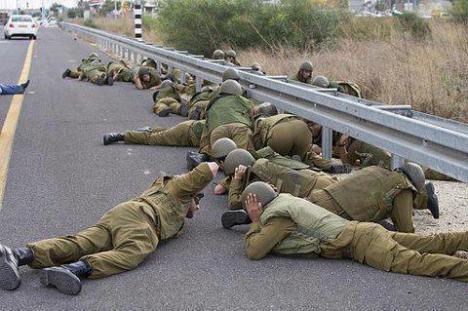 Anyone who has paid any attention to the news, of course, knows the answer.
The truth is, despite Israel’s enormous military might (paid for by American taxpayers to the tune of over $10 million per day), Israelis are among the most terrified populations in today’s world. Israelis feel unsafe in their cafes, on their streets, in their homes. They’re frightened to ride their own city buses. (The wealthy, of course, don’t. They take taxis and private cars.) And going to the mall in many parts of Israel is an experience that not many Americans would be eager to replicate here. Being searched by armed soldiers in combat gear before being allowed to enter, and then shopping amid people with loaded rifles strapped to their backs as they peruse the toy section is not a delight many of us would wish to copy.
Of course, you might point out, Israelis are living luxuriously compared to Palestinians. “Only” about 1,000 Israelis have been killed in the past five years, not over 3,500. “Only” approximately 100 Israeli children have been killed compared to more than 600 Palestinian ones. “Only” 7,000 Israelis have been injured, not 28,000. The unemployment rate is “only” 10 % not 50%. Israelis aren’t suffering malnutrition, being routinely imprisoned, grotesquely humiliated, regularly tortured.
There aren’t dozens of children with eyes injured and shot out, and while there are growing numbers of Israelis in wheelchairs, they don’t yet approach the hundreds of Palestinians whom Israeli bullets have permanently paralyzed. While many Israelis are maimed – arms missing, legs gone, faces mutilated – they’re “only” a fraction of the number you find in Palestine.
Nevertheless, despite their relative comfort, Israelis are not living in a condition that I wish to emulate.
The fact is, Israeli governmental security and policy “experts” have long promulgated policies of such ruthlessness and cruelty that a tiny but lethal number of their victims finally began to fight back. In the current intifada, 140 Palestinians were killed before a similar Jewish death on Israeli soil; 84 Palestinian children were killed before a single Israeli child. Now, as Palestinian deaths continue to spiral upward, Israeli deaths, while still significantly fewer, continue to grow as well. [See Timeline of deaths.]
It’s a very simple equation. The more that Israeli “experts” increase their actions to “protect” Israelis, the more they die.
Overall, in fact, Israelis have been so well served by their officials, that Israeli citizens are leaving the country in droves (hence, I suspect, the many “security consultants” now peddling their wares in the U.S. – security experts, too, know when to leave a sinking ship). In recent years, approximately ten percent of the population has left and some former American diplomats suspect the number of Israelis fleeing their country could easily be double that.
Personally, I’m proud of America’s history as a refuge for those “yearning to breathe free,” and I believe in doing our best to welcome those whom extreme need drives to our shores. I don’t, however, want anyone to bring “security” policies and “expertise” to our country that caused them to flee their own.
I’m not surprised that so many Israelis are moving to the US. I only wish we’d stop consulting them about how to make our own nation as safe as the one they’ve just fled.
IEA Opposed To Cheap Energy For Developing Nations
By Paul Homewood | Not A Lot Of People Know That | October 31, 2018
Once again, the IEA is trying to stir things up re “fossil fuel subsidies”:
Worldwide fossil fuel consumption subsidies almost halved between 2012 and 2016, from a high point in 2012 of more than half a trillion dollars. But the estimate crept higher again in 2017, according to new data from World Energy Outlook 2018, and the run-up in the oil price in 2018 is putting pricing reforms under pressure in some countries.
The new data for 2017 show a 12% increase in the estimated value of these subsidies, to more than $300 billion. Most of the increase relates to oil products, reflecting the higher price for oil (which, if an artificially low end-user price remains the same, increases the estimated value of the subsidy). In 2016, for the first time, the value of subsidies to fossil-fuelled electricity were higher than for oil. The 2017 data sees oil return as the most heavily subsidised energy carrier.
Fossil fuel consumption subsidies are in place across a range of countries. These subsidies lower the price of fossil fuels, or of fossil-fuel based electricity, to end-consumers, often as a way of pursuing social policies including energy access.
There can be good reasons for governments to make energy more affordable, particularly for the poorest and most vulnerable groups. But many subsidies are poorly targeted, disproportionally benefiting wealthier segments of the population that use much more of the subsidised fuel.
Such untargeted subsidy policies encourage wasteful consumption, pushing up emissions and straining government budgets. Phasing out fossil fuel consumption subsidies is a pillar of sound energy policy.
The period of high oil prices from 2010-2014 provided strong motivation for many oil-importing countries to pursue subsidy reform. The fall in price that began in 2014 presented the opportunity. A host of countries, from India to Indonesia and from Mexico to Malaysia, have implemented pricing reforms in recent years.


Every time a report like this comes out, Greenpeace and co leap up and down, pretending that taxpayers are actually handing money over to wicked oil companies.
In fact, as the IEA admit, these are “consumer subsidies”, and not “producer subsidies”. The latter are, of course, what we are paying to wind farms in this country, to enable them to compete with fossil fuels.
By contrast, consumer subsidies are given to keep prices down for the consumer, in this case energy, which may or may not come from fossil fuels.
The IEA explain their methodology below:
The IEA estimates subsidies to fossil fuels that are consumed directly by end-users or consumed as inputs to electricity generation. The price-gap approach, the most commonly applied methodology for quantifying consumption subsidies, is used for this analysis. It compares average end-user prices paid by consumers with reference prices that correspond to the full cost of supply. The price gap is the amount by which an end-use price falls short of the reference price and its existence indicates the presence of a subsidy.
https://www.iea.org/weo/energysubsidies/
My first reaction is just what the hell does any of this have to do with the IEA?
If, for instance, the Indian government wants to subsidise the price of electricity, so that its citizens are able to afford to run air conditioners, then that is up to them, and nobody else.
Similarly, if Iran wants to subsidise natural gas to enable its people to survive in winter, what right does the IEA to criticise?
The Report actually notes that such subsidies can be beneficial, but then ludicrously go on to complain that some richer people might benefit as well:
There can be good reasons for governments to make energy more affordable, particularly for the poorest and most vulnerable groups. But many subsidies are poorly targeted, disproportionally benefiting wealthier segments of the population that use much more of the subsidised fuel.
In reality, energy taxes are one of the most regressive taxes of all. Removal of subsidies would have the same effect.
Subsidising energy for industry is also seen to be important by many countries, who would worry about the loss of competitiveness if they were withdrawn.
The IEA, of course, has ulterior motives, and could not give a toss about the wellbeing or livelihoods of ordinary people in developing nations, where all of the subsidies are concentrated. No EU country appears on the list, nor the US, Canada or Australia:

https://www.iea.org/weo/energysubsidies/
That is because the IEA is set up under the auspices of the OECD, the rich nations club.
Originally the IEA was designed to help countries co-ordinate a collective response to major disruptions in the supply of oil, such as the crisis of 1973/4.
In theory, its four main areas of focus are:
- Energy Security: Promoting diversity, efficiency, flexibility and reliability for all fuels and energy sources;
- Economic Development: Supporting free markets to foster economic growth and eliminate energy poverty;
- Environmental Awareness: Analysing policy options to offset the impact of energy production and use on the environment, especially for tackling climate change and air pollution; and
- Engagement Worldwide: Working closely with partner countries, especially major emerging economies, to find solutions to shared energy and environmental concerns.
https://www.iea.org/about/ourmission/
However, it no longer seems to care about energy security, fostering economic growth or eliminating energy poverty.
Instead, it appears to have an overarching remit to tackle climate change. If there was any doubt at all about this, check out Fatih Birol’s despair last week at the news that CO2 emissions were continuing to climb.
And as far as he is concerned, developing countries can go to hell.
Featured Video

Daniel Davis: Trump’s New Iran Land Blockade Is a Dangerous Fantasy
or go to
Aletho News Archives – Video-Images
New Book
The Vaccine Mafia: Pfizer’s Former Chief Toxicologist Proves How Toxic Substances Were Unlawfully Sold to Us as a Solution for COVID-19
By Helmut Sterz
Former Pfizer chief toxicologist Helmut Sterz presents a critical examination of the development, approval, and global rollout of mRNA COVID-19 vaccines—particularly those produced by Pfizer/BioNTech. The Vaccine Mafia details the failure of pharmaceutical companies, regulatory authorities, politicians, and international organizations to follow established scientific and ethical standards during the pandemic. Drawing on the author’s decades of experience in pharmaceutical toxicology, Sterz reveals the many ways the vaccines’ inadequate or omitted preclinical safety testing put the world’s population at risk.
Sterz demonstrates how “emergency” approvals allowed manufacturers to bypass long-standing international guidelines governing toxicity testing, especially with regard to reproductive and cancer risks. They also allowed governments and health authorities to ignore or conceal evidence of serious adverse effects that occurred, including myocarditis, reproductive harm, and other long-term health risks.
Blog Roll
 Aletho News
- The ‘Gaza Treatment’: How Media Headlines Obscure Who is Bombing Yemen
- Ro Khanna urges Democrats to strip Israel ‘integration’ provision from defense bill
- Why Iran designated British MI6, Royal Navy, and RAF as hostile, terrorist organizations
- Armenian opposition politician dies in custody
- US still trying to recycle failed hypersonic missile programs
- France’s ‘Cold War’: Paris blames Tehran for supermarket fridge hacks
- Psywar no more? 77th Brigade’s sudden death
- Ukraine Already Carved Up… Before Talks Begin? /Prof. Richard Sakwa
- The vindication of Marjorie Taylor Greene
- Nearly 80% of Britons consider Israel a threat to world peace and security: Survey
- If Americans Knew
- An error has occurred; the feed is probably down. Try again later.
- No Tricks Zone
- German Authorities Start Initiative To Evaluate Public Register For Climate “Disinformation” Spreaders!
- Zonal Asymmetry of Temperature Change in the Antarctic Circumpolar Current
- New Study: The Net Fossil Fuel Contribution To Rising Atmospheric CO2 Has Been Zero For 500 Years
- Germany’s Green Energy Transition Becoming Increasingly Expensive…Another 6 Trillion Euros!
- Sudden Stratospheric Warming, Powerful El Niño Combination May Lead To Extreme Europe Cold, Energy Crisis!
- Two New Studies Find Thwaites Glacier Melt Cannot Be Driven By Human Activity Or A Warming Ocean
- E-Cars Reduce CO2 Emissions By Only 41% Compared To Internal Combustion Engine Vehicles
- Predictions Made By Renowned Climate Professor Over Past Decades Have Been Proven To Be Poor
- New Study Suggests Large Regions Of The Pacific Ocean Have Been Cooling For The Last 80 Years
- Germany’s Green Energy Debacle: High Energy Costs Force Kahla Porzellan to Close After 182 Years!

