Asked if he would agree to be interviewed by Robert Mueller’s team, President Donald Trump told the White House press corps, “I would love to do it … as soon as possible. … under oath, absolutely.”
On hearing this, the special counsel’s office must have looked like the Eagles’ locker room after the 38-7 rout of the Vikings put them in the Super Bowl.
If the president’s legal team lets Trump sit for hours answering Mueller’s agents, they should be disbarred for malpractice.
For what Mueller is running here is not, as Trump suggests, a “witch hunt.” It is a Trump hunt.
After 18 months investigating Trumpian “collusion” with Putin’s Russia in hacking the DNC’s and John Podesta’s emails, the FBI has hit a stone wall. Failing to get Trump for collusion, the fallback position is to charge him with obstruction of justice. As a good prosecutor can get a grand jury to indict a ham sandwich, the tactic is understandable.
Mueller’s problem: He has no perjury charge to go with it. And the heart of his obstruction case, Trump’s firing of FBI Director James Comey, is starting to look like something Trump should have done sooner.
Consider what is now known of how Comey and the FBI set about ensuring Hillary Clinton would not be indicted for using a private email server to transmit national security secrets.
The first draft of Comey’s statement calling for no indictment was prepared before 17 witnesses, and Hillary, were even interviewed.
Comey’s initial draft charged Clinton with “gross negligence,” the requirement for indictment. But his team softened that charge in subsequent drafts to read, “extreme carelessness.”
Attorney General Loretta Lynch, among others, appears to have known in advance an exoneration of Clinton was baked in the cake. Yet Comey testified otherwise.
Also edited out of Comey’s statement was that Hillary, while abroad, communicated with then-President Obama, who had to see that her message came through a private server. Yet Obama told the nation he only learned Hillary had been using a private server at the same time the public did.
A trial of Hillary would have meant Obama in the witness chair being asked, “What did you know, sir, and when did you know it?”
More information has also been unearthed about FBI collusion with British spy Christopher Steele, who worked up — for Fusion GPS, the dirt-divers of the Clinton campaign — the Steele dossier detailing Trump’s ties to Russia and alleged frolics with prostitutes in a Moscow hotel.
While the Steele dossier was shopped around town to the media, which, unable to substantiate its lurid and sensational charges, declined to publish them, Comey’s FBI went all in.
Not only did the Steele dossier apparently trigger a wider FBI investigation of the Trump campaign, it served as the basis of FBI requests for FISA court warrants to put on Trump the kind of full-court press J. Edgar Hoover put on Dr. King for the Kennedys and LBJ.
Amazing. Oppo-research dirt, unsourced and unsubstantiated, dredged up by a foreign spy with Kremlin contacts, is utilized by our FBI to potentially propel an investigation to destroy a major U.S. presidential candidate. And the Beltway media regard it as a distraction.
An aggressive Republican Party on the Hill, however, has forced the FBI to cough up documents that are casting the work of Comey’s cohorts in an ever more partisan and sinister light.
This cabal appears to have set goals of protecting Obama, clearing Hillary, defeating Trump, and bringing down the new president the people had elected, before he had even taken his oath.
Not exactly normal business for our legendary FBI.
What have these people done to the reputation of their agency when congressmen not given to intemperate speech are using words like “criminal,” “conspiracy,” “corruption” and “coup” to describe what they are discovering went on in the FBI executive chambers?
Bob Mueller, who inherited this investigation, is sitting on an IED because of what went on before he got there. Mueller needs to file his charges before his own investigation becomes the subject of a Justice Department investigation by a special counsel.
As for Trump, he should not sit for any extended interview by FBI agents whose questions will be crafted by prosecutors to steer our disputatious president into challenging or contradicting the sworn testimony of other witnesses.
This a perjury trap.
Let the special counsel submit his questions in writing, and let Trump submit his answers in writing.
At bottom, this is a political issue, an issue of power, an issue of whether the Trump revolution will be dethroned by the deep state it was sent to this capital to corral and contain.
If Trump is guilty of attempted obstruction, it appears to be not of justice, but obstruction of an injustice being perpetrated against him.
Trump should be in no hurry to respond to Mueller, for time no longer appears to be on Mueller’s side.
The US has created a special task force to promote the free flow of information on the internet in Cuba, the State Department announced. The move was decried by Cuban media as an attempt to destabilize the island.
“The Department of State is convening a Cuba Internet Task Force composed of US government and non-governmental representatives to promote the free and unregulated flow of information in Cuba,” the agency said in a statement on Tuesday. “The task force will examine the technological challenges and opportunities for expanding internet access and independent media in Cuba.”
The unit is being put together in line with President Donald Trump’s memorandum on “Strengthening the Policy of the United States Toward Cuba” from June 16, 2017, the State Department said. The task force is scheduled to hold its first public meeting on February 7.
The Cuban Communist Party’s official newspaper, Granma, said the task force is really “aimed at subverting Cuba’s internal order. According to the paper, previously “phrases like promoting ‘freedom of speech’ and ‘expanding access to the internet in Cuba’ have been used by Washington as a pretext for schemes to destabilize the country using new technologies.”
Granma reminded its readers of the ill-fated ZunZuneo messenger, which was dubbed “the Cuban Twitter” when it was introduced in 2010. The US-made app, however, went offline two years later, after media revelations that it spied on its users and was actually aimed at provoking an uprising among the Cuban youth.
The Cuban paper cited a local expert who said “2017 will be remembered as the boom year for the expansion of internet access in our country.” Around 40 percent of Cuba’s 11-million population connected to the internet last year, which is 37 percent more than in 2010, the expert said.
The 500 public wi-fi hotspots across country created by the government registered 250,000 connections every day last year, according to Granma. Cuban authorities say that faster expansion of the internet on the island is hampered by US sanctions.
The US made an effort to mend ties with Cuba under President Barack Obama, as the neighbors reestablish embassies in Havana and Washington in 2014 after a 50-year break. Telecommunications equipment became one of the first exemptions from the US trade embargo, as the Obama administration saw improved internet access in Cuba as a key factor in rapprochement.
However, Trump announced a rollback of his predecessor’s policies towards the Communist island nation. In November, Washington introduced new travel restriction on Cuba for Americans, and barred them from doing business with dozens of stores, hotels, tourist agencies and even rum makers that were allegedly linked to the Cuban military.
The anti-Russia narrative is collapsing under the growing weight of evidence pointing to a concerted internal effort on the part of the US establishment to sabotage the Trump presidency.
Russiagate – the ongoing American witch hunt that imagines the Kremlin behind everything, up to and including Donald Trump’s presence in the Oval Office – is starting to resemble a Russian matryoshka stacking doll.
On the outer shell of this multilayered plaything, the media has painted for us an ominous image of Russia, which, they would have us believe, is the bogeyman responsible for hacking Hillary Clinton’s computer, and hypnotizing US voters over their Facebook and Twitter accounts, thereby giving Trump a free ride into the White House.
Yet as we begin to pry open each layer of this extremely convoluted story we discover to our surprise that there is absolutely nothing inside even remotely connected to Russia. Nothing. A big nothing matryoska.
Memo madness
In the latest installment of this never-ending goose chase, Washington is now bracing itself for the release of a four-page memo by the House Intelligence Committee. Members of Congress say it reveals reported abuses of the Foreign Intelligence Surveillance Act (FISA) by the Obama administration, which approved surveillance against Trump’s team on behalf of the Clinton campaign.
That announcement emerged shortly before the release of another sensational story involving two lovebirds at the FBI, Peter Strzok and Lisa Page.
Strzok, who served as Chief of the Counterespionage Section during the FBI’s investigation into Clinton’s use of a personal email server, and Page, a lawyer with the agency, were found to have exchanged numerous email messages expressing their strong disdain for the Republican candidate.
At one point, Strzok referred to Trump as an “utter idiot,” and told Page that Clinton “just had to win” the election. No bias there.
Although the story broke in December, it grabbed headlines last week when the Justice Department said it had no records of Strzok-Page messages between December 14, 2016 and May 17, 2017. This represents a critical period in the investigation, encompassing Michael Flynn’s resignation and FBI Director James Comey’s firing.
The surprises did not end there. Strzok and Page also dropped mention of a “secret society” that was supposedly meeting behind closed doors to work against the Trump administration, an explosive claim if proven to be true.
“We learned today from information that in the immediate aftermath of his election that there may have been a secret society of folks within the Department of Justice and the FBI to include Page and Strzok to be working against him,” Rep. John Ratcliffe (R-Texas) told Fox News.
However, like so many things related to the Trump investigation, when you touch the FISA question, or claims of anti-Trump bias inside of the FBI, you get a reaction much like the mythical Hydra that quickly grows back a pair of heads for every one that is severed.
In the case of the memo that is causing fireworks in Washington, the Republicans allege that the FISA judge who signed off on surveillance warrants against individuals aligned with the Trump campaign “was not given full information about the Trump-Russia dossier,” according to a report by Manu Raju, CNN senior congressional correspondent
Indeed, there were some glaring problems with the dossier, which was carried out by Fusion GPS. As it has been revealed, the American research firm got its funding from the Democratic National Committee and the Clinton campaign. To say that represents a conflict of interest is a serious understatement.
As Bloomberg’s Leonid Bershidsky, a reporter with little love lost for Moscow, admitted, “private operative Steele couldn’t even offer his informants the thin protection that comes with working for a foreign intelligence agency, which might help a valuable agent if push came to shove.”
If the DOJ really made the decision to allow surveillance on any member of the Trump team on the basis of such a flimsy report, the Republicans certainly seem justified in demanding the release of this memo. Indeed, calls for the release of the memo are growing daily.
“The House must immediately make public the memo prepared by the Intelligence Committee regarding the FBI and the Department of Justice,” Rep. Matt Gaetz, R-Fla, said. “The facts contained in this memo are jaw-dropping and demand full transparency.”
House Intelligence Committee Chairman Devin Nunes, who has even denied a request by the FBI to review the memo, said it would take over two weeks to process its release.
Meanwhile, the Democrats – none of whom, incidentally, voted to have the memo released – are in full damage control, blaming the hype over the memo not on its allegedly explosive contents, but rather on the ‘fact’ that – yes – the Russians are behind this latest development as well, manipulating social media to wreak havoc in Washington.
They are also betraying a high level of hypocrisy by fighting against the memo’s release. After all, the Democrats expressed no dismay when BuzzFeed made the unethical decision to publish a wholly unverified document. Nor did they rise up in protest when Senator Dianne Feinstein made the unilateral decision to release a 312-page transcript of a congressional interview with Fusion GPS co-founder Glenn Simpson.
Feinstein said she released the transcript because “the American people deserve the opportunity to see what he said and judge for themselves.”
But where is Feinstein’s commitment to transparency now when it comes to releasing the memo from the House Intelligence Committee? We’ll answer that question in a moment.
Blame Russia
Responding to the sudden surge in popularity of the trending hashtag #ReleaseTheMemo, Democratic congressman Adam Schiff (D-California) placed the blame squarely on Moscow’s doorstep.
The Republicans have “made common cause once again with Russian bots because Russian bots are pushing their narrative out there,” he told CNN. “We have Assange and WikiLeaks and Russian trolls and bots saying, you know, hashtag whatever the GOP narrative is. That ought to tell you a lot about what’s driving this.”
On Tuesday, Schiff and Senator Dianne Feinstein (D-California) sent a letter to Facebook CEO Mark Zuckerberg and Twitter CEO Jack Dorsey imploring their assistance. The lawmakers said that Russia-linked social media accounts are “again exploiting Twitter and Facebook platforms in an effort to manipulate public opinion.”
We’ve seen such diversionary tactics before.
Last year, when questions began to surface over Hillary Clinton’s handling of classified government data on her personal computer – a federal offense punishable by up to 15 years in prison – the Democrats deflected public attention away from that primary question, alleging without evidence that Russia had “hacked” Clinton’s email.
The mainstream media took to that unsubstantiated story like fish to water, while everybody seemed to forget the main question: Why was Clinton using her personal server?
Before long, the media was engaged in a contest with itself to come up with the most outrageous claims against Russia – which ran the gamut from hacking the US power grid to posing as Black activists on Facebook to sow discord in the home of the brave. No story involving Russia could be considered too outlandish.
The circumstances involving the FBI’s Clinton probe become even more preposterous when it is remembered that the FBI never got close to the DNC computers. Instead, the FBI relied upon the findings of the security firm CrowdStrike as the basis for its probe.
Would it surprise anyone to know that the co-founder of CrowdStrike is Dmitri Alperovitch, who also serves as a nonresident senior fellow on the Atlantic Council, a think tank that would never be accused of being pro-Russia.
In other words, from the beginning of this virulently anti-Russia campaign, the Democrats have been granted carte blanche to organize and fund the very probes that have done so much to damage US-Russia relations.
With that in mind, it will be very interesting to see the content of the much-anticipated memo. That is, if it really does get released.
Israel has many instruments with which to conduct its colonial project in occupied Palestine: cutting-edge military technology; its nuclear weapons and strategic alliance with the US that Israel’s deterrence factor relies on; and US diplomatic protection to contain countries attempting to stop the colonial-settlement of historical Palestine. Now even the dead are being involved, as the story of the Mamilla Cemetery in occupied Jerusalem attests.
Mamilla is a neighbourhood of Israeli-occupied Jerusalem, located to the west of the Old City’s Jaffa Gate. It is known mainly for its commercial activities in Mamilla Mall that was built in 2007.
As with all of Jerusalem’s neighbourhoods, Mamilla also hosts dozens of historical sites and structures. Mamilla pool is said to have been built by the Romans and gives the area its name. However, the name originates from the Arabic roots “Maman Allah”, which means “water of God” or “benefit from God”.
For centuries, Mamilla Cemetery has been a burial place for Muslims. Some of the Blessed Companions of Prophet Muhammad are buried there, as are some of Salahuddin Al-Ayyoubi’s soldiers and generals.
During the Ottoman period, in 1860, the cemetery was protected by a 2 metre-high fence and Jerusalemites continued to use it as a burial site. In 1927, the Muslim Supreme Court decided to declare the area as a historical site and maintain the tombs in good condition.
In 1948, though, that changed with the creation of the state of Israel and the occupation of West Jerusalem. Mamilla was deemed by the Zionist government to come under the jurisdiction of the Israeli Department of Absentee Landholders. Following the 1967 occupation of the rest of Jerusalem, the Islamic Waqf (Endowment) Department submitted a petition to get the cemetery back and resume burials there.
The Israeli authorities rejected this, and the Jerusalem municipality took the first step to erase Palestinian heritage from the area by turning a large part of the cemetery into a public space, called ‘’Independence Park’’. Many graves were removed in the process, as they were years later when cafes, a car park and, ironically, a “Museum of Tolerance” were planned for the cemetery.
“Museum of Tolerance”
In 2004, the Israeli government and the Los Angeles-based Simon Wiesenthal Centre announced plans for the so-called Museum of Tolerance. By that time, only 8 per cent of Mamilla Cemetery was left, with only 5 per cent of the graves.
The museum is planned to be a multimedia centre for children and adults with theatre and education facilities. The Centre announced the project as a 21st century project dealing with “contemporary issues crucial to Israel’s future — intolerance, anti-Semitism, terrorism, Jewish unity and mutual respect and human dignity for all.”
Once the construction of the museum started, Palestinians and international supporters responded. In 2006, the families whose ancestors are buried in the cemetery, along with human rights organisations, submitted complaints to the Israeli Supreme Court. Petitions were also sent to the UN and UNESCO but to no avail.
According to the chief archaeologist of the Israeli Antiquities Authority, Gideon Suleimani, the human bones unearthed during the construction of the museum date back to 1278; those who were buried in that area were the political, military and religious elite of the Muslim community. His report led Israeli academics and media to raise concerns; the Supreme Court then suspended excavations temporarily. In 2008, the Court declared that the project could continue on the basis that a car park had been built in the area more than 40 years ago which had raised no objections.
Another effort to halt excavation was a petition presented to five different UN bodies in February 2010. Palestinian historian Rashid Khalidi and other individuals from sixty families in Jerusalem whose ancestors were buried in Mamilla Cemetery organised a “campaign to preserve Mamilla Jerusalem Cemetery”. The Centre for Constitutional Rights in New York supported a petition to the UN but it didn’t stop Israel and the Israeli Antiquities Authority from digging up even more graves.
Even the dead are dangerous for Israel
For the Zionists, whatever is linked to Palestinian identity poses a threat to their colonial plan to Judaise Palestine. In their thinking, places like Mamilla Cemetery are evidence of the land’s Palestinian history and must be erased.
Even though the Wiesenthal Centre claimed that ‘’the [human] remains were handled in keeping with the highest standards and High Court’s guidelines’’, lawyer Ahmad Amara, who was responsible for defending the Mamilla Cemetery between 2004 and 2007, saw for himself that bones were desecrated and thrown into cartons and left on one side. What Suleimani described as an “archaeological crime” continued despite the legal protests by Palestinians. Between 2008 and 2009 alone, around 1,000 skeletons were dug up and removed from the site.
In 2010, the Israeli Land Administration bulldozed 300 Muslim gravestones in the cemetery. The following year, another 100 were destroyed. Vandals from the “Price tag” settlers’ group attacked the cemetery in 2011, spraying ‘’Death to the Arabs” on gravestones.
Also in 2011, eighty-four archaeologists demanded that the Simon Wiesenthal Centre, the Jerusalem Municipality and the Israeli Antiquities Authority should end the museum construction. The project, they argued, was against all of the ethics of archaeology. ‘’The bulldozing of historic cemeteries is the ultimate act of territorial aggrandisement,” said Yale University Professor of Near Eastern Archaeology Harvey Weiss, “the erasure of prior residents.’’
Despite all of the objections, the “Museum of Tolerance” is expected to open in a few months’ time to coincide with the state of Israel’s 70th anniversary. That, of course, was the beginning of the Palestinian Nakba (Catastrophe); the Nakba is ongoing.
US Defense Secretary James Mattis is a Marine’s Marine and a respected military scholar. Yet his recent remarks to reporters about US conduct around the world smack of either hypocrisy or woeful misinformation.
Mattis is visiting Indonesia and Vietnam this week, as part of a US effort to expand alliances in the Asia-Pacific region. On his way over to Jakarta on Monday, he held a “press gaggle” on board the plane and, according to transcripts provided by the Pentagon, said this:
I think that what we’re looking for is a world where we solve problems, and we don’t shred trust. We don’t militarize features in the middle of international waters. We don’t invade other countries, in Russia’s case ‒ Georgia, Ukraine. That we settle things by international rule of law, you know, this sort of thing.
Mattis was elaborating on the new US National Defense Strategy, which prioritized “inter-state strategic competition,” over terrorism and called out Russia and China as “revisionist powers” threatening the “free and open international order” created by the US and its allies after World War II.
If anything, Russia and China are actually “reactionary” powers. Both countries have repeatedly said that they seek only to apply the existing rules of international order equally to everyone – including the US, which has held itself exempt from them.
That belief in American exceptionalism is evident in Mattis’s own words, aimed at Beijing and Moscow.
“We don’t militarize features in the middle of international waters”
Here, Mattis is clearly referring to the islands in the South China Sea, claimed by China and a number of nearby nations. China has built military installations on a number of previously uninhabited islands and reefs, and sent naval forces into the area in response to repeated US overflights and maritime patrols.
However, while the People’s Liberation Army Navy operates in its home waters, the US Navy operates around the world – with bases in places like Japan, Bahrain, Spain and Italy, among others.
In pursuit of military bases around the globe, Washington has gone so far as to approve the forcible relocation of Chagos Islands residents so the US could build and maintain a massive base on Diego Garcia. A number of Marshall Islanders were also relocated from atolls in the Pacific because of nuclear tests (e.g. Bikini).
“We don’t invade other countries”
Where to even begin with this one? What was Libya in 2011, then? What happened in Iraq in 2003? Or the NATO attack on Yugoslavia in 1999, which violated both the UN Charter, the NATO Charter, and US law?
In Libya, the US and its NATO allies grossly abused a UN resolution allowing certain humanitarian actions to launch a full “regime change” operation against the government of Muammar Gaddafi. Nearly seven years later, Libya is a chaotic failed state, with open-air slave markets and terrorists staking claim on territory “liberated” by US-backed rebels.
Iraq was invaded without any legal justification whatsoever, with George W. Bush’s regime-changing “coalition of the willing” acting in stark contrast with his father’s multinational force, which invoked the UN Charter for the 1991 intervention to liberate Kuwait.
Yugoslavia was bombed by NATO for 78 days, until the UN found a fig leaf in the shape of Security Council Resolution 1244 to allow the alliance to occupy Serbia’s Kosovo province. Except that, too, was trampled in 2008, when the US backed an ethnic Albanian government that declared the occupied province an independent state.
Mattis holds up Georgia and Ukraine as examples of Russian “invasions.” Yet it was the US-backed government in Georgia that started the hostilities in August 2008, launching an attack on the breakaway republic of South Ossetia that killed Russian peacekeepers. It’s understandable the Pentagon might be sore that a Russian border army managed to dismantle the entire NATO-trained Georgian military in less than a week, but that doesn’t change the fact that Tbilisi started the war, as even the EU fact-finding mission admitted in 2009. The warmongering president, Mikhail Saakashvili, has since been stripped of citizenship and charged with corruption. He is now in Ukraine.
What of Ukraine, then? Washington has accused Russia of invading and occupying Crimea in 2014. The overwhelmingly ethnic Russian region, reassigned to Ukraine by Soviet leader Nikita Khrushchev in 1954, reunited with Russia in 2014, after a US-backed coup in Kiev brought into power a government that included neo-Nazis.
That government, “midwifed” by US diplomats and directed by Washington ever since, responded to popular discontent in several regions by sending tanks against its own civilians. In Odessa, neo-Nazi activists backing the government even set dissenters on fire. The US has sent weapons to neo-Nazi militias fighting the “Russian invaders” in the eastern regions of Lugansk and Donetsk, while Moscow sent humanitarian aid.
Kiev has claimed, and Washington echoed, that regular Russian troops were on the ground in Donetsk and Lugansk. As “evidence” of this, they offered photos of Russian tanks – taken in 2008 in Georgia.
Trying to argue against the Crimean referendum, US President Barack Obama claimed there had been an internationally recognized referendum in Kosovo. That was simply not true.
“…we respect these as sovereign nations”
Another thing Mattis argued was that the US respected national sovereignty and opposed “veto authority” over their decision-making:
One point I want to make is we respect these as sovereign nations with a sovereign voice and sovereign decisions, and we don’t think anyone else should have a veto authority over their economic, their diplomatic or their security decisions.
There is absolutely nothing wrong with this sentiment in theory. In practice, however, the US routinely tramples the sovereignty of other countries, and exercises veto powers over their economic and security decisions.
Ukraine has already been mentioned as one example. The US is also pressuring the EU to find a way to stop Nord Stream 2, a pipeline that in a recent anti-Russian report, Senator Ben Cardin (D-Maryland) said would deprive Ukraine of transit fees. What he left out was that it would also remove Kiev’s ability to hold Europe hostage by controlling the flow of Russian gas. Also, does anyone actually believe that Bulgaria decided on its own to back out of the Russian-sponsored South Stream pipeline project?
More recently, in the supposedly “independent” state of Kosovo, the US and UK ambassadors threatened “harsh consequences” if the government there dared vote against an internationally imposed war crimes court. US ambassadors in places like Bosnia-Herzegovina or Serbia routinely dictate to local authorities what laws they need to adopt and when. Local leaders who refuse to obey are sanctioned.
‘Mad Dog’ or ‘Warrior Monk’?
It was the American media that dubbed Mattis “Mad Dog” during the operations in Iraq, when he commanded the Marines that fought insurgents in Fallujah and destroyed the city in order to save it, to paraphrase that one US officer from Vietnam.
Mattis himself reportedly resents the nickname, preferring to be known as a “Warrior Monk,” a scholar with no family who has dedicated his life to the US Marine Corps. What is one to make, then, of his quotes from the flight to Jakarta, which deny observable reality in favor of wishful thinking embraced by his predecessors?
When Mattis was up for confirmation, a number of media outlets published a story about how he took guard duty at Christmas one year in order to have the junior Marine officer spend time with his family. He is clearly someone who cares about the lives of his troops. Yet his misconceptions about US conduct around the world are more likely to get them killed than faulty weapons or the bloated Pentagon bureaucracy, both of which he has set out to fix.
2017 seemed like a year full of bad weather news. But a deeper look at the global data suggests that attempts to link the last year’s extreme weather to climate change are misleading.
Former US vice president Joe Biden boasted that he had a word to say in another state’s internal affairs, admitting to have pressured the Ukrainian government into sacking a prosecutor general in just a few hours.
“I looked at them and said: ‘I’m leaving in six hours. If the prosecutor is not fired, you’re not getting the money,’” Biden said during a meeting of the US Council on Foreign Relations. He was referring to Ukrainian President Petro Poroshenko and former Ukrainian prime minister Arseny Yatsenyuk. Biden added that the prosecutor was then fired.
“Well, son of a b***h. (Laughter.) He got fired.”
The incident that Biden referred to dates back to late March 2016. At that time, the then-US vice president met Ukrainian government officials to discuss the situation in Ukraine as well as US financial assistance to Kiev. Biden apparently used US guarantees of a third loan worth $1 billion as a means of applying pressure on Kiev. “I said, ‘I’m telling you, you’re not getting the billion dollars,’” he said at the meeting on Tuesday, recalling on the incident.
The then-Ukrainian prosecutor general Viktor Shokin was indeed removed from his post by the Ukrainian parliament on March 29, 2016. Two days later, Kiev announced that Biden had met with Poroshenko and “informed him about the US decision to provide [an] additional $335 million for reforms of the security sector of Ukraine.” It also said that “possibilities for providing the third loan guarantee of $1 billion” were “open.” Poroshenko officially dismissed Shokin on April 3, 2016.
Earlier, Biden also boasted of other cases of US interference in Ukrainian internal affairs. In a book titled ‘Promise Me, Dad: A Year of Hope, Hardship and Purpose,’ which was published in November, the former vice president said that he openly demanded that former Ukrainian president Viktor Yanukovich resign back in 2014.
He also claimed that he had to direct almost every step of the Poroshenko administration after it came to power, following a chain of events that started with a coup that ousted ex-leader Viktor Yanukovich and gave rise to the Ukrainian crisis. Biden also admitted that he “had been on [the] phone with either Poroshenko or… Yatsenyuk, or both, almost every week” for months.
However, Ukraine was far from the only country pressured by Washington at that time. During the Tuesday meeting, Biden also revealed that the US administration “spent so much time on the phone making sure that everyone from… [former French president Francois] Hollande to [former Italian prime minister Matteo] Renzi wouldn’t walk away” from anti-Russian sanctions.
Europe initially sought to avoid the sanctions campaign against Moscow, the former US vice president said. He also added that German Chancellor Angela Merkel was almost the only major European leader who “was strong enough to… stand with” the US on this issue, even though she “did not like it” and supported Washington only “reluctantly.”
Facebook has admitted that sometimes, it might actually be bad for democracy. Facebook is right about that. However, I’m not sure that the social media platform really understands why this is the case.
The admission comes in a series of official blog posts by Facebook insiders about what effect social media can have on democracy. “I wish I could guarantee that the positives are destined to outweigh the negatives, but I can‘t,” wrote Samidh Chakrabarti, a Facebook product manager. He continued: “… we have a moral duty to understand how these technologies are being used and what can be done to make communities like Facebook as representative, civil and trustworthy as possible.”
First off, it’s important to understand the political and media context in which Facebook has felt forced to make these comments. That context is alleged ‘Russian interference’ in the 2016 election through the promotion of political ads designed to take advantage of social division. Facebook is responding to a not small cohort of Americans who genuinely believe that Russian Facebook ads are destroying democracy. The second thing to understand is that while Facebook’s admission may sound like noble self-reflection, the truth is that what Facebook says and what it means are two very different things.
There is a temptation among some to believe that the social media giant is a neutral actor that cares about fairness and democracy and that it is doing its very best to ensure it has a positive effect on democracy. This could not be further from the truth.
If Facebook’s recent history is anything to go by, the California-based company is not actually a big fan of democracy at all. Even before Facebook decided to become selectively outraged about the ubiquitousness of propaganda and ‘fake news’ on its platform, it was already engaging in political censorship. Take this 2016 story in which Facebook employees admit to suppressing conservative news on the platform, for example. Not only that, but employees were told to artificially “inject” Facebook-approved stories into the trending news module when they weren’t popular enough to make it there organically. The employees were also told not to include news about Facebook itself into the trending category.
“Facebook’s news section operates like a traditional newsroom, reflecting the biases of its workers and the institutional imperatives of the corporation,” Michael Nunez wrote for Gizmodo. With that kind of ability and willingness to manipulate, Facebook itself possesses huge potential to affect political outcomes, far more than some Russian ads.
Facebook has said it believes that simply adding the ability to click an “I voted” sticker can increase actual voter turnout significantly through a combination of simply seeing the sticker and feeling the peer pressure to vote if your friends have done so. This is supposed to be one of the good things Facebook has done for democracy, but there are so many ways that Facebook could use this kind of thing to surreptitiously promote its own political agenda.
What if Facebook were to artificially push certain news stories in specific locations – say, where an election was taking place – and then add the “I voted” button for users in that area. Or alternatively chose not to add that button for certain races where a lower turnout might be deemed a good thing.
What Facebook means when it says it is worried about how its platform is being used is that it’s not entirely comfortable with the fact that it can’t fully control the political narrative. Even Facebook believes it has created a monster. It would like to control what our impressionable minds might see and read – lest we fall victim to unapproved opinions or ideologies. But Facebook also knows that such control is not entirely possible – and therein lies their true crisis.
Even the steps Facebook has taken to address alleged Russian interference in the 2016 election are questionable. In his blog post, Chakrabarti writes that the platform has “made it easier to report false news” and has “taken steps in partnership with third-party fact checkers to rank these stories lower” in the news feed. Once the fact-checkers identify a story as fake, Facebook can reduce impressions of that story by 80%, he says. But who are these third-party fact checkers? Facebook doesn’t tell us.
“We’re also working to make it harder for bad actors to profit from false news,” he writes. But again, we don’t get a definition of bad actor, either. One assumes Russia is the bad actor referred to – but if Facebook was truly concerned about government propaganda and its effect on election outcomes, the crackdown would surely not be limited to one government. Are some governments bad actors and other governments good actors? Is some propaganda good and some bad? Are some sock-puppet accounts acceptable and others not? Can we get a breakdown?
Facebook has also been kind enough to help users figure out whether they were unfortunate enough to have come into contact with any Russian-linked posts. It’s part of their “action plan against foreign interference”. Again, we might benefit from a definition here of “foreign interference.” Facebook is an international platform, thus the potential exists for elections to be ‘interfered’ with through Facebook all over the world, not just in the United States. Does Facebook’s fight against foreign interference incorporate all those efforts equally? This kind of information would be really helpful, if Facebook would be kind enough to provide it.
Facebook is not alone in its mission to rid the world of nasty Russian propaganda. Twitter is at it, too. Last week, the company sent out emails to users warning them that they may have come into contact with Russian propaganda on the microblogging platform. Curiously, no similar warnings have been sent to users who came into contact with American propaganda online – despite the fact that we’ve known for years that the US government has been using sock-puppet accounts to spread its own propaganda and misinformation online.
Google has also dipped its toes in the water. Eric Schmidt, the executive chairman of Google’s parent company Alphabet Inc., said recently that Google was trying to create special algorithms and “engineer the systems” to make RT’s content less visible on the search engine.
Media coverage of Facebook’s comments was fairly uniform. Most outlets have been treating the blog posts as a ‘see, we told you!’ moment, focusing entirely on the Russia angle but ignoring the many other ways in which Facebook has itself attempted to corrupt the free flow of information and manipulated its users. The reporting is almost sympathetic: Poor innocent Facebook is coming to terms with the fact that sometimes bad things happen online.
The Washington Post called Facebook blog posts the “most critical self-assessment yet.” Another piece in the Post opines on Facebook’s “year of reckoning.” Reutersreported that the sharing of “misleading headlines” became a “global issue” after accusations that Russia had used Facebook to interfere in the 2016 election. The implication is almost that misleading headlines are some kind of new phenomenon and Facebook is out there on the frontlines of the battle.
Facebook wants you to stay mad about Russian ads. It wants you to believe that its democracy-loving executives are truly sorry and doing all they can to make the platform as good for democracy as possible. What they don’t want is for us to examine their own practices too closely. But that’s exactly what we should be doing – instead of congratulating them on their disingenuous foray into self-reflection.
The US is allegedly mulling over sophisticated new methods of influencing the public opinion in Russia, Iran and North Korea, among other countries. Russian and Iranian cyber-security specialists shed light on the US Army Intelligence and Security Command’s (INSCOM) recent initiative and the potential counter-measures to handle the challenge
It appears that the US Army Intelligence and Security Command (INSCOM) is seeking to create an “army of bots” which would analyze social network data and influence users across the world. According to the INSCOM request, it is targeting those who speak Arabic, French, Pashtu, Farsi, Urdu, Russian, and Korean.
Mikhail Friben, a cyber-security specialist at the Ural Information and Analytical Center, suggested that at the initial stage the INSCOM initiative won’t prove effective and could be counterbalanced by “mirror measures.”
Artificial Neural Networks
“Back in 2010, when I was researching artificial neural networks [ANN], I noted that their shortcoming was the lack of high-quality linguistic agents, i.e. software, that can speak adequately in one language or another,” the cyber-security specialist told Sputnik Persian. “Now, judging by the US statement, they have [developed] such software. But here is the rub: for the declared countries, linguistic agents are different in terms of language structure.”
It is expected that this army of bots will monitor posts, learn colloquial expressions, differences in spelling and slang. This would help the US Army determine whether user messages are negative, positive or neutral and influence a specific audience.
Friben explained that although in 2010 the US developed effective linguistic agents for the English language, it was impossible to create such software for the Russian language, given the difficulty of defining semantics by word structure in this tongue.
However, according to the cyber-security analyst, the people, who read comments, are mostly affected by the emotional coloring of the message and not so much by its meaning. Therefore, theoretically, the INSCOM system will be able to perform the assigned tasks efficiently, Friben underscored.
The question then arises as to how the US will turn the theory into practice.
“Such systems usually work poorly at the initial stage, since the neural network needs to be properly ‘trained’ with the help of native speakers,” the specialist emphasized. “Yes, there is a system of machine learning, which can prove successful only if the parameters are correctly set. And for this, again, we need a human resource with knowledge of a specific language. But as a rule, [linguistic] specialists who could understand the emotional coloring of the language may misread the actual situation, especially in social networks.”
How to Counter US ‘Army of Bots’
Nevertheless, if not resisted, the ANN can become very effective in manipulating sentiment, the specialist noted, adding that there are at least two options to handle the challenge.First, Russia can create its own “army of bots” to nullify the emotional impact generated by the American system, Friben noted.
The second option is to directly monitor users.
The cyber-security analyst explained that a real social network user has diverse activities: he exchanges messages, writes comments, post some news.
“All these parameters can be set in the ANN so that it can analyze them,” Friben said. “As a result, you get a certain portrait of a user… Take, for example, Vkontakte [social media platform]. It has a bot tracking system which will allow it to track a new American army of bots. For more effective work it is necessary to simulate all actions of the user. Also, you will have to simulate geo-targeting and other parameters. It will be possible to track the bots.”
Why Iranian Users Are Invulnerable to Bot Attacks
Mohammadreza Azali, co-founder of the large Iranian IT portal Techrasa believes that an attack by American bots will have little if any impact on Iranian users.
He draws attention to the fact that lots of major social media platforms are blocked in the Islamic Republic of Iran (IRI). It requires a certain level of computer literacy to reach these platforms via VPN, however, according to Azali, the majority of Iranians cannot be called experienced users.
On the other hand, “many Iranian residents today associate the Internet and social networks with Telegram, and it is used by the majority of the inhabitants of our country,” the IT specialist told Sputnik. “In addition, Telegram has a high level of protection and encryption, which does not allow bots to gather information. So far, there have been no cases of so-called bots being able to communicate in Telegram.”
Azali noted that, citing the looming security threat, Ayatollah Seyyed Ali Khamenei established the Supreme Council of Cyberspace six years ago which explores the country’s cyberspace and the online segment. Within the framework of the new structure a special body — the National Center for Cyberspace — was created.
One of the measures the center took was the increase in mobile Internet users, as well as the attraction of domestic investors in this sphere, the IT specialist underscored, adding that now the IRI has 47 million mobile Internet users “who are easy to control.”
“Moreover, many foreign services were blocked by this center, and instead of these services domestic alternatives were presented,” Azali said. “We use Aparat instead of Youtube and Café Bazaar instead of Google Play. Therefore, it is unlikely that Iran would really suffer from this army of American bots. Their action can be effective only at the level of those social networks that are blocked in Iran.”
Speaking on the conditions on anonymity with Sputnik a leading analyst of the Iranian National IT Center for Cyber Security said that the IRI is capable of resisting any kinds of attacks, including those in cyberspace.
He specified that, to counter the bots, special mechanisms were implemented in Iran including the creation of national social networks and the development and popularization of technological culture and knowledge.
“One of the effective methods of the struggle was to block a number of Western social networks and portals,” the analyst said. “We have developed a whole range of software and technical mechanisms for identifying malicious artificial digital robots (bots). But given the national security issue, I cannot share information on how the algorithm works.”
Last week “Mad Dog” Mattis announced a new US Defence Strategy, the first for a decade and with a radical change of focus, from fighting terrorism to fighting Russia and China. The US DoD put it like this:
“The National Defense Strategy seeks to implement the pillars of the National Security Strategy: peace through strength, the affirmation of America’s international role, the U.S. alliance and partnership structure and the necessity to build military advantage to maintain key regional balances of power.”
According to Deputy Defense Secretary Elbridge A. Colby this strategy is necessitated because of:
“the erosion of U.S. military advantage vis-a-vis China and Russia, which, if unaddressed, could ultimately undermine our ability to deter aggression and coercion and imperil the free and open order that we seek to underwrite with our alliance constellation.”
“The strategy aims at thwarting Chinese and Russian aggression and use of coercion and intimidation to advance their goals and harm U.S. interests, and specifically focuses on three key theaters: Europe, the Indo-Pacific and the Middle East, Colby said.”
Whether this is a new strategy or just a new declaration of the existing one depends on your point of view. In announcing it at the press conference Jim Mattis stressed the supposed shift from fighting terrorism to countering Russia and China, as well as their effective allies North Korea and Iran. Following hot on the heels of Tillerson’s confrontational outburst, and refusal to get out of Syria following the defeat of Islamic State, the sudden shift looks rather convenient – the US can now claim it must stay in Syria to counter Russia’s growing influence in the region.
What’s new! Wasn’t this always the US plan, as laid out a decade earlier in “Which path to Persia?” – a plan that seems to be relentlessly moving forward despite all obstacles, including particularly international law?
While there have been a few setbacks in the US project to advance its goals around the globe against the interests of Russia and China and their allies, the escalation in aggressive US confrontations in those “key theatres” since Trump came to power makes nonsense of Colby’s claim that the new policy is “not a strategy of confrontation, but it is strategy that recognizes the reality of competition.”
Even if that were true, it only emphasizes the fundamental difference in approach between the great powers. Neither Russia nor China see competition or confrontation as their goals, leave alone the insulting and ludicrous “aggression, coercion and intimidation” which the US attributes to them. Faced with a rational and responsible partner rather than the expansionist and exceptionalist US, it is a desire for collaboration and co-existence that evidently motivate China and Russia, and also lie at the center of their own developing cooperation.
Symbolizing this difference – or rather conflict – between world views, is the ongoing dispute over the South China Sea. Just before Mattis announcement, the US sent a ship into the disputed waters as part of its “freedom of navigation” exercises, and received an immediate demand to leave from China, which has long lost patience with this serial provocation. In this area one of America’s “constellation” allies Australia is forced to take sides, and reveals itself as an accomplice to the ongoing Imperial crimes.
Despite Australia’s crucial economic dependence on China, its current government seems to be going out of its way in provoking and insulting Chinese leaders and representatives. As Mattis made his announcement, PM Malcolm Turnbull was in Japan visiting a missile defense base and talking about joint exercises and military cooperation. Australia also took part in the provocative exercises against North Korea with the US and South Korea at a time of high tension last year, despite Russian and Chinese warnings against them.
And when it comes to the South China Sea issue, it must be pointed out that China’s legitimate concerns are to maintain the freedom of navigation through its main transport artery to the West and Australia. Given the US coalition’s participation in exercises simulating a blockade of these channels it’s not hard to see and support China’s defensive stand on this issue.
Part of the “new strategy” in the Indo-Pacific is also likely to be an expansion of the US presence and bases in Australia. “In the new security environment” – whatever that is – the stationing of US strategic bombers in Northern Australia is now being proposed. Along with the massive regional US surveillance base in Pine Gap, nuclear-armed bombers will make us a prime target for one of China’s ICBMs, so no doubt we’ll also be getting THAAD missile defense systems.
On reflection it appears that the “new” US “National Defense” Strategy is little more than the one pursued fifty years ago against the Soviets and the Chinese Communists. Fifteen years of the “Global war on Terror”, culminating with the scourge of “Islamic State” was just means to the same end, and can now be discarded.
The tragedy is that with Vladimir Putin and Xi Jing Ping we really had a chance for diplomacy, law and peace to prevail.
The Federal Bureau of Investigation is always under fire for something. As of late January, that something is destruction of evidence. Text messages between agents involved in the Bureau’s investigations of Hillary Clinton and Donald Trump, from a key time frame during the presidential transition, are missing. Congress, the Bureau, and the US Justice Department are at each other’s throats over the missing messages and what they might say.
It’s far from the first time, as James Bovard points out at The Hill. In 1973, acting FBI director Patrick Gray was forced to resign for destroying evidence in the Watergate investigation. After the 1992 murder of Vicki Weaver by an FBI sniper, an FBI division chief went to prison for destruction of evidence in that case.
The FBI has had 110 years to prove its worth. A dispassionate look at its history says that it’s far more often served as a center for blackmail, corruption, and political manipulation than as anything resembling a legitimate law enforcement agency.
In fact, it was a bad idea in the first place.
The FBI — then merely the Bureau of Investigation, or BOI — was created during a congressional recess and without congressional approval by the Attorney General in 1908 for purposes of “investigating” (read: Drumming up a scare over) the role of prostitution in “white slavery,” a forerunner of today’s “human trafficking” panic. It’s pretty much gone downhill from there.
The US Constitution defines only three federal crimes: Treason, piracy and counterfeiting. The first two are military matters and the third is handled by the Secret Service. There’s no room for an FBI in a constitutional law enforcement scheme.
One excuse for keeping the FBI going has been to facilitate investigations of crimes with an interstate angle. But given today’s technology, the states could presumably set up their own clearinghouses to exchange information and track down cross-border bank robbers and kidnappers. The FBI is just another bureaucratic layer inserting itself between the commission of a crime and the arrest of those thought to be responsible.
While the FBI has no particularly compelling, or even legitimate, mission, it certainly has its illegitimate uses. It’s probably not going too far to think of J. Edgar Hoover, the FBI’s first director, as having been a sort of shadow president for much of his 48 years of service. He used agents to get the goods on aspiring political leaders, and apparently used that information to get what he wanted from them both for the Bureau itself and in public policy generally.
One big problem with a federal law enforcement agency as big and well-funded as the FBI is that at some points it’s almost certain to stop working for the rest of the government and start running the rest of the government. Election? Who needs an election? Just ask J. Edgar what to do.
Unfortunately, the second big problem with such an agency is that it’s hard to get rid of after more than a century of nearly uncontested power.
But we should try.
Thomas L. Knapp (Twitter: @thomaslknapp) is director and senior news analyst at the William Lloyd Garrison Center for Libertarian Advocacy Journalism (thegarrisoncenter.org).
Presenting the 2018 National Defense Strategy of the United States on Friday at the Johns Hopkins University, Secretary of Defense James Mattis painted a picture of a dangerous world in which U.S. power – and all of the supposed “good” that it does around the world – is on the decline.
“Our competitive edge has eroded in every domain of warfare – air, land, sea, space, and cyberspace,” he said. “And it is continually eroding.”
What he could have said instead is that the United States military is overextended in every domain, and that much of the chaos seen around the world is the direct result of past and current military adventurism. Further, he could have acknowledged, perhaps, that the erosion of U.S. influence has been the result of a series of self-inflicted blows to American credibility through foreign policy disasters such as 2003 invasion of Iraq.
There were also two important words hidden between the lines, but never mentioned by name, in the new U.S. National Defense Strategy: “empire” and “imperialism.”
It has long been taboo for U.S. officials and corporate media to speak of U.S. foreign policy as “imperialism,” or of the U.S.’s global military occupations and network of hundreds of military bases as an “empire.” These words are on a long-standing blacklist of “banned topics” that U.S. official statements and mainstream U.S. media reports must never mention.
The streams of Orwellian euphemisms with which U.S. officials and media instead discuss U.S. foreign policy do more to obscure the reality of the U.S. role in the world than to describe or explain it, “hiding imperial interests behind ever more elaborate fig leaves,” as British historian A.J.P. Taylor described European imperialists doing the same a century ago.
As topics like empire, imperialism, and even war and peace, are censored and excised from political debate, U.S. officials, subservient media and the rest of the U.S. political class conjure up an illusion of peace for domestic consumption by simply not mentioning our country’s 291,000 occupation troops in 183 other countries or the 39,000 bombs and missiles dropped on our neighbors in Iraq, Syria and Afghanistan since Trump took office.
The 100,000 bombs and missiles dropped on these and other countries by Obama and the 70,000 dropped on them by Bush II have likewise been swept down a kind of real time “memory hole,” leaving America’s collective conscience untroubled by what the public was never told in the first place.
But in reality, it’s been a long time since U.S. leaders of either party resisted the temptation to threaten anyone anywhere, or to follow through on their threats with “fire and fury” bombing campaigns, coups and invasions. This is how empires maintain a “credible threat” to undergird their power and discourage other countries from challenging them.
But far from establishing the “Pax Americana” promised by policymakers and military strategists in the 1990s, from Paul Wolfowitz and Dick Cheney to Madeleine Albright and Hillary Clinton, the results have been consistently catastrophic, producing what the new National Defense Strategy calls, “increased global disorder, characterized by decline in the long-standing, rules-based international order.”
Of course the drafters of this U.S. strategy document dare not admit that U.S. policy is almost single-handedly responsible for this global chaos, after successive U.S. administrations have worked to marginalize the institutions and rules of international law and to establish illegal U.S. threats and uses of force that international law defines as crimes of aggression as the ultimate arbiter of international affairs.
Nor do they dare acknowledge that the CIA’s politicized intelligence and covert operations, which generate a steady stream of political pretexts for U.S. military intervention, are designed to create and exacerbate international crises, not to solve them. For U.S. officials to admit such hard truths would shake the very foundations of U.S. imperialism.
Opposition to the Joint Comprehensive Plan of Action with Iran – the so-called nuclear deal – from Republicans and Democratic hawks alike seems to stem from the fear that it might validate the use of diplomacy over sanctions, coups and war, and set a dangerous precedent for resolving other crises – from Afghanistan and Korea to future crises in Africa and Latin America. Iran’s success at bringing the U.S. to the negotiating table, instead of falling victim to the endless violence and chaos of U.S.-backed regime change, may already be encouraging North Korea and other targets of U.S. aggression to try to pull off the same trick.
But how will the U.S. justify its global military occupation, illegal threats and uses of force, and trillion-dollar war budget once serious diplomacy is seen to be more effective at resolving international crises than the endless violence and chaos of U.S. sanctions, coups, wars and occupations?
From Bhurtpoor to Baghdad
Major Danny Sjursen, who has fought in Iraq and Afghanistan and taught history at West Point, is a rare voice of sanity from within the U.S. military. In a poignant article in Truthdig, Major Sjursen eloquently described the horrors he has witnessed and the sadness he expects to live with for the rest of his life. “The truth is,” he wrote, “I fought for next to nothing, for a country that, in recent conflicts, has made the world a deadlier, more chaotic place.”
Danny Sjursen’s life as a soldier of the U.S. Empire reminds me of another soldier of Empire, my great-great-great grandfather, Samuel Goddard. Samuel was born in Norfolk in England in 1793, and joined the 14th Regiment of Foot as a teenager. He was a Sergeant at the Battle of Waterloo in 1815. During 14 years in India, his battalion led the assault on the fortress of Bhurtpoor in 1826, which ended the last resistance of the Maratha dynasty to British rule. He spent 3 years in the Caribbean, 6 years in Canada, and retired as Commandant of Dublin Castle in 1853 after a lifetime of service to Empire.
Danny’s and Samuel’s lives have much in common. They would probably have a lot to talk about if they could ever meet. But there are critical differences. At Bhurtpoor, the two British regiments who led the attack were followed through the breech in the walls by 15 regiments of Indian “Native Infantry.” After Bhurtpoor, Britain ruled India (including Pakistan and Bangladesh) for 120 years, with only a thousand British officials in the Indian Civil Service and a few thousand British officers in command of up to 2.5 million Indian troops.
The British brutally put down the Indian Mutiny in 1857-8 with massacres in Delhi, Allahabad, Kanpur and Lucknow. Then, as up to 30 million Indians died in famines in 1876-9 and 1896-1902, the British government of India explicitly prohibited relief efforts or actions that might reduce exports from India to the U.K. or interfere with the operation of the “free market.”
As Mike Davis wrote in his 2001 book, Late Victorian Holocausts, “What seemed from a metropolitan perspective the nineteenth century’s final blaze of imperial glory was, from an Asian or African viewpoint, only the hideous light of a giant funeral pyre.”
And yet Britain kept control of India by commanding such loyalty and subservience from millions of Indians that, in every crisis, Indian troops obeyed orders from British officers to massacre their own people.
Danny Sjursen and U.S. troops in Afghanistan, Iraq and other post-Cold War U.S. war zones are having a very different experience. In Afghanistan, as the Taliban and its allies have taken control of more of the country than at any time since the U.S. invasion, the U.S.-backed Afghan National Army has 25,000 fewer troops under its command than it did five years ago, while ten years of training by U.S. special operations forces has produced only 21,000 trained Afghan Commandos, the elite troops who do 70-80% of the killing and dying for the corrupt U.S.-backed Afghan government.
But the U.S. has not completely failed to win the loyalty of its imperial subjects. The first U.S. soldier killed in action in Afghanistan in 2018 was Sergeant 1st Class Mihail Golin, originally from Latvia. Mihail arrived in the U.S. in November 2004, enlisted in the U.S. Army three months later and has now given his life for the U.S. Empire and for whatever his service to it meant to him. At least 127 other Eastern Europeans have died in occupied Afghanistan, along with 455 British troops, 158 Canadians and 396 soldiers from 17 other countries. But 2,402 – or 68%, over two-thirds – of the occupation troops who have died in Afghanistan since 2001, were Americans.
In Iraq, an American war that always had even less international support or legitimacy, 93% of the occupation troops who have died were Americans, 4,530 out of a total of 4,852 “coalition” deaths.
When Ben Griffin, who later founded the U.K. branch of Veterans for Peace, told his superiors in the U.K.’s elite SAS (Special Air Service) that he could no longer take part in murderous house raids in Baghdad with U.S. special operations forces, he was surprised to find that his entire chain of command understood and accepted his decision. The only officer who tried to change his mind was the chaplain.
The Future of Empire
The U.S. Joint Chiefs of Staff have explicitly told Congress that war with North Korea would require a ground invasion, and the same would likely be true of a U.S. war on Iran. South Korea wants to avoid war at all costs, but may be unavoidably drawn into a U.S.-led Second Korean War.
But besides South Korea, the level of support the U.S. could expect from its allies in a Second Korean War or other wars of aggression in the future would probably be more like Iraq than Afghanistan, with significant international opposition, even from traditional U.S. allies. U.S. troops would therefore make up nearly all of the invasion and occupation forces – and take nearly all of the casualties.
Compared to past empires, the cost in blood and treasure of policing the U.S. Empire and the blame for its catastrophic failures fall disproportionately – and rightly – on Americans. Even Donald Trump recognizes this problem, but his demands for allied countries to spend more on their militaries and buy more U.S. weapons will not change their people’s unwillingness to die in America’s wars.
This reality has created political pressure on U.S. leaders to wage war in ways that cost fewer American lives but inevitably kill many more people in countries being punished for resistance to U.S. imperialism, using air strikes and locally recruited death squads instead of U.S. “boots on the ground” wherever possible.
When former Iraqi foreign minister Hoshyar Zebari told Patrick Cockburn of the U.K.’s Independent newspaper that he had seen Iraqi Kurdish intelligence reports which estimated that the U.S.- and Iraqi-led destruction of Mosul had killed 40,000 civilians, the only remotely realistic estimate so far from an official source, no other mainstream Western media followed up on the story.
But America’s wars are killing millions of innocent people: people defending themselves, their families, their communities and countries against U.S. imperialism and aggression; and many more who were simply in the wrong place at the wrong time under the onslaught of over 210,000 American bombs and missiles dropped on at least 7 countries since 2001.
According to a growing body of research (for example, see the UN Development Program study, Journey to Extremism in Africa: Drivers, Incentives and the Tipping-Point for Recruitment), most people who join armed resistance or “terrorist” groups do so mainly to protect themselves and their families from the dangers of wars that others have inflicted on them. The UNDP survey found that the final “tipping point” that pushes over 70% of them to take the fateful step of joining an armed group is the killing or detention of a close friend or family member by foreign or local security forces.
So the reliance on airstrikes and locally recruited death squads, the very strategies that make U.S. imperialism palatable to the American public, are in fact the main “drivers” spreading armed resistance and terrorism to country after country, placing the U.S. Empire on a collision course with itself.
The U.S. effort to delegate war in the Middle East to Saudi Arabia is turning it into a target of global condemnation as it tries to mimic the U.S. model of warfare by bombing and starving millions of innocent people in Yemen while blaming the victims for their plight. The slaughter by poorly trained and undisciplined Saudi and Emirati pilots is even more indiscriminate than U.S. bombing campaigns, and the Saudis lack the full protection of the Western propaganda system to minimize international outrage at tens of thousands of civilian casualties and an ever-worsening humanitarian crisis.
The need to win the loyalty of imperial subjects by some combination of fear and respect is a basic requirement of Empire. But it appears to be unattainable in the 21st century, certainly by the kind of murderous policies the U.S. has embraced since the end of the Cold War. As Richard Barnet already observed 45 years ago, at the end of the American War in Vietnam, “At the very moment the number one nation has perfected the science of killing, it has become an impractical instrument of political domination.”
Obama’s sugar-coated charm offensive won U.S. imperialism a reprieve from global public opinion and provided political cover for allied leaders to actively rejoin U.S.-led alliances. But it was dishonest. Under cover of Obama’s iconic image, the U.S. spread the violence and chaos of its wars and regime changes and the armed resistance and terrorism they provoke farther and wider, affecting tens of millions more people from Syria and Libya to Nigeria and Ukraine.
Now Trump has taken the mask off and the world is once again confronting the unvarnished, brutal reality of U.S. imperialism and aggression.
China’s approach to the world based on trade and infrastructure development has been more successful than U.S. imperialism. The U.S. share of the global economy has declined from 40% to 22% since the 1960s, while China is expected to overtake the U.S. as the world’s largest economy in the next decade or two – by some measures, it already has.
While China has become the manufacturing and trading hub of the global economy, the U.S. economy has been financialized and hollowed out, hardly a solid basis for future growth. The neoliberal model of politics and economics that the U.S. adopted a generation ago has created even greater wealth for people who already owned disproportionate shares of everything, but it has left working people in the U.S. and across the U.S. Empire worse off than before.
Like the “next to nothing” that Danny Sjursen came to realize he was fighting for in Iraq and Afghanistan, the prospects for the U.S. economy seem ephemeral and highly vulnerable to the changing tides of economic history.
The Rise and Fall of the Great Powers
In his 1987 book, The Rise and Fall of the Great Powers: Economic Change and Military Conflict from 1500 to 2000, historian Paul Kennedy examined the relationship between economic and military power in the histories of the Western empires who colonized the world in the past 500 years. He described how rising powers enjoy significant competitive advantages over established ones, and how every once-dominant power sooner or later has to adjust to the tides of economic history and find a new place in a world it can no longer dominate.
Kennedy explained that military power is only a secondary form of power that wealthy nations develop to protect and support their expanding economic interests. An economically dominant power can quickly convert some of its resources into military power, as the U.S. did during the Second World War or as China is doing today. But once formerly dominant powers have lost ground to new, rising powers, using military power more aggressively has never been a successful way to restore their economic dominance. On the contrary, it has typically been a way to squander the critical years and scarce resources they could otherwise have used to manage a peaceful transition to a prosperous future.
As the U.K. found in the 1950s, using military force to try to hold on to its empire proved counter-productive, as Kennedy described, and peaceful transitions to independence proved to be a more profitable basis for future relations with its former colonies. The drawdown of its global military commitments was an essential part of its transition to a viable post-imperial future.
The transition from hegemony to coexistence has never been easy for any great power, and there is nothing exceptional about the temptation to use military force to try to preserve and prolong the old order. This has often led to catastrophic wars and it has always failed.
It is difficult for any political or military leader to preside over a diminution of his or her country’s power in the world. Military leaders are rewarded for military strategies that win wars and expand their country’s power, not for dismantling it. Mid-level staff officers who tell their superiors that their weapons and armies cannot solve their country’s problems do not win promotion to decision-making positions.
As Gabriel Kolko noted in Century of War in 1994, this marginalization of critical voices leads to an “inherent, even unavoidable institutional myopia,” under which, “options and decisions that are intrinsically dangerous and irrational become not merely plausible but the only form of reasoning about war and diplomacy that is possible in official circles.”
After two world wars and the independence of India, the Suez crisis of 1956 was the final nail in the coffin of the British Empire, and the Eisenhower administration burnished its own anti-colonial credentials by refusing to support the British-French-Israeli invasion of Egypt. British Prime Minister Anthony Eden was forced to resign, and he was replaced by Harold Macmillan, who had been a close aide to Eisenhower during the Second World War.
Macmillan dismantled the remains of the British Empire behind the backs of his Conservative Party’s supporters, winning reelection in 1959 on the slogan, “You’ve never had it so good,” while the U.S. supported a relatively peaceful transition that preserved Western international business interests and military power.
As the U.S. faces a similar transition from empire to a post-imperial future, its leaders have been seduced by the chimera of the post-Cold War “power dividend” to try to use military force to preserve and expand the U.S. Empire, even as the relative economic position of the U.S. declines.
In 1987, Paul Kennedy ended The Rise and Fall of the Great Powers with a prescient analysis of the U.S. position in the world. He concluded,
“In all of the discussions about the erosion of American leadership, it needs to be repeated again and again that the decline referred to is relative not absolute, and is therefore perfectly natural; and that the only serious threat to the real interests of the United States can come from a failure to adjust sensibly to the newer world order.”
But after Kennedy wrote that in 1987, instead of accepting the future of peace and disarmament that the whole world hoped for at the end of the Cold War, a generation of American leaders made a fateful bid for “superpower.” Their delusions were exactly the kind of failure to adjust to a changing world that Kennedy warned against.
The results have been catastrophic for millions of victims of U.S. wars, but they have also been corrosive and debilitating for American society, as the perverted priorities of militarism and Empire squander our country’s resources and leave working Americans poorer, sicker, less educated and more isolated from the rest of the world.
Instead, eight more years of carefully disguised savagery under Obama have squandered more precious time and good will and spread the violence and chaos of U.S. war-making even farther and wider. The new National Defense Strategy’s implicit threats against Russia and China reveal that 20 years of disastrous imperial wars have done nothing to disabuse U.S. leaders of their delusions of “superpower status” or to restore any kind of sanity to U.S. foreign policy.
Trump is not even pretending to respect diplomacy or international law, as he escalates Bush’s and Obama’s wars and threatens new ones of his own. But maybe Trump’s nakedly aggressive policies will force the world to finally confront the dangers of U.S. imperialism. A coming together of the international community to stop further U.S. aggression may be the only way to prevent an even greater catastrophe than the ones that have already befallen the people of Afghanistan, Iraq, Somalia, Honduras, Libya, Syria, Ukraine and Yemen.
Or will it actually take a new and even more catastrophic war in Korea, Iran or somewhere else to finally force the United States to “adjust sensibly to the new world order,” as Paul Kennedy put it in 1987? The world has already paid a terrible price for our leaders’ failure to take his sound advice a generation ago. But what will be the final cost if they keep ignoring it even now?
Recent disclosures by the Zionist regime show that some 2,069 British nationals were serving in the IDF as of March 2025, according to Freedom of Information (FoI) requests submitted to the occupation forces (1,686 dual British-Israeli, plus 383 multinational). We cannot tell from the figures how many of these were already settler colonists and intend to stay in the colony, and how many will return or have returned to the UK. Presumably, those returning to the UK will number far fewer than 2,000, since many are known to have become permanently residents of the colony.
Additionally, the IDF figures only provide a snapshot, and do not tell us how many have served in the Jewish supremacist military either before or after March 2025. One way into the question of how many genocidaires are living in Britain is to ask how many current British residents were born in the Zionist colony. There is data on that, as we shall see. … continue
This site is provided as a research and reference tool. Although we make every reasonable effort to ensure that the information and data provided at this site are useful, accurate, and current, we cannot guarantee that the information and data provided here will be error-free. By using this site, you assume all responsibility for and risk arising from your use of and reliance upon the contents of this site.
This site and the information available through it do not, and are not intended to constitute legal advice. Should you require legal advice, you should consult your own attorney.
Nothing within this site or linked to by this site constitutes investment advice or medical advice.
Materials accessible from or added to this site by third parties, such as comments posted, are strictly the responsibility of the third party who added such materials or made them accessible and we neither endorse nor undertake to control, monitor, edit or assume responsibility for any such third-party material.
The posting of stories, commentaries, reports, documents and links (embedded or otherwise) on this site does not in any way, shape or form, implied or otherwise, necessarily express or suggest endorsement or support of any of such posted material or parts therein.
The word “alleged” is deemed to occur before the word “fraud.” Since the rule of law still applies. To peasants, at least.
Fair Use
This site contains copyrighted material the use of which has not always been specifically authorized by the copyright owner. We are making such material available in our efforts to advance understanding of environmental, political, human rights, economic, democracy, scientific, and social justice issues, etc. We believe this constitutes a ‘fair use’ of any such copyrighted material as provided for in section 107 of the US Copyright Law. In accordance with Title 17 U.S.C. Section 107, the material on this site is distributed without profit to those who have expressed a prior interest in receiving the included information for research and educational purposes. For more info go to: http://www.law.cornell.edu/uscode/17/107.shtml. If you wish to use copyrighted material from this site for purposes of your own that go beyond ‘fair use’, you must obtain permission from the copyright owner.
DMCA Contact
This is information for anyone that wishes to challenge our “fair use” of copyrighted material.
If you are a legal copyright holder or a designated agent for such and you believe that content residing on or accessible through our website infringes a copyright and falls outside the boundaries of “Fair Use”, please send a notice of infringement by contacting atheonews@gmail.com.
We will respond and take necessary action immediately.
If notice is given of an alleged copyright violation we will act expeditiously to remove or disable access to the material(s) in question.
All 3rd party material posted on this website is copyright the respective owners / authors. Aletho News makes no claim of copyright on such material.

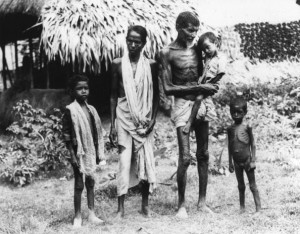 The British brutally put down the Indian Mutiny in 1857-8 with massacres in Delhi, Allahabad, Kanpur and Lucknow. Then, as up to 30 million Indians died in famines in 1876-9 and 1896-1902, the British government of India explicitly prohibited relief efforts or actions that might reduce exports from India to the U.K. or interfere with the operation of the “free market.”

 Aletho News

