The First Intifada: Nostalgia

Palestinian women confront Israeli soldiers during the First Intifada [Facebook]
Nadia Naser-Najjab | MEMO | December 9, 2017
This month marks the 30th anniversary of the First Intifada, an event which fundamentally altered the profile and trajectory of the Palestinian national struggle against occupation. It shifted political leadership away from the exiled Palestine Liberation Organisation (PLO) leadership, reconfigured local political arrangements and, most crucially, challenged the Israeli occupation at its weakest and most vulnerable points.
However, its full significance has not been, to my mind, sufficiently acknowledged, whether by international observers or by younger generations of Palestinians. This is unfortunate, as the Intifada is not purely an historical event – in my view it has much to contribute to discussions that relate to the conceptual framing, theorisation and tactics of contemporary resistance. This article does not, however, propose to engage at any of these points. It has instead been conceived and developed as a personal account which is grounded within my own perspectives and experiences.
In the late 1980s, I lived in the village of Burqa, which is close to Nablus, in the northern West Bank. My home village – like the rest of the West Bank and the Gaza Strip – had been subject to Israeli occupation for two decades. At the time, the wider world knew little of this reality: insofar as it engaged with the Palestinian “question”, it tended to fixate upon the diaspora refugee communities who had been at the forefront of the Palestinian struggle in Lebanon and Jordan. In the aftermath of the Oslo Accords, this emphasis was inverted. The Occupied Palestinian Territories (OPT) became the focus of international attention and Palestinian refugee communities became, at best, a secondary preoccupation.
For Palestinians in the OPT, there was no possibility that they could be similarly blind to the occupation, whose curfews and collective punishments imposed themselves upon almost every aspect of everyday life. Refuge could not be sought in political quietism: the occupation did not distinguish between the politically active and apathetic. Indeed, this was one of the main oversights of the occupation: it politicised ordinary Palestinians by making resistance an imperative which weighed equally upon every Palestinian man, women and child. My own parents, who had previously shown little inclination to join in revolutionary activities (quite the contrary – they tried to dissuade me and my sisters from participating), joined a protest after Israeli soldiers killed a ten-year-old boy who was playing in his backyard in my home village.
Looking back, I remember how, in imposing collective punishment upon my home village, the Israeli occupiers forced all adult males to congregate in the school courtyard. They made little allowance for age, seniority or status: teachers and doctors were forced to run around while shouting senseless and random words like “tomato” and “potato”. They were sometimes detained for more than six hours, and were not allowed to use the toilet or speak to each other during that entire time. Fathers, brothers, relatives and neighbours were deliberately humiliated in front of each other.
The occupiers inflicted this treatment on my own father. One day, soldiers told him to bring down a Palestinian flag which activists had placed on top of an electricity pole. He was over 60. When he told the soldiers this and tried to make them see how difficult it would be for him to climb the pole, they refused to accept his “excuse” and threatened him with violence if he did not obey. He also knew that if he refused, his ID card would be confiscated and he would have to travel to the military offices in Nablus and wait for hours or even days to get it back.
Israeli soldiers did not therefore always have to resort to direct violence. More often than not, this was unnecessary. In the OPT, violence was an implicit undertone, ever-present in the background. During one prolonged curfew, my sister sneaked out to visit my aunt, who lived around a ten minutes’ walk away. She did not encounter a single Israeli soldier. The Israeli army knew full well that their orders and directives did not require direct enforcement.
This suddenly changed when the First Intifada broke out on 9 December 1987. Yitzhak Rabin declared an “Iron Fist” policy to tame Palestinians, and a man who would later be near-universally venerated as a “dove” of peace openly called upon Israeli soldiers to “break the bones” of Palestinian protestors. This violence also took other forms. Birzeit University, an important centre of popular resistance and struggle, was forced to close. A number of students (myself included) were prevented from graduating on time.
While Rabin’s actions said much about his own considerable capacity for violence and intransigence, they said an equal amount about the settler-colonial mentality. In adhering to its guiding tenets, Israel’s political-military establishment believe that Palestinians cannot be engaged with as equals. Instead, it is more appropriate to engage with “them” with treatment commensurate to their level of personal and social development. Violence presents itself as an appropriate mode of conduct at this point.
While the Israeli political-military establishment continually endeavours to gain insights into the mindset of its Palestinian adversaries, it appears to be structurally predisposed to underestimate Palestinians and their capacity for collective organisation and mobilisation. In other words, the influence of Zionism’s implicit racism and ethnocentrism invariably frustrates the initial aspiration to understand. It is true that the PLO leadership had been similarly blind to the possibilities of mass mobilisation. However, as Frantz Fanon observes, the colonised “…is overpowered but not tamed; he is treated as an inferior but he is not convinced of his inferiority”.
The profound flaws within this misconception were clearly exposed when the United National Leadership of the Uprising (UNLU) took control of what was initially a spontaneous outburst of popular anger and resentment and turned it towards clear ends and purposes. The Intifada rapidly coalesced into a disciplined, broad-based and democratic uprising that was focused upon clear ends and objectives. The uprising became a source of immense pride for Palestinians, and it was characterised by a sense of self-sacrifice and commitment to the wider struggle. Patriotic poems were smuggled from prisons; Palestinian musicians composed Intifada songs, and their tape cassettes helped to raise Palestinian spirits. Sharif Kanaana, a professor at Birzeit University, collected what became known as “Intifada jokes”. He noted that there was a clear difference between jokes told in the pre-Intifada period and those told after it. In the latter instance there was a stronger sense of defiance, and the humour was invariably at the expense of the occupying power.
When the Israeli army closed schools, the popular committees created home schools. When these home schools were then banned, Palestinians continued to operate them underground. One father, whose furniture and television set were confiscated after he refused to pay the occupation tax, spoke of how his son had told him not to protest on his own behalf. He refused to grant the Israelis this minor victory. His son said: “I don’t want to watch cartoons. Do not ask them to keep it.” When I joined solidarity visits to the injured at Al-Makaseed Hospital I was struck by the pride and defiance that shone in the eyes of the injured.
In the current context devoid of any real sense of purpose, it is unsurprising that Palestinians should look back on the Intifada as a “golden age” of Palestinian struggle. However, there is a clear danger that these recollections will romanticise the uprising. It is crucial not to fall into this trap. After all, the Intifada was not entirely cohesive (there were ongoing tensions between the UNLU, the PLO and Hamas) and it could be argued that it was ultimately a failure – after all, its main contribution proved to be the abortive Oslo Accords.
These limitations do not detract from the essential fact that the Intifada has a perhaps unparalleled significance in the history of the occupation, standing apart as the point at which Palestinians gathered the strength and collective sense of purpose which enabled them to confront an occupation which had imposed itself upon Palestinian society for two decades. It will always remain a source of pride for Palestinians, and will always to some extent reside at the level of imagination. In reflecting back upon it, Palestinians should take pride in its many achievements but also resist the temptation to idealise or romanticise. If this caveat is taken into account, then there is every reason to suppose that looking back will produce concrete benefits in the present.
Read also: 250,000 Palestinians injured since First Intifada
Most Europeans Want Better Relations With Russia, Not Sanctions War – Poll
Sputnik | November 23, 2107
As the European Union continues to bear the economic brunt of its sanctions policy towards Russia, a recent poll by Sputnik has revealed that an absolute majority of Britons, Germans, French and Poles want better relations between Brussels and Moscow.
The French Institute of Public Opinion (Ifop) has conducted an opinion poll at Sputnik’s behest, in an attempt to gauge the attitude of Europeans towards the deteriorating relationship between the EU and Russia.
Relations between Brussels and Moscow took a turn for the worse in 2014 amid the crisis in Ukraine, resulting in a perpetuating cycle of sanctions and counter-sanctions which tax the economies of European states.
Ifop interviewed a total of 3,228 respondents of 18 years old or older in the UK, France, Germany and Poland, asking them a single question: “As a result of sanctions and counter-sanctions the political as well as economic relations between Russia and the EU continue to deteriorate. Would you like relations between the EU and Russia to improve in the near future?”
The vast majority of respondents favored improvement in relations between Brussels and Moscow, with 87 percent of Germans, 85 percent of Poles, 79 percent of French and 68 percent of Britons answering “Yes.” It is noteworthy that the economies of the four countries are among those hit hardest by sanctions and Russia’s responsive countermeasures in terms of economic losses.
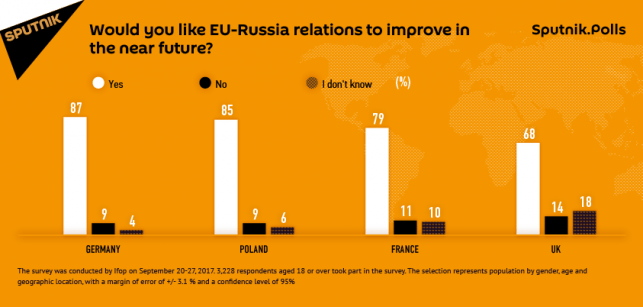
Vast Majority of Germans, Poles, French, Britons Want to Improve Ties With Russia
In Germany, which has lost “tens, if not hundreds of billions euros” and nearly 60,000 jobs due to anti-Russian sanctions, according to a study, 90 percent of male respondents in Germany turned out to be more inclined towards better relations with Russia. In France and the UK, which have reportedly lost €2.1 billion ($2.5 billion) and €3.1 billion ($3.7 billion) in exports respectively, 82 percent and 71 percent of male respondents favored better relations between Brussels and Moscow, the poll has shown.
The relationship between Russia and the European Union soured after Crimean peninsula seceded from Ukraine and reunified with Russia following the March 2014 referendum. The Western countries, including the EU members, have not recognized the legitimacy of the vote, imposing several rounds of sanctions on Russia.
Do You Hold Dual Citizenship? You Can Serve in Congress–but not the Israeli Knesset!

By Richard Edmondson | Fig Trees and Vineyards | December 8, 2017
A few days ago I posted an article entitled Zionists Form Group to Promote Kurdish Statehood, about the latest efforts underway to carve up the Middle East. In the course of researching that article I made a rather interesting discovery: that Israel has a law prohibiting holders of dual citizenship from serving in the Knesset, the Israeli parliament.
Needless to say, we need such a law here in the US, but of course anyone who suggests this gets accused of anti-Semitism.
A couple of years ago when talk show host Diane Rhem interjected a discussion about dual Israeli citizenship into an interview with Senator Bernie Sanders, Rhem was subjected to withering criticism. The ADL, among others, jumped into the fray, accusing Rhem of playing into “classic anti-Semitic charges of dual loyalty,” and the talk show host was forced to issue an apology.
And this kind of thing doesn’t just happen in America. When an official in South Africa proposed a law that would revoke South African citizenship under certain circumstances, one of them being if dual citizens were to serve in the armed forces of the other country, the reaction from South African Jews was about what you’d expect:
South African Jewish community leaders have expressed outrage at an African National Congress (ANC) official’s recent announcement of possible plans to ban dual citizenship.
While Obed Bapela, head of the ANC’s national executive committee’s subcommittee on international relations, has countered that the idea includes anybody with dual citizenship without discrimination, the South African Jewish Board of Deputies and South African Zionist Federation have issued a joint communication condemning the move as discriminatory towards Jews.
But dual citizens are banned from serving in the Israeli Knesset and no one seems to get too upset over it.
In my article of a few days ago, I mentioned a Knesset member by the name of Ksenia Svetlova, who is passionately advocating the formation of a Kurdish state. According to a Times of Israel article, Svetlova held dual Israeli-Russian citizenship until 2015, when she was elected to the Knesset, at which time she was forced to formally renounce her Russian citizenship.
“While Israelis may hold dual citizenship, a Basic Law passed in 1958 states that Knesset members cannot pledge allegiance as parliamentarians unless their foreign citizenship has been revoked under the laws of that country,” the article states.
Another Israeli politician, who was elected at the same time as Svetlova is Rachel Azaria, who was also forced to renounce her foreign citizenship–in the US! Again from the Times of Israel :
Azaria, a 38-year-old Jerusalem deputy mayor, renounced her American citizenship, which she had held by virtue of her mother having been born in the US.
It is astounding, is it not? Israel gets billions of dollars per year courtesy of US taxpayers–but anyone holding US citizenship is barred from serving in the Knesset! But we are not allowed to have a similar law here in the US banning Israeli citizens from serving in Congress!
And not only do we not have a similar in the US, but apparently Freedom of Information Act requests aimed at finding out which Congress members do in fact hold dual citizenship–are denied. The following is a 2015 article that was published at Counterpunch.
***
Dual Citizens in Congress?
By L. Michael Hager
Is dual citizenship in the U.S. Congress and administration creating potentially serious conflicts of interest?
My Counterpunch piece of November 12, 2014 described a failed effort to identify members of Congress who hold dual citizenship and to ascertain the second nationality of those members. I mentioned the then outstanding Freedom of Information Act request that I filed with the Congressional Research Service (CRS) last October.
This week I received the information I sought, in the form of a telephone call from a legal officer of the Library of Congress. After reminding me that Congress (and the CRS by its connection with Congress) is exempt from FOIA requests, he verbally confirmed my suspicion that CRS does not currently collect dual citizenship data.
That’s bad news for those of us who believe that citizens should know if their representatives in Congress (and senior government officials and judges, for that matter) owe allegiance to any other nation. For example, when a Senator, a House Member or a high USG official speaks out, submits bills or determines policy on an issue of importance to a second country, shouldn’t constituents (and citizens at large) be able to judge whether there is or is not a conflict (or apparent) conflict of interest?
Without transparency on dual citizenship, Americans remain in the dark, free to speculate on which representatives may have divided loyalties. Current entries on the Internet reveal a wide range of such speculation. The lack of transparency is dangerous, for it erodes trust in government, creating credibility doubts where there should be none and allowing some conflicts to continue undetected, without question or debate.
Thus the first requirement is transparency. We need a government agency (presumably the CRS) or a non-governmental organization to disclose the names and non-U.S. national affiliations of Members of Congress and senior government officials and to track and report on this issue.
Secondly, we need more media attention to the subject of dual citizenship. Senator Ted Cruz and Representative Michelle Bachman both received wide press coverage, when they renounced their Canadian and Swiss nationalities, respectively.
Stanley Fischer, who currently serves as vice chairman of the U.S. Federal Reserve, became an Israeli citizen in 2005 while retaining his American citizenship. Prior to his appointment to the Fed in 2014, he served for eight years as governor of the Bank of Israel. Although the New York Times article of March 13, 2014 reporting on his then upcoming confirmation hearings, disclosed his dual nationality, it failed to ask the obvious question of why one appointed to such a senior policy position should not be required to renounce his Israeli citizenship. Why has the mainstream media largely ignored the potential conflict of interest inherent in dual citizen Members of Congress and Executive Branch officers?
What about those members and government officials who fail even to disclose their second or more nationalities? As mentioned in my previous article on this subject, U.S. officials and government officers with Jewish identity may acquire Israeli citizenship without much or any formality under the Israeli Law of Return. Thus it is possible, if not probable, that some of such officials hold Israeli citizenship.
Beyond the threshold issue of transparency are equally important questions of whether a dual citizen elected to Congress or appointed to a senior USG position should be required to renounce his or her citizenship in the second nation. Even if American law continues to allow the government service of dual citizens, should it not require such persons at least to recuse themselves from participating in decisions or policy debates that relate to their second nationality?
To address these question we need accurate information on who are the dual citizens in our government. To obtain such data will require a vigorous campaign by interested citizens and NGOs, first to have elected Members disclose any non-U.S. citizenship they hold and second to have the CRS begin to track and report on the presence of dual citizens in Congress and in the higher levels of Government.
Conflicts of interest and apparent conflicts by public officials erode trust in government. Allowing dual citizenship in Congress (and in the Executive and Judicial Branches) to flourish under cover of non-disclosure puts our democracy at risk.
It’s time to bring this issue into open debate.
L. Michael Hager is co-founder and former director general of the International Development Law Organization, Rome
John Lennon Was Right: The Government Is Run by Maniacs for Maniacal Means
By John W. Whitehead | Rutherford Institute | December 07, 2017
 Not much has changed in the 37 years since John Lennon was gunned down by an assassin’s bullet.
All of the many complaints we have about government today—surveillance, corruption, harassment, political persecution, spying, overcriminalization, etc.—were used against Lennon, who never refrained from speaking truth to power and calling for social justice, peace and a populist revolution.
Little wonder, then, that the U.S. government saw Lennon as enemy number one.
A prime example of the lengths to which the U.S. government will go to persecute those who dare to challenge its authority, Lennon was the subject of a four-year campaign of surveillance and harassment by the U.S. government (spearheaded by FBI Director J. Edgar Hoover), in an attempt by President Richard Nixon to have him “neutralized” and deported. As Adam Cohen of the New York Times points out, “The F.B.I.’s surveillance of Lennon is a reminder of how easily domestic spying can become unmoored from any legitimate law enforcement purpose.”
Years after Lennon’s assassination, it would be revealed that the FBI had collected 281 pages of surveillance files on him. As the New York Times notes, “Critics of today’s domestic surveillance object largely on privacy grounds. They have focused far less on how easily government surveillance can become an instrument for the people in power to try to hold on to power. ‘The U.S. vs. John Lennon’ … is the story not only of one man being harassed, but of a democracy being undermined.”
Such government-directed harassment was nothing new.
The FBI has had a long history of persecuting, prosecuting and generally harassing activists, politicians, and cultural figures, including Martin Luther King Jr.
In Lennon’s case, the ex-Beatle saw that his music could mobilize the public and help to bring about change. Yet while Lennon believed in the power of the people, he also understood the danger of a power-hungry government. “The trouble with government as it is, is that it doesn’t represent the people,” observed Lennon. “It controls them.”
By March 1971, when his “Power to the People” single was released, it was clear that Lennon was ready to participate in political activism against the U. S. government, the “monster” that was financing the war in Vietnam.
The release of Lennon’s Sometime in New York City album, which contained a radical anti-government message in virtually every song, only fanned the flames of the government’s war on Lennon.
In 1972, Nixon had the ex-Beatle served with deportation orders “in an effort to silence him as a voice of the peace movement.” Despite the fact that Lennon was not plotting to bring down the Nixon Administration, as the government feared, the government persisted in its efforts to have him deported. Equally determined to resist, Lennon dug in and fought back. Finally, in 1976, Lennon won the battle to stay in the country. By 1980, the old radical was back and ready to cause trouble.
Unfortunately, Lennon’s time as a troublemaker was short-lived.
Mark David Chapman was waiting in the shadows on Dec. 8, 1980, just as Lennon was returning to his New York apartment building. As Lennon stepped outside the car to greet the fans congregating outside, Chapman dropped into a two-handed combat stance, emptied his .38-caliber pistol and pumped four hollow-point bullets into Lennon’s back and left arm.
John Lennon was pronounced dead on arrival at the hospital.
Much like Martin Luther King Jr., John F. Kennedy, Malcolm X, Robert Kennedy and others who have died attempting to challenge the powers-that-be, Lennon had finally been “neutralized.”
Yet Lennon’s legacy lives on in his words, his music and his efforts to speak truth to power.
Even so, his work to change the world for the better is far from done.
As I make clear in my book Battlefield America: The War on the American People, peace remains out of reach. Activists and whistleblowers continue to be prosecuted for challenging the government’s authority. Militarism is on the rise, all the while the governmental war machine continues to wreak havoc on innocent lives. And those who do dare to speak up are labeled dissidents, troublemakers, terrorists, lunatics, or mentally ill and tagged for surveillance, censorship or, worse, involuntary detention.
As Lennon shared in a 1968 interview:
I think all our society is run by insane people for insane objectives… I think we’re being run by maniacs for maniacal means. If anybody can put on paper what our government and the American government and the Russian… Chinese… what they are actually trying to do, and what they think they’re doing, I’d be very pleased to know what they think they’re doing. I think they’re all insane. But I’m liable to be put away as insane for expressing that. That’s what’s insane about it.”
So what’s the answer?
Lennon had a multitude of suggestions.
“If everyone demanded peace instead of another television set, then there’d be peace.”
“Produce your own dream. If you want to save Peru, go save Peru. It’s quite possible to do anything, but not to put it on the leaders….You have to do it yourself.”
“Peace is not something you wish for; It’s something you make, Something you do, Something you are, And something you give away.”
“War is over, if you want it.”
In other words, fighting the evil of the American police state can only come about by way of conscious thoughts that are put into action.
Do you want an end to war? Then stop supporting the government’s military campaigns. Do you want government violence against the citizenry to end? Then demand that your local police de-militarize. Do you want a restoration of your freedoms? You’ll have to get the government to recognize that “we the people” are the masters in this relationship and government employees are our public servants.
The choice is ours.
The power (if we want it), as Lennon recognized, is in our hands.
“The people have the power, all we have to do is awaken that power in the people,” concluded Lennon. “The people are unaware. They’re not educated to realize that they have power. The system is so geared that everyone believes the government will fix everything. We are the government.”
For the moment, the choice is still ours: slavery or freedom, war or peace, death or life.
The point at which we have no choice is the point at which the monsters—the maniacs, the powers-that-be, the Deep State—win.
As Lennon warned, “You either get tired fighting for peace, or you die.”
Tayseer Khaled Calls for Boycott of US Goods

IMEMC News & Agencies | December 7, 2017
Amid controversy over the US decision to move their embassy to Jerusalem, PLO Executive Committee member, Tayseer Khaled, published a press release calling for an international campaign in the Arab, Islamic and Friendly States to boycott US goods.
The press release stated the following, according to the PNN :
“Tayseer Khaled , the PLO Executive Committee member, Head of the Palestinian Expatriate Affairs Department called on the Political Organizations, Trade Unions, Youth and Women Organizations and other Civil Society Organizations in Arab, Islamic and friendly countries to launch an international campaign to boycott American goods in support for Jerusalem, a response to the American insulting against our people, and for every unwise political step taken by the American Administration aimed to change the Legal and political Status of East Jerusalem, as an integral part of the occupied Palestinian Territories in June 1967, whether through moving the US Embassy from Tel Aviv to Jerusalem or recognize Jerusalem as the capital of the Israeli Occupation State.”
Khaled added that US President Trump’s administration acts viciously with the Arab and Islamic countries, and it neither gives attention to the Arab public opinion, nor to international law and the legitimacy resolutions related to the Palestinian – Israeli conflict.
Moreover, he said, it neglects the UN Security Council resolutions on Jerusalem, of which begins with resolution 215, issued on May 2nd, 1968, that denounces the Israeli Military Parade in Jerusalem, through resolution no. 476, issued on June 30th, 1980, which nullifies the Israeli measures to change the features of Jerusalem, then resolution no. 478 of Aug. 29th, 1980, which calls for non-recognition of the Israeli law on Jerusalem and the withdrawal of all the diplomatic missions from the city, as well as resolution no. 2334 on Dec. 23rd 2016, which affirms that the construction of settlements in the occupied Palestinian territories since June 4th, 1967, including East Jerusalem, is illegal, and demands it to ban all settlement activities. Furthermore, he stated that Israel doesn’t respect the advisory opinion of the International Court of Justice on the Apartheid Wall or its painful consequences on the occupied West Bank, the status quo in Jerusalem and its surroundings, and opposes the Israeli claims and annexation laws issued by the Knesset, and announced that East Jerusalem is, in fact, an occupied city, adding that Israel is obliged by international humanitarian law and international law, in general, to ensure free access to the holy sites under its control.
At the Palestinian level, Khaled called for uniting efforts to encounter any American step aimed at undermining the legal and political status of Jerusalem, and to stop dealing with the US administration as a qualified mediator to achieve a political settlement to the Palestinian – Israeli conflict. He insisted the US administration be informed that Palestinians are free of such obligations or understandings with, which propose discriminatory rules of conduct to the Palestinians that are restricting their right to go to the UN international bodies and agencies to apply for their membership, as is the case with the World Health Organization (WHO), the International Labor Organization (ILO), and the Food and Agriculture Organization (FAO) and others, or to apply to the International Criminal Court (ICC) to investigate Israel’s violations of Palestinian human rights under occupation, and to investigate war crimes and settlement crimes, which Article (8) of the Rome Statute regards as a war crime.
(photo: hadfnews.ps)
Their Jerusalem is our Ayodhya

Babri Masjid
By M K Bhadrakumar | Indian Punchline | December 7, 2017
The cat is out of the bag – the Modi government will not condemn the US President Donald Trump’s announcement recognising Jerusalem as the capital of Israel. The European Union, Russia, China and the entire Muslim world are aghast. But India ducks by claiming it has “independent and consistent… views and interests” that are “not determined by any third country.” (here)
Why such cowardly prevarication? Either the Modi government should show the courage to acknowledge that India has a pro-Zionist West Asian policy or join the vehement international opinion. There’s nothing to hide, really. PM Modi after all went and paid homage at the tomb of the founder of Zionism in broad daylight when he visited Israel, accompanied by PM Benjamin Netanyahu.
Zionism and India’s freedom struggle are antithetical to each other. Period. There is no other way to frame the moral dilemma. But, inevitably, for the Modi government, political expediency trumps morality. It simply cannot bring itself to annoy Trump. Also, Netanyahu expects Modi to stand by – after all, Israeli and Indian companies are entering into co-production of advanced drone aircraft, finally.
But then, there is more to this than an intense family affair. The Modi government has high stakes in Trump’s announcement on Jerusalem. The point is, the Modi government is also preparing for its Jerusalem announcement – construction of a Hindu temple in Ayodhya. (Both are, ironically, “campaign pledges”.)
Circumstances may vary, but the powerful symbolism is quintessentially the same – bludgeoning the “other” party into submission by creating a fait accompli. Both Jerusalem and Ayodhya are explosive issues. In a world, which is barely coping with tensions and challenges of various kinds, it is illogical to inject more poison. The toxic act is unwarranted and risky unless based on consensus within a broader framework of reconciliation.
But, on the other hand, it has become necessary to placate the ‘core constituency’ at home as well as to address compulsions that exist or are expected shortly. Certainly, Trump must shore up his Christian support base and counts on the Jewish lobby to rescue him if the Congress attempts to impeach him – that is, if Michael Flynn implicates Trump’s son-in-law Jared Kushner (a Jew, ironically) by telling FBI special prosecutor Mueller’s team that he had contacted the Russians during the campaign itself while acting on Trump’s instructions.
In India, too, the “core constituency” of the ruling elite is no longer euphoric. Dawood Ibrahim is still in Pakistan; Article 370 remains in the book. Equally, Make in India isn’t taking off. The best option is to follow Trump’s footfalls to shore up the support base and distract public opinion. By a strange coincidence, Trump’s announcement on Jerusalem and the 25th anniversary of Babri Masjid in Ayodhya overlapped on November 6. (Indian Express )
Of course, Trump is going to be pilloried by the international opinion and the US’ Middle East policies will run into headwinds. Hopefully, Trump will reciprocate India’s support. Two is company, as they say.
The bottom line is, China is the winner. Beijing probably anticipates it. This is what the foreign ministry spokesman said in Beijing on November 6 even before Trump made the announcement:
- We have noted the report and are paying close attention to the relevant development. What we worry about is any potential flare-up of regional tensions. The status of Jerusalem is a complicated and sensitive issue. All parties shall bear in mind regional peace and tranquility, proceed with caution, and avoid impacting on the long-standing basis for the settlement of the Palestinian issue or triggering new rivalry in the region.
- China firmly supports and advances the Middle East peace process. We support the just cause of the Palestinian people to restore their legitimate national rights and stand behind Palestine in building an independent, full sovereignty state along the 1967 borders with East Jerusalem as its capital. We call on all parties to remain committed to resolving disputes through negotiations and promoting regional peace and stability in accordance with the relevant UN resolutions.
There is no daylight possible between China and the Muslim world. Whereas, from now onward, there is not only daylight but also moonlight possible between India and the Muslim world.
An illegitimate capital for a state without legitimacy

By Ibrahim Hewitt | MEMO | December 7, 2017
It should come as no surprise that Donald Trump has declared that the US is recognising Jerusalem as the capital of Israel. For seasoned US-Israel watchers, it merely confirms what we have been saying for decades: Washington is no honest broker in negotiations to end the Palestine-Israel conflict. Quite the opposite, in fact; it has ensured that the odds have been stacked in Israel’s favour and turned a blind eye to its contempt for international law — which Trump clearly shares — even while its brutal military occupation has stolen ever more Palestinian land throughout the seven decades since 1948.
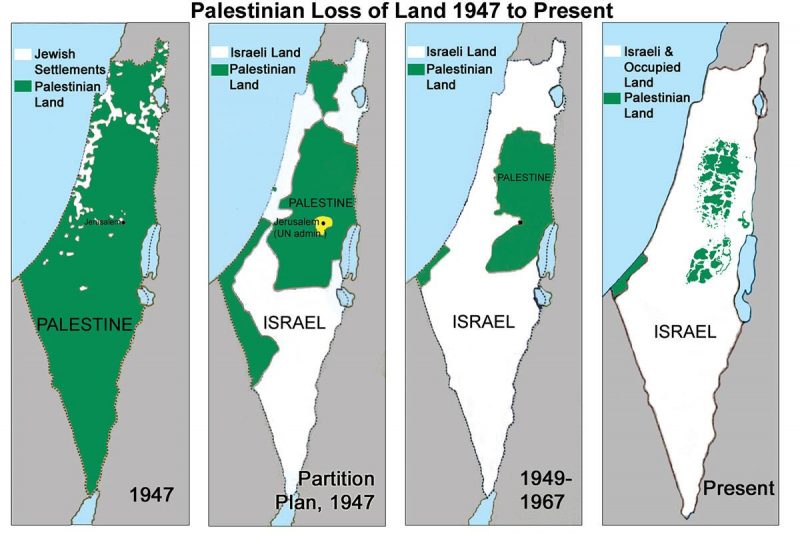
US recognition of Israel’s self-declared capital has no legal basis. The 1947 UN Partition Plan for Palestine, upon which Israel largely bases its international legitimacy, had three components: “Independent Arab and Jewish States and the Special International Regime for the City of Jerusalem”. Only one of these has come into being, primarily because Israel and its backers haven’t allowed the others to happen. What’s more, although the borders of the “Arab and Jewish States” were set out clearly by the UN, Israel took possession of more than its allocation, including West Jerusalem. It took the rest of the city in 1967 along with the remaining land designated for the “Arab State”, and went on to annex the Holy City; this has never been recognised by the rest of the world and, legally, Jerusalem remains “occupied territory”, as do the West Bank and Gaza Strip.
Hence, if we are to be accurate, whenever we discuss the Israeli occupation, this should refer to the West Bank, Gaza Strip and other land now accepted to be part of Israel which it has occupied since the 1949 Armistice. While paying lip-service to the UN Partition Plan for its own legitimacy, Israel continues to ignore the terms of the resolution in almost every respect. A glance at the “Disappearing Palestine” maps confirms this unpleasant fact on the ground.
Ignoring the UN is the norm for Israel; it has violated 28 UN Security Council Resolutions — which are supposed to be binding on UN member states — and ignored at least 40 non-binding General Assembly Resolutions. There is a strong case for throwing Israel out of the UN, given such a record and the fact that its membership in the first place was dependent on allowing Palestinian refugees to return to their homes. This has never been permitted by Israel, and the UN has been unable or unwilling to enforce the will of the international community.
In part, of course, this is because of the diplomatic protection given to Israel by the United States, which has used its veto in the Security Council to block resolutions critical of Israel at least 40 times since 1972. It also reflects the impotence of Europe in the face of whatever power the pro-Israel lobby has over its politicians. European guilt over the Holocaust, perhaps? Or something more mundane, such as electoral influence and donations? Or maybe a combination of the two.
Whatever it is, we can’t pin the blame entirely on Trump and the US; European complicity has also played a role in allowing Israel to act with impunity, as has the collaboration of the Palestinian Authority in what President Mahmoud Abbas has called its “sacred” security cooperation with the occupying state. Indeed, as is now becoming clear, it seems as if major Arab countries have been involved in their own, under the radar, collaboration with Israel by establishing now very open links with the Zionist state.
It is hard to know at the moment if Trump actually understands what impact his move on Jerusalem will have on the people in the region. None of us knows for certain, of course, but it doesn’t take a genius to work out that the prospects for a just peace are now even more remote. A peace of sorts could be imposed by brute force, no doubt, but it would never be based on justice; and it would never last.
Do the US President and his right-wing supporters care about this? Probably not. America’s Christian Zionists largely back him to the hilt, and they aren’t interested in peace; they see the establishment of the state of Israel and the “incoming of the exiles” (the Jews) as an essential prelude to the second coming of Jesus and “the rapture”; ultimately, in fact, the end of the world. The late Grace Halsell explained this thinking in her 1999 book “Forcing God’s Hand”. Israel exploits this through its lobby groups around the world to gain political, military and economic support.
What effect will Trump’s declaration have on the Palestinians for whom Jerusalem is home? Will Israel complete the ethnic cleansing of the city by forcing them out and bringing their complete ethnic cleansing a step closer? With the US watching its back, it is perfectly feasible that the far-right government of Benjamin Netanyahu will feel emboldened enough to do this.
Another option would be for the Jerusalemite Palestinians to be offered Israeli citizenship, but that would upset those who already see Israel’s 20 per cent non-Jewish citizens as a democratic threat to the “Jewish State”. The likelihood, therefore, is that Israeli Apartheid will simply be entrenched further and those Palestinians left in occupied Jerusalem will face yet more discrimination at the hands of an overtly racist government.
Pro-Israel lobbyists are forever bleating that the campaign for justice for and by the Palestinians seeks to “de-legitimise” the state, but they have yet to explain with any credibility the validity of its credentials; in truth, there is none. Israel’s latest poodle in Washington has now recognised an illegitimate capital for a state without legitimacy.
Moreover, Israel has become a rogue state par excellence; not only is its star rising— for now — but it has also been incredibly successful in convincing the major powers in the world that it is the innocent victim in all of this. However, it is no longer surrounded by hostile states; the “self-defence and security” excuse for its vile occupation and military offensives against Palestinian civilians is unravelling as Saudi Arabia and the UAE join Jordan and Egypt in tying their camels and putting their trust in Tel Aviv.
Israel is ticking the boxes on its wish list. The battle for Jerusalem appears to have been won. After incessant Jewish colonial-settler incursions into the Noble Sanctuary — which will be viewed in the future as its initial skirmishes — the battle for Al-Aqsa Mosque, the heart of the Palestinian and Muslim presence in the Holy Land, may well be about to start in earnest. Recognition of Jerusalem as Israel’s capital is just the beginning. The next target will be to occupy and demolish Al-Aqsa and the Dome of the Rock Mosques and build a temple in their place. The blueprints for this are already prepared.
With the villain of the piece portrayed as the victim — poor little Israel — and those with international law and justice on their side demonised as wrongdoers, the days of the False Messiah may well be upon us. Anyone for Armageddon?
@ibrahimhewitt56
Featured Video

Seyed M. Marandi: US-Iran War Inevitable: Kuwait and Bahrain May Fall
or go to
Aletho News Archives – Video-Images
From the Archives
Oil and the Israel Lobby
Reknowned economist M. Shahid Alam offers this excellent critique of Noam Chomsky’s defective analysis of the relative influence of Oil versus the Israel lobby over US foreign policy: … continue
Blog Roll
 Aletho News
- ICC ignored ‘very well-documented’ NATO crimes – ex-Libyan minister
- SNSC secretary dismisses US response to Iran’s conditions as ‘inadequate’
- Sanaa says Taiz roads open, secure for residents, warns Saudi forces
- Iraqi resistance group urges Saudi leadership to admit defeat, lift Yemen siege
- Trump’s Retreat: How Al-Aqsa Flood Took Down the US Empire
- Israel’s Military Actions in Lebanon Grossly Violate International Law — Lavrov
- Seyed M. Marandi: US-Iran War Inevitable: Kuwait and Bahrain May Fall
- Leaders Condemn Ansarallah Attack on Saudi Arabia While Ignoring Illegal War Against Yemen
- Leaked: Britain’s Covert Iraqi Psyops Network
- Yemeni Armed Forces Warn Airlines Against Using Saudi Airports, Exempt Mecca and Medina
- If Americans Knew
- How Israel Conquered the Latin American Right
- Agents search Rep. Omar’s Washington home in criminal probe as she vows she won’t ‘be silenced’
- “The Rule Was: ‘Shoot Everyone You See'”
- Israel goes ballistic over Nobel Laureate Navi Pillay
- U.S. May Join Yet Another Middle Eastern War — TCN
- Yellow Line moves again as Israel closes in on trapped Gazans – Daily Update
- Israeli Attacks Kill Seven Palestinians in Gaza Including Six-year-old Girl
- Gaza: Ceasefire Anniversary Marks Year of Failed Promises
- The American Conservative: Mike Huckabee Should Resign
- A C-Section in Shackles: A Palestinian Woman’s Harrowing Birth in Israeli Detention
- No Tricks Zone
- Germany’s Green Energy Debacle: High Energy Costs Force Kahla Porzellan to Close After 182 Years!
- New Study: 50 Years Of The Most Aggressive ‘Net Zero’ Policies Can Only Affect The Global Climate By 0.03°C
- US September “Heat” Was No Record…Many Records Set Decades Ago
- Latest European Green Energy Debacle; Portugal’s Largest Flagship Solar Park Insolvent!
- Green Energy Debacle: German Expert Professor Fritz Vahrenholt Warns Of Severe Economic And Social Consequences
- Two More Paleo Reconstructions Affirm Meters-Higher Sea Levels Across Ireland, Brazil 7000-6000 Years Ago
- New Study: Earth And Venus Surface Warmth Largely Explained By Convection And Lapse Rate, Not CO2 Or Radiation
- 2025 Nature Paper Claiming Worsening Global Drought Gets RETRACTED …Heavily Flawed
- New Study: ‘Global Drought Shows No Detectable Recent Acceleration Under Climate Warming’
- Economic Masterminds: German Socialists Suggest Taxing Productivity Gains Stemming From Using AI

