To resolve the nuclear crisis in 2003, six-party talks were established, on which three main groups were formed. The first camp was North Korea, the second – the United States, joined by Japan. The third, the most important and the most numerous, was made up of Russia, China and the “Roh Moo – hyun’s ROK”, a camp of pragmatists who made every effort to ensure that the talks were negotiations, not a series of mutual demarches.
North Koreans immediately filed four demands, under which Pyongyang is prepared not to use nuclear weapons – the signing of the US non-aggression package; establishment of diplomatic relations with the DPRK; ensuring economic cooperation with Japan and South Korea; providing North Korea with light water reactors for energy.
Apparently, these requirements were not very different from what was stipulated in the Framework Agreement, but the American delegation, led by the same Kelly, took a very tough stance. However, the US immediately rose to a “non-negotiable” position from the category “All or nothing,” a complete, confirmed and unconditional liquidation of the nuclear program. In translation from “diplomatic speech” it meant: the DPRK freezes the ENTIRE nuclear program and liquidates the nuclear infrastructure created in the DPRK, and then the United States will check whether the program is really frozen and decide what to give Pyongyang in return. At the same time, the dismantling of the facilities was set at 3 months, which was certainly not feasible, and the idea of the need to prove complete liquidation immediately reminded everyone of the Iraqi experience – but stating problem made it possible to remove the issue of the Americans’ failure to comply with their agreed part of the Agreement Framework. It is clear that in such a situation negotiations were difficult, and the academic circles regarded as a success the fact that the negotiating parties did not quarrel immediately after the first round.
The result of the second round was also the agreement to continue negotiations. However, this stage ended Pyongyang’s attempt at the very last moment to make changes in the joint communiqué on the results of the talks, because of which the closing ceremony was postponed for several hours. The final document was not adopted again.
According to unofficial sources, the United States considered the talks an opportunity to create a united ‘coalition of pressure’ against North Korea and declared in an ultimatum to the DPRK that it should freeze its nuclear program and return to the treaty, or else ….
The northerners responded to “or not” with their ‘bold proposal’ (according to some reports, it sounded something like this: “And what will you do if we hold a nuclear detonation?”). After that, the negotiations were stopped, and the DPRK’s position was presented as extremism and nuclear blackmail, although the demands of the North were to sign a nonaggression pact, diplomatic recognition of the DPRK and to give it more opportunities to participate in international trade. For blackmail, this seems even less than the previous demands of the DPRK, which sought financial assistance in exchange for abandoning the nuclear program.
China’s perseverance had borne fruit, as the Americans came with a specific proposal on the third round of talks on June 23-24, 2004, according to which North Korea could be provided with economic favors in exchange for freezing the nuclear program and transferring North Korea’s nuclear facilities to be under temporary international management of a commission of five powers or the IAEA.
This was a departure from the original American position, but by the end of the three-day talks the situation returned to “No deal”. Nevertheless, North Korea has expressed its readiness to freeze and even liquidate its nuclear facilities on the terms of lifting sanctions and providing energy assistance (2 million kW per year), but in general there was consensus that the freeze of nuclear development would be the first step in the transformation of the peninsula into a nuclear-free zone.
The fourth round of talks was scheduled for September 2004, but was only held in September 2005. This was partly due to the re-election of George W. Bush, after which it became clear that the balance of power in the negotiations will not change much. Partly with the fact that some USA State Department officials made a number of statements that even in the case of nuclear disarmament of the DPRK, the “Korean problem” will remain a problem due to the lack of democracy and respect for human rights.
On February 10, 2005, North Korea withdrew from the six-party talks and for the first time recognized the creation of its own nuclear weapons. “Our nuclear weapons are completely defensive, and they will remain as a force of nuclear deterrence,” said a spokesman for the DPRK Foreign Ministry. And on March, 3rd, 2005, the DPRK declared, that it no longer considers itself bound by the 1999 moratorium on the testing of medium-range ballistic missiles: “Dialogue with the USA ceased in 2001 with the coming to power of the Bush administration, which means that we have the right to resume the tests.”
An important detail of the fourth round of talks, which took place in two stages: July 26 – August 7 and September 13-19, 2005, was the replacement of the head of the American delegation (former Ambassador to the ROK Christopher Hill) and an abundance of bilateral consultations, including North Korean and American. This fact of the changing of the negotiating structure spoke about the greater flexibility of the participants in principle and about the desire of the two main parties to start direct communication. Actually, this is exactly what Pyongyang had been longing for: its main demand at this stage was that the US “recognize North Korea as a partner and treat it with respect.”
The fourth round ended with a very important document the Joint Statement, which fixed the principles for solving the nuclear problem on the Korean Peninsula: the sides agreed on coordinated steps for the practical implementation of the agreements reached on a phased basis: “The North Korean side declares its right to peaceful use of atomic energy. Other negotiators expressed their recognition of this right and agreed to discuss the issue of granting the DPRK light water reactors at the right time.” In addition, the DPRK reaffirmed its “commitment to abandon all nuclear weapons and ongoing nuclear programs, return as soon as possible to the Treaty on the Non-Proliferation of Nuclear Weapons, as well as under IAEA inspections.” China, the ROK, the USA, Japan and Russia, in turn, announced their intention to provide Pyongyang with energy assistance.
The fifth round of talks began on 9-11 November 2005 in an optimistic atmosphere (Pyongyang promised to postpone tests of nuclear weapons), but the DPRK was interrupted after Washington actually torpedoed the decisions of the joint statement by conducting a whole package of ‘hostile actions’: a special Congressional decision to allocate money for subversive activities within North Korea, the appointment of a special representative on the issue of human rights in the DPRK and sanctions against eight North Korean companies unfoundedly accused of money laundering, drug trafficking and other criminal activities. According to US officials, the funds received from the activities of these companies were used to finance the DPRK’s nuclear programs.
In addition, the US froze North Korean accounts at Delta Asia Bank (Macao) for $ 25 million. The seizure of North Korean money was perceived as evidence of their criminal origin, but there is one important nuance. This action was carried out in accordance with the Patriot Act, adopted in the USA on the wave of the fight against terrorism after September 11, 2001, to facilitate the conduction of investigative procedures. In particular, with regard to money that could have been used by terrorists, the act presupposed the possibility of anticipating the seizure of funds in order to make them inaccessible if they were really criminal. In other words, first to seize accounts that seemed suspicious, and then deal with them. However, in the eyes of the world community, which is accustomed to the fact that accounts are seized only when their criminal origin is confirmed, this fact has become “evidence of the criminal nature of the North Korean regime.”
North Korea took this seizure as an attempt to cut it off from the world financial system and give a signal to banks conducting business with the DPRK not to do it anymore because of possible problems with the US, especially because subsequent developments have led to a fear of such consequences, Asian banks have virtually ceased to cooperate with the DPRK.
It is difficult to say whether this was a deliberate attempt to torpedo the success of the Joint Statement, but North Korea’s reaction was predictable and it once again ‘slammed the door’, saying that until the sanctions are lifted, there will be no negotiations, especially since there was no serious evidence that North Korean money was ‘dirty’.
After that, there was a long pause at the talks, as the results of their fourth round were in fact disavowed. On December 20, 2005, the Central Telegraph Agency of Korea reported that “When the Bush administration shut down supplying light water reactors, we will actively develop an independent nuclear power industry based on graphite reactors with a capacity of 50 and 200 megawatts.” Thus, the DPRK denounced its previous promises to abandon all nuclear programs in exchange for security guarantees and economic assistance, and unlike similar actions by the US, this statement is constantly used as an example of Pyongyang’s treachery and unpredictability.
Visibly, the first stage of the six-party talks does not fit into the pattern “The United States is making concessions, and the DPRK is breaking promises over and over again.” Rather – on the contrary. Moreover, the attempt to cut off the DPRK from the world financial system, in the author’s view, buried not only the outcome of the agreement reached in the framework of the 2005 Joint Statement, but also the possibility of voluntary denuclearization after such actions by Washington towards the DPRK, apparently, concluded and more serious compromises were not reached.
Konstantin Asmolov, Ph.D. (Hist.) is a leading researcher at the Center for Korean Studies of the Institute of the Far East of the Russian Academy of Sciences.
The Intermediate-range Nuclear Forces (INF) Treaty – one of the most significant arms-reduction accomplishments of the Cold War – marked its thirtieth anniversary on December 8. It was signed by Ronald Reagan and Mikhail Gorbachev in 1987 to ban US and Soviet ground-launched ballistic and cruise missiles with ranges between 500 and 5,500 kilometers (300 and 3,300 miles). Some 2,700 missiles and their launchers have been destroyed. The landmark treaty has served well to prevent a nuclear arms race but today it is the weakest link in the system of nuclear arms control and its future is uncertain.
The United States is set to impose new sanctions against Russia over Moscow’s alleged violation of the INF Treaty. The US Commerce Department will introduce punitive measure against Russian companies that have provided technology to help develop a new weapon. The December 8 announcement made by the State Department was the first of its sort by President Donald Trump’s administration.
The decision is taken after a lengthy review undertaken by the National Security Council and made public ahead of a meeting of the Special Verification Commission (SVC), the implementing body for the treaty, to bring together US and Russian officials and experts. Past meetings to discuss controversial issues have failed to accomplish results. The missile in question is the so-called Novator 9M729 (SSC-8). Washington alleges the missile has already been deployed in at least two Russian regions.
In addition to the new sanctions, the Defense Department will begin research and development on a new nuclear cruise missile. The fiscal 2018 defense policy bill is authorizing $58 million to develop a new INF-busting road-mobile cruise missile capable of carrying conventional or nuclear warheads. It should be noted that it would cost billions of dollars and take years to field. One can hardly imagine a US ally in Europe or Asia, agreeing to deploy such a weapon on its territory.
Even more provocatively, in the same budget, Congress has directed the Defense Department to report on the cost to convert existing missile systems, such as the missile-defense interceptor SM-3 currently deployed in Romania, into medium-range nuclear systems. This is a validation of Russia’s concern that the ground-based missile defense systems being deployed in Europe can be used for intermediate range offensive missiles. The bill is also calling on the president to submit to Congress a plan to impose US sanctions on Russians responsible for “ordering or facilitating non-compliance” with the treaty.
The United States first formally accused Russia of developing a missile in violation of the INF back in 2014, and has repeated the accusations several times since then. Earlier this year, Washington said the missile was operational and had been deployed.
Moscow has denied the accusations as groundless and insisted it is committed to the INF pact. Russia said on Dec. 9 it was fully committed to a Cold War-era agreement.
Moscow has its own list of complaints over the US non-compliance. The list includes the drones that can deliver ordnance at ranges between 500 and 5,500 km, and target missiles used for ballistic missile defense (BMD) tests, which have a range exceeding the limits imposed by the treaty and can be potentially weaponized. US drones are cruise missiles because they fall inside the definition of cruise missiles in treaty Article II, paragraph 2: “an unmanned, self-propelled vehicle that sustains flight through the use of aerodynamic lift over most of its flight path.”
Russia’s special concern is the use of Mk-41 VLS launcher as an element of the AEGIS Ashore missile defense system operational in Romania and to be deployed in Poland next year. A ship-borne version is designed to fire both Tomahawk cruise missiles and SM-3 interceptors. It gives the US the ability to launch intermediate-range cruise missiles from land. The treaty bans the deployment in Europe of the ground-based intermediate range capable launchers.
It’s worth noting that some elected officials in the United States are setting the stage for withdrawal from the treaty. In July, Senator Tom Cotton, who is a member of the Armed Services Committee, said the US should sidestep the accord. In his speech at the Center for Strategic and International Studies in Washington, D.C., the senator urged the administration to transfer American missile technologies to allies, particularly Poland, to help develop their own mid-range missiles, despite the fact that only the US and Russia are signatories to the INF Treaty. “The time is coming to consider whether the US should stay in the INF treaty, even if Russia came back into compliance,” he said at the time. Earlier in 2017, the US government offered to help its South Korean counterparts develop new longer-range ballistic missiles that American forces would themselves be unable to employ.
Much has been said about the problems related to the INF Treaty. True, there are problems that should be addressed and the SVC is the right forum to do so. With the treaty torn up, the prospects for a strategic offensive arms treaty after the New START expires in 2021 become blurred. The INF and the New START are the only arms control treaties remaining in force to limit US and Russia’s nuclear forces. Without them, an arms race becomes inevitable. Instead of engaging in futile exchanges of accusations, the parties should jointly work out additional verification measures to eliminate mutual suspicions. That’s what should be done. The US states its goal is to have the treaty in force but it looks like it wants it on its own terms, giving it an exclusive right to define what meets the treaty’s provisions and what does not. Otherwise, how can one explain the fact that the statement about imposing the INF-related sanctions on Russia came before the SVC talks started?
This is an act of intimidation and outright pressure unacceptable for Moscow and the State Department is aware of it. The Russia’s reaction is quite predictable. At the October 2017 Valdai Club meeting Russian President Vladimir Putin said: “If someone… wishes to withdraw from the treaty, for example, our American partners, our response would be… immediate and reciprocal.” The use of ultimatums is a wrong language to speak with Moscow and Washington knows it well.
Then the imposition of sanctions is nothing but a provocative act, pursuing the goal of shifting the blame on Russia for something the US wants to be done – dumping the treaty. A unilateral withdrawal would not be supported internationally and Washington will face problems with allies. But if the US succeeded in creating the image of a victim, which has to do something about the Russia’s “nefarious” plans, it would eat the cake and have it. This is “a pot calling the kettle black” policy. Otherwise, the announcement of sanctions would not precede the talks.
The revelation that the Trump transition team colluded with Israel to sabotage a foreign policy initiative by the Obama White House made the news, sort of, when the story broke at the end of November. But it has since died, pushed down by the relentless pressure in the media to “disappear” all things critical of Israel or its behavior.
Thanks to the ongoing investigation of Russiagate by Special Counsel Robert Mueller, we Americans have learned that prior to President Donald Trump’s inauguration, some of his closest advisers responded to Israeli solicitation to derail a United Nations vote on illegal Israeli settlements in the occupied Palestinian territories. The effort to help Israel was implemented behind the scenes and in opposition to the official U.S. foreign policy.
Possible collusion with a foreign state has produced an avalanche of negative press coverage and congressional baying for blood related to Moscow and its President Vladimir Putin but similar action on the part of Israel has produced little to nothing in terms of a response from the Fourth Estate and political class.
Perhaps not too surprising, the story has actually taken a different turn, producing some opinion pieces, mostly from American Jews, insisting that Jared Kushner, the presidential son-in-law who was behind the effort, did the right thing because it was done “for Israel.” It is a sure sign of the invulnerability of those exercising Jewish power in the United States that something very close to treason involving a foreign country can be applauded with impunity. This is in spite of the fact that successful attempts to bury the story and even to justify what was done inevitably raises the issue of “dual loyalty” on the part of some American Jews who clearly see Israel as something that has to be protected and cherished even when it means doing serious damage to the American people and U.S. national interests.
One of the most illustrative opinion pieces written by an “Israel firster” appeared recently in Forward, America’s leading Jewish news and information website. It was entitled “Jared Kushner Was Right To ‘Collude’ with Russia – because he did it for Israel” before it was changed in the online edition to “Was Kushner doing the right thing?” The author, Daniel Kohn, lives in San Diego California. The article is particularly interesting as it makes a grotesque convoluted effort to not only justify what took place but also to sing the praises of Israel and all its works.
The extent to which the op-ed is characteristic of American-Jewish thinking regarding Israel is, of course, difficult to estimate but I would suspect that most Jews in the U.S., who are generally self-described progressives, would find much of it rather dubious, though many would be reluctant to openly criticize or counter the arguments being made for fear of ostracism by their community.
Kohn constructs a straw man around the fact that previous incoming presidential administrations have communicated with foreign governments during their transition periods. This is certainly true and even sensible. But, at the same time, meeting representatives of other countries cannot be allowed to undercut the policies being pursued by the White House team that is actually still in power. In this case, President Barack Obama had made clear that his opposition to the Israeli settlement expansion would be expressed through U.S. abstention on a United Nations Security Council vote condemning such activity.
In response, the government of Israel asked Jared Kushner to use Trump’s potential leverage to bring about a veto or delay in the resolution. Kushner clearly approached his task with some zeal, instructing incoming National Security Adviser Mike Flynn to contact the U.N. delegations of the countries on the Security Council to do just that, undercutting what Obama was doing. That is how the phone call from Flynn to Russian Ambassador Sergei Kislyak came about.
Kohn also critiques the applicability of the Logan Act, which blocks American citizens from negotiating with foreign governments on behalf of the United States by claiming that it “would likely not be a successful litigation path.” He argues that Kushner was “already acting in an official capacity,” which is flat out untrue as he had no official status. If Kushner had in fact been an honest broker he would have gone through the State Department, but he was instead working covertly to subvert a policy being pursued by the legally-in-power President of the United States. There is no other way to look at it.
Finally, Kohn argues that the U.N. Resolution 2334 that was approved in spite of Flynn’s call, gives the Palestinians both “more leverage” and “moral authority” in any future negotiations with the Israelis. He sees this as a bad thing, that Kushner was therefore rightly “pursuing a moral agenda that would help Israel’s security.” This is really the crux of the matter as Kohn sees the Middle East in very simple terms: Israeli dominance is a good thing, enabling Netanyahu to dictate both the pace and consequences arising from the endless peace talks that only continue to sustain land thefts and human rights violations by powerful Jews in dealing with virtually powerless Arabs. That is just the way Kohn and the Israelis want things to be, and, unfortunately President Donald Trump has now made clear that he endorses “that reality.”
There are altogether too many American Jews like Daniel Kohn who reflexively think as he does. Israelis are cheering in Jerusalem over Donald Trump’s surrender to them over the location of their capital, but real Americans should be mourning. The arrogance of Jewish power in the United States, exemplified by Kushner in regards to the United Nations and more recently concerning Jerusalem, means that U.S. citizens will be less secure when they travel, American businesses will have to think twice when seeking overseas markets, and diplomats and soldiers working in foreign Embassies and military bases will become targets. If there is an actual positive American interest concealed somewhere in the packages of concessions to Israel, I certainly cannot find it.
The US advanced military research body – DARPA – announced that it will invest tens of millions of dollars into genetic extinction research. While the official aim of this research is said to be fighting harmful insects, there are significantly darker speculations about the possible use of such a tool.
Radio Sputnik discussed the possible dangers of this kind of research with Silvia Ribeiro, Latin America director of the ETC Group, an international organization dedicated to “the conservation and sustainable advancement of cultural and ecological diversity and human rights.”
“When it is developed under an umbrella of a military research, you get a clear notion that there can be a dual purpose of this research,” Ribeiro told Sputnik.
Speaking about the official purpose of the so-called extinction technologies research — fighting malaria-bearing mosquitoes — she noted that even if one species of mosquito is eradicated, it will not influence the bacteria that causes malaria.
“[The malaria bacteria] will find another vector,” she stated.
So-called gene drive technologies allow for the artificial modification of the genes of a particular species, replacing unwanted genes with those that are seen to be beneficial, and the modified gene is then transferred to future generations.
According to Ribeiro, the UN Convention on Biological Diversity has been discussing the ethics of whether such a tool should be developed.
Specialists speculate that if gene drive technology is to be developed it must be done in ultra high-security Biosafety level-4 facilities with the most stringent level of precautions, possibly a laboratory on an island, as the threat such a tool poses — one which would inexorably spread throughout the world — has no comparable antecedent.
The Environmental Modification Convention (ENMOD) explicitly forbids the hostile, military use of tools that modify the environment or the ecology of a so-called enemy country. The US, Russia and China are parties to this convention. What DARPA wants to develop falls into the category, according to Ribiero, as eradicating any species influences an ecology in ways that cannot be predicted.
The problem with the UN and the conventions it adopts is that they do not provide for sufficient monitoring or prevention of such weapons.
“The whole UN is about diplomacy,” Ribeiro said. “The military goes under their radar.”
According to watchdog head, the only reason the world knows about this research is because human rights groups like ETC make requests using the Freedom of Information Act, requesting information from public universities related to the development of the gene technology.
Due to its poor track record on reigning in abusers of technology, a moratorium or ban by the UN would not prevent the US military from developing any gene tool they chose, she asserted.
Earlier in October, Russian President Vladimir Putin said that US specialists are harvesting biological material in Russia, “purposefully and professionally.”
With the development of genetic extinction technologies, fears of creating an “ethnic weapon” that could target those with specific racial characteristics based on genetic sequences rise to the surface.
Lebanon’s foreign minister has told an emergency Arab League meeting that imposing economic sanctions should be considered against the US over its embassy relocation move.
“Preemptive measures (must be) taken against the decision… beginning with diplomatic measures, then political, then economic and financial sanctions,” said Gebran Bassil during an Arab Lague meeting held in Cario on Saturday.
US President Donald Trump on Wednesday defied global warnings and said Washington formally recognized Jerusalem al-Quds as the “capital” of Israel and would begin the process of moving its embassy to the occupied city, breaking with decades of American policy.
“Could this calamity bring us together and wake us from our slumber? Let it be known that history will never forgive us and our future will not be proud of what we have done,” added Bassil.
Arab League chief Ahmed Aboul-Gheit also called on world nations to recognize the State of Palestine with East Jerusalem al-Quds as its capital.
He added that Trump’s decision raised a question over Washington’s role as a peace mediator, not just in Palestine but the whole world. “The decision amounts to the legalization of occupation,” he added.
“The decision by the US administration is in its essence legitimizing the occupation and admitting and allowing their stance by force. It is a waste of international legitimacy and the principles of justice, and therefore has placed he who took (the decision) in a state of conflict with the collective will of the international community,” he stressed.
Palestinian Foreign Minister Riyad Al-Maliki called on members of the league to instruct their UN envoys to submit a draft resolution to Security Council to condemn Trump’s decision, which “betrays its hostility and bias against the Palestinian people.”
He also called on world nations to recognize the State of Palestine with East Jerusalem al-Quds as its capital.
“I expect from you to commission the Arab block (in the Security council) to immediately act in presenting a draft resolution to the security council that rejects this American decision. We also call upon all Arabs in light of this American decision that challenged, not only Arabs and Muslims, but the world as a whole, to quickly visit Jerusalem, so as not to leave it as a victim to the American decision and Israeli threat,” he added.
Jordanian foreign minister also stressed that there will be no peace and security in the region unless Jerusalem al-Quds is free.
“We want peace as a strategic option, which we demand for all of the region’s peoples completely and indefinitely. However, there will be no peace without a free and independent Palestine, there will be no peace unless Jerusalem is free, and is the capital of Palestine,” said Ayman Al Safadi.
Meanwhile, Palestinian President Mahmud Abbas’s diplomatic adviser said that Abbas will reject to meet US Vice President Mike Pence during his scheduled visit to the region later in the month.
“There will be no meeting with the vice president of America in Palestine… The United States has crossed all the red lines with the Jerusalem decision,” he added.
Clashes between Israeli security forces and Palestinian protesters in al-Quds continued on Saturday over the Trump administration’s divisive decision.
Palestinian protestors threw objects at Israeli soldiers and set trash cans on fire, while others held guns to the head of an effigy of Trump, before burning it.
This month marks the 30th anniversary of the First Intifada, an event which fundamentally altered the profile and trajectory of the Palestinian national struggle against occupation. It shifted political leadership away from the exiled Palestine Liberation Organisation (PLO) leadership, reconfigured local political arrangements and, most crucially, challenged the Israeli occupation at its weakest and most vulnerable points.
However, its full significance has not been, to my mind, sufficiently acknowledged, whether by international observers or by younger generations of Palestinians. This is unfortunate, as the Intifada is not purely an historical event – in my view it has much to contribute to discussions that relate to the conceptual framing, theorisation and tactics of contemporary resistance. This article does not, however, propose to engage at any of these points. It has instead been conceived and developed as a personal account which is grounded within my own perspectives and experiences.
In the late 1980s, I lived in the village of Burqa, which is close to Nablus, in the northern West Bank. My home village – like the rest of the West Bank and the Gaza Strip – had been subject to Israeli occupation for two decades. At the time, the wider world knew little of this reality: insofar as it engaged with the Palestinian “question”, it tended to fixate upon the diaspora refugee communities who had been at the forefront of the Palestinian struggle in Lebanon and Jordan. In the aftermath of the Oslo Accords, this emphasis was inverted. The Occupied Palestinian Territories (OPT) became the focus of international attention and Palestinian refugee communities became, at best, a secondary preoccupation.
For Palestinians in the OPT, there was no possibility that they could be similarly blind to the occupation, whose curfews and collective punishments imposed themselves upon almost every aspect of everyday life. Refuge could not be sought in political quietism: the occupation did not distinguish between the politically active and apathetic. Indeed, this was one of the main oversights of the occupation: it politicised ordinary Palestinians by making resistance an imperative which weighed equally upon every Palestinian man, women and child. My own parents, who had previously shown little inclination to join in revolutionary activities (quite the contrary – they tried to dissuade me and my sisters from participating), joined a protest after Israeli soldiers killed a ten-year-old boy who was playing in his backyard in my home village.
Looking back, I remember how, in imposing collective punishment upon my home village, the Israeli occupiers forced all adult males to congregate in the school courtyard. They made little allowance for age, seniority or status: teachers and doctors were forced to run around while shouting senseless and random words like “tomato” and “potato”. They were sometimes detained for more than six hours, and were not allowed to use the toilet or speak to each other during that entire time. Fathers, brothers, relatives and neighbours were deliberately humiliated in front of each other.
The occupiers inflicted this treatment on my own father. One day, soldiers told him to bring down a Palestinian flag which activists had placed on top of an electricity pole. He was over 60. When he told the soldiers this and tried to make them see how difficult it would be for him to climb the pole, they refused to accept his “excuse” and threatened him with violence if he did not obey. He also knew that if he refused, his ID card would be confiscated and he would have to travel to the military offices in Nablus and wait for hours or even days to get it back.
Israeli soldiers did not therefore always have to resort to direct violence. More often than not, this was unnecessary. In the OPT, violence was an implicit undertone, ever-present in the background. During one prolonged curfew, my sister sneaked out to visit my aunt, who lived around a ten minutes’ walk away. She did not encounter a single Israeli soldier. The Israeli army knew full well that their orders and directives did not require direct enforcement.
This suddenly changed when the First Intifada broke out on 9 December 1987. Yitzhak Rabin declared an “Iron Fist” policy to tame Palestinians, and a man who would later be near-universally venerated as a “dove” of peace openly called upon Israeli soldiers to “break the bones” of Palestinian protestors. This violence also took other forms. Birzeit University, an important centre of popular resistance and struggle, was forced to close. A number of students (myself included) were prevented from graduating on time.
While Rabin’s actions said much about his own considerable capacity for violence and intransigence, they said an equal amount about the settler-colonial mentality. In adhering to its guiding tenets, Israel’s political-military establishment believe that Palestinians cannot be engaged with as equals. Instead, it is more appropriate to engage with “them” with treatment commensurate to their level of personal and social development. Violence presents itself as an appropriate mode of conduct at this point.
While the Israeli political-military establishment continually endeavours to gain insights into the mindset of its Palestinian adversaries, it appears to be structurally predisposed to underestimate Palestinians and their capacity for collective organisation and mobilisation. In other words, the influence of Zionism’s implicit racism and ethnocentrism invariably frustrates the initial aspiration to understand. It is true that the PLO leadership had been similarly blind to the possibilities of mass mobilisation. However, as Frantz Fanon observes, the colonised “…is overpowered but not tamed; he is treated as an inferior but he is not convinced of his inferiority”.
The profound flaws within this misconception were clearly exposed when the United National Leadership of the Uprising (UNLU) took control of what was initially a spontaneous outburst of popular anger and resentment and turned it towards clear ends and purposes. The Intifada rapidly coalesced into a disciplined, broad-based and democratic uprising that was focused upon clear ends and objectives. The uprising became a source of immense pride for Palestinians, and it was characterised by a sense of self-sacrifice and commitment to the wider struggle. Patriotic poems were smuggled from prisons; Palestinian musicians composed Intifada songs, and their tape cassettes helped to raise Palestinian spirits. Sharif Kanaana, a professor at Birzeit University, collected what became known as “Intifada jokes”. He noted that there was a clear difference between jokes told in the pre-Intifada period and those told after it. In the latter instance there was a stronger sense of defiance, and the humour was invariably at the expense of the occupying power.
When the Israeli army closed schools, the popular committees created home schools. When these home schools were then banned, Palestinians continued to operate them underground. One father, whose furniture and television set were confiscated after he refused to pay the occupation tax, spoke of how his son had told him not to protest on his own behalf. He refused to grant the Israelis this minor victory. His son said: “I don’t want to watch cartoons. Do not ask them to keep it.” When I joined solidarity visits to the injured at Al-Makaseed Hospital I was struck by the pride and defiance that shone in the eyes of the injured.
In the current context devoid of any real sense of purpose, it is unsurprising that Palestinians should look back on the Intifada as a “golden age” of Palestinian struggle. However, there is a clear danger that these recollections will romanticise the uprising. It is crucial not to fall into this trap. After all, the Intifada was not entirely cohesive (there were ongoing tensions between the UNLU, the PLO and Hamas) and it could be argued that it was ultimately a failure – after all, its main contribution proved to be the abortive Oslo Accords.
These limitations do not detract from the essential fact that the Intifada has a perhaps unparalleled significance in the history of the occupation, standing apart as the point at which Palestinians gathered the strength and collective sense of purpose which enabled them to confront an occupation which had imposed itself upon Palestinian society for two decades. It will always remain a source of pride for Palestinians, and will always to some extent reside at the level of imagination. In reflecting back upon it, Palestinians should take pride in its many achievements but also resist the temptation to idealise or romanticise. If this caveat is taken into account, then there is every reason to suppose that looking back will produce concrete benefits in the present.
The United States’ self-goal on Jerusalem opens for Russia a window of opportunity to strengthen its standing as the most creative and positive player in the Middle East politics. Within four days of President Trump’s announcement on Jerusalem, President Vladimir Putin is undertaking unscheduled ‘working visits’ to Egypt and Turkey.
We believe a fair and lasting solution to the protracted Palestinian-Israeli conflict should be based on international law, including UN Security Council and General Assembly resolutions that provide for settling all aspects of the final status of the Palestinian territories, including the highly delicate issue of Jerusalem, through direct Palestinian-Israeli talks. The United States’ new position on Jerusalem can further complicate Palestinian-Israeli relations and the situation in the region… Russia sees East Jerusalem as the capital of the future Palestinian state and West Jerusalem as the capital of the State of Israel.
Russia has positioned itself appropriately on the Arab Street. But the Jerusalem issue is not what is taking Putin to Cairo. The Kremlin readout flagged the need of “providing stability and security in the Middle East and North Africa.” Which means Libya, Sinai and Syria and to an extent Yemen – in that order, perhaps.
The point is, the ‘Libyan file’ has re-opened. The Islamic State is relocating in Libya after its crushing defeat in Iraq and Syria. Russia and Egypt sense the imperative need to mobilize quickly and confront the extremist groups in Libya. Both are supportive of the Libyan National Army commander Khalifa Haftar who’s ensconced in Benghazi, whom they (rightly) see as a bulwark against violent extremism in Libya. The power vacuum in Libya and the growing insecurity in western Egypt threaten the stability of Egypt and President Sisi’s prestige is at stake. On the other hand, Egyptian involvement in Libya affects the balance of power in the Middle East. Interestingly, the Gulf monarchies are also involved in the Libyan crisis.
Enter Trump. The Libyan PM Prime Minister Fayez al-Sarraj visited the White House on December 1 and Trump discussed with him “opportunities for future partnerships” while emphasizing “America’s continued commitment to defeating ISIS and other jihadist terrorists in Libya” and “to work together to advance Libyan stability and unity.” On a parallel track, French President Emmanuel Macron had also hosted Sarraj in Paris. (Sarraj has an established reputation as the ‘Ashraf Ghani’ of the Maghreb – a politician imposed by western powers. Keeping Russia out of Libya is a key template of the western strategy (as is the case in Afghanistan.)
But Russia and Egypt have specific interests, too. Libya used to be a Soviet ally and it has a strategic Mediterranean location facing the NATO’s southern tier. As for Egypt, the instability in Libya spills over to Sinai Peninsula, which is already happening. Sisi’s ambition could be to create a sort of Egyptian protectorate in Cyrenaica against extremist groups. No doubt, with 1,200 kilometers of shared border with Libya, Egypt’s security concerns are legitimate.
Egypt is also a net importer of energy. Haftar controls the so-called oil crescent in Libya and the Russian oil giant Rosneft is back in Libya. Clearly, the energy platform provides a potentially lucrative 3-way cooperation between Russia, Haftar and Egypt – although secondary to the military and security dimension.
Prima facie, Moscow is deferring to the UN in key matters and is also engaging Sarraj’s government in Tripoli. Which suggests that Moscow may be positioning itself as a broker between Libya’s rival partners – Sarraj and Haftar, principally – and eventually to manoeuver itself to make up for the financial losses it suffered in 2011 following the regime change which is estimated to be in excess of $10 billion in railway contracts, construction projects, energy deals and arms sales.
But the West will be wary that Putin doesn’t do a Syria on them and checkmate them in Libya too. The Libyan situation has its specific features but big-power rivalry is accelerating. Washington may appear to be better placed in Libya, since the US’ NATO allies are stakeholders. But all bets are off when Putin enters the centre stage. For an effective Russian role in the military and security sphere to stabilize Libya, Moscow needs a regional partner. Putin enjoys excellent rapport with Sisi. Washington will be closely monitoring their talks in Cairo on Monday.
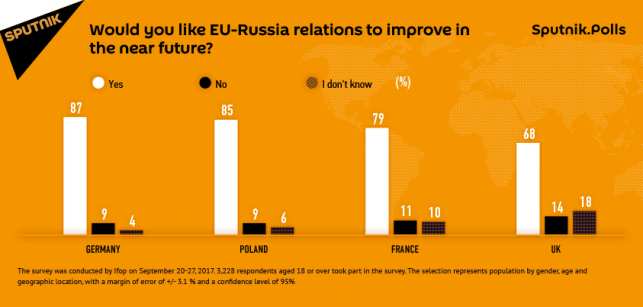
As the European Union continues to bear the economic brunt of its sanctions policy towards Russia, a recent poll by Sputnik has revealed that an absolute majority of Britons, Germans, French and Poles want better relations between Brussels and Moscow.
The French Institute of Public Opinion (Ifop) has conducted an opinion poll at Sputnik’s behest, in an attempt to gauge the attitude of Europeans towards the deteriorating relationship between the EU and Russia.
Relations between Brussels and Moscow took a turn for the worse in 2014 amid the crisis in Ukraine, resulting in a perpetuating cycle of sanctions and counter-sanctions which tax the economies of European states.
Ifop interviewed a total of 3,228 respondents of 18 years old or older in the UK, France, Germany and Poland, asking them a single question: “As a result of sanctions and counter-sanctions the political as well as economic relations between Russia and the EU continue to deteriorate. Would you like relations between the EU and Russia to improve in the near future?”
The vast majority of respondents favored improvement in relations between Brussels and Moscow, with 87 percent of Germans, 85 percent of Poles, 79 percent of French and 68 percent of Britons answering “Yes.” It is noteworthy that the economies of the four countries are among those hit hardest by sanctions and Russia’s responsive countermeasures in terms of economic losses.
Vast Majority of Germans, Poles, French, Britons Want to Improve Ties With Russia
In Germany, which has lost “tens, if not hundreds of billions euros” and nearly 60,000 jobs due to anti-Russian sanctions, according to a study, 90 percent of male respondents in Germany turned out to be more inclined towards better relations with Russia. In France and the UK, which have reportedly lost €2.1 billion ($2.5 billion) and €3.1 billion ($3.7 billion) in exports respectively, 82 percent and 71 percent of male respondents favored better relations between Brussels and Moscow, the poll has shown.
The relationship between Russia and the European Union soured after Crimean peninsula seceded from Ukraine and reunified with Russia following the March 2014 referendum. The Western countries, including the EU members, have not recognized the legitimacy of the vote, imposing several rounds of sanctions on Russia.
When a Department of Defense intelligence report about the Syrian rebel movement became public in May 2015, lots of people didn’t know what to make of it. After all, what the report said was unthinkable – not only that Al Qaeda had dominated the so-called democratic revolt against Syrian President Bashar al-Assad for years, but that the West continued to support the jihadis regardless, even to the point of backing their goal of creating a Sunni Salafist principality in the eastern deserts.
The United States lining up behind Sunni terrorism – how could this be? How could a nice liberal like Barack Obama team up with the same people who had brought down the World Trade Center?
It was impossible, which perhaps explains why the report remained a non-story long after it was released courtesy of a Judicial Watch freedom-of-information lawsuit. The New York Times didn’t mention it until six months later while the Washington Post waited more than a year before dismissing it as “loopy” and “relatively unimportant.” With ISIS rampaging across much of Syria and Iraq, no one wanted to admit that U.S. attitudes were ever anything other than hostile.
But three years earlier, when the Defense Intelligence Agency was compiling the report, attitudes were different. Jihadis were heroes rather than terrorists, and all the experts agreed that they were a low-risk, high-yield way of removing Assad from office.
After spending five days with a Syrian rebel unit, for instance, New York Times reporter C.J. Chivers wrote that the group “mixes paramilitary discipline, civilian policing, Islamic law, and the harsh demands of necessity with battlefield coldness and outright cunning.”
Paul Salem, director of the Carnegie Middle East Center in Beirut, assured the Washington Post that “al Qaeda is a fringe element” among the rebels, while, not to be outdone, the gossip site Buzzfeed published a pin-up of a “ridiculously photogenic” jihadi toting an RPG.
“Hey girl,” said the subhead. “Nothing sexier than fighting the oppression of tyranny.”
And then there was Foreign Policy, the magazine founded by neocon guru Samuel P. Huntington, which was most enthusiastic of all. Gary Gambill’s “Two Cheers for Syrian Islamists,” which ran on the FP web site just a couple of weeks after the DIA report was completed, didn’t distort the facts or make stuff up in any obvious way. Nonetheless, it is a classic of U.S. propaganda. Its subhead glibly observed: “So the rebels aren’t secular Jeffersonians. As far as America is concerned, it doesn’t much matter.”
Assessing the Damage
Five years later, it’s worth a second look to see how Washington uses self-serving logic to reduce an entire nation to rubble.
First a bit of background. After displacing France and Britain as the region’s prime imperial overlord during the 1956 Suez Crisis and then breaking with Egyptian President Gamal Abdel Nasser a few years later, the United States committed itself to the goal of defeating Arab nationalism and Soviet Communism, two sides of the same coin as far as Washington was concerned. Over the next half-century, this would mean steering Egypt to the right with assistance from the Saudis, isolating Libyan strong man Muammar Gaddafi, and doing what it could to undermine the Syrian Baathist regime as well.
William Roebuck, the American embassy’s chargé d’affaires in Damascus, thus urged Washington in 2006 to coordinate with Egypt and Saudi Arabia to encourage Sunni Syrian fears of Shi‘ite Iranian proselytizing even though such concerns are “often exaggerated.” It was akin to playing up fears of Jewish dominance in the 1930s in coordination with Nazi Germany.
A year later, former NATO commander Wesley Clark learned of a classified Defense Department memo stating that U.S. policy was now to “attack and destroy the governments in seven countries in five years,” first Iraq, then Syria, Lebanon, Libya, Somalia, Sudan, and Iran. (Quote starts at 2:07.)
Since the United States didn’t like what such governments were doing, the solution was to install more pliable ones in their place. Hence Washington’s joy when the Arab Spring struck Syria in March 2011 and it appeared that protesters would soon topple the Baathists on their own.
Even when lofty democratic rhetoric gave way to ominous sectarian chants of “Christians to Beirut, Alawites to the coffin,” U.S. enthusiasm remained strong. With Sunnis accounting for perhaps 60 percent of the population, strategists figured that there was no way Assad could hold out against religious outrage welling up from below.
Enter Gambill and the FP. The big news, his article began, is that secularists are no longer in command of the burgeoning Syrian rebel movement and that Sunni Islamists are taking the lead instead. As unfortunate as this might seem, he argued that such a development was both unavoidable and far from entirely negative.
“Islamist political ascendancy is inevitable in a majority Sunni Muslim country brutalized for more than four decades by a secular minoritarian dictatorship,” he wrote in reference to the Baathists. “Moreover, enormous financial resources are pouring in from the Arab-Islamic world to promote explicitly Islamist resistance to Assad’s Alawite-dominated, Iranian-backed regime.”
So the answer was not to oppose the Islamists, but to use them. Even though “the Islamist surge will not be a picnic for the Syrian people,” Gambill said, “it has two important silver linings for US interests.” One is that the jihadis “are simply more effective fighters than their secular counterparts” thanks to their skill with “suicide bombings and roadside bombs.”
The other is that a Sunni Islamist victory in Syria will result in “a full-blown strategic defeat” for Iran, thereby putting Washington at least part way toward fulfilling the seven-country demolition job discussed by Wesley Clark.
“So long as Syrian jihadis are committed to fighting Iran and its Arab proxies,” the article concluded, “we should quietly root for them – while keeping our distance from a conflict that is going to get very ugly before the smoke clears. There will be plenty of time to tame the beast after Iran’s regional hegemonic ambitions have gone down in flames.”
Deals with the Devil
The U.S. would settle with the jihadis only after the jihadis had settled with Assad. The good would ultimately outweigh the bad. This kind of self-centered moral calculus would not have mattered had Gambill only spoken for himself. But he didn’t. Rather, he was expressing the viewpoint of Official Washington in general, which is why the ultra-respectable FP ran his piece in the first place.
The Islamists were something America could employ to their advantage and then throw away like a squeezed lemon. A few Syrians would suffer, but America would win, and that’s all that counts.
The parallels with the DIA report are striking. “The west, gulf countries, and Turkey support the opposition,” the intelligence report declared, even though “the Salafist[s], the Muslim Brotherhood, and AQI [i.e. Al Qaeda in Iraq] are the major forces driving the insurgency.”
Where Gambill predicted that “Assad and his minions will likely retreat to northwestern Syria,” the DIA speculated that the jihadis might establish “a declared or undeclared Salafist principality” at the other end of the country near cities like Hasaka and Der Zor (also known as Deir ez-Zor).
Where the FP said that the ultimate aim was to roll back Iranian influence and undermine Shi‘ite rule, the DIA said that a Salafist principality “is exactly what the supporting powers to the opposition want in order to isolate the Syrian regime, which is considered the strategic depth of Shia expansion (Iraq and Iran).”
Bottle up the Shi‘ites in northwestern Syria, in other words, while encouraging Sunni extremists to establish a base in the east so as to put pressure on Shi‘ite-influenced Iraq and Shi‘ite-ruled Iran.
As Gambill put it: “Whatever misfortunes Sunni Islamists may visit upon the Syrian people, any government they form will be strategically preferable to the Assad regime, for three reasons: A new government in Damascus will find continuing the alliance with Tehran unthinkable, it won’t have to distract Syrians from its minority status with foreign policy adventurism like the ancien régime, and it will be flush with petrodollars from Arab Gulf states (relatively) friendly to Washington.”
With the Saudis footing the bill, the U.S. would exercise untrammeled sway.
Disastrous Thinking
Has a forecast ever gone more spectacularly wrong? Syria’s Baathist government is hardly blameless in this affair. But thanks largely to the U.S.-backed sectarian offensive, 400,000 Syrians or more have died since Gambill’s article appeared, with another 6.1 million displaced and an estimated 4.8 million fleeing abroad.
War-time destruction totals around $250 billion, according to U.N. estimates, a staggering sum for a country of 18.8 million people where per-capita income prior to the outbreak of violence was under $3,000. From Syria, the specter of sectarian violence has spread across Asia and Africa and into Europe and North America as well. Political leaders throughout the advanced industrial world are still struggling to contain the populist fury that the Middle East refugee crisis, the result of U.S.-instituted regime change, helped set off.
So instead of advancing U.S. policy goals, Gambill helped do the opposite. The Middle East is more explosive than ever while U.S. influence has fallen to sub-basement levels. Iranian influence now extends from the Arabian Sea to the Mediterranean, while the country that now seems to be wobbling out of control is Saudi Arabia where Crown Prince Muhammad bin Salman is lurching from one self-induced crisis to another. The country that Gambill counted on to shore up the status quo turns out to be undermining it.
It’s not easy to screw things up so badly, but somehow Washington’s bloated foreign-policy establishment has done it. Since helping to snatch defeat from the jaws of victory, Gambill has moved on to a post at the rightwing Middle East Forum where Daniel Pipes, the group’s founder and chief, now inveighs against the same Sunni ethnic cleansing that his employee defended or at least apologized for.
The forum is particularly well known for its Campus Watch program, which targets academic critics of Israel, Islamists, and – despite Gambill’s kind words about “suicide bombings and roadside bombs” – anyone it considers the least bit apologetic about Islamic terrorism.
Double your standard, double the fun. Terrorism, it seems, is only terrorism when others do it to the U.S., not when the U.S. does it to others.
A few days ago I posted an article entitled Zionists Form Group to Promote Kurdish Statehood, about the latest efforts underway to carve up the Middle East. In the course of researching that article I made a rather interesting discovery: that Israel has a law prohibiting holders of dual citizenship from serving in the Knesset, the Israeli parliament.
Needless to say, we need such a law here in the US, but of course anyone who suggests this gets accused of anti-Semitism.
A couple of years ago when talk show host Diane Rhem interjected a discussion about dual Israeli citizenship into an interview with Senator Bernie Sanders, Rhem was subjected to withering criticism. The ADL, among others, jumped into the fray, accusing Rhem of playing into “classic anti-Semitic charges of dual loyalty,” and the talk show host was forced to issue an apology.
And this kind of thing doesn’t just happen in America. When an official in South Africa proposed a law that would revoke South African citizenship under certain circumstances, one of them being if dual citizens were to serve in the armed forces of the other country, the reaction from South African Jews was about what you’d expect:
South African Jewish community leaders have expressed outrage at an African National Congress (ANC) official’s recent announcement of possible plans to ban dual citizenship.
While Obed Bapela, head of the ANC’s national executive committee’s subcommittee on international relations, has countered that the idea includes anybody with dual citizenship without discrimination, the South African Jewish Board of Deputies and South African Zionist Federation have issued a joint communication condemning the move as discriminatory towards Jews.
But dual citizens are banned from serving in the Israeli Knesset and no one seems to get too upset over it.
In my article of a few days ago, I mentioned a Knesset member by the name of Ksenia Svetlova, who is passionately advocating the formation of a Kurdish state. According to a Times of Israelarticle, Svetlova held dual Israeli-Russian citizenship until 2015, when she was elected to the Knesset, at which time she was forced to formally renounce her Russian citizenship.
“While Israelis may hold dual citizenship, a Basic Law passed in 1958 states that Knesset members cannot pledge allegiance as parliamentarians unless their foreign citizenship has been revoked under the laws of that country,” the article states.
Another Israeli politician, who was elected at the same time as Svetlova is Rachel Azaria, who was also forced to renounce her foreign citizenship–in the US! Again from the Times of Israel:
Azaria, a 38-year-old Jerusalem deputy mayor, renounced her American citizenship, which she had held by virtue of her mother having been born in the US.
It is astounding, is it not? Israel gets billions of dollars per year courtesy of US taxpayers–but anyone holding US citizenship is barred from serving in the Knesset! But we are not allowed to have a similar law here in the US banning Israeli citizens from serving in Congress!
And not only do we not have a similar in the US, but apparently Freedom of Information Act requests aimed at finding out which Congress members do in fact hold dual citizenship–are denied. The following is a 2015 article that was published at Counterpunch.
***
Dual Citizens in Congress?
By L. Michael Hager
Is dual citizenship in the U.S. Congress and administration creating potentially serious conflicts of interest?
MyCounterpunchpiece of November 12, 2014 described a failed effort to identify members of Congress who hold dual citizenship and to ascertain the second nationality of those members. I mentioned the then outstanding Freedom of Information Act request that I filed with the Congressional Research Service (CRS) last October.
This week I received the information I sought, in the form of a telephone call from a legal officer of the Library of Congress. After reminding me that Congress (and the CRS by its connection with Congress) is exempt from FOIA requests, he verbally confirmed my suspicion that CRS does not currently collect dual citizenship data.
That’s bad news for those of us who believe that citizens should know if their representatives in Congress (and senior government officials and judges, for that matter) owe allegiance to any other nation. For example, when a Senator, a House Member or a high USG official speaks out, submits bills or determines policy on an issue of importance to a second country, shouldn’t constituents (and citizens at large) be able to judge whether there is or is not a conflict (or apparent) conflict of interest?
Without transparency on dual citizenship, Americans remain in the dark, free to speculate on which representatives may have divided loyalties. Current entries on the Internet reveal a wide range of such speculation. The lack of transparency is dangerous, for it erodes trust in government, creating credibility doubts where there should be none and allowing some conflicts to continue undetected, without question or debate.
Thus the first requirement is transparency. We need a government agency (presumably the CRS) or a non-governmental organization to disclose the names and non-U.S. national affiliations of Members of Congress and senior government officials and to track and report on this issue.
Secondly, we need more media attention to the subject of dual citizenship. Senator Ted Cruz and Representative Michelle Bachman both received wide press coverage, when they renounced their Canadian and Swiss nationalities, respectively.
Stanley Fischer, who currently serves as vice chairman of the U.S. Federal Reserve, became an Israeli citizen in 2005 while retaining his American citizenship. Prior to his appointment to the Fed in 2014, he served for eight years as governor of the Bank of Israel. Although the New York Timesarticle of March 13, 2014 reporting on his then upcoming confirmation hearings, disclosed his dual nationality, it failed to ask the obvious question of why one appointed to such a senior policy position should not be required to renounce his Israeli citizenship. Why has the mainstream media largely ignored the potential conflict of interest inherent in dual citizen Members of Congress and Executive Branch officers?
What about those members and government officials who fail even to disclose their second or more nationalities? As mentioned in my previous article on this subject, U.S. officials and government officers with Jewish identity may acquire Israeli citizenship without much or any formality under the Israeli Law of Return. Thus it is possible, if not probable, that some of such officials hold Israeli citizenship.
Beyond the threshold issue of transparency are equally important questions of whether a dual citizen elected to Congress or appointed to a senior USG position should be required to renounce his or her citizenship in the second nation. Even if American law continues to allow the government service of dual citizens, should it not require such persons at least to recuse themselves from participating in decisions or policy debates that relate to their second nationality?
To address these question we need accurate information on who are the dual citizens in our government. To obtain such data will require a vigorous campaign by interested citizens and NGOs, first to have elected Members disclose any non-U.S. citizenship they hold and second to have the CRS begin to track and report on the presence of dual citizens in Congress and in the higher levels of Government.
Conflicts of interest and apparent conflicts by public officials erode trust in government. Allowing dual citizenship in Congress (and in the Executive and Judicial Branches) to flourish under cover of non-disclosure puts our democracy at risk.
It’s time to bring this issue into open debate.
L. Michael Hager is co-founder and former director general of the International Development Law Organization, Rome
Even interventionists are regretting some of the wars into which they helped plunge the United States in this century.
Among those wars are Afghanistan and Iraq, the longest in our history; Libya, which was left without a stable government; Syria’s civil war, a six-year human rights disaster we helped kick off by arming rebels to overthrow Bashar Assad; and Yemen, where a U.S.-backed Saudi bombing campaign and starvation blockade is causing a humanitarian catastrophe.
Yet, twice this century, the War Party was beaten back when seeking a clash with Putin’s Russia. And the “neo-isolationists” who won those arguments served America well.
What triggered this observation was an item on Page 1 of Wednesday’s New York Times that read in its entirety:
“Mikheil Saakashvili, former president of Georgia, led marchers through Kiev after threatening to jump from a five-story building to evade arrest. Page A4″
Who is Saakashvili? The wunderkind elected in 2004 in Tbilisi after a “Rose Revolution” we backed during George W. Bush’s crusade for global democracy.
During the Beijing Olympics in August 2008, Saakashvili sent his army crashing into the tiny enclave of South Ossetia, which had broken free of Georgia when Georgia broke free of Russia.
In overrunning the enclave, however, Saakashvili’s troops killed Russian peacekeepers. Big mistake. Within 24 hours, Putin’s tanks and troops were pouring through Roki Tunnel, running Saakashvili’s army out of South Ossetia, and occupying parts of Georgia itself.
As defeat loomed for the neocon hero, U.S. foreign policy elites were alive with denunciations of “Russian aggression” and calls to send in the 82nd Airborne, bring Georgia into NATO, and station U.S. forces in the Caucasus.
“We are all Georgians!” thundered John McCain.
Not quite. When an outcry arose against getting into a collision with Russia, Bush, reading the nation right, decided to confine U.S. protests to the nonviolent. A wise call.
And Saakashvili? He held power until 2013, and then saw his party defeated, was charged with corruption, and fled to Ukraine. There, President Boris Poroshenko, beneficiary of the Kiev coup the U.S. had backed in 2014, put him in charge of Odessa, one of the most corrupt provinces in a country rife with corruption.
In 2016, an exasperated Saakashvili quit, charged his patron Poroshenko with corruption, and fled Ukraine. In September, with a band of supporters, he made a forced entry back across the border.
Here is the Times’ Andrew Higgins on his latest antics:
“On Tuesday … Saakashvili, onetime darling of the West, took his high-wire political career to bizarre new heights when he climbed onto the roof of his five-story apartment building in the center of Kiev…
“As … hundreds of supporters gathered below, he shouted insults at Ukraine’s leaders … and threatened to jump if security agents tried to grab him.
“Dragged from the roof after denouncing Mr. Poroshenko as a traitor and a thief, the former Georgian leader was detained but then freed by his supporters, who … blocked a security service van before it could take Mr. Saakashvili to a Kiev detention center and allowed him to escape.
“With a Ukrainian flag draped across his shoulders and a pair of handcuffs still attached to one of his wrists, Mr. Saakashvili then led hundreds of supporters in a march across Kiev toward Parliament. Speaking through a bullhorn he called for ‘peaceful protests’ to remove Mr. Poroshenko from office, just as protests had toppled the former President, Victor F. Yanukovych, in February 2014.”
This reads like a script for a Peter Sellers movie in the ’60s.
Yet this clown was president of Georgia, for whose cause in South Ossetia some in our foreign policy elite thought we should go to the brink of war with Russia.
And there was broad support for bringing Georgia into NATO. This would have given Saakashvili an ability to ignite a confrontation with Russia, which could have forced U.S. intervention.
Consider Ukraine. Three years ago, McCain was declaring, in support of the overthrow of the elected pro-Russian government in Kiev, “We are all Ukrainians now.”
Following that coup, U.S. elites were urging us to confront Putin in Crimea, bring Ukraine, as well as Georgia, into NATO, and send Kiev the lethal weapons needed to defeat Russian-backed rebels in the East.
This could have led straight to a Ukraine-Russia war, precipitated by our sending of U.S. arms.
Do we really want to cede to folks of the temperament of Mikhail Saakashvili an ability to instigate a war with a nuclear-armed Russia, which every Cold War president was resolved to avoid, even if it meant accepting Moscow’s hegemony in Eastern Europe all the way to the Elbe?
Watching Saakashvili losing it in the streets of Kiev like some blitzed college student should cause us to reassess the stability of all these allies to whom we have ceded a capacity to drag us into war.
Alliances, after all, are the transmission belts of war.
Recent disclosures by the Zionist regime show that some 2,069 British nationals were serving in the IDF as of March 2025, according to Freedom of Information (FoI) requests submitted to the occupation forces (1,686 dual British-Israeli, plus 383 multinational). We cannot tell from the figures how many of these were already settler colonists and intend to stay in the colony, and how many will return or have returned to the UK. Presumably, those returning to the UK will number far fewer than 2,000, since many are known to have become permanently residents of the colony.
Additionally, the IDF figures only provide a snapshot, and do not tell us how many have served in the Jewish supremacist military either before or after March 2025. One way into the question of how many genocidaires are living in Britain is to ask how many current British residents were born in the Zionist colony. There is data on that, as we shall see. … continue
This site is provided as a research and reference tool. Although we make every reasonable effort to ensure that the information and data provided at this site are useful, accurate, and current, we cannot guarantee that the information and data provided here will be error-free. By using this site, you assume all responsibility for and risk arising from your use of and reliance upon the contents of this site.
This site and the information available through it do not, and are not intended to constitute legal advice. Should you require legal advice, you should consult your own attorney.
Nothing within this site or linked to by this site constitutes investment advice or medical advice.
Materials accessible from or added to this site by third parties, such as comments posted, are strictly the responsibility of the third party who added such materials or made them accessible and we neither endorse nor undertake to control, monitor, edit or assume responsibility for any such third-party material.
The posting of stories, commentaries, reports, documents and links (embedded or otherwise) on this site does not in any way, shape or form, implied or otherwise, necessarily express or suggest endorsement or support of any of such posted material or parts therein.
The word “alleged” is deemed to occur before the word “fraud.” Since the rule of law still applies. To peasants, at least.
Fair Use
This site contains copyrighted material the use of which has not always been specifically authorized by the copyright owner. We are making such material available in our efforts to advance understanding of environmental, political, human rights, economic, democracy, scientific, and social justice issues, etc. We believe this constitutes a ‘fair use’ of any such copyrighted material as provided for in section 107 of the US Copyright Law. In accordance with Title 17 U.S.C. Section 107, the material on this site is distributed without profit to those who have expressed a prior interest in receiving the included information for research and educational purposes. For more info go to: http://www.law.cornell.edu/uscode/17/107.shtml. If you wish to use copyrighted material from this site for purposes of your own that go beyond ‘fair use’, you must obtain permission from the copyright owner.
DMCA Contact
This is information for anyone that wishes to challenge our “fair use” of copyrighted material.
If you are a legal copyright holder or a designated agent for such and you believe that content residing on or accessible through our website infringes a copyright and falls outside the boundaries of “Fair Use”, please send a notice of infringement by contacting atheonews@gmail.com.
We will respond and take necessary action immediately.
If notice is given of an alleged copyright violation we will act expeditiously to remove or disable access to the material(s) in question.
All 3rd party material posted on this website is copyright the respective owners / authors. Aletho News makes no claim of copyright on such material.

 Lebanon’s foreign minister has told an emergency Arab League meeting that imposing economic sanctions should be considered against the US over its embassy relocation move.



 Aletho News

