Israel To Commit War Crime Against West Bank Villagers
“No sanctimonious language… can erase the disgrace or hide the facts: the destruction of Khan al-Ahmar means the forcible transfer of protected persons,
and forcible transfer is a war crime.”
[If Americans Knew notes: Twelve Palestinian communities in an area near Jerusalem are at risk of expulsion. These villages have been living for years without basic health, education, and welfare services, and without proper electricity or sewage systems. They are under constant surveillance for “illegal” construction—structures built without a permit from the Israeli government (permits are impossible to obtain in this region). These structures, many built of necessity to house growing families, are then quickly demolished by Israel’s Civil Administration.
Israel makes life almost unbearable for these Palestinians. Demolishing homes is just the beginning: grazing and farming land is confiscated, making it harder and harder for the residents to feed themselves and make a living; roads are nearly impassable; settlers and Israeli authorities harass them daily.
This is taking place not in Israel, but in the West Bank, on Palestinian land under full control of Israel.
One community that is at risk of imminent expulsion is Khan al-Ahmar. The Bedouin tribe has already been expelled twice since the 1950s.]
IMEMC News | September 26, 2017
Israeli rights group B’Tselem said, on Monday afternoon, that Israeli government is to commit war crimes against Palestinian villagers in Khan al-Ahmar.
B’Tselem Executive Director Hagai el-Ad said, according to Days of Palestine: “Following the state’s response submitted earlier today to the [Israeli] High Court of Justice, that the state was asking the court to authorize a war crime.”
He explained: “No sanctimonious language about a ‘planning, proprietary and realistic’ alternate, or ‘time to prepare’ can erase the disgrace or hide the facts: the destruction of Khan al-Ahmar means the forcible transfer of protected persons, and forcible transfer is a war crime.”
El-Ad added: “Those responsible for it will bear personal criminal liability – exactly as B’Tselem stated two weeks ago, in a letter addressed to the prime minister, defence minister, justice minister, chief of staff and the head of the Civil Administration.”
According to updated data, Khan al-Ahmar community, which lives on land Israel has earmarked for settlement expansion in the area, is home to 32 families numbering 173 persons, including 92 minors.
It has a mosque and a school, which was established in 2009 and serves more than 150 children between the ages of six and fifteen – some of them from neighbouring communities.
Khan al-Ahmar is located around the illegal Israeli settlement of Ma’aleh Adumim, in the occupied Palestinian West Bank.
The Israeli occupation considers it strategic for building and expanding illegal settlements and establishing a territorial link between Ma’aleh Adumim and Jerusalem.
More background on Khan al-Ahmar and the other communities can be found here.
September 27, 2017 Posted by aletho | Ethnic Cleansing, Racism, Zionism, Timeless or most popular, War Crimes | Israel, Israeli settlement, Jerusalem, Palestine, Zionism | Leave a comment
‘Killer Robots’ Could Lower Barrier for Politicians to Start Wars
By Tommy Yang | Sputnik | September 27, 2017
As robots and artificial intelligence (AI) have grown rapidly in recent years, visionaries in global AI research and development have expressed concerns over how the same technology could be used in lethal autonomous weapons, often referred to as “killer robots,” because these unmanned weapons could lower the barrier for politicians to start wars.
In late August, a group of leading global AI researchers, including 116 founders of robotics and artificial intelligence companies from 26 countries, issued an open letter urging the United Nations to urgently address the challenge of lethal autonomous weapons and ban their use internationally.
The letter was released by its key organizer, Toby Walsh, Scientia Professor of Artificial Intelligence at the University of New South Wales in Sydney, at the opening of the International Joint Conference on Artificial Intelligence 2017 in Melbourne, the world’s prominent gathering of top experts in AI and robotics.
THERE SHOULD BE DIFFICULT BARRIERS TO WAR
While many politicians defended the use of lethal autonomous weapons as they could help save human lives in a military conflict, the Australian expert told Sputnik that the lowered cost of starting a war could be a bad thing, because wars are supposed to be costly.
“If we feel we can do this [getting involved in a military conflict] without risking human lives, maybe this lowers the barrier to war. And that’s a very bad thing. There should be very difficult barriers to war. War should be a massive loss. We should be discouraging it. It should be that politicians have to explain why our sons and daughters are coming home in body bags,” Walsh told Sputnik.
The expert argued that previous wars were started based on the same misconception.”It’s a rather short-sighted argument. It ignored the fact that all the civilians and other people got caught up in the crossfire. Maybe you have taken your people out of the battlefield; you’re not taking the civilians out of the battlefield. We probably have been drawn into these conflicts in Iraq or Afghanistan, because we thought we could fight without putting military boots on the ground. It’s a misconception that we could actually fight without risking soldiers’ lives,” he said.
The Australian scholar elaborated that if future wars will be with robots fighting robots, humans won’t need to fight wars anymore because the result can be decided by a game of chess.
‘DUMB ROBOTS’ CAUSE MORE WORRIES
Compared to super smart robots and AI technology we see in Hollywood movies, the Sydney-based AI expert expressed concerns that it’s the “dumb robots” that makes him worry the most.
“Those sort of things you see in Hollywood movies, like Iron Man or The Terminator, they’re still a long way away. Actually, I am more worried about stupid AI, than I am about smart AI. We’ll be giving responsibilities to machines that aren’t very capable at the moment and certainly can’t follow international humanitarian laws. They won’t be able to make the right distinction and there will be a lot of collateral damage. It’s the incompetence that I’m worried about [more] than anything else,” Walsh said.Walsh noted that the UK’s Ministry of Defense said it may actually remove humans from the loop of Predator-like drones, which is technically possible today.
“It wouldn’t be very capable, but it will still be able to commit a lot of harm. We have already seen the fact that the Predator drones are actually killing a lot of the wrong people, even with humans in the loop. It’s not difficult to do that with fully autonomous drones,” the expert said.
In 2016, former US president Barack Obama admitted that drone and other airstrikes had killed between 64 and 116 civilians during his administration, a figure that is widely criticized as under-representing the loss of innocent civilian lives during those strikes.
NO HUMAN-ENSLAVING EVIL AI
Despite popular plots in Hollywood Sci-Fi movies where super smart AIs often try to conquer the human race, just like what Skynet tried to do in The Terminator, world-leading AI researchers dismissed such plots because they lack a basic understanding of AI technologies.
“It [current AI technology] is really different from what you see in Arnold Schwarzenegger’s movies, where you have the evil AI fighting the good bodybuilder. In the movies, you have a goal conflict between the super smart AIs and the humans. It doesn’t really make sense for an AI to enslave humans. A super smart AI has very little interest in humans as slaves, because we’re miserable slaves for someone who can build a smart robot much more quickly and make it do whatever it wants to do,” Jurgen Schmidhuber, a signatory to the open letter and a leading deep learning expert who co-founded AI research firm Nnaisense in Switzerland, told Sputnik.
There have been several initiatives seeking to regulate the development of AI technologies. In December 2016, Dmitry Grishin, former chairman of Mail.ru group, proposed a draft law on robots, based on the Three Laws of Robotics conceived by Russian-born US Sci-Fi novelist Isaac Asimov in a short story named “Runaround” in 1942.
According to Asimov’s Laws, a robot may not injure a human being or, through inaction, allow a human being to come to harm; a robot must obey the orders given it by human beings except where such orders would conflict with the First Law; a robot must protect its own existence as long as such protection does not conflict with the First or Second Laws.
Russia’s State Duma, the lower house of parliament, plans to introduce a new legislation regulating relations between humans and AI in the near future, Vyacheslav Volodin, the speaker of the State Duma, said Monday.
“Relations between humans and AIs, the relations between humans and robots are the issues that we should define legally in the near future. This issue is on our agenda,” Volodin said.
But the Swiss AI expert argued that the regulation in the field would be difficult to put in place.
“It’s rather difficult to regulate the use of a particular algorithm, such as the Long Short-Term Memory (LSTM), it’s about as difficult as regulating the use of fire. To a certain extent, you can regulate fire, but anybody can buy a set of matches, burn them at home or even burn his own house or his neighbor’s garden. Although everybody can do that, fire, as a powerful thing that has been known for 600,000-700,000 years, is something very useful, because it keeps us warm at night and we can cook with it. These two sides of fire are widely known. Society has adapted to its use. The advantages of fire are overwhelming that its disadvantages are accepted. I guess we will also have continually evolving sets of regulations for AI in a similar way,” Schmidhuber said.
The Swiss entrepreneur’s LSTM AI algorithm is now being used in 3 billion smartphones globally. He believes that AI in the future will not have a goal conflict with humans because they will realize that all the sources are out there in space, as less than one-billionth of all sunlight hits the earth. The AI will be ready to emigrate to outer space, which is impossible for humans, as AI can travel by radio just like how the algorithm is transmitted in his own labs, the Swiss expert explained.
September 27, 2017 Posted by aletho | Militarism, Timeless or most popular | Human rights | Leave a comment
Philip Giraldi’s Remedy for Wars

May 5, 2016: Ultra-Zionist Billionaire Megadonor Sheldon Adelson attends 4th annual champions of Jewish values international awards gala at Marriott Marquis Times Square
By Israel Shamir | The Unz Review | September 27, 2017
Once in a while, an observer notices a concerted Jewish action, and reports on it pro bono publico. It could be that Jews support Third-world immigration, or Jews fight the memorials, or, in the recent case, Jews promote the war on Iran. The Jews respond with a huge vehement counterattack and make life very difficult for the outspoken observer. Afterwards, the subject recedes, as people get cold feet to proceed, or do not know how to proceed, though the problem remains at large.
The recent example is a piece by Philip Giraldi on the Unz.com, which still produces waves on the web. In his piece he rolled the list of Jews who were keen on Iraq invasion, and who are pushing the US now into an attack on Iran: “David Frum, Max Boot, Bill Kristol and Bret Stephens, Mark Dubowitz, Michael Ledeen… And yep, they’re all Jewish, plus most of them would self-describe as neo-conservatives.”
Giraldi proposed to keep Jews out of the positions of influence on the foreign affairs, in order to keep the US out of wars it does not need. Giraldi wrote: “We don’t need a war with Iran because Israel wants one and some rich and powerful American Jews are happy to deliver.”
Actually, the Israeli newspaper Haaretz wrote at the time (in April 2003): “The war in Iraq was conceived by 25 neoconservative intellectuals, most of them Jewish, who are pushing President Bush to change the course of history. Two of them, journalists William Kristol and Charles Krauthammer, say it’s possible.”
I also wrote things in the same vein during Iraq invasion, and it is good to see that this thesis did not die but keeps resurging from time to time. One could add that these very persons are pushing for conflict with Russia, demonise Putin and attack Trump, though the Orange Man tries to fulfil their wishes as an eager Santa Claus of diligent Lizzie.
While agreeing with Giraldi on the malady, let us discuss the remedy. Would keeping Jews out of foreign policy making actually help? Did the US keep out of wars before the Rise of Jews in late 1960s? The Jews weren’t specially prominent before that time, and certainly weren’t overrepresented in the establishment. A Jewish couple, Ethel and Julius Rosenberg has been fried on the electric chair in 1953, and there were few objections. McCarthy terrorized Jews. The word Holocaust had yet to make its first appearance (in 1968). Jews were still kept out of clubs and out of high level politics. Israel had been threatened by the US (in 1956) rather than assisted.
And still, the free-from-Jews US had fought in Korea the terrible three-year long war (1950-1953), and in Vietnam (up to 1974), invaded and caused regime change in Guatemala and Iran, violently interfered in elections in France and Italy, and had fought the fierce Cold War against the USSR. In all these campaigns, the US Jews were actually for peace and against war. The Jews were nowhere in power when the US fought its wars against Spain and Mexico. The non-Jewish US made a coup in Iran, and non-Jewish and not-pro-Israel President Carter tried to invade Iran. Jews weren’t involved in the conquest of Panama, in Nicaragua intervention, in Granada operation.
Perhaps the Jews had moved the arena of wars to the Middle East and out of Latin America. Less Jewish-influenced America would rather invade Venezuela than Iraq or Iran. But is it so wonderful?
The idea of correcting or channelling the excessive Jewish influence is a reasonable one, but can this goal be achieved by keeping Kristol and Krauthammer out of media (an excellent thought anyway)?
The Jewish prominence in the US is inbuilt in the US culture and tradition. Karl Marx wrote that “in North America, the practical domination of Judaism over the Christian world has achieved as its unambiguous and normal expression”. He said that all Yankees are Jews, behave like Jews, aspire to be Jews and even are circumcised like Jews. So it is natural that real Jews succeed better in being Jews than their Gentile neighbours. Werner Sombart added that Jews were prominent from the very dawn of America and they created American-style capitalism the way that fits them. The Jews are prominent now because America is custom-built for Jews to fit and suit them, he said.
This is what should be corrected, and then the Jewish scribes, these Krauthammers will be out of business of inciting wars. Stop subscribing to Jewish success model, and the Jews won’t be able to influence the Senate. Make the US Christian as Christ taught, share labour and wealth, aspire to God instead of Mammon, make the first last and the last first, love thy neighbour and the problem will be solved.
If this is too tall an order, make it a smaller one. Unseating Ledeens and Frums (and I think they deserve tar and feathers all right) will not do the trick unless the rich Jews are un-wealthed. Without excessive Jewish wealth, there will be no excessive Jewish push for wars. And provided that more than half of all US wealth is in few Jewish hands, freeing it will make a colossal effect of improving life of every American, even every person on earth.
And why to stop there? The super-rich non-Jews are as Jewish as any Jew. They share the same aspirations. Strip them of their assets. Why should we worry whether Jeff Bezos is a Jew by blood or faith, or he is not? He behaves like a Jew, and that is enough. Establish a ceiling of wealth, a counterpart of minimal wage. This idea has been mulled: Jeremy Corbyn called for the maximum wage. Taxes can do it easily – in wonderful Sweden of 1950s, top tax rate was 102%. Or this can be achieved in a more festive way of stripping the richest men of their ill-gotten wealth on the main square of Washington, DC on Mardi Gras Sunday. Do not say this is a punishment for their diligence – other way around, this is assistance on their way to spiritual improvement. Too many assets imprison the spirit.
This would be good for Jews and for all concerned: while the average Jewish wealth in the US had been lagging below total average (that is as long as Jews were less wealthy than Gentiles), the Jews acted in the interests of the people. Around 1968-1970 the Jews became more wealthy than all Americans, and that was it: they ceased to strive for the common good.
Jews could be a force for good if their excessive tendency to collect material goods is nipped in the bud. So it was in the USSR: as the Jews could not make money, they went into science and worked for the common good. Even oligarchs could be good managers instead of pain in the neck for the society.
This is not more complicated than booting Max Boot out of writing business. So why to go for a palliative if you can go for the jugular?
Israel Shamir can be reached at adam@israelshamir.net
September 27, 2017 Posted by aletho | Economics, Militarism, Timeless or most popular | United States, Zionism | Leave a comment
Destruction of Last Chemical Munition in Russia is ‘Historic Event’ – Putin

Sputnik – September 27, 2017
Russian President Vladimir Putin has called the destruction of the last chemical munitions in the country a “historic event.”
The last kilogram of Russia’s 40,000-tonne stockpile of chemical warfare agents, which was contained in two artillery shells, was destroyed on Wednesday at the Kizner facility in Udmurtia.
Attending the event via video link, Putin said that it is “a huge step towards” a more balanced and secure world, stressing that Russia had held the largest chemical stockpiles in the world. Putin also said Russia was working closely with partners to save mankind from the threat of the use and spread of chemical weapons.
“In this regard, I would like to recall the key role of our country in solving the problem of chemical weapons in Syria,” he said.
The president pointed out that Moscow is fulfilling all of its obligations under the non-proliferation treaties and expects that other countries, including the United States, will follow in Russia’s footsteps.
“As is known, Russia was the largest holder and possessor of chemical weapons, and so far the United States, which unfortunately does not fulfill its obligations on the timing of the destruction of chemical weapons, has already three times postponed the destruction on the pretext of lack of funds, which sounds very strange,” he pointed out.
The elimination of chemical materials was conducted under the Chemical Weapons Convention (CWC), an arms control treaty that prohibits the production, stockpiling, and use of chemical weapons. The treaty, which came into force in 1997, has been signed by 192 states as of April 2016.
Russia joined the CWC in 1997 and was initially expected to destroy its chemical weapons stockpiles by December 31, 2018.
September 27, 2017 Posted by aletho | Environmentalism, Timeless or most popular | Chemical Weapons Convention, Russia, United States | Leave a comment
Referendum Blues: The Issue of an Independent Kurdistan
By Dr Can Erimtan | 21st Century Wire | September 26, 2017
Recep Tayyip Erdoğan (aka the Prez) and his Justice and Development Party (or AKP) have been steering the state founded by Mustafa Kemal [Atatürk] (1881-1938) into distinctly Islamic waters for quite some time now… and as Turkey houses the largest percentage of Kurds in the region (14.7 million according to the CIA), solving Turkey’s Kurdish issue had been part and parcel of the AKP’s policy of Sunnification.
The Prez and his AKP henchmen had namely devised a plan to transform the country into a nation of believers, firmly dedicated to Sunni Islam and moving away from Turkish nationalism.
A Nation of Muslim Immigrants versus an independent Kurdistan
But the Iraqi Kurdish leader Masoud Barzani now seems to have thrown a spanner in the works, as he told the international press in 2014 that “We [referring to the Kurdish population of Iraq living in the north of the country] will hold a referendum in [the KRG or Kurdish Regional Government] and we will respect and be bound by the decision of our people and hope that others will do likewise.” In this way, one of Turkey’s deepest fears is finally about to become a reality now – the formation of an independent nation state called Kurdistan in the wake of a popular referendum to be held on Monday, 25 September 2017. Somewhat fortunate for Ankara, though, not quite on Turkish soil, but nevertheless directly adjacent to Turkey’s south-eastern region, which many Kurds as well as their sympathisers refer to as Northern Kurdistan these days. And thus, AKP-led Ankara is now up in arms as the rather natural expectation is that a so-called domino effect will take place and that Turkey’s Kurds might very well want to join their southern brethren in an independent nation state possessing underground hydrocarbon reserves or a coveted natural source of income, if you will.
The Turkish nation state established by, Mustafa Kemal, and his followers developed its own brand of nationalism, its own brand of Turkish nationalism which was meant to transform the ethnically diverse inhabitants of Anatolia and Eastern Thrace into a homogeneous body of Turks (or Turkish citizens). Throughout most of its existence, the ideological construct of Turkish nationalism adhered to the politcal precepts of the state carrying the name Kemalism, in reference to the nation state’s founding father and, as I explained nearly four years ago: “the idea of the Anatolian population as a Turkish entity was first proposed as early as 1922, the year prior to the official proclamation of the republic. And in 1924, the first Turkish constitution proclaimed that the ‘name Turk, as a political term, shall be understood to include all citizens of the Turkish Republic, without distinction of, or reference to, race or religion.’ A policy of ‘Turkification’ carried out in the first decades of the republican existence has meant that these various ethnic subgroups have in time merged with the Turkish mainstream.” This Kemalist exercise in social engineering worked well for the majority of ‘Turks,’ whose ethnic identities became submerged in a superstructure of Turkishness that came to replace the previously employed social construct of Ottomanism, that had been in place in the period 1876-1918. The only notable exception to this narrative were the Kurds, whose tribal organisation at the fringes of both the Ottoman and Turkish state structures basically meant that they were able to continue their lives beyond the strictures of the state and its bureaucratic framework and control.
Prior to the foundation of the Republic in 1923, “Anatolia was . . . home to ethnically heterogeneous Muslim groups: in addition to a large majority of Turkish Muslims, there were Kurds, Arabs, Lazes, Muslim Georgians, Greek-speaking Muslims, Albanians, Macedonian Muslims, Pomaks, Serbian Muslims, Bosnian Muslims, Tatars, Circassians, Abkhazians and Dagestanis among others. Prior to the formulation of Turkish nationalism as an ideological binding-force, the diverse ethnic groups in Anatolia were united by their common identity as Muslims and their allegiance to the Ottoman Caliphate, abolished in 1924 . . . Anatolia has always been home to a wide variety of ethnic and religious groups and sub-groups, and today, the makeup Turkey’s population is the result of Ottoman government policies carried out in the late 19th and early 20th centuries. These policies were aimed at transforming Anatolia (the heartland of the Ottoman Empire and the Turkish Republic’s geo-body, using Thongchai Winichakul’s coinage denoting the territory of a nation as expressed on a map and inscribed on the people’s consciousness) into a Muslim homeland where refugees from the Russian Empire and the Balkans were settled.” And in the 21st century, the Prez and his AKP henchmen are bent to return Turkey’s state-of-affairs to this pre-nationalist reality, dismantling “the nation state Turkey into an Anatolian federation of Muslim ethnicities,” beholden to the Prophet’s example, the strictures of the Shariah and possibly even to a revived Caliphate. As a result, the expectation was that the Prez and his henchmen would be able “to unite and pacify the country as a nation of believers, firmly dedicated to Sunni Islam able to supersede mere ethnic or national ties and solidarity.” And in this way, the issues of Turkish and Kurdish nationalism that had in the Kemalist past (1923-2002) caused major unrest in the country would have been replaced by the common cause of Islam and Muslim solidarity. But events in the real world were such that developments in neighbouring Syria and Iraq have led to a strengthened sense of Kurdish nationalism, not just in Turkey. First in northern Iraq where the KRG emerged on the scene in the aftermath of the first and second Gulf Wars led by Bush, Senior and Junior respectively. As well as in Syria where the “three autonomous cantons of Kobani, Afrin, and Cizre, making up the district of Rojava, are under the control of the PYD (or the Kurdish Democratic Union Party) that is arguably attempting to put into practice precepts and ideas of ‘libertarian municipalism’ developed by the libertarian socialist thinker Murray Bookchin (1921-2006).” This last aspect is particularly troubling for Turkey, as its homegrown Kurdish terror group PKK (or the Kurdistan Workers’ Party) equally espouses these ideals which were popularised by its imprisoned leader Abdullah Öçalan, thereby attesting to the organic ties between the PKK and the PYD, and its military wings the YPG (People’s Protection Units) and YPJ (Women’s Protection Units).
And finally, there is also a notable Kurdish presence in Iran, supporting its own separatist terror group, known as PJAK and which Turkey also sees as being organically linked to the PKK.

The Spectre of a Greater Kurdistan: 25 September 2017
The fact that the Kurds, arguably much like the Palestinians or even the Rohingya, are a social group consisting of Muslims that lack a proper homeland or nation state means that they can easily garner major support around the world, particularly in the West where the cult of the underdog has transformed the Kurds into a perennial favourite amongst human rights’ supporters all around. And as such, the Kurds and the goal of an independent Kurdistan have now also found major backers in the somewhat unlikely duo of Israel and Saudi Arabia, as I explained in the summer of 2015.
The spectre of “an independent Kurdistan in Northern Iraq could very well be the opening move for redrawing the mapped heritage of Sykes-Picot by means of consolidating Kurdish unity – stretching from Syria in the West (Rojava), over Turkey in the North (South-Eastern Anatolia) and Iraq in the South (KRG) to Iran in the East (Rojhilate Kurdistane).” As such, on the sidelines of the U.N. General Assembly meetings in New York City (19 – 25 September 2017), Iranian Foreign Minister Javad Zarif, Iraqi Foreign Minister Ibrahim Jaferi, and Turkish Foreign Minister Mevlüt Çavuşoğlu got together to discuss this thorny issue (20 September 2017)… even managing to publish a joint communiqué afterwards: “In the meeting, the three Ministers, reaffirmed their strong commitment to the territorial integrity and political unity of Iraq, welcomed the recent liberation of the Nineveh Governorate, which constituted a major victory against DEASH [or the Islamic State or ISIS]… acknowledged the perseverance, commitment and resolve of the people of Iraq as a whole in fighting DEASH . . . . . . Expressed their concern that the planned referendum by the KRG, which is scheduled for September 25, 2017, puts Iraq’s hard-earned gains against DEASH under great risk, [f]urther expressed their concern that the planned KRG referendum is unconstitutional and runs the risk of provoking new conflicts in the region, that will prove difficult to contain.” As a result, the Kurds managed to do the impossible – to unite the governments of Turkey, Iraq and Iran. Or, as put by the communiqué: the assembled foreign ministers “… registered their unequivocal opposition to the referendum, decided to urge the leadership of the KRG to refrain from holding the referendum, emphasized that the referendum will not be beneficial for the Kurds and [the] KRG, [and a]greed, in this regard, to consider taking counter-measures in coordination,” adding that there is a “need for concerted international efforts to convince the KRG on calling off the referendum,“ while renewing “their call on the international community to remain engaged on the issue.“
Turkish Reactions: War in the Offing?!??
With the fateful date fast approaching, and the Prez also having had his last minute tête-à-tête with the current Leader of the Free World in New York City (21 September 2017), while his proxy the hapless PM Binali Yıldırım spoke to the Turkish press invoking the Treaty of Lausanne (24 July 1923) in his argumentation against the possible outcome of the upcoming referendum (22 September 1922): “This referendum is an issue of Turkey’s national security. Turkey is determined to use its natural rights originating from international and bilateral conventions and will not hesitate in this.” Hapless Yıldırım referred particularly to articles 3 and 16 of the cited document.
The Lausanne Treaty basically functions as the Turkish Republic’s founding document in the aftermath of the Great War (1914-18), the Turkish War of Independence (1919-22) and the abolition of the Ottoman Sultanate (1922). Its third article holds that the “Turkish and British Governments reciprocally undertake that . . . no military or other movement shall take place which might modify in any way the present state of the territories“ of the Republic of Turkey and Iraq, which was then known as the Kingdom of Iraq under British Administration (1920-32) or simply a British protectorate under the sway of Westminster and nominally ruled by George V (1910-36). Article 16, on the other hand, simply clarifies that “Turkey hereby renounces all rights and title whatsoever over or respecting the territories outside the frontiers laid down in the present Treaty,“ which is basically quite beyond the present scope of Turkey’s foreign policy. But Yıldırım citing the article clearly signifies that Turkey’s Kurds should not harbour any desires of joining their southern ethnic brethren, given the finality of Turkey’s borders. The fact that Yıldırım, representing his boss and the AKP establishment, is now quoting Lausanne to sway the Iraqi Kurds from holding a referendum indicates that AKP-led Ankara is really grasping at straws. Turkish Islamists and the AKP nomenklatura, in particular, have in the past always attacked the Treaty of Lausanne as a document of surrender, signing the death of the Ottoman enterprise and forcing Turkey to renege on much-coveted territories. In fact, but last year the Prez himself referred to the Kemalist ‘National Pact’ or Misak-ı Millî (originally drafted by Mustafa Kemal during the Erzurum Congress, 23 July-5 August 1919, and accepted by the last Ottoman parliament on 28 January 1920) to argue that Aleppo, Kerkük and Mosul are “ours” (23 October 2016) – areas also inhabited by Iraqi Turkmen as well as harbouring underground hydrocarbon reserves.
And now, with the hours counting down and everyone’s nerves on end, “the Turkish government will seek a mandate from the Parliament [or TBMM, in acronymized Turkish] to send troops to Iraq and Syria after consecutive security meetings where measures to be taken against the Erbil administration have been decided. The Turkish Parliament is set to hold an extraordinary session on Sept 23 to vote on a mandate that permits the government to deploy troops to its southern neighboring countries, Iraq and Syria, just two days before the scheduled referendum to be held by the Iraqi Kurdistan Regional Government (KRG),“ as reported by the Turkish press.
As it happens, Turkey’s National Security Council, which was supposed to convene on Wednesday, 27 September 2017, was also been brought forward to coincide with the extraordinary parliamentary session. Tayyip Erdoğan told the Turkish press on Friday (22 September) that “[w]e will initiate another step in conjunction [with the already agreed upon measures]. This step will consist of deciding upon what kind of sanctions will be imposed, we will discuss all these matters in great detail during the National Security Council meeting. It would not be right for me to say anything about that now. The timing of the sanctions, what the road map will be like, all these things will be discussed in the National Security Council meeting and if necessary in the Council of Ministers meeting, and our government shall announce the decisions following the Council of Ministers meeting.” As it turns out, when it comes to the Kurds, the post-Kemalist state (2002-) turns out to be as firm and ruthless as its Kemalist predecessor (1923-2002).
The extraordinary parliamentary session on Saturday approved a motion to extend a mandate permitting the AKP government to deploy its armed forces (or TSK, in acronymized Turkish) to Iraq and Syria for another year. In spite of the extreme political polarisation present in post-Kemalist Turkey, the said motion received the approval of a large majority in the TBMM with deputies from the main opposition CHP (or Republican People’s Party) and the opposition fascist MHP (or Nationalist Movement Party) easily joining the nationalist cause spearheaded by the Prez and his AKP henchmen. The mainly Kurdish opposition HDP (or Peoples’ Democratic Party) quite naturally did not join the nationalist and Islamofascist throng in the Turkish Parliament. During the proceedings, Defense Minister Nurettin Canikli made the following remarks: “Pulling out just a brick from a structure based on very sensitive and fragile balances [which is the territorial status quo that emerged in the wake of the Sykes-Picot agreement, ratified on 16 May 1916] will sow the seeds for new hatred, enmity and clashes . . . Th[is] pirate referendum which is illegal and unacceptable should be cancelled before it is too late,” making plain how the Turkish political establishment is unable to countenance the merest hint of Kurdish independence or even the noun Kurdistan, for that matter.
The opposition CHP MP Öztürk Yılmaz promptly echoed the Defense Minister’s words, declaring somewhat disingenuously that “[w]e want the referendum to be cancelled and support the motion not for war but for peace in the region.” In fact, the rather surreal concordance between government and opposition was all but underlined by a surprise meeting between the hapless PM and the CHP leader Kemal Kılıçdaroğlu and the MHP leader Devlet Bahçeli during a break at the session. The HDP MP Osman Baydemir, on the other hand, simply and matter-of-factly called the session’s predictable outcome a “war mandate . . . [and] a proclamation of enmity towards 40 million Kurds.” Meanwhile, on the same day. south of the border, in the sovereign state that is the as-yet unitary Republic of Iraq, where Kurds constitute about 17% of the population, the KRG’s ruling bloc sent a delegation to the central government in Baghdad, a Shi‘ite Arab coalition led by the PM Haider al-Abadi and ceremonially presided over by the ethnically Kurdish politician Fuad Masum. Kurdish leader Massoud Barzani’s top adviser Hoshiyar Zebari told the Reuters news agency that the “delegation will discuss the referendum but the referendum is still happening . . . We said we would talk to Baghdad before, during and after the referendum.” And then, there is the U.S., the main culprit behind the current predicament as the KRG was set up in 1992 (with first elections organised on 19 May), in the wake of the first Gulf War (2 August 1990–28 February 1991), led by Bush, Senior, the 41st President of the United States of America (1989-93). The current Trump administration has now vocally urged the Kurds to cancel the referendum, while the U.N. Security Council, for good measure, issued a warning calling the vote “potentially destabilizing” for Iraq and the region.
In other words, another frontline in the Middle East’s ongoing military conflict could very well be added to the conflagrations in Syria, Iraq and Yemen . . . another front that might or might not include the south-eastern part of Anatolia, nowadays more commonly referred to as Northern Kurdistan and an integral part of the territories of the Republic of Turkey, albeit largely inhabited by Kurds-carrying-Turkish-passports and ID cards. And this “potentially destabilizing” military action would come to sit on top of the ongoing fight against the Islamic State (or ISIS or Daesh) and pit Turkish soldiers against Kurdish Peshmerga and civilians . . . and northern Iraq as well as the whole of Turkey – as Kurds live dispersed thoughout the whole of the country and not just the South East – might very well join the lands where death and destruction have come to dominate daily life and have turned the solid and stable structures of men into sheer rubble and junk. At the moment, such alarmist words are merely hovering in the air, as on the appointed day, “Kurds voted in large numbers in an independence referendum in northern Iraq” (voter turnout of aproximately 78%), as explained by Reuters. While simultaneously, Turkey and Iran engaged in war games on the Iraqi border. Iraq’s PM al-Abadi, for his part, ordered the Iraqi army to “protect citizens being threatened and coerced” by triumphant Kurds.
Now that the long-awaited and much-feared day of reckoning has come and gone, “Tehran and Ankara fear the spread of separatism to their own Kurdish populations,” as expressed by Reuters, and the Baghdad government is all but fearful of maintaining Iraq’s territorial integrity… and all-out ethnic war could just be around the corner now.
***
21WIRE special contributor Dr. Can Erimtan is an independent scholar who was living in Istanbul for some time, with a wide interest in the politics, history and culture of the Balkans and the Greater Middle East. He attended the VUB in Brussels and did his graduate work at the universities of Essex and Oxford. In Oxford, Erimtan was a member of Lady Margaret Hall and he obtained his doctorate in Modern History in 2002. His publications include the book “Ottomans Looking West?” as well as numerous scholarly articles. In the period 2010-11, he wrote op-eds for Today’s Zaman and in the further course of 2011 he also published a number of pieces in Hürriyet Daily News. In 2013, he was the Turkey Editor of the İstanbul Gazette. He is on Twitter at @theerimtanangle
September 27, 2017 Posted by aletho | Timeless or most popular | Iran, Iraq, Israel, Middle East, Syria, Turkiye, United States | Leave a comment
Syria prepared to discuss post-war autonomy with Kurds in geo-strategic blow to the US and Israel
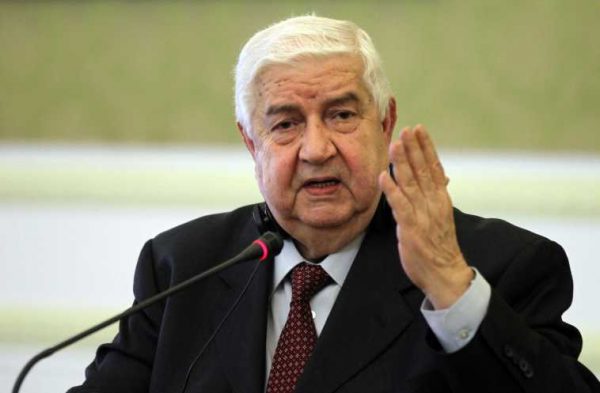
By Adam Garrie | The Duran | September 26, 2017
Syria’s Deputy Prime Minister and Foreign Minister Walid Muallem has stated that once the conflict against terrorist groups is finished in Syria, Damascus will be willing to politically negotiate internal autonomy for Syrian Kurds.
Reuters quotes Muallem, who delivered Syria’s address to the United Nations, as stating,
“This topic (Kurdish autonomy) is open to negotiation and discussion and when we are done eliminating Daesh (aka ISIS), we can sit with our Kurdish sons and reach an understanding on a formula for the future”.
There are several geo-political implications to this statement.
1. Seizing the initiative from the US occupiers
First and foremost, Muallem’s proposals take the wind out of the sails of the United States. As I wrote previously in The Duran, with Syria and Russia quickly securing control over areas east of the River Euphrates, the US is being squeezed out of Syria.
Bearing these realities in mind, one of the only options the US has left is to use the Kurdish national cause in order to foment either a new puppet state in the region that is built on stolen Syrian territory or else create a permanently occupied entity similar to the Serbian Autonomous Province of Kosovo and Metohija. Apart from this, the US will have no choice but to either leave Syria or directly confront the Syrian Arab Army and most likely, also its Russia ally. Presently, the US seems unwilling to confront Russia by any means other than through the US of proxy/terrorist forces and this is unlikely to change.
However, given the extreme backlash against Kurdish separatism in Iraq, the US would not only retain old enemies but gain new ones, particularly in the form of Turkey. Ankara is vocally opposed to Kurdish separatism in Iraq and has threatened to take all measures necessary to stop moves in this direction. Turkey has an even worse relationship with Syrian Kurds. This would automatically mean that the US would be in for a very difficult ride if they backed Kurdish separatism in Syria.
With Turkey’s President Erdogan specifically telling Iraqi Kurds “The Israel flag will not save you”, Syria’s proposals would be a geo-strategic blow not only to the US but also to Israel.
2. Separating SDF terrorists from civilian Kurds with Syrian citizenship
The Arab Socialist Ba’ath party has already given Syrian Kurds full citizenship rights which means that they are co-equals to Arabs as well as to other minorities including Assyrians and Armenians, both of whom are grateful to the pluralistic Ba’athist government for protecting them from foreign funded Sunni supremacist terrorism.
While it is clear that the Kurdish fronted SDF proxy militia is operating as a terrorist force in Syria, the old line about separating terrorists from moderates could work in a post-war scenario where the SDF has been defeated in certain regions and rendered irrelevant in others.
In exchange for negotiated autonomy, one which would clearly have to protect the rights of Arabs in ‘Kurdish regions’ of an Arab Republic, Syria could force Kurdish leaders to weed out those who have collaborated with foreign powers and create a new political paradigm for Kurds in Syria.
This would give the moderate Kurds what they want, it would protect the human rights of Arabs and Syrian minorities and it would allow Syria to further purge her soil of terrorists and enemy collaborators.
3. Leverage with Turkey
Unlike Iraq which is currently collaborating with Turkey in military drills bordering separatist regions of Iraq, Syria has no plans to engage with Turkey after years of Turkey’s participation in the pro-jihadist war against Syria.
However, in actively preventing the formation of a Kurdish state in Syria through a negotiated settlement which Turkey’s new found partner Russia could possibly help to broker, Syria could effectively end the current ‘Kurdish excuse’ which is being subtly invoked by Turkey to justify its continued presence in Syria.
Furthermore, Syria could, possibly again via Russia, offer Turkey assurances that Syria will not allow for PKK activity directed against Turkey to foment on Syrian soil. This would be in the best interests of peace in the region as Turkey and Syria both need to eventually come to terms with the fact that they are neighbours.
Historically, Syria’s traditional regional adversaries have been Israel and Jordan and more recently the extremist Arab states of the Persian Gulf. These are the states Syria must be on guard against when looking to the wider future. Because of this, Syria and Turkey will and should slowly but surely normalise relations.
4. Containing Iraqi Kurds
While Iraqi Kurds are politically at odds with their Kurdish counterparts, there exists a fear that the menacing separatist movement in Iraq could lead towards a greater Kurdish push for a multi-state land grab which would be supported by Israel, especially where Syria and Iran are concerned.
If, as is expected, Turkey sends its troops into northern Iraq, it would send a message to the wider Kurdish movement that Kurdish independence equals creating not a greater Kurdistan but a greater Turkey.
Thus, the example of Iraq when viewed simultaneously with the generous offer from Syria, may lead to moderate elements within the Syrian Kurdish movement making the pragmatic choice for guaranteed autonomy versus the prospect of Turkish domination.
Conclusion
Far from being a concession, it was always expected that after the present conflict against imperialism and imperialist funded jihad, Syria would happily engage in a political process with various parts of the Syrian population, including Kurds, in order to develop a settled internal peace.
Syria, in announcing this now however, sends a strong message to radical Kurds and the United States. The message is clear, Syria is a sovereign country and the Kurdish issue is a purely internal matter.
September 26, 2017 Posted by aletho | Timeless or most popular | Iran, Iraq, Israel, Middle East, Syria, Turkiye, United States | Leave a comment
Israel is struggling to adapt to the end of the Syrian conflict
By Mahan Abedin | MEMO | September 26, 2017
As the Syrian conflict gradually winds down it is becoming easier to identify the winners and the losers. At a global level the conflict is seen widely as a big win for Russia, and by extension a loss for the United States.
However, despite their significant differences, Russia and the US have established an uneasy accommodation in Syria, as demonstrated by a succession of local ceasefire deals. The same logic applies to Turkey and Iran, two major regional powers which are setting aside their differences to focus on the bigger picture in post-conflict Syria.
However, there is one clear loser in the conflict which is unable to reach an accommodation with its regional foes: Israel. The Zionist state has failed to achieve its core objective, namely to weaken the Syrian state by what it deems to be a sufficient degree.
On the contrary, the Syrian government is increasingly strident and confident of its victory. By extension, the so-called “Axis of Resistance” – the regional alliance led by Iran – has had a shot in the arm, as evidenced by Lebanese Hezbollah’s growing regional clout.
This outcome has increased tensions significantly between Hezbollah and Israel, as demonstrated by frequent Israeli air strikes on alleged Hezbollah-related targets inside Syria. These strikes are a harbinger of what may be just around the corner, namely a major war initiated by Israel to redress the balance of power.
Unlike some Western powers, Israel did not want Syrian President Bashar Al-Assad to be overthrown, just sufficiently battered and permanently embattled. As part of this policy Israel has extended significant support to some Syrian rebel groups, particularly in Quneitra province close to the Israeli-occupied Golan Heights.
This support, though, does not necessarily constitute sympathy for the rebels’ ultimate aim, notably the overthrow of Assad, if not the Syrian government in its entirety. Israel does not trust Syrian rebels and its attitude toward the president is informed by the old adage of better the devil you know than the devil you don’t know.
At the strategic level, Israel has made two major miscalculations. First and foremost, it failed to anticipate Russia’s forceful entry into the war in late September 2015. The Russian air force rolled back rebel gains and the wider Russian presence in Syria signalled a firm determination to maintain the political status quo. This placed Israel at a disadvantage in so far as it enabled the Syrian government to go on the offensive against its armed enemies.
Second, Israel underestimated the extent of Iran’s ability to influence the outcome of the conflict. This miscalculation centres on capability as opposed to motivation, as the Israelis were under no illusions that Iran is committed wholeheartedly to the current regime in Damascus. Israeli intelligence and defence chiefs also underestimated Iran’s military and intelligence prowess, particularly the latter’s ability to mastermind a highly effective multinational paramilitary force in Syria dominated by Shia Afghani fighters.
Whilst Iran’s human losses in Syria are considerable, in terms of what has been at stake – namely its ability to project decisive influence in the Levant region – these losses are more than tolerable. Furthermore, the blood spilt in Syria means that Iran is more than ever determined to safeguard its investment by keeping a substantial military force in the country on a long-term basis. This outcome is simply intolerable for the Israelis.
In the past 35 years, beginning with the Israeli invasion of Lebanon in June 1982, the cycle of conflict between the Zionist state and the pro-Iranian Hezbollah has undergone several distinct phases, marked by short periods of sharp escalation and a much longer period of uneasy peace. The former has occurred roughly every ten years, as demonstrated by the sixteen-day Grapes of Wrath operation in April 1996 and the longer and more intense war of summer 2006.
Israel is understood widely to have lost the 2006 war, at least in terms of asymmetric warfare, an outcome that has had a decisive influence in containing Israeli aggression towards Lebanon. Nevertheless, it is worth remembering that the conflict between Israel and Hezbollah goes beyond the region and has a truly global dimension. Both sides spy on each other around the world, a fierce intelligence war that occasionally escalates into the assassination of Hezbollah commanders and alleged bombings in retaliation.
In terms of the next major conflict, there are two factors that weigh heavily on Israeli strategists. First is the psychological requirement to exorcise the ghosts of 2006 and restore – albeit partially – Israel’s image of military invincibility. Second, there is a growing realisation that Israel’s containment strategy is failing to stem Hezbollah’s military capability, which reportedly includes an arsenal of 120,000 rockets.
Whilst unable to influence the course of the Syrian conflict at a strategic level, at tactical and operational levels Israel has conducted dozens of air strikes against alleged Hezbollah targets in Syria – and occasionally against purely Syrian targets – with the declared goal of preventing the transfer of sensitive weapons systems to the Lebanese militant group.
There is a growing acknowledgement by prominent Israeli analysts that these strikes have failed to achieve their objective, namely to contain Hezbollah’s growing military clout. This failure is used by these analysts to push the warped idea that in the next war Israel has to raise the stakes significantly by declaring war on Lebanon, as opposed to just Hezbollah. This strategy necessitates the wholesale destruction of Lebanese infrastructure.
There are now growing signs that a conflict may break out sooner than expected, with the Israelis carefully preparing a Western audience for a major war. The trigger for this war could come in any shape or form, with the repeated Israeli violations of Syrian sovereignty – in the form of air strikes – likely to elicit a credible response from either Hezbollah or Syria at some point. In this arena – as in other conflict arenas involving the Zionist state – it is the Israelis who control the provocation game.
The next war is likely to prove more devastating than the last, even if it is not longer, as Israel will mobilise all its resources to compensate for its loss in the Syrian conflict and, by extension, to change the balance of power with its most potent enemies. As it struggles to adapt to the end of the Syrian conflict, others must get ready to pay the price.
Read: Israel’s new occupation zone in Syria
September 26, 2017 Posted by aletho | Ethnic Cleansing, Racism, Zionism, Timeless or most popular, War Crimes | Hezbollah, Iran, Israel, Lebanon, Syria, Zionism | Leave a comment
The Baseness of Israel’s US Military “Facility”
By Michael Dickinson | CounterPunch | September 26, 2017
On Monday, with a commemorative tree-planting and ceremonial ribbon-cutting, Israeli and US officials inaugurated the ‘first permanent American military base’ at the IDF’s Air Defense School, not far from a US military radar installation in the Negev Desert. American and Israeli flags flew side by side as high-ranking military officers and soldiers from both countries participated at the opening ceremony.
In his speech, Maj. Gen. John Gronski, deputy commander of US Army National Guard in Europe, said “The United States and Israel have long planned together, exercised together and trained together. And now, with the opening of this site, these crucial interactions will happen every day.” (US military forces are routinely based in Israel, for joint exercises, cooperation with the IDF, and to operate some US facilities in the country.)
Brig. Gen. Tzvika Haimovitch, head of the IAF’s Aerial Defense Command, told reporters: “We established an American base in the State of Israel, in the Israel Defense Forces, for the first time, with an American flag. A permanent base.” He lauded the opening of the facility for allowing “us to improve our defense, in discovery and in interception and in preparedness,” saying the permanent presence of a US facility on Israeli soil sends a “message to the region and our surroundings that our partnership with our friend the United States is important.”
However, despite the solemn and celebratory talk at the opening ceremony on Monday, things came down with a bump on Tuesday when the American military contradicted the claim made by the Israel Defense Forces that the United States had established its first base in Israel.
“The new buildings on the existing Israeli Air Force Base are not a US military base,” said Meghan Henderson, deputy director of EUCOM’s Media Operations Division. “The buildings will function as a living facility for US service members, who are currently working at the Israeli base.” An Israeli army official confirmed that the Americans had contacted the IDF and requested the change in terminology. The message was passed along, and all mentions on its website of a “US military base” were quickly changed to read “US military facility.”
‘Base’, it seems, is an inappropriate word because it carries with it a number of legal distinctions and can only be applied to facilities of a certain size.
Of course, the word ‘base’ has many different meanings totally unrelated to army camps. The adjective means ‘immoral’ or ‘not having moral principles or rules.’ Ironically it seems sum up the governments of both Israel and the US.
Michael Dickinson can be contacted at michaelyabanji@gmail.com.
September 26, 2017 Posted by aletho | Ethnic Cleansing, Racism, Zionism, Timeless or most popular, War Crimes | Israel, Palestine, United States | Leave a comment
Plans to Dump Nuclear Waste on Australian Aboriginal Sacred Site May Be Halted
Sputnik – 26.09.2017
Plans to transport nuclear waste from Britain to a sacred Aboriginal site in southern Australia could now be put on hold.
Proposals to ship nuclear waste from northern Scotland to a heritage site considered important to indigenous groups in Australia may be halted.
Campaigners acting for Aboriginal Australians are challenging a bid to transfer the waste from Dounreay, Caithness, to a proposed new dump located at Wallerberdina, 280 miles north of Adelaide.
They insist the potential location for what would be Australia’s first nuclear dump would infringe on a historical site rich in burial mounds, fossilized bones and stone tools and considered sacred by Aboriginals.
Under an agreement reached in 2012, all waste from Australia, Belgium, Germany and Italy that is processed at the Scottish facility must be returned to the country of origin.
Now the Scottish government has indicated that all concerns voiced by indigenous peoples must be taken into account before the waste is transferred by ship, presently planned for 2020.
A government spokesman said it would continue to work with the UK government and the Nuclear Decommissioning Authority to decide where the shipment should be sent.
“Any concerns expressed by indigenous peoples must be addressed in full and action taken, to ensure that vulnerable communities do not suffer future adverse impacts. We recognize that the management of nuclear waste must take full account of human rights and equality obligations, including the importance of ensuring that security and waste management arrangements protect public safety and avoid harmful environmental impacts,” the government said in a statement.
‘Creating More Problems’
Earlier Gary Cushway, a dual Australian-British citizen, had written to the Scottish First Minister Nicola Sturgeon raising the concerns of the residents from the Adnyamathanha community, who live on land adjacent to the proposed dump site at Wallerberdina.
“Radioactive waste is a problem we need to deal with, but shifting the problem on to remote indigenous communities isn’t fixing the problem. It is just creating more problems for indigenous communities that have been mistreated for centuries already,” Mr. Cushway wrote.
In pressing the Scottish government, Mr. Cushway said it was an opportunity to correct the past mistakes of the UK government who tested nuclear weapons on indigenous homelands in South Australia, forcing many of them to be moved from their properties.
The federal Australian government has identified two possible locations for the national waste dump site, having previously been thwarted by campaigns by indigenous and community groups since the 1990s.
No date has, so far, been set for a final decision, although federal government ministers are aware they face a strong backlash if they select the Wallerberdina option as it borders an Indigenous Protected Area where they are still permitted to hunt.
In addition, the state government of South Australia took the decision in June, 2017, to reject plans to cite any of the sites there.
September 26, 2017 Posted by aletho | Environmentalism, Ethnic Cleansing, Racism, Zionism, Nuclear Power, Timeless or most popular | Australia, Human rights, UK | Leave a comment
Ukraine’s Chief Military Psychiatrist Fired After Uncovering Horrifying Secret
Sputnik – 25.09.2017
Ukraine’s Defense Ministry has sacked chief military psychiatrist Oleh Druz, who told lawmakers that 93% of veterans from the conflict in the country’s east need treatment for mental health issues. Radio Sputnik contributor Vladimir Filippov says Druz’s remarks, and Kiev’s reaction, are a testament to the senselessness of the country’s civil war.
Last week, Ukrainian Defense Minister Stepan Poltorak dismissed Colonel Oleh Druz, the head of the psychiatry clinic of the Main Military Clinical Hospital “in connection with the unsatisfactory fulfillment of his official duties.” The dismissal followed remarks by the top military psychiatrist at a round table of parliamentary committees, where Druz revealed that over 90% of the veterans of Kiev’s military operation in Donbass require mental help and pose a potential danger to society.
Commenting on the scandal, Radio Sputnik contributor Vladimir Filippov said that Druz’s real problem was that he decided to tell the truth.
The journalist recalled that according to Kiev’s own official statistics, “nine out of ten participants of the fighting in the Donbass have medical and social problems, while a third are diagnosed with post-traumatic stress disorder. Experts say a state-run program of support for vets is needed, but for now this is something done mainly on a voluntary basis.”
In his remarks before lawmakers, Druz warned that veterans’ disorders include heightened levels of aggression, decreased ability to return to civilian work, the development and exacerbation of chronic diseases, growing rates of alcoholism and drug addiction, shortened life expectancy, and increased suicide rates. Statistics reveal that 63 veterans took their own lives in 2016 alone.
In light of these horrifying figures, Filippov suggested that Kiev’s reaction was highly “original.”
“They simply dismissed the chief psychiatrist. Why? Probably because he said too much. Someone might think that among the [Donbass vets] are completely mentally unstable people. In fact, to shoot one’s fellow citizens is already beyond the realm of a normal worldview. And if one kills unarmed civilians, children and the elderly, what kinds of mental state can one speak of?”
According to the analyst, the hard truth is that Ukraine’s authorities couldn’t care less about its vets, with the government allocating precious little money for them, most of its defense funds either stolen outright or allocated to weapons purchases.
Filippov suggested that as far as Kiev is concerned, the only problem posed by the vets is the political danger they pose to the government – “to their soft chairs and their wealth. They have no plans to share with the veterans, hence the need to drive their problems deep out of sight and out of mind. No one needs them. They are cannon fodder, spent material.”
“That’s why Poltorak got so anxious,” the analyst stressed. “Because the 93% figure is a military secret – top-secret information! Capable of undermining the military capability of the regime,” Filippov concluded.
September 25, 2017 Posted by aletho | Timeless or most popular, War Crimes | Ukraine | Leave a comment
Obfuscating the Truths of Vietnam
By S. Brian Willson | CounterPunch | September 25, 2017
I have hesitated to comment on the instructive discussion on VFP’s Full Disclosure page about the Burns-Novick Vietnam PBS series because I am not watching it. I have enjoyed reading many of the comments, and have communicated with people who have seen advance screenings.
In 2014, I heard Burns’ publicly discuss his pending PBS Vietnam series. He responded to a question about Agent Orange with a “safe” position that damage to human beings from the chemical herbicide was scientifically inconclusive. This was not surprising given that Burns is a popular, established film maker of various aspects of history from jazz, to baseball, to the Civil War. However, any deep threat to the US American basic “good guy” self-image would likely curtail his continued popularity, not likely to lend itself to corporate funding on PBS, whether from Bank of America, the Rockefeller or Koch Brothers.
Any treatment of the US War against the Vietnamese, Cambodians, and Laotians that does not establish the historic foundation of the US criminal invasion, occupation, and destruction of an innocent country, murdering and maiming millions – profound moral issues – flunks authentic history. And, equally, if the presentation ignores the US creation of a fictional puppet government in the South that was so unpopular that the US was forced to deploy 3 million troops and massive airpower to protect it from the Vietnamese people themselves, it will fail miserably to do justice to genuine history.
Despite this history, Viet Nam is still commonly called a “Civil War” of relative “equivalencies”, a preposterous representation suggesting an “enemy” of basically poor people 8-10,000 miles distant on their own ground who for some unknown reason might threaten the wealthy US with bombs or naval and ground invasions, or….. ? And to represent that the war was “begun in good faith by decent people”, ignores the revelations of the Pentagon Papers.
Thus, Burns’s and Novick’s 18-hour “The Vietnam War” series severely obfuscates the most significant great truths of the US war – that “The Vietnam War” was and remains a Great Lie. Provoking national discussion about the war is important, but for it to be acceptable to a national PBS audience, the producers had to assure that in the framing the US remains basically the good guy against evil.
The honest portrayal of a people who wanted authentic autonomy from a stream of colonial intervenors seems outside our capacity to embrace, and certainly we were not able to comprehend the deep Vietnamese commitment to do whatever they believed necessary to rid itself of its latest occupier. Instead, the US created and funded a fictitious government with a corresponding enemy to justify our intervention against the shadowy, deceitful, evil, though tenacious “communists”. This US policy was intended to prevent a successful “Third World” post-WWII revolutionary movement that possessed the potential to spread to other restive peoples.
Without establishing this fundamental immoral foundation to the history of the US intervention, this Burns-Novick documentary history safely avoids provoking the US American people into an overdue, painful self-examination of its cultural “DNA”. Our geltanshauung was cast as a divinely guided “predestination” for goodness in 1630 when Puritan John Winthrop of the Massachusetts Bay Colony declared “that we shall be as a city upon a hill” and “the eyes of all people are upon us”.
We are reminded of such arrogance in “Founding Father” Thomas Jefferson’s hypocritical words penned in the 1776 Declaration of Independence that claimed “all men are created equal”, yet a few words later declared the King of England using the “merciless Indian savages” to attack with “known rule of warfare” the new settlors with “undistinguished destruction of all ages, sexes and conditions”.
Let’s see…. those words describe well our behavior in Viet Nam, genocidal behavior then, as in Viet Nam, off limits for US to consider.
*The US destroyed more than 60 percent of Viet Nam’s 21,000 inhabited, undefended villages, including use of unprecedented 8 million tons of bombs and 370,000 tons of napalm, murdering 4 to 5 million, leaving a decimated landscape with 26 million bomb craters and as many as 300,000 tons of unexploded ordnance that continue to kill and injure thousands every year;
*USAF manuals instructed the intentional bombings of the “psycho-social structure” of Viet Nam such as pagodas and churches (950 of them), schools (over 3,000) and hospitals and maternity wards (1,850, many with large red crosses painted on their roofs);
*US and South Vietnamese pilots were trained to “cut people down like little cloth dummies” during daytime raids;
*US employed the most intensive use of chemical warfare in human history, spraying 21 million gallons of lethal poison leaving millions deformed, sick and dead, now with third generation birth deformities;
*The US used torture in every southern province to extract confessions;
*The US imposed free fire (genocide) zones over 75 percent of the South, mass murdering villagers on the ground, etc.
In fact, our behavior was unspeakable, but similar to what our forebears did against our Indigenous inhabitants. Viet Nam was no aberration.
Yes, the PBS series will present much important history for the viewers through its artful selection of dramatic war footage and wide-ranging interviews with Vietnamese and US Americans. It will indeed educate and raise questions….as long as the storyline essentially preserves the US as the better of two basically equivalent fighting forces. It admits making terrible mistakes, but not crimes, implying or expressing justification for our intervention against evil – here the convenient Cold War Pavlovian “communist” bogeyman.
This PBS series is being aired as the US deepens its atrocious pattern of perpetual war around the globe since Viet Nam, the chess pieces continually moving from Viet Nam to almost everywhere else under a philosophy of “full spectrum dominance”. This includes use of the ultimate wholesale terror from the sky using missile-laden drones.
The nature of US behavior in Viet Nam, and in the little understood tragic Korean war more than a decade earlier, and in virtually all countries in which it intervenes, covertly or overtly, is virtually ungraspable to the majority of US Americans. In 1967, Martin Luther King, Jr delivered his anti-Vietnam War speech, declaring that “the greatest purveyor of violence in the world today is my own government”. Hmm!
Without a willingness to honestly address our long pattern of immoral and criminal military and covert interventions to preserve essentially selfish, narcissistic values, utilizing deceit and grotesque barbaric techniques, when and how might the US people be awakened to discover a political consciousness of mutual respect? The Burns-Novick series will produce healthy debates about the US War in Southeast Asia, but it will tragically steer clear of revealing, while obscuring, the Grand Lie of the war itself, even as the documentary is touted by observers and viewers as monumental history. What a lost opportunity!
So, as people are glued to this intriguing PBS series, they will nonetheless continue to shop, their government will continue to bomb, and the warmakers will continue to get richer. Nothing changes.
S. Brian Willson, USAF Combat Security Police Officer, Viet Nam, 1969.
S. Brian Willson, as a 1st lieutenant, served as commander of a US Air Force combat security police unit in Viet Nam’s Mekong Delta in 1969. He is a trained lawyer who has been an anti-war, peace and justice activist for more than forty years. His psychohistorical memoir, “Blood On The Tracks: The Life and Times of S. Brian Willson” was published in 2011 by PM Press. A long time member of Veterans For Peace, he currently resides in Portland, Oregon
September 25, 2017 Posted by aletho | Film Review, Mainstream Media, Warmongering, Timeless or most popular | PBS, United States, Vietnam War | Leave a comment
A Risky Referendum for Kurdistan Underway in Iraq
By Barbara Nimri Aziz | CounterPunch | September 25, 2017
At least the combative and haughty Israeli prime minister was forthright: he supports a free and independent Kurdistan. Tomorrow’s vote by Iraqi Kurdish parties to secede from Iraq may well push the country into another war, a civil war. (Doubtless nothing would please Israel more.) The referendum is opposed by neighboring powers, but most significantly by the central government in Baghdad.
It is a far more serious move than the well publicized Catalonian vote in Spain scheduled for October 1st, also more perilous than Middle East watchers let on. Why the Iraqi referendum is receiving so little scrutiny, I don’t know.
Our revered English language “fake-news” establishment (e.g. The New York Times and The Guardian, among them) is underplaying the significance of a Kurdistan secession, also denying American and British endorsement for it. In reality the US and UK are totally with Israel in promoting and supporting north Iraq’s independence.
Iran’s and Turkey’s opposition is well known; Syria would also be in that camp although no one publicly listens to Syria these days. (Remember that US troops are closely collaborating with Syrian Kurdish forces in opposition to Damascus.)
Reading the buried articles on Iraqi Kurdish national aspirations, one would gather it’s a scheme conceived after the 2003 US invasion, and advanced only by Kurdish leaders.
This is nonsense.
Although the British divided the large, strategic area occupied mainly by Kurdish-speaking people among Syria, Iraq, Iran and Turkey with their Sykes-Picot “Agreement” during World War I (part of the dissolution of the Turkish Empire), more recent plans by the imperial powers and Israel involve reconfiguring the modern Middle East into smaller and smaller pieces, starting with Iraqi Kurdistan. (Talk of Iraq’s division into three parts arose in 1991; similar scenarios are applied to Syria today.)
Public discussion of an independent Kurdistan has been ongoing since the launch of the US-led war on Iraq. Yes, Washington’s war on Iraq began not with the 2003 invasion but in 1991, with what’s called the Persian Gulf War (as if it was confined to that area). The ongoing assault included the murderous, destabilizing and destructive embargo war that continued from 1990 to 2003).
As for the Kurds, readers will recall images of tens of thousands of besieged families fleeing into the mountains ostensibly pursued by Saddam’s army. Without delay, humanitarian-motivated (sic) western powers rushed to the Kurds’ aid, using the opportunity of diversionary assaults in pursuit of Saddam and the Baathists, to essentially occupy the three Kurdish governates on behalf of that besieged minority. With Kurdish leaders’ wholehearted complicity, occupation was easily secured by a band of CIA agents, a low profile US military contingent working with an Israeli team, protected by the insipid northern “no-fly zone” (blessed, I believe, by the United Nations Security Council). The Kurdish region has remained semi-autonomous since then, sanctioned by a clause in the US-framed Iraqi constitution granting Kurds a degree of autonomy. Day by day, year by year, those three Kurdish governates have enjoyed protection, economic development, including a thriving tourist industry, freedom from any sanctions, and freedom to sell oil from its territory directly to foreign companies, all unquestioned thanks to its benevolent international image in Human Rights reports and the press.
During these 26 years, tensions between the central government and the KRG (Kurdish regional government) in Erbil have steadily heightened. Neither US occupiers nor other influential forces in Iraq have done anything to lessen the crisis. American Kurdish experts led by the intrepid former US diplomat Peter Galbraith have consistently argued for an independent Kurdistan.
Then there is Kirkuk: Iraq’s major city in the area lies outside that semi-autonomous Kurdish region. Until 1991 Kirkuk was overwhelmingly inhabited by Iraqi Turkmen people. Kirkuk and smaller nearby cities (e.g. Tel Afar) have been Turkmen’s homeland for centuries, an area profoundly and unquestionably Iraqi in loyalty.
You’d never know this from western press accounts which characterize Kirkuk simply as a center of oil deposits. I say Kirkuk was a largely Turkmen city because that has changed; since 1991 Iraqi Kurds have been steadfastly engaged driving Turkmen from their towns while repopulating them with Kurdish families. Although no mass killings of Turkmen have occurred as far as I am aware, there has been a major ethnic cleansing underway, turning Kirkuk from a major Turkmen society into a Kurdish one. All this has been in preparation for the inclusion of Kirkuk into the anticipated autonomous Kurdistan, a process known and condoned by US, Israel and the UK policy makers.
With the coming referendum, although the three regions (minus Kirkuk) enjoyed a marked degree of independence, despite successive Baghdad government attempts to limit this, Kirkuk has now become the additional prize and a noted target in the coming referendum.
Baghdad opposes the referendum as strongly as Madrid rejects Catalonia’s independence vote. In recent weeks Madrid has taken startlingly firm action to thwart the regional vote. Baghdad’s position is as uncompromising; a federal court has declared the referendum illegal according to the Iraqi constitution, and Baghdad declared its readiness to use military action, at least to hold Kirkuk.
Don’t believe news reports that the US and its allies oppose this referendum. Note the absence of any diplomatic effort by Washington to help reach a compromise and avoid another period of strife there.
All Iraqis must be feeling very nervous tonight.
Barbara Nimri Aziz is a New York based anthropologist and journalist. Find her work at www.RadioTahrir.org. She was a longtime producer at Pacifica-WBAI Radio in NY, also author of Swimming Up The Tigris, Real Life Encounters with Iraq, (University Press of Florida, 2007).
September 25, 2017 Posted by aletho | Deception, Timeless or most popular, Wars for Israel | Iraq, Israel, Middle East, UK, United States, Zionism | Leave a comment
Featured Video
Seyed M. Marandi: US-Iran War Inevitable: Kuwait and Bahrain May Fall
or go to
Aletho News Archives – Video-Images
From the Archives
Oil and the Israel Lobby
Reknowned economist M. Shahid Alam offers this excellent critique of Noam Chomsky’s defective analysis of the relative influence of Oil versus the Israel lobby over US foreign policy: … continue
Blog Roll
-
Join 2,352 other subscribers
Visits Since December 2009
- 7,759,568 hits
Looking for something?
Archives
Calendar
Categories
Aletho News Civil Liberties Corruption Deception Economics Environmentalism Ethnic Cleansing, Racism, Zionism Fake News False Flag Terrorism Full Spectrum Dominance Illegal Occupation Mainstream Media, Warmongering Malthusian Ideology, Phony Scarcity Militarism Progressive Hypocrite Russophobia Science and Pseudo-Science Solidarity and Activism Subjugation - Torture Supremacism, Social Darwinism Timeless or most popular Video War Crimes Wars for IsraelTags
Afghanistan Africa AIPAC al-Qaeda Australia BBC Benjamin Netanyahu Brazil Canada CDC Central Intelligence Agency China CIA CNN Covid-19 COVID-19 Vaccine Donald Trump Egypt European Union Facebook FBI FDA France Gaza Germany Google Hamas Hebron Hezbollah Hillary Clinton Human rights Hungary India Iran Iraq ISIS Israel Israeli settlement Japan Jerusalem Joe Biden Korea Latin America Lebanon Libya Middle East National Security Agency NATO New York Times North Korea NSA Obama Pakistan Palestine Poland Qatar Russia Sanctions against Iran Saudi Arabia Syria The Guardian Turkiye Twitter UAE UK Ukraine United Nations United States USA Venezuela Washington Post West Bank WHO Yemen Zionism
Aletho News- ICC ignored ‘very well-documented’ NATO crimes – ex-Libyan minister
- SNSC secretary dismisses US response to Iran’s conditions as ‘inadequate’
- Sanaa says Taiz roads open, secure for residents, warns Saudi forces
- Iraqi resistance group urges Saudi leadership to admit defeat, lift Yemen siege
- Trump’s Retreat: How Al-Aqsa Flood Took Down the US Empire
- Israel’s Military Actions in Lebanon Grossly Violate International Law — Lavrov
- Seyed M. Marandi: US-Iran War Inevitable: Kuwait and Bahrain May Fall
- Leaders Condemn Ansarallah Attack on Saudi Arabia While Ignoring Illegal War Against Yemen
- Leaked: Britain’s Covert Iraqi Psyops Network
- Yemeni Armed Forces Warn Airlines Against Using Saudi Airports, Exempt Mecca and Medina
If Americans Knew- After Oct 7, IDF policy allowed civilian casualties for even the lowest-ranking targets
- Israel’s Destruction of Southern Lebanon Intensified After the Cease-Fire
- The Last-Minute Decision That Gave Israel Its Name
- The American Conservative: How Trump Made the World Go Nuclear
- Meet the US generals and admirals advancing Israeli policy
- Opinion: Why news organizations should boycott Israel
- The Israeli witch hunt of Sami Abu Shehadeh exposes the lie of the ‘Jewish and democratic’ state
- No state has a ‘right’ to exist – least of all Israel
- Testimonies about Gaza’s civilian death toll expose Israel’s atrocities – Daily Update
- How Israel Conquered the Latin American Right
No Tricks Zone- New Study Suggests Large Regions Of The Pacific Ocean Have Been Cooling For The Last 80 Years
- Germany’s Green Energy Debacle: High Energy Costs Force Kahla Porzellan to Close After 182 Years!
- New Study: 50 Years Of The Most Aggressive ‘Net Zero’ Policies Can Only Affect The Global Climate By 0.03°C
- US September “Heat” Was No Record…Many Records Set Decades Ago
- Latest European Green Energy Debacle; Portugal’s Largest Flagship Solar Park Insolvent!
- Green Energy Debacle: German Expert Professor Fritz Vahrenholt Warns Of Severe Economic And Social Consequences
- Two More Paleo Reconstructions Affirm Meters-Higher Sea Levels Across Ireland, Brazil 7000-6000 Years Ago
- New Study: Earth And Venus Surface Warmth Largely Explained By Convection And Lapse Rate, Not CO2 Or Radiation
- 2025 Nature Paper Claiming Worsening Global Drought Gets RETRACTED …Heavily Flawed
- New Study: ‘Global Drought Shows No Detectable Recent Acceleration Under Climate Warming’
Contact:
atheonews (at) gmail.com
Disclaimer
This site is provided as a research and reference tool. Although we make every reasonable effort to ensure that the information and data provided at this site are useful, accurate, and current, we cannot guarantee that the information and data provided here will be error-free. By using this site, you assume all responsibility for and risk arising from your use of and reliance upon the contents of this site.
This site and the information available through it do not, and are not intended to constitute legal advice. Should you require legal advice, you should consult your own attorney.
Nothing within this site or linked to by this site constitutes investment advice or medical advice.
Materials accessible from or added to this site by third parties, such as comments posted, are strictly the responsibility of the third party who added such materials or made them accessible and we neither endorse nor undertake to control, monitor, edit or assume responsibility for any such third-party material.
The posting of stories, commentaries, reports, documents and links (embedded or otherwise) on this site does not in any way, shape or form, implied or otherwise, necessarily express or suggest endorsement or support of any of such posted material or parts therein.
The word “alleged” is deemed to occur before the word “fraud.” Since the rule of law still applies. To peasants, at least.
Fair Use
This site contains copyrighted material the use of which has not always been specifically authorized by the copyright owner. We are making such material available in our efforts to advance understanding of environmental, political, human rights, economic, democracy, scientific, and social justice issues, etc. We believe this constitutes a ‘fair use’ of any such copyrighted material as provided for in section 107 of the US Copyright Law. In accordance with Title 17 U.S.C. Section 107, the material on this site is distributed without profit to those who have expressed a prior interest in receiving the included information for research and educational purposes. For more info go to: http://www.law.cornell.edu/uscode/17/107.shtml. If you wish to use copyrighted material from this site for purposes of your own that go beyond ‘fair use’, you must obtain permission from the copyright owner.
DMCA Contact
This is information for anyone that wishes to challenge our “fair use” of copyrighted material.
If you are a legal copyright holder or a designated agent for such and you believe that content residing on or accessible through our website infringes a copyright and falls outside the boundaries of “Fair Use”, please send a notice of infringement by contacting atheonews@gmail.com.
We will respond and take necessary action immediately.
If notice is given of an alleged copyright violation we will act expeditiously to remove or disable access to the material(s) in question.
All 3rd party material posted on this website is copyright the respective owners / authors. Aletho News makes no claim of copyright on such material.

