Staircase History and the Subprime Morality of the Nanking Massacre

The Great Nanjing Massacre, by Zi Jian Li, 1992
By Colin Liddell | Occidental Observer | June 2, 2017
The French have a term for it, L’esprit de l’escalier, or “staircase wit.” It means bright and witty sayings thought of too late as one is exiting a party. But history has its own “staircase” element as well, namely events that receive historical attention much later than they should if, as we are supposed to believe, they were so important to begin with.
A perfect example of this is the “Nanking Massacre” of 1937, now a much-contested historical event in the Sino-Japanese War (1937—45). The Chinese claim that the Japanese went on a brutal rampage resulting in 300,000 deaths. The Japanese claim they were responding to irregular troops in civilian clothing using guerrilla tactics, with a much lower death toll.
Even though this is now presented as a pivotal historical event and something that we are all supposed to know, the surprising thing is that, like the Jewish Holocaust from the same era (which began to be used to advance Jewish ethnic interests after the 1967 Arab-Israeli war and really only gained traction in the 1970s [here, p. 42ff]), it got off to a rather late start, becoming suddenly very, very important decades after it actually happened.
Not only had Clio the Muse of History descended the staircase before anything of importance had been written about this supposedly groundbreaking event, but she had climbed into her carriage, arrived home, and kicked off her shoes as well. If Nanking was so important surely it should have been broached at the first practical opportunity, say in the immediate post-war period. Of course it wasn’t, not by the Chinese nor by anyone else. As it was, the event had to wait until the publication of Iris Chang’s best seller The Rape of Nanking in 1997 to really get its historical marching boots on — a full 60 years after the event! Some staircase!
James Dao, writing in the New York Times in 1998, called attention to the sudden spurt of interest:
As recently as five years ago, the 1937 Rape of Nanking, in which up to 300,000 Chinese were massacred in six weeks by Japanese troops, was barely a footnote in American popular culture. Since then the event has inspired two novels, a documentary film, a book of photographs, several Internet Web sites and a dozen academic conferences. Another documentary on the Rape of Nanking for the History Channel and one on the Sino-Japanese War for public television are also in production.
As remarkable as this sudden interest was, it was perhaps even more remarkable that Chang’s book became the vehicle for this, as it had serious flaws as a work of history, the main ones being its lack of credible causation for what was supposed to be a particularly violent incident by Japanese troops. Essentially Chang ascribed it to the inherently violent nature of the Japanese, something I have yet to notice in decades spent living here. More importantly for a book that was presented as a serious academic work, she did zero research in Japan, laying her work open to the charge of being extremely one-sided.
Despite this, the book was lionized, with the author getting the full “instant celebrity” treatment of newspaper profiles, talk show appearances, honorary degrees, and invitations to the Clinton White House. No doubt, the racy title in conjunction with a young Chinese female author — she was 29 at the time — played some part in stimulating interest.
This saga reveals once again that history is never just about what happened in such-and-such a place at such-and-such at time. It’s much more about what certain groups choose to focus on and why. Personally, I’m not overly interested in the minutiae of the Nanking Massacre. Trainspotterly hairsplitting about numbers of victims or whether the victims were blameworthy can get boring extremely fast. People died, how many, how, and why, take your pick. What is more interesting is why “Nanking 1937” suddenly jumped to life as “history” in the late 1990s.
To answer this, you first need to understand why it wasn’t considered historically important much nearer to the time in which it happened, in the same way that, say, Dunkirk, Stalingrad, or Hiroshima were.
There are two reasons for this. Firstly, Nanking 1937 wasn’t particularly unique or special. Secondly, it was an event that had no effect on the actual outcome of events at the time. Ironically, the only unique thing about it was how particularly ineffectual it was on outcomes. This is because the whole point of the Japanese advance on the city of Nanking was to force Chang Kai-Chek’s Nationalist government to come to terms, something that the fall of the city signally failed to do.
Beaten at Nanking, the Nationalists just moved their capital to Hankow, and when that city also fell, they moved it again. Like Napoleon in 1812, the Japanese seemed to naively think that they just had to show up at the opposition’s capital to win, possibly because that is exactly what would have forced them to surrender if the boot had been on the other foot.
Also, terrible as it was, the Nanking Massacre was just one of many incidents of a similar nature. I believe this makes it what is sometimes called, a “mere detail” of history. The Sino-Japanese War lasted 8 years and covered most of the heavily populated parts of China. It was so vast and violent, with millions dying, that there are many other examples of horrific butchery/ tragic violence besides Nanking to develop historical narratives with.
Indeed, just a few months before Nanking, the Chinese themselves committed an act demonstrably much worse than the Nanking Massacre — even if we accept the highest estimate of 300,000 deaths — when they deliberately destroyed the Huayuankou Dyke on the south bank of the Yangtze River in a ruthless attempt to halt the Japanese advance. This act of demolition unleashed flood waters across a wide area of Henan, Anhui, and Jiangsu provinces. In order to avoid Japanese counter-measures, the civilian population was not warned, so the flooding resulted in a massive death toll from drowning, estimated at 800,000, with many millions more displaced and made homeless.
In the context of the wider war, we can say that Nanking 1937 was not unique and not decisive, and furthermore that it was dwarfed by the Chinese government’s atrocities against its own people. From this, you can see there was no immediate reason for Nanking to become a significant part of history. Why then was it subsequently presented as such?
The most obvious answer to this is that it proved useful to the Chinese government and to a lesser extent Western elites. Internally Nanking serves as a useful unifying device for the Chinese state, giving the Chinese people an external hate figure — Japan — while also reminding them that they need a strong centralized government to avoid similar outrages. Externally the Chinese use it as a stick to beat Japan with, and keep them on the defensive regarding their historical pride and identity. This serves to weaken their Asian rival, although, overusing the tactic can backfire. It could be argued that this is one factor that has pushed Japan in a more assertively nationalist direction in recent years.
But why did the Chinese wait so long before resorting to this tactic? Iris Chang’s book put it down to the economic weakness and isolation of Communist China, which sought economic benefits from trading with Japan. By the 1960s “Red China” was opposed not just by the West but also by the Soviet Union, with which it had fallen out. It was only with the collapse of the Soviet Union in 1991 and the success of Deng Xiaoping’s economic reforms that the country felt strong enough to use this stick to beat Japan. Interestingly, by that time, those same economic reforms were creating big inequalities within China that challenged social cohesion. China’s version of Japan bashing arrived at an opportune moment.
But what about Western elites? The benefit of the Nanking Massacre for these people is less obvious, especially as it is occasionally used to undermine Japan, a key Western ally. But maybe this is exactly what is wanted, namely a Japan that is regarded as somehow historically flawed and morally tainted, because this is a Japan that can operate less on its own terms and has an obvious need for a geopolitical intermediary. As Dutch journalist Ian Buruma, writing in the Guardian in 2010 said:
Most Japanese were happy to be pacifists and concentrate on making money. Japanese governments could devote their energy to building up the country’s industrial wealth, while the US took care of security, and by extension much of Japan’s foreign policy. It was an arrangement that suited everyone: the Japanese became rich, the Americans had a compliant anti-communist vassal state, and other Asians, even Communist China, preferred Pax Americana to a revival of Japanese military clout.
But, there could well be less obvious reasons, connected to the strangely moralizing purpose to which history is put these days. Victim narratives are an important part of the “power eco-system” in Western societies, where they are typically used to “de-privilege” the core populations of Western states through White guilt. This is done for a variety of reasons: (1) to facilitate the importation of cheap labor, (2) to create “diversity” as an end in itself, and (3) to justifying the “affirmative action” necessary to maintain social cohesion in societies characterized by very substantial racial differences and divisions. In the case of the Holocaust, Jewish activists have used it as a rationalization for Israel and its policies, to silence critics of immigration and multiculturalism, to portray the relatively wealthy and successful Jewish community as victims, and pad the coffers of Jewish organizations (here, p. lvi ff).
Western elites get benefits from victim narratives that feature Jews, Blacks, and other non-Whites as “victims” of Whites. But, what about a narrative presenting the Chinese as victims of the Japanese? Aside from the geopolitical benefits outlined above, there are two possible additional benefits. The first one emphasizes the Japanese side of the equation and the other the Chinese side.
The first possible benefit is that narratives of Japanese guilt play into the wider narrative of White guilt. Japan has often been viewed as “honorary White” nation in the past, and was described by President Theodore Roosevelt as “the only nation in Asia that understands the principles and methods of Western civilization.”
The second possible benefit is that persuading the Chinese to participate in a victim narrative helps to strengthen the institution of victimology itself. In the decades leading up to Chang’s book, victim narratives in general had already been overextended and overused to the extent that they were in danger of losing their value. The obvious analogy here is with currency notes or government bonds, which quickly depreciate if too many are issued.
By 1997, when Chang’s book came out, the global guilt industry had enjoyed its first big spurt and needed a fresh infusion of energy. Getting China to buy into its own victim narrative, not only served specific Chinese and Western elite goals, but it also helped to keep the global guilt market afloat. As with America’s overproduction of fiat currency in the Chimerica years, here too China picked up the slack.
Missing the Real Noriega Story
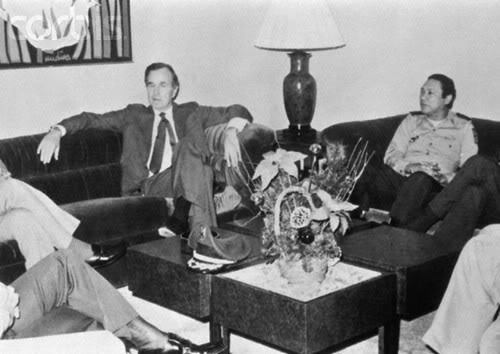
Vice President George H.W. Bush meeting with Panamanian Gen. Manuel Noriega in the mid-1980s when Noriega was considered a key ally in helping the Nicaraguan Contras wage a brutal guerrilla war to overthrow the leftist Sandinista government.
By Jonathan Marshall | Consortium News | June 1, 2017
The death of former Panamanian strongman Manuel Noriega on May 29 elicited few if any tears. But it should have sparked more reflection in the United States on his ugly history of service to the CIA, the hypocrisy of Washington’s sudden discovery of his abuses once Noriega became an unreliable ally against the Nicaraguan Sandinistas, and the George H.W. Bush administration’s bloody and illegal invasion of Panama in December 1989.
In fairness, many progressives and mainstream journalists have called attention to this troublesome history over the years. But few have dared to question the nearly universal condemnation of Noriega as a protector of international drug traffickers. That incendiary claim — first broadcast loudly by the unlikely trio of right-wing Sen. Jesse Helms, R-North Carolina; liberal Sen. John Kerry, D-Massachusetts; and investigative journalist Seymour Hersh — galvanized the American public to support his ouster.
After the U.S. invasion, which killed hundreds of Panamanians and 23 U.S. soldiers, Noriega was arrested on Jan. 3, 1990 by armed U.S. drug agents.
President George H. W. Bush declared that Noriega’s “apprehension and return to the United States should send a clear signal that the United States is serious in its determination that those charged with promoting the distribution of drugs cannot escape the scrutiny of justice.” U.S. Ambassador Deane Hinton called the invasion “the biggest drug bust in history.”
Convicted in 1992 on eight felony counts following what officials called the “trial of the century,” Noriega was sentenced to 40 years in jail. Although released early from U.S. incarceration, he spent the rest of his life in French and Panamanian prisons.
The resulting publicity created lasting myths about Noriega and drugs. Journalists who should know better have described Noriega as “one of the world’s biggest drug kingpins,” to quote Time magazine. In fact, Louis Kellner, the U.S. attorney who oversaw his Miami indictment and trial admitted, “Noriega was never a major player in the drug war.”
Indeed, at worst, he was a small fry compared to the military rulers of Honduras, whose epic protection of the cocaine trade was tolerated by Washington in return for using that country as a staging base for Contra operations against the Sandinista-led government of Nicaragua in the 1980s.
Deeply Flawed Trial
A few close observers of the long, expensive, and controversial trial believe it failed to prove Noriega’s guilt at all.
David Adams, who covered it extensively for the London Independent, said the government’s case was “marred by incompetent witnesses, false testimony, and poor presentation.”
Newsday’s Peter Eisner quoted Judge William Hoeveler, who presided over the trial, as saying “the outcome could have been different” if Noriega had been better represented.
Although the government put more than two dozen people on the stand, their testimony was not always relevant or credible.
Paul Rothstein, Georgetown University law professor and former chairman of the American Bar Association’s criminal evidence committee, said of the government’s witnesses, “What promised to be the trumpeting of elephants turned out to be the whimperings of mice.”
Big-time drug bosses enjoyed great rewards for telling the jury what the government wanted. Observed reporter Glenn Garvin, “To convict Noriega, the strike force had to make a flurry of deals with other accused narcotraffickers, bargaining a collective 1,435 years in prison down to 81.”
The fierce Noriega critic R. M. Kostner declared, “The prosecution was shameless in its bribery of witnesses. What co-defendants got for flipping made me sometimes wish that I had been indicted. The proceedings were almost totally politicized. It was clear long before they opened that, regardless of evidence, Noriega could not possibly be acquitted – a very sad thing for the United States.”
Other witnesses who never took the stand contradicted the government’s case years later. Retired Medellin cocaine lord Juan David Ochoa claimed in an interview with Frontline that “at no moment did [Noriega] protect us. . . . As far as I know he had nothing to do with the drug trade.”
Greg Passic, former head of financial operations for the DEA, said, “The Colombians I talked to in the drug transportation business said they didn’t deal with Noriega at all. To deal with him you would just have to pay him more money. They didn’t need it. It would be expensive.”
In fact, DEA officials repeatedly lauded Noriega’s cooperation with their anti-drug investigations, both in public letters of support and in private. Recalled Duane Clarridge, former head of Latin America operations for the CIA, “The DEA had told us that they were getting great support in Panama, and from Noriega in particular, in interdicting drugs.”
More than a year after the U.S. invasion, when it was absolutely impolitic to voice such sentiments, one “federal drug enforcement source” told a reporter, “Noriega was helping us, not ten percent, not twenty percent of the time, but in every instance we asked him to do so, one-hundred percent of the time. . . . These were key operations . . . that struck at both the Cali and Medellin cartels.”
Even the U.S. ambassador to Panama in the final years of Noriega’s rule, Arthur H. Davis Jr., said in an oral history interview, “all I know is that, all the time I was there, Noriega . . . cooperated one hundred percent with our people. Anytime we had a ship that we wanted to be interdicted on the high seas and we asked permission, they gave permission. . . . Anytime there was some prominent drug man coming up and we knew about it, Noriega would help us with it. And when we found out about things, the [Panamanian Defense Forces] would go over there and round them up and turn them over to us.”
Turning Against Noriega
One of the high points of Noriega’s cooperation was Operation Pisces, a three-year undercover probe that culminated in 1987. Attorney General Edwin Meese called it “nothing less than the largest and most successful undercover investigation in federal drug law enforcement history.”
Among those indicted were Medellin Cartel kingpins Pablo Escobar and Fabio Ochoa. Panama made 40 arrests and seized $12 million from accounts in 18 local banks. Said one U.S. prosecutor who helped direct the case, “The Panamanian officials we were dealing with were sincerely cooperative. . . . They could have breached security, and they didn’t.”
The operation may have pleased the DEA, but it angered the country’s financial elite, who directly profited from money laundering. One local banker warned, “this could end the Panamanian banking system, because people will no longer believe they can count on bank secrecy.”
Within two months, spooked investors withdrew up to $4 billion of the country’s $39 billion in bank deposits, triggering the most serious banking crisis in Panama’s history.
A Western diplomat said of Noriega, “The bankers can bring him down. They are complaining in Washington and they’ve got a lot of clout.” The demonstrations organized that summer by Panama’s business elite — and Noriega’s heavy-handed response to them — triggered his eventual slide from power
The bankers were joined by angry cartel leaders, who viewed Noriega as an “obstacle to the functioning” of their money laundering operations in Panama, in the words of drug policy expert Rensellaer Lee.
A lawyer for the bosses of the Cali Cartel complained that his clients were “frustrated by the problems” Noriega created for them in Panama.
Cali leaders later got their revenge when they paid $1.25 million to bribe a drug trafficker to become a key witness against Noriega in his Miami trial. In exchange for the testimony, eager U.S. prosecutors agreed to cut nine years off the sentence of an unrelated Cali trafficker — brother of one of that cartel’s senior leaders.
When Noriega’s defense team cried foul, a federal appeals court declined to order a new trial, but criticized the government for appearing “to have treaded close to the line of willful blindness” in its eagerness to win a conviction.
Medellin leaders were just as unhappy with Noriega as those in Cali. A pilot for one of the biggest Medellin smugglers described Pablo Escobar’s reaction after Noriega approved a raid on one of his cocaine labs in May 1984: “He was just really out of whack with Noriega. He was like, ‘This guy is dead. No matter what, he is dead.”’
It would be foolish to assert that Noriega, alone among all leaders in Central America, kept his hands clean of drugs. But much of his personal fortune is easily accounted for from other sources, such as the sale of Panamanian passports on the black market.
Whatever Noriega’s involvement with drug traffickers, as I have shown elsewhere, the Bush administration displayed unbelievable cynicism when, even before his capture, it swore in a new president of Panama who had sat on the board of one of the most notorious drug-money-laundering banks in the country. His attorney general, who unfroze the bank accounts of Cali traffickers, later became legal counsel for the Cali Cartel’s top smuggler in Panama.
Following Noriega’s ouster, not surprisingly, cocaine trafficking began surging in the country. A year and a half after his arrest, unnamed “U.S. experts” told Time magazine that “the unexpected result . . . is that the rival Cali cartel established a base in Panama and has since inundated the country, along with Mexico, Guatemala and the Caribbean, with vast quantities of cocaine destined for the U.S. and Europe.”
Today, though, all that is forgotten, along with the questionable course of justice during Noriega’s trial. Noriega, even in death, deserves no eulogies, but he does deserve a more balanced judgment of history.
Obama vs. Trump

By Margaret Kimberley | Black Agenda Report | May 31, 2017
Barack Obama presided over the sale of more than $100 billion in weaponry to Saudi Arabia during his presidency. These deals were transacted before, during and after the Saudis’ devastating attacks on Yemen. It is important to state these simple facts because there is now a concerted effort among the rulers to make us believe that these recent events never took place.
Donald Trump’s visit to Saudi Arabia and announcement of yet another arms sale is the immediate cause of consternation. The continuity in foreign policy decision making from one president to another is a longstanding American tradition. But acknowledgement is problematic now that Trump is the one acting as his predecessors did.
The Saudi bombing and blockade of Yemen has resulted in starvation and a cholera epidemic. The corporate media and their talking heads ignored the crime as long as Barack Obama was in the White House. Now the same forces who hid the carnage beginning in 2015 behave as if the new president bears responsibility when Obama gave the green light.
A New York Times editorial is an example of the official propaganda scheme. Entitled “Will President Trump Help Save Yemen,” the editorial excoriated Trump for doing nothing more than what Obama had done. There was no mention of the former president’s support, in fact the Times gave the impression that he somehow opposed a policy he had carried out.
The New York Times is not alone in trying to make observant people disbelieve their lying eyes. Obama UN ambassador Samantha Power is also part of the amnesiac brigade. In a twitter post she responded to Trump administration boasting about the arms sale. “For a country whose attacks on civilians in Yemen — and inability to learn from mistakes — have been devastating to human life.” Fortunately, social media is a two way street and her obvious attempt at changing history was called into question by angry readers.
So concerned are the elites and their friends around the world that they won’t let Obama go. Defending the prerogatives of the ruling classes is a permanent position after all. That is why Obama was invited months ago to give a speech in Berlin with Angela Merkel by his side. The obvious goal of the photo opportunity was to help Merkel’s election campaign. Now an Obama visit may also undermine any foreign policy changes Trump may contemplate. Trump’s message of America first throws the imperial project into jeopardy and causes panic among current and former leaders.
The corporate media and foreign governments don’t care about the damage Trump is doing domestically. The ICE raids, emboldened racism, voter suppression and cuts to government programs don’t concern them. But Trump’s victory already killed the TPP trade deal. His white America first philosophy leaves less room for NATO machinations and imperial imperatives.
Trump literally shoved the president of Montenegro aside at the NATO summit. The juvenile alpha male move was ironic for several reasons. Tiny Montenegro has been pushed into NATO against the wishes of many of its people. But NATO is determined to expand because Russia is the last country capable of saying no to America’s whims and its determination to run the whole world.
Trump’s understanding of European foreign policy consists of worrying about how much America contributes towards NATO funding vis a vis other nations. He is a businessman after all and sees no reason to pay more than the next guy. This nationalistic impulse creates huge problems for the elites, who had no intention of giving up on their grand schemes of control backed by American muscle.
Trump’s non-commitment to NATO’s Article 5 may have done the world a huge favor. Article 5 makes every member nation responsible for the defense of the others. NATO assists in every act of aggression that the United States cooks up and that is one of the reasons the elites want Trump gone. The American/NATO effort to tear Yugoslavia apart included the bombing of Montenegro. Trump’s wrong headed impulse reveals some important truths about the state of the world.
And that is why Obama will keep showing up for his friends. He is still working for the western oligarchs who want the system to keep running as it has done. No one should worry about Merkel’s lament that Europe can’t count on the United States. Trump’s boorish behavior is a lot less dangerous than the trans Atlantic alliance of war making.
Of course Obama acolytes are lying about his relationship with Saudi Arabia. American presidents always genuflect to their partner in crime. The Saudis have aided in the destruction of much of that region but those facts are inconvenient. Obama’s second act won’t work unless some very big lies are served up.
Margaret Kimberley can be reached via e-Mail at Margaret.Kimberley(at)BlackAgendaReport.com.
Sheldon Adelson’s Crocodile Tears for Tillerson
Yet another round of Israeli political theater to perpetuate the victim mentality of Zionists

By Ali Salaam | American Herald Tribune | May 31, 2017
Due to a delay in the move of the US Embassy in the occupying Zionist entity from Tel Aviv to Jerusalem, Jewish Zionist billionaire Sheldon Adelson is reported to be angry with Secretary of State Rex Tillerson due to remarks he made in NBC’s “Meet the Press”suggesting President Donald Trump was deliberating the move in order to determine the cost/benefits it would have on the Israel/Palestine peace process.
Adelson donated tens of millions of dollars to Trump’s election campaign and another cool 5 mil to the Trump inauguration committee. Adelson’s friend, Jewish Zionist billionaire Haim Saban, donated heavily to the Hillary Clinton campaign. In 2016, the Zionists hedged their bets on both carefully groomed and predetermined major-party candidates, as usual.
A close look at the Trump administration’s policies towards the Zionist entity may deem Adelson’s fury egregious and unwarranted; a case of political theater to justify the perpetual victim complex needed to gain sympathy for the Zionist regime.
Let’s rewind to the Obama administration. Controversy after controversy surrounded the many times Obama ‘refused’ to meet with Netanyahu, officially due to scheduling conflicts. This political theater justified the neoconservative approach that Obama was ‘too weak’ on foreign policy.
The neocons knew their claims about Obama were false.
Before Obama’s election he was cozying up to the Zionist lobby. He had Rahm Israel Emmanuel, the son of a Zionist terrorist, as his Chief of Staff. Obama continued the Zionist wars in the Middle East, especially in Iraq, until the Iraqis forced Obama to leave, which was already in accordance with Bush’s time table. Obama helped the Israelis to coordinate the color revolution in Iran following the 2009 elections, otherwise known as the Green “Revolution,” which was revenge for Ahmadinejad’s role in securing the victory for Lebanon against Zionist aggression in the July 2006 invasion. Obama helped to kill Muammar Gaddaffi in 2011, a war which benefited the Zionists and the global central banking cartel, due to Gadaffi’s support for Palestine and for a gold-backed independent dinar that would have liberated Africa from the grips of crippling IMF debt. Obama turned a blind eye to the war crimes of Israel’s Operation Cast Lead in 2009, in which Israel used white phosphorous chemical weapons against civilians in Gaza. Additionally, the US provided military aid to Israel in 2009, making the US and the Obama administration directly complicit in the war crimes.
And that is just Obama’s first term, where he proved his Zionist credentials through actions. Obama’s facade of diplomacy and peace was just that: an illusion. The media can play all they like with it to fool the American people into thinking that the Democratic party is the party that is against war (most wars since JFK were waged by Democratic administrations) and that the two-party system is something that the people can still rely on for change. The Democrats serve as controlled opposition for American’s anger at Republican policies, when in reality both parties are two wings of the same vulture.
In his second term, Obama supported arming takfiri Wahabbi rebels in Syria to overthrow the legitimately elected government of Bashar al-Assad, also as revenge for the victory of Lebanon over Zionist invasion in 2006, as Syria supports the Lebanese and Palestinian resistance with arms and other resources. Leaked cables reveal that after the July 2006 war, Israel and the US started to lay the groundwork for plans to overthrow Assad in Syria, using artificially inflated sectarian strife to achieve it. Saudi Arabia, Qatar, and their sectarian media machine as well as financial support for terrorist networks served as the proxy army for the Israeli/American-backed coup attempt in Syria.
Obama and Clinton, along with their Republican doppelgangers John McCain and Joe Lieberman, armed and trained the Free Syrian Army, which had zero grassroots ties to the Syrian people and had many foreign fighters among their ranks. Many FSA generals expressed their alliances with the Al Nusra Front, Syria’s al-Qaeda affiliate. The Pentagon knew that they were arming al-Qaeda-linked terrorists, but that was part of their plan. Out of this toxic concoction, ISIS was born. After the 2013 chemical false flag in Ghouta, Syria, which UN inspector Carla Del Ponte correctly placed blame on the Syrian rebels, the American people were not willing to support overt US involvement in Syria, though many were not aware of the covert involvement in the arming of takfiri mercenaries and falsely dubbing it a “revolution” against “dictator” Bashar al-Assad. ISIS was the perfect pretext to sneak into Syria and to turn it from a war against ISIS to a war against Assad, Hezbollah, and Iran, a war that America has wanted since 2001, and a war that Israel has wanted since the 1980s with the Oded Yinon “Greater Israel” strategy of dividing neighboring Arab countries along ethnic/sectarian lines.
Obama’s creation of the takfiri proxy army that serves the Zionist and American imperialist agenda is the greatest gift to Israel as it has helped to tear apart the Middle East, widen sectarian gaps, and provide a path to weakening Hezbollah and the Islamic Republic of Iran. Though of course, due to the resilience of the Axis of Resistance (Syria, Palestine, Iran, Hezbollah, Iraq, Yemen) the destructive Zionist agenda hasn’t had much success. It has only increased what the leader of the Islamic Revolution Ayatollah Sayed Ali Khamenei refers to as the “Islamic awakening.”
Add to that the cherry on top: Obama fully supported and backed Israel’s Operation Protective Edge in 2014, one of the deadliest onslaughts against the besieged Gaza Strip, in which over 500 children were murdered in cold blood.
To further demonstrate the political theater around Israel, most of the prominent Democrats that boycotted Netanyahu’s speech at Congress in the following year voted to support giving Israel more weapons in the midst of their 2014 massacre of Gaza. When it counts, they fall in line to support the Zionist regime’s constant campaign of bloodshed. This includes seemingly pro-peace politicians like Senator Bernie Sanders.
Like Obama, Trump’s apparent quarrels with the Zionist regime are nothing but theater. While Obama’s $38 billion aid package to Israel was the largest at the time, Trump is already promising to increase that amount.
Trump has taken Israel’s side in the “Assad must go” bandwagon, being the first US president to directly strike the Syrian Arab Army, compared to the years of covert proxy war being carried out through al-Qaeda-linked proxies.
Trump has sided with Israel’s close ally Saudi Arabia, taking groups like the Al-Nusra Front off terrorist watch lists, yet declaring the Lebanese self-defense/resistance group Hezbollah a ‘terrorist’ organization.
While Obama laid the ground for the Oded Yinon strategy of sectarian division among Arab nations, specifically in Syria, Trump is starting to invest in the ethnic division of the Oded Yinon plan, supporting Kurdish factions, giving the potential rise to a future Kurd vs. Arab vs. Turk war and the bloodshed that will follow, in addition to a divided Syria, Iraq, and Iran being weaker in the face of global Zionism and American imperialism.
Trump’s close confidant is his Zionist Jewish son-in-law Jared Kushner, who is using his position to advance the Zionist cause in Iraq, Syria, and elsewhere.
Rex Tillerson himself is advancing the Zionist cause in Venezuela, using US-backed opposition to try and topple Chavismo, which has historically stood with the resistance axis of Palestine, Iran, Syria, and Hezbollah.
Also, Trump was supported greatly by the conservative news site Breitbart, which was founded by two Jews – Larry Solov and the late Andrew Breitbart – in Israel in 2007.
With all of Trump’s kowtowing to the altar of Zionism, why is Adelson crying about a slight delay in the downright messianic plans to move the embassy to Jerusalem?
In the eyes of the Zionists, no one is good enough when it comes to serving their blood-soaked agenda. Any ounce of timidity is used as an excuse to create political theater and make Israel out to be the victim, when it is in fact the opposite: it is the main aggressor and mischief maker.
“The media’s the most powerful entity on earth. They have the power to make the innocent guilty and to make the guilty innocent, and that’s power. Because they control the minds of the masses.” – Malcolm X
*(Sheldon Adelson, is chairman and CEO of the Las Vegas Sands Corporation. Image credit: DonkeyHotey/ flickr).
Featured Video

Trump asks Iran not to retaliate after he strikes Pickaxe Mountain
or go to
Aletho News Archives – Video-Images
Book Review
‘Why Fauci Must Rot in Prison’: A Tale of Two Diaries
By Jill Erzen | The Defender | October 13, 2026
Dr. Anthony Fauci’s private diary reveals a “mind-numbing” contradiction between what the former top U.S. infectious disease official knew about COVID-19 and what he told the public, senior White House adviser Peter Navarro, Ph.D., said last week on “American Thought Leaders.”
In his new book, “Why Fauci Must Rot in Prison,” due out Oct. 20, Navarro compares Fauci’s private entries to his own pandemic-era diary, and uses what he calls “a tale of two diaries” to argue that Fauci should face criminal prosecution.
“I show, actually, how a prosecution can and should happen … at the state level, most likely,” Navarro said. “He should wind up in prison, and we’ve got the receipts in this book to put him there.”
Navarro said Fauci repeatedly acknowledged important facts in private, then publicly pursued policies that contradicted those facts — with devastating consequences.
“What he says many times privately in his diary is so at odds with both his public behavior and public statements that it’s mind-numbing,” Navarro said.
Navarro examines the lasting damage caused by lockdowns and other pandemic policies, and the ongoing toll of long COVID.
His book also addresses questions about vaccine safety, including why healthy young people faced COVID-19 vaccination mandates despite concerns about myocarditis, and why women were not warned about miscarriage risks linked to the shots. … continue
Blog Roll
 Aletho News
- Trump asks Iran not to retaliate after he strikes Pickaxe Mountain – w/ Prof. Marandi
- Vice President J.D. Vance’s Deceptive ‘Antiwar’ Campaign Speech
- Iran: Palestinians’ rights must not be compromised in Gaza’s future; US, Israel to blame for Hormuz situation
- Ongoing tales of Syrian chemical weapons
- Moscow blasts UN for ignoring torture of Russian POWs
- Millions of Books Could Have Been Destroyed in Lebanon During Israeli Bombings
- Moscow warns of ‘hunt for Russians’
- Calling of an Angel: The True Story of Rene Caisse and an Indian Herbal Medicine Called Essiac (1988)
- South Korean Assistance to the U.S. in the War with Iran: Between Allied Duty and National Interests
- Pharma- and Gates-Funded GAVI Seeks to Assure Parents
- If Americans Knew
- Israeli soldiers debunk Israel’s talking points
- In West Bank, Israeli settlers are totally out of control – Daily Update
- NPR investigation finds evidence of widespread fraud at mall kiosks tied to Israeli skincare brand
- Tucker Carlson exposes Israeli Lies about the Oct 7th attack, Charlie Kirk, and the U.S.
- Israel has detained thousands of Palestinian children since Oct 7th – over half spent time in solitary, many uncharged
- Israeli Analysis: Is Netanyahu Planning an ‘October Surprise’ Attack Before Israel’s Election?
- Israeli settlers brutally attack Palestinians and Washington Post female photographer, 65
- Words Have Changed, Occupation Continues: The Reality of the Gaza Ceasefire
- Gaza’s child amputees are growing faster than their prosthetics allow
- Israel keeps Palestinians struggling just to survive–Daily Update
- No Tricks Zone
- New Study Suggests Large Regions Of The Pacific Ocean Have Been Cooling For The Last 80 Years
- Germany’s Green Energy Debacle: High Energy Costs Force Kahla Porzellan to Close After 182 Years!
- New Study: 50 Years Of The Most Aggressive ‘Net Zero’ Policies Can Only Affect The Global Climate By 0.03°C
- US September “Heat” Was No Record…Many Records Set Decades Ago
- Latest European Green Energy Debacle; Portugal’s Largest Flagship Solar Park Insolvent!
- Green Energy Debacle: German Expert Professor Fritz Vahrenholt Warns Of Severe Economic And Social Consequences
- Two More Paleo Reconstructions Affirm Meters-Higher Sea Levels Across Ireland, Brazil 7000-6000 Years Ago
- New Study: Earth And Venus Surface Warmth Largely Explained By Convection And Lapse Rate, Not CO2 Or Radiation
- 2025 Nature Paper Claiming Worsening Global Drought Gets RETRACTED …Heavily Flawed
- New Study: ‘Global Drought Shows No Detectable Recent Acceleration Under Climate Warming’

