A major development in Russia-Iran relations, which merits close attention in New Delhi, has been that a preliminary agreement has been reached in Tehran two days ago to replace the US dollar with local currencies in the bilateral trade. The symbolism here is important against the backdrop of the recurring speculation that the new US president Donald Trump may tighten sanctions against Iran. A reasonable explanation for the decision to use the local currencies by Moscow and Tehran is that the two sides are insulating the dynamics of their strategic partnership from being buffeted by US’ unfriendly policies toward Iran.
Put differently, any improvement of ties for Moscow with the US in the coming period will be sequestered from the dynamics of the Russian-Iran partnership, no matter the Trump Administration’s policies toward Iran. Broadly speaking, albeit with some caveats, Beijing also has signaled a similar approach to Sino-Iranian ties.
Clearly, therefore, the revival of a containment strategy against Iran by Washington on the pattern of what the Obama administration managed to put together may never again be possible to resurrect so long as Tehran remains committed to the implementation of the nuclear deal of July last year. New Delhi should draw appropriate conclusions in regard of the future projection of India-Iran economic cooperation. This is one thing.
Secondly, again on Tuesday, Russia and Iran also took a great leap forward in energy cooperation. Several major tie-ups have been announced, signifying that the Russian energy companies are re-entering the Iranian oil sector in a big way ahead of western competitors, following the announcement of new policies by Tehran to encourage foreign collaboration.
An interesting dimension to this, from the Indian perspective, will be that Russia’s Gazprom has shown renewed interest in getting involved in the Iran-India subsea gas pipeline project. Gazprom’s deputy chairman Alexander Medvedev has been quoted as saying that “we (Russia) can develop Iran’s liquefied gas projects, get involved in Iran-India subsea gas pipeline as well as some upstream sectors like exploration, gas production”. Indeed, the National Iranian Gas Export Company has been negotiating to lay a $4.5-billion worth undersea gas pipeline from the Iranian coast via the Oman Sea to Gujarat.
India is a key market for Iran as it plans to increase gas exports from the current level of 10 billion cubic meters per year (bcm/y) to 60-80 bcm/y by 2021. Turkey is at present Iran’s only customer. Iran also has a half-finished liquefied natural gas (LNG) plant, which needs a $8-11 billion investment to produce 10.4 million tons per year (14 bcm/y) of LNG. This is apart from building a string of several mini-LNG plants with about 150,000 tons per year of capacity. Gazprom is the most likely foreign partner in this field.
Besides, Gazprom is also interested in developing Iran’s underground gas storage (UGS) facilities, which is important for Iran to realise its plans to emerge as a major gas exporter in the future. Iran plans to increase its gas output from the current 750 mcm/d to 1,250 mcm/d by 2021. Gazprom has very good experience in this sphere, owning 22 UGS facilities at 26 gas storages in Russia itself, apart from having such facilities in Europe.
Another area of interest to India will be that Iran and Russia also inked a $1.6 billion agreement on Tuesday to build a 1,400 megawatt gas-fired power plant in the southern Hormozgan Province close to the giant South Pars gas field, which shares 60 percent of Iran’s gas production. Of course, India’s ONGC Videsh has been negotiating partnership in the development of Farzad-B as field in the South Pars.
Without doubt, Russia’s looming presence in Iran’s energy sector has profound implications for India’s energy security. The prospects are definitely there for India-Iran-Russia collaboration in the oil and gas sector and affiliated activities whereby Russian technology and collaboration become useful for India to tap Iran’s vast energy resources. Given the excellent ties India enjoys with Iran and Russia being a time-tested friend, New Delhi should optimize the window of opportunity here. It is important to note as well that Russia is keen to induct Iran as a full member of the Shanghai Cooperation Organization. Read a Bloomberg dispatch on Russia’s burgeoning Iran ties in the energy sector – Gazprom signs oil deals with Iran as Russians return in force.
According to a number of politicians, diplomatic officials, and observers, the foreign policy of the new US President Donald Trump will surely introduce new and unexpected changes in many aspects of global politics. For example, Donald Trump has triumphantly announced that he does not intend to overthrow governments abroad in favour of the USA’s interests. He stated that Washington intends to contribute to stability in the international arena by all means.
“We will pursue a new foreign policy that finally learns from the mistakes of the past. We will stop looking to topple regimes and overthrow governments. Our goal is stability and not chaos as we want to rebuild our country.” This opinion is to be welcomed if it is put into effect as it completely differs from the aggressive and offensive line maintained by Nobel Peace Prize winner, former President Barack Obama who is retreating into insignificance.
For example, Donald Trump has underscored that he intends to change the policy in respect of the Middle East and cooperate with any country that combats terrorism, in particular, with the Islamic State. He admits that the USA has spent more than $6 trillion on this region to date and “the Middle East is in a much worse state than ever.” However, the new President has not yet specified particular changes and amendments to be introduced in the foreign policy of his country in this respect. Apparently, his team is still to be formed, nor does he or his team-mates know the details of the upcoming American policy and its changes.
However, there is one country in the Middle East regarding which Donald Trump has not yet decided or just does not know what policy the USA should maintain. He continues to offer the hackneyed phrases of the previous President and is preparing to toughen the American policy. This strongly contradicts with his speeches on so-called changes to the foreign policy. This country is Iran. If we look at his pre-election statements in respect of Tehran, they were predominately negative.
Therefore, the world is actively discussing the possible foreign policy strategies the USA will pursue – in particular, the prospects of the USA’s unilateral withdrawal from the nuclear deal with Iran, which Tehran accepted in exchange for a partial lifting of sanctions, and which the newly elected President called “a disaster” for the USA promising to terminate it. As is well known, in his pre-election speeches D. Trump swore to “completely dismantle the global terror network created by Iran” and promised other punishments aimed at Tehran. The Senate has just strongly supported Trump’s position and unanimously adopted the draft bill on prolonging the sanctions against Iran for a further 10 years. Now, the document will be submitted to US President Barack Obama, who will surely sign it before his resignation on January 20.
However, the experts who have worked with D. Trump or who know him well believe that he is unlikely to enact a sudden termination of the Iranian nuclear program deal. Termination is perhaps a too strong and decisive action, and the new President would rather reconsider the deal, submit it to the Congress, and try to demand that Iran agree to the omission of some clauses or change them in favour of the USA, and that it will be further discussed. The fact remains: the new President’s administration is unlikely to adopt the Iranian deal in its current version.
The thing is, the deal with Iran, according to Trump, is not effective enough and does not solve all the problems from the American point of view. The reconsideration of the Iranian nuclear program is still not the priority objective of the foreign policy of the USA and the new administration, which is likely to focus on domestic problems in the nearest future. The Iranian factor is rather weighty in Syria, which will surely be taken into consideration by the new administration. The question is how the Iranian problem fits in with the top-priority tasks of Trump’s foreign policy.
“They are already looking closely at their options — and that very much includes non-nuclear sanctions,” the newspaper reported citing a congressional official. Non-nuclear measures may be the reason for a possible introduction of new sanctions – for example, the program developing ballistic missiles and human rights violations. The President’s team believes their introduction will not violate the terms of the nuclear deal with Iran.
Experts suppose that the introduction of new US sanctions may put pressure on Iran, in particular, in order to force it to make concessions regarding support for armed groups in the Middle East, in particular, in Syria and Yemen. Thus, the new administration may avoid withdrawing from the nuclear deal with Iran by introducing new sanctions. Meanwhile, the possible introduction of new sanctions against Iran will incur a negative reaction from Washington’s European allies as European analysts note. In other words, in this case, Donald Trump will have to move skilfully like the legendary Ulysses between the international Scylla and Iranian Charybdis. Let us see if he manages to do so, and afterwards, we can make a conclusion on the ability of the powerful Unites States and its new President to conduct foreign policy intelligently. One that is not aimed at the confrontation but at peaceful co-existence of states with various forms of government.
As for the government of Iran, it previously perceived the plans of the new President to reconsider Washington’s foreign policy rather calmly considering it to be the usual propaganda aimed at the strengthening Trump’s position. For example, the Iranian Foreign Minister Mohammad Javad Zarif made it clear that if the USA prolonged sanctions, it would become a reason for the global community to distrust the USA. According to Tehran, the sanctions will not affect the relations between Iran and the other states that signed the so-called nuclear dossier.
Nevertheless, Iran’s President Hassan Rouhani expressed his opinion on this issue once again and threatened the USA with a response if Barack Obama signed the law that prolongs the sanctions against Iran. According to Iran’s President, the USA is violating previously reached agreements which presuppose lifting a number of sanctions against Iran.
On December 4, the head of the Atomic Energy Organization of Iran, Ali Akbar Salehi, warned the USA rather seriously about a “firm and decisive reaction” if America continued to threaten the nuclear deal. At the Conference on nuclear security, the head of the Atomic Energy Organization of Iran urged the USA to abandon its “unreasonable and provocative” measures.
After that, the subsequent actions demonstrate that the Iranian leadership became concerned with the upcoming changes in the American policy and decided to resort to other measures. Thus, Iran suddenly changed its opinion on Russia’s use of airbases on its territory. Whereas earlier, in August, Russia’s use of airbases would have caused internal political scandal in Iran, now Tehran is almost urging Moscow to use its airfields. This change in mood apparently has global political subtext related to the new President Donald Trump. “If Russia should have such a need and the issue is agreed with the Russian Party, the Russian Aerospace Forces may use the base in Hamadan to conduct its military mission in Syria,” declared the Advisor to the Iranian Minister of Foreign Affairs, Hossein Sheikholislam. “If the situation in Syria requires it, we are once again ready to provide Russia with the opportunity to conduct its Aerospace Forces’ flights and refuelling at this airfield like last time” (Tehran Times, December 1).
Other combat measures have been prepared inside the country. In particular, the Islamic Consultative Assembly of Iran has adopted a law to prohibit the import of American consumer goods. It is notable that the Iranian deputies unanimously supported this draft law “taking into consideration the constant hostility (towards Iran) and disregard for US obligations by the US Congress under the multilateral Iranian nuclear program deal.”
It should be noted that Moscow supports the legal position of Iran and opposes the political pressure on Tehran brought about by US sanctions.
Viktor Mikhin, corresponding member of the Russian Academy of Natural Sciences.
The spin, lies, manipulation and deceptions are coming so fast and thick it’s increasingly difficult to document them all, let alone analyze them. But in the broad sweep of recent events we can see a common theme emerging: the abnormalization of dissent. And when political ideology boils down to nothing more than “real” and “fake” the control of political discourse through language itself is almost complete. Can outright censorship be far behind?
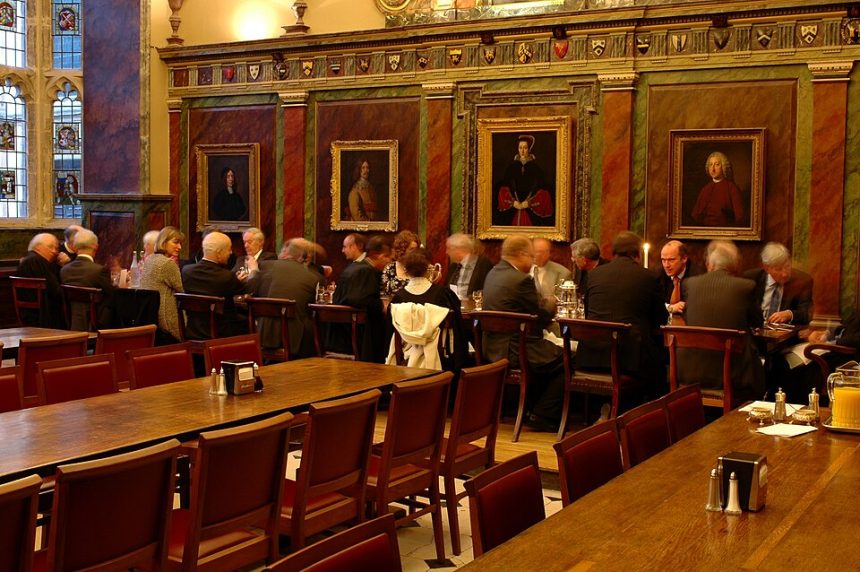
Oxford Trinity College High Table. I doubt these professors have anything to fear from a food tax. By Winky from Oxford, UK (Flickr) [CC BY 2.0], via Wikimedia Commons
A group of researchers in Oxford University, England have suggested that imposing a massive tax on carbon intensive foods – specifically protein rich foods like meat and dairy – could help combat climate change.
Pricing food according to its climate impacts could save half a million lives and one billion tonnes of greenhouse gas emissions
Taxing greenhouse gas emissions from food production could save more emissions than are currently generated by global aviation, and lead to half a million fewer deaths from chronic diseases, according to a new study published in Nature Climate Change.
The study, conducted by a team of researchers from the Oxford Martin Programme on the Future of Food at the University of Oxford and the International Food Policy Research Institute in Washington DC, is the first global analysis to estimate the impacts that levying emissions prices on food could have on greenhouse gas emissions and human health.
The findings show that about one billion tonnes of greenhouse gas emissions could be avoided in the year 2020 if emissions pricing of foods were to be implemented, more than the total current emissions from global aviation. However, the authors stress that due consideration would need to be given to ensuring such policies did not impact negatively on low income populations.
“Emissions pricing of foods would generate a much needed contribution of the food system to reducing the impacts of global climate change,” said Dr Marco Springmann of the Oxford Martin Programme on the Future of Food, who led the study. “We hope that’s something policymakers gathering this week at the Marrakech climate conference will take note of.”
Much of the emissions reduction would stem from higher prices and lower consumption of animal products, as their emissions are particularly high. The researchers found that beef would have to be 40% more expensive globally to pay for the climate damage caused by its production. The price of milk and other meats would need to increase by up to 20%, and the price of vegetable oils would also increase significantly. The researchers estimate that such price increases would result in around 10% lower consumption of food items that are high in emissions. “If you’d have to pay 40% more for your steak, you might choose to have it once a week instead of twice,” said Dr Springmann.
…
The results indicate that the emissions pricing of foods could, if appropriately designed, be a health-promoting climate-change mitigation policy in high-income, middle-income, and most low-income countries. Special policy attention would be needed in those low-income countries where a high fraction of the population is underweight, and possibly for low-income segments within countries.
Mitigation potential and global health impacts from emissions pricing of food commodities
Marco Springmann, Daniel Mason-D’Croz, Sherman Robinson, Keith Wiebe, H. Charles J. Godfray, Mike Rayner & Peter Scarborough
The projected rise in food-related greenhouse gas emissions could seriously impede efforts to limit global warming to acceptable levels. Despite that, food production and consumption have long been excluded from climate policies, in part due to concerns about the potential impact on food security. Using a coupled agriculture and health modelling framework, we show that the global climate change mitigation potential of emissions pricing of food commodities could be substantial, and that levying greenhouse gas taxes on food commodities could, if appropriately designed, be a health-promoting climate policy in high-income countries, as well as in most low- and middle-income countries. Sparing food groups known to be beneficial for health from taxation, selectively compensating for income losses associated with tax-related price increases, and using a portion of tax revenues for health promotion are potential policy options that could help avert most of the negative health impacts experienced by vulnerable groups, whilst still promoting changes towards diets which are more environmentally sustainable.
This proposal, from a group of people who have probably never missed a meal in their lives, is totally obscene. High income countries often have a lot of poor people who would be hard hit by increases in the price of food.
Needlessly exacerbating the risk poor people don’t get enough to eat, especially children and pregnant mothers, who are especially vulnerable to adverse health impacts from lack of protein in their diet – if this ghastly proposal is ever implemented, future generations will look upon it as a crime against humanity.
President Obama’s announcement of a waiver for arming unspecified rebel groups in Syria came shortly before the terrorist group Islamic State launched a massive attack on Palmyra. Syrian President Bashar Assad believes it was no coincidence, he told RT.
“The announcement of the lifting of that embargo is related directly to the attack on Palmyra and to the support of other terrorists outside Aleppo, because when they are defeated in Aleppo, the United States and the West, they need to support their proxies somewhere else,” he said.
“The crux of that announcement is to create more chaos, because the United States creates chaos in order to manage this chaos,” Assad added.
He added that Islamic State (IS, formerly ISIS/ISIL) forces “came with different and huge manpower and firepower that ISIS never had before during this attack, and they attacked on a huge front, tens of kilometers that could be a front of armies. ISIS could only have done that with the support of states. Not state; states.”
In the interview, the Syrian leader explained how his approach to fighting terrorism differs from that of the US, why he believes the military success of his forces in Aleppo was taken so negatively in the West, and what he expects from US President-elect Donald Trump.
The full transcript of the interview is below.
RT: Mr. President, thank you very much for agreeing to speak with us.
President Bashar al-Assad: You’re most welcome in Damascus.
RT: We start with Aleppo, of course. Aleppo is now seeing what is perhaps the most fierce fighting since the war started almost six years ago here in Syria, but the Western politicians and Western media have been largely negative about your army’s advance. Why you think this is happening? Do they take it as their own defeat?
B.A.: Actually, after they failed in Damascus, because the whole narrative was about “liberating Damascus from the state” during the first three years. When they failed, they moved to Homs, when they failed in Homs, they moved to Aleppo, they focused on Aleppo during the last three years, and for them this is the last most important card they could have played on the Syrian battlefield. Of course, they still have terrorists in different areas in Syria, but it’s not like talking about Aleppo as the second largest city which has the political, military, economic, and even moral sense when their terrorists are defeated. So, for them the defeat of the terrorists is the defeating of their proxies, to talk bluntly. These are their proxies, and for them the defeat of these terrorists is the defeat of the countries that supervised them, whether regional countries or Western countries like United States, first of all United States, and France, and UK.
RT: So, you think they take it as their own defeat, right?
B.A.: Exactly, that’s what I mean. The defeat of the terrorists, this is their own defeat because these are their real army on the ground. They didn’t interfere in Syria, or intervened, directly; they have intervened through these proxies. So, that’s how we have to look at it if we want to be realistic, regardless of their statements, of course.
RT: Palmyra is another troubled region now, and it’s now taken by ISIS or ISIL, but we don’t hear a lot of condemnation about it. Is that because of the same reason?
B.A.: Exactly, because if it was captured by the government, they will be worried about the heritage. If we liberate Aleppo from the terrorists, they would be – I mean, the Western officials and the mainstream media – they’re going to be worried about the civilians. They’re not worried when the opposite happens, when the terrorists are killing those civilians or attacking Palmyra and started destroying the human heritage, not only the Syrian heritage. Exactly, you are right, because ISIS, if you look at the timing of the attack, it’s related to what’s happening in Aleppo. This is the response to what’s happening in Aleppo, the advancement of the Syrian Arab Army, and they wanted to make this… or let’s say, to undermine the victory in Aleppo, and at the same time to distract the Syrian Army from Aleppo, to make it move toward Palmyra and stop the advancement, but of course it didn’t work.
‘ISIS could only attack Palmyra the way it did with supervision of US alliance’
RT: We also hear reports that Palmyra siege was not only related to Aleppo battle, but also to what was happening in Iraq, and there are reports that the US-led coalition – which is almost 70 countries – allowed ISIL fighters in Mosul in Iraq to leave, and that strengthened ISIL here in Syria. Do you think it could be the case?
B.A.: It could be, but this is only to wash the hand of the American politicians from their responsibility on the attack, when they say “just because of Mosul, of course, the Iraqi army attacked Mosul, and ISIS left Mosul to Syria.” That’s not the case. Why? Because they came with different and huge manpower and firepower that ISIS never had before during this attack, and they attacked on a huge front, tens of kilometers that could be a front of armies. ISIS could only have done that with the support of states. Not state; states. They came with different machineguns, cannons, artillery, everything is different. So, it could only happen when they come in this desert with the supervision of the American alliance that’s supposed to attack them in al-Raqqa and Mosul and Deir Ezzor, but it didn’t happen; they either turned a blind eye on what ISIS is going to do, and, or – and that’s what I believe – they pushed toward Palmyra. So, it’s not about Mosul. We don’t have to fall in that trap. It’s about al-Raqqa and Deir Ezzor. They are very close, only a few hundred kilometers, they could come under the supervision of the American satellites and the American drones and the American support.
RT: How strong is ISIS today?
B.A.: As strong as the support that they get from the West and regional powers. Actually, they’re not strong for… if you talk isolated case, ISIS as isolated case, they’re not strong, because they don’t have the natural social incubator. Without it, terrorists cannot be strong enough. But the real support they have, the money, the oil field investment, the support of the American allies’ aircraft, that’s why they are strong. So, they are as strong as their supporters, or as their supervisors.
RT: In Aleppo, we heard that you allowed some of these terrorists to leave the battleground freely. Why would you do that? It’s clear that they can go back to, let’s say, Idleb, and get arms and get ready for further attacks, then maybe attack those liberating Aleppo.
B.A.: Exactly, exactly, that’s correct, and that’s been happening for the last few years, but you always have things to lose and things to gain, and when the gain is more than what you lose, you go for that gain. In that case, our priority is to protect the area from being destroyed because of the war, to protect the civilians who live there, to give the chance for those civilians to leave through the open gates, to leave that area to the areas under the control of the government, and to give the chance to those terrorists to change their minds, to join the government, to go back to their normal life, and to get amnesty. When they don’t, they can leave with their armaments, with the disadvantage that you mentioned, but this is not our priority, because if you fight them in any other area outside the city, you’re going to have less destruction and less civilian casualties, that’s why.
‘Fighting terrorists US-style cannot solve the problem’
RT: I feel that you call them terrorists, but at the same time you treat them as human beings, you tell them “you have a chance to go back to your normal life.”
B.A.: Exactly. They are terrorists because they are holding machineguns, they kill, they destroy, they commit vandalism, and so on, and that’s natural, everywhere in the world that’s called as terrorism. But at the same time, they are humans who committed terrorism. They could be something else. They joined the terrorists for different reasons, either out of fear, for the money, sometimes for the ideology. So, if you can bring them back to their normal life, to be natural citizens, that’s your job as a government. It’s not enough to say “we’re going to fight terrorists.” Fighting terrorists is like a videogame; you can destroy your enemy in the videogame, but the videogame will generate and regenerate thousands of enemies, so you cannot deal with it on the American way: just killing, just killing! This is not our goal; this is the last option you have. If you can change, this is a good option, and it succeeded. It succeeded because many of those terrorists, when you change their position, some of them living normal lives, and some of them joined the Syrian Army, they fought with the Syrian Army against the other terrorists. This is success, from our point of view.
RT: Mr. President, you just said that you gain and you lose. Do you feel you’ve done enough to minimize civilian casualties during this conflict?
B.A.: We do our utmost. What’s enough, this is subjective; each one could look at it in his own way. At the end, what’s enough is what you can do; my ability as a person, the ability of the government, the ability of Syria as a small country to face a war that’s been supported by tens of countries, mainstream media’s hundreds of channels, and other machines working against you. So, it depends on the definition of “enough,” so this is, as I said, very subjective, but I’m sure that we are doing our best. Nothing is enough at the end, and the human practice is always full of correct and flows, or mistakes, let’s say, and that’s the natural thing.
‘West’s cries for ceasefire meant to save terrorists’
RT: We hear Western powers asking Russia and Iran repeatedly to put pressure on you to, as they put it, “stop the violence,” and just recently, six Western nations, in an unprecedented message, asked Russia and Iran again to put pressure on you, asking for a ceasefire in Aleppo.
B.A.: Yes.
RT: Will you go for it? At the time when your army was progressing, they were asking for a ceasefire.
B.A.: Exactly. It’s always important in politics to read between the lines, not to be literal. It doesn’t matter what they ask; the translation of their statement is for Russia: “please stop the advancement of the Syrian Army against the terrorists.” That’s the meaning of that statement, forget about the rest. “You went too far in defeating the terrorists, that shouldn’t happen. You should tell the Syrians to stop this, we have to keep the terrorists and to save them.” This is in brief.
Second, Russia never – these days, I mean, during this war, before that war, during the Soviet Union – never tried to interfere in our decision. Whenever they had opinion or advice, doesn’t matter how we can look at it, they say at the end “this is your country, you know what the best decision you want to take; this is how we see it, but if you see it in a different way, you know, you are the Syrian.” They are realistic, and they respect our sovereignty, and they always defend the sovereignty that’s based on the international law and the Charter of the United Nations. So, it never happened that they made any pressure, and they will never do it. This is not their methodology.
RT: How strong is the Syrian Army today?
B.A.: It’s about the comparison, to two things: first of all, the war itself; second, to the size of Syria. Syria is not a great country, so it cannot have a great army in the numerical sense. The support of our allies was very important; mainly Russia, and Iran. After six years, or nearly six years of the war, which is longer than the first World War and the second World War, it’s definitely and self-evident that the Syrian Army is not to be as strong as it was before that. But what we have is determination to defend our country. This is the most important thing. We lost so many lives in our army, we have so many martyrs, so many disabled soldiers. Numerically, we lost a lot, but we still have this determination, and I can tell you this determination is much stronger than before the war. But of course, we cannot ignore the support from Russia, we cannot ignore the support from Iran, that make this determination more effective and efficient.
‘Stronger Russia, China make world a safer place’
RT: President Obama has lifted a ban on arming some Syrian rebels just recently. What impact do you think could it have on the situation on the ground, and could it directly or indirectly provide a boost to terrorists?
B.A.: We’re not sure that he lifted that embargo when he announced it. Maybe he lifted it before, but announced it later just to give it the political legitimacy, let’s say. This is first. The second point, which is very important: the timing of the announcement and the timing of attacking Palmyra. There’s a direct link between these two, so the question is to whom those armaments are going to? In the hands of who? In the hands of ISIS and al-Nusra, and there’s coordination between ISIS and al-Nusra. So, the announcement of this lifting of that embargo is related directly to the attack on Palmyra and to the support of other terrorists outside Aleppo, because when they are defeated in Aleppo, the United States and the West, they need to support their proxies somewhere else, because they don’t have any interest in solving the conflict in Syria. So, the crux of that announcement is to create more chaos, because the United States creates chaos in order to manage this chaos, and when they manage it, they want to use the different factors in that chaos in order to exploit the different parties of the conflict, whether they are internal parties or external parties.
RT: Mr. President, how do you feel about being a small country in the middle of this tornado of countries not interested in ending the war here?
B.A.: Exactly. It’s something we’ve always felt before this war, but we felt it more of course today, because small countries feel safer when there’s international balance, and we felt the same, what you just mentioned, after the collapse of the Soviet Union when there was only American hegemony, and they wanted to implement whatever they want and to dictate all their policies on everyone. Small countries suffer the most. So, we feel it today, but at the same time, today there’s more balance with the Russian role. That’s why I think we always believe the more Russia is stronger – I’m not only talking about Syria, I’m talking about every small country in the world – whenever the stronger Russia, more rising China, we feel more secure. It’s painful, I would say it’s very painful, this situation that we’ve been living, on every level; humanitarian level, the feeling, the loss, everything. But at the end, it’s not about losing and winning; it’s about either winning or losing your country. It’s existential threat for Syria. It’s not about government losing against other government or army against army; either the country will win, or the country will disappear. That’s how we look at it. That’s why you don’t have time to feel that pain; you only have time to fight and defend and do something on the ground.
‘Mainstream media lost credibility along with moral compass’
RT: Let’s talk about media’s role in this conflict.
B.A.: Yes
RT: All sides during this war have been accused of civilian casualties, but the Western media has been almost completely silent about the atrocities committed by the rebels… what role is the media playing here?
B.A.: First of all, the mainstream media with their fellow politicians, they are suffering during the last few decades from moral decay. So, they have no morals. Whatever they talk about, whatever they mention or they use as mask, human rights, civilians, children; they use all these just for their own political agenda in order to provoke the feelings of their public opinion to support them in their intervention in this region, whether militarily or politically. So, they don’t have any credibility regarding this. If you want to look at what’s happening in the United States is rebellion against the mainstream media, because they’ve been lying and they kept lying to their audiences. We can tell that, those, let’s say, the public opinion or the people in the West doesn’t know the real story in our region, but at least they know that the mainstream media and their politicians were lying to them for their own vested interests agenda and vested interests politicians. That’s why I don’t think the mainstream media could sell their stories anymore and that’s why they are fighting for their existence in the West, although they have huge experience and huge support and money and resources, but they don’t have something very important for them to survive, which is the credibility. They don’t have it, they lost it. They don’t have the transparency, that’s why they don’t have credibility. That’s why they are very coward today, they are afraid of your channel, of any statement that could tell the truth because it’s going to debunk their talks. That’s why.
RT: Reuters news agency have been quoting Amaq, ISIL’s mouthpiece, regarding the siege of Palmyra. Do you think they give legitimacy to extremists in such a way? They’re quoting their media.
B.A.: Even if they don’t mention their news agencies, they adopt their narrative anyway. But if you look at the technical side of the way ISIS presented itself from the very beginning through the videos and the news and the media in general and the PR, they use Western technique. Look at it, it’s very sophisticated. How could somebody who’s under siege, who’s despised all over the world, who’s under attack from the airplanes, who the whole world wants to liberate every city from him, could be that sophisticated unless he is not relaxed and has all the support? So, I don’t think it is about Amaq; it’s about the West adopting their stories, sometimes directly, sometimes indirectly.
RT: Donald Trump takes over as US President in a few weeks. You mentioned America many times today. What do you expect from America’s new administration?
B.A.: His rhetoric during the campaign was positive regarding the terrorism, which is our priority today. Anything else is not priority, so, I wouldn’t focus on anything else, the rest is American, let’s say, internal matters, I wouldn’t worry about. But the question whether Trump has the will or the ability to implement what he just mentioned. You know that most of the mainstream media and big corporate, the lobbies, the Congress, even some in his party were against him; they want to have more hegemony, more conflict with Russia, more interference in different countries, toppling governments, and so on. He said something in the other direction. Could he sustain against all those after he started next month? That’s the question. If he could, I think the world will be in a different place, because the most important thing is the relation between Russia and the Unites States. If he goes towards that relation, most of the tension around the world will be pacified. That’s very important for us in Syria, but I don’t think anyone has the answer to that. He wasn’t a politician, so, we don’t have any reference to judge him, first. Second, nobody can tell what kind of pattern is it going to be next month and after.
‘Western countries only sent aid to terrorists’
RT: The humanitarian situation in Syria is a disaster, and we hear from EU foreign policy chief, Madam Mogherini, that EU is the only entity to deliver humanitarian aid to Syria. Is that true?
B.A.: Actually, all the aid that any Western country sent was to the terrorists, to be very clear, blunt and very transparent. They never cared about a single Syrian human life. We have so many cities in Syria till today surrounded by and besieged by the terrorists; they prevented anything to reach them, food, water, anything, all the basic needs of life. Of course, they attack them on daily basis by mortars and try to kill them. What did the EU send to those? If they are worried about the human life, if they talk about the humanitarian aspect, because when you talk about the humanitarian aspect or issue, you don’t discriminate. All the Syrians are humans, all the people are humans. They don’t do that. So, this is the double standard, this is the lie that they keep telling, and it’s becoming a disgusting lie, no-one is selling their stories anymore. That’s not true, what she mentioned, not true.
RT: Some suggestions say that for Syria, the best solution would to split into separate countries governed by Sunni, Shi’a, Kurds. Is it in any way possible?
B.A.: This is the Western – with some regional countries’ – hope or dream, and this is not new, not related to this war; that was before the war, and you have maps for this division and disintegration. But actually, if you look at the society today, the Syrian society is more unified than before the war. This is reality. I’m not saying anything to raise the morale of anyone, I’m not talking to Syrian audience anyway now, I’m talking about the reality. Because of the lessons of the war, the society became more realistic and pragmatic and many Syrians knew that being fanatic doesn’t help, being extreme in any idea, I’m not only talking about extremism in the religious meaning; politically, socially, culturally, doesn’t help Syria. Only when we accept each other, when we respect each other, we can live with each other and we can have one country. So, regarding the disintegration of Syria, if you don’t have this real disintegration among the society and different shades and spectrum of the Syrian society, Syrian fabric, you cannot have division. It’s not a map you draw, I mean, even if you have one country while the people are divided, you have disintegration. Look at Iraq, it’s one country, but it is disintegrated in reality. So, no, I’m not worried about this. There’s no way that Syrians will accept that. I’m talking now about the vast majority of the Syrians, because this is not new, this is not the subject of the last few weeks or the last few months. This is the subject of this war. So, after nearly six years, I can tell you the majority of the Syrians wouldn’t accept anything related to disintegration, they are going to live as one Syria.
RT: As a mother, I feel the pain of all Syrian mothers. I’m speaking about children in Syria, what does the future hold for them?
B.A.: This is the most dangerous aspect of our problem, not only in Syria; wherever you talk about this dark Wahhabi ideology, because many of those children who became young during the last decade, or more than one decade, who joined the terrorists on ideological basis, not for the like of money or anything else, or hope, let’s say, they came from open-minded families, educated families, intellectual families. So, you can imagine how strong the terrorism is.
‘Being secular doesn’t protect a nation from terrorist ideology’
RT: So, that happened because of their propaganda?
B.A.: Exactly, because the ideology is very dangerous; it knows no borders, no political borders, and the network, the worldwide web has helped those terrorists using fast and inexpensive tools in order to promote their ideology, and they could infiltrate any family anywhere in the world, whether in Europe, in your country, in my country, anywhere. You have secular society, I have secular society, but it didn’t protect the society from being infiltrated.
RT: Do you have any counter ideology for this?
B.A.: Exactly, because they built their ideology on the Islam, you have to use the same ideology, using the real Islam, the real moderate Islam, in order to counter their ideology. This is the fast way. If we want to talk about the mid-term and long-term, it’s about how much can you upgrade the society, the way the people analyze and think, because this ideology can only work when you cannot analyze, when you don’t think properly. So, it’s about the algorithm of the mind, if you have natural or healthy operating system, if you want to draw an analogy to the IT, if you have good operating systems in our mind, they cannot infiltrate it like a virus. So, it’s about the education, media and policy because sometimes when you have a cause, a national cause, and people lose hope, you can push those people towards being extremists, and this is one of the influences in our region since the seventies, after the war between the Arabs and the Israelis, and the peace failed in every aspect to recapture the land, to give the land and the rights to its people, you have more desperation, and that played into the hand of the extremists, and this is where the Wahhabi find fertile soil to promote its ideology.
RT: Mr. President, thank you very much for your time, and I wish your country peace and prosperity, and as soon as possible.
B.A.: Thank you very much for coming.
RT: This time has been very tough for you, so I wish it’s going to end soon.
B.A.: Thank you very much for coming to Syria. I’m very glad to receive you.
Recently, Democrat Hawaii Congresswoman, Tulsi Gabbard, went on CNN’s “The Lead” hosted by Jake Tapper, to talk about Donald Trump’s foreign policy, and more importantly, to discuss the disturbing reality of US taxpayer support of armed militants and terrorists in places like Syria. Instead of adulation for doing the honorable thing, she received a hostile reaction from one of CNN’s many highly paid onscreen propagandists.
When asked by CNN’s Jake Tapper (photo, right) about US Representative Tulsi Gabbard’s recent visit to Trump Tower, she replied, “My goal in going there, in receiving the invitation to speak to President-elect Trump was to speak specifically about the situation in Syria, the dangerous consequences of escalating the regime change war that the United States is fuelling there along with countries like Saudi Arabia, and Qatar, and Turkey are escalating that through a so-called no-fly zone or safe zone. And urging him to end our regime change war there to stop funding both directly and indirectly groups that are working with Al Qaeda and ISIS. And to stop funneling those dollars and weapons and other assistance through these others countries like Saudi Arabia who are directly supporting these terrorist groups who are supposed to be our enemy, who we’re supposed to be fighting to defeat.”
Visibly agitated by her answer, Tapper then asks Gabbard, herself an Iraq War veteran and a current member of the Hawaii National Guard, about her recent Bill introduced on the House floor last week entitled, the “Stop Arming Terrorists Act,” which proposes severe legal repercussions to any US officials or persons involved in the arming or funding, either directly or possibly indirectly, of terrorists overseas – including the US-backed “rebel” terrorists currently operating in Syria. What’s key is that Gabbard points out that this activity is funded by the US taxpayer. Not surprisingly, CNN has never reported this side of the clandestine issue before. Here’s how their fascinating conversation transpired:
TAPPER: And tell me about legislation. You have a bill that you introduced today that would address loopholes.
GABBARD: Yes.
TAPPER: You say have allowed American taxpayer dollars to fund terror groups such as Al Qaeda and ISIS in Syria. Are you — are you suggesting that the U.S. government is funding these terrorist groups?
GABBARD: I’m not only suggesting it. This is — this is the reality that we’re living in.
TAPPER: Not directly, though.
GABBARD: Most Americans — you know, if you were — I were to go and provide money, weapons, or support or whatever to a group like Al Qaeda or ISIS, you would immediately be thrown in Jail. However, the U.S. government has been providing money, weapons, intel assistance and other types of support through the CIA, directly to these groups that are working with and are affiliated with Al Qaeda and ISIS.
TAPPER: So, you’re saying the CIA is giving money to groups in Syria, and those groups are working with Al-Nusra and ISIS.
GABBARD: There are — there have been numerous reports from The New York Times to the Wall Street Journal and other news outlets who have declared that these rebel groups have formed these battlefield alliances with Al Qaeda, that essentially is Al Qaeda groups are in charge of every single rebel group on the ground fighting in Syria to overthrow the Syrian government.
Tapper goes on to act stunned and befuddled, insinuating that Gabbard is “wrong” – as if Gabbard were somehow making up her accusations, as he becomes somewhat confused trying to manage CNN’s complicated contrived narrative. Tapper then insists that “Obviously, they (US-funded ‘rebel’ terrorists) are all fighting Assad.” Gabbard quickly calls out Tapper’s clear attempt at US State Dept propaganda talking points management Here’s the latter exchange:
TAPPER: And the U.S. government says they vet the groups that they give money to very, very closely. And that you’re wrong, there are not alliances between groups that the American taxpayers fund and these other groups. Obviously, they all are fighting Assad.
GABBARD: I beg to differ. Evidence has shown time and time again that that is not the case, that we are both directly and indirectly supporting these groups who are allied with or partnered with Al Qaeda and ISIS, in working to over throw the Syrian government of Assad. And we’ve also been providing that support through countries like Saudi Arabia, Turkey and Qatar to do that.
Gabbard’s brave new legislation might be the most important and explosive development regarding Syrian Foreign Policy in Washington, but instead of pursuing this discussion, CNN’s Tapper predictably tried to change the subject to Michael Flynn instead.
Watch this incredible exchange here:
21WIRE has reported previously on the possibility that CNN is serving as a media adjunct to either the Pentagon, NSA or the CIA (or all three). Judging by Jake Tapper’s offhanded comments and attempt to discredit Gabbard live on air, it only strengthens that probability.
21WIRE also reported previously how CNN has clearly chosen to only air coverage favorable to what the network has claimed to be “rebels” in Syria, when in reality – these were mostly terrorist fighting groups. CNN’s “star reporter” Clarissa Ward even went so far as to characterize terrorist suicide bombers in a sympathetic manner in her reports – clearly designed to give positive PR to terrorists groups like Al Nusra Front who have been occupying East Aleppo since 2012. Other actors in field seemingly employed by CNN who are operating in clear support of terrorists in East Aleppo include one Bilal Abdul Kariman apparent US asset promoting jihadist extremism, together with Ward, producing what are clearly staged reports, alongside CNN’s endless airing of unvetted, staged White Helmets imagery. 21WIRE have also recently revealed additional terrorist-links with the White Helmets, who are a US State Dept, British Foreign Office and EU-funded pseudo NGO – and passing it off to the viewing public as authentic video and photos supplied by nameless “Syrian activists”.
Throughout the west’s proxy war against Syria, CNN has only reported the rebel/terrorist perspective, shamelessly portraying militant terrorists as “moderate rebels” and freedom fighters, while systematically demonizing any Syrian or Russian who is defending the nation-state of Syria. This might explain Tapper’s near contempt for Gabbard’s accurate statements regarding US arming and funding of known terrorist groups in Syria.
2016 was the year that CNN was exposed as perhaps the most corrupt mainstream media outlet in the United States. A number of other leaked emails revealed an unprecedented level of media corruption and systematic partisan collusion between operatives at CNN and the Hillary Clinton Campaign – a naked violation of every fundamental principle of nonobjective press practices. In the leaked email exchanges, one could see gleeful Clinton campaign officials boasting about getting favorable news coverage from compliant mainstream media ‘journalists’ – with CNN being perhaps the worst offender. Clinton staffers even went so far as to circulate names of journalists who were deemed “friendly” to their candidate.
Among the notorious Wikileaks email dump was a CNN request to DNC staffers asking for questions to ask during a Wolf Blitzer interview with then GOP candidate Donald Trump.
In another email on April 28, CNN operative Jason Seher, a writer for Jake Tapper’s show “The Lead” on CNN, emailed DNC media coordinator Pablo Manriquez thanking him for working behind the scenes with CNN.
In a separate conversation CNN’s Seher, then thanked DNC insider Martinez for ‘facilitating Luis coming on today, and bearing with us through a meelee of GOP nonsense and cancellations and all that. Any particular points he’ll want to make? We’re gonna stay Dem focused…’
Perhaps the worst CNN violation of press independence was when the network’s supposed “chief political analyst,” Gloria Borger, tried to get an interview with Clinton chief of staff John Podesta by assuring him of essentially softball questions.
“I know John will have an exalted place in the campaign, and would love to chat with him about HRC, in a general way, not in a gotcha way re HRC,” said Borger. “It would be about 10 mins, very general, about her as a person and a candidate.”
What most amazing about all of this, is that CNN executives refused to consider firing any of their personalities who have been implicated in open collusion with the Democratic party during one of the most crucial political contests in US history.
In another leak provided to The Intercept by the source known as Gucifer 2.0 Other CNN reporters discovered on the DNC’s ‘VIP List’ of media operatives counted on by the Clinton campaign included Kate Bouldan, Brianna Kielar, Jeff Zeleny, Sam Feist, David Chalian, John Berman, and Mark Preston.
The only person who lost their paid position with CNN was the now disgrace political operative, Donna Brazile, currently still holding onto her gifted position as interim Chairwoman of the DNC – who was also moonlight for extra cash as “contributor” for CNN. Brazile was also a Super Delegate for Hillary Clinton. Podesta Email dumps exposed the fact that Brazile, a CNN contributor was caught giving Hillary’s campaign debate questions in advance of CNN’s Town Hall debate event.
As a result, CNN’s reputation as a trustworthy media outlets has been held in question by most of the public.
When it comes to coverage of both the 2016 Election and the Syrian War, CNN has been on the wrong side of history – and should not be trusted to give accurate and fair reporting regarding serious and important issues.
US President-elect Donald Trump has announced ExxonMobil CEO Rex Tillerson as his secretary of state. Tillerson, who has close ties to Russia, spoke to RT back in 2012 after signing a landmark deal with Russian oil giant Rosneft.
Back then, Tillerson said that bolstering ties with Russia was vital for business. In 2012 he oversaw the singing of a partnership deal between Exxon and Rosneft to develop the Arctic’s rich untapped reserves.
“With these agreements we have a lot on our plate. But we will continue to evaluate other opportunities that might present themselves,” he told RT.
Israel’s “defence” minister Avigdor Lieberman has penned an article for Defense News to explain his regime’s struggles in a turbulent Middle East.
In a similar tone to those of the Israeli politicians, Lieberman wastes no time to call the legitimate forces of Hamas in Palestine and Hezbollah in Lebanon as terrorist forces. He says, “The massive convulsions that in recent years have swept through North Africa and erupted in Syria, Iraq and Yemen and elsewhere throughout the region, and which have seen the empowerment of semi-territorial terrorist organizations such as ISIS, Hamas and Hezbollah, represent an earthquake of historic proportions. Multi-ethnic states such as Libya, Syria and Iraq have descended into chaotic civil wars as many aspects of the region’s enduring political order, whose origins lie in the aftermath of World War One, disintegrate.”
Lieberman goes on to draw three conclusions as the solutions for ending the crisis in the Middle East. The second conclusion is clearly a call to attack the sovereignty of the independent countries. Lieberman says, “many of the countries in the Middle East were established artificially, as a result of the Sykes-Picot Agreement and based on colonial considerations that did not take into account the pattern of habitation and the deep sectarian rifts within the respective societies.
Thus, to genuinely solve the region’s problems, borders will have to be altered, specifically in countries like Syria and Iraq. Boundaries need to be redrawn between Sunnis, Shia and other communities to diminish sectarian strife and to enable the emergence of states that will enjoy internal legitimacy. It is a mistake to think that these states can survive in their current borders.
A similar conclusion holds true for the Israeli-Palestinian arena and for the borders that will ultimately need to be drawn for the achievement of a stable two-state outcome. We need “out of the box” analysis to avoid being misled by habitual ways of thinking.”
One can not better understand the reason behind the “civil wars” in Syria and Iraq without reading Israel’s defense minister’s call to divide Syria and Iraq.
Independent journalist Eva Bartlett (who has done incredible work in Gaza as well) sets a smug Norwegian reporter straight during a UN Syria Mission press conference.
Russia Insider was started in September 2014 by a group of expats living in Russia who felt that coverage of Russia is biased and inaccurate. The mission of Russia Insider is media criticism and reform.
Last week US President Obama waived military aid restrictions for “foreign forces” and others in Syria. When hopes were raised for an end to the Syrian conflict following the recapture of most of eastern Aleppo, the US is pouring more petrol on the fire.
Now, we can question as to whether this will make a massive difference on the ground as we know the US and its allies have already been backing “foreign forces” in Syria. However, at least it shows people who may have had their doubts, as to what Washington’s game is. Namely, to prolong the agony for the people of Syria for as long as it can. The attitude is: “If we cannot topple Assad, then we’ll damn well make sure we’ll keep his country burning.” And all this – lest we forget- brought to us by an American President who was awarded the Nobel Peace Prize.
The truth is that every time there’s been a real chance of an end to the conflict in Syria, Uncle Sam has stepped in to sabotage it.
Members of the Syrian opposition who wanted to participate in democratic politics under Syria’s new constitution were deliberately sidelined. Instead, the US and their pro-regime-change allies backed radical militants who wanted the violent overthrow of the country’s government. In March 2012, a six-point peace plan to end the conflict (then just over a year old) was put forward by the Arab League and the UN. The Syrian government was reported to have accepted the so-called Kofi Annan plan, and the initiative also got thumbs up from opposition figures in Syria. So what did ‘Fireman’ Uncle Sam and his allies do? Yes, that’s right: They poured more petrol onto the fire at a time when the blaze could have been extinguished.
“Within days of Annan’s peace plan gaining a positive response from both sides in late March, the imperial powers openly pledged, for the first time, millions of dollars for the Free Syrian Army; for military equipment, to provide salaries to its soldiers and to bribe government forces to defect. In other words, terrified that the civil war is starting to die down, they are setting about institutionalizing it”, wrote Dan Glazebrook in Al-Ahram Weekly.
Just imagine if the Annan peace plan had succeeded in 2012. How many Syrians, now dead, would still be alive?
However, Washington only wanted to escalate the conflict – not to end it.
It was a similar story in the Balkan wars in the 1990s. The 1992 Lisbon agreement provided for the peaceful division of an independent Bosnia. But, US Ambassador Warren Zimmerman urged Alija Izetbegovic to renege on his acceptance of the deal telling him “If you don’t like it, why sign it.”
Result: a brutal war in Bosnia in which many thousands of people lost their lives including around 8,000 at Srebrenica. Again, it could all have been avoided if the US had genuinely wanted peace. Instead, the US set fire to Bosnia and then blamed the Serbs.
Seven years later, the State Department was at it again, deliberately preventing a diplomatic solution to the conflict in Kosovo, a conflict which – as in Syria and Bosnia – they had done much to ignite in the first place. Horrified that Yugoslav President Slobodan Milosevic was ready to accept international peacekeeping forces in Kosovo and therefore deprive NATO of a pretext for bombing his country, the US and the UK added an Appendix to the document at Rambouillet allowing for NATO’s military occupation of Yugoslavia, which they knew Milosevic could not possibly agree.
Later, Lord Gilbert, a UK Minister for Defence Procurement, admitted: “I think certain people were spoiling for a fight in NATO at that time. I think the terms put to Milosevic at Rambouillet were absolutely intolerable: how could he possibly accept them? It was quite deliberate.”
In Afghanistan, the US has spent decades in making sure that peace does not prevail. For most of the 80s, the Soviet leadership was looking to withdraw its forces from the country and negotiate a peace deal. In their book “Cold War,” Jeremy Isaacs and Taylor Downing, note how Yuri Andropov, Soviet leader from 1982-1984, offered a timetable for withdrawal if the US (and Pakistan) stopped supplying the anti-government Mujahedeen and a government similar to the one in power in Kabul stayed in place. “From the archives, we know that the Soviets were trying to disengage honorably, leaving behind a friendly regime in Kabul,” say Isaacs and Downing. However, the US “concentrated instead on supplying arms to the Mujahedeen and on letting the Soviet Union ‘bleed’.”
Even after the Soviet Union formally signed up to withdrawal in accords in 1988, the US was still pumping arms into the country. “A long civil war dragged on for years,” note Isaacs and Downing.
And still drags on to this day. In his farewell speech in 2014, Afghanistan’s outgoing President Hamid Karzai, who had come to power following the US-led invasion of his country in 2001, blamed the US for the fact that his country was still at war. “One of the reasons was that the Americans did not want peace because they had their own agenda and objective,” Karzai said. He warned the new Afghan government to be “extra cautious in its dealings with the West.”
Across the world, as I detailed here, the US has fought consistently against the peace.
As a foreign policy, it’s hard to think of a more devilish one than starting fires and then doing everything to stop those fires being put out. But of course, while it is bad news for the ordinary people on the ground, it is good news for the arms manufacturers and those who want certain strategically important countries kept permanently weakened.
The question is: Will things change under Trump, whom only last week pledged “We will stop trying racing to topple regimes” and that the policy of ‘intervene and chaos’ would come to an end?
Perhaps it’s just words, but some, clearly, are worried that there will be a shift. You don’t have to be a Trump supporter to acknowledge that the US ‘Deep State’ and much of the establishment media is doing all it can to de-legitimize his election win.
And you’d be very naïve indeed to think that they’re doing this because of things he said about women.
“Perles of Wisdom for the Feithful,” by Akiva Eldar, Ha’aretz, October 1, 2002: http://iakn.us/2hkzdzo
“The Bush Neocons and Israel,” by Kathleen and Bill Christison, Counterpunch, December 2002: http://iakn.us/2h1ajEi
“Neo-Cons, Israel and the Bush Administration,” by Stephen Green, Counterpunch, February 2004: http://iakn.us/2ggBcVi
Books mentioned in the video:
“The Transparent Cabal: The Neoconservative Agenda, War in the Middle East, and the National Interest of Israel” by Dr. Stephen J Sniegoski: http://iakn.us/2geT2mJ
“The Road to Iraq: The Making of a Neoconservative War” by Muhammad Idrees Ahmad: http://iakn.us/2hoz4Hn
“The Israel Lobby and U.S. Foreign Policy” by John J. Mearsheimer and Stephen M. Walt: http://iakn.us/2gfPFAR
Some additional books with information on this topic:
“Shadow Elite: How the World’s New Power Brokers Undermine Democracy, Government, and the Free Market” by Janine R. Wedel: http://iakn.us/2hoBKEW
“Queen of Chaos: The Misadventures of Hillary Clinton” by Diane Johnstone: http://iakn.us/2gojmhO
Wedell discusses the “massive and concerted ‘information’ effort conducted by the Neocon core and their associates, with crucial participation from certain columnists and reporters, that was essential in taking the United States to war in Iraq.”
“….beginning in the mid-1970s, they employed methods ranging from the creation of alternative intelligence; to might-be-authorized, might-not-be authorized diplomacy; to setting up pressure groups; to suspending standard government process, always contesting government information, assessments, and expertise. These methods—perfected over the years—would be deployed in full force in the Neocon core’s effort to take the United States to war in 2003.”
Johnstone states: “…the neocons gained notoriety as architects of the disastrous invasion of Iraq. The main thinker behind this war was Bush’s Under Secretary of Defense for Policy, Paul Wolfowitz…”
“…two veterans of the defunct PNAC, William Kristol and Robert Kagan, returned in 2009 to found the Foreign Policy Institute (FPI). Robert Kagan is the current leading neocon theorist and the husband of Secretary of State Hillary Clinton’s spokeswoman, Victoria Nuland, instigator of the Ukrainian coup in early 2014.”
For information on the early roots of the Israel lobby, please see Alison Weir’s book, “Against Our Better Judgment: The Hidden History of How the U.S. Was Used to Create Israel”: http://iakn.us/AOBJ-book
Iran has summoned the British ambassador to Tehran over the recent meddlesome remarks made by UK Prime Minister Theresa May against the Islamic Republic. Speaking at the annual summit of the [Persian] Gulf Cooperation Council [GCC] in the Bahraini capital of Manama on Wednesday, May said Britain would help the GCC states “push back” against what she claimed to be Iran’s “aggressive regional actions.”
An investigative journalist says Theresa May seems to be from the school of “foot in mouth” diplomacy, adding that she is speaking more in the interest of foreign powers such as the United States and Israel than Britain.
“Right at the moment, there is a very important deal being struck between Royal Dutch Shell and Iran as she should know, and she cannot go around talking about Iran’s aggressive actions in the region where actually it is a bit rich coming from her, [because] Britain’s aggressive actions in the region along with the United States have been going on since the First World War. There is also problems because Britain and America have been interfering in the region for a long, long time and so she has been totally hypocritical,” Tony Gosling told Press TV in an interview on Sunday.
He stated that the British premier is ruining the good relations built between Tehran and London.
The analyst also noted that Theresa May represents an “authoritarian” government at the moment in Britain, adding that she neither represents the views of ordinary British people, nor of her own cabinet.
Golsing further opined that UK’s ulterior motive for increasing its presence in the Middle East is arms sales to the Persian Gulf states such as Bahrain.
He also argued that Theresa May has effectively been implanted by the “securocrats” in Britain, that is to say the secret services and the top echelons of the civil service.
“She is walking around the world saying silly things and what is worse she is supping with some of the worst regimes on the planet. We are talking about people like Saudi Arabia with an appalling human rights record, which is smashing poor Yemen, a beautiful country, incredibly historic place, [and also] the poorest country in the Middle East,” he said.
An Open Letter to Terry Allen, Noam Chomsky, Alexander Cockburn, David Corn, Chris Hayes, George Monbiot, Matthew Rothschild, and Matt Taibbi.
[1]According to several left-leaning critics of the 9/11 Truth Movement, some of its central claims, especially about the destruction of the World Trade Center, show its members to be scientifically challenged. In the opinion of some of these critics, moreover, claims made by members of this movement are sometimes unscientific in the strongest possible sense, implying an acceptance of magic and miracles. … Full article
This site is provided as a research and reference tool. Although we make every reasonable effort to ensure that the information and data provided at this site are useful, accurate, and current, we cannot guarantee that the information and data provided here will be error-free. By using this site, you assume all responsibility for and risk arising from your use of and reliance upon the contents of this site.
This site and the information available through it do not, and are not intended to constitute legal advice. Should you require legal advice, you should consult your own attorney.
Nothing within this site or linked to by this site constitutes investment advice or medical advice.
Materials accessible from or added to this site by third parties, such as comments posted, are strictly the responsibility of the third party who added such materials or made them accessible and we neither endorse nor undertake to control, monitor, edit or assume responsibility for any such third-party material.
The posting of stories, commentaries, reports, documents and links (embedded or otherwise) on this site does not in any way, shape or form, implied or otherwise, necessarily express or suggest endorsement or support of any of such posted material or parts therein.
The word “alleged” is deemed to occur before the word “fraud.” Since the rule of law still applies. To peasants, at least.
Fair Use
This site contains copyrighted material the use of which has not always been specifically authorized by the copyright owner. We are making such material available in our efforts to advance understanding of environmental, political, human rights, economic, democracy, scientific, and social justice issues, etc. We believe this constitutes a ‘fair use’ of any such copyrighted material as provided for in section 107 of the US Copyright Law. In accordance with Title 17 U.S.C. Section 107, the material on this site is distributed without profit to those who have expressed a prior interest in receiving the included information for research and educational purposes. For more info go to: http://www.law.cornell.edu/uscode/17/107.shtml. If you wish to use copyrighted material from this site for purposes of your own that go beyond ‘fair use’, you must obtain permission from the copyright owner.
DMCA Contact
This is information for anyone that wishes to challenge our “fair use” of copyrighted material.
If you are a legal copyright holder or a designated agent for such and you believe that content residing on or accessible through our website infringes a copyright and falls outside the boundaries of “Fair Use”, please send a notice of infringement by contacting atheonews@gmail.com.
We will respond and take necessary action immediately.
If notice is given of an alleged copyright violation we will act expeditiously to remove or disable access to the material(s) in question.
All 3rd party material posted on this website is copyright the respective owners / authors. Aletho News makes no claim of copyright on such material.

 When asked by CNN’s Jake Tapper (photo, right) about US Representative Tulsi Gabbard’s recent visit to Trump Tower, she replied, “My goal in going there, in receiving the invitation to speak to President-elect Trump was to speak specifically about the situation in Syria, the dangerous consequences of escalating the regime change war that the United States is fuelling there along with countries like Saudi Arabia, and Qatar, and Turkey are escalating that through a so-called no-fly zone or safe zone. And urging him to end our regime change war there to stop funding both directly and indirectly groups that are working with Al Qaeda and ISIS. And to stop funneling those dollars and weapons and other assistance through these others countries like Saudi Arabia who are directly supporting these terrorist groups who are supposed to be our enemy, who we’re supposed to be fighting to defeat.”


 Aletho News


