One of the West’s top points in condemning Vladimir Putin’s “regime” since 2007 has been his alleged suppression of democratic institutions, including an assault on media freedom and imposition of government-directed propaganda. This week, the accusation was repeated in a resolution of the European Parliament calling for stronger counter-measures in defense of European values against “information warfare” from Moscow.
The charges — that Russian media are only an instrument of state propaganda directed at the domestic population to keep Russian citizens in line and at foreign audiences to sow dissent among Russia’s neighbors and within the European Union — are taken as a matter of faith with almost no proofs adduced. Anyone who questions this “group think” is immediately labeled a “tool of Putin” or worse.
I experienced this firsthand in March 2015 when, as one of three debaters on “The Network,” a Euronews public affairs program, I objected to remarks by a fellow panelist, Chairman of the European Parliament’s Foreign Relations Committee Elmar Brok, who maintained that Putin crushed all liberties and his country has no free press.
Based on my familiarity with the many different political lines of the Russian print media and of the patently unintimidated Kremlin-critics behind the national radio station Ekho Moskvy and television station Dozhd’, I countered that, for example, Russian coverage of events in the Donbass was more multi-sided and free than coverage in the U.S.
Brok lashed out with the slanderous question: “And how much did the Kremlin pay you to say that?” The broadcaster then allowed this video-taped exchange to air freely.
I have ruminated on this exchange ever since and sought incontrovertible proof of the relative freedom of expression on Russian broadcast media. My close examination of the wildly popular political talk shows on Russian television first as a spectator and then as a participant has provided just that.
I have written previously about my initial experience going back six months to when I first took part in a program on the Rossiya 1/Vesti 24 state channel, Yevgeni Popov’s “Special Correspondent.” I mentioned at the time the nearly permanent presence on these programs of domestic opposition figures as well as of foreigners from the U.S., Ukraine, Poland and Israel, in particular, who could be counted on to present views on the political topic of the day’s discussion at sharp variance with the Kremlin line.
Assessing the Talk Shows
In early autumn I appeared on the same presenter’s new show “Sixty Minutes,” as well on what is probably the most respected show of this genre, “Sunday Evening with Vladimir Soloviev,” another Rossiya 1 production. Soloviev has done feature-length television interviews with Vladimir Putin and may be considered to be as close to power as people in this medium get. His personal views are probably more nationalist than the ruling United Russia party, but on his shows he, too, gives time on air to very diverse Russian and foreign views.
In the past month, I broadened my experience with the Russian talk show format by participating in shows on the other major state channel, Pervy Kanal (“Time Will Tell”) and on the country’s largest commercial television channel, NTV (“The Meeting Place”). This accelerated learning was facilitated by the U.S. presidential elections, which made Russian-speaking talking heads from America like myself a rather hot commodity on Russian television at least briefly.
In speaking to fellow panelists during break time, in interviews with presenters, I gathered some inside information about the production side of the talk shows, including their target audiences, their technical aspects and their substantive positioning.
Anyone looking over Russian television programming in general quickly finds that talk shows as a format take up a very large part of broadcast time. Of course, the focus of talk shows may be highly diverse, and political talk shows were traditionally an evening phenomenon, as is the case with the Rossiya 1 shows cited above, while daytime programming more typically focuses on housewives’ concerns, daydreams of romance or tips for cooking, and the like.
In this sense, it was a bold move when two years ago Pervy Kanal decided to launch a daily two-hour political talk show (“Time Will Tell”) in mid-afternoon. As expected, the target audience proved to be stay-at-home women and viewers aged 50 and above, although it appears there are also a fair number of viewers watching the program in the work place.
Going Daytime
The ratings captured by this show typically are in the 20s, meaning that 20 or so percent of all television viewers in Russia at the given time are tuned to the given program, yielding an audience numbering in the millions. On Nov. 9, when I appeared on the show dedicated to analysis of the U.S. election results, the numbers spiked to 30 percent, as one might well understand given the very great interest among ordinary Russians in the outcome of the race for the U.S. presidency and the outlook for war or peace.
As “Time Will Tell” presenter Artyom Sheinin explained to me, the decision to appear on daytime television called for certain production decisions differentiating the programs from the evening talk shows. Firstly, the expectation of a less sophisticated audience meant that the language of panelists should be free of political science jargon and allusion to little known names or philosophies.
Said Artyom, panelists are asked to pitch their arguments as they would “talking to their kids, their mom or their lover.’’ On the other hand, overly calm discussion is not seen as a benefit. The presenter explains that his audience sitting at home at mid-day is in need of “an adrenaline shot,” and the normal penchant of Russian panelists to shout down one another in a free-for-all is not discouraged in the way it is on evening programming. The evening viewer is assumed to have come home from work and is seated in his armchair before the television, wants his nerves soothed more than excited.
All Russian political talk shows on the main channels are produced in the afternoon, Moscow time, and all feature on screen the caption “Live On Air.” However, where and when these shows are broadcast live versus rebroadcast from video tapes is another matter.
For example, the Rossiya 1/Vesti programs are broadcast live to the Russian Far East, where they appear at the end of prime-time evening broadcasts. Then they are re-broadcast at local evening prime time in each of the eight other time zones of the Russian Federation lying to the west, showing last in Moscow.
In this regard, two years ago when it launched “Time Will Tell,” Pervy Kanal took a second unparalleled risk by broadcasting live to Moscow in the afternoon. From a political standpoint, this was like a high-flying trapeze act without the benefit of a safety net.
In fact all of these programs are also video-taped, and all the major channels make the tapes available for internet viewing on their websites in full or shortened versions.
Similar Formats
Just as Russian television has often copied studio design and presentation formats from American television (I think in particular of the way the “Tonight Show” has been replicated on major Russian channels), so they copy from one another. In fact, if you turn on any of the political talk shows I cited above, you will find rather similar studios with live audiences.
Indeed, at Pervy Kanal, the producers remark jokingly that when NTV decided to launch its own afternoon talk show, “The Meeting Place,” that network picked up not only the production format and studio design but also some of the production staff. The format of having male-female pairs of talk show hosts also has spread widely in the industry.
But there appears to be a significant difference between these shows on the degree to which they are “scripted” by management upstairs, the degree to which they are free discussion. Perhaps the most scripted is this season’s new entry at Rossiya 1, “Sixty Minutes,” in which presenters Yevgeni Popov and Olga Skabeyeva are reading off teleprompters and the audience applause is aggressively prompted. On the other hand, the lead presenter on Pervy Kanal’s “Time Will Tell,” Artyom Sheinin proudly says that he has no script handed to him, that what he says on air is what he himself prepared or is thinking at the time.
One ubiquitous fact is that the panelists are not scripted and if anyone is cut off in mid-sentence it is by other panelists vying for the microphone, not by the presenter keeping the political line of discourse in check. Except in the case of senior politicians, who are given the respect their rank demands, no panelist is safe from interruptions and the audience encourages a culture of gladiators in the arena, with applause punctuating the debates.
On NTV there is the additional expression of audience disapproval, but that is rare. The benefits of these ground rules go to the quick-witted as well as to the loudest voices, whatever their political complexion.
The culture of these talk shows is permeated by a newsroom mentality. Some of the presenters, especially on Rossiya 1/Vesti 24, come from television journalism and have gotten their appointments as a reward for successful work in the field, especially in hazardous areas. Such was the background of talk show host Yevgeni Popov, who for years reported from Ukraine, initially during the Orange Revolution days and later during the Maidan protests.
The content of each program on all channels is subject to change at the last minute as are the list of invited panelists in case of breaking news. This favors inviting panelists who are living in the Moscow area. They can be invited and disinvited at short notice. In fact, all the major political shows on the three channels I observed from inside use many of the same Russian and foreign panelists chosen from among political scientists at universities or think tanks, journalists and Duma or Federation Council members.
Western Voices
To be sure, not all panelists come down to the studio. A very few lucky experts are given air time from remote locations, their close-up image projected onto a wall-sized screen.
One such “regular” on the Rossiya 1/Vesti 24 channel is Dimitri Simes, president of The Center for the National Interest in Washington, D.C. These vignette appearances get special treatment, without any interruption from other panelists and only respectful questioning from the host.
Panelists in greatest demand can be seen leaving one show early so as to be able to get over to another studio on a different channel when there is the rotation of panelists between advertising breaks. None is in greater demand than the American Michael Bohm, who in the dark days of worsening relations with the West provided all channels with highly fluent statements in Russian of the latest policy position of the Washington Consensus, often accompanied by Russian folk expressions.
This has been especially appreciated by television producers representing the more hardline supporters of the Kremlin for whom Bohm is the kind of American the audience loves to hate, his every remark justifying demands for greater military expenditures by the Kremlin. Nonetheless, it remains true that through Bohm and a few other Westerners on these shows, the full blast of Western critiques of Kremlin policy gets prime broadcasting time in Russia.
The senior politicians brought in as panelists come from all the Duma parties, not just the ruling United Russia. In the past half year, I noted in particular the frequent presence of the leader of the nationalist LDPR party, Vladimir Zhirinovsky, while Gennady Zyuganov of the Communists or Sergey Mironov, leader of Just Russia, have been rare birds.
On the other hand, there have been frequent appearances by the Liberals of the Yabloko party, which never made it past 1 percent of votes cast in the latest parliamentary elections, not to mention the minimum 5 percent threshold for Duma representation.
The talk show programs are prepared with great professionalism. Behind each there is extensive research to find appropriate archival and/or latest visuals. The administrative chores involved in arranging logistics for the panelists chosen are also considerable. The team members I have encountered were uniformly dedicated, working crazy hours to get their job done.
Encouraging Strong Opinions
I also noted a peculiar complicity between the staff “handlers” and us panelists. Clearly, production staff is rewarded for finding “fresh blood” panelists who play out well, and they make sure that their dogs in the race are well tended with coffee, tea, and, if needed, a shot of brandy during breaks to keep their spirits high.
On the Rossiya 1/Vesti 24 talk shows presenters and the panelists all are wired with headset microphones. However, on both Pervy Kanal and NTV, only the presenters are wired, while panelists are seated next to production assistants holding microphones, which they make available upon request. Indeed, the assistants act as coaches to newcomers like myself, whom they urge to speak louder, speak faster, etc. to get the greatest debate effect out of us.
In conclusion, my firsthand experience with the Russian political talk show phenomenon left me with no doubt that this is bona fide journalism serving the public interest, exposing the broad Russian television audience, from everyone’s parents and grandparents to business leaders and university dons, to a great many different competing and well-presented views on the major issues of the day, both domestic and international.
This reality is sharply at variance with what U.S. and Western European mainstream media would have us believe about Putin’s Russia.
Gilbert Doctorow is the European Coordinator of The American Committee for East West Accord Ltd. His most recent book, Does Russia Have a Future? was published in August 2015.
By Jon Rappoport | Activist Post | November 20, 2016
They kept telling the American people Hillary Clinton was going to win the election; and in every way they could think of, they told the American people this was a good idea.
Then, on election night, they, the media, crashed.
The results came in.
The media went into deep shock.
As protests and riots then spread across America, the media neglected to mention a) they’d been bashing Trump because he said he might not accept the outcome of the vote, and b) here were large numbers of people on the Democrat side who weren’t accepting the outcome of the vote.
A new campaign had to be launched.
Suddenly, on cue, it was: Hillary Clinton lost because “fake news” about her had been spread around during the campaign.
Fake news sites. That was the reason.
These “fake sites” had to be punished. Somehow. They had to be defamed. Blocked. Censored.
Here is an excerpt from a list of “fake news” sites suggested by one professor. The list is circulating widely on the Web: Project Veritas; Infowars; Breitbart; Coast To Coast AM; Natural News; Zero Hedge; The Daily Sheeple; Activist Post; 21st Century Wire.
Free speech? Bill of Rights? Never heard of it.
Obama put in his two cents: “Because in an age where there’s so much active misinformation and it’s packaged very well and it looks the same when you see it on a Facebook page or you turn on your television… If everything seems to be the same and no distinctions are made, then we won’t know what to protect.”
Excuse me. “We won’t know what to protect?” Meaning what to favor, what to promote, what to lie about? Meaning only some speech is free?
Obama is way, way behind the curve. Thousands of websites and blogs have been exposing major media as fake for years. I started nomorefakenews.com in 2001.
If Google, Facebook, and Twitter keep expanding their censorship of “disfavored messages,” they’re going to pay a price. More and more users will go elsewhere.
The facade of the major media is getting thinner. You can see a glow of rage and resentment behind it. They’re desperately looking for revenge on the millions and millions of people who are deserting them and laughing at them.
They presumed too much. They presumed they had us in the palm of their hand. We were their property. We were transfixed by their authority.
All that is going away. Bye, bye.
The big shift is accelerating. Independent media are in the ascendance. Understand that. Recognize it.
The impossible is happening.
Fake news sites? Please. The major media are the biggest fakes the world has ever seen. Their anchors and star reporters are bloviating cranks. They’re dinner-theater actors.
Over the years, I’ve talked to some of them. I’ve warned them of their coming troubles. They were miles away from believing me. Now, they’re starting to sweat blood.
Major media news for America is still basically manufactured in New York and Washington—plus occasional outbursts from Hollywood creatures who bemoan the decline of inclusive liberalism, as they expand their gun-toting security staffs and dig deeper bunkers. The New York-Washington axis exists in a self-serving bubble, which has now taken serious punctures. The delusional attacks against “fake sites” underlines how out of touch these elites are with the rest of the country.
Independent media outlets are winning. They won’t be stopped.
When the people who now head the tech giants were growing up, they were heralding the Internet as a new era of free information-exchange. But now that they find themselves working with the government in the Surveillance State, they’re fronting for censorship. In fact, they’re showing they were never for freedom. That was a pose all along. They were, from the beginning, agents of repression. They can try to stop independent media now, but they will fail.
Fake web sites? What about fake companies? What about Google, Facebook, Twitter? Behind their happy-happy messages, they were built to propagandize, profile, and control.
Understand this: major media have a rock-bottom article of faith. It is: “We own the news.”
They can’t give it up. They’ll never give it up. It fuels everything they do. It’s the substance and core of their attitude.
As their ship goes down below the waves, they’ll be chanting it. “We own the news.”
But they don’t. In truth, they never did. For a time, they managed to sell that delusion to the people.
That time is drawing to a close.
The elite political class and their media minions fear more than independent news countering their own news. For obvious reasons, every civilization down through history has had its own monopolistic media, its central “broadcasting system.” Its controlled outlet. But now, The One has become Many.
That is the threat.
The rapid proliferation of The Many is an unpredictable X-factor.
The population is waking up to decentralized media. Instead of the hypnotic attachment to one basic information source — the habit of a lifetime — the public is learning to handle multiple sources. Therefore, the hypnotic spell is being broken and dissolved.
This is the basic problem for the elites.
How can they reinstate the trance?
By trying to censor the Internet? By creating a sudden war or other disaster, briefly “unifying” the country? These are not permanent solutions, particularly since more and more people understand such maneuvers and their true aims.
Awake is awake. Putting the genie back in the bottle—particularly when major media denizens aren’t very bright, as evidenced by their latest “fake news” scam—is on the order of trying to perform a piece of stage magic after the audience has already learned how it’s done.
Of course, the media clowns will try. And in the process, they’ll further expose themselves and actually assist in the awakening.
After the shock of Brexit and then election of Donald Trump to the White House, anything now seems possible in the political world. Six months hence, Marine Le Pen, the leader of France’s Front National (FN), will be within reach of the presidency.
It’s a possibility that Le Pen is not alone in trumpeting, following Britain’s surprise vote to leave the European Union and Trump’s equally surprising US victory earlier this month. Last week, incumbent French Prime Minister Manuel Valls acknowledged that the FN leader could be elected the French republic’s new president when the country goes to the polls during April-May next year.
The 48-year-old Le Pen, a trained lawyer, is hoping that her bid for Élysée Palace will tap into the zeitgeist of what she calls a “popular uprising against ruling elites”.
Her chances of becoming head of state in the EU’s second largest member after Germany has just received a further boost from the expected nomination of Francois Fillon as presidential candidate of the center-right Les Republicains party. Fillon is way ahead of his party rival Alain Juppé in the nomination process, which concludes this coming weekend.
While Fillon has adopted Le Pen’s agenda of tougher immigration controls, there is a gulf of difference on economic issues, as well as on France’s relation to the EU bloc.
Fillon, a prime minister under former President Nicolas Sarkozy (2007-2012), is an economic neoliberal hawk. He proudly claims the late British premier Margaret Thatcher as one of his ideological mentors. Fillon is promising to slash public service jobs and budgets, while also gutting French labor laws to remove statutory caps on maximum working hours and to increase the retirement age.
It is hard to conceive of a more politically tone-deaf candidate for the presidency. This year France has seen months of massive public protests against the very hardline austerity measures that Fillon is advocating.
So, while his tough rhetoric on clamping down on immigration and his socially conservative opposition to gay marriage might appeal to some citizens on the political right, Marine Le Pen appears to be more in tune with concerns of the broader electorate. Those concerns are motivated by economic insecurity and loss of democratic accountability in an era of seemingly implacable financial globalization.
The rise of FN in France and other eurosceptic political parties across Europe is not simply due to xenophobia and racial tensions over immigration. It is arguably much more about counteracting the excesses of a global oligarchy, which the EU and established political parties have come to embody.
Whereas Le Pen wants to follow Britain in quitting the EU altogether to reassert national control over the economy, Fillon has no such ambitions. He is a candidate for globalization and austerity, the very program that has become a totemic hate symbol driving the populist mood for revolt.
The FN has come a long way from its origins when it was considered a bete noire of French and European politics owing to perceived fascist and racist tendencies. Founded in 1993 by Jean-Marie Le Pen, father of Marine, the party would never receive mainstream media coverage. Now it does.
Marine Le Pen cleans house
When she took over the FN leadership in 2011, Le Pen embarked on a “detoxication” of the party, cleaning up its image as an anti-Semitic, racist fringe movement. This has led to an acrimonious split with her father, who has been banished to obscurity as “honorary president” over his repeated remarks about the Nazi Holocaust being a mere “historical footnote”.
Under Marine, the FN has also adopted a more leftwing economic agenda, such as protecting employment rights, increasing the minimum wage and vowing to fight corporate capitalism by spurning neoliberal international trade deals.
This is perhaps where she promises to rally French voters when they go to the first and second rounds of the presidential election on April 23 and May 7.
The incumbent Socialist President Francois Hollande and his prime minister Manuel Valls have become toxic for French workers and traditional leftwing voters. Since his election in 2012, Hollande’s popularity has plummeted to record single-digit lows. The Socialist party leadership is vilified as “betraying” ordinary citizens by accommodating finance capital and embracing neoliberal austerity.
So abject has the Socialist party become in the eyes of the electorate, it is inconceivable that it will be able muster a viable candidate for the presidential election.
That in effect makes the ballot a face-off between Marine Le Pen and Francois Fillon, whose supporters may be betting on his anti-immigrant rhetoric to decisively capture the rightwing vote. The 62-year-old also has more than three decades of parliamentary experience, which might be viewed as giving him appeal for more centrist voters.
But such calculations are badly amiss in gauging the popular mood in France and elsewhere. The popular discontent with conventional politics goes beyond rightwing concerns over excessive immigration and “multi-culturalism”. It is about challenging the status quo of perceived economic oppression that politicians like Francois Fillon represent.
In this assessment, Le Pen stands to reap votes from a much broader constituency of French citizens, straddling both the traditional left and right, but all united under the banner of demanding democratic control over basic economic matters.
If the FN sweeps to power by May of next year, the European political landscape will be shattered. An outwardly anti-EU French presidency would herald the collapse of the 28-member bloc as we know it.
That will have radical implications for US, European and Russian relations. No longer shackled by pro-Washington Atlanticism, France and Europe would begin to realign with more balanced and mutual relations with Moscow. Given Donald Trump’s more pragmatic friendly intentions towards Russian President Vladimir Putin, the whole geopolitical outlook next year could be upended – and upended for the greater global good. The current US-led hostility towards Russia abandoned and flash-points in Ukraine and Syria defused.
Center-right presidential hopeful Francois Fillon has a more reasonable view of Russia compared with the slavish Socialist party leadership under Hollande and Valls. Last week, he called for a international coalition involving Russia as a partner in the global fight against terrorism.
However, Le Pen is again seen to be more in tune with the electorate on that issue. She has berated Washington and European leaders for demonizing Russia, wants to jettison self-defeating punitive sanctions against Moscow, and she openly aligns with Vladimir Putin on foreign policy objectives, including his support for Syria against illegally armed insurgents who also pose grave security threats to France and the rest of Europe.
Whether Le Pen can deliver on policies to ameliorate French society and the economy is a moot point. But the improved shake-up of France and Europe’s foreign relations with the US and Russia is something that one feels many French voters will be willing to take a chance on.
Brexit, Trump, Le Pen could prove to be three moments in a year of major upheaval. As with any change, there are always risks for downsides. But given the rottenness of conventional politics in the West, the possibility of change is welcome.
And a Le Pen political earthquake might be the final shock to bring a rotten edifice crashing down.
If there is one hopeful sign in the Presidency of Donald Trump, it is his pledge to ‘drain the swamp’ as it relates to those special insider interests who run the show and those outsider interests who own the show.
It is a hugely ambitious task and hardly achievable in four short years but there is a branch of the Federal government where the President-elect (PE) would find immediate results and bring the satisfaction that American foreign policy would no longer be dependent on globalization or spreading unwinnable wars on wasteful adventurism overseas. If the PE is, in fact, favorable towards a non-interventionist role, the opportunity for a thorough housecleaning and a reshape of the State Department is Now. According to current reports, the struggle is underway within the transition team for the soul of the State Department and ultimately the Trump Administration.
As HRC continued her crazed war talk about Syria and defended NATO encroachment on Russian borders while uttering unprovoked attacks on Russian President Vladimir Putin, there was every reason to believe that minutes after concluding her inaugural address, HRC would have walked off the stage and signed the order initiating a No-Fly Zone over Syria, right then and there. And bingo-bango-bongo, Putin would have responded. I knew it as sure as I know my own name. At some point it became clear, as Green Party candidate Jill Stein said so precisely, HRC would be more dangerous than Donald Trump.
Even as he talked about modernizing the US military, Trump’s campaign rhetoric about disentangling from foreign entanglements, making NATO nations pay their fair share and dialogue with Putin rather than the usual “Blame it on the Russians” bombast, struck a chord; there was reason for hope. Unlike Bernie Sanders who has proven to be just another Democrat, Trump dared to question whether there were any ‘moderate’ rebels (aka terrorists) in Syria, the mythical existence of which justified the Obama administration’s lust to overthrow the Assad government. Trump’s positions, limited elucidation though there was, were always far more reasonable than HRC’s inflammatory saber rattling and aggressive militarism that stirred justified fears of WW III. If anyone bothered to listen, Trump was voicing foreign policy concerns that not one Democrat in Congress has dared to articulate in the last eight years.
While I am in the ‘wait and see’ category of pragmatists regarding the PE, I agree with Robert Parry’s point that Trump has the opportunity to be a truly great president IF, and it’s a big IF, he uses his inner grit and a street savvy to break the globalist/neoliberal/neocon stranglehold (with its links to shadow government) on foreign policy at the State Department, a concept that President Barack Obama never understood or even aspired to. The PE appointment for Secretary of State which is currently an intense subject of debate within the transition will indicate which direction the PE will take US foreign policy.
In the early days after the election Trump communication advisor Jason Miller offered reassurance with the following:
“There will be non-traditional names, a number of people who have had wide-ranging success in a number of different fields; wide-ranging success in business … People will be excited when they see the type of leaders the President-elect brings into this administration.”
One not so non-traditional and not so exciting appointment is that of Rep. Mike Pompeo (R-KS), a member of the House Intelligence Committee and the Select Committee on Benghazi, as Director of the CIA. Pompeo, who graduated first in his class at West Point and then Harvard Law School and was a backer of Sen. Marco Rubio (R-Fl) during the primaries, would hardly qualify as anything more than the ‘same old’ school of CIA Directors that have dominated the agency for decades under the Republicrats. Pompeo, known as a rabid political ideologue, is not expected to break with the past and can be expected to continue the agency’s widespread unconstitutional violations with an unabashed torture program as if that ever revealed reliable ‘actionable intelligence’ or curtailed dedicated terrorists. So what message does that appointment send?
During their interview, it would be interesting to know if there was discussion that PE Trump’s opposition to the Iran nuclear treaty has been largely based on non-inclusive trade concerns. If, in fact, the PE’s view of foreign policy includes trade as a legitimate tool for negotiations, the House of Representatives recent party-line vote in rejection (a plum for Israel) of the sale of Boeing and Airbus commercial jets to Iran would be considered a diplomatic setback (under a Trump Administration).
Yet to be determined is whether Trump will roll over and appoint his good friend Rudy Giuliani who has no diplomatic experience whatsoever to qualify him and will inevitably be utterly lost in the State Department’s bureaucracy and political snake pit – or will the President-elect allow himself to be pressured to accept former Bush UN Ambassador, the wacky conniving John Bolton who will owe his allegiance to the professional warmongering neocons. Sen. Rand Paul (R-SC) who frequently shows some good Libertarian common sense on foreign policy issues, has announced his intention to block either nomination.
While former Presidential candidate Mitt Romney who has been recently added to the list for Secretary of State would add a certain gravitas, he is another not non-traditional name with little first hand, on the ground knowledge of today’s foreign policy complexities. More importantly, does Romney know how to clean house?
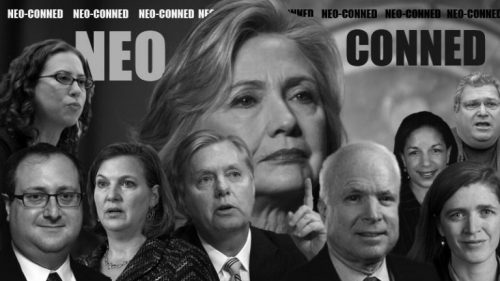
As soon as the votes were counted, certain neo-cons jumped Clinton’s sinking ship without so much as a fond adieu and, being shy, retiring types, sought to elbow their way onto the Trump Ship of State. More recently, Eliot Cohen’s attempts at a tryst soured as he expressed displeasure after having ‘made the case that young conservatives should volunteer to serve” now concluded he ‘was wrong’.
Other neo-con names floating as transition team members have been the especially slimy, Richard Perle known appropriately as the Prince of Darkness, foreign policy analyst Michael Ledeen who supports the use violence to spread democracy and noted Islamaphobe Frank Gaffney, who denied he was on the transition team and had ever been contacted.
If the PE and his closest aides are naïve enough to believe that a conciliatory gesture will engender cooperation from the foreign policy establishment, they are woefully misguided. If Trump fails to rein in the neocons and war hawk neolibs (including assistant secretaries, deputy assistant secretaries and lower level staff) with dispatch, they will quickly discover that if you get into the swamp with alligators, you had better be prepared to wrestle alligators.
At the same time, the reality is that the estimated hundreds of embedded neocons and neolibs at State have the potential, as they clean out their desks, to pilfer (an ultra serious legal violation) the last decade worth of top secret and confidential memos, notes and reports, contacts and network names and other vital information necessary for the transition of foreign policy to the Trump administration. It would not be surprising for a situation to develop similar to some months ago when fifty plus State mid level careerists ‘leaked’ an internal memo criticizing President Obama’s policy on Syria without any apparent repercussions. If the Trump Administration takes foreign policy in a new, improved direction, how will the new President deal with being subtly, or not so subtly, undermined by his own staff? There is no reason to believe that the most virulent elements of the US foreign policy establishment closely tied to Israel will ‘go quietly into that good night.’
Less than a week after the election, PE had his first phone conversation with Putin and they reportedly talked extensively about Syria and promised a face-to-face in the near future. Moscow reported that Putin told Trump he was ready for “dialogue of partnership based on principles of equality, mutual response and non-interference in the internal affairs of each other.” The Trump transition team statement said that the PE told Putin ‘he is very much looking forward to having a strong and enduring relationship with Russia and the people of Russia” which is considerably more encouraging than what HRC would have told Putin if she had been elected.
In a Wall Street Journal interview three days after the election, Trump suggested a shift from Obama’s foreign policy objectives regarding support for the Syrian opposition and its insistence on ousting Syrian president Bashar al Assad. “We’re backing rebels against Syria and we have no idea who these people are.”
Not unexpectedly, Trump named retired Lt. Gen. Michael Flynn, former director of the Defense Intelligence Agency (2012-2014), as his National Security Adviser succeeding Obama NSA Susan Rice. Flynn resigned or was pushed out of the DIA because of a public difference of opinion regarding the Obama Syria strategy which was to support those mythical ‘moderate’ Syrian rebels to oust Assad rather than focus on the destruction of ISIS. Flynn is being portrayed by the NY Times and others as ‘hotheaded’ and irresponsible with ‘poor judgment’ as well as an “alarming pick” for NSA.
In an interview with Fareed Zakaria in 2015 which was replayed on CNN since his appointment, Flynn spoke about threats from ISIS: “We are not winning, we are participating. We need to do more to defeat this problem than just go kill a couple more radical Islamists.” Flynn took the discussion beyond a military solution citing the need for an “economic transformation beyond building schools” while creating “other aspects of energy to achieve that economic transformation” and the use of “water as a means to increase the economic health of the region.”
Zakaria debunked Flynn’s thoughts with “that would require a huge transformation of the whole region” and would be “incredibly costly, laborious and generational. I think the Obama Administration would say it’s not worth the effort; not the kind of existential threat to the US that would warrant that massive expenditure of time, money and resources.” As if the US war-related $20 trillion deficit is peanuts.
Currently, Flynn is being criticized for comments referring to radical Islamists as ‘a political ideology hiding behind the notion of it being a religion” which brings to mind a discussion re the true tenets of Islam that I had with a Florida Imam. His comparison was that as certain fundamental Christians have distorted Christianity to suit their political agenda; so too have certain Moslems used their religion to justify their ideology. The fact that Flynn sees that distinction is encouraging.
Renee Parsons has been a member of the ACLU’s Florida State Board of Directors and president of the ACLU Treasure Coast Chapter. She has been an elected public official in Colorado, an environmental lobbyist and staff member of the US House of Representatives in Washington DC. She can be found on Twitter @reneedove31
… This video appears to be another White Helmets staged rescue operation, complete with a “crisis actor,” in what some have dubbed a poor attempt at the mannequin challenge type of video. The #TheMannequinChallenge social engineering phenomena first went viral in late October featuring, students from a Jacksonville high school, who were “pretending to be stuck motionless, mid-pose, as if they were modeling slacks at Macy’s.” … Full article
Carthage, Tunisia – No one knows what the future will bring. Yet, many observers have been quick to announce the decline of American interventionism and the revival of isolationism–the end of an era and the beginning of another.
Rightly or wrongly, Hillary Clinton’s defeat by Donald Trump fuels this prediction, which depresses some and delights other. The conflicted responses to Trump’s victory, based on ideological interests and values, register even within families. However, the most dramatic split reactions to Trump’s victory are exemplified by the left’s reception—liberal or socialist—in the global North versus the global South. If the North reacted to Trump’s victory with suffocated apprehension, the South experienced it as a breath of fresh air, not out of sympathy for Trump but as a rejection of Clinton.
The global South associates the name of Clinton—Bill or Hillary—with the heralds of humanitarian intervention. If the discourse of humanitarianism seduced the North, it has not been so in the South, even less in the Near and Middle East, which no longer believe in it. The patent humanitarian disasters in Kosovo, Iraq, Libya, and Syria have disillusioned them.
It is in this sense that Trump’s victory is felt as a release, a hope for change, and a rupture from the policy of Clinton, Bush, and Obama. This policy, in the name of edifying nations (“nation building”), has destroyed some of the oldest nations and civilizations on earth; in the name of delivering well-being, it has delivered misery; in the name of liberal values, it has galvanized religious zeal; in the name of democracy and human rights, it has installed autocracies and Sharia law.
Who is to blame?
Did the United States not know that intervening in “the lands of Islam” would act as a catalyst for Jihad? Was it by chance that the United States intervened only in secular states, turning them into manholes of religious extremism? Is it a coincidence that these interventions were and are often supported by regimes that sponsor political Islam? Conspiracy theory, you say? No, these are historical facts.
Can the United States not learn from history, or does it just doom itself to repeat it? Does it not pose itself the question of how al-Qaeda and Daesh originated? How did they organize themselves? Who trained them? What is their mobilizing discourse? (1) Why is the US their target? None of this seems to matter to the US: all it cares about is projecting its own idealism. (2)
The death of thousands of people in Yugoslavia, Iraq, Libya or Syria, has it contributed to the well being of these peoples? Or does the United States perhaps respond to this question in the manner of Madeleine Albright, Bill Clinton’s Secretary of State, who regretted the death of five-hundred-thousand Iraqi children, deprived of medications by the American embargo, to conclude with the infamous sentence, “[But] it was worth it “?
Was it worth it that people came to perceive humanitarian intervention as the new crusades? Was it worth it that they now perceive democracy as a pagan, pre-Islamic model, abjured by their belief? Was it worth it that they now perceive modernity as deviating believers from the “true” path? Was it worth that they now perceive human rights as human standards as contrary to the divine will? Was it worth it that people now perceive secularism as atheism whose defenders are punishable by beheading?
Have universal values become a problem rather than a solution? What then to think of making war in their name? Has humanitarian intervention become punishment rather than help?
The South has understood where the North has not: the selective nature of humanitarian interventions reflects their punitive nature; sanctions go to non-client regimes; interventions seem to be a new excuse for the hegemonic ambitions of the United States and its allies; they are a new rationale for NATO after the collapse of the Soviet Union; they are a way to suppress Russia and deprive it of its zones of influence. (3)
What a far-sighted motion was that of the coalition of the countries of the Third World (G77) at the Havana Summit in 2000! It declared its rejection of any intervention, including humanitarian, which did not respect the sovereignty of the states concerned. (4) This was nothing other than a rejection of the Clinton Doctrine, announced in 1999, in the wake of the war of Kosovo, which made “humanitarian intervention” the new bedrock, or perhaps the new facade, of the foreign policy of the United States. It was the same policy followed and developed by Hillary Clinton during her tenure as secretary of state. (5)
The end of interventionism?
But are Clinton’s defeat and Trump’s accession to power sufficient reasons to declare the decline of interventionism?
Donald Trump is a nationalist, whose rise has been the result of a coalition of anti-interventionists within the Republican Party. They profess a foreign policy that Trump has summarized in these words: “We will use military force only in cases of vital necessity to the national security of the United States. We will put an end to attempts of imposing democracy and overthrowing regimes abroad, as well as involving ourselves in situations in which we have no right to intervene.” (6)
But drawing conclusions about the foreign policy of the United States from unofficial statements seems simplistic. At the moment of this writing, any speculation as to the policy choices of Trump’s foreign policy is premature. One can’t predict his policy with regard to the Near and Middle East, since he has not yet even formed his cabinet. Moreover, presidents in office can change their tune in the course of their tenure. The case of George W. Bush provides an excellent example.
Like Donald Trump, George W. Bush was a conservative Republican non-interventionist. He advocated “America First,” called for a more subdued foreign policy and adopted Colin Powell’s realism “to attend without stress” (7) with regard to the Near and Middle East. But his policy shifted to become the most aggressive and most brutal in the history of the United States. Many international observers argue that this shift came as a response to the September 11 attacks, but they fail to note that the aggressive germs already existed within Bush’s cabinet and advisers: the neo-conservatives occupied key functions in his administration. (8)
Up until now, Trump’s links with the neo-cons remain unclear. The best-known neo-cons, Paul Wolfowitz, William Kristol, and Robert Kagan, appear to have lost their bet by supporting Hillary Clinton’s candidacy. But others, less prominent or influential, seem to have won it by supporting Trump: Dick Cheney, Norman Podhoretz, and James Woolsey, his adviser and one of the architects of the wars in the Middle East.
These indices show that nothing seems to have been gained by the South, still less by the Near and Middle East. There appears to be no guarantee that the situation will improve.
The non-interventionism promised by Trump may not necessarily equate to a policy of isolationism. A non-interventionist policy does not automatically mean that the United States will stop protecting their interests abroad, strategic or otherwise. Rather, it could mean that the United States will not intervene abroad except to defend their own interests, unilaterally–and perhaps even more aggressively. Such a potential is implied in Trump’s promise to increase the budget for the army and the military-industrial complex. Thus, it is more realistic to suppose that as long as the United States has interests in the countries of the South and the Near and Middle East, so long it will not hesitate to intervene.
In this context, Clinton’s defeat and Trump’s accession are not sufficient reasons to declare the decline of interventionism—the end of an era and the beginning of another. The political reality is too complex to be reduced to statements by a presidential candidate campaigning for election, by an elected president, or even by a president in the course of performing his office.
No one knows what the future will bring.
Marwen Bouassida is a researcher in international law at North African-European relations, University of Carthage, Tunisia. He regularly contributes to the online magazine Kapitalis.
November 22 marks the 53rd anniversary of John F. Kennedy’s assassination. If history is any guide, it’s likely some mainstream outlet will commemorate that dark day with reassurances that the Warren Commission was right that Lee Harvey Oswald did it alone, and that most doubters, who have been in the majority since the mid-1960s, are randy conspiracy theorists. That is the essential message by one of the experts likely to be cited this year, attorney Howard Willens.
One of the few still-living Warren Commission staffers, Willens followed up his 2013 book, History Will Prove Us Right, with a spirited defense of the Commission in the summer, 2016 issue of the journal, The American Scholar, which he co-wrote with another Commission staffer, attorney Richard Mosk. The piece, “The Truth About Dallas,” isa celebration of the work and conclusions of the original investigation.
But Willens’s and Mosk’s defense of the work of the Warren Commission they served on is more notable for what they omit from the official record than what they include. “What the critics often forget or ignore,” they write, “is that since 1964, several government agencies have also looked at aspects of our work,” (p. 59) as if the Church Committee and the House Select Committee on Assassinations (HSCA) had reviewed and applauded the Commission’s work.
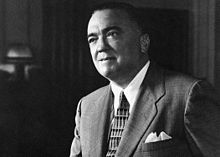
FBI Director J. Edgar Hoover
Indeed, they did look at it. But rather than plaudits, they issued stinging rebukes, principally for the Commission’s having been rolled by FBI Director J. Edgar Hoover, and to a lesser extent, by the CIA and the Secret Service.
“It must be said that the FBI generally exhausted its resources in confirming its case against Oswald as the lone assassin,” the HSCA concluded, “a case that Director J. Edgar Hoover, at least, seemed determined to make within 24 hours of the of the assassination.”
In essence, the experienced investigators concluded that Hoover had divined the solution to the crime before starting the inquiry, and then his agents confirmed the boss’s epiphany. The intimidated Warren Commission went right along.
And with good reason, only part of which Willens and Mosk tell. They admit that the “FBI had originally opposed the creation of the Warren Commission” and that Hoover “ordered investigations of commission staff members.” But they don’t tell that Hoover deployed one of his favorite dirty tricks to deal not only with support staffers, such as Willens and Mosk, but also with the commissioners themselves.
“[D]erogatory information pertaining to both Commission members and staff was brought to Mr. Hoover’s attention,” the Church Committee reported. (emphasis added)
Hoover’s Spy
Willens and Mosk also forgot to mention that Hoover had a personal spy on the Warren Commission, then Rep. Gerald Ford, who tattled on Commissioners who were (justifiably) skeptical of the Bureau’s work.
“Ford indicated he would keep me thoroughly advised as to the activities of the Commission,” FBI Agent Cartha DeLoach wrote in a once secret memo. “He stated this would have to be done on a confidential basis, however he thought it should be done.”
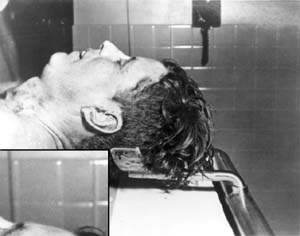
Autopsy photo of President John F. Kennedy
At the bottom of the memo, Hoover scrawled, “Well handled.” The success of Hoover’s machinations was obvious to subsequent government investigators. (Ford, of course, later became President upon the resignation of Richard Nixon in 1974.)
The HSCA’s chief counsel, Notre Dame Law Professor Robert Blakey, a criminal investigator and prosecutor with vastly better credentials than either Willens or Mosk, was impressed with neither the Commission’s vigor nor its independence.
“What was significant,” Blakey determined, “was the ability of the FBI to intimidate the Commission, in light of the Bureau’s predisposition on the questions of Oswald’s guilt and whether there had been a conspiracy. At a January 27 [1964] Commission meeting, there was another dialogue [among Warren Commissioners]:
“John McCloy: ‘… the time is almost overdue for us to have a better perspective of the FBI investigation than we now have … We are so dependent on them for our facts … .’
“Commission counsel J. Lee Rankin: ‘Part of our difficulty in regard to it is that they have no problem. They have decided that no one else is involved … .’
“Senator Richard Russell: ‘They have tried the case and reached a verdict on every aspect.’
“Senator Hale Boggs: ‘You have put your finger on it.’ (Closed Warren Commission meeting.)” [Blakey & Billings, Fatal Hour– The Assassination of President. See also: North, Act of Treason]
Testifying before the HSCA, the Warren Commission’s chief counsel J. Lee Rankin shamefully admitted, “Who could protest against what Mr. Hoover did back in those days?” Apparently not President Lyndon Johnson’s blue-ribbon commissioners.
The HSCA’s Blakey also reported that “When asked if he was satisfied with the (Commission’s) investigation that led to the (no conspiracy) conclusion, Judge Burt Griffin (a Commission staff member) said he was not.” [Blakey & Billings, Ibid.]
And author Gus Russo reported that Judge Griffin also admitted, “We spent virtually no time investigating the possibility of conspiracy. I wish we had.” [Russo, Live by the Sword]
Clear Misgivings
Thus, despite their clear misgivings, the Commissioners bowed to the imperious FBI chief rather than conduct a thorough investigation. Notably, the Commission never once employed a rudimentary investigative tool. “The Commission,” the HSCA reported, “failed to utilize the instruments of immunity from prosecution and prosecution for perjury with respect to witnesses whose veracity it doubted.” [US Cong. House of Reps. Report of Comm. on Assassinations, 1979]
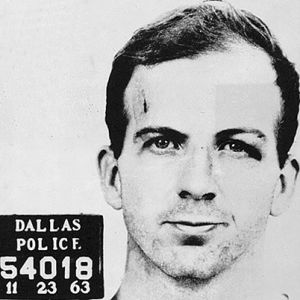
Lee Harvey Oswald
This policy had serious repercussions when the Commission confronted two key issues: published claims that Lee Harvey Oswald had been an FBI informant, and the possibility that Jack Ruby was mobbed up.
“The Commission did not investigate Hoover or the FBI, and managed to avoid the appearance of doing so,” the HSCA determined. “It ended up doing what the members had agreed they would not do: Rely mainly on the FBI’s denial of the allegations (that Oswald had been a Bureau informant).”
Hoover merely sent the Commission his signed affidavit declaring that Oswald was not an informant and also “sent over 10 additional affidavits from each FBI agent who had had contact with Oswald.” And with that, case closed.
Regarding Jack Ruby, the FBI had his phone records, yet failed to spot Ruby’s obvious, and atypical, pattern of calls to known Mafiosi in the weeks leading up to the assassination. After performing the simple, obvious task of actually analyzing those calls, the HSCA determined that, if not a sworn member of La Cosa Nostra, Ruby had ongoing, close links to numerous Mafiosi.
Thus the HSCA roundly rejected the Warren Commission’s conclusion that, “the evidence does not establish a significant link between Ruby and organized crime.”
The list of Warren Commission shortcomings that the HSCA assembled is not short. A brief summary of them runs some 47 pages in the Bantam Books version of the report (p. 289–336), which outlines what required much of the 500 pages of HSCA volume XI to cover (available on-line).
“The evidence indicates that facts which may have been relevant to, and would have substantially affected, the Warren Commission’s investigation were not provided by the agencies (FBI and the CIA). Hence, the Warren Commission’s findings may have been formulated without all of the relevant information.”
The Church Committee said that the problem was that “the Commission was perceived as an adversary by both Hoover and senior FBI officials.” “Such a relationship,” the Committee dryly observed, “was not conductive to the cooperation necessary for a thorough and exhaustive investigation.”
But the FBI did more than just withhold evidence from the Commission. Although they admit that the FBI destroyed a note Oswald wrote to Agent Hosty, and withheld that information from the Commission, Willens and Mosk don’t mention that Agent Hosty reported that his own personnel file, and other FBI files, had been falsified. [Hosty, Jr. Assignment: Oswald]
Nor that author Curt Gentry learned from assistant FBI director William Sullivan that there were other JFK documents at the Bureau that had been destroyed. [Gentry, J. Edgar Hoover– The Man and His Secrets]
Perhaps one of the reasons the public has remained mistrustful of the government’s conclusions, and the mainstream media reassurances, is the sort of selective presentation of evidence by ax grinders like Willens and Mosk who get heralded by our “responsible” media.
Gary Aguilar is one of the few physicians outside the government ever allowed to see the still-restricted JFK autopsy photos and X-rays. He has published and lectured on the topic of the JFK assassination for many years.
The Oxford Dictionaries have named ‘post-truth’ as the word of the year. ‘Fake news’ and ‘post-truth’ politics have been blamed for both the Brexit vote in the UK and the victory of Donald Trump in America.
It seems the uneducated plebs are falling for ’fake news’ they read in ’new media’ and the lies of dreadful rabble-rousing populist politicians who are relying on people’s emotions, instead of ’objective facts,’ to get votes. It’s all terribly worrying and poses a dire threat to Western civilization as we know it.
Well, forgive me for laughing out loud. For this establishment ‘fake news’/’post-truth politics’ concern is the funniest thing I’ve come across in politics since Lord Jenkins of Hillhead, the very grand Chancellor of the University of Oxford, repeatedly called distinguished Sheldonian guest Mikhail Gorbachev, “Mr. Brezhnev.”
Why is it so hilarious? Because the people and the outlets warning of the dangers of ‘fake news’ and ‘post-truth politics’ have been the biggest peddlers of ‘fake news’ and ‘post-truth politics’ out there. It’s like receiving lectures on the immorality of bootlegging from Al Capone or being told to sit up straight by the Hunchback of Notre Dame.
Without a doubt the best, or rather the worst example of ‘fake news’ in the last 25 years or so, was the neocon lie that Iraq had WMDs in 2002/3. That wasn’t peddled by ‘obscure bloggers’ and ‘new media,’ but by mainstream Western politicians, from ‘mainstream’ political parties, establishment-approved ‘experts’ on the BBC/ITV/CNN, etc., and Op-ed columnists in ‘serious’ and ‘respectable’ media outlets.
There was absolutely no evidence that Saddam possessed WMDs. The story was complete and utter BS. Yet this fake news dominated the headlines for months in 2002/3 and led to an illegal invasion in which many people lost their lives. Unlike today’s manufactured ‘fake news’ hysteria the Iraq war was no joke. An entire country was destroyed.
And guess what? Those who pushed the ‘Iraq has WMDs line’ are now coming on television to express their concern over ‘fake news’!
John Hilley notes “The BBC even had Alastair Campbell (Tony Blair’s spin doctor), in the studio defending the term ‘post-truth’ as a way of exposing the ‘dangers’ of ‘fake news.'”
Campbell stated: “It’s acknowledging that politics, which has always been rough, has moved to a different phase where politicians who lie now appear to get rewarded for it.” (BBC2 Jeremy Vine Show, 16/11/2016).
What might Orwell have said about Campbell, master spinner and Blairite warmonger, sitting inside the BBC being rewarded for his thoughts on ‘post-truth and ‘fake news?’ Hilley asks.
Once again, I’m sure old George is spinning in his grave in Sutton Courtenay.
Then there’s that serial warmonger Bernard-Henri Levy. The Sunday Telegraph today told us in its headlines: ‘Leading French philosopher: Marine Le Pen may win election as people have lost interest in whether politicians tell the truth.’
Oh, the irony!
Because if the French people really have ‘lost interest in whether politicians tell the truth,’ Henri-Levy and his fellow liberal interventionist ‘regime changers’ have got a lot to do with it.
Think back to the war against Libya, which the ‘leading French philosopher’ lobbied hard for. To sell the war to the Western public, we were told that Muammar Gaddafi was about to commit a ‘Srebrenica-style’ massacre in Benghazi. Media Lens noted the claims that were made at the time.
But again it was a load of ‘rollocks.’ Five years after Libya, like Iraq before it, had been destroyed by Western ‘interventionists,’ a report of the Foreign Affairs Committee of the House of Commons declared: “the proposition that Muammar Gaddafi would have ordered the massacre of civilians in Benghazi was not supported by the available evidence.”
It wasn’t the only claim made about Libya by Western politicians that was ‘not supported by the available evidence.’ In February 2011, UK Foreign Secretary William Hague insisted that he had seen ‘information’ which suggested that Gaddafi was on his way to Venezuela. An unnamed ‘diplomat’ said that this was ‘credible information.’ But it wasn’t. It was the same old fake news that we get every time the Western elites are trying to achieve ‘regime change.’
In April 2011 we heard that the devilish Gaddafi (who had not, after all, fled to Caracas), was supplying his troops with Viagra “to encourage mass rape.”
“Gaddafi’s security forces and other groups in the region are trying to divide the people by using violence against women and rape as tools of war, and the United States condemns this in the strongest possible terms,” declared Secretary of State Hillary Clinton, whose supporters are now complaining about ‘post-truth politics.
Again, no evidence was put forward for the Viagra/mass rape claim and, surprise, surprise, none was ever found.
A clear pattern can be discerned. To get public support for its illegal regime change wars, the Western establishment energetically promotes a number of ‘fake news’ stories. These stories are usually reported unquestioningly in ‘respectable’ outlets and are regularly cited by neocon/liberal interventionist commentators as a reason for taking action against the target state. ‘Anonymous’ sources feature heavily in these stories, which like MI6’s ‘Operation Mass Appeal’ are often planted by the security services.
Meanwhile, people’s emotions are shamelessly played upon by the ‘something must be done’ brigade of ‘liberal’ laptop bombardiers, the same crowd, note well, who accuse ‘populist’ politicians of ignoring ‘objective facts’ and playing on people’s emotions.
The fake news continues while the regime change operation is ongoing. After its over, we’re all meant to forget about the false stories we were fed and focus on the next ’New Hitler’ who needs to be dealt with. In 2011, it was the despicable Gaddafi, now it’s the despicable Assad and the despicable Putin who we’re told: “have to be stopped.”
The term ‘post-truth’ politics implies there was a time when politics was truthful. I doubt if that ever was the case, but certainly in the last 25 years, thanks to the influence of neocons and ‘liberal interventionists’, the lies have been off the scale. Remember the Niger uranium forgeries? And Saddam’s horrific ‘People Shredder‘?
And before the Iraq war, we had the ‘humanitarian’ NATO bombing of Yugoslavia, where again fake news dominated. US Defense Secretary William Cohen claimed “about 100,000 military-aged” Kosovan Albanians were missing… “they may have been murdered.”
As John Pilger reminded us, “Kosovo, the site of a genocide that never was, is now a violent “free market” in drugs and prostitution.”
It wasn’t the only lurid claim that was made to sell the war. But again the ‘genocide’ and hundreds of thousands killed stories were false, as a UN court itself ruled in 2001.
Fake news also featured heavily in the neocon campaign to get Iran sanctioned for an entirely unproven nuclear weapons program. It’s dominated the coverage of recent events in Ukraine, with Russia’s non-existent ‘invasion of Ukraine’ routinely referred to as a fact. The conflict in Syria too has been marked by ‘fake news,’ and theories being reported as if they’re 100 percent proven. How many times have you read that “Assad gassed his own people” at Ghouta in 2013, even though we still don’t know for sure who carried out the attack?
If it’s ‘official enemies’ we’re talking about ‘fact-checking’ and citing sources isn’t all that important for those who pounce on a mere typo if it’s an anti-war writer who’s making a claim.
Now, the same people who have disseminated fake news for so long and who are still, even after Iraq and Libya, embedded in the West’s political and media establishments, are lashing out because they no longer control the narrative as they used to. The public is getting their news from a much wider variety of sources and voting for ‘populist,’ i.e., non-neocon/liberal interventionist-anointed candidates/parties at elections.
Instead of admitting that it’s their ’fake news’ and ‘post-truth politics’ which has caused people to switch off from establishment media and to stop voting for status quo candidates, the endless war lobby has the effrontery to accuse others of the things they have been guilty of.
Concern over ‘fake news’ and ‘post-truth politics’ from the West’s endless war propagandists?
It’s hard to think of a better example of what psychologists call ‘projection.’
The injury into UK’s involvement in the 2003 invasion of Iraq was designed by the government to avoid allocating blame to individuals and departments, memos obtained under the Freedom of Information Act have reportedly revealed.
The papers were made public thanks to Chris Lamb, an FOI campaigner from Bristol, who had won a two-year court battle for the right to access classified memos by government officials relating to the creation of the Chilcot Inquiry. The memos were penned in the four-week period in May and June 2009, the Observer reported.
The documents revealed that high-level politicians in Britain sought to ensure that the probe would not result in branches of the government or individuals being held legally liable for the Iraq war. Some officials opposed a public inquiry due to the amount of daily publicity, cost and, ironically, long time such a procedure would take.
The Chilcot Report, released in July, was the culmination of seven years of investigation, started by Prime Minister Gordon Brown in 2009, and chaired by Sir John Chilcot. Although the investigation had found that Saddam Hussein had not posed any credible threat to the West – nor were there any WMD in his possession – it stopped short of assigning any blame to Tony Blair, who was UK prime minister at the time of the invasion, or any officials in his government.
Now it has been reportedly revealed that officials at the highest levels were involved in driving the inquiry to that outcome.
“The inquiry was hobbled before it even started, with tight restrictions on what it could do that were not fully made public,” Lamb told the newspaper.
The Observer reports that according to the memos, former cabinet secretary under Brown, Sir (now Lord) Gus O’Donnell ignored Whitehall protocol when he made Margaret Aldred the secretary on the inquiry – one of the most senior roles with the investigation.
Aldred had chaired the Iraq senior officials group during the period Chilcot was investigating and her appointment ran against the advice by Cabinet Office official Ben Lyon, who said in one memo that the secretariat should not draw from civil servants, and specifically that they “should not have been involved in Iraq policy since 2002.”
Other people involved in the 2003 war helped set up the inquiry, including Sir Jeremy Heywood, who served as Blair’s parliamentary private secretary until 2003, and former spy chief Sir John Scarlett, who was the central figure in trumpeting up the so-called Iraq dossier on Saddam Hussein’s non-existant arsenal of weapons of mass destruction.
In another memo, O’Donnell advised to avoid a legal focus, and recommended that the investigation be structured so as to prevent “any conclusion on questions of law or fact, which create circumstances which expose organizations, departments and/or individuals to criminal or civil proceedings or judicial review.” Part of this approach was not to have any judges or lawyers among the inquiry appointees.
Another big point for the investigation was to keep it secret rather than public. Lyon warned that a public inquiry would “attract a daily running commentary,” like the 2003 Hutton inquiry into the death of Iraq weapons inspector David Kelly. O’Donnell used the same reasoning and warned that a public inquiry would “threaten legal liability for individuals” and “take a long time.”
Brown initially wanted the injury to be carried by the Privy Council and announced this procedure in June 2009. But after a public outcry he agreed to make some of the hearing public.
1. What are State Crimes Against Democracy (SCADs)?
I coined the term “State Crimes Against Democracy” in a peer-reviewed article published by Administrative Theory & Praxis, the journal of the Public Administration Theory Network. SCADs are defined as “concerted actions or inactions by government insiders intended to manipulate democratic processes and undermine popular sovereignty.” Until recently, scholarly research on political criminality has given little attention to antidemocratic conspiracies in high office, focusing instead on graft, bribery, embezzlement, and other forms of government corruption where the aim is personal enrichment rather than social control, partisan advantage, or political power. However, SCADs are far more dangerous to democracy than these other, more mundane forms of political criminality because of their potential to subvert political institutions and entire governments or branches of government.
2. What are some examples of SCADs in recent U.S. history?
Examples of SCADs that have been officially proven include the Watergate break-ins and cover up; the secret wars in Laos and Cambodia; the illegal arms sales and covert operations in Iran-Contra; and the effort to discredit Joseph Wilson by revealing his wife’s status as an intelligence agent. Examples of suspected SCADs include the fabricated attacks on U.S. ships in the Gulf of Tonkin in 1964; the “October Surprises” in the presidential elections of 1968 and 1980; the assassinations of John Kennedy, Robert Kennedy, and Martin Luther King; the attempted assassinations of George Wallace and Ronald Reagan; the election breakdowns in 2000 and 2004; the numerous defense failures on 9-11-2001; the anthrax mailings in October 2001; and the misrepresentation of intelligence to justify the invasion and occupation of Iraq.
3. Are suspicions about SCADs “conspiracy theories”?
The concept of State Crimes against Democracy was developed, in part, to replace the term “conspiracy theory.” The conspiracy-theory literature about assassinations, 9/11, and other suspicious events has generally examined each event in isolation. The SCAD construct was introduced to move inquiry beyond incident-specific theorizing. It delineates a crime category comparable to white collar crime, organized crime, and hate crime. SCAD research looks for patterns across events. The objective is to develop (a) an empirically grounded theory of elite political criminality, (b) forensic methods for SCAD detection and investigation, and (c) political reforms to discourage SCADs from being committed in the first place.
4. Why are SCADs difficult to detect?
SCADs are usually complex conspiracies involving people with expertise in law, law enforcement, and police procedures. Ordinary crimes are often solved by pressuring criminals to inform on one another, but this may be impossible with SCADs because they are often organized like covert intelligence operations. Each element of the operation is compartmentalized, and information about participant roles is shared only on a need-to-know basis.
5. Why are SCAD suspects seldom convicted and punished?
One reason SCADs often go unpunished is that the agencies assigned to investigate what may be high crimes often bear some blame or have some connection to the events in question; hence, personnel in these agencies are inevitably tempted to conceal evidence that would implicate or embarrass the agencies or their top managers. In the investigation of the assassination of President Kennedy, for example, both the FBI and the CIA concealed evidence of their contacts with Lee Harvey Oswald and Jack Ruby (Talbot, 2007). Likewise, in response to the inquiry into the defense failures surrounding 9-11, the Department of Defense appears to have withheld from the 9-11 Commission evidence that military intelligence agents had uncovered the 9-11 hijackers’ activities well in advance of September 2001. SCAD investigations and prosecutions are also impeded by Presidential pardons and commutations. Gerald Ford pardoned Richard Nixon without even allowing a full investigation into all of Nixon’s possible crimes. Similarly, George H.W. Bush pardoned the Iran-Contra conspirators and effectively prevented further investigation of his own role in the affair. George W. Bush appears to have had similar motives with respect to Scooter Libby. In commuting Libby’s sentence rather than issuing a pardon, Bush made it impossible for Congress to compel Libby’s testimony in any further inquiry into Plame’s exposure.
6. Why do the mainstream media spurn “conspiracy theories”?
There are powerful norms among political, economic, and media elites that discourage speculation about corruption in high office. In elite discourse, convention prohibits suspicions from being voiced about top officials unless their guilt can be proven unambiguously by “smoking gun” evidence. This norm does not come from the principle in American jurisprudence that suspects are considered innocent until proven guilty. The presumption of innocence was never intended to outlaw suspicions. Rather, it calls for suspicions to be tested with thorough and fair investigations grounded by procedural rules for procuring and presenting evidence. Norms against conspiratorial speculations in elite discourse function to protect the legitimacy of elites as a class.
7. Was 9/11 a SCAD?
Much circumstantial evidence suggests the Bush-Cheney Administration may have somehow been involved in 9-11. The Administration ignored many warning signs that the 9-11 terrorist attack was imminent and that the attack might include hijackings; the CIA had a working relationship with bin Laden, and provided weapons, money, and technical support to Islamist terrorists in Afghanistan during the Soviet occupation; some officials appear to have received warnings not to fly on 9-11; the Twin Towers and Building 7, which collapsed at near free-fall acceleration, are suspected of having been brought down by controlled demolition; chemical tests have found traces of Thermate (an incendiary for cutting steel) in dust from the Trade Center site; and, as is usual with most SCADs, the Twin Towers crime scene was cleaned up quickly and given only a superficial investigation.
8. What patterns have been uncovered with SCAD research?
Several patterns stand out when SCADs and suspected SCADs are considered comparatively. First, many SCADs are associated with foreign policy and international conflict: the Gulf of Tonkin incident; the burglary of Daniel Ellsberg’s psychiatrist’s office; Iran-Contra; 9-11; Iraq-gate; the assassinations of John Kennedy and Robert Kennedy; and the attempted assassinations of Patrick Leahy and Tom Daschle. All of these SCADs contributed to the initiation or continuation of military conflicts.
Second, SCADs are fairly limited in their modus operandi (MO). The most common SCAD-MOs are assassinations and mass deceptions related to foreign policy. Other MOs include election tampering, contrived international conflicts, and “black bag” burglaries. All of these MOs are indicative of groups with expertise in the skills of espionage and covert, paramilitary operations.
Third, many SCADs in the post-WWII era are associated with two presidents: Richard Nixon and George W. Bush. Nixon was not only responsible for Watergate and the illegal surveillance of Daniel Ellsberg, he alone benefited from all three of the suspicious attacks on presidential candidates in the 1960s and 1970s: the assassinations of John Kennedy and Robert Kennedy, and the attempted assassination of George Wallace. The SCADs that benefited Bush include the election-administration problems in Florida in 2000 and in Ohio in 2004; the defense failures on 9/11; the (U.S. defense grade) anthrax attacks on top Senate Democrats in October 2001; Iraq-gate; and the multiple and specious terror alerts that rallied support for Bush before the 2004 presidential election.
9. Are there any patterns in assassination targets?
The range of officials targeted for assassination is limited to those most directly associated with foreign policy: presidents and senators. Presidents are most vulnerable when they have Vice Presidents who are more closely aligned than they are to military and intelligence elites. This was the case for both Kennedy and Reagan. Senators are most vulnerable when the Senate is very closely divided along partisan lines and the death of a single senator will shift control of the Senate to the more hawkish party. This was the situation when Senator Paul Wellstone was killed in a suspicious plane crash, and when anthrax was mailed to Senators Daschle and Leahy.
Most other high-ranking officials in the federal government have seldom been murdered even though many have attracted widespread hostility and opposition. In the post-World War II era if not generally, no Vice Presidents have been assassinated, nor have any members of the U.S. House of Representatives or the U.S. Supreme Court. If lone gunmen have been roaming the country in search of political victims, it is difficult to understand why they have not struck more widely, especially given that most officials receive no Secret Service protection.
10. What do SCAD patterns reveal about SCAD perpetrators?
SCADs frequently involve presidents either as victims or principals, benefit military and military-industrial elites, and employ the skills of intelligence and paramilitary operatives. This policy locus could mean that the nation’s civilian leadership is being targeted by military and intelligence elites, or that military and intelligence assets and capabilities are being politicized by the civilian leadership, or both. In any event, officials at the highest levels of American government appear to be using deception, conspiracy, and violence to shape national policies and priorities. This sub rosa manipulation of domestic politics is an extension of America’s duplicity in foreign affairs and draws on the nation’s well-developed skills in covert operations.
A University of Colorado professor who’s been criticized for his writings about climate change has been caught up in WikiLeaks’ dump of emails involving John Podesta, campaign chairman for Hillary Clinton.
The email was sent by Judd Legum, the editor of ThinkProgress, a site that’s part of the Center for American Progress Action Fund, the advocacy arm of the liberal think tank Center for American Progress, which was founded by Podesta in 2003.
In his email to billionaire environmentalist Tom Steyer, Legum described how he believed Climate Progress, the environmental arm of ThinkProgress, got Pielke to stop writing about climate change for FiveThirtyEight.
“I think it’s fair say that, without Climate Progress, Pielke would still be writing on climate change for 538,” Legum wrote.
Legum did not respond to interview requests on Wednesday.
The email was one of tens of thousands of messages from Podesta’s hacked Gmail account released by WikiLeaks this month.
The group took issue with Pielke’s piece titled “Disasters Cost More Than Ever —- But Not Because of Climate Change,” in which he questioned the link between rising natural disaster costs and climate change.
Pielke argued that the cost of disasters is increasing because the world is getting wealthier, not because there are more — or more intense — floods, droughts, hurricanes or tornadoes.
“We’re seeing ever-larger losses simply because we had more to lose — when an earthquake or flood occurs, more stuff gets damaged,” he wrote.
Pielke, who has written extensively about climate-change economics, is a polarizing figure among climate change scientists and activists.
Pielke refutes claims that he’s a climate-change skeptic or denier, pointing to his public support for a carbon tax. He says that many of the arguments he presents are supported by the Intergovernmental Panel on Climate Change.
The criticism of Pielke’s piece continued, with stories about Pielke and FiveThirtyEight founder Nate Silver appearing in Salon, Slateand the Huffington Post.
“Silver is still backing the wrong horse, and the sooner he dumps Pielke, the better,” David Auerbach wrote for Slate.
Shortly thereafter, Pielke stopped writing for FiveThirtyEight. In the email released by WikiLeaks, Legum gave ThinkProgress credit for that.
“I don’t think there is another site on the internet having this kind of impact on the climate debate,” Legum wrote of FiveThirtyEight.
In response, CU President Bruce Benson wrote that the university “did not discover any information indicating that Pielke’s funding sources influenced his research,” adding that Pielke confirmed that he received no funding from the oil and gas industry.
Pielke has more or less stopped writing about climate change. Since then, he’s focused his efforts on sports governance and is now the director of CU’s Sports Governance Center.
“They were ultimately successful in removing an academic from working on a topic,” Pielke said, adding that there’s “nothing like a political witch hunt to help you focus on career priorities.”
When he read the leaked email last week, Pielke said he wasn’t surprised by its contents.
“It spells out in black and white … that there was an organized, politically motivated campaign to damage my career and reputation, based on a perception that my academic research was thought to be inconvenient,” he said.
At a regular meeting in Denver, the regents passed a resolution 9-0 to send the message that “faculty and students must have complete freedom to study, to learn, to do research and to communicate the results of these pursuits to others.”
The principles of academic freedom are codified in regent laws, which govern the university. The board was restating its commitment to those principles on Thursday.
Though he was not mentioned in the resolution, Pielke was the motivating factor behind it, according to its author, Regent John Carson, a Republican from Highlands Ranch.
Pielke was the subject of a 2014 email sent by the editor of ThinkProgress, a website that’s part of the Center for American Progress Action Fund, the advocacy arm of the liberal think tank Center for American Progress.
In Judd Legum’s email to billionaire environmentalist Tom Steyer, Legum described how he believed the website got Pielke to stop writing about climate change for the data-focused news website FiveThirtyEight.
The email was part of an October WikiLeaks dump of emails involving John Podesta, the founder of the Center for American Progress and the chairman for Hillary Clinton’s presidential campaign.
Pielke and others described the email as evidence that there was a “politically motivated campaign” to damage his career and reputation. Ultimately, he stopped writing about climate change and now directs CU’s new Center for Sports Governance.
Carson said he felt that type of conduct was unacceptable and that he thought the board should show all CU faculty and researchers that it stands behind them.
“I want to go on record making clear that I don’t think this type of conduct is appropriate and we’re going to defend our faculty and we’re going to go on record, when we find out about these types of things, opposing it,” Carson said.
Pielke wrote for FiveThirtyEight that “human-caused climate change is both real and important,” but came under fire for an essay the website published in which he argued that rising natural disaster costs were not linked to climate change.
Reporters at ThinkProgress asked several climate scientists to weigh in on Pielke’s claims and published stories in which those scientists said Pielke’s claims were misleading. By Pielke’s count, the website has published more than 160 critical articles about him.
“There was inaccurate information being presented in his writing … We called a number of climate scientists and asked them about the claims he was making in this piece,” Legum told the Daily Camera last month. “They said that there were a lot of really inaccurate or misleading things, and we reported on that.”
In response, CU President Bruce Benson wrote that the university “did not discover any information indicating that Pielke’s funding sources influenced his research,” adding that Pielke confirmed that he received no funding from the oil and gas industry. […]
Though he did not attend the meeting, Pielke wrote in an email to the Daily Camera that he felt supported by the leaders of the university.
He said the bipartisan-backed resolution sent a strong message “to my faculty peers who may question whether it is worth participating in important debates of the day — that CU has their back.”
Chris Mooney is well known for biased and misleading reporting where climate change is concerned, but it is always sad to see otherwise respectable meteorologists such as Jason Samenow, one of the Capital Weather Gang, roped in as well, something that has become more frequent in recent years.
The simple reality, as Samenow should know, is that such departures above “normal” are not unusual during the colder months in the Arctic.
DMI have records back to 1954 for Arctic temperatures, and a quick trawl uncovers several similar instances, for instance 1972, 1974 and 1976:
The only difference was that these occurrences took place in January/February, rather than November. We should bear in mind that the 1970s were a time of expanding Arctic ice.
The Washington Post article actually explains what has been going on:
The Arctic is super-hot, even as a vast area of cold polar air has been displaced over Siberia…..
It’s about 20C [36 degrees Fahrenheit] warmer than normal over most of the Arctic Ocean, along with cold anomalies of about the same magnitude over north-central Asia,” Jennifer Francis, an Arctic specialist at Rutgers University, said by email Wednesday.
“The Arctic warmth is the result of a combination of record-low sea-ice extent for this time of year, probably very thin ice, and plenty of warm/moist air from lower latitudes being driven northward by a very wavy jet stream.”
The key is the comment about warm/moist air. Because of latent heat, when that moist air turns back to water, heat is given off, thus warming the atmosphere disproportionately.
Jennifer Francis has long claimed that the “wavy jetstream” is caused by melting Arctic ice. Yet HH Lamb found the same phenomenon in the 1960s and 70s, and believed it was caused by a colder Arctic!
Indeed, if we check out the GISS global temperature maps for the three years I have highlighted above, 1972, 1974 and 1976, we find very similar weather patterns, with very cold polar air displaced over Siberia and North America, along with warm air invading the Arctic.
An Open Letter to Terry Allen, Noam Chomsky, Alexander Cockburn, David Corn, Chris Hayes, George Monbiot, Matthew Rothschild, and Matt Taibbi.
[1]According to several left-leaning critics of the 9/11 Truth Movement, some of its central claims, especially about the destruction of the World Trade Center, show its members to be scientifically challenged. In the opinion of some of these critics, moreover, claims made by members of this movement are sometimes unscientific in the strongest possible sense, implying an acceptance of magic and miracles. … Full article
This site is provided as a research and reference tool. Although we make every reasonable effort to ensure that the information and data provided at this site are useful, accurate, and current, we cannot guarantee that the information and data provided here will be error-free. By using this site, you assume all responsibility for and risk arising from your use of and reliance upon the contents of this site.
This site and the information available through it do not, and are not intended to constitute legal advice. Should you require legal advice, you should consult your own attorney.
Nothing within this site or linked to by this site constitutes investment advice or medical advice.
Materials accessible from or added to this site by third parties, such as comments posted, are strictly the responsibility of the third party who added such materials or made them accessible and we neither endorse nor undertake to control, monitor, edit or assume responsibility for any such third-party material.
The posting of stories, commentaries, reports, documents and links (embedded or otherwise) on this site does not in any way, shape or form, implied or otherwise, necessarily express or suggest endorsement or support of any of such posted material or parts therein.
The word “alleged” is deemed to occur before the word “fraud.” Since the rule of law still applies. To peasants, at least.
Fair Use
This site contains copyrighted material the use of which has not always been specifically authorized by the copyright owner. We are making such material available in our efforts to advance understanding of environmental, political, human rights, economic, democracy, scientific, and social justice issues, etc. We believe this constitutes a ‘fair use’ of any such copyrighted material as provided for in section 107 of the US Copyright Law. In accordance with Title 17 U.S.C. Section 107, the material on this site is distributed without profit to those who have expressed a prior interest in receiving the included information for research and educational purposes. For more info go to: http://www.law.cornell.edu/uscode/17/107.shtml. If you wish to use copyrighted material from this site for purposes of your own that go beyond ‘fair use’, you must obtain permission from the copyright owner.
DMCA Contact
This is information for anyone that wishes to challenge our “fair use” of copyrighted material.
If you are a legal copyright holder or a designated agent for such and you believe that content residing on or accessible through our website infringes a copyright and falls outside the boundaries of “Fair Use”, please send a notice of infringement by contacting atheonews@gmail.com.
We will respond and take necessary action immediately.
If notice is given of an alleged copyright violation we will act expeditiously to remove or disable access to the material(s) in question.
All 3rd party material posted on this website is copyright the respective owners / authors. Aletho News makes no claim of copyright on such material.