57 Congress Reps Taken to Israel
Who Do They Really Represent?
By Paul Larudee | Dissident Voice | December 14, 2015
In August, 2015, 57 brand new members of the U.S. House of Representatives bowed their heads and promised to obey their Israeli overlords. They allowed themselves to be taken to Israel, plied with good food and propaganda. They then returned home to do Israel’s bidding in the Congressional seats that Israel helped them win. Sixty were invited, but only three decided not to go, for unknown reasons.

But isn’t there a more innocent explanation? Perhaps they just wanted to learn more about the issue and would equally have accepted an invitation to visit Palestine and see it from a Palestinian point of view. Nothing wrong with giving equal opportunity to both sides.
The Free Palestine Movement tested this theory and found it wanting. We sent a personalized invitation to exactly the same members of Congress to come to Palestine at our expense. Not a single one accepted. Although we sent a followup to those who did not respond the first time, the vast majority never responded at all. A few said that they could not make time in their schedule, not even when we suggested that they could wait as long as their next term. Only one, Brad Ashford of Nebraska, said that he was working with some of his constituents to visit Palestine. (We have been able to find no evidence of such an initiative.)
Israel, through its US Lobby, has of course been doing this for more than half a century. There are hardly any members of Congress that have not accepted an invitation at least one time during their career, often more. Can you name any other country with such a devoted following in the U.S. Congress?
The reason, of course, is that the Israel Lobby has a reputation of making or breaking congressional careers, and that members of Congress are x-rayed to assure that they possess no detectable spine before they take office. There is more pushback from some Israeli newspapers than from the US Congress.
And why not? There has never been any price to pay for obeying Israel. In fact, candidates compete to do favors for Israel and to get donations managed by Israel’s Lobby, with little or no consideration of how much they are robbing their constituents.
But this time it’s different. We may not be able to persuade members of Congress to look at both sides of the Israel question, nor to ask why US taxpayer money is supporting an Israeli ethnic cleansing campaign against Palestinians, nor why our roads are not paved nor our bridges repaired nor our children educated. But we can show the depravity of our elected officials. We can demonstrate their hypocrisy and their bias and dishonest treatment of US foreign policy, which results in war, death and destruction for all but the tiny number of super-wealthy profiteers whose hands are covered in blood.
That’s why the Free Palestine Movement is running the ad below on the sides of buses in San Francisco. It is why we are making the same ad available at cost as a 3″ x 9″ sticker to anyone who wants to use it. It’s why we’re ready to share the cost of a display ad on buses or anywhere else with any group that wants to run the ad anywhere in the US, for as long as our funds last.
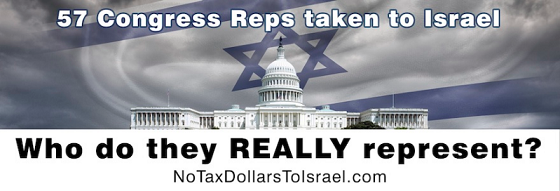
It is only a start, but we can at least begin to hold our elected officials accountable. We can make them begin to pay a price for selling out both the American and the Palestinian people to Israel.
Paul Larudee is one of the founders of the Free Gaza and Free Palestine Movements and an organizer in the International Solidarity Movement.
‘The race to save Peter Kassig’
By Dr Richard Marsden | The Business of Emotions | December 24, 2014
 On Thursday, December 18, 2014, The Guardian published The race to save Peter Kassig by Ali Younes, Shiv Malik, Spencer Ackerman and Mustafa Khalili. To refresh memories here is the preface to the story:
The American aid worker was killed by his Isis captors on 16 November. Here, for the first time, is the story of an extraordinary effort to secure his release, which involved a radical New York lawyer, the US government, and the world’s most revered jihadi scholar.
Listen to The Guardian team tell of the daring and extraordinary effort to secure Kassig’s release.
The radical New York lawyer in question is Stanley Cohen, ‘one of America’s most controversial lawyers’. In January he begins an 18-month prison sentence after pleading guilty to a charge from the US Internal Revenue Service. The Guardian article tells a gripping tale of how Cohen put together a team of Islamic scholars and al-Qaeda fellow-travellers to negotiate the release of Peter Kassig from Islamic State’s captivity—only to be thwarted at the last minute by an ill-timed intervention by Jordan’s secret service.
Clearly it’s an important story deserving of a wide readership. How curious then that The Guardian first broke the story just before Christmas, when readers are busy with other things, and that since then corporate news media in the United States have ignored it. On Twitter it’s another matter. Cohen is lauded as a hero for selflessly attempting a rescue mission while the authorities did nothing and his prison cell beckoned. There is talk of a film deal. The Pardon Stanley Cohen movement has more of a spring in its step.
All well and good, then.
And yet, to my ears, ‘The race to rescue Peter Kassig’ does not ring true. Lest it be sanctified by Hollywood without the bother of critical evaluation, I want to register some questions and comments so that we might better understand the fate of Peter Kassig. I fear that Guardian readers, the article’s authors, and even Stanley Cohen, have been taken advantage of by altogether more diabolical forces.
1. Let’s start at the beginning: Where is the evidence that Peter Kassig was ever held captive by ‘Islamic State’ or that they decapitated him? This is so widely assumed that the question is seldom asked. It should be. Questioning assumptions should be a starting point for investigative journalists. If he is to be ‘rescued’ we ought to ask, From whom and where?
Surely the 15 minute video ‘Although the disbelievers dislike it’ is all the evidence we need, even if few have seen it? I do not think so. I’ve studied it carefully and can find evidence only of the Tarantino-like film making skills of whoever created this little masterpiece of deception. (See ISIS Lessons in Terror Marketing: How to Change the World by Deception). No one is decapitated in that video; not anyone of those Syrian servicemen; not Peter Kassig. It’s all camera angles, special effects and clever editing.
What about Kassig’s severed head at the feet of ‘Jihadi John’ in the final segment of that video? It certainly looks like a severed head and it resembles Kassig’s and this is proof of what exactly? The props department of most major theatre and opera companies can produce a severed head on demand, even of a specific individual. Here the Royal Shakespeare Company shows how it is done. Props departments have their counterparts in film; they’re called digital artists. Look carefully: ‘Kassig’s head’ is a digitally inserted prop. It’s not proof of Kassig’s death. It’s proof that someone is attempting to deceive us.
Questions such as these are not asked because ‘we are passive consumers of the pornography of violence’ (Will Self, The Guardian, 2014-12-23). Effectively, public opinion defers to the testimony of ‘Jihadi John’. So when he says ‘This is Peter Edward Kassig, a US citizen of your country’ it surely must be true. From this shaky assumption Ali Younes, Shiv Malik, Spencer Ackerman and Mustafa Khalili set forth on their investigation.
2. Strictly speaking, the byline of ‘The race to save Peter Kassig’ should be ‘Stanley Cohen as told to Younes et al’ for the entire account is based on what Cohen told them he recalled, felt and did. The article reads like an extract from a novel, in which Cohen is the protagonist and Younes et al attempt to breath some life into the character by seeing the world through his eyes. For example, Cohen ‘had other things on his mind’; ‘as he returned from court’; ‘To Cohen, it seemed like fate’; ‘Cohen saw something of himself.’ And so on. The entire article is written like this.
Investigative journalism surely calls for more critical distance from those it investigates. This is especially important since three of the central players in this drama are anonymous and we have no way of checking their account: the FBI official (‘Mike’), the federal prosecutor and an ex-Guantanamo, ‘Kuwaiti member of al-Qaida’ (‘Food’). Essentially, Cohen speaks for them and the coauthors document what he says. The article’s rhetorical style leaves readers no room to make up their own minds about what happened.
3. Even fictional narratives must be plausible; this article stretches plausibility to its limit.
(a) Readers are asked to believe that the United States, with its vast intelligence and diplomatic resources, has no one capable of negotiating with Islamic State for the release of one of its citizens—apart from this maverick Jewish soon-to-be imprisoned lawyer. If so, what’s the point of those ‘diplomats’ in that vast US ‘embassy’ in Baghdad?
(b) How plausible is it that Cohen was given a free hand to negotiate with Islamic State? Let’s look at what he so nearly did with it. According to the article, he concluded that the only way to achieve Kassig’s release was to bring about rapprochement between Turki al-Binali and Abu Muhammad al-Maqdisi; or, put another way, to bring about reconciliation between ISIS and al-Qaeda. No kidding. And this would be a good thing? The life of this one American would be worth this exorbitant price would it? Apparently so. The US intelligence and diplomat community, it would seem, was indifferent to this prospect, which, but for the bungling interference of Jordan’s secret service in arresting al-Maqdisi, would have come about.
(c) How likely is it that Jordan’s secret service would act contrary to the wishes of their American counterparts, especially on a mission of such vital importance?
(d) Why would anyone reasonably expect ‘Islamic State’ to be so magnanimous as to free Kassig just so it could have the pleasure of dedicating his release ‘to Muslim political prisoners around the world, including those in Guantánamo’, as Cohen suggested? What is there in ‘Jihadi John’s’ demeanour that suggests this? Yet this prospect, apparently, was enough for Islamic State to agree that Kassig would not be harmed ‘while Cohen was still engaged on the ground.’
(e) The ‘tentative proposal for Kassig’s unilateral release’ was put together by Cohen with the help of three anonymous characters—the FBI official (‘Mike’), the federal prosecutor and an ex-Guantanamo, ‘Kuwaiti member of al-Qaida’ (‘Food’). Why would they want to conceal their involvement in this noble but tragic rescue mission, when others with more to lose are named?
(f) Turki al-Binali is an elusive character. Just 30-years old, but ‘Isis’s chief scholar’ ‘who has his own English language Facebook page’ and ‘the only person who could stay Jihadi John’s knife with a single edict.’ (‘Jihadi John’, then, is in charge.) Just as ‘Jihadi John’ is a man whose face we have not seen and whose voice is not authenticated, Turki al-Binali is encountered more in the virtual realm than in the flesh. No one actually sees him during these negotiations nor is there any mention of where he is physically located. It’s all done via WhatsApp.
(g) Why would the venerable Abu Muhammad al-Maqdisi, newly released from 5 years in a Jordanian prison, want to jeopardize his freedom by messaging with al-Binali, Islamic State’s ‘scholar-in-arms’, over such a harebrained scheme and then have his private conversations published in a national newspaper for the whole world to gawp at? Incredibly, he takes the word of Cohen, who he has just met, and his anonymous FBI handler (‘Mike’).
(h) In fact, it’s not clear why al-Maqdisi, ‘who may be the world’s most revered living jihadi scholar’, would agree to meet with Cohen in the first place, let alone immediately invite this stranger into his home. ‘The flat was tidy: on the floor were children’s toys and, on the walls, framed religious quotations.’ This is as close as we come to an explanation:
When Cohen told Mike about his travel plans, the FBI official was surprised. “He said ‘Maqdisi is going to meet with you?’” Cohen recalled. “I said ‘Yeah, he’s waiting for me.’ He said ‘Go’.”
As easy as that then. Could the following help explain this instant cordiality? In an article published in the Arab Daily News, October 28, 2014, one of the authors of ‘The race to save Peter Kassig’, Ali Younes, writes of an interview he conducted with the said Abu Mohamad al-Maqdisi. (There they are together in two photographs, friendly as anything). Younes reveals that he had spoken with al-Maqdisi ‘on several occasions in the past few weeks’. This is the very period that Cohen claims to have been communicating with al-Maqdisi. It surely wasn’t the case that one of the authors of ‘The race to save Peter Kassig’ was a party to these negotiations? We would have been told. Wouldn’t we?
(i) According to ‘The race to save Peter Kassig’ al-Maqdisi and al-Binali tried to reach an agreement on the release of Kassig, not by meeting face-to-face, speaking on the phone or even by writing letters, but via WhatsApp (‘one of Isis’s favoured modes of communication’).
By now it was evening, and for the next two hours or so, Maqdisi and Binali messaged each other on WhatsApp. Their exchange was “very warm,” Cohen says. Maqdisi jokingly called Binali “my ungrateful son” and Binali messaged back and said, “Abu Muhammad [Maqdisi] is my father. All these other sheikhs [in Isis] are my uncles.” Binali was eager to show off: he prefaced some of his messages by saying there was a drone overhead or there had just been an air strike, to impress Maqdisi. He also sent his former teacher a picture of himself wearing an ammunition vest and holding a Qur’an.
Quite touching. These are Cohen’s recollections, mind, not al-Maqdisi’s or al-Binali’s.
Maqdisi told Cohen that he’d had an additional WhatsApp discussion with Binali. They made progress towards a personal rapprochement and had even started to resolve their religious differences. Tomorrow, Maqdisi said, he planned on specifically broaching the subject of Kassig with him.
I cannot even imagine the bookish al-Maqdisi using WhatsApp. Is this really how Jihadi scholars do business these days? They are so trusting. Neither could know for sure who he was messaging with. Having ‘made progress towards a personal rapprochement’ they were to ‘resolve their religious differences’—by WhatsApp. This is how the reconciliation between Islamic State and al-Qaeda was to be achieved? This is how the fate of this young man was to be decided? This is the very best the United States could do to rescue him?
Incidentally, where was al-Binali during these exchanges? This isn’t mentioned in the article. Did Cohen or anyone on his team see him or know where he was? Other than by his appearances on WhatsApp, Twitter and Facebook, how would the skeptical know that the elusive al-Binali actually exists?
For these and other reasons I am not at all persuaded by ‘The race to save Peter Kassig’. I do, however, have a more plausible explanation of the events depicted in the article. As I have argued at length elsewhere, the suite of Islamic State beheading videos (of Foley, Sotloff, Henning and Haines, along with ‘Although the disbelievers dislike it’) are works of military deception (MILDEC) aimed primarily at Western public opinion. No one dies in those videos. Their immediate objective was to facilitate Anglo-American military reengagement in Iraq (unthinkable only a few months ago) by goading an emotional reaction among Brits and Americans. Mission accomplished. Their broader objective is to disguise the real forces behind Islamic State and their motives. Things are not as they seem. I do not know for sure who is behind these particular Islamic State beheading videos, other than that it is not ‘Islamic State’, but if a faction within US/UK intelligence did not create them they surely know who did.
To return to the fate of Peter Kassig and the ‘race’ to save him.
Whenever an American hostage meets an untimely demise the US feels obliged to tell us of the heroic efforts they made to save him or her, only to be foiled by circumstances beyond their control. It happens every time. For simulated hostages there are simulated rescue attempts. The day after the release of the Foley beheading video, for example, ‘senior Obama administration officials’ told of an unsuccessful secret operation to rescue Foley and several other Americans held captive in Syria. The Syrian government said it never happened. ‘The race to save Peter Kassig’ tells of the diplomatic equivalent of these heroically unsuccessful military rescue missions. Even if some or all of the participants were sincere, it was a simulated rescue that was designed to fail. Jordanian and American intelligence are like heart and lung on these matters. They work in unison. If Maqdisi was arrested just as the deal was about to be sealed it’s because the US wanted it.
No actual diplomats would fall for this pantomime, but an amateur one facing prison might. No seasoned journalists would fall for it either; they would raise questions such as the above. So what happened to these Guardianistas ? The accompanying audio (by Phoebe Greenward) tells us that the ‘race’ began with ‘a series of emails obtained by the Guardian.‘ ‘Obtained’ suggests some active investigation. A more accurate word I suggest is ‘fed’ (given to Shiv Malik). By whom? And why to a British rather than an American newspaper? Mustafa Khalili’s first response when he read them—’disbelief’—was correct. But these journalists were so intoxicated by the romance of what they read that their investigation lapsed into fleshing out a narrative on the bare bones of those emails, the whole lot marinated in sentiment. The name for this is ‘creative nonfiction’, not investigative journalism.
The correct answer to ‘What happened to Peter Kassig?’ is ‘We don’t know’. This is a more honest position than seeing beheadings where there are none and taking ‘Jihadi John’s’ word as gospel. To answer the question, researching how ‘The race to save Peter Kassig’ came to be would be a good start.
Dr. Richard Marsden
Faculty of Humanities and Social Sciences
Athabasca University
Alberta, Canada T9S 3A3
Street art campaign brightens Gaza refugee camp
30 artists attempt to lift spirits in Gaza Strip’s poverty-stricken, war-weary Al-Shati refugee camp
MEMO | December 13, 2015
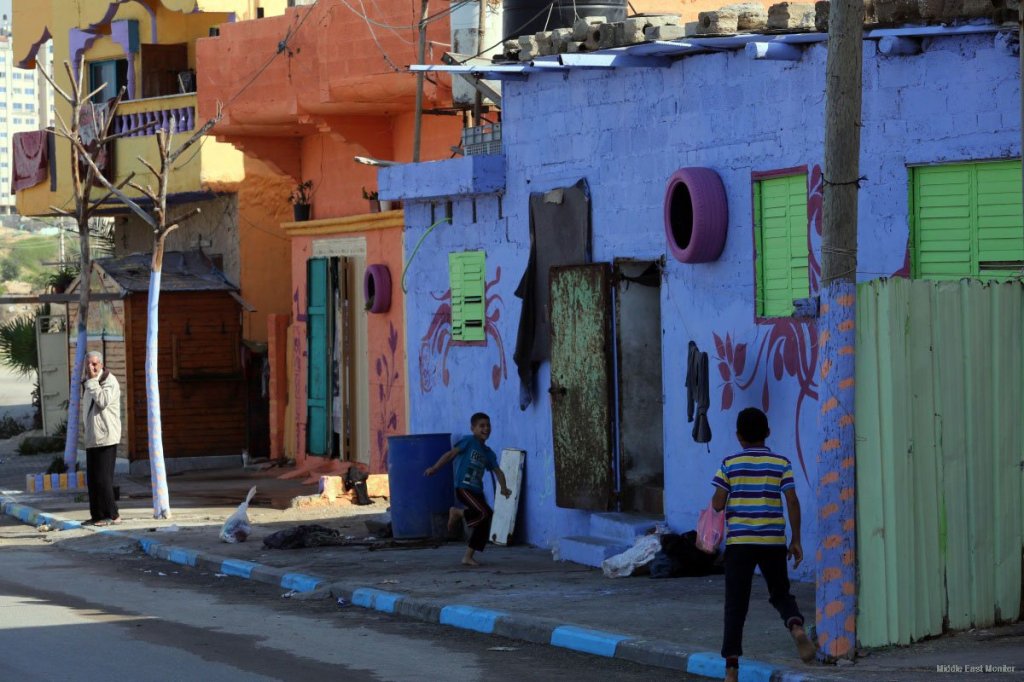
At the Al-Shati refugee camp in the northern Gaza Strip, the streets and walls of many of the homes have been splashed with color by 30 painters in an effort to bring some cheer to an area usually associated with war and poverty.
The “Better Gaza” campaign is aimed at giving the Al-Shati camp – home to some 82,000 Palestinian refugees – a new face by adorning its homes and public spaces with colourful images of trees, flowers and butterflies.
But while camp residents are pleased with the new, cheerful appearance of many of their homes, Al-Shati nevertheless remains haunted by the spectre of poverty and privation.
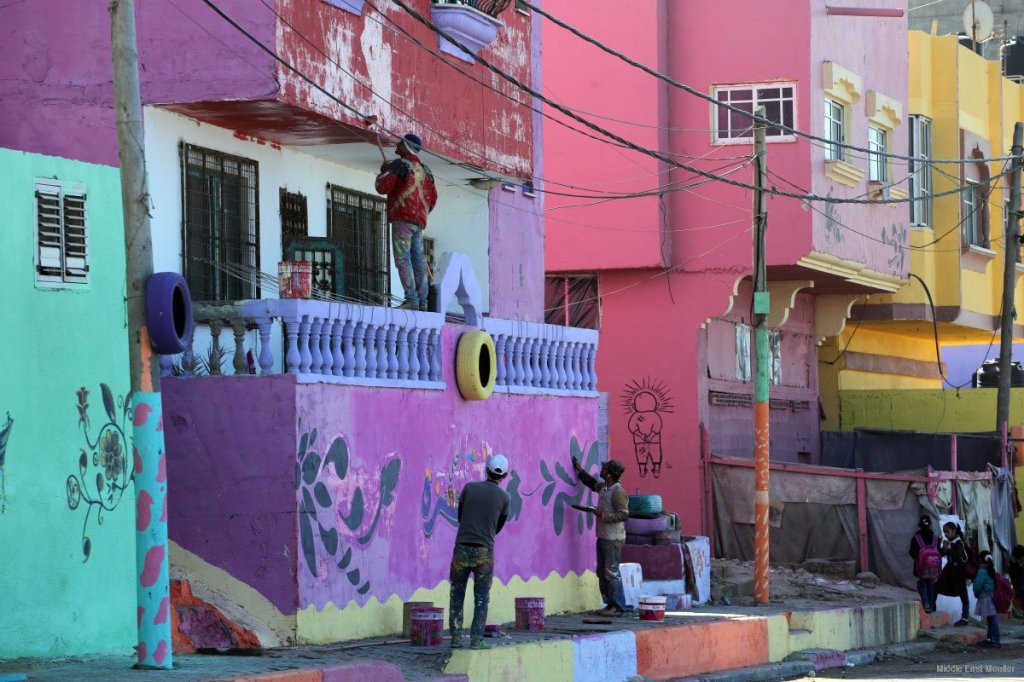
Bahgat Abu Hamad, the father of eight children, likes the cheerful images of orange and purple flowers that now adorn his once-gray home.
“But the pretty paintings will neither improve our deplorable living conditions nor provide me with a job or food for my family,” he laments.
“Our house is colourful on the outside but it remains dark on the inside as we continue to struggle with poverty and our chronically tough circumstances,” says Abu Hamad.
“Nevertheless,” he adds, “the bright and beautiful colours have made many of us happy, especially the children.”
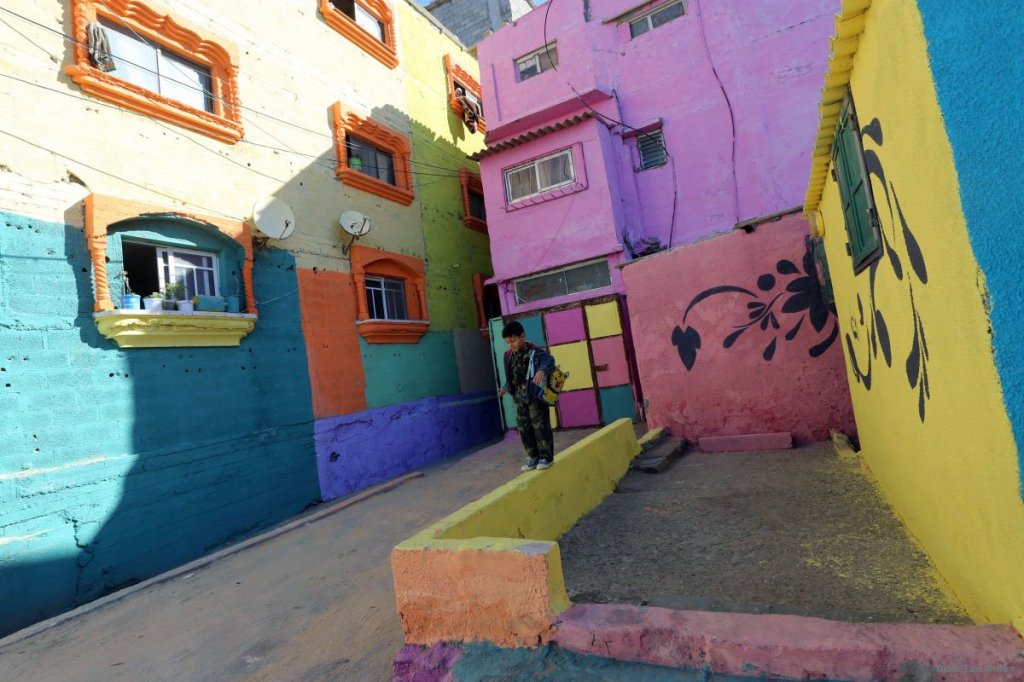
Eleven-year-old Nidal Semir, for one, loves the new paintings.
“I can’t believe how pretty they are,” she said when she first saw the bright flowers and butterflies on the wall of her family home.
Nine-year-old Raed Bekr also loves the new look of his home, but adds, “I wish they had painted the inside of the house as well.”
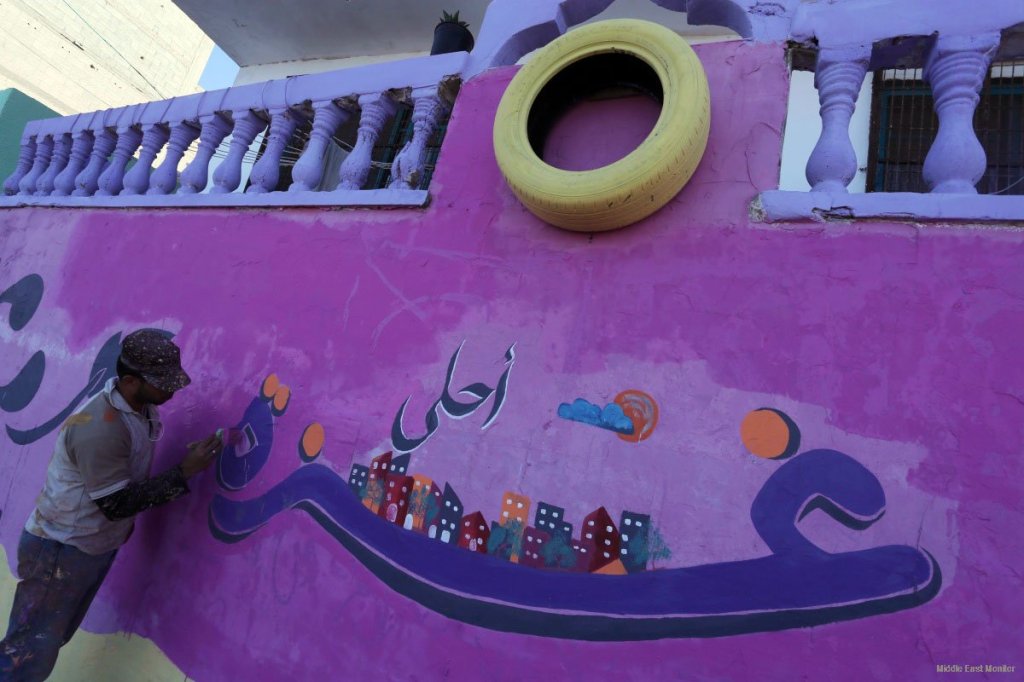
According to campaign coordinator Dalia Abdurrahman, “Better Gaza” aims to revive hope among struggling camp residents who in recent years have had little to smile about.
“The message we’re trying to deliver is that the Palestinians of the Gaza Strip still have a longing for life,” Abdurrahman said.
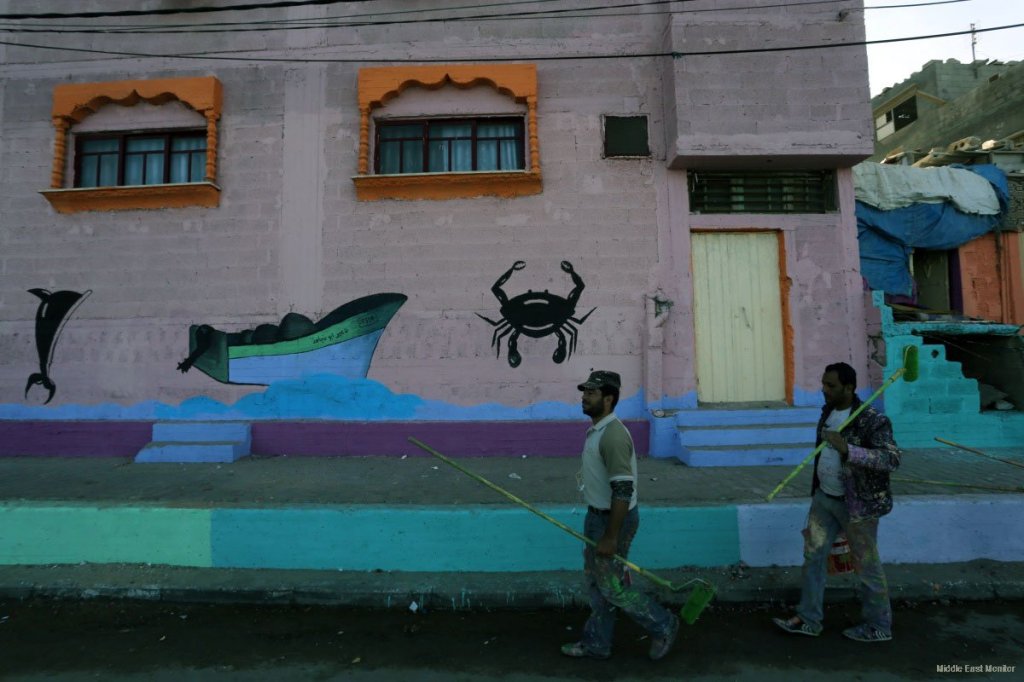
According to a September report issued by the UN Conference on Trade and Development (UNCTAD), the Gaza Strip could become uninhabitable by 2020 if current economic trends — and an ongoing blockade by Israel and Egypt – persist.
In May, the World Bank warned that the Gaza Strip’s unemployment rate had reached a whopping 43 percent – the highest in the world.
News from Anadolu Agency. Images by MEMO Photographer Mohammed Asad.
Dead, Disabled, Displaced or Destroyed – Democracy Delivered

By Graham Vanbergen | TruePublica | December 10, 2015
Six months ago, the Washington DC-based Physicians for Social Responsibility (PRS) released a landmark study over the death toll from 10 years of the “War on Terror” since the 9/11 attacks. It was largely ignored by the world’s press.
The 97-page report accompanied by hundreds of studies, reports and investigations by the Nobel Peace Prize-winning doctors’ group is the first to tally up the total number of civilian casualties from US-UK led interventions in Iraq, Afghanistan and Pakistan. This article uses much of the content from that report called the IPPNW (International Physicians for the Prevention of Nuclear War) Body Count publication.
A poll carried out by the Associated Press (AP) two years ago found that, on average, U.S. citizens believe that only 9,900 Iraqis were killed during the 2003-2011 occupation of Iraq by the US, UK and allied forces.
Random spot checks have suggested that more than two-thirds of all violent deaths that occurred in Baghdad between 2003 and 2007 did not appear in the media, and were therefore not included in official statistics distributed by the Iraq Body Count (IBC). The IBC has a media-centered approach to counting and documenting the deaths and is considered very unreliable as a result but is much quoted by the establishment and mainstream press the world over.
For instance, evidence of the 27,000 bombs that were dropped in just the first year during the invasion of Iraqi cities is practically non-existent in the IBC database.
In many cases, the occupying powers explicitly blocked journalists from investigating instances where the British or American forces were accused of mass killings. Numerous journalists in Iraq who tried to report on the activities of the occupation troops and their consequences were killed or arrested.
In Iraq itself, only a small number of casualties made it to the central hospitals or morgues where they could be registered. That proportion decreased the more intense the military battles were and the more the violence between various sections of the population escalated. Since Islam requires a funeral within one day, relatives generally had no choice but to bury their dead directly – either in their yards or close to their homes.
Moreover, the occupying power often forbade the hospitals and morgues from making their numbers public.
The fate of Iraqi physicians is one area that is very well documented. According to data from the independent Iraqi Medical Association, of the 34,000 registered physicians, almost 2,000 were killed and 20,000 left the country. In its database, IBC lists only 70 Iraqi physicians. Even though this may in part be due to a lack of data on the profession of the victims, this piece of evidence alone suggests very large gaps in IBC’s calculations.
According to the Najaf governorate’s spokesperson Ahmed Di’aibil (member of the Supreme Islamic Council of Iraq), in this city alone, which has a population of close to 600,000, 40,000 non-identified corpses were buried since the start of the war. The IBC database documents only 1,354 victims in Najaf, barely 3% of the actual.
In a September 2009 speech, Samir Sumaidaie, the Iraqi ambassador to the U.S. installed by the occupation power, talked about 500,000 newly widowed persons in Iraq. A February 2007 BBC poll in the region came to the conclusion that 17% of all Iraqi households have lost at least one member through violence since 2003. Given the total population at the time of some 27 million, this too suggests that more than 500,000 Iraqis fell victim to the war and its consequences just in the first four years.
By 2008, the number of refugees from Iraq in foreign countries and internally displaced persons had risen to 5 million.
Such a high number of victims – reaching genocidal dimensions – represented a massive indictment of the U.S. administration, British government and its allies that they simply could not allow to stand. Hence, the findings of this study were furiously criticized. Even though nearly all the experts in the field, including the scientists of the British administration, confirmed the accuracy of the study, it was slandered by governments and main stream establishment media.
Dr. h.c. Hans-C. von Sponeck, UN Assistant Secretary General & UN Humanitarian Coordinator for Iraq (1998-2000); UN Resident Coordinator for Pakistan (1988- 94) covering also Afghanistan said in his report:
“The U.S.-led Multinational Force have carefully kept a running total of fatalities they have suffered. However, the military’s only interest has been in counting “their” bodies.”
“Since U.S. and other foreign military boots are only intermittently and secretly on the ground in Pakistan, mainly in the northern tribal areas, there are no body count statistics for coalition force casualties available for Pakistan. The picture of physically wounded military personnel for both war theatres is in- complete. Only the U.S. military is identified: (a) 32,223 were wounded during the 2003 Iraq invasion and its aftermath, and (b) until November 2014 20,040 were wounded in Afghanistan.”
No figures are known for mental disorders involving military personnel who have been deployed in Iraq, Afghanistan and Pakistan but US veteran soldiers are still committing suicide at the rate of 22 per day.
Officially ignored are casualties, injured or killed, involving enemy combatants and civilians together. This, of course, comes as no surprise. It is not an oversight but a deliberate omission. The U.S. authorities have kept no known records of such deaths. This would have destroyed the arguments that freeing Iraq by military force from a dictatorship, removing Al-Qaeda from Afghanistan and eliminating safe-havens for terrorists in Pakistan’s tribal areas has prevented terrorism from reaching the U.S. homeland, improved global security and advanced human rights, all at “defendable” costs.
The IPPNW Body Count publication must be seen as a significant contribution to narrowing the gap between reliable estimates of victims of war, especially civilians in Iraq, Afghanistan and Pakistan and tendentious, manipulated or even fraudulent accounts.
After 58,000 dead US soldiers and 2 million civilian deaths in Vietnam, the Reagan Administration sought to resolve the negative public opinion problem by utilizing obeisant client states or surrogate forces, epitomized by the “Contra” armies and death squads deployed in Central America and Southern Africa instead of using its own attacking forces. With the end of the Cold War, U.S. policymakers triumphantly pronounced the end of the “Vietnam Syndrome,” and ushered in a new era of American “boots on the ground” that led ultimately to the debacle in Iraq, Afghanistan and the surrounding region.
This investigation and report comes to the conclusion that the war has, directly or indirectly, killed around 1 million people in Iraq, 220,000 in Afghanistan and 80,000 in Pakistan, i.e. a total of around 1.3 million. The figure is approximately 10 times greater than that of which the public, experts and decision makers are aware of and propagated by the media and major NGOs. And this is only a conservative estimate. The total number of deaths in the three countries named above could easily be in excess of 2 million.
For some degree of context – should the number of Iraqis killed from the 2003 U.S. invasion until 2012 actually be around one million, this would represent 5% of the total population of Iraq. By contrast, during World War II Germany lost around 10% of its population.
In Iraq, results from statistical surveys conducted by the Johns Hopkins University, published in 2004 and 2006 in the medical journal The Lancet, (The basis of the Lancet study, which was executed by a U.S.-Iraqi team led by renowned scientists was a survey of a representative selection of 1,850 Iraqi households across Iraq) as well as by the British polling institute Opinion Research Business (ORB) in 2007 suggest that already by 2008 over one million Iraqis had died as a result of war, occupation and their indirect consequences. many more have died since.
Moreover, and in addition to the appalling numbers, according to the International Commission on Missing Persons (ICMP), between 250,000 and one million persons are missing in Iraq, presumed dead.
For an estimate of the current casualty numbers, one has to interpolate. The U.S. NGO Just Foreign Policy does exactly this with its Iraqi Death Estimator, where it multiplies the number of victims of violence determined by the Lancet study as of June 2006 by the increase in the number since then as provided by IBC. From the relation between the current number given by IBC and the one given for the end of June 2006 (43,394), it concludes that the number of Iraqis killed up to September 2011 is at around 1.46 million.
One development of the scale of bombing was that the health care system largely collapsed. Diseases spread because of the lack of access to drinking water and the contamination of rivers. Almost three million people became internal refugees; as a consequence, large parts of once reasonably affluent cities turned into slums.
The long-term consequences through the poisoning of the environment brought about by the war must also be taken into consideration. Many areas of Iraq that were subjected to furious attacks by the occupying forces show a dramatic increase in the number of diseases. In many areas, the number of occurrences of various forms of cancer, of miscarriages and abnormal and deformed babies multiplied. A major reason for this is likely to be the massive use of ammunition containing depleted uranium.
According to the Landmine and Cluster Munition Monitor of the International Campaign to Ban Landmines (ICBL) and the Cluster Munition Coalition (CMC), since 2003, U.S. and UK troops have used around 13,000 cluster bombs in Iraq. Iraq is littered with high levels of nuclear and dioxin contamination. These have disseminated their sub-ammunition – almost 2 million bomblets – widely in and around the fought-over cities. In addition, the 20 million bomblets from the 61,000 cluster bombs dropped in 1991 have also still not all been cleared. This makes Iraq one of the countries with the highest contamination of highly explosive unexploded ordnance in the world.
Evidence of this can be seen in child mortality that multiplied in the following years, the number of occurrences of cancer quadrupled, and the number of cases of leukemia increased by a factor of 40.
Afghanistan and Pakistan
There have so far been no representative studies on the number of victims from the ongoing UN-mandated NATO war in Afghanistan. The few investigations that exist on deaths as a result of that war are all based on passive observation.
In Pakistan, the number of killed civilians and combatants is much harder to determine than in Afghanistan. Even data based on passive observation are barely existent. Taking all sources and factors into account, a total number of 300,000 war deaths in the AfPak War-Theatre until 2013 seems realistic.
Libya
Estimates of deaths in the fall of Libya as a result of US/UK/NATO bombing and subsequent civil war between March 2 and October 2, 2011 vary. An exact figure is hard to ascertain, partly due to a media clamp-down by the Libyan government. Some conservative estimates have been released of around 25,000. NATO holds itself to no standard of measurement whatsoever in this regard. If Iraq and Afghanistan are anything to go by this number could easily be over 100,000. Some of the killing “may amount to crimes against humanity” according to the United Nations Security Council and as of March 2011, is under investigation by the International Criminal Court.
Conclusion
It is impossible to calculate the death, destruction and decay incurred by the people of these countries. It is fair to say two million are dead, another one million presumed dead with many more deaths as a result of disease, lack of medical care, child birth, birth defects, cancer care and the like. One should not forget, these countries continue to feel the after effects of current governance and a lack of control over security that culminates in many bombings, shooting, kidnapping, murders and suicides.
The current death toll in Syria is reported at 250,000 and counting with 6.5 million displaced.
Finally, as the FT reported in February “In all, more than 100,000 people, perhaps a third or more civilians, died violently in conflicts in Syria, Iraq, Libya, Yemen and the Gaza Strip in 2014, making it one of the bloodiest years in the Middle East’s history”. Death continues at a horrific rate.
Read the full IPPNW report HERE
Thousands gather in Montenegro capital to protest NATO membership
RT | December 13, 2015
Shortly after Montenegro’s bid to join the North Atlantic Alliance was given the green light, thousands flooded the streets of the capital to protest the upcoming membership and remind people of lives taken during the NATO invasion of 1999.
Former Montenegrin President Momir Bulatovic and opposition leaders called the rally on Saturday in Montenegro’s capital, Podgorica. They gathered at least 5,000 supporters outside the parliament, according to the local Vijesti newspaper. The protesters held national flags while patriotic and pro-Russian chants rang out from the assembled crowd.
Bulatovic, who was also prime minister of the Federal Republic of Yugoslavia from 1998 to 2000, told the rally that joining NATO would mean the “blood of innocent people on our hands,” and emphasized his country had been against the alliance’s wars until recently.
“What has Afghanistan done wrong, what has Iraq done wrong? Why has Libya been destroyed, what’s happening today in Syria? Can we close our eyes to that?” he said.
He added that Montenegro’s ascension into NATO is strange, because “in 1999 NATO attacked Yugoslavia [and] bombs fell on Montenegro as well.”
“It’s impossible to erase such [actions] with an apology,” he said as quoted by Sputnik, adding that by letting his country in, NATO simply wants to have “a few more soldiers against Russia.”
The protesters chanted “Russia” as well as “NATO Murderers” in reference to NATO’s war in 1999 against the former Yugoslavia, which took the lives of many civilians in the alliance’s nationwide bombing raids against what were called military targets.

© Ruptly
One of the placards raised by the protesters showed the faces of six civilians – including children – who died in NATO’s airstrike on the small Montenegrin village of Murino in May 1999. The village had no military significance, nor did it host any troops at that time. The bombing added further to the so-called “collateral damage” log of NATO’s war against the former Yugoslavia. No official apology or inquiry followed that incident.
Montenegro was offered NATO membership at the alliance’s summit on December 2. It was pushed forward by the current pro-Western President Milo Djukanovic. Montenegro remained part of a union with Serbia until 2006 and has since been actively integrating in EU and NATO structures. According to recent polling by the Podgorica-based Center for Democracy and Human Rights, 37 percent of surveyed Montenegrins oppose NATO membership, with 36 percent welcoming it. The country is home to 600,000 people.
Another anti-NATO protest took place in Montenegro’s capital earlier in October, involving as many 5,000 people who clashed with police after demanding President Djukanovic step down due to his pro-alliance stance.
Featured Video

Genocide-linked firm handles Britons’ NHS data
or go to
Aletho News Archives – Video-Images
Book Review
Book review: Boiling Point, How America Brought War to Ukraine
By Tim Kirby | Strategic Culture Foundation | November 14, 2026
Did Vladimir Putin just wake up one day on the wrong side of the bed and decide to invade Ukraine in February of 2022 or is there a lot more to this single decision that has been reshaping the 21st century geopolitical landscape?
Obviously, from the way that I just posed the question you can see that I am on the side that views the causes for the war in Ukraine to be very deep, long-term, historical and consciously nefarious, and most importantly, not from within the halls of the Kremlin. So it was a pleasure to take a look at the book “Boiling Point, How America Brought War to Ukraine” by author Stephen Kinzer, who like myself, also believes that the real reasons behind military conflicts around the world are not what CNN and the BBC have been telling you. The main thesis of this book was stated clearly by its creator; the war “may have been illegal, but it was definitely not unprovoked.” … continue
Blog Roll
 Aletho News
- NATO cancels 2027 leaders’ summit
- IAEA’s politicized use of safeguards undermines its impartiality: Russian envoy
- UK must be ready to strike Russian Arctic – ex-PM
- Fico’s Two Red Lines: Russian Energy and the Next Ukraine Loan
- Thousands rally for banned NATO-skeptic presidential candidate
- Ukraine Settlement and New European Security Architecture Must Go Hand in Hand – Kremlin
- Book review: Boiling Point, How America Brought War to Ukraine
- Israel Revives The ‘Iranian Assassination Threat Against Trump’ Deception In A Desperate Bid To Restart The War
- US rewrites history to dodge blame for illegal war on Iran: Foreign Ministry spokesperson
- TURBO CANCER DATA from Ontario, Canada (OHIP Insurance Billing Data)
- If Americans Knew
- No, Christians did not invent Zionism
- Hakeem Jeffries & Chuck Schumer: Conduits for Israel Lobby Dark Money
- DAILY UPDATE: Latest essential news on Palestine, Israel, & region
- Aid organizations in Gaza are pulling back, leaving hundreds of thousands of Palestinians without food
- 1.4 Million People in Gaza Live in Tents. Winter Storms Can Be a Death Sentence.
- Israel Used a U.S.-Made Missile to Kill Six at Gaza’s Nasser Hospital
- Congress Might Sneakily Use Lame Duck to Deeply Intertwine the U.S. and Israeli Militaries
- DAILY UPDATE: Latest essential news on Palestine, Israel, & region
- 9-month-old baby dies from severe cold in Gaza, 1st cold-related death this winter: Health Ministry
- Israel Kills over 12, Injures Many Across Gaza
- No Tricks Zone
- New Study: Barents Sea Temperatures Were Warmer And Sea Ice Less Extensive In The 1700s Than Today
- German Authorities Start Initiative To Evaluate Public Register For Climate “Disinformation” Spreaders!
- Zonal Asymmetry of Temperature Change in the Antarctic Circumpolar Current
- New Study: The Net Fossil Fuel Contribution To Rising Atmospheric CO2 Has Been Zero For 500 Years
- Germany’s Green Energy Transition Becoming Increasingly Expensive…Another 6 Trillion Euros!
- Sudden Stratospheric Warming, Powerful El Niño Combination May Lead To Extreme Europe Cold, Energy Crisis!
- Two New Studies Find Thwaites Glacier Melt Cannot Be Driven By Human Activity Or A Warming Ocean
- E-Cars Reduce CO2 Emissions By Only 41% Compared To Internal Combustion Engine Vehicles
- Predictions Made By Renowned Climate Professor Over Past Decades Have Been Proven To Be Poor
- New Study Suggests Large Regions Of The Pacific Ocean Have Been Cooling For The Last 80 Years

