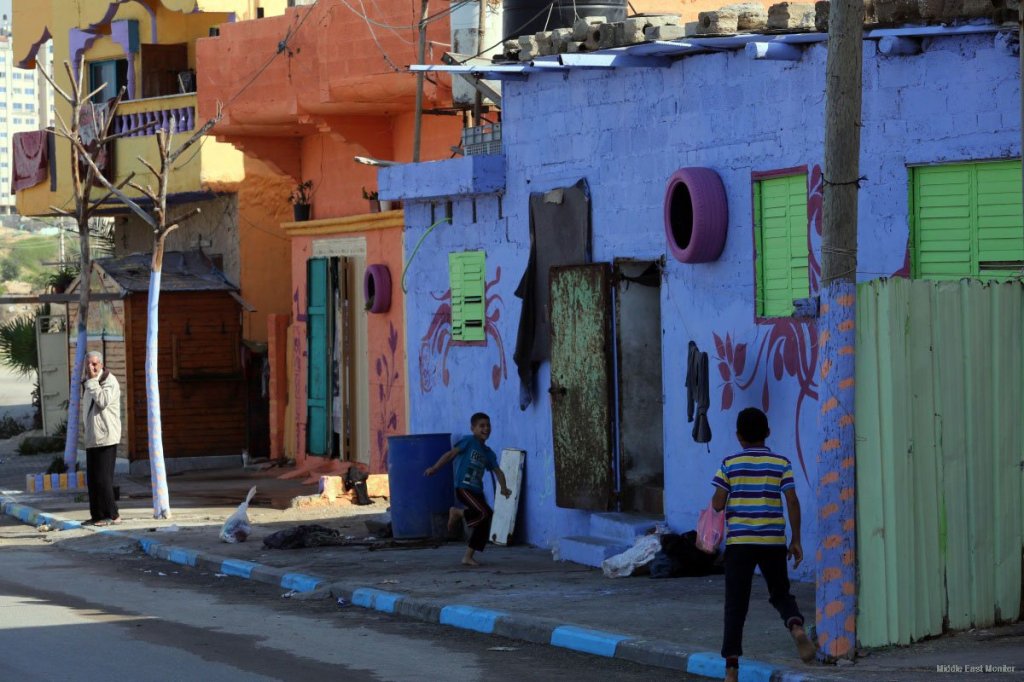
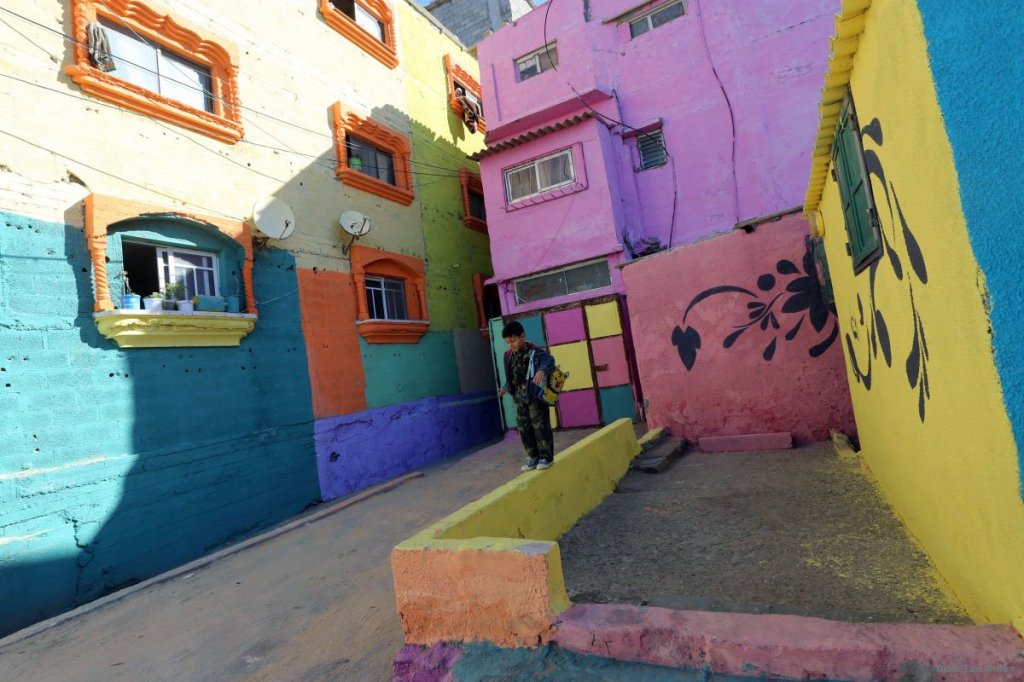
At the Al-Shati refugee camp in the northern Gaza Strip, the streets and walls of many of the homes have been splashed with color by 30 painters in an effort to bring some cheer to an area usually associated with war and poverty.
The “Better Gaza” campaign is aimed at giving the Al-Shati camp – home to some 82,000 Palestinian refugees – a new face by adorning its homes and public spaces with colourful images of trees, flowers and butterflies.
But while camp residents are pleased with the new, cheerful appearance of many of their homes, Al-Shati nevertheless remains haunted by the spectre of poverty and privation.
Bahgat Abu Hamad, the father of eight children, likes the cheerful images of orange and purple flowers that now adorn his once-gray home.
“But the pretty paintings will neither improve our deplorable living conditions nor provide me with a job or food for my family,” he laments.
“Our house is colourful on the outside but it remains dark on the inside as we continue to struggle with poverty and our chronically tough circumstances,” says Abu Hamad.
“Nevertheless,” he adds, “the bright and beautiful colours have made many of us happy, especially the children.”
Eleven-year-old Nidal Semir, for one, loves the new paintings.
“I can’t believe how pretty they are,” she said when she first saw the bright flowers and butterflies on the wall of her family home.
Nine-year-old Raed Bekr also loves the new look of his home, but adds, “I wish they had painted the inside of the house as well.”
According to campaign coordinator Dalia Abdurrahman, “Better Gaza” aims to revive hope among struggling camp residents who in recent years have had little to smile about.
“The message we’re trying to deliver is that the Palestinians of the Gaza Strip still have a longing for life,” Abdurrahman said.
According to a September report issued by the UN Conference on Trade and Development (UNCTAD), the Gaza Strip could become uninhabitable by 2020 if current economic trends — and an ongoing blockade by Israel and Egypt – persist.
In May, the World Bank warned that the Gaza Strip’s unemployment rate had reached a whopping 43 percent – the highest in the world.
News from Anadolu Agency. Images by MEMO Photographer Mohammed Asad.
At the Brookings Institution in Washington last Friday, Israeli Defence Minister Moshe Ya’alon gave an expose of his country’s perspectives on the conflict in Syria. Ya’alon is a former chief of staff of Israeli armed forces. His extensive remarks betrayed Israel’s acute dilemma on the policy front following the traumatic defeat its diplomacy suffered in attempting to forestall the Iran nuclear deal. Israel is finding it hard to turn a new leaf, while other protagonists in the region and indeed the Obama administration are moving on. Ya’alon made the following points:
Russia is playing a “more significant role” than the US in the Syrian conflict at present. This is not to Israel’s liking, because Russia supports the ‘Shia axis’, which includes Iran, Syria (Assad regime), Hezbollah, Houthis in Yemen and other Shia elements in Bahrain and Saudi Arabia, etc.
Israel disfavors the Syrian peace process devolving upon the UN-sponsored International Syria Support Group and the Vienna talks because it recognizes Iran’s key role in reaching any settlement, which can only lead to the consolidation of Iran’s ‘hegemony’ in Syria.
The geopolitics of the Middle East in general and in Syria are centred around three groupings: a) The “very solid” Shia axis which at present enjoys the support of Russia, is anathema to Israel; b) The Muslim Brotherhood axis which comprises Turkey, Qatar, and Gaza (Hamas), which is “not on the same page” as with the US or Israel; and, c) The Sunni Arab camp, “the most significant camp” in the region, which lacks leadership, but brings together Israel with Saudi Arabia and other GCC states, Egypt, Jordan, and Morocco.
The US should “orchestrate” and lead the Sunni Arab camp; in Syria, this means defeating Daesh with the foot soldiers provided by Sunni Arabs and Kurds, whom, therefore, Washington should ‘empower, support, finance and arm’. The US should have done this from the very beginning, but it is not yet “a lost cause. There is still a chance to do it”.
One of the dangerous implications of the Iran deal is that Tehran is increasingly perceived as “a part of the solution” in Middle East’s hot spots, whereas, a resurgent Iran is a more confident Iran which is all set on the path to become a big military power. The S-300 missiles supplied by Russia recently “are going to be operational within a couple of weeks.”
The Russian military operations in Syria have been a failure insofar as Moscow had estimated that a 3-month offensive would gain more territory for the Syrian regime, whereas, this hasn’t happened, and, therefore, pressure has built on Moscow to explore a political settlement.
A settlement is hard to reach in Syria and the country will remain unstable for a very long time to come.
Interestingly, Ya’alon conceded that the “apocalyptic, messianic” regime in Iran is firmly ensconced in power in Tehran and “with more money now, without political isolation, without external pressure”, it has more room to maneuver. Thus, no change can be expected in the Iranian policies. As he put it, “I don’t see the chance to have McDonald branches in Tehran as the new future”.
The remarks by Ya’alon underscore the stark isolation of Israel in the politics of the Middle East. Evidently, Israel’s preferred option is that the US resumes its containment strategy against Iran, and, as part of the policy, should lead its regional allies to militarily push for regime change in Syria. On the other hand, the Obama administration has had enough of confrontation with Iran, has no stomach for getting involved in a prolonged war in Syria or anywhere in the Middle East. Besides, Israel is overlooking that the West’s attitude toward the Assad regime has mellowed significantly and there is overall acceptance that Assad has a role in the transition.
On the other hand, the S-300 missiles supplied by Russia recently are becoming operational within the coming week or so and they will considerably strengthen Iran’s air defence system. In sum, an Israeli military option against Iran is inconceivable from now onward. Both Iran and Israel are acutely conscious that the power balance in the region has shifted. Put differently, the spectre that is haunting Israel is the inexorable rise of Iran as a regional ‘superpower’. At one point Ya’alon put it as follows:
We believe in the end Daesh (Islamic State) is going to be defeated. Iran is very different. It’s actually an original superpower… That is why we worry about this regime, and if they are perceived as a key for the solution because they are ready to fight Daesh, then they are going to gain more hegemony in the region… to be more dangerous, to be situated on our border, as part of the political settlement in Syria. This is very dangerous.
The implications of a Syrian settlement, reached on the basis of a consensus involving Iran, are very serious indeed for Israel. Iran put its cards on the table recently by stressing that the fate of President Assad is a ‘red line’ for Tehran – non-negotiable. And Iran openly regards Assad as an anchor sheet of ‘resistance’. Significantly, one of the most influential figures in the Iranian establishment, Ali Akbar Velayati, the advisor on foreign affairs to the Supreme Leader and a distinguished former foreign minister himself, made a stunning statement last week that Tehran expects Russia to join the resistance soon — and China too in a conceivable future. Velayati’s statement cannot be without any basis.
Israel has adopted a tactful line so far by engaging Russia and avoiding any skirmishes with the Russian forces operating in Syria. But it thoroughly dislikes the Russian-Iranian-Hezbollah axis in Syria, which is only going from strength to strength. Israel watches with unease that the Russian-Iranian military ties are poised for a phenomenal makeover. (Iranian and Hezbollah forces apparently helped in the rescue of the Russian pilot recently on the Syrian-Turkish border.) The Russian operations go hand in hand with the ground attacks by the Syrian government forces, who are assisted by the Hezbollah and are operating under the guidance of Iranian military advisors.
The crunch time comes if and when the military operations intensify in the southern regions of Syria bordering the Golan Heights. The instability in Syria is useful for Israel to disrupt the supply lines for Hezbollah. But the new reality could be a strong Iranian-Hezbollah presence in southern Syria in the approaches to the Golan Heights enjoying Russian air cover. If that happens, Israel’s illegal annexation of the Golan Heights could become a theatre for the forces of the ‘resistance’. Read Ya’alon’s extensive remarks here.
Six months ago, the Washington DC-based Physicians for Social Responsibility (PRS) released a landmark study over the death toll from 10 years of the “War on Terror” since the 9/11 attacks. It was largely ignored by the world’s press.
The 97-page report accompanied by hundreds of studies, reports and investigations by the Nobel Peace Prize-winning doctors’ group is the first to tally up the total number of civilian casualties from US-UK led interventions in Iraq, Afghanistan and Pakistan. This article uses much of the content from that report called the IPPNW (International Physicians for the Prevention of Nuclear War) Body Count publication.
A poll carried out by the Associated Press (AP) two years ago found that, on average, U.S. citizens believe that only 9,900 Iraqis were killed during the 2003-2011 occupation of Iraq by the US, UK and allied forces.
Random spot checks have suggested that more than two-thirds of all violent deaths that occurred in Baghdad between 2003 and 2007 did not appear in the media, and were therefore not included in official statistics distributed by the Iraq Body Count (IBC). The IBC has a media-centered approach to counting and documenting the deaths and is considered very unreliable as a result but is much quoted by the establishment and mainstream press the world over.
For instance, evidence of the 27,000 bombs that were dropped in just the first year during the invasion of Iraqi cities is practically non-existent in the IBC database.
In many cases, the occupying powers explicitly blocked journalists from investigating instances where the British or American forces were accused of mass killings. Numerous journalists in Iraq who tried to report on the activities of the occupation troops and their consequences were killed or arrested.
In Iraq itself, only a small number of casualties made it to the central hospitals or morgues where they could be registered. That proportion decreased the more intense the military battles were and the more the violence between various sections of the population escalated. Since Islam requires a funeral within one day, relatives generally had no choice but to bury their dead directly – either in their yards or close to their homes.
Moreover, the occupying power often forbade the hospitals and morgues from making their numbers public.
The fate of Iraqi physicians is one area that is very well documented. According to data from the independent Iraqi Medical Association, of the 34,000 registered physicians, almost 2,000 were killed and 20,000 left the country. In its database, IBC lists only 70 Iraqi physicians. Even though this may in part be due to a lack of data on the profession of the victims, this piece of evidence alone suggests very large gaps in IBC’s calculations.
According to the Najaf governorate’s spokesperson Ahmed Di’aibil (member of the Supreme Islamic Council of Iraq), in this city alone, which has a population of close to 600,000, 40,000 non-identified corpses were buried since the start of the war. The IBC database documents only 1,354 victims in Najaf, barely 3% of the actual.
In a September 2009 speech, Samir Sumaidaie, the Iraqi ambassador to the U.S. installed by the occupation power, talked about 500,000 newly widowed persons in Iraq. A February 2007 BBC poll in the region came to the conclusion that 17% of all Iraqi households have lost at least one member through violence since 2003. Given the total population at the time of some 27 million, this too suggests that more than 500,000 Iraqis fell victim to the war and its consequences just in the first four years.
By 2008, the number of refugees from Iraq in foreign countries and internally displaced persons had risen to 5 million.
Such a high number of victims – reaching genocidal dimensions – represented a massive indictment of the U.S. administration, British government and its allies that they simply could not allow to stand. Hence, the findings of this study were furiously criticized. Even though nearly all the experts in the field, including the scientists of the British administration, confirmed the accuracy of the study, it was slandered by governments and main stream establishment media.
Dr. h.c. Hans-C. von Sponeck, UN Assistant Secretary General & UN Humanitarian Coordinator for Iraq (1998-2000); UN Resident Coordinator for Pakistan (1988- 94) covering also Afghanistan said in his report:
“The U.S.-led Multinational Force have carefully kept a running total of fatalities they have suffered. However, the military’s only interest has been in counting “their” bodies.”
“Since U.S. and other foreign military boots are only intermittently and secretly on the ground in Pakistan, mainly in the northern tribal areas, there are no body count statistics for coalition force casualties available for Pakistan. The picture of physically wounded military personnel for both war theatres is in- complete. Only the U.S. military is identified: (a) 32,223 were wounded during the 2003 Iraq invasion and its aftermath, and (b) until November 2014 20,040 were wounded in Afghanistan.”
No figures are known for mental disorders involving military personnel who have been deployed in Iraq, Afghanistan and Pakistan but US veteran soldiers are still committing suicide at the rate of 22 per day.
Officially ignored are casualties, injured or killed, involving enemy combatants and civilians together. This, of course, comes as no surprise. It is not an oversight but a deliberate omission. The U.S. authorities have kept no known records of such deaths. This would have destroyed the arguments that freeing Iraq by military force from a dictatorship, removing Al-Qaeda from Afghanistan and eliminating safe-havens for terrorists in Pakistan’s tribal areas has prevented terrorism from reaching the U.S. homeland, improved global security and advanced human rights, all at “defendable” costs.
The IPPNW Body Count publication must be seen as a significant contribution to narrowing the gap between reliable estimates of victims of war, especially civilians in Iraq, Afghanistan and Pakistan and tendentious, manipulated or even fraudulent accounts.
After 58,000 dead US soldiers and 2 million civilian deaths in Vietnam, the Reagan Administration sought to resolve the negative public opinion problem by utilizing obeisant client states or surrogate forces, epitomized by the “Contra” armies and death squads deployed in Central America and Southern Africa instead of using its own attacking forces. With the end of the Cold War, U.S. policymakers triumphantly pronounced the end of the “Vietnam Syndrome,” and ushered in a new era of American “boots on the ground” that led ultimately to the debacle in Iraq, Afghanistan and the surrounding region.
This investigation and report comes to the conclusion that the war has, directly or indirectly, killed around 1 million people in Iraq, 220,000 in Afghanistan and 80,000 in Pakistan, i.e. a total of around 1.3 million. The figure is approximately 10 times greater than that of which the public, experts and decision makers are aware of and propagated by the media and major NGOs. And this is only a conservative estimate. The total number of deaths in the three countries named above could easily be in excess of 2 million.
For some degree of context – should the number of Iraqis killed from the 2003 U.S. invasion until 2012 actually be around one million, this would represent 5% of the total population of Iraq. By contrast, during World War II Germany lost around 10% of its population.
In Iraq, results from statistical surveys conducted by the Johns Hopkins University, published in 2004 and 2006 in the medical journal The Lancet, (The basis of the Lancet study, which was executed by a U.S.-Iraqi team led by renowned scientists was a survey of a representative selection of 1,850 Iraqi households across Iraq) as well as by the British polling institute Opinion Research Business (ORB) in 2007 suggest that already by 2008 over one million Iraqis had died as a result of war, occupation and their indirect consequences. many more have died since.
Moreover, and in addition to the appalling numbers, according to the International Commission on Missing Persons (ICMP), between 250,000 and one million persons are missing in Iraq, presumed dead.
For an estimate of the current casualty numbers, one has to interpolate. The U.S. NGO Just Foreign Policy does exactly this with its Iraqi Death Estimator, where it multiplies the number of victims of violence determined by the Lancet study as of June 2006 by the increase in the number since then as provided by IBC. From the relation between the current number given by IBC and the one given for the end of June 2006 (43,394), it concludes that the number of Iraqis killed up to September 2011 is at around 1.46 million.
One development of the scale of bombing was that the health care system largely collapsed. Diseases spread because of the lack of access to drinking water and the contamination of rivers. Almost three million people became internal refugees; as a consequence, large parts of once reasonably affluent cities turned into slums.
The long-term consequences through the poisoning of the environment brought about by the war must also be taken into consideration. Many areas of Iraq that were subjected to furious attacks by the occupying forces show a dramatic increase in the number of diseases. In many areas, the number of occurrences of various forms of cancer, of miscarriages and abnormal and deformed babies multiplied. A major reason for this is likely to be the massive use of ammunition containing depleted uranium.
According to the Landmine and Cluster Munition Monitor of the International Campaign to Ban Landmines (ICBL) and the Cluster Munition Coalition (CMC), since 2003, U.S. and UK troops have used around 13,000 cluster bombs in Iraq. Iraq is littered with high levels of nuclear and dioxin contamination. These have disseminated their sub-ammunition – almost 2 million bomblets – widely in and around the fought-over cities. In addition, the 20 million bomblets from the 61,000 cluster bombs dropped in 1991 have also still not all been cleared. This makes Iraq one of the countries with the highest contamination of highly explosive unexploded ordnance in the world.
Evidence of this can be seen in child mortality that multiplied in the following years, the number of occurrences of cancer quadrupled, and the number of cases of leukemia increased by a factor of 40.
Afghanistan and Pakistan
There have so far been no representative studies on the number of victims from the ongoing UN-mandated NATO war in Afghanistan. The few investigations that exist on deaths as a result of that war are all based on passive observation.
In Pakistan, the number of killed civilians and combatants is much harder to determine than in Afghanistan. Even data based on passive observation are barely existent. Taking all sources and factors into account, a total number of 300,000 war deaths in the AfPak War-Theatre until 2013 seems realistic.
Libya
Estimates of deaths in the fall of Libya as a result of US/UK/NATO bombing and subsequent civil war between March 2 and October 2, 2011 vary. An exact figure is hard to ascertain, partly due to a media clamp-down by the Libyan government. Some conservative estimates have been released of around 25,000. NATO holds itself to no standard of measurement whatsoever in this regard. If Iraq and Afghanistan are anything to go by this number could easily be over 100,000. Some of the killing “may amount to crimes against humanity” according to the United Nations Security Council and as of March 2011, is under investigation by the International Criminal Court.
Conclusion
It is impossible to calculate the death, destruction and decay incurred by the people of these countries. It is fair to say two million are dead, another one million presumed dead with many more deaths as a result of disease, lack of medical care, child birth, birth defects, cancer care and the like. One should not forget, these countries continue to feel the after effects of current governance and a lack of control over security that culminates in many bombings, shooting, kidnapping, murders and suicides.
The current death toll in Syria is reported at 250,000 and counting with 6.5 million displaced.
Finally, as the FT reported in February “In all, more than 100,000 people, perhaps a third or more civilians, died violently in conflicts in Syria, Iraq, Libya, Yemen and the Gaza Strip in 2014, making it one of the bloodiest years in the Middle East’s history”. Death continues at a horrific rate.
Shortly after Montenegro’s bid to join the North Atlantic Alliance was given the green light, thousands flooded the streets of the capital to protest the upcoming membership and remind people of lives taken during the NATO invasion of 1999.
Former Montenegrin President Momir Bulatovic and opposition leaders called the rally on Saturday in Montenegro’s capital, Podgorica. They gathered at least 5,000 supporters outside the parliament, according to the local Vijesti newspaper. The protesters held national flags while patriotic and pro-Russian chants rang out from the assembled crowd.
Bulatovic, who was also prime minister of the Federal Republic of Yugoslavia from 1998 to 2000, told the rally that joining NATO would mean the “blood of innocent people on our hands,” and emphasized his country had been against the alliance’s wars until recently.
“What has Afghanistan done wrong, what has Iraq done wrong? Why has Libya been destroyed, what’s happening today in Syria? Can we close our eyes to that?” he said.
He added that Montenegro’s ascension into NATO is strange, because “in 1999 NATO attacked Yugoslavia [and] bombs fell on Montenegro as well.”
“It’s impossible to erase such [actions] with an apology,” he said as quoted by Sputnik, adding that by letting his country in, NATO simply wants to have “a few more soldiers against Russia.”
The protesters chanted “Russia” as well as “NATO Murderers” in reference to NATO’s war in 1999 against the former Yugoslavia, which took the lives of many civilians in the alliance’s nationwide bombing raids against what were called military targets.
One of the placards raised by the protesters showed the faces of six civilians – including children – who died in NATO’s airstrike on the small Montenegrin village of Murino in May 1999. The village had no military significance, nor did it host any troops at that time. The bombing added further to the so-called “collateral damage” log of NATO’s war against the former Yugoslavia. No official apology or inquiry followed that incident.
Montenegro was offered NATO membership at the alliance’s summit on December 2. It was pushed forward by the current pro-Western President Milo Djukanovic. Montenegro remained part of a union with Serbia until 2006 and has since been actively integrating in EU and NATO structures. According to recent polling by the Podgorica-based Center for Democracy and Human Rights, 37 percent of surveyed Montenegrins oppose NATO membership, with 36 percent welcoming it. The country is home to 600,000 people.
Another anti-NATO protest took place in Montenegro’s capital earlier in October, involving as many 5,000 people who clashed with police after demanding President Djukanovic step down due to his pro-alliance stance.
The US nuclear program poses an abstract threat to global stability, but it has also had direct repercussions for those working in atomic weapons facilities. A new investigative report reveals the staggering risks of radiation exposure from the Pentagon’s aging arsenal.
America’s nearly 70-year-old nuclear program has left an indelible mark on the world. But the Pentagon’s massive stockpile of atomic weapons, rotting away in bunkers, has also gradually poisoned the bombs’ caretakers.
In addition to the roughly 200,000 people killed during the bombing of Hiroshima and Nagasaki, a new investigative report from McClatchy has found that at least 33,480 Americans have been killed from radiation exposure during the last seven decades.
The report is based on over 100 interviews with individuals who have worked in and lived near weapons plants, as well as the analysis of over 70 million federal records.
In 2001, the US government created a special fund to quietly pay out compensation for those affected by nuclear radiation. Officials initially estimated that the program would only need to serve 3,000 people, but that number has soared in 14 years.
While over 33,000 of the individuals on that list are dead, they represent only a fraction of the 107,394 people who have been diagnosed with cancer after working with the nation’s nuclear stockpile. Through the program, American taxpayers have spent $12 billion covering medical expenses, and that amount only covers half of those affected.
Over 50,000 people have gone without compensation, despite their debilitating illnesses.
“I thought I was approved and shared it with my wife,” George Smith Anderson Jr., a former worker at a nuclear weapons plant in Georgia, told McClatchy, “and within no time at all it was disapproved.” He died of multiple myeloma last month.
The report comes as the United States is about to spend an estimated $1 trillion upgrading its nuclear stockpile of 4,700 weapons. The plan has drawn fierce criticism on a number of fronts. Many have questioned the need to spend such exorbitant sums, especially as the world works toward nuclear disarmament.
The upgrades have also come under fire for potentially breaching a pledge made by the Obama administration. While Washington is not supposed to develop any new weapons, many have criticized the modifications being made to the current arsenal. Adding new tail kits, the Pentagon aims to make its “dumb” nukes precision guided. The upgrades will also give the bombs an adjustable yield.
“If I can drive down the yield, drive down, therefore, the likelihood of fallout, etc, does that make it more usable in the eyes of some – some president or national security decision-making process?” former head of US Strategic Command General James Cartwright told PBS.
“And the answer is, it likely could be more usable.”
But McClatchy’s report also raises health concerns over the upgrades, as stronger safety standards have not prevented radiation exposure. Faced with questions over the program’s hefty price tag, officials have also been looking for ways to cut costs. Much of those savings will come from workers’ health benefits.
“Whenever you work at a nuclear plant and you deal with nuclear material, the most important thing to you is going to be your medical benefits,” Roger Richard, a production technician at a warhead reassembly plant, told McClatchy.
“It’s not prejudiced,” Clarence Rashada, the president of Amarillo Metal Trades Union, told McClatchy, speaking of the illnesses nuclear workers take on.
“If you’re on the plant…you’ll get something eventually.”
It’s not a bank, nor an insurance company, central bank, finance ministry or sovereign wealth fund. But it advises or owns such institutions. It operates virtually unregulated, often in the background, yet there is scarcely a company, country or region of the planet that this, the world’s largest asset management firm, does not touch or influence.
At a mere 27 years of age, BlackRock manages $4.5 trillion in assets, making it the single largest investor on Earth. It manages more wealth than Japan and Germany have in GDP. In fact, only China and the United States have a larger GDP than BlackRock has assets under management. Yet when one includes assets that the company not only manages, but advises upon, the number soars to around $15 trillion, roughly equal to U.S. GDP.
It’s safe to say that BlackRock is the single largest financial institution in the world: a vast holding company that has become a major shareholder in roughly 40% of all publicly traded companies in the U.S., the largest single shareholder in one out of every five U.S. corporations, and one of the largest shareholders in companies around the world, from Canada to Brazil, Germany, Japan, China and beyond.
BlackRock’s other large holdings include Microsoft, Johnson & Johnson, Amazon, Facebook, Berkshire Hathaway, Gilead Sciences, Pfizer, Procter & Gamble, Merck, Intel, Coca-Cola, Walt Disney Company, Home Depot, Philip Morris, VISA, McDonald’s, Cisco Systems, PepsiCo, IBM, Oracle, Comcast, Lockheed Martin, MasterCard, Starbucks, Boeing and ConocoPhillips, along with thousands of other, smaller brands.
But despite its size and influence, BlackRock remains virtually unregulated as an asset management firm. Unlike a bank, asset management firms do not manage and invest their own money, but do so on behalf of their many clients. In the case of BlackRock, those clients come in the form of banks, corporations, insurance companies, pension funds, sovereign wealth funds, central banks and foundations. Gerald Davis, a professor of management and organization at the University of Michigan, described BlackRock as “the silent giant” that few know about, but which is “incredibly powerful.”
The company’s power is expressed not merely in terms of its equity (shareholdings) and bonds (debt ownership), but in its role as an adviser to governments and institutions. This role is not only played by certain divisions within the company, but by the co-founder and CEO of BlackRock itself, Larry Fink. The son of a shoe salesman and English professor, Laurence Fink started his finance career working for First Boston, trading bonds during the 1980s, and became the firm’s youngest-ever managing director at the age of 31.
Fink Ascends to the Top
In 1988, Fink, along with a handful of other traders, founded BlackRock with support from its first financial backer, the private equity firm Blackstone (notice the similar name). Within five years, BlackRock had more than $20 billion under management. But in 1994, a conflict with Blackstone’s Stephen Schwarzman led to a separation of the two companies.
Schwarzman sold Blackstone’s 32% share of BlackRock to a Pittsburgh bank, PNC, for $240 million, a transaction Schwarzman would later regret.
BlackRock went public in 1999 and began acquiring other companies throughout the 2000s. But the company’s most profitable move was its purchase of Barclays Global Investors for $13.5 billion, turning BlackRock into the world’s largest asset management firm overnight. This occurred in 2009, in the immediate aftermath of the global financial crisis, and the firm took on a vast portfolio of exchange-traded funds (ETFs) known as iShares.
But even before it earned the title of largest money manager in the world, BlackRock was raising eyebrows concerning its business advising and contracting with governments. When the financial crisis struck the U.S. in 2008, the U.S. Treasury and Federal Reserve turned to BlackRock and Larry Fink for support. BlackRock advised the government on the rescues, bailouts and purchases of Bear Stearns, American International Group (AIG), Citigroup, Fannie Mae and Freddie Mac.
Throughout the crisis, Fink would find himself on the phone multiple times a day in conversation with then-President of the New York Federal Reserve, Timothy Geithner, Treasury Secretary and the former CEO of Goldman Sachs, Hank Paulson, and Federal Reserve Chairman Ben Bernanke. Fink explained, “It gives comfort to our clients that we are being involved in some of the solutions of our economy, and it allows us to show our clients that we are being asked in these difficult situations to provide advice.”
According to Vanity Fair, one of Fink’s favorite phrases to insert into casual conversations is: “As I told Washington…” And it’s something to be said without much exaggeration. When Timothy Geithner went from being President of the New York Fed to Secretary of the U.S. Treasury, Fink’s access to the top echelons of political power grew immensely. Indeed, apart from other government officials, the BlackRock chief became “the Treasury secretary’s most frequent corporate interlocutor and an emblem of BlackRock’s growing influence in global financial affairs,” noted the Financial Times.
Using data compiled from the Treasury Secretary’s public records from 2009 to 2013, Geithner held phone calls or private meetings with Fink at least 104 times during the duration of his term. Even with Geithner’s successor at Treasury, Jack Lew, pervasive contact has been maintained with Fink.
Enter Hillary’s Right-Hand Woman
In 2013, BlackRock hired to its board of directors Cheryl Mills, a “longtime confidant and counselor to former secretary of state Hillary Rodham Clinton.” Mills was chief of staff to Clinton at the State Department, and was “among the inner circle of advisers helping Clinton chart her plans for the future.” Mills has a long history with both Clintons; she was one of President Bill Clinton’s top attorneys during his impeachment. A former aide with knowledge of the Clinton-Mills relationship explained, “There are no secrets… Cheryl knows everything and that’s a great equalizer for them.” In an interview with the Washington Post, Mills explained that she still advises and speaks with Hillary regularly.
As Hillary Clinton campaigns for the Democratic presidential nomination, her discussions of Wall Street regulations focus almost exclusively on banks – but nowhere does she mention the role played by asset management firms like BlackRock. In fact, in her comments on the subject, Clinton actually tends to parrot the ideas that have been put forward by Fink himself. For instance, after Clinton gave a speech on Wall Street reform, The New York Timesnoted that it seemed as if “she could have been channeling Laurence D. Fink.”
For years, Fink has been touted as a possible Treasury Secretary the likelihood of which may increase if Clinton becomes president. Indeed, Fink, a longtime Democrat, would be perfectly suited to such a position as the “top consigliere” of Wall Street in Washington, Suzanna Andrews writes in Vanity Fair, “and the leading member of the country’s financial oligarchy.”
And, of course, it helps that Fink and BlackRock are not simply influential within the U.S. but across the globe. BlackRock has been hired as a consultant and adviser in Europe multiple times throughout the European debt crisis, having worked with the Irish central bank, the Greek central bank, and more recently the European Central Bank to advise on its quantitative easing program.
With $4.5 trillion in assets, under management the firm is without a doubt “one of, if not the, most influential financial institutions in the world,” noted a BlackRock co-founder. And Larry Fink, the architect of “his own Wall Street empire,” could become a household name in U.S. politics soon enough.
Andrew Gavin Marshall is an independent researcher and writer based in Montreal, Canada, writing on a number of social, political, economic, and historical issues. He is co-editor of the book, The Global Economic Crisis: The Great Depression of the XXI Century.
After more than a year of stonewalling and what some might call obstructing justice, Chicago Mayor Rahm Emanuel issued an apology for the horrific execution of Laquan McDonald by Chicago police officer Jason van Dyke. Laquan McDonald was the black 17-year-old who was shot 16 times by the police officer on Oct. 20, 2014. The video showing the shooting was only released by Chicago officials when they were ordered to do so by a judge in late November 2015.
But apology or not, the underlying substantive issue is that the summary execution of McDonald was the sort of atrocity that one would expect to see in what the U.S. once called “police states.” In fact, one can imagine a death squad execution in El Salvador in the 1980s looking very similar on video to McDonald’s slaying.
“Police state” is a term which has fallen into disuse since 9/11 with the adoption of so many similar practices by the so-called “democracies” in their domestic policies. The term generally was applied to Fascist or Communist governments and described a country where the police and the military exercised martial law over citizens or military occupation powers that uses military force to control a civilian population.
Sometimes these arbitrary powers were enforced by summary executions, depending on how much the authorities could get away with in their “extreme measures.” This was the practice in countries such as Nazi Germany; Pinochet’s Chile; El Salvador and Guatemala during the Cold War; to a lesser degree, apartheid South Africa; and military occupied territories such as Tibet, Israeli-occupied Palestine, and Eastern Europe under the Soviet Union.
But Chicago isn’t under martial law or military occupation, is it? Nor is it an apartheid state, with apartheid enforced by domestic martial law and military force, is it? To a normal civilian-oriented mind, one would think it is not under military occupation or martial law.
Seeking Israeli Training
Yet, under Mayor Emanuel, a former Israeli Defense Force (IDF) volunteer, and Garry McCarthy, the now former Chicago Police Superintendent (Emanuel fired him Dec. 1), it seems that parts of Chicago were treated as if they were occupied territory under police or paramilitary rule.
That is, under arbitrary martial law, just like the repressive martial law regime of the IDF in the occupied territory of Palestine. Martial law or occupation law is arbitrary as it is not law, but is the manifestation of the occupying military commander’s “will.”
How could this be in the civilian government of Chicago? In part, because Police Superintendent McCarthy and the City of Chicago sought out and received training by Israeli occupation forces in “counter-terrorism” policing, that is, “pacifying” a population through aggressive intelligence gathering and the application of military force. Counter-insurgency is the term used for when this doctrine is applied by military forces.
This collaboration between Israel and U.S. police agencies, including Chicago, emerged after the Sept. 11, 2001 attacks on New York and Washington. Since then, by one count, at least 300 high-ranking sheriffs and police from cities both large and small have received counter-terrorism training in Israel. For instance, in January 2003, 33 senior U.S. law enforcement officials from Chicago and other major American cities flew to Israel for sessions on “Law Enforcement in the Era of Global Terror.”
In 2009, Israel’s Midwest Consulate General co-sponsored “an intensive seminar” in Israel for senior Chicago police officials “on intelligence-led policing techniques.” Chicago Police Superintendent McCarthy was a key participant in this Israeli seminar. The Israel Trade & Economic Office of the U.S. Midwest Region invited police officials to “Join Chicago Police Superintendent Garry McCarthy & the Midwest Delegation to the Israel Homeland Security International Conference 2012, and be a part of an international gathering of public security officials and private technology companies.”
In 2012, these “security officials” got to “experience demonstrations of breakthrough technologies from Israel” and “tour security infrastructure at the Old City of Jerusalem,” a city under Israeli military occupation. It wasn’t made clear if the “demonstrations of breakthrough technologies from Israel” would extend to live subjects in occupied Jerusalem.
In November 2014, Chicago’s McCarthy “led a delegation of senior law enforcement officials to Israel” as part of a training mission “to engage directly with their Israeli counterparts to discuss best practices, unique strategies, and new technologies in a range of law enforcement areas,” according to the same Israeli trade office.
“The visit also aimed to build a foundation for enhanced collaboration between the Chicago Police Department and the State of Israel.” Included in the delegation was the Executive Director of Cook County’s Homeland Security and Emergency Management Office, the Chief of Staff of the Chicago Police Department, as well as police officials from other large American cities. [The itinerary of the delegation is explained more here.]
In other words, over more than a decade, senior Chicago police officials have been studying Israel’s militarized police practices for how best to maintain a repressive military control over an occupied population living under permanent, strict martial, or occupation, law.
An Occupation Mentality
Why this matters is that Israel doesn’t have a domestic civilian policing model but instead applies a counter-insurgency policing model intended for a population under military occupation, or otherwise considered as hostile under martial law.
This policing model is being sold by Israel’s government to gullible or authoritarian-leaning U.S. police officials as a legitimate domestic policing model when, in fact, it is a military model of the sort used by militaristic, authoritarian regimes, customarily referred to as “fascist.”
What many people fail to understand about Israel and the IDF is that since 1967, now going on half a century, the Palestinian civilians who “fell into [Israeli] hands” when the IDF conquered Palestinian territory have been kept in strict and harsh military captivity of the sort the U.S. condemned when the former Soviet Union did the same to its captive peoples.
This pattern continues even though the Israeli occupation has been repeatedly declared illegal under international law. Chicago police being trained by Israeli security police and occupation forces is analogous to, and merits the same condemnation as, a U.S. city sending its officials to receive “police” training from Soviet security police who maintained military occupation of Eastern Europe in the 1950s-1960s. Or to North Korea today.
But in this case, there is also the issue of colluding with Israeli occupation authorities in an illegal occupation. These U.S. police officials are put in what should be the awkward position of aiding and abetting illegality.
Of course, one killing by a Chicago police officer, though similar to some of the killings by the IDF of civilians in the Israeli-occupied West Bank, and far below the scale of killing of the periodic “mowing the grass” that Israel undertakes in Gaza every couple of years, does not mean that illegal military occupation tactics are being practiced in Chicago. Or does it?
Secret Interrogations
In isolation, no. But while Chicago police have always had the reputation of being simply a rival gang to the many other gangs in Chicago’s history, under Rahm Emanuel’s regime, it has come to resemble an occupying military force down to a “secret interrogation facility,” as reported by Britain’s Guardian newspaper in August 2015: “At least 3,500 Americans have been detained inside a Chicago police warehouse described by some of its arrestees as a secretive interrogation facility, newly uncovered records reveal.”
The Chicago Police Department maintained that the warehouse was not a secret facility “so much as an undercover police base operating in plain sight.” But, as the Guardian reported, people were shackled and held for hours or even days without access to attorneys in violation of the U.S. Constitution, but the sort of detention permitted of Palestinians under IDF occupation.
A Chicago civil rights activist said he was abducted by masked officers, shackled and held on false charges, “with no food, no water, no access to the outside world” at the behest of “covert operations.” In other words, he simply disappeared.
Another former “detainee,” Charles Jones, was told in the interrogation room that he would be allowed a phone call once booked and processed. But he said his requests for legal counsel were repeatedly denied during the six-to-eight hours he was held at Homan Square.
“The only reason you’re brought to Homan and Fillmore is to extract information,” Jones said, referring to the cross streets of the facility.
“The police probably feel they need those covert operations because that’s the only way to get the intel they need instead of doing the good work – the hard work. . . . It’s easy to just go grab someone, throw ’em somewhere – no food, no water, no access to the outside world, intimidating and threatening ’em,” he said.
That is similar to intelligence-driven techniques used in counter-insurgency warfare. Several ex-Homan Square detainees told the Guardian that their detentions “were out of proportion to their alleged crimes, if any – but calibrated to pressure them into becoming informants.” This, in fact, is just like what U.S. forces did in occupied Iraq and Israeli forces do in Occupied Palestine. Indeed, that is what occupying armies do.
According to the Guardian, while the police data is incomplete, the disclosures “suggest an intensification of Homan Square usage under Emanuel. Approximately 70% of the Homan Square detentions the Chicago police acknowledge thus far have occurred under the current mayor.”
At the time of the Guardian article, then-Police Superintendent McCarthy was attending a meeting on violence and policing in Washington and was unavailable for comment.
After the Guardian’s initial Homan Square exposé in February 2015, protests were held and local politicians called for investigations. But Rahm Emanuel was not among the concerned officials even though he was running for re-election in part on a platform of police reform. Instead, Emanuel took ownership of the unorthodox operation and “defended his police,” claiming, “we follow all the rules” at Homan Square and called the reporting “not true.”
Israeli Comparisons
To Mayor Emanuel and former Superintendent McCarthy, it seemed, affluent sections of Chicago’s North Side are to Chicago’s South and West sides what Tel Aviv is to Occupied Palestine’s Jerusalem and Ramallah.
Emanuel and McCarthy seemed to have imported the Israeli military occupation ideology that just as Palestine must be kept “under the heavy heel of Israeli military occupation,” so must Chicago’s poorer areas be kept under the heavy heel of the Chicago police, acting as a paramilitary occupation force.
That Emanuel bears responsibility for all that has taken place in regard to the McDonald execution is shown in his role in making the Independent Police Review Authority (IPRA), the civilian agency that investigates allegations of excessive force by police, irrelevant.
The Chicago Tribune published an examination that found that of the 409 police shootings since IPRA was created in September 2007, only two allegations against police officers were deemed credible. (Emanuel has been mayor since May 16, 2011.)
This week, in announcing that former federal prosecutor Sharon Fairley would take charge of the IPRA after the resignation of her predecessor, neither Emanuel nor Fairley addressed how IPRA would improve “its woeful track record in investigating shootings,” as the Chicago Tribune described it.
Instead, Fairley stated: “the mission of IPRA will remain the same: thorough, fair and timely investigation of police officer misconduct.” Absurdly, that seems to be a statement asserting that nothing would change, allowing the police to continue operating with a sense of entitlement as they run roughshod over a population they are supposed to protect.
According to the Chicago Tribune, Chicago police officials under Emanuel stopped participating in meetings with the IPRA to discuss officer shootings, “a change that came with the knowledge of the mayor’s office.” Will that remain the same?
U.S. Attorney General Loretta Lynch was asked whether the federal investigation would extend to the mayor’s and state’s attorney’s offices. Notwithstanding Emanuel’s alleged role in shutting down police participation with the IPRA, Lynch said the investigation would focus on the Police Department’s practices.
That’s not all that remarkable when one considers that the U.S. Justice Department and President Barack Obama declared they would take no action on the issue of “war on terror” torture by U.S. government officials involving the CIA and the military. As President Obama’s former Chief of Staff, Emanuel seems to fall under a similar protective shield of impunity.
What is remarkable is that the Illinois Legislative Black Caucus “called for Lynch to expand her probe to include IPRA and the state’s attorney’s office, but it left out the mayor’s office.” That is remarkable because Mayor Emanuel appears to be the person who gave impunity for civil rights violations to Chicago police officers to the degree that they felt legally immune in summarily executing Laquan McDonald.
A Family History
If Mayor Rahm Emanuel seems to have brought a Fascist sensibility to Chicago and the police force, it can be said it’s part of a family tradition. According to the Israeli newspaper Haaretz, Emanuel “is the son of a Jerusalem-born pediatrician who was a member of the Irgun (Etzel or IZL), a militant Zionist group that operated in Palestine between 1931 and 1948.”
In addition, according to Emanuel’s father, Benjamin, his son “is the namesake of Rahamim, a Lehi combatant who was killed” and was obviously a close friend or seen as a martyr. Both Lehi and the Irgun were terrorist organizations, not only in the eyes of the British and the Arabs in pre-Israel Palestine, but in the eyes of their fellow Jews, whom they also attacked.
Furthermore, the clandestine terror squads considered themselves Fascist organizations, not only in their tactics but in their ideology which had aligned them with Mussolini’s Italy and other inter-war European Fascist parties.
In The Road to Power: Herut Party in Israel, author Yonathan Shapiro describes Irgun as the military wing of the Betar Movement. The two groups jointly published a paper, Die Tat. Shapiro writes: “Betar activists were swept up by the radical-right nationalism then at its height in Europe.”
This was shown in the Betar press in Poland, where the Yiddish-language Betar-Irgun paper Die Tat was sympathetic to radical-right parties. The paper ran a series of articles in late 1938 and early 1939 entitled “The Third Europe,” which Shapiro says “was the overall name given to radical-right movements such as the Nazis in Germany, the Fascists in Italy, the Iron Guard in Romania, and the Franco camp in Spain, and so forth.”
One article in the series explained that Hitler’s attempted putsch in 1923 derailed “the German leadership from its track of havlagah – the same term that Zionist leaders used for their policy of moderation in their dealings with the Arab nationalist movement in Palestine.” The implication was that the Jewish radical right had to do something similar to break the Jewish leaders from moderation in Palestine.
Another Die Tat writer who was based in Tel Aviv argued that anti-Semitism wasn’t “an integral part of Naziism, which in the final analysis was a version of Fascism,” of which he approved. In an editorial entitled, “Hitler and Judaism,” a few weeks later, “the paper wrote that it did not reject Hitler’s views, not even on the race issue. It only objected to the campaign that ‘in practice’ he was waging against the Jewish people, and its desire to establish an independent state.”
Lessons of Terror
In 1942, Menachem Begin arrived in “Eretz-Israel,” as Irgun members referred to Palestine. He was “offered command of the Irgun and leadership of Betar.” Begin refused leadership of Betar on the grounds that Ze’ev Jabotinsky, though dead, remained head of Betar, and Jabotinsky as the irreplaceable leader of Betar “came to symbolize the idea of the absolute leader.”
Begin, the future founder of Likud and prime minister of Israel, was his “pupil and successor,” who shared the view of other Fascist parties that “believed in the principle of the omnipotent leader.” These were the Fascist ideas that Rahm Emanuel’s father imbibed and celebrated in his youth, and shared with his Lehi friend, Rahamim.
The distinction between the Irgun and Lehi was that the Irgun later called a truce with the British during World War II when it finally became apparent to them that Hitler represented a threat to Zionist interests, whereas Lehi saw Great Britain as much or more of the enemy than Hitler. Lehi continued terrorist attacks against Britain throughout the war.
Whatever the elder Emanuel’s political thoughts are today, he seemed to retain his youthful Fascist-style contempt for Arabs as he commented when Rahm was named President Obama’s Chief of Staff: “Obviously he’ll influence the president to be pro-Israel. Why wouldn’t he? What is he, an Arab? He’s not going to be mopping floors at the White House,” as reported in the New York Times.
None of this is to suggest that Rahm Emanuel shares any of the Fascist ideas of his father’s youthful associates in the Irgun or of his father in his youth. But if Rahm Emanuel is going to preside over secret interrogation and detention centers as the Mayor of Chicago and is responsible for a police force learning and using Fascist-style police tactics, people may begin to notice a resemblance to the youthful Benjamin Emanuel and the ideology of his Irgun associates.
Emanuel’s Style
True to form in some people’s eyes – after the court-ordered release of the video revealing the murder of Laquan McDonald – Mayor Emanuel didn’t actually take responsibility for the cover-up except to acknowledge the obvious with his statement that it “happened on my watch.” He didn’t explain how the murder was swept under the carpet for over a year so, as some allege, it wouldn’t interfere with his reelection.
NPR reported, “Emanuel acknowledged there is an underlying ‘trust problem’ that Chicago needs to address,” and “the city now needs to begin the process of healing and restoring trust and confidence in the police department.”
Furthermore, “Emanuel says supervision and leadership in the police department failed, and he promises to address ‘the thin blue line’ and ‘the code of silence,’ in which police officers ignore, deny and cover up the bad actions of a colleague.”
But with Israel making its counter-insurgency police training a major export to U.S. police forces, with American cities such as Chicago eager to adopt that training, it is little wonder that minorities increasingly feel they are under repressive military-style occupation in their communities. They have good reason to feel that way since the police are getting training from a country that is expert at keeping a conquered people under an open-ended military occupation.
Todd E. Pierce retired as a Major in the U.S. Army Judge Advocate General (JAG) Corps in November 2012. His most recent assignment was defense counsel in the Office of Chief Defense Counsel, Office of Military Commissions. In the course of that assignment, he researched and reviewed the complete records of military commissions held during the Civil War and stored at the National Archives in Washington, D.C.
Thomas Friedman has some harsh words in his New York Times column (12/9/15) for Donald Trump and his unsophisticated grasp of the complexities of foreign policy:
As for Trump, well, he may be a deal maker, but he’s no poker player ready for the Middle East five-card stud sharks. His xenophobic rhetoric and unrealistic, infantile threats of massive bombing make up the kind of simplistic hand you’d play in “Go Fish” — not in this high-stakes game.
Where could Trump have gotten the idea that his “infantile threats of massive bombing” would be taken seriously as foreign policy proposals? Well, as a resident of New York City, maybe he reads the New York Times:
There is only Option 2 — bombing Iraq, over and over and over again, until either Saddam says uncle, and agrees to let the UN back in on US terms, or the Iraqi people eliminate him…. Given the problems with the other options, we may have no choice but to go down this road. Once we do, however, we better have the stomach to stay the course.
Let’s at least have a real air war. The idea that people are still holding rock concerts in Belgrade, or going out for Sunday merry-go-round rides, while their fellow Serbs are ‘cleansing’ Kosovo, is outrageous. It should be lights out in Belgrade: Every power grid, water pipe, bridge, road and war-related factory has to be targeted….
Every week you ravage Kosovo is another decade we will set your country back by pulverizing you. You want 1950? We can do 1950. You want 1389? We can do 1389 too.
–Thomas Friedman (New York Times, 4/23/99) on Serbia
People tend to change their minds and adjust their goals as they see the price they are paying mount. Twelve days of surgical bombing was never going to turn Serbia around. Let’s see what 12 weeks of less than surgical bombing does. Give war a chance.
I was a critic of [Defense Secretary Donald] Rumsfeld before, but there’s one thing… that I do like about Rumsfeld. He’s just a little bit crazy, OK? He’s just a little bit crazy, and in this kind of war, they always count on being able to out-crazy us, and I’m glad we got some guy on our bench that our quarterback — who’s just a little bit crazy, not totally, but you never know what that guy’s going to do, and I say that’s my guy.”
There is a lot about the Bush team’s foreign policy I don’t like, but their willingness to restore our deterrence, and to be as crazy as some of our enemies, is one thing they have right.
We needed to go over there, basically, and take out a very big stick… and there was only one way to do it…. What they needed to see was American boys and girls going house to house, from Basra to Baghdad, and basically saying: “Which part of this sentence don’t you understand?
You don’t think, you know, we care about our open society? You think this bubble fantasy, we’re just gonna to let it grow? Well: Suck. On. This.” That, Charlie, is what this war was about. We could have hit Saudi Arabia; it was part of that bubble. Could have hit Pakistan. We hit Iraq because we could.
Israel’s counterstrategy was to use its air force to pummel Hezbollah and, while not directly targeting the Lebanese civilians with whom Hezbollah was intertwined, to inflict substantial property damage and collateral casualties on Lebanon at large. It was not pretty, but it was logical. Israel basically said that when dealing with a nonstate actor, Hezbollah, nested among civilians, the only long-term source of deterrence was to exact enough pain on the civilians–the families and employers of the militants–to restrain Hezbollah in the future.”
—New York Times columnist Thomas Friedman (1/13/09) on why Israel needed to kill civilians in Gaza
The National Endowment for Democracy, or NED, is an organization that presents itself as an NGO officially dedicated to “the growth and strengthening of democratic institutions around the world”. But in reality it gets 95% of its budget from the United States Congress. It was officially created by the Reagan administration in 1982.
The nature of the NED has led many contemporary intellectuals and researchers to describe it as an agency enabling the secret services of the US to overthrow governments that the US State Department dislikes.
This description was supported by the testimony of Oliviet Guilmain, a researcher at the CECE (Centre for the Comparative Study of Elections), during an information session at the French Senate concerning financing of the electoral process. It is known that the NED finances opposition parties in numerous countries and provides special aid to exiles and opponents of regimes targeted by the US State Department.
In the case of Syria, NED’s main organization is the Damascus Center for Human Rights Studies. It is also a partner of the International Human Rights Federation (FIDH) which received $140,000 following a meeting in December 2009 between Carl Gershman and self-styled French human rights organizations. NED’s French contact was François Zimeray, who was former Foreign Minister Bernard Kouchner’s Ambassador for Human Rights. Those present during that meeting included the Catholic Committee against Hunger and for Development (CCFD), the African section of AEDH (Act Together for Human Rights), Reporters Without Borders, SOS Racisme and the FIDH.
The International Federation of Human Rights is thus an official partner of the NED, as is also shown by its support for the allegations made by the ex-secretary general of the Libyan Human Rights League – also attached to the FIDH – against the government of Moammer Kadhafi. Those allegations, also supported by the NGO “U.N Watch”, were what set off the diplomatic procedures against the Libyan Arab Jamahiriya.
In the case of Syria, Dr. Radwan Ziadeh is the director of the Damascus Center for Human Rights Studies. His highly impressive biography makes clear his engagement is in favor of US foreign policy in the Middle East. In particular, he is a member of the Middle East Studies Association (MESA) and director of the Syrian Center for Political and Strategic Studies in Washington. He was present alongside Aly Abuzakuuk – one of the NED representatives in Libya – for the Round Table of the Democracy Awards, which is an event that honors so-called “human rights activists” by the NED.
Moreover, there are strong similarities between the process that created the Humanitarian War in Libya and what is being elaborated in regard to Syria. For example, UN Watch, an organization that coordinates the operations of the NED and the FIDH in Geneva, has already launched several petitions against the Syrian regime and Bachar Al-Assad. These petitions against Syria make the same allegations of massacres as those put forth by the ex-secretary of the Libyan Human Rights League, Sliman Bouchuiguir, at the UN Human Rights Council against Libya.
It is therefore an urgent matter to denounce these procedures. It is all the more important since recent history shows us that these allegations were not verified in the case of Libya. Nor was there any proof based on any solid evidence about the allegations made against Tripoli, contrary to the claims of the International Criminal Court.
Julien Teil is a videographer and investigative documentary film maker from France.
This 1990 publication is the first comprehensive and balanced account of the most controversial and well-known espionage organization in the world, taking readers through the complex web of politics and personal ambition that led to such disasters as the brutal violence on the West Bank.
The amount of detail in this book certainly lends some credence to the book’s subtitle, and the journalist authors have also uncovered some fascinating new information: Israel has a number of top secret agencies, including one devoted to protecting their nuclear program and another for rescuing Jews from unfriendly countries; nuclear weapons using submarine-based launch platforms are nearly a reality; and Israel has been spying on the United States for years. The authors work diligently in this book to convince the world of the high morality of the Israeli cause. Israeli intelligence has been a popular subject for fiction and nonfiction, but there has yet to be a definitive nonfiction account on the subject. This readable and entertaining book is recommended for larger Middle East collections. –David P. Snider, Casa Grande P.L., Ariz. – Copyright 1990 Reed Business Information, Inc.
Dan Raviv is/was a Washington-based correspondent for CBS News and host of the national radio magazine Weekend Roundup. New book published in July 2012: SPIES AGAINST ARMAGEDDON: INSIDE ISRAEL’S SECRET WARS. Most of his books are co-authored with Yossi Melman, and Dan wrote COMIC WARS about the Marvel Comics bankruptcy and renaissance. An earlier book with Yossi, EVERY SPY A PRINCE, was a national best seller; and they have a book about U.S.-Israel relations, FRIENDS IN DEED. Now they are again writing about the history of Israeli espionage — and how Israel intends to stop Iran from developing nuclear weapons. The book is largely aimed at Kindle readers — because if something big happens in the Middle East, the authors will update the e-book immediately. Again, the title: SPIES AGAINST ARMAGEDDON: INSIDE ISRAEL’S SECRET WARS.
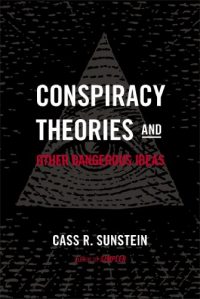
A Review of Conspiracy Theories and Other Dangerous Ideas by Cass Sunstein (based on an earlier paper co-authored with Adrian Vermeule); In Defense of Troublemakers: The Power of Dissent in Life and Business by Charlan Nemeth; and Conspiracy Theories and the People Who Believe Them, edited by Joseph E. Uscinski
On January 25 2018 YouTube unleashed the latest salvo in the war on conspiracy theories, saying “we’ll begin reducing recommendations of borderline content and content that could misinform users in harmful ways—such as videos promoting a phony miracle cure for a serious illness, claiming the earth is flat, or making blatantly false claims about historic events like 9/11.”
At first glance that sounds reasonable. Nobody wants YouTube or anyone else to recommend bad information. And almost everyone agrees that phony miracle cures, flat earthism, and blatantly false claims about 9/11 and other historical events are undesirable.
But if we stop and seriously consider those words, we notice a couple of problems. First, the word “recommend” is not just misleading but mendacious. YouTube obviously doesn’t really recommend anything. When it says it does, it is lying. … continue
This site is provided as a research and reference tool. Although we make every reasonable effort to ensure that the information and data provided at this site are useful, accurate, and current, we cannot guarantee that the information and data provided here will be error-free. By using this site, you assume all responsibility for and risk arising from your use of and reliance upon the contents of this site.
This site and the information available through it do not, and are not intended to constitute legal advice. Should you require legal advice, you should consult your own attorney.
Nothing within this site or linked to by this site constitutes investment advice or medical advice.
Materials accessible from or added to this site by third parties, such as comments posted, are strictly the responsibility of the third party who added such materials or made them accessible and we neither endorse nor undertake to control, monitor, edit or assume responsibility for any such third-party material.
The posting of stories, commentaries, reports, documents and links (embedded or otherwise) on this site does not in any way, shape or form, implied or otherwise, necessarily express or suggest endorsement or support of any of such posted material or parts therein.
The word “alleged” is deemed to occur before the word “fraud.” Since the rule of law still applies. To peasants, at least.
Fair Use
This site contains copyrighted material the use of which has not always been specifically authorized by the copyright owner. We are making such material available in our efforts to advance understanding of environmental, political, human rights, economic, democracy, scientific, and social justice issues, etc. We believe this constitutes a ‘fair use’ of any such copyrighted material as provided for in section 107 of the US Copyright Law. In accordance with Title 17 U.S.C. Section 107, the material on this site is distributed without profit to those who have expressed a prior interest in receiving the included information for research and educational purposes. For more info go to: http://www.law.cornell.edu/uscode/17/107.shtml. If you wish to use copyrighted material from this site for purposes of your own that go beyond ‘fair use’, you must obtain permission from the copyright owner.
DMCA Contact
This is information for anyone that wishes to challenge our “fair use” of copyrighted material.
If you are a legal copyright holder or a designated agent for such and you believe that content residing on or accessible through our website infringes a copyright and falls outside the boundaries of “Fair Use”, please send a notice of infringement by contacting atheonews@gmail.com.
We will respond and take necessary action immediately.
If notice is given of an alleged copyright violation we will act expeditiously to remove or disable access to the material(s) in question.
All 3rd party material posted on this website is copyright the respective owners / authors. Aletho News makes no claim of copyright on such material.





 The amount of detail in this book certainly lends some credence to the book’s subtitle, and the journalist authors have also uncovered some fascinating new information: Israel has a number of top secret agencies, including one devoted to protecting their nuclear program and another for rescuing Jews from unfriendly countries; nuclear weapons using submarine-based launch platforms are nearly a reality; and Israel has been spying on the United States for years. The authors work diligently in this book to convince the world of the high morality of the Israeli cause. Israeli intelligence has been a popular subject for fiction and nonfiction, but there has yet to be a definitive nonfiction account on the subject. This readable and entertaining book is recommended for larger Middle East collections. –David P. Snider, Casa Grande P.L., Ariz. – Copyright 1990 Reed Business Information, Inc.
 A Review of Conspiracy Theories and Other Dangerous Ideas by Cass Sunstein (based on an earlier paper co-authored with Adrian Vermeule); In Defense of Troublemakers: The Power of Dissent in Life and Business by Charlan Nemeth; and Conspiracy Theories and the People Who Believe Them, edited by Joseph E. Uscinski
 Aletho News

