Leader of the Islamic Revolution Ayatollah Seyyed Ali Khamenei says the sanctions against Iran have nothing to do with the country’s nuclear activities or human rights record, adding that there are other motives behind the bans.
Addressing a group of university professors and researchers on Saturday night, Ayatollah Khamenei said those who have imposed sanctions on Iran are themselves the ones who foster terrorism and commit human rights violations.
The Leader said the sanctions against Iran have been imposed because the Islamic Republic has emerged as a nation, a movement and an identity guided by principles against the hegemonic system.
“Their objective is to prevent Iran from reaching a prominent civilizational status,” Ayatollah Khamenei said.
The Leader also highlighted the special role of professors in educating a generation of self-reliable, confident and diligent youths who will further move Iran toward progress.
The official story about 9/11 is questioned by millions of people.
In this Danish documentary you will meet architect Jan Utzon, Danish Tax Minister Benny Engelbrecht, professor Niels Harrit, airline captain Niels Studstrup, journalist Tommy Hansen and artist Jacob Fuglsang.
They will talk about their doubt and skepticism and explain why they have come to feel and think this way.
– http://www.facebook.com/911TheSensibl…
– http://www.ae911truth.org/
– http://firefightersfor911truth.org/
– http://www.911truth.org/
Modern medicine has spawned great things like antibiotics, open heart surgery, and corneal transplants. And then there is antiretroviral therapy for HIV/AIDS.
A civic-minded, healthy person volunteers to donate blood but, tested for HIV (human immunodeficiency virus), is found to be HIV-positive. This would-be donor will be put on a treatment regimen that follows the (285-page) Guidelines for the Use of Antiretroviral Agents in HIV-1-Infected Adults and Adolescents [1] and will be thrust into a medical world peppered with acronyms like CD4, ART, HIV RNA, HIV Ag/Ab, NRTI, NNRTI, PI, INSTI, PrEP, and P4P4P.
Adhering to these government-issued guidelines, a “health care provider” will start this healthy blood donor on antiretroviral therapy (ART). For the last two decades the standard for treating HIV infection is a three-drug protocol—“2 nukes and a third drug.” The “2 nukes” are nucleoside reverse transcriptase inhibitors (NRTI) and DNA chain terminators, like AZT (azidothymidine – Retrovir, which is also a NRTI). The “third drug” is a non-NRTI (NNRTI), a protease inhibitor (PI) or an integrase strand transfer inhibitor (INSTI). [2]
These drugs are toxic. With prolonged use they can cause cardiovascular disease, liver damage, premature aging (due to damage of mitochondria), lactic acidosis, gallstones (especially with protease inhibitors), cognitive impairment, and cancer. The majority of people who take them experience unpleasant side effects, like nausea, vomiting, and diarrhea.
AZT, the most powerful “nuke” in the ART arsenal actually killed some 150,000 “HIV-positive” people when it started being used in 1987 to the mid-1990s, after which, if the drug was used, dosage was lowered. [3] When an HIV-positive person on long-term ART gets cardiovascular disease or cancer, providers blame the virus for helping cause these diseases. Substantial evidence, however, supports the opposite conclusion: it is the antiretroviral treatment itself that causes cancer, liver damage, cardiovascular and other diseases in these patients. [3] They are iatrogenic diseases.
The orthodox view holds that HIV causes AIDS (acquired immunodeficiency syndrome)—one or more of an assemblage of now 26 diseases. Reinforcing this alleged fact in the public’s mind, the human immunodeficiency virus is no longer just called HIV, it is now “HIV/AIDS.”
A new development in HIV care, called preexposure prophylaxis (PrEP), promotes universal coverage with antiretroviral drugs to prevent HIV infections, based on the tenet that prevention is the best “treatment.” Given their unpleasant side effects, however, many people stop taking their antiretroviral drugs. An answer for that in the HIV/AIDS-care world is addressed by its P4P4P acronym (pay for performance for patients). With P4P4P, now under study, patients are given financial incentives to encourage them to keep taking the drugs. [2]
Could the hypothesis that the multi-billion-dollar HIV/AIDS medical-pharmaceutical establishment bases its actions on be wrong? In 1987, Peter Duesberg, a professor of molecular and cell biology at the University of California, Berkeley, who isolated the first cancer gene, and in 1970 mapped the genetic structure of retroviruses, published a paper in Cancer Research questioning the role of retroviruses in disease and the HIV/AIDS hypothesis in particular [4]. Then, in 1988, he published one in Science titled “HIV is Not the Cause of AIDS.” [5] As a result, Dr. Duesberg became a pariah in the retroviral HIV/AIDS establishment, which branded him a “rebel” and a “maverick.” Colleague David Baltimore labeled him “irresponsible and pernicious,” and Robert Gallo declared his work to be “absolute and total nonsense.”
Skeptics of the HIV/AIDS hypothesis are chastised and subjected to ad hominem attacks. Anyone who questions this hypothesis is now branded an “AIDS denier,” which is analogous to being called a Holocaust denier. Nevertheless, non-orthodox scholars have been questioning the HIV/AIDS paradigm for thirty years; and now, in the 21st century, as Rebecca Culshaw puts it, “there is good evidence that the entire basis for this theory is wrong.” [6]
A key feature of the HIV/AIDS hypothesis is that the virus is sexually transmitted. But only 1 in 1,000 acts of unprotected intercourse transmits HIV, and only 1 in 275 Americans is HIV-positive! Drug-free prostitutes do not become HIV-positive, despite their occupation. [3,7]
HIV is said to cause immunodeficiency by killing T cell lymphocytes. But T cells grown in test tubes infected with HIV do not die. They thrive. And they produce large quantities of the virus that laboratories use to detect antibodies to HIV in a person’s blood. HIV infects less than 1 in every 500 T cells in the body and thus is hard to find. The HIV test detects antibodies to it, not the virus itself. For these and other reasons a growing body of evidence shows that the HIV theory of AIDS is untenable. [7]
A positive HIV test does not necessarily mean one is infected with this virus. Flu vaccines, hepatitis B vaccine, and tuberculosis are a few of the more than 70 things that can cause a false-positive HIV test. In healthy individuals, pregnancy and African ancestry conduce to testing HIV positive. In some people a positive test may simply indicate (without any virus) that one’s immune system has become damaged, from heavy recreational drug use, malnutrition, or some other reason. [8]
If HIV does not cause AIDS, then what does? The classic paper on AIDS causation, published in 2003 by Duesberg et al., implicates recreational drugs, anti-viral chemotherapy, and malnutrition. [9]
If the theory is wrong, how can it persist? In a review of The Origin, Persistence, and Failings of the HIV/AIDS Theory by Henry Bauer, the late Joel Kaufman writes:
“One of the most difficult things to write is a refutation of a massive fraud, especially a health fraud, in the face of research cartels, media control, and knowledge monopolies by financial powerhouses… The obstacles to dumping the dogma are clearly highlighted as Dr. Bauer discusses the near impossibility of having so many organizations recant, partly because of the record number of lawsuits that would arise.” [10]
Henry Bauer, professor emeritus of chemistry and science studies and former dean of the Virginia Tech College of Arts and Sciences, also presents a concisely reasoned refutation of the HIV/AIDS hypothesis in a 28-page online study, “The Case Against HIV,” with 51 pages of references—now 896 of them, which he continually updates. [3]
In a review of Harvey Bialy’s book, Review of Oncogenes, Aneuploidy, and AIDS: A Scientific Life and Times of Peter Duesberg, my colleague Gerald Pollack, professor of bioengineering at the University of Washington, writes:
“The book reminds us that although over $100 billion has been spent on AIDS research, not a single AIDS patient has been cured—a colossal failure with tragic consequences. It explains in too-clear terms the reasons why AIDS research focuses so single-mindedly on this lone hypothesis to the exclusion of all others: egos, prestige, and money. Mainstream virologists have assumed the power of the purse, and their self-interests (sometimes financial), propel them to suppress challenges. This is not an unusual story: challenges to mainstream views are consistently suppressed by mainstream scientists who have a stake in maintaining the status quo. It’s not just Semmelweis and Galileo, but is happening broadly in today’s scientific arena.” [11]
Adhering to the erroneous hypothesis that HIV causes AIDS, the U.S. government spends billions of dollars annually on HIV/AIDS programs and research—$29.7 Billion for fiscal year 2014. It is a waste of money. It fleeces taxpayers and enriches the HIV/AIDS medical establishment and the pharmaceutical companies that make antiretroviral drugs. The annual cost of HIV care averages $25,000-$30,000 per patient, of which 67-70 percent is spent on antiretroviral drugs. [2]
The tide is beginning to turn, as evidenced in the Sept 24, 2014, publication by Patricia Goodson of the Department of Health and Kinesiology at Texas A&M University. She notes that “the scientific establishment worldwide insistently refuses to re-examine the HIV-AIDS hypothesis,” even while it is becoming increasingly “more difficult to accept.” She writes:
“This paper represents a call to reflect upon our public health practice vis-à-vis HIV-AIDS… The debate between orthodox and unorthodox scientists comprises much more than an intellectual pursuit or a scientific skirmish: it is a matter of life-and-death. It is a matter of justice. Millions of lives, worldwide, have been and will be significantly affected by an HIV or AIDS diagnosis. If we – the public health work force – lose sight of the social justice implication and the magnitude of the effect, we lose ‘the very purpose of our mission.’” [12]
Despite its long-term, widespread acceptance, the HIV/AIDS hypothesis is proving to be a substantial fallacy of modern medicine.
“10 Changes in HIV Care That Are Revolutionizing the Field,” John Bartlett (December 2, 2013) Available at: http://www.medscape.com/viewarticle/814712 . Accessed Dec 15, 2014.
The Case Against HIV, collated by Henry Bauer. Available at: http://thecaseagainsthiv.net/ . Accessed December 15, 2014
Duesberg PH. Retroviruses as Carcinogens and Pathogens: Expectations and Reality. Cancer Research. 1987;47:1199-1220.
Culshaw R. Science Sold Out: Does HIV Really Cause AIDS?, Berkeley, CA: North Atlantic Books; 2007.
Bauer H. The Origin, Persistence and Failings of HIV/AIDS Theory, Jefferson, NC: McFarland; 2007.
Duesberg PH. Inventing the AIDS Virus, Washington, D.C.: Regnery Publishing; 1996.
Duesberg PH, Koehnlein C, Rasnick D. The Chemical Basis of the Various AIDS Epidemics: Recreational Drugs, Anti-viral Chemotherapy, and Malnutrition. J Biosci 2003;28:384-412. Available at: http://www.duesberg.com/papers/chemical-bases.html. Accessed Dec 15, 2014.
Kauffman JM. Review of The Origin, Persistence, and Failings of the HIV/AIDS Theory, by Henry H. Bauer, Jefferson, NC, McFarland, 2007. J Am Phys Surg. 2007;12:121-122.
Bobby Ghosh, former TIME contributor and currently managing editor at Quartz, decided on Tuesday to produce some absurd, mouth-breathing click-bait – the kind of deliberately sloppy disinformation that serves only to further chum the waters of public opinion with the false narratives and grotesque stereotypes that have long been the stock-in-trade of agenda-driven, attention-seeking commentators about Iran and its nuclear program.
There’s a quick answer to this leading – and deceiving – question: No, no he did not.
There’s a longer answer, too, which we’ll get to in a minute.
Ghosh, in his desire to expose what he thinks is a “gotcha” moment from a recent Iranian media interview with Iranian President Hassan Rouhani, eagerly and disingenuously conflates uranium enrichment with nuclear weapons development. In doing so, he reveals himself to be more interested in delivering page views to his website and dishing out conventional wisdom than in reporting truthfully and critically about an important international issue.
Ghosh notes that, during a interview with Iranian media about the pending nuclear deal with six world powers, Rouhani said that “if the other side breaches the deal, we will go back to the old path, stronger than what they can imagine.” Ghosh omitted Rouhani’s initial comment, “If we reach a deal, both sides should be committed to it.”
What gets Ghosh’s goat is Rouhani’s reference to “the old path,” that is, the allusion to Iran’s previous state of nuclear development, as opposed to its current restricted program under the interim deal and what results from a potential negotiated multilateral agreement.
Conceding that Iranian officials have long “sworn, over and over again, that [Iran] has never pursued nuclear weapons,” Ghosh then gets to the crux of his claim:
If we’re to believe the regime’s claim, then Rouhani’s threat makes no sense. The “old path” would simply be more “peaceful” nuclear research, allowing the sanctions to continue devastating the Iranian economy. That’s not so much a threat as a flagellant’s cry for help: “If you go back on your word, I’ll hurt myself.”
To jump to such a conclusion requires a remarkably mistaken understanding of both the history of Iran’s nuclear program and either the ignorance or dismissal of the massive concessions it has already made during ongoing international talks. Ghosh apparently suffers from both.
In an emblematically Ghoshian column on why the Iranian government is eviler than the Cuban government, Ghosh wrote on December 18, 2014, that Iran “was caught trying to build nuclear-weapons technology as recently as 2002, when its secret facilities at Arak and Nataz [sic] were discovered. Thereafter, under pressure from the US and the international community, the Tehran regime backed down from its policy of developing dual-use nuclear technology (for energy and weapons) and promised not to build bombs.”
There’s a lot wrong here, but I’ll try to be quick (not my strong suit).
The facilities at Arak and Natanz were never “secret” nor do they “build nuclear-weapons technology.” In 2002, they were both under construction and non-operational. Iran was, at that point, not obligated to declare their existence to the IAEA. Arak was designed as a power plant, Natanz is an enrichment site. Upon declaration, both have been subject to IAEA safeguards for over a decade. Iran’s interest in developing an uranium enrichment industry has been open knowledge (and publicly acknowledged) since shortly after the Iranian Revolution in 1979.
The Iranian government never “backed down” from a “policy of developing dual-use technology” and “promised not to build bombs” as Ghosh claims. Such a claim is bizarre. Beyond the fact that, as an original signatory to the Nuclear Nonproliferation Treaty, Iran has in effect “promised not to build [nuclear] bombs” since 1968 and Iranian officials have – since at least the early 1990s – constantly and consistently condemned and prohibited any domestic development of nuclear weapons (not only after 2002), it is literally impossible for any nation with an ongoing enrichment program to stop the acquisition of “dual-use” nuclear infrastructure since every single enrichment program on Earth is inherently dual-use: enriched uranium can be used for both energy or weaponry.
With this false narrative, Ghosh has, however, set up a convenient straw man with which to bandy about his erroneous assumptions of Iran’s nuclear past. This brings us back to his recent article.
In trying to hash out what Rouhani’s “old path” statement means, Ghosh establishes two options – the bluff or the blackmail – one of which, he claims, must be true. The bluff is that, in Ghosh’s words, “There’s no “old path,” and Tehran is simply trying to frighten the P5+1 into relenting on the remaining sticking points at the negotiating table in Vienna.”
The blackmail, on the other hand, is a damning admission by the Iranian leader of a clandestine nuclear weapons program Iran has long denied having. “The alternative,” Ghosh writes, “is that Rouhani has unwittingly revealed that Iran was indeed pursuing nukes. That would be a real threat, especially if he is also sincere in pursuing this path ‘stronger than what they can imagine.'”
But there is a third option, unacknowledged by Ghosh, which is the most obvious and most accurate: Rouhani is not talking about a nuclear weapons program to return to, but rather the reestablishment of full-scale uranium enrichment, which has been curtailed by Iran’s obligations under the terms of its diplomatic agreements since January 2014.
Ghosh doesn’t tell his readers that, in the same interview he cites as “fascinating” and “belligerent,” Rouhani said of his international interlocutors, “If they claim that they want to prevent the development of nuclear weapons in Iran, they should know that Iran has never sought to build nuclear weapons.” Obviously, such a statement – in the very same interview – severely undermines the credibility of Ghosh’s blackmail or blunder claim that Rouhani has either purposely or accidentally revealed something alarming about its nuclear work.
Under the terms of the November 2013 Joint Plan of Action, agreed to by Iran and the six powers – Britain, China, France, Germany, Russia, and the United States – known as the P5+1, Iran has halted all enrichment above 5%, diluted or disposed of its entire stockpile of 19.75% low-enriched uranium (LEU), converted the vast majority of its remaining stockpile of LEU to a form incapable of being weaponized, suspended upgrades and construction on its safeguarded nuclear facilities at Natanz, Fordow, and Arak, and allowed unprecedented access to its program by IAEA inspectors.
At every single juncture, Iran has complied fully with the demands of the plan.
All Rouhani was saying, therefore, is that these commitments – which were negotiated and agreed to by Iran, not imposed forcibly by foreign countries – would no longer be binding and Iran would resume its previous course of action, or “the old path.” This previous course of action, still, was anything but a mysterious, opaque, nefarious development of dubious and deadly technology. Rather, even before current talks began, Iran’s was the most heavily-scrutinized nuclear program on the planet and had been for years.
Rouhani’s statement, therefore, was actually a fairly innocuous clarification of the fact that, if the P5+1 reneges on its own negotiated commitments, Iran will no longer abide by the deal either. That’s hardly cause for Ghosh to collapse on his fainting couch.
What Ghosh also doesn’t point out is that there is clear historical precedent for Rouhani’s statement.
A dozen years ago, Iran’s then-nascent uranium enrichment program was the subject of intensive diplomacy between Iran and the EU-3, shorthand for Britain, France and Germany. It was on Rouhani’s watch – he was secretary of Iran’s Supreme National Security Council and lead negotiator at the talks – that Iran voluntarily suspended uranium enrichment in 2003 and accepted intrusive inspections above and beyond what was legally required by its safeguards agreement as talks progressed. During this period, the IAEA affirmed the peaceful nature of the program.
In mid-2004, with Iran fully complying with its obligations under Saadabad Agreement of October 2013, the negotiations were strained by the prospect of a new European-drafted IAEA resolution against Iran. President Mohammad Khatami told the press, in terms strikingly similar to Rouhani’s recent statement, that Iran’s voluntary suspension of enrichment would thus be endangered if the resolution passed.
“If the draft resolution proposed by the European countries is approved by the IAEA, Iran will reject it,” Khatami said on June 18, 2004. “If Europe has no commitment toward Iran, then Iran will not have a commitment toward Europe.”
A month later, Khatami insisted that “nothing stands in the way” of Iran “building and assembling centrifuges designed for uranium enrichment,” reported the Associated Press.
Throughout the first half of 2005, Iranian officials were still intent on resolving the nuclear impasse through diplomacy with Europe, but explained that the resumption of “full-scale enrichment” was the ultimate goal of the talks, along with assurances that the program would remain forever peaceful.
Following the election of Mahmoud Ahmadinejad in June 2005, outgoing president Khatami made the Iranian position clear. “We will never overlook our legal and national right for possessing nuclear technology and fuel cycle to generate electricity. Iran will never change its national policy in this respect,” he said, adding, “We have made it clear that suspension of uranium enrichment will not be forever. We have displayed our good faith. Now, it is the turn of the European friends to do in line with the commitments they have made about the matter.”
Regardless of the offer soon to be put forward by the EU-3, Khatami reiterated that Iran would resume its conversion activities and eventually enrichment as well, in line with its inalienable rights to development domestic, civilian nuclear technology. “I hope that the Europeans’ proposals will, as agreed, allow for the resumption of [nuclear activities],” Khatami told reporters in late July 2005. “But if they do not agree, the system has already made its decision to resume [uranium conversion] at Isfahan.”
Uranium conversion restarted in early August 2005.
It was only after Iran’s European negotiating partners, at the behest of the Americans, reneged on their promise to offer substantive commitments and respect Iran’s inalienable right to a domestic nuclear infrastructure that talks dissolved and Iran resumed enrichment. The proposal eventually brought to Iran by Western negotiators on August 5, 2005 has been described as “vague on incentives and heavy on demands,” and even dismissed by one EU diplomat as “a lot of gift wrapping around an empty box.”
The resumption of full-scale enrichment by Iran had nothing to do with nuclear weapons, as the IAEA has affirmed consistently in quarterly reports over the past decade that no fissile material has ever been diverted to military purposes. Lingering questions about Iran’s past work have long been debunked as unfounded allegations for which no credible evidence actually exists.
Rouhani’s statement about “the old path” – that is, the legal and inalienable right of Iran to enrich uranium under international safeguards and supervision – therefore reveals nothing not previously known.
On the other hand, Ghosh’s reaction to Rouhani’s statement reveals the extent to which Ghosh himself will go to demonize and propagandize about Iran and its nuclear program. If he can’t get the small stuff like this right, why are we listening to him about anything at all?
*****
Disclosure: I am an (often erstwhile) editor for the online magazine Muftah, which has recently announced a new partnership with Quartz, where Mr. Ghosh is managing editor.
One week ago, Tunisian student Seifeddine Rezgai opened fire on tourists near Sousse, Tunisia, killing 38 people. On the same day, a man was beheaded in France and a bomb detonated in a Shia mosque in Kuwait killing 27. ISIS claimed responsibility for all three.
Amidst the media coverage that follows terrorist attacks such as these, two schools of thought generally emerge: one asserts that terrorists are driven by religious ideology and the other that they are driven by political motives, principally western foreign policy. “All the evidence suggests that this is deeply political,” says Richard Jackson, Deputy Director of the National Centre for Peace and Conflict Studies at the University of Otago in New Zealand. “It’s the conclusion of all the serious scholars I’m aware of that, in particular, the invasion of Iraq was the single most radicalising event for militants across the Middle East and in European and Western countries.”
“That makes complete sense,” he continues. “Because if we look at this kind of terrorism it wasn’t around in the same form and the same level or even close to the same extent 20, 30, 40, 50 years ago. Islam’s been around for hundreds of years… but this is a very modern phenomenon and it’s very, very connected to the politics of the Middle East, particularly to the invasions to Guantanamo, to Abu Ghraib torture, to drone strikes and so on.”
“What you’ve got to remember is that the west has killed 1.3 million people in Iraq. That’s likely to drive any reasonable person into a rage and cause immense grievance.”
The Tunisian government responded to last Friday’s attacks by issuing an order to close more than 80 mosques. Jackson, who is also Chief Editor of Critical Studies on Terrorism and runs a blog on the subject, explains that one of the oldest precepts of theories on terrorism states that isolated acts of violence push the state to respond by cracking down, which in turn intensifies grievances against the state and mobilises support.
The theory, he says, “is that you provoke the power to respond in a disproportionate way, which then creates grievance, which then gives terrorists more support and leads eventually to a broader, deeper movement that can perhaps consider moving to the next stage, which would be a kind of a civil war or an insurgency and then eventually overthrowing [the] regime.” […]
Last year, Jackson took a break from writing academic books to pen Confessions of a Terrorist, a fictional account of a dialogue between a wanted terrorist and a British intelligence officer. Jackson says he has always wanted a novel to give to his students but only found literature that painted terrorists out to be Hollywood-style villains.
Confessions of a Terrorist questions the taboo of talking to terrorists and the fear many have that doing so will lead to understanding and sympathising with their behaviour. “I think that it’s really important that we talk to them so we know what we really want and so that we understand what they’re trying to achieve and why they think they have to use violence… and whether if the situation was reversed we would do the same thing… [T]he reality is in many ways we go and commit a lot of violence overseas and then when people react against that and fight back we get all shocked and surprised. So we need to talk to them.”
“If you look at the academic research, you find out that actually most terrorist groups are not defeated through military means, but a much higher proportion of them stop their terrorism through political dialogue,” he continues. “So once you start talking to them and once you bring them into the political process, once you listen to what their grievances are and try and address them terrorism subsides.”
One of the consequences of not talking to terrorists, believes Jackson, is that we have dehumanised them which allows us to take away their human rights and justifies acts such as killing them with drones. “As a consequence countless innocent people have been killed… Countless innocent people have been tortured; have been kidnapped and taken to these horrible, secret prisons around the world. All kinds of human rights abuses have been carried out and as a result we in many ways have betrayed our own values and that’s because we’ve dehumanised the terrorists and that’s why I think it’s really important to re-humanise them.”
The language of terrorism is thus a way of defining the “other” and drawing a distinction between us and them, good versus evil, freedom lovers against freedom haters and soldiers and patriots against terrorists, says Jackson: “You can look through history – recent and long in the past –and realise that actually governments commit exactly the same acts as so-called terrorists. They use violence to try and terrify groups of people and intimidate groups of people. Sometimes, they plant bombs in public places or blow up or hijack planes. There are so many examples.”
A lot of terrorist scholars argue, therefore, that if the definition of terrorism is applied objectively a lot of state violence can be classified as state terrorism. “But again, that’s a very difficult narrative to make and to be accepted in public because we like to have these clear lines between our good legitimate violence which comes out of the authority of the state and illegitimate, illegal violence,” says Jackson.
“The problem is that when those two forms of violence look identical and you can’t tell the difference between them; [then] there comes to be a question over [whether] our violence [is] actually that legitimate.”
Horace M. Kallen, the social philosopher best known in American intellectual history for his theory of cultural pluralism, adopted Zionism in 1903 as a secular mode of retaining Jewish identity, an alternative to the Jewish religious tradition which seemed to him to be incompatible with twentieth century America. He had come to Zionism primarily through the influence of two of his Harvard professors, literary historian Barrett Wendell, who interpreted the Hebraic spirit of prophetic social justice as the inspiration for the American founding fathers, and William James, whose philosophy of Pragmatism emphasized the reality of meanness.
Kallen extended Wendell’s identification of Hebraic tradition with American idealism; he defined Zionism, the movement to renationalize the Jewish people, as an opportunity to found a model democracy based on the same concepts of liberty and equality, which, for him, symbolized America. At the same time he applied James’s concept of pluralism to the ethnic group; among them the Jews, who were beginning to become prominent in the United States, and argued that preservation of differences constituted the true measure of equality the Declaration of Independence had set forth. Zionism, thus, was able to fulfill two functions for Kallen- it allowed him to retain his Jewish identity and to become, thereby, a better American.
In 1911 Kallen became an instructor of philosophy and psychology at the University of Wisconsin. When he moved to the Middle West, he left his familiar environment. Lonely, and somewhat out of place in Madison; he felt the need to assert his Jewish identity more strongly and stepped up his pace of Zionist involvement. Finding little understanding within the official Federation of American Zionists for an expression of his own, philosophically oriented, ideas on Zionism, and quite some antagonism for his demand that the Zionist organization concentrate its activities on obtaining statehood for the Jewish nation in line with the 1896 Basle Platform which had sought “a home in Palestine secured by public law,” Kallen decided to form an organizational instrument through which he could effectively channel his own Zionist activity. On August 18,1913, therefore, Kallen founded a secret Zionist society which he called The Parushim, the Hebrew word which means both “the Pharisees” and “separate”.[1]
The Pharisees had flourished as a separate sect during the time of the second Jewish Temple, goading the Jewish Establishment into making the traditional “written law” more relevant to the times by adding to it the interpretations of the “oral law.” Kallen saw much the same role for his group of Parushim, whose purpose he defined as “advancement by deed and word of the cause of autonomous Jewish nationality in the interest of Hebraism.” As Kallen recalled, “The Parushim was a group much like the Peace Corps, young men and women who saw the Utopian opportunity that existed for the Jewish people in Palestine and who were willing to devote themselves to an ideal.”[2]
The Parushim was a very unusual Zionist group, organized both as a secret fraternity and as a reform movement. Unlike other social groups at the time, both men and women were eligible; “there was ascertain definite interest on desegregation of the sexes.” Enrollment was by an oath of initiation, and there was a probationary period for up to three years, during which time the initiate was to give exclusive and specific service to the cause.” Kallen invited no one to become a member until the candidate had given specific assurances regarding devotion and resolution to the Zionist cause, and each initiate had to undergo a rigorous analysis of his qualifications, loyalty, and willingness to take orders from the Order’s Executive Council. The motto of the group was the response traditionally attributed to the Jewish people on receipt of the Ten Commandments-“Nasseh V’Nishmah”-“we will do and we will hear.”[3]
A member swearing allegiance to the Parushim felt something of the spirit of commitment to a secret military fellowship. At the initiation ceremony the head of the Order informed him:
You are about to take a step which will bind you to a single cause for all your life. You will for one year be subject to an absolute duty whose call you will be impelled to heed at any time, in any place, and at any cost. And ever after, until our purpose shall be accomplished, you will be fellow of a brotherhood whose bond you will regard as greater than any other in your life-dearer than that of family, of school, of nation. By entering this brotherhood, you become a self-dedicated soldier in the army of Zion. Your obligation to Zion becomes your paramount obligation… It is the wish of your heart and of your own free will to join our fellowship, to share its duties, its tasks, and its necessary sacrifices.
The initiate responded by swearing:
Before this council, in the name of all that I hold dear and holy, I hereby vow myself, my life, my fortune, and my honor to the restoration of the Jewish nation, -to its restoration as a free and autonomous state, by its laws perfect in justice, by its life enriching and preserving the historic speech, the culture, and the ideals of the Jewish people.
To this end I dedicate myself in behalf of the Jews, my people, and in behalf of all mankind.
To this end I enroll myself in the fellowship of the Parushim. I pledge myself utterly to guard and to obey and to keep secret the laws and the labor of the fellowship, its existence and its aims. Amen.[4]
It is clear both from the wording of these vows, which paralleled Kallen’s published phrases on Zionism, and from the handwriting on the original copy of this induction ceremony, that Kallen was its author. For him, the organization of the Parushim had many implications. It demonstrated his overriding commitment towards working for the realization of the Zionist ideal, and his need to create, if necessary, an educated militant group that would join him in the cause. It was indicative of his desire to stimulate Zionist activity beyond that of the official Zionist organization, which tended to devote its time to polemic and debate, rather than towards effecting substantial productive achievement. It showed Kallen’s trust in an elite Zionist cadre, a vanguard for the Zionist army that was to come. Most important, perhaps, it reflected his own need for a Zionist community with which he could feel comfortable, a substitute both for his own family, and for the Harvard fellowship of congenial minds that he had left behind when he moved to the Mid-West.
The kind of people Kallen considered worthy of invitation to the Parushim is indicated in a memorandum he prepared on “Signatories to the Zionist Pledge.” The list includes, among others, Alexander Dushkin, an authority on Jewish education; Dr. I. L. Kandel, an educator then with the Carnegie Foundation and Teacher’s College of Columbia University; Israel Thurman, a lawyer and “Harvard man,” who would be used to propagandize among young lawyers; and Nathan C. House, a “Columbia man” and high school teacher, who could work out plans for training Jewish high school boys “along the lines of Zionist sentiment coupled to physical development and Boy Scout discipline.”[5]
It seems from the replies to Kallen’s invitations to join the Parushim that he had hit on the kind of organization that would meet thee needs of others besides himself. The few people he invited to join the Order, all well educated, all Zionist leaders in their own communities, answered enthusiastically. I. J. Biskind, a doctor in Cleveland, who during World War I was to go to Palestine as a medical missionary, responded:
In behalf of Zion, in behalf of Hebraism I will accept a membership of the Parushim- if elected-unconditionally and for life. I want to work, work, work and not sing ”Hatikvah.” I want to be a soldier of the ranks and do actual work. We have been sleeping too long; we have been dreaming and golden opportunities have slipped by us.[6]
Henrietta Szold, founder of Hadassah, the Women’s Zionist Organization, was another early member of the Parushim. She wrote Kallen, “If … I may state the difficulties we [Hadassah] are encountering in our educational work, and so secure instructive advice from the hidden source, it will cause an increase not only in the results but also in the strength and zeal of the workers.” Her reference to “the hidden source” was, no doubt, tongue in cheek, for she continued, “If ever I emerge from under the … routine work in which I am now enveloped, I am going to devote myself to the reading you have prescribed for such as I am, and attempt to make myself more effective than I have been.”[7]
In 1913 Kallen, aware of the moribund condition of the Zionist organization, felt that the way in which he and the Parushim would-be most influential was through a program of education. His focus. was on “the play of ideas-it had to be more theoretical than practical, imaging a program or an action without doing it.” One of his first requests to Henrietta Szold, for instance, was that she provide literature for Zionist courses to be given in Temples and Sunday Schools, a request to which she readily acquiesced. Within a few months, however, Kallen was looking further afield, and by April1914 was writing to Max Nordau, a political Zionist who had been Herzl’s first and most loyal colleague and closest adviser, of his desire to internationalize his secret order.
. .. [l]t happens to be my turn to head the secret organization here in America, which is aiming to turn the Zionist movement in a political direction, from within.
Our order is called Parushim. It is the outcome of the prolonged association of a number of young men in “academic” life who observing the general trend of events in the Zionist movement decided that the higher ideals would fail unless a check were set … Members must alba of distinguished character and trained minds … Our present purposes one of quiet propaganda and education in the “political idea.” We aim to make the masses consciously “political.”
… It is our desire and plan to organize brotherhoods all over the world . . .. We hope if all goes well in a few years quietly to turn the Zionist movement back into its proper channels…. [8]
There is no written record of Nordau’s reply to Kallen, nor of his evaluation of a world-wide Zionist brotherhood, bent on secret activity and influence. Kallen recalls that Nordau “wouldn’t cotton to it. He didn’t think … a vow would be of any use.” The matter was shortly to become moot, however, for four months later war broke out in Europe, forcing the dislocation of the World Zionist headquarters from Berlin. From 1914 until1920, European Zionists lost their influence as the center of Zionist activity shifted first to the United States, then to England. Kallen’s plan for a secret world-wide Zionist society became one of the war’s casualties. But as the United States became more prominent on the Zionist stage, Kallen and his vision of Jewish renationalization were to receive an opportunity for expression wider in scope and more vast in influence than anything he had ever imagined.
On August 30, 1914, an “Extraordinary Conference of representatives of American Zionists” met in New York and organized a “Provisional Executive Committee for General Zionist Affairs” with Louis D. Brandeis, the famous “People’s Attorney,” as its Chairman. Kallen had played an important part in persuading Brandeis to become a Zionist and to take an active role in Zionist affairs, by applying the reasoning of his cultural pluralist argument to the then prevalent contention that Zionist membership implied the unpatriotic condition of “dual loyalty.” Just prior to the August 30 conference, Kallen had presented Brandeis with his own plans for a Jewish State based on the same ideals of liberty and justice for all, which the American Declaration of Independence had enunciated.[9]
Kallen then argued that a commitment to Zionism, instead of being detrimental to American loyalty, actually increased it, for Zionists and Americans shared the same values and traditions, and, therefore, were working towards the same ends. Brandeis, who late in life had felt a sudden emotional pull to the Jewish people, found that Kallen’s reasoning provided him with an intellectual rationale for Zionist activism. Thereafter he looked to Kallen as one of his mistrusted advisers, and used him as his right-hand man both in formulating ideas and proposals and in carrying out schemes of an intricate or delicate nature.
Soon after Brandeis assumed the active leadership of the Provisional Executive Committee Kallen invited him to become an honorary member of the Parushim. Brandeis accepted, and began to assign the Parushim to carry out special “missions” for him.[10] In particular the Parushim were to serve as a school for leaders, and under Kallen’s direction its members initially became the leading activists of the reorganized American Zionist movement. Excerpts from several letters to and from Kallen in late 1914 show clearly that new energies were flowing through the Zionist movement; they show, also, the roles Kallen’s Parushim were assuming in leading the way.
1. To Stephen S. Wise; Prominent Reform Rabbi and leader in the Jewish Community:
Madison, Wisconsin
September 25, 1914
Dear Mr. Wise,
. . . I hope you will bear in mind what I told you about the Order [the Parushim]. We want most of all disciplined and well-trained young men and young women who have vision as well as executive ability, and spirituality, as well as force. In New York there are a good many who might be trained for leadership under proper direction, and I feel that you could play a very powerful and ideal part in the making of such leaders .
. . . As for your feeling about the secrecy of the work, it is, after all, no more secret than any important work has to be … (A)n organization which has the aims which we have must be anonymous, must work silently, and through education and infection rather than through force and noise, and can gain results only insofar as its standards are made to live in the lives of the people to whom they’re brought. But no thing could be more suicidal than the announcement of such an object, so that the secrecy is inevitable. I hope that you will join with us and take your place in our executive committee together with Mr. Brandeis.[11]
2. From Henry Hurwitz, President of the Intercollegiate Menorah Association:
Dorchester, Mass.
October 5, 1914
Dear Harry [Kallen’s favorite nickname for “Horace”],
I got your letter the other day while I was in New York. I went chiefly to attend a meeting of the Provisional Committee. The meeting was rather routine. Chiefly on how to raise the fund. Coming very slow. Brandeis anxious to have done with it in order to have energies free for the bigger problems-also before general appeal for relief floods us. Brandeis put it up to [Judah] Magnes and [Stephen] Wise to raise money among their people [rich congregants].
So far, the mass meetings seem to be little successful, except the Boston meeting…. That was really an extraordinary night for Boston Jews. Surging mob at Symphony Hall when doors opened at 7.At 7:10 necessary to open Jordan Hall for overflow meeting. Still a couple of thousand turned away from both halls. … Brookline [established well-to-do Jews] came down as well as Roxbury and West End [Jewish immigrant communities], to hear and to join. Brandeis spoke over an hour, simply but with suppressed emotion; seemed to hook the subject and reluctant to leave it. Got great ovation both before and after speech. Tremendously different attitude towards Zionism in Boston now along all classes.
I saw Oscar Straus … on a Menorah matter. Incidentally, we talked Zionism. He declared himself strongly in favor of Jewish colonization in Palestine … but only under political guarantees of one or more powers…. He is greatly impressed with Brandeis as leader; expressed a desire to meet him and talk over the problems of Zionism with him…. Wise will arrange a meeting between them.[12]
3. To Richard Gottheil, former President of the Federation of American Zionists:
Madison, Wisconsin
Oct. 14, 1914
Dear Prof. Gottheil:
… My reports from New York are disquieting. I hear of a good deal of restlessness on the part of Federation [of American Zionist] officials, who think they are being displaced…. I hope that, insofar as possible, [Louis] Lipsky, [Shemaryahu] Levin al).d Co. will be given as much kouad [honor] as possible. I am told that they feel “snuffed out”; and I fear very much that they may develop obstructionist tactics which will disgust Mr. Brandeis, and perhaps lead him to cut himself off from the organization. I am particularly concerned about the movement of the I.A.C. [World Zionist Inner Actions Committee] toward the re-opening of offices in Berlin, and the meeting in Stockholm. The situation seems to me to be very delicate, and I hope that you, Wise, Miss Szold, Brandeis and Hurwitz can find some way of suppressing what I feel will be-knowing the character of the Federation [of American Zionists] as I do-very unwise action.
Finally, there is this matter, which seems to me now to be of prime importance. I do not find in any of the foreign periodicals any recognition of the significance of Brandeis’ leadership. I think that it is necessary to make this very clear by a statement of Brandeis’ position and importance in this country, written by a number of people, e.g., you, Wise, Oscar Straus. . and sent to such papers as the Jewish Chronicle of London, the Zionist, etc. The Chronicle is ominously silent about the activities in America, and I regard that as a dangerous thing. Will you kindly put this matter also to our group [Parushim]? We shall have to depend upon ourselves, I forsee almost exclusively, if we are to save Brandeis for the -great work of the movement, without being involved in much unnecessary quarreling and personalities.[13]
4. From I.J. Biskind, a Cleveland surgeon:
Oct. 19, 1914[14]
Dear Dr. Kallen,
Your letter received . . .
We have done all in our power to make the Brandeis meeting a success. Mr. Brandeis arrived here [Cleveland] at about noon. Several of our people and one of the Uptown Jews (as you call them) met him at the station. After a few introductions we turned him over to the Germans [“uptown” German Jews] who had a luncheon waiting for him. He spoke at the luncheon and made a very good impression. None of our people was present, as our uptown Jews did not want to have a Zionist luncheon. … Towards evening 30-40 of our people had Mr. Brandeis to a luncheon of our own, where he gave us a nice talk . . .
I think, that now is the time for us to start to round public opinion and influence it in our favor. People like Mr. Brandeis, youself and Dr. Gottheil should come out openly in the big newspapers and magazines and tell the world what we want and demand…[15]
5. To Henrietta Szold: My dear Miss Szold:
Madison, Wisconsin
October 28, 1914
I am glad to hear from you at last. I have been wondering what turn matters were taking in New York . . ..
I have been in communication with Maurice Browne of The Little Theater of Chicago. He has enthusiastically agreed to organize a company of Jewish players who will present nationalistic plays all over the country…. I have undertaken the writing of one play, but we need two more, one of which must be a comedy…. If you know of any mss. already in existence or of any persons who have real dramatic power, will you kindly put them into immediate communication with me . . ..
As for the status of the Provisional Committee, I do not despair. The chief good of its organization lies not in whether its authority is forthcoming from the [World Zionist] Central Actions Committee or not, but in the fact that it has placed Brandeis definitely at the head of the movement in this country and as a member of the movement, and that has brought out the enthusiasm and practical cooperation of the student bodies everywhere-in short, that it has injected into the movement a new spirit and a new personnel, and promises, I hope, to put an end forever to Ghetto methods and petty Ghetto ideas and personalities that has marked the history of the Federation.[16]
6. To Stephen S. Wise:
Indianapolis
Oct. 25, 1914
Dear Dr. Wise:
I am writing from Indianapolis. Last night I spoke in the local reformed synagogue here-naturally on Zionism. Today I am to meet a number of members of the congregation and to urge upon them a practical allegiance to the cause. I am told … that you are to occupy the same pulpit next Friday, and I am venturing to suggest that it would be very advantageous to the cause here if you also spoke on Zionism and urged practical allegiance. The community here, impressed me all in all as being unconscious Jews and rather materialistic, but they have their possibilities and if awakened, may become potent for much good….[17]
7. To Henry Hurwitz:
Madison, Wisconsin
Nov. 7th, 1914
Dear Henry: Madison,
… We have now the difficult problem of suggesting that the Jews as a whole are rather pro-Allies, but that there is a distinct anti-Russian feeling among them that must not be confused with a pro-German sentiment. . . It becomes necessary, therefore, to write to the daily and weekly press stating why and how it is natural for the Jews to be anti-Russian and still for the Allies. I have asked [Marvin] Lowenthal and [Alexander] Sachs [two members of the Parushim] to write to the Nation. Will you get a couple of your men to write to the Times and the Sun, and write yourself, if possible. Now that Turkey is in [World War I], it is very necessary … to consider the possible alternatives before us . . .. It is absolutely necessary that we should have a dossier containing plans for meeting each of [the]. . possible emergencies, and that practical steps be taken to safeguard our own interests as nearly as possible from all sides at once .
. .. When Brandeis will be in Chicago … we could then have a meeting of “פ” [Parushim] and consider the problems of national organization in this country and many other things. Brandeis writes that he feels this to be most important, and I am feeling pleased as Punch that he realizes its importance so soon.[18]
8. To Alexander Sachs, a graduate student in economics at Columbia University:
Madison, Wisconsin
Nov. 7, 1914
Dear Mr. Sachs:
I have yours of the 3rd inst. You will take note of these two things.
1. Let me know as fully as possible just what the situation is in the P.C. [Provisional Committee) office.
2. Please report on the progress you have made with the list of candidates for “פּ ” [Parushim] which you had sent for approval to the Executive Committee.
3. In order to show that the Jews are not unanimously against the allies, it has become necessary to publish letters stating the Jewish position from the Zionist point of view. This letter should cover the following points:
(a) That the Jews are engaged equally on all sides (b) That in the order of their treatment, their sympathies are as follows: England, France, Austria, Germany, Russia (c) That they have suffered terribly at the hands of Russia, and that they are naturally anti-Russian rather than pro-German (d) That their stake in the war is perhaps as great as that of Belgium, and that. . the great mass of them are suffering just as much (e) That the way out would lie in nationalization … (f) That. .. the attitude and feeling of the Jews independent entirely on the kind of treatment that.. . is being accorded to their helpless brethren in that region, so that their sympathies are divided between the love of England and France and the hatred of Russia.
You are directed to write such a letter and to submit it through me to the [Parushim] Council before offering it for publication. Many thanks for your personal appreciation, and please regard it as reciprocated.[19]
9. To Stephen S. Wise:
Madison, Wisconsin
November 18, 1914
Dear Wise:
.. . I have been wondering since Turkey has gone into the war whether we could not through Mr. Crane [former U.S. Senator, interested in the rights of small nations] and other Americans and Gentiles get options, or perhaps buy outright, all the… government land in Palestine. In this respect, Turkey’s need is distinctly our opportunity, and action at this moment may save us a great deal of embarrassment and difficulty later on. The thing, if it is done at all, will of course have to be done through Gentiles, and would involve a double transfer, as I am quite sure the Turks would not be willing to sell to the Jews. There are many other things that ought to be talked through; and I imagine that sooner or later our particular group [the Parushim] will need to meet and canvass the whole actual situation with its possibilities, and form plans to meet them all.[20]
10. To Mrs. Maurice Leon, Richard Gottheil’s daughter:
Madison, Wisconsin
Oct. 28th, 1914
Dear Miss [sic] Leon:
I have to acknowledge the receipt of the additional documents ….I shall have abstracts made of them and filed ….
. . . [D]o not despair. We have been badly off many times before, but we have always managed to come clear. What we need most is loyalty and discipline; and so long as we work together like true soldiers, I have no fear for the result-no matter what may stand in the way …[21]
—
As these excerpts make clear, Kallen, though in Wisconsin, half a continent removed from New York, was, as head of the Parushim, in reality at the center of all Zionist activity. His Parushim wrote him faithfully of all that was going on; sometimes several people wrote him of the same event, giving him a unique multifaceted perspective. Kallen’s Wisconsin address was the terminal of a wide-spread communications system and, as the leader of an intimate inner circle, he sifted, channeled, and commented on his information in ways that he felt would produce the most effective results.
The image that emerges of the Parushim is that of a secret underground guerilla force determined to influence the course of events in a quiet, anonymous way. Indeed, the repetition of military terminology in these letters is striking. “We [must] work together like true soldiers,” Kallen wrote Mrs. Leon, and he deployed his Parushim like members of an army. Like any underground leader he demanded of his followers discipline, obedience, and whole-hearted devotion to the cause; the inefficient and slipshod Federation received only his scorn and approbation. Surprisingly, perhaps, the members of the Parushim, each of whom was a leader of the highest caliber in his own right, consented to Kallen’s demands. No doubt, the secret organization dramatized the potential for effective Zionist actions. Additionally, Kallen provided constant encouragement to flagging spirits, and held out the promise, through concrete action, of tangible Zionist accomplishment.
Kallen’s constant use of military terminology was no accident. Seeking, in the words of his mentor, William James, “a moral equivalent for war,” Kallen had found one in the possibilities for action within the Zionist movement, possibilities that had become viable by Brandeis’ assumption of leadership. As leader of the Parushim, Kallen was commanding his army in the ways he felt would do the most good. A good Pragmatist, he was putting his insights about Zionism to the test of experience.
The commitment to, and insistence on, a well-run organization colored all of Kallen’s directives to the Parushim. Even more important, however, were the plans he suggested and the actions he initiated. Letter writing campaigns, both here and abroad, a Zionist Theatre group, plans for purchase of land in Palestine, the insistence on political action contingency plans, schemes-for influence of foreign diplomats- Kallen was overflowing with ideas to hasten the achievement of the Zionist goal. These were not the schemes of a dreamer, however; always practical, Kallen outlined each plan in all its details, and assigned it to the most suitable person. As leader of the Parushim Kallen was the very model of the “Messianic pragmatist”; first he defined a goal in theory, and then he proceeded to suggest its means of implementation. His followers did carry out his directions-Henrietta Szold, for instance, procured the manuscript she requested-and the Zionist organization began to function more efficiently, to receive attention, and to attract more widespread support. In turn the members of the Parushim began to experience a sense of behind-the-scenes power and influence.
Kallen’s correspondents, it is clear, ascribed to him a special relationship with, and influence on, Brandeis. He had more intimate access to the new Chairman than they and, therefore, the opportunity for recognition as one of Brandeis’ principal advisers. Kallen, however, apparently did not wish to advance his own personal interests or career through Brandeis. The letters show his concern with protecting Brandeis and with providing for him an optimal climate in which to become a successful leader. Certainly Kallen wished to “instruct” Brandeis; perhaps, covertly, even to manipulate him. But Kallen’s preference was for the role of anonymous string-puller. He knew that Brandeis could accomplish for the Zionist cause things of which he and the Parushim only dreamed, and was content to channel all his insights and energies through Brandeis. This is one of the reasons that, to now, little has been known about the Parushim.
One of the more interesting projects that the Parushim considered was the establishment of a Parushim College which would give supplementary training in leadership for members of the Order, collect data and material to be used especially for propaganda, and provide for research into Zionist problems. Students would take courses in economics, psychology, philosophy, Jewish history, Zionism, Hebrew language and literature, and read certain prescribed books. Their activity would be both leadership training and a means to keep the Parushim interested and motivated towards Zionist activity.[22]
A prototype for the Parushim College had been the School of Zionism run by Jesse Sampter, a colleague of Henrietta Szold and one of the first members of the Parushim. Various members of the Parushim taught courses in Jewish history, Zionism and Bible interpretation at the New York Young Women’s Hebrew Association and also conducted a “correspondence school” for groups and individuals unable to attend the formal classes. Miss Sampter, a writer and poetess, compiled an original syllabus (published in 1920 as Guide to Zionism) which was used extensively in education programs of groups like Hadassah.[23]
Unlike the successful New York school, however, plans for the national college never went much beyond the outline stage. Particularly disappointed were Parushim members outside of New York, like David Shapiro, an agricultural student at the University of California, who felt isolated from mainstream Zionist activity. Shapiro’s note of regret to Kallen is of special interest, for it provides succinct description of the goals Kallen and his followers had: “If our Jewish State is to be founded on justice, elimination of crushing competition, and abolishment of human exploitation,” Shapiro wrote, “these principles should become a part and parcel of the consciousness of our men…. Discipline will work much better when the men are not only trained in the habit of obedience but also to be conscious of their work.”[24]
Kallen’s inability to successfully organize the Parushim College is symptomatic of the problems he began to have with his organization by late 1915. Though he continued to receive reports from his followers, they were becoming less frequent and less detailed as the Zionist workers concentrated on projects of their own and scattered to other commitments. Henrietta Szold, for example, was the moving force, through the Hadassah women’s organization, which she had founded, behind a plan to send to Palestine a completely equipped medical ship and to recruit doctors and nurses for work in Palestine. Stephen Wise concentrated on developing his own “Free Synagogue,” and on cultivating a role as Jewish liaison with the Wilson administration.
Kallen’s leadership, particularly his neglect of Jewish tradition, irritated some members of the Parushim; they resented, instance, his calling meetings for the Jewish Sabbath. “Since I understand that ours is not a separatist Order in the sense that it does not exclude any Jew who has proved his complete devotion to the Zionist cause,” wrote Jesse Sampter, “it would be unkind, unfair• and unjust to call a meeting at this particular time [Friday evening].” Henrietta Szold concurred, “I entered into an engagement about thirty-five hundred years ago on Mount Sinai upon which the Jewish ages have put a certain interpretation. The rule of my life is to accept this interpretation and that prevents me from making my way [to the Parushim meeting].”[25]
In addition, there developed a conflict between Brandeis’ moderate position in approaching non-Zionists and Kallen’s more radical stance. Brandeis, showing the same talents for organization that had earned him his reputation as a leading lawyer and reform leader, had begun by late 1915 to make contacts and judgments of his own. Interested in broadening support for the Zionist movement, Brandeis preferred to back away from confrontations, which might upset established Jewish communities and interests. Kallen, however, despite Brandeis’ disapproval, continued to define the policy of the Parushim as “militant and aggressive”; “we must constantly, with pen and tongue, attack that part of Reform Judaism which …attacks Zionism and the leaders of Zionism,” he directed new recruits.[26]
When Kallen instructed economist Alexander Sachs, one of the original Parushim, to “counter-attack” speeches of two prominent Reform Rabbis, Sachs consulted Brandeis, who advised against it. Sachs began to feel that the separatism of the Parushim questioned the sovereignty of Brandeis, and declined to follow Kallen’s instructions. Further, he implied that his work for the New England Zionist Bureau super ceded his commitment to the Parushim, thus questioning his oath of discipline and obedience.[27]
Brandeis confirmed his difficulty in working through the Parushim. By November 1915 he was writing to Kallen of his disappointment in the group’s performance. At the same time other Zionist factions scorned the Parushim. “I understand that [Louis]Lipsky and some others call the Group פרושי�? thinking that it is a term of opprobrium, in the sense of snobs, separatists or highbrows,” reported one of the Parushim, Alexander Dushkin, to Kallen.[28]
Elisha Friedman, President of the Collegiate Zionist League, though loyal to Kallen’s leadership, was another member of the Parushim who began to question the group’s validity. Though acknowledging that members of his group were engaged in studying educational, industrial and economic conditions in Palestine, and that this would provide the basis for useful planning for the future, Friedman felt that the non-secret University Zionist Society (which Kallen had also helped to found) could just as effectively perform this research.[29]
Kallen was unyielding in his demands for secrecy, and, despite these signs of unrest, stood firm. He replied to Friedman,
“The bond which unites its [Parushim] members is … of a delicate and psychological sort, very different from the kind of formal organization involved in the University Zionist Society . . . . The society naturally does not bind itself by a sort of pledge to an unquestioning leadership as the group does. In point of fact, it might become the task of the group .. . to join the society and to direct its activities. But some form of separateness it must maintain.”
And he reassured Dushkin, “I am delighted that Lipsky and others call the group ‘Parushim‘ in scorn. The thing for us to do now is to turn that scorn into astonished admiration by the highest degree possible of effectiveness.”[30]
The correspondence with the Parushim, however, dropped off sharply after early 1916, though there are random letters dated1917 and 1918, confirming that the group continued to exist. Indeed, its greatest achievement was to come in 1918, when the Parushim helped to formulate the principles of the famous “Pittsburgh Program.” Yet there is no doubt that despite the fact that Kallen felt that the need for a close-knit “community” like the Parushim hadn’t diminished, the difficulty inherent in sustaining, long-distance, the loyalty and discipline of a group of intelligent individuals with minds and leadership qualities of their own, became too great an obstacle. As Kallen wrote shortly before his death,
It [the Parushim] never became as practical as perhaps it could have been and as I thought it might be .. : I was troubled by so much of the luftmenschlichkeit, the rhetoricism among Zionists . .. and I thought that a group organized as a “guided” democracy .. . might turn interest and action toward vital change. The expressions of this notion that I drafted were to be points of departure for rules of teaming up .. . . [31]
But the “teaming up” became impossible with a leader so geographically removed from the center of power, a leader so dependent upon the cooperation of his followers, both for news and for self-sustained activity.
Though Kallen felt some disappointment that his dream of a vanguard army for Zionism was not to be, he seemed never to have lost hope. In early 1918, shortly after the publication of the Balfour Declaration, Kallen called his Parushim together once again to confront the problem of how Palestine might be developed into a Jewish State, grounded on the principles of economic and social justice, which Kallen and his followers so highly valued. According to Kallen’s account in his 1921 Zionism and World Politics, the eight or nine men and women who participated in the discussion were of all shades of opinion and of all schools of economic thought. By common consent, however, “they determined to leave doctrine as nearly as possible to the doctrinaires” and to face the realistic problem of developing Palestine into a free Jewish commonwealth. On the basis of their discussions Kallen formulated “A Memorandum on the Principles of Organization of the Jewish Commonwealth in Palestine”; the core of this memorandum, somewhat refined, became the seven statements of the so-called “Pittsburgh Program.”[32]
The Pittsburgh Program was a series of basic principles that the delegates to the 1918 Convention of the Zionist Organization of America adopted as their credo. It represented the crowning achievement by Kallen, and by the “Americanized” Zionists like Brandeis whom he had influenced, to express their faith and vision in reordering Palestine as a model democratic Jewish nationality. Like other of Kallen’s ideas, however, it was a formulation for the elite; the Zionist masses never really understood it and the American Yiddish press of the period ignored it.
Nevertheless its contents reflected well the kinds of emphases that Kallen and the Parushim envisioned for Palestine. Included in the Pittsburgh Program were provisions for political and civic equality for all of Palestine’s inhabitants, including women and Arabs; ownership and control of the land and national resources by “the whole people”; the use of “the cooperative principle” in all agricultural, industrial, commercial and financial undertakings; and a system of universal public education using Hebrew as the language of instruction.[33]
These principles appear rather commonplace today, and, as a matter of fact, the State of Israel has incorporated most of them. In 1918, however, when the Parushim presented them, the majority of Zionists considered these proposals to be the expressions of a radical group. English Zionist theoretician Leon Simon, for example, wrote Kallen criticizing his principles for being “far off; . .. in relation to the present and the future the Program simply doesn’t face facts.”[34]
The discrepancy lay primarily in Kallen’s assumption that the purpose of Zionism, and the goal of his Parushim, was to work for the immediate establishment of a Jewish Commonwealth rather than to concentrate efforts, as the European Zionists were doing, on the stimulation of a Diaspora Zionist consciousness. As he wrote to one of his Parushim, the General Secretary of the Associated Jewish Charities of Omaha, Nebraska, “The English declaration has made it important for us … to make every preparation to meet the responsibility of administration and development of Palestine that the end of the war will put upon us.”[35]
The Pittsburgh Program seems to have been the last of the projects of the Parushim. By the end of World War I, its early members had scattered-several of them to Palestine-and the American Zionist organization had grown so large, mostly with the addition of the newly arrived immigrant masses, that a small elite cadre could no longer make much impact. Perhaps it was unrealistic from the start to expect a small group devoted to anonymous activity to exert much influence on a disorganized movement of many parts, movement growing rapidly, with new leaders and new problems. Certainly Kallen’s demand for separatism did not make it easy to bead member of the Parushim, once the initial drama wore off. As Kallen recalled in 1964, “The thing didn’t function very well. …What you could do with young Italy [in the days of the nationalist leader Mazzini] you couldn’t do with young Jewry, or old …. “[36]
Yet, though the Parushim failed, its organization stands as an interesting chapter in early American Zionist history for what it attempted to do-for its ideals of disciplined leadership, for its plans for a just, perhaps Utopian state, for its implied criticism of the methods and priorities of the formal Zionist movement. Had it succeeded, the course of the development of American Zionism, and of the Palestinian Jewish community, might have been different. That it did not is a comment not only on the gap between Kallen’s ideals and those of the rest of the Zionist movement, but also on the readiness of the Zionist membership to accept the discipline implicit in assuming responsibility for nationhood. It was to take another generation, after the tragic events of the 1930’s and 1940’s in Europe, before that: American Jewish community was willing to face up to the challenge of helping to create a living embodiment of the Jewish nationality. By then Kallen and the other Parushim had long forgotten their secret organization; today the story of the Parushim remains a fascinating footnote in the annals of “what might have been.”
[1] Memorandum, in Kallen’s handwriting, concerning the organization of Parushim, in the Horace M. Kallen Collection at the American Jewish Archives, Cincinnati, Ohio (hereafter referred to as KC-AJA).
[2] Ibid; Kallen’s recollections are all from an interview with the author, July, 1972.
[3] Memorandum and Interview. Ibid.
[4] “Induction Ceremony into the Order of the Parushim,” with corrections and annotations in Kallen’s handwriting, and marked by him “Strictly Confidential,” KC•AJA.
[5] “Memorandum of Signatories to the Zionist Pledge, Sunday, April 4th, 1915,” KC-AJA.
[6] I. J. Biskind to Kallen, Oct. 4, 1913, KC-AJA.
[7] Henrietta Szold to Kallen, Nov. 9th, 1913, KC-AJA.
[8] Kallen to Max Nordau, April 7th, 1914, Central Zionist Archives, Jerusalem, File A119/50/8/8.
[9] H.M. Kallen, “The International Aspects of Zionism,” an unpublished memorandum with Kallen’s handwritten notation, “Copy submitted to Mr. Brandeis August 29th, 1914, KC-AJA.
[10] Kallen to Brandeis, September 21st, 1914; Brandeis to Kallen, March 4th, 1915; Brandeis Papers, Zionist Archives, New York.
[11] Kallen to Stephen S. Wise, Sept. 15th, 1914. Stephen S. Wise Collection, AJA.
[12] Henry Hurwitz to Kallen, Oct. 5th, 1914. KC-AJA.
[13] Kallen to Richard Gottheil, Oct. 14th, 1914. KC-AJA.
[14] This Hebrew letter was often used as a heading on the reports of Parushim members.
[15] Biskind to Kallen, Oct. 19th, 1914, KC-AJA.
[16] Kallen to Szold, Oct. 28th, 1914, KC-AJA.
[17] Kallen to Wise, Oct. 25th, 1914, KC-AJA.
[18] Kallen to Hurwitz, Nov. 7th, 1914. KC-AJA.
[19] Kallen to Alexander Sachs, Nov. 7th, 1914. KC-AJA.
[20] Kallen to Wise, Nov. 18th, 1914. Stephen S. Wise Collection, KC-AJA.
[21] Kallen to Mrs. Maurice Leon, Oct. 28th, 1914, KC-AJA.
[22] “Tentative Outline of the פּ (Parushim) College,” Dec. 25th, 1915. KC-AJA.
[23] Jesse Sampter, “Report פּ , Zionist Work from Nov. 1914 to Jan. 1915,” KC-AJA.
[24] David Shapiro to Kallen, Nov. 22nd, 1915, KC-AJA.
[25] Sampter to Kallen, Dec. 26th, 1915; Szold to Henry Hurwitz, (Kallen’s chief link with the Parushim in New York,) Dec. 31st 1915, KC-AJA.
[26] Kallen to Brandeis, Feb. 23rd, 1915, Brandeis Papers, Zionist Archives, New York; Brandeis to Kallen, Mar. 4th, 1915, KC-AJA: Report of Meeting of Parushim, Dec. 31st, 1915, KC-AJA.
[27] Alexander Sachs to Henry Hurwitz, Dec. 30, 1915, KC-AJA.
[28] Brandeis to Kallen, Nov. 29th, 1915, KC-AJA; Alexander Dushkin to Kallen, Feb. 8th, 1916, KC-AJA.
[29] Elisha Friedman to Kallen, Mar. 1st, 1916, KC-AJA.
[30] Kallen to Friedman, Mar. 6th, 1916; Kallen to Dushkin, Feb 15, 1916, KC-AJA.
[31] Kallen to author, June 8, 1973, commenting on some of the findings of this article.
[32] Kallen, Zionism and World Politics (New York: 1921), p. 300; “A Memorandum on the Principles of Organization of the Jewish Commonwealth in Palestine,” KC-AJA.
[33] Kallen, Zionism, cites the Pittsburgh Program in its entirety, p. 301-302.
[34] Leon Simon to Kallen, Aug. 3rd, 1919, KC-AJA.
[35] Kallen to Jacques Bieur, Nov. 20th, 1917, KC-AJA.
[36] Kallen, Interview with Milton Konvitz and Dorothy Oko, 1964.
Dr. Sarah Schmidt is senior lecturer in modern Jewish history and Zionist history at the Rothberg International School of the Hebrew University of Jerusalem, where she also teaches an honors seminar, “The American Jew and the Israeli Jew: A Comparative Analysis.”
Governments should support brave humanitarian voyagers and back their play in future.
Welcome to the latest chapter in a long tale of unspeakable cruelty.
Israel’s military are once more raiding mercy ships on the high seas in an effort to prevent humanitarian aid reaching the 1.8 million souls in shattered Gaza.
The Jerusalem Post reports that the Swedish boat Marianne with 18 passengers has been “interdicted” by Israeli commandos 85 miles from the Gaza coast and towed to Ashdod. The three other vessels in the flotilla turned back and another big-hearted mission ended “with a whimper”.
Defence Minister Moshe Ya’alon called his operation to deprive desperate, poverty stricken Gazans a “success”. The Marianne‘s passengers would be be deported. “There is no humanitarian crisis in Gaza,” he added.
Israel’s Prime Minister Netanyahu said: “This flotilla is nothing but a demonstration of hypocrisy and lies that is only assisting Hamas and ignores all of the horrors in our region”, and he added that a panel established by UN Secretary-General Ban Ki-moon determined that Israel’s blockade of Gaza is lawful.
“Israel is a democracy that defends itself in accordance with international law.” He stressed there was no “siege” of Gaza,
There’s no siege of Gaza, no humanitarian crisis? Anyone who’s been there knows Netanyahu and Ya’alon are liars.
The Freedom Flotilla Coalition said on Monday that at around 2:00am the Marianne reported that she was surrounded by three Israel Navy boats in international waters some 100 nautical miles from the Gaza coast. Radio contact was then lost. In a statement they said:
We have no reason to believe that Marianne’s capture was ‘uneventful’, because the last time the IDF said something like that, in 2012, the people on board the Estelle were badly tasered and beaten with clubs. Back in 2010, ten passengers of Mavi Marmara were murdered by the IDF during a similar operation in international waters.
“Reckless to travel to Gaza”
Britain has ‘form’ when it comes to disregarding international law and keeping the Israeli blockade going. Back in July 2009, I received a letter from the office of Britain’s then foreign secretary, David Miliband, in reply to questions about Israel’s hijacking of the mercy ship Spirit of Humanity on the high seas and the outrageous treatment of six peace-loving British citizens including the skipper. They were en route to Gaza, not Israel, had their gear stolen or damaged and were thrown into Israeli jails. The letter said:
All those on board, including six British nationals, were handed over to Israeli immigration officials. British consular officials had good access to the British detainees and established that they were treated well.
That’s not the story the peaceful seafarers told. They were assaulted, put in fear for their lives and deprived of their liberty for fully a week – a long time in a stinking Israeli jail – for committing no offence whatsoever.
The letter continued:
The Foreign Secretary said in the House of Commons on 30 June that it was ‘vital that all states respect international law, including the law of the sea’… We regularly remind the Israeli government of its obligations under international law on a variety of issues, including with respect to humanitarian access to Gaza as well as Israel’s control of Gazan waters…
Our Travel Advice makes clear that we advise against all travel to Gaza, including its offshore waters; that it is reckless to travel to Gaza at this time…
So, instead of keeping the seaways open, it seems the British Government was colluding with Israel to keep part of the Holy Land off-limits to British pilgrims, humanitarians and businesspeople and implicating itself in the collective punishment inflicted by the Israeli regime on the citizens of Gaza.
A year later the Mavi Marmara was the target for armed assault on the high seas by Israeli commandos, who left 9 passengers dead and dozens injured. The vessel was part of the Free Gaza flotilla. When reports were coming in that Israeli gunboats had “intercepted” the flotilla 90 miles out to sea and threatened humanitarian workers that they would be boarded and towed to an Israeli port, I emailed Britain’s then deputy prime minister Nick Clegg: “Where is the Royal Navy when it’s needed to protect life and limb of the 30-odd British nationals?”
Ministers had themselves received advanced warning of Israel’s intention to stop the flotilla “by any means”, and the British people wanted their government to do them proud and provide real protection for those brave souls in their peaceful mission to bring relief to Palestinians whose lives were made a living hell by the bully-boys of the Middle East.
They were, after all, only doing the right thing… doing what the West’s cowardly leaders wet their pants at the very thought of doing.
Blockade “unacceptable and unsustainable”. So why is it still in place 9 years later?
A few months earlier, in the run-up to the general election, Clegg had written in The Guardian:
…And what has the British government and the international community done to lift the blockade? Next to nothing. Tough-sounding declarations are issued at regular intervals but little real pressure is applied. It is a scandal that the international community has sat on its hands in the face of this unfolding crisis.
But Clegg, now in power and able to act, was as wimpy as every senior minister before him when put to the test:
The Government was very clear in its disapproval of the Israeli actions which ended in such heavy and tragic loss of life.
We have underlined the need for a full, credible, impartial and independent investigation into the events… Israel’s announcement of an inquiry headed by former Supreme Court judge Yaakov Tirkel is an important step forward….
These events… arose from the unacceptable and unsustainable blockade of Gaza…. It has long been the view of the Government that restrictions on Gaza should be lifted – a view confirmed by UN Security Council Resolution 1860, which called for the sustained delivery of humanitarian aid and called on states to alleviate the humanitarian and economic situation persisting there.
It is essential that there is unfettered access – not only to meet the humanitarian needs of the people of Gaza, but to enable the reconstruction of homes and livelihoods and permit trade to take place.
It was then — and still is now — pointless calling for the blockade to be lifted. Israel’s repeated promises to “ease it” are purely cosmetic. In 2010 incoming goods to Gaza rose by a miserable 7 or 8% while the block on exports remained. That’s all the West’s feeble hand-wringing achieved.
UN Security Council Resolution 1860 (America abstained on Israel’s orders, according to former prime minister Ehud Olmert) called for the reopening of crossing points on the basis of the 2005 Agreement on Movement and Access. To this day there is no sign of Israeli compliance.
The following year, 2011, MP Caroline Lucas quizzed foreign secretary William Hague in the Commons, as recorded by Hansard (29 June)….
Caroline Lucas (Brighton, Pavilion): Earlier today, Palestine solidarity groups, politicians, teachers and others marked the anniversary of the attacks on the Free Gaza flotilla last year by sailing down the river outside Parliament and marking the launch of a new Free Gaza flotilla. As the Foreign Secretary has previously said that the situation in Gaza is unacceptable and unsustainable, will he tell us what further action he is taking to help get the siege lifted, and will he do everything that he can to get guarantees that this new flotilla will be safe from attack?
Mr Hague: We have continued to take the action that I set out in the House last year. We have urged Israel greatly to improve access to Gaza. It has taken some steps, but those steps have not been as fruitful as we had hoped when they were set out. Egypt has now opened an important crossing into Gaza, which may also provide some relief. The answer relies on the general lifting of a blockade of Gaza and on a negotiated two-state solution in the middle east. However, embarking on new flotillas is not the way in which to bring that about. We advise against all travel to Gaza by British nationals, which includes people who may be thinking of boarding a flotilla to go there. We hope that Israel will make only a proportionate response to any such flotilla, but it is, none the less, not the way in which to sort out the problems of the middle east. Such problems require negotiations in good faith by the parties concerned.
Hague’s answer might have been written by Israeli speech writers. He insisted that flotillas were “not the way”. Well, what is? The proper way to break a siege, which the UN itself calls “illegal and contrary to Article 33 of the Fourth Geneva Convention”, is surely for the UN to apply sanctions. Failing that, the right thing would be for UN warships to break the siege… or for international civil society to do it escorted by UN warships or by warships belonging to the nation(s) of the flagged humanitarian vessels threatened with piratical aggression.
The proper way for Israel to avoid trouble would be to end its illegal blockade of Gaza and its illegal occupation of the rest of Palestine, and not interfere with humanitarians going about their lawful business.
As for “negotiations in good faith”, when did they ever happen?
A year after Israel’s murderous assault on the Mavi Marmara Hague was making more daft remarks in the House of Commons:
• “Our clear advice to British nationals is not to travel to Gaza.” Music to Israel’s ears, of course, as Hague helped to legitimize the illegal sea blockade..
• “Their welfare [meaning the British nationals on board] is our top priority.” Hague knew of Israel’s intention to go to any lengths, including the use of lethal force, to stop the mercy ships but took no precautionary action.
• He referred to “individuals who are allegedly involved in violence against Israeli servicemen during the boarding”, but failed to grasp that the violence was committed by Israeli storm-troopers dropping from helicopters with guns blazing under cover of darkness in international waters.
• “Restrictions on Gaza should be lifted – a view confirmed in United Nations Security Council resolution 1860.” Bravo, he gets that bit right. But Resolution 1860 goes much further and calls for the sustained reopening of crossing points on the basis of the 2005 Agreement on Movement and Access, which provides for:
– the reduction of obstacles to movement within the West Bank
– bus and truck convoys between the West Bank and Gaza
– the building of a new seaport in Gaza
– re-opening of the airport in Gaza
When did we see any of that happen?
Hague was challenged by Sir Gerald Kaufman, the straight-talking Jewish MP, who pointed out that any one of the 37 UK citizens might have been killed when the Israelis “committed a war crime of piracy in international waters, kidnapping and murder—and all in pursuit of upholding an illegal blockade on Gaza that amounts to collective punishment…” He asked Mr Hague for his assurance that further steps would be taken if the Israelis failed to comply with the modest request that had been made.
But Hague sidestepped, saying: “It is our strong advice to British nationals, as it has been in the past and will be in the future, not to travel to Gaza — let me make that absolutely clear — as they would be going into a dangerous situation, but it is absolutely wrong to maintain the blockade.”
MP Jeremy Corbyn asked if it wasn’t time for sanctions such as revoking the EU-Israel trade agreement. Hague replied that he did not think imposing sanctions was the right policy either – but gave no reason.
MP Frank Dobson suggested that Britain and the other European members of NATO should give naval protection if another flotilla were to set off for Gaza, with the Royal Navy reverting to its traditional role of protecting the freedom of the seas. Hague dismissed this too.
As usual, no consequences for Israel’s crimes were contemplated. And the Government chicken coop happily clucked its approval as Hague handed the Israelis total victory. Today, five years on, Israel is making the same threats and committing the same acts of piracy against the latest flotilla.
Legal or not?
Israel’s naval blockade is illegal and so was Israel’s interception of the Mavi Marmara and other Gaza-bound vessels in international waters in May 2010. So said the United Nations fact-finding mission set up by the Human Rights Council.
The Mission’s team, chaired by Karl T. Hudson-Phillips, QC, a retired Judge of the International Criminal Court, reported they were “satisfied that the blockade was inflicting disproportionate damage upon the civilian population in the Gaza Strip and that as such the interception could not be justified and therefore has to be considered illegal…
The Mission considers that one of the principal motives behind the imposition of the blockade was a desire to punish the people of the Gaza Strip for having elected Hamas. The combination of this motive and the effect of the restrictions on the Gaza Strip leave no doubt that Israel’s actions and policies amount to collective punishment as defined by international law… No case can be made for the legality of the interception and the Mission therefore finds that the interception was illegal.
That wasn’t all. The naval blockade was implemented in support of the overall closure regime.
As such it was part of a single disproportionate measure of armed conflict and as such cannot itself be found proportionate. Furthermore, the closure regime is considered by the Mission to constitute collective punishment of the people living in the Gaza Strip and thus to be illegal and contrary to Article 33 of the Fourth Geneva Convention.
Intercepting the Mavi Marmara on the high seas was “clearly unlawful” and could not be justified even under Article 51 of the Charter of the United Nations [the right of self-defence].
The Centre for Constitutional Rights also concluded that the Israeli blockade was illegal under international law:
Due both to the legal nature of Israel’s relationship to Gaza – that of occupier – and the impact of the blockade on the civilian population, amounting to ‘collective punishment’, the blockade cannot be reconciled with the principles of international law, including international humanitarian law. It is recalled that the international community, speaking through both the United Nations and individual States, has repeatedly and emphatically called for an end to the blockade of the Gaza Strip.
The flotilla did not seek to travel to Israel, let alone ‘attack’ Israel. Furthermore, the flotilla did not constitute an act which required an ‘urgent’ response, such that Israel had to launch a middle-of-the-night armed boarding… Israel could also have diplomatically engaged Turkey, arranged for a third party to verify there were no weapons onboard and then peacefully guided the vessel to Gaza.
Craig Murray was Head of the Maritime Section of the Foreign and Commonwealth Office and responsible for giving political and legal clearance to Royal Navy boarding operations in the Persian Gulf following the Iraqi invasion of Kuwait, in enforcement of the UN authorised blockade against Iraqi weapons shipments. He is therefore an internationally recognized authority on these matters. Referring to the participation of an American boat he said:
Right of free passage is guaranteed by the UN Convention on the Law of the Seas, to which the United States is a full party. Any incident which takes place upon a US flagged ship on the High Seas is subject to United States legal jurisdiction. A ship is entitled to look to its flag state for protection from attack on the High Seas…
Israel has declared a blockade on Gaza and justified previous fatal attacks on neutral civilian vessels on the High Seas in terms of enforcing that embargo, under the legal cover given by the San Remo Manual of International Law Applicable to Armed Conflicts at Sea. There are however fundamental flaws in this line of argument. It falls completely on one fact alone. San Remo only applies to blockade in times of armed conflict. Israel is not currently engaged in an armed conflict, and presumably does not wish to be. San Remo does not confer any right to impose a permanent blockade outwith times of armed conflict, and in fact specifically excludes as illegal a general blockade on an entire population.
Sporadic attacks from Gaza did not come close to reaching the bar of armed conflict that would trigger the right to impose a naval blockade, he said. When the UK suffered continued terrorist attack from the IRA (Irish Republican Army), sustaining many more deaths than anything Israel has suffered in recent years from Gaza, it would have been ridiculous to argue that the UK had a right to mount a general naval blockade of the Republic of Ireland.
The EU Commission declared that “all those wishing to deliver goods to Gaza should do so through established channels”. The “established channel” for delivering goods to Gaza is, of course, the time-honoured route by sea, which is protected by maritime and international law. Flotilla organizers have offered their cargoes for inspection and verification by a trusted third party to allay Israel’s fears about weapon supplies. They should not have to deal direct with the belligerent regime that’s cruelly turning the screws on civilians with an illegal blockade. Anyone suggesting they must hand over their cargo to the aggressor seeks to legitimize the blockade, which we all know to be illegal and a crime against humanity.
Quite simply, an attack on civilian ships carrying humanitarian assistance to Gaza cannot be justified by the existence of a blockade that violates international law. So Israel doesn’t have a leg to stand on. Nor does the cowardly British Government. Nor do the 80 percent of Conservative MPs and MEPs who, for whatever dark reasons, love and adore the abhorrent Israeli regime and the war criminals who run it. Therefore “all good men and true” should rally to support those brave humanitarian voyagers and ensure their governments back their play in future.
It has taken Africa just over a decade to conclude that the International Criminal Court (ICC), established in 2002 by the Rome Statute, is simply unfit for purpose. That certainly is the conclusion of the South African government following the recent African Union summit in Johannesburg. The institution African countries signed up for post 1998, a court that promised to pursue injustice without fear or favor, is not the one they see before them today. They were sold a false bill of goods. The ICC’s claims to international jurisdiction and judicial independence are institutionally flawed and the Court’s reputation has been irretrievably damaged by its racism, blatant double-standards, hypocrisy, corruption and serious judicial irregularities.
While the ICC presents itself as the world’s court this is simply not the case. Its members represent just over one quarter of the world’s population: China, Russia, the United States, India, Pakistan and Indonesia are just some of the many countries that have remained outside of the Court’s jurisdiction.
A court is also only as credible as its independence. Far from being an independent and impartial court, the ICC’s own statute grants special “prosecutorial” rights of referral and deferral to the Security Council – by default its five permanent members (three of which are not even ICC members). Political interference in the legal process was thus made part of the Court’s founding terms of reference. The Court is also inextricably tied to the European Union which provides over 60 percent of its funding. The expression “He who pays the piper calls the tune” could not be more appropriate. The fact that the big five ICC funders are Africa’s former colonial masters also sits uneasily with a continent suspicious of recolonization by questionable legal diktat. The EU is additionally guilty of blatant political and economic blackmail in tying aid for developing countries to ICC membership.
Africa is also correct when it points out that the ICC is self-evidently a racist court, in that it treats one race of people differently to all others. Instead of impartially enforcing the Rome Statute, the Europeans have chosen to focus the Court exclusively on Africa. African heads of state have spoken of “race hunting.” Despite having received almost 9,000 formal complaints about alleged war crimes in at least 139 countries, the ICC has chosen to indict 36 black Africans in eight African countries. In so doing the ICC has ignored all European or Western human rights abuses in conflicts such as those in Afghanistan and Iraq or human rights abuses by Western client states. While the ICC’s key first two cases were African “self-referrals” it is now clear that the African governments were made “an offer they could not refuse”: refer yourself and we will only indict your rebels – if not we will indict both government and rebels.
The ICC has emerged very much as a European-funded and directed instrument of European foreign policy. Broader western hypocrisy is all too evident. The United States has forcefully pointed out that the ICC is a kangaroo court, a travesty of justice open to political influence and that no American citizen will ever come before it. Washington is nonetheless very happy, for its own political reasons, to demand that black Africans appear before it.
Double standards and politics aside, the ICC has shown itself to be irretrievably dysfunctional. The court’s proceedings thus far have often been questionable where not simply farcical. Its judges – some of whom have never been lawyers, let alone judges – are the result of grubbily corrupt vote-trading amongst member states. Far from securing the best legal minds in the world this produces mediocrity. At least one elected “judge” had neither law degree nor legal experience but her country had contributed handsomely to the ICC budget. The Court has produced witnesses who recanted their testimony the moment they got into the witness box, admitting that they were coached by non-governmental organizations as to what false statements to make. Dozens of other “witnesses” have similarly disavowed their “evidence.” Most recently the ICC prosecutor had to admit that one of its own star witnesses in its case against Kenyan Vice-President Ruto was “a thoroughly unreliable and incredible” witness.
And then there has also been the ICC prosecutor who was not only seemingly unaware of the legal concept of presumption of innocence but also threatened to criminalize third-parties who might argue a presumption of innocence on the part of those indicted – and as yet unconvicted – by the Court. A clearer case of Alice in Wonderland justice, along the lines of “sentence first, verdict afterwards,” is difficult to find. There has been prosecutorial misconduct, not least of which hiding exculpatory evidence, which should have ended any fair trial because they would have compromised the integrity of any legal process. The ICC’s first trial proceeded erratically because of crass prosecutorial misbehavior and judicial decisions to add new charges half-way through proceedings, a move that was subsequently overturned. Simply put, the Court and the prosecutor have been making things up as they go along.
The ICC claims to be “economical” and to bring “swift justice,” yet it has consumed more than a billion Euros in its 13-year existence and has only secured two questionable convictions. The ICC claims to be victim-centered yet Human Rights Watch has publicly criticized the ICC’s ambivalence towards victim communities. The ICC claims to be fighting impunity, yet it has granted de jure immunity to the United States and afforded defacto immunity and impunity to NATO member states and several serial abusers of human rights who happen to be friends of the European Union and United States.
Far from bringing peace to Africa, the ICC’s double-standards and autistic legal blundering has derailed delicate peace processes across the continent – thereby prolonging devastating civil wars. The court is responsible for the death, injury and displacement of many thousands of Africans. The ICC’s involvement in Uganda, for example, destroyed peace talks in that country, intensifying the conflict which then spread into three neighboring countries.”
The reality is that the ICC is an inept, corrupt, political court that does not have Africa’s welfare at heart, only the furtherance of Western, and especially European, foreign policy and its own bureaucratic imperative – to exist, to employ more Europeans and North Americans and where possible to continue to increase its budget – all at the expense of African lives. Three cheers for South Africa pointing out that the Emperor is naked.
Dr. David Hoile is the author of Justice Denied: The Reality of the International Criminal Court, a 610-page study of the International Criminal Court published by the Africa Research Centre. The book is available to read or download at www.africaresearchcentre.org. The author can be contacted by email at africaresearchcentre@gmail.com.
The UK government approved £4 million worth of arms sales to Israel in the immediate months following the Israeli government’s military bombardment of Gaza last summer, new research reveals.
Detailed analysis published Thursday indicates that the related arms licenses cover military hardware likely to be deployed if violence in the besieged coastal strip resumes.
Among the arms sales Britain presided over were special components for military helicopters and a range of hi-tech parts for guidance and navigation systems used by the Israeli Defense Force (IDF).
The former Conservative-Liberal Democrat coalition government also approved arms licenses for a slew of third-party states that sell weapons to Israel. These particular licenses covered the sale of components for military communications equipment, helicopters used in combat and ground-to-ground missiles.
The controversial revelations formed part of a report authored by David Wearing, a researcher at the School of African and Oriental Studies (SOAS). A member of Campaign Against the Arms Trade’s (CAAT) steering committee, Wearing’s work focuses on domestic and international politics.
The research, “Arming Apartheid: UK Complicity in Israel’s Crimes Against the Palestinian People,” analyses how Britain’s arming of Israel renders it complicit in grievous human rights violations.
CAAT’s Andrew Smith said the revelations published in the report showed it was “business as usual” with Israel for the UK government.
“More than 2,000 people died in Israel’s bombardment of Gaza, and yet in the months immediately following the conflict it was business as usual for the UK government and the arms companies they support,” he said.
Smith said that Britain continues to sell arms to Israel, despite the Israeli administration’s continued violation of international law.
“The continuation of arms sales represents a form of political as well as material support from the UK to Israel despite the construction of the ‘apartheid wall’ in the Occupied Palestinian Territories, the expansion of illegal Israeli settlements there and the ongoing blockade of Gaza,” he said.
Palestine Solidarity Campaign director Sarah Colborne said the British state is arming an “apartheid” regime. She argued Palestinians will not be freed from Israeli occupation, discrimination, and bloodshed until sanctions are imposed on Israel.
Ryvka Barnard, a senior campaigner on militarism and security at War on Want, said the Arming Apartheid study highlights Britain’s complicity in “Israel’s oppression of the Palestinian people.”
She argued that the global campaign for boycott, divestment and sanctions (BDS) on Israel has become more vital than ever.
“Only a full two-way arms embargo can ensure the UK will no longer be complicit in Israeli state crimes and abuses,” he said.
Report author Wearing says ministers’ suggestion that British controls on arms exports are tightly controlled “do not stand up to scrutiny.”
“Any real restriction comes from the embarrassment of bad publicity, and then only in the wake of a conflict, too late for the Palestinians affected,” he added.
Britain has a history of unethical arms sales to Israel.
A ministerial statement issued in April 2009 by the then-Labour Foreign Secretary David Miliband confirmed that Israeli military wares used in the 2008-9 Gaza conflict “almost certainly” contained UK-supplied components.
The document was sent to the anti-arms charity after it launched a legal challenge against then-Secretary of State for Business, Innovations and Skills Vince Cable in 2014.
Last summer’s Israel-Palestine conflict culminated in the killing of an estimated 2,000 Palestinians [mostly civilians]. Israel, by contrast, suffered the deaths of 64 soldiers and three civilians during the conflict.
~~~
Take Action
Act now to Stop Arming Israel. Help increase the pressure on the UK government to end its arms trade with Israel and its complicity in Israel’s occupation and war crimes.
1. Email your MP to demand a two-way arms embargo against Israel.
3. Target the companies profiting from Israel’s occupation.
Find the suppliers on your doorstep
More than 100 companies supplying military and security equipment to Israel have bases in the UK. Find out about the suppliers on your doorstep.
Block the factory!
During last summer’s assault on Gaza, activists occupied Israeli arms company Elbit’s factory in Shenstone, causing its operations to grind to a halt and costing Elbit over £100,000. On 6th July, to mark the first anniversary of the assault on Gaza, groups and campaigners from across the UK are going back to Elbit’s factory to demand that the UK stops arming Israel. Join a day of creative action in solidarity with Palestine!
4. Support BDS
Support the Palestinian call for a global movement of Boycott, Divestment and Sanctions against Israel. Visit waronwant.org/BDS
Secretary of State Hillary Clinton fancied the violent 2011 “regime change” in Libya such a triumph that her aides discussed labeling it the start of a “Clinton Doctrine,” according to recently released emails that urged her to claim credit when longtime Libyan leader Muammar Gaddafi was deposed. And Clinton did celebrate when Gaddafi was captured and murdered.
“We came; we saw; he died,” Clinton exulted in a TV interview after receiving word of Gaddafi’s death on Oct. 20, 2011, though it is not clear how much she knew about the grisly details, such as Gaddafi being sodomized with a knife before his execution.
Since then, the cascading Libyan chaos has turned the “regime change” from a positive notch on Clinton’s belt and into a black mark on her record. That violence has included the terrorist slaying of U.S. Ambassador Christopher Stevens and three other U.S. diplomatic personnel in Benghazi on Sept. 11, 2012, and jihadist killings across northern Africa, including the Islamic State’s decapitation of a group of Coptic Christians last February.
It turns out that Gaddafi’s warning about the need to crush Islamic terrorism in Libya’s east was well-founded although the Obama administration cited it as the pretext to justify its “humanitarian intervention” against Gaddafi. The vacuum created by the U.S.-led destruction of Gaddafi and his army drew in even more terrorists and extremists, forcing the United States and Western nations to abandon their embassies in Tripoli a year ago.
One could argue that those who devised and implemented the disastrous Libyan “regime change” – the likes of Hillary Clinton and Samantha Power – should be almost disqualified from playing any future role in U.S. foreign policy. Instead, Clinton is the Democratic frontrunner to succeed Barack Obama as President and Power was promoted from Obama’s White House staff to be U.S. Ambassador to the United Nations — where she is at the center of other dangerous U.S. initiatives in seeking “regime change” in Syria and pulling off “regime change” in Ukraine.
In fairness, however, it should be noted that it has been the pattern in Official Washington over the past few decades for hawkish “regime change” advocates to fail upwards. With only a few exceptions, the government architects and the media promoters of the catastrophic Iraq War have escaped meaningful accountability and continue to be leading voices in setting U.S. foreign policy.
A Dubious Validation
In August 2011, Secretary of State Clinton saw the Libyan “regime change” as a resounding validation of her foreign policy credentials, according to the emails released this week and described at the end of a New York Timesarticle by Michael S. Schmidt.
According to one email chain, her longtime friend and personal adviser Sidney Blumenthal praised the military success of the bombing campaign to destroy Gaddafi’s army and hailed the dictator’s impending ouster.
“First, brava! This is a historic moment and you will be credited for realizing it,” Blumenthal wrote on Aug. 22, 2011. “When Qaddafi himself is finally removed, you should of course make a public statement before the cameras wherever you are, even in the driveway of your vacation home. … You must go on camera. You must establish yourself in the historical record at this moment. … The most important phrase is: ‘successful strategy.’”
Clinton forwarded Blumenthal’s advice to Jake Sullivan, a close State Department aide. “Pls read below,” she wrote. “Sid makes a good case for what I should say, but it’s premised on being said after Q[addafi] goes, which will make it more dramatic. That’s my hesitancy, since I’m not sure how many chances I’ll get.”
Sullivan responded, saying “it might make sense for you to do an op-ed to run right after he falls, making this point. … You can reinforce the op-ed in all your appearances, but it makes sense to lay down something definitive, almost like the Clinton Doctrine.”
However, when Gaddafi abandoned Tripoli that day, President Obama seized the moment to make a triumphant announcement. Clinton’s opportunity to highlight her joy at the Libyan “regime change” had to wait until Oct. 20, 2011, when Gaddafi was captured, tortured and murdered.
In a TV interview, Clinton celebrated the news when it appeared on her cell phone and even paraphrased Julius Caesar’s famous line after Roman forces achieved a resounding victory in 46 B.C. and he declared, “veni, vidi, vici” – “I came, I saw, I conquered.” Clinton’s reprise of Caesar’s boast went: “We came; we saw; he died.” She then laughed and clapped her hands.
Presumably, the “Clinton Doctrine” would have been a policy of “liberal interventionism” to achieve “regime change” in countries where there is some crisis in which the leader seeks to put down an internal security threat and where the United States objects to the action.
Of course, the Clinton Doctrine would be selective. It would not apply to brutal security crackdowns by U.S.-favored governments, say, Israel attacking Gaza or the Kiev regime in Ukraine slaughtering ethnic Russians in the east. But it’s likely, given the continuing bloodshed in Libya, that Hillary Clinton won’t be touting the “Clinton Doctrine” in her presidential campaign.
~
Investigative reporter Robert Parry broke many of the Iran-Contra stories for The Associated Press and Newsweek in the 1980s. You can buy his latest book, America’s Stolen Narrative, either in print here or as an e-book (from Amazon and barnesandnoble.com).
London, U.K. – An ancient Anglo-Saxon potion, used to treat eye infections in the 10th-century, has shown the potential to eradicate the modern MRSA superbug, according to research.
The ancient remedy was uncovered in the British Library in a leather-bound edition of what is considered one of the earliest known medical textbooks, Bald’s Leechbook.
The thousand-year-old volume, containing the “eyesalve” treatment, was translated by Christina Lee, an expert on Anglo-Saxon society at the University of Nottingham.
In a video posted to the universities website, Lee explains why this particular recipe was chosen from the book after being translated.
“We chose this recipe in Bald’s Leechbook because it contains ingredients such as garlic that are currently investigated by other researchers on their potential antibiotic effectiveness,” Lee said.
The recipe calls for two species of Allium (garlic and onion or leek), wine and oxgall (bile from a cow’s stomach) to be brewed in a brass vessel. The instructions in the book called for the potion to be left to stand for nine days before being strained through a cloth.
“And so we looked at a recipe that is fairly straightforward. It’s also a recipe where we are told it’s the ‘best of leechdoms’ — how could you not test that? So we were curious.”
Lee then looked towards the university’s microbiology department to test the efficacy of the formula, recruiting microbiologists to test and recreate the exact recipe described in the text.
“We recreated the recipe as faithfully as we could. The Bald gives very precise instructions for the ratio of different ingredients and for the way they should be combined before use, so we tried to follow that as closely as possible,” said microbiologist Freya Harrison, who led the research into the formula at the University of Nottingham’s School of Life Sciences.
After closely following the instructions to recreate the exact recipe, researchers then began to test the formula on MRSA, methicillin-resistant Staphylococcus aureus, cultures. MRSA is commonly referred to as a superbug, as antibiotic treatments are largely ineffective in treatment.
Not holding out much hope for the ancient potion, researchers were amazed by the results of their lab tests.
“What we found was very interesting — we found that Bald’s eyesalve is incredibly potent as an anti-Staphylococcal antibiotic in this context,” Harrison said.
“We were going from a mature, established population of a few billion cells, all stuck together in this highly protected biofilm coat, to really just a few thousand cells left alive. This is a massive, massive killing ability.”
The research team then asked its U.S. collaborators to test the formula using “in vivo,” a wound in live organism, and according to Steve Diggle, an associate professor of socio microbiology, who also worked on the project, “the big surprise was that it seems to be more effective than conventional antibiotic treatment.”
Any fears of the test being an anomaly were dissipated when three subsequent batches, each made from scratch, achieved the same results, according to Harrison.
The research team has replicated data showing that the medicine kills up to 90% of MRSA bacteria in “in vivo” wound biopsies from mice.
Scientists are not completely sure how the medicine works, but according to Harrison they have a few potential theories. There might be several active components in the mixture that work to attack the bacterial cells on different fronts, making it very hard for them to resist. Or, that by combining the ingredients and leaving them to steep in alcohol, a new, more potent bacteria-fighting molecule is potentially born in the process.
What is key to understand is that although people refer to the period of time this remedy was created in as the “Dark Ages,” ancient knowledge such as this cannot be discounted as holding extreme potential for the advancement of science and technology.
When we break out of the modern medicine paradigm, and realize there are numerous alternative treatments and therapies that have been used successfully for thousands of years, our potential opportunities for optimal health grow exponentially.
How many other amazing ancient cures have been lost to time and are simply waiting to be rediscovered such as this amazing potential medicine?
Jay Syrmopoulos is an investigative journalist, free thinker, researcher, and ardent opponent of authoritarianism. He is currently a graduate student at University of Denver pursuing a masters in Global Affairs. Jay’s work has previously been published on BenSwann.com and WeAreChange.org. You can follow him on Twitter @sirmetropolis, on Facebook at Sir Metropolis and now on tsu.
By Tim Kirby | Strategic Culture Foundation | November 14, 2026
Did Vladimir Putin just wake up one day on the wrong side of the bed and decide to invade Ukraine in February of 2022 or is there a lot more to this single decision that has been reshaping the 21st century geopolitical landscape?
Obviously, from the way that I just posed the question you can see that I am on the side that views the causes for the war in Ukraine to be very deep, long-term, historical and consciously nefarious, and most importantly, not from within the halls of the Kremlin. So it was a pleasure to take a look at the book “Boiling Point, How America Brought War to Ukraine” by author Stephen Kinzer, who like myself, also believes that the real reasons behind military conflicts around the world are not what CNN and the BBC have been telling you. The main thesis of this book was stated clearly by its creator; the war “may have been illegal, but it was definitely not unprovoked.” … continue
This site is provided as a research and reference tool. Although we make every reasonable effort to ensure that the information and data provided at this site are useful, accurate, and current, we cannot guarantee that the information and data provided here will be error-free. By using this site, you assume all responsibility for and risk arising from your use of and reliance upon the contents of this site.
This site and the information available through it do not, and are not intended to constitute legal advice. Should you require legal advice, you should consult your own attorney.
Nothing within this site or linked to by this site constitutes investment advice or medical advice.
Materials accessible from or added to this site by third parties, such as comments posted, are strictly the responsibility of the third party who added such materials or made them accessible and we neither endorse nor undertake to control, monitor, edit or assume responsibility for any such third-party material.
The posting of stories, commentaries, reports, documents and links (embedded or otherwise) on this site does not in any way, shape or form, implied or otherwise, necessarily express or suggest endorsement or support of any of such posted material or parts therein.
The word “alleged” is deemed to occur before the word “fraud.” Since the rule of law still applies. To peasants, at least.
Fair Use
This site contains copyrighted material the use of which has not always been specifically authorized by the copyright owner. We are making such material available in our efforts to advance understanding of environmental, political, human rights, economic, democracy, scientific, and social justice issues, etc. We believe this constitutes a ‘fair use’ of any such copyrighted material as provided for in section 107 of the US Copyright Law. In accordance with Title 17 U.S.C. Section 107, the material on this site is distributed without profit to those who have expressed a prior interest in receiving the included information for research and educational purposes. For more info go to: http://www.law.cornell.edu/uscode/17/107.shtml. If you wish to use copyrighted material from this site for purposes of your own that go beyond ‘fair use’, you must obtain permission from the copyright owner.
DMCA Contact
This is information for anyone that wishes to challenge our “fair use” of copyrighted material.
If you are a legal copyright holder or a designated agent for such and you believe that content residing on or accessible through our website infringes a copyright and falls outside the boundaries of “Fair Use”, please send a notice of infringement by contacting atheonews@gmail.com.
We will respond and take necessary action immediately.
If notice is given of an alleged copyright violation we will act expeditiously to remove or disable access to the material(s) in question.
All 3rd party material posted on this website is copyright the respective owners / authors. Aletho News makes no claim of copyright on such material.
 Leader of the Islamic Revolution Ayatollah Seyyed Ali Khamenei says the sanctions against Iran have nothing to do with the country’s nuclear activities or human rights record, adding that there are other motives behind the bans.

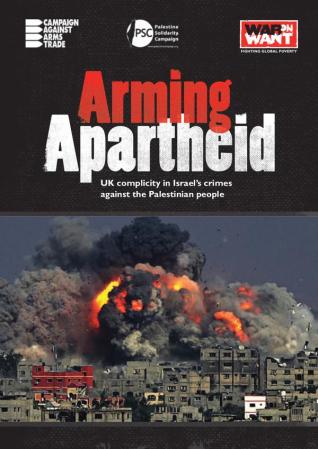 The controversial revelations formed part of a report authored by David Wearing, a researcher at the School of African and Oriental Studies (SOAS). A member of Campaign Against the Arms Trade’s (CAAT) steering committee, Wearing’s work focuses on domestic and international politics.
 Act now to Stop Arming Israel. Help increase the pressure on the UK government to end its arms trade with Israel and its complicity in Israel’s occupation and war crimes.



