Deep underwater, and deeper underground, scientists see surprising hints that gas and oil deposits can be replenished, filling up again, sometimes rapidly.
Although it sounds too good to be true, increasing evidence from the Gulf of Mexico suggests that some old oil fields are being refilled by petroleum surging up from deep below, scientists report. That may mean that current estimates of oil and gas abundance are far too low.
Recent measurements in a major oil field show “that the fluids were changing over time; that very light oil and gas were being injected from below, even as the producing [oil pumping] was going on,” said chemical oceanographer Mahlon “Chuck” Kennicutt. “They are refilling as we speak. But whether this is a worldwide phenomenon, we don’t know.”
Also not known, Kennicutt said, is whether the injection of new oil from deeper strata is of any economic significance, whether there will be enough to be exploitable. The discovery was unexpected, and it is still “somewhat controversial” within the oil industry.
Kennicutt, a faculty member at Texas A&M University, said it is now clear that gas and oil are coming into the known reservoirs very rapidly in terms of geologic time. The inflow of new gas, and some oil, has been detectable in as little as three to 10 years. In the past, it was not suspected that oil fields can refill because it was assumed the oil formed in place, or nearby, rather than far below.
According to marine geologist Harry Roberts, at Louisiana State University, “petroleum geologists don’t accept it as a general phenomenon because it doesn’t happen in most reservoirs. But in this case, it does seem to be happening. You have a very leaky fault system that does allow it to migrate in. It’s directly connected to an oil and gas generating system at great depth.”
What the scientists suspect is that very old petroleum — formed tens of millions of years ago — has continued migrating up into reservoirs that oil companies have been exploiting for years. But no one had expected that depleted oil fields might refill themselves.
Now, if it is found that gas and oil are coming up in significant amounts, and if the same is occurring in oil fields around the globe, then a lot more fuel than anyone expected could become available eventually. It hints that the world may not, in fact, be running out of petroleum.
“No one has been more astonished by the potential implications of our work than myself,” said analytic chemist Jean Whelan, at the Woods Hole Oceanographic Institution, in Massachusetts. “There already appears to be a large body of evidence consistent with … oil and gas generation and migration on very short time scales in many areas globally,” she wrote in the journal Sea Technology.
“Almost equally surprising,” she added, is that “there seem to be no compelling arguments refuting the existence of these rapid, dynamic migration processes.”
The first sketchy evidence of this emerged in 1984, when Kennicutt and colleagues from Texas A&M University were in the Gulf of Mexico trying to understand a phenomenon called “seeps,” areas on the seafloor where sometimes large amounts of oil and gas escape through natural fissures.
“Our first discovery was with trawls. We knew it was an area of massive seepage, and we expected that the oil seeps would poison everything around” the site. But they found just the opposite.
“On the first trawl, we brought up over two tons of stuff. We had a tough time getting the nets back on board because they were so full” of very odd-looking sea floor creatures, Kennicutt said. “They were long straw-like things that turned out to be tube worms.
“The clams were the first thing I noticed,” he added. “They were pretty big, like the size of your hand, and it was obvious they had red blood inside, which is unusual. And these long tubes — 3, 4 and 5 feet long — we didn’t know what they were, but they started bleeding red fluid, too. We didn’t know what to make of it.”
The biologists they consulted did know what to make of it. “The experts immediately recognized them as chemo-synthetic communities,” creatures that get their energy from hydrocarbons — oil and gas — rather than from ordinary foods. So these animals are very much like, but still different from, recently discovered creatures living near very hot seafloor vent sites in the Pacific, Atlantic and other oceans.
The difference, Kennicutt said, is that the animals living around cold seeps live on methane and oil, while the creatures growing near hot water vents exploit sulfur compounds in the hot water.
The discovery of abundant life where scientists expected a deserted seafloor also suggested that the seeps are a long-duration phenomenon. Indeed, the clams are thought to be about 100 years old, and the tube worms may live as long as 600 years, or more, Kennicutt said.
The surprises kept pouring in as the researchers explored further and in more detail using research submarines. In some areas, the methane-metabolizing organisms even build up structures that resemble coral reefs.
It has long been known by geologists and oil industry workers that seeps exist. In Southern California, for example, there are seeps near Santa Barbara, at a geologic feature called Coal Oil Point. And, Roberts said, it’s clear that “the Gulf of Mexico leaks like a sieve. You can’t take a submarine dive without running into an oil or gas seep. And on a calm day, you can’t take a boat ride without seeing gigantic oil slicks” on the sea surface.
Roberts added that natural seepage in places like the Gulf of Mexico “far exceeds anything that gets spilled” by oil tankers and other sources.
“The results of this have been a big surprise for me,” said Whelan. “I never would have expected that the gas is moving up so quickly and what a huge effect it has on the whole system.”
Although the oil industry hasn’t shown great enthusiasm for the idea — arguing that the upward migration is too slow and too uncommon to do much good — the search for new oil and gas supplies already has been affected, Whelan and Kennicutt said. Now, companies scan the sea surface for signs of oil slicks that might point to new deposits.
“People are using airplane surveys for the slicks and are doing water column fluorescence measurements looking for the oil,” Whelan said. “They’re looking for the sources of the seeps and trying to hook that into the seismic evidence” normally used in searching for buried oil.
Similar research on known oil basins in the North Sea is also under way, and “that oil is very interesting. There are absolutely marvelous pictures of coral reefs which formed from seepage [of gas] from North Sea reservoirs,” Whelan said.
Analysis of the ancient oil that seems to be coming up from deep below in the Gulf of Mexico suggests that the flow of new oil “is coming from deeper, hotter formations” and is not simply a lateral inflow from the old deposits that surround existing oil fields, she said. The chemical composition of the migrating oil also indicates it is being driven upward and is being altered by highly pressurized gases squeezing up from below.
This upwelling phenomenon, Whelan noted, fits into a classic analysis of the world’s oil and gas done years ago by geochemist-geologist John Hunt. He suggested that less than 1 percent of the oil that is generated at depth ever makes it into exploitable reservoirs. About 40 percent of the oil and gas remains hidden, spread out in the tiny pores and fissures of deep sedimentary rock formations.
And “the remaining 60 percent,” Whelan said, “leaks upward and out of the sediment” via the numerous seeps that occur globally.
Also, the idea that dynamic migration of oil and gas is occurring implies that new supplies “are not only charging some reservoirs at the present time, but that a huge fraction of total oil and gas must be episodically or continuously bypassing reservoirs completely and seeping from surface sediments on a relatively large scale,” Whelan explained.
So far, measurements involving biological and geological analysis, plus satellite images, “show widespread and pervasive leakage over the entire northern slope of the Gulf of Mexico,” she added.
“For example, Ian MacDonald at Texas A&M has published some remarkable satellite photographs of oil slicks which go for miles in the Gulf of Mexico in areas where no oil production is occurring.” Before this research in oil basins began, she added, “changes in reservoired oils were not suspected, so no reliable data exists on how widespread the phenomenon might be in the Gulf Coast or elsewhere.”
The researchers, especially the Texas team, have been working on this subject for almost 15 years in collaboration with oil industry experts and various university scientists. Their first focus was on the zone called South Eugene Island block 330, which is 150 miles south of New Orleans. It is known as one of the most productive oil and gas fields in the world. The block lies in water more than 300 feet deep.
As a test, the researchers attempted to drill down into a known fault zone that was thought to be a natural conduit for new petroleum. The drilling was paid for by the U.S. Department of Energy.
Whelan recalled that as the drill dug deeper and deeper, the project seemed to be succeeding, but then it abruptly ended in failure. “We were able to produce only a small amount of oil before the fault closed, like a giant straw,” probably because reducing the pressure there allowed the fissure to collapse.
In addition to the drilling effort and the inspection of seeps, Whelan and her colleagues reported that three-dimensional seismic profiles of the underground reservoirs commonly show giant gas plumes coming from depth and disrupting sediments all the way to the surface.
This also shows that in an area west of the South Eugene Island area, a giant gas plume originates from beneath salt about 15,000 feet down and then disrupts the sediment layers all the way to the surface. The surface expression of this plume is very large — about 1,500 feet in diameter. One surprise, Whelan said, was that the gas plume seems to exist outside of faults, the ground fractures, which at present are the main targets of oil exploration.
It is suspected that the process of upward migration of petroleum is driven by natural gas that is being continually produced both by deeply buried bacteria and from oil being broken down in the deeper, hotter layers of sediment. The pressures and heat at great depth are thought to be increasing because the ground is sinking — subsiding — as a result of new sediments piling up on top. The site is part of the huge delta formed over thousands of years by the southward flow of the massive Mississippi River. Like other major deltas, the Mississippi’s outflow structure is continually being built from sands, muds and silts washed off the continent.
Analysis of the oil being driven into the reservoirs suggests they were created during the so-called Jurassic and Early Cretaceous periods (100 million to 150 million years ago), even before the existing basin itself was formed. This means the source rock is buried and remains invisible to seismic imaging beneath layers of salt.
In studying so-called biomarkers in the oil, Whelan said, it was concluded that the oil is closely related to other very old oils, implying that it “was probably generated very early and then remained trapped at depth until recently.” And, she added, other analyses “show that this oil must have remained trapped at depths and temperatures much greater than those of the present-day producing reservoirs.”
At great depth, where the heat and pressure are high enough, she explained, methane is produced by oil being “cracked,” and production of gas “is able to cause sufficient pressure to periodically open the fracture system and allow upward fluid flow of methane, with entrapment of oil in its path.”
When they can’t explain it, they do the next best thing.
They ignore it.
The U.S. government, the 9/11 Commission, the National Institute of Standards and Technology, FEMA and the mainstream media all do the same thing. When they can’t explain something that contradicts the official version of events on 9/11, they simply pretend the questions don’t exist.
Among the most crucial examples of this are the large pools of molten metal found under the rubble of the two twin towers of the World Trade Center and Building 7. The molten metal burned under the rubble for weeks, with the final fires not being extinguished until December of 2001, three months after the disaster.
The official story can’t explain this; it doesn’t even try. That’s because the molten metal points to a controlled demolition – explosive charges combined with a material that causes a chemical reaction creating extreme heat to cut through steel beams.
According to Brigham Young University physics professor Steven Jones, who has questioned the science of the official story, the most likely material to have been used to melt through the beams is thermite.
Thermite devices could have been wrapped around the steel girders diagonally to cut through them. They could have contributed, along with the explosives, to bringing the structure down. When ignited, thermite can reach temperatures of 4,500F in less than two seconds.
One of the by-products of the use of thermite is molten steel. Another is aluminum oxide, which shows itself as a fine white smoke. What did we have in the wake of the towers’ collapse? Molten steel and fine white “smoke.” There was so much of this smoke that it could be seen from the International Space Station.
FEMA, the Federal Emergency Management Agency, stated in its report that most of the jet fuel from the planes would have burned up in the initial impact or in the first minutes after impact.
So what was all that smoke coming from the towers and later the wreckage of the towers? Smoke poured out of the rubble for weeks as emergency workers attempted to extinguish the molten metal fires underneath.
The melting point for steel is about 2,800F while the maximum temperature that jet fuel can burn at is about 1,800F. Experts like Jones have pointed out that the black smoke coming from the towers indicates that the fire was oxygen starved and therefore was burning at a much lower temperature even than 1,800F.
How do we know the molten metal didn’t come from some underground source? We know this because there are photographs that clearly show molten metal flowing from the 81st floor of the South Tower BEFORE collapse. Some have tried to explain this by saying that it is molten aluminum from the planes.
Aluminum may glow at a high enough temperature but it’s ridiculous to suggest that aluminum burned underground for three months. Molten metal was found under Building 7, which was not hit by a plane. Those of you who refuse to consider the “demolition” possibility might want to try and explain where this molten metal came from.
By the way, the existence of these “hot spots” under all three buildings was confirmed by aerial thermal images taken by NASA in the first two weeks after 9/11.
As for proving that the molten steel was actually there, photographs show it, and even then New York Mayor Rudy Giuliani talked about it publicly. He talked about how the boots of emergency workers would melt after a few hours of clearing rubble.
Many other witnesses reported the presence of the molten pools under the building rubble. Leslie Robertson, one of the designers of the World Trade Center, reported molten metal running under the buildings 21 days after 9/11.
Public health adviser Ron Burger likened the pools to a volcano. Other workers say it looked like a foundry or that the metal “looked like lava.” Witnesses say they saw molten steel “dripping from beams and walls” in the basement of the towers. New York firefighters referred to “rivers of molten metal” under the rubble.
SOMEONE NEEDS TO EXPLAIN THIS.
The FEMA report also mentions sulfur residue on the steel beams of the towers after collapse. This also supports the controlled demolition theory because sulfur is used to lower the melting point of the steel. Sulfur combined with thermite creates thermate. This dramatically speeds up the melting of the steel.
If there’s a reasonable explanation for all of this, why haven’t we heard it? And if you’re wondering if the whole controlled demolition case might all rest on this, you can be assured it does not.
The Five Points district of lower Manhattan, painted by George Catlin in 1827. New York’s first free Black settlement, Five Points was also a destination for Irish immigrants and a focal point for the stormy collective life of the new working class. Cops were invented to gain control over neighborhoods and populations like this.
In England and the United States, the police were invented within the space of just a few decades—roughly from 1825 to 1855.
The new institution was not a response to an increase in crime, and it really didn’t lead to new methods for dealing with crime. The most common way for authorities to solve a crime, before and since the invention of police, has been for someone to tell them who did it.
Besides, crime has to do with the acts of individuals, and the ruling elites who invented the police were responding to challenges posed by collective action. To put it in a nutshell: The authorities created the police in response to large, defiant crowds. That’s
— strikes in England,
— riots in the Northern US,
— and the threat of slave insurrections in the South.
So the police are a response to crowds, not to crime.
I will be focusing a lot on who these crowds were, how they became such a challenge. We’ll see that one difficulty for the rulers, besides the growth of social polarization in the cities, was the breakdown of old methods of personal supervision of the working population. In these decades, the state stepped in to fill the social breach.
We’ll see that, in the North, the invention of the police was just one part of a state effort to manage and shape the workforce on a day-to-day basis. Governments also expanded their systems of poor relief in order to regulate the labor market, and they developed the system of public education to regulate workers’ minds. I will connect those points to police work later on, but mostly I’ll be focusing on how the police developed in London, New York, Charleston (South Carolina), and Philadelphia.
* * * * *
To get a sense of what’s special about modern police, it will help to talk about the situation when capitalism was just beginning. Specifically, let’s consider the market towns of the late medieval period, about 1,000 years ago.
The dominant class of the time wasn’t in the towns. The feudal landholders were based in the countryside. They didn’t have cops. They could pull together armed forces to terrorize the serfs—who were semi-slaves—or they could fight against other nobles. But these forces were not professional or full-time.
The population of the towns was mostly serfs who had bought their freedom, or simply escaped from their masters. They were known as bourgeois, which means town-dweller. The bourgeoisie pioneered economic relations that later became known as capitalism.
For the purposes of our discussion, let’s say that a capitalist is somebody who uses money to make more money. At the beginning, the dominant capitalists were merchants. A merchant takes money to buy goods in order to sell them for more money. There are also capitalists who deal only with money—bankers—who lend out a certain amount in order to get more back.
You could also be a craftsman who buys materials and makes something like shoes in order to sell them for more money. In the guild system, a master craftsman would work alongside and supervise journeymen and apprentices. The masters were profiting from their work, so there was exploitation going on, but the journeymen and apprentices had reasonable hopes of becoming masters themselves eventually. So class relations in the towns were quite fluid, especially in comparison to the relation between noble and serf. Besides, the guilds operated in ways that put some limits on exploitation, so it was the merchants who really accumulated capital at that time.
In France, in the 11th and 12th centuries, these towns became known as communes. They incorporated into communes under various conditions, sometimes with the permission of a feudal lord, but in general they were seen as self-governing entities or even city-states.
But they didn’t have cops. They had their own courts—and small armed forces made up of the townsmen themselves. These forces generally had nothing to do with bringing people up on charges. If you got robbed or assaulted, or were cheated in a business deal, then you, the citizen, would press the charges.
One example of this do-it-yourself justice, a method that lasted for centuries, was known as the hue and cry. If you were in a marketplace and you saw somebody stealing, you were supposed to yell and scream, saying “Stop, thief!” and chase after the thief. The rest of the deal was that anybody who saw you do this was supposed to add to the hue and cry and also run after the thief.
The towns didn’t need cops because they had a high degree of social equality, which gave people a sense of mutual obligation. Over the years, class conflicts did intensify within the towns, but even so, the towns held together—through a common antagonism to the power of the nobles and through continued bonds of mutual obligation.
For hundreds of years, the French carried an idealized memory of these early commune towns—as self-governing communities of equals. So it’s no surprise that in 1871, when workers took over Paris, they named it the Commune. But that’s jumping a little farther forward than we should just yet.
* * * * *
Capitalism underwent major changes as it grew up inside feudal society. First of all, the size of capital holdings grew. Remember, that’s the point—to make smaller piles of money into bigger piles of money. The size of holdings began to grow astronomically during the conquest of the Americas, as gold and silver were looted from the New World and Africans were kidnapped to work on plantations.
More and more things were produced for sale on the market. The losers in market competition began to lose their independence as producers and had to take wage jobs. But in places like England, the biggest force driving people to look for wage work was the state-endorsed movement to drive peasants off the land.
The towns grew as peasants became refugees from the countryside, while inequality grew within the cities. The capitalist bourgeoisie became a social layer that was more distinct from workers than it used to be. The market was having a corrosive effect on solidarity of craft guilds—something I’ll take up in more detail when I talk about New York. Workshops got bigger than ever, as a single English boss would be in command of maybe dozens of workers. I’m talking about the mid-1700s here, the period right before real factory industrialization began.
There still weren’t cops, but the richer classes began to resort to more and more violence to suppress the poor population. Sometimes the army was ordered to shoot into rebellious crowds, and sometimes the constables would arrest the leaders and hang them. So class struggle was beginning to heat up, but things really began to change when the Industrial Revolution took off in England.
* * * * *
At the same time, the French were going through a political and social revolution of their own, beginning in 1789. The response of the British ruling class was to panic over the possibility that English workers would follow the French lead. They outlawed trade unions and meetings of more than 50 people.
Nevertheless, English workers put together bigger and bigger demonstrations and strikes from about 1792 to 1820. The ruling class response was to send in the army. But there are really only two things the army could do, and they’re both bad. They could refuse to shoot, and the crowd would get away with whatever it came to do. Or they could shoot into the crowd and produce working-class martyrs.
This is exactly what happened in Manchester in 1819. Soldiers were sent charging into a crowd of 80,000, injuring hundreds of people and killing 11. Instead of subduing the crowd, this action, known as the Peterloo Massacre, provoked a wave of strikes and protests.
Even the time-honored tactic of hanging the movement’s leaders began to backfire. An execution would exert an intimidating effect on a crowd of 100, but crowds now ranged up to 50,000 supporters of the condemned man, and the executions just made them want to fight. The growth of British cities, and the growth of social polarization within them—that is, two quantitative changes—had begun to produce qualitatively new outbreaks of struggle.
The ruling class needed new institutions to get this under control. One of them was the London police, founded in 1829, just 10 years after Peterloo. The new police force was designed specifically to inflict nonlethal violence upon crowds to break them up while deliberately trying to avoid creating martyrs. Now, any force that’s organized to deliver violence on a routine basis is going to kill some people. But for every police murder, there are hundreds or thousands of acts of police violence that are nonlethal—calculated and calibrated to produce intimidation while avoiding an angry collective response.
When the London police were not concentrated into squads for crowd control, they were dispersed out into the city to police the daily life of the poor and working class. That sums up the distinctive dual function of modern police: There is the dispersed form of surveillance and intimidation that’s done in the name of fighting crime; and then there’s the concentrated form of activity to take on strikes, riots, and major demonstrations.
That’s what they were invented for—to deal with crowds—but what we see most of the time is the presence of the cop on the beat. Before I talk about the evolution of police in New York, I want to explore the connection between these two modes of police work.
*****
I’ll begin with the more general topic of class struggle over the use of outdoor space. This is a very consequential issue for workers and the poor. The outdoors is important to workers
— for work
— for leisure and entertainment
— for living space, if you don’t have a home
… and for politics.
First, about work. While successful merchants could control indoor spaces, those without so many means had to set themselves up as vendors on the street. The established merchants saw them as competitors and got the police to remove them.
Street vendors are also effective purveyors of stolen goods because they’re mobile and anonymous. It wasn’t just pickpockets and burglars who made use of street vendors this way. The servants and slaves of the middle class also stole from their masters and passed the goods on to the local vendors. (By the way, New York City had slavery until 1827.) The leakage of wealth out of the city’s comfortable homes is another reason that the middle class demanded action against street vendors.
The street was also simply where workers would spend their free time—because their homes were not comfortable. The street was a place where they could get friendship and free entertainment, and, depending on the place and time, they might engage in dissident religion or politics. British Marxist historian EP Thompson summed all this up when he wrote that 19th century English police were
impartial, attempting to sweep off the streets with an equable hand street traders, beggars, prostitutes, street-entertainers, pickets, children playing football and freethinking and socialist speakers alike. The pretext very often was that a complaint of interruption of trade had been received from a shopkeeper.
On both sides of the Atlantic, most arrests were related to victimless crimes, or crimes against the public order. Another Marxist historian Sidney Harring noted: “The criminologist’s definition of ‘public order crimes’ comes perilously close to the historian’s description of ‘working-class leisure-time activity.’”
Outdoor life was—and is—especially important to working-class politics. Established politicians and corporate managers can meet indoors and make decisions that have big consequences because these people are in command of bureaucracies and workforces. But when working people meet and make decisions about how to change things, it usually doesn’t count for much unless they can gather some supporters out on the street, whether it’s for a strike or a demonstration. The street is the proving ground for much of working-class politics, and the ruling class is fully aware of that. That’s why they put the police on the street as a counter-force whenever the working class shows its strength.
Now we can look at the connections between the two major forms of police activity—routine patrols and crowd control. The day-to-day life of patrolling gets police accustomed to using violence and the threat of violence. This gets them ready to pull off the large-scale acts of repression that are necessary when workers and the oppressed rise up in larger groups. It’s not just a question of getting practice with weapons and tactics. Routine patrol work is crucial to creating a mindset among police that their violence is for the greater good.
The day-to-day work also allows commanders to discover which cops are most comfortable inflicting pain—and then to assign them to the front lines when it comes to a crackdown. At the same time, the “good cop” you may meet on the beat provides crucial public-relations cover for the brutal work that needs to be done by the “bad cops.” Routine work can also become useful in periods of political upheaval because the police have already spent time in the neighborhoods trying to identify the leaders and the radicals.
* * * * *
Now we can jump back into the historical narrative and talk about New York City.
I’ll begin with a couple of points about the traditions of crowds before the revolution. During the colonial period, people got rowdy sometimes, but it was often formalized in ways that the colonial elite would approve or at least tolerate. There were various celebrations that fell in the category of “misrule,” in which social positions were reversed and the lower orders could pretend that they were on the top. This was a way for the subordinate classes to blow off steam by satirizing their masters—a way that acknowledged the right of the elite to be in charge on every other day of the year. This tradition of symbolic misrule was especially prominent around Christmas and New Year’s. Even slaves would be allowed to participate.
There was also a yearly celebration of Pope Day, in which members of the Protestant majority would parade around with effigies, including one of the Pope—until they burned them all at the end. A little sectarian provocation, “all in good fun,” all approved by the city fathers. At that point, Pope Day didn’t usually lead to violence against actual Catholics because there were only a few hundred in New York and not a single Catholic church before the revolution.
These crowd traditions were loud and even riotous, but they tended to reinforce the connection between the lower orders and the elite, not to break that connection.
The lower orders were also bound to the elite by constant personal supervision. This applied to slaves and house servants, of course, but apprentices and journeyman craftsmen also lived in the same house with the master. So there were not a lot of these subordinate people roaming around the streets at all hours. In fact, there was a colonial ordinance for a while that said that working people could be on the streets only when they were going to and from work.
This situation left sailors and day laborers as the city’s rowdiest unsupervised elements. But sailors spent most of their time near the waterfront, and the laborers—that is, the class of regular wage workers—were not yet a large group.
Under these circumstances where most people were already supervised during the day, there was no need for regular police force. There was a night watch, which tried to guard against vandalism and arrested any Black person who couldn’t prove that s/he was free. The watch was not professional in any way. All of them had day jobs and rotated into watch duty temporarily, so they didn’t patrol regular beats—and everybody hated doing it. The rich bought their way out of it by paying for substitutes.
During the day, a small number of constables were on duty, but they didn’t patrol. They were agents of the court who executed writs like summonses and arrest warrants. They did not do detective work. In the 1700s and well into the 1800s, the system relied almost entirely on civilian informants who were promised a portion of any fine that the offender might have to pay.
* * * * *
The revolutionary period changed a few things about the role of crowds and the relation between classes. In the 1760s, beginning with the agitation against the Stamp Act, the elite of merchants and property-holders endorsed new forms of popular mobilization. These were new loud demonstrations and riots that borrowed from existing traditions, obviously in the use of effigies. Instead of burning the Pope, they’d burn the governor, or King George.
I don’t have time to go into detail about what they did, but it’s important to note the class composition of these crowds. Members of the elite might be there themselves, but the body of these crowds was the skilled workers, collectively known as the mechanics. That means that a master would be out in the crowd with his journeymen and apprentices. People of higher social rank tended to view the master craftsmen as their lieutenants for mobilizing the rest of the mechanics.
As the conflict with Britain intensified, the mechanics became more radicalized and organized themselves independently from the colonial elite. There was friction between the mechanics and the elite, but never a complete breach.
And, naturally, when the British were defeated and the elite set up their own government, they had had enough of all this street agitation. There continued to be rebellions and riots in the new independent United States, but they were taking new shapes—partly because economic development was breaking up the unity of the mechanics themselves.
* * * * *
I’ll turn now to those developments that followed the revolution—changes that produced a new working class out of a conflicted hodgepodge of social elements.
Let’s start with the skilled workers. Even before the revolution, the division between masters and journeymen had sharpened. To understand this, we should look more closely at the lingering influence of the guild system; formal guilds did not exist in United States, but some of their traditions lived on among skilled workers.
The old guilds had essentially been cartels, unions of workers who had a monopoly on a particular skill that allowed them to manage the market. They could set customary prices for their goods and even decide beforehand how big the market was going to be.
The managed market allowed for some customary stability of relations among workers of the same trade. A master acquired an apprentice as an indentured servant from his parents in return for a promise of teaching him a skill and giving him room and board for seven years. Apprentices graduated to become journeymen, but often continued to work for the same master as long as there is no slot for them to become masters themselves. Journeymen received customary wages with long-term contracts. This meant that pay would keep coming in despite seasonal variations in the amount of work. Even without the formal structure of guilds, much of this customary set of relations was still in place in the pre-revolutionary period.
From about 1750 to 1850, however, this corporative structure within the skilled trades was falling apart because the external relation—the tradesmen’s control of the market—was also beginning to break down. Trade that came from other cities or from overseas would undermine the masters’ ability to set prices, so workshops were thrown into competition with each other in a way that’s familiar today.
Competition drove the masters to become more like entrepreneurs, seeking out labor-saving innovation and treating their workers more like disposable wage workers. Enterprises became larger and more impersonal—more like factories, with dozens of employees.
In the first decades of the 19th century, employees were not only losing their long-term contracts, but they also were losing their place to live in the masters’ households. The apprentices found this to be a liberating experience, as young men got out from under the authority of their parents and their masters. Free to come and go as they pleased, they could meet young women and create their own social life among their peers. Working women were employed mostly in household service of various types unless they were prostitutes.
Outdoor life became transformed as these young people mingled with the other parts of the population that comprised the developing working class.
The mingling wasn’t always peaceful. Irish Catholic immigration expanded after 1800. By 1829, there were about 25,000 Catholics in the city—one person out of eight. The Irish were segregated by neighborhood, often living alongside Blacks, who themselves were now about 5 percent of the population. In 1799, Protestants burned an effigy of St. Patrick, and the Irish fought back. These battles recurred over the next few years, and it was clear to the Irish that the constables and the watch were taking sides against them.
So, before there were even modern police forces, the lawmen were doing racial profiling. The city’s elite took note of the Irish lack of respect for the watch—their open combativeness—and responded by expanding the watch and making its patrols more targeted. This went along with increasing police attention to Africans, who lived in the same areas and often had the same attitude toward the authorities.
Underlying the sectarian and racial divisions were economic competition, since Irish workers were generally less skilled and drew lower wages than craft workers. At the same time, masters were trying to de-skill the jobs in the workshops. In this way, Anglo apprentices became part of a real labor market as they lost their long-term contracts. When this happened, they found themselves just a rung above Irish immigrants on the wage scale. Black workers, who performed domestic service or worked as general laborers, were a further rung or two down the wage scale from the Irish.
At the same time, the older unskilled part of the wage-working class, centered around the docks and building construction, was expanding because trade and construction both expanded after the Revolution.
Overall, population expanded rapidly. New York was 60,000 in 1800, but it doubled in size by 1820. In 1830, New York had more than 200,000 people—and 312,000 by 1840.
* * * * *
That’s a rough profile of New York’s new working class.
In these decades, all sections of the class went into collective action on their own behalf. It’s quite a complicated story, because of the number of actions and the fragmentation of the class. But we could start with a generalization that the most common form of struggle was also the most elementary—the riot.
Now some specifics. From 1801 to 1832, Black New Yorkers rioted four times to prevent former slaves from being sent back to their out-of-town masters. These efforts generally failed, the watch responded violently, and the participants received unusually harsh sentences. White abolitionists joined in the condemnations of these riots. So these riots illustrate popular self-activity despite elite disapproval—not to mention racial disparity in the application of the law.
There was also white harassment of black churches and theaters, sometimes rising to the level of riots. Poor immigrants were involved, but sometimes rich whites and the constables themselves took part. One anti-Black riot raged for three days in 1826, damaging Black houses and churches—along with houses and churches of white abolitionist ministers.
But there wasn’t just conflict between Black and white workers. In 1802, white and Black sailors struck for higher wages. As with most strikes during this period, the method was something that historian Eric Hobsbawm called “collective bargaining by riot.” In this case, strikers disabled the ships that were hiring at the lower wages. Dockworkers also united across racial and sectarian lines for militant strikes in 1825 and 1828.
Job actions by skilled workers like journeymen didn’t usually need to resort to such physical coercion, because they possessed a monopoly on the relevant skills. Journeymen nevertheless became more militant in these years. Strikes in the skilled trades happened in 3 waves, starting in 1809, 1822 and 1829. Each wave was more militant and coercive than the previous—as they targeted other skilled workers who broke solidarity. In 1829, the journeymen led a movement to limit the workday to 10 hours and created the Workingmen’s Party. The party collapsed in the same year, but it led to the founding the General Trade Union in 1833.
While workers grew more conscious of themselves as a class, they also began to engage in more and more “run-of-the-mill” riots wherever crowds gathered, in taverns or in theaters or in the street. Such riots may have had no clear economic or political objective, but they were still instances of collective self-assertion by the working class—or by ethnic and racial fractions of the class. In the opening decades of the century, there was one of these riots about four times a year, but in the period from 1825 to 1830, New Yorkers rioted at a rate of once per month.
One of these riots in particular alarmed the elite. Known as the Christmas riot of 1828, it actually happened at New Year’s. A noisy crowd of about 4,000 young Anglo workers brought out their drums and noisemakers and headed toward Broadway where the rich lived. On the way, they busted up an African church and beat the church members. The watch arrested several of the rioters, but the crowd rescued them and sent the watch running.
The crowd picked up some more numbers and turned toward the commercial district, where they busted up the stores. At the Battery, they broke windows in some of the city’s richest homes. Then they headed back up Broadway because they knew that the rich were having their own celebration at the City Hotel. There the crowd blocked the coaches from exiting.
A large contingent of the watch showed up, but the leaders of the crowd called a five-minute truce. This allowed the watch to think about the fight that they were about to get into. When the five minutes were up, the watch stepped aside, and the deafening crowd marched past them up Broadway.
This spectacle of working-class defiance took place in full view of the families that ran New York City. Newspapers immediately began calling for a major expansion of the watch, so the Christmas Riot accelerated a set of incremental reforms that finally lead to the creation the New York City Police Department in 1845.
The reforms of 1845 enlarged the police force, professionalized them, and centralized them with a more military chain of command. The watch was expanded to 24 hours, and policemen were forbidden from taking a second job. The pay was increased, and police no longer received a portion of the fines that were extracted from offenders.
This meant the cops were no longer going out on patrol looking for how they were going to make a living, a process that could lead to a strange selection of prosecutions. Eliminating the fee system gave commanders greater freedom to set policy and priorities—and thus made the department more responsive to the shifting needs of the economic elite.
That’s how the New York police got started.
*****
The story of police in the South is a bit different, as you might expect.
One of the first modern-type police forces came in Charleston, South Carolina, in the years before New York force became fully professional. The precursor of the Charleston’s police force was not a set of urban watchmen but slave patrols that operated in the countryside. As one historian put it, “throughout all of the [Southern] states [before the Civil War], roving armed police patrols scoured the countryside day and night, intimidating, terrorizing, and brutalizing slaves into submission and meekness.”
These were generally volunteer forces of white citizens who provided their own weapons. Over time, the system got adapted to city life. Charleston’s population did not explode like New York’s. In 1820, there were still less than 25,000 people—but half of them were Black.
The only way that the South could pull off any real industrialization was to allow slaves to work in wage jobs in the cities. Some slaves were owned directly by factory owners, especially in the South’s most industrial city, Richmond. Most urban slaves, however, were owned by white town-dwellers who used them for personal service and “rented them out” to wage-paying employers.
At first, the masters found the jobs for their slaves and took all of the wages for themselves. But they quickly found it most convenient to let their slaves find their own jobs while collecting a flat fee from the slave for the time spent away from the master.
This new set of arrangements fundamentally altered the relation between slaves and their masters—not to mention among the slaves themselves. For long stretches of time, the slaves got out from under the direct supervision of their masters, and slaves could make cash for themselves above and beyond the fees they paid their masters. Many African Americans could even afford to live outside their masters’ households. Slaves could marry and cohabit independently. By the first decades of the 19th century, Charleston had a Black suburb, populated mostly by slaves alongside some freedmen.
The South’s white population, both in town and country, lived in constant fear of insurrection. In the countryside, however, Blacks were under constant surveillance, and there were few opportunities within the grueling work regime for slaves to develop wide social connections. The dramatically freer circumstances in the cities meant that the state had to step in to do the job of repression that the slavemasters had usually taken care of themselves.
The Charleston Guard and Watch developed by trial and error into a recognizably modern city-run police force by the 1820s, performing both day-to-day harassment of the Black population and staying on call for rapid mobilization to control crowds. It received a big push toward professionalization in 1822 when plans for a coordinated slave insurrection were discovered. They crushed the insurrection, and then they bulked up the force.
The Southern force was more militarized than in the North, even before professionalization. Mounted police were the exception in the North, but they were the rule in the South. And Southern police carried guns, with bayonets.
The specific history of police forces varied in all American cities, but since they were facing similar problems in repressing urban workers and the poor, they all tended to converge on similar institutional solutions. The Southern experience also reinforces the point that was already clear in the North: Anti-Black racism was built into American police work from the very first day.
* * * * *
Toward the end, I’ll say a few words about Philadelphia, but before that, I’m going to draw out some themes that apply to all of these cases.
First of all, we need to put policing in the context of a bigger ruling-class project of managing and shaping the working class. I said at the beginning that the emergence of workers’ revolt coincided with a breakdown of old methods of constant personal supervision of the workforce. The state stepped in to provide supervision. The cops were part of that effort, but in the North, the state also expanded its programs of poor relief and public schooling.
Police work was integrated with the system of poor relief, as constables worked on registration of the poor and their placement in workhouses. That’s even before the police were professionalized—the constables were sorting out the “deserving poor” from the “undeserving poor.” If people were unemployed and unable to work, constables would direct them toward charity from churches or the city itself. But if folks were able to work, they were judged to be “idlers” and sent off to the horrors of the workhouse.
The system for poor relief made a crucial contribution to the creation of the market for wage labor. The key function of the relief system was to make unemployment so unpleasant and humiliating that people were willing to take ordinary jobs at very low wages just to avoid unemployment. By punishing the poorest people, capitalism creates a low baseline for the wage scale and pulls the whole scale downward.
The police no longer play such a direct role in selecting people for relief, but they do deliver a good deal of the punishment. As we know, lots of police work has to do with making life unpleasant for unemployed people on the street.
The rise of modern policing also coincides with the rise of public education. Public schools accustom children to the discipline of the capitalist workplace; children are separated from their families to perform a series of tasks alongside others, under the direction of an authority figure, according to a schedule ruled by a clock. The school reform movement of the 1830s and 40s also aimed to shape the students’ moral character. The effect of this was supposed to be that students would willingly submit to authority, that they would be able to work hard, exercise self-control, and delay gratification.
In fact, the concepts of good citizenship that came out of school reform movement were perfectly aligned with the concepts of criminology that were being invented to categorize people on the street. The police were to focus not just on crime but on criminal types—a method of profiling backed up by supposedly scientific credentials. The “juvenile delinquent,” for example, is a concept that is common to schooling and policing—and has helped to link the two activities in practice.
This ideology of good citizenship was supposed to have a big effect inside the heads of students, encouraging them to think that the problems in society come from the actions of “bad guys.” A key objective of schooling, according to reformer Horace Mann, should be to implant a certain kind of conscience in the students—so that they discipline their own behavior and begin to police themselves. In Mann’s words, the objective was for children to “think of duty rather than of the policeman.”
Needless to say, an analytic scheme for dividing society between good guys and bad guys is perfect for identifying scapegoats, especially racial ones. Such a moralistic scheme was (and is) also a direct competitor to a class-conscious worldview, which identifies society’s basic antagonism as the conflict between exploiters and exploited. Police activity thus goes beyond simple repression—it “teaches” an ideology of good and bad citizenship that dovetails with the lessons of the classroom and the workhouse.
The overall point here is that the invention of the police was part of a broader expansion of state activity to gain control over the day-to-day behavior of the working class. Schooling, poor relief and police work all aimed to shape workers to become useful to—and loyal to—the capitalist class.
* * * * *
The next general point is about something we all know, and that’s this:
There is the law … and then there’s what cops do.
First, a few words about the law: Despite what you may have learned in civics class, the law is not the framework in which society operates. The law is a product of the way society operates, but it doesn’t tell you how things really work. The law is also not a framework for the way that society should operate, even though some people hold out that hope.
The law is really just one tool among others, in the hands of those who are empowered to use it, to affect the course of events. Corporations are empowered to use this tool because they can hire expensive lawyers. Politicians, prosecutors and the police are also empowered to use the law.
Now, specifically about cops and the law. The law has many more provisions than they actually use, so their enforcement is always selective. That means that they are always profiling what part of the population to target and choosing which kinds of behavior they want to change. It also means that cops have a permanent opportunity for corruption. If they have discretion over who gets picked up for a crime, they can demand a reward for not picking somebody up.
Another way to see the gap between the law and what cops do is to examine the common idea that punishment begins after conviction in a court. The thing is, anybody who’s dealt with the cops will tell you that punishment begins the moment they lay hands on you. They can arrest you and put you in jail without ever filing charges. That’s punishment, and they know it. That’s not to mention the physical abuse you might get, or the ways they can mess with you even if they don’t arrest you.
So the cops order people around every day without a court order, and they punish people every day without a court judgment. Obviously, then, some of the key social functions of the police are not written into the law. They’re part of police culture that cops learn from each other with encouragement and direction from their commanders.
This brings us back to a theme that I started with at the very beginning. The law deals with crimes, and individuals are charged with crimes. But the police were really invented to deal with what workers and the poor had become in their collective expressions: Cops deal with crowds, neighborhoods, targeted parts of the population—all collective entities.
They may use the law as they do this, but their broad directives come to them as policy from their commanders or from their own instincts as experienced cops. The policy directives frequently have a collective nature—say, to gain control of an unruly neighborhood. They decide to do that, and then they figure out what laws to use.
That’s the meaning of “zero tolerance” policies, “broken windows” policies—policies that, in the past, might have been frankly termed “uppity nigger” policies. The aim is to intimidate and assert control over a mass of people by acting on a few. Such tactics have been built into police work from the very beginning. The law is a tool to use on individuals, but the real goal is to control the behavior of the larger mass.
* * * * *
I’ll use my last few minutes to talk about some alternatives.
One of them is a justice system that existed in the United States before the rise of the police. It’s well documented for Philadelphia, so that’s the place I’ll discuss. Colonial Philadelphia developed a system called the minor courts in which most criminal prosecutions took place. The mayor and the aldermen served as the judges—the magistrates. Poor people would save up money so they could pay a fee to the magistrate to hear a case.
Then, as now, most crime was committed by poor people against poor people. In these courts, the victim of assault, theft, or defamation would act as prosecutor. A constable might get involved in order to bring in the accused, but that’s not the same thing as a cop making an arrest. The whole action was driven by the victim’s desires, not the state’s objectives. The accused could also counter-sue.
There were no lawyers involved on either side, so the only expense was the fee to the magistrate. The system wasn’t perfect, because the judge might be corrupt, and the life of the poor didn’t stop being miserable when they won a case. But the system was quite popular and continued operating for some time even after a system of modern police and state prosecutors developed in parallel.
The rise of the police, which came along with the rise of the prosecutors, meant that the state was putting its thumb on the scales of justice. In court, you might hope to be treated as innocent until proven guilty. Before you get to court, though, you have to pass through the hands of the cops and prosecutors who certainly don’t treat you like you’re innocent. They have a chance to pressure you or torture you into a confession—or nowadays a confession in the form of a plea bargain—before you ever get to court.
However unfair the system came to be as it was dominated by cops and prosecutors, the minor courts had shown Philadelphians that an alternative was possible that looked a lot more like dispute resolution among equals.
That’s the key—we can make an alternative available again if we abolish the unequal social relations that that police were invented to defend. When the workers of Paris took over the city for two months in 1871, they established a government under the old name of the Commune. The beginnings of social equality in Paris undercut the need for repression and allowed the Communards to experiment with abolishing the police as a separate state force, apart from the citizenry. People would elect their own officers of public safety, accountable to the electors and subject to immediate recall.
This never became a settled routine because the city was under siege from day one, but the Communards had the right idea. In order to overcome a regime of police repression, the crucial work was to live up to the name of the Commune—that is, to build a self-governing community of equals. That’s still pretty much what we need to do.
* * * * *
This is an edited text of a talk I gave in Chicago in late June 2012 at the annual Socialism conference. Audio of the talk is available at wearemany.org, but the text here corrects some mistakes I made back then.
* * * * *
Some sources.
On law and order in the European Middle Ages:
Tigar, Michael. Law and the Rise of Capitalism. New York: Monthly Review Press, 2000.
On the working class and the police in England:
Thompson, E. P. The Making of the English Working Class. Vintage, 1966.
Farrell, Audrey. Crime, Class and Corruption. Bookmarks, 1995.
For some history in the US and insight into the functions of the police:
Williams, Kristian. Our Enemies in Blue: Police and Power in America. Revised Edition. South End Press, 2007.
Silberman, Charles E. Criminal Violence, Criminal Justice. First Edition. New York: Vintage, 1980.
The key source on the evolution of the police in the major cities of the US:
Bacon, Selden Daskam. The Early Development of American Municipal Police: A Study of the Evolution of Formal Controls in a Changing Society. Two volumes. University Microfilms, 1939.
Specific sources on New York, Philadelphia and the South:
Gilje, Paul A. The Road to Mobocracy: Popular Disorder in New York City, 1763-1834. The University of North Carolina Press, 1987.
Steinberg, Allen. The Transformation of Criminal Justice: Philadelphia, 1800-1880. 1st edition. Chapel Hill: The University of North Carolina Press, 1989.
Wade, Richard C. Slavery in the Cities: The South 1820–1860. Oxford University Press, 1964.
On the early years of public schooling in the US:
Bowles, Samuel, and Herbert Gintis. Schooling In Capitalist America: Educational Reform and the Contradictions of Economic Life. Reprint. Haymarket Books, 2011.
For the past three months, I and other leaders of the organization May First/People Link have been under a federal subpoena to provide information we don’t have. During that time, we have also been forbidden by a federal court “gag order” to tell anyone about that subpoena, although we had already announced it and commented on it before the order was sent. Finally, we were forbidden from telling anyone about the gag order itself.
It all sounds comical but any laughter would end if we violated that “gag order,” because that would be a felony and we could face prison sentences and huge fines.
We were silenced by our own government in a case we had nothing to do with and over information we didn’t have…and we couldn’t tell anyone about any of it.
The court order has now expired as of December 18 and I am now free to talk about it.
It’s actually not easy to write about. Not because it was very painful — it really wasn’t. But it was so bizarre, illogical and foreign to my normal experience that it cut into the normal expectation of discourse and communications I, and people in this country, take for granted as a right. Not being able to talk about something and not being able to explain why was among the most surreal experiences I’ve had in nearly 50 years as an activist and, because of its implication, it was one of the most disturbing.
It’s also difficult because I have no complete political context for this. I know there are many activists who are under such gag orders but I don’t who they are. They are gagged and, while the order that restrained us came from a judge and had a three-month time limit, many of these orders are issued instead as a federal National Security Letter and they are open-ended. I know people who have been gagged for years and had to press hard to have the order lifted long after the relevant investigation was over.
The numbers alone attest to the seriousness of this situation. So let me explain what happened to us.
Among other things, May First/People Link provides Internet hosting services to its members — like a web host. Most of our members are activists and activist organizations in the United States and Mexico but we have a few members in other countries who need the security of data and protection from government intrusion which we provide on principle.
We’ve been doing that for a decade and during that decade we have received many information requests, letters about investigations and other less official but just as daunting actions like threats from companies who believe their copyright has been violated in some satirical piece on them. We respond by resisting all these requests for as long as we can and usually the affected member tells us to comply. Since May First doesn’t keep much recorded information on members, there’s not much to turn over.
On September 5 this year, the Department of Justice (apparently cooperating with Greek law enforcement authorities) demanded account information about the Athens (Greece) Indymedia Center (IMC), one of our members. Although no government has confirmed this, we believe the target of the investigation was an activist organization wanted by Greek law enforcement that is believed to have used the Indymedia website at one point. There’s nothing unique or surprising about that — IndyMedia is an international organization dedicated to providing news about movements world-wide, news which is often written by those movements. So anyone who wants to post on an Indymedia Center website is freely allowed to do so.
In fact, the Athens IMC had very little information on the organization under investigation. It doesn’t maintain logs or records of visitors. It just had a couple of email addresses that the government already knew about. In other words, we didn’t have anything the government wanted and couldn’t turn over what we didn’t have even if we wanted to. Normally, things would have ended there.
But this request was different from others we’ve received because the government subpoena demanded information not just for the Athens IMC but for the entire server their site is on. And that server, which belongs to us, hosts many other May First members.
This was particularly egregious for two reasons. First, those other MF/PL members had nothing to do with this investigation and seizing their information not only violated the privacy and data protection principles we live by but it also violated any concept of responsible investigation. The government wanted us to turn over information about members who didn’t even know anything about this case and who had no connection at all to Athens IMC (much less the target of the investigation).
Second, the Athens IMC itself wasn’t suspected of doing anything illegal, but the Greek government could easily use information concerning it for repressive purposes. We knew there was nothing connected to its investigation on that server so why were these people trying to get this information?
After consulting with the Athens IMC, we refused to release personally identifying information to the government. We then publicly announced the existence of the subpoena to our membership and posted that information on our website.
Two weeks later, we were served with the gag order forbidding us from talking about the subpoena and forbidding us from even acknowledging to anyone outside our Leadership Committee that the order existed. That included friends, family, our membership and even the Athens IMC. We were to act as if nothing had happened even though we had already announced that it had.
We were informed that any violation of this order could result in fines and imprisonment, which could have destroyed the organization. Our lawyers from the Electronic Frontier Foundation advised us to comply.
I hate bullies and my natural inclination when I confront one is to push back. That’s more or less what May First does in most of the legal cases we face. It wasn’t the threat of a prison sentence that concerned us but a misstep in this case could mean a huge fine that would shut us down, closing down the websites and email accounts of thousands of activists. That would be movement-crippling and so we decided to follow our lawyers’ advice and comply.
We heard nothing more from the government and haven’t heard anything since. And that’s the first absurdity in the whole tale.
You would think that not allowing a citizen to talk would be a pretty huge decision for the government in this country. But this was treated like a routine matter and that’s because it is routine. It has become one of the government’s favorite investigative tools and the specific kind of tool the government usually uses is a National Security Letter.
Essentially the NSL is a demand for certain information which always includes a gag order like the one we received (except ours came from the federal court itself). Under the Patriot Act, the FBI can issue such a letter (without a judge’s approval or a hearing) if the agent running an ongoing investigation believes the information being sought is relevant to the case. Most of these letters are about illegal clandestine activities or terrorism but that’s a pretty wide berth for any investigation. What’s more, the letters never tell you what the investigation is about. There is no judicial review of the request required although, after the reform of the Patriot Act in 2006, you can appeal the letter to a federal judge. But the record shows that such appeals are almost never successful.
So you have to give up the information on people who expect that you will protect their information, never tell these people or anyone else you’re doing it and never tell anybody that you can’t tell them.
This alone shows that, in the United States, we have no privacy and, since you can’t communicate with people about what you’re being forced to do, no real freedom of speech.
To illustrate how absurd things got: I was contacted by several journalists from Greece who were, naturally, interested in a story about the US government cooperating with their own government’s investigators.
One asked me, “Have you received this subpoena?” and I responded that we have issued a statement on it.
He then asked if there are new developments and I answered, “I am unable to further comment on this situation at this time.”
These Greek reporters are clever souls so this one asked me, “Are you under a gag order from your government?”
I repeated my answer about not being able to comment. (By now I was starting to feel like the British Prime Minister during Minister’s Questions in Parliament. “I refer the honorable gentleman to an answer I gave previously.”)
Then, in the kind of question I would ask several times a week when I was working for a daily newspaper, he asked “Can we assume that this would be your answer if you were under a government gag order?”
My non-answer answer: “You can only assume what I have stated in my previous answer.”
Any reporter with any experience would realize that I’m under a gag order at that point, so the whole thing was ridiculous, particularly because we had already published a statement about this before we were gagged.
But maybe this wasn’t about not publishing the information. Maybe this was about exercising repressive power over a citizen… testing how far they can go, testing how much we will accept.
Because our order was issued by a federal judge, it was reviewed and had an expiration date. But if it had been issued through an NSL, the gag would be virtually permanent. If an activist believes that a particular government investigation is invasive (which it often is), that activist can never speak about it, comment on it, publicly analyze it. It becomes cloaked in the virtual smoke of a room of repression and constitutional violation.
That room is furnished with the other accoutrements of a rapidly degenerating police-state society: cops killing young men of color without any real legal repercussion; a prison system bloated with young people that substitutes for gainful employment; a war policy that provides the only job potential young people have… to kill and die; a shocking policy of data gathering that violates every premise of privacy and civil rights; a democracy that is broken and manipulated as a matter of course and a government that is brazenly dysfunctional.
In that context of a society that clearly cannot be reformed, this absurd drama that would make Samuel Beckett proud makes a whole lot of sense. It’s not about the information you can give the government, it’s about blocking the information you can give other people.
For most of my life, people in this country have pointed out to me that at least we should be pleased that we can protest and that we have freedom of speech, privacy and association. But we really don’t. At least a third of a million of us haven’t enjoyed that freedom for an indeterminate period and probably a large percentage of them still don’t. Any freedom we have is granted by a government which constantly demonstrates that it’s ready to withdraw that freedom if it deems that necessary.
For some reason, not being gagged doesn’t feel very “free”.
Solstice: the sun stands still. In temperate countries of the northern and southern hemispheres, every year there are two: summer and winter. The northern hemisphere’s summer solstice, which occurs on a day in the middle of the year (June 20 to 22, depending on the year), is the southern hemisphere’s winter solstice. Conversely, the southern hemisphere’s summer solstice, which occurs on a day in the third week of December (December 20 to 23, depending on the year), just prior to the New Year, is the northern hemisphere’s winter solstice. In the tropics, these astronomical events are not physically felt, except for the holiday celebration called Christmas that is associated with the northern’s hemisphere winter solstice and was brought by European Christian religions to countries like the Philippines, where I was born.
Dies natalis Solis invicti: Birthday of the unconquered Sun
Though we are more familiar now with the so-called Christmas season, connected with the winter solstice, there has always been something religious or spiritual about this time of year that antedates the Christian era. The traditions of caroling and midnight service, and common symbols in the celebration of Christmas, like mistletoes, decorated trees, candles and lights, wreaths and hollies, among others, were present in European paganism long before the advent of Christianity. Christmas is therefore the “Christianization” of the winter solstice celebration, whose institutionalization over time has led to the theft of most, if not all, of the major highlights from the pagan world.
In the Hebrew scriptures of the Jewish religion, known as the Old Testament in the Christian Bible, there occurs a single instance of the word “solstice” that is not in any way associated with the annual summer and winter astronomical events. In the book of Joshua, chapter 10 and verses 12 to 14, it is reported that the tribal deity of ancient Israel, called YHWH, caused the sun to stand still in Gibeon to give the Israelites, known to be the people of the said tribal deity, the best opportunity to slaughter and annihilate, in broad daylight, an enemy tribe called the Amorites.
“Then Joshua spoke to the Lord in the day when the Lord delivered up the Amorites before the sons of Israel, and he said in the sight of Israel, ‘O sun, stand still at Gibeon, And O moon in the valley of Aijalon.’ So the sun stood still, and the moon stopped, Until the nation avenged themselves of their enemies. Is it not written in the book of Jashar? And the sun stopped in the middle of the sky and did not hasten to go down for about a whole day. There was no day like that before it or after it, when the Lord listened to the voice of a man; for the Lord fought for Israel.…”
This Lord, the sadistic tribal deity of ancient Israel, is a far cry from the god of love whose son, Jesus, is mythically believed by Christians to have been born sometime during the winter solstice and in whose honor Christians celebrate Christmas. By contrast to the murderous solstice of the Jewish story, the pagan winter solstice has always symbolized renewed hope, faith in the restorative cosmic forces and most of all, a love of life.
“In the depths of winter I finally learned there was in me an invincible summer.” – Albert Camus
The pagan winter solstice is an exaltation of the human spirit’s rebirth and revitalization, from “the dark nights of the soul” (“la noche oscura del alma”, with apologies to St. John of the Cross) into the energizing warmth of a radiant morning. It is the grandeur of this splendid background that the Christian religion stole for its prevailing celebration called Christmas, to the point of claiming: “It is not the birth of the Sun but rather that of the Son.”
Christianity, whose key figure, Jesus Christ, is a paragon of humility, should be humble enough not to monopolize the significance of the annual December 25 celebration. Deities from other religions whose births, in different periods, have been celebrated on the same date include: Attis and Dionysus, both of Greece; Mithra of Persia; Salivahana of Bermuda; Odin of Scandinavia; Crite of Chaldez; Thammuz of Syria; Addad of Assyria, and Beddru of Japan.
The winter solstice has influenced the lives of many generations of humanity, through the passing of different civilizations. Therefore the universalizing slogan “Jesus is the reason for the season,” is inaccurate. A more logically acceptable statement for Christians is: “Jesus is our reason for the season.” An all-encompassing claim that articulates ownership of the winter solstice celebration, by claiming that Jesus Christ is the season’s only source of meaning, is a blatant audacity of narrow-minded fundamentalist and evangelical Christians. Christians should be more sensitive not to monopolize the winter solstice celebration and should acknowledge the fact that most—if not all—material symbolisms in Christmas originate from the pagan realm. The legacy of the ancient pagans is still carried on by modern pagans who continue to use the ancient material symbolisms inherited from their precursors with comparable spiritual intensity and pomp.
It is tragic that the originally spiritual celebration of the pagan winter solstice has been ruined by the materialism of modern nominal Christianity. The modern winter solstice celebration has become commercialized and has lost, not only the graciousness originally associated with ancient pagan spirituality, but also the magnanimity of Christian virtues exemplified by the teachings of Jesus Christ.
“The black moment is the moment when the real message of transformation is going to come. At the darkest moment comes the light.” – Joseph Campbell
Even Christianity has been made seasonal by Christmas, which has become the only time of the year when nominal Christians affirm their shallow Christianity through their superficial adoration of their so-called Lord. I think that Christians, to be true to their commitment, should draw their inspiration and get moved to action not only during the Christmas season but also on a daily basis by the words of wisdom and example of Jesus. A truer spirit of Christianity might well reside in the pagan spirituality that has animated the ancient winter solstice celebration with its promise of renewed hope, faith in the restorative cosmic forces and love of life.
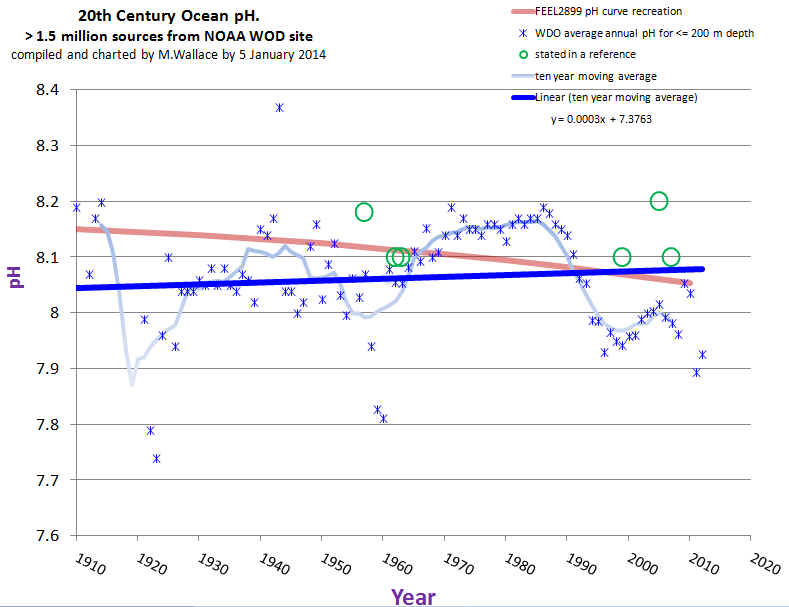
“…startling data omission that he told me: “eclipses even the so-called climategate event.””
Willis Eschenbach tips me to a story by Marita Noon, titled:
What if Obama’s climate change policies are based on pHraud?
I’ve reproduced portions of it here, with a link to the full article. The graph with ALL the data is compelling.
“Ocean acidification” (OA) is receiving growing attention. While someone who doesn’t follow climate change science might think OA is a stomach condition resulting from eating bad seafood, OA is claimed to be a phenomenon that will destroy ocean life—all due to mankind’s use of fossil fuels. It is a foundational theory upon which the global warming/climate change narrative is built.
The science and engineering website Quest, recently posted: “Since the Industrial Revolution in the late 1700s, we have been mining and burning coal, oil and natural gas for energy and transportation. These processes release carbon dioxide (CO2) into the atmosphere. It is well established that the rising level of CO2 in our atmosphere is a major cause of global warming. However, the increase in CO2 is also causing changes to the chemistry of the ocean. The ocean absorbs some of the excess atmospheric CO2, which causes what scientists call ocean acidification. And ocean acidification could have major impacts on marine life.”
Within the Quest text is a link to a chart by Dr. Richard A. Feely, who is a senior scientist with the Pacific Marine Environmental Laboratory (PMEL)—which is part of the National Oceanic and Atmospheric Administration (NOAA). Feely’s climate-crisis views are widely used to support the narrative.
Feely’s four-page report: Carbon Dioxide and Our Ocean Legacy, offered on the NOAA website, contains a similar chart. This chart, titled “Historical & Projected pH & Dissolved Co2,” begins at 1850. Feely testified before Congress in 2010—using the same data that shows a decline in seawater pH (making it more acidic) that appears to coincide with increasing atmospheric carbon dioxide.
…
The December edition of the scientific journal Nature Climate Change features commentary titled: “Lessons learned from ocean acidification research.”
However, an inquisitive graduate student presented me with a very different “lesson” on OA research.
Mike Wallace is a hydrologist with nearly 30 years’ experience, who is now working on his Ph.D. in nanogeosciences at the University of New Mexico. In the course of his studies, he uncovered a startling data omission that he told me: “eclipses even the so-called climategate event.” Feely’s work is based on computer models that don’t line up with real-world data—which Feely acknowledged in email communications with Wallace (which I have read). And, as Wallace determined, there is real world data. Feely, and his coauthor Dr. Christopher L. Sabine, PMEL Director, omitted 80 years of data, which incorporate more than 2 million records of ocean pH levels.
Feely’s chart, first mentioned, begins in 1988—which is surprising as instrumental ocean pH data has been measured for more than 100 years since the invention of the glass electrode pH (GEPH) meter. As a hydrologist, Wallace was aware of GEPH’s history and found it odd that the Feely/Sabine work omitted it. He went to the source. The NOAA paper with the chart beginning in 1850 lists Dave Bard, with Pew Charitable Trust, as the contact.
Wallace sent Bard an email: “I’m looking in fact for the source references for the red curve in their plot which was labeled ‘Historical & Projected pH & Dissolved Co2.’ This plot is at the top of the second page. It covers the period of my interest.” Bard responded and suggested that Wallace communicate with Feely and Sabine—which he did over a period of several months. Wallace asked again for the “time series data (NOT MODELING) of ocean pH for 20th century.” Sabine responded by saying that it was inappropriate for Wallace to question their “motives or quality of our science,” adding that if he continued in this manner, “you will not last long in your career.” He then included a few links to websites that Wallace, after spending hours reviewing them, called “blind alleys.” Sabine concludes the email with: “I hope you will refrain from contacting me again.” But communications did continue for several more exchanges.
In an effort to obtain access to the records Feely/Sabine didn’t want to provide, Wallace filed a Freedom of Information Act (FOIA) request.
In a May 25, 2013 email, Wallace offers some statements, which he asks Feely/Sabine to confirm:
“…it is possible that Dr. Sabine WAS partially responsive to my request. That could only be possible however, if only data from 1989 and later was used to develop the 20th century portion of the subject curve.”
“…it’s possible that Dr. Feely also WAS partially responsive to my request. Yet again, this could not be possible unless the measurement data used to define 20th century ocean pH for their curve, came exclusively from 1989 and later (thereby omitting 80 previous years of ocean pH 20th century measurement data, which is the very data I’m hoping to find).”
Sabine writes: “Your statements in italics are essentially correct.” He adds: “The rest of the curve you are trying to reproduce is from a modeling study that Dr. Feely has already provided and referenced in the publication.”
In his last email exchange, Wallace offers to close out the FOIA because the email string “clarified that your subject paper (and especially the ‘History’ segment of the associated time series pH curve) did not rely upon either data or other contemporary representations for global ocean pH over the period of time between the first decade of 1900 (when the pH metric was first devised, and ocean pH values likely were first instrumentally measured and recorded) through and up to just before 1988.” Wallace received no reply, but the FOIA was closed in July 2013 with a “no document found” response.
Interestingly, in this same general timeframe, NOAA reissued its World Ocean Database. Wallace was then able to extract the instrumental records he sought and turned the GEPH data into a meaningful time series chart, which reveals that the oceans are not acidifying. (For another day, Wallace found that the levels coincide with the Pacific Decadal Oscillation.) As Wallace emphasized: “there is no global acidification trend.”
Regarding the chart in question, Wallace concludes: “Ocean acidification may seem like a minor issue to some, but besides being wrong, it is a crucial leg to the entire narrative of ‘human-influenced climate change.’ By urging our leaders in science and policy to finally disclose and correct these omissions, you will be helping to bring honesty, transparency, and accountability back where it is most sorely needed.”
“In whose professional world,” Wallace asks, “is it acceptable to omit the majority of the data and also to not disclose the omission to any other soul or Congressional body?”
As a taxpayer who is helping to pay your salary I’d like to know why you are refusing to include all the data on ocean acidification that is available.
Sabine’s response:
Chris Sabine – NOAA Federal
12:31 AM (11 hours ago)
As a public servant that must stick to the rigor of the scientific method and only present data that is of sufficient quality to address the question, I am obliged to report the best evaluation of ocean chemistry changes available. This is what you pay me to do and I am working very hard to give you the best value for your tax dollar every day. I hope you are having a good holiday season.
The question that immediately comes to mind is:
Who determined that the directly measured ocean pH data was not of “sufficient quality” and if it wasn’t, why then did NOAA make the data available on their website as part of other ocean data in their World Ocean Database without a caveat?
My search on NOAA’s NODC database for ocean pH data showed plenty of data and no caveats on use… continue
By Robert Fantina | Aletho News | December 24, 2014
It might be easy to assume that the United States’ ignoring of the horrific suffering in Palestine, suffering it caused by its military and financial support of Israel, is just part of the general racism inherent in U.S. culture. Despite civil rights laws, and the U.S.’s self-proclaimed status as a free country, the world knows that racial inequality is rife within U.S. society. This racism has been on ugly display with the recent killings of Michael Brown in Ferguson, Missouri, and Eric Gardner in New York City, both unarmed African-Americans, and both killed by white police officers. That a grand jury in each jurisdiction failed to see any reason to indict either of them just adds evidence to the blatant fact of institutional racism in the U.S.
The U.S. has three main reasons, it will tell the world, for assisting a suffering people: 1) an oppressed people are struggling for the basic right of self-determination, as in Iraq in 2003; 2) a war or other destructive conflict has ended, and either or both parties are in need of support to rebuild homes and infrastructure, as it did following World War II (we don’t need to mention here that the U.S. caused a lot of that destruction), or 3) a natural disaster has hit, causing death, homelessness and leaving a major population at risk of starvation and disease, as in Haiti, in 2005.
However, as noble as these lofty goals are, they are not universally applied. Let us look at one nation that is experiencing events in each of those categories, and is yet to see any assistance from the United States.
The people of Palestine were expelled from over 50% of their nation’s lands over sixty years ago.
They had no say in this decision, received no compensation for the loss of their homes, farms and lands, and were driven into refugee camps. Since that time, hundreds of thousands more have been driven from their homes; their schools, hospitals, mosques and museums have been destroyed, and they now live under occupation in a small fraction of the land that comprised their nation for centuries. During the original expulsion, at least 10,000 Palestinians were killed. Since that time, tens of thousands more have been killed, with no one held accountable for these deaths.
Genocide is defined as the eradication of a people and their culture; it is clear that what has been happening to the people of Palestine is genocide.
Resistance by the Palestinians, a legal right for an occupied people according to international law, takes many forms. There are weekly non-violent demonstrations in the West Bank, yet ‘non-violent’ may not be the correct term. Palestinians demonstrate non-violently, but IDF (Israeli Defense Forces) terrorists will arrest, shoot and kill these demonstrators. In the Gaza Strip, some materials can be smuggled in to build what Dr. Norman Finkelstein, the son of Holocaust survivors and a vocal advocate for the rights of the Palestinian people, calls ‘enhanced fireworks’. These are sometimes shot into Israel, with little or no effect.
So this oppressed population, seeking the basic right of self-determination, would, it might seem, be eligible for U.S. support. After all, back in 2012, then Secretary of State (and probable 2016 Democratic presidential candidate) Hillary Clinton said this in regard to Syria: “We reject any equivalence between premeditated murders by a government’s military machine and the actions of civilians under siege driven to self-defense.” Now, would it be unrealistic to consider a brutally occupied nation to be ‘under siege’? Would not such a people, as Mrs. Clinton so eloquently expressed, be ‘driven to self-defense’? One might think so.
Well, since for some bizarre reason the Palestinians don’t qualify for U.S. help under the first criterion, let us look at Door Number 2: war or other destructive conflict.
What occurred in the Gaza Strip in July and August of this year was not a war; it was simply a slaughter. Israel, with the full backing of the U.S., which has provided it with a powerful military system, with as many of the world’s most highly advanced weapons as Israel wants, bombed and invaded Palestine, a country with no army, navy or air force. Independent sources have said that the destruction is the worst that has been seen anywhere in decades; thousands died, and tens of thousands were rendered homeless. Electricity is available for only a few hours a day, and much of the water is not fit to drink.
This must be viewed as a destructive conflict. Yet, curiously, the U.S., with such a huge percent of the world’s wealth, has not rushed in. Yet it continues to send Israel aid at the rate of nearly $9 million dollars every single day.
Well, it seems that, for some inexplicable reason, Palestine still doesn’t qualify for U.S. largesse. Let’s look at the third reason the U.S. says it rushes in to assist: natural disasters.
Following Israel’s fifty-one day bombardment and invasion of Palestine, rains caused flooding, which further eroded the quality of drinking water, and risked disease. In addition, the tens of thousands of people who were rendered homeless by Israel’s attack had to find shelter where they could: in buildings still standing that may have been damaged to the point of being unsafe; by quickly assembling make-shift shelters from whatever parts of destroyed buildings they could use, or by crowding in with anyone lucky enough to still have a home. This, it would seem, is the kind of suffering that provides countless photo opportunities for U.S. politicians to showcase their concern for the less fortunate.
And yet, the amount of aid sent to Palestine by the U.S. remains at zero. Why, any intelligent person may ask, is this the case?
One hates to be crass, but with the U.S’s elected officials, there is no greater priority than their own re-election. The right of self-determination, freedom, human rights, the basic survival needs of a suffering people all take a distant back seat to the grasping, clutching need to gain every dollar possible for re-election campaigns. And the Israeli lobby, through the American Israel Political Affairs Committee (AIPAC), is extremely generous to the elected officials it has bought and paid for. And these officials don’t come cheap. Between 2008 and 2014, Israel lobbies’ contributions to U.S. senate campaigns cost a whopping $12,036,252. And to purchase members of the House of Representatives, those lobbies spent $4,961,445 in just two years (2012 – 2014).
So, one would be unfair indeed to say that the U.S., in causing and then ignoring the horrific suffering of the Palestinian people, was merely acting out its own inherent racism. After all, these are Arabs we’re talking about, which might lead one to that conclusion. But no, that is an unjust characterization of U.S. governance. We can all be assured that, if there were a rich, powerful American Palestine Political Affairs Committee (APPAC), the U.S. would be pouring billions of dollars into Palestine, sending advisors, providing a peace-keeping force to prevent Israeli aggression, supporting every proposal the United Nations advanced that favored Palestine. U.S. presidents would speak at APPAC conventions, say how they are ‘Palestinian in their hearts’, and describe the U.S. as Palestine’s closest ally.
So it isn’t racism, after all. While recent domestic events should remove any doubt anyone may have still had that the U.S. is a racist society, one must not blame that racism for the way the U.S. treats Palestine. No, that is a result of greed, not racism. One must keep one’s vices straight.
One looks in vain for U.S. citizens to remove the blood-stained glasses, and see the U.S. clearly. Its elected officials don’t represent anyone but the powerful lobbies who buy their offices. The nation doesn’t stand for peace and freedom, but for corporate profits and the wars that enrich the already rich. And human rights aren’t worthy of consideration, if they stand in the way of power or profit. This is the U.S. as it is today, and always has been.
By Sherwood Ross | Aletho News | December 24, 2014
President Obama’s “gift” to Americans this holiday season is to renege on his 2009 pledge “to seek the peace and security of a world without nuclear weapons.”
He is upgrading the lethality level of an atomic arsenal already so deadly it can destroy all life on Earth. Then he’ll send Mr. and Mrs. America the bill, estimated by one Federal study at $1-trillion, to pay for the deadly upgrades he wants, rather than the peaceful improvements Americans need.
“The stated goal of the program is to increase the ‘reliability’ of US nuclear forces,” writes Theodore Postol in the Dec. 29 issue of The Nation. “But a close analysis reveals a technically sophisticated effort to ready US nuclear forces for a direct confrontation with Russia.”
Author Postol, a former adviser to the Chief of Naval Operations, slams this modernization as “a reckless policy that directly undermines our safety and national security.”
He writes, “No rational actor would take steps to start a nuclear war. But the modernization effort significantly increases the chances of an accident during an unpredicted, and unpredictable crisis—one that could escalate beyond anyone’s capacity to imagine.”
Why, Postol wants to know, does the White House aim to overhaul “the entire US nuclear-weapons arsenal, with a particular focus on improving the fusing systems and accuracy of long-range land- and sea-based ballistic-missile warheads and on increasing the killing power of other nuclear warheads.”
And, he says, the scale and character of these weapons’ effects are so large and so deadly that any notion of using them in a controlled or limited way “is completely disconnected from reality.” Postol’s article is appropriately titled, “Striving for Armageddon: How the Obama Administration Learned to Stop Worrying and Love the Bomb.”
Today’s nuclear bombs are vastly more deadly than those the U.S. used to scourge Japan at the end of World War Two. But Postol writes that improving the reliability of fuses on the ballistic-missile warheads disguises the fact the fuses “have been modified to increase the killing power of the warheads.”
What’s more, “Painstaking efforts have also gone into improving their delivery accuracy” and when the results of these combined activities are summarized for Russian political leaders, “it is not hard to understand their alarm.” Postol asserts that it is the U.S. that has pushed the Russians to a higher state of alert.
He reminds, “There is a long history of accidents during the Cold War that brought the United States treacherously close to disaster.” In one major false alert, a training tape loaded into a computer “made it appear to US launch officers that a full-scale Soviet attack was under way.”
And he believes the Russians have good reason to be worried. “With a fully modernized arsenal, the formerly ‘less capable’ nuclear warheads will be able to destroy Russian silo-based ICBMs with confidence. This would free up higher-yield nuclear warheads for other war-fighting tasks, enabling the US military to inflict greater damage on Russian command centers, fixed military facilities and civilian industrial infrastructures.”
Despite Mr. Obama’s recognition that peace depends on nuclear disarmament, Postol says, “the US is making those nightmare scenarios more likely by rebuilding the stockpile of atomic warheads as if they were just another form of conventional weapon.” They aren’t.
When Russia was communist and occupying much of Eastern Europe, U.S. leaders claimed they had to be armed to the teeth. Now that the Russians have scrapped the failed Bolshevik system, have become largely capitalist, and have withdrawn from Eastern Europe, President Obama is ratcheting up the same old tensions. Only now the game he is playing is much more dangerous than ever.
Sherwood Ross, a national public relations consultant from Miami, formerly worked for wire services, major dailies and civil rights organizations. He is both an award-winning journalist and award-winning poet. Reach him at sherwoodross10@gmail.com
“GAO says FBI’s investigation of anthrax attacks was flawed”:
“The FBI used flawed scientific methods to investigate the 2001 anthrax attacks that killed five people and sickened 17 others, federal auditors said Friday in a report sure to fuel skepticism over the FBI’s conclusion that Army biodefense researcher Bruce Ivins was the sole perpetrator.”
Yes, having absolutely no evidence would ‘be sure to fuel skepticism’ over the frame-up of Ivins.
Footnote:
“Ivins died in July 2008 of an apparently intentional Tylenol overdose as the Justice Department prepared to indict him.”
Steven Hatfill was the first patsy the FBI picked, and when he fought back too successfully, they settled on Ivins, whose personal weaknesses made it too difficult for him to challenge the lies. As we’ve seen with the recent FBI blame on North Korea for the Sony hacking case, the FBI is nothing more than a lie factory.
From the same time period (fall of 2001), a possible murder that many have wondered about:
Graeme MacQueen’s new book, The 2001 Anthrax Deception, reveals stunning links between the 9/11 attacks and the anthrax attacks that immediately followed. The book also reviews some of the interesting actions taken by alleged hijacker leader, Mohamed Atta, in the years preceding 9/11. These actions suggest that Atta was trying to leave the people he encountered with memories that would support the official myth. In the few years before JFK’s assassination, Lee Harvey Oswald engaged in similar attention-seeking actions. Considering this leads to the discovery that Oswald and Atta had a lot in common.
The legend of Mohamed Atta describes a man who seemed to be everywhere at once. In just the two years before 9/11, Atta reportedly lived and/or plotted in Germany, The Netherlands, The Philippines, Czechoslovakia, Afghanistan (via Turkey and Pakistan), Oklahoma, Las Vegas, Spain, and numerous locations in Florida. Oswald also traveled extensively in the years before the JFK assassination—back and forth from California to Japan, to New Orleans, Dallas, and Fort Worth, to Mexico City, and to Minsk and Moscow.
Atta was involved in many notable events in a short period before 9/11. Among other things, he annoyed airport employees, was bitten by a dog, consumed alcohol and cocaine, lived with an exotic dancer, and killed a cat and her litter of kittens. He got pulled over for driving without a license, got drunk and swore at a waiter, and abandoned a plane on the runway. In some of these cases Atta interacted with police and the risk for police interactions was there in almost every case.
Some of Atta’s reported actions suggest that he was trying to leave clues. One such incident, occurring around April of 2000, involved his attempt to seek a U.S. government loan to help him purchase and modify a crop dusting plane for large-scale chemical use. In his one-hour encounter with Johnell Bryant, a federal employee from whom he was seeking the loan, Atta talked about security at the World Trade Center and buildings in Washington. He went on to talk about his connection to Al Qaeda and his admiration for Osama bin Laden. The most vivid memory Bryant had of Atta was his extremely dilated pupils—a symptom of drug abuse.
In his interaction with Bryant, Atta made a big deal about a picture of Washington D.C. in her office. Bryant said that Atta acted like he wanted that picture very badly. Johnell said that Atta’s “emotions kept going up and down, up and down” and he became agitated when she would not sell him the picture or give him the $650,000 loan to buy the plane and equip it with the large chemical tank. To emphasize his displeasure and heighten the experience, Atta suggested that he might cut her throat. Those are certainly not the actions of someone trying to keep a highly secret terrorist plot from being discovered.
Atta’s antics continued until the day before 9/11, when he made an inexplicable last-minute trip to Portland, Maine, leaving with only 75 minutes to catch the flight that he allegedly had carefully planned to hijack in Boston. He conveniently left the most incriminating evidence possible in his luggage.
Like Atta, Lee Harvey Oswald was busy making himself visible before he allegedly assassinated the President of the United States. His activities in that regard are described well in James Douglass’ book, JFK and the Unspeakable. In fact, reports about Oswald suggest that, like Atta, he was too busy to have been only one person. Whoever it was, the person posing as Oswald made a number of attempts to draw attention his way.
Oswald’s strange behavior in the summer of 1963 provided evidence that he was trying to be noticed. In New Orleans, he engaged in pro-Castro activities by pretending to be the head of the local chapter of the Fair Play for Cuba Committee—but he was its only member. This appears to have been a superficial attempt to support what would become the official line that communists were behind the JFK assassination.
Oswald went to Mexico City in the fall of 1963. During this visit he allegedly made phone calls and visits to both the Cuban and Soviet embassies. He is also reported to have written a letter to a known KGB agent who specialized in assassinations. The CIA monitored such communications closely and it is interesting to consider that 9/11 investigation leader Porter Goss was a CIA operative in Mexico City that same year. In any case, whether true or not, Oswald’s reported actions there indicate that he was working to provide a more recent history for himself as a communist operative or supporter.
Another such incident occurred in the last week of September 1963, when strangers visited Silvia Odio, a 26-year-old Cuban immigrant, in her Dallas apartment. They told Silvia that they were members of an anti-Castro group that her parents were involved in. Sylvia was suspicious, but the visitors said they had come to introduce her to an American named Leon Oswald, who accompanied them. A couple of days later, Sylvia got a phone call from one of them who asked, “What do you think of the American? He’s great but kinda nuts. He told us we don’t have any guts, you Cubans, because President Kennedy should have been assassinated right after the Bay of Pigs.”
Sylvia was disturbed by the visit and the call, and she wrote to her father in prison who wrote back that he knew none of the visitors. When Sylvia heard of President Kennedy’s assassination on the radio—before any mention of Oswald had been made—she was convinced that “Leon Oswald” did it and she reported it to authorities. The FBI interviewed Sylvia in December 1963. Although her testimony was not included in the Warren Report, the incident was clearly meant to connect Oswald to the assassination plot.
Apart from their world travels and attempts to be noticed, Atta and Oswald had other important things in common. For one, both of them appeared to be above the law. That is, they both committed crimes and yet they were not held accountable.
There are reasons to believe that Oswald might have been subjected to CIA mind-control experiments using LSD in the late 1950s. In any case, in 1959 he defected to the Soviet Union. At the U.S. Embassy in Moscow, he reportedly told officials that he planned to give radar secrets to the Soviets. That, of course, would have been treason. Oswald lived in the Soviet Union for three years and married a young Russian woman. In June 1962, he was not only allowed to return to the United States, the U.S. government loaned him money to return, never prosecuted him, and claimed to have never even debriefed him.
Although Mohamed Atta ‘s pre-9/11 crimes were not so dramatic, he enjoyed the same unbelievable luck with regard to lack of prosecution or interrogation. In 1995, Atta was investigated by German authorities for drug-related offenses yet was never charged. There is evidence that Atta continued to use drugs, as was suspected of Oswald. Atta’s stripper girlfriend, Amanda Keller, said that he “had massive supplies of cocaine” which he restocked whenever needed at one of the flight schools he frequented in Florida. Keller said that during the time she dated him, she saw Atta do cocaine on multiple occasions.
Atta should have also been wanted for abandoning a stalled aircraft on a busy runway at Miami International Airport, in December 2000. Although the Federal Aviation Administration threatened to investigate the matter and hold him accountable, the whole thing was mysteriously dropped.
Three months before 9/11, a warrant was issued for Atta’s arrest in Florida. Having been stopped earlier by Florida police and cited for not having a driver’s license, the warrant was issued because Atta failed to show up at court for the hearing. Yet not only was he not arrested, Atta spent the next few months flying all over the U.S. using his real name without being stopped or questioned. He was pulled over again in July—this time for speeding—in Delray Beach, Florida. Instead of being arrested on the outstanding warrant (supposedly still not entered in the computer system more than a month later,) Atta was simply given a warning.
If the Delray Beach police had checked his immigration status, they would have found that Atta’s visa had expired—another crime. A month after that, Atta’s rental car was queried by police in Broward County, Florida. The existing arrest warrant still did not generate interest, despite the fact that Atta had rented the car in his own name. When Atta bought his flight ticket for 9/11, the outstanding arrest warrant was still in effect and his visa had been expired for over two months. It turned out that violating visa regulations was common for many of the alleged hijackers, yet it never caused them problems.
People have often wondered if Oswald was a CIA employee. Whether or not that was true, or can be proven, several of Oswald’s associates were CIA employees. For example, Oswald’s “best friend” in Dallas, George DeMohrenschild, admitted that he was connected to the Dallas office of the CIA. Another close friend of Oswald and his wife was Ruth Paine, in whose house much of the incriminating evidence was found. Paine’s sister worked for the CIA and Oswald’s wife later said that Paine was sympathizing (or associated) with the CIA.
Similarly, Mohamed Atta had associations with people linked to the CIA. For example, Luai Sakra, an informant for the CIA, was reportedly in contact with Atta before 9/11. Sakra’s lawyer later said that his client admitted to helping the alleged hijackers. Moreover, it is known that the CIA made efforts to recruit another of Atta’s friends. This was Mamoun Darkazanli, who along with Atta was a member of the Hamburg Al-Qaeda cell.
By early 2000, Atta was under CIA surveillance. At the time, he began contacting flight schools in the United States. This included communicating with and visiting airports in Oklahoma. Those activities led Atta to the same locations as persons of 9/11 interest such as University of Oklahoma president David Boren and Stratesec CEO Wirt D. Walker, whose company provided security for facilities related to 9/11.
The man who trained Zacarias Moussaoui, the sole person convicted of crimes related to 9/11, now occupies the same airport hangar as Walker’s companies did in the years before and after 9/11. Coincidentally, while Atta and Marwan Alshehhi were learning to fly at Huffmann Aviation in Venice, Florida, “A CIA front company called Air Caribe was also operating out of the very same hangar at Venice airport.” The southwest Florida area near Venice, where Atta and the alleged hijackers spent so much time, was home to a long history of CIA and drug trafficking operations.
Lee Harvey Oswald and Mohamed Atta had much in common. They both traveled extensively in the time leading up to their respective crimes and both sought attention in ways that would implicate them in those crimes. They were both suspected of using illicit drugs. They both seemed to be protected by authorities when they might have been prosecuted before accomplishing their tasks, and they were both associated with CIA-linked entities. Officially the biggest difference between them is that one was part of a conspiracy and one was not, but the evidence indicates that they were both operating within wider deceptions controlled by powerful people.
President Barack Obama announced on December 17th that the United States would begin normalizing relations with Cuba. Both governments agreed to a prisoner swap: Cuba released imprisoned USAID contractor Alan Gross and a US intelligence operative, while the United States released three Cuban intelligence agents arrested in the 1990s while spying on militant Cuban exile groups. The countries will begin talks with the goal of opening embassies, Obama will ease travel and financial restrictions for American citizens, and Cuba will release a group of detainees that the US has designated political prisoners. The US trade embargo remains in place, and requires Congressional action to repeal.
“U.S. to Restore Full Relations With Cuba, Erasing a Last Trace of Cold War Hostility,” the New York Times proclaimed. The notion that the US embargo is a Cold War relic that has outlived its usefulness has long been a common assertion among American critics of Cuba policy. Democratic Senators, the editor ofThe Nation, progressive NGOs, and even Forbescolumnists and the Cato Institute have framed the conflict in these terms.
US-Cuban relations have undoubtedly been shaped by the Cold War, but the narrative of Cold War conflict between the two countries is a historically dubious rendering, obfuscating a long record of US intervention in Cuba and the rest of Latin America.
The United States immediately recognized Fidel Castro’s revolutionary government when it took power in January 1959. We all know that the amity didn’t last long, but US telling often misconstrues how the United States and Cuba became enemies.
In May 1959, Castro unveiled the revolution’s land reform program, which called for breaking up holdings larger than 1,000 acres and distributing them to small farmers. It also specified that only Cubans would be allowed to own land, and promised compensation for confiscated territory.
In an era of worldwide land reform this was hardly radical, but US officials perceived the move as a threat to the vast property owned by American companies in Cuba. According to historian Richard Gott, a June 1959 meeting of the National Security Council concluded that Castro couldn’t be allowed to stay in power. By October, the CIA had drafted a program that “authorized us to support elements in Cuba opposed to the Castro government, while making Castro’s downfall seem to be the result of his own mistakes.” The Eisenhower administration began plotting with Cuban exiles in Florida.
Cuba had no diplomatic relations with the Soviet Union at this point, and wouldn’t until May 1960. In July 1960, hoping to deal an economic blow to the Cuban Revolution, Eisenhower declined to purchase 700,000 tons of Cuban sugar. The Soviet Union offered to buy it. In August, Cuba nationalized all American property on the island; the US embargo began in November.
US-Cuban relations declined further, to put it mildly, when US-trained Cuban exiles invaded the Bay of Pigs in 1961. In 1962, Castro asked the USSR for support that would guarantee that any US attack “would mean a war not only with Cuba.” According to Gott’s telling, he envisioned a military defense pact; the Soviets suggested nuclear missiles. The decision was made that summer, and the world narrowly avoided nuclear war in October.
In the United States, events like the Bay of Pigs invasion are typically portrayed as reactions to Cuban instigation, but the chronology belies this framing. In fact, the causality runs in almost exactly the opposite direction: US hostility wasn’t a response to Cuba’s Communist ties; Cuba’s Communist ties were a response to US hostility.
That hostility didn’t start in 1959, either. In his book “Cuba in the American Imagination,” historian Louis A. Pérez Jr. argues that from the early years of US history, American leaders saw themselves as the rightful stewards of Cuban territory, and their understandings of Cuba formed an ethos that has shaped policy toward the island ever since. Pérez quotes US Secretary of State John Quincy Adams, who in 1823 called Cuba a “natural appendage” of the United States. Adams went on to claim:
There are laws of political as well as of physical gravitation; and if an apple, severed by the tempest from its native tree, cannot choose but fall to the ground, Cuba, forcibly disjoined from its own unnatural connexion with Spain, and incapable of self-support, can gravitate only towards the North American Union, which, by the same law of nature, cannot cast her off from its bosom.
The US saw its chance to bring that apple to its bosom during the war for Cuban independence in 1898, when Cuban rebels were beginning to gain the upper hand against Spanish troops. The United States declared war on Spain and quickly crushed the fading colonial power. The emerging superpower then claimed Cuba for itself, forcing the infamous Platt Amendment into Cuba’s new constitution. The law gave the US the right to intervene militarily in Cuban affairs, control the nation’s finances, and approve or veto its treaties with other countries.
In 1906, the Chicago Tribune wrote, “The possession of Cuba has been the dream of American statesmen ever since our government was organized. […] We have as righteous a claim to it as the people who are now occupying it.” Leonard Wood, the general who governed the island under US occupation, said that the United States “must always control the destinies of Cuba.”
And for a while, it did. By 1923, American troops had been dispatched on three separate occasions to quell rebellions. Havana became a haven for American mob bosses and a Vegas-like den of sin for American tourists. A former ambassador to Cuba told Congress in 1960 that “The United States, until the advent of Castro, was so overwhelmingly influential in Cuba that … the American Ambassador was the second most important man in Cuba; sometimes even more important than the President.”
Castro and his revolutionaries considered themselves responsible for ending the humiliation of such a hollow independence. The land reform that so riled the United States seemed a fitting way to start making Cuban sovereignty real. According to Pérez, as Castro began to introduce other redistributive policies, American officials were mystified, incapable of understanding the Cuban leader’s public grievances about US neocolonialism. How could they have understood? Pérez writes:
Americans rarely engaged the Cuban reality on its own terms or as a condition possessed of an internal logic, or Cubans as a people possessed of an interior history or as a nation possessed of an inner-directed destiny. It has always been thus between the United States and Cuba.
The “Cold War” rhetoric obscures this long history of domination and frustrated independence. (It also underhandedly implies that the pain inflicted upon the Cuban people—by US invasion, support for counterrevolutionary insurgents, and the continuing trade embargo—was permissible in a Cold War context.)
More importantly, the Cold War framing ignores the fact that we’ve never needed the Cold War to justify overthrowing governments, in Cuba or elsewhere. We’re doing fine without it: Our government has at least tacitly supported coups in Venezuela in 2002, Haiti in 2004, and Honduras in 2009.
It remains to be seen exactly how Obama’s announcement this week will impact the long fight between US and Cuba. Is Obama conceding defeat in the long effort to dismantle the Cuban Revolution though, or merely searching for more effective means? One Cuba expert on Democracy Now! on Thursday speculated whether the President is “buying into the idea if we flood more money into Cuba, maybe we’ll be able to subvert the fundamental values of the revolution.” US officials have also said that USAID “democracy promotion” efforts to undermine the Cuban government will continue. But even as the two nations remain rivals, Obama’s normalization of relations might finally be an acknowledgement of that “inner-directed destiny” that we have denied Cubans for so long.
Chris Lewis is a freelance journalist based in Michigan. He studied at the University of Havana as an exchange student.
Almost immediately after the proxy war erupted, ISIS-tier footage of the torture and murder of Russians in Ukrainian custody emerged.
On July 6th, the New York Times published an astonishing investigation: In Ukraine, Killings of Surrendering Russians Divide an American-Led Unit. The article documents in grim detail how Chosen Company, an international volunteer battalion for Kiev, routinely executes Russian prisoners of war. It is the very first mainstream admission that this practice – a brazen breach of the Geneva Conventions, and a grave war crime – is widespread among Ukraine’s fighters, both foreign and homegrown. … continue
This site is provided as a research and reference tool. Although we make every reasonable effort to ensure that the information and data provided at this site are useful, accurate, and current, we cannot guarantee that the information and data provided here will be error-free. By using this site, you assume all responsibility for and risk arising from your use of and reliance upon the contents of this site.
This site and the information available through it do not, and are not intended to constitute legal advice. Should you require legal advice, you should consult your own attorney.
Nothing within this site or linked to by this site constitutes investment advice or medical advice.
Materials accessible from or added to this site by third parties, such as comments posted, are strictly the responsibility of the third party who added such materials or made them accessible and we neither endorse nor undertake to control, monitor, edit or assume responsibility for any such third-party material.
The posting of stories, commentaries, reports, documents and links (embedded or otherwise) on this site does not in any way, shape or form, implied or otherwise, necessarily express or suggest endorsement or support of any of such posted material or parts therein.
The word “alleged” is deemed to occur before the word “fraud.” Since the rule of law still applies. To peasants, at least.
Fair Use
This site contains copyrighted material the use of which has not always been specifically authorized by the copyright owner. We are making such material available in our efforts to advance understanding of environmental, political, human rights, economic, democracy, scientific, and social justice issues, etc. We believe this constitutes a ‘fair use’ of any such copyrighted material as provided for in section 107 of the US Copyright Law. In accordance with Title 17 U.S.C. Section 107, the material on this site is distributed without profit to those who have expressed a prior interest in receiving the included information for research and educational purposes. For more info go to: http://www.law.cornell.edu/uscode/17/107.shtml. If you wish to use copyrighted material from this site for purposes of your own that go beyond ‘fair use’, you must obtain permission from the copyright owner.
DMCA Contact
This is information for anyone that wishes to challenge our “fair use” of copyrighted material.
If you are a legal copyright holder or a designated agent for such and you believe that content residing on or accessible through our website infringes a copyright and falls outside the boundaries of “Fair Use”, please send a notice of infringement by contacting atheonews@gmail.com.
We will respond and take necessary action immediately.
If notice is given of an alleged copyright violation we will act expeditiously to remove or disable access to the material(s) in question.
All 3rd party material posted on this website is copyright the respective owners / authors. Aletho News makes no claim of copyright on such material.