David Brooks’ son is in the Israeli Military… Inside & outside the Mondoweiss, Common Dreams loop…
The following explores a variety of cover-ups and sort of cover-ups…

By Alison Weir | October 1, 2014
David Brooks is a prominent and powerful journalist. He is a columnist for the New York Times and a commentator for PBS New Hour and NPR.
Now we learn, through an article in Jewish Journal, that Brooks’ son is in the Israeli military. In other words, he has a profound conflict with impartiality, as the New York Times ethics code calls it, and Brooks, the Times, NPR, etc. have not revealed this to the public.
The Jewish Journal article reports:
One of the more interesting nuggets buried in a long, Hebrew-language interview with New York Times columnist David Brooks in the recent Ha’aretz magazine is the revelation, toward the very end, that Brooks’s oldest son serves in the Israel Defense Forces.
I find it interesting, and disturbing, that Ha’aretz hid this information from its English readers.
(By the way, I have written extensively about numerous journalists having close personal and family ties to the Israeli military – see below.)
Philip Weis has a strong article that tells about Brooks’ reporting, and notes:
“So when David Brooks was commenting favorably on Israel’s onslaught on Gaza this summer on National Public Radio, his son was serving in the Israeli army. Why didn’t NPR tell us?”
It is ironic, then, that Weiss also decides not to tell readers insider information he feels they shouldn’t know:
“This is now the third Times reporter/writer whose son has gone into the Israeli Defense Forces. Famously Ethan Bronner, of course… and a third person I will not identify (I know the individual personally, the beat didn’t involve the Middle East, the son left before long).”
Weiss’s reluctance to share his insider information with others is a bit reminiscent of Ha’aretz. Perhaps it’s ok, since this is a personal friend. But it shows again that some are inside a loop that the rest of us aren’t.
This is also reminiscent of Common Dreams, which exposed an Israel-partisan who posed as an anti-Semite on numerous websites, but refused to disclose his name, thus keeping its insider information away from the rest of us – even though many of our websites may also have been victimized by this infiltrator.
Again, some are in the loop. The rest of us aren’t.
*
Some of my articles on US journalists’ personal ties to the Israeli military
Myra Noveck & the New York Times: Another journalist with children in the Israeli military
US Media and Israeli Military: All in the Family
Ethan Bronner’s Conflict With Impartiality
Is “pundit” actually Israeli military officer?
AP’s Matti Friedman: Israeli citizen and former Israeli soldier
Media hyped walrus climate scare stories debunked
By Marc Morano | Climate Depot | October 1, 2014
The October 1, 2014 Associated Press article linking the walrus gathering to melting sea ice, lacks historical perspective and contains serious spin that would lead readers to erroneous conclusions about walruses and the climate.
Zoologist Dr. Susan Crockford weighs in:
Mass haulouts of Pacific walrus and stampede deaths are not new, not due to low ice cover
‘The attempts by WWF and others to link this event to global warming is self-serving nonsense that has nothing to do with science…this is blatant nonsense and those who support or encourage this interpretation are misinforming the public.’
First off, walruses are not endangered. According to the New York Times, “the Pacific walrus remains abundant, numbering at least 200,000 by some accounts, double the number in the 1950s.”
The AP article titled, “35,000 walrus come ashore in northwest Alaska”, claims “the gathering of walrus on shore is a phenomenon that has accompanied the loss of summer sea ice as the climate has warmed.” The AP even includes the environmental group World Wildlife Fund, to ramp up climate hype. “It’s another remarkable sign of the dramatic environmental conditions changing as the result of sea ice loss,” said Margaret Williams, managing director of the group’s Arctic program, by phone from Washington, D.C.

But the AP is recycling its own climate stories on walruses. See: 2009: AP : Walruses Gather as Ice Melts in the Arctic Sea (Sept. 17, 2009) Also see fact check on “melting” Arctic sea ice. See: Paper: ‘Myth of arctic meltdown’ : Stunning satellite images show ice cap has grown by an area twice the size of Alaska in two years – Despite Al Gore’s prediction it would be ICE-FREE by now
The media and green groups are implying that walrus hanging out by the tens of thousands is a new phenomenon and due to melting Arctic ice. But dating back to at least the 1604, there have been reports of large walrus gatherings or haulouts.
Excerpt:
“Walruses became only really known in Europe after the 1604 expedition to the Kola Peninsula of the ship “Speed” of Muscovy Company, commanded by Stephen Bennet. On the way back to England the Speed reached what some years before a Dutch expedition had named “Bear Island”. The crew of the Speed discovered a haulout numbering about a thousand walruses on the island’s northern coast.”
According to a National Geographic article in 2007, walrus populations were not endangered. See: “While scientists lack a firm population estimate for the species, researchers have encountered herds as large as 100,000 in recent years”
Even the green activist group, the WWF, admits walrus ‘hangouts’ of tens of thousands are not unprecedented.
A 2009 WWF blog report noted: “WWF Polar Bear coordinator Geoff York returned on 17 September from a trip along the Russian coast and saw a haul out there with an estimated 20,000 walruses near Ryrkaipiy (on the Chukchi Peninsula).”
AP’s own reporting debunks walrus claims
Are 35,000 walruses gathering in “haulouts” on the shoreline with many be stampeded to death really that unusual? The answer is No!
The AP reported on 40,000 walruses in a haulout just 7 years ago in a single location. See: AP 12/14/2007: “40,000 in one spot” – “As a result, walruses came ashore earlier and stayed longer, congregating in extremely high numbers, with herds as big as 40,000 at Point Shmidt, a spot that had not been used by walruses as a “haulout” place for a century, scientists said.”
As climate blogger Tom Nelson noted in a December 28 2007 analysis: “Are you saying that that spot *was* used as a haulout in earlier years?” Nelson wrote.
Nelson noted the media reported that “Walruses are vulnerable to stampedes when they gather in such large numbers. The appearance of a polar bear, a hunter or a low-flying airplane can send them rushing to the water.”
Nelson then asked: “Are stampedes ever caused by the appearance of researchers or low-flying research planes?”
Walrus stampede deaths drop dramatically from 3,000 to 50?
The October 1, 2014 AP article notes with obvious concern for the walrus species: “Observers last week saw about 50 carcasses on the beach from animals that may have been killed in a stampede…”
Fifty walrus carcasses? That number is a significant improvement from 2007 when there were a reported 3000 dead walruses discovered from the late summer and fall on the Russian side of the Arctic, according to the AP’s own earlier reporting. See: 2007: ‘3,000 walruses die in stampedes tied to Climate’
Are walrus stampede deaths declining in recent years? It is difficult to say based on reports, but a high of 3,000 deaths in 2007 (for a whole season) to a low of 50 deaths in 2014 for a single location, but it does not appear to be an alarming trend. Why does the AP fail to put any historical perspective on their climate scare stories, especially when the AP’s own reporting from 7 years ago calls into question their claims?
The next issue is whether or not sea ice extent is critical to walruses in late summer and fall. According to this report, ice extent is not critical. As Nelson noted in 2007:
“When I read this in the (2007) ‘walrus’ Wikipedia entry, I’m also not convinced that lack of summer ice is necessarily a big deal.”
2007 Wikipedia entry:
“In the non-reproductive season (late summer and fall) walruses tend to migrate away from the ice and form massive aggregations of tens of thousands of individuals on rocky beaches or outcrops.” [Note: This line has been omitted from the Wikipedia entry in 2014]
Walrus stampede deaths benefit polar bears
In addition, a 2007 WWF post inadvertently noted that the carcasses of stampeded walruses may actually be a great benefit to polar bears.
“Last fall some 20,000-30,000 animals were piled up there. No one has actually counted them all, but the Vankarem residents are certain the number is growing…In early winter, when the ice is re-forming and walruses leave the beach, up to 100 carcasses remain behind. These blubbery animals offer a perfect meal for wandering and hungry polar bears… In mid-November, a truck driver alerted the patrol to bear tracks on the beach. The wave had begun. For the next three weeks, bears making their way along the coast stopped to graze on the carcasses at this so-called “feeding point” instead of proceeding to the village. At one time alone, Sergey and his team counted 96 bears feeding on the walrus. In total they estimated that 185 bears had been circulating with a six mile radius around the village.”
The stampeded remains of 100 walruses fed up to 185 polar bears!
But despite the easily accessible historical data on walruses, the WWF and the AP and other media in 2014, continue to spin the haulouts as evidence of “climate change.”
Margaret Williams, WWF’s managing director of the Arctic program said in a September 18, 2014 article:
“The massive concentration of walruses onshore—when they should be scattered broadly in ice-covered waters—is just one example of the impacts of climate change on the distribution of marine species in the Arctic.”
Is the WWF correct? Should walruses be “scattered broadly in ice-covered waters”? Not exactly. As Tom Nelson noted on Twitter, (Tom Nelson@tan123) “If walrus haulouts are a new thing, why was this walrus haulout sanctuary established in 1960”
According to the Alaskan government, walrus haulouts are not unusual and have long been recognized and islands have been set aside for such gatherings.
Excerpt:
“The Walrus Islands State Game Sanctuary (WISGS), protects a group of seven small craggy islands and their adjacent waters in northern Bristol Bay, approximately 65 miles southwest of Dillingham. The WISGS includes Round Island, Summit Island, Crooked Island, High Island, Black Rock and The Twins. The WISGS was established in 1960 to protect one of the largest terrestrial haulout sites in North America for Pacific walrus (Odobenus rosmarus divergens).”
The Alaskan government report noted that numbers of 14,000 walrus haulouts in a single day were not unusual.
“Each summer large numbers of male walruses haul out on exposed, rocky beaches. Round Island is one of four major terrestrial haulouts in Alaska; the others are Capes Peirce (Togiak NWR), Newenham (Togiak NWR), and Seniavin (near Port Moller). Male walrus return to these haulouts every spring as the ice pack recedes northward, remaining in Bristol Bay to feed they haul out at these beach sites for several days between each feeding foray. The number of walrus using the island fluctuates significantly from year to year. However, up to 14,000 walrus have been counted on Round Island in a single day.”
Hunters have relied on large hangouts of walruses. This report details how walruses were “predictably present” and made for “clean and efficient butchering.”
Expert:
“Qayassiq was especially important for walrus hunting because it was accessible in good weather; walruses were predictably present on the beach during the preferred fall hunt; and the beach is rocky, not sandy, promoting clean and efficient butchering. Hunting on haulouts was a highly organized activity.”
###
Zoologist Dr. Susan Crockford:
‘The attempts by WWF and others to link this event to global warming is self-serving nonsense that has nothing to do with science… this is blatant nonsense and those who support or encourage this interpretation are misinforming the public.’ – Large haulouts of walruses — such as the one making news at Point Lay, Alaska on the Chukchi Sea (and which happened before back in 2009) — are not a new phenomenon for this region over the last 45 years and thus cannot be due to low sea ice levels. Nor are deaths by stampede within these herds (composed primarily of females and their young) unusual, as a brief search of the literature reveals. At least two documented incidents like this have occurred in the recent past: one in 1978, on St. Lawrence Island and the associated Punuk Islands and the other in 1972, on Wrangell Island (Fay and Kelly 1980, excerpts below)… Here is how the WWF is spinning this recent gathering at Point Lay:
“We are witnessing a slow-motion catastrophe in the Arctic,” said Lou Leonard, WWF’s vice president for climate change.”
Crockford Summed it up: “this is blatant nonsense and those who support or encourage this interpretation are misinforming the public.”
Related Link:
Tom Nelson’s 2007 report: About those walrus stampedes – FRIDAY, DECEMBER 28, 2007
Google currently shows about 14,000 hits for “walruses stampedes”.
Excerpts from a typical scare story, along with my comments:
The giant, tusked mammals typically clamber onto the sea ice to rest, or haul themselves onto land for just a few weeks at a time.
Ok, so it’s not unusual for them to haul up on land. Google shows a lot of pictures of them on land.
As a result, walruses came ashore earlier and stayed longer, congregating in extremely high numbers, with herds as big as 40,000 at Point Shmidt, a spot that had not been used by walruses as a “haulout” for a century, scientists said.
Are you saying that that spot *was* used as a haulout in earlier years?
Walruses are vulnerable to stampedes when they gather in such large numbers. The appearance of a polar bear, a hunter or a low-flying airplane can send them rushing to the water.
Are stampedes ever caused by the appearance of researchers or low-flying research planes?
Sure enough, scientists received reports of hundreds and hundreds of walruses dead of internal injuries suffered in stampedes. Many of the youngest and weakest animals, mostly calves born in the spring, were crushed.
Biologist Anatoly Kochnev of Russia’s Pacific Institute of Fisheries and Oceanography estimated 3,000 to 4,000 walruses out of population of perhaps 200,000 died, or two or three times the usual number on shoreline haulouts.
Were anecdotal reports of “hundreds and hundreds” used to come up with the estimate of 3,000 to 4,000? How much actual counting was done? What’s the baseline number of annual stampede deaths? Is anyone checking that any animals found dead were killed in stampedes, rather than dying from some other cause?
No large-scale walrus die-offs were seen in Alaska during the same period, apparently because the animals congregated in smaller groups on the American side of the Bering Strait, with the biggest known herd at about 2,500.
So when a walrus herd of 2,500 is panicked, stampede deaths are not a big deal, but when the herd reaches tens of thousands, we can expect lots of stampede deaths?
—–
It seems to me that more walruses worldwide may die from hunting than from stampedes. Note an excerpt from this Sea World link:
As the Pacific walrus population grew, annual subsistence catches by indigenous Arctic peoples ranged from about 3,000 to 16,000 walruses per year until about 1990, and then decreased to an average of 5,789 animals per year from 1996 to 2000.
A related paragraph is here:
Pacific walrus meat has been used for the past 40 years to feed foxes which are kept on government – subsidised fur farms in Chukotka. One estimate made by natives was of an annual kill of 10,000 – 12,000 walruses per year, but this may have been overstated. Recent investigations have found that much of the meat is left to waste and that there are no markets for the resultant fox furs. Fox farming operations in Chukotka are currently in decline due to economic recession. Local unemployment caused by the general economic situation and the closure of the farms has however led to a recent increase in illegal head-hunting.
Some more background information is in this 2007 WWF post:
Last fall some 20,000-30,000 animals were piled up there. No one has actually counted them all, but the Vankarem residents are certain the number is growing.
…
In early winter, when the ice is re-forming and walruses leave the beach, up to 100 carcasses remain behind. These blubbery animals offer a perfect meal for wandering and hungry polar bears.
…
As soon as the walruses departed, the polar bear patrol spent several days working to collect the remains of walruses killed in the stampedes. Using a tractor, they carted the carcasses six miles west of the village, anticipating that the bears would come from the west in the fall. In the end, they scattered some 80 walruses around selected sites — and then they waited.
In mid-November, a truck driver alerted the patrol to bear tracks on the beach. The wave had begun. For the next three weeks, bears making their way along the coast stopped to graze on the carcasses at this so-called “feeding point” instead of proceeding to the village. At one time alone, Sergey and his team counted 96 bears feeding on the walrus. In total they estimated that 185 bears had been circulating with a six mile radius around the village.
My comments: Eighty-100 dead walruses out of 20,000-30,000 hauled out on land seems quite low, if Kochnev’s estimate of 3,000-4,000 total stampede deaths is correct (remember, his estimate is based on a population of maybe 200,000, many of which are not hauled out in huge herds).
Also, if polar bear numbers are so threatened by global warming, what are 185 of them doing within six miles of the village?
When I read stuff like this, I’m also not completely convinced that walruses are threatened with extinction:
… researchers have encountered herds as large as 100,000 in recent years…
When I read this in the “walrus” Wikipedia entry, I’m also not convinced that lack of summer ice is necessarily a big deal:
“In the non-reproductive season (late summer and fall) walruses tend to migrate away from the ice and form massive aggregations of tens of thousands of individuals on rocky beaches or outcrops.”
In the same entry, when I read this, I’m not convinced that polar bears really need year-round sea ice in order to feed successfully.”
Polar bears hunt walruses by rushing at beached aggregations and consuming those individuals that are crushed or wounded in the sudden mass exodus, typically younger or infirm animals.
Some video of polar bears successfully hunting walruses is here and here. I don’t see any ice in that first hunting scene.
Kissinger Planned Attacks on Cuba

Secretary of State Henry Kissinger. (Photo: Gerald Ford Library)
National Security Archive | October 1, 2014
Secretary of State Henry Kissinger ordered a series of secret contingency plans that included airstrikes and mining of Cuban harbors in the aftermath of Fidel Castro’s decision to send Cuban forces into Angola in late 1975, according to declassified documents made public today for the first time. “If we decide to use military power it must succeed. There should be no halfway measures,” Kissinger instructed General George Brown of the Joint Chiefs of Staff during a high-level meeting of national security officials on March 24, 1976, that included then Secretary of Defense Donald Rumsfeld. “I think we are going to have to smash Castro,” Kissinger told President Ford. “We probably can’t do it before the [1976 presidential] elections.” “I agree,” the president responded.
The story of Kissinger’s Cuban contingency planning was published today in a new book, Back Channel to Cuba: The Hidden History of Negotiations Between Washington and Havana, co-authored by American University professor William M. LeoGrande and Peter Kornbluh who directs the National Security Archive’s Cuba Documentation Project. Research for the book, which reveals the surprising and untold history of bilateral efforts towards rapprochement and reconciliation, draws on hundreds of formerly secret records obtained by the authors. The documents detailing Kissinger’s Cuban contingency planning in 1976 were obtained by Kornbluh through a Freedom of Information Act request to the Gerald R. Ford Presidential Library.
According to the book, Kissinger’s consideration of open hostilities with Cuba came after a protracted effort of secret diplomatic talks to normalize relations — including furtive meetings between U.S. and Cuban emissaries at La Guardia airport and an unprecedented three-hour negotiating session at the five-star Pierre Hotel in New York City. Cuba’s efforts at supporting the anti-colonial struggle in Africa, the authors write, “was the type of threat to U.S. interests that Kissinger had hoped the prospect of better relations would mitigate.”
The book describes Kissinger as “apoplectic” with Castro — in oval office meetings Kissinger referred to the Cuban leader as a “pipsqueak” — for Cuba’s decision to deploy thousands of soldiers to Angola to assist the Popular Movement for the Liberation of Angola (MPLA) party of António Agostinho Neto against attacks from insurgent groups that were supported covertly by the United States and apartheid regime of South Africa. Concerned that Castro would eventually broaden his military incursion beyond Angola, Kissinger counseled Ford that they would have to “crack the Cubans.” “If they move into Namibia or Rhodesia, I would be in favor of clobbering them,” Kissinger told the president, according to a March 15, 1976, Oval Office memorandum of conversation.
In the March 24 meeting with an elite national security team known as the Washington Special Actions Group, Kissinger expanded on the domino scenario. “If the Cubans destroy Rhodesia then Namibia is next and then there is South Africa,” Kissinger argued. To permit the “Cubans as the shock troops of the revolution” in Africa, he argued, was unacceptable and could cause racial tensions in the “Caribbean with the Cubans appealing to disaffected minorities and could then spillover into South America and even into our own country.”
Moreover, the lack of a U.S. response to the global exercise of military power by a small Caribbean island nation, Kissinger feared, would be seen as American weakness. “If there is a perception overseas that we are so weakened by our internal debate [over Vietnam] so that it looks like we can’t do anything about a country of eight million people, then in three or four years we are going to have a real crisis.”
Drafted secretly by the Washington Special Actions Group in April 1976, the contingency plans outlined punitive options that ranged from economic and political sanctions to acts of war such as mining Cuba’s harbors, a naval quarantine, and strategic airstrikes “to destroy selected Cuban military and military-related targets.” The contingency planners warned Kissinger, however, that any act of aggression could trigger a superpower confrontation. Unlike the 1962 missile crisis, stated one planning paper, “a new Cuban crisis would not necessarily lead to a Soviet retreat.”
Indeed, “a Cuban/Soviet response could escalate in areas that would maximize US casualties and thus provoke stronger response,” Kissinger’s national security advisers warned. “The circumstances that could lead the United States to select a military option against Cuba should be serious enough to warrant further action in preparation for general war.”
Back Channel to Cuba was released today at a press conference at the Pierre Hotel, the site of the first official secret meeting to normalize relations between the United States and Cuba in July 1975. The authors suggested that the history of such talks, and the lessons they hold, remain especially relevant at a time when both President Obama and President Raul Castro have publicly declared the urgency of moving beyond the legacy of perpetual hostility in U.S.-Cuban relations.
Document 1: Memorandum of Conversation, February 25, 1976
During a conversation with President Ford in the Oval Office, Secretary of State Kissinger raises the issue of Cuba’s military incursion into Angola, implying that Latin American nations are concerned about a “race war” because of Cuba’s efforts in Africa. “I think we are going to have to smash Castro. We probably can’t do it before the elections.” The president responds, “I agree.”
Document 2: Memorandum of Conversation, March 15, 1976
In another Oval Office conversation, Kissinger raises the Cuban military involvement in Africa and expresses concern that Castro may deploy troops elsewhere in the region. “I think sooner or later we have to crack the Cubans … I think we have to humiliate them.” He continues to argue that, “If they move into Namibia or Rhodesia, I would be in favor of clobbering them. That would create a furor … but I think we might have to demand they get out of Africa.” When President Ford asks, “what if they don’t?” Kissinger responds, “I think we could blockade.”
Document 3: Washington Special Actions Group Meeting, Cuba, March 24, 1976
Kissinger convenes The Washington Special Actions Group-a small elite team of national security officials-on March 24 to discuss a range of options and capabilities to move against Cuba. “We want to get planning started in the political, economic and military fields so that we can see what we can do if we want to move against Cuba,” he explains. “In the military field there is an invasion or blockade.” Kissinger shares his domino theory of Cuban military involvement in the region. “If the Cubans destroy Rhodesia then Namibia is next and then there is South Africa. It might only take five years,” Kissinger argues. In discussing military options, he states, “if we decide to use military power it must succeed. There should be no halfway measures – we get no reward for using military power in moderation.” Kissinger orders the group to secretly draw up plans for retaliation if Cuban troops go beyond Angola.
Document 4: Cuban Contingency Plan Summary, (ca. April 1976)
This document is a summary of the Cuban Contingency survey considering the possible U.S. reactions to continued Cuban and USSR “Angola style” intervention. The summary notes that the U.S. is already engaging in some efforts to dissuade further intervention through “public warnings, signals to the USSR, changes in our African policy and some measures designed to isolate Castro.” While any U.S. response will affect U.S.-Soviet relations, “It is easier to bring pressure on Cuba, as the closer and weaker partner in a tightly interwoven relationship, than on the Soviet Union.”
Document 5: Cuban Contingency Plan Paper 1, (ca. April 1976)
According to this lengthy contingency planning paper, the objective of these plans is to prevent a pattern in which Cuba and the USSR “arrogate to themselves the right to intervene with combat forces in local or regional conflicts.” The contingency plan outlines four courses of action that vary on a scale of seriousness for deterring continued Cuban intervention, including: political pressure, actions against the USSR, a scenario of actions (combining political, economic and military measures), and military steps. Any actions taken towards Cuba could spur greater tension with the USSR. “In short, confronting Cuba — the weaker partner — is an obvious step toward confronting the USSR.” Political measures are presented as the best option for dissuading Cuba because of the increased chances of a U.S.-Cuban “incident” stemming from military actions. Along with the possibility of an incident, this document notes that “one of Cuba’s main foreign policy objectives has been to normalize relations with the countries of this hemisphere.”
The document outlines the option for a quarantine. As Cuba is highly dependent on imports and foreign military equipment (from the USSR), especially by sea, the U.S. would be able to exacerbate Cuba’s greatest vulnerability. On that same theme, the paper points to the U.S. base at Guantanamo as the greatest vulnerability for a Cuban response to any U.S. military actions. Other military steps outlined in the plans include mining Cuban ports and conducting punitive strikes against selected targets.
Document 6: Cuban Contingency Plan Paper 2, (ca. April 1976)
This paper covers several categories of U.S. actions against Cuba: deterrence, pressure to cease and desist, interdiction of Cuban action under way, and retaliation. Any form of deterrence taken by the U.S. would have to be “predicated on a willingness to take some action if the deterrence failed.” However, and reiterated once again, any action taken to confront Cuba would also incite a confrontation with the USSR. The possible military measures presented include three forms of quarantine (selected war materiel, POL imports, maritime blockade excluding food and medicine), mining Cuban ports, and punitive airstrikes on selected targets.
The document notes two important ambiguities — the role of Cuban military involvement in Africa and the threshold to determine the U.S. response to a Cuban provocation. “In sum, there is a good chance the US will be confronted by an ambiguous situation, in which Cuban intervention is not clearly established.” As well, there is “no precise threshold” which would determine the U.S. response, except to state that the threshold would be low if Cuban action were directed against the US or its territories (Puerto Rico), higher in the Caribbean and Latin America, and highest in Africa.
The document states that “we should further make it clear that we are not reverting to the shenanigans of the early 1960’s” and that the U.S. is not violating any international agreements. While the Soviets in 1970 indicated that they regarded the 1962 U.S.-Soviet agreement as still in force, the “failure of the Cubans to permit the UN supervision renders the US pledge technically inoperative.”
Document 7: Kissinger Aide-Memoire to Cuba, January 11, 1975
This conciliatory message drafted by an aide to Kissinger, and approved by the Secretary of State, was given to the Cuban side at the first meeting between U.S. and Cuban representatives, which took place at a cafeteria in La Guardia airport. “We are meeting here to explore the possibilities for a more normal relationship between our two countries,” it begins. The objective is to “determine whether there exists an equal determination on both sides to settle the differences that exist between us.” While the ideological differences are wide, Kissinger expresses hope that such talks will “be useful in addressing concrete issues which it is in the interest of both countries to resolve.” As a gesture to the Cubans, the U.S. will permit Cuban diplomats (accredited to the UN) to travel from New York to Washington and may begin granting additional visas to Cubans for cultural, scientific and education meetings. For Kissinger, “no purpose is served in attempting to embargo ideas.”
Document 8: Memorandum for the Secretary, Meeting in New York with Cuban Representatives, January 11, 1975
In a briefing paper on the first secret meeting at La Guardia airport, Kissinger’s aide Lawrence Eagleburger reports on the tone and exchange of views. The Cubans stated they had no authority to negotiate at that time, but emphasized the importance of removing the embargo as a “sine qua non” for talks. Eagleburger reports that he wanted to “leave both Cubans with a clear understanding that while I had received their message, I was in no way prepared — even unofficially — to accept [removing the embargo] as a precondition to further talks.” Even though at times there was a seemingly difficult tone in the meeting, as Eagleburger explains, “the atmosphere of the meeting was extremely friendly.”
Document 9: Memorandum of Conversation, Pierre Hotel, U.S.-Cuba Meeting, July 9, 1975
This meeting marks the first formal negotiating session to explore normalized relations between the United States and Cuba. To break the ice, Eagleburger suggests that Kissinger is disposed to meet with the Cuban foreign minister during the upcoming UNGA meetings in September. Assistant Secretary of State William D. Rogers begins by explaining that Washington would support lifting multilateral sanctions at the OAS and that the United States would then begin to dismantle the trade embargo, piece by piece, in response to similar gestures from the Cubans. Over the course of the next three hours the U.S. and Cuban officials discuss a series of reciprocal and bilateral improvements of relations, with much of the meeting focused on the Cuban responses to the points raised by the U.S. side. Responding to the piece by piece approach of the U.S., the Cuban representatives reiterate that any precondition for talks remains the lifting of the embargo. “We cannot negotiate under the blockade,” Ramon Sánchez-Parodi argues; “until the embargo is lifted, Cuba and the United States cannot deal with each other as equals and consequently cannot negotiate.”
On Israel’s little-known concentration and labor camps in 1948-1955
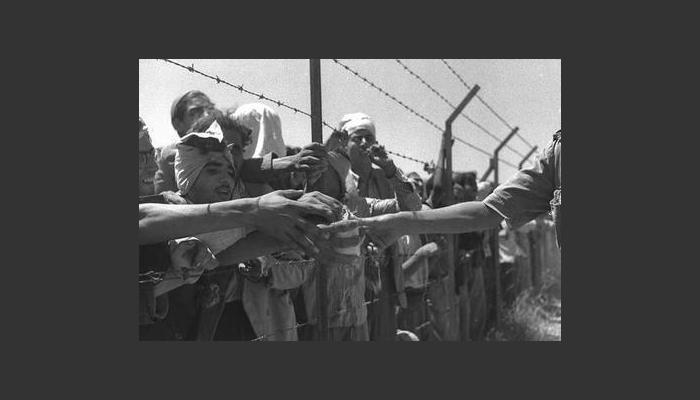
Civilians captured during the fall of Lydda and Ramle around the time of July 12, 1948 and taken to labour camps.
By Yazan al-Saadi | Al-Akhbar | September 29, 2014
Much of the grim and murky circumstances of the Zionist ethnic cleansing of Palestinians in the late 1940s have gradually been exposed over time. One aspect – rarely researched or deeply discussed – is the internment of thousands of Palestinian civilians within at least 22 Zionist-run concentration and labor camps that existed from 1948 to 1955. Now more is known about the contours of this historical crime, due to the comprehensive research by renowned Palestinian historian Salman Abu Sitta and founding member of the Palestinian resource center BADIL Terry Rempel.
The facts are these.
The study – to be published in the upcoming issue of the Journal of Palestine Studies – relies on almost 500 pages of International Committee of the Red Cross’s (ICRC) reports written during the 1948 war, that were declassified and made available to the public in 1996, and accidentally discovered by one of the authors in 1999.
Furthermore, testimonies of 22 former Palestinian civilian detainees of these camps were collected by the authors, through interviews they conducted themselves in 2002, or documented by others during different moments of time.
With these sources of information, the authors, as they put it, pieced together a clearer story of how Israel captured and imprisoned “thousands of Palestinian civilians as forced laborers,” and exploited them “to support its war-time economy.”
Digging up the crimes
“I came across this piece of history in the 1990s when I was collecting material and documents about Palestinians,” Abu Sitta told Al-Akhbar English. “The more and more you dig, the more you find there are crimes that have taken place that are not reported and not known.”
At that time, Abu Sitta went to Geneva for a week to check out the newly-opened archives of the ICRC. According to him, the archives were opened to the public after accusations that the ICRC had sided with the Nazis during World War II. It was an opportunity that he could not miss in terms of seeing what the ICRC had recorded of the events that occurred in Palestine in 1948. It was there he stumbled onto records discussing the existence of five concentration camps run by the Israelis.
He then decided to look for witnesses or former detainees, interviewing Palestinians in occupied Palestine, Syria, and Jordan.
“They all described the same story, and their real experience in these camps,” he said.
One question that immediately struck him was why there were barely any references in history about these camps, especially when it became clearer the more he researched that they existed, and were more than just five camps.
“Many former Palestinian detainees saw the concept of Israel as a vicious enemy, so they thought their experience labouring in these concentration camps was nothing in comparison to the other larger tragedy of the Nakba. The Nakba overshadowed everything,” Abu Sitta explained.“However, when I dug into the period of 1948-1955, I found more references like Mohammed Nimr al-Khatib, who was an imam in Haifa, who had written down interviews with someone from al-Yahya family that was in one of the camps. I was able to trace this man all the way to California and spoke with him in 2002,” he added.
More references were eventually and slowly discovered by Abu Sitta that included information from a Jewish woman called Janoud, a single masters thesis in Hebrew University about the topic, and the personal accounts of economist Yusif Sayigh, helped to further flesh out the scale and nature of these camps.
After more than a decade, Abu Sitta, with his co-author Rempel, are finally presenting their findings to the public.
From burden to opportunity: concentration and labor camps
The establishment of concentration and labor camps occurred after the unilateral declaration of Israel’s statehood on May 1948.
Prior to that event, the number of Palestinian captives in Zionist hands were quite low, because, as the study states, “the Zionist leadership concluded early on that forcible expulsion of the civilian population was the only way to establish a Jewish state in Palestine with a large enough Jewish majority to be ‘viable’.” In other words, for the Zionist strategists, prisoners were a burden in the beginning phases of the ethnic cleansing.
Those calculations changed with the declaration of the Israeli state and the involvement of the armies of Egypt, Syria, Iraq, and Transjordan, after much of the ethnic cleansing had occurred. From that moment, “the Israeli forces began taking prisoners, both regular Arab soldiers (for eventual exchange), and – selectively – able-bodied Palestinian non-combatant civilians.”
The first camp at Ijlil, which was about 13 km northeast of Jaffa, on the site of the destroyed Palestinian village Ijlil al-Qibiliyya, emptied of its inhabitants in early April. Ijlil was predominately made up of tents, housing hundreds and hundreds of prisoners, categorized as POWs by the Israelis, surrounded by barbed wire fences, watchtowers, and a gate with guards.
As the Israeli conquests grew, in turn exceedingly increasing the number of prisoners, three more camps were established. These are the four “official” camps that the Israelis acknowledged and were actively visited by the ICRC.
The study notes:
All four camps were either on or adjacent to military installations set up by the British during the Mandate. These had been used during World War II for the interment of German, Italian, and other POWs. Two of the camps – Atlit, established in July about 20 kms south of Haifa, and Sarafand, established in September near the depopulated village of Sarafand al-Amar in central Palestine—had earlier been used in the 1930s and 1940s to detain illegal Jewish immigrants.
Atlit was the second largest camp after Ijlil, it had the capacity of holding up to 2,900 prisoners, while Sarafand had the maximum capacity of 1,800, and Tel Letwinksy, near Tel Aviv, held more than 1,000.
All four camps were administered by “former British officers who had defected their ranks when British forces withdrew from Palestine in mid-May 1948,” and the camp’s guards and administrative staff were former members of the Irgun and the Stern Gang – both groups designated as terrorist organizations by the British before their departure. In total, the four “official” camps were staffed by 973 soldiers.
A fifth camp, called Umm Khalid, was established at a site of another depopulated village near the Zionist settlement of Netanya, and was even assigned an official number in the records, but never attained “official” status. It had the capacity to hold 1,500 prisoners. Unlike the other four camps, Umm Khalid would be “the fist camp established exclusively as a labor camp” and was “the first of the “recognized” camps to be shut down… by the end of 1948.”
Complementing these five “recognized” camps, were at least 17 other “unrecognized camps” that were not mentioned in official sources, but the authors discovered through multiple prisoner testimonies.
“Many of [these camps],” the authors noted, “[were] apparently improvised or ad hoc, often consisting of no more than a police station, a school, or the house of a village notable,” with holding capacities that ranged from almost 200 prisoners to tens.
Most of the camps, official and unofficial, were situated within the borders of the UN-proposed Jewish state, “although at least four [unofficial camps] – Beersheba, Julis, Bayt Daras, and Bayt Nabala – were in the UN-assigned Arab state and one was inside the Jerusalem “corpus separatum.”
The number of Palestinian non-combatant detainees “far exceeded” those of Arab soldiers in regular armies or bona fide POWs. Citing a July 1948 monthly report made by ICRC mission head Jacques de Reynier, the study states that de Reynier noted, “that the situation of civilian internees was ‘absolutely confused’ with that of POWs, and that the Jewish authorities ‘treated all Arabs between the ages of 16 and 55 as combatants and locked them up as prisoners of war.’” In addition, the ICRC found among the detainees in official camps, that 90 of the prisoners were elderly men, and 77 were boys, aged 15 years or younger. The study highlights the statements by an ICRC delegate Emile Moeri in January 1949 of the camp inmates:
It is painful to see these poor people, especially old, who were snatched from their villages and put without reason in a camp, obliged to pass the winter under wet tents, away from their families; those who could not survive these conditions died. Little children (10-12 years) are equally found under these conditions. Similarly sick people, some with tuberculosis, languish in these camps under conditions which, while fine for healthy individuals, will certainly lead to their death if we do not find a solution to this problem. For a long time we have demanded that the Jewish authorities release those civilians who are sick and need treatment to the care of their families or to an Arab hospital, but we have not received a response.
As the report noted, “there are no precise figures on the total number of Palestinian civilians held by Israel during the 1948-49 war” and estimates tend to not account for “unofficial” camps, in addition to the frequent movement of prisoners between the camps in use. In the four “official” camps, the number of Palestinian prisoners never exceeded 5,000 according to figures in Israeli records.
Taking account of the capacity of Umm Khalid, and estimates of the “unofficial camps,” the final number of Palestinian prisoners could be around the 7,000 range, and perhaps much more when, as the study states, taking into account a November 17, 1948 diary entry by David Ben-Gurion, one of the main Zionist leaders and Israel’s first prime minister, who mentioned “the existence of 9,000 POWs in Israeli-run camps.”
In general, the living conditions in the “official” camps were far below what would be considered appropriate by international law at that time. Moeri, who visited the camps constantly, reported that in Ijlil in November 1948:
“[m]any [of the] tents are torn, that the camp was “not ready for winter,” the latrines not covered, and the canteen not working for two weeks. Referring to an apparently ongoing situation, he stated that “the fruits are still defective, the meat is of poor quality, [and] the vegetables are in short supply.”
Furthermore, Moeri reported that he saw for himself, “the wounds left by the abuse” of the previous week, when the guards had fired on the prisoners, wounding one, and had beaten another.”
As the study shows, the civilian status of the majority of the detainees were clear for the ICRC delegates in the country, who reported that the men captured “had undoubtedly never been in a regular army.” Detainees who were combatants, the study explains, were “routinely shot on the pretense that they had been attempting to escape.”
The Israeli forces seemed to always target able-bodied men, leaving behind women, children, and the elderly – when not massacring them – the policy continued even after there were low levels of military confrontation. All in all, as the Israeli records show and the study cites, “Palestinian civilians comprised the vast majority (82 percent) of the 5,950 listed as internees in the POW camps, while the Palestinians alone (civilian plus military) comprised 85 percent.”
The wide-scale kidnapping and imprisonment of Palestinian civilians tend to correspond with the Israeli military campaigns. For example, one of the first major roundups occurred during Operation Danj, when 60-70,000 Palestinians were expelled from the central towns of Lydda and Ramleh. At the same time, between a fifth and a quarter of the male population from these two towns who were over the age of 15 were sent to the camps.
The largest round-up of civilians came from villages of central Galilee who were captured during Operation Hiram in the fall of 1948.
One Palestinian survivor, Moussa, described to the authors what he witnessed at the time.
“They took us from all villages around us: al-Bi’na, Deir al-Asad, Nahaf, al-Rama, and Eilabun. They took 4 young men and shot them dead… They drove us on foot. It was hot. We were not allowed to drink. They took us to [the Palestinian Druze village] al-Maghar, then [to the Jewish settlement] Nahalal, then to Atlit.”
A November 16, 1948 UN report collaborated Moussa’s account, stating that some 500 Palestinian men “were taken by force march and vehicle to a Jewish concentration camp at Nahlal.”
Maintaining Israel’s economy with “slave labor”
The policy of targeting civilians, particular “able-bodied” men, was not accidental according to the study. It states, “with tens of thousands of Jewish men and women called up for military service, Palestinian civilian internees constituted an important supplement to the Jewish civilian labor employed under emergency legislation in maintaining the Israeli economy,” which even the ICRC delegation had noted in their reports.
The prisoners were forced to do public and military work, such as draining wetlands, working as servants, collecting and transporting looted refugee property, moving stones from demolished Palestinian homes, paving roads, digging military trenches, burying the dead, and much more. As one former Palestinian detainee named Habib Mohammed Ali Jarada described in the study, “At gunpoint, I was made to work all day. At night, we slept in tents. In winter, water was seeping below our bedding, which was dry leaves, cartons and wooden pieces.”
Another prisoner in Umm Khalied, Marwan Iqab al-Yehiya said in an interview with the authors, “We had to cut and carry stones all day [in a quarry]. Our daily food was only one potato in the morning and half dried fish at night. They beat anyone who disobeyed orders.” This labor was interspersed with acts of humiliation by the Israeli guards, with Yehiya speaking of prisoners being “lined up and ordered to strip naked as a punishment for the escape of two prisoners at night.”
“[Jewish] Adults and children came from nearby kibbutz to watch us line up naked and laugh. To us this was most degrading,” he added.
Abuses by the Israeli guards were systematic and rife in the camps, the brunt of which was directed toward villagers, farmers, and lower class Palestinians. This was so, the study said, because educated prisoners “knew their rights and had the confidence to argue with and stand up to their captors.”
What is also interestingly noted by the study is how ideological affiliations between prisoners and their guards, had another effect in terms of the relationship between them. The study, cites the testimony of Kamal Ghattas, who was captured during the Israeli attack in the Galilee, who said:
We had a fight with our jailers. Four hundred of us confronted 100 soldiers. They brought reinforcements. Three of my friends and I were taken to a cell. They threatened to shoot us. All night we sang the Communist Anthem. They took the four of us to Umm Khaled camp. The Israelis were afraid of their image in Europe. Our contact with our Central Committee and Mapam [Socialist Israeli party] saved us .… I met a Russian officer and told him they took us from our homes although we were non-combatants which was against the Geneva Conventions. When he knew I was a Communist he embraced me and said, “Comrade, I have two brothers in the Red Army. Long live Stalin. Long Live Mother Russia”.
Yet, the less fortunate Palestinians faced acts of violence which included arbitrary executions and torture, with no recourse. The executions were always defended as stopping “escape attempts” – real or claimed by the guards.
It became so common that one former Palestinian detainee of Tel Litwinsky, Tewfic Ahmed Jum’a Ghanim recounted, “Anyone who refused to work was shot. They said [the person] tried to escape. Those of us who thought [we] were going to be killed walked backward facing the guards.”
Ultimately, by the end of 1949, Palestinian prisoners were gradually released after heavy lobbying by the ICRC, and other organizations, but was limited in scale and very focused to specific cases. Prisoners of Arab armies were released in prisoner exchanges, but Palestinian prisoners were unilaterally expelled across the armistice line without any food, supplies, or shelter, and told to walk into the distance, never to return.
It would not be until 1955 that most of the Palestinian civilian prisoners would finally be released.
An enduring crime
The importance of this study is multi-faceted. Not only does it reveal the numerous violations of international law and conventions of the age, such as 1907 Hague Regulations and the 1929 Geneva Conventions, but also shows how the event shaped the ICRC in the long run.
Because the ICRC was faced with an Israeli belligerent actor who was unwilling to listen and conform to international law and conventions, the ICRC itself had to adapt in what it considered were practical ways to help ensure the Palestinian civilian prisoners were protected under the barest of rights.
Citing his final report, the study quotes de Reynier:
[The ICRC] protested on numerous occasions affirming the right of these civilians to enjoy their freedom unless found guilty and judged by a court. But we have tacitly accepted their POW status because in this way they would enjoy the rights conferred upon them by the Convention. Otherwise, if they were not in the camps they would be expelled [to an Arab country] and in one way or another, they would lead, without resources, the miserable life of refugees.
In the end, the ICRC, and other organizations, were simply ineffective as Israel ignored its condemnations with impunity, in addition to the diplomatic cover of major Western powers.
More importantly, the study sheds more light on the extent of the Israeli crimes during its brutal and bloody birth. And “much more remains to be told,” as the final line of the study states.
“It is amazing to me, and many Europeans, who have seen my evidence,” Abu Sitta said, “that a forced labor camp was opened in Palestine three years after they were closed in Germany, and were run by former prisoners – there were German Jewish guards.”
“This is a bad reflection of the human spirit, where the oppressed copies an oppressor against innocent lives,” he added. The study essentially shows the foundations and beginnings of Israeli policy towards Palestinian civilians that comes in the form of kidnapping, arrest, and detainment. This criminality continues till this day. One merely has to read the reports on the hundreds of Palestinians arrested prior, during, and after Israel’s latest war on Gaza mid-summer of this year.
“Gaza today is a concentration camp, no different than the past,” Abu Sitta concluded to Al-Akhbar English.
Yazan is a staff writer for Al-Akhbar English. Follow him on Twitter: @WhySadeye



