US Supreme Court Denies Review of NSA Warrantless Surveillance Case
Center for Constitutional Rights | March 4, 2014
New York – The Supreme Court announced yesterday that it would not hear Center for Constitutional Rights v. Obama, a lawsuit challenging the National Security Agency’s warrantless surveillance of people within the United States. The suit sought an injunction ordering the government to destroy any records of surveillance that it still retains from the illegal NSA program. The Center for Constitutional Rights issued the following statement in response to the Court’s decision:
The Supreme Court’s refusal to review this case guarantees that the federal courts will never address a fundamental question: Was the warrantless surveillance program the NSA carried out on President Bush’s orders legal? The Court’s decision also guarantees that the Obama administration, which has for the last five years refused to take any position on that question, will now never have to answer either.
Despite mounting evidence of government spying on attorneys’ privileged communications, the Court yesterday declined to review the lower court’s determination that CCR attorneys’ fears of surveillance under President Bush’s NSA program, which involved no review by judges or Congress and flew directly in the face of express criminal prohibitions, were too “speculative” to allow CCR to challenge the program in court.
The Court’s decision comes as increasing evidence suggests the government has been surveilling attorney-client communications for some time. The New York Times recently reported that in 2013 the NSA surveilled law firm Mayer Brown while it represented the government of Indonesia in trade talks with the United States. In 2008, The Times reported Justice Department officials had confirmed that attorney-client communications in terrorism cases were sometimes subject to surveillance. And a document accidentally released to an Islamic charity in 2004 indicated that the D.C.-based attorneys for the charity had been subject to surveillance while speaking to their clients.
A memo released by whistleblower Edward Snowden indicated that the government only excludes attorney-client communications from collection when the client is under actual indictment in the United States. Communications of attorneys not directly with a client (for example, with expert witnesses or investigators abroad), or with a client not formally charged in the United States (including, for example, the Center for Constitutional Rights’ many Guantanamo detainee clients, none of whom are charged in federal courts) might now be subject to surveillance under broad orders issued under the current FISA statute.
press@ccrjustice.org
Related article

Progress in Iran Nuclear Talks Depends on the Israeli Government Coming Clean on its Nuclear Disinformation Campaigns
By Dr. Yousaf Butt | Arms Control Law | March 4, 2014
One of the sticking points in the on-going Iran nuclear negotiations is the fate of the so-called “Possible Military Dimensions” (aka “Alleged Studies”) file. This is a compendium of allegations against Iran’s nuclear program – largely gathered by third-party intelligence agencies – that the IAEA would like Iran to respond to. Not only are the allegations largely outside the IAEA legal authority and expertise (because they do not directly deal with nuclear material diversion), but Iran has not been allowed to see much of this secret evidence that is being used against it. Such a process is, of course, not consistent with normal Western legal practice. Iran has responded to what little it has been shown of the PMD file by saying that the evidence thus far shown is fabricated.
Though this Iranian response is often cast as Iran “not cooperating with the IAEA” (or “refusing to discuss the matter”), another possibility must be considered: that Iran is correct. That is, that at least some the evidence has indeed been cooked-up by an adversarial Intelligence service (or by an agent recruited by such an Intelligence service).
A wonderful new book by Gudrun Harrer on the IAEA inspections in Iraq sheds some light on which countries could be involved in fabricating and planting such fake nuclear “evidence”. On p. 185 of the book, it is confirmed that Israel provided the IAEA with false information on Laser Isotope Separation activities in Iraq. The reference for this information is the author’s interview with David Albright of ISIS (see at this insert the relevant scanned pages from the book):
Israel has, of course, long been suspected of being behind some of the forged and suspect evidence against Iran: the neutron initiators, AP graphs, etc., but until now it was hard to definitely pin the blame on that country. Thanks to David Albright at ISIS, we now know that Israel has been guilty of planting disinformation with the IAEA in the past.
The German intelligence agency has also discredited much of the secret evidence against Iran.
Having myself analyzed some of what is (evidently) in this PMD file – with Dr. Ferenc Dalnoki-Veress of the James Martin Center for Nonproliferation Studies – I can say that the evidence is certainly of poor quality and/or an amateurish forgery. It does not look like anything a state-level research scientist would produce. There are large and conspicuous mathematical and physical errors in the material.
Similarly, Robert Kelley has assessed that at least some of the evidence purporting to show weaponization research work continuing past 2004 is less than compelling:
[The] evidence, according to the IAEA, tells us Iran embarked on a four-year program, starting around 2006, to validate the design of a device to produce a burst of neutrons that could initiate a fission chain reaction. Though I cannot say for sure what source the agency is relying on, I can say for certain that this project was earlier at the center of what appeared to be a misinformation campaign…. Mohamed ElBaradei, who was then the agency’s director general, rejected the information because there was no chain of custody for the paper, no clear source, document markings, date of issue or anything else that could establish its authenticity…
David Albright’s confirmation of Israeli nuclear disinformation goes hand-in-glove with statements from former IAEA director, and Nobel Prize winner, Mohammed ElBaradei. In his biography, ElBaradei says that the documents that the IAEA had about the alleged neutron initiators in Iran circa 2008 were given to the Agency by Israel. He further states that Israel gave him permission to show the evidence to Iran.
So the question is, why has the IAEA not cooperated with Iran in evaluating material like they did with Iraq circa 1995, in the incident mentioned by Harrer?
Iran could be genuinely helpful if they were allowed to see the original evidence and comment on it. When the IAEA worked with Iraq to evaluate documents, the Iraqis helpfully pointed out mistakes that the IAEA could independently confirm. Isn’t that the example we would like to see with Iran?
Being charged with secret evidence also goes against every notion of Western justice. The IAEA either needs to drop the PMD file, or amend their procedures.
Unfortunately, it is quite likely that the Israeli government is once again carrying out nuclear disinformation, possibly in collaboration with the MEK, an Iranian terrorist – in some nations, formerly terrorist – organization opposed to the current Iranian regime.
Over the past weekend, it was also confirmed that Israel masterminded the assassinations of Iranian nuclear scientists. These assassinations, too, perhaps were carried out with local MEK collaboration. If the Israeli government is capable of assassinating civilian Iranian scientists, would fabricating nuclear intel on Iran trouble their consciences? Presumably not. Especially as they have done it in the past, according to David Albright at ISIS.
Before further pursuing Iran on the PMD file – which may contain substantial forged evidence – it would make sense to ask Israel to come clean about any fabricated intelligence it may have planted with the IAEA. It is quite possible that some of the PMD file is not fake. Israel’s assistance and cooperation in identifying what is fake and what is not would be most helpful. If David Albright of ISIS has further insight into this – as he did in the Iraqi case – his involvement would also, of course, be very welcome.
It is becoming increasingly difficult to give credibility to hyperbolic Israeli statements about Iran’s underhandedness in pursuing its nuclear program, when Israel itself has been underhanded in pursuing clandestine disinformation campaigns against NPT states, while itself remaining resolutely outside the NPT.
There are several points for the IAEA to consider in light of these recent developments:
1. Should the IAEA reject all evidence from Israel against Iran and other adversarial states now?
2. Should the IAEA, generally, not accept intelligence from non-NPT states?
3. The IAEA should show Iran any evidence it wants an Iranian response on. Anything less is not consistent with Western notions of justice. Furthermore such cooperation could unveil the origin of any possible forgeries in the PMD file.
4. The IAEA and the US should ask Israel to come clean on any fabricated “evidence” it may have inserted into the PMD file.
5. As I have suggested previously, it would be best to simply drop the PMD file as it relates to decade old unauthenticated allegations of possible research. It is not even clear that what is in the PMD file – even if true – would be a violation of the NPT or the safeguards agreement.
6. If the IAEA really wants to pursue the content of the PMD in a legal way they can initiate special inspections or undertake arbitration as provided for in the CSA. The IAEA does not even have the technical expertise in-house to undertake investigations of missiles, warheads etc. which are mentioned in the PMD file.
7. Since Iran is now in compliance with its safeguards agreement, Iran’s nuclear file – currently hung-up in the Security Council – should return to the IAEA. The referral to the Security Council was unorthodox and politicized to begin with, and there is no rationale for Iran’s nuclear file to remain there post-2008. (Footnote 38 of the latest IAEA report on Iran makes clear that the remaining issues are not IAEA safeguards issues but extraneous UNSC ones).
8. This also means that the UNSC nuclear-related sanctions on Iran should now be dropped. In fact, they ought to have been dropped in 2008.
David Albright must be commended for his helpful insight into fabricated Israeli intelligence in Iraq, and hopefully can assist in tracking down similar disinformation in the case of Iran.
Relatedly, we must thank him and ISIS also for showing the international community expensive satellite pictures of Parchin, in which one can see that west of the paving activity, the site is untouched, and so the IAEA could get environmental samples there (if they even needed those). This undercuts ISIS’ own conclusion that the site has been magically “sanitized” by paving. Normally, of course, the IAEA would take such swipe samples from within the buildings where any suspect U naturally collects: in the corners and at the places where the walls meet the floor.
The technical weaknesses in ISIS’ and IAEA’s approach to Parchin were previously commented on.
The IAEA’s technically unsound obsession with environmental sampling at Parchin may also mean they are confusing the site at Marivan (where open-air implosion tests may have taken place) with the site at Parchin (where implosions in a chamber are alleged).
From the May 2008 Board report, referring to the Marivan site:
A.2. High Explosives Testing
[………….]
Document 3: Five page document in English describing experimentation undertaken with a complex multipoint initiation system to detonate a substantial amount of high explosive in hemispherical geometry and to monitor the development of the detonation wave in that high explosive using a considerable number of diagnostic probes.
And the alleged weapons’ studies annex Nov 2011:
43. Information provided to the Agency by the same Member State referred to in the previous paragraph describes the multipoint initiation concept referred to above as being used by Iran in at least one large scale experiment in 2003 to initiate a high explosive charge in the form of a hemispherical shell. [……] Further information provided to the Agency by the same Member State indicates that the large scale high explosive experiments were conducted by Iran in the region of Marivan.
So what is the point of carrying out environmental sampling at Parchin (where chamber experiments are alleged) and not at Marivan where open-air experiments were allegedly done? Is the IAEA – and ISIS – confused between Marivan and Parchin?
The IAEA’s unprofessionalism in vetting the content of the PMD file, and in the obsession over Parchin (which the IAEA visited twice already) vs. Marivan smacks of an agenda to target Iran rather than any sound technical analysis. It is likely to blow up the Iran nuclear deal for no good reason. Iran has cooperated with the IAEA on the PMD file by saying that the material it was shown was fabricated – this may be true. Now Israel should also cooperate and come clean about what forged material – or material from compromised sources like “Curveball” – may be within this file. David Albright, with his past knowledge and evident expertise in fabricated Israeli intelligence should also step up to the plate.
And, certainly, Iran should be shown any evidence it is being asked to answer to by the IAEA. The Agency should also spend about half an hour and check whether the site it is interested in for environmental sampling is Marivan or Parchin. Environmental sampling at Parchin makes little sense. At Parchin, swipes would be taken from within the buildings since chamber-based implosions are alleged. While it is at it, the IAEA should also review the technical basis of their conclusions on Syria.
It is hard to take the Agency seriously when it persists in being blatantly unprofessional.
Dr Jim Walsh, a research associate at MIT, has an excellent suggestion about what to do with Iran’s “PMD” file – as paraphrased by Mark Hibbs: “If the nuclear activities were in the past, I don’t care. It’s dead, and it’s regretful, but let’s do a deal with Iran that moves forward.”
But before we do that, the IAEA should ask Israel to come clean about its potential role in fabricating some of the “evidence” within the PMD file.
Given its historical misuse, the IAEA should also re-visit whether it will continue to accept intelligence from third-parties, especially non-NPT member states.
Dr. Yousaf Butt, a nuclear physicist, is Director of the Emerging Technologies Program at the Cultural Intelligence Institute, a non-profit organization dedicated to promoting fact-based cultural awareness among individuals, institutions, and governments. The views expressed here are his own.
Their history and ours: the first world war that won’t be commemorated in 2014
By Neil Faulkner | No Glory in War | January 5, 2014
Military historian Max Hastings and education minister Michael Gove say we should should blame the Germans for World War I and celebrate the victory for ‘freedom’ and ‘democracy’. Archaeologist Neil Faulkner disagrees.
Max Hastings has his new book on 1914 out already (Catastrophe: Europe goes to war, 1914). In it he pulls no punches. Even the dustcover proclaims the forthright revisionist message.
‘He [the author] finds the evidence overwhelming that Austria and Germany must accept the principal blame for the outbreak. While what followed was a vast tragedy, he argues passionately against the ‘poets ‘view’ that the war was not worth winning. It was vital to the freedom of Europe, he says, that the Kaiser’s Germany should be defeated.’
UK secretary of state for education, Michael Gove, writing in the Daily Mail, takes the same view:
The First World War may have been a uniquely horrific war, but it was also plainly a just war… The ruthless social Darwinism of the German elites, the pitiless approach they took to occupation, their aggressively expansionist war aims and their scorn for the international order all made resistance more than justified.
So there you have it. Just as the rulers of Britain and France argued at the time, it was all Germany’s fault. Never mind that Britain had the largest empire in the world, ruling over one-fifth of the world’s land mass and one-quarter of its people. Never mind that Britain’s navy was almost the twice the size of Germany’s. Never mind that Britain had formed a military alliance with Russia and France, leaving Germany’s rulers feeling corralled and threatened in an arms race they were losing.
This is not to exonerate the Kaiser. It is simply to say that he was no worse than the rulers of Britain and France. All were imperialists and warmongers. All were prepared to plunge the world into an industrialised war for the power and profit of a few. The vast majority of humanity – the vast majority of the people these rulers were supposed to represent – had no interest in the war. The conscripted workers and peasants of Europe were the victims of a millionaires’ war.
‘No poet,’ says Hastings, ‘ever identified a route by which the British, French, and Belgian people could have escaped the conflict, save by accepting the Kaiser’s domination of Europe.’ This claim appears in a Daily Mail article in June this year headlined Sucking up to the Germans is no way to remember our Great War heroes, Mr Cameron‘.
But this is nonsense. There was a Europe-wide movement against war. Just days before Germany’s declaration of war there were 100,000 anti-war demonstrators on the streets of Berlin. Across Germany, during four days of mass protest in the final days of peace, there had been no fewer than 288 anti-war demonstrations involving up to three-quarters of a million people.
Across Europe that last summer of peace, as millions of people took action against their own rulers, there was a widespread mood of internationalism and solidarity. But when the leaders of all the mainstream parties lined up in support of the war effort, they reinforced a tide of jingoism that the killed the anti-war movement and swept the people of Europe into internecine carnage.
But that mood would resurface, and when it did, beginning in 1917, it would be charged with bitterness at the slaughter and impoverishment, becoming a giant wave of revolution crashing across the continent, ending the war, toppling tyrants, and shaking the foundations of the entire social order.
‘Far from dying in vain,’ continues Hastings, ‘those who perished … between 1914 and 1918 made as important a contribution to our privileged, peaceful lives today as did their sons in World War II.’
And Michael Gove agrees:
‘For all our mistakes as a nation, Britain’s role in the world has also been marked by nobility and courage. Indeed, the more we reflect on every aspect of the war, the more cause there is for us to appreciate what we owe to our forebears and their traditions.’
These are extraordinary claims. The British and the French used their victory in 1918 to re-divide the world, helping themselves to German colonies, hacking off chunks of German territory in Europe, and imposing crippling reparations payments on the German people.
Meantime, to control their enlarged empires in Africa, Asia, and the Middle East, they gunned down protestors demanding democracy and independence. This imperialist carve-up – ‘a peace to end all peace’ – created the preconditions for the Second World War two decades later.
The cost of the First World War was 15 million dead. The cost of the sequel was 60 million dead. More human beings have been killed by war in the last century than in the whole of the rest of human history put together.
The immense potential of industrial society to provide the goods and service we all need has, again and again, been turned into its opposite: means of destruction and waste on an unprecedented scale.
This is not something to be rationalised into a choice between ‘good’ empires and ‘bad’ empires; a choice between ‘democratic’ Britain and France as against ‘autocratic’ and ‘expansionist’ Germany. This is to trivialise historical events, reducing them to little more than a banal discussion about who sent the final ultimatum, who mobilised first, who fired the first shot.
Max Hastings and Michael Gove want us to side with one empire against another. He wants us to wave a Union Jack, celebrate a British victory, and promote the lie that the 15 million dead of the First World War were ‘a necessary sacrifice’.
What is required is an analysis that roots tragedies like the First World War, and all the other imperialist conflicts of the last century, in the madness of a world divided into competing corporations and warring nation-states.
No Glory – the real History of the First World War
Neil Faulkner’s new pamphlet published by No Glory in War
More details and how to buy…
Neil Faulkner is a First World War archaeologist and editor of Military History Monthly. He is one of the founders of the No Glory in War campaign.
Related articles


Imperialism and NGOs in Latin America
By James Petras :: 12.18.1997
By the early 1980s the more perceptive sectors of the neoliberal ruling classes realized that their policies were polarizing the society and provoking large-scale social discontent.
Neoliberal politicians began to finance and promote a parallel strategy “from below,” the promotion of “grassroots” organization with an”anti-statist” ideology to intervene among potentially conflictory classes, to create a “social cushion.” These organizations were financially dependent on neoliberal sources and were directly involved in competing with socio-political movements for the allegiance of local leaders and activist communities. By the 1990s these organizations, described as “nongovernmental,” numbered in the thousands and were receiving close to four billion dollars world-wide.
Neoliberalism and the NGOs
The confusion concerning the political character of the nongovernmental organizations (NGOs) stems from their earlier history in the 1970s during the days of the dictatorships. In this period they were active in providing humanitarian support to the victims of the military dictatorship and denouncing human rights violations. The NGOs supported “soup kitchens” which allowed victimized families to survive the first wave of shock treatments administered by the neoliberal dictatorships. This period created a favorable image of NGOs even among the left. They were considered part of the “progressive camp.”
Even then, however, the limits of the NGOs were evident. While they attacked the human rights violations of local dictatorships, they rarely denounced the U.S. and European patrons who financed and advised them. Nor was there a serious effort to link the neoliberal economic policies and human rights violations to the new turn in the imperialist system. Obviously the external sources of funding limited the sphere of criticism and human rights action.
As opposition to neoliberalism grew in the early 1980s, the U.S. and European governments and the World Bank increased their funding ofNGOs. There is a direct relation between the growth of social movements challenging the neoliberal model and the effort to subvert them by creating alternative forms of social action through the NGOs. The basic point of convergence between the NGOs and the World Bank was their common opposition to”statism.” On the surface the NGOs criticized the state from a “left” perspective defending civil society, while the right did so in the name of the market. In reality, however, the World Bank, the neoliberal regimes, and western foundations co-opted and encouraged the NGOs to undermine the national welfare state by providing social services to compensate the victims of the multinational corporations (MNCs). In other words, as the neoliberal regimes at the top devastated communities by inundating the country with cheap imports, extracting external debt payment, abolishing labor legislation, and creating a growing mass of low-paid and unemployed workers, the NGOs were funded to provide “self-help” projects, “popular education,” and job training, to temporarily absorb small groups of poor, to co-opt local leaders, and to undermine anti-system struggles.
The NGOs became the “community face” of neoliberalism, intimately related to those at the top and complementing their destructive work with local projects. In effect the neoliberals organized a “pincer” operation or dual strategy. Unfortunately many on the left focused only on “neoliberalism” from above and the outside (International Monetary Fund, World Bank) and not on neoliberalism from below (NGOs, micro-enterprises). A major reason for this oversight was the conversion of many ex-Marxists to the NGO formula and practice. Anti-Statism was the ideological transit ticket from class politics to “community development,” from Marxism to the NGOs.
Typically, NGO ideologues counterpose “state” power to “local” power. State power is, they argue, distant from its citizens, autonomous, and arbitrary, and it tends to develop interests different from and opposed to those of its citizens, while local power is necessarily closer and more responsive to the people. But apart from historical cases where the reverse has also been true, this leaves out the essential relation between state and local power—the simple truth that state power wielded by a dominant, exploiting class will undermine progressive local initiatives, while that same power in the hands of progressive forces can reinforce such initiatives.
The counter position of state and local power has been used to justify the role of NGOs as brokers between local organizations, neoliberal foreign donors (World Bank, Europe, or the United States) and the local free market regimes. But the effect is to strengthen neoliberal regimes by severing the link between local struggles and organizations and national/international political movements. The emphasis on “local activity” serves the neoliberal regimes since it allows its foreign and domestic backers to dominate macro-socio-economic policy and to channel most of the state’s resources toward subsidies for export capitalists and financial institutions.
So while the neoliberals were transferring lucrative state properties to the private rich, the NGOs were not part of the trade union resistance. On the contrary they were active in local private projects, promoting the private enterprise discourse (self-help) in the local communities by focusing on micro-enterprises. The NGOs built ideological bridges between the small scale capitalists and the monopolies benefiting from privatization—all in the name of “anti-statism”and the building of civil societies. While the rich accumulated vast financial empires from the privatization, the NGO middle class professionals got small sums to finance offices, transportation, and small-scale economic activity.
The important political point is that the NGOs depoliticized sectors of the population, undermined their commitment to public employees, and co-opted potential leaders in small projects. NGOs abstain from public schoolteacher struggles, as the neoliberal regimes attack public education and public educators. Rarely if ever do NGOs support the strikes and protests against low wages and budget cuts. Since their educational funding comes from the neoliberal governments, they avoid solidarity with public educators in struggle. In practice, “non-governmental” translates into anti-public-spending activities, freeing the bulk of funds for neoliberals to subsidize export capitalists while small sums trickle from the government to NGOs.
In reality non-governmental organizations are not non-governmental. They receive funds from overseas governments or work as private subcontractors of local governments. Frequently they openly collaborate with governmental agencies at home or overseas. This “subcontracting”undermines professionals with fixed contracts, replacing them with contingent professionals. The NGOs cannot provide the long-term comprehensive programs that the welfare state can furnish. Instead they provide limited services to narrow groups of communities. More importantly, their programs are not accountable to the local people but to overseas donors. In that sense NGOs undermine democracy by taking social programs out of the hands of the local people and their elected officials to create dependence on non-elected, overseas officials and their locally anointed officials.
NGOs shift people’s attention and struggles away from the national budget and toward self-exploitation to secure local social services. This allows the neoliberals to cut social budgets and transfer state funds to subsidize bad debts of private banks, and provide loans to exporters. Self exploitation (self-help) means that, in addition to paying taxes to the state and not getting anything in return, working people have to work extra hours with marginal resources, and expend scarce energies to obtain services that the bourgeoisie continues to receive from the state. More fundamentally, the NGO ideology of “private voluntaristic activity” undermines the sense of the “public”: the idea that the government has an obligation to look after its citizens and provide them with life, liberty, and the pursuit of happiness; that the political responsibility of the state is essential for the well-being of citizens. Against this notion of public responsibility, the NGOs foster the neoliberal idea of private responsibility for social problems and the importance of private resources to solve these problems. In effect they impose a double burden on the poor who continue to pay taxes to finance the neoliberal state to serve the rich, but are left with private self-exploitation to take care of their own needs.
NGOs and Socio-political Movements
NGOs emphasize projects, not movements; they “mobilize” people to produce at the margins but not to struggle to control the basic means of production and wealth; they focus on technical financial assistance of projects, not on structural conditions that shape the everyday lives of people. The NGOs co-opt the language of the left: “popular power,” “empowerment,” “gender equality,” “sustainable development,” “bottom-up leadership.” The problem is that this language is linked to a framework of collaboration with donors and government agencies that subordinate practical activity to non-confrontational politics. The local nature of NGO activity means that “empowerment” never goes beyond influencing small areas of social life, with limited resources, and within the conditions permitted by the neoliberal state and macro-economy.
The NGOs and their post-Marxist professional staff directly compete with the socio-political movements for influence among the poor, women, and the racially excluded. Their ideology and practice diverts attention from the sources and solutions of poverty (looking downward and inward instead of upward and outward). To speak of micro-enterprises, instead of the elimination of exploitation by the overseas banks, as the solution, is based on the notion that the problem is one of individual initiative rather than the transference of income overseas. The NGO’s aid affects small sectors of the population, setting up competition between communities for scarce resources, generating insidious distinctions and inter- and intra-community rivalries, thus undermining class solidarity. The same is true among the professionals: each sets up its NGO to solicit overseas funds. They compete by presenting proposals more congenial to the overseas donors, while claiming to speak for their followers.
The net effect is a proliferation of NGOs that fragment poor communities into sectoral and sub-sectoral groupings unable to see the larger social picture that afflicts them and even less able to unite in struggle against the system. Recent experience also demonstrates that foreign donors finance projects during “crises”—political and social challenges to the status quo. Once the movements have ebbed they shift funding to NGO-style “collaboration,” fitting the NGO projects into the neoliberal agenda. Economic development compatible with the “free market” rather than social organization for social change becomes the dominant item on the funding agenda.
The structure and nature of NGOs, with their “apolitical” posture and their focus on self-help, depoliticizes and demobilizes the poor. They reinforce the electoral processes encouraged by the neoliberal parties and mass media. Political education about the nature of imperialism, and the class basis of neoliberalism, the class struggle between exporters and temporary workers, are avoided. Instead the NGOs discuss “the excluded,” the “powerless,” “extreme poverty,” “gender or racial discrimination,” without moving beyond the superficial symptom to the social system that produces these conditions. Incorporating the poor into the neoliberal economy through purely “private voluntary action,” the NGOs create a political world where the appearance of solidarity and social action cloaks a conservative conformity with the international and national structure of power.
It is no coincidence that as NGOs have become dominant in certain regions, independent class political action has declined, and neoliberalism goes uncontested. The bottom line is that the growth of NGOs coincides with increased funding under neoliberalism and the deepening of poverty everywhere. Despite the claims of many local successes, the overall power of neoliberalism stands unchallenged and the NGOs increasingly search for niches in the interstices of power.
The problem of formulating alternatives has been hindered in another way too. Many of the former leaders of guerrilla and social movements, trade union and popular women’s organizations have been co-opted by the NGOs. Some have undoubtedly been attracted by the hope—or the illusion—that this might give them access to levers of power which would allow them to do some good. But in any case, the offer is tempting: higher pay (occasionally in hard currency), prestige and recognition by overseas donors, overseas conferences and networks, office staff, and relative security from repression. In contrast, the socio-political movements offer few material benefits but greater respect and independence and, more importantly, the freedom to challenge the political and economic system. The NGOs and their overseas banking supporters (Inter-American Development Bank, the World Bank) publish newsletters featuring success stories of micro-enterprises and other self-help projects—without mentioning the high rates of failure as popular consumption declines, low-priced imports flood the market, and interest rates spiral, as in Mexico today.
Even the “successes” affect only a small fraction of the total poor and succeed only to the degree that others cannot enter the same market. The propaganda value of individual micro-enterprise success, however, is important in fostering the illusion that neoliberalism is a popular phenomenon. The frequent violent mass outbursts that take place in regions of micro-enterprise promotion suggests that the ideology is not hegemonic and the NGOs have not yet displaced independent class movements.
Finally NGOs foster a new type of cultural and economic colonialism and dependency. Projects are designed, or at least approved, based on the “guidelines” and priorities of the imperial centers and their institutions. They are administered and “sold” to communities. Evaluations are done by and for the imperial institutions. Shifts of funding priorities or bad evaluations result in the dumping of groups, communities, farms, and co-operatives. Everything and everybody is increasingly disciplined to comply with the donors and project evaluators’ demands. The new viceroys supervise and ensure conformity with the goals, values, and ideologies of the donor as well as the proper use of funds. Where “successes” occur they are heavily dependent on continued outside support, without which they could collapse.
In many ways the hierarchical structures and the forms of transmission of “aid” and “training” resemble nineteenth-century charity, and the promoters are not very different from Christian missionaries. The NGOs emphasize “self-help” in attacking “paternalism and dependence” on the state. In this competition among NGOs to capture the victims of neoliberals, they receive important subsidies from their counterparts in Europe and the United States. The self-help ideology emphasizes the replacement of public employees by volunteers, and upwardly mobile professionals contracted on a temporary basis. The basic philosophy of the NGO intellectuals is to transform “solidarity” into collaboration and subordination to the macro-economy of neoliberalism, by focusing attention away from state resources of the wealthy classes toward self-exploitation of the poor.
But, while the mass of NGOs are increasingly instruments of neoliberalism, there is a small minority which attempt to develop an alternative strategy that is supportive of anti-imperialist and class politics. None of them receive funds from the World Bank, European, or U.S. governmental agencies. They support efforts to link local power to struggles for state power. They link local projects to national socio-political movements: occupying large landed estates, defending public property and national ownership against multinationals. They provide political solidarity to social movements involved in struggles to expropriate land. They support women’s struggles linked to class perspectives. They recognize the importance of politics in defining local and immediate struggles. They believe that local organizations should fight at the national level and that national leaders must be accountable to local activists.
Some Examples
Let us examine some examples of the role of NGOs and their relation to neoliberalism and imperialism in specific countries:
Bolivia
In 1985 the Bolivian government launched its New Economic Policy (NEP) by decree: freezing wages for four months while inflation raged at a 15,000 percent annual rate. The NEP annulled all price controls and reduced or ended food and fuel subsidies. It also laid the basis for the privatization of most state enterprises and the firing of public-sector employees. Massive cutbacks in health and education programs eliminated most public services. These structural adjustment policies (SAP) were designed and dictated by the World Bank and the IMF and approved by the U.S. and European governments and banks. The number of poverty stricken Bolivians grew geometrically. Prolonged general strikes and violent confrontations followed. In response the World Bank, European, and U.S. governments provided massive aid to fund a “poverty alleviation program.” Most of the money was directed to a Bolivian government agency, the Emergency Social Fund (ESF), which channeled funds to the NGOs to implement its program. The funds were not insignificant: in 1990 foreign aid totaled $738 million.
The number of NGOs in Bolivia grew rapidly in response to international funding: prior to 1980 there were 100 NGOs; by 1992 there were 530 and growing. Almost all the NGOs are directed toward addressing social problems created by the World Bank and the Bolivian government’s free market policies, which the dismantled state institutions no longer can deal with. Of the tens of millions allocated to the NGOs, only 15 to 20 percent reached the poor. The rest was siphoned off to pay administrative costs and professional salaries. The Bolivian NGOs functioned as appendages of the state and served to consolidate its power. The absolute levels of poverty stayed the same and the long-term structural causes—the neoliberal policies—were cushioned by the NGOs. While not solving the poverty problem, the NGO-administered poverty programs strengthened the regime and weakened opposition to the SAP. The NGOs, with their big budgets, exploited vulnerable groups and were able to convince some leaders of the opposition that they could benefit from working with the government. According to one observer, commenting on the NGO role in the “poverty program”: “If this (NGO programs) did not create direct support, it at least reduced potential opposition to the government and its program.”
When the public school teachers of La Paz went on strike to protest $50-a-month wages and crowded classrooms, the NGOs ignored it; when cholera and yellow fever epidemics raged in the countryside, the NGO self-help programs were helpless where a comprehensive public health program would have been successful in preventing them. The NGOs did absorb many of Bolivia’s former leftist intellectuals and turned them into apologists for the neoliberal system. Their seminars about “civil society” and “globalization” obscured the fact that the worst exploiters (the private mine owners, new rich agro-exporters, and high paid consultants) were members of “civil society” and that the SAP was an imperial design to open the country’s mineral resources to unregulated pillage.
Chile
In Chile under the Pinochet dictatorship in 1973-1989, the NGOs played an important role denouncing human rights violations, preparing studies critical of the neoliberal model and sustaining soup kitchens and other poverty programs. Their numbers multiplied with the advent of the massive popular struggles between 1982 and 1986 that threatened to overthrow the dictatorship. To the extent that they expressed an ideology, it was oriented toward “democracy” and “development with equity.” Of the close to two hundred NGOs, fewer than five provided a clear critical analysis and exposition of the links between U.S. imperialism and the dictatorship, the ties between World Bank funded free market policies and the 47 percent level of poverty.
In July of 1986 there was a successful general strike—a guerrilla group almost succeeded in killing Pinochet—and the United States sent a representative (Gelbard) to broker an electoral transition between the more conservative sectors of the opposition and Pinochet. An electoral calendar was established, a plebiscite was organized, and the electoral parties re-emerged. An alliance between Christian Democrats and Socialists was forged and eventually won the plebiscite, ending Pinochet’s rule (but not his command of the armed forces and secret police); this alliance subsequently won the presidency.
The social movements which played a vital role in ending the dictatorships were marginalized. The NGOs turned from supporting the movements to collaborating with the government. The Socialist and Christian Democratic NGO professionals became government ministers. From critics of Pinochet’s free market policies they became its celebrants. Former President of CIEPLAN (a major research institute) Alejandro Foxley publicly promised to continue managing the macro-economic indicators in the same fashion as Pinochet’s minister. The NGOs were instructed by their foreign donors to end their support for independent grassroots movements and to collaborate with the new civilian neoliberal regime. Sur Profesionales, one of the best known research NGOs, carried out research on the “propensity for violence” in the shantytowns—information that was useful to the police and the new regime in repressing independent social movements. Two of its chief researchers (specialty: social movements) became government ministers administering economic policies that created the most lopsided income inequalities in recent Chilean history.
The NGOs’ external links and the professional ambitions of its leaders played a major role in undermining the burgeoning popular movement. Most of its leaders became government functionaries who co-opted local leaders, while undermining rank-and-file style community assemblies. Interviews with women active in the shantytown Lo Hermida revealed the shift in the post-electoral period. “The NGOs told us that because democracy has arrived there is no need to continue the (soup-kitchen) programs. You don’t need us.” Increasingly the NGOs conditioned their activities on supporting the “democratic” free market regime. The NGO functionaries continued to use their participatory rhetoric to hustle votes for their parties in the government and to secure government contracts.
One striking impact of the NGOs in Chile was its relationship to the “women’s movement.” What started as a promising activist group in the mid-1980s was gradually taken over by NGOs who published expensive newsletters from well-furnished offices. The “leaders” who lived in fashionable neighborhoods represented a shrinking number of women. During the Latin American Feminist Conference in Chile in 1997, a militant group of rank-and-file Chilean feminist (”the autonomists”) provided a radical critique of the NGO feminists as sellouts to government subsidies.
Brazil
The most dynamic social movement in Brazil is the Landless Rural Workers Movement (MST). With over five thousand organizers and several hundred thousand sympathizers and activists, it has been directly involved in hundreds of land occupations over the past few years. At a conference organized in May 1996, by the MST, at which I spoke, the role of NGOs was one of the subjects of debate. A representative from a Dutch NGO appeared on the scene and insisted on participating. When he was told the meeting was closed, he told them that he had a “proposal” for funding ($300 thousand) community development, and insisted on entering. In no uncertain terms the MST leaders told him that they were not for sale and that anyway, they, the MST, design their own “projects” according to their own needs and don’t need NGO tutors.
Later the women’s caucus of the MST discussed a recent meeting with rural-based feminist NGOs. The MST women pushed for a class struggle perspective, combining direct action (land occupations) and the struggle for agrarian reform with gender equality. The NGO professionals insisted that the MST women break with their organizations and support a minimalist program of strictly feminist reforms. The end result was a tactical agreement opposing domestic violence, registering women as heads of families, and encouraging gender equality. The MST women, mostly daughters of landless peasants, perceived the NGO professionals as divisive careerists, not willing to challenge the political and economic elite that oppressed all peasants. Despite their criticisms of their male comrades, they clearly felt greater affinity with the movement than with the class-collaborationist “feminist” NGOs.
In our discussion, the MST distinguished between NGOs that contribute to the movement (money, resources, etc.) to finance class struggle, and NGOs that are essentially missionary outfits that fragment and isolate peasants, as is the case with many pentecostal and USAID and World Bank sponsored NGO projects.
El Salvador
Throughout Latin America peasant militants have voiced serious criticisms of the role and politics of the vast majority of NGOs, particularly about the patronizing and domineering attitude that they display behind their ingratiating rhetoric of “popular empowerment” and participation. I encountered this directly during a recent visit to El Salvador, where I was giving a seminar for the Alianza Democratica Campesino (the ADC, or Democratic Peasant Alliance) which represents 26 peasant and landless workers’ organizations.
Part of our collaboration involved the joint development of a project to fund a peasant-directed research and training center. Together with the leaders of the ADC we visited a private Canadian agency, CRC SOGEMA, which was subcontracted by CIDA, the Canadian government’s foreign assistance agency. They administered a $25 million (Canadian) aid packet for El Salvador. Before our visit, one of the ADC leaders had held an informal discussion with one of the Salvadoran associates of CRC SOGEMA. He explained the proposal and its importance for stimulating peasant-based participatory research. The CRC SOGEMA representative proceeded to draw a figure of a person on a piece of paper. He pointed to the head. “That,” he said, “is the NGOs: they think, write, and prepare programs.” He then pointed to the hands and feet, “that’s the peasants: they provide data and implement the projects.”
This revealing episode was the background to our formal meeting with the head of CRC SOGEMA. The director told us that the money was already earmarked for a Salvadoran NGO: FUNDE (Fundacion Nacional para el Desarrollo, the National Foundation for Development), a consulting firm of upwardly mobile professionals. She encouraged the peasant leaders to co-operate and to become involved because, she said, it would be “empowering.” In the course of our conversation, it emerged that the Salvadoran associate of CRC SOGEMA who had expressed that outrageous view of the relation between NGOs (the head) and peasants (the hands and feet) was a “link” between FUNDE and SOGEMA. The ADC leaders responded that, while FUNDE was technically competent, their “courses” and research did not meet the needs of the peasants and that they had a very paternalistic attitude toward the peasants. When the Canadian director asked for an example, the ADC leaders related the incident of the “political drawing” and the role to which it relegated peasants.
This was, said the director of SOGEMA, a “very unfortunate incident,” but they were nonetheless committed to working with the FUNDE. If the ADC wished to have an impact they would best attend FUNDE meetings. The ADC leaders pointed out that the project’s design and goals were elaborated by middle class professionals, while peasants were invited to collaborate by providing data and attending their “seminars.” In a fit of annoyance, the director called the meeting to an end. The peasant leaders were furious. “Why were we led to believe that they (the Canadian agency) were interested in peasant participation, democracy, and all the other crap, when they are already plugged into the NGOs, who don’t represent a single peasant? That study will never be read by any peasant, nor will it be at all relevant to our struggle for land. It will be about “modernization” and how to swindle the peasants out of their land and turn them into commercial farms or tourist areas.”
The managers of NGOs have become skilled in designing projects. They transmit the new rhetoric of “identity” and “globalism” into the popular movements. Their activities and texts promote international cooperation, self-help, micro-enterprises, and forge ideological bonds with the neoliberals while forcing people into economic dependency on external donors. After a decade of NGO activity these professionals have “depoliticized” and de-radicalized whole areas of social life: women, neighborhoods, and youth organizations. In Peru and Chile, where the NGO’s have become firmly established, the radical social movements have declined.
Local struggles over immediate issues are the food and substance that nurture emerging movements. NGOs certainly emphasize the “local,” but the crucial question is what direction local actions will take: whether they will raise the larger issues of the social system and link up with other local forces to confront the state and its imperial backers, or whether they will turn inward, while looking to foreign donors and fragmenting into a series of competing supplicants for external subsidies. The ideology of NGOs encourages the latter.
NGO intellectuals frequently write about “co-operation” but without dwelling on the price and conditions for securing the co-operation of neoliberal regimes and overseas funding agencies. In their role as mediators and brokers, hustling funds overseas and matching the funds to projects acceptable to donors and local recipients, the “foundation entrepreneurs” are engaged in a new type of politics similar to the “labor contractors” (enganchadores) of the not too distant past: herding together women to be “trained”; setting up micro-firms subcontracted to larger producers or exporters employing cheap labor. The new politics of the NGOs is essentially the politics of compradores: they produce no national products; instead, they link foreign funders with local labor (self-help micro-enterprises) to facilitate the continuation of the neoliberal regime. The managers of NGOs are fundamentally political actors whose projects and training workshops do not make any significant economic impact in raising workers’ and peasants’ incomes. But their activities do make an impact in diverting people from the class struggle into forms of collaboration with their oppressors.
To justify this approach, NGO ideologies will often invoke “pragmatism” or “realism,” citing the decline of the revolutionary left, the triumph of capitalism in the East, the “crisis of Marxism,” the loss of alternatives, the strength of the United States, the coups and repression by the military. This “possibilism” is used to convince the left to work within the niches of the free market imposed by the World Bank and structural adjustment, and to confine politics to the electoral parameters imposed by the military.
The pessimistic “possibilism” of the NGO ideologues is necessarily one-sided. They focus on neoliberal electoral victories and not on the post-electoral mass protests and general strikes that mobilize large numbers of people in extra-parliamentary activity. They look at the demise of communism in the late eighties and not to the revival of radical social movements in the mid-nineties. They describe the constraints of the military on electoral politicians without looking at the challenges to the military by the Zapatista guerrillas, the urban rebellions in Caracas, the general strikes in Bolivia. In a word, the possibilists overlook the dynamics of struggles that begin at the sectoral or local level within the electoral parameters of the military, and then are propelled upward and beyond those limits by the failures of the possibilists to satisfy the elementary demands and needs of the people.
The pragmatism of the NGOs is matched by the extremism of the neoliberals. The 1990’s has witnessed a radicalization of neoliberal policies, designed to forestall crisis by handing over even more lucrative investment and speculative opportunities to overseas banks and multinationals: petroleum in Brazil, Argentina, Mexico, Venezuela; lower wages and less social security payments; greater tax exemption; and the elimination of all protective labor legislation. Contemporary Latin American class structure is more rigid and the state more directly tied to the ruling classes than ever. The irony is that the neoliberals are creating a polarized class structure much closer to the Marxist paradigm of society than to the NGO vision.
This is why Marxism offers a real alternative to NGOism. And in Latin America, there do exist Marxist intellectuals who write and speak for the social movements in struggle, committed to sharing the same political consequences. They are “organic” intellectuals who are basically part of the movement—the resource people providing analysis and education for class struggle, in contrast to the “post-Marxist” NGO intellectuals, who are embedded in the world of institutions, academic seminars, foreign foundations, international conferences and bureaucratic reports. These Marxist intellectuals recognize the centrality of local struggles, but they also acknowledge that the success of those struggles depends to a large extent on the outcome of the conflict between classes over state power at the national level.
What they offer is not the hierarchical “solidarity” of foreign aid and collaboration with neoliberalism, but class solidarity, and within the class, the solidarity of oppressed groups (women and people of color) against their foreign and domestic exploiters. The major focus is not on the donations that divide classes and pacify small groups for a limited time, but on the common action by members of the same class, sharing their common economic, predicament struggling for collective improvement.
The strength of the critical Marxist intellectuals resides in the fact that their ideas are in tune with changing social realities. The growing polarization of classes and the increasingly violent confrontations are apparent. So while the Marxists are numerically weak in the institutional sense, they are strategically strong as they begin to connect with a new generation of revolutionary militants, from the Zapatistas in Mexico to the MST in Brazil.
How to stop the commemoration of WWI becoming a justification for future wars
By John Rees | No Glory | January 30, 2014
The effect of the Parliament’s decision not to attack Syria last year is still reverberating through the Western military establishment.
Let’s not forget that the decision was forced on the political elite. In the days before the vote the BBC was openly speculating that any such decision would re-ignite Iraq war levels of protest. They cited opinion polling going back a decade to show that anti-war opinion had become entrenched in the UK.
Many MPs in the lobbies did not hide the fact that they were embarrassed at the Iraq vote in 2003 and were unwilling to follow the government into another deeply unpopular conflict.
More recently the Guardian has reported that the Ministry of Defence is worried that multi-culturalism in Britain has made the country systematically averse to war: ‘The MoD is still taking stock of the surprise decision of the House of Commons last summer to reject military intervention to punish President Assad of Syria for the use of chemical weapons against rebel forces’.
In fact the situation is so serious that it is impacting on the defence review, ‘A growing reluctance in an increasingly multicultural Britain to see UK troops deployed on the ground in future operations abroad is influencing the next two strategic defence reviews, according to senior figures at the Ministry of Defence’.
In the wake of the Syria vote, Robert Gates, US imperial Grandee and former Defense Secretary and director of the CIA who served under both Bush and Obama, has said the defence spending cuts in the UK mean that the ‘special relationship’ is over and that Britain ‘won’t have full spectrum capabilities and the ability to be a full partner as they have been in the past’.
This combination of a crisis in public support for military adventures and the usual push-back from the military over defence cuts is casting a new light over the debate about the 100 year commemoration of the First World War.
David Cameron has long made it clear that huge set-piece public spectaculars are part of the government’s way of getting through the recession. The Queen’s Jubilee and the Olympics were part of this ‘no bread and circuses’ strategy.
The First World War commemoration was initially thought of mainly in this register, although it was always also going to be about refurbishing the standing of the military as well.
But now, as neo-con Michael Gove’s recent intervention into the debate has made clear, it’s become an ideological offensive bound up with the post-Syria vote crisis of interventionism. Remember Gove was incandescent at the loss of the Syria vote, publically and abusively bawling out Labour MPs in the House of Commons corridors because the vote, he said, had ‘got to him’.
So make no mistake, this will be a full scale British establishment operation.
The Queen will be at a special event at Glasgow Cathedral on 4th August because the city is hosting the Commonwealth Games which end the day before. The plan is that across the country, flags on public buildings will fly at half mast on the anniversary of the outbreak of war. The day will end with a vigil at Westminster Abbey to be ‘attended by scouts, cubs and brownies’ as well as members of the Armed Forces. This will be replicated around Britain in churches, town halls, and other venues.
Ministers hope this will allow people to mark the conflict which ravaged the continent ‘with sorrow and with pride’ and have set aside £10 million just for funding art, drama and music projects linked to the war, from a total government funding for the commemoration of £50 million. According to the Daily Telegraph, a government source said ‘We are keen to ensure that this [will be] a centenary programme that the country can come together on’.
The BBC are planning major, all year coverage. There will be 1,000 books published this year alone on the First World War.
The anti-war movement must meet this ideological operation by the government just as it has met its previous pro-war propaganda efforts. The No Glory campaign, initiated by the Stop the War Coalition, has made a great start. Its initial letter is approaching 15,000 signatures, its website is drawing thousands of visitors every week, the No Glory pamphlet, The Real History of World War One, is a best seller and thousands of pounds were donated in the first few hours of its financial appeal to help fund its events and activities.
But we need to do more. No pro-war article, speech or event should go unchallenged. We need to get into the colleges and schools where these commemorations are being planned. We need to sustain the cultural events that are critical of the war.
The image of the First World War has been established in the popular mind as the most disastrous war ever. The Tories and the establishment hate that fact. And they are out to reverse it.
We cannot let that happen. The more the dead and injured of the First World War are forgotten in a rush of chauvinistic nostalgia, the more likely it is that dead will pile up in future conflicts. This is not just a battle to remember the past correctly. It’s about political priorities in the present. It’s about keeping the peace in the future.
“High-rise Safety Initiative” exposes 9/11 truth
By Dr. Kevin Barrett | Press TV | March 3, 2014
Do not ever set foot inside a tall building.
According to the US government, steel-frame high-rise buildings can suddenly crumble to dust for no apparent reason, plunging at free-fall acceleration straight into the ground.
The National Institute of Standards and Technology (NIST) asserts that World Trade Center Building 7, a 47-story high-rise, imploded at 5:20 p.m. on the afternoon of September 11th, 2001 due to modest office fires of undetermined origin. According to NIST, these small fires somehow triggered a new physical phenomenon, unknown to science before 9/11/2001, called “thermal expansion.”
The results looked exactly like a classic controlled demolition.
If NIST were right, skyscrapers everywhere would be in danger of imploding at any time – all it would take would be a few small office fires.
Can tall buildings really just implode? A group of New Yorkers, led by 9/11 victims’ family members, wants to find out. NYCcan.org is launching a campaign called the High Rise Safety Initiative. If passed, the Initiative would force the New York Department of Buildings to investigate the collapse of World Trade Center Building 7. Such an investigation would almost certainly conclude that the official story of Building 7’s “collapse” is preposterous.
NIST’s report on WTC-7 is so obviously false that even Dr. Frank Greening – the only independent scientist who has ever made a serious effort to support the government’s position on the destruction of the World Trade Center – finds it ridiculous. Greening, formerly the go-to scientist for the so-called debunkers, is now a WTC-7 “conspiracy theorist.” So is virtually everyone else who has studied the demise of WTC-7.
So the good news is that nobody, not even pro-government people like Frank Greening, really believes NIST’s absurd claims about Building 7. That means that skyscrapers are not likely to start falling down due to wastebasket fires any time soon. “Thermal expansion” is almost certainly a myth – a complete and utter non-threat to the structural integrity of skyscrapers.
But the bad news is that skyscrapers really can suddenly implode at any time: They can be illegally destroyed in permit-free, unregulated demolitions by organized crime networks. And those deceptive demolitions can be disguised as “terrorist attacks” with the complicity of government insiders.
Larry Silverstein, a reputed organized crime figure with links to the Israeli and American governments, purchased the condemned-for-asbestos World Trade Center skyscrapers in July 2001. The first thing he did was to double the WTC’s terror insurance policy and hardball the insurers into changing the terms to “cash payout.”
After spending about $15 million of his own money to buy the condemned buildings, two months later – on September 11th, 2001 – “Lucky Larry” hit the jackpot. Controlled demolitions were conducted without permits, without asbestos removal, and without emptying the Twin Towers of people. Silverstein collected $4.6 billion dollars in cash from his insurers, plus rights to rebuild.
Silverstein’s televised admission that he “pulled” or demolished World Trade Center 7 makes him the worst self-confessed insurance fraud criminal in world history.
A few years after demolishing the World Trade Center and collecting billions of “double-indemnity” insurance dollars based on the bizarre notion of two completely separate and unrelated terrorist attacks – the two planes – Silverstein used his ill-gotten gains to purchase Chicago’s Sears Tower. Shortly thereafter, Silverstein hired Kroll Security, a company implicated in both the 9/11 and anthrax attacks, to guard his new high-rise icon.
The Sears Tower and other skyscrapers really could implode at any time for no apparent reason.
Thousands of lives really are at risk.
The High Rise Safety Initiative, sponsored by NYCcan.org, could help prevent future skyscraper disasters. A new investigation into the destruction of Building 7 could look at all the evidence, including:
*Eyewitness testimony that a countdown to demolition was broadcast over police radio during the seconds before the “collapse” of Building 7.
*Eyewitness testimony that preparatory pre-demolition explosions gutted WTC-7 on the morning of 9/11 before either Tower had collapsed.
*Videotaped proof that WTC owner Larry Silverstein confessed to demolishing WTC-7 on national television.
*Videotaped proof that the BBC and CNN erroneously reported the “collapse” of WTC-7 shortly before it happened, showing that those networks were reading scripts prepared by 9/11 conspirators but mistimed their script-reading.
The lead spokesperson for NYCcan.org’s High-rise Safety Initiative is Bob McIlvaine, who lost his son Bobby when the North Tower of the World Trade Center exploded in ten seconds into thousands of tons of sub-100-micron dust, along with some grit and gravel-sized particles.
McIlvaine knows that the Twin Towers did not collapse; they exploded. (See the youtube video “North Tower Exploding” showing the explosions)
Bob McIlvaine knows that more than 1000 victims of the explosive demolitions of the Twin Towers did not leave behind so much as the tiniest sliver of bone. They were blasted to dust. Even the meticulous sifting and bucketing of WTC debris could not even find a sliver of fingernail from any of these 1000-plus people.
Other people who were blown to smithereens in the tremendous explosions that destroyed the Twin Towers did leave behind traces of themselves – and absolute, smoking gun proof that the buildings did not fall, but were blown up. That proof consists of the tiny splinters of human bone that were found all over the roof of the Deutsche Bank building, across the street from the World Trade Center, a few years ago.
Bob McIlvaine and the other family members of 9/11 victims deserve the truth about what happened to their loved ones. Only truth and justice can bring them inner peace. And only truth and justice can stop the neocons war on the world and establish world peace. The High Rise Safety Initiative, sponsored by NYCcan.org, could be an important step in that direction.
The Crimea will soon be back in Russia

By Col. W. Patrick Lang | March 1, 2014
It is becoming clear that the Nuland/neocon/NED campaign against Russia in Ukraine was probably a covert action intended to punish Russia for not supporting US/Israeli/Saudi and Turkish policy in Syria and to some extent with regard to Iran.
I have no specific knowledge of US actions in this but “back azimuths” run into events and actors make the true story obvious. Was there to be a second phase of the spread of revolution, a phase aimed at Russia itself? We will probably never know.
In any case Putin has called Obama’s bluff:
“Mr. Putin’s request, largely a formality, signaled publicly for the first time the Kremlin’s readiness to intervene militarily in Ukraine, and it served as a blunt response to President Obama, who just hours earlier pointedly warned Russia to respect Ukraine’s sovereignty. Even as Mr. Putin submitted his request to the Senate, formally called the Federation Council, it was clear that forces allied with Moscow were largely in control of the disputed peninsula.” – NY Times
You should not threaten if you are not prepared to act. The Russian Strategic Missile Forces have the ability to end civilization in North America. The same is true with regard to the capabilities of US missile forces if they were applied to the Eurasian land mass.
For those who have forgotten or never knew, this is called MAD (mutual assured destruction). Russian and US ICBM forces cancel each other out as instruments of war.
Obama threatened penalties for Russia for disobedience to his warnings.
What could they be?
- Conventional war conducted by the US in Russia’s back yard would be very foolish. The risk of escalation to nuclear war would loom large.
- The editorial board of the Washington Post suggests diplomatic and economic sanctions against Russia.
What?
- We would close our diplomatic posts in Russia and withdraw our ambassador?
- We would boycott the G-8 meeting in Sochi?
- We would persuade the Europeans to boycott Russian natural gas?
- We would seek UN sanctions against Russia? They would veto anything like that.
- We would not allow them to participate in diplomacy involving Syria and Iran?
You get the picture.
http://www.cnn.com/2014/03/01/world/europe/ukraine-politics/
http://www.haaretz.com/news/world/1.577114
Colonel W. Patrick Lang is a retired senior officer of U.S. Military Intelligence
UN finds no evidence Iran seeks nuclear arms: Rouhani
Al-Akhbar | March 2, 2014
President Hassan Rouhani said Sunday that despite “thousands of hours” of inspection, the UN’s atomic watchdog has found no evidence of military objectives in Iran’s nuclear drive.
His remarks came on the eve of an International Atomic Energy Agency board of governors meeting in Vienna, on the sidelines of which Iran will hold expert-level talks with world powers.
Western powers “all know that nuclear science in Iran follows a peaceful path”, Rouhani said in a speech broadcast on state television.
“The agency has conducted thousands of hours of inspection, and announced it has not found any diversion from the peaceful use (of nuclear technology) to military purposes.”
In its latest report on Iran in late February, the IAEA said Iran was sticking to a nuclear freeze it agreed under a November interim deal with world powers.
The watchdog’s report came a month after the deal came into force.
Iran and the so-called P5+1 group of world powers are seeking to reach a lasting accord that would allay Western suspicions that Tehran’s nuclear activities mask military objectives.
As part of such a comprehensive deal, the six seek to pressure Iran over its ballistic missile program, which could theoretically provide Tehran with a device to deliver a nuclear warhead, should it choose to build one. Iran has consistently denied any claims that it seeks to militarize it’s nuclear program.
Rouhani on Sunday defended the program, saying it has “always been defensive in nature, and will always remain so”.
On Saturday, Rouhani had called for calm amid provocative rhetoric from Iranian hardliners.
“Sometimes one does not seek war but talks as if one does, and this is seen as a threat to other parties. This is an unnecessary provocation,” he told military personnel and defense ministry officials.
“The Islamic Republic of Iran’s foreign policy is based on detente and building trust,” he added.
Since taking office in August, Rouhani has vowed to rebuild strained relations with the West.
(AFP, Al-Akhbar)
Related article

What the Hell is Obama Thinking?
Worst Man for the Job
By Daniel Patrick Welch – 3/01/2014
Nothing is quite as nauseating as watching the hypocrisy and hubris with which President Obama ‘warns’ the Russian president not to ‘interfere’ in Ukraine, telling the Russians there would be ‘costs to pay.’ It’s a surreal move, echoed by his equally creepy and out-of-touch consigliore and chief “diplomat,” the morally bankrupt John Kerry. Astonishing in its audacity and lack of regard for history, truth or facts, this bellicose blather seems aimed only at the idiots over whom he presides, the fools and tools in congress and the press, and his bought-and-paid-for lackeys in European capitals.
Outside the bubble, the sabre rattling is alarming and threatening. Having stood the issue completely on its head, No Drama Obama ignores how it looks to Russia, China and anyone with a skeptical mind. It is so jarring that it leaves only two options: is he crazy or does he really want war? That’s why the Russian Senate, offended to the core, asked President Putin to recall the US ambassador over Obama’s remarks.
How oblivious or arrogant do you have to be to spend $5 billion dollars destabilizing a country (the actual total is undoubtedly much higher), have your diplomats caught on tape planning a coup, bring a gang of fascist thugs to power on Russia’s doorstep–whose first order of business is to outlaw the Russian language, conduct a purge of opposing parties, threaten the Russian-speaking population, threaten to restore Ukraine’s nuclear status and provoke and threaten Russia non-stop… and have the *balls* to lecture anyone about interfering? Oh, add to the pot that you have done the same exact thing in several other countries in the past few years alone. It simply boggles the mind.
Continue poking Putin by suggesting he is being a “bully” when he moves to protect the Russian naval base, protect Russians, and listen to the wishes of the elected government of the region who ask for his support, as as new protests erupted across eastern Ukraine rejecting the putschists in Kiev, with Russian flags being raised over government buildings and protesters brandished signs saying “In Russia We Have Brothers. In Europe We Are Slaves” and “Where We Are, It is Also Russia.” This is called an ‘invasion’ by the people who bought and organized a fascist coup. Bizarro World.
But why do I focus on Obama? After all, he is little more than an irrelevant placeholder president, a sort of ventriloquist’s dummy for the vested interests and forces that put him where he is. Furthermore, I am not a fan of any Great Man theory of history that implies superhuman powers to people instead of historical forces. Accordingly, I don’t really go in for ad hominem attacks, which seems to be the only stock-in-trade of the western media, whose searing, eternal question seems to be who is the next Hitler.
Maybe it’s because I’m in the grip of the question the rest of the world is pondering: is he crazy or does he really want war? I can’t get past wondering whether he is sleepwalking through his presidency, having given over control of his administration to a foreign policy apparatus gone wild–or if he indeed believes the hypocritical warmongering crap that escapes his mouth. In short, Either he eats babies for breakfast or he has no clue that he is being led by the nose by psychopaths.
It’s important because in either case he is perhaps the most dangerous man who has ever held the office. His chief flaw is *exactly* the puzzle piece that is *least* amenable to being a leader at this historical juncture. It is a horrific perfect storm, and one that has allowed him to blunder disastrously close to World War III on at least two occasions.
The measure of the man has always told us he was an extremely glib politician. On watching an early speech of his, my wife was shocked at what all the fuss was about, and actually quoted King Herod out loud to the TV: “Take him away/ He’s got *nothing* to say!” Yeah, she’s funny like that. But still, glibness isn’t always hollowness. We got more of a glimpse when he joked casually about sending drones after any boys who had designs on his precious daughters. Later, referring to the boys he actual did mow down with his drones, he joked to aides–equally casually, we assume–that he never thought he ‘would wind up being so good at killing people.’
But the clincher for me is one memory which still haunts me from campaign 2008: a late rally in some Florida dump where Clinton explained (actually apologizing for going off script) that Obama was The Guy because he had said to the council of elders behind closed doors–you tell me what’s the right thing to do and I’ll sell it. At the time I did a double take, and it raised the hairs on the back of my neck. This is not a leader, a president, or even a thinker at all, but a glorified and willing Pitchman-in-Chief, a sort of real life Clayton Bigsby selling an ideology he is too blind to see.
It was a bit of the mask slipping… and it was incredibly ominous. I felt it and said so to my wife at the time, but she had checked out long before. Never thought he was anything more than a charlatan and a whore – from the first time she heard him, actually. Damn, I envy her clarity sometimes. It’s like they made a clone of Truman in a test tube, only this time not a hick… scary. Jimmy Burns led Truman around on a leash, and this misplaced trust in Wise Men led to war crimes such as Hiroshima and Nagasaki, among others.
In another famous example, Kennedy stupidly let the Bay of Pigs invasion proceed, as he was advised by ‘wiser men’ who told him it was already in the pipeline. However, he wisely vetoed air support, realizing that is was a stupid plan laid out by zealots. Obama has neither the balls nor the intelligence to pull off any such thing. There was a flicker over Syria in August, but it appears to have been a mirage brought on by Russian missiles and wiser generals. He has the fatal flaw which makes all smart men stupid: heeding the counsel of fools and those with their own secret agenda masquerading as Wise Men.
The zealots who have his ear have been in power for a long time, and they are the kind of fanatics who avoid scrutiny in public and accountability even to themselves, so stupid or proud that they still see chasing the Russians out of Afghanistan as their greatest triumph, and take no responsibility for having created, from the ground up, the very concept of militarized global jihad.
Even cutting him the most possible slack, he listens to them–and that makes him delusional, a hollow man issuing idle threats. As logic dictates, it is the US who should be worrying about costs, starting with billions to set the coup in motion. That will turn out to have been a pittance.
He is now a dangerous man being counseled by dangerous men. Just today, listening to his smug, arrogant self humiliate a heckler, someone trying to shout a tiny bit of truth through the noise, is truly chilling. The trouble is, Obama may not be lying. He really doesn’t know what the guy is talking about, and doesn’t know that this is the plan–at what may be the most dangerous moment in history–and will go along with whichever three loudest advisers tell him is the right thing. The saddest and scariest part is that he doesn’t even seem to know it–a true button pusher. Soulless.
But this is a measure of the man. At a friendly, fundraising event, with full control and no opposition, he could have said anything he wanted, could have made some sensible retort. Instead he chose to be mean and demeaning, calling the guy a drunk and implying that he is crazy. So now I have to add Bad Man to my list. No lie lives forever, and some day his uppance will come, as Stewie Griffin says. He richly deserves the place he has earned in history, and I have lost interest in splitting hairs: enabler, dupe or antichrist–take your pick.
Writer, singer, linguist and activist Daniel Patrick Welch lives and writes in Salem, Massachusetts, with his wife, Julia Nambalirwa-Lugudde. Translations of articles are available in in up to 30 languages.
Resolving Nuclear Arms Claims Hinges on Iran’s Demand for Documents
By Gareth Porter | IPS | March 2, 2014
The Barack Obama administration has demanded that Iran resolve “past and present concerns” about the “possible military dimensions” of its nuclear program as a condition for signing a comprehensive nuclear agreement with Tehran.
Administration officials have suggested that Iran must satisfy the International Atomic Energy Agency (IAEA) regarding the allegations in the agency’s report that it has had a covert nuclear weapons program in the past.
But the record of negotiations between Iran and the IAEA shows Tehran has been ready for the past two years to provide detailed responses to all the charges of an Iranian nuclear weapons work, and that the problem has been the refusal of the IAEA to share with Iran the documentary evidence on which those allegations have been based.
The real obstacle to providing those documents, however, has long been a U.S. policy of refusing to share the documents on the assumption that Iran must confess to having had a weaponization program.
The head of Iran’s Atomic Energy Organisation, Ali Akbar Salehi, declared February 12, “The authenticity of each allegation should be proven first, then the person who submitted it to the agency should give us the genuine document. When we are assured of the authenticity, then we can talk to the agency.”
Neither the IAEA nor the Obama administration has responded publicly to Salehi’s statement. In response to a query from IPS, the spokesperson for the National Security Council, Bernadette Meehan, said the NSC officials would have no comment on the Iranian demand for access to the documents.
The spokesperson for IAEA Director Yukiya Amano did not answer a request from IPS Thursday for the agency’s comment.
But a draft text of an agreement being negotiated between the IAEA and Iran dated February 20, 2012, shows that the only difference between the two sides on resolving issues about allegations of Iranian nuclear weapons work was Iran’s demand to have the documents on which the allegations are based.
The draft text, which was later published on the website of the Arms Control Association, reflects Iran’s deletions and additions to the original IAEA proposal. It calls for Iran to provide a “conclusive technical assessment” of a set of six “topics”, which included 12 distinct charges in the report in a particular order that the IAEA desired.
Iran and the IAEA agreed that Iran would provide a “conclusive technical assessment” on a list of 10 issues in a particular order. The only topics that Iran proposed to delete from the list were “management structure” and “Procurement activities”, which did not involve charges of specifically nuclear weapons work.
The two sides had agreed in the draft that the IAEA would provide a “detailed explanation of its concerns”. But they had failed to agree on provision of documents to Iran by the IAEA. The IAEA had proposed language that the agency would provide Iran with the relevant documents only “where appropriate”. Iran was insisting on deletion of that qualifying phrase from the draft.
The first priority on the list of topics to which both sides had agreed in the draft was “Parchin” – referring to the claim of intelligence from an unnamed state that Iran had installed a large cylinder at the Parchin military reservation.
A November 2011 IAEA report suggested the cylinder was intended for testing nuclear weapons designs and had been built with the assistance of a “foreign expert”. Iran also agreed to respond in detail on the issue of the “foreign expert”, who has been identified as Vyacheslav Danilenko, a Ukrainian specialist on nanodiamonds.
The evidence associated with that claim and others published in the 2011 report shows that they were based on intelligence reports and documents given to the IAEA by Israel in 2008-09. Former IAEA Director General Mohamed ElBaradei referred to a series of documents provided by Israel in his 2012 memoirs.
Iran also agreed to respond in detail to allegations that Iran had sought to integrate a nuclear weapon into the reentry vehicle of the Shahab-3 missile, and that it had developed high explosives as a “detonator” for a nuclear weapon.
Both alleged activities had been depicted or described in documents reported in the U.S. news media in 2005-06 as having come from a covert Iranian nuclear weapons program.
Those documents, about whose authenticity ElBaradei and other senior IAEA officials have publicly expressed serious doubts, have now been revealed as having been given to Western intelligence by an anti-regime Iranian terrorist organization.
Former senior German foreign office official Karsten Voigt revealed in an interview last year for a newly published book by this writer that senior officials of the German intelligence agency BND had told him in November 2004 that the BND had gotten the entire collection of documents from a member of the Mujahedin-e-Khalq (MEK) who had been one of their sources, and that they did not consider the source to be reliable.
The MEK, considered by the United States and European states as a terrorist organization, had been used by Saddam Hussein’s regime to support the war against Iran and by Israel to issue intelligence and propaganda that Mossad did not want attributed to it.
ElBaradei, who retired from the IAEA in November 2009, had declared repeatedly that sharing the documents was necessary to ensure “due process” in resolving the issue, but the United States had prevented him from doing so.
In his final statement to the Board of Governors on September 7, 2009 he appealed to “those who provided the information related to the alleged weaponization studies to share with Iran as much information as possible.”
A former IAEA official, who asked not to be identified, told IPS that the United States had allowed only a very limited number of documents to be shown to Iran in the form of Power Point slides projected on a screen.
A May 2008 IAEA report described a number of documents purported to be from the Iranian weapons program but said that the IAEA “was not in possession of the documents and was therefore unfortunately unable to make them available to Iran.”
Around 100 pages of documents were given by the United States to the agency to share with Iran, the former official said, but none of the documents described in the report were among them.
The U.S. policy of denying Iranian access to the documents continued during the Obama administration, as shown by a U.S. diplomatic cable from Vienna dated April 29, 2009 and released by WikiLeaks. At a P5+1 technical meeting, both U.S. and IAEA officials were quoted as implying that the objective of the policy was to press Iran to confess to the activities portrayed in the papers.
U.S. officials said that a failure by Iran to “disclose any past weaponization-related work” would “suggest Iran wishes to hide and pursue its past work, perhaps to keep a future weapons option”.
IAEA Safeguards Chief Olli Heinonen made it clear that no copies of the relevant documents charging Iran with weaponization would be provided to Iran and complained that Iran had continued to claim that the documents were fabricated.
In its report of November 14, 2013, the IAEA said it had received more information – presumably from Israel – that “corroborates the analysis” in its 2011 report.
The past unwillingness of the Obama administration to entertain the possibility that the documents provided by the MEK were fabricated or to allow Iran the opportunity to prove that through close analysis of the documents, and the IAEA’s continued commitment to the weaponization information it has published suggest that the issue of past claims will be just as contentious as the technical issues to be negotiated, if not more so.
Gareth Porter, an investigative historian and journalist specializing in U.S. national security policy, received the UK-based Gellhorn Prize for journalism for 2011 for articles on the U.S. war in Afghanistan. His new book “Manufactured Crisis: the Untold Story of the Iran Nuclear Scare”, was published Feb. 14.
How International Financial Elites Change Governments to Implement Austerity
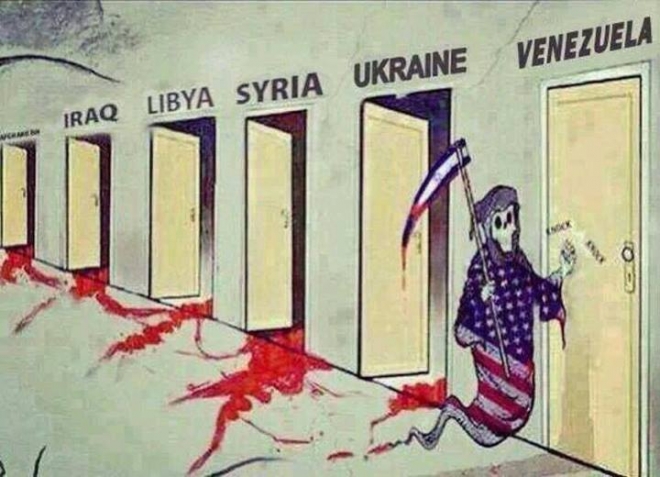
By ISMAEL HOSSEIN-ZADEH | CounterPunch | February 28, 2014
Many countries around the world are plagued by all kinds of armed rebellions, economic sanctions, civil wars, “democratic” coup d’états and/or wars of “regime change.” These include Ukraine, Venezuela, Syria, Thailand, Iran, Afghanistan, Iraq, Egypt, Yemen, Somalia and Lebanon. Even in the core capitalist countries the overwhelming majority of citizens are subjected to brutal wars of economic austerity.
While not new, social convulsions seem to have become more numerous in recent years. They have become especially more frequent since the mysterious 9-11 attacks on the World Trade Center in 2001 and the 2008 financial collapse in the United States, which soon led to similar financial implosions and economic crises in Europe and beyond.
Despite their many differences, these social turbulences share two common features. The first is that they are largely induced, nurtured and orchestrated from outside, that is, by the Unites States and its allies—of course, in collaboration with their class allies from inside. And the second is that, contrary to the long-established historical pattern of social revolutions, where the desperate and disenfranchised masses rebelled against the ruing elites, in most of the recent struggles it is the elites that have instigated insurgencies and civil wars against the masses. The two features are, of course, integrally intertwined: essentially reflecting the shared interests and collaborative schemes of the international plutocracies against the global 99%.
Fighting to Make Austerity Economics Universal
The official rationale (offered by the U.S. and its allies) that the goal of supporting anti-government opposition forces in places such as Syria, Ukraine and Venezuela is to spread democracy no longer holds any validity; it can easily be dismissed as a harebrained pretext to export neoliberalism and spread austerity economics. Abundant and irrefutable evidence shows that in places where the majority of citizens voted for and elected governments that were not to the liking of Western powers, these powers mobilized their local allies and hired all kinds of mercenary forces in order to overthrow the duly elected governments, thereby quashing the majority vote.
Such blatant interventions to overturn the elections that resulted from the majority vote include the promotion of the Orange Revolution in Ukraine (2004 and 2014), Rose Revolution in Georgia (2003), Cedar Revolution in Lebanon (2005), Tulip Revolution in Kyrgyzstan (2005) and the Green Revolution in Iran (2009). They also include the relentless agitation against the duly elected governments of the late Hugo Chavez and now his successor Nicolás Maduro in Venezuela, as well as the rejection (and effective annulment) of the duly elected Hamas government in Palestine.
So, the real driving forces behind wars of regime change need to be sought elsewhere; specifically, in the imperatives of expansion and accumulation of capital on a global level. Socialist, social-democratic, populist or nationalist leaders who do not embrace neoliberal economic policies, and who may be wary of having their markets wide open to unbridled foreign capital, would be targeted for replacement with pliant leaders, or client states. This is, of course, not a new explanation of economic imperialism; it is as old as the internationalization of trade and investment.
What is relatively new, and seems to be the main driving force behind the recent wars of regime change, is that, as the U.S. and other major capitalist powers have lately embarked on austerity economic policies at home they also expect and, indeed, demand that other countries follow suit. In other words, it is no longer enough for a country to open its markets to investment and trade with Western economic powers. It seems equally important to these powers that that country also dismantle its public welfare programs and implement austerity measures of neoliberalism.
For example, after resisting imperialist pressures for years, the late Libyan leader Muammar al-Gaddafi eventually relented in 1993, and granted major oil and other transnational corporations of Western powers lucrative investment and trade deals. Under pressure, he even dismantled his country’s nuclear technology altogether in the hope that this would please them to “leave him” alone, so to speak. None of the concessions he made, however, proved satisfactory to the U.S. and its allies, as his regime was violently overthrown in 2011and he was literally butchered by the thuggish gangs that were trained and armed by Western powers.
Why? Because the U.S. and its allies expected more; they wanted him to follow the economic guidelines of the “experts” of global finance, that is, of the U.S. and European economic “advisors,” of the International Monetary Fund and of the World Trade Organization—in short, to dismantle his country’s rather robust state welfare programs and to restructure its economy after the model of neoliberalism.
The criminal treatment of al-Gaddafi can help explain why imperialist powers have also been scheming to overthrow the populist/socialist regimes of the late Hugo Chavez and his successor in Venezuela, of the Castro brothers in Cuba, of Rafael Correa Delgado in Ecuador, of Bashar Al-assad in Syria and of Evo Morales in Bolivia. It also helps explain why they overthrew the popularly elected nationalist governments of Mohammad Mossadeq in Iran, of Jacobo Arbenz in Guatemala, of Kusno Sukarno in Indonesia, of Salvador Allende in Chile, of Sandinistas in Nicaragua, of Jean-Bertrand Aristide in Haiti and of Manuel Zelaya in Honduras.
The imperialist agenda of overthrowing al-Gaddafi and other “insubordinate” proponents of welfare state programs abroad is essentially part of the same evil agenda of dismantling such programs at home. While the form, the context and the means of destruction may be different, the thrust of the relentless attacks on the living conditions of the Libyan, Iranian, Venezuelan or Cuban peoples are essentially the same as the equally brutal attacks on the living conditions of the poor and working people in the US, UK, France and other degenerate capitalist countries. In a subtle way they are all part of an ongoing unilateral class warfare on a global scale. Whether they are carried out by military means and bombardments or through the apparently “non-violent” processes of judicial or legislative means does not make a substantial difference as far as their impact on people’s lives and livelihoods is concerned.
The powerful plutocratic establishment in the core capitalist countries does not seem to feel comfortable to dismantle New Deal economics, Social Democratic reforms and welfare state programs in these countries while people in smaller, less-developed countries such as (al-Gaddafi’s) Libya, Venezuela or Cuba enjoy strong, state-sponsored social safety net programs. Plutocracy’s intolerance of “regimented” economies stems from a fear that strong state-sponsored economic safely net programs elsewhere may serve as “bad” models that could be demanded by citizens in the core capitalist countries.
In a moment of honesty, former U.S. President Harry Truman is reported as having expressed (in 1947) the unstated mission of the United States to globalize its economic system in the following words: “The whole world should adopt the American system. The American system can survive in America only if it becomes a world system” [1].
In a similar fashion, Lord Cecil Rhodes, who conquered much of Africa for the British Empire, is reported to have suggested during the heydays of the Empire that the simplest way to achieve peace was for England to convert and add the rest of the world (except the United States, Germany and few other Western powers of the time) to its colonies.
The Mafia equivalent of Truman’s or Rhodes’ statements would be something like this: “You do it our way, or we break your leg.”
The mindset behind Truman’s blunt statement that the rest of the world “should adopt the American system” has indeed served as something akin to a sacred mission that has guided the foreign policy of the United States ever since it supplanted the British authority as the major world power.
It explains, for example, the real and the main reason behind the Cold War hostilities between the U.S. and its allies, on the one side, and the Soviet Union and its allies, on the other. While the “threat of communism” has been the official rationale for the start and escalation of those hostilities, there is convincing evidence that not only Joseph Stalin and his successors in the Soviet Union had no plans to wage war against the United States or its allies but that, in fact, they played a restraining role to contain independent revolutionary movements worldwide. “It is often forgotten,” points out Sidney Lens, “that for a few years after the war, he [Stalin] assumed an exceedingly moderate posture. . . . His nation had lost 25 million people in the war, was desperately in need of aid for rebuilding, and continued for a long time to nurture hopes of coexistence. Far from being revolutionary, Stalin in those years put the damper on revolution wherever he could” [2]. To accommodate the United States and other Western powers in the hope of peaceful coexistence, Stalin often advised, and sometimes ordered, the pro-Moscow communist/leftist parties in Europe and elsewhere in the world to refrain from revolutionary policies that might jeopardize the hoped-for chances of coexistence.
The goal or mission of converting other economies to the U.S.-style capitalism also helps explain why the United States has engaged in so many military operations and engineered so many coup d’états and regime changes around the world. The Federation of American Scientists has recorded a list of U.S. foreign military engagements which shows that in the first decade after the collapse of the Berlin Wall (1989-99) the U.S. engaged in 134 such operations, the majority of which are altogether unknown to the American public [3].
Global financial elites change “unaccommodating” regimes not only in the less developed countries but also in the core capitalist countries. They accomplish this not so much by military means as by utilizing two very subtle but powerful means: (a) artificial, money-driven elections, peddled as “democracy in action”; and (b) powerful financial institutions and think tanks such as the International Monetary Fund (IMF), central banks and bond/credit rating agencies like Moody’s, Standard & Poor’s and Fitch Group. An unfavorable rating report by these agencies on the credit status of a country can create havoc on that country’s economic, financial and currency position in world markets, thereby dooming its government to collapse and replacement. This is how during the ongoing financial turbulence of recent years a number of governments have been changed in places like Greece and Italy—no need for the traditional or military style regime change, the “soft-power” financial coup d’état engineered by the IMF and/or rating agencies would serve the purpose even more effectively.
Class War on a Global Scale
As noted, all the schemes and wars of regime change, whether by the traditional military means or by the “soft” power of the global financial juggernaut, essentially represent one thing: a disguised class war on a global level, a relentless worldwide economic war by the one percent financial-economic oligarchy against the rest of the world population.
Class struggle in an economically-tiered society is of course not new. What is relatively new in the recent years’ war of the 1% against the 99% is its escalated pace, its widespread scale and its globally orchestrated character. While neoliberal austerity attacks on the living conditions of the public in the core capitalist countries began (formally) with the supply-side economics of President Ronald Reagan and Prime Minister Margaret Thatcher more than three decades ago, the brutality of such attacks have become much more severe in the context of the current financial/economic crisis, which began with the 2008 financial crash in the United States.
Taking advantage of the crash (as an economic shock therapy, as Naomi Klein put it), the financial oligarchy and their proxies in the governments of the core capitalist countries have been carrying out a systematic economic coup d’état against the people the ravages of which include the following:
• Transfer of tens of trillions of dollars from the public to the financial oligarchy through merciless austerity cuts;
• Extensive privatization of public assets and services, including irreplaceable historical monuments, priceless cultural landmarks, and vital social services such as healthcare, education and water supply;
• Substitution of corporate/banking welfare policies for people’s welfare programs;
• Allocation of the lion’s share of government’s monetary largesse (and of credit creation in general) to speculative investment instead of real investment;
• Systematic undermining of the retirement security of millions of workers (both white and blue collar) and civil servants;
• Ever more blatant control of economic and/or financial policies by the representatives of the financial oligarchy.
Combined, these policies have significantly aggravated the already lopsided income/wealth distribution in these countries. The massive cuts in social spending have resulted in an enormous transfer of economic resources from the bottom up. The transfer has, indeed, more than made up for the 2008 losses of the financial speculators. In the U.S., for example, the wealthiest one percent now own 40 percent of the entire country’s wealth; while the bottom 80 percent own only seven percent. Likewise, the richest one percent now take home 24 percent of the country’s total income, compared to only nine percent four decades ago [4].
This shows that, as pointed out earlier, while neoliberal attacks on the 99% in the core capitalist countries may not seem as violent as those raging, for example, in Venezuela, Syria or Ukraine, the financial impact of such attacks on the living conditions of the 99% is not any less devastating.
Plutocrats of the World Are United
Policies of regime change are usually designed and carried out as collaborative schemes by cross-border plutocracies, that is, by the financial oligarchies of the imperialist countries in partnership with their native counterparts in the less-developed countries.
In addition to constant behind-the-scenes strategizing, representatives of transnational capital and their proxies in capitalist governments also routinely meet at international conferences in order to synchronize their cross-border business and financial policies—a major focus of which in recent years has been to implement global austerity measures and entrench neoliberal policies worldwide. These include the World Economic Forum in Davos, Switzerland, the World Bank and IMF annual meetings, the Periodic G20 meetings, the Aspen Institute’s Ideas Festival, The Bilderberg Group annual geopolitics forum, and the Herb Allen’s Sun Valley gathering of media moguls—to name only a handful of the many such international policy gatherings.
Through its global strategies and operations, transnational capital has broken free from national constraints and commitments at home and successfully shifted the correlation of class forces and social alliances worldwide. Today’s elites of global capitalism “are becoming a trans-global community of peers who have more in common with one another than with their countrymen back home,” writes Chrystia Freeland, Global Editor of Reuters, who travels with the elites to many parts of the world. “Whether they maintain primary residences in New York or Hong Kong, Moscow or Mumbai, today’s super-rich are increasingly a nation unto themselves,” she adds [5].
Implications for Globalization from Below
What conclusions can the 99% draw from this? What can the working people and other grassroots do to protect their jobs, their sources of livelihood, their communities and their environment? What can communities of ordinary people do to undermine the strategies of the global 1% that block life-sustaining progressive social and economic reforms?
In the same fashion that, in their fight against the working people, the elites of the international capitalist class are not bound by territoriality or national boundaries, so does the working class need to coordinate its response internationally.
A logical, first step deterrent to transnational capital’s strategy of blackmailing labor and communities through threats such as destroying or exporting jobs by moving their business elsewhere would be to remove the lures that induce plant relocation, capital flight or outsourcing. Making labor costs of production comparable on an international level would be crucial for this purpose. This would entail taking the necessary steps toward the international establishment of wage and benefits, that is, of labor cost parity within the same company and the same trade, subject to (a) the cost of living, and (b) productivity in each country.
A strategy of this sort would replace the current downward competition between workers in various countries with coordinated bargaining and joint policies for mutual interests and problem-solving on a global level. While this may sound radical, it is not any more radical than what the transnational 1% is doing: coordinating their anti-99% strategies on a global scale. If at an earlier stage of capitalist development “workers of the world unite” seemed an outlandish dream of the leading labor champion Karl Marx, internationalization of capital, the abundance of material resources and developments in technology, which has greatly facilitated cross-border organizing and coordination of actions by the 99%, has now made that dream an urgent necessity.
As capital and labor are the cornerstones of capitalist production, their respective organizations and institutions evolve more or less apace, over time and space. Thus, when production was local, so was labor: carpenters, shoemakers, bricklayers, and other craftsmen organized primarily in their local communities. But as capitalist production became national, so did trade unions. Now that capitalist production has become global, labor organizations too need to become international in order to safeguard their and their communities’ rights against the profit-driven whims of the footloose and fancy-free transnational capital.
Many would argue that these are not propitious times to speak of radical alternatives to capitalism. The present state of the sociopolitical landscape of our societies appears to support such feelings of pessimism. The high levels of unemployment in most countries of the world and the resulting international labor rivalry, combined with the austerity offensive of neoliberalism on a global level, have thrown the working class and other grassroots on the defensive. The steady drift of the European socialist, Social Democratic, and labor parties/governments toward the U.S.–style market economies and the erosion of their traditional ideology, power, and prestige have led to workers’ confusion there. The collapse of the Soviet Union, however much some socialists have always distanced themselves from that system, haunts the specter of socialism, and is likely to do so for some time to come. These developments have understandably led to workers’ and other grassroots’ confusion and disorientation globally.
None of these, however, mean that there is no way out of the status quo. Capitalism is not only “destructive,” it is also “regenerative,” as Karl Marx put. As it captures world markets, universalizes the reign of capital, and disrupts the living conditions for many, it simultaneously sows the seeds of its own transformation. On the one hand, it creates common problems and shared concerns for the majority of the world population; on the other, it creates the material conditions and the technology that facilitate communication and cooperation among this majority of world citizens for joint actions and alternative solutions.
When the majority of world population, the global 99%, will come to the realization and determination to actually appropriate and utilize the existing technology and material resources for a better organization and management of the world economy, no one can tell. But the potential and the long term trajectory of global socioeconomic developments point in that direction. The distance between now and then, between our immediate frustrations and the superior but elusive civilization of our desire, can be traversed only if we take the necessary steps toward that end [6].
Ismael Hossein-zadeh is Professor Emeritus of Economics, Drake University, Des Moines, Iowa. He is the author of The Political Economy of U.S. Militarism (Palgrave – Macmillan 2007), the Soviet Non-capitalist Development: The Case of Nasser’s Egypt (Praeger Publishers 1989), and most recently, Beyond Mainstream Explanations of the Financial Crisis (forthcoming from Routledge, April 29, 2014).
The National Endowment for Democracy in Venezuela
By Kim Scipes | CounterPunch | February 28, 2014
As protests have been taking place in Venezuela the last couple of weeks, it is always good to check on the National Endowment for Democracy (NED), the US Empire’s “stealth” destabilizer. What has the NED been up to in Venezuela?
Before going into details, it is important to note what NED is and is not. First of all, it has NOTHING to do with the democracy we are taught in civics classes, concerning one person-one vote, with everyone affected having a say in the decision, etc. (This is commonly known as “popular” or grassroots democracy.) The NED opposes this kind of democracy.
The NED promotes top-down, elite, constrained (or “polyarchal”) democracy. This is the democracy where the elites get to decide the candidates or questions suitable to go before the people—and always limiting the choices to what the elites are comfortable with. Then, once the elites have made their decision, THEN the people are presented with the “choice” that the elites approve. And then NED prattles on with its nonsense about how it is “promoting democracy around the world.”
This is one of the most cynical uses of democracy there is. It’s notable even in what my friend Dave Lippmann calls “Washington Deceit.”
The other thing to note about NED is that it is NOT independent as it claims, ad nauseum. It was created by the US Congress, signed into US law by President Ronald Reagan (that staunch defender of democracy), and it operates from funds provided annually by the US Government.
However, its Board of Directors is drawn from among the elites in the US Government’s foreign policy making realm. Past Board members have included Henry Kissinger, Madeleine Albright, Zbigniew Brzezinski, Frank Carlucci, General Wesley K. Clark, and Paul Wolfowitz. Today’s board can be found at http://www.ned.org/about/board; most notable is Elliot Abrams of Reagan Administration fame.
In reality, NED is part of the US Empire’s tools, and “independent” only in the sense that no elected presidential administration can directly alter its composition or activities, even if it wanted to. It’s initial project director, Professor Allen Weinstein of Georgetown University, admitted in the Washington Post of September 22, 1991, that “a lot of what we do today was done covertly 25 years ago by the CIA.”
In other words, according to Professor William Robinson in his 1996 book, Promoting Polyarchy, NED is a product of US Government foreign policy shift from “earlier strategies to contain social and political mobilization through a focus on control of the state and governmental apparatus” to a process of “democracy promotion,” whereby “the United States and local elites thoroughly penetrate civil society, and from therein, assure control over popular mobilization and mass movements.” What this means, as I note in my 2010 book, AFL-CIO’s Secret War against Developing Country Workers: Solidarity or Sabotage?, “is that instead of waiting for a client government to be threatened by its people and then responding, US foreign policy shifted to intervening in the civil society of a country ‘of interest’ (as defined by US foreign policy goals) before popular mobilization could become significant, and by supporting certain groups and certain politicians, then channel any potential mobilization in the direction desired by the US Government.”
Obviously, this also means that these “civil society” organizations can be used offensively as well, against any government the US opposes. NED funding, for example, was used in all of the “color revolutions” in Eastern Europe and, I expect, currently in the Ukraine as well as elsewhere.
How do they operate? They have four “institutes” through which they work: the International Republican Institute (currently headed by US Senator John McCain), the National Democratic Institute for International Affairs (currently headed by former US Secretary of State Madeleine Albright), the Center for International Private Enterprise (the international wing of the US Chamber of Commerce), and the American Center for International Labor Solidarity (ACILS), the foreign policy operation of the AFL-CIO, with Richard Trumka the head of its Board of Directors.
As I documented in my book, ACILS had been indirectly involved in the 2002 coup attempt in Venezuela by participating in meetings with leaders later involved in the coup beforehand, and then denying afterwards the involvement of the leaders of the right-wing labor organization (CTV) in the coup, leaders of an organization long affiliated with the AFL-CIO. We also know NED overall had been active in Venezuela since 1997.
The NED and its institutes continue to actively fund projects in Venezuela today. From the 2012 NED Annual Report (the latest available), we see they have provided $1,338,331 to organizations and projects in Venezuela that year alone: $120,125 for projects for “accountability”; $470,870 for “civic education”; $96,400 for “democratic ideas and values”; $105,000 for “freedom of information”; $92,265 for “human rights”; $216,063 for “political processes”; $34,962 for “rule of law”; $45,000 for “strengthening political institutions”; and $153,646 for Center for International Private Enterprise (CIPE).
Additionally, however, as found on the NED “Latin American and Caribbean” regional page, NED has granted $465,000 to ACILS to advance NED objectives of “freedom of association” in the region, with another $380,000 to take place in Venezuela and Colombia. This is in addition to another $645,000 to the International Republican Institute, and $750,000 to the National Democratic Institute for International Affairs.
The irony of these pious claims for “freedom of association,” etc., is that Venezuela has developed public participation to one of the highest levels in the world, and has one of the most free media in the world. Even with massive private TV media involvement in the 2002 coup, the government did not take away their right to broadcast afterward.
In other words, NED and its institutes are not active in Venezuela to help promote democracy, as they claim, but in fact, to act against popular democracy in an effort to restore the rule of the elite, top-down democracy. They want to take popular democracy away from those nasty Chavistas, and show who is boss in the US Empire. This author bets they fail.
Kim Scipes, Ph.D., is an Associate Professor of Sociology at Purdue University North Central in Westville, IN, and is author of AFL-CIO’s Secret War against Developing Country Workers: Solidarity or Sabotage?, and KMU: Building Genuine Trade Unionism in the Philippines, 1980-1994. He can be reached through his web site at http://faculty.pnc.edu/kscipes.
Related articles
Featured Video
Elijah Magnier: Yemen’s strikes are shattering Saudi Arabia’s long-term strategy
or go to
Aletho News Archives – Video-Images
From the Archives
British weapons and personnel doing much of the killing in Yemen
Press TV – June 18, 2019
A detailed report published by the Guardian newspaper has shown how Britain is massively contributing to Saudi Arabia’s devastating war on Yemen as it suggests that London is not only supplying the bombs that fall on Yemenis, but it provides the personnel and expertise that keep the war going.
The comprehensive report by Arron Merat published on Tuesday showed that Britain was doing much of the killing in Yemen as the country continues to provide Saudi Arabia with everything it needs to turn its southern impoverished neighbor into a graveyard.
“Every day Yemen is hit by British bombs – dropped by British planes that are flown by British-trained pilots and maintained and prepared inside Saudi Arabia by thousands of British contractors,” said Merat in the report. … continue
Blog Roll
 Aletho News
- Netizens condemn Japanese drama for projecting Japan’s wartime atrocities onto Chinese characters
- Racist Seinfeld Dances for Joy as Bibi Unveils His New Map
- A West Bank War for Netanyahu’s Election Campaign, Could It Backfire?
- Yemen denounces European Parliament’s ‘hypocritical’ push to blacklist Ansarullah
- Qalibaf: UAE’s UN bid aims to ‘clear the runway’ for ‘Greater Israel’, whitewash genocide
- Pakistan reopens Iran border after boosting security: Report
- Why are so many Brazilians voting for Flávio Bolsonaro?
- Democrats Put Anti-Russia Agenda Ahead of American Workers
- Elijah Magnier: Yemen’s Strikes Are Shattering Saudi Arabia’s Long-Term Strategy
- Pentagon designates Chinese cultural centers national security threat
- If Americans Knew
- Latest updates from Israeli assault on West Bank
- Tourism Ministry launches free food truck tour in US
- “So Much Worse Than People Realize”: Never-Before-Seen Images Reveal Damage at U.S. Bases as Troops Describe Being Abandoned
- UK Bell Review Confirms Only Anti-Israel Attitudes Are Rising, Not Antisemitism
- DAILY UPDATE: Latest essential news on Palestine, Israel, & region
- DAILY UPDATE: Latest essential news on Palestine, Israel, & region
- Damning report shows the media must confront its failures on Gaza
- BBC senior broadcaster speaks out on Gaza coverage
- Netanyahu vows vast West Bank invasion in response to 20-minute skirmish that left 2 Israeli soldiers and 2 Palestinian fighters dead
- Tied up and tortured: Israel using US-made electroshock weapons on Palestinian detainees
- No Tricks Zone
- Sudden Stratospheric Warming, Powerful El Niño Combination May Lead To Extreme Europe Cold, Energy Crisis!
- Two New Studies Find Thwaites Glacier Melt Cannot Be Driven By Human Activity Or A Warming Ocean
- E-Cars Reduce CO2 Emissions By Only 41% Compared To Internal Combustion Engine Vehicles
- Predictions Made By Renowned Climate Professor Over Past Decades Have Been Proven To Be Poor
- New Study Suggests Large Regions Of The Pacific Ocean Have Been Cooling For The Last 80 Years
- Germany’s Green Energy Debacle: High Energy Costs Force Kahla Porzellan to Close After 182 Years!
- New Study: 50 Years Of The Most Aggressive ‘Net Zero’ Policies Can Only Affect The Global Climate By 0.03°C
- US September “Heat” Was No Record…Many Records Set Decades Ago
- Latest European Green Energy Debacle; Portugal’s Largest Flagship Solar Park Insolvent!
- Green Energy Debacle: German Expert Professor Fritz Vahrenholt Warns Of Severe Economic And Social Consequences

