~
Jay Knott wrote The Mass Psychology of Anti-Fascism.
Interview with Mauro Manno
By Giovanna Canzano – 06/01/2009
CANZANO – Jews “Über alles”. Since 1948, with the birth of the state of Israel, we can see, from reading various papers, the Jewish presence in every sector of cultural and economic life: guides and wise men and “righteous men”?
MANNO – I wouldn’t say “Jews Über alles” but rather “Zionists über Alles”. Today this distinction is fundamental. I’ve been studying the politics of Zionism for years now and can say with certainty that the confusion over this point is not only erroneous, historically and politically, but it is also unfair towards those many Jews who had been the victims of Zionism. Even today there are Jews who are victims of Zionism. A few of these new victims I know personally and it doesn’t seem to me that they are “über Alles”, but instead they are certainly under Zionist scrutiny. They are ostracised, they lose their university positions such as happened to Norman Finkelstein, the author of “The Holocaust Industry” or they get isolated and put in conditions where they leave not only their university post, but also their loved ones and friends in Israel and emigrate in the West, as happened to Ilan Pappe, the author of “The Ethnic Cleansing of Palestine”. These Jews suffer because they have the courage of proclaiming that they are anti-Zionists. This act of revolt against Zionism doesn’t constitute only the repudiation of that political ideology, but also the rejection of the historical consequences that its victory has had, that is, the Jewish State, Israel as a Jewish State. The anti-Zionists wish for the end of the state of Israel as it has been built by the Zionists and they fight for its substitution with a single, democratic state for all the Jews and all the Palestinians who are within the whole of Palestine, that is, within Israel and the Occupied Territories, Gaza included.
But that is not all; they also support the Right of Return of the refugees forced to leave in 1948, just as is sanctioned by UN Resolution 194, which was voted upon exactly 60 years ago (11 December 1948) but never applied.
However, there is an important point to make! Whoever knows the fate of these new victims of Zionism, the anti-Zionist Jews, must not forget the much more tragic fate reserved for the assimilationist Jews during the Second World War. They too were against Zionism, and they too were the victims of Zionism. This is the part of their story that the Zionists want to keep absolutely hidden. The Zionist battle against assimilationist Jews, conducted in collaboration with the Nazis and the anti-Semites.
Anything but “righteous men”, the Zionists are the political men who are the least righteous at all, towards other Jews and non-Jews alike.
CANZANO – Who are the Jewish assimilationists?
MANNO – Jewish assimilationists were those Jews who wanted to assimilate, become part of the population in the country they were born in. According to Rabbinic law, Halacha is the Jew who is son or daughter of a Jewish woman or someone who converts to Judaism. Jewishness is therefore transmitted by way of blood, from mother to son or daughter. For other religions, this is not the case: the Christianity of a Catholic or the Islam of a Muslim is not transmitted by way of blood. To conserve this Jewish peculiarity, it is fundamental towards the conservation of Judaism in general that the family does not have any mixed marriages, with non-Jews. If a Jew (not born in Israel) believes that the fact of being the child of a Jewish mother does not make him Jewish, if he rejects the Jewish religion, if he considers himself a free human being that can chose another religion or no religion at all, if he wants to live without the weight of the Jewish past of his family, then he is an assimilationist. He wants to leave the closed Jewish world and enter into the world that is more open and free that he finds outside the Jewish one. So, this person would have totally adopted the culture, language, lifestyle, cuisine, tradition, etc., of the country in which he lives. He would adopt its destiny as well. He wouldn’t feel obligated to marry a Jewish woman and in that way according to Halacha, his children would no longer be Jews. If he educates his children in the spirit in which he himself has lived, and his children also have mixed marriages, and their children and so on, after a few generations, his descendants will no longer be Jews, but they will be Italians, Germans, French, etc., in every way, shape and form. The Zionist Jabotinsky, who obviously abhorred assimilation said, “to read true assimilation… [the Jew] would have to produce, through a long series of mixed marriages, in a period of various decades, a grandson of a grandson of a grandson within whose veins runs only a slight trace of Jewish blood, because that grandson of a grandson of a grandson will have the spiritual conformation of a true Frenchman or a true German.” Mixed marriage is at the base of assimilation. Before the Second World War, mixed marriages were in strong progression, for example, in 1929 in Germany, they constituted 59% of the marriages, and pure marriages,with both of the spouses being Jewish was a 41% minority. That frightened the Zionists, who considered assimilationists something like traitors. When the Nazis came to power, the International Zionist organisations broke their necks to collaborate with them and they even made pacts with them to allow only the emigration of Zionists outside of Germany (recovering their belongings) and sending them to the Palestinian colonies. The assimilationist Jews did not interest them and they were left to their own fate. The Zionists did nothing so that the assimilationist Jews could emigrate to America or to other Western states, as a matter of fact, they blocked any efforts in this direction. Later, during the war, they extended this policy to the rest of Europe. There were killings and massacres of Jews and they were dealing only in order to save those who were Zionists and who would emigrate to Palestine, all the rest could simply be left to die. The example of Rezso Kasztner is illuminating. This Hungarian Zionist in 1944 bartered the salvation of his family and those belonging to various Hungarian Zionist organisations, 1,600 persons in all, in exchange for his collaboration and that of his followers in order to facilitate the deportation to Auschwitz of hundreds of thousands of assimilationist Jews.
This policy has facilitated the near extinction of non-Zionist Jews, those on the road towards assimilation. The Zionists share responsibility, together with the Nazis, of this crime. This is the reason for which most of the Jews of the Diaspora declare themselves to be Zionists and they generally marry only other Jews.
CANZANO – Are you saying there was an ethnic cleansing of Jews conducted by other Jews?
MANNO – I would hold that term, “ethnic cleansing” to describe what the Zionists did to the Palestinians in 1948. They had cleared Palestine of its antique inhabitants, as Ilan Pappe has carefully demonstrated in his recent book, the title of which refers to the ethnic cleansing. I would instead say that there was a will of the Zionists to rid themselves of non-Zionist Jews. I had spoken of the shared responsibility of the Zionists with the Nazis. It was [left to] the Nazis to bring them to their deaths, while the Zionists collaborated at various levels with the killers. During the Second World War, the Zionists, in some cases, had even killed directly, most of the time they had denounced other Jews, they often helped run the concentration camps, they had convinced the assimilationists to stay in their place, to not rebel, all of that in exchange for the salvation of their Zionist followers, their friends and their families. Regarding their followers, it is essential to note that the Zionist leaders didn’t even work on saving them all, but only the young ones, that is, those who could engage in armed combat (in prevision of a war against the English and the Palestinians), in other words, those who could work towards the development of the colonies, those who could bear children. The old people and small children only would have been an encumbrance. In 1937 Chaim Weizmann, future President of Israel, before the Peel Commission in London coldly declared: “I want to save… the young [for Palestine]. The old ones will pass. They will bear their fate or they will not. They were dust, economic and moral dust in a cruel world…Only the branch of the young shall survive… They have to accept it.” And, remember, this is a Zionist speaking. Ben Gurion, speaking in ’38 of children (children of Zionists and non-Zionists) said, “If I knew that it was possible to save all the children of Germany by transporting them to England and only half of them by transporting them to Palestine I would choose the second.” Ben Gurion knew that if the assimilationists and persons of good will would have wanted to choose between “saving Jews from Concentration Camps” and Zionism, “mercy” would have “had the upper hand and the whole energy of the people would be channelled into saving Jews from various countries;” then Zionism “will be struck off the agenda not only in world public opinion, in Britain and in the United States, but elsewhere in Jewish public opinion.” For the Zionists this absolutely could not be allowed to happen and they did everything possible so that it did not happen. Just think that when someone said to Yitzhak Gruenbaum, leader of the Rescue Committee (!) of the Jewish Agency in Palestine, in 1943 when the killings started said, “Don’t build new colonies (…) send money save Jews in the Diaspora,” he responded: “Zionism is above everything.” On another occasion, still in 1943, he stated, “one cow in Palestine is worth more than all the Jews in Europe.” So, it was in this way that the Zionists, allying themselves with the Nazis, saved themselves, while the non-Zionists were eliminated as a direct result of that alliance. And today the Zionists dominate over all the Jews and they greatly influence the Western governments. They determine American foreign policy (see the book by Mearsheimer and Walt). And for this, reason, Israel is untouchable and can do anything it wants to and not only to the Palestinians… but here we are touching upon the problem of the Zionist lobby.
CANZANO – Zionist lobby?
MANNO – To make it understandable, let us take the example of the Zionist lobby in America, which is the strongest Zionist lobby in the West. In the race for the American presidency, everyone had to see both Obama and his vice, Biden and the two losers McCain and Palin, run to genuflect before the organisation of the strongest of the lobbies, AIPAC. This had been foreseen by Mearsheimer and Walt and it happened without delay. The two candidates have been forced to undergo an accurate examination before the judges of the lobby concerning their proposals regarding Israel and to the command posts that would be willing to pass to Zionists (Jews or non-Jews) in their future administration. Everyone will remember how Obama was able to catch his rival off balance proclaiming that he supported the line of “a sole and indivisible Jerusalem as capital of the Jewish State.” McCain didn’t go quite so far. This line is officially condemned by the international community on the basis of a series of UN resolutions. Israel continues in its expulsion of the Palestinians (many of them Christians) of the Holy City and the West pretends nothing is happening while at the same time maintaining the official position of the UN. Now Obama, the “man of peace” has gone closer to the side of Israel than any other president has yet done. It seemed in the beginning that the determinant support of the lobby was going to go towards McCain, but then something changed. It is necessary to recall that Obama’s vice, Joe Biden, as soon as he was nominated declared himself to be “an ardent Zionist”! And I would not be surprised if it was the Lobby itself that had imposed Biden on Obama. Then Obama was able to give secure guarantees, favours (and money) of the lobby all flowed his way. It was a formidable coup for the Zionists. Now the lobby will have a pro-Israel policy and a pro-Israel lobby pushed forward by a popular president and not by a shadow of Bush. The Western politicians can also make their own policies more pro-Israel and pro-USA (which is the same) without clashing as much with public opinion. The pacifist movement is completely shattered. Certainly, quite soon Obama will destroy his image of the new man, becoming like Rice or Powell, the black man that is used to serve the interests of the lobby, but this means nothing to the lobby, and why should it if they are able to get just what they want? In reality the image of Obama is already sullied. The choice of Clinton for Secretary of State, the choice of Rahm Emanuel (whose father declared that he detests Arabs and he is sure that his son will work in favour of Israel) are just the first signs. The lobby was able to obtain something else as well. After the domination that Bush had given to another wing of the lobby, to the discredited neo-cons (almost all of them Jewish), the Zionists strategists figured out how to have the same policies be carried out by non-Jews, but ones who are of proven Zionist faith. Thus, after Biden, we see the re-emergence of Clinton (with whom Obama once had clashes regarding foreign policy, and now we see him entrust that ministry to her). Hillary is another Zionist that will bring to the Secretary of State office the Jewish team her husband had: Madeleine Albright, Holbrooke, Dennis Ross, etc. The same politics of the Jewish neo-cons but officially carried out by non-Jews. The non-Jewish Zionists are fortunately very few but they are the worst traitors of their country and they send young Americans to war so that Israel can be strengthened, which is what happened in Iraq. Even we Europeans have our Zionist lobby. Let’s not harbour any illusions there.
CANZANO – There is a Zionist lobby in Europe?
MANNO – The Zionist lobby can be found anywhere in the world where there are Zionists. If they were all in Israel it would all be so simple, but there is the Diaspora and among the Jews of the Diaspora there are many Zionists. This was already in the program of the First Zionist Congress (1897) that the Zionists of the Diaspora would have to take the preparatory steps “towards obtaining the consent of governments, where necessary in order to reach the goals of Zionism.” And that is what they have been able to do. Today, after the birth of Israel, the American Zionist lobby and the various national lobbies always serve the “goals of Zionism”, that however are not the same as those when the task at hand was founding the Jewish State. 60 years since its foundation, Israel does not yet have a solid base. Its existence as a “Jewish State” is taken to task and it is maintained only with the use of force. Being an ethnic state that occupied other people’s land and oppresses the Palestinians, without any respect for international law, it is well aware that it is an illegitimate state. The lobby has the task of “making it legitimate” at least in the eyes of the West. Europe, at least on a formal level, has been involved in the Middle East in a position of equilibrium between Arabs and Israelis. We have major interests in the Arab world. In 2004 there have been the first changes. The EU Council approved the “EU-Israel Action Plan” and in spite of the horrifying record of Israel in the area of human rights, the Plan declared that “The EU and Israel share the same values of democracy, respect for human rights and sovereignty of law and the fundamental freedoms.” This is absolutely false and I am prepared to demonstrate it. However the Plan gets worse: it gives Israel the possibility of “participating in key aspects of EU policies and programmes.” We will become a Zionist colony.
Since 2006 the position of Europe has further changed. First there was a softening of criticism of Israel. That took place by pressure from a special “Jewish American Committee for Europe”. Within that group we find AIPAC, the ADL (Anti-Defamation League), the American Jewish Congress, which has distinguished itself from the others. Responding in a positive way on behalf of Europe as first Prodi, then Ferrero-Waldner and now Barroso. Before 2000 the EU expected Israel to pay for the damage caused within the Occupied Territories with European money and now, after Ferrero-Waldner and Barroso, the territories don’t get anything. Today in the European Parliament there is a group of approximately 200 parliament members called “European Friends of Israel” who work for Tel Aviv. This effort is sustained by Jewish businessmen everywhere in the continent as well as Jews who have been elected in the various parliaments such as, in Italy, Fiamma Nierenstein and the lawyer Alessandro Ruben. Lastly, with the French EU presidency of the Jewish Zionist (he himself declared this) Nicolas Sarkozy and the constitution of the Mediterranean Union, Zionism is now very close to obtaining the acceptance and the legitimisation of Israel in the Arab world, through Europe. Be very careful, this is not a peace policy, as the European governors keep saying. If there is the realisation of Arab legitimisation, Israel will have their hands free for a military policy, against Iran, against Hezbollah and the Palestinians, with the blessings of the Arab countries. In this framework, the Palestinian State will be a series of tiny Bantustans that are completely surrounded, just like Gaza. Only the economic crisis of the West can stop the conflict.
CANZANO – So, Israel is not a democratic State?
MANNO – No. No, it is not. It is an ethnocratic state. A Jews-only state. Democracy in the Jewish State is only valid for Jews. For non-Jews it is a farce. Let’s try to imagine for a moment that in a multi-ethnic country in which there is a colonial administration, a party that represents a particular ethnic group has in mind, once colonialism has ended, to constitute a democratic state over the entire country, but to kick out all the other ethnic groups. How can we say that the programme that this party has is a democratic one? For me it’s a racist programme based on ethnic cleansing.
Now, let’s try to imagine that once the phase of colonialism has ended, this party is allowed to make it’s own state by only on part of the territory in the country and on the condition that even on that territory there are no expulsions made on an ethnic basis. It instead happened that the state was founded immediately after the expulsion of the majority of its inhabitants on behalf of the minority, according to its initial racist programme. It’s a democratic state but democracy is supposed to involve the entire population, not just the minority that has undertaken an ethnic cleansing. Now we see that institutions that represent international law (the UN for example) are asking this ethnic state to reintegrate those who had been expelled and to give them equal democratic rights. In response, this “democratic” state (only for the ethnic group it represents) refuses to do it, instead it perseveres with its initial programme of wanting to conquer the entire territory of the country and to colonise it with people of its same ethnic group that are brought in from other countries. This new expansion and this new ethnic cleansing do not happen in a haphazard way, but rather is sanctioned within the founding documents of the “democratic” state. For example, within them we see that the entire territory of the country belongs to all of those who are members of the right ethnic group wherever they are to be found and do not on the other hand belong to those who had been expelled just prior to the foundation of the ethnic state. Is this still a democratic state?
And that is not all. Let’s imagine that in this ethnic state there has been a small minority of the wrong ethnic group that has survived. It’s a minority with a demographic growth that constitutes nearly a quarter of the entire population. These persons are treated like second-class citizens, in economic activities, before the law, in daily life, and so on, where they have to undergo a thousand kinds of discrimination. The worst discrimination concerns the possession of land. The state has secured for itself, with another founding law by the ethnic “democracy”, that 93% of the country’s land has to stay in the hands of the right ethnic group. The sale of terrain (and that includes any property that is built upon it) is allowed only between people of this ethnic group. It is however possible to purchase new land in that 7% that was left to the minority ethnic group, in such as way so as to expand the property of the right ethnic group. Is it still a democratic state?
When confronted with these discriminations, the ethnic state concedes a limited voting right and a limited right to criticise for the discriminated minority group. Are these political rights enough when put next to the thousand discriminations to make this a democratic state?
I can already hear the defenders of Israel, because that is what we are talking about, object and protest against my last affirmation on the limited political rights of the Palestinian majority. Instead, that is only the way it is. Think about the fact that in Israel it is prohibited to challenge the Jewish character of the state. It is prohibited to found parties that have as a programme proposing a different kind of state, not an ethnic one, but one for all its citizens. It is prohibited to fight for the application of UN Resolution 194 that imposes the right of return of the Palestinians who had been expelled. It is prohibited to fight for the abolition of the founding law of the state that says that Palestine belongs to all the Jews of the world and in any moment any one of them may come to Palestine to occupy property that the army of the Jewish state has seen to taking away from some Palestinian of the Occupied Territories. Is this still a democratic state? Then it is established that Catholic citizens (whatever that term comes to mean now) cannot sell property to Jews, Protestants, et al., so that the land of Italy will be concentrated more and more in Catholic hands. Non-Catholics will have the right to vote, but in such a way so as to not endanger the “Catholic” character of the state. Could Italy still call itself democratic under those conditions? And I have to remind those who defend Israel that the Jews in Italy are not a quarter of the population as the Palestinians in Israel are. I remind them as well that if things continue in this direction, there is the risk not only of an ethnocratic state of Israel, but that it actually becomes a theocratic state, taking into consideration the growing importance of religious parties in Israeli politics.
CANZANO – In relation to what has already been said in this interview, what would your explanation be for the furious Israeli attack against Gaza?
MANNO – If we look at what’s happening in Gaza now within the historical framework that in some way we have traced in this interview, we must conclude that this is nothing less than a further step ahead in the ethnic cleansing of the Palestinians. If Israel wanted to come to a compromise with the Palestinians regarding a Palestinian state, well, there were no shortage of opportunities. The supporters of Israel insist that it was the Palestinian side that would not accept the division of Palestine in 1948. But, who would have accepted such a thing? What nation would have accepted the division of its own territory imposed from on high, even from the UN (which at the time, bear in mind, was constituted of only a quarter of the current states and it was under control of the US and USSR). If then the UN would have imposed also the application of UN Resolution 194, which asked Israel to allow the Palestinians cast off forcefully to be able to return, then things would have gone quite differently. But Israel rejected the Resolution, as it was sure of the support of the USA, which was already under the heavy influence of the American Zionist lobby. It did much more, actually. It assassinated the UN mediator Folke Bernadotte who was elaborating a new policy at the time.
Israel wanted an ethnically pure state and nothing else would suffice. This is Zionism. After the 1967 war, Israel would not accept Resolution 242 either, which imposed the withdrawal of Israel from the Occupied Territories. Instead, against all international law, it started to colonise these territories. Israel would accept no compromise during the Oslo Agreements and it still today forges ahead with colonisation. In 2002 the Arab states offered the recognition of Israel in exchange for the withdrawal of Israel to the confines of 1967, but Israel refused, started the construction of the wall that has claimed vast parts of the Occupied Territories from which the Palestinian population is slowly but surely being expelled from, and it still carries on with the construction of settlements and the suffocation of the Palestinians of East Jerusalem.
Translated by Tlaxcala
December 15, 2013 Posted by aletho | Ethnic Cleansing, Racism, Zionism, Illegal Occupation, Timeless or most popular | Israel, Jewish State, Judaism, Palestine, Zionism | Leave a comment
By Haitham Sabbah • Jul 23, 2009
The row over a racist advert of Cellcom – an Israeli mobile phone operator, which shows Israel Occupation Forces soldiers playing football with Palestinians on both sides of the Apartheid Wall, continues.
In the Cellcom advert, IOF soldiers on patrol along the Wall stop their army jeep when it is hit by a soccer ball from the Palestinian side of the Wall. A game ensues, back and forth with the unseen Palestinians after a soldier dials up “reinforcements,” including two smiling women in uniform, to come and play.
The advertisement made by McCann Erickson, part of U.S. Interpublic Group, ends with the upbeat voiceover: “After all, what are we all after? Just a little fun.”
The advert has been extensively criticized for making light of the Palestinian suffering inflicted by the West Bank Apartheid Wall.
The Palestinians put controversial ad to test. A video recently posted on YouTube has tried to reenact the game in reality, and found that the result could not be further removed from the situation on the ground: when the Palestinians kick the ball to the other side of the Wall, what they get in return is a salvo of tear gas grenades and bullets.
Protesters in Bilin tested the “fun” claimed by Cellcom to find that it “smells” and can “kill you” if you play it with Israelis.
One of the activists in Bil’in said: “We wanted to show everyone how the soldiers really behave, contrary to what was shown in the ad. This is a message from the protestors on what really goes on at the separation fence – this is what we get from the soldiers, tear gas.”
The Israeli ad prompted Arab lawmakers in Israel to demand it be taken off air. MK Ahmed Tibi called to scrap this television commercial.
What the Israelis sees as “Just a little fun” is actually an Apartheid Wall that separates families and prevents children from reaching schools and clinics, yet the advertisement presents the Wall as though it were just a garden fence in Tel Aviv.
Cellcom, however, has remained defiant and stood by the commercial.
“We are a communications company that facilitates human interaction,” they said. “We don’t deal with politics. We’ve had very positive feedback about the advert. There was absolutely no cynical intention behind it.”
The ad went out during the same week as Palestinians marked the fifth anniversary of a World Court ruling that Israel’s walls and fences in the West Bank were illegal.
Hagai Matar, an Israeli activist, said that the violent atmosphere near the fence was far from resembling the pastoral, pleasant atmosphere reflected in the Cellcom advert.
“While the people of Bilin suffer from frequent and repeated harassments by the army, while the residents are subjected to nightly arrests, violence and tear gas, not only during rallies but also in their yards, the people of Bilin continue to use amusing and creative ways to protest the separation fence,” he said.
I got really too nauseous watching the ad. You see the Israeli occupation forces playing with ?!… the people that they are incarcerating behind the Apartheid Wall. But the most grotesque and disgusting part of this TV ad is the fact that the Palestinians basically aren’t seen. Why? Because they are not there waiting for the football, but for … This ad correctly portray the occupation as monsters or aliens … This is the alienation that Israeli society feels toward the Palestinian people. In reality, if a Palestinian comes close to the Apartheid Wall to return a football … he is likely to get shot.
Cellcom should take this racist commercial off the air immediately and apologies for the Palestinian people. Refusing to do so only confirms the fact that racism is a culture that is widely adopted, believed and practiced in Israel.
December 14, 2013 Posted by aletho | Ethnic Cleansing, Racism, Zionism, Timeless or most popular, Video | Cellcom, Israel, McCann Erickson, Palestine, Zionism | Leave a comment
Twenty years since its passage, NAFTA has displaced workers on both sides of the U.S.-Mexico border, depressed wages, weakened unions, and set the terms of the neoliberal global economy.
By Jeff Faux | Foreign Policy in Focus | December 13, 2013
Foreign Policy In Focus is partnering with Mexico’s La Jornada del campo magazine, where an earlier version of this commentary appeared, to publish a series of pieces examining the impacts of the North American Free Trade Agreement (NAFTA) 20 years since its implementation. This is the first in the series.
The North American Free Trade Agreement, or NAFTA, was the door through which American workers were shoved into the neoliberal global labor market.
By establishing the principle that U.S. corporations could relocate production elsewhere and sell their products back into the United States, NAFTA undercut the bargaining power of American workers, which had driven the expansion of the middle class since the end of World War II. The result has been 20 years of stagnant wages and the upward redistribution of income, wealth, and political power.
A Template for Neoliberal Globalization
NAFTA impacted U.S. workers in four principal ways.
First, it caused the loss of some 700,000 jobs as companies moved their production to Mexico, where labor was cheaper. Most of these losses came in California, Texas, Michigan, and other states where manufacturing is concentrated (and where many immigrants from Mexico go). To be sure, there were some job gains along the border in the service and retail sectors resulting from increased trucking activity. But these gains are small in relation to the losses, and have generally come in lower paying occupations. The vast majority of workers who lost jobs from NAFTA, therefore, suffered a permanent loss of income.
Second, NAFTA strengthened the ability of U.S. employers to force workers to accept lower wages and benefits. As soon as NAFTA became law, corporate managers began telling their workers that their companies intended to move to Mexico unless the workers lowered the cost of their labor. In the midst of collective bargaining negotiations with unions, some companies even started loading machinery into trucks that they said were bound for Mexico. The same threats were used to fight union organizing efforts. The message was: “If you vote to form a union, we will move south of the border.” With NAFTA, corporations also could more easily blackmail local governments into giving them tax breaks and other subsidies, which of course ultimately meant higher taxes on employees and other taxpayers.
Third, NAFTA drove several million Mexican workers and their families out of the agriculture and small business sectors, which could not compete with the flood of products—often subsidized—from U.S. producers. This dislocation was a major cause of the dramatic increase of undocumented workers in the United States, putting further downward pressure on North American wages, particularly in already lower-paying labor markets.
Fourth, and ultimately most importantly, NAFTA created a template for the rules of the emerging global economy, in which the benefits would flow to capital and the costs to labor. Among other things, NAFTA granted corporations extraordinary protections against national labor laws that might threaten profits, set up special courts—chosen from rosters of pro-business experts—to judge corporate suits against governments, and at the same time effectively denied legal status to workers and unions to defend themselves in these new cross-border jurisdictions.
The U.S. governing class—in alliance with the financial elites of its trading partners—applied the NAFTA principles to the World Trade Organization, to the policies of the World Bank and IMF, and to the deal under which employers of China’s huge supply of low-wage workers were allowed access to U.S. markets in exchange for allowing American multinational corporations to invest there. The NAFTA doctrine of socialism for capital and free markets for labor also drove U.S. policy in the Mexican peso crisis of 1994-95, the Asian financial crash of 1997, and the global financial meltdown of 2008. In each case, the U.S. government organized the rescue of banks and corporate investors while letting the workers fend for themselves.
A Watershed in U.S. Politics
In U.S. politics, the passage of NAFTA under President Bill Clinton signaled that the elites of the Democratic Party—the “progressive” major party—had accepted the reactionary economic ideology of Ronald Reagan.
A “North American Accord” was first proposed by the Republican Reagan in 1979, a year before he was elected president. A decade later, his Republican successor, George H.W. Bush, negotiated the final agreement with Mexico and Canada.
At the time, the Democrats who controlled Congress would not approve the agreement. And when Democrat Bill Clinton was elected in 1992, it was widely assumed that the political pendulum would swing back from the right, and that therefore NAFTA would never pass. But Clinton surrounded himself with economic advisers from Wall Street and in his first year pushed the approval of NAFTA through the Congress.
Despite the rhetoric, the central goal of NAFTA was not “expanding trade.” After all, the United States, Mexico, and Canada had been trading goods and services with each other for three centuries. NAFTA’s central purpose was to free American corporations from U.S. laws protecting workers and the environment. Moreover, it paved the way for the rest of the neoliberal agenda in the United States: the privatization of public services, the deregulation of finance, and the destruction of the independent trade union movement.
The inevitable result was to undercut the living standards of workers all across North America: Wages and benefits have fallen behind worker productivity in all three countries. Moreover, despite declining wages in the United States, the gap between the typical American and typical Mexican worker in manufacturing remains the same. Even after adjusting for differences in living costs, Mexican workers continue to make about 30 percent of the wages that workers make in the United States. Thus, NAFTA is both symbol and substance of the global “race to the bottom.”
Creating a New Template
Here in North America there are two alternative political strategies for change.
One is repeal: NAFTA gives each nation the right to opt out of the agreement. The problem is that by now the three countries’ economies and populations have become so integrated that dis-integration could cause widespread dislocation, unemployment, and a substantial drop in living standards.
The other option is to build a cross-border political movement to rewrite NAFTA in a way that gives ordinary citizens rights and labor protections at least equal to the current privileges of corporate investors. For example, all three NAFTA nations should adopt similar high standards for the protection of free trade unions, collective bargaining, and health and safety—and their citizens should have the right to sue other countries for violations.
This would obviously not be easy. But a foundation has already been laid by the growing collaboration among immigrant, trade unionist, human rights, and other activist organizations in all three counties.
If such a movement could succeed in drawing up a new continent-wide social contract, North American economic integration—instead of being a blueprint for worker exploitation—might just become a model for bringing social justice to the global economy.
Jeff Faux is the founder, and now Distinguished Fellow, of the Economic Policy Institute in Washington DC. His latest book is The Servant Economy.
December 14, 2013 Posted by aletho | Civil Liberties, Economics, Environmentalism, Solidarity and Activism, Timeless or most popular | Bill Clinton, Democratic Party, George H. W. Bush, Jeff Faux, Mexico, NAFTA, North American Free Trade Agreement, United States | Leave a comment
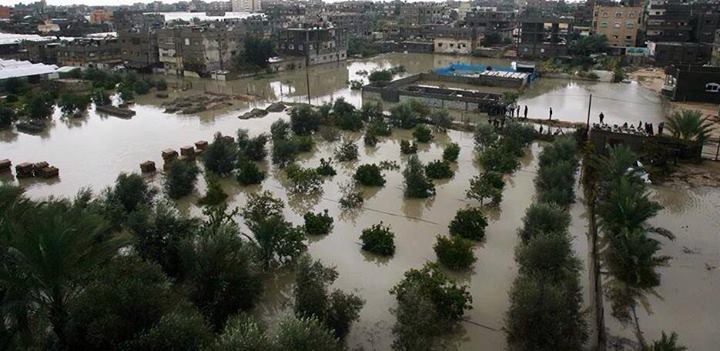
Ma’an – 13/12/2013
BETHLEHEM – The Gaza Government’s Disaster Response Committee announced late Friday that Israeli authorities had opened up dams just east of the Gaza Strip, flooding numerous residential areas in nearby villages within the coastal territory.
Committee chairman Yasser Shanti said in a press conference that Israeli authorities had opened up dams just to the east of the border with the Gaza Strip earlier in the day.
He warned that residential areas within the Gaza Valley would be flooding within the coming hours.
He said that the move by Israeli authorities would flood areas in Moghraqa and other parts of Deir el-Balah in central Gaza, and he called upon residents of areas near the Gaza Valley to evacuate their homes in preparation for the anticipated flooding.
The Gaza Strip is currently under a state of emergency due to severe weather conditions caused by a historic storm front moving south across the Levant.
Fuel shortages have caused daily life in the Gaza Strip to grind slowly to a halt since early November, as power plants and water pumps are forced to shut down, cutting off access to basic necessities for Gaza residents.
Lack of diesel fuel is a result of the tightening of a seven-year-long blockade imposed on the territory by Israel with Egyptian support.
The Gaza Strip has been under a severe economic blockade imposed by the State of Israel since 2006.
See also:
Palestine Information Center – 16/12/2013
GAZA — Israeli occupation forces opened on Sunday Wadi Sofa dam east of Rafah, south of the Gaza Strip, flooding dozens of Palestinian homes, local sources said.
The IOF opened its dams towards Palestinian houses without any prior warning for the second time since the stormy weather hit the region recently.
Rescue teams have evacuated trapped people from their flooded houses and transferred them to safe places and shelter centers.
Several Israeli earth dams have been established to the east of Gaza Strip, in order to benefit from rainwater and prevent its access to Gaza; however in such cases the Israeli occupation opens its dams toward the Strip to prevent swamping its agriculture lands.
Many residential areas and agricultural lands in Gaza were flooded when the Israeli authorities opened up the dams, which aggravated the population’s suffering. … Full article
Update:
By Richard Edmondson | Fig Trees and Vineyards | December 17, 2013
It has been reported in the past several days, by Ma’an News and on several websites including this one, that Israel may have opened one or more dams resulting in the severe flooding we have seen in Gaza and further exacerbated conditions already made dire by the onslaught of winter storm Alexa. This at any rate is the charge that has been made by the Gaza government’s Disaster Response Committee and its chairman, Yasser Shanti.
So far I myself have heard no official response from Israel either confirming or denying. However, the following is reported by the Middle East Monitor:
According to Israel’s Yedioth Ahronoth newspaper, the rainfall led to a lot of excess water which couldn’t drain away, so “the Israeli authorities resorted to discharging the excess water into the Gaza Strip.”
I could not find this reported on Ynet’s English website, but it’s possible it was reported in the Hebrew edition. So was a dam released? All we have to go on is the statement by Shanti, accompanied, of course, by the shocking images we have seen of inundated streets, flooded homes, and people paddling in boats. But I did come across this video and thought I would share it. If it turns out that a dam or floodgate of some sort was deliberately released, it apparently would not be without precedent. The following was reported by Press TV in January of 2010—and take special note of what the reporter says regarding the flooding and its coinciding with the one-year anniversary of the close of Israel’s Operation Cast Lead.
If Israel did this in 2010, does it beggar belief they would have done the same thing again this past week? If they did, the question then becomes did they do it out of a) a need to divert flooding from their own communities in Israel, or b) pure malice?
The question of whether a dam was opened or floodwater in some way diverted is addressed in a report on the Gaza flooding published at The Ecologist, an environmental website:
Amid the chaos it is impossible to verify the accusations. The heavy rain has also affected bordering areas of Israel and whether or not dams have been deliberately opened, drainage systems in Sderot and other cities were certainly overwhelmed by the volume of water.
What is certain is that low-lying Gaza, on the coastal plain, lacking functioning drainage and sewage systems, would in any case suffer most severely from the rainfall. Moreover Israel already stands accused of deliberately running down basic sanitation services in Gaza in order to make life unlivable for its residents.
And as Gaza resident Fidaa Abuassi points out: “Unlike their neighbors in Sderot Gaza’s refugees have nowhere to flee when heavy rains flood their 25-mile occupied territory, blockaded by land, air, and sea.”
Even as the floodwaters recede, there may be worse to come. The report warns of what most likely is an “impending health catastrophe” in the making, with a flare up of respiratory and skin diseases brought on by constant exposure to sewage water and lack of medical supplies.
Update #2
December 13, 2013 Posted by aletho | Ethnic Cleansing, Racism, Zionism, Subjugation - Torture, Timeless or most popular, Video | Deir al-Balah, Gaza, Israel, Palestine | Leave a comment
By Jonathon Cook | December 12, 2013
There’s a common mistaken assumption that Israelis’ hostility towards Palestinians and Arabs is based on a justified / deluded (take your choice) sense of the danger they pose. Israelis’ insecurity, it is often believed, derives from centuries of persecution of Jews around the world.
In reality, this is only a part of the story. There is also a deeply entrenched sense of separateness that comes both from the religion (the “chosen people” of Judaism) and from the lifestyle Jewish communities adopted in the face of persecution (e.g. the pales of settlement).
Reinvented by Zionism, the need for separation embodied by the Jewish state profoundly bolstered and exaggerated the kind of lingering legacy of “white racism” we find in western societies – the “model” for Ashkenazi Jews.
This was illustrated in a recent Haaretz feature about how the interior ministry grossly abuses non-Jewish spouses of Israelis when they try to naturalise.
It is also a prominent feature of Israel’s treatment of asylum seekers and foreign workers. Israel is barely better than a police state for these unfortunates.
But it also extends to Israeli Jews whom the wider society refuses to accept as “proper” Jews.
It is only with this background that one can make sense of the extraordinary story of a member of the Israeli parliament, Pnina Tamano-Shata, being treated as though she were a cross between a leper and the “kitchen help” at a recent blood donor drive run by the ambulance service at the parliament building.
Tamano-Shata’s problem is that she is black – an Ethiopian Jew. When she went to donate blood this week, alongside other MPs, she was rejected. The medics told her she had “the special kind of Jewish-Ethiopian blood”. When she insisted on speaking to the supervisor, she was told she could donate but the blood would not be used. The supervisor apparently added: “Sweetheart, don’t be insulted, you’re right but these are the Health Ministry’s directives.”
The directive tars a whole community with the idea that Ethiopian Jews are carriers of HIV.
Paradoxically, this long-standing practice of refusing blood blanket-fashion from Ethiopian Jews was what brought Tamano-Shata to public attention after she led a public campaign against it.
There has been lots of hand-wringing from government officials since the story went public. Health Minister Yael German said feebly in response, as though the government was powerless: “I find it absurd that in Israel of 2013, people of Ethiopian descent that came to Israel over 25 years ago can still not donate blood.”
But Ethiopians face myriad forms of discrimination. Not long ago, for example, it what Ethiopian women had been given long-term contraceptive injections, despite the known dangers, to try to stop them having more Ethiopian babies.
Perhaps, not surprisingly, it was left to a Palestinian MP in Israel, Ahmed Tibi, to make best sense of the events: “This is a disgraceful, racist decision. The Israeli society and its systems continue to be infected by the deadly virus of racism, aimed at times against Ethiopians and many other times against Arabs. Racism is racism is racism. I feel solidarity with MK Tamano-Shata.”
Sources
December 13, 2013 Posted by aletho | Ethnic Cleansing, Racism, Zionism, Timeless or most popular | Israel, Jews, Pnina Tamano-Shata, Tamano-Shata | Leave a comment
By Richard Hugus | January 11, 2009
In July 1980, American Indian Russell Means gave a speech at a gathering in the Paha Sapa (Black Hills) in the land of the Lakota (South Dakota). The title of the speech was “For America to Live, Europe Must Die”.1 In his speech, Means spoke to young Indians on the perils of European culture — particularly philosophies of European culture like Marxism and Christianity that appear to be for good things, like ending capitalism and loving one’s neighbor, but end up perpetuating the original problem — European culture itself and its destructive view of the world. Russell Means also spoke recently on the similarity between the genocide of the native Americans and the genocide of the Palestinians.2
Today the world watches helplessly while the Zionist entity slaughters the people of Gaza. This is nothing new — for the past 62 years, the world has watched massacre after massacre, attack after attack, and done nothing about it. In this latest atrocity, at least 900 Palestinians so far have been murdered from afar, with the Zionist’s US-supplied bombs and other weapons, and more weapons are on the way. No one who takes to the streets to denounce this barbarity is to be faulted, but protests taking place under slogans like “Let Gaza Live” seem to come from the same place that enabled the oppression of Palestine in the first place. Rather than pity the victim, why not stop the aggressor? Instead of “Let Gaza Live,” why not “Let Israel Die”? Pity for victims can go on forever; it’s high time to deal with the people who are beating that victim. And it’s time to do more for Palestinians than to just plea for them to be able to live.
The world has supplied relief to Gaza through such organizations as UNRWA for decades. Wouldn’t it have been much more effective to address the obvious cause of Gaza’s suffering at the source, when it began? Wouldn’t it have been better to drop all talk of peace with a belligerent who had proved again and again he wasn’t for peace, and forcibly take the gun out of his hands? Why hasn’t this happened? Why isn’t it happening now?
Perhaps the biggest reason is that this particular aggressor, though small in numbers, has been clever at deception, infiltration, and propaganda. Zionists have talked peace but waged war. They have infiltrated ruling elites in every strategically important country in the world — the US in particular. They have infiltrated the media, the entertainment industry, Wall Street, the government, the corporate power structure, human rights and civil liberties groups, and the antiwar left. They have infiltrated the places and communities where Judaism is observed, so that today one cannot go into a synagogue in the US without seeing the blue and white “Israeli” flag. At least 80% of Jewish people in the US either support the Zionist state or are afraid to criticize it. Yet to make an issue of this would be deemed a monstrous case of religious intolerance.
Judaism has been so thoroughly hijacked by Zionism that it is no longer clear where one ends and the other begins. At the end of December, a demonstration in Boston to condemn the just-begun bombing of Gaza was met with an almost equal number of supporters of the Zionist entity holding both the star of David and the stars and stripes. They carried signs saying “We Stand With Israel” and sang anthems for both “Israel” and the US. Well-established synagogues and temples have called for gatherings in support of the Zionist state even as the mass murder is carried out.
Support for Zionism is well integrated into US culture, itself built on the unacknowledged genocide its own indigenous people, and of the African slave. In such an environment the mainstream Jewish community is allowed to have it both ways — they can support one genocide, but they can’t be challenged because of their history as the victims of another genocide. One doesn’t accuse the authority on genocide with the same crime. This would be termed a “hate crime.” With its “No Place For Hate” programs in cities across the US, the Anti-Defamation League, which explicitly supports the Zionist state, has set itself up as the arbiter of any and all persecution and intolerance in American communities.
An even more effective tool of Zionism is its propaganda, built up over the period of 64 years since the end of World War II. This propaganda has elevated the victimhood of Jews at the hands of Nazi Germany to the level of religious belief, so that this genocide is the one above all others in history that counts. Not only must this go unquestioned, it is sacrilege (and now illegal) to do so. So it has come about that Jews who commit the same or worse crimes as the Nazis may do so with impunity. In the US and Europe, Christian guilt, Christian pity, and Christian forgiveness also make this possible. Zionists have exploited both Judaism and Christianity very thoroughly, especially attitudes of exceptionalism found in each religion.
For many people — and the numbers grow daily — the acts and atrocities of Zionism have completely burned up the credit that European Jews accrued in Nazi Germany. The holocaust is an old song that no one wants to hear any more. The victims of the Warsaw ghetto are now the perpetrators of the Gaza ghetto, and the massacre inside it.
The power that Zionists have achieved must be taken away from them, first morally, then physically. No one has a corner on suffering, even the eternal victim. Palestine must be returned to Palestinians, and the Zionist state, which was based on a crime and can only exist as a crime, must be condemned as a whole. For the killing to end, “Israel” has to go.
—
1. Transcript at http://www.dickshovel.com/Banks.html
2. See http://www.republicoflakotah.com/?p=692
December 12, 2013 Posted by aletho | Ethnic Cleansing, Racism, Zionism, Mainstream Media, Warmongering, Timeless or most popular, War Crimes | Gaza, Israel, Palestine, Russell Means, Zionism | Leave a comment
By Jay Knott | Dissident Voice | December 11, 2013
Note: throughout this review I refer to concepts like “racial oppression”, “Jewish supremacy” and so on. None of this is intended to imply that the concept “race” is meaningful, biologically or otherwise. Racial supremacy does not depend on the reality of race, but merely on the belief in it. Whether race is or is not meaningful is a completely separate question from whether Israel is an instance of racial supremacy. I cover this separate question in another article, Invention, Imagination, Race and Nation.
Max Blumenthal just had a book published, entitled Goliath: Life and Loathing in Greater Israel. He is a left-wing Jewish American journalist. The book assumes that the left/right political dichotomy is meaningful, not only in America, but in the Jewish state. He writes as if Israel can be reformed:
“The Nakba law was only one among a constantly expanding battery of racist and anti-democratic proposals pouring from the legislative offices onto the floor of the Knesset” (page 62).
“Israel’s very existence is threatened by fascism” (Uri Avnery, quoted sympathetically by Max Blumenthal on page 65, complaining about Jewish extremism undermining what is good about Israel).
“…the maintenance of a Jewish demographic majority is Israel’s national priority…” (page 42).
A national priority is something which can be changed. [it changed in south africa] But a Jewish majority is what Israel is.
My point (at least, in this review) is not to criticize reformism as such – normal Western countries can be, and are continually being, reformed. They are critical of their own histories, particularly in regard to racial oppression. Israel stands alone in its self-righteousness.The almost exclusive concern of organizations such as the Southern Poverty Law Center, radical anti-racist groups, and various academic departments, with “white racism”, tends to obscure this. Another article of mine, “The One-Sided View of Hate in Hate Studies,” goes into this question in more detail.
On several occasions in the book, the author criticizes the “settlements” in the “occupied territories” and the “right wing” Israeli politicians who support them. Taken seriously, this argument supports Israel’s fallback position — withdrawal to its 1967 frontiers, before it occupied the “occupied territories”. On page 273, he explains that liberal Zionists mislead us, by claiming that the “source of Israel’s crisis” is in 1967, with the occupation of the West Bank and other areas, rather than with the ethnic cleansing of 1948. But the Nakba was not the “source of Israel’s crisis” – it was the source of Israel!
The book is critical of what it calls Israeli “racism”, for example, on pages 18, 23, 39, 77, 135, 176, 247, 334 and 398. But what would it mean for a state, whose very definition of citizenship is membership of a particular “race”, regardless of geographical origin, leading to the expulsion of non-members of that “race”, who happen to be located within that state’s boundaries, to be “less racist”?
One area where Blumenthal argues there could be improvement, is the mistreatment of Israeli citizens of Palestinian Arab descent.
“…it is hard to find any Arab citizen who travels abroad by air and who has not experienced a discriminatory security check at least once” (page 39).
But, unlike equality for minorities in Western countries like the USA, equality for Israel’s Arab minority would make no difference to the basic fact that Israel, the Jewish state, is an implementation of imagined racial supremacy. They’re a minority because most of them were driven out.
In line with his effort to make Israel look like a Western society, Blumenthal lauds “feisty bands of Israeli radical leftists who had dedicated themselves to direct action against their country’s militaristic policies” (page 67) as if they are analogous to the anti-war movement in the USA. But the war in Vietnam really was a US policy, and that is why it could be changed. Ditto, US aggression in the Middle East. The imposition of Jewish supremacy is not an Israeli policy. It is what Israel is.
On page 116, he contrasts the left-wing shministim with right-wing “Israeli ultra-nationalists”. But what is an “ultra” nationalist in Israel? You either support Jewish power, or you don’t. Uri Avnery confuses the issue further by claiming that the “violence” of the “rightists” is the result of “brainwashing”.
“About fifty Jewish radical leftists brought up the rear of the protest [against a settlement], banging drums and chanting in Hebrew ‘Fascism will not pass!’” (page 50).
One of Blumenthal’s radicals left Israel and landed in London. No, it’s not Gilad Atzmon, whom the author explicitly repudiates. In contrast to Atzmon’s critique of Zionism and Jewish anti-Zionism, Blumenthal’s favorite joined “a radical counterculture” that was “transforming the Western world”, “successfully fusing anti-Zionism into the New Left’s broader struggle against colonialism” (page 265).
He’s right. Subordinating anti-Zionism to anti-racism, etc., has been very successful – in the sense of making it completely ineffective. As a result, the struggle against Zionism has been a complete failure – segregation and apartheid were ended, but Jewish supremacy in Palestine continues.
Blumenthal is, at best, ambiguous; he criticizes Israeli policies and politicians, and sometimes comes close to criticizing the entire project, but never once gets to the point – since the Western countries (the USA, Britain, France, etc.) have repudiated racial supremacy, and enforced compliance with that repudiation, and Israel is, by its very definition, based on racial supremacy, the Western countries should, if they follow their own standards, boycott Israel until it grants citizenship only to those born in Palestine, and those whose recent ancestors were born in Palestine, in other words, ceases to exist.
An example of this ambiguity is the first paragraph on page 74. It starts by saying there is not much to choose between the right and left wing Israeli parties, because they only differ in how to maintain the what he delicately calls the “Jewish demographic majority”. But the same paragraph ends:
In a society where maintaining the tyranny of the ethnic majority formed the underpinnings of national policy, there could be little wonder that an unapologetically supremacist party like Yisrael Beiteinu was able to consolidate a mainstream foothold in such a rapid fashion.
What does claiming the tyranny of the ethnic majority forms the underpinnings of national policy mean? Isn’t it just a roundabout way of saying that racial supremacy is what that nation is? In which case, why does it matter how unapologetic its parties are about their supremacy?
Blumenthal complicates and confuses the issue, but it’s quite simple. There are three major differences between South African apartheid and Israel. One is that, unlike apartheid, Israel exists. The second, is that Israel is Jewish. Finally, South Africa merely had to change its laws, but if Israel abandoned racial supremacy, it would no longer be the Jewish state. The complete contrast between the treatments of these two implementations of racial supremacy means that Jews have special rights in the Western world, and that white gentiles do not. It follows that opposing racial supremacy today therefore means, first and foremost, dismantling Jewish privilege, and that the “anti-racist” industry’s continuing emphasis on the critique of “white privilege” is, to put it charitably, a diversion.
How is Jewish privilege maintained? Blumenthal does briefly mention an example of president Obama having to grovel to the power of the American Jewish lobby on page 275, but only in passing, and with no attempt to help us understand how the organizations of a small ethnic minority can make the most powerful country in the world follow its interests.
~
Jay Knott wrote The Mass Psychology of Anti-Fascism.
December 12, 2013 Posted by aletho | Book Review, Deception, Ethnic Cleansing, Racism, Zionism, Solidarity and Activism, Timeless or most popular | Anti-Zionism, Gilad Atzmon, Israel, Max Blumenthal, Southern Poverty Law Center, United States, Zionism | Leave a comment

By Richard Edmondson | Fig Trees and Vineyards | December 11, 2013
It’s kind of one of those pictures that are “worth a thousand words,” don’t you think? What you’re looking at is Obama onstage with media mogul and Israeli dual national Haim Saban, who has stated previously, “I’m a one issue guy, and my issue is Israel.” The photo was taken last weekend at the Saban Forum, held in Washington. During the event Saban and Obama appeared together for what was billed as a “conversation” on the Middle East, but basically it was a one-on-one press conference—with Saban doing the grilling and Obama doing the answering. Do the facial expressions in the photo, the body language, suggest anything to you—like for instance which of the two figures is dominant and which is submissive?
Saban, of course, has lots of money. In 2002 he provided a $13 million grant which established the Saban Center for Middle East Policy, and which is part of the larger Brookings Institution think tank. Today he is a major funder of political candidates, particularly of the Democratic Party. You can go here and watch a 48-minute video of his “conversation” with Obama, which includes a few questions from the audience towards the end (all of the people selected to ask questions in that closing segment, coincidentally, happen to be Israelis). At one point, Saban jokingly remarks upon how “obedient” Obama is. A little later in the video, Obama states the following:
“The one thing I will say to the people of Israel is that you can be assured, whoever is in the office I currently occupy, Democrat or Republican, that your security will be uppermost on our minds. That will not change.”
Does it not strike you as a curious comment? Why would the security of a foreign nation be “uppermost” in the minds of the leaders of a supposedly sovereign country? But then maybe America is no longer a sovereign nation.
Obama indeed proves his “obedience” by never once bringing up Israel’s nuclear weapons. Much of the conversation is dominated by talk about Iran’s domestic nuclear energy program. The president at one point repeats the standard, stock-in-trade “options-on-the-table” remark—which in essence is nothing more than a threat to attack Iran—yet nowhere, in the entire 48-minute video, does the subject of Israel’s nuclear weapons come up.
A report on the Saban Forum was posted recently at the Mondoweiss blog. While the article mentions the “conversation” between Obama and Saban, much of the piece is devoted to the remarks of John Kerry, who delivered the keynote address for the event. Allison Deger, the author of the report, notes that Kerry expressed the view that Palestinians in the West Bank are deserving of “state institutions” (as opposed to an actual state) of their own, a comment which seems to have prompted Deger to draw the conclusion that “Palestinian statehood is not on the table in the current round of peace talks.” It is a not unreasonable conclusion to draw.
Kerry also referred to Palestinians as a “demographic time bomb” threatening to jeopardize Israel’s “future as a democratic, Jewish state”—apparently the secretary of state’s first public expression of concern over the so-called “demographic threat.” But perhaps most interesting is what Deger reports on comments by Israeli Foreign Minister Avigdor Lieberman, who also attended the event:
Even though Lieberman was amongst a crowd of Washington and Israeli officials familiar with his anti-Arab diatribes, audible gasps could be heard throughout the room when he called to expel Palestinian citizens of Israel. A diplomat from the Russian embassy seated next to me even choked. Another moment of discontent between the plated-dinner audience and Lieberman passed when the foreign minister made a forlorn pun at Sen. Joe Lieberman. Otherwise the foreign minister was amongst allies.
Much has been made of the recent bone of contention between Obama and Netanyahu over the negotiations with Iran, with some suggesting that the US president is beginning to assert himself and to defy the Israeli lobby on some key, important issues. Is it simply wishful thinking on the part of some commentators? I don’t pretend to know the answer to that, but if there was any note of defiance struck at last weekend’s Saban Forum, all I can say is it is extremely difficult to detect.
*
Update-12/11/13:
The following information on Saban comes from Wikipedia:
In March 2008, Saban was among a group of major Jewish donors to sign a letter to Democratic Party house leader Nancy Pelosi warning her to “keep out of the Democratic presidential primaries.” The donors, who “were strong supporters of Sen. Hillary Rodham Clinton presidential campaign”, “were incensed by a March 16 interview in which Pelosi said that party ‘superdelegates’ should heed the will of the majority in selecting a candidate.” The letter to Pelosi stated the donors “have been strong supporters of the DCCC” [Democratic Congressional Campaign Committee] and implied, according to The Jewish Telegraphic Agency, that Pelosi could lose their financial support in important upcoming congressional elections.
And also this:
Regarding Jane Harman AIPAC Controversy, in April 2009, New York Times, quoting anonymous sources, said a caller promised her that Saban would withhold campaign contributions to Representative Nancy Pelosi if she did not select Ms. Harman for the intelligence post.”
And additionally this:
Saban says his greatest concern is to protect Israel. At a conference in Israel, Saban described his formula. His three ways to influence American politics were: make donations to political parties, establish think tanks, and control media outlets.
December 12, 2013 Posted by aletho | Ethnic Cleansing, Racism, Zionism, Progressive Hypocrite, Timeless or most popular, Video, Wars for Israel | Haim Saban, Iran, Israel, John Kerry, Obama, Saban, Saban Center for Middle East Policy, Sanctions against Iran, United States, Zionism | Leave a comment
A Faustian Pact With Neoliberalism
By RONNIE KASRILS | CounterPunch | December 11, 2013
South Africa’s young people today are known as the Born Free generation. They enjoy the dignity of being born into a democratic society with the right to vote and choose who will govern. But modern South Africa is not a perfect society. Full equality – social and economic – does not exist, and control of the country’s wealth remains in the hands of a few, so new challenges and frustrations arise. Veterans of the anti-apartheid struggle like myself are frequently asked whether, in the light of such disappointment, the sacrifice was worth it. While my answer is yes, I must confess to grave misgivings: I believe we should be doing far better.
There have been impressive achievements since the attainment of freedom in 1994: in building houses, crèches, schools, roads and infrastructure; the provision of water and electricity to millions; free education and healthcare; increases in pensions and social grants; financial and banking stability; and slow but steady economic growth (until the 2008 crisis at any rate). These gains, however, have been offset by a breakdown in service delivery, resulting in violent protests by poor and marginalised communities; gross inadequacies and inequities in the education and health sectors; a ferocious rise in unemployment; endemic police brutality and torture; unseemly power struggles within the ruling party that have grown far worse since the ousting of Mbeki in 2008; an alarming tendency to secrecy and authoritarianism in government; the meddling with the judiciary; and threats to the media and freedom of expression. Even Nelson Mandela’s privacy and dignity are violated for the sake of a cheap photo opportunity by the ANC’s top echelon.
Most shameful and shocking of all, the events of Bloody Thursday – 16 August 2012 – when police massacred 34 striking miners at Marikana mine, owned by the London-based Lonmin company. The Sharpeville massacre in 1960 prompted me to join the ANC. I found Marikana even more distressing: a democratic South Africa was meant to bring an end to such barbarity. And yet the president and his ministers, locked into a culture of cover-up. Incredibly, the South African Communist party, my party of over 50 years, did not condemn the police either.
South Africa’s liberation struggle reached a high point but not its zenith when we overcame apartheid rule. Back then, our hopes were high for our country given its modern industrial economy, strategic mineral resources (not only gold and diamonds), and a working class and organised trade union movement with a rich tradition of struggle. But that optimism overlooked the tenacity of the international capitalist system. From 1991 to 1996 the battle for the ANC’s soul got under way, and was eventually lost to corporate power: we were entrapped by the neoliberal economy – or, as some today cry out, we “sold our people down the river”.
What I call our Faustian moment came when we took an IMF loan on the eve of our first democratic election. That loan, with strings attached that precluded a radical economic agenda, was considered a necessary evil, as were concessions to keep negotiations on track and take delivery of the promised land for our people. Doubt had come to reign supreme: we believed, wrongly, there was no other option; that we had to be cautious, since by 1991 our once powerful ally, the Soviet union, bankrupted by the arms race, had collapsed. Inexcusably, we had lost faith in the ability of our own revolutionary masses to overcome all obstacles. Whatever the threats to isolate a radicalising South Africa, the world could not have done without our vast reserves of minerals. To lose our nerve was not necessary or inevitable. The ANC leadership needed to remain determined, united and free of corruption – and, above all, to hold on to its revolutionary will. Instead, we chickened out. The ANC leadership needed to remain true to its commitment of serving the people. This would have given it the hegemony it required not only over the entrenched capitalist class but over emergent elitists, many of whom would seek wealth through black economic empowerment, corrupt practices and selling political influence.
To break apartheid rule through negotiation, rather than a bloody civil war, seemed then an option too good to be ignored. However, at that time, the balance of power was with the ANC, and conditions were favourable for more radical change at the negotiating table than we ultimately accepted. It is by no means certain that the old order, apart from isolated rightist extremists, had the will or capability to resort to the bloody repression envisaged by Mandela’s leadership. If we had held our nerve, we could have pressed forward without making the concessions we did.
It was a dire error on my part to focus on my own responsibilities and leave the economic issues to the ANC’s experts. However, at the time, most of us never quite knew what was happening with the top-level economic discussions. As Sampie Terreblanche has revealed in his critique, Lost in Transformation, by late 1993 big business strategies – hatched in 1991 at the mining mogul Harry Oppenheimer‘s Johannesburg residence – were crystallising in secret late-night discussions at the Development Bank of South Africa. Present were South Africa’s mineral and energy leaders, the bosses of US and British companies with a presence in South Africa – and young ANC economists schooled in western economics. They were reporting to Mandela, and were either outwitted or frightened into submission by hints of the dire consequences for South Africa should an ANC government prevail with what were considered ruinous economic policies.
All means to eradicate poverty, which was Mandela’s and the ANC’s sworn promise to the “poorest of the poor”, were lost in the process. Nationalisation of the mines and heights of the economy as envisaged by the Freedom charter was abandoned. The ANC accepted responsibility for a vast apartheid-era debt, which should have been cancelled. A wealth tax on the super-rich to fund developmental projects was set aside, and domestic and international corporations, enriched by apartheid, were excused from any financial reparations. Extremely tight budgetary obligations were instituted that would tie the hands of any future governments; obligations to implement a free-trade policy and abolish all forms of tariff protection in keeping with neo-liberal free trade fundamentals were accepted. Big corporations were allowed to shift their main listings abroad. In Terreblanche’s opinion, these ANC concessions constituted “treacherous decisions that [will] haunt South Africa for generations to come”.
An ANC-Communist party leadership eager to assume political office (myself no less than others) readily accepted this devil’s pact, only to be damned in the process. It has bequeathed an economy so tied in to the neoliberal global formula and market fundamentalism that there is very little room to alleviate the plight of most of our people.
Little wonder that their patience is running out; that their anguished protests increase as they wrestle with deteriorating conditions of life; that those in power have no solutions. The scraps that are left go to the emergent black elite; corruption has taken root as the greedy and ambitious fight like dogs over a bone.
In South Africa in 2008 the poorest 50% received only 7.8% of total income. While 83% of white South Africans were among the top 20% of income receivers in 2008, only 11% of our black population were. These statistics conceal unmitigated human suffering. Little wonder that the country has seen such an enormous rise in civil protest.
A descent into darkness must be curtailed. I do not believe the ANC alliance is beyond hope. There are countless good people in the ranks. But a revitalisation and renewal from top to bottom is urgently required. The ANC’s soul needs to be restored; its traditional values and culture of service reinstated. The pact with the devil needs to be broken.
At present the impoverished majority do not see any hope other than the ruling party, although the ANC’s ability to hold those allegiances is deteriorating. The effective parliamentary opposition reflects big business interests of various stripes, and while a strong parliamentary opposition is vital to keep the ANC on its toes, most voters want socialist policies, not measures inclined to serve big business interests, more privatisation and neoliberal economics.
This does not mean it is only up to the ANC, SACP and Cosatu to rescue the country from crises. There are countless patriots and comrades in existing and emerging organised formations who are vital to the process. Then there are the legal avenues and institutions such as the public protector’s office and human rights commission that – including the ultimate appeal to the constitutional court – can test, expose and challenge injustice and the infringement of rights. The strategies and tactics of the grassroots – trade unions, civic and community organisations, women’s and youth groups – signpost the way ahead with their non-violent and dignified but militant action.
The space and freedom to express one’s views, won through decades of struggle, are available and need to be developed. We look to the Born Frees as the future torchbearers.
Ronnie Kasrils was a member of the national executive committee of the African National Congress from 1987 to 2007, and a member of the central committee of the South African Communist party from December 1986 to 2007. He was the country’s minister for intelligence services from 2004 to 2008. This is an extract from the new introduction to his autobiography, Armed and Dangerous.
December 11, 2013 Posted by aletho | Corruption, Economics, Ethnic Cleansing, Racism, Zionism, Timeless or most popular | African National Congress, ANC, Mandela, Nelson Mandela, Sampie Terreblanche, Sharpeville massacre, South Africa | Leave a comment
By Ismail Salami | Press TV | December 11, 2013
There is no remission to Washington’s belligerence towards Iran and no deal seems to be an antidote to this venom of spite secreted out on the part of the US officials on a daily basis.
In a tone not unfamiliar to Iranian ears, US Defense Secretary Chuck Hagel on board the USS Ponce, just 120 miles off the coast of Iran once again reminded the military men that the “threat of US military force still exists even though the Obama administration is pursuing a six-month long diplomatic process with Iran to freeze its nuclear program.”
There was some hope that the nuclear deal between Iran and the six world powers would considerably alleviate the tensions on Iran, relieve the inhumane sanctions against the Iranian population and offset future internal and external attempts directed at imposing more illegal sanctions against the Islamic Republic.
However, the sanctions are not only still in place but there is also a perceptibly powerful force at work in Washington to intensify the sanctions that have already taken human toll in Iran.
According to reports, the Democratic chairman of the Senate Foreign Relations Committee, Robert Menendez, and Republican Senator Mark Kirk are on the verge of “agreeing on legislation that would target Iran’s remaining oil exports, foreign exchange reserves and strategic industries.”
Widely considered the major engineers of the anti-Iran sanctions, these two senators are at the beck and call of the Zionists and their efforts are certainly aimed at gratifying their Iranophobic desires.
Quite naturally, Iran’s Foreign Minister Javad Zarif has warned Washington of imposing new sanctions as they would definitely kill the nuclear deal.
A top Republican Senate aide has told Reuters that the legislation is “an insurance policy to protect against Iranian deception.”
Time and again, Sen. Robert Menendez has proved to be cravenly submissive to Tel Aviv and has frequently warned Washington of the impending danger Iran poses towards the entity. For instance, in September, he recklessly said that Iran and Hezbollah “could possibly” strike Israel.
“The Iranians and Hezbollah… ultimately could possibly strike against neighbors in the region, including our ally, the state of Israel.”
Apart from playing an extremely effective role in imposing sanctions on Iran, he has resorted to any brute means to instill a sense of threat and phobia about Iran.
Also, in his AIPAC address, he clearly said that he would make every endeavor to safeguard the interests of Israel.
“The committee has helped every American president, from Harry Truman to Barack Obama, protect and defend our fundamental promise to stand with Israel and the Israeli people in a strong and lasting and enduring alliance. And as chairman, I can say without hesitation I will keep that promise as I always have. There will never be any daylight between the United States and Israel on my watch. Never. Not on my watch.”
Prominent among his numerous political hunger games are designing anti-Iran sanctions after sanctions under the aegis of Tel Aviv, authorizing the US President the use of military force in Afghanistan and his refusal to vote against the Iraq Resolution, which terminated in an invasion of Iraq.
In this diabolical league comes in Sen. Mark Kirk, who tries in a similar way to disseminate fear of Iran in the world. During an invitation-only phone briefing for supporters, Kirk said, “It’s the reason why I ran for the Senate, [it] is all wrapped up in this battle. I am totally dedicated to the survival of the state of Israel in the 21st century. This has been very much a one-senator show, unfortunately.”
After all, Sen. Mark Kirk is a darling of the Zionists. In 2002, when he was still home recovering from a stroke that incapacitated him from making an appearance at AIPAC, Israeli Prime Minister Benjamin Netanyahu voiced his “sincere request” during his keynote and said, “I want to send a special message to a great friend of Israel who is not here tonight: Senator Mark Kirk, the co-author of the Kirk-Menendez Iran Sanctions Act. Senator Kirk, I know you’re watching this tonight. Please get well soon. America needs you; Israel needs you. I send you wishes for a speedy recovery. So get well and get back to work.”
Indeed it is not hard to imagine that these well-financed marionette-handlers in Washington are playing in the hands of Tel Aviv to advance their ultimate goals regarding Iran, which is clearly regime change. As time passes and realities come to surface, one acquires conviction that the rift that keeps deepening more and more between Iran and the West has nothing to do with a West concerned about Iran’s intention in trying to build a nuclear bomb; rather, it is an ulterior motive long cherished and shaped by the West and the Zionists: uprooting a tree of truth.
The confrontational attitude of these senators against Iran and the unfortunate and powerful sway they exercise on the powers-that-be in America leave no room for optimism in restructuring a politically correct attitude on the part of Washington towards Iran.
Be that as it may, global awakening is on the horizon. Manipulation of public opinion has run its course. Distorting the realities on the ground is a threadbare ploy. It is now generally acknowledged that the West’s narrative on Iran’s intention to produce nuclear weapons is but a thumping big lie and a fairy tale forcefully woven into the warps and wefts of public opinion. Indeed, it is, in Shakespeare’s words, “a tale told by an idiot full of sound and fury signifying nothing.”
December 11, 2013 Posted by aletho | Ethnic Cleansing, Racism, Zionism, Timeless or most popular, Wars for Israel | Iran, Israel, Mark Kirk, Sanctions against Iran, United States, Zionism | Leave a comment
By Robert Parry | Consortium News | December 9, 2013
Nearly a decade before Gary Webb published his investigative series on cocaine trafficking by Nicaraguan Contra rebels, U.S. law enforcement received a detailed account of top Contra leader Adolfo Calero casually associating with Norwin Meneses, called “a well-reputed drug dealer” in a “secret” document that I recently found at the National Archives.
Meneses was near the center of Webb’s 1996 articles for the San Jose Mercury-News, a series that came under fierce attack from U.S. government officials as well as major news organizations, including the New York Times, the Washington Post and the Los Angeles Times. The controversy cost Webb his career, left him nearly penniless and ultimately contributed to his suicide on Dec. 9, 2004.
But the bitter irony of Webb’s demise, which will be the subject of a 2014 movie starring Jeremy Renner as Webb, is that Webb’s much-maligned “Dark Alliance” series forced major admissions from the CIA, the Justice Department and other government agencies revealing an even-deeper relationship between President Ronald Reagan’s beloved Contras and drug cartels than Webb ever alleged.
Typical of the evidence that the Reagan administration chose to ignore was information provided by Dennis Ainsworth, a blue-blood Republican from San Francisco who volunteered to help the Contra cause in 1984-85. That put him in position to witness the strange behind-the-scenes activities of Contra leaders hobnobbing with drug traffickers and negotiating arms deals with White House emissaries.
Ainsworth also was a source of mine in fall 1985 when I was investigating the mysterious sources of funding for the Contras after Congress shut off CIA support in 1984 amid widespread reports of Contra atrocities inflicted on Nicaraguan civilians, including rapes, executions and torture.
Ainsworth’s first-hand knowledge of the Contra dealings dovetailed with information that I already had, such as the central role of National Security Council aide Oliver North in aiding the Contras and his use of “courier” Rob Owen as an off-the-books White House intermediary to the Contras. I later developed confirmation of some other details that Ainsworth described, such as his overhearing Owen and Calero working together on an arms deal as Ainsworth drove them through the streets of San Francisco.
As for Ainsworth’s knowledge about the Contra-cocaine connection, he said he sponsored a June 1984 cocktail party at which Calero spoke to about 60 people. Meneses, a notorious drug kingpin in the Nicaraguan community, showed up uninvited and clearly had a personal relationship with Calero, who was then the political leader of the Contra’s chief fighting force, the CIA-backed Nicaraguan Democratic Force (or FDN).
“At the end of the cocktail party, Meneses and Calero went off together,” Ainsworth told U.S. Attorney Joseph P. Russoniello, according to a “secret” Jan. 6, 1987 cable submitted by Russoniello to an FBI investigation code-named “Front Door,” a probe into corruption by the Reagan administration.
After Calero’s speech, Ainsworth said Meneses accompanied Calero and about 20 people to dinner and picked up the entire tab, according to a more detailed debriefing of Ainsworth by the FBI. Concerned about this relationship, Ainsworth said he was told by Renato Pena, an FDN leader in the San Francisco area, that “the FDN is involved in drug smuggling with the aid of Norwin Meneses who also buys arms for Enrique Bermudez, a leader of the FDN.” Bermudez was then the top Contra military commander.
Corroborating Account
Pena, who himself was convicted on federal drug charges in 1984, gave a similar account to the Drug Enforcement Administration. According to a 1998 report by the Justice Department’s Inspector General Michael Bromwich, “When debriefed by the DEA in the early 1980s, Pena said that the CIA was allowing the Contras to fly drugs into the United States, sell them, and keep the proceeds. …
“Pena stated that he was present on many occasions when Meneses telephoned Bermudez in Honduras. Meneses told Pena of Bermudez’s requests for such things as gun silencers (which Pena said Meneses obtained in Los Angeles), cross bows, and other military equipment for the Contras. Pena believed that Meneses would sometimes transport certain of these items himself to Central America, and other times would have contacts in Los Angeles and Miami send cargo to Honduras, where the authorities were cooperating with the Contras. Pena believed Meneses had contact with Bermudez from about 1981 or 1982 through the mid-1980s.”
Bromwich’s report then added, “Pena said he was one of the couriers Meneses used to deliver drug money to a Colombian known as ‘Carlos’ in Los Angeles and return to San Francisco with cocaine. Pena made six to eight trips, with anywhere from $600,000 to nearly $1 million, and brought back six to eight kilos of cocaine each time. Pena said Meneses was moving hundreds of kilos a week. ‘Carlos’ once told Pena, ‘We’re helping your cause with this drug thing … we are helping your organization a lot.”
Ainsworth also said he tried to alert Oliver North in 1985 about the troubling connections between the Contra movement and cocaine traffickers but that North turned a deaf ear. “In the spring some friends of mine and I went back to the White House staff but we were put off by Ollie North and others on the staff who really don’t want to know all what’s going on,” Ainsworth told Russoniello.
When I first spoke with Ainsworth in September 1985 at a coffee shop in San Francisco, he asked for confidentiality which I granted. However, since the documents released by the National Archives include him describing his conversations with me, that confidentiality no longer applies. Ainsworth also spoke with Webb for his 1996 San Jose Mercury-News series under the pseudonym “David Morrison.”
Though I found Ainsworth to be generally reliable, some of his depictions of our conversations contained mild exaggerations or confusion over details, such as his claim that I called him from Costa Rica in January 1986 and told him that the Contra-cocaine story that I had been working on with my AP colleague Brian Barger “never hit the papers because it was suppressed by the Associated Press due to political pressure primarily from the CIA.”
In reality, Barger and I returned from Costa Rica in fall 1985, wrote our story about the Contras’ involvement in cocaine smuggling, and pushed it onto the AP wire in December though in a reduced form because of resistance from some senior AP news executives who were supportive of President Reagan’s foreign policies. The CIA, the White House and other agencies of the Reagan administration did seek to discredit our story, but they did not prevent its publication.
An Overriding Hostility
The Reagan administration’s neglect of Ainsworth’s insights reflected the overriding hostility toward any information – even from Republican activists – that put the Contras in a negative light. In early 1987, when Ainsworth spoke with U.S. Attorney Russoniello and the FBI, the Reagan administration was in full damage-control mode, trying to tamp down the Iran-Contra disclosures about Oliver North diverting profits from secret arms sales to Iran to the Contra war.
Fears that the Iran-Contra scandal could lead to Reagan’s impeachment made it even less likely that the Justice Department would pursue an investigation into drug ties implicating the Contra leadership. Ainsworth’s information was simply passed on to Independent Counsel Lawrence Walsh whose inquiry was already overwhelmed by the task of sorting out the convoluted Iran transactions.
Publicly, the Reagan team continued dumping on the Contra-cocaine allegations and playing the find-any-possible-reason-to-reject-a-witness game. The major news media went along, leading to much mainstream ridicule of a 1989 investigative report by Sen. John Kerry, D-Massachusetts, who uncovered more drug connections implicating the Contras and the Reagan administration.
Only occasionally, such as when the George H.W. Bush administration needed witnesses to convict Panamanian dictator Manuel Noriega did the Contra-cocaine evidence pop onto Official Washington’s radar screens.
During Noriega’s drug-trafficking trial in 1991, U.S. prosecutors called as a witness Colombian Medellín cartel kingpin Carlos Lehder, who — along with implicating Noriega — testified that the cartel had given $10 million to the Contras, an allegation first unearthed by Sen. Kerry. “The Kerry hearings didn’t get the attention they deserved at the time,” a Washington Post editorial on Nov. 27, 1991, acknowledged. “The Noriega trial brings this sordid aspect of the Nicaraguan engagement to fresh public attention.”
But the Post offered its readers no explanation for why Kerry’s hearings had been largely ignored, with the Post itself a leading culprit in this journalistic misfeasance. Nor did the Post and the other leading newspapers use the opening created by the Noriega trial to do anything to rectify their past neglect.
Everything quickly returned to the status quo in which the desired perception of the noble Contras trumped the clear reality of their criminal activities. Instead of recognizing the skewed moral compass of the Reagan administration, Congress was soon falling over itself to attach Reagan’s name to as many public buildings and facilities as possible, including Washington’s National Airport.
Meanwhile, those of us in journalism who had exposed the national security crimes of the 1980s saw our careers mostly sink or go sideways. We were regarded as “pariahs” in our profession.
As for me, shortly after the Iran-Contra scandal broke wide open in fall 1986, I accepted a job at Newsweek, one of the many mainstream news outlets that had long ignored Contra-connected scandals and briefly thought it needed to bolster its coverage. But I soon discovered that senior editors remained hostile toward the Iran-Contra story and related spinoff scandals, including the Contra-cocaine mess.
After losing battle after battle with my Newsweek editors, I departed the magazine in June 1990 to write a book (called Fooling America) about the decline of the Washington press corps and the parallel rise of a new generation of government propagandists.
I was also hired by PBS Frontline to investigate whether there had been a prequel to the Iran-Contra scandal — whether those arms-for-hostage deals in the mid-1980s had been preceded by contacts between Reagan’s 1980 campaign staff and Iran, which was then holding 52 Americans hostage and essentially destroying Jimmy Carter’s reelection hopes. [For more on that topic, see Robert Parry’s Secrecy & Privilege and America’s Stolen Narrative.]
Finding New Ways
In 1995, frustrated by the growing triviality of American journalism — and acting on the advice of and with the assistance of my oldest son Sam — I turned to a new medium and launched the Internet’s first investigative news magazine, known as Consortiumnews.com. The Web site became a way for me to put out well-reported stories that my former mainstream colleagues ignored or mock.
So, when Gary Webb called me in 1996 to talk about the Contra-cocaine story, I explained some of this tortured history and urged him to make sure that his editors were firmly behind him. He sounded perplexed at my advice and assured me that he had the solid support of his editors.
When Webb’s “Dark Alliance” series finally appeared in late August 1996, it initially drew little attention. The major national news outlets applied their usual studied indifference to a topic that they had already judged unworthy of serious attention.
But Webb’s story proved hard to ignore. First, unlike the work that Barger and I did for AP in the mid-1980s, Webb’s series wasn’t just a story about drug traffickers in Central America and their protectors in Washington. It was about the on-the-ground consequences, inside the United States, of that drug trafficking, how the lives of Americans were blighted and destroyed as the collateral damage of a U.S. foreign policy initiative.
In other words, there were real-life American victims, and they were concentrated in African-American communities. That meant the ever-sensitive issue of race had been injected into the controversy. Anger from black communities spread quickly to the Congressional Black Caucus, which started demanding answers.
Secondly, the San Jose Mercury News, which was the local newspaper for Silicon Valley, had posted documents and audio on its state-of-the-art Internet site. That way, readers could examine much of the documentary support for the series.
It also meant that the traditional “gatekeeper” role of the major newspapers — the New York Times, the Washington Post, and the Los Angeles Times — was under assault. If a regional paper like the Mercury News could finance a major journalistic investigation like this one, and circumvent the judgments of the editorial boards at the Big Three, then there might be a tectonic shift in the power relations of the U.S. news media. There could be a breakdown of the established order.
This combination of factors led to the next phase of the Contra-cocaine battle: the “get-Gary-Webb” counterattack. Soon, the Washington Post, the New York Times, and the Los Angeles Times were lining up like some tag-team wrestlers taking turns pummeling Webb and his story.
On Oct. 4, 1996, the Washington Post published a front-page article knocking down Webb’s series, although acknowledging that some Contra operatives did help the cocaine cartels. The Post’s approach fit with the Big Media’s cognitive dissonance on the topic: first, the Post called the Contra-cocaine allegations old news — “even CIA personnel testified to Congress they knew that those covert operations involved drug traffickers,” the Post said — and second, the Post minimized the importance of the one Contra smuggling channel that Webb had highlighted in his series, saying it had not “played a major role in the emergence of crack.”
To add to the smug hoo-hah treatment that was enveloping Webb and his story, a Post published a sidebar story dismissing African-Americans as prone to “conspiracy fears.”
Next, the New York Times and the Los Angeles Times weighed in with lengthy articles castigating Webb and “Dark Alliance.” The big newspapers made much of the CIA’s internal reviews in 1987 and 1988 — almost a decade earlier — that supposedly had cleared the spy agency of any role in Contra-cocaine smuggling.
But the first ominous sign for the CIA’s cover-up emerged on Oct. 24, 1996, when CIA Inspector General Frederick Hitz conceded before the Senate Intelligence Committee that the first CIA probe had lasted only12 days, and the second only three days. He promised a more thorough review.
Mocking Webb
But Webb had already crossed over from being treated as a serious journalist to becoming a target of ridicule. Influential Washington Post media critic Howard Kurtz mocked Webb for saying in a book proposal that he would explore the possibility that the Contra war was primarily a business to its participants. “Oliver Stone, check your voice mail,” Kurtz smirked.
Yet, Webb’s suspicion was no conspiracy theory. Indeed, Oliver North’s chief Contra emissary, Rob Owen, had made the same point in a March 17, 1986, message about the Contra leadership. “Few of the so-called leaders of the movement . . . really care about the boys in the field,” Owen wrote. “THIS WAR HAS BECOME A BUSINESS TO MANY OF THEM.” [Emphasis in original.]
Ainsworth and other pro-Contra activists were reaching the same conclusion, that the Contra leadership was skimming money from the supply lines and padding their personal wealth with proceeds from the drug trade. According to a Jan. 21, 1987 interview report by the FBI, Ainsworth said he had “made inquiries in the local San Francisco Nicaraguan community and wondered among his acquaintances what Adolfo Calero and the other people in the FDN movement were doing and the word that he received back is that they were probably engaged in cocaine smuggling.”
In other words, Webb was right about the suspicion that the Contra movement had become less a cause than a business to many of its participants. Even Oliver North’s emissary reported that many Contra leaders treated the conflict as “a business.” But accuracy had ceased to be relevant in the media’s hazing of Gary Webb.
In another double standard, while Webb was held to the strictest standards of journalism, it was entirely all right for Kurtz — the supposed arbiter of journalistic integrity who was a longtime fixture on CNN’s “Reliable Sources” — to make judgments based on ignorance. Kurtz would face no repercussions for mocking a fellow journalist who was factually correct.
The Big Three’s assault — combined with their disparaging tone — had a predictable effect on the executives of the Mercury News. As it turned out, Webb’s confidence in his editors had been misplaced. By early 1997, executive editor Jerry Ceppos, who had his own corporate career to worry about, was in retreat.
On May 11, 1997, Ceppos published a front-page column saying the series “fell short of my standards.” He criticized the stories because they “strongly implied CIA knowledge” of Contra connections to U.S. drug dealers who were manufacturing crack cocaine. “We did not have enough proof that top CIA officials knew of the relationship,” Ceppos wrote.
Ceppos was wrong about the proof, of course. At AP, before we published our first Contra-cocaine article in 1985, Barger and I had known that the CIA and Reagan’s White House were aware of the Contra-cocaine problem at senior levels.
However, Ceppos recognized that he and his newspaper were facing a credibility crisis brought on by the harsh consensus delivered by the Big Three, a judgment that had quickly solidified into conventional wisdom throughout the major news media and inside Knight-Ridder, Inc., which owned the Mercury News. The only career-saving move – career-saving for Ceppos even if career-destroying for Webb – was to jettison Webb and the Contra-cocaine investigative project.
A ‘Vindication’
The big newspapers and the Contras’ defenders celebrated Ceppos’s retreat as vindication of their own dismissal of the Contra-cocaine stories. In particular, Kurtz seemed proud that his demeaning of Webb now had the endorsement of Webb’s editor. Ceppos next pulled the plug on the Mercury News’ continuing Contra-cocaine investigation and reassigned Webb to a small office in Cupertino, California, far from his family. Webb resigned from the paper in disgrace.
For undercutting Webb and other Mercury News reporters working on the Contra-cocaine project – some of whom were facing personal danger in Central America – Ceppos was lauded by the American Journalism Review and received the 1997 national Ethics in Journalism Award by the Society of Professional Journalists.
While Ceppos won raves, Webb watched his career collapse and his marriage break up. Still, Gary Webb had set in motion internal government investigations that would bring to the surface long-hidden facts about how the Reagan administration had conducted the Contra war.
The CIA published the first part of Inspector General Hitz’s findings on Jan. 29, 1998. Though the CIA’s press release for the report criticized Webb and defended the CIA, Hitz’s Volume One admitted that not only were many of Webb’s allegations true but that he actually understated the seriousness of the Contra-drug crimes and the CIA’s knowledge of them.
Hitz conceded that cocaine smugglers played a significant early role in the Contra movement and that the CIA intervened to block an image-threatening 1984 federal investigation into a San Francisco–based drug ring with suspected ties to the Contras, the so-called “Frogman Case.”
After Volume One was released, I called Webb (whom I had spent some time with since his series was published). I chided him for indeed getting the story “wrong.” He had understated how serious the problem of Contra-cocaine trafficking had been.
It was a form of gallows humor for the two of us, since nothing had changed in the way the major newspapers treated the Contra-cocaine issue. They focused only on the press release that continued to attack Webb, while ignoring the incriminating information that could be found in the full report. All I could do was highlight those admissions at Consortiumnews.com, which sadly had a much, much smaller readership than the Big Three.
The major U.S. news media also looked the other way on other startling disclosures.
On May 7, 1998, for instance, Rep. Maxine Waters, a California Democrat, introduced into the Congressional Record a Feb. 11, 1982 letter of understanding between the CIA and the Justice Department. The letter, which had been requested by CIA Director William Casey, freed the CIA from legal requirements that it must report drug smuggling by CIA assets, a provision that covered the Nicaraguan Contras and the Afghan mujahedeen.
In other words, early in those two covert wars, the CIA leadership wanted to make sure that its geopolitical objectives would not be complicated by a legal requirement to turn in its client forces for drug trafficking.
Justice Denied
The next break in the long-running Contra-cocaine cover-up was a report by the Justice Department’s Inspector General Michael Bromwich. Given the hostile climate surrounding Webb’s series, Bromwich’s report also opened with criticism of Webb. But, like the CIA’s Volume One, the contents revealed new details about serious government wrongdoing.
According to evidence cited by Bromwich, the Reagan administration knew almost from the outset of the Contra war that cocaine traffickers permeated the paramilitary operation. The administration also did next to nothing to expose or stop the crimes. Bromwich’s report revealed example after example of leads not followed, corroborated witnesses disparaged, official law-enforcement investigations sabotaged, and even the CIA facilitating the work of drug traffickers.
The report showed that the Contras and their supporters ran several parallel drug-smuggling operations, not just the one at the center of Webb’s series. The report also found that the CIA shared little of its information about Contra drugs with law-enforcement agencies and on three occasions disrupted cocaine-trafficking investigations that threatened the Contras.
As well as depicting a more widespread Contra-drug operation than Webb had understood, the Justice Department report provided some important corroboration about Nicaraguan drug smuggler Norwin Meneses, a key figure in Gary Webb’s series and Adolfo Calero’s friend as described by Dennis Ainsworth.
Bromwich cited U.S. government informants who supplied detailed information about Meneses’s drug operation and his financial assistance to the Contras. For instance, Renato Pena, the money-and-drug courier for Meneses, said that in the early 1980s the CIA allowed the Contras to fly drugs into the United States, sell them, and keep the proceeds. Pena, the FDN’s northern California representative, said the drug trafficking was forced on the Contras by the inadequate levels of U.S. government assistance.
The Justice Department report also disclosed repeated examples of the CIA and U.S. embassies in Central America discouraging DEA investigations, including one into Contra-cocaine shipments moving through the international airport in El Salvador. Bromwich said secrecy trumped all. “We have no doubt that the CIA and the U.S. Embassy were not anxious for the DEA to pursue its investigation at the airport,” he wrote.
Bromwich also described the curious case of how a DEA pilot helped a CIA asset escape from Costa Rican authorities in 1989 after the man, American farmer John Hull, had been charged in connection with Contra-cocaine trafficking. [See Consortiumnews.com’s “John Hull’s Great Escape.”]
Hull’s ranch in northern Costa Rica had been the site of Contra camps for attacking Nicaragua from the south. For years, Contra-connected witnesses also said Hull’s property was used for the transshipment of cocaine en route to the United States, but those accounts were brushed aside by the Reagan administration and disparaged in major U.S. newspapers.
Yet, according to Bromwich’s report, the DEA took the accounts seriously enough to prepare a research report on the evidence in November 1986. One informant described Colombian cocaine off-loaded at an airstrip on Hull’s ranch.
The drugs were then concealed in a shipment of frozen shrimp and transported to the United States. The alleged Costa Rican shipper was Frigorificos de Puntarenas, a firm controlled by Cuban-American Luis Rodriguez. Like Hull, however, Frigorificos had friends in high places. In 1985-86, the State Department had selected the shrimp company to handle $261,937 in non-lethal assistance earmarked for the Contras.
Hull also remained a man with powerful protectors. Even after Costa Rican authorities brought drug charges against him, influential Americans, including Rep. Lee Hamilton, D-Indiana, demanded that Hull be let out of jail pending trial. Then, in July 1989 with the help of a DEA pilot – and possibly a DEA agent – Hull managed to fly out of Costa Rica to Haiti and then to the United States.
Despite these startling new disclosures, the big newspapers still showed no inclination to read beyond the criticism of Webb in the press release.
Major Disclosures
By fall 1998, Washington was obsessed with President Bill Clinton’s Monica Lewinsky sex scandal, which made it easier to ignore even more stunning Contra-cocaine disclosures in the CIA’s Volume Two, published on Oct. 8, 1998.
In the report, CIA Inspector General Hitz identified more than 50 Contras and Contra-related entities implicated in the drug trade. He also detailed how the Reagan administration had protected these drug operations and frustrated federal investigations throughout the 1980s.
According to Volume Two, the CIA knew the criminal nature of its Contra clients from the start of the war against Nicaragua’s leftist Sandinista government. The earliest Contra force, called the Nicaraguan Revolutionary Democratic Alliance (ADREN) or the 15th of September Legion, had chosen “to stoop to criminal activities in order to feed and clothe their cadre,” according to a June 1981 draft of a CIA field report.
According to a September 1981 cable to CIA headquarters, two ADREN members made the first delivery of drugs to Miami in July 1981. ADREN’s leaders included Enrique Bermúdez and other early Contras who would later direct the major Contra army, the CIA-organized FDN which was based in Honduras, along Nicaragua’s northern border.
Throughout the war, Bermúdez remained the top Contra military commander. The CIA later corroborated the allegations about ADREN’s cocaine trafficking, but insisted that Bermúdez had opposed the drug shipments to the United States that went ahead nonetheless.
The truth about Bermúdez’s supposed objections to drug trafficking, however, was less clear. According to Hitz’s Volume One, Bermúdez enlisted Norwin Meneses – the Nicaraguan cocaine smuggler, the friend of Adolfo Calero, and a key figure in Webb’s series – to raise money and buy supplies for the Contras.
Volume One had quoted another Nicaraguan trafficker, Danilo Blandón, a Meneses associate (and another lead character in Webb’s series), as telling Hitz’s investigators that he (Blandón) and Meneses flew to Honduras to meet with Bermúdez in 1982. At the time, Meneses’s criminal activities were well-known in the Nicaraguan exile community, but Bermúdez told the cocaine smugglers that “the ends justify the means” in raising money for the Contras.
After the Bermúdez meeting, Meneses and Blandón were briefly arrested by Honduran police who confiscated $100,000 that the police suspected was to be a payment for a drug transaction. The Contras intervened, gained freedom for the two traffickers and got them their money back by saying the cash, which indeed was for a cocaine purchase in Bolivia, belonged to the Contras.
There were other indications of Bermúdez’s drug-smuggling complicity. In February 1988, another Nicaraguan exile linked to the drug trade accused Bermúdez of participation in narcotics trafficking, according to Hitz’s report. After the Contra war ended, Bermúdez returned to Managua, Nicaragua, where he was shot to death on Feb. 16, 1991. The murder has never been solved.
The Southern Front
Along the Southern Front, the Contras’ military operations in Costa Rica on Nicaragua’s southern border, the CIA’s drug evidence centered on the forces of Edén Pastora, another top Contra commander. But Hitz discovered that the U.S. government may have made the drug situation worse, not better.
Hitz revealed that the CIA put an admitted drug operative — known by his CIA pseudonym “Ivan Gomez” — in a supervisory position over Pastora. Hitz reported that the CIA discovered Gomez’s drug history in 1987 when Gomez failed a security review on drug-trafficking questions.
In internal CIA interviews, Gomez admitted that in March or April 1982, he helped family members who were engaged in drug trafficking and money laundering. In one case, Gomez said he assisted his brother and brother-in-law transporting cash from New York City to Miami. He admitted he “knew this act was illegal.”
Later, Gomez expanded on his admission, describing how his family members had fallen $2 million into debt and had gone to Miami to run a money-laundering center for drug traffickers. Gomez said “his brother had many visitors whom [Gomez] assumed to be in the drug trafficking business.” Gomez’s brother was arrested on drug charges in June 1982. Three months later, in September 1982, Gomez started his CIA assignment in Costa Rica.
Years later, convicted drug trafficker Carlos Cabezas alleged that in the early 1980s, Ivan Gomez was the CIA agent in Costa Rica who was overseeing drug-money donations to the Contras. Gomez “was to make sure the money was given to the right people [the Contras] and nobody was taking . . . profit they weren’t supposed to,” Cabezas stated publicly.
But the CIA sought to discredit Cabezas at the time because he had trouble identifying Gomez’s picture and put Gomez at one meeting in early 1982 before Gomez started his CIA assignment. While the CIA was able to fend off Cabezas’s allegations by pointing to these discrepancies, Hitz’s report revealed that the CIA was nevertheless aware of Gomez’s direct role in drug-money laundering, a fact the agency hid from Sen. Kerry in his investigation during the late 1980s.
There was also more to know about Gomez. In November 1985, the FBI learned from an informant that Gomez’s two brothers had been large-scale cocaine importers, with one brother arranging shipments from Bolivia’s infamous drug kingpin Roberto Suarez.
Suarez already was known as a financier of right-wing causes. In 1980, with the support of Argentina’s hard-line anticommunist military regime, Suarez bankrolled a coup in Bolivia that ousted the elected left-of-center government. The violent putsch became known as the Cocaine Coup because it made Bolivia the region’s first narco-state.
By protecting cocaine shipments headed north, Bolivia’s government helped transform Colombia’s Medellín cartel from a struggling local operation into a giant corporate-style business for delivering vast quantities of cocaine to the U.S. market.
Flush with cash in the early 1980s, Suarez invested more than $30 million in various right-wing paramilitary operations, including the Contra forces in Central America, according to U.S. Senate testimony by an Argentine intelligence officer, Leonardo Sanchez-Reisse.
In 1987, Sanchez-Reisse said the Suarez drug money was laundered through front companies in Miami before going to Central America. There, other Argentine intelligence officers — veterans of the Bolivian coup — trained the Contras in the early 1980s, even before the CIA arrived to first assist with the training and later take over the Contra operation from the Argentines.
Inspector General Hitz added another piece to the mystery of the Bolivian-Contra connection. One Contra fund-raiser, Jose Orlando Bolanos, boasted that the Argentine government was supporting his Contra activities, according to a May 1982 cable to CIA headquarters. Bolanos made the statement during a meeting with undercover DEA agents in Florida. He even offered to introduce them to his Bolivian cocaine supplier.
Despite all this suspicious drug activity centered around Ivan Gomez and the Contras, the CIA insisted that it did not unmask Gomez until 1987, when he failed a security check and confessed his role in his family’s drug business. The CIA official who interviewed Gomez concluded that “Gomez directly participated in illegal drug transactions, concealed participation in illegal drug transactions, and concealed information about involvement in illegal drug activity,” Hitz wrote.
But senior CIA officials still protected Gomez. They refused to refer the Gomez case to the Justice Department, citing the 1982 agreement that spared the CIA from a legal obligation to report narcotics crimes by people collaborating with the CIA who were not formal agency employees. Gomez was an independent contractor who worked for the CIA but was not officially on staff. The CIA eased Gomez out of the agency in February 1988, without alerting law enforcement or the congressional oversight committees.
When questioned about the case nearly a decade later, one senior CIA official who had supported the gentle treatment of Gomez had second thoughts. “It is a striking commentary on me and everyone that this guy’s involvement in narcotics didn’t weigh more heavily on me or the system,” the official told Hitz’s investigators.
Drug Path to the White House
A Medellín drug connection arose in another section of Hitz’s report, when he revealed evidence suggesting that some Contra trafficking may have been sanctioned by Reagan’s National Security Council. The protagonist for this part of the Contra-cocaine mystery was Moises Nunez, a Cuban-American who worked for Oliver North’s NSC Contra-support operation and for two drug-connected seafood importers, Ocean Hunter in Miami and Frigorificos De Puntarenas in Costa Rica.
Frigorificos De Puntarenas was created in the early 1980s as a cover for drug-money laundering, according to sworn testimony by two of the firm’s principals — Carlos Soto and Medellín cartel accountant Ramon Milian Rodriguez. (It was also the company implicated by a DEA informant in moving cocaine from John Hull’s ranch to the United States.)
Drug allegations were swirling around Moises Nunez by the mid-1980s. Indeed, his operation was one of the targets of my and Barger’s AP investigation in 1985. Finally reacting to the suspicions, the CIA questioned Nunez about his alleged cocaine trafficking on March 25, 1987. He responded by pointing the finger at his NSC superiors.
“Nunez revealed that since 1985, he had engaged in a clandestine relationship with the National Security Council,” Hitz reported, adding: “Nunez refused to elaborate on the nature of these actions, but indicated it was difficult to answer questions relating to his involvement in narcotics trafficking because of the specific tasks he had performed at the direction of the NSC. Nunez refused to identify the NSC officials with whom he had been involved.”
After this first round of questioning, CIA headquarters authorized an additional session, but then senior CIA officials reversed the decision. There would be no further efforts at “debriefing Nunez.”
Hitz noted that “the cable [from headquarters] offered no explanation for the decision” to stop the Nunez interrogation. But the CIA’s Central American Task Force chief Alan Fiers Jr. said the Nunez-NSC drug lead was not pursued “because of the NSC connection and the possibility that this could be somehow connected to the Private Benefactor program [the Contra money handled by the NSC’s Oliver North] a decision was made not to pursue this matter.”
Joseph Fernandez, who had been the CIA’s station chief in Costa Rica, confirmed to congressional Iran-Contra investigators that Nunez “was involved in a very sensitive operation” for North’s “Enterprise.” The exact nature of that NSC-authorized activity has never been divulged.
At the time of the Nunez-NSC drug admissions and his truncated interrogation, the CIA’s acting director was Robert Gates, who nearly two decades later became President George W. Bush’s second secretary of defense, a position he retained under President Barack Obama.
Drug Record
The CIA also worked directly with other drug-connected Cuban-Americans on the Contra project, Hitz found. One of Nunez’s Cuban-American associates, Felipe Vidal, had a criminal record as a narcotics trafficker in the 1970s. But the CIA still hired him to serve as a logistics coordinator for the Contras, Hitz reported.
The CIA also learned that Vidal’s drug connections were not only in the past. A December 1984 cable to CIA headquarters revealed Vidal’s ties to Rene Corvo, another Cuban-American suspected of drug trafficking. Corvo was working with Cuban anticommunist Frank Castro, who was viewed as a Medellín cartel representative within the Contra movement.
There were other narcotics links to Vidal. In January 1986, the DEA in Miami seized 414 pounds of cocaine concealed in a shipment of yucca that was going from a Contra operative in Costa Rica to Ocean Hunter, the company where Vidal (and Moises Nunez) worked. Despite the evidence, Vidal remained a CIA employee as he collaborated with Frank Castro’s assistant, Rene Corvo, in raising money for the Contras, according to a CIA memo in June 1986.
By fall 1986, Sen. Kerry had heard enough rumors about Vidal to demand information about him as part of his congressional inquiry into Contra drugs. But the CIA withheld the derogatory information in its files. On Oct. 15, 1986, Kerry received a briefing from the CIA’s Alan Fiers, who didn’t mention Vidal’s drug arrests and conviction in the 1970s.
But Vidal was not yet in the clear. In 1987, the U.S. Attorney’s Office in Miami began investigating Vidal, Ocean Hunter, and other Contra-connected entities. This prosecutorial attention worried the CIA. The CIA’s Latin American division felt it was time for a security review of Vidal. But on Aug. 5, 1987, the CIA’s security office blocked the review for fear that the Vidal drug information “could be exposed during any future litigation.”
As expected, the U.S. Attorney’s Office did request documents about “Contra-related activities” by Vidal, Ocean Hunter, and 16 other entities. The CIA advised the prosecutor that “no information had been found regarding Ocean Hunter,” a statement that was clearly false. The CIA continued Vidal’s employment as an adviser to the Contra movement until 1990, virtually the end of the Contra war.
Hitz also revealed that drugs tainted the highest levels of the Honduran-based FDN, the largest Contra army. Hitz found that Juan Rivas, a Contra commander who rose to be chief of staff, admitted that he had been a cocaine trafficker in Colombia before the war.
The CIA asked Rivas, known as El Quiche, about his background after the DEA began suspecting that Rivas might be an escaped convict from a Colombian prison. In interviews with CIA officers, Rivas acknowledged that he had been arrested and convicted of packaging and transporting cocaine for the drug trade in Barranquilla, Colombia. After several months in prison, Rivas said, he escaped and moved to Central America, where he joined the Contras.
Defending Rivas, CIA officials insisted that there was no evidence that Rivas engaged in trafficking while with the Contras. But one CIA cable noted that he lived an expensive lifestyle, even keeping a $100,000 Thoroughbred horse at the Contra camp. Contra military commander Bermúdez later attributed Rivas’s wealth to his ex-girlfriend’s rich family. But a CIA cable in March 1989 added that “some in the FDN may have suspected at the time that the father-in-law was engaged in drug trafficking.”
Still, the CIA moved quickly to protect Rivas from exposure and possible extradition to Colombia. In February 1989, CIA headquarters asked that the DEA take no action “in view of the serious political damage to the U.S. Government that could occur should the information about Rivas become public.” Rivas was eased out of the Contra leadership with an explanation of poor health. With U.S. government help, he was allowed to resettle in Miami. Colombia was not informed about his fugitive status.
Another senior FDN official implicated in the drug trade was its chief spokesman in Honduras, Arnoldo Jose “Frank” Arana. The drug allegations against Arana dated back to 1983 when a federal narcotics task force put him under criminal investigation because of plans “to smuggle 100 kilograms of cocaine into the United States from South America.” On Jan. 23, 1986, the FBI reported that Arana and his brothers were involved in a drug-smuggling enterprise, although Arana was not charged.
Arana sought to clear up another set of drug suspicions in 1989 by visiting the DEA in Honduras with a business associate, Jose Perez. Arana’s association with Perez, however, only raised new alarms. If “Arana is mixed up with the Perez brothers, he is probably dirty,” the DEA said.
Drug Airlines
Through their ownership of an air services company called SETCO, the Perez brothers were associated with Juan Matta-Ballesteros, a major cocaine kingpin connected to the 1985 torture-murder of DEA agent Enrique “Kiki” Camarena, according to reports by the DEA and U.S. Customs. Hitz reported that someone at the CIA scribbled a note on a DEA cable about Arana stating: “Arnold Arana . . . still active and working, we [CIA] may have a problem.”
Despite its drug ties to Matta-Ballesteros, SETCO emerged as the principal company for ferrying supplies to the Contras in Honduras. During congressional Iran-Contra hearings, FDN political leader Adolfo Calero testified that SETCO was paid from bank accounts controlled by Oliver North. SETCO also received $185,924 from the State Department for ferrying supplies to the Contras in 1986. Furthermore, Hitz found that other air transport companies used by the Contras were implicated in the cocaine trade as well.
Even FDN leaders suspected that they were shipping supplies to Central America aboard planes that might be returning with drugs. Mario Calero, Adolfo Calero’s brother and the chief of Contra logistics, grew so uneasy about one air freight company that he notified U.S. law enforcement that the FDN only chartered the planes for the flights south, not the return flights north.
Hitz found that some drug pilots simply rotated from one sector of the Contra operation to another. Donaldo Frixone, who had a drug record in the Dominican Republic, was hired by the CIA to fly Contra missions from 1983 to 1985. In September 1986, however, Frixone was implicated in smuggling 19,000 pounds of marijuana into the United States. In late 1986 or early 1987, he went to work for Vortex, another U.S.-paid Contra supply company linked to the drug trade.
By the time that Hitz’s Volume Two was published in fall 1998, the CIA’s defense against Webb’s series had shrunk to a fig leaf: that the CIA did not conspire with the Contras to raise money through cocaine trafficking. But Hitz made clear that the Contra war took precedence over law enforcement and that the CIA withheld evidence of Contra crimes from the Justice Department, Congress, and even the CIA’s own analytical division.
Besides tracing the evidence of Contra-drug trafficking through the decade-long Contra war, the inspector general interviewed senior CIA officers who acknowledged that they were aware of the Contra-drug problem but didn’t want its exposure to undermine the struggle to overthrow Nicaragua’s leftist Sandinista government.
According to Hitz, the CIA had “one overriding priority: to oust the Sandinista government. . . . [CIA officers] were determined that the various difficulties they encountered not be allowed to prevent effective implementation of the Contra program.” One CIA field officer explained, “The focus was to get the job done, get the support and win the war.”
Hitz also recounted complaints from CIA analysts that CIA operations officers handling the Contras hid evidence of Contra-drug trafficking even from the CIA’s analysts.
Because of the withheld evidence, the CIA analysts incorrectly concluded in the mid-1980s that “only a handful of Contras might have been involved in drug trafficking.” That false assessment was passed on to Congress and to major news organizations — serving as an important basis for denouncing Gary Webb and his “Dark Alliance” series in 1996.
CIA Admission
Although Hitz’s report was an extraordinary admission of institutional guilt by the CIA, it went almost unnoticed by the big American newspapers.
On Oct. 10, 1998, two days after Hitz’s Volume Two was posted on the CIA’s Web site, the New York Times published a brief article that continued to deride Webb but acknowledged the Contra-drug problem may have been worse than earlier understood. Several weeks later, the Washington Post weighed in with a similarly superficial article. The Los Angeles Times never published a story on the release of Hitz’s Volume Two.
In 2000, the House Intelligence Committee grudgingly acknowledged that the stories about Reagan’s CIA protecting Contra drug traffickers were true. The committee released a report citing classified testimony from CIA Inspector General Britt Snider (Hitz’s successor) admitting that the spy agency had turned a blind eye to evidence of Contra-drug smuggling and generally treated drug smuggling through Central America as a low priority.
“In the end the objective of unseating the Sandinistas appears to have taken precedence over dealing properly with potentially serious allegations against those with whom the agency was working,” Snider said, adding that the CIA did not treat the drug allegations in “a consistent, reasoned or justifiable manner.”
The House committee — then controlled by Republicans — still downplayed the significance of the Contra-cocaine scandal, but the panel acknowledged, deep inside its report, that in some cases, “CIA employees did nothing to verify or disprove drug trafficking information, even when they had the opportunity to do so. In some of these, receipt of a drug allegation appeared to provoke no specific response, and business went on as usual.”
Like the release of Hitz’s report in 1998, the admissions by Snider and the House committee drew virtually no media attention in 2000 — except for a few articles on the Internet, including one at Consortiumnews.com.
Because of this journalistic misconduct by the Big Three newspapers — choosing to conceal their own neglect of the Contra-cocaine scandal and to protect the Reagan administration’s image — Webb’s reputation was never rehabilitated.
After his original “Dark Alliance” series was published in 1996, Webb had been inundated with attractive book offers from major publishing houses, but once the vilification began, the interest evaporated. Webb’s agent contacted an independent publishing house, Seven Stories Press, which had a reputation for publishing books that had been censored, and it took on the project.
After Dark Alliance: The CIA, the Contras, and the Crack Cocaine Explosion was published in 1998, I joined Webb in a few speaking appearances on the West Coast, including one packed book talk at the Midnight Special bookstore in Santa Monica, California. For a time, Webb was treated as a celebrity on the American Left, but that gradually faded.
In our interactions during these joint appearances, I found Webb to be a regular guy who seemed to be holding up fairly well under the terrible pressure. He had landed an investigative job with a California state legislative committee. He also felt some measure of vindication when CIA Inspector General Hitz’s reports came out.
But Webb never could overcome the pain caused by his betrayal at the hands of his journalistic colleagues, his peers. In the years that followed, Webb was unable to find decent-paying work in his profession — the conventional wisdom remained that he had somehow been exposed as a journalistic fraud. His state job ended; his marriage fell apart; he struggled to pay bills; and he was faced with a move out of a modest rental house near Sacramento, California.
On Dec. 9, 2004, the 49-year-old Webb typed out suicide notes to his ex-wife and his three children; laid out a certificate for his cremation; and taped a note on the door telling movers — who were coming the next morning — to instead call 911. Webb then took out his father’s pistol and shot himself in the head. The first shot was not lethal, so he fired once more.
Even with Webb’s death, the big newspapers that had played key roles in his destruction couldn’t bring themselves to show Webb any mercy. After Webb’s body was found, I received a call from a reporter for the Los Angeles Times who knew that I was one of Webb’s few journalistic colleagues who had defended him and his work.
I told the reporter that American history owed a great debt to Gary Webb because he had forced out important facts about Reagan-era crimes. But I added that the Los Angeles Times would be hard-pressed to write an honest obituary because the newspaper had not published a single word on the contents of Hitz’s final report, which had largely vindicated Webb.
To my disappointment but not my surprise, I was correct. The Los Angeles Times ran a mean-spirited obituary that made no mention of either my defense of Webb, nor the CIA’s admissions in 1998. The obituary was republished in other newspapers, including the Washington Post.
In effect, Webb’s suicide enabled senior editors at the Big Three newspapers to breathe a little easier — one of the few people who understood the ugly story of the Reagan administration’s cover-up of the Contra-cocaine scandal and the U.S. media’s complicity was now silenced.
To this day, none of the journalists or media critics who participated in the destruction of Gary Webb has paid a price. None has faced the sort of humiliation that Webb had to endure. None had to experience that special pain of standing up for what is best in the profession of journalism — taking on a difficult story that seeks to hold powerful people accountable for serious crimes — and then being vilified by your own colleagues, the people that you expected to understand and appreciate what you had done.
On the contrary, many were rewarded with professional advancement and lucrative careers. For instance, for years, Howard Kurtz got to host the CNN program, “Reliable Sources,” which lectured journalists on professional standards. He was described in the program’s bio as “the nation’s premier media critic.” (His show has since moved to Fox News, renamed “MediaBuzz.”)
The rehabilitation of Webb’s reputation and possibly even the correction of this dark chapter of American history now rests on how accurately – and how bravely – Hollywood presents Webb’s story in the film, “Kill the Messenger,” starring Jeremy Renner and scheduled for release next year. [For more on the Contra-cocaine story, see Robert Parry’s Lost History.]
~
Investigative reporter Robert Parry broke many of the Iran-Contra stories for The Associated Press and Newsweek in the 1980s. You can buy his new book, America’s Stolen Narrative, either in print here or as an e-book (from Amazon and barnesandnoble.com).
December 11, 2013 Posted by aletho | Corruption, Deception, Timeless or most popular | Adolfo Calero, Central Intelligence Agency, CIA, Gary Webb, Oliver North, Ronald Reagan | Leave a comment
Historic opportunity missed
By Linn Washington Jr. | This Can’t Be Happening | December 10, 2013
When Barack Obama, the first black president of America, delivered remarks Tuesday during a South African memorial service for that country’s first black president, he muffed a historic opportunity to right a grave wrong done by the American government – one that helped send Nelson Mandela to prison for nearly 30-years.
Obama, during his remarks at a Johannesburg, SA memorial service for Mandela, who died on December 5 at age 95, recalled how that world-revered leader had endured “brutal imprisonment.”
But the U.S. president conveniently excluded the fact that America’s CIA had helped South African agents capture Mandela, leading to the very imprisonment that Obama and other world leaders were decrying during that service.
A few miles from the soccer stadium where that memorial service for Mandela was held is the house in Soweto where Mandela lived before he went underground in the early 1960s to ramp up the fight in his homeland against apartheid – that racist system modeled on U.S. segregation laws.
That small four-room house on Vilakazi Street in Soweto’s Orlando West section is now a museum commemorating the life and sacrifices of the man credited universally hailed as the ‘Father’ of modern South Africa.
Included among the abundant memorabilia inside that museum is a June 1990 letter sent to then U.S. President George H.W. Bush Sr. by some state legislators in Michigan asking Bush to apologize to Mandela for the U.S. CIA’s role in helping South African government agents capture Mandela in August 1962, leading to his long imprisonment. Mandela was finally been released from prison in February of 1990.
Bush Sr., a former CIA Director, brushed aside that request. His cold-shouldered non-response to that request continued the stance among legions of American governmental and corporate leaders who aided-&- and abetted South African apartheid right up to the negotiated end of white supremacist rule and the 1994 election of Mandela. The U.S. government had backed South Africa’s white minority government economically, militarily and diplomatically for decades.
Obama, during his eloquent memorial remarks, could have apologized specifically for that CIA role in Mandela’s arrest or he could have at least acknowledged America’s decades-long stance on the wrong side of the anti-apartheid struggle. Instead, he took a pass, even at the point when he urged persons who attended that memorial to “act on behalf of justice.”
Obama’s immediate predecessors in the White House – George W. Bush and Bill Clinton – also were on hand for the Mandela memorial service. Neither of them had extended an apology to Mandela for the CIA’s role in his arrest, during their respective presidencies. Bush, in 2008, did sign a measure removing Mandela and ANC leaders from America’s ‘Terrorist Watch List’– a labeling left over from the era of federal government backing of apartheid.
Despite an Obama declaration during his remarks that lauded Mandela for embracing the “moral necessity of racial justice” the failures – real and perceived – of America’s current president to practice what he preaches about justice, is precisely what sparked protests against him when he visited South Africa last June.
On the occasion of that presidential visit, protesters blasted Obama for his arrogant and oppressive foreign policy according to press accounts. Protesters castigated his drone wars, his failure to close the Guantanamo Bay prison and America’s continuing support of Israel in that country’s apartheid-like subjugation of the Palestinians. Protesters included leading members of COSATU (the Coalition of South African Trade Unions) and South Africa’s Communist Party. Those two organizations, along with the African National Congress (ANC), form the tripartite coalition now governing South Africa. Mandela once headed the ANC.
Obama, during his Mandela service remarks, assailed the fact that “around the world men and woman are still imprisoned for their political beliefs.” Yet there too, was an element of hypocrisy, since as president, Obama has not pardoned any of the scores of Americans who’ve spent decades in prison for their political beliefs in fighting against American apartheid during the late 1960s and early 1970s – many of whom were falsely imprisoned under the illegal police-state-style COINTELPRO program once operated by the FBI.
President Obama has exercised his pardon powers less than any U.S. President in modern history. As Amy Goodman of Democracy Now! noted recently, Obama’s has to date pardoned ten turkeys during Thanksgiving but only 39 people during his presidential tenure. None of those pardoned have been America’s political prisoners.
Obama praised Mandela for teaching “us the power of action…” Apparently, though, Obama has not learned a key lesson of Mandela’s legacy: moving beyond symbolic rhetoric to real action.
Obama applauded Mandela as a “giant of history (who) moved a nation toward justice.” Mandela’s death, Obama said, occasioned a “time of self-reflection.”
Ironically, self-reflection would appear to be exactly what this US president needs if he is to improve his record of putting real substance into his too frequent symbolic efforts towards remediating festering wrongs committed by the American government.
See also: Obama Laughs It Up At Mandela’s Memorial Service
December 11, 2013 Posted by aletho | Progressive Hypocrite, Subjugation - Torture, Timeless or most popular | African National Congress, George W. Bush, Mandela, Nelson Mandela, Obama, United States | Leave a comment
or go to
Aletho News Archives – Video-Images
By Gareth Porter | TruthDig | March 27, 2019
Dr. Tom Dooley, whose best-selling book “Deliver Us From Evil” helped create a favorable climate of opinion for U.S. intervention in South Vietnam, has long been linked to legendary CIA officer Edward G. Lansdale and his black operations in Vietnam between 1954 and 1955. But the real story about Dooley’s influential book, which has finally emerged from more recent scholarly research, is that it was engineered by an official of the U.S. Navy’s Pacific Command, Capt. William Lederer.
Lederer is best known as the co-author, with Eugene Burdick, of the 1958 novel “The Ugly American,” which was turned into a 1963 movie starring Marlon Brando. Far more important, however, is the fact that from 1951 through 1957 Capt. Lederer was on the staff of the commander in chief of the U.S. Pacific Fleet (CINCPAC), Adm. Felix Stump. … continue
 Aletho News If Americans Knew No Tricks Zone
atheonews (at) gmail.com
This site is provided as a research and reference tool. Although we make every reasonable effort to ensure that the information and data provided at this site are useful, accurate, and current, we cannot guarantee that the information and data provided here will be error-free. By using this site, you assume all responsibility for and risk arising from your use of and reliance upon the contents of this site.
This site and the information available through it do not, and are not intended to constitute legal advice. Should you require legal advice, you should consult your own attorney.
Nothing within this site or linked to by this site constitutes investment advice or medical advice.
Materials accessible from or added to this site by third parties, such as comments posted, are strictly the responsibility of the third party who added such materials or made them accessible and we neither endorse nor undertake to control, monitor, edit or assume responsibility for any such third-party material.
The posting of stories, commentaries, reports, documents and links (embedded or otherwise) on this site does not in any way, shape or form, implied or otherwise, necessarily express or suggest endorsement or support of any of such posted material or parts therein.
The word “alleged” is deemed to occur before the word “fraud.” Since the rule of law still applies. To peasants, at least.
Fair Use
This site contains copyrighted material the use of which has not always been specifically authorized by the copyright owner. We are making such material available in our efforts to advance understanding of environmental, political, human rights, economic, democracy, scientific, and social justice issues, etc. We believe this constitutes a ‘fair use’ of any such copyrighted material as provided for in section 107 of the US Copyright Law. In accordance with Title 17 U.S.C. Section 107, the material on this site is distributed without profit to those who have expressed a prior interest in receiving the included information for research and educational purposes. For more info go to: http://www.law.cornell.edu/uscode/17/107.shtml. If you wish to use copyrighted material from this site for purposes of your own that go beyond ‘fair use’, you must obtain permission from the copyright owner.
DMCA Contact
This is information for anyone that wishes to challenge our “fair use” of copyrighted material.
If you are a legal copyright holder or a designated agent for such and you believe that content residing on or accessible through our website infringes a copyright and falls outside the boundaries of “Fair Use”, please send a notice of infringement by contacting atheonews@gmail.com.
We will respond and take necessary action immediately.
If notice is given of an alleged copyright violation we will act expeditiously to remove or disable access to the material(s) in question.
All 3rd party material posted on this website is copyright the respective owners / authors. Aletho News makes no claim of copyright on such material.
Have a WordPress.com account? Log in now.


