Report Examines Widespread Attacks On Palestinian Human Rights Activists On College Campuses
By Kevin Gostzola | ShadowProof | September 30, 2015
A nonprofit legal advocacy organization has documented and responded to nearly 300 incidents of censorship, punishment, and other actions intended to “burden” advocacy for Palestinian human rights. The incidents point to a pervasive problem on American campuses, which is chilling the rights of individuals to engage in free speech.
The incidents are largely a result of pressure from defenders of Israel to the increased success of the boycott, divestment, and sanctions (BDS) movement against Israeli military occupation.
Palestine Legal, which was founded in 2012 to support the rights of Americans to speak out for Palestinian freedom, and the Center for Constitutional Rights (CCR) put together a “first of its kind” report focusing on the suppression of speech, expression, and activism over the past two years.
According to the report, the organization “responded to 140 incidents and 33 requests for assistance in anticipation of potential suppression” in the first six months of 2015. In 2014, the organization “responded to 152 incidents” and “68 additional requests for legal assistance in anticipation of such actions.”
“The overwhelming majority of these incidents—89 percent in 2014 and 80 percent in the first half of 2015—targeted students and scholars, a reaction to the increasingly central role universities play in the movement for Palestinian rights,” noted Palestine Legal.
Of incidents from the first six months of 2015, Palestine Legal found more than half involved “false accusations of anti-Semitism” based “solely on speech critical of Israeli policy.” About half of the incidents responded to in 2014 involved accusations of anti-Semitism based solely on criticism of Israeli policy.
Nearly a third of incidents in the first six months of 2015 stemmed from “false accusations of support for terrorism.” This was an increase, as only 13 percent of incidents in 2014 suggested Palestinian advocates supported terrorism.

“The claim that Palestine activists support terrorism frequently relies on anti-Muslim and xenophobic stereotypes about the inherent violence and hateful worldviews of Arab, Muslim, and international students,” the report states.
Most importantly, the accusations are “baseless,” because “no links between terrorism and student activism for Palestinian rights have been substantiated.”
Dima Khalidi, the director for Palestine Legal, noted the organization had interviewed hundreds of students, professors, administrators, and others. Eighty-five percent of the incidents took place on 65 college and university campuses and in 24 different states.
“We’re not just talking about a handful of isolated incidents,” Khalidi declared. “This is really a widespread problem that affects hundreds of people across the country.”
A “primary tool” for pro-Israel groups is vilification
Israel advocacy groups, university administrators, and government officials accuse Palestinian human rights activists of anti-Semitism or “supporting Hamas” to frighten them into abandoning their organizing. Several students informed Palestine Legal false accusations “would hinder their ability to find a job or travel.”
As the report acknowledges, “The speech activities of Palestinian-American, Arab-American, and Muslim students routinely subject them to heightened harassment, intimidation, and discriminatory treatment in the midst of a post-9/11 climate in which their communities already face infringements of their civil liberties.”
Vilification is a “primary tool” for pro-Israel groups. One student falsely accused of associating with terrorists suggested, “The underlying message [is] that if you speak out too loudly or work too hard … anti-Palestinian activist[s] will smear you just like [they] tried to smear me.”
These accusations of anti-Semitism and support for terrorism coerce campus administrators into restricting and punishing students or scholars for their speech.
Fodder for character assassination against Palestinian human rights activists sometimes comes from surveillance of social media. Organizations “identify out-of-context quotations, Facebook posts, and other material.”
In January 2015, as the report highlights, “The Reut Institute reportedly held a ‘hackathon,’ in which Israeli officials and a number of other Israeli advocacy groups participated, aimed at exploring ways to gather intelligence on and target individuals involved in Palestine solidarity work. In its June 2015 strategy document, the Reut Institute highlighted the need to ‘out-name-shame the delegitimizers’ as a strategy to fight BDS, recommending the use of ‘all available firepower—financial, social, legal, etc.’”
A shady outfit called Canary Mission put out a “list of organizations and activists it accused of supporting terrorism, including campus chapters of the Muslim Student Association, which it refers to as a ‘virtual terror factory.”
The list was published for the express McCarthyist purpose of “exposing” individuals and student groups to make it harder for them to obtain positions in school and earn jobs after graduation.
Students have reported being spied upon by Israeli consulate officials. For example, in 2014, students reported members of the Israeli consul general’s entourage “photographed pro-divestment student campaigners as they spoke with other students and leafleted.”
The surveillance was part of acts to disrupt a divestment vote on campus. Students with family and friends in occupied Palestine expressed concern “such surveillance could have serious consequences” as it might allow Israel to block them from entering Israel and the West Bank to visit family.
Additionally, the comprehensive report examines various other tactics used against activists, including: official denunciation, bureaucratic barriers, cancellations and alterations of academic and cultural events, administrative sanctions, threats to academic freedom, lawsuits and legal threats, legislation, and criminal investigations and prosecutions.
“All of these tactics—individually and in the aggregate—threaten the First Amendment rights of people who seek to raise awareness about Palestinian human rights and challenge the dominant perspective in this country, which discounts Israel’s discriminatory and violent government policies,” the report asserts.
Multiple examples of tactics used against activists
The report details several examples of instances when these tactics were wielded to disrupt and stifle actions.
In February 2015, DePaul University’s Students for Justice in Palestine chapter sought to hold a fundraising event for Rasmea Odeh, a Palestinian American organizer who was tortured by Israeli forces into confessing that she played a role in a 1967 bombing. The United States government prosecuted her for lying about her past history in immigration documents.
DePaul administrators imposed security fees on the SJP because of a “planned counter-protest,” which led administrators to determine they might need the protection. Four security guards were detailed, and SJP was billed $480. After being forced to subsidize risk from threatened opposition, SJP could not afford to pay the bill and lost the privilege to reserve space for events on campus.
On October 8, 2014, John Jay College instructed the SJP chapter not to “use sheet covered in red paint (representing blood),” as they did during their “Die In/Vigil from Ferguson to Gaza” action. The instruction was a response to pro-Israeli students, who claimed they “felt uncomfortable with the message.”
University of Illinois Urbana-Champaign violated Professor Steven Salaita’s academic freedom when they terminated him in 2014 over tweets he sent reacting to Israel’s assault on Gaza.
At Montclair State University, the student government initially sanctioned the university’s SJP for handing out “offensive” pamphlets. The literature led SGA to “fine the group five percent of its fall semester budget” and an order to cease distribution of all “political propaganda.” The brochure focused on Israeli settlements and the loss of Palestinian land from 1946 to 2000.
In April 2013, Northeastern University placed SJP members on “probation” after they walked out of a campus event featuring a soldier from the Israeli Defense Forces (IDF). Offficials warned the students before the event not to hold signs or engage in “vocal disruption.”
“Students decided to tape the names of Palestinian children killed by the IDF to their shirts and planned a walkout,” the report notes. “During a pause in the presentation, one SJP student stood up and stated, ‘The IDF are war criminals and they are not welcome on our campus,” then proceeded to walk out with other students, who spontaneously chanted ‘Free Palestine’ as they left the room.”
Students were investigated by university administrators, and the university canceled a lecture the SJP had planned with Dr. Abu Sitta. The students were later charged with violations of school codes, and after a hearing, SJP was found to have violated “demonstration policy.” They were on probation until December 2013 and forced to write a “civility statement.”
In November 2010, Rutgers University administrators refused to allow students, who raised money for the Gaza Flotilla, to disburse those funds after Hillel alleged the fundraising constituted “material support for terrorism.”
Rather stunningly, University of California President Mark Yudof issued a rare public statement in February 2012 after activists disrupted an event, which compared Palestinian rights activism to incidents of racism. He likened the “hecklers” to the “hanging of nooses” on black students’ dorm doors or putting “swastikas on Jewish students’ property. He pledged to get the Anti-Defamation League (ADL) and the Simon Wiesenthal Center’s Museum of Tolerance involved to “improve campus climate for all students.”
In the spring semester of 2015, the University of Toledo student government caved to Israeli advocacy groups and blocked the public from attending a divestment hearing, a violation of the Open Meetings Act in Ohio. Attendance by SJP members was restricted, as they were forced to sit in a “separate room” away from Hillel students. Student senators were blocked from voting on the resolution. But outcry eventually led to the resolution coming up for a vote and it passed “overwhelmingly.”
One of the more stunning examples involves eleven University of California-Irvine students, who were criminally prosecuted in 2010 for walking out of a speech by then-Israeli ambassador to the U.S., Michael Oren. They were charged with misdemeanors for disrupting a public meeting, and the jury found ten of the students guilty.
The numbers do not necessarily tell the full story of how organizing is being suppressed. These are only incidents, which were reported to Palestine Legal so the organization could provide assistance.
“They’re really only the tip of the iceberg with a lot more incidents that go unreported,” Khalidi added.
However, the report clearly demonstrates how heavy-handed tactics are being used to intimidate Palestinian human rights activists and chill their criticism of Israeli policies against Palestinians.
Remembering Muhammad al-Durrah
International Solidarity Movement | September 30, 2015
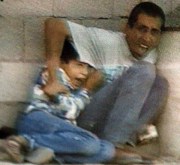 … Filmed by Talal Abu Rahma, a Palestinian cameraman freelancing for France 2, Jamal al-Durrah and his 12-year-old son Muhammad are seen, backs pressed against the wall, Jamal’s arm shielding his young son whose mouth is oval with what must have been a paralyzing fear. And then the shots.
When the cloud of dust cleared, the boy is on his side, draped over his father’s lap.
Throughout an enduing four and a half year widespread Palestinian resistance, with all of its gut wrenching failures, and with the solace and strengths of solidarity en masse coming from both the history before the second intifada and the aftermath in its wake, the slaughter of Muhammad al-Durrah continues to be a defining moment. A young boy viewed guilty through the eyes of the Israeli military due only to the origin of his birth.
In the investigation to follow, an Israeli-initiated tug of war of blame across the grave of and over Muhammad’s murder ensued. Where initially the Israeli government took blame and expressed public relational regret with an apology, that space soon became occupied with denials, accusations and disturbing tales of Palestinian’s faking the boy’s death. If only Palestinians weren’t so busy mourning the actual mass murders of their children in order to be able to spontaneously arrange for the staged murder of one, a second intifada might not have been necessary, nor a third or a fourth for that matter.
Without politicizing the end of a human life, in a 67 year crime drenched in politics; fifteen years ago today a terrified little boy was shot to death while he hid beside his father. And the world should remember his name.
Warning graphic content! Raw footage of Mohammed ad-Durrah’s final moments of his life:
How To Solve The European Migrant/Refugee Crisis – 5 Simple Steps
Storm Clouds Gathering | September 25, 2015
The refugee crisis in Europe could be easily solved. The problem is that the real solution would not suit the the political establishment of the United States or Western Europe. We’ve distilled what needs to be done down to 5 simple steps.
- Stop funding and arming rebel groups attempting to overthrow the Syrian government. It’s well established that these weapons have been ending up in the hands of ISIS and its affiliates. This has caused nothing but chaos and destruction. Money being funneled into these shady operations should be immediately redirected to an intensive reconstruction effort.
- Pressure Turkey and Jordan to cut off ISIS supply routes, and impose sanctions on any country facilitating the sale of oil from IS territory or allowing funds or materials to reach them. No army can function if their supply chain is broken. It’s not an accident these routes start at the Turkish and Jordanian borders.
- Support the Syrian government. An entire year of U.S. airstrikes in Syria have utterly failed to destroy or even significantly weaken ISIS. Of course this is because the real strategy isn’t to bring ISIS down, but rather to contain them and allow them to weaken Assad gradually. If Washington really wanted to stop this group, they would take a hint from Russia and provide the Syrian government with weapons, training and logistical support to enable them to push ISIS back. This means Washington and its allies would have to officially abandon all plans for a forced regime change. They might not like Assad, but the majority of the citizens of Syria support him. In fact he has more support within his country than Obama or the U.S. congress have in America. And at various intervals he’s had more support than Congress and Obama combined. Any government installed after a U.S. backed regime change will be viewed as a puppet government, and will therefore lack the legitimacy needed to stabilize the region. If you need evidence of this, just look at Afghanistan or Iraq.
- Provide direct assistance to rebuild housing, infrastructure and businesses destroyed by the conflict. In the short term temporary refugee camps should be set up in areas outside of the conflict zone, and food and medical supplies shipped in on a regular basis. Yes this will cost money, but so has the five year regime change push that created the problem in the first place.
- Return the refugees to these stabilized regions. It is in no one’s interest to flood Europe with masses of unemployed refugees. Doing so will only lead to heightened tensions and will strengthen xenophobic movements. These people don’t need to be transplanted into the ghettos of Europe, they need their homes back.
Unprovoked, Israeli Soldiers Attack AFP Journalists in West Bank
Sputnik – 26.09.2015
While covering a demonstration in the West Bank, two journalists with Agence France-Presse were attacked by Israeli soldiers, who then proceeded to destroy their equipment.
Andrea Bernardi and Abbas Momani were near the village of Beit Furik on Friday. On assignment for AFP, the two journalists were reporting on a protest that followed the funeral of a Palestinian man shot by Israeli security forces.
In covering the events, Bernardi and Momani were themselves attacked by Israeli soldiers.
“They had passed the first checkpoint of the border police with their press cards without problem,” AFP bureau chief Thomas Cox told the Guardian. “Andrea paused to check his camera setting and as he was doing so a soldier immediately arrived and told him to stop filming and pushed his camera.”
“He then took the camera and smashed it.”
Video of the incident shows the journalists walking away, only to be chased down by another soldier who destroys more of the pair’s equipment.
According to Cox, Bernardi later went back to recover his camera, and things escalated from there.
“At this point a soldier jumped on him and put a pistol on his face and attacked him.”
“It was crazy,” Bernardi told the Guardian. “When we arrived at the border police checkpoint we showed our documents. There was no problem. They were being nice.”
“We passed the first line of soldiers loading teargas. I heard screaming and a soldier started pushing and shouting ‘what the f*ck are you doing’ in English. I then [realized] he was loading this gun and I thought ‘what the…’ and we started walking back.”
Bernardi notes that if either he or Momani had been guilty of some crime that they would have been arrested, but that never happened.
“After we got back to the car I saw a piece of the camera and wanted to take a picture of it because I was worried they would accuse me of doing something wrong,” he said. “That’s when a soldier pointed a pistol in my face and pulled me down.”
AFP has announced its intention to file a formal complaint. … Full article
Washington State Cops Who Killed Unarmed Mexican Man Return to Work
© Family Photo
Sputnik | 24.09.2015
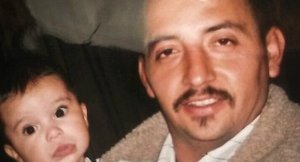
In February, the Pasco police made global headlines after three officers were caught on camera firing 17 bullets at an unarmed man in the back as he ran away from them with his hands in the air.
Now, after the officers received seven months of paid administrative leave for the shooting of Mexican national Antonio Zambrano-Montes, who was 35, they have been cleared of any wrongdoing. Two of the officers will be reportedly returning to work effective “immediately,” while the third, Ryan Flanagan, has parted ways with the department for unknown reasons.
The incident took place on February 10, when police were called to an intersection because of a man allegedly throwing rocks at vehicles. The department claims that Zambrano-Montes, who has a history of mental illness, ran after hitting two of the officers with rocks, Fusion reported.
Zambrano-Montes was the fourth person killed by officers in the department in less than a year.
A video of the incident, filmed by Dario Infante Zuniga, 21, went massively viral, collecting over 1,600,000 views within nine days. It has now been viewed over two million times.
Approximately one week after the shooting, the Pasco Police Department announced that they had launched a “full investigation into their victim” — instead of the officers who shot him.
Ken Lattin, a spokesperson for the Kennewick Police Department, stated in February that he was trying to piece together what Zambrano-Montes was doing “hours, days, and weeks leading up to this incident.”
“It’s curious that when you ask them about the past of some of the officers, they say that information is not pertinent to the investigation,” Felix Vargas, chair of Consejo Latino, a local organization of Hispanic-owned businesses, said after a briefing, Fusion reported.
“But somehow what Zambrano was doing weeks before this incident is vital information.”
While activists and commentators have expressed remorse, anger, and sadness over the lack of charges and the officers returning to their duties, many have noted that it was to be expected, as the cops were never really the ones under investigation.
Tactical retreat: NATO for the first time criticizes Ukraine’s government
German Economic News | 22.09.15
New sounds are being heard at NATO: for the first time, NATO criticizes not the arch-enemy Russia, but the Government in Kiev, which is funded by the EU, telling them to adhere to the Minsk agreements.
Whether Kiev can be trusted to adhere to anything, is another question: The country’s extreme right have imposed a blockade of Crimea [contrary to Minsk] — without the government obstructing them at all.
NATO Secretary General Jens Stoltenberg has called upon Ukraine to implement the peace plan for the war zone in Donbass. “It is extremely important that Ukraine continue to implement all aspects of the Minsk agreements,” he said on Tuesday in Kiev. No other solution to the conflict exists. Stoltenberg was attending a meeting of the Ukrainian Security Council, the first NATO chief to do so. He then signed an agreement on a planned NATO representative in Kiev.
Ukraine’s President Petro Poroshenko confirmed plans for a referendum on a possible NATO membership for the former Soviet republic. “De jure we are not a member of NATO, but de facto we are more than just partners,” stressed Poroshenko.
Since early September in eastern Ukraine, a ceasefire between government forces and the rebels is holding reasonably well. In fact, that is why the OSCE is concerned that the Donbass civilian population could be exposed to extreme cold during the winter, without being able to protect themselves. The water system has been destroyed virtually throughout the region, many areas are mined. The OSCE called on Ukraine a few days ago to withdraw their army, so that the residents in rebel-controlled areas with the worst damage can do at least makeshift repairs.
There is disagreement, however, over [two aspects of the Mink agreement] a desired weapons withdrawal from the front, as well as local elections according to Ukrainian law in the breakaway regions. The rebels showed a willingness to compromise, possibly to postpone their planned October 18 and November 1 elections till the end of February. In the Belarusian capital Minsk, the Ukraine Contact Group wanted to discuss on Tuesday the peace plan.
Already former Federal Foreign Minister Frank-Walter Steinmeier had shown himself to be unusually confident that the war in Ukraine can be contained for the time being. Americans and Russians seem to have reached initial agreement, to co-operate in Syria. And neither of the two great powers can win much right now in Ukraine. Furthermore, EU taxpayers have taken on the financing of Ukraine, providing breathing-room for the conflict there between the U.S. and Russia.
The NATO communication is a tactical measure, as shown, above all, by the announcement that a NATO Embassy will be established in Ukraine. Furthermore, the United States have just started the deployment of new nuclear weapons in Germany, which is regarded by the Russians as a provocation. The Bundestag had expressly rejected this development some time ago. But German Chancellor Angela Merkel considers it right — thus also needlessly complicating a possible mediating role for Germany in the Ukrainian conflict.
The biggest unknown, however, in the short term, is the unstable political situation within Ukraine. A few days ago a senior right-wing extremist was killed in an explosion. The right-wing extremists are plotting revenge. The civil war might shift to the Western Ukraine.
The regional power of the right-wing is also likely to escalate the conflict with Russia again: Right-wing extremists, whom the government of Ukraine allows to move freely even in the war-zone, refuse to comply with Ukrainian law, and have blocked the highways connecting Crimea to the East of Ukraine. This blockade, which is supported by anti-Crimean Tatars outside of Crimea, could cause supply problems before winter (see the video at the beginning of the article [It’s in English!]).
Translation by Eric Zuesse
Investigative historian Eric Zuesse is the author, most recently, of They’re Not Even Close: The Democratic vs. Republican Economic Records, 1910-2010, and of CHRIST’S VENTRILOQUISTS: The Event that Created Christianity.
Around 200 masked men storm Kharkov city hall in Eastern Ukraine
© slava.mavrichev / Facebook
RT – September 23, 2015
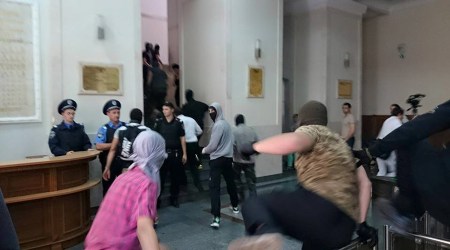
At least 200 people wearing camouflage and masks stormed the local administration building in the city of Kharkov, eastern Ukraine, local media said. The perpetrators are alleged to be members of the radical Azov battalion.
The masked men reportedly clashed with police and security forces at the city’s administration building. Those who have entered the building have also reportedly used tear gas, the Ukrainian 112 channel is saying.
The masked activists were seen holding flags with the insignia of the radical Azov Battalion, which is accused of committing numerous human rights violations in Eastern Ukraine, according to international watchdogs.
“There have been several small clashes between police and people in balaclavas. A few minutes ago somebody let off tear gas. The entrance to the city council is surrounded by a tight police cordon,” a journalist at the scene, from the 112 channel reported.
Earlier, at least 50 people wearing camouflage and balaclavas had taken part in a protest in front of the residence of the local politician, Mikhail Dobkin, who represents the ‘Opposition Bloc’ political party, which wants to find a peaceful solution to the current crisis in Ukraine. The masked men had not set out any demands. However, they were reported to have stated their aim was to “to throw Dobkin out of the city and not to let Kernes become Kharkov’s mayor,” according to the 112 channel.
Gennady Kernes has been the mayor of Kharkov since March 2010. Before the coup in Ukraine, he had been a strong supporter of President Viktor Yanokovich. However, he subsequently switched sides and has backed the new Ukrainian government in order to keep his position.
Featured Video
The American Retreat from Vietnam
or go to
Aletho News Archives – Video-Images
From the Archives
Secret document reveals plans for civil war in Lebanon, Israeli false flags, and invasion
By Randi Nord | Geopolitics Alert | April 5, 2019
Beirut – During his visit with US Secretary of State, Mike Pompeo, Lebanese President Michael Aoun reportedly received a US-Israeli document detailing plans for creating a civil war in Lebanon with covert false flag operations and possible Israeli invasion.
Although the source of the document is Israeli and created in partnership with Washington, no one knows who presented it to Aoun. The Lebanese TV station, Al-Jadeed, initially reported the document on Lebanese TV and a video on its website. Geopolitics Alert translated the report for this article. … continue
Blog Roll
 Aletho News
- There’s a drought in academia: A drought in honest research on the subject of drought and other weather extremes
- Department of War Awards $20.7 Billion Contract to Raytheon for Air-to-Air Missiles
- ‘Distance yourselves from Israel’: IRGC urges US population to question govt policies
- America’s Greenland deal has a radioactive backstory
- The RAF Fairford ‘terror plot’: Unpacking escalation in the UK echo-chamber
- EU Council Advances Chat Control 2.0 Scanning Proposal
- Ex-Greek MEP files complaint against Israeli spyware firm over alleged Pegasus surveillance
- Troubling ideas throughout the Torah, Talmud, Mishneh Torah and Tanya
- ‘Grave, alarming’: Iran mission on Trump’s UNGA ‘annihilation’ threats
- Najaf airport to reopen to Iranian flights within 24 hours: Ambassador
- If Americans Knew
- New Report: “Scholasticide and Genocide in Gaza: Assessment, Testimonies and Legal Analysis”
- Ex-Biden officials are desperate for a Gaza scapegoat
- Israeli “settlers” Invade Al-Aqsa; Pour Boiling Water on 75-Year-Old
- Israel Has Kidnapped Another American Teenager
- US arms sales to Israel worth $21.6 billion in 20 months
- Three Palestinians Killed in Israeli Attacks on Gaza
- Revealed: German “Anti-Semitism Expert” Driving Crackdown on Palestine Solidarity is Former Israeli Spy
- Egypt’s Warning to Israel Before Oct 7
- Israel’s siege signals another cruel winter for 1.8 million Gazans – Daily Update
- Netanyahu Asked UAE Leader to Deny Report on Oct. 7 Warning in Secret Visit, Sources Say
- No Tricks Zone
- New Study: Earth And Venus Surface Warmth Largely Explained By Convection And Lapse Rate, Not CO2 Or Radiation
- 2025 Nature Paper Claiming Worsening Global Drought Gets RETRACTED …Heavily Flawed
- New Study: ‘Global Drought Shows No Detectable Recent Acceleration Under Climate Warming’
- Economic Masterminds: German Socialists Suggest Taxing Productivity Gains Stemming From Using AI
- The South China Sea Has Not Been Cooperating With The Climate Change Narrative
- Energy Crisis: Germany Enters Heating Season With Historically Low Gas Reserve Fill Levels
- New Study: The Antarctic Ice Sheet Gained Mass From 2020-2024 Due To Staggering Snow And Ice Accumulation
- Study: Ocean Heating Rates From Thousands Of Years Ago ‘Dwarf’ Modern Ocean Heating Rates
- Climate Extremists Target, Attack Large-Scale Power Grid Infrastructure In Germany!
- New Study: Antarctic Ice Melt Has Contributed Less Than 1 Centimeter To Sea Level Rise In The Last 30 Years

