MH17 FULLY EXPOSED
corbettreport | August 26, 2014
SHOW NOTES AND MP3: http://www.corbettreport.com/?p=11947
When Malaysia Airlines Flight 17 went down on July 17, 2014, we were immediately inundated with base propaganda trying to convince us that the shootdown could be traced back to the Kremlin. But what was this rush to judgement based on? What have we learned about the crash since then? Why has MH17 completely disappeared from the news cycle? And who really stood to benefit from the disaster?
Russia at the gates? US State Dept, Pentagon grilled over NATO expansion
RT | October 17, 2014
US State Department spokesperson Jen Psaki and Pentagon Press Secretary Rear Adm. John Kirby have been challenged over the Department of Defense’s claims that the US must “deal” with “modern and capable” Russian armed forces on NATO’s doorstep.
Russian Defense Minister Sergey Shoigu expressed “grave concern” and “surprise” at a Wednesday speech made by US Secretary of Defense Chuck Hagel during the Association of the United States Army’s annual conference. Hagel declared that US armed forces “must deal with a revisionist Russia – with its modern and capable army – on NATO’s doorstep.”
During a State Department briefing on Friday, however, an AP journalist suggested that it would be more logical to say that “NATO has moved closer to Russia’s borders.”
“Is it not logical to look at this and say – the reason why Russia’s army is on NATO’s doorstep, is because NATO expands,” journalist Matt Lee said.
“That’s the way [Russian] President Putin probably looks at it, it’s certainly not the way that we look at it,” Kirby said in response to the journalist’s reasoning.
Though he eventually admitted that NATO has expanded, Kirby added that “NATO is not an anti-Russia alliance, it is a security alliance.”
“It wasn’t NATO that was ordering tons of tactical battalions and army to [the] Ukraine border,” Kirby added, before being reminded that Ukraine is not part of NATO.
Kirby then refused to agree with the point that the Russians could understandably perceive NATO’s expansion as a “threat,” especially given that the alliance existed as “anti-Soviet” for half a century.
“I’m not going to pretend to know what goes in President Putin’s mind or Russian military commanders… I mean, I barely got a history degree at the University of South Florida,” Kirby joked, dodging the question.
Kirby assured that NATO’s moves were not “hostile and threatening,” but rather a matter of security. He added that he was “worried about their [Russia’s] moves around Ukraine.” Psaki then cut in, saying that “other countries feel threatened,” and urged the conversation to move on.
In terms of new threats at NATO’s borders, Russian Defense Minister Sergey Shoigu said on Friday that it is the US which has been “stubbornly approaching… closer to our doors.”
Relations between Russia and NATO have been tense since the alliance accused Russia of becoming involved in the Ukrainian conflict – a claim Russia has continuously denied.
Following Crimea’s accession to Russia in March, the US and Europe bombarded Moscow with sanctions. NATO also significantly increased its military presence near Russia’s borders, especially in Poland and the former Soviet Baltic states of Latvia, Lithuania, and Estonia, which have expressed concern at the potential for Russian incursions into their territories.
READ MORE: US works on military ‘scenarios’ near our borders – Russian defense minister
Mark Duggan Lawful Killing Appeal Rejected
Amina Taylor | Press TV | October 14, 2014
The family of Mark Duggan –the man whose death sparked the UK riots in 2011 – have lost their bid to have the inquest verdict that ruled his death ‘lawful’ overturned. Lawyers acting for the Duggan family had argued that the coroner had blundered in his summing up and lead the jury to conclude that Duggan was unarmed at the time but the police’s shooting of him was still lawful. Amina Taylor has more from London.
It was a killing that was the spark for one of the worst periods of civil unrest seen in the UK for a generation. The inquest into the death 29-year old of Mark Duggan at the hands of a Metropolitan Police marksman in August 2011, was ruled ‘lawful’.
The Duggan family disagreed but on Tuesday lost their appeal to have the inquest verdict set aside. The family was not in court to hear the decision of Lord Justice Levenson and two other high court judges.
In Tottenham where Mark Duggan used to live, among his friends, family and wider support network there will be an overwhelming sense of disappointment at the court’s decision because so many of those who protested against the way in which Mark was killed by Metropolitan polices marksman they’ve argued that for so long that his death was tantamount to ‘state-sanctioned murder’
Those involved in the Mark Duggan justice campaign say they believe the coroner and the jury were mislead and that police corruption may be involved.
The Independent Police Complaints Commission is continuing its investigation into the shooting.
Bolivia Witnessing Community Radio Renaissance
teleSUR | October 7, 2014
Bolivian president Evo Morales’ government has been promoting community radio stations as an alternative to the mainstream press, and it’s starting to show results.
In the eastern city of Santa Cruz, Radio Venceremos has become one of the most popular local community stations.
“We go on the air so that the people can participate in our programming, we call on listeners to join our broadcast so they can report and inform people on the issues affecting their neighborhood and so they can feel like they have a voice, it is the voice of the voiceless,” one of the station’s presenters told teleSUR English’s correspondent, David Dougherty.
“The government of President Evo Morales has actively promoted the diffusion of community radio stations in both rural and urban areas where marginalized populations demand alternatives to Bolivia’s mainstream media offerings,” the host explained from Venceremos’ studio in a community recreation center in the working class Plan 3000 neighborhood.
For years community radio stations had been struggling across the country, but according to Catarina Campos from the National Network of Information and Communication Workers, the sea change came from communities that demanded a voice on the airwaves.
The community radio stations emerged as a result of a push from the people,” she stated. However, Campos also credits Morales’ government with responding to the demands of the grassroots.
“Now with the government of President Evo Morales we see a bit more support on behalf of the state, but without a doubt the community radio stations were born of the necessities and pressure exerted by these communities,” she stated.
Featured Video
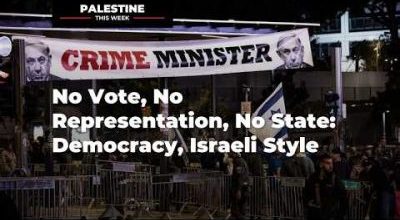
No Vote, No Representation, No State: Democracy, Israeli Style
or go to
Aletho News Archives – Video-Images
From the Archives
Sanctions, War and the Policy of Dual Containment
By SASAN FAYAZMANESH | March 17, 2008
It is now nearly three decades since the Unites States adopted the policy of dual containment of Iran and Iraq. While much has been written about the containment of Iraq, there has been very little in-depth analysis of this policy when it comes to Iran. In a book that is going to be released on March 31, 2008, entitled The United States and Iran: Sanctions, Wars and the Policy of Dual Containment (Routledge), I attempt to address this shortcoming by investigating when and why the US policy of containment of Iran came about, how it evolved, and where it stands today.[1] To the extent that Israel has been involved in US policy making, the study will also include the role that Israel has played in the containment of Iran. Also, since the fate of Iran has been inextricably linked to that of Iraq, occasionally the investigation will overlap with the containment of Iraq.
The policy of dual containment of Iran and Iraq originated during the Carter Administration, but it was not until the Clinton Administration that the expression “dual containment” became popular. … continue
Blog Roll
 Aletho News
- NATO chief advocates war of aggression
- No Vote, No Representation, No State: Democracy, Israeli Style
- Zionist Bought Senate Blocks Information About American Citizens Killed By Israel
- While Gaza dominates the UN, these are the people keeping it alive
- New Report: “Scholasticide and Genocide in Gaza: Assessment, Testimonies and Legal Analysis”
- ‘THAAD Delusion’: Iran war exposes US missile shield limits – The Atlantic
- Moscow issues warning to NATO over Russian exclave
- Yes, the Iran war has destroyed Trump’s presidency
- The fallacy of US delusions about Iran’s economic collapse
- Hezbollah denies Syria cell link, warns of Israeli plan to sow discord
- If Americans Knew
- Mamdani releases plan to combat antisemitism and hate crimes in New York City
- Iran’s Revolutionary Guards Publish Letter to the American People
- DMFI launches $1 million ad campaign supporting Virginia’s Elaine Luria
- US Senate blocks resolution seeking report on Americans killed by Israel
- Israeli Attacks Kill Ten Palestinians in Gaza
- Massacre at Minab: The School That Became a Grave
- Israeli media: The IDF Shows It Doesn’t Turn a Blind Eye; It Actively Emboldens Settler Havoc
- As settlers ravage West Bank, Israeli forces kill 10 in Gaza – Daily Update
- New Report: “Scholasticide and Genocide in Gaza: Assessment, Testimonies and Legal Analysis”
- Ex-Biden officials are desperate for a Gaza scapegoat
- No Tricks Zone
- Green Energy Debacle: German Expert Professor Fritz Vahrenholt Warns Of Severe Economic And Social Consequences
- Two More Paleo Reconstructions Affirm Meters-Higher Sea Levels Across Ireland, Brazil 7000-6000 Years Ago
- New Study: Earth And Venus Surface Warmth Largely Explained By Convection And Lapse Rate, Not CO2 Or Radiation
- 2025 Nature Paper Claiming Worsening Global Drought Gets RETRACTED …Heavily Flawed
- New Study: ‘Global Drought Shows No Detectable Recent Acceleration Under Climate Warming’
- Economic Masterminds: German Socialists Suggest Taxing Productivity Gains Stemming From Using AI
- The South China Sea Has Not Been Cooperating With The Climate Change Narrative
- Energy Crisis: Germany Enters Heating Season With Historically Low Gas Reserve Fill Levels
- New Study: The Antarctic Ice Sheet Gained Mass From 2020-2024 Due To Staggering Snow And Ice Accumulation
- Study: Ocean Heating Rates From Thousands Of Years Ago ‘Dwarf’ Modern Ocean Heating Rates

