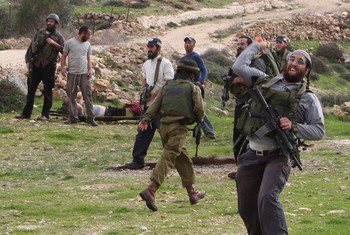
Israel’s Parliament decided today not to investigate charges that former Defense Minister Yitzhak Rabin [later Prime Minister] ordered soldiers to break the bones of Arab militants at the beginning of the Palestinian uprising…
… Soldiers testifying at Colonel Meir’s trial said Mr. Rabin and other senior commanders told them privately that beatings should be used to punish Arabs known to be troublemakers.
… a company commander under Colonel Meir, testified in April that he was told by Colonel Meir to ”break the arms and legs” of Arabs ”because the detention camps are full.” Full story
BETHLEHEM – Ten years after Israel exiled 39 Palestinians taking refuge in Bethlehem’s Nativity Church, deportees say they have been forgotten by Palestinian leaders.
On May 10, 2002, Israeli forces ended a 39-day siege on the church after striking a deal with Palestinian leaders to send 39 people given sanctuary in the church to Gaza and Europe.
When Israeli tanks surrounded Bethlehem on April 2, 2002, around 220 locals — including around 40 priests and nuns — took shelter in the church. Over the next 39 days, eight Palestinians were killed inside the church and 27 others injured.
The siege on the site believed to be Jesus’ birthplace sparked outrage in the Vatican as monks sheltering inside pleaded for international assistance.
Former Bethlehem Governor Salah Tamari headed the negotiations team to end the siege, and told Ma’an TV the deportation deal was reached without his knowledge.
He recalled his shock when Israeli officials told him Palestinians would be exiled, and said he called the office of President Yasser Arafat to resign as chief negotiator.
Israeli officials had demanded a list of names of everyone in the church, Tamari said.
“Since the first moment, we refused to give any names. We told [the Israelis] if you have anyone who’s wanted, give us their names and we’ll see if their charges affect the Palestinian law, we’ll hold them accountable.”
Rafat Obayyat was one of 27 Palestinians injured by Israeli attacks on the church. He is in a wheelchair due to his injuries.
He told Ma’an the grotto was the safest place in the church during the siege. Food was scarce and small amounts of pasta would be rationed between everyone, he added.
After a decade in exile, deportees say they have been abandoned by the Palestinian Authority and all political factions. They have not been allowed to return to their families in the West Bank.
Deportees had planned to demonstrate on Thursday but canceled the protest to stand beside prisoners on hunger strike, spokesman for the group Fahmi Kanan said at a press conference on Monday.
Instead, deportees will go on a 3-day hunger strike on Thursday in solidarity with detainees in Israeli jails, Kanan said.
‘A dangerous precedent’
Former detainee and researcher Abdul Nasser Farwaneh said the deportation deal was a clear violation of international law and human rights.
The Palestinian leadership’s acceptance of the deal to send Palestinians into exile set a dangerous precedent and over the last decade Israel has deported hundreds more Palestinians, Farwaneh said in a statement.
He urged the international community to send a commission of inquiry into Israel’s siege on one of the world’s holiest sites.
He also called for greater efforts to bring the deportees home and said the ongoing failure to bring them back from exile reflected Palestinian indifference to the issue.
From Tennessee to the District of Columbia, police are using mobile and stationary surveillance cameras to collect and store license plates of residents who have committed no crime—so that they can be found if they ever do.
In Tennessee, police utilize cameras mounted atop patrol cars that can capture thousands of license numbers each day. The information is then loaded into an ever-expanding database, which can help officers locate a vehicle in the event its owner is suspected of criminal behavior. The program is now expanding to include stationary cameras mounted next to busy roads.
“I’m sure that there’s going to be people out there that say this is an invasion of privacy,” Detective James Kemp of Gallatin County told The Tennessean. But “the possibilities are endless there for solving crimes. It’s just a multitude of information out there—to not tap into it to better protect your citizens, that’s ludicrous.”
In Washington D.C., local police make use of 250 cameras set up around the city that can capture license plates. Last year they claimed that the cameras led to an average of one arrest a day. DC reportedly has the highest concentration of cameras per square mile in the United States for spotting criminals on the move or just ordinary citizens going about their lives.
Jay Stanley, senior policy analyst for the American Civil Liberties Union’s technology and liberty program, expressed concern over D.C.’s “large database of innocent people’s comings and goings.” He told The Washington Post: “The government has no business collecting that kind of information on people without a warrant.”
Others predict that the technology will be declared constitutional because license plates are displayed in public, so there is no invasion of privacy.
Israel is the only regime that has threatened to obliterate all world countries in a “nuclear Armageddon,” if its existence is put in jeopardy, a political analyst tells Press TV.
In a Friday interview, Mark Glenn, from The Crescent and Cross Solidarity movement, lashed out at Israel for its nuclear stockpile, sayingTel Aviv is the only regime that “has threatened to take the entire world down in a nuclear Armageddon in the instance that her precious experiments in Jewish self-rule in the Middle East ceases to materialize.”
“There is no other country in existence today that has basically told the entire world that if we are going to go down we are going to take the rest of the world down with us,” he added.
Even Israel’s most prominent military professor, Martin Van Creveld, has once alluded to such nuclear ambitions by Israel and confirmed that Tel Aviv has several hundred atomic warheads and rockets targeted at all directions — mostly at European capitals — and that Tel Aviv is ready to take the entire world down before the regime itself ceases to exist, Glenn pointed out.
The analyst expressed regret that the nuclear threat from Israel looms over the world, while Tel Aviv continues to use its mainstream media outlets to level allegations against other countries, accusing them of possessing non-civilian nuclear programs.
Israel is widely believed to be the sole possessor of nuclear weapons in the Middle East. Tel Aviv began building its first plutonium and uranium processing facility, Dimona, in the Negev desert in 1958.
Former US President Jimmy Carter has stated that Israel has a nuclear arsenal that includes between 200 and 300 warheads. Decades of recurrent reporting and aerial footage have also established the possession of atomic arms by Israel.
Under its official policy of nuclear ambiguity, Tel Aviv neither confirms nor denies the possession of nukes and refuses to join the Nuclear Non-Proliferation Treaty (NPT) or allow inspections of its nuclear facilities.
Calgary – Activists and Academics are increasingly questioning the purpose of Canada having ‘hate speech’ laws to criminalize certain forms of speech.
Critics say such laws are applied inconsistently and often serve the interests of powerful groups whilst doing nothing to prevent the tide of Islamophobia that has swept Canada since the disputed events of 9/11.
‘I can tell you that headline wasn’t in Calgary….it could be in the National Post but I can tell you that didn’t originate in Calgary’
That was the response of Rick Hanson, Chief of the Calgary police when confronted by Press TV with a hateful headline claiming that Iraqis worship the devil, printed by one of Canada’s most prominent broadsheet newspapers. The question was prompted after the police chief had given a speech in which he had affirmed his desire to use controversial anti-Hate Crime legislation to stamp out prejudice and discrimination in the city of Calgary. Canada has Hate Speech laws which criminalize certain forms of speech that are deemed to be illegitimate by the Canadian state.
Press TV was interested to discover whether or not Hate Speech laws were being applied consistently in Canada, even to powerful elites who seek to demonize Muslims. The police chief’s response was terse.
Critics say that Hate Speech laws are not applied consistently in Canada as every day we see the mainstream media stigmatizing and dehumanizing Middle Eastern people with impunity. On the other hand those anti-racists who criticize Israel’s policies of genocide and apartheid are finding their freedom of speech to do so increasingly challenged with powerful pro-Israel lobbyists seeking to conflate criticism of Israel with anti-Semitism.
Press TV got in touch with a prestigious Canadian professor and member of the Canadian Islamic Congress who had tried but failed to invoke Canada’s Hate-Speech laws to prosecute a journalist in Canada who had disseminated anti-Islamic conspiracy theories in an article published in a prominent Canadian magazine called MacCleans.
It is clear that Hate Speech laws are controversial. And when such laws are being applied inconsistently and in a politicized or ethnicized manner experts warn that they can only have a negative effect on society.
The first story was shaky from the start, that Sgt. Robert Bales “sneaked” off a combat outpost into hostile, landmined territory in the middle of the night, walked north a little over a half mile to a village, engaged in bloody murder, then walked back that half mile, past the base, and another mile south, killed more people, then turned himself in at the gate, all within an hour. Sharp-eyed bloggers did the math and recalled from other reports that Bales has part of a foot missing from a wound in Iraq, making the feat all the more remarkable.
Among the dead were a number of children, including a two-year-old.
Two weeks later the Pentagon’s story changed, and Bales had managed to sneak off the base twice over a longer timeline:
“Staff Sgt. Robert Bales, who is suspected in the shooting deaths this month of 17 Afghans, sneaked off his remote outpost twice during his alleged 90-minute rampage in two Afghan villages, two senior U.S. officials told CNN on Monday.
The officials said that, after the March 11 shootings in one village in Kandahar province, Bales sneaked back onto his base. They said Bales was seen at that point by fellow troops.
One official said investigators believe Bales told other soldiers he had just killed military-aged Afghan men. The officials said they did not know whether those troops told anyone else.
Then Bales sneaked out again and headed to the second village; he was apprehended by a search party as he attempted to re-enter the combat outpost the second time, the officials said.
Before this account, an Afghan guard was believed to have been the sole person who saw Bales that night. The guard alerted U.S. troops on base.”
“Members of the Afghan delegation investigating the killings said one Afghan guard working from midnight to 2am saw a US soldier return to the base around 1.30am. Another Afghan soldier who replaced the first and worked until 4am said he saw a US soldier leaving the base at 2.30am. It’s unknown whether the Afghan guards saw the same US soldier. If the gunman acted alone, information from the Afghan guards would suggest that he returned to base in between the shooting sprees.”
Never mind that this leaves open the question of whether security at a “hot” outpost is routinely left, in this era of attacks coming from inside the wire, to purely indigenous guard, while US troops sleep. Ho Chi Minh would have dreamed of this situation. CNN reported that a US official told them that Bales had returned to the base “unnoticed.”
“One U.S. official with knowledge of the investigation said an Afghan guard allegedly spotted Bales leaving his outpost around 1 a.m. It is not clear why Bales’ superiors weren’t alerted, and the official said Bales was not noticed when he allegedly returned to the compound an hour later.”
The NY Times report quoting one Afghan General Hameed seemed aimed at putting a bit of spin on how Bales could have sashayed on and off the base so easily, saying:
“In recent interviews, American and Afghan officials said that the outpost in the rural Panjwai district was guarded by Afghan soldiers that night, as it probably was on most nights, because there were relatively few American soldiers based there, possibly only a platoon. Platoons typically have between 25 and 40 soldiers. –“Details Offered on How Suspect Could Have Left Afghan Base”“
So let me get this straight. A base in one of the most hostile parts of a war zone is under indigenous guard at night because, out of 25 – 40 tough US soldiers, they all need to be get their beauty sleep? This isn’t the 21st Century Army. This is “F Troop.” If the Pentagon really wants to fool people, they should learn when to shut up.
Jefferson Morley of Salon.com was the first reliable American outlet to report President Karzai’s, and the members of an Afghan Parliament investigative team’s, insistence that there was more than one shooter:
“A group of Afghan parliamentary investigators has concluded that Bales was part of a group of 15-20 soldiers. As Outlook Afghanistan reported Monday, “The team spent two days in the province, interviewing the bereaved families, tribal elders, survivors and collecting evidences at the site in Panjwai district.” One of the parliamentarians told Pajhwok Afghan News that investigators believed 15 to 20 American soldiers carried out the killings.”
“After our investigations, we came to know that the killings were not carried out by one single soldier. More than a dozen soldiers went, killed the villagers and then burnt the bodies,” lawmaker Naheem Lalai Hameedzai claimed…..
“All the villagers that we talked to said there were 15 to 20 men (who) had conducted a night raid operation in several areas in the village,” said Hameedzai.”
Disputing this is the governor of the province and the local police chief. The provincial governor who upholds the one gunman scenario says:
“It is time for Afghanistan to calm down and not let the insurgents take advantage of this case. They want foreign troops to leave such areas like this so they can hold those areas. We should be aware of their intentions and try to help the government, not the insurgents.”
The governor does not say where in “try to help the government” the truth figures in.
Interestingly, the initial Reuters report on the scene immediately after the killings made numerous references to multiple shooters, in addition to reporting that one staff sergeant was in custody, and that US officials were insisting on one shooter
“Neighbors and relatives of the dead said they had seen a group of U.S. soldiers arrive at their village in Kandahar’s Panjwayi district at about 2 a.m., enter homes and open fire.
An Afghan man who said his children were killed in the shooting spree accused soldiers of later burning the bodies.
…
“They (Americans) poured chemicals over their dead bodies and burned them,” Samad told Reuters at the scene.
Neighbors said they had awoken to crackling gunfire from American soldiers, who they described as laughing and drunk.
“They were all drunk and shooting all over the place,” said neighbor Agha Lala, who visited one of the homes where killings took place.””
Now the first western reporter to gain access to child witnesses in the shooting, which she says the military tried to block, gives accounts of many men with “flashlights” on the ends of their rifles and on their helmets. As carried by MSNBC:
“”the children told Hakim [Yalda Hakim, a journalist for SBS Dateline in Australia] that other Americans were present during the rampage, holding flashlights in the yard.
Noorbinak, 8, told Hakim that the shooter first shot her father’s dog. Then, Noorbinak said in the video, he shot her father in the foot and dragged her mother by the hair. When her father started screaming, he shot her father, the child says. Then he turned the gun on Noorbinak and shot her in the leg.
“One man entered the room and the others were standing in the yard, holding lights,” Noorbinak said in the video.
A brother of one victim told Hakim that his brother’s children mentioned more than one soldier wearing a headlamp. They also had lights at the end of their guns, he said.
“They don’t know whether there were 15 or 20, however many there were,” he said in the video.
Army officials have repeatedly denied that others were involved in the massacre, emphasizing that Bales acted alone.”
The interesting thing here is that Afghan children don’t have videogames. They don’t have TV. In most parts of the country they don’t even have electricity. So night-raid equipment like weapons lights are not likely to arise from their imaginations.
From SureFire catalog “Weapon Lights”, Standard night-raid equipment for US forces
VIDEO: The SureFire Story
Hakim told MSNBC that the reason American investigators gave for trying to prevent her from interviewing the children was that her questions could “traumatize them.”
Stop the presses. In this war of nightly drone attacks on compounds known to have children present, in which hundreds if not thousands of children have been killed, and killed in night raids on such compounds, the interviews might “traumatize” them. I am rarely at a loss for words. This is one of those times.
One story floated about a week after the killings puts down the sighting of more than one soldier to possible confusion with the search party looking for Bales.
“About 3:30 a.m., the official said, a surveillance camera spotted Bales returning to the base, and the search team found him just outside the compound.”
The NY Times, quoting Afghan Gen. Abdul Hameed, the corps commander for the Afghan National Army in Kandahar, reported:
“When American commanders became aware that a soldier was missing, they first checked sleeping quarters, toilets and the kitchen area before organizing a patrol to look outside the compound, General Hameed said. But before the patrol left, a high-powered infrared camera on a small blimp spotted Sergeant Bales nearby.”
Salon.com’s Morley reports an “unnamed senior U.S. official’ telling the New York Times: “When it all comes out, it will be a combination of stress, alcohol and domestic issues,” leaving aside the question of how the senior official already knows how it will all “come out.”
Morley writes:
“The passing admission that two other soldiers face disciplinary action for drinking with Bales on the night of the massacre might cast doubt on the notion that no one else knew what Bales was going to do. Army spokeswoman Lt. Col Amy Hannah said in telephone interview that she could not confirm the Times’ account. “I am not aware of any releases of information” about other soldiers facing disciplinary action, Hannah said. If the U.S. official’s remarks to the Times were accurate, then the Army is refraining from disclosing how many soldiers are under investigation.
Then there is conflicting eyewitness testimony. In this CNN video, one man describes the actions of a group in carrying out the killings. “They took him my uncle out of the room and shot him,” he says. “They came to this room and martyred all the children.” But one boy seen on the tape says there was only a single gunman. Still other witnesses pointed out a place outside the home, where they said they found footprints of more than one U.S. soldier.
Journalists seeking to clarify the question have been thwarted. In Afghanistan, Pajhaowk Afghan News reports that Lewis Boone, the public affairs director for coalition forces, declined to answer questions about the massacre, saying that a joint Afghan-ISAF team was investigating the killings. As the Seattle Times noted yesterday, the Army has been struggling “to regulate information on the Afghanistan suspect.”
The laugh for the day in Morley’s report comes when Ryan Evans, who worked with ISAF in Afghanistan and is now a research fellow at the Center for National Policy in Washington, said he thought “a cover up is very unlikely.” Now why would anyone think that, after Lt. Col. Daniel Davis just told us in a major report on Afghanistan that:
“We seem significantly challenged to tell the truth in almost any situation.”
And in a fascinating McClatchy report, Karzai’s lead investigator seems to differ with the president’s conclusion of more than one shooter, but then apparently contradicts himself.
KABUL, Afghanistan — The chief Afghan investigator in last month’s slayings of 17 civilians says there’s strong evidence that only one killer was involved, a view that puts him at odds with Afghanistan’s president, Hamid Karzai.
….
Afghan army chief Gen. Sher Mohammad Karimi, whom Karzai sent to Kandahar to investigate the massacre, told McClatchy that two survivors he interviewed offered credible accounts that the killings were the act of a lone person.
“They told me the same thing,” Karimi said. “They both said there was (only) one individual who came to their house.”
….
At a meeting at the presidential palace with relatives of the victims days after the massacre, Karzai openly questioned the U.S. account of a lone gunman. The president pointed to one relative and said: “In his family, in four rooms people were killed — children and women were killed — and then they were all brought together in one room and then set on fire. That, one man cannot do.”
Karimi said he returned to Kabul to deliver his interim report but the villagers had spoken to Karzai before he did.
“And everybody said (to the president), ‘Sir, it was not one person. … How can one guy shoot people in four rooms, kill them, then lift them, bring them to one room and set them on fire?'”
Underscoring how the incident has become a political football, Karimi himself appeared to parrot Karzai’s line in an interview with an Australian television program broadcast last week, in which he said, “I’m guessing — assumption — that (the killer was) helped by somebody. One person or two persons.”
There are a couple of possibilities here. Karimi could be honestly saying, interpreted by McClatchy as a contradiction, that two survivors said “there was (only) one individual who came to their house.” This would not rule out other men going to other houses or taking positions outside, and McClatchy could be wrong in its interpretation. Or, as McClatchy suggests, Harimi could be trying to play both sides of the fence. However, the rest of Harimi’s witness to the Australian reporter is clear, and MSNBC views it differently than McClatchy:
“Gen. Karimi, assigned by Afghan President Hamid Karzai to investigate the murders, told Hakim that he, too, wonders whether Bales acted alone and how he could left the base without notice.
“Village elders said several soldiers took part and that there is boot prints in the area,” Karimi told Hakim. He said villagers told him that they saw three or four individuals kneeling and that helicopters were overhead during the rampage.
“To search for him?” Karimi said he asked them.
“No,” he said they told him. “They were there from the very beginning.””
Other soldiers who have been stationed at the same base paint a different picture of how hard it would be to sneak off the base. The NY Times tells us:
“A Green Beret who has spent time in Panjwai in the past year said the combat outpost would have been relatively small, protected by dirt-filled containers known as Hesco barriers, with guard towers and perhaps a blimp with a high-powered camera capable of capturing images more than a mile away. It would have been difficult, but not impossible, for Sergeant Bales to slip away at night unnoticed, as the Army says he did.”
Okay. Not impossible. But now it’s twice.
As if this brew needs anymore spice, Bales’ attorney claims the government is withholding evidence:
“UPDATE: The attorney representing the American soldier accused of slaughtering 17 Afghan civilians accused the U.S. government on Friday of withholding evidence that would be crucial to his defense.
Speaking to the Associated Press, lawyer John Henry Browne detailed what he said were numerous examples of the government going out of their way to “hide evidence,” including denying his team access to video allegedly taken from a surveillance blimp showing Staff Sgt. Robert Bales on the night of the killings.”
Perhaps most damning of all, one might ask, isn’t this a simple matter of interviewing the many wounded witnesses? After all, we know beyond doubt that they saw what happened first hand. But Bales’ attorney Brown issued the following statement at the end of March:
“We are facing an almost complete information blackout from the government, which is having a devastating effect on our ability to investigate the charges preferred against our client,” the defense team statement said.
“When we tried to interview the injured civilians being treated at Kandahar Hospital we were denied access and told to coordinate with the prosecution team. The next day the prosecution team interviewed the civilian injured. We found out shortly after the prosecution interviews of the injured civilians that the civilians were all released from the hospital and there was no contact information for them,” the statement said.”
“People on our staff in Afghanistan went to the hospital where there supposedly were eyewitnesses to this … and we were told by the prosecutors to come back the next day, which is fine. We went back the next day, and they’d all been released from the hospital and they’d all been scattered throughout Afghanistan. That was a violation of the trust we had in the prosecutors,”…
“We’ve been misled greatly…. They were promised to be there, and they were not,” he said, adding that there isn’t much hope of finding the witnesses now. “People just disappear into the Afghan countryside.”
Finally the Global Post, a project of long-time Boston Globe journalist Charles Sennott, turns in a report which seems to attempt to discount the value of Afghan witness testimony, but in the end relates detail from a witness which corroborates the behavior of soldiers intent on committing war crimes:
“Baran’s brother was killed in the shooting spree, but he didn’t see the shooting happen. Baran said he told Karzai what his sister-in-law, who was at the scene, had told him.
When GlobalPost asked Baran to speak directly with his sister-in-law, he initially refused.
“You don’t need to talk her,” Baran said. “I did, and I can tell you the story.”
Eventually Baran relented, allowing GlobalPost to interview her by phone.
Massouma, who lives in the neighboring village of Najiban, where 12 people were killed, said she heard helicopters fly overhead as a uniformed soldier entered her home. She said he flashed a “big, white light,” and yelled, “Taliban! Taliban! Taliban!”
Massouma said the soldier shouted “walkie-talkie, walkie-talkie.” The rules of engagement in hostile areas in Afghanistan permit US soldiers to shoot Afghans holding walkie-talkies because they could be Taliban spotters.
“He had a radio antenna on his shoulder. He had a walkie-talkie himself, and he was speaking into it,” she said.”
BBC says villagers say they heard helicopters in the night, explained by “correspondents” in the same report by the fact that helicopters are heard often in that part of the country. However helicopters in support of an operation would be distinctly closer and louder than those passing by at altitude.
“A woman in one of the targeted villages told the BBC she first heard helicopters at 02:00 and then gunfire. Others said helicopters and gunfire could be heard from midnight….Some villagers say that helicopters were flying overhead as the killings took place. Many locals appear to believe that they were in fact supporting the operation rather than trying to stop the gunman.
But correspondents say helicopters are frequently heard overhead in parts of the country.”
Reports of Bales’ testimony and behavior seem an intriguing mix of admissions to guilt and confusion. Reuters:
“Army Staff Sgt. Robert Bales initially asserted that he had shot several Afghan men outside a U.S. combat outpost in southern Afghanistan on March 11 and did not mention that a dozen women and children were among the dead, according to a senior U.S. official briefed on the case.
“He indicated to his buddies that he had taken out some military-aged males,” the senior official said. Soldiers normally use that term to denote insurgents.
But Bales’ story soon broke down when commanders on the base learned details of the pre-dawn shooting spree in which 16 Afghan civilians were killed in their homes. At that point, the 38-year-old Army veteran was taken into custody. He refused to talk further and soon asked for a lawyer, two officials said.”
Bales’ wife has stood steadfastly by her husband, saying that whatever he had done, he loved children and could never harm them.
“I’ve never been more proud to be a part of this unit … for the simple fact that we discriminated between the bad guys and the noncombatants,” he told the after a battle in Iraq in 2007. “Afterward we ended up helping the people that three or four hours before were trying to kill us.”
“The charges run contrary to Bales’ own words in the 2007 interview with his local newspaper as well, when he expressed disdain for any insurgent would could put “his family in harm’s way like that,” he said. “I think that’s the real difference between being an American as opposed to being a bad guy.””
Publicintellligence.net notes the irony of the current lack of evidence against Bales when forensics against insurgents in Afghanistan are highly developed:
“A presentation from the U.S. Army’s Office of the Provost Marshal General indicates that as of August 2011 there were three Joint Expeditionary Forensics Facilities (JEFFs) throughout Afghanistan including one in Kandahar, the same province where Staff Sgt. Bales reportedly committed the massacre. These forensics facilities are capable of DNA analysis, latent print identification, photographic forensics, as well as chemical and ballistic analysis.
——-
… it remains to be seen whether the U.S. military will present the same level of forensic evidence that it routinely collects and analyzes when attempting to prosecute suspected insurgents.”
The families of the dead have been paid $50,000 for each victim, an extraordinary sum for most Afghans who often take work, when it is available, which pays one dollar a day. The country is the fifth poorest in the world and suffers a 60% rate of child malnutrition, according to Save the Children. Typical victim compensation in cases of civilian deaths is on the order of $2,000.
Today we went farming with the family of Ahmed Saadat. We arrived in Khuzaa at about 7 AM and met Ahmed. He told us that the Israeli’s had already shot at his family when they went to their land to begin work. We went to the land, which lies 300 meters from the border and directly on the buffer zone. You immediately know the buffer zone, nothing is planted in it, no trees are left, and everything has been destroyed, only weeds grow there.
Ahmed and his family began to work, ten people on their knees harvesting wheat by hand. To harvest the wheat they pull it up by the roots and tie it into sheaves to be taken to a threshing machine. The land is quite large, in the past perhaps they would have hired a combine to harvest the wheat so that they would not have to do it by hand, but now it is dangerous to bring equipment near the buffer zone. Now, they work by hand.
At about 7:45 AM an Israeli Occupation Forces (IOF) Humvee pulled up onto a hill north of us. Soon shots began to ring out, these were not directed at us, they were directed at farmers harvesting wheat to our northwest. At about 8 AM soldiers in a tower next to the Humvee launched either tear gas or a smoke grenade, it landed extremely close to the tower, which was about 400 meters from us. This was soon followed by shooting at us.
Bullets whistled past our ears, they slammed into the ground around us, most of them about 20 meters away from us. The farmers were scared, but most of them kept working. They have little choice, the IOF shoots a lot in this area, it is inevitable that they will be shot at while they try to harvest their wheat. After a minute or two of shooting the bullets stop. Soon the Humvee drives down off of the hill and moves further down the border. All morning long the Humvee drives up and down the border, accompanied by two jeeps.
The farmers continue to work harvesting wheat. At about 8:30 Ahmed receives a phone call. It is from Ma’aan organization. They say that the Red Cross has called them asking Ahmed and advising him to leave the area. He is advised to go two kilometers from the border because of the danger. The Red Cross had been called by the IOF asking them who we were, and if we were internationals with the farmers.
Ahmed laughs, two kilometers is the other side of Khuzaa. The farmers continue harvesting their wheat until about 11 AM. While they work chmed tells us a little bit about his family. Like most Gazans, they are refugees. His family is from Salame, near Jaffa. They were expelled in 1948. His family still has the documents proving that they own the land they were expelled from. Now, his family works what land they have managed to buy in Gaza over the years.
He said, “What am I to do, Israel expelled us from our land, now they steal more of it, they shoot at us, but we need this wheat to live, we must continue to work our land.”
Interview with former Palestinian prisoner Abdulaziz Umar
“They (Palestinian prisoners) just live in graves and their families do not know anything about them; they’re not allowed to contact their families and they are deprived of everything. Some of them are suffering from handicaps and others are even suffering from psychological problems. Of course they spend all this long time in these dark cells under occupation without having any access to the external world.”
Twice in the last 4 years, oil prices have surged causing major disruption in the global economy. In 2008 oil prices went up to $147 per barrel, and last year, disruptions in the supply of oil from Libya sent the price of oil rocketing up to $127. The sharp increase in the price of oil has had a worrying impact on the global economy, and the US as well as Europe has felt the effect. Oil prices are up around 15% since the beginning of the year and rich-country oil stocks are at a 5-year low. Oil prices rose by 80% at the start of the first Gulf War. Now that global oil prices are on the rise again, at a time when the financial crisis is only starting to recover, there is more pressure on western governments to act. Economic sanctions on Iran have the potential to make the situation much worse for the west – but by their own doing. Iran – a major contributor to the world’s oil economy – exports 20% of the world’s oil needs. With oil embargoes already on Syria disruption to this supply of oil from Iran could be disastrous for the West.
BETHLEHEM – Israeli forces assaulted a group of cyclists who were participating in a West Bank tour on Saturday, official news agency Wafa reported.
Footage appeared on Youtube which showed an Israeli commander hitting an international participant with the butt of his rifle, in an unprovoked attack.
Israeli forces can be seen physically assaulting cyclists in the video.
Soldiers stopped a group of around 250 participants near the Jericho village of al-Auja and refused to let them start a cycling tour, which was organized by youth group Sharek and officials from the al-Auja environmental center.
The tour planned to take participants on a 25 km journey through the Jordan Valley.
When participants protested against orders to stop cycling, soldiers used force against them, injuring several people.
The officer involved in the assault was identified as Shalom Eisner, the deputy commander of the Jordan Valley brigade.
An Israeli army spokeswoman described the incident as “very severe,” adding that Israeli GOC central command Nitzan Alon has ordered an investigation into the event.
In recent years we have learned about a few sporadic Rabbis who promote peace, justice and humanism. But more often it seems, Israel’s prominent Rabbis are more openly enthusiastic about violence, brutality and abuse.
Ynetreports today that Israel leading rabbis rally to the aid of Lieutenant-Colonel Eisner, an IDF hooligan officer who attacked Danish peace activist yesterday.
Several prominent rabbis expressed their support for the religious Lieutenant-Colonel who was caught on camera brutally attacking a peace activist with his rifle. The Rabbis insist that the military’s decision to suspend the Lieutenant-Colonel was impetuous.
Lieutenant-Colonel Eisner expressed remorse over his action, saying that while he should not have flung his weapon at the activist, the video footage released depicted only “60 seconds out of a two-hour event.” This is indeed a winning Talmudic spin. Rather than dealing with factuality and truth of the matter, we are asked to engage with the ‘unknown’, the ‘missing footage’ so to say.
Rabbi Haim Drukman, who was Eisner’s mentor, described his former pupil as “a fine man, an idealist. He didn’t choose a military career because he needed a job – he is there to give his life for the security of the IDF “. Rabbi Druknam may be correct here, looking again at the footage, we must admit that the silent Danish peace activist seems indeed to threaten the IDF, the State of Israel, and the Jewish people in general.
Former Chief IDF Rabbi Avihai Ronski slammed the decision to suspend Eisner, who he described as “a highly ethical individual.” I guess that by now it is clear to most people that ‘ethics’ is a very relative notion in the Jews Only State.
I guess that the Israeli Rabbis are clever enough to discern a problem within the IDF’s attitude towards its hooligan officer. If Israel wants to maintain itself as the Jews only State, if Israel insists in maintaining its symptoms at the expense of the Palestinian indigenous population, then, its officers must be brutal and vile towards any from of resistance.
Sooner or later, Israel and its Rabbis will have to make a very painful decision. They will have to face the horrific moral and ethical consequences of maintaining a racist, nationalist and expansionist Jewish State.
Tens of thousands of protesters have attended rallies in more than 70 cities across Germany to protest against the US-led war in Afghanistan as well as the proliferation of nuclear arms.
Hundreds of protesters also gathered in front of the US embassy in the capital Berlin on Saturday to voice opposition to US policies in Afghanistan and the Middle East.
Chanting slogans in support of the Nobel literature laureate Gunter Grass who criticized Israeli policies in the Middle East in his recent poem, the protesters demanded an end to war and violence.
“We are generally protesting an increase of violence, threats of violence and war. Central, it is the situation in Afghanistan and we demand an immediate withdrawal of all German troops from Afghanistan,” Ekkehard Lentz of Bremen Peace Forum said.
Meanwhile, several demonstrations were also held in front of a number of US military bases across the European country.
Protesters also thronged in front of a German military airbase in southwest Germany, which is home to at least 20 US nuclear warheads.
“More weapons are being produced throughout the world and more weapons are being traded than ever before. This indicates that we are to face much more terrible times,” Peter Sturtynski of Federal Committee for Peace Council said.
The traditional Easter marches continue throughout the weekend. Last year, more than 120,000 people joined the protests on the same occasion.
By Maryanne DemasiMaryanne Demasi | Brownstone Institute | June 15, 2026
For decades, vaccines have been treated as the sacred cow of modern medicine. I was taught that they were the holy grail. To question them was heresy. To raise concerns about safety was to risk professional exile.
“No child should be sacrificed on the altar of the religion of vaccines,” Siri writes, as he turns his focus to America’s overcrowded childhood immunisation schedule.
I assumed little in this book would surprise me. I’ve spent years reporting on drug safety, regulatory capture, and the corruption of science. But Siri showed me how wrong I was.
Siri is not a doctor or a scientist. He is an attorney, and this, he says, is his advantage. In court, rhetoric won’t save you. Evidence does. As he puts it, he doesn’t get to say “trust me” the way many doctors do. “I need to prove claims with real data.”
This site is provided as a research and reference tool. Although we make every reasonable effort to ensure that the information and data provided at this site are useful, accurate, and current, we cannot guarantee that the information and data provided here will be error-free. By using this site, you assume all responsibility for and risk arising from your use of and reliance upon the contents of this site.
This site and the information available through it do not, and are not intended to constitute legal advice. Should you require legal advice, you should consult your own attorney.
Nothing within this site or linked to by this site constitutes investment advice or medical advice.
Materials accessible from or added to this site by third parties, such as comments posted, are strictly the responsibility of the third party who added such materials or made them accessible and we neither endorse nor undertake to control, monitor, edit or assume responsibility for any such third-party material.
The posting of stories, commentaries, reports, documents and links (embedded or otherwise) on this site does not in any way, shape or form, implied or otherwise, necessarily express or suggest endorsement or support of any of such posted material or parts therein.
The word “alleged” is deemed to occur before the word “fraud.” Since the rule of law still applies. To peasants, at least.
Fair Use
This site contains copyrighted material the use of which has not always been specifically authorized by the copyright owner. We are making such material available in our efforts to advance understanding of environmental, political, human rights, economic, democracy, scientific, and social justice issues, etc. We believe this constitutes a ‘fair use’ of any such copyrighted material as provided for in section 107 of the US Copyright Law. In accordance with Title 17 U.S.C. Section 107, the material on this site is distributed without profit to those who have expressed a prior interest in receiving the included information for research and educational purposes. For more info go to: http://www.law.cornell.edu/uscode/17/107.shtml. If you wish to use copyrighted material from this site for purposes of your own that go beyond ‘fair use’, you must obtain permission from the copyright owner.
DMCA Contact
This is information for anyone that wishes to challenge our “fair use” of copyrighted material.
If you are a legal copyright holder or a designated agent for such and you believe that content residing on or accessible through our website infringes a copyright and falls outside the boundaries of “Fair Use”, please send a notice of infringement by contacting atheonews@gmail.com.
We will respond and take necessary action immediately.
If notice is given of an alleged copyright violation we will act expeditiously to remove or disable access to the material(s) in question.
All 3rd party material posted on this website is copyright the respective owners / authors. Aletho News makes no claim of copyright on such material.