President Bashar al-Assad speech on Gaza
Syriana Analysis | November 11, 2023
President al-Assad: Gaza has never just been a cause… Palestine is the Cause, and Gaza is the embodiment of its essence.
View at Odysee
If you’d like to support the channel:
🅿️ Patreon: https://www.patreon.com/Syrianaanalysis
▶️YouTube Membership: https://www.youtube.com/channel/UClvD…
💳 PAYPAL DONATIONS: https://www.paypal.me/kevorkalmassian
Israel Will Lose. Here’s Why.
Western media are getting it wrong, just like in Ukraine
BY KEVIN BARRETT | NOVEMBER 8, 2023
Ever since February 2022, Western mainstream media has been telling us that Russia cannot possibly win its war in Ukraine. Zelensky, with his hundreds of billions of dollars’ backing from the West, would surely prevail. Russia has always been taking unbearably heavy losses. Putin is always about to keel over dead. A fresh shipment of US wonder-weapons will turn the tide. A crushing Ukrainian victory is always at hand.
Because they could not imagine Ukraine losing, Western pundits could not see that it was losing. They missed the fact that from the moment the non-Western world majority refused to accept US sanctions on Russia, it was effectively over. Virtually the entire war has been fought under the shadow of an inevitable Russian victory. It has always been just a matter of time.
Might a similar situation prevail in the war for Palestine? The non-Western world majority has turned sharply against Israel—even more sharply than it turned against the US in its war on Russia through Ukraine. Yet Western media continue to manufacture and inhabit a bubble completely divorced from moral and strategic reality. They can’t even imagine Israel being in the wrong, even though it obviously is. They can’t imagine Hamas being noble and chivalrous fighters, and Israelis being cowardly child-killing terrorists, though such is obviously the case. They can’t acknowledge that the vast majority of the world disagrees with them for very good reasons, not because of “anti-Semitism.” And above all they can’t imagine that Israel, despite (or because of) its genocidal assault on civilians, is losing the war.
Just as you had to read “pro-Russian” sources (like Col. Douglas MacGregor) to get the truth about the war in Ukraine, you need to stay abreast of the pro-Resistance global majority view to get an accurate picture of the war for Palestine. To that end, check out my quick, Google-translate-assisted rendition of an enlightening article published yesterday by Al-Jazeera.
The shock that produced the predicament… Israel between an “image of victory” and defeat
Zuhair Hamdani and Talal Mushati for Al-Jazeera
Israeli leaders are preparing a tense and frustrated Israeli public for unforeseen surprises in their war on Gaza, by talking about a long, costly, and cruel war. The high expectations they have set for their war will be difficult to achieve, lacking as they do a clear military or political plan.
Israeli Chief of Staff Herzi Halevy says, “We are waging a war with a cruel enemy, and this war has a painful and heavy price,” while Defense Minister Benny Gantz sums up the difficulty of the ground war: “The images coming from the ground battle are painful, and our tears are falling when we see our soldiers falling.”
The Israeli leadership has launched its war on Gaza at a time when it has the confidence of only 27% of the Israeli public, while only about 51% trust the Israeli army. Added to this are the burdens of 250,000 people seeking refuge from the Gaza region and the northern areas near Lebanon, as well as the more than 240 Israelis held prisoner by the resistance in Gaza.
Accordingly, for Israel, this war is not like previous wars. Israel is suffering huge daily losses and erosion of resources, including soldiers, equipment, time, money, and legitimacy (internal and external support). The cost will continue to rise as the war lengthens or expands.
Maariv newspaper comments on the conditions of the ground war taking place on the outskirts of Gaza, saying, “The resistance forces are very far from being broken. Despite the liquidations and assassinations, Hamas is succeeding in most cases in maintaining an organized method of fighting, based mainly on tunnel fighting, exiting from hiding places, and launching missiles at our armoured vehicles.”
Two overriding factors drive the fierce Israeli war on Gaza: the shock of the resounding military defeat and the security and intelligence failure that resulted from the Palestinian resistance’s launch of Operation “Al-Aqsa Storm” on October 7; and the predicament of the huge number of prisoners being held by the Al-Qassam Brigades and other Palestinian factions. Therefore, military action revolves around these two goals.
Under the psychological influence of the “Black Saturday” events, the Israelis went directly to the ultimate goal of any war, which is “to destroy the enemy.” This was a high ceiling that they probably knew, by virtue of previous experience, could not be achieved. It cannot happen except at a price they could not afford to pay.
In this context, Defense Minister Yoav Galant said, “There is no place for Hamas in Gaza. At the end of our battle, there will be no Hamas.” That is an unrealistic goal based on past experience and the current realities on the ground.
Considering previous wars including 2008 and 2014, we find that “destroying Hamas” was always a basic goal that was never achievable. There is no reason to believe that it will be achievable this time, especially since the movement is now much stronger, with much deeper roots in the Gaza Strip, than before. Its military defenses and arsenal have been strengthened to the point of being difficult to penetrate, and in the end it is not a state or a regular army that can announce its surrender, but rather an extended popular resistance movement in the path of a protracted Palestinian struggle.
The war that Israel does not want
If war consists of combat operations that require mobilizing the resources and capabilities of the state to carry out a specific military campaign in order to implement military and political objectives, ranging from moving a front to achieving tactical successes and imposing certain conditions or carrying out a decisive battle that breaks the will of the “enemy,” then it requires an agreed-upon leadership that enjoys a degree of consensus. It requires a military apparatus that is trained, equipped, and at least minimally psychologically mobilized for combat; an appropriate confrontation plan; and a unified, cohesive internal political and social front directed toward that goal.
It also requires an economic mobilization that comprehends the circumstances and course of the war and its surprises, and an understanding or supportive international and regional front. Victory is difficult to achieve if any or all of these conditions are absent, especially in the case of long battles that require continuous mobilization. The results are also linked to the enemy’s reaction, the extent of its strength, and the tactics it chooses.
Was Israel ready?
In terms of military capabilities, Israel always seems prepared for war on several fronts. But technical military capabilities and weapons alone do not resolve wars, especially if they are not the kind of lighting wars that Israel favors. In practice Israel suffers from significant defects in almost all of the above-mentioned ingredients for winning a war.
At the leadership level: There is no agreed-upon leadership in Israel that enjoys consensus or the necessary charisma. Prime Minister Benjamin Netanyahu, as polls show, is extremely unpopular. In a recent Israeli public opinion survey conducted by the Israeli newspaper Maariv, it was found that only 27% of Israelis support his political survival, and his political and military decisions are not accepted and are subject to widespread criticism. The course of the war has also proven that he is indecisive and does not have a clear and convincing plan for military or political action.
Netanyahu also refuses to accept responsibility for the security failure on October 7, which exposed him to severe internal criticism. Israeli opposition leader Yair Lapid, for example, warned that Netanyahu’s attempts to evade responsibility and blame the security establishment, thereby weakening the Israeli army, amounted to “crossing red lines.”
The Home Front: The home front appears to have disintegrated. Israelis are living in a state of severe division at the partisan, popular and political levels. Especially controversial is how to deal with the issue of prisoners held by the resistance, in light of the dangers of a ground war and the major losses it would entail.
Netanyahu and the extremist members of his government stand accused of dividing Israeli society. The leader of the opposition Labor Party, Merav Michaeli, has charged the Prime Minister with “fighting the army and the people of Israel.” The issue of prisoners held by the resistance has also sparked internal divisions, especially after Heritage Minister Amichai Eliyahu called for bombing Gaza with a nuclear weapon, saying, “What does hostage mean? In war, the price is paid. Why are the lives of hostages more precious than the lives of soldiers?” This was considered by Israelis to be “an abandonment by the government of its commitment to returning the hostages.”
Military front: The events of “Al-Aqsa Flood”, especially the first six hours of October 7, demonstrated that the Israeli army suffers from severe deficiencies, as do its many security services. Now the daily losses it is suffering in its ongoing ground operation have made it the object of suspicion within Israeli society, which was relying upon it to maintain an aura of safety and stability.
Economic situation: The Israeli economic situation is at its worst, with major sectors such as tourism paralyzed, travel declining, and the agricultural sector suffering damage. With the mobilization of about 360,000 reserve soldiers, most of them suddenly removed from the labor force, and the evacuation of about 250,000 settlers, the economy is witnessing a severe labor shortage in various fields. Israel recently announced that the last three weeks of war have cost about 7 billion dollars, without taking into account the direct and indirect damages. While this damage may cost about 3 billion dollars per month, preliminary estimates show that the war on Gaza will cost Israel’s budget 200 billion shekels ($51 billion), or about 10% of the gross domestic product, and as the war continues for a long period, the Israeli economy may be crippled according to Israeli estimates.
Diplomatic front: After last October 7, Western countries that were historically biased towards Israel rushed to support it, but this support quickly began to erode due to the impact of Israeli crimes and doubts about the ability of the Israeli army to resolve the war. Many countries condemned Israel or cut off their diplomatic relations with it (Colombia, Bolivia), while other countries recalled their ambassadors (Chile, Jordan, Bahrain, Turkey, Honduras…) Ever-increasing global popular pressure is pushing governments to take boycott measures, exposing Israel to isolation that has begun to worsen.
US Support for Israel Eroding?
In contrast to the direct support at the beginning, the administration of President Joe Biden began to re-assess its absolute support for Netanyahu for fear that things would spiral into a wider regional war. Washington fears the crazy scenarios that Netanyahu may create in an attempt to save his future at America expense.
After about a month, the Americans realized that the only constant in the Israeli plan was the use of massive destructive force targeting civilians and infrastructure in the Gaza Strip. It seemed Netanyahu was waiting for a solution to save himself from a harsh predicament in the sands of Gaza—and waiting for the illusion of the resistance’s surrender that wasn’t going to happen. They began to have doubts about Israel’s management of the war and its results.
CNN has indicated that US President Joe Biden and senior US administration officials have warned Israel that support is eroding as global anger intensifies over the extent of human suffering resulting from its crimes in Gaza.
What’s happening in the field?
Over the course of about a month of war, it does not appear that Israel has achieved any serious gains on the ground. Contradictory statements indicate confusion about how to manage the battle and set final goals in the face of severe resistance. The shock of the mismanaged October 7 battle, and the psychological scars it left on the entire Israeli military establishment, still haunt the course of the war.
This psychological atmosphere also looms over the soldiers, as they realize that their return from the sands of Gaza would require a miracle. They recall the experiences of their colleagues and their bitter memories of the 2014 war as they witness the elite of the Givati Brigade drowning in the sands of Gaza in a battle that is still in its infancy. In effect, the Israeli army advanced a few meters into open lands in the northern Gaza Strip and lost 30 soldiers—according to reports—meaning that it is possible that hundreds of soldiers would be lost if the army advanced a few kilometers, amid a complex network of tunnels and fortifications, minefields, snipers, explosive devices, and hand-to-hand combat in the streets facing the unlimited fighting will of the resistance.
Since Israel does not have a clear plan for the war, it has inclined toward slow, calculated progress inside Gaza. Thus, achieving the dubious final goal may take a long period and unbearably heavy losses. In the meantime, important military or political transformations may occur that will ravage the entire plan.
In its current operations, Israel is losing up to 5 soldiers every day on the outskirts of Gaza without a clear and effective military advance. Nahum Barnea, the Israeli journalist in the Yedioth Ahronoth newspaper, says, “A war of attrition on the outskirts of Gaza is the last thing the Israelis want to experience.”
Israeli military officials realize that it is impossible to liberate the prisoners militarily, but they are proceeding nonetheless under political pressure, despite the fact that the families of the prisoners, as well as the countries that have nationals among the prisoners, want an exchange deal. Netanyahu believes that such a deal would be a final acknowledgment of defeat and a victory for Hamas and the Palestinian resistance.
The cohesion of the resistance and the Israeli non-plan
Israeli public opinion fears that the war will be lost on two or more fronts, by failing to liberate or release the prisoners (about 60 of them have already been killed in Israeli raids) and by failure to dismantle the capabilities of the Hamas movement and the Palestinian resistance. Worse, a large number of soldiers will be killed, perhaps in the hundreds.
In contrast to the Israeli non-plan, following the painful military blow directed at Israel on the morning of October 7, the plan of Hamas and the resistance seems clear: stop the war, carry out a comprehensive prisoner exchange, and lift the siege of Gaza. The resistance is waging a war of attrition on the Israeli army, inflicting ever-increasing daily losses, and appears prepared for a long war to erode the elements of Israeli power.
Time is not on Israel’s side, as it loses more money, men, and legitimacy, its internal crisis worsens, and the pressures and doubts surrounding it increase, with the possibility of the situation exploding regionally. Instead it is on the side of the Palestinian resistance, which believes that all of these internal and external military and political pressures will ultimately make Israel yield and accept its terms.
In that case, the war would not only end with the defeat of Netanyahu, but also with the defeat of the far-right government and its racist program. Israeli society has increasingly rejected this government’s policies at all levels, and the war has proven that it cannot impose surrender on the Palestinian people despite the tragedies caused by Israeli crimes in Gaza, whose repercussions have made the international community wary and inclined to reject Israeli narratives.
Netanyahu’s predicament
The international community has begun to realize that the campaign launched by Benjamin Netanyahu on Gaza is nothing more than a series of horrific daily massacres against civilians that has not achieved any significant military breakthrough. The prognosis: Israel will be forced to submit to defeat under internal and external pressures. Already serious movements have begun from the international community to stop the war in the wake of the horror of ongoing Israeli massacres.
Nadav Eyal asserts in his article in Yedioth Ahronoth newspaper that the Israeli army cannot be satisfied with the “image of victory” in its war on Gaza, and that the era of the policy of “mowing the grass” (reducing threats to an acceptable level) has ended. Instead, Israel needs a “real victory.” But this leaves Prime Minister Benjamin Netanyahu in a deeply distressing predicament
The main dilemma concerns Netanyahu himself, who does not want to come down from the heights of the tree into which he scrambled on the morning of October 7. He realizes that he is finished politically (due to Al-Aqsa Storm) yet dreams of a resurrection linked to the results of his campaign in Gaza.
Netanyahu and his war cabinet are acting impulsively under the influence of the shock of October 7, without a clear military plan for the war, which is mainly being fought as a mindless emotional reaction to the well-prepared resistance in Gaza. Israel lacks a clear plan to liberate or recover the prisoners, or to confront the huge and ever-escalating international protests, to the point that Netanyahu began addressing Israeli soldiers in Gaza with quotes from the Bible, telling them to “remember what Amalek did to you.” (Amalek represents the height of evil in Jewish tradition.) Netanyahu has used the Amalek reference more than once to motivate the Israeli army in its war against Gaza.
Netanyahu is accumulating losses on all fronts, trying to write off “Black Saturday,” ignoring that his leadership does not enjoy popular acceptance, and pretending not to notice Israel’s broken army, eroding economy, undermined international reputation, disintegrated home front, large daily military losses, and the United Nations’ condemnation of his crimes.
Violent Pro-Israel Counter-Protesters Clash With Police At Palestine Solidarity March In London
RT | November 11, 2023
At least 300,000 people marched in the British capital on Saturday demanding an immediate ceasefire in Gaza. London Metropolitan Police reported at least 126 arrests amid clashes with counter protesters in which nice officers were injured.
The largely peaceful crowds were chanting “free Palestine”, “ceasefire now” and “from the river to the sea, Palestine will be free,” as they marched through the streets of London. The largest to date demonstration coincided with the annual Armistice Day commemorations.
Ahead of the pro-Palestinian march, a group of right-wing protesters, mainly consisting of football hooligans from across the UK, arrived in central London on a pretense of protecting monuments, but “were already intoxicated, aggressive and clearly looking for confrontation,” assistant commissioner Matt Twist said in a statement.
The violent crowd, chanting “you’re not English any more” hailed abuses at the officers, who were protecting the Cenotaph and preventing them from confronting the pro-Palestinian activists.
“Nine officers were injured during the day, two requiring hospital treatment with a fractured elbow and a suspected dislocated hip. Those officers were injured on Whitehall as they prevented a violent crowd getting to the Cenotaph while a remembrance service was taking place,” police said, adding that “the extreme violence from the right wing protestors towards the police today was extraordinary and deeply concerning.”
The Palestine Solidarity Campaign (PSC) march, which the organizers themselves estimated to be at least 500,000 strong, “did not see the sort of physical violence carried out by the right wing,” according to police, although a fringe group of some 150 masked people was intercepted while firing fireworks. Several arrests were made “after some of the fireworks struck officers in the face,” police said.
The unrest follows the debate earlier this week whether the pro-Palenstian protest should be permitted on Armistice day, that is traditionally observed in the UK by a two-minute silence during the 11th hour of the 11th day of the 11th marking the end of WWI in 1918.
Home Secretary Suella Braverman was accused of fuelling the tensions by branding pro-Palestinian demonstrations as “hate marches,” while accusing the police of bias for letting the rally go ahead.
London Mayor Sadiq Khan said that the clashes were “encouraged and emboldened” by senior politicians “like the Home Secretary” and were a “direct result” of her words.
The Prime Minister, Rich Sunak condemned the violence and hatred from both sides and called for the nations “to come together” to remember “those who fought and died for our freedom.”
An explosive discussion with ex-CDC scientist Norman Pieniazek
BY MARTIN NEIL, JONATHAN ENGLER, AND JESSICA HOCKETT | OCTOBER 30, 2023
Dr Norman Pieniazek is a molecular biologist, geneticist, epidemiologist with 147 publications in virology and parasitology. Before he retired, he spent 24 years working at the Center for Disease Control (CDC) in the USA. He has also spent time abroad including time working in Spain and Poland.
We met up with Norman for what was planned to be a short meeting to introduce ourselves and informally discuss common interests around covid. However, this turned into a two-hour long, wide-ranging and fascinating discussion that touched on a huge number of topics.
Early on in the meeting Norman made the wise suggestion that we record and share the discussion. So, he hit the record button on Skype and we started again. The video, accessible below, is approximately two hours long. Be aware that, given it wasn’t planned as an ‘interview’ or for broadcast, it is largely unstructured. However, for those short of time here is a synopsis of the discussion with a focus on what Norman said1:
- The bacterial pneumonia hypothesis suggests that early treatment – hydroxychloroquine, ivermectin and antibiotics address bacterial infection. Norman confirmed bacteria are everywhere in our bodies including in the lungs, creating an ever-present potentially hazardous predisposition that, given the right circumstances, might cause a deadly bacterial pneumonia infection.
- Well-understood remedies such as the stockpile of antibiotics, as recommended by Fauci, were cast aside in 2020. Bacterial infection can cause sepsis hence we need antibiotics. A Cytokine storm is caused by bacterial infection in the lungs, filling them with fluid; this lowers the oxygen level in the blood because of poor lung function.
- In-person diagnosis by a physician based on physical symptoms was largely replaced by the PCR test, and with the rise in tele-health visits, social distancing etc physicians stopped using stethoscopes to listen to a patient’s chest. This is an essential diagnostic tool to enable a doctor to audibly tell whether a patient has crossed the line into a bacterial infection which will then require antibiotics.
- Norman knew Donald Henderson who co-authored a classic work on how to best respond to a flu epidemic. Henderson and colleagues did not recommend any of the NPIs that were followed during covid because of the obvious severe health, social and economic costs. (As an aside this work was co-authored by Prof. Thomas Inglesby at John Hopkins who attended Event 201 and, oddly, recommended NPIs be used for covid – the very same ones he had rejected previously).
- Orthodox immunology was ignored – herd immunity is a fiction given there is a ‘soup’ of constantly mutating coronaviruses.
- Why didn’t scientists at the CDC question things early in 2020? Work from home restrictions meant that people at CDC couldn’t communicate and coordinate to overturn the madness being imposed from the ‘sixth floor’ top brass. You could not isolate CDC from the HHS (Health and Human Services) and it was HHS that were calling the shots.
- The Wuhan scientists were on a routine ‘fishing expedition’ for coronaviruses and unusual pneumonias. Why was this work being done in Wuhan? It is easier to do in China because it is legal and because there are lots of hospitals, in a concentrated area, where the population is in relatively poor health. Also, it is easier to get permission to perform a painful bronchial lavage procedure on patients to obtain pathogens in China; this is much harder to do in the USA. This procedure is done in the lower respiratory tract and guarantees higher quality samples than can be obtained using swabs, which really just measure the quality of the air that has entered your upper respiratory tract.
- To determine what pathogen is causing lower respiratory tract symptoms you should not use swabs and PCR. Why not? CDC acknowledges the inability of swabs to collect causative agents as reported by the EPIC study in these 2015 NEJM articles (one done on adults and one on children). Hence a positive result gained from a sample taken from the upper throat or the nose does not mean an infection is caused by the detected pathogen.


- In 2002-2004 SARS-COV was not subject to mass PCR testing, yet SARS-COV-2 was. PCR was used for SARS-COV but only on samples taken using bronchial lavage, but NOT from swab samples taken from the nose or upper throat.2
- Wu et al discovered WH-Human-1 using samples collected by bronchial lavage, and next generation sequencing of the collected genetic samples, and ultimately reported it in GenBank.
- Before reporting on GenBank they published a preprint identifying the genetic sequences3, which was appropriated and found its way into the hands of Corman and Drosten, who then decided to exploit it for personal gain (via commercial PCR testing), fabricating a story about validating it against SARS-1. It was subsequently renamed SARS-COV-2. (For a proposed timeline of events see here).
- Norman thinks SARS-COV-2 is simply a beta coronavirus (a cold), one of the many thousands of cold viruses that had remained undiscovered until 2020, but which have always been ever present in nature.
- SARS-COV-2 cannot be a novel virus created in a lab or by natural zoonotic mutation. It is simply novel to detection4. As soon as the EUA approved PCR tests started to be used the virus was simultaneously discovered in a number of disparate geographical regions. There was no evidence of sudden spread.
- In effect the results of any test are as much determined by the choice of test to apply as by the presence/absence of viruses. Norman says, “you will find whatever you want to find”. Hence people will be symptomless yet will have a lot of, whatever viruses happen to be around in their nose or throat.
- The established taxonomy of viruses is unusable simply because there are so many unknown viruses circulating in the wild.
- The mRNA vaccine technology ended in a ‘garbage heap’, because it is extremely toxic, and was rendered obsolete by protein subunit vaccines by 2019. So, the mRNA vaccines were doomed from the start. Subunit (protein-based) vaccines have been known since the late 1970s, but Moderna, Pfizer and BioNTech needed a way to realise a return on their vast investments in mRNA. Hence the pandemic.
- Novavax is a protein subunit vaccine, based on the spike protein, which was available in August 2020 but did not get approval from the FDA. Although it is protein based it will stay in the deltoid muscle injection site. It was however approved in Canada. It may not be very good for you (and ineffective against coronaviruses), but it is less dangerous than the mRNA vaccines.
- mRNA vaccines were found to be too dangerous for animals. Also, arguments that they are a safe basis for cancer drugs are based on lies. There is a competing technology called humanised monoclonal antibodies that cured President Carter from a melanoma that had migrated to his brain and there are now 500 versions of these drugs currently available.
- Norman was told that the patent on the flu vaccines, grown in eggs, expired in 2020. Hence there was little ROI in continuing with this technology.
- Viruses are in your respiratory tract and antibodies, responding to vaccines, are in your blood. These two things do not match well because the antibodies in the blood do not get into the lungs. The immune system ‘stays away’ from the complex respiratory system that deals with the thousands of pathogens we breathe in with every breath.
- Are serology studies a pointless exercise? Because of wide variation between individual’s antibody measurement only makes sense by studying change in any single individual over time.
- Testing for antibodies means nothing because antibodies in the blood cannot travel to the lungs to react.
- Testing for antigens is a cheaper and less sensitive version of the PCR test with the same limitation.
- Norman is very sceptical of a number of covid virus theories including those by Walter Chesnut and JJCoey’s infectious clone theory, though they weren’t discussed in any great detail and were probably not characterised fully (or maybe even fairly).
- The issue with ‘infectious clones’ is that ‘you do not know what to create’ because there are millions of sequences of coronavirus so there is no ‘clonality’ and each one has 30 thousand nucleotides and there are combinatorically infinite changes you could potentially need to consider when creating a coronavirus5. It therefore isn’t possible to know what to change, via Gain of Function (GoF), to make the virus behave in more dangerous ways.
- As part of the ‘partnership for peace’ programme in 1994 Norman hired two ex-Soviet bioweapons scientists and asked them ‘how come you worked for 20 years and didn’t create any new deadly viruses?’
- They can create thousands of virus combinations, but the problem is how to test these creations. There is no way to test the billions and billions of possible changes to a virus and identify which changes to the sequence are ‘bad’. You need the phenotype, and you cannot deduce the phenotype from the genotype. So how would GoF researchers – E.g., EcoHealth alliance – know exactly what to create?
- The claim that Saddam Hussian had biological weapons was groundless and this was confirmed to Norman by Donald Henderson who was involved at the time and who said it was not possible.
- Thus, GoF claims that changes to spike protein and furin cleavage sites make a virus more deadly are fiction. It isn’t possible and there is no proof they can produce deadly bioweapons. Those advocating this position and making these claims – EcoHealth alliance (Fauci, Baric and Duszak) should get fired by their bosses for producing “not a tiger but a kitty”.
- We discussed Gulf War syndrome. Norman said people imagine anthrax is dangerous, but the ex-Soviet bioweapons researchers said to attack New York with anthrax would need 20,000 Boeing 747s flying over the city, dropping millions of tons of anthrax spores from a low height then people spreading it with shovels. The only way to infect people with anthrax is by direct means via an oxygen line or a direct injection.
- Norman said the Tokyo gas attack was successful in Japan because the terrorist used sarin, a nerve agent. The biological agents used, botulinum and anthrax, fortunately failed.
- Within the CDC Fauci was called the ‘mean midget’ and during the AIDS epidemic he sunk Robert Gallo by inventing the story that Gallo had stolen the HIV virus from Luc Montagnier, thus destroying Gallo’s chances of being awarded the Nobel prize (he was also denied a patent).
- Fauci is “not stupid, he is mean”. Fauci wanted to get a Nobel prize, but he didn’t get a Nobel prize for AIDS, so he wanted it for the Wuhan virus. In January 2023 knowing that he wasn’t going to get the Nobel prize he “pulled the plug” and published this paper saying new types of vaccines are needed for respiratory infections, as an act of spite.
We learned a lot from Norman and are very grateful to him for giving us his valuable time. You will notice that we briefly discussed the vaccines, but you will be very pleased to hear that Norman has agreed to follow up with another meeting in early December to share his thoughts on this important topic (see here for a sneak peek)
You can access Norman’s other material on YouTube and Facebook (much of his material is in Polish and Norman speaks six languages!) His twitter handle is @normanpie.
1 Note that this synopsis is not a verbatim and true transcription of the conversation.
2 This document presents evidence PCR was used to collect samples, but no mass testing was undertaken.
3 Submitted (05-JAN-2020) Department of Zoonoses, National Institute of Communicable Disease Control and Prevention, Chinese Center for Disease Control and Prevention. The first submission to GenBank had two subsequent revisions.
4 The supposed ‘novel and deadly’ attributes of the virus are discussed extensively here.
5 See this paper. “Mammals are the reservoir hosts of the majority of emerging zoonoses (2, 3, 18). If we assume that all 5,486 described mammalian species (19) harbor an average of 58 viruses in the nine families of interest (as estimated here in P. giganteus) and that these viruses exhibit 100% host specificity, the total richness of mammalian viruses awaiting discovery exceeds ~320,000.”
“Shedding” of Covid mRNA Vaccine Components and Products From The Vaccinated to the Unvaccinated – Part 1
It’s happening. The manufacturers and regulators knew it was a risk, yet, like numerous aspects of the Covid vaccine mRNA technology, did not test for excretion potential of spike proteins or LNP’s.
Pierre Kory’s Medical Musings | November 1, 2023
Awareness of the Federal Regulators and Vaccine Manufacturers
The data showing the toxicity and lethality of the vaccines started within weeks of the roll-out with hundreds of thousands of adverse events and hundreds of deaths reported to VAERS in January of 2021, far exceeding previous stopping points of any new medical product or vaccine.
Although ignored (to this day), anyone paying unbiased attention could see a further mountain of evidence develop, including a skyrocketing number of newspaper and television reports of healthy athletes and young people arresting and dying while doing normal everyday activities or sports (countered by corporate/government controlled media with a plethora of fact checking articles using cherry picked data to inform the world that what they are seeing is not factually true).
Then life insurance industry data emerged showing historically unprecedented rises in death claims being paid out amongst the healthiest sectors of society temporally associated with the proliferation of Covid mRNA vaccine mandates within schools, corporations, universities, health care institutions, federal contractors etc. Most telling of the deathly impact of mandates was the fact that the largest increases among the sudden, rapid rises in excess deaths occurred among employed white collar workers.
The reality is that these data are still ignored by media and public health agencies across the world. Even more worrying are the more recent reports finding universal contamination of every studied vaccine vial with large magnitude, excess levels of DNA fragments and DNA plasmids. Then the discovery that the DNA plasmids used in the manufacturing process contained genetic sequences that both promote DNA integration into the human genome as well as promote the development of cancer.
It truly is unimaginable that we now must consider the risks (and reality) of “shedding” of the vaccine products from the vaccinated to the unvaccinated. This now has implications for nearly every human being walking the earth, vaccinated or unvaccinated (including me).
This series will explore the regulatory, scientific, epidemiological, and clinical data indicating that shedding is occurring. The health of who knows how many is now being threatened, with the extent of the risks likely both highly variable and difficult to predict, both in the short term and long term. That is unless we start to seriously study the phenomenon further. So, let’s review what is known.
Within 3 months of the rollout of the global Covid mRNA vaccination campaign, I was consulted by two different unvaccinated women in their late 30’s and early 40’s respectively, who reported that they were suffering acute menstrual abnormalities in the days following close exposure to a recently vaccinated practitioner (one visited a massage therapist and another an acupuncturist). Both had a history of highly regular, uncomplicated menstrual cycles over decades.
Since that time, at least twenty other unvaccinated and vaccinated people, both men and women, have reported to me compelling histories of typical post-mRNA vaccine adverse effects subsequent to close exposure to vaccinated family members, contacts, or friends.
Further, my partner Scott Marsland at our Leading Edge Clinic, who also specializes in treating Long Covid/Long Vax syndromes, has a growing series of detailed case histories of similar “shedding” events occurring. I will revisit this in a later post in this series, but I will briefly say here that our clinical observations conclude that symptomatic shedding events do occur. However, we have little idea of exactly how common it is occurring among the general population.
This is further complicated by the fact that even if it were occurring frequently, the vast majority of people suddenly developing typical vaccine side effects symptoms after exposure to a vaccinated person would never think to relate it to exposure to shed vaccine products. It is my belief that very few people in the general public are aware of the possibility it could occur. You know, because the regulators have assured the country that mRNA technology is “safe and effective.”
However, my general sense is that it occurs largely in people who have increased physiologic sensitivity to environmental exposures, toxins, or pharmaceuticals and that it is generally transmitted by someone recently vaccinated or someone who is producing a lot of spike protein. Note that is my “general sense.” More studies are required to fully understand both the frequency of and physiologic impacts from such events.
My ignorance as to the frequency of symptomatic shedding events is due to the fact that the concept of transmitting spike proteins (or lipid nanoparticles) from a Covid mRNA vaccinated person to another is one of the least studied and published-on aspect of the mRNA vaccine technology.
What is so shocking about that lack of research (actually nothing is shocking anymore) is that shedding has major global implications. Apparently it is not just me who thinks this because, as an expert on several aspects of Covid, I have been lecturing across the U.S, Europe, and South America in conferences, Parliamentary hearings, or invited lectures. Questions about shedding appear everywhere (in the dozens of Q & A’s that I have participated in, it is nearly always the first question. It is also a very common topic in the chat of our FLCCC weekly webinar.
Know that in this tonight’s FLCCC webinar, I will present a 15-20 minute overview of this series along with my private practice partner Scott Marsland. We expect to be deluged with questions after.
Anyway, I believe that by the end of this series on the science, epidemiology, and clinical observations of shedding, you will be convinced that it can and does occur.
From our Federal government, in this FDA document, the term “shedding” is defined as:
“The release of viral or bacterial gene therapy products from the patient by any or all of the following routes: feces (feces); secretions (urine, saliva, nasopharyngeal fluids, etc.); or through the skin (pustules, lesions, sores).”
They forgot to mention “exhaled breath.” More on that later. The “products” they refer to that can be transmitted from a Covid vaccinated person to another include not only the genetically programmed spike protein product, but also the lipid nanoparticle (LNP) containing the mRNA that is in the injections as well as naked mRNA that can be released from the LNP. Even more worrying is the recent shocking discovery that every single Moderna and Pfizer vaccine vial is contaminated with high levels of DNA plasmids potentially capable of integrating into the human genome. Contemplating that last one is disturbing, the implications of which we will not know for some time.
First off, let’s be clear that the Covid mRNA and DNA vaccines are gene therapy medicinal products (GMTPs or GTP’s) as stated in the FDA’s 2015 document on Gene Product Shedding Studies.
“Gene therapy products are all products that mediate their effects by transcription and/or translation of transferred genetic material and/or by integrating into the host genome and that are administered as nucleic acids, viruses, or genetically engineered microorganisms.
Also note that in this European Medicines Agency (EMA) document, the mRNA vaccines also meet their definition of gene therapy medicinal products (GMTP’s).
Ok, now that we know what a gene therapy product is and that the Covid mRNA injection is actually a form of gene therapy (marketed to the public as a “vaccine”), what does that have to do with “shedding?” Again from the FDA document regarding the evaluation of the safety of gene therapy products, they emphasize the importance of studying shedding:
Shedding is distinct from biodistribution because the latter describes how a product is spread within the patient’s body from the site of administration while the former describes how it is excreted or released from the patient’s body. Shedding raises the possibility of transmission of virus or bacteria based gene therapy products (VBGT) from treated to untreated individuals (e.g., close contacts and health care professionals).
This guidance represents FDA’s current thinking on how and when shedding data should be collected for VBGT and oncolytic products during preclinical and clinical development and how shedding data can be used to assess the potential for transmission to untreated individuals.
So, with these findings in mind, it may be no wonder why the FDA insists on shedding studies:
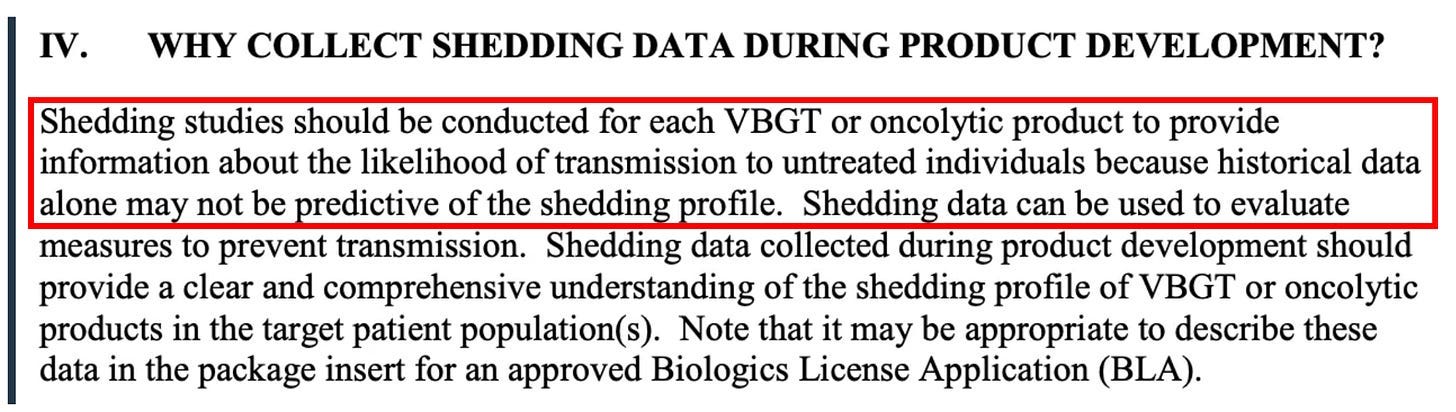
Further on in the document, the FDA again emphasizes the importance of shedding studies:
Note that the FDA emphasizes the importance of doing human shedding studies and not just relying on animal studies:
To inform the design of human shedding studies, shedding data may be collected in animals following administration of the VBGT or oncolytic product. These data can help estimate the likelihood and potential shedding profile in humans, particularly when there is concern about transmission to untreated individuals. However, such data cannot substitute for human shedding studies for several reasons.
But again, no studies testing whether excretion of mRNA-containing LNPs, modified spike-encoding mRNA, or spike produced by vaccinated people have been done. Well, I shouldn’t say none, because in this paper the author cites a Pfizer document obtained by FOIA which apparently revealed that shedding was studied in the urine and feces of intra-muscular injected rats. Unfortunately, that document is no longer at the website referenced.
To summarize from the above, the FDA’s position is that:
- the mRNA vaccines are gene therapy products
- Gene therapy products require shedding studies in both animals and humans
- Gene therapy product shedding raises the possibility of transmission from treated to untreated individuals
Note that much of the rest of this series of posts on shedding is guided by a masterful comprehensive review of the topic of gene therapy product shedding by independent researcher (by definition) Helene Banoun in Infectious Diseases Research. Hers is one of the only papers I could find that attempted to meticulously explore what is known about shedding of the mRNA gene therapy vaccines.
As already stated, an important point Banoun makes is:
There was no regulation of mRNA clinical trials prior to RNA vaccines, yet there is strict regulation of gene therapy products. It is difficult to justify that mRNA vaccines are not considered in the same way as gene therapies regarding this regulation; indeed the only difference is that they are (historically) supposed to protect against a disease and not cure it. Gene therapies are intended for a small number of people in poor health, whereas vaccines are used on a large scale on healthy people: it would therefore be wise to apply stricter rules to them.
She further points out another omission of the regulatory process:
Any experiment involving the deliberate transfer of a nucleic acid to a human must be preceded by Institutional Biosafety Committee approval (document on the regulatory standards is here), but approval was not given because of the emergency clearance given to mRNA vaccines.
Therefore, according to both the American and European agencies, mRNA vaccines are gene therapy products and should have been subjected to excretion studies of all secreted fluids (urine, exhaled droplets, saliva, sputum, nasopharyngeal fluids, semen, breast milk, feces, and sweat). Again, these studies were not done for mRNA vaccines nor for the DNA adenovirus vaccine (J&J).
So, where are the clinical human shedding studies? Well, I just learned of one that is about to be published (next ten days?) where the research team exposed a population of unvaccinated women to vaccinated individuals and their assessment outcome was the development of menstrual abnormalities. I know the results but want to respect the research teams right to present their original work. They have promised to share their manuscript with me and Paul Marik as soon as the peer-review and acceptance process is complete. I have no idea what journal they submitted to but I can be highly confident it is not the New England Journal of Medicine.
The entire reason why I did a “deep dive” into shedding science is because shedding was not studied when it absolutely should have been and I believe with near certainty that it occurs. Note my use of “near certain” is only to seem objective but it really is too late for that – both my partner Scott and I have diagnosed and successfully treated a number of shedding “victims.”
The lack of shedding studies prior to the mRNA rollout was, in my opinion, an insanely reckless and irresponsible omission (or willfully criminal, take your pick). As an evolving expert in the evaluation and treatment of Covid mRNA vaccine injury syndromes, I and others have identified the spike protein as the main component responsible for not only the pathogenicity of Covid but also of the vaccines, with this review paper proposing a new field named “spikeopathy” (study of the disease processes triggered by the spike protein).
If vaccine transcribed spike protein can be transmitted in sufficient quantity from vaccinated folks to unvaccinated ones, it stands to reason that adverse effects of the vaccine can develop in some unvaccinated people who came into contact (or close proximity) with vaccinated people. How did they get away with not studying this possibility?
An easy answer is they were doing science at “warp speed.” The more uncomfortable answer is that the “vaccines”, although meeting the definition of a gene therapy product, were actually not even legally considered a medical product at all and thus did not require a diverse range of safety studies (like on genotoxicity, reproductive risks, excretion potential etc). What? Why? How?
The reality is that the Covid vaccines, as a result of successive federal legislative actions which evolved over decades, was legally categorized as a “countermeasure” under a “public health emergency.” Such “countermeasures” require no specific regulatory approval process prior to dissemination. All a countermeasure needs is the recommendation of the Secretary of Health and Human Services that “it may be effective.”
This is the conclusion derived from the legal investigatory work of various independent and legal experts and researchers like Catherine Watts, Todd Callender, and Sasha Latypova. If interested in learning more, I would watch this lecture by Sasha Latypova (scroll down the page to find her lecture). As they have uncovered, “countermeasures” (even gene therapy ones) do not legally require studies of excretion potential, bio-distribution, pharmacokinetics, genotoxicity, insertional mutagenesis etc.
They don’t even require FDA regulated clinical trials of efficacy or safety.
So why did Pfizer and Moderna even do the efficacy trials? Latypova maintains that they did this not only to satisfy the public’s confidence to increase vaccine uptake, but also to “fool” the public into thinking these vaccines were medical products subject to standard (albeit accelerated) pharmaceutical product regulatory processes.
This obscured the reality that they were instead classified as military “countermeasures” against a perceived (if not actual) bioweapon. To wit, the COO of Operation Warp Speed was a General from the Department of Defense (DOD) and the vaccine manufacturers were under contract with the DOD to produce the countermeasure, sometimes referred to as a “demonstration (demo)” and/or a “prototype” in numerous legal documents they uncovered.
Anyway, as a result of this lack of a legal requirement to fully study these products in a public health emergency, the list and types of studies that should have been conducted (but were not) is long. Researchers and clinicians have been screaming about this since they were rolled out. These cries were met with a deafening silence by governmental health agencies across the world.
I know, it is a lot to take in.
But the latest “word on the street” is that the finance and insurance industries may finally be waking up to this fraud and its devastating impacts on U.S disability and death rates. Knowledge of these society-wide impacts largely results from the work of two different research teams led by former Blackrock portfolio manager Ed Dowd and insurance industry consultant Josh Stirling).
This article describes the reasons why Pfizer and Moderna stock are crashing of late. Put more succinctly, from what I hear it is due to the hedge fund guys shorting their stock. I believe Pfizer is in even deeper trouble now that this “forensic” paper just got published finding that they hid vaccine trial deaths which obscured a 3.7 fold increased risk of cardiac death in the vaccinated arm of their trial.
“Shedding” Part 1– Shedding of Covid mRNA Vaccine Components and Products From The Vaccinated to the Unvaccinated – Part 1
“Shedding” Part 2 – The Bio-Distribution and Excretion Potential of Covid mRNA Vaccine Products
“Shedding” Part 3 – Can You Absorb Lipid Nanoparticles From Being Exposed To a Vaccinated Person?
“Shedding” Part 4 – Evidence of Placental and Breast Milk Transmission of Covid mRNA Vaccine Components
“Shedding” Part 5 – Evidence of Shedding Causing Illness In Others
“Shedding Part 6– Clinical Case Notes Describing Shedding Phenomena Among Leading Edge Clinic Patients
“Shedding” Part 7 – Shedding Via Sexual Intercourse – Clinical Reports
Ukrainian border guards using drones to catch ‘fleeing’ citizens – UNIAN
RT | October 31, 2023
Ukraine’s border-guard service (DPSU) has released several videos showing surveillance drones helping officers catch people trying to leave the country illegally. National media have described those who’ve been caught as nationals “fleeing” Ukraine, amid an armed-forces mobilization as Kiev’s conflict with Russia continues.
In the first clip published by DPSU on Saturday, a drone operator uses the aircraft’s thermal camera to guide a patrol towards a group of people hiding in bushes. The service claims the technique helped it catch 14 trespassers in four separate interceptions near the village of Okny near the border with Moldova.
The next day the border guards released footage of a short chase, as seen from a drone via a night camera. The DPSU said the four would-be violators in this instance wanted to go to Moldova but were intercepted as they made their attempt.
Another video published by the service on Monday includes drone footage of a car moving down a battered road. Guards then stop the vehicle and apprehend the driver, who the DPSU claimed to be a people-smuggler.
The suspect allegedly used his transport to sneak his clients to a part of the border with Moldova from where they would then cross illegally. Would-be violators in the first two cases reported by the DPSU had also used services of smugglers, who ask as much as $2,000 for help crossing the border, according to the service.
The footage doesn’t go into what motivates people to embark their law-breaking trips. UNIAN, a major Ukrainian news outlet, described the official action as guards “keeping catching nationals fleeing across the border.”
Kiev has banned men who are eligible to serve in the military from leaving the country unless they get a waiver. It’s now reportedly ramping up efforts to draft additional troops, after suffering heavy casualties in attempts to breach Russian defensive lines over the months of the so-called summer counteroffensive.
Ukrainian MP Sergey Rakhmanin, who sits on the parliamentary Committee for Security, Defense, and Intelligence, said in an interview last week that the country had long exhausted the reserve of persons who’d volunteered to go the front.
Moscow has accused Kiev’s Western sponsors of using Ukrainians as “cannon fodder” in a proxy war against Russia. In a speech at a security forum in Beijing on Monday, Defense Minister Sergey Shoigu estimated Ukrainian casualties during the counteroffensive at over 90,000.
Israel targets journalists, kills their families as Big Tech & Biden admin silence Palestinians
BY WYATT REED · THE GRAYZONE · OCTOBER 27, 2023
With Israeli airstrikes on Gaza killing at least twenty Palestinian journalists—and the Biden administration working to muzzle others—Big Tech is quietly coordinating with Tel Aviv to muzzle Palestinian media outfits.
Israeli strikes on the Gaza Strip killed three Palestinian journalists on October 25 in one of the deadliest days for local reporters since the military’s bombing campaign began nearly three weeks before. As the hours passed, footage appeared showing the moment Ramallah-based journalist Mohammed Farra learned that his wife and children were all killed in an Israeli airstrike in Gaza’s Khan Younes neighborhood.
Similarly heart-rending scenes would play out more than once over the course of the day. Elsewhere in the besieged coastal enclave, an Israeli airstrike killed the wife, son, daughter and infant grandson of Al Jazeera Arabic’s Gaza bureau chief, Wael Dahdouh.
Israel’s attacks on Palestinian journalists came hours after US Secretary of State Antony Blinken assured “American Jewish community leaders” that he urged Qatar’s government “to tone down Al Jazeera’s rhetoric about the war in Gaza” during a recent trip to Doha.
Suspicions that Israeli forces deliberately targeted Dahdouh’s family were quickly bolstered by comments from News 13 journalist Zvi Yehezkeli.
“Generally we know the target,” Yehezkeli told audiences within hours of the strike, adding, “for example, today there was a target: the family of an Al Jazeera reporter.”
“In general, we know,” he concluded.
If true, it wouldn’t be the first time the Dahdouh’s outlet found itself in Israeli crosshairs. In 2021, the Israeli military leveled the Gaza tower that housed the officers of both the Associated Press and Al Jazeera. The following year, Israeli forces assassinated renowned Palestinian-American journalist Shireen Abu-Akleh, a veteran Jerusalem-based correspondent for Al Jazeera, in a shooting that drew international condemnation but was largely ignored by the US government, which echoes the Israeli government’s position that her killing was “unintentional.” Under Blinken, the State Department has distanced itself from its initial expressions of outrage and no longer calls for either an independent investigation or criminal charges for the perpetrators.
Big Tech censorship targets Palestinian journalists after Israel targets their homes
As the US and Israel rush to censor the voice of Palestinian journalists, Big Tech censorship has proven indispensable to Israel’s propaganda war. In the aftermath of October 7, multiple social media platforms have suspended or deactivated profiles belonging to numerous prominent journalists, human rights advocates, and Palestinian activists. The crackdown follows years of complaints alleging double standards when it comes to anti-Zionist content on social media.
Accounts operated by Eye On Palestine disappeared from Instagram, Facebook, and X on October 25, leaving more than 6 million followers unable to access one of the most popular resources providing firsthand footage of destruction in Gaza. A spokesman for Meta, the parent company of Instagram and Facebook, insisted the suspensions were not politically motivated, asserting “We did not disable these accounts because of any content they were sharing.”
Despite Meta’s denial, it is worth recalling the company’s record of complying with Israeli government censorship requests. Following the approval of a so-called “Facebook Bill” aimed at clamping down on digital “incitement” in 2016, fanatical former Israeli Justice Minister Ayelet Shaked bragged that Facebook, Twitter and Google were complying with 70 percent of their takedown orders.
Tamer Al Mishal, a Palestinian journalist who has served as a crucial Gaza-based news source for many years, put a face to that statistic. In September, Al Mishal made waves when he published an exposé on Al Jazeera illustrating how Meta coordinated with Israeli intelligence to stifle pro-Palestinian content. When he attempted to access his social media profile days later, the reporter made an alarming discovery: his Facebook page had completely ceased to exist.
He wasn’t the only one. The week before, Meta suspended the Instagram account of Palestinian influencer and photojournalist Motaz Azaiza after he shared footage of the remnants of his apartment building, where 15 of his family members were killed in an Israeli airstrikes.
“Palestinian journalists in Gaza are not just facing the Israeli occupation,” Shadi Abdelrahman, a local reporter with years of experience covering events in Gaza from the ground, explained to The Grayzone. “They also have to overcome a lot of censorship by Facebook, YouTube,” he told The Grayzone, adding: “anything on social media, they need to be very careful because they will get their accounts banned.”
“Working as a journalist in Gaza is not an easy job,” he says, not only “because you are being censored by social media, [but] also it can cause problems with Israeli authorities, especially if you’d like to leave through any crossing which is controlled by Israel.”
If you’re outspoken in your coverage, Abdelrahman says, Israeli authorities “will consider you as an enemy.”
During 2021’s Great March of Return, “those journalists who were attending the weekly marches and covering it were targeted deliberately by Israel.”
“Some of them were shot in the knees, some of them were shot in the legs. Some of them got killed,” Abdelrahman recalled.
On Instagram, meanwhile, users noted an apparent ‘glitch’ temporarily translated the Arabic word for “Palestinian” into “Palestinian terrorist.”
During an October 26 raid in Jenin, the Israeli army destroyed the memorial to Shireen Abu Akleh, the renowned Al Jazeera correspondent it killed there a year before.
Featured Video

Houthis Keep Advancing as the Red Sea Crisis Deepens
or go to
Aletho News Archives – Video-Images
From the Archives
15 Saudi ‘hijackers’ were CIA agents working for US: Scholar
Press TV – April 13, 2016
Fifteen of the 9/11 “hijackers” from Saudi Arabia were CIA agents working for the United States government, which was seeking to destroy the Middle East for Israel and to double the American military budget, says Dr. Kevin Barrett, an American academic who has been studying the events of 9/11 since late 2003…. continue
Blog Roll
 Aletho News
- Damascus rejects Saudi request for Syrian fighters to counter Yemen: Report
- South Korea says will not send troops to join terrorist US war on Iran
- Russia Just Struck the Eyes of NATO’s War Machine in Ukraine
- Russia summons UK charge d’affaires over Kiev drone support
- NATO member warns bloc seeking pretext for war with Russia
- Macgregor: We Haven’t Seen the Worst of the Iran War Yet
- ‘We are not like everyone else’ laws that bind other nations do not apply to Israel, says Likud lawmaker
- Report: Saudi Arabia seeks allies’ assistance as missiles deplete amid war on Yemen
- Fuel Crisis Deepens: Pakistan Warns Tanker Attack in Red Sea Would Be an ‘Act of War’
- ‘Bucha massacre’ a false flag orchestrated by UK – Moscow
- If Americans Knew
- Robert Kraft: The Billionaire Friend of Netanyahu Pulling The Strings Behind the Macklemore/Ed Sheeran Blow Up
- Columbia Administered Fund Gives Big Money to Pro-Israel Groups
- Deportation Case of Palestinian Activist Salah Sarsour Tests First Amendment
- ‘We Will Not Forget’: Palestinians Mark 44 Years since Sabra and Shatila
- Why do we let Zionists decide what we can and can’t say?
- US welcomes Israeli, Iranian delegations to UN, but not Palestinians – Daily Update
- Biden’s Genocide Accomplices Targeted by New Accountability Campaign
- AIPAC’s Network Has Already Spent $67.2 Million to Shape the Midterm Elections
- Jewish Supremacist Manufacturing a Civilizational Threat to License Bigotry
- US bans Palestinian president from speaking at the UN
- No Tricks Zone
- New Study: ‘Global Drought Shows No Detectable Recent Acceleration Under Climate Warming’
- Economic Masterminds: German Socialists Suggest Taxing Productivity Gains Stemming From Using AI
- The South China Sea Has Not Been Cooperating With The Climate Change Narrative
- Energy Crisis: Germany Enters Heating Season With Historically Low Gas Reserve Fill Levels
- New Study: The Antarctic Ice Sheet Gained Mass From 2020-2024 Due To Staggering Snow And Ice Accumulation
- Study: Ocean Heating Rates From Thousands Of Years Ago ‘Dwarf’ Modern Ocean Heating Rates
- Climate Extremists Target, Attack Large-Scale Power Grid Infrastructure In Germany!
- New Study: Antarctic Ice Melt Has Contributed Less Than 1 Centimeter To Sea Level Rise In The Last 30 Years
- Fear Of Debate: Alarmist German Climate Scientist Calls On Mainstream Media To Discredit Skeptic Voices
- End-Of-August Arctic Sea Ice Extent Hasn’t Fallen In 20 Years, Official Data Show!
 Aletho News