Is this the turning of the tide against Bill Gates?

By Roger Watson | TCW Defending Freedom | September 20, 2022
It is hard to know if these are the end days for monkeypox, but I think they are. One of the main drivers, if not the sole driver, for pushing the monkeypox agenda was Big Pharma and the likely profits it would make from manufacturing a monkeypox vaccine. But with the imminent retirement of the representative of Big Pharma on earth, Anthony Fauci, to his $350,000 per annum package (and continued Covid infection and Paxlovid treatment ‘rebound’) and the start of the exposure of its high priest Bill Gates in the mainstream media, we can but hope the vaccine pushers may no longer prevail.
The exposure I refer to is an astonishing in-depth investigative article, published by the hitherto pro-vaccine Politico, entitled ‘How Bill Gates and his partners used their clout to control the global Covid response – with little oversight’ which reveals the extent of this one man’s control over the production and distribution of vaccines.
The disclosures will come as little surprise to readers of TCW, where Gates’s Covid vaccine development role has been under the microscope since December 2021. They will know already from TCW reporting that in March 2020 Gates stepped down from his position on the Microsoft board of directors, citing his desire to concentrate on Covid-19, that a month later he pledged to make Covid-19 vaccines available to 7billion people (the global population was estimated at 7.8billion last year) and that in December 2020 the Bill and Melinda Gates Foundation committed $1.75billion to develop Covid-19 tests and vaccines, making itself the self-appointed leader of the global response to Covid-19. They will know, too, that this comes on the back of his hubristic long-term total global vaccine project.
What the Politico article makes clear is that all the major bodies involved in unleashing the scourge of Covid-19 vaccines on the world such as Gavi, a global ‘vaccine alliance’ instigated by Bill Gates, the World Health Organisation, the Wellcome Foundation and the Coalition for Epidemic Preparedness Innovations (CEPI) were all receiving substantial funding from Bill Gates. This is exemplified by the fact that in 2021 the funding received by the WHO from Gates exceeded the contribution of the United States. Politico, with the German newspaper Die Welt, examined meeting minutes and thousands of pages of financial disclosures and tax documents, which revealed that the groups have spent nearly $10billion since 2020 in one of the first comprehensive accountings of expenditures by global health organisations on the global fight against the pandemic.
What the Politico article also shows is that Covid vaccine process spearheaded by Gates has been, from the perspective of the poorer parts of the world, a complete failure. In managing Covid-19, Politico argues that in the early days there was ‘a steady, almost inexorable shift in power from the overwhelmed governments to a group of non-governmental organisations’. These organisations ‘took on roles often played by governments – but without the accountability of governments’.
In her investigative reports for TCW into the guilty men behind global lockdown and the fast-tracked gene therapy vaccines, Paula Jardine casts an even more sinister light on this process. Her analysis points to the operation of CEPI (‘cross-populated’ with several men associated with or employed by BMGF, Wellcome and Gavi) a self-appointed international cabal that both engineered the crisis and the solutions to it, and to how it successfully sought to influence and control Covid policies – from lockdown to vaccination – round the world, deliberately panicking and pressuring governments.
The Politico investigation by contrast focuses on the disturbing and influential role played by one man, the man with the money, that great ‘philanthropist’ Gates, who refused to suspend intellectual property rights which Doctors Without Borders, questioning the undue influence of Gates, stated emphatically was ‘protecting the interests of pharmaceutical giants over people living in poorer nations’. An unnamed former senior US health official is reported to have said: ‘You have to remember that when you’re dealing with the Gates Foundation, it’s almost like you’re dealing with another major country in terms of their donations to these global health organisations.’
Health fascists and medical meddlers have started to lose credibility in face of ‘operation backtrack’ over the damaging effect of lockdowns; the question is when backtrack will start in earnest over vaccines. Despite abundant evidence for, on the one hand, the ineffectiveness of the Covid-19 vaccines and, on the other hand, their harmful side-effects, is there yet enough scepticism amongst the mass vaccinated to knock Gates, the vaccine architect, off his powerful pedestal?
That Politico and Die Welt – the latter also pro-Covid – had not been critical of Bill Gates up to this point gives a glimmer of hope. If other MSM follow where they lead, the tables could start to turn on Gates and spell the end of his role as the world’s leading vaccine cajoler; the end of a ‘vaccine for every ill’ global health culture, at the expense of all other public health measures, whether they are needed or not or do more harm than the diseases they were meant to prevent. We can but hope.
Russia Presents Evidence of US Ukraine-Based Military-Biological Activity to Geneva Convention
Samizdat – 19.09.2022
The Russian Defense Ministry has presented evidence of US military-biological activity in Ukraine to member states of the Biological Weapons Convention in Geneva, head of the Radiation, Chemical and Biological Defense of the Russian Armed Forces, Lt. Gen. Igor Kirillov, said.
The ministry’s representative said that member states’ delegations did not question the authenticity of the documents they were presented as proof of the US’ and Ukraine’s violation of articles I and IV of the Convention.
“The participants of the meeting received copies of real documents previously mentioned by the Ministry of Defense of Russia, as well as material evidence confirming the implementation of work on military-biological programs in Ukraine, for consideration,” Kirillov said.
The head of the RCBD of the Russian Armed Forces further pointed out that the US and Ukraine failed to present convincing evidence to the Convention’s members that would prove that the Pentagon’s cooperation with the Ukrainian laboratories benefited the epidemiological situation in the country. Kirillov said that the US Department of Defense only came up with a few photos of renovated laboratories, while the said epidemiological situation in Ukraine has been deteriorating for the past 15 years.
The Russian Defense Ministry’s representative further stated that the US admitted the fact that Ukraine exported biological pathogens and materials, as well as engaging in ethically questionable experiments – namely on the military and socially vulnerable groups of the Ukrainian population such as psychiatric ward patients. Kirillov slammed the US attempts to tone down the problem by using claims that it did not occur “often”.
Russia raised 20 questions regarding the illegal activities of Kiev and Washington that violate the provisions of the Convention with the BWC member states, Kirillov said. Among them are questions regarding the choice of pathogens for studies, which often included ones that have never been discovered in Ukraine.
The ministry’s representative also reiterated Russia’s previous statements regarding Ukraine seeking to procure drones from Turkey fit to disperse aerosols. The Turkish defense company refused to deliver the UAVs, which could have been used to spread harmful and potentially deadly pathogens.
Children among civilians killed in Ukrainian strike – authorities
Samizdat – September 19, 2022
At least 13 civilians have lost their lives in a Ukrainian artillery strike on the city of Donetsk, local authorities have said.
Donetsk city administration chief Alexey Kulemzin took to Telegram on Monday, writing: “according to preliminary information, 13 civilians are dead as a result of a punitive strike on Baku Commissars square.”
The official added that the exact number of those injured in the attack is not yet known.
Local media, citing eyewitnesses, has said an artillery shell hit a bus stop.
Speaking to Russia’s Rossiya 24 news channel later in the day, Kulemzin said: “two children are among the dead,” adding that it’s not the first case of minors being killed by Ukrainian strikes in that district.
The territorial defense of the Donetsk People’s Republic, in turn, posted a message on their own Telegram channel, alleging that the Ukrainian military used Western-supplied 155mm howitzers to shell residential areas of Donetsk.
The authorities said infrastructure and apartment blocks came under fire in one of the city’s districts. Local residents have been advised to stay indoors or move “to shelters if necessary.”
According to the Donetsk Territorial Defense, six more people were killed in shelling on Sunday through Monday morning.
108 civilians killed by mines and cluster bombs in Yemen since April: Report
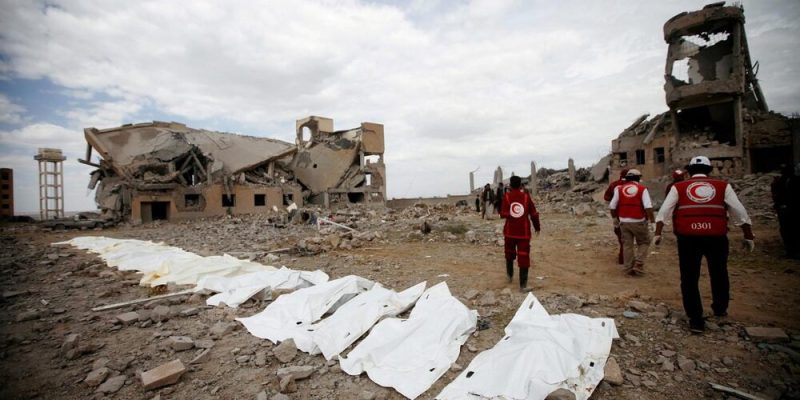
The Cradle | September 18, 2022
The Executive Center for Mine Action (YEMAC) in Sanaa has confirmed that 324 civilians have been killed and injured since the truce took effect on 2 April as a result of mines and cluster bombs used by the Saudi-led coalition.
In a statement, the Center said that since the beginning of the UN-brokered truce, 108 civilians had been killed and 216 injured through landmines, cluster bomb explosions, and other remnants of the 8-year-long war.
The YEMAC renewed the call to provide field supplies and equipment to demine the battlefields in Yemen from cluster bombs, unexploded shells, and mines. Despite the agreement to do so, efforts remain constrained by the Saudi-led coalition.
According to the reports, cluster bombs used by the Saudi-led coalition have caused the most damage, killing 18 civilians and wounding 57 others.
Another report published by the Entesaf Organization, which focuses on the rights of women and children, Saudi Arabia’s war in Yemen has killed and injured over 13,000 Yemeni civilians since 2015.
On 29 August, Abdul Karim al-Safiani, deputy director of Yemen’s Water Resource Organization, stated that he discovered high radioactive substances and toxic metals in freshwater resources in Hodeidah province.
According to Yemeni sources, Saudi Arabia and its partners are also responsible for the looting of vast quantities of oil from detained tankers.
Earlier this month, the spokesman for the Yemeni Petroleum Company (YPC) in Sanaa, Issam al-Mutawakel, said the total number of fuel ships seized by the coalition reached 12 ships.
Sanaa accused the Saudi-led coalition on 28 August of destroying 2,995 water facilities since the beginning of the war in 2015, including dams, barriers, pumps, tanks, irrigation channels, and irrigation networks, fueling the humanitarian crisis in the country.
According to the United Nations Refugee Agency (UNHCR), more than 23.4 are in desperate need of humanitarian assistance in Yemen, the worst human-made humanitarian crisis in the world.
Meanwhile, the Saudi-led coalition is blocking the country’s access to assistance and necessary resources by controlling access via sea, air, and land. Half of the country’s health facilities are also out of service and lack energy and supplies for the adequate treatment of its patients.
The West is poised to throw Yemen under the bus again to fuel its economic war on Russia
By Robert Inlakesh | Samizdat | September 11, 2022
Strained by the consequences of the ongoing conflict between NATO and Russia over Ukraine, France may be destroying all prospects for peace in Yemen, in a bid to secure energy resource from the United Arab Emirates.
Considered to be home to the worst humanitarian crisis in modern history, according to the United Nations, earlier this year, its people saw glimmers of hope towards ending its seven-year long war. A ceasefire truce, which has largely held since April, has been viewed as the first step towards reaching a UN-mediated solution for peace between the Ansarallah government in Sanaa and the Saudi-led coalition forces which claim to represent the internationally backed Yemeni government in exile.
According to UN estimates, the total number of people killed in Yemen’s war already reached 377,000 by the beginning of 2022. The civilian death rate is said to have doubled, according to the Norwegian Refugee Council (NRC), since the controversial withdrawal of UN human rights monitors last October.
Although Saudi coalition forces and Ansarallah, popularly referred to in Western media as the “Iran-backed Houthi rebels,” have managed to keep fighting to a minimum during the past months, another major player in the south of Yemen has recently decided to go on the offensive. The Southern Transitional Council (STC), often called Yemen’s southern separatists, are backed by the United Arab Emirates (UAE) and declared the start of a new military operation in the Abyan province “to cleanse it of terrorist organisations.” This follows territorial gains by the STC, in neighboring Shawba province, against the Muslim Brotherhood aligned Islah Party and others. The offensives launched by the UAE-backed STC have been regarded as a major challenge to UN efforts to end the conflict in Yemen, as well as having imperiled the Saudi initiative, which it calls the ‘Yemen Presidential Council,’ aimed at solidifying the legitimacy of the alternative Yemeni leadership in exile.
Where France Comes In
Although its role is little known to the Western public, Paris is the third largest arms supplier to the UAE and Saudi Arabia for their war efforts in Yemen, ranking just behind the US and UK. In fact, Germany, Spain and Italy have also sold weapons that have been used in the devastating war. Despite criticism, from human rights groups, of French weapons being used by Abu Dhabi and Riyadh to commit war crimes, the sale of weapons has continued from France.
April 15, 2019, French investigative magazine, Disclose, published an expose on Paris’s role in Yemen’s war. The information presented was based on a leaked French Military Intelligence (DRM) report dating back to September, 2018, clearly proving that the country had sold offensive weapons that were used in civilian areas, a charge that the French government has denied. As far back as June, 2018, credible reports began to emerge that French special forces units were operating on the ground in Yemen, alongside forces belonging to the UAE. Last December, Paris decided to further tighten its relationship with Abu Dhabi, signing its largest ever weapons sale to the UAE, worth 19.23 billion US dollars according to a report from Reuters.
France first turned to the US
France is now desperately in need of alternative energy suppliers to Russia, in order to meet its required needs, fearing that as the winter hits, Moscow may strategically cut off its natural gas completely. As part of NATO, Paris is backing a US-led initiative which seeks to make Russia pay an economic and military price for its offensive in Ukraine, however, this strategy has majorly backfired economically.
US President Joe Biden made two major foreign policy pledges when running for office in 2020, which are relevant to the current French predicament. The first being to revive the Obama-era Iran nuclear deal and the second being to find a diplomatic solution to the war in Yemen. Due to the ongoing NATO-Russia conflict, seeking a revival of the Iran nuclear deal has re-emerged on the political agenda of his administration in a major way. Iran, free from sanctions, could become an alternative source to fill the energy needs of Europe in the future, yet it could take some time for this to actually happen.
On the issue of the war in Yemen, Joe Biden pledged as part of his first speech on his government’s foreign policy goals, that he would hold Saudi Arabia to account and seek to find a solution to the crisis in Yemen. However, the war in Ukraine clearly changed his approach to Riyadh, so much so that Washington signaled in the review a decision to not sell offensive weapons to the Saudi government. The US President was heavily criticized by Human Rights Watch for traveling to Saudi Arabia in July.
Despite US attempts to have Gulf Cooperation Council (GCC) states increase their oil production, none have yet complied in the manner that Washington had hoped for. Specifically in the cases of the UAE and Saudi Arabia, it is clear that both are seeking to fast track their journey to diversify their economies. That has meant them hanging onto their strategic reserves of oil and gas, during a global energy crisis, which has made fiscal sense for them. In the cases of Venezuela and Iran, despite the US having seemingly reached out to both, neither seem to be a real replacement to Russia in the near future.
All Bets On Yemen
France is now looking for alternatives on its own. In June, the European Union announced that it had signed an agreement with Israel and Egypt. Under the deal, Israel will send gas through pipelines to Egypt, where it will then be transported to Europe. Although this may work, Tel Aviv does not have the capacity to replace Moscow as Europe’s main supplier of gas. Israel seeks to double its gas output, but in doing so is already running into potential problems over its maritime border dispute with Lebanon and its planned extraction of gas from the ‘Karish field’ in September, considered to be located in a disputed area. Lebanese Hezbollah has even threatened to strike all of Israel’s gas facilities in the event that Beirut is not given a fair deal to access its own resources.
French President, Emmanuel Macron, has attempted to persuade resource rich Algeria to become part of the EU’s solution, also going on a three-day trip to Algiers in order to mend ties. Algeria, which maintains close relations with Moscow, withdrew its ambassador from Paris for three months last year, during a diplomatic row. Macron had accused the Algerian President Abdelmadjid Tebboune’s government of “exploiting memory” and “rewriting history” of the colonial era and even questioned the legitimacy of Algeria as a State prior to French settler-colonial rule there. Around 1.5 million Algerians were killed in the battle for independence from France, which its resistance eventually managed to win in 1962. The tone of the French president has now dramatically changed from that of last year, with Macron remarking that both nations “have a complex, painful common past. And it has at times prevented us from looking at the future.”
The other major alternative path that France seems to be now seeking, is through its close alliance with the UAE. As mentioned above, it has been clear for some time that Paris has been involved in supplying weapons, logistical support and even boots on the ground to its allies in Abu Dhabi and Riyadh, aiding their fight in Yemen. However, it is also clear that the UAE has not been interested in cutting into its strategic oil reserves to meet the demands of Europe.
In July, as President Macron hosted the Emirati President, Mohammed bin Zayed al-Nahyan, in Paris, the French ministry of economy announced a new strategic energy agreement between the UAE and France. An aide to the French president noted that France was eager to secure diesel fuel from the UAE, hinting that the cooperation agreement involving France’s ‘Total Energies’ and the UAE’s ‘ADNOC’ may be linked. Although it is unknown as to what the specifics of the “strategic agreement” are, it has been speculated that the deal could potentially be worth billions.
Then, in August, the UAE-backed STC suddenly began new offensive operations in both the Shabwa and Abyan provinces. It just so happens that the STC forces decided to take over the energy sites in the Shabwa province too. Leading human rights NGOs had urged Paris to keep in mind Abu Dhabi’s human rights abuses in the advent of the signing of the strategic energy agreement, calls clearly not heeded. On August 21st, when UAE-backed forces seized the oil facilities in Yemen’s south, it may have been with the French deal in mind. Yemen’s former foreign minister, Dr. Abu Bakr al-Qirbi stated on Twitter that “preparations are being made to export gas from the Balhaf facility in light of increased international gas prices.” This was then followed by an announcement from the parliament of the Sana’a-based National Salvation Government, warning of suspicious movement from both US and French forces.
The key Balhaf facility, in Yemen’s Shabwa province, has reportedly been turned into a base for forces belonging to the UAE, with allegations suggesting that Paris could “provide protection for the facility through the French Foreign Legion.” There are also countless reports of the UAE looting resources from Yemen, which would seem to support the idea that they could be attempting to extract them to send to France. The latest reported looting of Yemen’s resources, from June, quotes Yemeni officials as having alleged that a Gulf Aetos tanker, carrying 400,000 barrels of Yemeni crude oil, had departed from Rudum port and was being operated by the UAE.
What these offensive moves by the STC also mean, is that the Saudi-backed forces in Yemen and Ansarallah will likely also get involved in the combat too. This could mean the dissolution of the ceasefire truce between the two sides, the renewal of the Ansarallah offensive to take the oil rich Marib province from the Saudi-backed forces and the death of any potential peace initiative to end the war.
It is unlikely that Ansarallah will stay silent, if the STC are aiding in the theft of Yemen’s resources for the sake of France. One of the major reasons behind the dramatic escalation of violence last year, was the Ansarallah offensive, launched with the aim of taking out the last northern stronghold of the Saudi-led coalition, Marib. The purpose of taking the resource rich area would be to stop the looting of Yemen’s resources, which according to reports is amounting to the theft of millions of barrels per year. Some sources claim that an unofficial agreement is in place between the US and Saudi governments, to purposefully keep the resources of Yemen away from its people and instead, divert the profits to Saudi banks.
Part of the reason why there was a Yemeni revolution in 2011, then a seizure of power in 2015 by Ansarallah in conjunction with the country’s military, was the popular belief that the past two Presidents of Yemen, Ali Abdullah Saleh and Abdrabbuh Mansour Hadi, were corrupt. The people of Yemen were fed up with Saleh for a multitude of reasons, primarily that he mismanaged resources, had sold out to the United States and was corrupt. President Hadi was later to be seen as a stooge, controlled completely by the Saudis.
Perhaps the biggest problem here however, is not just that Yemen is a resource rich country, with a starving population, being torn apart by foreign powers, but also that nobody even knows what their governments are involved in. On August 25, then British prime minister, Boris Johnson, stated, about rising energy bills, that “While people are paying energy bills, people in Ukraine are paying with blood”. Yet, it may turn out that for Europe to keep the lights on, the people of Yemen will pay with their blood. Except in this case, the UK, US and France can’t blame that bloodshed on Moscow, this is their own doing.
Robert Inlakesh is a political analyst, journalist and documentary filmmaker currently based in London, UK. He has reported from and lived in the occupied Palestinian territories and currently works with Quds News.
Wisconsin Healthcare Workers Who Had Religious, Medical Exemptions Must Get Novavax COVID Shot or Lose Job
By Suzanne Burdick, Ph.D. | The Defender | September 9, 2022
A Wisconsin hospital this week said it is withdrawing medical and religious exemptions for some employees from the hospital’s COVID-19 vaccine mandate, giving those employees until Sept. 21 to get the Novavax vaccine.
Froedtert & the Medical College of Wisconsin, which operates 11 hospitals and more than 45 health centers and clinics throughout the midwest and employs more than 2,000 physicians, in an email said the Novavax vaccine option “eliminates conflicts” for those who originally declined COVID-19 vaccination for religious or medical reasons.
The U.S. Food and Drug Administration in July granted Emergency Use Authorization of the Novavax COVID-19 vaccine for adults ages 18 and up. While the prior COVID-19 vaccines made by Pfizer, Moderna and Johnson & Johnson used fetal cell lines from unborn fetuses in various stages of development and testing, the Novavax vaccine is made differently and does not use human fetal cell lines.
Froedtert employees who don’t get the first Novavax dose by Sept. 21 will be terminated as Froedtert will consider them to have “voluntarily resigned,” the company said.
The hospital said in a statement:
“Froedtert Health requires staff and providers be fully vaccinated against COVID-19 as a federal requirement that is monitored for compliance. We join many other health systems around southeast Wisconsin and the U.S. that have made vaccination a condition of employment.
“The Novavax vaccination for COVID-19 is now available. This protein-based vaccination option eliminates conflicts for those staff with religious or medical exemptions caused by mRNA-based vaccines and other concerns.
“Since those staff are now eligible for a vaccination that does not conflict with their religious beliefs or medical situation, their exemption will expire. This affects a small percentage of staff with a vaccine exemption. Eligible staff continue to be exempt from a COVID-19 vaccine for religious and medical reasons.
“Froedtert Health respects the right of staff and providers to engage in activity protected by state and federal law.”
A Froedtert employee who spoke anonymously to WISN 12 News on Wednesday said Froedtert’s abrupt demand will have negative repercussions.
“Anyone in healthcare knows we’re very understaffed and overworked right now and this is just going to take away a lot of nurses from the bedside,” she said. “This will affect patient care and safety.”
Although according to Froedtert, as of October 2021 — their most recent count — nearly 99% of their employees had been vaccinated against COVID-19, the employee said she thought about 100 nurses would be affected.
The employee, a Catholic, said the previous vaccines were against her religious beliefs because of the ingredients. However, the Novavax vaccine also goes against her religious beliefs, she said.
“Now that we’re two, almost three years into this [COVID-19 pandemic] and we know more, we should be able to make our own educated decision,” she said.
She added:
“It’s my body, my temple. God is within us. If we’re uncomfortable, or not sure about something, then we shouldn’t do it.”
The employee said she’s presently unsure what she will do.
“I carry the health insurance for our family. I have a week to decide if I feel comfortable taking this vaccine otherwise I honestly don’t know. I don’t know if any other healthcare facilities in this area even take exemptions,” she said.
Froedtert officials said their recent exemption withdrawal complies with federal regulations that mandate all employees must be vaccinated against COVID-19 or have legitimate religious or medical exemptions.
Mark Goldstein, an employment lawyer, told WISN 12 News employees affected by the mandate could “attempt to recast their religious exemption as a more generalized claim.”
“Quite frankly,” he added, “some of it depends on how strident they are in that regard.”
The hospital’s requirement is that employees be fully vaccinated against COVID-19, but not that they have to get the new Omicron-specific booster shot made by Pfizer and Moderna.
Novavax pushed on unvaccinated despite safety concerns
As The Defender reported in late July when the Centers for Disease Control and Prevention (CDC) recommended the Novavax COVID-19 vaccine for adults age 18 and up, Operation Warp Speed in 2020 awarded Novavax — which like Moderna, had never brought a product to market before COVID-19 — a secret contract worth $1.6 billion (now being reported as $1.8 billion).
It was one of the largest taxpayer handouts channeled through Operation Warp Speed.
The media characterized the Novavax injection as a “game changer” in comparison to the mRNA and adenovirus-vectored gene therapy shots, claiming it should be “reassuring to those who are hesitant.”
In fact, according to the CDC’s advisors, the unvaccinated represent the “primary target population for Novavax.”
Some media outlets claimed Novavax — made with recombinant moth-cell-based nanoparticle technology, the problematic surfactant polysorbate 80 and a never-before-approved nanoparticulate adjuvant called Matrix-M — is “free of side effects.”
However, the day after the FDA issued its Novavax authorization, the European Medicines Agency (EMA) updated its product information for the Novavax shot to disclose “new” side effects.
The EMA’s list of side effects included “severe allergic reaction [anaphylaxis] and unusual or decreased feeling in the skin” (called paresthesia and hypoesthesia, respectively).
In addition, the EMA said it would assess myocarditis and pericarditis as Novavax side effects — safety signals that also were on display in the FDA’s briefing document on Novavax.
And in clinical trials, older adults who received the Novavax vaccine experienced an increased incidence of hypertension compared to those in the placebo group.
Not as ‘traditional’ as portrayed
The Novavax vaccine relies on a protein-based technology used for decades, leading some media outlets to portray it as a “traditional” vaccine compared with other COVID-19 vaccines that use newer technologies.
But according to Dr. Meryl Nass, an internist with a special interest in vaccine-induced illnesses, chronic fatigue syndrome and toxicology, the media’s portrayal of Novavax as a more traditional vaccine is not accurate.
Nass, a member of the Children’s Health Defense (CHD) scientific advisory committee, pointed out that the Novavax shot contains a novel adjuvant, Matrix-M, “so it is not really an old-fashioned shot.”
Nass raised safety concerns specific to the adjuvant, while others voiced concerns about Novavax being linked to heart inflammation and blood clots, and the fact that the vaccine was designed for use against the original Wuhan strain of SARS-CoV-2 — not the Omicron variants that are dominant today.
Adjuvant used in Novavax linked to autoimmune disease
Because Novavax is a protein subunit vaccine, it uses just the spike protein as the antigen rather than the whole pathogen (an inactivated or attenuated virus). Using the whole pathogen would expose the host to the virus’ entire protein coat instead of just one protein.
Protein subunit vaccines are often less immunogenic (less likely to provoke the immune system) than vaccines that use whole pathogens as the antigen, and may not generate a strong enough immune response.
That’s why they require the use of an adjuvant — in this case, Matrix-M — in addition to the antigen to get a stronger immune response.
However, few adjuvants are both potent and non-toxic enough for clinical use.
The proposed primary series for Novavax is two intramuscular injections 21 days apart at the dose level of 5 µg of the recombinant spike protein and 50 µg of the Matrix-M adjuvant.
Matrix-M, originally called QS-21, was one of the saponins derived from Quillaja saponaria, which is the soap bark tree native to Chile.
Some reports point out that the Matrix-M adjuvant — unlike the polyethylene glycol (PEG) lipid used in mRNA vaccines — is not linked to anaphylaxis (a severe allergic reaction), making it more attractive to people who are allergic to PEG.
But according to Nass, while it’s true that Matrix-M — which is not found in any other vaccines in the U.S. — isn’t linked to anaphylaxis, it is linked to autoimmune diseases.
“While touted as a replacement for the PEG lipid found in the mRNA vaccine, Matrix-M is less likely to cause anaphylaxis but more likely to cause autoimmune diseases,” Nass said.
Nass voiced other safety concerns about Novavax technology, including the use of moth cells.
According to the University of Nebraska Medical Center, where Novavax Phase 3 clinical trials were conducted, the Novavax vaccine uses moth cells to create a nanotechnology version of the COVID-19 spike protein.
Nass said insect cells can be used to grow proteins rapidly. “There is one flu vaccine made the same way: Flublok,” Nass said. Flublok is one of two egg-free flu vaccines licensed for use in the U.S.
“How many insect and viral proteins or other molecules are being injected into you when you get the Novavax vaccine — which is a function of how purified the vaccine is — is unknown,” Nass said.
Novavax still uses the spike protein
The SARS-CoV-2 virus encodes 29 proteins, but Novavax — like Pfizer, Moderna and Johnson & Johnson — chose to target only the spike protein.
As previously reported in The Defender, it is not known if the spike protein itself is safe.
“We have known for a long time that the spike protein is a pathogenic protein,” said Byram Bridle, Ph.D., associate professor of viral immunology at the University of Guelph, Ontario. “It is a toxin. It can cause damage to our body if it gets into circulation.”
According to Brian Hooker, Ph.D., P.E., CHD’s chief scientific officer, “If you wanted to pick the most toxic protein, you know what represents the highest virulence, the highest amount of damage on the COVID-19 virus? You would pick the spike protein.”
The spike protein “has been consistently shown to create clotting issues in the blood,” Hooker said.
Suzanne Burdick, Ph.D., is a reporter and researcher for The Defender based in Fairfield, Iowa. She holds a Ph.D. in Communication Studies from the University of Texas at Austin (2021), and a master’s degree in communication and leadership from Gonzaga University (2015). Her scholarship has been published in Health Communication.
This article was originally published by The Defender — Children’s Health Defense’s News & Views Website under Creative Commons license CC BY-NC-ND 4.0. Please consider subscribing to The Defender or donating to Children’s Health Defense.
Featured Video

Dan Dicks with James Corbett on Solutions Watch
or go to
Aletho News Archives – Video-Images
From the Archives
Secret document reveals plans for civil war in Lebanon, Israeli false flags, and invasion
By Randi Nord | Geopolitics Alert | April 5, 2019
Beirut – During his visit with US Secretary of State, Mike Pompeo, Lebanese President Michael Aoun reportedly received a US-Israeli document detailing plans for creating a civil war in Lebanon with covert false flag operations and possible Israeli invasion.
Although the source of the document is Israeli and created in partnership with Washington, no one knows who presented it to Aoun. The Lebanese TV station, Al-Jadeed, initially reported the document on Lebanese TV and a video on its website. Geopolitics Alert translated the report for this article. … continue
Blog Roll
 Aletho News
- Sheikh al-Asadi warns of Iraqi government compliance with US demands
- How to MAKE THE CONSPIRATORS PAY for their crimes! Dan Dicks with James Corbett on Solutions Watch
- There’s a drought in academia: A drought in honest research on the subject of drought and other weather extremes
- Department of War Awards $20.7 Billion Contract to Raytheon for Air-to-Air Missiles
- ‘Distance yourselves from Israel’: IRGC urges US population to question govt policies
- America’s Greenland deal has a radioactive backstory
- The RAF Fairford ‘terror plot’: Unpacking escalation in the UK echo-chamber
- EU Council Advances Chat Control 2.0 Scanning Proposal
- Ex-Greek MEP files complaint against Israeli spyware firm over alleged Pegasus surveillance
- Troubling ideas throughout the Torah, Talmud, Mishneh Torah and Tanya
- If Americans Knew
- New Report: “Scholasticide and Genocide in Gaza: Assessment, Testimonies and Legal Analysis”
- Ex-Biden officials are desperate for a Gaza scapegoat
- Israeli “settlers” Invade Al-Aqsa; Pour Boiling Water on 75-Year-Old
- Israel Has Kidnapped Another American Teenager
- US arms sales to Israel worth $21.6 billion in 20 months
- Three Palestinians Killed in Israeli Attacks on Gaza
- Revealed: German “Anti-Semitism Expert” Driving Crackdown on Palestine Solidarity is Former Israeli Spy
- Egypt’s Warning to Israel Before Oct 7
- Israel’s siege signals another cruel winter for 1.8 million Gazans – Daily Update
- Netanyahu Asked UAE Leader to Deny Report on Oct. 7 Warning in Secret Visit, Sources Say
- No Tricks Zone
- An error has occurred; the feed is probably down. Try again later.

