Should Europeans ‘Thank’ the Americans for Destroying Nord Stream?
By Robert Bridge | Strategic Culture Foundation | September 29, 2022
With an investigation continuing into the destruction of the Nord Stream gas pipeline that provided energy supplies to Europe from Russia, there appears to be just one prime suspect, and that should surprise nobody.
Following the sabotage of the Nord Stream 1 and 2 gas pipelines, former Polish Foreign Minister Radoslaw Sikorski already seemed to know the identity of the perpetrator when he tweeted out: “Thank you, USA.”
At first glance, it seemed that Sikorski was speaking sarcastically, berating Washington for carrying out an attack that will have severe repercussions for the people of Europe. After all, how could anyone see any good coming from the termination of Europe’s primary source of gas reserves with winter just around the corner? It was Sikorski’s homeland of Poland, after all, that urged its citizens to collect firewood in the face of dwindling gas reserves.
In fact, the Polish diplomat was speaking one-hundred percent literally, thanking the United States for plunging the continent deeper into the abyss. This has been the attitude of European leaders from the start of Russia’s special military operation in Ukraine: ‘we will accept our self-destruction as scripted by Washington policymakers so long as the baddies in Moscow hear our virtue-signaling whimpers and screams.’ European capitals are about to learn the hard way that virtue signaling does not put food on the table or heat homes.
Judging by the rising temperature in Europe, however, last seen in Italy where a far-right leader has come to power on the wave of voters fed up with high electricity bills and loose immigration, the phrase ‘Thank you, USA’ may eventually be chiseled into Europe’s tombstone.
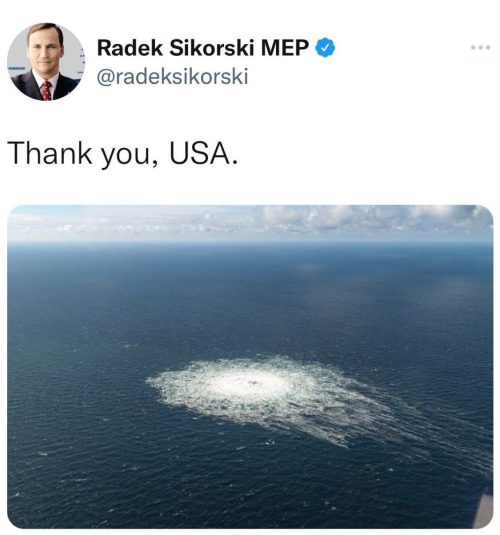
But first, the big question: was the United States really responsible for the destruction of Nord Stream, as Sikorski seems to believe? Well, if we were are to take bumbling Joe Biden at his word, then the answer would seem to be yes.
“If Russia invades, that means tanks or troops crossing the border of Ukraine, again, then there will be — there will be no longer a Nord Stream 2,” the U.S. leader told reporters two weeks before Russia began its Ukrainian mission. “We will bring an end to it.”
When asked to specify, Biden responded, “I promise you, we’ll be able to do it.”
There are other clues that point to American complicity.
On September 2, an American helicopter with the call sign FFAB123 was observed maneuvering in the area of the Nord Stream pipelines. According to the site ads-b.nl, six aircraft used this call sign that day, of which the tail numbers of three were established. All of them were Sikorsky MH-60S. By overlaying the FFAB123 route on the scheme marking the areas of the explosions, it is observable that the helicopter either flew along the Nord Stream-2 route, or exactly between the points where the ‘accident’ occurred.
Meanwhile, on Twitter, there are screenshots of other American aircraft flights as of September 13th in exactly the same area. In June there was an article in Sea Power magazine where the Americans boast of experiments in the field of underwater drones that they set up at the BALTOPS 22 exercises – in the area of Bornholm Island, the Danish island where the explosions were reported to have occurred.
“Experimentation was conducted off the coast of Bornholm, Denmark, with participants from Naval Information Warfare Center Pacific, Naval Undersea Warfare Center Newport, and Mine Warfare Readiness and Effectiveness Measuring all under the direction of U.S. 6th Fleet Task Force 68,” Sea Power reports.
Such an “experiment” would have required the deep-sea equipment needed for reaching the depths where the Nord Stream pipelines are located.
Finally, here’s one last tantalizing piece of information for all of the ‘coincidence theorists’ out there. On the day after Nord Stream 1 and 2 went offline, Poland, Norway and Denmark’s leaders attended the opening ceremony of the new Baltic Pipe, which will transport natural gas from Norway via Denmark and through the Baltic Sea to, yes, Sikorski’s ferociously Russophobic homeland of Poland. Yes, just a coincidence.
However, the main motivating factor for Washington having a hand in destroying Nord Stream is the awesome powers – both financial and political – that it will reap. The economic crisis in Europe is already forcing companies and corporations to consider relocating to the U.S., which is providing a better business environment and more or less affordable electricity bills.
And after the destruction of Nord Stream, the economic situation on the continent will deteriorate significantly. Even though the NS-II was not launched, there was the chance of its launch, and this “chance” had a considerable effect on the market. Now, without its main energy supplier, Europe is doomed while America will soar.
The economic destruction of Europe makes it totally dependent on the U.S. economically, politically, and militarily, turning it into a toothless tiger with no political will and independence. At the same time, Europe will become almost completely dependent on the U.S. for its (prohibitive) gas. The United States plans to supply at least 15 billion cubic metres (bcm) of liquefied natural gas (LNG) to European Union markets this year as Europe seeks to wean itself off Russian gas supplies.
In other words, the transformation of the EU into a banana republic – albeit it one in the northern hemisphere with winter quickly approaching – has already begun.
Europe, you really should have heeded the advice of Henry Kissinger, who understands the nature of the U.S. better than anyone: “To be an enemy of the U.S. is dangerous, but to be a friend is fatal.”
Who wins from demolishing the EU’s gas lifelines?
By Rachel Marsden | Samizdat | September 29, 2022
Speculation abounds since both Nord Stream 1 and 2 pipelines, designed to carry cheap Russian gas to Europe, were damaged this week in what officials widely describe as deliberate acts of sabotage. Who could be responsible? Incidents buried in the past may provide a clue.
Speculation abounds, and typically in a direction colored by the preexisting biases of the person speculating – which is hardly helpful.
Let’s start with the end result and work backwards. The outcome ultimately means that Europe’s economic impetus for ever seeking peace with Russia has been seriously undermined, if not literally destroyed. Someone has taken it upon themselves to demolish the remaining bridges between the two. Until now, there was always a chance of reconciliation. Russian President Vladimir Putin said himself recently that all the EU needed to do to pull itself out of its self-imposed energy crisis was to push the button on its gas supply from Russia and drop the anti-Russian sanctions that prevent it from doing so.
People in the streets of German cities protesting against Berlin’s blind following of Brussels’ anti-Russia sanctions also knew that was the answer. But now that option has been taken off the table. The EU is now adrift amid a deepening energy crisis and someone burned its last sails. It’s clear that Europe itself wouldn’t benefit from that. Nor does it benefit at all from any of its own anti-Russian sanctions. But who gave Brussels that idea, to harm its own economy in the first place?
At the onset of the Ukrainian conflict, it was Washington that egged on the EU to mirror measures that Washington itself had adopted in an effort to deprive Moscow of revenues to fuel its interests and objectives in Ukraine. The problem is that the EU’s economy was far more entwined with Russia’s than America’s. Any sense that US President Joe Biden and his administration may have given EU leaders, that they’d be there to help the bloc soften the blow of its self-sacrificial sanctions, has since been replaced by a harsh, pragmatic reality. US shale executives have explained to Western media that they simply lack the capacity to ramp up production for Europe’s winter crunch, even amid the growing rationing, deindustrialization, and risk of blackouts.
So, pressure has recently been increasing on EU member states to achieve a rapid diplomatic, peaceful resolution. But any reconnection of Nord Stream gas would have been a blow to US economic ambitions, which eventually include turning the EU into a dependent liquefied natural gas client. To that end, US officials have even tried to market their natural gas in the past as “freedom molecules,” in contrast to the “authoritarian” Russian gas.
Biden himself said of Nord Stream 2 during a press conference on February 7, before the Ukraine conflict had even popped off, that “we will bring an end to it,” despite it being out of American control. But even long before that, the US was sanctioning and bullying European companies into halting construction on Nord Stream 2 under the pretext of saving Europe from Russia. It’s worth noting that Europe didn’t really have problems with Russia this century until the US decided to make Ukraine an outpost for the State Department.
Not only did Gazprom, Russia’s state-owned operator of the pipeline, persist against all odds to finish it, but it’s really the only leverage that Moscow has in Europe. Attributing to Moscow the recent sabotage of their own economic interests in Europe seems absurd. The damage done to the pipelines now means that to prevent them from being completely filled with sea water and destroyed, Russia is forced to keep pumping gas through them and into the sea at their own expense. What exactly does Moscow gain from any of this? Conversely, what does Washington gain? Nothing less than Brussels’ full dependence, which proved elusive when Europe could split its interests between the east and west.
As for who possesses the technical ability to execute underwater pipeline sabotage, both Russia and the US do. Much has been made in the past of the potential for cutting undersea cables – defined as an act of war by UK defense chief Admiral Sir Tony Radakin. The US actually has a history in such operations, having tapped into undersea cables to spy on the Soviet Union in the 1970s Operation Ivy Bells, according to public records about Operation Ivy Bells. Washington also has sabotaged Soviet gas pipelines before, albeit indirectly – according to Thomas C. Reed, a former Air Force secretary who served on the National Security Council in 1982, when then-US President Ronald Reagan allegedly approved a plan for the CIA to sabotage components of a pipeline operated by the Soviet Union. The objective was to prevent Western Europe from importing natural gas from the Soviets. Sound familiar?
Time and inquiry will uncover the culprit eventually – if we’re lucky. EU officials are vowing to get to the bottom of it. “All available information indicates leaks are the result of a deliberate act. Deliberate disruption of European energy infrastructure is utterly unacceptable and will be met with a robust and united response,” Tweeted the bloc’s chief diplomat, Josep Borrell. Perhaps investigators could pay a visit to Radoslaw Sikorski, European Parliament member and former Polish foreign minister, who tweeted a photo of the disaster aftermath along with the note, “Thank you, USA.”
But if it indeed turns out that Washington committed what some consider to be an act of war against Europe’s economy, will Brussels have the heart to really confront it? Or will Brussels continue to find justifications to remain complicit in its own demise?
Rachel Marsden is a columnist, political strategist, and host of independently produced talk-shows in French and English. rachelmarsden.com
Children among dead after Ukraine shells refugee convoy – Donbass official
Samizdat | September 29, 2022
The Ukrainian army has attacked a refugee convoy in the eastern region of Kharkov, killing over 30 people, according to the Lugansk People’s Republic’s envoy to Russia.
Rodion Miroshnik wrote on his Telegram channel that those killed in the artillery bombardment included children. He added that emergency services are unable to access the bodies, as shelling from Kiev’s forces continues. The republic’s health ministry stated that seven other people were injured, including two children who lost their parents in the shelling.
Miroshnik claimed the Ukrainian army knew exactly who they were shooting at, as they had allegedly used drones to track down the refugee vehicle convoy and were “intentionally aiming at civilians.” Kiev has yet to respond to the allegations.
Speaking to the Russia 24 TV channel, the LPR envoy noted that the number of civilians trying to get out of Kharkov Region has significantly increased in recent days, as fighting in the area has intensified in the wake of Kiev’s forces reclaiming most of the region. Miroshnik said most of the fleeing residents are trying to cross into Russia’s Belgorod region or the LPR, especially from the cities of Kupyansk and Balakleya.
‘US Wants to Destroy EU as Economic Player’: Analysts Mull Ramifications of Nord Stream Breakdown
Samizdat – 28.09.2022
The Nord Stream 1 and 2 natural gas pipelines have been effectively rendered inoperable this week due to an incident that may have been an act of sabotage.
As the Nord Stream and Nord Stream 2 natural gas pipelines are currently incapable of transporting natural gas from Russia to Europe, experts ponder who is going to benefit from this catastrophe.
Vladimir Demidov, an international analyst of energy and natural resource markets, told Sputnik that the parties who oppose negotiations between Germany and Russia definitely benefit from the Nord Stream breakdown.
As these negotiations may lead to sanctions against Russia being partially lifted – potentially in exchange for gas shipments during winter – those who want to keep these sanctions in place could also be regarded as an interested party, he added.
“This is an act of aggression on a planetary level,” Demidov remarked. “A country or a bloc destroying infrastructure of another country. And we’re not talking about domestic infrastructure here, but infrastructure that connects countries and supplies about 30 percent of the natural gas Europe uses.”
Russian National Energy Security Fund analyst Igor Yushkov also observed that neither Russia nor Germany were interested in the pipeline’s destruction: for Berlin, Nord Stream presented an option to stave off a potential “energy collapse” during winter, while Moscow invested a lot of money into the project.
Both Demidov and Yushkov observed that Europe will now have to purchase natural gas from the United States, the largest liquefied natural gas supplier while it looks like Russia was essentially squeezed out from the European natural gas market.
“The natural gas from the US is going to become more expensive and Europe would still have to buy it because there is no other gas,” Demidov said. “A very amusing diversification has occurred in Europe: they switched from key supplier of the ‘bad’ gas from Russia to the ‘freedom’ gas from the United States that costs at least twice as much.”
He also pointed at former Polish Foreign Minister Radoslav Sikorsky, who “thanked” the United States on social media for the Nord Stream breakdown, with Demidov arguing that when people of such caliber make such statements, it looks as if they are trying to make the truth look like a joke.
“I have a feeling that the United States really wants to destroy the European Union as a global economic player,” he said.
US Blew Up Russian Gas Pipelines Nord Stream 1 & 2: Former Polish Defense Minister
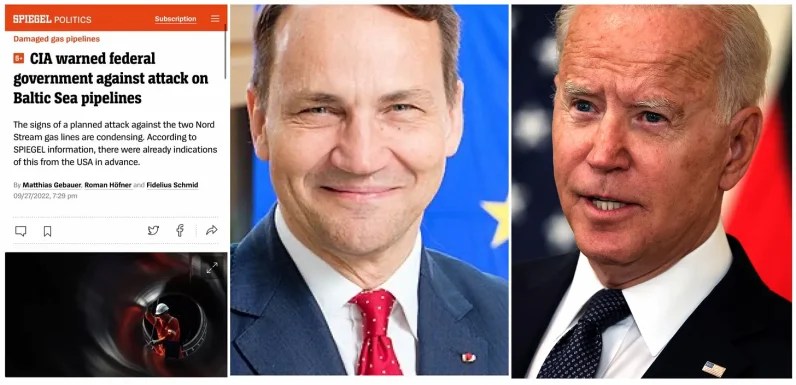
Der Spiegel says CIA warned German government of potential sabotage weeks ago
By Michael Shellenberger | September 27, 2022
A former Polish Defense Minister, Radek Sikorski, has attributed to the United States the sabotage of two pipelines, Nord Stream 1 and 2, which carry natural gas from Russia to Germany. “Thank you, USA,” Sikorski wrote on Twitter. Sikorski was Minister of National Defense from 2005 – 2007 and served as Deputy Minister of National Defense and Deputy Minister of Foreign Affairs, previously. He is currently an elected member of the European parliament.
Nord Stream 1 and 2 lie on the bed of the Baltic Sea. Nord Stream 2 was finished last year but Germany never opened it because Russia invaded Ukraine on February 24.
Poland’s Secretary of State, Stanisław Żaryn, denounced Sikorki’s claim on Twitter as “Russian #propaganda,” calling it “a smear campaign against Poland, the US, and Ukraine, accusing the West of aggression against #NS1 and #NS2. Authenticating the Russian lies at this particular moment jeopardizes the security of Poland. What an act of gross irresponsibility!”
But it’s not out of the realm of the possible that the U.S. is indeed behind the attack. President Joe Biden promised on February 7 to prevent Nord Stream 2 from becoming operational if Russia invaded Ukraine. “If Russia invades,” said Biden, “then there will be no longer a Nord Stream 2. We will bring an end to it.”
Reporter: “But how will you do that, exactly, since… the project is in Germany’s control?”
Biden: “I promise you, we will be able to do that.”
And:
Evidence of harm
By Steve Kirsch | September 21, 2022
A short collection of key pieces of evidence showing the COVID vaccines are not “safe and effective.” Not even close. They are the most deadly vaccines we’ve ever produced.
Here’s a high level collection of some of the most compelling pieces of evidence I’ve seen to date. This is not an exhaustive list, but just the key pieces of data that are impossible to explain if the vaccines are safe and effective.
I’ve divided the collection into sections and I’ve tried to limit each section to the most compelling data points. So don’t be disappointed if your favorite item isn’t mentioned in this article; I wanted to keep it short enough to be read..
I’ll try to keep this updated over time. It can be found in the Reference section of my Substack.
- The Pfizer trial 6 month report showed absolutely no all-cause morbidity or mortality benefit. There were no all-cause benefits at all. It was all negative. Ask your doctor why you should take a new, unproven medical intervention that is not shown to have an overall benefit. Even if there was a benefit of fewer COVID infections (which is seriously suspect due to the gaming below), the fact that the total all-cause numbers for both mortality and morbidity were negative means the intervention should not be recommended by any doctor.
- The Pfizer trial 6 month report showed that more people died (and were injured) who got the drug than who got the placebo. In other words, the cure was worse than the disease. The drug maker claimed that none of the people in the vaccine group were killed by the vaccine. They do not reveal the tests they did and explain how they were able to make that assessment. Why the secrecy here, especially in light of the study by Bhakdi and Burkhardt showing that trained medical examiners missed the causality link in 93% of the cases they looked at? The Pfizer vaccine had 4X as many cardiac arrests in the treatment group than the placebo (see page 12 of the Supplemental Appendix). This lines up very well with the numerous cardiac-related problems related to the vaccine as documented in the study by Retsef Levi and in the VAERS data which showed that the “cardiac arrest” reports were elevated by a factor of 93X higher than the annual baseline rate (VAERS reports from all vaccines combined in previous years). For some reason, the CDC wasn’t able to detect that signal (it was only 100 times higher than normal so they ignored it for some reason; they won’t let me ask them about it). In short, the claims from the manufacturer that none of the deaths were caused by the vaccine are highly suspect since all the evidence for those claims remains hidden from public view for some reason.
- The Pfizer trial 6 month report showed that at best, the drug saved only 1 COVID life per 22,000 recipients. This means that at best, after vaccinating 220M Americans, we might save 10,000 lives from COVID. But the VAERS reports show an excess death toll of well over 10,000 people and that’s before applying the minimum estimated under-reporting factor of 41. So there isn’t a mortality benefit: it’s actually the reverse. Furthermore, VAERS reports will likely only be filed for deaths in temporal proximity to the shot and is highly unlikely to report those deaths happening 5 months after the shot which appear to be the bulk of the deaths. This makes the comparison even worse. In short, we aren’t anywhere close to saving any lives at all.
- The Classen paper analyzed the clinical trial data for all three US vaccines and confirmed the lack of any overall benefit. There was an increase in morbidity which was highly statistically significant in all three vaccines. It concluded, “Based on this data it is all but a certainty that mass COVID-19 immunization is hurting the health of the population in general. Scientific principles dictate that the mass immunization with COVID-19 vaccines must be halted immediately because we face a looming vaccine induced public health catastrophe.” This is exactly right.
- The paper by Christine Stabell Benn entitled, “Randomised Clinical Trials of COVID-19 Vaccines: Do Adenovirus-Vector Vaccines Have Beneficial Non-Specific Effects?” confirmed that there was no mortality benefit by taking the COVID mRNA vaccines. “Based on the RCTs with the longest possible follow-up, mRNA vaccines had no effect on overall mortality despite protecting against fatal COVID-19.” See this article by Daniel Horowitz for more information. In other words, these vaccines have no death benefit. Period. Full stop. This is exactly what the Canadian analysis below showed.
- Serious adverse reactions, including paralysis, were not reported to the FDA and there were other very serious discrepancies in the trials. For some reason, nobody seems to be interested in exploring or explaining these very serious issues. Some are very clear cut such as the case of Maddie de Garay who was one of 1,000 kids in the clinical trial. She’s paralyzed now and has to eat with a feeding tube. The FDA and Pfizer never investigated, but reported her results as mild abdominal pain in the trial results. This is fraud. Also, there were 5 times as many exclusions in the treatment arm as in the placebo arm of the trial: 311 vs. 60. Do the p-value computation on that one and you’ll find that it could not possibly have happened by chance (1e-40). It means the trial was not blinded. Why didn’t anyone in the medical community ever point this out? Nobody will tell me.
- Pfizer admitted to clinical trial fraud in federal court. Their defense was that the FDA was in on it.
- The VAERS data, which is the official adverse event reporting system used by the US government, shows that an estimated hundreds of thousands have died and millions have been injured. If these weren’t caused by the vaccine, what caused them? Why are there more adverse events reported for these vaccines than for all other vaccines in history combined? Nobody can answer that question. See this tutorial and this recent confirmation and this article on VAERS and causality. Here’s how these numbers were calculated. Here is independent confirmation of the estimates by Dr. Naomi Wolf who used different datasets. No fact checker was interested in contacting me to challenge the facts since I always insist on recording any calls. Also, the causality of events was confirmed by the Israeli safety studies, but nobody wants to look at those.
 Can you spot the unsafe vaccine? People at the CDC don’t see any problem with this mortality chart: all the vaccines look perfectly safe.
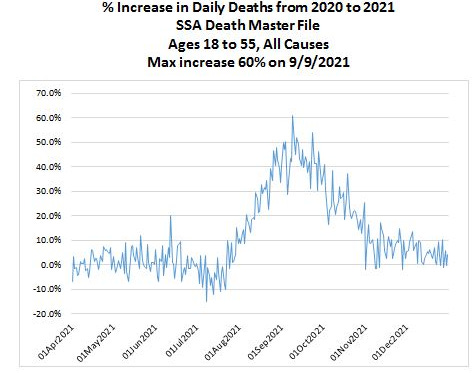
 - The US Social Security Death Master File showed a 60% increase in the all-cause death rate in September 2021 vs. September 2020 for ages 18 to 55. According to the insurance companies, it wasn’t COVID. COVID kills only a small fraction of people in this age range so even if the COVID death rate doubled, it would be a minor blip on the all-cause death rate. A five month delay in death vs. vaccination was discovered in multiple countries, not just the US. Different studies found nearly identical delays. Also, I find it very troubling that the insurance companies aren’t asking the family of the policyholders who died whether they were vaccinated with the COVID vaccine and when. They don’t want to collect this information for some odd reason. So let’s be clear that a 60% increase in all-cause death rate makes this intervention extremely dangerous. I’m not aware of anything that comes close to killing people in such massive numbers. The CDC is silent on this. They don’t even want to show the public this chart:
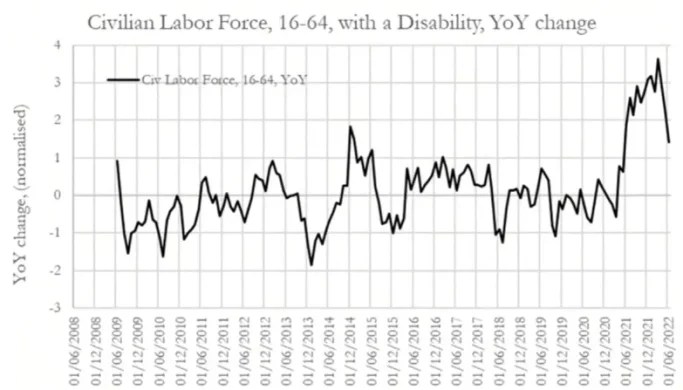
- US disability rose dramatically soon after the vaccines rolled out (Y axis is Z-score). A 3 sigma increase is hard to explain.
- As of Sep 2, 2022, the vaccination rate in Israel is now just 2.4%. They used to be one of the world’s most vaccinated countries. Today, very few people in Israel are considered to be vaccinated. If the vaccines are so beneficial, why has nearly the entire country shifted from extremely pro-vax to extremely anti-vax in such a short period of time?
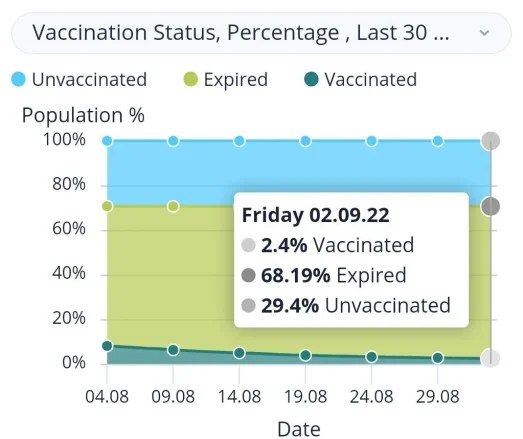
- The Israeli Ministry of Health revealed in a confidential meeting with scientists that the reason that they never notified the people of Israel about the safety issues from the vaccines was because of budget/staffing issues. Apparently, while they had millions of dollars to promote the vaccines as safe and effective, they forgot to budget for the possibility they were wrong.
- The Israeli vaccine safety data showed very clearly the side-effects are serious, long-lasting, and caused by the vaccines. Secondly, it showed that the Israeli authorities and the worldwide mainstream media are covering it all up. It also showed that US officials were not interested in seeing credible COVID vaccine safety that didn’t go along with the narrative. I tried to find out why, but nobody would talk to me. Harvard Professor Martin Kulldorff, a widely respected authority on vaccines, when asked why these people wouldn’t want to see the data, replied, “I don’t know.” This is the single most damaging report in the history of the COVID vaccines. Nobody wants to talk about it. They are hoping it will die. It won’t. Some people claim Israeli used a broad mix of vaccines, but that’s not true. Over 90% of the reports are from Pfizer, the bulk of the others are from Moderna. See also Israeli Investigators Find COVID-19 Vaccines Cause Side Effects: Leaked Video.
- The Canadian report prepared for the Liberal Party of Canada (Trudeau’s party) showed no benefit for infection, hospitalization, and death for those under 60. “The empirical evidence investigated in this report from PHO and PHAC does not support continuing mass vaccination programs, mandates, passports and travel bans for all age groups.” You can’t have a vaccine that doesn’t work in Canada work in other countries. The authors of the report had to hide their identities for fear of retribution. The statistics analyzed were those from Ontario which is not a small province (15M people). Naturally, the mainstream press ignored the report. Nobody has shown where the experts who wrote this made a mistake. The conclusion of the report is supported by independent analysis done by Mathew Crawford of the data from San Diego County, San Diego County Data Busts a Hole in Vaccine Efficacy Narrative. So apparently, the results are not limited to Ontario.
- The Harvard-Hopkins-UCSF study showed it is unethical to mandate vaccination for college students and anyone younger. The study clearly said, “University booster mandates are unethical.”
- The Thailand study did blood tests before vs. after the jab and determined that nearly 30% of young adults experienced cardiovascular injuries after the jab. How is that safe? And why didn’t anyone in the US ever do such a study? Do we not want to know? This was a simple blood test before and after the vaccine. Why did they not notify parents as soon as the study was published?
- The study by Bhakdi and Burkhardt showing 93% of deaths after vaccination were caused by the vaccine
- The data showing the vaccines cause prion diseases shortly after vaccination. This is impossible if the vaccines are truly safe. See the paper on ScienceOpen.com (after ResearchGate removed it).
- Determinants of COVID-19 Vaccine-Induced Myocarditis Requiring Hospitalization by Jessica Rose and Peter McCullough showing the myocarditis caused by the vaccine have distinct biomarkers.
- The Fraiman-Doshi paper looked at serious adverse event rates and found that the vaccines may not be as safe as has been claimed, but they cannot do a proper analysis because they are not allowed to see the data. “Full transparency of the COVID-19 vaccine clinical trial data is needed to properly evaluate these questions. Unfortunately, as we approach 2 years after release of COVID-19 vaccines, participant level data remain inaccessible.” You have to wonder: if the vaccine is so safe, why are the drug companies hiding the data?
- The Levi cardiac arrest rate elevation paper showed a troubling correlation between vaccine doses and increased cardiac events from January–May 2021. When they tried to get data after May 2021, they were refused access. This begs the question: if the vaccines are perfectly safe, what are they trying to hide?
- There are over 1,250 papers published in the scientific peer-reviewed literature showing the vaccines cause significant adverse events.
- The Walach paper found that the vaccines harm more people than they save.
- This news article published in the BMJ showed that 10 out of 100 deaths in elderly people they examined were “likely” caused by the vaccine. Funny, in America we think the number is 0. They can’t both be right. Someone should investigate why we have different results. This is very important. In fact, with a deeper investigation, over 90% of the deaths thought by medical examiners not to be caused by the vaccine were shown to be caused by the vaccine. This suggests that the US isn’t looking at the deaths.
- My colleagues and I are not misinformation spreaders according to this paper published in a peer-reviewed medical journal.
Are the Covid mRNA Vaccines Safe? was written by Harvard professor Martin Kulldorff who until recently was on vaccine committees of the FDA and CDC. He concluded:
Fraiman and colleagues have produced the best evidence yet regarding the overall safety of the mRNA vaccines. The results are concerning. It is the responsibility of the manufacturers and FDA to ensure that benefits outweigh harms. They have failed to do so.
Canadian court decisions on the constitutionality of Covid measures are invalid due to jurisdictional errors of law reviews court decisions on COVID and emphasizes the courts’ repeated over reliance on government expert testimony. Courts are supposed to find the truth and not rely on government representations or propaganda.
- The Watson et al. “modeling study”: did “COVID vaccinations” really prevent 14 million deaths? The original paper was clearly bogus since the vaccines kill more people than they save. This article examines the paper claiming the vaccines have been ridiculously effective.
There are specialized tests required to diagnose a death from the COVID vaccine.
The CDC has never told any medical examiner in the US about these tests.
So the medical examiners aren’t implicating the vaccine in any of the deaths.
The question is we know what the tests are, we know there is solid evidence from multiple countries that the vaccine causes death, yet we refuse to even consider the possibility that the vaccine caused the deaths. Why?
This paper, A Report on Myocarditis Adverse Events in the U.S. Vaccine Adverse Events Reporting System (VAERS) in Association with COVID-19 Injectable Biological Products, was retracted because the publisher didn’t like the result. So he unilaterally decided to retract the paper. This is unethical.
Here’s the “withdrawn” notice.
Here is the backstory as well as this censorship update.
The publisher hasn’t fixed the problem in over a year despite assurances it would be quickly resolved.
Here is another retracted paper that was correct:
Why are we vaccinating children against COVID-19? by Ron Kostoff
“Compared with the 28,000 deaths the CDC stated were due to COVID-19 and not associated morbidities for the 65+ age range, the inoculation-based deaths are an order-of-magnitude greater than the COVID-19 deaths!”
That is basically what I found: the vaccines kill >10X more people than the number of COVID deaths that they save. The paper passed peer review and was published. The editor of the journal quit after he was overridden by the publisher on the retraction.
The reason cited for the retraction:
- The use of key terminology, specifically the key terms “inoculation” and “vaccination” diverges from common use and are incorrect, indicating clear evidence of bias.
- Publicly available data from the United States Center for Disease Control (U.S. CDC) were concluded by the external reviewers to be misinterpreted to make the erroneous conclusion that the vast majority of reported deaths due to COVID-19 are actually due to other comorbidities. Such an egregious misinterpretation and misrepresentation are unacceptable.
This is completely bogus for two reasons:
- The editor could have easily normalized the terminology to eliminate any perceived “bias.” They simply ask the author to do a quick search and replace.
- The vast majority of COVID-19 deaths were in fact due to other comorbidities. For example, the New Mexico death records where COVID-19 was listed as the cause of death and 5 out 6 were not consistent with a COVID death. If anyone wants to challenge me on that, I have access to the death data. In Massachusetts, only 10% to 20% of the deaths listed as COVID were actually caused by COVID. Most people don’t have access to the death data, but I do. So I wonder if the journal is interested in fixing their error?
Can anyone explain how these anecdotes are possible?
- Why don’t Dr. Paul Offit (FDA vaccine outside committee) and Professor Grace Lee (Chair, CDC vaccine outside committee) want to see the Israeli safety data? They are deliberately avoiding answering the question. Why?
- In Canada, the #1 cause of death is now “unexplained.” See Deaths with unknown causes now Alberta’s top killer: province. If it isn’t the vaccine, what is causing this?
- There is data from over 1,000 vaccine injured people where 10% of the injured report 30 or more symptoms that are unique to the vaccine injured. How is that possible if the vaccine is so safe? Marsha Gee was perfectly healthy before her COVID vaccine. Less than 1 hour after her first Pfizer shot she experienced severe symptoms and experiences 78 of symptoms common with other vaccine injured. If Marsha wasn’t injured by the COVID vaccine, what caused all these symptoms?
- Why is it illegal to analyze the vaccine vials? Why hasn’t a single medical institution done an analysis of the content of the vaccines to see if there are placebos with saline solution and the amount of mRNA degradation, rendering the vaccines useless? Why the secrecy here? If we knew what was in the vaccines would this cause harm? How?
- Why are prominent people risking their careers to obtain fake vaccine cards? We know top people at Mass General Hospital have fake vaccine cards. We’ve heard that people at the highest levels of the DoD can get fake vaccine cards. It is well known that the CEO of a large pharmaceutical company bought a fake vaccine card. Why would he risk spending years in jail if the vaccines are perfectly safe?
- The Died Suddenly group on Facebook was adding users at 20,000 per day making it the fastest growing group in Facebook history. They had to throttle the growth rate due to attempts by the British military to infiltrate the group to cause it to be shut down.
- The average age of the people reported dead in the Died Suddenly group has been trending younger and younger over time. How can you explain that? The only worldwide massive intervention that goes to younger people is the COVID vaccine.
- The embalmer data (such as The Epoch Times article and this interview). These clots are not blood clots, but they are clots embalmers never saw before mid-2021 (since they take 3 months or more to form into large sizes). If the vaccines are not causing these killer clots, what is? They can be found in up to 93% of the embalming cases.
- Insurance company data from insurance companies worldwide:
- Wayne Root’s wedding: 200 guests, half vaxxed, half unvaxxed. Only the vaxxed got injured (26%) or died (7%). I surveyed my readers and collected data from over 600 readers who collectively reported very similar stats. That’s hard to explain if there isn’t a huge effect.
- My neurologist stats: 11 years without needing to do a single VAERS report; this year, she needs to file 1,000 VAERS reports on 20,000 patients in the practice. How can anyone explain that if the vaccine is perfectly safe with mild, short term effects? This is similar to the 4.5% rate of neurological injury reported earlier by the Israeli Ministry of Health.
- The polling results using third party polling firms (so not my followers) consistently show that more people died from the vaccine than from the virus. The mainstream media refuses to do similar surveys and most survey firms refuse to even ask the questions.
- Ten different surveys I did all showed the vaccines are more harmful than helpful.
- Doctors in Canada died at a rate that was more than 10X normal after getting the fourth dose of the vaccine. And those are just the ones we know about.
- The fact that Paul Offit isn’t going to get the latest booster even though the CDC says he should. Why should any of us take the shot if Paul Offit is refusing to take the shot? He’s arguably the world’s most respected authority on vaccines and sits on the FDA outside advisory committee?
- Why are health authorities removing safety data on the latest shots? If they are so safe, why not release the data?
- Google searches show people became interested in topics related to vaccine safety before they became popular on social media
- When I ask data/statistics experts such as Joel Smalley and Professor Norman Fenton whether they’ve seen any credible data proving the vaccines are safe and effective, they are unable to cite a single reference.
- A local news station (WXYZ-TV) asked people to report on unvaxxed loved ones that became sick and died and instead they got hammered with hundreds of thousands of people saying they lost loved ones to the jab. See my video on the WXYZ-TV story and also this video.
- Woman collapses and dies 7 minutes after Booster shot… The stunning thing is the Twitter video documents that the pharmacy workers have been instructed to not bring it up when briefing patients and, if asked, not to comment on the death. Do you think they are looking out for your best interest by withholding adverse events like death 7 minutes after the shot from the public? That should never happen. Have you ever seen a video like this before the COVID vaccines rolled out? The death was ruled as “natural causes” which means it was from internal organ failure as opposed to being hit by a truck. However, the internal organ failure was due to an external event (vaccinated).
- Turbo-cancer is being reported now. It’s impossible to explain. Never been seen before.
- A reader wrote: I work in the financial services industry in Toronto. A co-worker of mine was recently diagnosed with cancer. He has been getting treated at Sunnybrook hospital for it. The doctors there told him they’ve seen a significant spike in cancer cases well above what could be explained by people missing getting screened due to the pandemic. What’s more though is that they catalogue the vaccine status of every cancer diagnosis and the spike in the number of cases is only occurring in those who are vaccinated– apparently they are researching it to try and find out why the vaxed have seen a spike in cancers vs the unvaxed who haven’t- obviously they are not ready to go public with this but they know about it and are researching it fwiw
- Turtles all the way down: Vaccine science and myth shows the vaccines are not nearly as safe as people think. This is the most damaging book ever written showing the safety of the vaccines is highly questionable. There isn’t a single risk-benefit trial on all cause mortality and morbidity vs. placebo for any of the 70 approved vaccines even though they’ve had 60 years to do this. If the vaccines are truly beneficial, why do you think it’s never been done for any vaccine? A team of Israeli scientists wrote this book over 5 years. It was recently translated into English and is available through purchase on Amazon.
- Dissolving Illusions: the history of vaccines shows they did a lot less than people think; probably next to nothing.
- The Real Anthony Fauci: illustrates the corruption in the medical community today. For example, they created a more accurate adverse event reporting system (ESP:VAERS) system and then scrapped it after it showed all the vaccines were unsafe.
- Vaccine Secrets: a 20 minute slide presentation from CHD
- The CCCA presentations:
- My mega-presentations:
Once I established a policy of always recording calls with “fact checkers,” I’ve not had a single call from them trying to refute anything I’ve written.
None of the drug companies that make these products will refute anything I’ve written or supply a representative to debate me or any of my colleagues in a live debate. They have immunity from liability and they are not willing to be held accountable in the court of public opinion either.
- The COVID lies by Dr. Michael Yeadon
This was a very well done study, but it is of course attacked by the pro narrative people. We’d love to have an open debate about this study, but the other side doesn’t want to talk about it in a neutral forum.
A LITERATURE REVIEW AND META-ANALYSIS OF THE EFFECTS OF LOCKDOWNS ON COVID-19 MORTALITY
Masks don’t work at all. See this article which has plenty of references. If anything, masks are more likely to hurt you than to benefit you.
There is no study at all on the 6 foot distance rule. They just made that one up.
Professor Jeffrey Sachs was tasked by The Lancet to lead an independent investigation into the source of the SARS-CoV-2 virus. After he determined it came from US biotechnology, all of a sudden nobody wanted to pursue the investigation any further.
Tony Fauci gets paid every time you get a Moderna shot. He won’t disclose how much he makes and you can’t get via FOIA (it’s blacked out). If the Republicans get control of the Senate, that will change. Watch this video from Sept 20, 2022 of Rand Paul commenting on this as well as the well founded accusation that Fauci created the virus in the first place and then desperately tried to make it look like it came from nature after top scientists said it was a lab leak (watch the video at 2:00 onwards). Rand Paul called it, quite rightly, “the biggest cover-up in the history of science.”
The question you have to ask yourself is why is Fauci keeping his funding of the gain of function research and also his compensation for each vaccine dose a secret?
Tony Fauci was the primary reason that all early treatments were ignored by the government. It appears he did that because it would cut into his revenue stream.
Early in the pandemic, two physicians, George Fareed and Brian Tyson, developed a treatment protocol using a variety of safe, low cost drugs and supplements with little to no side effects that had a near 100% success track record in preventing hospitalization, death, and long haul COVID if the patient started treatment shortly after realizing they were infected. They’ve treated over 10,000 patients. They wrote a best-selling book about it.
Today, more than two years later, the FDA and the CDC have not returned their calls.
- Why can’t we have open forums where our public health officials can be challenged by experts who disagree? Is there proof that having open debate results in worse outcomes?
- Why doesn’t anyone want to see the Israeli safety data?
- Why isn’t anyone asking for Fauci’s unredacted emails?
- Is there a scientific reason that the CDC is ignoring me and all the experts I work with?
- Questions I’d love to ask Congresswoman Anna Eshoo… that she’ll never answer
- Why hasn’t anyone calculated the minimum VAERS under-reporting factor (URF)?
- Did the propensity to report change in 2021 vs. previous years. What is the new number in 2021 and 2022 compared to previous years? How did you calculate it?
- Why do John Su and Tom Shimabukuro never talk about the URF in the ACIP meetings?
- There were over 14,000 excess deaths reported in VAERS. That’s before the URF is applied. If these weren’t caused by the vaccine, what caused them?
- If these vaccines are so safe, why are there more adverse events reported for these vaccines than for all other vaccines in history combined?
- I found thousands of adverse events that are elevated by these vaccines compared to all other vaccines combined in previous years. How many adverse events did the CDC find?
- There was a dramatic rise in adverse events reported in the VAERS system for the COVID vaccines. How could this not be a serious safety concern? The propensity to report did not increase. If you believe the propensity to report did increase, what data do you have to support that?
- My neurologist has been in practice for 11 years. She has 20,000 patients in her multi-physician practice. In that time, she’s never had to report a single event to VAERS. With the COVID vaccines, she now needs to make 1,000 reports. If the vaccines are safe and effective and most all the symptoms are mild and short term, how do you explain this? Her event rate similar to the 4.5% injury rate that the Israeli MoH found. So her reporting rate is more than 10,000 times higher than for any other vaccine. Couldn’t that be the explanation for the higher rate of VAERS reports? Doesn’t this suggest that the propensity to report is much lower this year because there are so many more events and doctors simply don’t have the time to report them all?
- The NEJM pregnancy paper by Tom Shimabukuro noted that the results on safety for pregnant women was preliminary since many of the women were still pregnant. What was the final result and why wasn’t it published?
- There was an analysis of the VAERS data by Hannah Rosenblum published in the Lancet. It never goes into explaining why there were elevated reporting rates and also the nature of the reported events are not normal background events. Couldn’t the elevated reporting rates be caused by a dangerous vaccine? Does she want to look at the Israeli safety data? If not, why not? The Israeli data directly contradicts the conclusion of the paper. Shouldn’t we figure out which conclusion is correct?
- Why does Carol Crawford not answer my questions about an open discussion with the top vaccine misinformation spreaders to resolve our differences and reduce vaccine hesitancy?
- Why does Martha Sharan ignore my emails and phone messages when I attempted to ask for permission to talk to the authors of the Rosenblum paper? Can’t she reply with the reason questions are not allowed?
Questions I’d love to get the answer to. These were asked, but never answered.
- Why did the CDC never publish the follow up on the NEJM pregnancy paper by Tom Shimabukuro?
- The CEO of Moderna was asked how the 19 nucleotide sequence from a Moderna patent got into the SARS-CoV-2 genome. That sequence is never found in a virus. How did it get in this one? The CEO said he’d look into it, but never reported the explanation. I’d love to know what it was.
- Why hasn’t any Democratic committee chairman asked the NIH for Tony Fauci’s unredacted emails? Don’t we want to know the truth about whether there was a deliberate cover-up? If there was, shouldn’t Fauci be fired?
- Fauci wasn’t supposed to be funding gain of function research but he was. How is he being held accountable?
- How much is Fauci making every time someone gets a Moderna shot? He’s a public official… Why is this a secret?
People who disagree with the mainstream narrative are rewarded with censorship, permanent bans on posting on social media, demonetization of your YouTube account, revocation of your medical license, revocation of your medical certifications, loss of hospital privileges, loss of job, loss of funding, loss of friends, and a Wikipedia entry labeling you a “misinformation spreader” and/or “conspiracy theorist.”
This is a problem. I am not aware of any paper published in the medical literature that shows that such tactics result in better health decisions.
Should we use the same rules at the UN when nations disagree? Do you think that will result in better outcomes?
The way people resolve differences is by confronting the issues and talking through them. But we are not doing this:
- Why can’t we find anyone who will defend the CDC, FDA, and NIH on camera?
- Dr. Byram Bridle and 2 colleagues challenged Canada’s health authorities to a debate
- Vinay Prasad’s most important op-ed
This is objective proof of a broken system. It is indefensible. Caught on video camera. There is no reason that anyone in a position of authority on the COVID vaccines would refuse an opportunity to see the most thorough post-vaccine safety study ever done: one that shows causality of serious adverse events.
From Israeli Investigators Find COVID-19 Vaccines Cause Side Effects: Leaked Video:
Rechallenge changes a causal link “from possible to definitive,” Dr. Mati Berkovitch, head of the research team and a pediatric specialist, said at the meeting.
and
Many of the reported adverse events were found to be long-lasting, which researchers said in the meeting was surprising since the brochure handed to vaccine recipients says otherwise. They also said Pfizer officials told them that Pfizer did not know of any long-lasting symptoms.
and
In the official report later issued to the public, the MoH did not detail how researchers were caught off guard by the duration of the events and side effects. The health agency also stated that there were no new events identified.
It concludes:
The choice to omit some of the crucial findings discussed in the meeting from the public report is “a recipe to destroy” the entire vaccine program, according to Levi, an Israeli native and an expert in risk management.
“The more pro-vaccine, the more disturbed you need to be from something like this,” Levi told The Epoch Times. “And the reason is that the two most important enablers for vaccine programs … to be successful is trust and transparency, that you actually communicate to people the real risk-benefits and allow them to make choices about what they want to do. The second thing is that you take care of the people that were harmed by the vaccine because no vaccine has 100 percent safety.”
“I think we have in this example … where we violate these two very important principles,” he added. “This is a recipe to basically destroy all vaccine programs, so the more pro-vaccine you are, you should be more disturbed by this.”
How can you have the chair of a safety committee not interested in seeing important safety data? Professor Grace Lee should be removed from her position by the CDC. Why isn’t she? Does anyone care?
Why does Dr. Paul Offit ignore requests to see the same data?
According to the Epoch Times article, everyone declined to comment on the story: the scientists, the MOH officials, and the CDC’s Immunization Safety Office declined to comment on the Israeli findings.
If the above isn’t enough, there are hundreds more “hard to explain” data points.
- List of over 1,200 papers published in peer-reviewed scientific journals
- The safe and effective narrative is falling apart
- Think we got it wrong?
- How the authorities can INSTANTLY stop the spread of “COVID misinformation”
- Examining COVID Vaccine Efficacy
There is an excellent article written in August 2020 by Norman Doidge entitled “Medicine’s Fundamentalists” which talks about the “all-available-evidence approach.” It should be read by every doctor in America. This is how medical science should work.
The precautionary principle medicine seems to have been thrown under the bus during the pandemic. It says in the face of uncertainty, one should take reasonable measures to avoid threats that are serious and plausible.
For example, the Pfizer clinical trial showed the vaccine saved only one COVID death per 22,000 injected. That means we might only save around 10,000 lives if we inject 200M Americans. So if VAERS, which is at least 41 times under reported, is showing over 12,000 deaths associated with the vaccine, any reasonable person should say that killing more than 41 people to save 1 life is nonsensical… shouldn’t we put a PAUSE on this intervention until we resolve the uncertainty?
In the current system, questioning the CDC or other authorities results in serious retribution as mentioned earlier.
Is that really the right way to handle scientific dissent?
Are the vaccines “safe and effective” as claimed?
To answer this, science requires that we look at all the available data and see whether the data is more consistent with the hypothesis of “safe and effective” or “not safe and effective.”
All the data that I and my colleagues have seen end up being placed in the “not” bucket.
We are open to being shown we got it wrong on the hundreds of pieces of evidence we have examined, but nobody is willing to discuss the data with us to resolve the issue, not even for $1M dollars.
I even went to extraordinary lengths to offer the Israeli safety data to ACIP Chair Grace Lee. Her response: she called the police on me. That pretty much tells you everything you need to know: they simply refuse to look at any data that goes against their currently held beliefs. That’s the way science works.
No, Lockdown Instigators Do Not Deserve the Benefit of the Doubt
The damage that lockdowns would cause was far too well known, uneven, and catastrophic to assume their chief instigators must have had good intentions.
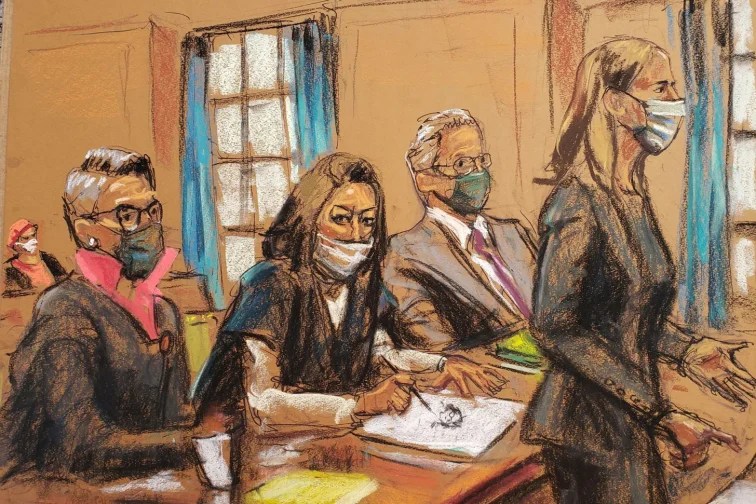
By Michael P Senger | The New Normal | September 20, 2022
In the United States, some 2,000,000 people—over 1% of adult men—currently reside in prisons and jails. In America’s poorest cities, crime and law enforcement are intertwined with life to such a degree that many children grow up more familiar with the justice system than the education system. For kids who grow up in these circumstances, getting through school while staying out of jail is a feat worth celebrating.
Some of this is, of course, necessary to maintain a peaceful society in a country as open and unequal as the United States. But the American political-prison-industrial complex is also riddled with perverse incentives. As Supreme Court Justice Neil Gorsuch put it: “We live in a world in which everything has been criminalized. And some professors have even opined that there’s not an American alive who hasn’t committed a felony under some state law.” We’ve even developed an Orwellian lexicon for this system; the term “crime of moral turpitude” is a tacit admission that America’s statutes are riddled with crimes that do not actually involve “moral turpitude”—it’s puzzling why these should be considered crimes at all.
Worse yet, an estimated 5% of convicts are actually innocent. That means there are currently some 100,000 Americans in prisons and jails who didn’t even commit the crimes for which they were charged. The sad truth is that just living in one of America’s poorest neighborhoods comes with some risk of incarceration; the more people around who are convicted, the greater the odds of becoming an innocent convict oneself. Juries do their best, but they’re beset by the usual human biases. Judges know all too well that verdicts often come down to such irrelevant factors as the defendant’s charisma, physical attractiveness, or even what the jury had for breakfast that morning.
Mass incarceration is one sad byproduct of inequality and community deterioration in the 21st century. But an even worse byproduct of that inequality is an entire caste of western elites who’ve begun to manipulate the system to exempt themselves and their supporters from the rule of law to a degree not seen since the rise of the fascist regimes of the 1930s. And in no instance has this been made more clear than in the promulgation of Covid lockdowns into policy in early 2020.
Lockdowns, or the shutting of businesses and community spaces with the force of law, were unprecedented in the western world prior to Xi Jinping’s lockdown of Wuhan and weren’t part of any democratic country’s pandemic plan; rather, these pandemic plans suggested only voluntary social distancing measures. While lockdowns bore some facial resemblance to the voluntary social distancing measures contemplated in pandemic plans, this similarity was no coincidence, as the concept of “social distancing” in its origin was lifted by the US CDC straight from the Chinese Communist Party policy of “lockdown” as imposed during SARS in 2003. Further, some leading federal officials have disclosed that at the time they recommended temporary social distancing measures for Covid, they did so with the intent that state governors would enforce them as indefinite forced lockdowns.
As former UN Assistant Secretary-General Ramesh Thakur has documented in scrupulous detail, the harms that lockdowns would cause were all well-known and reported at the time they were first adopted as policy in early 2020. These included accurate estimates of mass deaths due to delayed medical operations, a mental health crisis, drug overdoses, an economic recession, global poverty, hunger, and starvation.
Yet regardless, for reasons we’re still only beginning to understand, some key scientists, health officials, national security officials, media entities, international organizations, billionaires and influencers advocated the broad imposition of these unprecedented, devastating policies from the earliest possible date, ostensibly to stop or slow the coronavirus as the CCP claims to have done in Wuhan, while censoring any contrary opinions, spinning a false illusion of consensus amongst an unknowing public. A report later revealed that military leaders saw this as a unique opportunity to test propaganda techniques on the public, shaping and “exploiting” information to bolster government messages about the virus. Dissenting scientists were silenced. Psyops teams deployed fear campaigns on their own people in a scorched-earth campaign to drive consent for lockdowns.
These early advocates of lockdowns inverted the definitions of key public health principles in sophisticated, Orwellian fashion. While the lockdowns they advocated were deliberately intended to overturn existing public health practices, they instructed the public to “follow the science,” leading the public to believe that their policies were grounded in established scientific practice. They used the rhetoric of equity and vulnerability to advocate policies that disproportionately harmed the most vulnerable and increased existing economic divides. They then retroactively cited the broad public support for lockdowns that had been sown by their own propaganda as justification for their propaganda in support of those lockdowns.
Ultimately, these lockdowns failed to meaningfully slow the spread of the coronavirus and killed tens of thousands of young people in every country in which they were tried. We now know the virus had already begun spreading undetected all over the world by fall 2019 at the latest and had an infection fatality rate under 0.2%.
However, the lockdowns caused the public to believe that the virus was hundreds of times deadlier than it really was. Simultaneously, the World Health Organization issued global PCR testing guidance—using tests later confirmed by the New York Times to have a false positive rate over 85%—pursuant to which millions of cases were soon discovered in every country. Additionally, the WHO issued new guidance on the use of mechanical ventilators to member nations; over 97% of those over age 65 who received mechanical ventilation in accordance with this guidance were killed.
Terrified by this surge of deaths and the psychological terror campaigns deployed by governments on their own people, populations across the western world proceeded to impose an ever-darker swathe of illiberal mandates including forced masking and digital vaccine passes for everyday activities. Young children, who were at virtually no risk from the virus, lost years of primary education in the worst education crisis since the end of the Second World War. An indefinite state of legal emergency was imposed which continues to this day. The global fight for human rights and the end of poverty was set back decades.
Over $3 trillion in wealth was transferred from the world’s poorest to a tiny number of billionaires and their supporters, predominantly in China and in the tech and pharmaceutical industries. Several key early lockdown proponents indicated that they saw Covid as an opportunity to “entrench a new idea of the left … reconstructing a cultural hegemony on a new basis.” Authoritarian regimes grew more autocratic, and democratic governments took on authoritarian characteristics.
Worst of all, a norm was grafted onto western democracy that the fundamental rights to movement, work, association, bodily autonomy, and free expression, for which our forebears fought so tirelessly, can be suddenly and indefinitely suspended, without precedent, analysis, or logic, based on nothing but vague promises that doing so will “save lives” — rendering them all but moot.
Meanwhile, the lockdowns and mandates led to the deaths of over 170,000 Americans and proportionate numbers in countries that imposed them across the western world. By 2021, lockdowns had killed over 228,000 children in South Asia. Studies of excess deaths indicate that lockdowns led to several million deaths in India and proportionate numbers in other developing nations.
A million here, a million there, pretty soon you’re talking real atrocities.
These numbers do not even begin to count the total damage that will ultimately ensue due to the economic devastation of lockdowns, which we will continue to witness for many years to come. Many early lockdown proponents may never be among the 2,000,000 Americans currently residing in jails and prisons, but we can be sure that thousands more would-be innocent children will one day be added to the prison rolls as a result of the economic destruction their policies unleashed.
Ladies and gentlemen, this case ultimately comes down to whether, unlike the other 2,000,000 Americans currently in state custody, we can be sure that by virtue of their socioeconomic position and the panic over a virus which panic they deliberately stoked with their own policies, this handful of key early lockdown proponents acted in good faith when they convinced the world to adopt these unprecedented, catastrophic policies based on the belief that China eliminated the virus from an entire country by shutting down one city for two months—so sure that the question demands no further inquiry. I leave that for you to decide.
China demands end of US theft of Syrian resources
The Cradle | September 23, 2022
The People’s Republic of China called on the US government to stop the plundering of Syria’s oil resources, in a press statement on 22 September.
“We call on the United States to respect Syria’s sovereignty and territorial integrity, unilaterally lift sanctions, and end the theft of Syria’s national resources,” said China’s Foreign Ministry spokesman Wang Wenbin in a news briefing.
The call made by the Asian giant comes in light of repeated news that US armed forces have transported oil out of Hasakah governorate to military bases in Iraq.
The Syrian foreign ministry revealed the oil sector has incurred losses of at least $107.1 billion since the start of the US-sponsored war in 2011.
Meanwhile, Syria suffers from a severe energy crisis with repeated blackouts in various parts of the country.
China’s Foreign Ministry spokesman Wang Wenbin claimed that “this is not the first time that the United States military has stolen oil from Syria and they seem to be becoming more and more uncontrollable.”
Wenbin also called on the US government to investigate the claims made by Syria’s foreign ministry and compensate the country for any damages.
China’s foreign ministry spokesman highlighted that the US military has used at least 800 tankers in August alone.
“By June 2022, US military’s extraction, smuggling, and illegal transaction of Syrian oil, gas, and mineral resources have brought an estimated $18.2 bln of direct losses on Syria, making Syria’s humanitarian disaster much worse,” he added in his statement.
Wenbin described the situation in Syria relative to other countries such as Libya and Afghanistan, adding that “the rights and lives of the Syrian people are being taken away, instead of being protected.”
Western media continues to ignore how Ukraine is using NATO weapons to kill innocent civilians in the Donbass
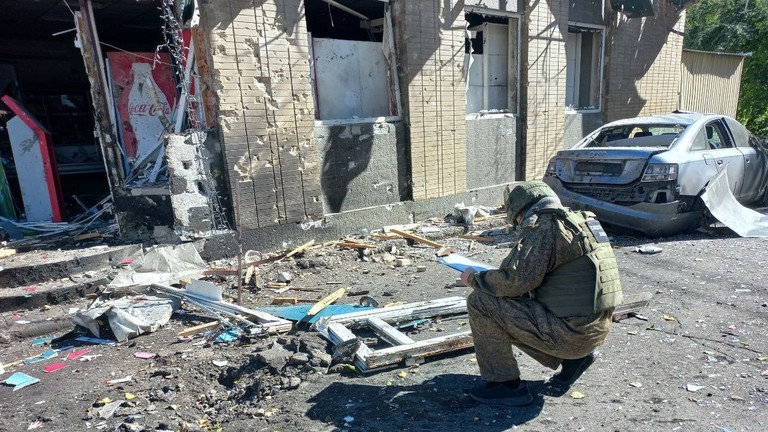
© Eva Bartlett
By Eva Bartlett | Samizdat | September 23, 2022
On Monday, Ukraine slaughtered 16 civilians, including two children, with 155mm NATO shells, according to the head of the Donetsk People’s Republic (DPR), Denis Pushilin. The projectiles hit two adjacent neighborhoods, decimating residential and commercial areas – including a market that had previously suffered fatal attacks.
Scenes of death are nothing new for residents and reporters here in Donetsk, which is intermittently the target of Ukrainian attacks, like the one that hit its central region on August 4, killing six people, including an 11-year-old ballerina, her grandmother, and her ballet teacher.
But the carnage on Monday was worse than anything I’ve seen in my months of reporting here. Chunks of flesh littered the street – part of a hand, a foot, an ear. Someone had put a dead man’s phone on his stomach. It was ringing, the cheery ringtone incongruous with his lifeless body and the scenes and stench of death around him.
For most people, the concept of war is a distant one, and deaths are normalized by media reporting the numbers of victims and destroyed buildings – so most who hear of civilians being killed don’t really understand what a scene like this looks or smells like.
For the locals, it is also normalized, in its own way, after over eight years of Ukrainian attacks – a tragically grotesque kind of normality, where the post-bombing routine starts soon after the last explosions die down.
When I arrived at the scene, locals were already sweeping up glass shards and boarding windows, preparing to reopen their shops. Inspectors from the Russian Investigative Committee were on site collecting shrapnel and measuring the shell’s impact point, to determine the nature of the armament. When asked about what happened, they were careful to state that they could not say anything until the conclusion of their investigation.
An emergency vehicle arrived and workers began loading the bodies, or body parts, onto stretchers, clearing them away.
About 100 meters away, there was a gaping hole in the side of an apartment building. The shell had struck right where writing on the wall indicated the direction to the nearest basement, which was to be used as a bomb shelter. Doors to such stairways are generally permanently left open, so that anyone caught up in shelling might have a chance to survive, if they can make it to the door and basement in time.
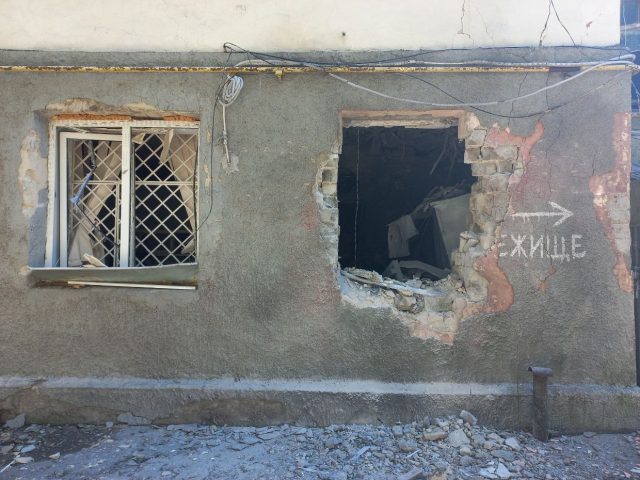
© Eva Bartlett
Victims of another Ukrainian assault, which took place on Saturday, didn’t have that option. The center of Donetsk was hit by at around ten bombs over the course of 30 minutes around noon. At least four civilians were killed, one of whom I saw still on the ground. Some minutes later, her body was taken away. One of the shells hit a car driving along Artema Street, setting it ablaze and killing two civilians. By the time I reached that site, the vehicle had burned out, the dead taken away. Workers were already repaving the roads, sweeping debris and glass from sidewalks.
Western weapons killing Donbass civilians
When Russian and Donbass voices state that Ukraine is killing Donbass civilians with Western weapons, the reply is silence, derision, or inversion of reality: claims that Russia is bombing Donbass – which any ordinary resident here would disprove easily, having been under Ukraine’s shelling for over eight years.
War correspondent, Christelle Neant, wrote of Saturday’s bombings:
“After submitting the photos of the shrapnel I found on the spot to Adrien Bocquet, who is now a NATO weapons expert for the DPR’s representation in the JCCC (Joint Monitoring and Co-ordination Center on Ukraine’s War Crimes), he confirmed that they were American 155mm shells, some fired from Caesar guns and others from TRF1 guns.
The famous TRF1 guns that can fire (banned) 155mm cluster munitions, which I had mentioned in June, and which the Western press had assured that France had not supplied to Ukraine! Before learning at the beginning of September that Paris had indeed sold them to Kiev!”
Europeans in Germany, France and Italy recently held “#StopKillingDonbass” actions, denouncing the sale of Western weapons to Ukraine, and calling for it to end. It was rather fitting that the actions occurred the day after Ukraine bombed central Donetsk again.
These actions were followed by the release of a petition against arms supplies to Ukraine, which stated:
“Today, contrary to the fundamental principles set forth in Article 2 of the UN Charter, in particular, the principles of sovereign equality and the peaceful settlement of international disputes, our countries supply Ukraine with weapons that cause massive deaths and injuries of civilians in Donbass, including children.”
It concludes: “We demand an end to the financing of state terrorism and genocide against the people of Donbass, as well as the ongoing violations of the Geneva Conventions of 1949 and other acts of international humanitarian law since 2014.”
At this point, there is no safe region in Donetsk, nowhere is off-limits for Ukraine’s bombings, not maternity hospitals, nor busy markets. The issue does, however, appear to be off-limits for the reporting of Western corporate-owned media.
Stalin’s Jews
BY LARRY ROMANOFF • UNZ REVIEW • SEPTEMBER 18, 2022
This topic is important not only for its own sake but because it provides linkages that help us to put other historical events in perspective, and even more because it is an astonishing, even astounding, example of how history is spun, of how the omission of only a few crucial facts can totally distort an entire vital segment of history. One result is that much of what we “know” of our history is factually wrong, but also it provokes us to despise innocent people while sympathising with the guilty.
Some years ago, Sever Plocker wrote an article for Israel’s Ynet News titled “Stalin’s Jews”[1] in which he stated, “We mustn’t forget that some of greatest [mass] murderers of modern times were Jewish.” This article is a testimony to his statements.
To quote Plocker:
“We cannot know with certainty the number of deaths Cheka was responsible for in its various manifestations, but the number is surely at least 20 million, including victims of the forced collectivization, the hunger, large purges, expulsions, banishments, executions, and mass death at Gulags. Whole population strata were eliminated: Independent farmers, ethnic minorities, members of the bourgeoisie, senior officers, intellectuals, artists, labor movement activists, “opposition members” who were defined completely randomly, and countless members of the Communist party itself.
And us, the Jews? Many Jews sold their soul to the devil of the Communist revolution and have blood on their hands for eternity. Dr. Halfin described the waves of soviet terror as a “carnival of mass murder,” “fantasy of purges”, and “messianism of evil.” Turns out that Jews too, when they become captivated by messianic ideology, can become great murderers, among the greatest known by modern history. Even if we deny it, we cannot escape the Jewishness of “our hangmen”, who served the Red Terror with loyalty and dedication from its establishment.
An Israeli student finishes high school without ever hearing the name “Genrikh Yagoda,” the greatest Jewish murderer of the 20th Century, the GPU’s deputy commander and the founder and commander of the NKVD. Yagoda diligently implemented Stalin’s collectivization orders and is responsible for the deaths of at least 10 million people. His Jewish deputies established and managed the Gulag system.”
Plocker then states a view all too common among Jews everywhere, when he writes, “The Jews active in official communist terror apparatuses . . . did not do this, obviously, as Jews, but rather, as Stalinists, communists, and “Soviet people”. But he does redeem himself by stating further, “My own view is different. I find it unacceptable that a person will be considered a member of the Jewish people when he does great things, but not considered part of our people when he does amazingly despicable things.” I couldn’t agree more.
If the arguments are valid, then Germany shouldn’t apologise or feel remorse about anything, because after all Hitler wasn’t acting as a German, but as a “European” or a “Nazi”. This is simply a lame attempt to tell us that Jews are “really Jews” only when they’re good. When they’re evil, their Jewishness is presumably cast off and they assume some other identity.
Jews are unwilling to confront the history of significant numbers of their own people committing savage atrocities, so they downplay their own origin, rewrite history, and forget it. Perhaps even more to the point, what about the savage and inhuman treatment the Jews in Israel inflict on the Palestinian people? When they shoot children in the head, bomb the UN school to utter destruction, destroy the American School in Gaza with white phosphor, and burn children alive, are they acting as Jews? Surely they must be.
Plocker refers to one other thing, an attempt to confuse and transfer liability and guilt from the Jews to the Russian people. He noted that Niall Ferguson, a so-called “historian” at Harvard University, in his book “The War of the World”, wrote that “no revolution in the history of mankind devoured its children with the same unrestrained appetite as did the Soviet revolution”. Plocker also recalled that Tel Aviv University’s Dr. Igal Halfin, in a book on the Stalinist purges, wrote that “Stalinist violence was unique in that it was directed internally”.
I find both those statements repulsive idiotic sophistry, apparent deliberate acts to deflect responsibility for a campaign of mass murder almost without equal. In no way did the Soviet Revolution “devour its own children”; rather the Jews came to Russia to devour Russian children. And the violence was “directed internally” only in the sense that those executing it were external agents, outsiders who came to kill.
A Bit of Historical Background
In a previous essay on Jews and Revolutions[2] I noted that there have been many waves of attempted revolutions in the past, all instigated by the Jews, but mostly buried and misrepresented by these same people. Russia is a particular case in point. It doesn’t seem widely-known, but Russia has had more than its share of attempted revolutions, both before and after the 1917 event we all know as “The Russian Revolution”.
The Revolutions of 1848
The world in 1848 had a virtual epidemic of attempted revolutions and overthrows of government, affecting literally dozens of countries, Russia among them. There was mild success in France, but all others were crushed. Nevertheless, 1848 was a major point in world history that is almost never seen as such because the individual elements are all treated separately by our so-called historians (primarily Jewish) and the book publishers (almost entirely Jewish) who never provide us with the tools to link all those disparate events into one picture. I won’t dwell on it here, but all of those revolutions of that year were from the same source, an enormous concentrated effort to reconfigure the governments of the world to be more compatible with the aims of the Khazar Jews.
The Revolution of 1881
Russia had another revolution in 1881,[3] stirred up by the same people, in this case with the assassination of Tsar Alexander II by a Jew named Vera Figner, leader of a Jewish terrorist group called “The People’s Will”. This was their notification to the new Tsar Alexander III: [4]
“Workers of Russia! Today, March 1st, Alexander the Tyrant (Alexander II) has been killed by us, Socialists. He was killed because he did not care for his people. He burdened them with taxes. He deprived the peasant of his land. He handed over the workers to plunderers and exploiters. He did not give the people freedom. He did not heed the people’s tears. He cared only for the rich. He himself lived in luxury. The police maltreated the people and he rewarded them instead of punishing them. He hanged or exiled any who stood out on behalf of the people or on behalf of justice. That is why he was killed. A Tsar should be a good shepherd, ready to devote his life to his sheep. Alexander II was a ravening wolf and a terrible death overtook him.”
The Revolution of 1890
It seems our revolutionaries didn’t much care for Alexander III either, and made another stillborn attempt in 1890. As part of their revolutionary plot, the Jews took advantage of a poor crop year in an attempt to foster a popular revolution with hunger as they did in France. The Russian government was at first unaware of the extent of the poor harvest and the food shortages, and delayed acting for some time. Realising the natural outcome, and also knowing that grain prices were much higher for export than for domestic consumption, Jewish “grain buyers” pre-empted the government’s actions by quickly purchasing and exporting much of the year’s already-limited crop before Imperial edicts could prevent it. The resulting famine was serious, and nearly 500,000 people died. The hoped-for revolution failed to appear, however.[5]
The Revolution of 1905
The next attempt following was much more momentous, this being the revolution of 1905 and the event termed “Bloody Sunday” where an organised protest was put down rather brutally by the new Tsar Nicholas II. During the next two years, the Jews organised terror brigades that killed many thousands of people, mainly police and government officials. Several thousand Jewish terrorists were caught and exiled to Siberia and elsewhere, but this story has a closely-related and very important element that history has de-linked and which we need to understand.[6]
The Russo-Japanese War
I won’t go into too much detail here because the topic is large and other references are easily available on the basic facts.[7] In simple terms, Russia wanted a warm-water naval port in Northern Korea or Northern China, areas under the control of the Japanese. The picture is a bit murky but it is clear that the Jews were heavily pushing belligerence and intractability on both sides, and definitely promoting serious military engagement. Jacob Schiff was promoting a (thoroughly fictitious) policy of helping Japan to industrialise and militarise, to protect itself from the “Christians of Russia’s Tsar”.[8]
One of the crucial details history has suppressed is that Japan was not only being pushed into a war with Russia, but was given financing of $200 million by the European Rothschilds to purchase a wide array of arms and weapons conveniently supplied by Rothschild’s arms factories in Germany. Japan was literally armed to the teeth with the latest of everything – and all on credit. Another detail history has omitted is that Russia was sold essentially the same weapons for about the same $200 million and also on credit, financed by another group of Jewish bankers but supplied by the same Rothschild factories. Fortunately for the Japanese, their weapons arrived just in time for the attacks on Russia, permitting Japan to destroy much of the Russian fleet. Unfortunately for Russia, their weapons shipments were inexplicably delayed, not arriving until all the damage had been done, thus leaving the government weak, demoralised and in disarray, with much of its military destroyed.
In spite of this defeat, Russia did eventually obtain half of Sakhalin Island at the time for use as its naval bases, and obtained the remainder after WWII. Thus, the Japanese realised that their war with Russia was actually of no benefit at all, at least not to them. However, they also realised something else – that they had been suckered by the Jews into a war with Russia for the sole purpose of weakening Russia as preparation for the planned 1905 revolution. They not only obtained no benefit from the war, but were used merely as an unwitting tool to weaken an enemy for someone else to conquer – and left almost bankrupt and with $200 million in debt for the experience.
Our history books and Wikipedia have no knowledge of this. One example of how omitting just one crucial detail changes the entire picture of an historical event, leading all students to precisely the wrong conclusion.
The Japanese didn’t forget this and, with further similar experiences, they realised they were never going to be accepted as part of the Western world. Thus, when the winds of WWII began blowing, the Japanese understandably didn’t want enemy aliens in their midst. They first expelled all the Jews from Nagasaki in 1926 and then later all the Jews from all of Japan. This is where we can make more historical links. It appears almost a certainty that the reason Bernard Baruch, a Jew and “the most powerful man in the US” at the time, selected Nagasaki as one of the targets for the atomic bomb. And the later total expulsions were arguably the reason Baruch chose Japan as the target for the US to demonstrate its new atomic prowess.
The Khazar Jews are not forgiving to any nation who expels them, which is the reason poor little Cuba has been horribly punished ever since Castro’s revolution, and one of the reasons China is such a target today – because Mao expelled all the opium and every kind of Jew from China as soon as he took power. Jewish publications tell us the Jews left Shanghai “in a hurry” after the war, neglecting to mention the cause of that “hurry”.
This is an aside, but the second expulsion of all Jews from Japan is the source of the fabricated stories of Shanghai “welcoming 40,000 Jews who were escaping Hitler’s atrocities in Europe”. The story, a lie in its entirety, is that all these Jews traveled from Germany to Shanghai where they would be “safe” from Hitler. But if this were their objective, crossing the border into Russia would have been enough; reaching Moscow would have been more than enough. Traveling 7,000 Kms. all the way through Siberia, then another 5,000 Kms. south to Shanghai makes no sense. There were many safe places on the way. In any case, transportation from Moscow to Siberia was minimal at best and there was no system capable of carrying an additional 40,000 people to Yakutsk, nor were there facilities to take those people through Siberia, Mongolia and Japan-controlled Manchuria all the way to Shanghai. While there might have been a few who did travel overland, it was the Jews expelled from Japan that flooded into Shanghai. And it was not the “warm-hearted Chinese” who saved 40,000 Jews from Hitler as we are told. The Japanese had full control of Shanghai as well as much of Northeast China, and Shanghai already had a huge number of opium Jews, so the transfer was a natural one. “China” had no say in the matter, Shanghai had no say in the matter, and all those “warm-hearted Chinese” didn’t even know what happened.
Back to the Revolution of 1905
The Tsar at the time, Nicholas II, had a serious change of heart and was willing to make major concessions to keep his country at peace and to avoid a civil war. One of his most effective ministers, Peter Stolypin, proposed many changes that would have cemented the contentment of the population and the security of Russia. It is said that Stolypin was perhaps the one man who could have avoided all the bloodshed and saved the Romanovs. Thus, Stolypin had to be removed.[9] A Jewish revolutionary named Dmitri Bogrov shot and killed Stolypin.[10] The Jews quickly claimed that Bogrov “acted alone” but mysteries about that assassination were never resolved. In any case, his assassination doomed the Romanov dynasty. Wikipedia had no idea Bogrov was a Jew.[11]
The 1917 Russian Revolution
We need to note first that the 1917 Russian Revolution was not, in any sense, a “Russian” revolution. It was entirely, 100%, a Jewish revolution against Russia and the Russian people. Native Russians had no part in the planning, and played little role in the execution of this immense tragedy, absolutely one of the bloodiest and most savage events in the world’s recent history.
It isn’t so much the revolution that is of interest to us, but the events preceding and following that should claim our attention. The Jews desperately wanted an upheaval to destroy Russia as it was, according to the plan for worldwide Communist control. This time, they planned much more carefully. It doesn’t seem widely-known, but Trotsky and several hundred Russian Jews who were expelled from Russia after the failed 1905 revolution, were all in the US receiving training for the next attempt, and they received literally many years of coaching. They were heavily financed by Jacob Schiff and Max Warburg, who spent more than $20 million on the training and the financing of the revolution itself. That would be about $750 million today, an enormous amount of money for the time.
In March of 1917, Schiff and Warburg sent Lev Davidovich Bronstein, better known as “Trotsky” and his group of several hundred Jewish communists off to Russia, to foment a revolution. At the same time, some 90,000 Jewish exiles returned to Russia from all over the world to infiltrate the country and assist in the revolution, most changing their Jewish names to blend more easily into Russian society. You can see this was not a trivial undertaking, but one with extensive worldwide planning from a single source – that source being the City of London.
Lenin was sent across Europe to Russia on the famous “sealed train” with an additional $5 million or $6 million in gold (about $175 million in today’s dollars). At the same time, Trotsky left New York aboard the S.S. Christiania with approximately 300 intensively-trained Jewish revolutionaries, with a huge hoard of gold in hand, their first port of call being Halifax, Nova Scotia. The Canadian government was aware of the plot and of the identities of those men, and arrested Trotsky and his people, and impounded their gold. But the Jews reacted immediately and with threats of force, with William Wiseman of Kuhn Loeb, and the famous “Colonel” House, imposing enormous pressure on Canada to release the men. Canada, cowardly as always, capitulated to the pressure and complied, Trotsky then free to meet up with Lenin and proceed with the Jewish plans for Russia. This is one of the many parts of Canadian history that no Canadian is permitted to learn.
In the world of motor vehicle insurance there used to be a doctrine for assigning responsibility for collisions, known as “the last clear chance”. The theory was that, regardless of who created the circumstances for an accident, if one driver had a last clear chance to avoid the collision but failed to exercise it, the blame would fall on him. If we adopt this doctrine, Canada had the last clear chance and can be assessed the entire blame for the revolution in Russia and the enormous toll of casualties that ensued.
The Jewish Revolutionists
The Georgian, Ioseb Besarionis dze Jughashvili (aka. Joseph Vissarionovich Stalin), may have been little more than a front, the real power behind the throne emanating from the City of London and masterminded by Jacob Schiff and Max Warburg. Some historians agree that Stalin was a mere figurehead, that it was Lazar Kaganovich (the Jewish head of the CHEKA, and the brother of Stalin’s Jewish wife) who was really in charge. More than a few historians appear to accept the thesis that it was all the Jews in important positions under Stalin, who actually made the decisions and determined the policies.
It should be noted that, while Jews were only a minuscule percentage of Russia’s population, between 80% and 90% of all Russian revolutionaries were Jews and, in some segments like the Gulags and the CHEKA, Jewish participation was effectively 100%. Jews absolutely dominated the entire Bolshevik regime after the 1917 Red October Revolution. Almost all the ministers in the first Soviet government were Jews, and the few who were not, were Freemasons, had Jewish wives, and spoke Yiddish. “The Bolshevik’s revolution in Russia was the work of Jewish brains, of Jewish dissatisfaction, of Jewish planning, whose goal is to create a new order in the world.” [12] As noted above, about 90,000 Jews from many European regions poured into the major cities of Russia, to be given prominent executive positions in all major sectors of government and the economy.
“According to data furnished by the Soviet press, out of 556 important functionaries of the Bolshevik state, including the above-mentioned, in 1918-1919 there were: 17 Russians, two Ukrainians, eleven Armenians, 35 Letts [Latvians], 15 Germans, one Hungarian, ten Georgians, three Poles, three Finns, one Czech, one Karaim, and 457 Jews.”[13]
“According to the U.S. State Department’s documents, a group of powerful Jewish financial elites were planning the overthrown of the Russian Tsar, Nicholas II, in 1916. These plotters included Jacob Schiff, Mortimer Schiff, Felix Warburg, Otto Kahn and Isaac Zeelman. They decided that Russia should be destroyed and a communist dictatorial regime would be implemented, subservient to the dictates of International Jewry.”[14]
Alexander Solzhenitsyn wrote: “You must understand. The . . . Bolsheviks who took over Russia were not Russians. They hated Russians! They hated Christians! Driven by ethnic hatred they tortured & slaughtered millions of Russians without a shred of human remorse. The October Revolution was not what you call in America the ‘Russian Revolution’. It was an invasion & conquest over the Russian people. More of my countrymen suffered horrific crimes at the blood-stained hands than any people, or nation ever suffered in the entirety of human history. It cannot be understated! Bolshevism was the greatest human slaughter of all time. The fact that most of the world is ignorant of this reality is proof that the global media itself is in the hands of the perpetrators. We cannot state that all Jews are Bolsheviks, but without Jews there would have been no Bolshevism. For a Jew, nothing is more insulting than the truth. The blood-maddened Jewish terrorists murdered 66 million in Russia from 1918 to 1957.”[15]
Winston Churchill wrote, “There is no need to exaggerate the part played in the creation of Bolshevism and in the actual bringing about of the Russian Revolution by these international and for the most part atheistical Jews . . . In the Soviet institutions the predominance of Jews is even more astonishing. And the prominent, if not indeed the principal, part in the system of terrorism applied by the Extraordinary Commissions for Combating Counter-Revolution (CHEKA) has been taken by Jews, and in some notable cases by Jewesses.”[16]
“The world revolution which we will experience will be exclusively our affair and will rest in our hands. This revolution will tighten the Jewish domination over all other people.”[17]
The Jewish CHEKA
The Jewish CHEKA was a secret police force created through the NKVD; its makeup was almost entirely Jewish. “Jews were especially dominant in the most feared and bloodthirsty part of the Bolshevik State apparatus, the CHEKA, which consisted of 250,000 officers”, all Jews, and with unlimited power, Kaganovich and his CHEKA organisation acting as “policeman, investigator, jailer, prosecutor, judge and executioner”.[18]
Lazar Kaganovich was the Jewish head of the CHEKA and was famous for his purges of those who opposed Jewish control of the country. Anyone daring to criticize Jewish Supremacy was mercilessly murdered, as “anti-Semitism” became a crime punishable by death in the Soviet Union.
Primarily, the CHEKA rounded up all Gentiles failing to support the Jewish government, then tortured and killed them. This especially included the military and government workers, all Christian clergy, and anyone with property valued at more than 10,000 rubles. The Jews operating the CHEKA not only exterminated all these categories of people but specialised in torture, their methods including skinning people while alive, scalping, impaling on stakes, hanging, stoning to death, being ‘crowned’ with barbed wire, being tied to planks and pushed slowly into tanks of boiling water. There was a further atrocity that was also commonly done to black slaves in America, that of pounding nails into a large wooden barrel so the points protruded into the inside, then placing a naked man into the barrel, nailing it shut, and rolling it down steep hills. They also used what is called the “rat torture”, placing a rat inside an open-bottom metal box attached to a man’s abdomen, then heating the metal box to red-hot, at which point the animal, crazed from the heat, would attempt escape by eating into the man’s body.
These Jews also specialised in torturing and killing women and children, inevitably raping the women before they were killed. The CHEKA Jews quite openly roamed the countryside kidnapping and killing children, eventually exterminating entire rural populations. They also burned down many or even most of the churches and destroyed most of the Christian monuments in Russia, turned the priests into street-sweepers or simply murdering them outright. In the end, the majority of the Christian clergy were killed by the Jews. “The Jewish CHEKA systematically exterminated the wealthy, the business class, the intelligent educated class, all the high-achieving segments of the population, leaving Russia with a population of ignorant workers, peasants, and a powerful Jewish ruling elite.”
The Jews in the CHEKA also murdered the entire family of Tsar Nicholas II, “the last of the Romanovs”. It was Yakov M. Yurovksy, a Jew, who carried out the murders. Trotsky rationalised the murders as “a useful measure, not only expedient but necessary.” He claimed it proved that “it showed everyone that we would continue to fight on mercilessly, stopping at nothing.” He said the executions were meant “to frighten, horrify and instill a sense of hopelessness” in the Gentile Christians, and also to show other Jews that “there was no turning back, that ahead lay either total victory or total doom.”
The Jewish Gulags
The Gulags consisted of about 500 Jewish concentration camps established under the CHEKA, and used primarily for forced labor, any dissenters in the population typically receiving sentences of 5 to 25 years of hard labor. Yagoda sent hundreds of thousands to work on the Baltic Sea canal project where countless numbers of Russians, Ukrainians, and others perished. The system was created and founded by two Jews, Naftaly Frenkel and Levi Berman, under the direct control of Genrikh Yagoda and with the camps commanded by Jews such as Rappoport, Solz, and Spiegelglas, all of whom are mentioned at length in the work of Solzhenitsyn.
“Millions of innocent people were incarcerated in these gulags which eventually became death camps. “Prisoners worked outdoors and in mines, in arid regions and the Arctic Circle without adequate clothing, tools, shelter, food, or even clean water. They trudged through mud in sub-zero -20C temperatures, cut down trees with handsaws, dug at frozen ground with primitive pickaxes and heaved huge rocks with primitive tools. Others mined coal or copper by hand, often suffering painful or fatal lung diseases from inhaling ore dust while on the job. These prisoners worked up to 14 hours a day on massive projects, including the Moscow-Volga Canal, the White Sea-Baltic Canal, and the Kolyma Highway.
Before Stalin’s death, nearly 20 million men and women were transported to these camps in Siberia and other outposts, many of them never to return. The prisoners suffered from starvation, illness, violence, and cold; an immense number of people died. Starvation was not uncommon, as prisoners were barely fed enough to sustain such difficult labor. Other prisoners were simply dragged out to the woods and shot by guards for little or no reason.”[19]
Jewish Collectivisation
The Jewish Bolsheviks implemented a policy known as “Collectivisation”, which meant confiscating all peasant land in the name of the state, and by the use of Red Terror at the hands of the CHEKA. “This is what Karl Marx himself described as the “essence of communism”, to abolish private property which belongs to the Gentiles“. After a dozen or so years, more than 90% of all the land had been ‘collectivised’. One direct result of this process was death by starvation, since the Jews confiscated not only the land but all the grain from these areas, directly condemning the peasants to death.
The famines created in Russia by the Jews were unimaginable. One historian, Yulia Khmelevskaya, wrote that “People were eating almost everything that could be swallowed. They ate straw from the roof.” The Jews deliberately organised three large waves of “man-made famines aimed at starving farmers in Ukraine, Belarus, Kazakhstan and Russia. Millions of people died a slow death and people resorted to eating grass and some even to cannibalism.” And the Jews’ attitude toward this? Trotsky is famous for having stated, “You are Starving? This is not famine yet; when your women start eating their children, then you may come and say we are starving.”[20]
The Jewish Holodomor in the Ukraine
The Encyclopedia Britannica estimates that around 8 million people, five million of them Ukrainian, were starved to death by one Kaganovich famine alone and the three Holodomor genocides together resulted in a death toll of 16.5 million people. The Jewish media and Jewish organisations of all stripes make enormous efforts today to dismiss the Ukrainian famines as a hoax when the evidence is overwhelming. They do so primarily to avoid competition for the Jews as the world’s only victims in WWII. This is worse than you might imagine; we have all seen photos of huge piles of emaciated dead bodies – literally skin and bones piled two or more meters high, which are presented to us as evidence of Jews starved to death by the Germans. But they are no such thing. They are instead evidence of Ukrainians, Russians and other Slavs starved to death by the Jews.[21]
Aleksandr Solzhenitsyn estimated that in total the Jewish regime in Russia managed to exterminate more than 60 million people, including victims of the forced Collectivisation, the starvations and famines, the purges, expulsions, banishments, executions, and mass deaths at Gulags. I believe he also said that “Industrial-scale murders like these are an essential part of [Jewish] communist theory.”
Khazar Jewish Sympathy for the Victims
Trotsky said “We must turn Russia into a desert, populated by White negroes upon whom we shall impose a tyranny such as the most terrible Eastern despots never dreamt of. The only difference is that this will be a left-wing tyranny, not a right-wing tyranny. It will be a Red (Jewish) tyranny, and not a White one. We mean the word “red” literally, because we shall shed such floods of blood as will make all the human losses suffered in the capitalist wars pale by comparison. The biggest bankers across the ocean will work in the closest possible contact with us. If we win the revolution, we shall establish the power of Zionism upon the wreckage of the revolution’s funeral, and we shall become a power before which the whole world will sink to its knees. We shall know what real power is. By means of terror & bloodbaths, we shall reduce the Russian intelligentsia to a state of complete stupefaction & idiocy and to an animal existence.” Lenin said that “Three-quarters of mankind may die, if necessary, to ensure the other quarter for Communism”.
Grigori Zinoviev, the head of the Jewish Communist International (Comintern), wrote in an article in the Krasnaya Gazeta, in 1918 where he stated, “We will make our hearts cruel, hard and immovable, so that no mercy will enter them, and so that they will not quiver at the sight of a sea of enemy blood. We will let loose the floodgates of that sea. Without mercy, without sparing, we will kill our enemies in scores of hundreds. Let them be thousands. Let them drown themselves in their own blood. Let there be floods of the blood of the bourgeois; more blood, as much as possible.”[22]
Stalin’s Jews
Lazar Kaganovich

Lazar Kaganovich was a close associate of Joseph Stalin and the brother of Stalin’s wife. As noted above, Kaganovich was the Jewish head of the CHEKA and famous for his purges of those who opposed Jewish control of the country, having ordered the deaths of millions. Kaganovich openly boasted of personal responsibility for killing at least twenty million people. It was Kaganovich also who presided over the total destruction of Christian churches and clergy, the man famous for standing atop the rubble of a Russian church and proclaiming, “Mother Russia has been cast down! We have torn away her skirts!”.[23]
This Jew truly “made life a living hell” for the people of Russia, killing countless millions of innocent peasants in a sea of blood. Not everyone objected: One Jew in Hollywood was reported to have said, “You can’t make an omelet without breaking eggs” and, in a statement variously attributed to both Stalin and Kaganovich, “The death of one man is a tragedy, the death of a million is a statistic.” On the other hand, the Jewish Virtual Library seems to know only that Kaganovich “managed the construction of the Moscow underground”, and that, rather than being Stalin’s main Jewish handler, his “subservience to Stalin was made abundantly clear” in some obscure article he supposedly wrote.[24] Kaganovich was just one of the Jewish mass murderers; there were many other Jews who contributed to the massacre of Russians under the cruelest circumstances.
Yakov Sverdlov

Yakov Sverdlov, known as the “devil of the revolution”, was the Jew’s executive secretary and head of the Jewish government. It was this man who created and unleashed what became known as “The Red Terror”. It was also Sverdlov who initiated the so-called “decossackization”, where about 1 million Don Cossacks were brutally killed, including women and infants, often by being buried alive. For the first several years after 1917, it seems that every single bloody action against the Russian people was instigated by Sverdlov, being “the brains of the party”. The writer P. Paganuzi said that “the monstrous crimes of the [Jewish] Bolsheviks which exceeded all measures of cruelty, were committed on orders from the center, and the main responsibility for them lay with Sverdlovsk.”[25] [26] [27] [28] [29] It was Sverdlov who gave the order to kill the Russian Royal Family. “Research in 1990 by the Moscow playwright and historian Edvard Radzinsky uncovered Sverdlov’s role in ordering the execution of Tsar Nicholas II and his family.” The Jews were so proud of him that the city of Yekaterinburg where the Tsar and his family were killed, was renamed Sverdlovsk in his honor.
Genrikh Yagoda (real name: Genakh Gershenovich)

Genrikh Yagoda was described as “Stalin’s leading terror chief responsible for keeping him in power”, and who was unquestionably “one of the greatest Jewish mass murderers of the 20th Century“. He was the GPU’s deputy commander and the founder and commander of the NKVD. It was Yagoda who implemented the Collectivisation of peasant lands and crops and was responsible for the deaths of at least 10 million people. It was Yagoda’s Jewish deputies who established & managed the Gulag system, of Aleksandr Solzhenitsyn fame.[30] Yagoda was later demoted and replaced as chief hangman by Nikolai Yezhov, “the bloodthirsty dwarf”.
Lavrentiy Pavlovich Beria

Lavrentiy Beria, certainly Stalin’s most powerful and vicious Jewish Lieutenant, was a mass murderer of peasants and a bloodthirsty sex maniac and pedophile who buried children in his basement, apparently many while still alive. Beria was the notorious police chief and powerful lieutenant who initiated the Katyn massacre.[31] Beria joined the CHEKA and became head of the NKVD in Georgia and eventually a member of the Central Committee of the Communist Party, then deputy prime minister and member of the Politburo. After Stalin’s death in 1953, Beria attempted to replace him as dictator of the Soviet Union, but was defeated by Nikita Khrushchev, Molotov and Malenkov.
As an example of how history is spun, consider this apparently trivial statement: “Beria has long symbolized all the evils of Stalinism . . .” Stalinism? This immense Russian tragedy, planned and executed entirely by Jews, is suddenly reduced to a single adjective that pins the entire blame on one man not apparently Jewish. In fact, Beria symbolises all the evils of “Jewish-ism”, still “haunting the public imagination both in the West and in the former Soviet Union”. Yet the man’s name (along with a few others) has been expunged from history and almost no one has heard of him.
Ilya Ehrenburg

There was also Ilya Ehrenburg, who is perhaps most famous as the Jew who taught people to hate – to “Kill all Germans because they are not human”.[32] It was Ehrenburg who incited troops to rape and maim German, Polish, and Czech women as a form of punishment, as part of his agitation for genocide against all Germans.[33]
“The Germans are not human beings. From now on, the word ‘German’ is the most horrible curse. From now on, the word ‘German’ strikes us to the quick. We have nothing to discuss. We will not get excited. We will kill. If you have not killed at least one German a day, you have wasted that day … If you cannot kill a German with a bullet, then kill him with your bayonet. If your part of the front is quiet and there is no fighting, then kill a German in the meantime … If you have already killed a German, then kill another one – there is nothing more amusing to us than a heap of German corpses. Don’t count the days, don’t count the kilometers. Count only one thing: the number of Germans you have killed. Kill the Germans! … – Kill the Germans! Kill!”
And in another leaflet: “The Germans must be killed. One must kill them … Do you feel sick? Do you feel a nightmare in your breast? … Kill a German! If you are a righteous and conscientious man – kill a German! … Kill!” [34] But according to Wikipedia, Ehrenburg was a nice man, a quiet journalist who is most famous for his written works detailing “the genocide of Russian Jews”.[35] Oddly, his fanatical writings demanding the genocide of all German Gentiles has been deleted by our history book publishers.[36]
And Many More
There was Leonid Reichman who was head of the NKVD’s special department and the organization’s chief interrogator, and a particularly cruel sadist.[37] There are many more, names that will mean little to you: Alexander Parvus, Solomon Lozovsky, Moisei Uritsky, Adolph Abramovich Joffe, Dmitry Bogrov, Lev Kamenev (real name Rosenfeld), Maxim Litvinov (born Meir Henoch Mojszewicz Wallach-Finkelstein), Karl Radek (real name Karol Sobelsohn), Grigori Zinoviev, Ilya Ehrenburg, Natalfy Frenkel, Mathias Berman. All Jewish mass murderers in their own right.
The Anonymity of the Jews
It is not always easy to know with certainty the Jewish identity of some people due to attempts of so many natures to disguise and obfuscate the facts. Merely by changing their names so often, Jews make the truth of their ethnicity difficult to discern. Lenin (Vladimir Ulyanov) was a Jew.[38] [39] [40] [41] It is widely speculated now that Stalin was a Georgian Jew, with even the Los Angeles B’nai B’rith Messenger crediting him as being a Jew. Certainly, he spoke Yiddish, he had three Jewish wives, and had no Gentiles anywhere in his inner circle. And certainly, part of the issue is that identifying Stalin as a Jew, eliminates his usefulness as a poster boy for Russian psychopathology, leaving no Gentile to blame for Jewish atrocities. As mentioned above, this permits the Jews to categorise the entire “Russian” revolution and all the atrocities as “Stalinism”, i.e., an entirely Gentile event when the destruction of Russia and the extermination of more than 60 million Russians was entirely of Jewish creation and execution. It should be noted that Russia’s population at the time, was only 125 million.
There are some Jewish websites such as Jew or Not Jew that are often very helpful in offering their determination of the ethnicity of various people, and usually one can write and ask for an opinion or determination. But there are some individuals who appear to be verboten in this respect. One such is Reimert Ravenholt, the former head of USAID, surely one of the greatest sociopaths and psychopaths of all time, having forcibly sterilised literally hundreds of millions of women in undeveloped countries, and causing only God knows how many deaths. I have attempted through these Jewish websites to obtain information or opinions on Ravenholt’s ethnic background, and in only this one case have all websites unanimously refused to reply to me.
“The difficulty in arriving at an accurate understanding of the problem of the Jews lies in the fact that there is a distinct Jewish religion and a distinct Jewish race. Where one ends and the other begins. Jews will, however, reply with assurance that they are not a race but a religion and that to differentiate between them and other religious bodies is sheer prejudice and bald Anti-Semitism.”[42]
“Judaism is a religion, not a nation.” That may be true, but we aren’t discussing the religion of Judaism; rather, we are focused on Jews as a people. The preceding statements deny that Jews are a people, a race, or a nation, and can be identified only as members of a religion. Well, maybe, but how is it that I – and hundreds of millions of others – can look at a face and tell you instantly that person is a Jew? It would be a very powerful religion indeed if it can alter the facial features of its adherents.
There is more to this. Many years ago, the Jewish Kehillah in New York heavily pressured the US government to avoid altogether the ethnic or racial identities of Jews and to record only their passport status. This resulted in the government having no firm knowledge of the number of Jews in the US, the NYC Kehilla being the only body possessing such records. The Jews have gone much further in the recent past by pressuring the US government to make illegal any request of a person’s religion on the basis that this amounted to “religious discrimination”. Having succeeded in this, the Jews then conflated the two and heavily promoted the thesis that “Jewishness” is solely a religion and not a race or nation, thus making it impossible to have any legal means to discover if someone is a Jew. Quite clever. And, since so many Jews frequently change their names, the identification effort becomes almost impossible.
Yet, the effort is necessary because it is only when we can make this identification that we can form the links necessary to connect all the dots and understand both our history and the current affairs of the world. It is only with this identification that we can realise that pornography is almost exclusively a Jewish talent, that the alphabet soup of “sexual preferences” is being promoted nearly entirely by Jews. It is only by this identification of Jews as a race and a nation that we can realise that the “Russian Revolution” was in actuality entirely a Jewish Revolution against Russia, and that the destruction and colonisation of Yugoslavia, Iraq and Libya were entirely Jewish events even though effected by the US military on the Jews’ behalf. For example, the so-called “provisional orders” issued for the colonisation of Iraq by Paul Bremer, take on a very different light when we learn that Bremer, the “Temporary President of Iraq” was a Jew, and a close affiliate of Henry Kissinger. (43) Bremer was clearly taking his direction from the City of London and not from George Bush. Thus, Iraq was also a “Jewish Revolution”, as were Yugoslavia and Libya.
There is yet more. I once had an acquaintance in Shanghai named Steven Wood – hardly a name one would identify as a Jew. At the time, Steven had a high HR position with Huawei, and confided that he possessed both American and Israeli passports and traveled to Israel several times a year. One day he sent me a file of about 50Mb, if I recall correctly, containing the technical details of all of Huawei’s products. I was surprised because it seemed to me that was information he should not have had, since engineering and design were not part of his job description. He never told me anything directly but, from the context, I assumed that whenever he traveled to Israel all of Huawei’s information went with him. Huawei of course would have no way of knowing they had been infiltrated.
Given the difficulties, it is possible to make occasional errors in the identification, and classify someone provisionally as a Jew when they are not. I would argue that such occasional errors are almost always trivial. Most of those so identified are dead, and these errors, though unfortunate, are unlikely to do particular harm. This is by no means an excuse for carelessness or a casual attitude, but I would argue that so much is at stake that “it is better to be safe than sorry”.
There are many other items of immense historical significance whose flavor is considerably altered if we can accurately make these identifications. For example, the greatest criminal organisation in the history of the world was Rothschild’s British East India Company, followed closely by the Dutch East India Company, both of which were created and controlled by Jews. Rothschild and his Jews killed at least 200 million people in India by execution and famine, with some estimations being much higher. Similarly, the business of growing opium in India and forcing it onto China, were entirely Jewish enterprises – which our history books, thanks to Jewish publishers, blame on “the British”. Again, Rothschild and Sassoon killed at least 100 million in China by slaughter and at least an additional 50 million by other means. The CIA’s MK-ULTRA program was entirely Jewish at the top and at least through the middle ranks, with atrocities that may never have an equal. The decision to do incendiary bombing of Germany’s residential areas was the result of one of Churchill’s Jewish advisors. Similarly, Holland’s Tulip Bubble and the South Seas Bubble were Jewish concoctions. There is so much more.
Enormous historical crimes are thus covered up, with the blame assigned to the wrong persons and leaving the Jews free to present themselves as the world’s victims instead of the perpetrators.
I would add a final note. Readers often complain they are unable to locate evidence of certain historical events such as the expulsions of Jews from Cuba or China, stating that their searches uncover nothing. They seem unable to fathom that Google heavily censors any topic dealing with the Jews, with Israel, with history (especially any history involving the Jews), with most political topics and much more. It is almost amusing that Google has no knowledge of the expulsion of Jews from China after the war, but instead knows a great deal about Jews who remained in China and who carried much influence. As someone wrote, “It would be better to not know so many things, than to know so many things that are wrong.”
It shouldn’t be necessary to point out that Google is as Jewish as Israel, and that the historical facts it permits to escape through the net on these topics, are those with a particular propaganda point of view and are, more often than not, factually wrong. For this reason, and because Google assiduously tracks (and saves in perpetuity) every search, every topic, every keyword, every clicked link, every website visited, I haven’t used Google for 20 years.
And, in spite of having no Google-related programs or apps on my computers, I am still warned of more than 500 attempts every month by Google attempting to track my online movements.
The Jewish Pogroms
These were events of punishment (by imprisoning or killing Jews) in Russia and some other countries, events which are presented (and which may have been) “witch hunts” against Jews for the crimes committed during and after the Revolution of 1917.
We have all seen enough of the Dr. Zhivago and Fiddler on the Roof-type movies to give us a sense of the sympathy-seeking approach by the Jews about the Russian Revolution. Because of their media and Hollywood control, much or even most of the world’s public consciousness about this enormous event has been resolved to only two items: One, Stalin was evil, and two, the Jews in Russia suffered terribly from these “anti-Semitic” pogroms, persecutions which the ever-chaste and stellarly-virginal Jews absolutely did not deserve because no Jew anywhere has ever done anything to anybody. It is almost unimaginable that the Jews have so much control over the media and book publishing that they have been able to perpetrate such an enormous and truly unforgivable hoax on the world’s public consciousness. Compared to what the Jews did to the Russian people, the so-called “pogroms” were too trivial to warrant mention.
I am obviously of Russian extraction. If you and your friends come to my country, brutally exterminate nearly half of our population, kill my King and his entire family and steal most of the Royal Treasures, torture millions, create famines to kill millions more, destroy the nation and the economy, then loot my country of most of its most priceless art treasures while also emptying my government’s central bank on your way out, I might be tempted to hunt you down too.
Epilogue
“We mustn’t forget that some of greatest [mass] murderers of modern times were Jewish.”
Does anyone recall Hitler writing: “The Jews are not human beings. From now on, the word ‘Jew’ is the most horrible curse. The Jews must be killed. One must kill them … If you cannot kill a Jew with a bullet, then kill him with your bayonet … Kill a Jew! If you are a righteous and conscientious man – kill a Jew! If you have already killed a Jew, then kill another one… Kill!”
No, of course not. Then, it is reasonable to ask why Hitler has become the poster boy for historical atrocities when most of these Jews were far worse, especially considering that much, if not most, of the so-called Nazi atrocities were merely “atrocity porn” proven later to have been entirely fabricated by the Jews. Why is it that we are inundated with tales of Hitler’s evils, both real and imaginary, but we have never heard of Beria, Kaganovich, Yagoda, Ehrenberg or Sverdlov? Who is it that controls the media and the book publishers? Who is it that labels you an “anti-Semitic Nazi Jew-hater” for revealing historical truths?
Think of the attitudes of the Jews mentioned in this article, of their actions. What kind of man boasts about having personal responsibility for killing “at least” 20 million innocent people? What kind of man says “If you are righteous and conscientious, kill a German”? What kind of man confiscates all the farm crops and thus sentences tens of millions to die? These are the Khazar Jews, as murderous and savage today as they were 700 years ago.
Moreover, these are the same people who today populate the City of London which is where the planning for all these atrocities has originated for centuries and continues still. Today, they dress nicely, drink afternoon tea with Royalty, and always brush their teeth after every meal. But they are responsible for one million deaths in Iraq, and many more recent tragedies. If COVID-19 was planned, this is where it was planned. These are the people who want a Third World War with Russia, China and Iran, and they will almost certainly have it because the Americans so under their control are stupid enough to launch it. The end.
Mr. Romanoff’s writing has been translated into 32 languages and his articles posted on more than 150 foreign-language news and politics websites in more than 30 countries, as well as more than 100 English language platforms. Larry Romanoff is a retired management consultant and businessman. He has held senior executive positions in international consulting firms, and owned an international import-export business. He has been a visiting professor at Shanghai’s Fudan University, presenting case studies in international affairs to senior EMBA classes. Mr. Romanoff lives in Shanghai and is currently writing a series of ten books generally related to China and the West. He is one of the contributing authors to Cynthia McKinney’s new anthology ‘When China Sneezes’. (Chapt. 2 — Dealing with Demons).
His full archive can be seen at https://www.bluemoonofshanghai.com/ + https://www.moonofshanghai.com/
He can be contacted at: 2186604556@qq.com
Notes
[1] Stalin’s Jews
https://www.ynetnews.com/articles/0,7340,L-3342999,00.html
[2] Jews and Revolutions
https://www.bluemoonofshanghai.com/politics/8184/
[3] 1881 March 13 Czar Alexander II assassinated in St. Petersburg
https://www.history.com/this-day-in-history/czar-alexander-ii-assassinated
[4] MANIFESTOS ON THE ASSASSINATION OF ALEXANDER II [1881]
https://alphahistory.com/russianrevolution/manifestos-assassination-of-alexander-ii-1881/
[5] Russian Famine of 1891-1892
https://www.volgagermans.org/history/famines/famine-1891-1892
[6] 1905 Russian Revolution
https://spartacus-educational.com/RUS1905.htm
[7] Russo-Japanese War
https://www.history.com/topics/japan/russo-japanese-war
[8] Jacob Schiff would help industrialize and militarize non-Christian Japan to fight against the Christians of Russia’s Tsar.
http://www.thechristiansolution.com/doc2009/145_Holodomor.html
[9] Stolypin, Peter
https://www.encyclopedia.com/history/encyclopedias-almanacs-transcripts-and-maps/stolypin-peter
[10] Dmitri Bogrov
https://spartacus-educational.com/RUSbogrov.htm
[11] Dmitry Bogrov
https://en.wikipedia.org/wiki/Dmitry_Bogrov
[12] The American Hebrew, 1920
https://en.wikipedia.org/wiki/The_American_Hebrew
[13] Robert Wilton
https://sunray22b.net/robert_wilton.htm
[14] The Jewish-Led Russian Revolution
http://www.renegadetribune.com/the-jewish-led-russian-revolution/
[15] The Jewish-Led Russian Revolution
http://www.renegadetribune.com/the-jewish-led-russian-revolution/
[16] The Jewish-Led Russian Revolution
http://www.renegadetribune.com/the-jewish-led-russian-revolution/
[17] Peuple Juif, February 8. 1919.
http://fau.digital.flvc.org/islandora/object/fau%3A32504/datastream/OBJ/view
[18] Jewish Bolsheviks mass-murdered 66 million Christians in Russia
[19] The Jewish-Led Russian Revolution
http://www.renegadetribune.com/the-jewish-led-russian-revolution/
[20] The Jewish-Led Russian Revolution
http://www.renegadetribune.com/the-jewish-led-russian-revolution/
[21] Holodomor Denial — A Crime against Humanity
http://www.thechristiansolution.com/doc2009/145_Holodomor.html
[22] The Jewish-Led Russian Revolution
http://www.renegadetribune.com/the-jewish-led-russian-revolution/
[23] Lazar Kaganovich – Stalin’s Mass Murderer
https://rense.com/general11/stal.htm
[24] Lazar Moiseyevich Kaganovich
https://www.jewishvirtuallibrary.org/kaganovich-lazar-moiseyevich
[25] Yakov Sverdlov. 100 years since the death of the “devil of the revolution”
https://topwar.ru/155444-jakov-sverdlov-100-let-so-dnja-smerti-djavola-revoljucii.html
[26] Yakov Sverdlov: the demon of the Leninist Revolution. 6 facts that are not found in textbooks
[27] Grandson of a merchant and brother of the American banker Y. M. Sverdlov (Gauchmann Aaron Moishevich)
https://sofya1444.livejournal.com/3187005.html
[28] Yakov Sverdlov-biography
https://biographe.ru/politiki/yakov-sverdlov
[29] The secret of Yakov Sverdlov’s death
https://proza.ru/2012/08/02/513
[30] The first NKVD commissar to be shot. Genrikh Yagoda
https://spbvedomosti.ru/news/nasledie/pervyy-rasstrelyannyy-narkom-nkvd-genrikh-yagoda/
[31] Katyn massacre
https://en.wikipedia.org/wiki/Katyn_massacre
[32] Ilya Ehrenburg agitated for genocide against Germans
https://ww2gravestone.com/ilya-ehrenburg-the-leading-soviet-propagandist-of-the-second-world-war/
[33] Ilya Ehrenburg – Kill all Germans because they are not human
[34] Ilya Ehrenberg – The Man Who Invented The ‘Six Million’
https://rense.com/general75/ehr.htm
[35] Ilya Ehrenburg
https://en.wikipedia.org/wiki/Ilya_Ehrenburg
[36] Ilya Ehrenburg
https://en.metapedia.org/wiki/Ilya_Ehrenburg
[37] Stalin’s Jews
https://www.ynetnews.com/articles/0,7340,L-3342999,00.html
[38] Lenin was a Jew
http://www.jewornotjew.com/profile.jsp?ID=1
[39] Lenin’s Jewish roots
https://www.thejc.com/news/features/lenin-s-jewish-roots-1.447185
[40] (Israel Moses) Blank in Odessa in the early 1800s.
The grandfather of Vladimir Ilyich Ulyanov — he began to take the pseudonym Lenin when he was around 30 — was born Sril Moiseyevich
[41] Was Lenin Jewish?
https://www.myjewishlearning.com/article/was-lenin-jewish/
[42] THE CAUSE OF WORLD UNREST
https://www.bluemoonofshanghai.com/wp-content/uploads/2022/09/The-Cause-of-World-Unrest.pdf
[43] Humanity at the Crossroads
https://www.bluemoonofshanghai.com/politics/humanity-at-the-crossroads/
Featured Video
Dan Dicks with James Corbett on Solutions Watch
or go to
Aletho News Archives – Video-Images
From the Archives
Secret document reveals plans for civil war in Lebanon, Israeli false flags, and invasion
By Randi Nord | Geopolitics Alert | April 5, 2019
Beirut – During his visit with US Secretary of State, Mike Pompeo, Lebanese President Michael Aoun reportedly received a US-Israeli document detailing plans for creating a civil war in Lebanon with covert false flag operations and possible Israeli invasion.
Although the source of the document is Israeli and created in partnership with Washington, no one knows who presented it to Aoun. The Lebanese TV station, Al-Jadeed, initially reported the document on Lebanese TV and a video on its website. Geopolitics Alert translated the report for this article. … continue
Blog Roll
 Aletho News
- Sheikh al-Asadi warns of Iraqi government compliance with US demands
- How to MAKE THE CONSPIRATORS PAY for their crimes! Dan Dicks with James Corbett on Solutions Watch
- There’s a drought in academia: A drought in honest research on the subject of drought and other weather extremes
- Department of War Awards $20.7 Billion Contract to Raytheon for Air-to-Air Missiles
- ‘Distance yourselves from Israel’: IRGC urges US population to question govt policies
- America’s Greenland deal has a radioactive backstory
- The RAF Fairford ‘terror plot’: Unpacking escalation in the UK echo-chamber
- EU Council Advances Chat Control 2.0 Scanning Proposal
- Ex-Greek MEP files complaint against Israeli spyware firm over alleged Pegasus surveillance
- Troubling ideas throughout the Torah, Talmud, Mishneh Torah and Tanya
- If Americans Knew
- New Report: “Scholasticide and Genocide in Gaza: Assessment, Testimonies and Legal Analysis”
- Ex-Biden officials are desperate for a Gaza scapegoat
- Israeli “settlers” Invade Al-Aqsa; Pour Boiling Water on 75-Year-Old
- Israel Has Kidnapped Another American Teenager
- US arms sales to Israel worth $21.6 billion in 20 months
- Three Palestinians Killed in Israeli Attacks on Gaza
- Revealed: German “Anti-Semitism Expert” Driving Crackdown on Palestine Solidarity is Former Israeli Spy
- Egypt’s Warning to Israel Before Oct 7
- Israel’s siege signals another cruel winter for 1.8 million Gazans – Daily Update
- Netanyahu Asked UAE Leader to Deny Report on Oct. 7 Warning in Secret Visit, Sources Say
- No Tricks Zone
- Two More Paleo Reconstructions Affirm Meters-Higher Sea Levels Across Ireland, Brazil 7000-6000 Years Ago
- New Study: Earth And Venus Surface Warmth Largely Explained By Convection And Lapse Rate, Not CO2 Or Radiation
- 2025 Nature Paper Claiming Worsening Global Drought Gets RETRACTED …Heavily Flawed
- New Study: ‘Global Drought Shows No Detectable Recent Acceleration Under Climate Warming’
- Economic Masterminds: German Socialists Suggest Taxing Productivity Gains Stemming From Using AI
- The South China Sea Has Not Been Cooperating With The Climate Change Narrative
- Energy Crisis: Germany Enters Heating Season With Historically Low Gas Reserve Fill Levels
- New Study: The Antarctic Ice Sheet Gained Mass From 2020-2024 Due To Staggering Snow And Ice Accumulation
- Study: Ocean Heating Rates From Thousands Of Years Ago ‘Dwarf’ Modern Ocean Heating Rates
- Climate Extremists Target, Attack Large-Scale Power Grid Infrastructure In Germany!

