Over a dozen ships carrying fuel, food impounded in Djibouti: Yemeni official
Press TV – April 9, 2020
A Yemeni maritime official says the Saudi-led coalition has impounded more than a dozen ships carrying energy derivatives and food destined for the conflict-plagued and impoverished Arab country, despite the fact that the vessels had earlier acquired necessary permits from the United Nations.
The unnamed official at Hudaydah port told Arabic-language al-Masirah television network on Thursday that 14 tankers loaded with more than 320 thousand tons of oil derivatives and three vessels with foodstuff aboard have been marooned at a port in Djibouti.
He added that the vessels had undergone inspection by the United Nations and obtained the relevant papers to dock at Yemen’s Hudaydah port.
The remarks came a day after the Saudi-led coalition, which has been engaged in a brutal five-year-old military aggression against Yemen, declared a two-week ceasefire, and announced that it would take effect at 12 p.m. local time (0900 GMT) on Thursday.
Yemen’s Houthi Ansarullah movement has, in return, downplayed the Saudi-led coalition’s ceasefire announcement, describing it as a chance for the alliance to get out of the quagmire with minimum disgrace. The movement highlighted it would will not abide unless a years-long siege on the impoverished nation is lifted.
Mohammed al-Bukhaiti, a senior member of the political bureau of the Ansarullah movement, told the Lebanon-based and Arabic-language al-Mayadeen television news network that the coalition’s move to announce a ceasefire was just another ploy by the aggressors.
“Saudis have repeatedly declared ceasefire in Yemen, but have violated it every time,” he noted.
Bukhaiti said Riyadh is using the outbreak of COVID-19 as an opportunity for ceasefire and a face-saving exit from the Yemen war.
However, he added, with the siege of Yemen in place, the war will not end.
“If any ceasefire does not include the removal of the siege on Yemen, that would be the continuation of the Saudi war,” he noted.
Houthis unilaterally release 70 prisoners
Separately, the Ansarullah movement has unilaterally released dozens of Saudi-sponsored Yemeni militiamen loyal to the country’s former president Abd Rabbuh Mansur Hadi.
The head of the Houthi-affiliated National Committee for Prisoners Affairs (NCPA), Abdulqader al-Mortada, said in a post published on his official Twitter page on Thursday that 70 prisoners were set free on humanitarian grounds and handed over to local authorities in a number of provinces amid the coronavirus pandemic.
Saudi Arabia and a number of its regional allies launched the devastating war on Yemen in March 2015 in order to bring Hadi back to power and crush Ansarullah.
The US-based Armed Conflict Location and Event Data Project (ACLED), a nonprofit conflict-research organization, estimates that the war has claimed more than 100,000 lives over the past five years.
Saudi Arabia and the United Arab Emirates have purchased billions of dollars’ worth of weapons from the United States, France and the United Kingdom in their war on Yemen.
Riyadh and its allies have been widely criticized for the high civilian death toll resulted from their bombing campaign in Yemen.
The UN says over 24 million Yemenis are in dire need of humanitarian aid, including 10 million suffering from extreme levels of hunger.
COVID-19: Devastated Saudi Royal Family Seeks to End Yemen War
By Joe Lauria | Consortium News | April 8, 2020
As the coronavirus continues its assault on members of the Saudi royal family, the rulers of the Kingdom on Wednesday called off its assault on Yemen.
The unilateral ceasefire will begin at noon on Thursday, Saudi time, and is to last at least two weeks.
Senior members of the royal family, including 84-year old King Salman, and the effective ruler, Muhammad bin Salman, have retreated to an island off the coast of Jeddah in the Red Sea.
Prince Faisal bin Bandar bin Abdulaziz Al Saud, the powerful governor of Riyadh who is a nephew to the king, is stricken with the disease and is in intensive care, The New York Times reported, citing two doctors “with ties” to King Faisal Hospital and two others sources near to the royal family.
In all, 150 members of the ruling family are reported to have been infected. The Saudi government officially said it is ending the war because of its fear that the virus could spread in Yemen, where there are still no reported cases.
Joining in the ceasefire would be the nations of the Saudi-led coalition as well as the Yemeni government in exile in the Saudi capital, the Times reported. The coalition said in a statement:
“On the occasion of holding and succeeding the efforts of the UN envoy to Yemen and to alleviate the suffering of the brotherly Yemeni people and work to confront the corona pandemic and prevent it from spreading, the coalition announces a comprehensive ceasefire for a period of two weeks, starting on Thursday.”
Mohammed Ali al-Houthi, a top Houthi official, tweeted an eight-page plan to end the war. The Houthis control the Yemeni capital Sanaa.
The unilateral ceasefire would end a vicious five-year campaign by the richest nation in the Middle East against the poorest. It began on March 26, 2015 just as the UN was close to brokering a deal to end the political standoff, as the then UN envoy to Yemen told me at the time.
Martin Griffiths, the current UN envoy, said in a statement: “The parties must now utilise this opportunity and cease immediately all hostilities with the utmost urgency.”
The BBC reported that the two sides would communicate in a video conference to discuss the ceasefire. “The proposal calls for the halting of all air, ground and naval hostilities,” the British national broadcaster said.
There has been as yet no reaction from Washington. The United States has backed the Saudi war with logistical and material support.
An end to the conflict would come as UN Secretary General Antonio Guterres has called for a global ceasefire, in which he said some 70 nations have already signed on. Saudi Arabia would appear on Wednesday to have joined that list.
UPDATE: At least 150 members of the Saudi royal family have been infected and as a result Riyadh is seeking to end its five-year disastrous assault on Yemen.
Targeting Iran While America Locks Down
A national health crisis does not stop the beat of the war drums
By Philip Giraldi • Unz Review • April 7, 2020
The United States has just declared war against the coronavirus, with President Donald Trump self-proclaiming that he is now a “wartime president.” Whether one believes that the virus must be confronted with maximum aggression by effectively shutting down the country or that the measures already in place are already an overreaction hardly seems to matter as developments over the next several months will likely demonstrate what could have/might have/should have been done. But meanwhile extreme views are proliferating, with Rush Limbaugh detecting a conspiracy by Democrats and communists to destroy capitalism under “the guise of saving lives” while a more restrained but ideologically driven libertarian Ron Paul meanwhile chose to pen an article entitled “Coronavirus Hoax” that personally pilloried as a “chief fearmonger” the government’s widely respected expert on the origin and spread of the disease Dr. Anthony Fauci.
Stalin famously said that the death of one person was a tragedy while the death of a million is a statistic. For both Limbaugh and Paul an epidemic that could kill tens or even hundreds of thousands Americans produces a statistic, of lesser importance than retaining a completely corrupt Wall Street and the individual’s “liberty” to go shopping. Indeed, if greed driven American “vulture” capitalism must be preserved in its current form to protect and empower the rich, radical change might be welcomed by most Americans to include a long overdue genuine health infrastructure safety net.
Meanwhile, more rational and legitimate concerns are being raised by those who are worried about what kind of American democracy and economy will emerge on the other side. They urge the public to be particularly alert to the continuation of emergency practices at both the federal and state levels, permitting respective governments to act autocratically with little in the way of transparency or accountability.
One particular step that has been implemented is the use of cell phone tracking, without the permission of the device owners, to monitor whether separation and isolation measures are being observed by individuals who are out and about, determining whether or not they are obeying the rules in place to penalize congregating in public. It appears that the government and even at least one private presumably Israeli company now have the capability to track hundreds of thousands if not millions of phones simultaneously. This “emergency” abuse of privacy rights amounts to an illegal search and should be challenged on its constitutionality, but the real danger is that the tools used to monitor locations of phones can also be used after the claimed crisis is over to monitor perfectly legal activities of citizens. There should also be the concern that once the technology is developed to track phones a bit more tweaking might well integrate that feature into the National Security Agency’s well-established ability to intercept and record private conversations.
To be sure a different world will emerge post-coronavirus, but one might observe ruefully that some things never seem to change even in the midst of a full-blown global health crisis. Indeed, one might actually suspect that the United States, far from putting its own house in order, has actually used the virus as cover for intensifying its aggressive activities in Asia and Latin America. Along the way, it has also deliberately exploited the disease to punish those countries with which is has an adversarial relationship.
Those promoting the Trump administration’s preferred regime change “maximum pressure” policies are the top White House civilians, namely Secretary of State Mike Pompeo and National Security Adviser Robert O’Brien. The generals, to include Secretary of Defense Mike Esper and the Joint Chiefs of Staff, view the military as already overextended and have so far resisted some of the crazier suggestions but that does not mean that the jingoistic proposals have gone away. They are still on the table being pushed most particularly by Pompeo, and as the president is remarkably easily convinced to take military action, they should be considered to be still viable.
The two proposed courses of action that recently surfaced that must be considered borderline insane both relate to Iran. One of them is remarkable in that it creates two new active enemies simultaneously. It consists of a Pentagon order to regional commanders to make preparations to attack and destroy the Iraqi Shi’ite militia Kataib Hezbollah that the O’Brien/Pompeo twofer believe to be tied to Iran and responsible for recent attacks on U.S. bases in Iraq.
Lt. General Robert P. White, the U.S. top commander in Iraq responded immediately to the order, objecting that such a move would risk war with Iran while also increasing pressure on the government in Baghdad to expel American forces from the country. White also observed that he did not have sufficient forces in Iraq and any attack on an Iraqi militia that is technically part of the Iraqi Army would produce open warfare within the borders of a country that is technically an ally. If other militias, to include the numerous and well-armed Badr Army, were to join in the attacks on U.S. bases there would be no way to defend them.
The order is a compromise due to strong disagreements inside the Trump administration over how to punish Iran and its proxy Iraqi militias. Pompeo and O’Brien see the coronavirus, which has hit Iran hard, as an opportunity to destroy the militias while Iran is in no position to react. Per the New York Times, Esper approved the planning only to create options for dealing with Iraq and Iran based on the possibility that attacks against U.S. forces will increase. So far, Donald Trump has warned that Iran or a proxy militia is planning a “sneak attack” on American bases in Iraq and has stated that Iran itself would “pay a very heavy price” if it were carried out. Nevertheless, the president has only agreed to letting the planning continue, though he has also threatened to “go up the food chain,” implying that he is prepared to attack Iran directly if there is any escalation against American troops.
Pompeo and O’Brien, joined by recently appointed Director of National Intelligence Richard Grenell, have also been promoting a more serious endeavor, namely attacking Iran without warning and without any pretext while it is in its weakened state from the health crisis. Pompeo, O’Brien and Grenell argued that a direct attack on Iran, possibly to include hitting its naval vessels, would so weaken the regime over its inability to defend the country that its leaders would be forced to open negotiations, i.e. to surrender to Washington.
Washington has both increased sanctions and denied medicines to Iran, as well as to Venezuela, to put additional pressure on their governments vis-à-vis the coronavirus pandemic. The Trump Administration has been able to block $5 billion emergency International Monetary Fund loans to both countries while also sending warships to the Caribbean and Persian Gulf to back up the message with force if necessary. The argument being used to punish Venezuela is that it is not clear who represents the legitimate government in the country, whether it is Nicolas Maduro, the president, whom Pompeo has labeled a “drug trafficker,” or Juan Guaido, the aspirant to the position of head of state being promoted by the State Department.
Much of Washington’s maneuvering has been taking place under the radar given the cover provided by the crisis over coronavirus. Venezuela aside, most of the planning has focused on Iran, the Trump White House’s most hated adversary and also, perhaps not coincidentally, the perpetual number one enemy of Israel. In another move, on March 27th, the U.S. State Department’s Defense Security Cooperation Agency has announced approval of an $2.4 billion deal with Israel to buy eight KC-46A Pegasus aerial tankers.
The agreement is the first time the United States has sold actual purpose-built tanker aircraft to Israel. The KC-46A Pegasus can carry 106 tons of fuel to refuel jet fighters and has a range of more than 6,000 miles. It will enable the Israeli Air Force to have sufficient refueling capability to directly attack Iran, its principal regional target. Israel has frequently stated its willingness to attack Iranian nuclear sites and might also exploit the opportunity afforded by the coronavirus and its aftermath to do so.
So, at a time when the American public is clamoring for assurances that everything possible is being done to deal with the coronavirus, some officials in the White House are planning new wars. If one were seeking evidence of just how dysfunctional the Trump Administration is, it would not be necessary to look any further.
Philip M. Giraldi, Ph.D., is Executive Director of the Council for the National Interest, a 501(c)3 tax deductible educational foundation (Federal ID Number #52-1739023) that seeks a more interests-based U.S. foreign policy in the Middle East. Website is councilforthenationalinterest.org, address is P.O. Box 2157, Purcellville VA 20134 and its email is inform@cnionline.org.
A Simple Democratic Transition Framework For Venezuela: End All Sanctions
By Nino Pagliccia | One World | April 4, 2020
Here is an idea how the US can help a real democratic transition framework in Venezuela: end all “sanctions” unconditionally, return to Venezuela all properties seized so Venezuelans can get on with their productive lives to restart the economy, and call on the radical Venezuelan opposition to peacefully and democratically participate in the political life of the country.
On March 31, the US Secretary of State issued a press statement proposing a “pathway” by which all Venezuelans would live happily ever after, at least that is what Mike Pompeo seems to wish. He “call[s] on all Venezuelans, whether military or civilian, young or old, of all ideological tendencies and party affiliations, to consider this framework carefully and seriously.” The 13-point document was posted on the US State Department website with the title “Democratic Transition Framework for Venezuela”. Let’s take a serious look at it.
General Observations
An initial major observation can be made even before reading the 13 paragraphs. If this is a proposal meant as a recommendation to resolve an impasse between parties, it will not accomplish its goal because no “serious” proposal can be made unilaterally and much less by a non-friendly government. In the recent past, attempts at international mediation have been flatly dismissed by Washington, suggesting US preference for unilateral political and other interests vis-à-vis Venezuela.
A second related general observation – that shouldn’t even need to be explained – must be made about the fact that Venezuela is a sovereign country. All other governments should stay out unless the legitimate government of the country makes a specific request. More than 120 governments recognise the Maduro government as legitimate, including the United Nations.
The title is also controversial. Unless what’s meant by “transition” is peacefully resolving a conflict, which is what the Maduro government has been asking of the extreme right-wing opposition for years, there is no other transition to be considered. As for “democratic”, the notion used by Washington has lost its real meaning over time, especially when it comes to regime change aspirations.
Those three observations alone would have been enough to suggest that this plan was a foolish decision to make. In fact, it is a non-starter, but for the sake of completion, let’s take a look at some of the 13 points.
After a review, we noticed that there are seven mentions of lifting “sanctions” at different steps if they are followed according to the “framework”. The author has already referred to the inappropriate use of the word “sanctions” in general. Its use in this context confirms that they are intended to be “a penalty for disobedience”. The preferred denomination is unilateral coercive measures.
What is Venezuela supposed to do in order for the US administration to remove the “penalty for disobedience”? In short, Venezuela is asked to break its 1999 constitution while it is trampled upon during the “transition”, accept the Monroe Doctrine, open its doors to neoliberal policies, and give up its self-determination.
The “Democratic Transition” Breaks The Constitutional Order
For instance, the first point in part asks for, “Full return of the National Assembly (AN)…National Constituent Assembly (ANC) is dissolved.” This is basically asking a) to legitimise an AN that was in contempt for forcing illegal membership; b) to reinstate Juan Guaidó as the speaker disregarding the election that took place last January when he refused to participate; and c) break the constitution by dissolving the constitutionally elected ANC.
Point number 5 requires the AN to approve a “Council of State” Law, “which creates a Council of State that becomes the executive branch”. But this is already being done. In fact, on March 31, President Nicolas Maduro attended the constitutional Council of State in order to deal with “a new imperial onslaught in the middle of the combat with the Covid-19” and to provide advice to the national government according to Articles 251 and 252 of the Venezuelan Constitution.
Point number 6 gives another example where the constitutional order must be broken during the “transition”. It states, “All of the powers assigned to the President by the Constitution will be vested exclusively in the Council of State.” Article 251 establishes, “The Council of State is the highest consulting body of the Government and the National Public Administration.” It does not take on the powers of the president.
The “Democratic Transition” Enforces The Monroe Doctrine
This is made clear in a very short paragraph as the third point of the plan. “All foreign security forces depart immediately unless authorized by 3/4 vote of the AN.” US President James Monroe of 19th-century “Monroe Doctrine” fame must have applauded from his tomb together with all other US presidents that followed who have made similar requests to all Latin American countries at one time or another. This is a reference to the presence of Cuban security advisors and health professionals, but also likely to the close Moscow-Caracas relationship since Hugo Chavez was president to this day with President Maduro. Russian military personnel have been engaged in training of Venezuelan Armed Forces in the use and maintenance of weapons, as well as joint military exercises.
The “Democratic Transition” Opens The Door To Neoliberal Policies
Here we quote point 9 in full: “The international community provides humanitarian, electoral, governance, development, security, and economic support, with special initial focus on medical care system, water and electricity supply. Existing social welfare programs, now to be supplemented with international support, must become equally accessible to all Venezuelan citizens. Negotiations begin with World Bank, IMF, and Inter-American Development Bank for major programs of support.” This does not require any further explanation except to emphasise that Venezuela’s self-determination will be lost.
The happy ending according to Washington’s script of this political play or farce to be performed in Caracas is that “presidential and AN elections are held” in 6-12 months, but this is a play that is not produced in Venezuela. In fact, Venezuelans will not be participants and protagonists in this play, as is their constitutional right now. They will be reduced to performing minor roles in a corner of the US’ “backyard” of Latin America.
The Venezuelan government has predictably rejected the US plan. Foreign Minister Jorge Arreaza stated publicly to Mike Pompeo, “decisions in Venezuela are made in Caracas.” The US must have been ready for that reaction because the day after making the “democratic transition” plan public, it deployed warships off the coast of Venezuela supposedly to “protect American people” from the scourge of illegal drugs coming from Venezuela. Never mind that the United Nations Office on Drug and Crime reports that 84% of cocaine arrives to the US via Guatemala by the Eastern Pacific and not by the Caribbean.
Here is an idea how the US can help a real democratic transition framework in Venezuela: end all “sanctions” unconditionally, return to Venezuela all properties seized so Venezuelans can get on with their productive lives to restart the economy, and call on the radical Venezuelan opposition to peacefully and democratically participate in the political life of the country.
Nino Pagliccia is a Venezuelan-Canadian freelance writer and activist.
Israel prevents Palestinians from combating COVID-19
By Robert Inlakesh | Press TV | April 3, 2020
As the COVID-19 pandemic death toll grows and the number of those infected creeps past one million confirmed cases, worldwide, the Palestinian health workers of Gaza and the West Bank try desperately to prevent the spread of the virus in the occupied territories. Unfortunately, however, this effort has been severely compromised by the Israeli occupation forces.
An issue almost completely overlooked by Western corporate media, is the issue of Israeli persecution of Palestinians during the ongoing pandemic. This major cover-up comes despite the fact that there is currently round the clock coverage of the impacts of the novel coronavirus.
Israel has continued its brutal policies of mistreatment of Palestinian political prisoners, massive arrest campaigns, break-ins, killings, bombings and even crimes specific to the pandemic, which we are currently living through, such as the destroying emergency clinics which have been set up to deal with the virus outbreak and also the dumping sick Palestinians outside of checkpoints.
If ever there was a time that the world would see unity between the oppressed and the oppressors, it would surely be at a time when the whole world is collectively under attack by an enemy of the collective which is not only infecting and killing people, but destroying the world economy. However, unfortunately, this has not been the case between Palestinians and the Israeli occupation.
Just in the past few weeks alone, Israeli occupation forces have continued arresting and detaining Palestinian minors in both the West Bank and East Jerusalem al-Quds. Also continuing to raid and attack Palestinians who are attempting to self isolate and practice social distancing in order to combat the spread of COVID-19.
On Sunday the 22nd of March, Israeli occupation forces killed a 32 year old Palestinian man, from the village of Nilin (near central Ramallah), in the West Bank. The 32 year old was shot in the head whilst driving his car and according to his family was simply running errands. Since then, dozens more have been shot and severely injured.
Palestinian political prisoners who are currently being held in Israeli prisoners are also fearful for their lives, some announcing hunger strikes over the lack of precautionary measures taken by the Israeli prisons. All Palestinian prisoners will now be essentially in the dark, as social distancing measures are in place, preventing any physical communication with loved ones. On top of this, a recently released Palestinian prisoner has, according to reports, tested positive for the novel coronavirus.
Israeli artillery strikes have also been reported as having hit three different areas inside of the illegally besieged Gaza Strip, just last week. Israel claimed this came after an unspecified number of rockets were fired, no damage was reported inside of Israel however. This bombardment of Gaza ignores the UN global call for ceasefire, which Israel has joined the likes of Saudi Arabia and the United States in already abandoning. Israel has continued running mock raids on Gaza since last week’s airstrikes.
Israel has also been documented as having dumped Palestinians who work in illegal settlements, randomly, outside checkpoints after the workers have displayed signs of sickness. One specific case gathering a lot of attention on social media, the Palestinian Health Ministry later confirmed that the man who had been featured in the video, did not test positive for the virus.
What Israel shows with its dealings with sick Palestinian workers, demonstrates its clearly racist views towards Palestinians, treating Palestinians as if they were animals that can be simply discarded of if they seem to pose a health risk.
According to Israeli Human Rights Organization BTselem, on the 26th of March, the Israeli military stormed the Palestinian village of Khirbet Ibziq, accompanied by a military escort with a bulldozer and two cranes, which they used to demolish an emergency clinic and community housing. The facilities were created to deal with the outbreak of the virus, which the Palestinian Authority, based in Ramallah, are ill-equipped to deal with in the event that the disease becomes more wide spread. The Israeli forces also confiscated equipment being used to combat the spread of COVID-19 on that day.
These are but only a sample of the problems faced by Palestinians under occupation, when it comes to dealing with the outbreak of COVID-19. But without using more examples of racist persecution, it is essential that we ask the question; that if Israel cannot put aside its dehumanizing tactics used against the Palestinian people now and cannot put aside its racism during a global pandemic, what will defeat this divisive mentality of the occupier?
Crisis & Critique: US Ramps up Aggression amid Pandemic
By Ociel Alí López – Venezuelanalysis – April 1, 2020
Venezuela has been one of the countries least affected by the coronavirus pandemic in the region so far. Nevertheless, the US government is attempting to exploit the situation in order to force a violent outcome to the country’s political standoff, putting a price on the head of Maduro and other top functionaries as well as pushing a new “transition” plan to depose the government in exchange for sanctions relief. Meanwhile, Venezuela’s attorney general has summoned Guaido for questioning on April 2. Far from bringing about a truce, the coronavirus has raised tensions to new heights.
On the verge of a truce
The pandemic has caught Venezuela’s opposition in a rather uncomfortable position. Their strategy of not recognizing Maduro and the never ending simulacrum that is Guaido’s “interim presidency” is, fourteen months later, an abject failure in terms of concrete achievements. Guaido’s virtual staying power is owed almost exclusively to Donald Trump, who invited him to the White House at the close of his international tour in February.
But this strategy leaves a vacuum in the opposition. The existence of an “interim president” precludes that of an opposition leader who can channel requests, critiques, and demands toward the government. Guaido is instead forced to speak as a president but without any state resources at his disposal to confront the COVID-19 crisis. Some of Guaido’s spokespeople such as his foreign relations envoy, Julio Borges, issue statements that are woefully out of touch with the gravity of the international conjuncture: “The coronavirus is Maduro and there will be no cure until he leaves power.”
For his part, Maduro, comfortable and without internal resistance, rapidly implemented the World Health Organization’s guidelines, decreeing a national quarantine within days of the first case being reported on March 13. Maduro also managed to meet not only with the country’s principal chamber of commerce, FEDECAMARAS, but also with Colombia’s health authorities, a fact which Colombian President Ivan Duque publicly denied. He additionally secured aid from Cuba and China, which have emerged as global leaders in COVID-19 response. Meanwhile, the United States and Guaido’s other Western sponsors are mired in an unprecedented health crisis due to the number of dead and infected.
On March 23, the European Union publicly called for the International Monetary Fund to accept emergency loan requests from Venezuela and Iran and for relief from US sanctions, which according to EU foreign policy chief Josep Borrell, “block them from receiving income by selling oil.” UN Secretary General Antonio Guterres also urged the lifting of unilateral coercive measures in the face of the pandemic.
The situation seemed favorable for Maduro’s struggle against the US economic blockade.
In this context, the coronavirus was on the verge of bringing about the unthinkable: an agreement between the opposition and the government. Henry Ramos Allup, the president of Venezuela’s main opposition party, announced on March 10 that Democratic Action would abandon its prior abstentionism and compete in parliamentary elections scheduled for 2020. Amid the global COVID-19 hysteria, former presidential candidate Henrique Capriles opened the possibility for an agreement with Maduro when he stated on March 25:
This pandemic must create an opportunity to pursue some kind of agreement that looks after people’s wellbeing… Let’s work together: you have internal control, and I have international support. You are willing to come to an agreement to join hands. Could it be that difficult? I don’t think so.
That very night, there were two, almost parallel reactions. Maduro said, “I agree with Capriles’ proposal,” and asked the Vatican’s representative in the country to mediate and open its offices for a meeting with the different opposition factions as soon as possible.
Minutes later, Guaido stated, “we are willing to do everything we have to do,” implicitly recognizing the need for an agreement to address the health emergency. However, he did enumerate certain conditions regarding the distribution of humanitarian aid, which should be managed by multilateral organisms and not the Maduro government.
Venezuela’s dueling political factions appeared to be on the verge of engaging in substantive talks, but it was not to be.
Escalating US assault
The next day, on the morning of March 26, US Attorney General William Barr gave a press conference announcing “narco-terrorism” charges against Maduro and other senior government officials.
As expected, the charges were endorsed by Trump in the midst of the COVID-19 crisis, effectively torpedoing negotiation efforts and once again raising tensions to a boiling point.
This is hardly the first time that the US has blocked dialogue. When in early August 2019 rumors were circulating of something resembling an electoral pre-agreement emerging from Norway-brokered talks, the United States ramped up sanctions with an August 5 executive order banning all dealings with the Venezuelan state and freezing its assets in what some analysts have linked to the Cuba embargo. The next day, Maduro abandoned talks.
The government had also previously claimed in February 2018 that a last minute call by then US Secretary of State Rex Tillerson to the head of the opposition negotiating team, Julio Borges, led the opposition to walk out in lieu of signing a finalized electoral deal. This was the fruit of months of negotiations mediated by former Spanish President Jose Rodriguez Zapatero and the Dominican government, and the agreement concerned guarantees for the 2018 presidential elections, which the main opposition parties opted to boycott.
With this latest decision, Trump ups the ante. On top of punishing economic sanctions, the US now places a multi-million dollar bounty on the head of Maduro and other top officials, giving the green light to renewed violent actions aimed at killing or capturing them.
But the move also aborts the nascent negotiation efforts recently underway. Rather than paving the way for an invasion, indictments open the way for paramilitary operations of the sort one might find in a Hollywood movie. Recall that neighboring Colombia is a country littered with irregular armed outfits. Just a few days ago, following the seizure of an arms cache in northeastern Colombia, retired Major General Cliver Alcala confessed to a plot to overthrow Maduro in coordination with Guaido and US advisors. Paradoxically, the general confirmed the coup plan only after he was indicted by the US Justice Department, subsequently turning himself in to Drug Enforcement Agency officials and traveling from Colombia to the US.
Several days later, on March 31, US Secretary of State Mike Pompeo, in a more conciliatory but equally arrogant tone, unveiled a “transition” plan proposing the creation of a “council of state” comprised of opposition and Chavista representatives, with both Guaido and Maduro stepping aside and new elections called. The Venezuelan constitution contains no provisions permitting such an arrangement, which has already been rejected by Foreign Minister Jorge Arreaza.
The government did not delay in rolling out its response. The attorney general summoned Guaido to appear for questioning on April 2 and it is very possible that he could be taken into custody after Alcala publicly named him as responsible for terrorist actions to be carried out with the arms confiscated in Colombia. With Guaido behind bars, another scenario opens up, and all that is left is to await a more decisive response from the US.
Meanwhile, we must not forget the arena that has taken center stage at present: healthcare.
Coronavirus and the collapse of the health sector
This escalation of conflict comes not only in the context of coronavirus, but also at a moment of deep crisis in Venezuela’s healthcare system, which could be rapidly overwhelmed if Venezuela’s curve mirrors that of other countries.
In a November 2019 report, UN Under-Secretary-General for Humanitarian Affairs Mark Lowcock observed:
I have seen myself how the health system is on the verge of collapse, with many hospitals lacking the most basic water and electricity infrastructure. Hospital patients, many of whom are already critically ill, are at high risk of losing their lives from new infections they are acquiring while they are in hospital, because basic cleaning and disinfection cannot be done. This is exacerbated by a lack of medicines, and a shortage of doctors and nurses to administer them. Preventable diseases including malaria and diphtheria are back with a vengeance. People with chronic health conditions, pregnant and nursing women, infants and those living with disabilities are among the most vulnerable.
No matter how much the government emphasizes its strength in the health sector owing to the support of its allies, the reality is that the system has suffered severe deterioration. If we project an Italy or Spain-style curve in Venezuela, the result could be not just a health sector collapse, but a catastrophe in every arena of life.
For this very reason, Washington’s bellicose measures provoke widespread animosity among diverse national and international constituencies. On the one hand, Chavismo automatically closes ranks behind the government, which implements stronger security measures that block efforts to open up the political field. On the other, the opposition factions that were engaged in or calling for dialogue with the government are now shut out of the game because it will be very difficult for them to compete in parliamentary elections to be held later this year. And if the main opposition parties do not participate, like in the last few elections, they will lose the only real power they have left: the National Assembly. The majority of opposition political actors have reacted with caution and have not automatically supported the US’ actions.
Washington’s latest maneuvers also fly in the face of positions taken by US allies like the European Union, as well as other multilateral bodies, which have called for lifting sanctions on Venezuela and Iran. Washington’s “kick them while their down” approach may appear disproportionate in the face of the current crisis, but we must remember that the US presidential campaign looms large and the Venezuela issue is key to winning the critical state of Florida.
For his part, Guaido may try to dust off the “humanitarian aid” discourse that he had dropped from his political repertoire after the opposition’s US-backed effort to force food and other supplies across the Colombian border in February 2019 ended not only in failure but in a corruption scandal that has dogged the “interim president” ever since. The US, Colombia, and Guaido’s other allies could make a fresh attempt at “humanitarian intervention” amid the current situation of international panic. US Deputy Assistant Secretary of State for Cuba and Venezuela Carrie Filipetti recently prepared the ground for this possibility, stating that the COVID-19 contagion in Venezuela could pose a regional threat.
This discourse is illogical given that according to official figures Venezuela has far fewer cases than its neighbors, while the US is now the global epicenter of the coronavirus outbreak. But when it comes to US-Venezuela relations, official discourses have little concern for facts. Anything can happen, above all, if elections require putting a face on the “invisible enemy.”
Ociel Alí López is a Venezuelan researcher who has published numerous written and multimedia works. He is dedicated to analyzing Venezuelan society for several European and Latin American media outlets. He is a co-founder of alternative Venezuelan state television station Avila TV in 2006. He is the recipient of the CLACSO/ASDI researcher prize and the Britto Garcia literature award.
Regime Change through the Drug War
By Jacob G. Hornberger | FFF | April 1, 2020
The Justice Department’s securing of a criminal indictment of Venezuela’s president Nicolás Maduro reminds us that when it comes to the U.S. government’s regime-change operations, coups, invasions, sanctions, embargoes, and state-sponsored assassinations are not the only ways to achieve regime change. Another way is through a criminal indictment issued by a federal grand jury that deferentially accedes to the wishes of federal prosecutors.
The best example of this regime change method involved the president of Panama, Manuel Noriega.
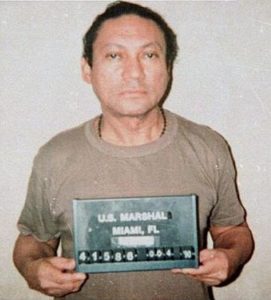 Like many corrupt and brutal dictators around the world, Noriega was a partner and ally of the U.S. government. In fact, he was actually trained at the Pentagon’s School of the Americas, which is referred to in Latin America as the School of Assassins. He later served as a paid asset of the CIA. He also served as a conduit for the U.S. government’s illegal war in Nicaragua, where U.S. officials were using the Contra rebels to effect a regime change in that country.
But like other loyal pro-U.S. dictators, Noriega fell out of favor with U.S. officials, who decided they wanted him out of office and replaced with someone more to their liking.
The big problem, of course, is the one that always afflicts U.S. regime-change aspirations: Noriega refused to go voluntarily.
U.S. officials knew that it would look bad to simply invade the country and effect a regime-change operation through force of arms. Undoubtedly, they considered a state-sponsored assassination through the CIA, which specialized in that form of regime change, but for whatever reason that regime-method wasn’t employed.
So, the regime-changers turned to the U.S. Justice Department, which secured a criminal indictment against Noriega for supposedly violating America’s drug laws. The U.S. rationale was that the U.S. government, as the world’s international policeman, has jurisdiction to enforce its drug laws against everyone in the world.
On December 20, 1989, the U.S. military invaded Panama to bring Noriega back to the United States to stand trial on the drug charges. One might consider the invasion to be one gigantic no-knock raid on an entire country as part of U.S. drug-war enforcement.
An estimated 23-60 U.S. soldiers were killed in the operation while some 300 were wounded. An estimated 300-800 Panamanian soldiers were killed. Estimates of civilian deaths ranged from 200 to 3,000. Property damage ranged in the billions of dollars.
But it was all considered worth it. By capturing Noriega and bringing him back for trial, U.S. officials felt that they had made big progress in finally winning the war on drugs. Equally important, they had secured the regime change that had been their original goal. At the same time, they sent a message to other rulers around the world: Leave office when we say or we’ll do this to you.
Noriega was convicted and received a 40-year jail sentence. When his lawyers tried to introduce evidence at trial of his close working relationship with the CIA and other elements of the U.S. national security state, not surprisingly federal prosecutors objected and the judge sustained their objections. Better to keep those types of things as secret as possible.
Alas, Noriega’s conviction and incarceration did not bring an end to the war on drugs, as this crooked, corrupt, failed, and racially bigoted government program continues to this day. Moreover, as Venezuelan strongman Nicolás Maduro might soon find out, the drug war continues to provide an effective way for U.S. officials to effect regime change.
Sick and Sadistic: World Fights COVID-19 Amid U.S. Sanctions
By Finian Cunningham | Strategic Culture Foundation | April 1, 2020
Dozens of U.S. government-chartered flights have begun to airlift vital medical equipment and supplies from China to the U.S. as the latter becomes the world’s biggest case load of infections from the novel coronavirus. There are grim forecasts for the number of deaths in the U.S. as the pandemic is weeks from peaking there.
China is cooperating with the U.S. in organizing the massive medical transfer, naturally of course, given the humanitarian crisis. You would think therefore that a little reciprocation would be in order from Washington. After all, China is one of those foreign countries that the U.S. has imposed sanctions on over alleged human rights violations. Would it not behoove the U.S. to show a bit of solidarity and gratitude by dropping its sanctions regime against China?
And not just China. There are are some 30 countries and territories that currently sit on a U.S. sanctions list, mostly due to Washington’s accusations of human rights violations. Some of the targeted nations have been under sanctions for decades, such as Cuba, North Korea and Iran. Others have joined the dubious club more recently, such as Russia, Yemen and Venezuela.
Surely at this unprecedented time of a global pandemic threatening millions of human beings regardless of nationality, it is time to show genuine solidarity and compassion for others. The very idea of imposing sanctions on other countries is not only anachronistic. It is utterly barbaric.
In any case, U.S. sanctions imposed unilaterally without the mandate of the UN Security Council are arguably illegal. Even before the coronavirus outbreak and its accompanying disease, Covid-19, the American deployment of embargoes to disrupt commerce and trade of other countries could be seen as reprehensible. Such measures are rightly judged to be collective punishment of civilians which violates international law and the UN Charter.
But now as countries battle against an existential threat posed by the virus, the existing U.S. sanctions can be seen as an abomination.
Iran is a particularly poignant case. It has one of the highest infection rates in the world with thousands of deaths in a matter of weeks. Yet the Trump administration sees fit to not only maintain harsh sanctions on Tehran, it has actually added three more rounds of sanctions against Iran since the epidemic occurred. The deaths in Iran are being multiplied by American policy.
The Trump administration cynically claims that U.S. sanctions do not impede humanitarian aid to Iran. The claim is beneath contempt. The crippling sanctions imposed by Trump’s “maximum pressure” policy virtually precludes Iran from making international financial transactions, including for medicines. Moreover, the effect of “secondary sanctions” means that many countries are intimidated from doing business with Iran out of fear of U.S. reprisals.
Washington has blood on its hands where any country is finding the fight against Covid-19 in any way more difficult. It already had blood on its hands from its illegal sanctions. But what we have now is the grotesque picture of a ghoulish, sadistic American government shamelessly showing its ugly face at a time of global suffering.
At the G20 summit last week – held by teleconference to avoid spreading coronavirus infection – Russian President Vladimir Putin called on the world to drop sanctions at this critical juncture. He said it was imperative for all nations to have access to medicines and equipment without financial restrictions. “It is a question of whether people live or die,” he added.
Putin’s call for discarding sanctions was backed by UN secretary-general Antonio Guterres and other world leaders, including Chinese President Xi Jinping.
In the end, however, the G20 final joint statement omitted any unanimous mention of sanctions. One suspects that the U.S. – the world’s number-one serial abuser of sanctions – pulled strings behind the scenes to pre-empt any move to banish such measures of financial coercion. Not surprisingly, because financial coercion (less politely, “terrorism”) is an instrumental weapon for U.S. foreign policy, as much as its military intimidation of other nations is.
Instead, what came out of the G20 conference was a joint statement of vapid, disingenuous rhetoric.
It opined: “Global action, solidarity and international cooperation are more than ever necessary to address this pandemic. We are confident that, working closely together, we will overcome this. We will protect
human life, restore global economic stability, and lay out solid foundations for strong, sustainable, balanced and inclusive growth.”
Just how does “global solidarity” and “working closer together to protect human life” translate into practical remedial action when Washington continues to wield a veto over some of the poorest and weakest nations gaining life-saving supplies?
If there were any compassion or morality in Washington, it would immediately rescind all its sanctions against other nations in recognition of common humanity. But the hard-heartedness of Washington is unrelenting even at a time of crisis and death. It is based on a self-righteousness that is frightening in the scale of its hubris and hypocrisy.
A certain natural “correction” is due for this endemic criminal mentality of America’s ruling class. And one senses that the correction for its systematic evildoing against fellow human beings is not going to pass lightly.
Can the United States decline peacefully?
By Kevin Barrett | Press TV | March 31, 2020
Professor Atta-ur-Rahman from Pakistan recently in an interview argued that this coronavirus pandemic may have originated as a US bioweapon. He’s not just any doctor, but he’s the chairman of (Pakistani Prime Minister) Imran Khan’s National Task Force on Science and Technology. And Pakistan’s former UN Ambassador Abdullah Hussain Haroon said the same thing.
This is very interesting. The US, of course, has been very close to Pakistan in the past. And today Pakistan is trying to balance between the US and China. Hearing this kind of statement from high level people in Pakistan is a wakeup call that the world needs to take this seriously.
I think that the context is such that anybody who’s seriously paying attention to contemporary history has to admit that from the circumstantial evidence alone, it seems very likely that we should see this as a deliberate US biological attack on China, and perhaps on Iran or perhaps the Israelis did that.
The reason for this is that the US has entered into a period of great power competition with a rising China, not just a rising China but with a very rapidly rising China, if we listen to serious geostrategic analysts such as John Mearsheimer, a very brilliant man who tries to tell the truth as he sees it, as we all know, from his analysis with, with Walt on the Israel lobby here in the United States.
In October 2014, just about six years to the day before the US military sports team came to Wuhan, China, perhaps bringing that virus and while at the same time an exercise was being run, “Event 201”, mimicking exactly what would happen in the case of this kind of pandemic, John Mearsheimer published an article called, Can China Rise Peacefully? His answer was no.
John Mearsheimer is an American political scientist and international relations scholar. And he argued that the United States is going to take extraordinary measures to kill Chinese economic growth, which has been averaging 10% since 1980, and which is still up at 7%, putting China on a course to grossly eclipse the United States in economic and enhanced technological and military power within a decade or two at the very most.
Mearsheimer says the United States will undoubtedly do what it takes to stop this no matter what. Here’s a quote from his article he said,
“All of this tells us the United States has a profound interest in seeing Chinese economic growth slowed considerably in the years ahead. That outcome might not be good for American prosperity, much less for global prosperity, but it would be good for American security, which is what matters most.”
So that prediction was that the US would be willing to kill not only the global economy, but the American economy as well in order to stop this precipitous Chinese ascendance in the world. That’s what’s happened obviously.
If China’s growing at over 7% and the US is growing at a couple of percent at most, that differential leads to quick Chinese dominance of its region and then the world, whereas if the whole world’s growth is killed, and China’s dives down to a percent or two, and even if the US growth goes a little bit negative, this change doesn’t happen, the US maintains its current global military supremacy or so it may think.
So clearly, from the background, the historical background in the context everybody in the world who knows anything about history needs to be talking about, this as a US bioweapon attack on China just as the Chinese are saying, just like the Iranian government’s saying just like the Russian government’s saying and now just like the top people in Pakistan are saying.
Kevin Barrett is an American author, journalist and radio host with a Ph.D. in Islamic and Arabic Studies.
Europe sends medical supplies to Iran in first INSTEX transaction: Germany
Press TV – March 31, 2020
Germany says the three European signatories to the 2015 Iran deal have registered the first transaction under a trade system set up last year to protect companies doing business with Iran from US sanctions, delivering medical supplies to the Islamic Republic amid the coronavirus pandemic.
On Tuesday, Berlin’s Foreign Ministry said Germany, France and Britain “confirm that INSTEX (trade system) has successfully concluded its first transaction, facilitating the export of medical goods from Europe to Iran.”
“These goods are now in Iran,” it said in a statement, giving no further details.
The German Foreign Ministry added that Berlin hopes to enhance the mechanism and carry out more transactions with Tehran.
“Now the first transaction is complete, INSTEX and its Iranian counterpart STFI (Special Trade and Finance Instrument) will work on more transactions and enhancing the mechanism,” the German Foreign Ministry said.
Iranian authorities have not commented on the news so far.
The transaction comes over a year after the European trio announced the creation of INSTEX — a non-dollar direct payment channel officially called the Instrument in Support of Trade Exchanges — in an effort to keep Iran’s nuclear deal with world powers alive.
The apparatus was designed to circumvent the sanctions that the United States re-imposed against Iran after leaving a nuclear deal with the Islamic Republic, the trio, plus Russia and China.
However, the Europeans have not been able to operationalize the non-dollar trade mechanism under pressure from the US.
The system was launched after Iran complained about the European countries failing to maintain trade with the country as mandated under the nuclear deal, and bowing instead to Washington’s pressure.
In May, Iran initiated a set of countermeasures against Washington’s withdrawal from the nuclear agreement, officially known as the Joint Comprehensive Plan of Action (JCPOA), and following the European partners’ failure to guarantee Tehran’s business interests under the agreement.
Iran had accepted the nuclear limits voluntarily as part of the deal, despite not being obligated by the UN nuclear agency to commit to any such restrictions.
Tehran has vowed to reverse all its nuclear activities as soon as the other JCPOA signatories begin fully implementing their obligations.
Featured Video
10K More U.S. Troops Deploy as Trump Weighs New Iran Strikes
or go to
Aletho News Archives – Video-Images
Book Review
The Genetic Deception — now in paperback (Second Edition)
Lies are Unbekoming | October 2, 2026
The genes the field promised were never there.
The genetic story of disease is a cover story.
The twenty-first century runs on it. Paediatric clinics. Cancer centres. Forensic laboratories. Family-planning counsel. It is used to explain illness, to assign blame, to foreclose questions. It protects the industries whose products and practices are what actually caused the harm.
It isn’t true.
In 2010, Jonathan Latham and Allison Wilson looked at over seven hundred genome-wide association studies covering some eighty common diseases. The genes the field had promised were not there. The field invented a term, “missing heritability”, to explain the absence, and has quietly worked to bury the finding ever since.
The Genetic Deception is a book about what Latham and Wilson found. What the field did with it. And what the public was told instead. … continue
Blog Roll
 Aletho News
- Von der Leyen gifts her spin doctor a job for life
- 10K More U.S. Troops Deploy as Trump Weighs New Iran Strikes /Suliaman Ahmed
- Iranian crew declared Dena training vessel ‘unarmed’ to US warship before deadly torpedo strike: Report
- Iran’s NPT debate moves beyond parliament
- Houthis condemn Saudi claims of attack on Medina
- Fatuous False Flags
- Are Europe’s Smallest Nations Dragging the Continent into War?
- EU draws up contingency plans for possible Merz exit
- G7 caves to US blackmail, announces ‘massive’ release of diesel reserves
- Reporting of the RAF Fairford arrests blows the idea of a ‘free press’ out of the water
- If Americans Knew
- The Israeli Right Portrays Islam as Murderous. It Serves a Political Purpose
- Jordan Has Had Enough: King Abdullah’s Scathing Warning to Israel
- Israeli Colonizers (i.e. Settlers) Kill Palestinian Man Near Salfit
- New Google Maps images reveal massive scale of devastation in Gaza
- Jewish supremacy, anti-Palestinian bigotry on display in Israel – Daily Update
- Israeli Soldiers Abduct At Least 22 Across Occupied West Bank
- Eight Palestinians Killed in Israeli Attacks on Gaza
- Israeli former leaders and security chiefs threaten legal action over ‘Jewish terrorism’
- Israel map in LA Times ad includes all land from the river to the sea
- Inside Lebanon’s 200-page dossier on Israeli war crimes
- No Tricks Zone
- Green Energy Debacle: German Expert Professor Fritz Vahrenholt Warns Of Severe Economic And Social Consequences
- Two More Paleo Reconstructions Affirm Meters-Higher Sea Levels Across Ireland, Brazil 7000-6000 Years Ago
- New Study: Earth And Venus Surface Warmth Largely Explained By Convection And Lapse Rate, Not CO2 Or Radiation
- 2025 Nature Paper Claiming Worsening Global Drought Gets RETRACTED …Heavily Flawed
- New Study: ‘Global Drought Shows No Detectable Recent Acceleration Under Climate Warming’
- Economic Masterminds: German Socialists Suggest Taxing Productivity Gains Stemming From Using AI
- The South China Sea Has Not Been Cooperating With The Climate Change Narrative
- Energy Crisis: Germany Enters Heating Season With Historically Low Gas Reserve Fill Levels
- New Study: The Antarctic Ice Sheet Gained Mass From 2020-2024 Due To Staggering Snow And Ice Accumulation
- Study: Ocean Heating Rates From Thousands Of Years Ago ‘Dwarf’ Modern Ocean Heating Rates

