The Myth of Barack Obama as the Great and Noble Nobel Global Statesman
By Martin SIEFF | Strategic Culture Foundation | 27.06.2018
It is no coincidence that the Sword, Sorcery and Dragons Fantasy Games of Thrones – filmed in large part on location in my native Northern Ireland – has entranced the American viewing public over the past decade: For the early 21st century has seen US policymakers and opinion-shapers plunging ever deeper into one fantasy after another. But even Game of Thrones pales in incredibility and absurdity next to the fantasy still believed by most Americans — That Barack Obama was a wise and responsible, peace-loving statesman.
In truth, Obama, casually and with evident self-satisfaction, unleashed series of catastrophic foreign national security policies that sent the world careening to the brink of nuclear war and inflicted needless suffering on scores of millions of people. No Game of Thrones villain ever did anything like that damage.
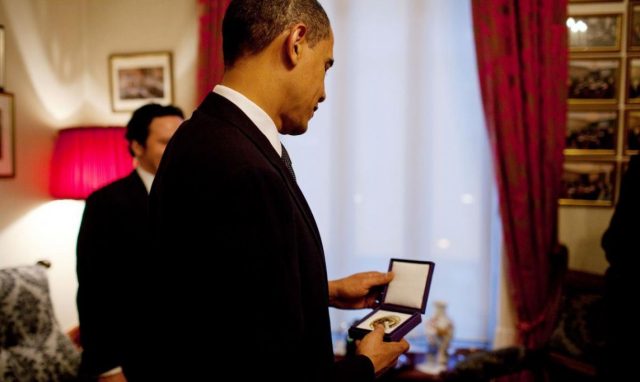
I have no doubt that the ludicrous award of the 2009 Nobel Peace Prize to Obama will go down in history as the most ridiculous such award in the entire history of the institution.
What in reality was Obama’s record as President of the United States?
He authorized a totally unnecessary and strategically meaningless $1 trillion nuclear build up over the coming generation that will play a major role in bankrupting the United States. It was also a move guaranteed to set off a ruinous global thermonuclear arms race with Russia, China and other powers who understandably fear being made defenseless before a succession of ever more unilateral and unpredictable US leaders.
Obama claimed to be deeply concerned about nuclear nonproliferation and hosted a Nuclear Safety Summit in Washington whose only real achievement was to feed his already enormous and delusional appreciation of his own self-worth.
However, as analyst Rebecca Heinrichs of the conservative Hudson Institute in Washington concluded, “If one actually looks at the risks of nuclear war as well as the likelihood of proliferation at the start of the President’s term compared to now, the Obama’s nonproliferation record earns a failing grade.”
In 2011, Obama a fecklessly allowed his warmongering, hyper-aggressive secretary of state Hillary Clinton to arrange with Britain and France the use of NATO air power to destroy the state of Libya by giving tactical support and protection to rebels against veteran leader Muammar Gaddafi.
Gaddafi’s previous decade of consistent cooperation with the US and its allies in the struggle against extreme Islamist terror and his monitored compliance with demands to scrap Libya’s nascent nuclear [program] were all for naught. Obama and Clinton’s reckless and even clownish policies ensured the complete disintegration of Libya, creating an infernal anarchy in which Islamist terror groups could thrive and metastasize throughout sub-Saharan Africa.
Far from encouraging nations to scrap their nuclear programs as Gaddafi in fact had done, Obama’s childish approval of the destruction of Libya sent precisely the opposite message to nations around the world: “Scrap your nuclear deterrents and there will be nothing to stop the United States from destroying you whenever its leaders feel like it.”
It was the same story in Syria where Obama and Clinton eagerly approved the flow of half a billion dollars a year to such groups including, incredibly the Nusrah Front, the Syrian franchise of al-Qaeda, heirs to the conspirators who [are said to have] killed nearly 3,000 Americans on September 11, 2001.
Obama’s utter ignorance and his clueless ignorance of diplomacy and the conduct of international relations was memorably exposed in his casual approval of the absurd and clownish Michael McFaul as US ambassador to Moscow.
The idea that an accredited ambassador could pass his days in sending out public abusive Twitter messages insulting the head of the state to which he was accredited was ludicrous even if that state was Mauritius, Lichtenstein or Tahiti let alone one of the world’s two thermonuclear superpowers.
McFaul openly worked overtime to give aid and encouragement to domestic opposition to the undermine the legitimate government of Russia: His activities would have provoked calls for full-scale war from the US Congress had any Russian envoy to Washington, DC presumed to act in such a way. None of this bothered Obama for a second.
Even worse was to follow: In 2014, US Assistant Secretary of State Victoria Nuland, the wife of leading neocon ideologue Robert Kagan and also the favored subordinate of Hillary Clinton when she was secretary of state openly paraded in the streets of Kiev, handing out cookies to violent protestors as they overthrew with mob riots and terror the constitutionally democratically elected government of a European nation of 45 million people. Obama fully – albeit, as usual, passively approved.
East-West relations were reduced to a state of chaos and distrust unseen in 52 years since the Cuban Missile Crisis. Obama does not appear to have noticed or even been concerned.
Obama was not totally ignorant and uninterested in international relations. During his casual and ill-attended, poorly documented student years at Columbia University in New York City, he attended only one course in international relations. It was given by none other than Zbigniew Brzezinski, former National Security Adviser to President Jimmy Carter.
Brzezinski was a descendant of the displaced minor Polish aristocracy who through his long career consistently fought to lock the United States into a set policies designed to weaken, disintegrate and encircle Russia with hostile powers and alliances. He was a major foreign policy influence on US Presidents Ronald Reagan, Bill Clinton and George W. Bush.
Brzezinski was Obama’s personal guide and guru to what little the 44th US president dimly grasped of strategic orientation and world affairs. Obama’s near-total ignorance of non-American history and diplomacy gave Brzezinski full scope to manipulate him into accepting all his own most virulent anti-Russian prejudices.
Thanks to Obama, superpower diplomatic relations collapsed to their most parlous state in the entire Nuclear Age. When Obama took office in January 2009, the Doomsday Clock of The Bulletin of the Atomic Scientists journal was set at two minutes to midnight and the journal soberly warned: “The world stands at the brink of a second nuclear age.”
Yet after eight years in power, when Obama left the White House in January 2017, as ignorant, complacent and filled with unearned self-regard as when he came to Washington, the Doomsday Clock stood at three minutes to midnight – two minutes closer than when he had taken office.
We do not need to wait to know the Verdict of History on Barack Obama’s eight years as a global statesman. That verdict is in and it is damning: The Nobel committee should rescind his 2009 Peace Prize. Perhaps it can be given instead to a harmless fantasy TV show like Game of Thrones.
Ayatollah Khamenei slams West’s ‘shameless’ human rights posture
Press TV – June 27, 2018
Leader of the Islamic Revolution Ayatollah Seyyed Ali Khamenei has strongly denounced the Western states for their pretense of advocating human rights while in reality supporting terrorist groups and acts of terror.
Addressing the staff of Iran’s Judiciary at a meeting in Tehran on Wednesday, Ayatollah Khamenei made reference to human rights violations committed by the United States in various parts of the world as well as France and Britain’s crimes of the past decades which took place in Africa and the Indian subcontinent.
The Leader added that the West’s support over the past years for the Daesh terror group in Syria and the atrocities being committed in Myanmar and elsewhere “is indicative of the repeated lies of the shameless fake human rights advocates.”
Ayatollah Khamenei said when it comes to the issue of human rights, it is actually the Islamic Republic that stands in the position of the true advocate of human rights as opposed to “the criminal Western pretenders.”
The Leader expressed satisfaction with the Judiciary’s work in restoring the Iranian nations’ rights in the face of bullying powers.
Separately, Ayatollah Khamenei advised the judicial officials to work closely with the government towards resolving the country’s economic problems.
‘Systemic corruption a lie’
The Leader criticized certain people who seek to create the impression among the public that there is “systemic corruption” within Iranian state institutions.
Corruption does exist in a number of governmental and commercial enterprises, “but the existence of systemic corruption is not true,” the Leader said. “This wrong impression should not be allowed to affect the public opinion.”
Ayatollah Khamenei further stated that foreign enemies and certain oblivious elements at home have made the Judiciary the target of the most severe propaganda and media pressure.
In order to effectively confront this massive propaganda campaign, the Leader suggested, the judicial system needs to develop a strong and skillful media arm.
Washington’s Syrian Chess Game Leaves Iraqi Forces Battling ISIS Dead
By Whitney Webb | Mint Press News | June 26, 2018
Last Sunday, June 17, local Syrian media reported that the U.S. coalition had bombed Syrian Arab Army installments in the town of Al-Hariri. The bombing killed dozens of Syrian Arab Army (SAA) soldiers as well as 22 fighters from the Iraqi paramilitary group known as the Popular Mobilization Forces (Hashd al-Sha’abi, PMF), which has been collaborating with the Syrian government to wipe out Daesh (ISIS) fighters around the Syrian-Iraqi border city of Abu Kamal in the Deir Ez-Zor governorate.
Soon after the strike, however, the U.S. denied responsibility for the attack, with Pentagon spokesman Adrian Rankine-Galloway asserting that the bombing was “not a U.S. or coalition strike,” while an anonymous U.S. official told Agence France-Presse, and later CNN, that Israel had been responsible for the strike. Israel declined to comment on the allegations.
While Israel was widely blamed for the strike following those media reports, new evidence gathered by Iraq’s PMF from the site of the strike has shown that the attack may, in fact, have been carried out by the U.S. coalition. After collecting fragments of missiles used in the strike, the group – which is sponsored by the government of Iraq – determined that the U.S. had carried out the strike by firing missiles at the SAA/PMF position from a location near the Iraqi border city of Al-Qa’im. U.S. culpability for the attack would mean that it is the second time in less than a month that the U.S.-led coalition has attacked pro-government fighters targeting Daesh within Syria.
The head of PMF’s military operations, Abu Munather Al-Husseini, asserted that the U.S.-led Joint Operations Command (JOC), also known as the U.S. coalition, had been informed by the Iraqi military of the PMF’s location prior to the strike. Thus, if the PMF’s analysis of the strike site is indeed correct, the U.S. coalition had intentionally and deliberately targeted the PMF as well as the SAA in conducting the strike.
As MintPress reported soon after the attack, the strike was launched from U.S.-occupied territory, meaning that either the U.S.-led coalition conducted the attack but publicly denied responsibility, or that Israel was responsible for the attack and “independently” launched the strike from Syrian territory occupied by the U.S.-led coalition. The PMF’s analysis of the strike site has now determined that the former was most likely the case, given that the group had waited to point the finger at Israel or the U.S. until concluding its analysis of the attack.
PMF’s leadership lambasted the U.S. for allegedly carrying out the strike and targeting its forces, while also urging retaliation against the U.S. for repeatedly interfering in its efforts to wipe out Daesh in Syria as well as Iraq. Indeed, just days before the strike, the PMF had successfully launched a major offensive against Daesh in the area of Syria where the strike later took place.
In a statement released on Sunday, PMF Deputy Commander Abu Mahdi al-Muhandis warned of retaliation against the U.S., stating:
We tell the Americans that we as the Hashd [PMF], including all of its formations, follow the Iraqi government. We will not remain silent about this attack. […] Remaining silent on this incident, saying that ‘that position is outside the Iraqi territory, hence we have nothing to do with it’ is forfeiting the blood of our martyrs.
U.S. chess game with ISIS as pawn
U.S.’ actions near Abu Kamal betray the fact that it is seeking to expand the portion of Syria’s Northeast that it currently occupies, an area that accounts for 30 percent of Syria’s total land mass and includes the majority of the country’s oil, gas, fresh water, and agricultural resources. The U.S. has long had its eye on the strategic border town, as it is the main border crossing between Syria and Iraq. More importantly, it is the only border crossing that connects Syrian government-controlled territory with Iran, through Iraq.
A major U.S. goal in its occupation of Syria has been disrupting this land bridge, but continued Syrian government control of Abu Kamal makes this impossible. Were the U.S. to take control of Abu Kamal, it would control Syria’s most important border crossings, as it already controls the Syrian-Jordanian border crossing at al-Tanf.
The U.S.’ interest in Abu Kamal and its recent targeting of forces fighting Daesh in the area suggest that a Daesh takeover of the city is likely to be used by the U.S. as the pretext for the expansion of Syrian territory, a tactic the U.S. has used before in Syria. The possibilities of a Daesh takeover of Abu Kamal have been openly noted by influential U.S. think tanks, such as the Center for a New American Security (CNAS), which recently mused that Daesh control over Abu Kamal would serve U.S. interests in the region, as it would allow the U.S.-occupied zone of Syria to “spread by osmosis.”
For that reason, the recent reappearance of Daesh (ISIS) in Abu Kamal is significant. Indeed, Daesh launched its largest military offensive in several months in Abu Kamal earlier this month, with 10 suicide bombers helping clear the way for Daesh militants to take over parts of the city. The offensive killed 25 Syrian soldiers and allied fighters, according to monitors. Daesh attacked from the U.S.-occupied zone of Syria, despite the fact that the U.S. has long justified its illegal presence in Syria by claiming that it is fighting the terror group. However, Russian and Syrian military sources have asserted that the U.S. is not fighting Daesh in the region, but protecting them.
The strikes on pro-Syrian government forces around Abu Kamal also come amid reports that indicate the U.S. is fortifying its military positions within occupied Syria by constructing military bases along the Euphrates river in proximity to Syrian military installments throughout the Deir Ez-Zor region and by transferring “a large volume of arms and equipment, including missiles, military vehicles and bridge equipment” to those same areas in recent weeks.
Given that the U.S. may soon lose its influence in Southern Syria and its control over the al-Tanf border crossing, thanks to the Syrian government’s offensive in the Dara’a governorate, it is likely the U.S. will continue to fortify its position in the country’s Northeast and expand its efforts to dislodge the SAA and its allies from Abu Kamal in a last-ditch attempt to prolong the conflict and succeed in its efforts to occupy and partition Syria.
Whitney Webb is a staff writer for MintPress News and a contributor to Ben Swann’s Truth in Media. Her work has appeared on Global Research, the Ron Paul Institute and 21st Century Wire, among others. She has also made radio and TV appearances on RT and Sputnik. She currently lives with her family in southern Chile.
Jeremy Corbyn Says Future Labour Government Would Recognize Palestine as State
By Whitney Webb | Mint Press News | June 25, 2018
The leader of the U.K. Labour Party, Jeremy Corbyn, officially announced on Friday that the U.K. would recognize Palestine as a state under a future Labour government. Corbyn, speaking in Jordan during his first trip to the region since becoming party leader in 2015, stated that the recognition of a Palestinian state would be aimed at achieving “a genuine two-state solution” that he would seek to tackle “very early on” were Labour to emerge victorious in the U.K.’s next general election in 2022.
“I think there has to be a recognition of the rights of the Palestinian people to their own state, which we as a Labour Party said we would recognize in government as a full state as part of the United Nations,” Corbyn stated.
A day later, on Saturday, Corbyn visited Jordan’s Al-Baqa’a refugee camp, which has long hosted Palestinians who fled the West Bank and Gaza Strip during the 1967 Arab-Israeli War.
After visiting the camp, Corbyn asserted the need to consider the rights of Palestinians in any future peace process, stating that “there has to be a right of the Palestinian people to live in peace, as well as the right of Israel.”
Corbyn has long been an advocate for Palestine, having been a long-time patron of the Palestine Solidarity Campaign and having endorsed key elements of the boycott, divest and sanctions (BDS) movement.
More recently, Corbyn has condemned Donald Trump’s decision to recognize Jerusalem as the capital of Israel – calling the move a “catastrophic mistake” — while also calling out Western silence over Israel’s killing of unarmed Palestinian protesters in Gaza during the Great Return March earlier this year. Corbyn’s criticism of recent Israeli violence targeting Palestinians has included calls for the U.K. to halt arms sales to Israel if those arms “could be used in violation of international law.”
As a result of his continued advocacy for Palestinians, Corbyn has consistently been attacked by the U.K.’s Israel lobby as an “anti-Semite.” Such concerns over “anti-Semitism” have grown into a frenzy in the U.K. media in recent years, particularly after Labour’s surprise performance in U.K. elections last year that led them to pick up several seats in Parliament. The “witch hunt” to smear Corbyn as an “anti-Semite” has led several Jewish groups to call out “the weaponization of anti-Semitism for political ends.”
Given his statements over the weekend on recognizing Palestine as a state, accusations of Corbyn’s “anti-Semitism” are unlikely to die out anytime soon.
Whitney Webb is a staff writer for MintPress News and a contributor to Ben Swann’s Truth in Media. Her work has appeared on Global Research, the Ron Paul Institute and 21st Century Wire, among others. She has also made radio and TV appearances on RT and Sputnik. She currently lives with her family in southern Chile.
Young protesters are defying Israel’s blockade with scraps of paper and plastic
By Jonathon Cook | The National | 24 June 2018
First Israel built a sophisticated missile interception system named Iron Dome to neutralise the threat of homemade rockets fired out of Gaza.
Next it created technology that could detect and destroy tunnels Palestinians had cut through the parched earth deep under the fences Israel erected to imprison Gaza on all sides.
Israel’s priority was to keep Gaza locked down with a blockade and its two million inhabitants invisible.
Now Israel is facing a new and apparently even tougher challenge: how to stop Palestinian resistance from Gaza using flaming kites, which have set fire to lands close by in Israel. F-16 fighter jets are equipped to take on many foes but not the humble kite.
These various innovations by Palestinians are widely seen by Israelis as part of the same relentless campaign by Hamas to destroy their country.
But from inside Gaza, things look very different. These initiatives are driven by a mix of recognisably human emotions: a refusal to bow before crushing oppression; a fear of becoming complicit through silence and inaction in being erased and forgotten; and a compelling need to take back control of one’s life.
Palestinians encaged in Gaza, denied entry and exit by Israel via land, sea and air for more than a decade, know that life there is rapidly becoming unsustainable. Most young people are unemployed, much of the infrastructure and housing are irreparably damaged, and polluted water sources are near-unpotable.
After waves of military attacks, Gaza’s children are traumatised with mental scars that may never heal.
This catastrophe was carefully engineered by Israel, which renews and enforces it daily.
The kites have long served as a potent symbol of freedom in Gaza. Children have flown them from the few spots in the tiny, congested enclave where people can still breathe – from rooftops or on Gaza’s beaches.
Five years ago, the film Flying Paper documented the successful efforts of Gaza’s children to set a new world record for mass kite-flying. The children defied Israel’s blockade, which prevents entry of most goods, by making kites from sticks, newspapers and scraps of plastic.
The children’s ambition was – if only briefly – to retake Gaza’s skies, which Israel dominates with its unseen, death-dealing drones that buzz interminably overhead and with missiles that can flatten a building in seconds.
A young girl observed of the kite’s lure: “When we fly the kite, we know that freedom exists.” A message scrawled on one read: “I have the right to pride, education, justice, equality and life.”
But the world record attempt was not only about the children’s dreams and their defiance. It was intended to highlight Gaza’s confinement and to issue a reminder that Palestinians too are human.
That same generation of children have grown into the youths being picked off weekly by Israeli snipers at unarmed protests at the perimeter fence – the most visible feature of Israel’s infrastructure of imprisonment.
A few have taken up kite-flying again. If they have refused to put away childish things, this time they have discarded their childish idealism. Their world record did not win them freedom, nor even much notice.
After the snipers began maiming thousands of the demonstrators, including children, medics and journalists, for the impudence of imagining they had a right to liberty, the enclave’s youths reinvented the kite’s role.
If it failed to serve as a reminder of Palestinians’ humanity, it could at least remind Israel and the outside world of their presence, of the cost of leaving two million human beings to rot.
So the kites were set on fire, flaming emissaries that brought a new kind of reckoning for Israel when they landed on the other side of the fence.
Gaza’s inhabitants can still see the lands from which many of them were expelled during the mass dispossession of the Palestinian people in 1948 – under western colonial sponsorship – to create a Jewish state.
Not only were those lands taken from them, but the Jewish farming communities that replaced them now irrigate their crops using water Palestinians are deprived of, including water seized from aquifers under the West Bank.
The kites have rained fire down on this idyll created by Israel at the expense of Gaza’s inhabitants. No one has been hurt but Israel claims extinguishing the fires has already cost some $2 million and 7,000 acres of farmland have been damaged.
Sadly, given the profound sense of entitlement that afflicts many Israelis, a small dent in their material wellbeing has not pricked consciences about the incomparably greater suffering only a few kilometres away in Gaza.
Instead, Israel’s public security minister Gilad Erdan called last week for anyone flying a kite, even young children, to be shot. He and other ministers have argued that another large-scale military assault on Gaza is necessary to create what Mr Erdan has termed “durable deterrence”.
That moment seems to be moving inexorably closer. The last few days have seen Israel launch punitive air strikes to stop the kites and Palestinian factions retaliate by firing significant numbers of rockets out of Gaza for the first time in years.
The Trump administration is no longer pretending to mediate. It has publicly thrown in its hand with Israel. It withdrew last week from the United Nations Human Rights Council, accusing it of being a “cesspool of political bias” after the council criticised Israel for executing Gaza’s unarmed demonstrators.
On a visit to the region last week, Jared Kushner, Donald Trump’s son-in-law and adviser, urged ordinary Palestinians to rebel against their leaders’ refusal to accept a long-awaited US peace plan that all evidence suggests will further undermine Palestinian hopes of a viable state.
Mr Kushner is apparently unaware that the Palestinian public is expressing its will, for liberation, by protesting at the Gaza fence – and risking execution by Israel for doing so.
Meanwhile, Prince William is due in Israel on Monday, the first British royal to make an official visit since the mandate ended 70 years ago. While Kensington Palace has stressed that the trip is non-political, Prince William will meet both Israeli Prime Minister Benjamin Netanyahu and Palestinian leader Mahmoud Abbas in an itinerary that has already been claimed by both sides as a victory.
From the vantage point of the Mount of Olives, from which he will view Jerusalem’s Old City, the prince may not quite manage to see the kite battles in Gaza’s skies that underscore who is Goliath and who is David. But he should see enough in the West Bank and occupied East Jerusalem to understand that western leaders have decisively chosen the side of Goliath.
Kushner says US Administration Will Continue with “Peace Plan” Even Without Abbas
IMEMC News & Agencies – June 24, 2018
US president Donald Trump’s senior adviser, Jared Kushne,r in an interview with Al-Quds Palestinian newspaper, said that his country will go on with a Middle East peace plan which has not been announced yet, whether Abbas agrees to participate in it or not.
Kushner questioned Abbas’s ability to make a deal, as the Palestinian Authority (PA) is boycotting the US administration for its moves, which included declaring Jerusalem as the capital of Israel, and moving the US embassy from Tel Aviv to Jerusalem.
“If President Abbas is willing to come back to the table, we are ready to engage; if he is not, we will likely air the plan publicly,” Kushner said, according to an English-language transcript released in Washington.
“However, I do question how much President Abbas has the ability to, or is willing to, lean into finishing a deal. He has his talking points which have not changed in the last 25 years,” Kushner said.
Commenting on the interview, Nabil Abu Rdainah, a spokesman for Abbas, said: “The road to peace is clear – commitment to the two-state solution, a Palestinian state on the 1967 borders with Jerusalem as its capital. This is the road to any negotiations or any meetings.”
Kushner and US Middle East envoy Jason Greenblatt, visited Jordan, Saudi Arabia, Qatar and Egypt before talks on Friday and Saturday with Israeli Prime Minister Benjamin Netanyahu, said Arab leaders conveyed they wanted to see a Palestinian state.
Erekat: Kushner represents a policy of dictation
In response, senior PLO member, Dr. Saeb Erekat said Kushner’s interview again illustrates the US refusal to talk substance, to mention Palestinian rights or a Palestinian state.
“This is an attempt to push forward a plan that consolidates Israel’s colonial control over Palestinian land and lives while telling the Palestinian people that money will compensate for our inalienable rights. Plain and simple: Palestine and Palestinian rights are not for sale,” Erekat said in a statement, according to the PNN.
“Kushner represents a policy of dictation rather than negotiations”, he added. “It is the Trump Administration has walked away from the negotiations, from international law and UN resolutions.”
Erekat added that the PA has continuously heard the same from the Israeli government that believes that there will be a better economic situation by pulverizing the political rights of the people of Palestine. Therefore, Kushner’s interview only confirms what we have heard from every international envoy we have met with, that there’s nothing of substance coming from the Trump Administration.
He added that it is outrageous to accept such blatant disregard of international law to be replaced with business packages to resolve the struggle of a people striving for their freedom.
“The aids of the current US Administration, including Jared Kushner, have heard it clear from our fellow Arab leaders that the core of the solution should be grounded on ending Israel’s occupation of Palestine and the establishment of a sovereign and the independent State of Palestine on the 1967 borders with East Jerusalem as its capital. Certainly, the end of Israel’s occupation and the fulfillment of our political rights is a matter of consensus among all Palestinians that are united on the vision and will to live in freedom,” Erekat concluded.
Human Rights Group Accuses UK of Secret Arms Sales to Saudis
Sputnik – 24.06.2018
NGOs allege that the UK has been selling weaponry to Saudi Arabia through an obscure system of arms exports licenses. Since 2015, a Saudi-led coalition has been involved in the Yemen war at the request of the country’s internationally recognized government.
Despite the UK has been insisting that it keeps all arms exports under close control, a freedom of information request submitted by Campaign Against Arms Trade, a UK-based NGO, disclosed that Britain has been selling Storm Shadow and Brimstone missiles, as well as Paveway IV laser-guided bombs to Saudi Arabia.
According to The Guardian, the deadly exports have been shipped for the last five years under Open Individual Export Licences (OIELs), which don’t oblige the seller to publish the total value of the license after it expires.
The surprising finding has prompted campaigners to claim that the authorities are trying to hide the real extent of their arms exports to Saudi Arabia.
Lloyd Russell-Moyle, a Labour MP and member of the Commons Committee on Arms Export Controls, said, as quoted by The Guardian, that hundreds of millions of pounds of bombs were shipped to Saudi Arabia under open licenses issued before it launched its Yemen campaign.
“Open licenses remove the need for the seller to obtain prior approval for each export,” said Andrew Smith of Campaign Against Arms Trade.
According to him, the “opaque” system of OIELs is used to hand over “extremely sensitive weaponry to the Saudi regime.”
Yemen is the site of a long-lasting conflict that rapidly escalated in September 2014 following a Houthi takeover of the Yemeni capital of Sana’a. In 2015, Saudi Arabia, the leader of a nine-member, mostly Sunni Arab, coalition, entered the conflict in a bid to restore Hadi’s government, concerned by the rise of Houthis.
The violent clash has destroyed the local economy and caused a humanitarian disaster. The UN estimates that the conflict has displaced around 3 million people and leaving over 22 million people in need of humanitarian assistance or protection.
United States demands that Japan stops buying oil from Iran – reports
Press TV – June 23, 2018
Washington has asked Tokyo to halt all crude purchases from Iran, insisting that its allies cease all trade with the country, according to Bloomberg.
The request was made during a meeting between US and Japanese officials in Tokyo this week, according to the media. No decision has been made yet, though, and talks will continue.
This means that Washington is taking a harder stance on Iran than it did in 2012. Six years ago, before the nuclear deal, the US demanded that its allies should reduce oil purchases from sanctioned Iran, rather than stop them completely.
Japan is Asia’s fourth-largest buyer of Iranian crude, which accounts for 5.3 percent of its oil consumption, or 172,000 barrels per day.
Refiners in Japan earlier said they could substitute Iranian oil with crude from other Middle Eastern countries, even though their plants are particularly compatible with crude from Iran.
Some analysts see the demand as a negotiating tactic before trade talks begin between the US and Japan.
“It could be that the US is initially demanding a big thing before offering Japan a way to go around it in negotiations,” Satoru Yoshida, a commodity analyst at Rakuten Securities told Bloomberg. “Even if the US is asking Japan to completely stop Iranian crude imports, which is a very high hurdle, it may lower its demand later.”
US-Backed Forces Claim to “Liberate” Yemenis, Instead Rape Detainees
By Randi Nord | Mint Press News | June 23, 2018
The so-called “liberators” in Yemen are sexually and physically torturing detainees at secret prisons. Survivors recall disturbing stories laden with gruesome interrogation tactics for extracting false confessions. Meanwhile, the Saudi-led coalition in Yemen attempts to portray themselves as the bearers of freedom and reason.
As an ally of the United States’ “counter-terrorism” operation in Yemen, the United Arab Emirates established 18 prisons throughout territory under their control. An ongoing investigation from the Associated Press has so far identified instances of deranged sexual torture at five of these facilities. The Emirati headquarters in Yemen houses one of such facilities where witnesses have seen American soldiers.
The United States provides the United Arab Emirates with billions in weapons, and military equipment through the Saudi-led coalition and counter-terror operations in Yemen. Washington also has ground troops in Yemen assisting and training Emirati forces.
Americans use Emiratis as gloves to do their dirty work,” at a prison in Mukallah told the Associated Press.
Two additional prison security officials said Americans were at all locations.
Witnesses say Emirati soldiers, mercenaries, and paid Blackwater mercenaries frequently raped detainees while others filmed the act. Other sexual torture includes electrocuting or hanging rocks from detainees’ testicles and sodomy with wooden or steel poles. The goal is to extract confessions.
They strip you naked, then tie your hands to a steel pole from the right and the left so you are spread open in front of them. Then the sodomizing starts,” said one man, a father of four.
Survivors told reporters about a mass torture event on March 10 at the Beir Ahmed prison in UAE-occupied Aden. Soldiers pulled hundreds of prisoners out of their cells, ordered them to disrobe, and searched their anal cavity looking for cell phones or contraband. One witness proclaimed, “Do you believe this! How could anyone hide a phone in there?” If anyone did not follow through with orders, soldiers threatened them with vicious dogs.
The detainee who drew the photos in the Tweet below spent time in at least three different prison centers.
They tortured me without even accusing me of anything. Sometimes I wish they would give me a charge so I can confess and end this pain,” he said. “The worst thing about it is that I wish for death every day and I can’t find it,” he said.
Unbelievable Hypocrisy
The Saudi-led coalition includes about 34 different countries from around the world. Many people don’t realize the scope of the war against Yemen. Even nations that tend to stay out of other major conflicts like Morocco, Sudan, Eritrea, and Croatia provide the Saudi coalition with military or logistic support.
The United States, United Kingdom, France, and Canada provide the bulk of the Saudi-coalition’s military support.
Considering that the available evidence linking Iran to Yemen’s resistance, Ansarullah (the “Houthis”), remains inconclusive, this is clearly a world war against Yemenis. Saudi Arabia launched this war in March of 2015 to reinstate their puppet government of Abdrabbuh Mansour Hadi who had already resigned from protests.
Throughout the course of this war, Saudi Arabia, the United Arab Emirates, and the United States have championed themselves as “liberators.” If anyone was fooled into believing a ragtag gang of head choppers and child killers were the “good guys” in this scenario, these torture prisons filled with rape should help change that perception.
Also throughout the course of this war, the Saudi coalition has peddled nonstop — and in most cases false — anti-Ansarullah (Houthi) propaganda about detaining journalists and activists. Of course, the stories about Ansarullah granting amnesty to political prisoners don’t fit the official Saudi narrative so they tend to not make headlines.
This story about rape at the secret prisons broke just as the United Arab Emirates launched their operation to take Hodeidah port from Ansarullah (indigenous Yemeni) forces. France sent special forces to assist the Saudi-UAE coalition. At this point, despite all the military might in the world behind them, coalition efforts to occupy Hodeidah remain unsuccessful.
The Saudi coalition that Ansarullah uses Hodeidah port to import Iranian weapons and military equipment under the front of aid. However, all ships entering the port must first dock at Djibouti or a neighboring port for inspection from the coalition themselves.
Experts say anywhere from 250,000 to 600,000 could die in operation “Golden Victory” to take Hodeidah port. Rough estimates put the casualty toll in Yemen at over 36,000 between killed and injured. Tens of thousands more have died from the Saudi-imposed and U.S.-enforced blockade which restricts land, sea, and air imports exports and the flow of movement.
The blockade has put between 18 and 22 million on the brink of famine and triggered a cholera epidemic completely unprecedented in modern times.
The War in Afghanistan is Killing More People Than Ever
By Edward Hunt | Lobe Log | June 20, 2018
Seventeen years into the war in Afghanistan, the longest war in U.S. history, violence has never been worse. In 2017, more than 20,000 Afghans died, a new record.
The dead include an estimated 10,000 Afghan security forces, 10,000 Taliban forces, and 3,438 civilians. Although there is no reliable data on Afghan casualties available to the public, reports published by the Costs of War Project at Brown University indicate that the annual death toll for the Afghan population has never been higher than it was in 2017.
For civilians, the last four years of the war have been the deadliest, with more than 3,400 civilians killed each year from 2014-2017, according to data from the United Nations and the Costs of War Project.
“We are concerned that we will see greater harm this year unless necessary steps are taken by all parties to prevent civilian casualties,” said Tadamichi Yamamoto, the UN Secretary General’s special representative for Afghanistan.
The record violence comes as the Trump administration has intensified the war against the Taliban. Although President Trump repeatedly indicated before he was president that he opposed the war and wanted to end it, he has instructed U.S. military forces to take more aggressive action.
“In Afghanistan, I’ve lifted restrictions and expanded authorities for commanders in the field,” Trump acknowledged last year. The new approach, according to Brigadier General Lance Bunch, means that “the gloves are off.” U.S. military forces are now looking for “any opportunity to target the enemies of Afghanistan wherever we find them in the theater.”
With the new authorities, the U.S.-led coalition has been waging a more aggressive war. In 2017, U.S. forces tripled the number of airstrikes against enemy forces. They also helped Afghan security forces intensify offensive operations against the Taliban.
“In the last year, we’ve seen offensive operations, kind of unprecedented over the last few years, by the Afghan security forces,” U.S. General John Nicholson, the commander of coalition forces in Afghanistan, has commented.
Administration officials acknowledge that they expected the Taliban to respond to the increase in military pressure with more violence. “And so we anticipated this,” Secretary of Defense James Mattis has said. In March, State Department official Alice Wells remarked that “it will not come as a surprise if we see more terrorist tactics addressed at urban audiences.”
The increase in violence has been devastating for the Afghan people. According to the UN Assistance Mission in Afghanistan, which tracks civilian casualties, more than 3,400 Afghan civilians have died and more than 6,800 Afghan civilians have been injured in each of the past four years of the war.
Afghan officials quietly acknowledge that about 10,000 Afghan security forces died last year, a significant increase from previous years. Fearing that the publication of the numbers could undermine morale and hinder ongoing recruitment efforts in Afghanistan, the U.S. military has begun censoring the records.
Although U.S. and Afghan officials estimate that about 10,000 Taliban forces were killed in 2017, Gen. Nicholson has said that “enemy casualty rates have been much higher.” Either way, last year’s combined death toll for Afghan combatants is about 20,000 people.
Despite the record death toll, the Trump administration remains committed to its strategy. “Progress and violence coexist in Afghanistan,” Secretary Mattis recently commented.
The U.S. military’s primary objective is to bring at least 80 percent of the Afghan population under the control of the Afghan government. According to a classified study, the Afghan government might prevail in the war if it achieves this goal. “The focus of our military operations is on increasing and expanding population control by the government of Afghanistan,” General Joseph Votel, the commander of U.S. Central Command, told Congress earlier this year.
The Trump administration’s approach is failing. Not only are record numbers of Afghans dying, but the Afghan government has been losing control of the population. In its latest report to Congress, the Special Inspector General for Afghanistan Reconstruction confirmed that the Afghan government’s control has dropped from 69 percent in August 2016 to 65 percent in January 2018.
Last year, the U.S. intelligence community largely predicted the failures. Director of National Intelligence Daniel Coats told the Senate Armed Services Committee that “the political and security situation in Afghanistan will almost certainly deteriorate through 2018 even with a modest increase in military assistance by the United States and its partners.”
Former Secretary of Defense Chuck Hagel has said that the war has reached a new low. “After 17 years in Afghanistan the situation is worse than it’s ever been,” Hagel commented earlier this year.
Perhaps the best hope for Afghanistan now lies with a growing Afghan peace movement, which has been calling for an immediate ceasefire and talks to end the war. Not only has it succeeded in getting Afghan President Ashraf Ghani to announce a temporary ceasefire, but the Taliban announced its own ceasefire, leading to a few days of peace and celebrations throughout the country.
“I think President Ghani is responding to and indeed reflecting the desire of a wide cross-section of Afghans… in desiring to see a reduction in violence and a way forward to an end to the conflict,” a senior State Department official said.
The Afghan government plans to maintain the ceasefire for the immediate future, despite the recent decision by Taliban officials to resume fighting.
Edward Hunt writes about war and empire. He has a PhD in American Studies from the College of William & Mary.
Raised eyebrows as Madeleine Albright & Bana Alabed to be honored for ‘defending freedom’
RT | June 20, 2018
The pro-NATO Atlantic Council think tank is set to honor former US Secretary of State Madeleine Albright and Syrian child activist Bana Alabed at its Freedom Awards this week.
The Freedom Awards honor individuals who “defend and advance the cause of freedom around the world” and will be hosted in Berlin later this week — but the nominations have caused quite a few puzzled reactions online.
According to the Atlantic Council website, Albright will be recognized for her “championing of global democracy” and as an exemplar of “the power of diplomacy in achieving solutions to the most pressing challenges facing our world.”
Albright seems like an odd choice, however, given she is known around the world for defending US sanctions on Iraq which caused the deaths of more than half a million Iraqi children.
When asked in an infamous 1996 interview if she thought the sanctions were “worth” the price — the price being hundreds of thousands of dead children — Albright replied almost without hesitation, that “the price is worth it.”
Alongside Albright will be a 9-year-old Twitter activist who is no stranger to controversy herself. Numerous Syrian and international commentators have argued that Syrian opposition icon Bana Alabed has been exploited by her parents and others as a propaganda tool for a pro-war agenda.
Bana began tweeting pro-US intervention messages on Twitter when she was just seven years old. Her tweets were written in perfect English and often incendiary. On one occasion, Bana’s Twitter account posted that it was “better to start 3rd world war instead of letting Russia & assad commit #HolocaustAleppo.”
Despite the controversy surrounding her account and accusations of child exploitation, Alabed will be honored by the Atlantic Council for her “use of social media to bring global attention to the plight of children in rebel-held areas of Syria.”
But maybe the Atlantic Council’s choice of nominees for its Freedom Awards shouldn’t be so surprising. In 2016, the think tank chose to bestow the award on the Syrian Civil Defence, also known as the White Helmets – a controversial outfit which bills itself as a first-responders group in the Syrian war, but operates exclusively in militant-held areas and has been accused of links to terrorist groups, including Al Qaeda.
Featured Video

Anthrax War – CBC The Passionate Eye
or go to
Aletho News Archives – Video-Images
Book Review
Shattered Dreams: The HPV Vaccine Exposed (2019)
By Christina England – 30 Q&As – Book Review & Summary
Lies are Unbekoming | September 4, 2026
… Gardasil received FDA fast-track approval in 2006, Cervarix followed in 2009, and Gardasil 9 was approved in December 2014 with more than double the aluminium adjuvant content of the original. The commercial context is specific. Merck was about to lose patent protection on Zocor and faced $18 billion in Vioxx injury claims from a cardiovascular drug the company had marketed while suppressing its own data showing a five-times increase in heart attacks. Analysts projected the global HPV vaccine market at $4 billion by 2011, contingent on government-funded national programs for teenage girls. The 1986 National Childhood Vaccine Injury Act had already granted manufacturers complete liability immunity. By 2013, Japan had withdrawn its HPV vaccine recommendation after cataloguing severe adverse reactions in hundreds of girls. No Western government followed. The establishment position across the UK, US, Australia, and most of Europe held, and still holds, that the vaccines are safe and effective, that reported injuries are coincidental, and that cervical cancer prevention justifies the program. The book was published into this position, not against a vacuum.
Shattered Dreams sits alongside Mary Holland’s The HPV Vaccine On Trial and Viera Scheibner’s foundational vaccination work as part of the documented record on what has been done to a generation of teenage girls under the banner of cancer prevention. The full summary unpacks three specific findings: that Merck used the aluminium adjuvant itself as the “placebo” control in 92.5% of trial subjects, making it structurally impossible to detect excess reactions from the adjuvant; that Dr. Sin Hang Lee found HPV DNA fragments bound to aluminium in every one of sixteen Gardasil samples tested, and in the blood and spleen of a New Zealand girl six months after her third dose; and that in every country with high vaccination coverage, including Australia, the UK, Norway, and Sweden, cervical cancer rates have stopped declining and started rising specifically in the vaccinated cohort. Martínez-Lavín’s 2017 calculation puts the number needed to seriously harm with Gardasil 9 at 140, and the number needed to vaccinate to prevent one case at 1,757. Thirteen young women are seriously harmed for every one who benefits. The vaccine was approved on the basis of trials that could not detect what the trials were supposed to detect, and it is still being given to twelve-year-olds today. … Read full review
Blog Roll
 Aletho News
- Georgia’s Largest Healthcare System Will Fire Employees Who Refuse Flu Vaccine
- The Five-Year Fuel Crisis: Why the World Economy Is Paying for a War It Thinks Is Ending
- Trump’s Big Bluff on Iran
- Swiss scammed out of millions by Ukraine-linked call centers – media
- Germany facing potential ‘violent conflict’ with Russia – spy chief
- Ukraine’s EU neighbors reject new plea from Kiev – Politico
- British Transport Police Facial Recognition Trial Scanned 926,912 People With Zero Arrests
- House Bill Would Ban Federal Use of Flock ALPR Data
- Can a Spice Rival a Drug? 10 Head-to-Head Trials Put It to the Test.
- The oil routes around Hormuz face their own chokepoints
- If Americans Knew
- “We See Our Homes Now From A Satellite, Like Strangers”
- Watch “Gaza: Doctors Under Attack”, originally censored by BBC
- NAZA: Israeli embassies in UK and US promote rival documentary to challenge Gaza genocide allegations
- David Ellison appoints Israeli to lead merged Paramount-Warner studios
- Turkish Red Crescent helps elderly Gaza man walk again after Israel confiscates his prosthetic limb
- Four Palestinians Killed in Israeli Attacks in Gaza
- Two Palestinian youths killed and village razed as Israeli attacks on West Bank continue
- Two more Christian women innocent victims of Gaza raids
- Cruelty, Deprivation, Indignity: A Journalist’s 22 Months in Israeli Prison
- New IDF Website Frames Slain Gaza Journalists as Terrorists
- No Tricks Zone
- Latest European Green Energy Debacle; Portugal’s Largest Flagship Solar Park Insolvent!
- Green Energy Debacle: German Expert Professor Fritz Vahrenholt Warns Of Severe Economic And Social Consequences
- Two More Paleo Reconstructions Affirm Meters-Higher Sea Levels Across Ireland, Brazil 7000-6000 Years Ago
- New Study: Earth And Venus Surface Warmth Largely Explained By Convection And Lapse Rate, Not CO2 Or Radiation
- 2025 Nature Paper Claiming Worsening Global Drought Gets RETRACTED …Heavily Flawed
- New Study: ‘Global Drought Shows No Detectable Recent Acceleration Under Climate Warming’
- Economic Masterminds: German Socialists Suggest Taxing Productivity Gains Stemming From Using AI
- The South China Sea Has Not Been Cooperating With The Climate Change Narrative
- Energy Crisis: Germany Enters Heating Season With Historically Low Gas Reserve Fill Levels
- New Study: The Antarctic Ice Sheet Gained Mass From 2020-2024 Due To Staggering Snow And Ice Accumulation

