SYRIA: US War Crime in Jabal Al Tharda, Deir Ezzor and the Implausible Denials
By Prof. Tim Anderson | 21st Century Wire | December 17, 2017
On 17 September 2016 a carefully planned US-led air raid on Jabal al Tharda (Mount Tharda), overlooking Deir Ezzor airport, slaughtered over 100 Syrian soldiers and delivered control of the mountain to DAESH / ISIS. After that surprise attack, the terrorist group held the mountain for almost a year, but did not manage to take the airport or the entire city. US-led forces admitted the attack but claimed it was all a ‘mistake’. However uncontested facts, eye witness accounts and critical circumstances show that was a lie. This article sets out the evidence of this crime, in context of Washington’s historical use of mercenaries for covert actions, linked to the doctrine of ‘plausible deniability’.
Syrian eyewitness accounts from Deir Ezzor deepen and confirm this simple fact: the US-led air raid on Syrian forces at Jabal al Tharda on 17 September 2016 was no ‘mistake’ but a well-planned and effective intervention on behalf of the terrorist group ISIS (DAESH in Arabic). After days of careful surveillance a devastating missile attack followed by machine gunning of the remaining Syrian soldiers helped ISIS take control of the strategic mountain, that same day.

Colonel Kanaan on the mountain. October 2017. (Photo: Tim Anderson)
Mercenary forces – like ISIS and the other jihadist groups in Iraq and Syria – were a staple of US intervention during the early decades of the cold war, deployed in more than 25 conflicts, such as those of the Congo, Angola and Nicaragua. Whatever their claimed aims and ideologies, they allowed for the ‘multiplication’ of US power and were associated with the doctrine of ‘plausible deniability’, where the ‘formal’ denial of the mastermind role in covert operations minimised damage to domestic public opinion and international relations (Voss 2016: 37-40).
That doctrine was discussed during the 1976 Church Committee hearings into CIA covert operations (especially assassinations and coups) and resurfaced during the Iran-Contra scandal of the 1980s (Hart 2005; Dorn 2010). The key idea behind the doctrine is to be able “to use violence without directly incriminating the [contracting out] regime” (Ron 2002). The use of terrorist proxy armies in Iraq and Syria, both overtly and covertly supported by US forces, is thoroughly consistent with this history.
By September 2016 a US-led coalition had been active in both Iraq and Syria for more than two years, supposedly to help Iraq fight ISIS, but without permission to enter Syria. The foreign powers tried to side-step that legal problem by claiming the invitation from Iraq allowed them to conduct cross border raids against ISIS (Payne 2017). By this time the Russian air force had been assisting Syria for almost a year against multiple terrorist groups, all of them, as senior US officials would admit (Biden in RT 2014 and Usher 2014; Dempsey in Rothman 2014), armed and financed by the US and its allies.

Syrian solider at the front line against ISIS, on the Euphrates. (Photo: Tim Anderson)
Contrary to the stated aims, there is little evidence the US-led group did anything to fight ISIS in Syria. Washington’s group sat back and watched ISIS twice take over Palmyra (in 2015 and 2016), then did nothing to help the Syrian Army take back Palmyra and Deir Ezzor. Most US activity focused on bombing Syrian infrastructure and helping a Kurdish-led separatist force (the SDF) replace ISIS in the city of Raqqa. On the other hand, the 17 September air raid positively helped ISIS in attempts to wrest the remaining parts of Deir Ezzor from the Syrian Army.
US, Australian, British and Danish forces quickly admitted their role in that attack, but claimed the slaughter of over 100 Syrian soldiers was a ‘mistake’. Now mistakes in war do happen. However they are usually associated with a single, unprepared incident. This attack was well-planned, sustained and achieved a key objective in the attempt to drive ‘the Syrian regime’ from Deir Ezzor. Assisting extremists create an ‘Islamic State’ in eastern Syria, US intelligence wrote back in August 2012, was “exactly” what Washington wanted so as “to weaken the regime in Damascus” (DIA 2012).
One year later, as Syrian forces re-took the whole of Deir Ezzor city from ISIS, I spoke with the commanding officer at Jabal al Tharda on that day, Colonel Nihad Kanaan, one of 35 survivors of the US-led attack. He confirmed US admissions that surveillance aircraft had overflown the mountain days before. He also said that the Syrian Army had held the mountain for many months and that their position was clearly marked with Syrian flags. One year later he still showed shock at recalling attack aircraft return to finish off his wounded comrades, with line-of-sight machine-gunning (Kanaan 2017).
That Washington could block most western media from serious study of this treacherous attack, simply by saying ‘sorry, mistake’, is testament to the near absence of critical media voices, at a time of war. The surprise attack was treacherous, not only to the Syrians whom the US had promised to not attack, but to the western populations who mostly believed what their governments said: that they were in Iraq and Syria ‘to fight ISIS’.
It was not that the denials over the crime at Jabal al Tharda were particularly ‘plausible’, just that they had been made. Formal denial was enough, it seems, to stop the western corporate and state media in its tracks. The practice of ‘plausible deniability’ was never so much intended to fool those familiar with the facts, as it was to set up a shield of formal denial which might be used to deflect or discredit ‘potentially hostile’ investigations (Voss 2016: 40; Bogan and Lynch 1989: 205). In past and present propaganda wars, less importance is given to independent evidence than to insistent repetition, denunciation and distraction.
This paper is a prosecuted case, not reportage where one side says this and the other side says that. I have announced my conclusion at the outset and intend to demonstrate that case with evidence. I also support the idea that readers are entitled to see all evidence, including the cover story of the criminals. However in this case the crime and its authors, I suggest, can be convincingly established by uncontested facts. Review of the Syrian perspective simply helps deepen our understanding of the conflict.
1. Uncontested facts
There are eight elements of this massacre where the facts are virtually uncontested:
1: First, the attack was on the forces of a strategic opponent, whom the US wished to overthrow, weaken or ‘isolate’;
2: Second, there was no semblance of provocation;
3: Third, this was a well-planned operation, with days of advance surveillance;
4: Fourth, the attack was sustained and effective, meeting conventional military objectives;
5: Fifth, there was both immediate and longer term benefit to ISIS;
6: Sixth, the US gave false locality information to the Russians before the attack, and their ‘hotline’ to Russia was defective during the attack;
7: Seventh, the US made false claims about being unable to identify Syrian troops;
8: Eighth, the US ‘investigation’ was hopelessly partisan, self-serving and forensically useless; there was no attempt to even contact the Syrian side.
Let’s look at each element in a little more depth
ONE: the attack was on a strategic opponent
Syrian forces were seen as adversaries. This was no ‘friendly fire accident’. The political leadership of the US-led operation had called for the dismissal or overthrow of the Syrian Government and had provided material support to armed opponents of the Government since mid-2011. The terrorist group ISIS had a campaign to create an Islamic State in the region and that objective was shared by Washington. US intelligence, in August 2012, had expressed satisfaction at extremist plans for a “salafist principality” (i.e. an Islamic State) in eastern Syria, “in order to isolate the Syrian regime” (DIA 2012).
The US had not admitted providing finance and arms to ISIS / DAESH, but several senior US officials acknowledged in 2014 that their ‘Arab allies’ had done so (Anderson 2016: Ch.12). After the attack US and Australian officials referred to their victims as forces aligned with the ‘Syrian regime’ (Johnston 2016; Payne 2017), reinforcing the fact that the assailants did not recognise Syrian soldiers as part of a legitimate national army.
TWO: no suggestion of provocation
There was no suggestion of any provocation, as had happened in previous ‘mistakes’; for example where a pilot had mistaken gunfire or fireworks for a hostile attack. This attack was premeditated.
THREE: a well-planned operation, with substantial surveillance
All sides agree this was a carefully planned operation, with surveillance days in advance. Colonel Nihad Kanaan, the Syrian Arab Army commanding officer on ‘Post Tharda 2’ (a military post on the second of three peaks of Tharda mountain range) that day, told this writer that US-coalition surveillance aircraft were seen “repeatedly circling” the area on 12 September, 5 days before the attack (Kanaan 2017). US reports confirm this. On the day of the attack the New York Times cited US Central Command saying that “coalition forces believed they were striking a DAESH fighting position that they had been tracking for a significant amount of time before the strike” (Barnard and Mazzetti 2016). A US military report, some weeks after the attack, said a “remotely piloted aircraft” (RPA) was sent to “investigate” the area the day before and two RPAs revisited the same area on the 17th, identifying two target areas with tanks and personnel (Coe 2016: 1).

General Aktham at the bridge to Raqqa, one of many destroyed by US planes. (Photo: Vanessa Beeley)
Australian Defence Minister Marise Payne wrote that “target identification was based on intelligence from a number of sources”, and that the US-led group had “informed Russian officials prior to approving air strikes on the DAESH position” (Payne 2017). Australian Chief of Joint Operations Vice-Admiral David Johnston pointed out that his country’s contribution to the attack had included “an Australian E7 Wedgetail airborne early warning and control and 2 FA-18 hornet strike fighters” (Johnston 2016). The Wedgetail E-7 is based on a Boeing 737 and came into operation in 2015. It is an intelligence and control aircraft said to have “tonnes of electronic wizardry” (Military Shop 2014) and to be “the most advanced air battlespace management capabilities in the world” (RAAF 2017). All this speaks of a well-planned and technologically capable operation.
Further, surveillance of the area over two years meant the US group were well aware of the strategic troop placements. Kuwait based Journalist Elijah Magnier, who had followed the battles around Deir Ezzor, said that defence of the airport depended on ‘four interconnected Syrian army positions on the Thardah mountain range. Largely because of these elevated fire power positions the “daily attacks’ by ISIS on the airport had failed (Porter 2016: 6). Fabrice Balanche, a leading French expert on Syria, adds that the Syrian Army had held positions along the Tharda range “from March 2016 until the US air strikes”, when ISIS took control (in Porter 2016: 6).
FOUR: the attack was sustained and effective, meeting conventional military objectives
The attack was carried out for an extended period and destroyed the Syrian Arab Army post, killing more than 100 soldiers and destroying tanks and all heavy equipment (O’Neill 2016; Kanaan 2017). The Syrian commander says the attack “continued for 1.5 hours, from 5.30 to 7pm”, as night fell (Kanaan 2017). There is some disagreement over exact times. Syrian Army Command said the attack began at about 5pm while US CentCom said the attack began earlier but “was halted immediately when coalition officials were informed by Russian officials that it was possible the personnel and vehicles targeted were part of the Syrian military” (Barnard and Mazzetti 2016). However the US military confirms that this sunset attack was extended, lasting for just over an hour (Coe 2016: 1).
The Syrian command said at first that 62 soldiers had been killed and 100 injured (RT 2016). Within a short time the numbers killed had been raised to “at least 80” (Killalea 2016). In addition, three T-72 tanks, 3 infantry vehicles and anti-aircraft gun and 4 mortars were destroyed (MOA 2016). A surviving solider said he saw planes “finishing with machine guns our soldiers who tried to take refuge … I saw with my own eyes the death of about 100 soldiers” (SFP 2016).
Colonel Kanaan puts the final number of dead at 123, with 35 survivors (Kanaan 2017). The US side did not bother reporting numbers killed, with General Richard Coe at first mentioning “15 dead regime loyalists” (Watkinson 2016) then late simply saying “Syrian regime/aligned forces were struck” (Coe 2016: 2). There is no report of ISIS forces on the mountain being struck by the coalition aircraft that day; nor any day over the next year.
FIVE: the attack created immediate and longer term benefit to ISIS
The Syrian side made it clear that the massacre had allowed an almost simultaneous ISIS attack on and takeover of the hill. After planes had pounded the Army position on the mountain, ISIS quickly moved in and took full control of the mountain range (FNA 2016a). Within hours they had posted video of themselves standing on the bodies of the Syrian soldiers, killed by the air strikes (Charkatli 2016). The US side failed to comment on the immediate consequence of their attack, but they did not contradict the Syrian and Russian reports. Colonel Nihad Kanaan confirms that, as the US strikes were being carried out, ISIS attacked the Syrian Army post at Thardah 2. Survivors had to flee, as they did not have time to repel the DAESH attack (Kanaan 2017). Syrian Army defences meant that ISIS did not manage to take the airport, but Syrian forces did not retake the mountain until early September 2017, when the Syrian Army broke the siege and began to liberate the entire city (Brown 2017).

Victory! Father and son at Deir Ezzor markets. October 2017. (Photo: Tim Anderson)
SIX: false information to and delayed communications with Russia
The US military report admits that “incorrect information [was] passed to the Russians” about the locale of the attack. They said:
“the strikes would occur 9 kilometres south of DAZ ‘airfield’. However this information was incorrect, as the strikes were planned approximately 3 to 6 kilometres south of the airfield and 9 kilometres south of Dayr az Zawr city. This may have affected the Russian response to the notification and caused considerable confusion in the DT process” (Coe 2016: 3).
Brigadier General Richard Coe agreed with reporters that this misleading information prevented a Russian intervention: “had we told them accurately, they would have warned us”, he admitted (Porter 2016: 4). Providing false information to Russia was quite consistent with a plan to protect the attack from any unwanted interference.
After that, there was yet another ‘mistake’. The US military admits there was a half hour delay in responding to a Russian alarm (that the US was striking Syrian forces) on their specially constructed ‘hotline’. The US military tried to shift blame for this delay to the Russian caller:
“when the Russians initially called at 1425Z, they elected to wait to speak to their usual point of contact (POC) rather than pass the information immediately to the Battle Director. This led to a delay of 27 minutes, during which 15 of the 37 strikes were conducted” (Coe 2016: 3).
The less benign view of this event was that the ‘hotline’ was left unattended during the attack. Haddad (2017) reported that: “During the attack, a hotline between Russia and US forces was reportedly left unattended for 27 minutes” (Haddad 2017). Certainly Russia had to ring twice to pass on the urgent message (McLeary 2016) and, by that time, the attack was virtually complete.
SEVEN: the US made false claims about non-identification of Syrian forces
The US military apologia relies heavily on claims that, despite their several days of surveillance, they identified “irregular forces” on the mountain. US General Coe claims that “in many ways, the group looked and acted like the (Islamic State) forces we have been targeting for the last two years” (Dickstein 2016). Echoing this story, Australian Vice-Admiral David Johnston, Chief of Joint Operations said
“in many ways these forces looked and acted like DAESH fighters the coalition has been targeting for the last 2 years. They were not wearing recognisable military uniforms or displaying identifying flags or markings” (Johnston 2016).
Colonel Kanaan said they had flags flying. The US military confirms this, admitting that they received a report about sighting a “possible [Syrian] flag … 30 minutes prior to the strike”, but did nothing about it (Coe 2016: 2). Could ‘doing nothing’ have been just another ‘mistake’, in such a well-planned operation? It tends to corroborate the case for a deliberate strike, with some attempt at cover up, for “plausible deniability”.
EIGHT: the US ‘investigation’ was hopelessly partisan
A brief report issued in November exonerated US forces of any wrong doing. It did admit some critical facts, as noted above. But this was the US military investigating itself. US General Richard Coe said:
“We made an unintentional, regrettable error, based on several factors in the targeting process” (Watkinson 2016).
The ‘errors’ relied upon were a series of random or ‘human’ mistakes and misidentification of the Syrian troops, supposedly because they were dressed in an irregular way. No attempt was made to contact the Syrian side (Coe 2016; Dickstein 2016). By reference to principles of criminal law some admissions made in this report are important and would be admissible evidence in a criminal trial. But the conclusions of the US report are entirely ‘self-serving’ and ‘recent inventions’ after the event. For that reason they are forensically worthless.
Summing up, the US-led air attack was a pre-meditated, brutal and effective massacre of the armed forces of a declared opponent. It gave an immediate and longer term advantage to one of the terrorist groups the US and its allies (as Biden and Dempsey admitted) were covertly supporting.
Even before we consider the Syrian perspective, uncontested facts destroy the feeble claim that this well planned and treacherous crime was a ‘mistake’. The US military admits that it gave false information to its Russian counterparts, then admits that its ‘hotline’ did not function properly during the attack. Despite all their sophisticated technology and days of surveillance, they pretend they could not distinguish between entrenched Syrian troops and terrorist ISIS gangs. They admit they had a report of a Syrian flag, but claim they just neglected it.
Having carried out a devastating attack on Syrian forces that day, allegedly by ‘mistake’, they did not return even once over the following year to attack the ISIS encampment on the mountain. This is as flimsy a cover story as any criminal has ever presented in court. If the commanders of this appalling massacre ever faced criminal charges, no independent tribunal could fail to convict.

Syrian soldiers at the Eurphrates, October 2017. (Photo: Tim Anderson)
2. The cover story
The ‘defence’ case centres around three matters.
First, they say that the 2014 request for assistance against ISIS from the Government of Iraq gave authority to the US coalition to venture into Syria.
Second, they insist that there was no intent to kill Syrian soldiers.
Third, they argue that their slaughter of soldiers was due to poor intelligence and mistaken identification.
Other aggravating factors were random ‘errors’. Then, by way of general excuse, and alluding to the supposed bases of human error, there was reliance on the ‘complexity’ of the situation. US CentCom, in its apologia, said ‘Syria is a complex situation’ (RT 2016); a phrase echoed by Australian Prime Minister Turnbull who said “it is a very complex environment” (Killalea 2016). None of this is compelling but, as was mentioned at the outset, the history of ‘plausible deniability’ rests not so much on its actual plausibility as on formal denials; that is thought sufficient to distract, intimidate and raise doubts.
The US apologia was repeated by its collaborators. Australian involvement in Syria had already been criticised at home (Billingsley 2015). After the attack on Jabal al Tharda, this writer wrote to ask Australian Prime Minister Malcolm Turnbull about the massacre and the legal basis for Australian air force presence in Syria. Defence Minister Marise Payne responded on 4 May 2017, addressing the legal question in the following way. Australia’s presence in Syria, the Minister claimed, came from a request made by the Government of Iraq for international assistance against DAESH/ISIS:
“The legal basis for ADF operations against DAESH in Syria is the collective defence of Iraq … The Government of Syria has, by its failure to constrain attacks upon Iraqi territory originating from DAESH bases within Syria, demonstrated that it is unable to prevent DAESH attacks” (Payne 2017).
Indeed, two Iraqi ministers of foreign affairs had made requests to the UN Security Council in June 2014 (Zebari 2014) and again in September 2014 (al Ja’fari 2014). Those requests referred to “thousands of foreign terrorists of various nationalities” coming across the border from eastern Syria (Zebari 2014). Both requests also stressed the need to respect national sovereignty. So the US-led forces might have relied on this argument, had they helped Syria reclaim its eastern cities and regions from ISIS. However, as discussed above, they did not.
On the general legal authority question there is one relevant matter. The Australian side was not so confident about its own law, before the strike. Two weeks before the attack it was said that the chief of the Australian Defence Forces Mark Binskin had “fears that Australian Defence Force members could be prosecuted in Australian courts for military actions that are legal internationally [sic]” (Wroe 2016). It is not clear why they were considering this matter at that time, two years after they had committed forces to Iraq and Syria.
The general apologia for the massacre relied on a supposed lack of intent. “We had no intent to target Syrian forces,” said Air Force Brigadier General Richard Coe. He blames, in part, the soldiers’ form of clothing. “The group looked and acted like the (Islamic State) forces we have been targeting for the last two years” (Dickstein 2016). In addition, Coe claimed, the soldiers displayed “friendly” interactions with other groups in an Islamic State “area of influence.” He blamed the massacre on “human factors,” including miscommunications and an optimistic view of the intelligence (Dickstein 2016).
Taking the ‘mistake’ cover story at face value (i.e. assuming that the attack was aimed at ISIS, and defending Syrian forces), some western commentators quickly suggested the massacre of Syrian soldiers represented an alarming turn to US coalition air support for the ‘Syrian regime’. Time magazine said “the location of the strike in Deir al-Zour suggested the raid could have been a rare, even unprecedented attempt to assist regime forces battling ISIS”. Similarly, Faysal Itani, senior fellow at the Atlantic Council tweeted: “U.S. airstrikes on ISIS in such close proximity to regime positions are unusual. Arguably constitute close air support for regime” (Malsin 2016). Following the same logic, but in open disbelief, Russia’s UN Ambassador Vitaly Churkin asked:
“Why would, all of a sudden, the United States chose to help the Syrian Armed forces, defending Deir Ezzor? After all they did nothing when ISIL was advancing on Palmyra … All of a sudden the United States decides to come to the assistance of Syrian armed forces defending Deir Ezzor?” (Hamza 2016).
Of course, they did not decide to do that, nor did they ‘assist’ Syrian forces. Nor did Russia believe the attack was a mistake. Damascus was also under no such illusions. President Bashar al Assad, invoking the wider antagonistic role of the US, said the surprise attack “was a premeditated attack by the American forces … the raid continued more than one hour, and they came many times” (Haddad 2017).
The US report of November 2016 became the core of explanations from US collaborators in the attack. Australian Vice-Admiral David Johnston gave more detail on Australian involvement in the Jabal al Tharda attack before he presented the official US version of events (Johnston 2016). The coalition air contingent, which included Australian aircraft, had “conducted multiple air strikes against what was believed to be DAESH fighters near Deir Ezzor”, he said. The Australian contingent had included “an Australian E7 Wedgetail airborne early warning and control and 2 FA-18 hornet strike fighters”, along with aircraft from the US, UK and Denmark. These planes carried out the attack “under the coordination and control of the US combined air operations centre” (Johnston 2016). The Australians were thus deeply involved in intelligence and coordination.
Johnston repeated the self-exonerating conclusions of the US report: “The air strikes were conducted in full compliance with the rules of engagement and the laws of armed conflict”. The investigation found that the decisions that identified the targets as DAESH fighters were supported by the information available at the time … [there was] no evidence of deliberate disregard of targeting procedures or rules of engagement” (Johnston 2016). He repeated the line that situation on the ground in Syria was “complex and dynamic. In many ways these forces looked and acted like DAESH fighters … They were not wearing recognisable military uniforms or displaying identifying flags or markings” (Johnston 2016).
A typical shallow Australian media review of the incident would admit that “something went badly wrong”; but then asserted, based more on loyalty than anything else: “no credible person suggest the RAAF pilots committed war crimes; everyone knows things go wrong in war” (Toohey 2016). Yet some independent, more detailed western commentaries expressed stark disbelief at the cover story. David MacIlwain complained about the failure of media scrutiny of Australia’s role in Iraq and Syria, asking why US coalition forces had not returned immediately to the mountain to correct their “mistake” (Macilwain 2016). Lawyer James O’Neill said, far from a mistake, “what happened at Deir Ezzor is entirely consistent with the long-standing American aim of regime change in Syria” (O’Neill 2016).
This “error” which killed over 100 soldiers who were defending Deir Ezzor from ISIS, was the only serious attack on what US coalition forces “believed to be DAESH fighters” near Deir Ezzor city. US-led forces would do nothing to help liberate Deir Ezzor. The ‘innocent massacre’ story just does not accord with known facts
3. The Syrian Perspective
For those not bound by wartime propaganda attempts to demonise or prohibit the ‘enemy’ media (a demand which results in reliance on US, British and French media), a Syrian perspective on the crime at Jabal al Tharda helps deepen our understanding. Sources in this section are Syrian, Lebanese, Iraqi, Iranian and Russian. We can speak of a Syrian perspective from the wider view, concerning the particulars of the attack and of events after that attack.
In the wider view the Syrian side has seen the US as the mastermind of all terrorist groups in Syria, making use of regional allies in particular Saudi Arabia, Qatar, Israel and Turkey. The Syrian armed forces make little distinction between ISIS and the western jihadist groups, which collaborate from time to time and whose members pass from one to the other, depending mainly on pay rates (Lucente and Al Shimale 2015). When Aleppo was liberated ISIS flags were seen alongside those of the al Nusra led coalition (RT 2016). Both international terrorist groups fought together for many years with the other jihadist groups which western governments had tried to brand as ‘moderate rebels’ (e.g. Paraszczuk 2013; Mowaffaq 2015).
The Syrian Government has regularly expressed ‘strong condemnation’ of US attacks on civilians and infrastructure, calling the group a “rogue coalition” which had added “new bloody massacres” to its record of “war crimes and crimes against humanity” (RT 2017).
US forces mounted several direct attacks on Syrian forces, over 2015-2017. An online investigative group has compiled information of four such attacks, between mid-2015 and mid 2017: on Saeqa airbase in Deir Ezzor (December 2015); on Jabal al Tharda (September 2016); on Shayrat Airbase (April 2017) and an attack on an SU-22 aircraft near Tabqa (June 2017) (MMM 2017). In June 2017 the US group also attacked Syrian forces near the southern al Tanf border crossing (Islam Times 2017). All attacks had different pretexts.
US bombing in Deir Ezzor at the time of the Jabal al Tharda attack (in the name of anti-ISIS operations) was notable for its destruction of infrastructure, in particular the destruction of seven bridges across the Euphrates in September and October 2016 (Syria Direct 2016; SANA 2016). Syrian Army sources told Iranian media that the US aimed to extend its influence in the region and stop the Syrian Army’s advance, as also to cut supply routes between the provinces and separate Deir Ezzor’s countryside from the city’ (FNA 2016a). Syrian General Aktham told me that the US bombing of bridges was to isolate Deir Ezzor, when the city was under siege from ISIS (Aktham 2017).
Direct US support for ISIS had been reported many times in Iraq, over 2014-2015. This was mainly to do with arms drops and helicopter evacuation assistance, as Iraqi forces struggled to contain a strong ISIS offensive. Iraqi MP Nahlah al Hababi said in December 2014 that the US coalition was “not serious” about air strikes on ISIS; she added that “terrorists are still receiving aid from unidentified fighter jets in Iraq and Syria” (FNA 2015a).
In February 2015 there were multiple and more specific reports. The Salahuddin Security Commission said that “unknown planes threw arms … to the ISIL” in Tikrit city (FNA 2015c). Majif al Gharawi, an Iraqi MP on the country’s Security and Defence Commission said that the US was “not serious” in its anti-ISIS fight, and that it wanted to prolong the war to get its own military bases in Mosul and Anbar (FNA 2015b). Jome Divan, member of the Sadr bloc in the Iraqi parliament, said the US coalition was “only an excuse for protecting the ISIL and helping the terrorist group with equipment and weapons” (FNA 2015b). Khalef Tarmouz, head of the al Anbar Provincial Council, told Iranian media that his Council had discovered weapons that were made in the USA, Europe and Israel, in areas liberated from ISIS in the al Baghdadi region (FNA 2015b). Hakem al Zameli, head of the National Security and Defence Committee, reported that Iraqi forces had shot down two British planes carrying weapons for ISIS, and that US planes had dropped weapons and food for ISIS in Salahuddin, al Anbar and Diyala provinces (FNA 2015b).
In other words, within a few months of the US military re-entering Iraq in late 2014, on a ‘fight ISIS’ pretext, there were several reports of exactly the reverse, from senior Iraqi figures. Although these reports were in English, none of them reached the western media. Apparently those channels had no interest in listening to those actually affected by ISIS, or perhaps they just saw it as unthinkable that their own governments were lying to cover up their support for terrorism.
On the Jabal al Tharda massacre, the Syrian Government immediately said that the strike was no mistake but “a very serious and flagrant aggression” which had aided DAESH (Barnard and Mazzetti 2016). President Assad said the troops were deliberately targeted, pointing out that there had been an hour of bombing (Watkinson 2016). “It was a premeditated attack by the American forces, because ISIS was shrinking”, said the Syrian President (Haddad 2016). Russian President Vladimir Putin suggested the attack must have been deliberate:
“Our American colleagues told us that this airstrike was made in error. This ‘error’ cost the lives of 80 people and, also just ‘coincidence’, perhaps, ISIS took the offensive immediately afterwards … [But] how could they make an error if they were several days in preparation?” (Putin in RT 2016).
Russian spokesperson Maria Zakharova said the attack showed the world that “The White House is defending ISIS” (FNA 2016a). More detail was hinted at. President of the Syrian Parliament, Hadiya Khalaf Abbas, said that Syrian intelligence had intercepted an audio recording between the US and ISIS before the airstrike on Deir Ezzor (Christoforou 2016). Syrian UN Ambassador Bashar al Jaafari denounced the attack as a movement from proxy aggression to “personal aggression”, lamenting the US renunciation of the Russian-US agreement of 9 September to combat al Nusra and ISIS (Mazen 2016).

Col Kanaan at the attack site, at Jabal al Tharda. (Photo: Tim Anderson)
The detail of eye-witness evidence gives a fuller picture. In October 2017, as the Syrian Army was liberating Deir Ezzor city, Syrian film-maker Sinan Saed and I interviewed Colonel Nihad Kanaan at Jabal al Tharda, where the attack took place. He told us they had seen US coalition surveillance aircraft on 12 September. On the day of the attack:
“Five Coalition aircraft began attacking the site. The fifth aircraft had a synchronized [line of sight] machine gun … I had 2 T-72 tanks, 2 BMP tanks, a 57mm gun on its base, and a 60mm mortar on a base. The aircraft first began attacking the arsenal. They did this by circling the site at very close distance. Once they were done targeting the arsenal, they began targeting the soldiers with perfect precision” (Kanaan 2017).

Col Kanaan at the attack site, at Jabal al Tharda. (Photo: Tim Anderson)
He says the raid continued for 1.5 hours, using missiles, bombs and machine guns. As the attack took place, ISIS launched “a very heavy attack” from the north-west shoulder of the mountain, using:
“all types of weapons- 14.5 mm, mortars, BKC machine guns and every other weapon they had. This was happening at the same time. They [ISIS] were attacking the post while the aircraft were bombing from above” (Kanaan 2017).
ISIS was using the US-coalition air strikes as cover as they advanced on the army posts, showing “connection and coordination between the US Coalition and ISIS”. The post fell and the airport was then cut off from the Maqaber road. “Then 2 aircraft bombed the actual airport from the Tharda 2 post” (Kanaan 2017).

Col Kanaan at the attack site, at Jabal al Tharda. (Photo: Tim Anderson)
Colonel Kannan’s group was flying Syrian flags, as the US military would later admit:
“When the Coalition aircraft attacked the post, the post had 3 Syrian flags up – one at the entrance, one in the middle and one at the forefront, and the soldiers were wearing the official military uniforms of the Syrian Arab Army … It is not true what the media reported, that the attack was a mistake. It was very clear that their target was the Syrian army and the Syrian soldiers. The Syrian flags were there, and the Syrian army uniforms were showing, and the site was so obviously belonging to the Syrian army. At the same time, ISIS were attacking us under their cover; the Coalition aircraft didn’t even shoot one bullet at them” (Kanaan 2017).

Eyewitness to the attack, Dr al Abeid in surgery at Deir Ezzor hospital. October 2017. (Photo: Tim Anderson)
There were other eye witnesses. A wounded solider saw dozens of his comrades being finished off with aircraft machine gunning (SFP 2016). Two days before speaking with Colonel Kanaan I had met Doctor Abd al Najem al Abeid, surgeon and head of Deir Ezzor health. As he rushed to the surgery from a group meeting I asked him a question about which I was embarrassed:
‘have you seen any sign of the US coalition helping remove DAESH [ISIS] from Deir Ezzor?’
I asked it this way because I wanted the answer to an open question for a western audience. But as I asked I also apologised, because I knew that the question, to an educated Syrian, would be rather insulting. He immediately said that the US forces had only helped ISIS and that he had seen the attack on Jabal al Tharda. He watched in shock for more than half an hour, as the aircraft attacked the strategic mountain base he knew was guarding the city (Abeid 2017). After that he rushed off to surgery to dig ISIS drone shrapnel from the abdomen of a young boy.

Children in Deir Ezzor, after liberation by the Syrian Arab Army. October 2017. (Photo: Tim Anderson)
After the massacre, reports of US forces providing logistic and intel support to ISIS, aiding regroupings and evacuations came from all along the Euphrates in late 2017, as Syrian forces took back Deir Ezzor. In September Press TV reported that the US had evacuated 22 DAESH commanders from Deir Ezzor.
This writer was in the city for 4 days in late October, as it was being liberated. On 26 August a US air force helicopter was reported as taking two DAESH commanders “of European origin” with family members. On 28 August another 20 DAESH field commanders were also taken by US helicopters from areas close to the city (Press TV 2017a). Then in November Muhammad Awad Hussein told Russian media he had seen US helicopters evacuate more DAESH fighters, after an airstrike outside al Mayadin, a city south of Deir Ezzor (Press TV 2017b). The anti-Syrian Government and British-based ‘Syrian Observatory for Human Rights’ confirmed that US helicopters were transferring DAESH fighters out of eastern Syria. Four DAESH members, including three Egyptians, and a civilian were taken from a house in Beqres, a suburb of Deir Ezzor which had been used as an arms depot (UFilter 2017).
Lebanese and Iranian media corroborated these reports. US forces were backing up ISIS with intelligence during the Syrian Army troops’ operation to liberate the town of Albu Kamal in Southeastern Deir Ezzur, according to the Secretary-General of Iraq’s al-Nujaba Resistance Movement Sheikh Akram al-Ka’abi. The al-Mayadeen news network quoted Sheikh al-Ka’abi saying that the US forces tried hard to push the Syrian army’s operation in Albu Kamal towards failure, and that US forces were targeting pro-government resistance forces before the AbuKamal battle, in ultimately unsuccessful attempts to block their advances (FNA 2017).
In late 2017 the Russian Defence Ministry announced it had evidence that “the US-led coalition provides support for the terrorist group Islamic State”. The US military had twice rejected Russian proposals to bomb identified ISIS convoys retreating from al Bukamal, saying that they enjoyed the protection of international law. That shielding of the terrorist group and its heavy weapons allowed them to regroup and carry out new attacks (TNA 2017). At the same time the US backed deals by the Kurdish-led SDF militia to allow ISIS fighters and their families to leave Raqqa for other parts of the region (Paterson 2017).
A senior Syrian General in Deir Ezzor confirmed to me helicopter evacuations from three points on the east bank of the Euphrates: south Deir Ezzor, east al Mayadeen and al Muhassan. He also spoke of US satellite intelligence being passed to ISIS. From this catalogue of US coordination and collaboration I asked him: ‘you must feel that you are fighting a US command?’ “100%” he responded (General SR 2017).
4. Assessment
As the Syrian Army liberated eastern Syria, over 2016-2017, the US military tried to slow its advance by a series of covert and overt actions. The massacre of more than 100 soldiers at Jabal al Tharda was one of five direct US attacks on Syrian forces, since 2015. Mistakes do happen in war, but this was no isolated mistake. The US-led attack on this strategic anti-ISIS base, protecting Deir Ezzor city, was a pre-meditated slaughter of Syrian forces which allowed ISIS to advance its plan to take the city. As it happened, Syrian Army defences meant that they did not do that. A series of uncontested facts make it clear this was a well-planned and deliberate strike, in support of ISIS. The US military gave false information to its Russian counterparts about the attack, left their ‘hotline’ unattended and hid evidence that showed they knew Syrian forces held the mountain. Having destroyed Syrian forces on that base, they did not return to attack ISIS on the mountain. Their cover story was weak and, while it served to block investigation by the western media, does not hold up to any serious scrutiny.
No independent tribunal would fail to convict US coalition commanders of this bloody massacre.
US and Australian denials over their responsibility for the 17 September 2016 massacre at Jabal al Tharda are not credible, on any close examination. However they did serve their immediate purpose. Most of the western corporate and state media was stopped in its tracks. Yet the crime was “entirely consistent with the long standing American aim of regime change in Syria … [and] the Australian Government provided a willing chorus to the regime change demands of the Americans” (O’Neill 2016).
North American, British and Australian arms sales to the chief ISIS sponsors, the Saudis, could proceed without interruption or scrutiny (Begley 2017; Brull 2017). The cold war doctrine of ‘plausible deniability’, as on many previous occasions, helped deflect ‘potentially hostile’ investigations. Nevertheless, I urge closer examination of this crime, using conventional principles of criminal law, considering the uncontested evidence and ignoring the intimidation of war propaganda. Particularly adventurous western observers might even read the Syrian perspective, drawing on Syrian, Lebanese, Iraqi, Iranian and Russian sources. That would help deepen their understandings of the conflict.
Watch video with Prof Tim Anderson in Deir Ezzor, made by Sinan Saed and Nisreen Al Khadour:
…
Bibliography
Al Abeid, Abd al Najem (2017) Interview with this writer, Deir Ezzor Hospital, 21 October. Dr al Abeid was, at this time, head of Deir Ezzor Health and a surgeon at the city’s main hospital.
Al Ja’fari, Ibrahim al-Usharqir (2014) ‘Annex to the letter dated 20 September 2014 from the permanent representative of Iraq to the United Nations addressed to the President of the Security Council’, United Nations Security Council, S/201/691, 20 September, online: https://www.justsecurity.org/wp-content/uploads/2015/12/Iraq-Letter-Requesting-US-Help-09202014.pdf
Aktham, General (2017) Interview with this writer, 21 October, Deir Ezzor
Barnard, Anne and Mark Mazzetti (2016) ‘U.S. admits airstrike in Syria, meant to hit ISIS, killed Syrian troops’, New York Times, 17 September, online: https://www.nytimes.com/2016/09/18/world/middleeast/us-airstrike-syrian-troops-isis-russia.html
Begley, Patrick (2017) ‘Senate pressures Defence for answers on Saudi Arabian military deals’, Sydney Morning Herald, 30 March, online: http://www.smh.com.au/federal-politics/political-news/senate-pressures-defence-for-answers-on-saudi-arabian-military-deals-20170329-gv996s.html
Billingsley, Anthony (2015) ‘Australian bombs won’t bring peace to Syria, so why do it?’, The Conversation, 31 August, online: http://theconversation.com/australian-bombs-wont-bring-peace-to-syria-so-why-do-it-46674
Bogen, David and Michael Lynch (1989) ‘Taking Account of the Hostile Native: Plausible Deniability and the Production of Conventional History in the Iran-Contra Hearings’, Social Problems, Vol. 36, No. 3 June, pp. 197-224
Brown, Matt (2017) ‘Syria breaks Islamic State siege on eastern city, opens a new phase in the war’, ABC News, 6 September, online: http://www.abc.net.au/news/2017-09-06/syria-breaks-is-siege-deir-ezzor-opens-a-new-phase-in-the-war/8876668
Brull Michael (2017) ‘Christopher Pyne Spruiks Aussie Arms To Saudi Arabia As UN Warns Of Impending Yemen Famine’, New Matilda, 13 November, online:https://newmatilda.com/2017/11/13/christopher-pyne-spruiks-aussie-arms-to-saudi-arabia-as-un-warns-of-impending-yemen-famine/
Charkatli, Izat (2016) ‘Video: ISIS militants cheer atop Syrian soldiers killed by US air strikes’, Al Masdar, 18 September, online: https://www.almasdarnews.com/article/video-isis-militants-cheer-atop-syrian-soldiers-killed-us-air-strikes/
Christoforou, Alex (2016) ‘Syrian MP: ‘Syrian intelligence intercepted audio recording between US and ISIS before airstrike on Deir ez-Zor’, The Duran, 26 September, online: http://theduran.com/syrian-mp-syrian-intelligence-intercepted-audio-recording-between-us-isis-airstrike-deir-ez-zor/
Coe, Richard (2016) ‘Memorandum for USAFCENT/CC’, Centcom, 2 November, online: http://www.centcom.mil/Portals/6/media/REDACTED_FINAL_XSUM_Memorandum__29_Nov_16___CLEAR.pdf
DIA (2012) ‘Intelligence report ‘R 050839Z Aug 2012’, Levant Report, August, online: https://levantreport.com/2015/05/19/2012-defense-intelligence-agency-document-west-will-facilitate-rise-of-islamic-state-in-order-to-isolate-the-syrian-regime/
Dickstein, Corey (2016) ‘Investigation: US, coalition airstrikes likely killed Syrian government forces’, Stars and Stripes, 29 November, online: https://www.stripes.com/news/investigation-us-coalition-airstrikes-likely-killed-syrian-government-forces-1.441745
Dorn, Walter (2010) ‘Plausible Deniability Plausible Deniability or How Leaders May Try to or How Leaders May Try to Conceal Their Roles Conceal Their Roles’, ICC Prosecutor presentation, 18 May, Walter Dorn, online:http://walterdorn.net/pdf/PlausibleDeniability_PPT_ICC-OTP_Presentation_Dorn_ReducedSize_18May2010_10June2011.pdf
Fadel, Leith (2016) ‘US Coalition knew they were bombing the Syrian Army in Deir Ezzor’, Al Masdar News, 27 September, online: https://www.almasdarnews.com/article/us-coalition-knew-bombing-syrian-army-deir-ezzor/
FNA (2015a) ‘Iraqi Hezbollah: Unidentified Planes Supplying ISIL with Arms from Saudi Arabia’, Fars News Agency, 10 January, online: http://en.farsnews.com/newstext.aspx?nn=13931020001065
FNA (2015b) ‘Iraq’s Popular Forces Release Photo of Downed US Chopper Carrying Arms for ISIL’, Fares News Agency, 28 February, online: http://en.farsnews.com/newstext.aspx?nn=13931209001345
FNA (2015c) ‘Iraqi Army Downs 2 UK Planes Carrying Weapons for ISIL’, Fars News Agency, 23 February, online: http://en.farsnews.com/newstext.aspx?nn=13931204001534
FNA (2016a) ‘Syrian people to file lawsuit against US over Deir Ezzor massacre’, FARS News Agency, 5 October, online: https://www.sott.net/article/330331-JASTA-blowback-Syrian-people-to-file-lawsuit-against-US-over-Deir-Ezzur-massacre
FNA (2016b) ‘Source Discloses Coordination between US, ISIL in Attacking Syrian Army in Deir Ezzur’, Fars News Agency, 18 September, online: http://en.farsnews.com/newstext.aspx?nn=13950628000914
FNA (2017) ‘Iraqi leader accuses US of providing intel to terrorists’, Fars News Agency, 26 November, online: http://en.farsnews.com/newstext.aspx?nn=13960905001064
General SR (2017) Interview with this writer, Deir Ezzor, 22 October. I have kept this Syrian General’s name private.
Haddad, Tareq (2017) ‘At least 30 dead in Deir ez-Zour after Isis launches biggest attack in Syria for months’, International Business Times, 14 January, online: http://www.ibtimes.co.uk/least-30-dead-deir-ez-zour-after-isis-launches-biggest-attack-syria-months-1601091
Hamza (2016) ‘Russia’s ambassador Vitaly Churkin exposes US actions in Syria’, YouTube, 18 September, online: https://www.youtube.com/watch?v=i4LVLajdhek
Hart, Gary (2005) ‘Intelligence Abuse Déjà Vu’, Huff Post, 21 December, online: https://www.huffingtonpost.com/gary-hart/intelligence-abuse-deja-v_b_12686.html
Islam Times (2017) ‘US Attacks on Syrian Forces in Al-Tanf a Blatant International Law Breach’, 11 June, online: http://islamtimes.org/en/doc/article/644956/
Johnston, David (2016) ‘Vice Admiral David Johnston speaks about the investigation findings’, ABC TV, 30 November, online: http://www.abc.net.au/news/2016-11-30/vice-admiral-david-johnston-speaks-about-syria-investigation/8077656
Kanaan, Nihad (2017) Interview with this writer at Mount Tharda (Deir Ezzor, Syria), 23 October. Colonel Nihad Kanaan was the Syrian Arab Army commanding officer at Post Tharda 2 on 17 September 2016.
Killalea, Debra (2016) ‘Syria air strikes mistake: At least 80 dead, Russia, US cast blame’, News Corp, 19 September, online: http://www.news.com.au/world/middle-east/syria-air-strikes-mistake-at-least-80-dead-russia-us-cast-blame/news-story/9470b270a7b4fc3e260878475f8274b3
Lucente, Adam and Zouhir Al Shimale (2015) ‘Free Syrian Army decimated by desertions’, Al Jazeera, 11 November, online: http://www.aljazeera.com/news/2015/11/free-syrian-army-decimated-desertions-151111064831800.html
Macilwain, David (2016) ‘Australia clears itself of blame in Deir ez-Zor bombing, watches on as Palmyra falls to ISIS’, Russian Insider, 12 December, online: http://russia-insider.com/en/aleppo-palmyra/ri18136
Malsin, Jared (2016) ‘How a Mistaken U.S.-Led Air Attack Could End the Syria Cease-Fire’, Time, 18 September, online: http://time.com/4498493/how-a-mistaken-u-s-led-air-attack-could-end-the-syria-cease-fire/
Mazen (2016) ‘Al-Jaafari: US-led coalition aggression on Syria means moving from a proxy aggression into “personal aggression”, SANA, 21 September, online: http://sana.sy/en/?p=88633
McLeary, Paul (2016) ‘Russia Had to Call U.S. Twice to Stop Syria Airstrike’, Foreign Policy, 20 September, online: https://foreignpolicy.com/2016/09/20/russia-had-to-call-u-s-twice-to-stop-syria-airstrike/
Military Shop (2014) ‘WHEN THE “SHIT GOT REAL” FOR AUSTRALIA’S WEDGETAIL’, 1 October, online: https://www.militaryshop.com.au/blog/read/n/WHEN-THE-SHIT-GOT-REAL-FOR-AUSTRALIAS-WEDGETAIL.html
MMM (2017) “Mistakes” behind 4 US attacks on Syrian Forces’, Monitor on Massacre Marketing, 19 June, online: http://libyancivilwar.blogspot.com.au/2017/06/mistakes-behind-4-us-attacks-on-syrian.html
MOA (2016) ‘U.S. ALLIES ‘VOLUNTEER’ TO SHARE (millimetric) BLAME FOR DEIR EZZOR ATTACK’, WorldInWar, 20 September, online: http://www.worldinwar.eu/u-s-allies-volunteer-to-share-millimetric-blame-for-deir-ezzor-attack/
O’Neill, James (2016) ‘Was Syrian air strike a ‘mistake’? and why does Australia loyally plead guilty? Independent Australia, 22 September, online: https://independentaustralia.net/politics/politics-display/was-syrian-air-strike-a-mistake-and-why-does-australia-loyally-plead-guilty,9501
Paraszczuk, Joanna (2013) ‘Syria Analysis: Which Insurgents Captured Menagh Airbase — & Who Led Them?’, EA Worldview, 7 August, online: http://eaworldview.com/2013/08/syria-feature-which-insurgents-captured-the-menagh-airbase/
Paterson, Stewart (2017) ‘The Great ISIS exodus: investigation reveals 250 fighters and 3,500 of their family members were driven out of Raqqa in coalition deal and are now ‘spreading across Syria and beyond’, Daily Mail, 14 November, online: http://www.dailymail.co.uk/news/article-5078691/Hundreds-ISIS-fighters-smuggled-Raqqa.html
Payne, Marise (2017) Letter to this writer, 4 May, Marise Payne was at that time the Australian Minister for Defence
Porter (2016) ‘US strikes on Syrian troops: Report data contradicts ‘mistake’ claims’, Middle East Eye, 6 December, online: http://www.middleeasteye.net/news/us-strike-syrian-troops-report-data-contradicts-mistake-claims-1291258286
Press TV (2017a) ‘US Evacuates 22 DAESH commanders from Dayr al-Zawr: report’, 7 September, online: http://www.presstv.com/Detail/2017/09/07/534383/US-Syria-Daesh-Dayr-Zawr
Press TV (2017b) ‘US airlifted DAESH cmdrs. In Syria to safety: witnesses’, 8 November, online: http://www.presstv.com/Detail/2017/11/08/541403/Syria-Mayadin-Daesh-commanders-US-airlift
Putin in RT (2016) ‘Putin: West responsible for Middle East instability and terrorism in Europe’ Russian Television, 12 October, online: https://www.rt.com/news/362554-putin-west-syria-war/
RAAF (2017) ‘E-7A Wedgetail’, Royal Australian Air Force, online: https://www.airforce.gov.au/Technology/Aircraft/B737-Wedgetail/?RAAF-yFLAkgbpvuhRf7dG5J3kHi1Q4caywtso
Ron, James (2002) ‘Territoriality and Plausible Deniability: Serbian Paramilitaries in the Bosnian War’, in Bruce B. Campbell and Arthur D. Brenner (2000) Death Squads in Global Perspective: murder with deniability, Palgrave MacMillan, London
Rothman, Noah (2014) ‘Dempsey: I know of Arab allies who fund ISIS’, YouTube, 16 September, online: https://www.youtube.com/watch?v=nA39iVSo7XE
RT (2014) ‘Anyone but US! Biden blames allies for ISIS rise’, 3 October, online: https://www.youtube.com/watch?v=11l8nLZNPSY
RT (2016) ‘US-led coalition aircraft strike Syrian army positions, kill 62 soldiers – military’, Russia Today, 17 September, online: https://www.rt.com/news/359678-us-strikes-syrian-army/
RT (2016a) ‘RT crew’s footage reveals ISIS & Al-Nusra flags planted on Aleppo’s frontline’, Russian Television, 10 October, online: https://www.rt.com/news/362205-aleppo-isis-snipers-exclusive/
RT (2017) ‘Damascus denounces US-led coalition for adding ‘new bloody massacres’ to their ‘war crimes’ record’, Russian Television, 13 November, online: https://www.rt.com/news/409657-damascus-us-led-coalition-massacres/
Safadi, Mowaffaq (2015) ‘Don’t rely on Syria’s ‘moderate’ fighting force. It doesn’t exist’, The Guardian, 17 December, online: https://www.theguardian.com/commentisfree/2015/dec/16/dont-rely-syria-moderate-fighting-force-anti-isis
SANA (2016) ‘US-led coalition continues targeting Syrian infrastructure by destroying al-Syasia bridge in Deir Ezzor’, Syrian Arab News Agency, 7 October, online: http://sana.sy/en/?p=89914
SFP (2016) ‘A Syrian survivor soldier from Deir Ezzour attack: “The U.S.-coalition warplanes were finishing the wounded [Syrian soldiers] by machine gun”’, Syrian Free Press, 22 September, online: https://syrianfreepress.wordpress.com/2016/09/22/deirezzour-saa-survivor/
Syria Direct (2016) ‘US-led coalition destroys two bridges in IS-held Deir e-Zor, leaving civilians in the lurch’, 29 September, online: http://syriadirect.org/news/us-led-coalition-destroys-two-bridges-in-is-held-deir-e-zor-leaving-civilians-in-the-lurch/
TNA (2017) ‘US directly supports IS terrorists in Syria – Russian Defence Ministry’, Tasnim News Agency, 14 November, online: https://www.tasnimnews.com/en/news/2017/11/14/1574055/us-directly-supports-daesh-terrorists-in-syria-russian-defense-ministry
Toohey, Paul (2016) ‘A war crime in Syria with Aussie jets? Unlikely’, News Corp, 24 September, online: http://www.news.com.au/national/a-war-crime-in-syria-with-aussie-jets-unlikely/news-story/cb53e264badc0cc9d99fe747f67ee49f
UFilter (2017) ‘US helicopters transfer DAESH members from eastern Syria’, Uden Filter, 5 November, online: http://ufilter.blogspot.com.au/2017/08/us-helicopters-transfer-daesh-members.html
Usher, Barbara Plett (2014) ‘Joe Biden apologised over IS remarks, but was he right?’ BBC News, 7 October, online: http://www.bbc.com/news/world-us-canada-29528482
Voss, Klaas (2016) ‘Plausibly deniable: mercenaries in US covert interventions during the Cold War, 1964-1987, Cold War History, Vol 16, No 1, 37-60
Watkinson, William (2016) ‘The US-led coalition said it attacked troops loyal to Bashar al-Assad in error on 17 September’, International Business Times, 29 November, online: http://www.ibtimes.co.uk/us-military-admits-it-targeted-killed-loyalist-syrian-forces-by-mistake-deir-ez-zor-1594076
Wroe, David (2016) ‘ Australian forces to expand Islamic State strikes after fears military members could be prosecuted’, Sydney Morning Herald, 1 September, online: http://www.smh.com.au/federal-politics/political-news/australian-forces-to-expand-islamic-state-strikes-after-fears-military-members-could-be-prosecuted-20160831-gr605c.html
Zebari, Hoshyar (2014) ‘Annex to the letter dated 25 June 2014 from the Permanent Representative of Iraq to the United Nations addressed to the Secretary General’, United Nations Security Council, S/2014/440, online:http://www.securitycouncilreport.org/atf/cf/%7B65BFCF9B-6D27-4E9C-8CD3-CF6E4FF96FF9%7D/s_2014_440.pdf
Yemen: Saudi Airstrikes Kill Dozens
teleSUR | December 13, 2017
Renewed Saudi airstrikes against Yemen, mainly in the capital city of Sana’a, have resulted in the deaths of dozens of people.
At least 39 people died and 90 others were left injured, Reuters reported. Yemen’s al-Masirah TV reported that at least 51 people died and 80 were left injured.
The airstrikes reportedly targeted Yemen’s military police headquarters in Sana’a’s Shu’ab district. Some of the casualties included prisoners detained at the facility awaiting investigation.
In a separate series of attacks, Saudi planes levelled Yemen’s northwestern district of Sahar. Four civilians were wounded, one of whom later died from injuries. Eleven people were also killed during airstrikes in Maqbanah District of the southwestern province of Ta’izz.
Since the bombing campaign against Yemen began in 2015, the United Kingdom has licensed roughly US$4.2 billion dollars in weapons to Saudi Arabia, according to PressTV.
In early June, the U.S. Department of Defense also confirmed a US$750 million military sale to Saudi Arabia. It included U.S. made missiles, bombs, armored personnel carriers, warships, munitions and a “blanket order training program” for Saudi security forces receiving the military equipment both inside and outside the kingdom, Reuters reported.
Amid the bombing and devastation, which has killed tens of thousands of people and forced more than a million to flee their homes, Yemen also faces a severe cholera outbreak that has claimed the lives of at least 2,119 people, according to Alexandre Faite, head of the International Committee of the Red Cross. Another eight million are on the verge of starvation.
Wolfgang Jamann, head of the Cooperative for Assistance and Relief non-governmental humanitarian agency, described the ongoing crisis in Yemen as being an absolute “shame on humanity.” The United Nations referred to it as “the world’s worst humanitarian crisis.”
The massacre of children and others at El Mozote
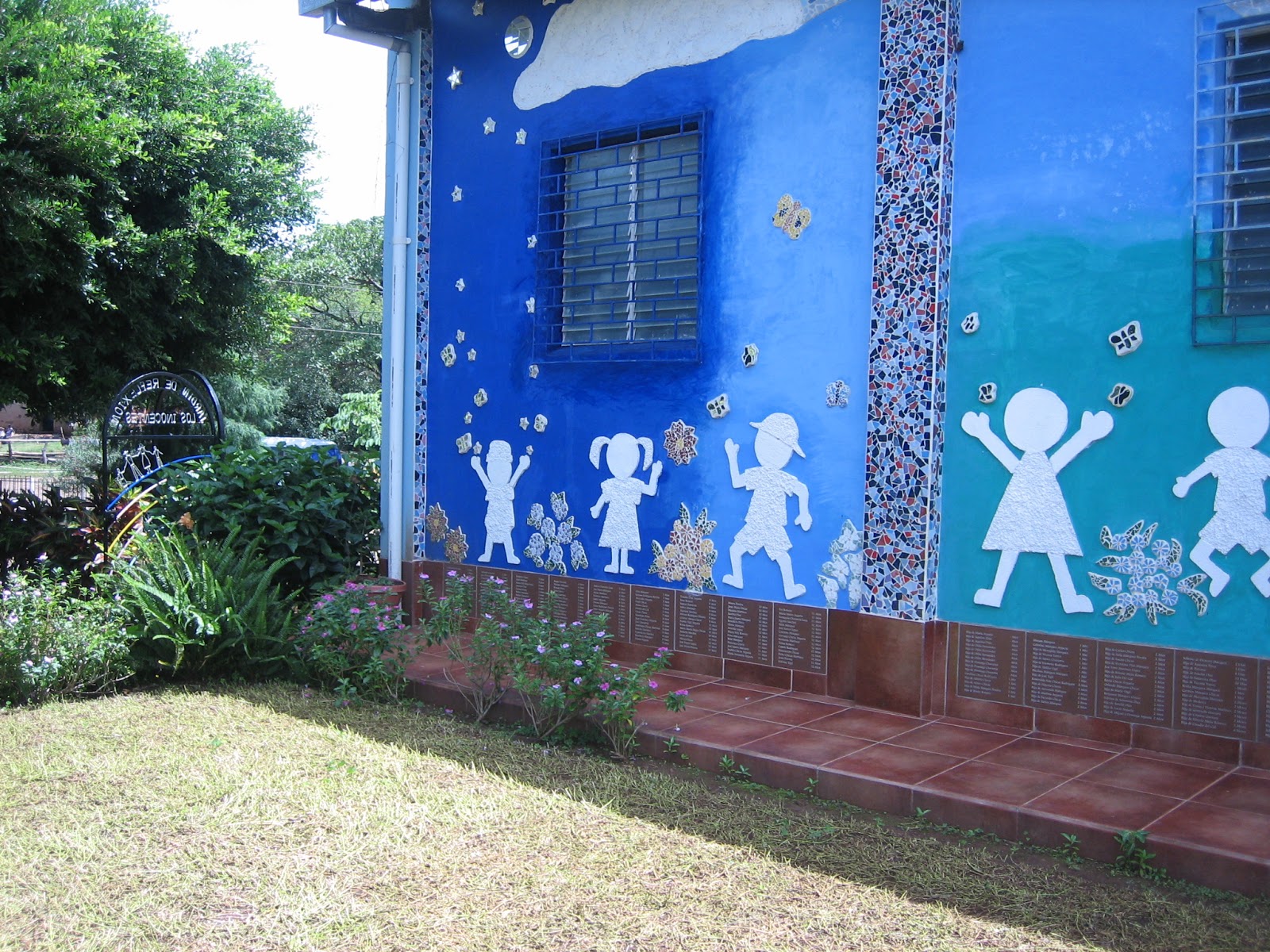
Garden next to church in El Mozote where hundreds of child victims lie buried.
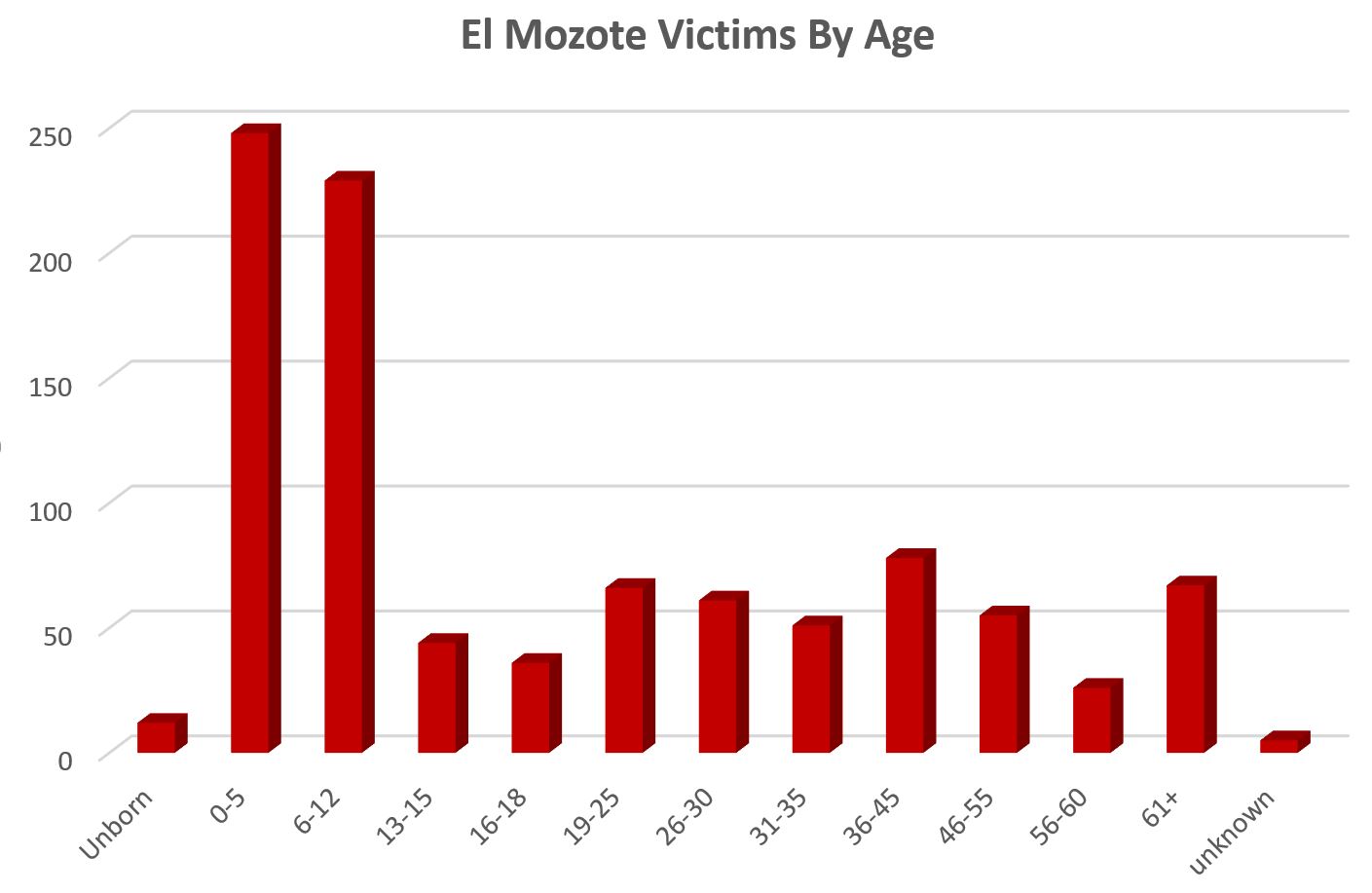
Thirty-six years ago, from December 10-12, 1981, the armed forces of El Salvador massacred hundreds of children in the town of El Mozote and surrounding communities. Last week El Salvador’s government divulged the results of the first official register of the victims who died in that massacre. Of 978 victims executed, 553 or 57% were under 18 years of age and 477 were 12 and under. Twelve infants died in their mothers wombs. Henceforth, at El Salvador Perspectives, we will refer to this atrocity as the “Massacre of Children and Others at El Mozote.”
As it covers the trial, the online periodical El Faro has offered us another view into the lives of the victims. A photogallery at the site shows ordinary objects of life in the village. The objects were recovered during the course of exhumations locating the bodies of the army’s massacre. Like the artifacts from Pompeii or Joye de Ceren, these items from everyday life give us a glimpse into the pre-disaster lives of the victims.
On this 36th anniversary, president Salvador Sanchez Ceren traveled to El Mozote for the first time during his presidency. In his speech, the president spoke of a debt to the victims, of the government’s efforts to invest in the zone as a form of reparations through public works, a health clinic, and cultural activities. The president indicated there were plans to construct a center devoted to historic memory so the events at El Mozote would not be forgotten. Despite his reference to historic memory, however, the president made no indication that the military would be required to open its archives from the time. He also made no mention of the current trial proceedings where former military commanders are charged with responsibility for the massacre of children and others at El Mozote.

Criminal law in El Salvador talks about those who are the material authors of a crime, the ones who pulled the trigger, and the intellectual authors of a crime, the ones who gave the orders for the crime. There have been previous trials in El Salvador for the material authors of such crimes as the murder of the Jesuits, a housekeeper and her daughter in 1989, or the murders of the four US churchwomen in 1980. But the current trial in the courtroom in San Francisco Gotera is the first full trial of the intellectual authors of atrocities committed during the civil war. For that reason, as well as the magnitude of the crime of a massacre of hundreds of children and others, the trial is historic.
The El Mozote criminal prosecution has developed a momentum and a seriousness not seen in any other case involving war crimes from the time of El Salvador’s civil war. It is a momentum pushed by the zealous efforts of the human rights lawyers for the victims who have called witness after witness to the stand to describe the loss of their families at the time. I have seen the coverage of the suit and the commentary about it in social media increasing as each new witness takes the stand. In small steps, the country is starting to confront what justice means for a military command which ordered its soldiers to massacre children.
Tayseer Khaled Calls for Boycott of US Goods

IMEMC News & Agencies | December 7, 2017
Amid controversy over the US decision to move their embassy to Jerusalem, PLO Executive Committee member, Tayseer Khaled, published a press release calling for an international campaign in the Arab, Islamic and Friendly States to boycott US goods.
The press release stated the following, according to the PNN :
“Tayseer Khaled , the PLO Executive Committee member, Head of the Palestinian Expatriate Affairs Department called on the Political Organizations, Trade Unions, Youth and Women Organizations and other Civil Society Organizations in Arab, Islamic and friendly countries to launch an international campaign to boycott American goods in support for Jerusalem, a response to the American insulting against our people, and for every unwise political step taken by the American Administration aimed to change the Legal and political Status of East Jerusalem, as an integral part of the occupied Palestinian Territories in June 1967, whether through moving the US Embassy from Tel Aviv to Jerusalem or recognize Jerusalem as the capital of the Israeli Occupation State.”
Khaled added that US President Trump’s administration acts viciously with the Arab and Islamic countries, and it neither gives attention to the Arab public opinion, nor to international law and the legitimacy resolutions related to the Palestinian – Israeli conflict.
Moreover, he said, it neglects the UN Security Council resolutions on Jerusalem, of which begins with resolution 215, issued on May 2nd, 1968, that denounces the Israeli Military Parade in Jerusalem, through resolution no. 476, issued on June 30th, 1980, which nullifies the Israeli measures to change the features of Jerusalem, then resolution no. 478 of Aug. 29th, 1980, which calls for non-recognition of the Israeli law on Jerusalem and the withdrawal of all the diplomatic missions from the city, as well as resolution no. 2334 on Dec. 23rd 2016, which affirms that the construction of settlements in the occupied Palestinian territories since June 4th, 1967, including East Jerusalem, is illegal, and demands it to ban all settlement activities. Furthermore, he stated that Israel doesn’t respect the advisory opinion of the International Court of Justice on the Apartheid Wall or its painful consequences on the occupied West Bank, the status quo in Jerusalem and its surroundings, and opposes the Israeli claims and annexation laws issued by the Knesset, and announced that East Jerusalem is, in fact, an occupied city, adding that Israel is obliged by international humanitarian law and international law, in general, to ensure free access to the holy sites under its control.
At the Palestinian level, Khaled called for uniting efforts to encounter any American step aimed at undermining the legal and political status of Jerusalem, and to stop dealing with the US administration as a qualified mediator to achieve a political settlement to the Palestinian – Israeli conflict. He insisted the US administration be informed that Palestinians are free of such obligations or understandings with, which propose discriminatory rules of conduct to the Palestinians that are restricting their right to go to the UN international bodies and agencies to apply for their membership, as is the case with the World Health Organization (WHO), the International Labor Organization (ILO), and the Food and Agriculture Organization (FAO) and others, or to apply to the International Criminal Court (ICC) to investigate Israel’s violations of Palestinian human rights under occupation, and to investigate war crimes and settlement crimes, which Article (8) of the Rome Statute regards as a war crime.
(photo: hadfnews.ps)
Featured Video
Daniel Davis: Trump’s New Iran Land Blockade Is a Dangerous Fantasy
or go to
Aletho News Archives – Video-Images
New Book
The Vaccine Mafia: Pfizer’s Former Chief Toxicologist Proves How Toxic Substances Were Unlawfully Sold to Us as a Solution for COVID-19
By Helmut Sterz
Former Pfizer chief toxicologist Helmut Sterz presents a critical examination of the development, approval, and global rollout of mRNA COVID-19 vaccines—particularly those produced by Pfizer/BioNTech. The Vaccine Mafia details the failure of pharmaceutical companies, regulatory authorities, politicians, and international organizations to follow established scientific and ethical standards during the pandemic. Drawing on the author’s decades of experience in pharmaceutical toxicology, Sterz reveals the many ways the vaccines’ inadequate or omitted preclinical safety testing put the world’s population at risk.
Sterz demonstrates how “emergency” approvals allowed manufacturers to bypass long-standing international guidelines governing toxicity testing, especially with regard to reproductive and cancer risks. They also allowed governments and health authorities to ignore or conceal evidence of serious adverse effects that occurred, including myocarditis, reproductive harm, and other long-term health risks.
Blog Roll
 Aletho News
- Armenian opposition politician dies in custody
- US still trying to recycle failed hypersonic missile programs
- France’s ‘Cold War’: Paris blames Tehran for supermarket fridge hacks
- Psywar no more? 77th Brigade’s sudden death
- Ukraine Already Carved Up… Before Talks Begin? /Prof. Richard Sakwa
- The vindication of Marjorie Taylor Greene
- Nearly 80% of Britons consider Israel a threat to world peace and security: Survey
- Rhode Island Staffer Could Be Reinstated After Firing Over Ceasefire Post
- Will Republicans Learn Their Lesson from the ‘Disastrous’ Midterms?
- Wrong, Newswise, Irresponsible Climate Messaging, Not Climate Change Itself, Is Fueling Student Anxiety
- If Americans Knew
- An error has occurred; the feed is probably down. Try again later.
- No Tricks Zone
- German Authorities Start Initiative To Evaluate Public Register For Climate “Disinformation” Spreaders!
- Zonal Asymmetry of Temperature Change in the Antarctic Circumpolar Current
- New Study: The Net Fossil Fuel Contribution To Rising Atmospheric CO2 Has Been Zero For 500 Years
- Germany’s Green Energy Transition Becoming Increasingly Expensive…Another 6 Trillion Euros!
- Sudden Stratospheric Warming, Powerful El Niño Combination May Lead To Extreme Europe Cold, Energy Crisis!
- Two New Studies Find Thwaites Glacier Melt Cannot Be Driven By Human Activity Or A Warming Ocean
- E-Cars Reduce CO2 Emissions By Only 41% Compared To Internal Combustion Engine Vehicles
- Predictions Made By Renowned Climate Professor Over Past Decades Have Been Proven To Be Poor
- New Study Suggests Large Regions Of The Pacific Ocean Have Been Cooling For The Last 80 Years
- Germany’s Green Energy Debacle: High Energy Costs Force Kahla Porzellan to Close After 182 Years!

