Remembering Brazil’s Leftist President João Goulart on Anniversary of His Death
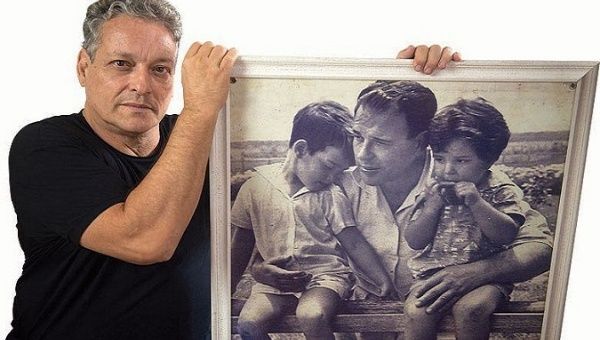
João Vicente Goulart holds a portrait of himself, his father, João Goulart, and his sister, Denize. | Photo: João Vicente Goulart
By Edu Montesanti | teleSUR | December 6, 2017
“Jango was my best friend, a great partner, and the best father to my children. It is still hard to forget,” Jango’s widow, Maria Theresa Goulart told teleSUR.
On Dec. 6, 1976, former Brazilian President João Goulart, popularly known as “Jango,” passed away at 57 years old in his exile with family in Mercedes, Argentina. Officially, he died of a cardiac attack, but evidence points to poisoning.
“There are still some available tissue samples at the Federal Police Criminal Institute of Brazil for a new investigation, as new evidence is expected if we can have more documents declassified and testimonies that would bring new information,” João Vicente Goulart, Jango’s son told teleSUR.
“In the first results analyzed, a substance appeared in tiny amounts which should not be in a human body, called pentaerythritol tetranitrate or erythrin tetranitrate, also known as pentrite,” said Goulart. “It is a chemical with characteristics and end of explosives that, at the time, was only controlled as an exclusive weapon used by the American army,” added Jango’s son, pointing out that secret agents used to infiltrate the family’s house in exile.
“It has been proven that spies removed my father’s documents, they could have easily changed his heart medicine for a poison.”

Jango speaks to a large crowd accompanied by his wife, Maria Theresa Goulart. Photo: João Vicente Goulart
Jango’s body did not undergo an autopsy at the time of his death. His body was buried in São Borja, Brazil, after the assurance that the coffin would not be opened. According to Goulart, “There was severe military repression at my father’s funeral.” There were military officials everywhere, monitoring Jango’s coffin so it could not be opened. In 2006, Mario Neira, a former Uruguayan secret agent, told Goulart that his father had been poisoned.
Overthrown from the Brazilian presidency by a military coup d’état on April 1, 1964, the democratically-elected João Goulart, with more than 70 percent of an approval rating, was exiled three days later with family to Uruguay. In 1973, President Juan Domingo Peron welcomed him. The Goularts were constantly threatened in exile, so the son, João Vicente and Denize, the Goularts’ daughter, left to study in London. Some friends warned former president Jango several times, that he could be killed.
On March 13, 1964, 18 days before the coup, President João Goulart gave a speech to more than 200,000 people in Central do Brasil square in Rio de Janeiro, with his wife Maria Theresa Goulart beside him, for the first time since assuming the presidency. He promised an agrarian reform, reducing remittances of profits overseas, extending democratic rights, along with other very popular reforms.
“Goulart committed the crime of reforming the economy. That was more than (U.S. President) Lyndon Johnson could tolerate and he opted to destabilize the economy and assist a right-wing military takeover,” said the U.S. historian Peter Kuznick to teleSUR.
“The 1964 coup that toppled Goulart’s government was extremely significant,” added Kuznick. “Oliver Stone and I began our documentary about the invasion of Vietnam with a discussion of that coup. We then talk about the Dominican Republic, Greece, Indonesia, and Chile to show that the Vietnam War was part of a pattern.
“A National Intelligence Estimate in the summer of 1963 had warned that Goulart might be establishing ‘an extreme leftist regime, with a strongly anti-U.S. character.’ Johnson’s appointment in December of Thomas Mann as assistant secretary of state to coordinate Latin American affairs was another nail in the Goulart government’s coffin.
“When Goulart responded the next year to U.S. demands to impose austerity on the Brazilian people by instead offering land reform and control of foreign capital and by recognizing Cuba, the U.S. moved quickly to destabilize the economy. Goulart seized U.S. properties.
“Ambassador Lincoln Gordon and U.S. embassy officials urged right-wing Brazilian officers to overthrow Goulart. The U.S. backed Army Chief of Staff General Humberto Castelo Branco. The CIA assisted behind the scenes,” observed Kuznick, who is the director of the Institute of Nuclear Studies at the American University.
The Brazilian historian Victor Schincariol told teleSUR that in order to preserve national peace and people’s security, President Jango didn’t call for a military intervention to protect him. “Goulart was genuinely committed to democracy and social peace. He said that he could not tolerate the death of Brazilians in a virtual civil war.
“At the same time, he knew that the U.S. would support the right-wing forces, which would make the case for the defense of democracy very hard indeed to win,” added the Brazilian researcher at the University of ABC in São Paulo.
On Dec. 18, in the presence of the heads of the military and President Dilma Rousseff, the Brazilian Congress symbolically returned President João Goulart’s mandate, as the OAS exhorted Brazil in 2010 for the crimes against humanity never punished, committed by the military dictatorship that killed 475 people, left 144 “disappeared,” and tortured more than 30,000 people.
There is an Amnesty Act in Brazil, elaborated and passed in 1979 by Brazilian military officials themselves — never addressed in the country by politicians, mainstream media and local elites — that acquits the dictators of the crimes committed between 1964 and 1985.
“Goulart’s and Varga’s legacy was erased, physically and ideologically, by the military dictatorship between 1964-1985. The economy was “globalized;” the case for an industrialization with national capitals, social justice and national independence was substituted by dependence, fascist policies and censorship; the democratic and left-wing forces were imprisoned, killed or left the nation,” said Professor Doctor Schincariol.
“The most important legacy Jango left to Brazil was his tireless fight for workers’ right and social justice,” Jango’s widow, Maria Theresa Goulart told teleSUR. “And for us, his family, his generosity and partnership.”
Syria Denounces Israeli Aggression on its Territories
teleSUR | December 5, 2107
Syria’s Foreign Ministry has denounced recent Israeli attacks on Syrian territory, strongly condemning Israel’s continuing acts of aggression.
The Yemraya region was struck by Israeli jets Monday night. Another military area in Al-Keswaha was attacked on December 2.
Syrian forces responded to Monday’s attack by firing anti-aircraft missiles at jets targeting government military sites and positions of the Shiite Lebanese resistance movement, Hezbollah.
The latest developments follow seemingly random attacks on Syria by the Israeli Defense Forces, which regularly target positions near the Golan Heights but have also expanded operations to attack more valuable targets.
The Syrian government says there is evidence of “the coordination, association and alliance that links Israeli terrorism with that practiced by Daesh, the Al-Nousra Front and other terrorist organizations.”
The Foreign Ministry has stated that Tel Aviv provides many extremist groups in the region with logistical, material, health and financial support.
It has called on both the United Nations and the international community to take measures against Israel’s aggression, as well as its support for terrorism in the region.
DOUBLE STANDARD: The Hill refuses to publish column about USS Liberty

USS Liberty crew members attacked by Israeli forces on June 8, 1967. Over 170 were wounded and 34 killed. This is reportedly the most decorated crew for a single engagement in US Naval history.
If Americans Knew | December 5, 2017
The Hill, a major Washington DC publication, published a guest column on November 15th entitled “Passing the Taylor Force Act Will Mark a Vital Step in the War on Terror.” The column called for the U.S. government to stop payments of $300 million aid to Palestinians, based on the murder of an American serviceman by a Palestinian individual who was unaffiliated with the Palestinian Authority, Hamas, or any other Palestinian organization. (Info here.) The authors of the column were officials of the pro-Israel advocacy organization JINSA (Jewish Institute for National Security of America)
In response to that column, Marine veteran Geoffrey ONeill submitted a column suggesting that the $3.8 billion given by the U.S. government to Israel be suspended, based on the Israeli military’s killing of 34 American servicemen, injuring of 173+ American servicemen, and attempt to sink a US Navy ship with all men aboard. (Info here.)
The Hill would not publish that column. Below is O’Neil’s rejected article:
Cut off aid to Israel for killing American servicemen
By Geoffrey ONeill
This is a response to an article in The Hill recently titled “Passing the Taylor Force Act Will Mark a Vital Step in the War on Terror” by authors Michael Makovsky and Mark Fitzgerald. The authors are calling for the U.S. government to stop payments of $300 million dollars to Palestine based on the murder of American serviceman, Taylor Force by a Palestinian. While I condemn gratuitous violence, particularly murder committed by anyone on another person and would, if given a chance, express my condolences to the family of Taylor Force, I find it ironic that the authors would express such outrage of a murder committed by a Palestinian of ONE American serviceman. Perhaps the authors need be reminded of an act of terror committed years ago on an entire crew of American servicemen in international waters off the coast of the Sinai Peninsula on JUNE 8, 1967. It might put their outrage and demands in a different perspective. Of course I am referring to the unprovoked, ruthless attack by the IDF on the USS Liberty.
On that bright clear day, after surveilling the ship several times, with the American flag in plain view, the IDF attacked the Liberty killing 34 of its crew and wounding at least 173 others. The Liberty was an electronic surveillance ship, essentially defenseless with only two 50 caliber machine guns mounted on the decks to ward off pirates.
After jets strafed the decks with rockets, bombs and napalm, torpedo boats showed up to finish the job. Three torpedoes were fired. One was a direct hit on the side of the Liberty that killed 25 men. Meanwhile on deck, American sailors were lowering life rafts into the water to help the wounded to safety. The Israelis shot the life boats out of the water to ensure everyone stayed on board. Authors Makovsky and Fitzgerald I assume are educated enough to know that sinking life boats is a violation of International law and considered a war crime forbidden by the Geneva Accords.
The attack lasted for an hour and a half then was suddenly called off when the IDF intercepted an SOS from the Liberty sent by a sailor who managed to rig wires and get the message to the Sixth Fleet.
What happened next was typical, lies, obfuscation and cover up. The IDF immediately called the Pentagon claiming they MADE A MISTAKE. Suffice it to say, President Lyndon Johnson by caving to pressure from pro-Israel lobbying , ordered a media blackout and a cover up of the incident. In an incredible act of betrayal, the brave survivors were sworn to secrecy about the attack. They were told if they spoke of it to anyone, including members of their own family, they would face court martial and imprisonment. This was not only a betrayal to the crew of the Liberty but to all American servicemen, past and present, including yours truly.
If anyone is interested in a detailed, well sourced graphic summary of the attack on the Liberty, I suggest you read the second chapter of renowned journalist Alan Hart’s excellent, highly acclaimed book, Zionism The Real Enemy of the Jews. It refutes all claims of a “mistake” and the anti-semitism meme that follows any criticism of Israel.
The State Department demanded $17 million in reparations for the Liberty survivors. Israel offered $6 million which was accepted immediately by President Johnson in a cowardly sniveling way. The state-of-the-art ship was valued at $40 million.
In fairness I would like to suggest a compromise to Mr. Makovsky and Mr. Fitzgerald. I appreciate your outrage at the murder of an American serviceman by a Palestinian. Having said that, If you gentlemen are sincere and honest, you should be far more outraged about what your government did to an entire crew of American servicemen. So, here is the compromise I suggest. I will enthusiastically lobby my government to suspend payments of $300 million to Palestine if you guys lobby to suspend annual payments of $3.8 billion, not million, to the Israeli government. That way we save the American tax payer $4.1 billion annually. Millions of Americans are living in poverty and the $3.8 billion given to the Israeli government represents about $30,000 for each Israeli citizen. In all seriousness, do you need that much money from us in that so many here are homeless and living well below the poverty line? Really? What do you say fellas, do we have a deal?
Geoffrey ONeil is a retired business owner. He was a Marine officer during the Vietnam conflict with a 13 month forward area tour. Congress is debating the Taylor Force Act today, with the vote expected later this week.
RELATED:
The strange, sad saga of the Taylor Force Act
Instead of Taylor Force Act, Congress should consider Rachel Corrie Act, Orwah Hammad Act
Information on the Israeli attack on the USS Liberty
Documentary:
US Military Reverses Course, Won’t Ban Use of Cluster Bombs
Sputnik – 30.11.2017
The US had planned to end its use of cluster bombs, a type of explosive that ejects smaller submunitions to kill personnel and obliterate vehicles, by 2019, but on Thursday, the Pentagon approved a new policy reversing this promise.
US President George W. Bush declared in 2008 that US would stop using cluster bombs by 2019. On Thursday, though, the Pentagon declared that the weapons have a legitimate use in military operations.
When deployed, cluster bombs scatter hundreds or thousands of bomblets across swaths of territory than can encompass several football fields. The bombs are notorious for failing to explode during the initial weapon deployment — leaving mine-like explosives that can blow up decades later. Anywhere from two to 20 percent of the bomblets released in modern cluster bombs fail to detonate on first use, according to Legacies of War, a Washington-based non-profit.
The United Nations-backed Convention on Cluster Munitions banning the weapons took effect in 2010. More than 100 nations have become signatories to the agreement. The US, Israel, China, Russia, Brazil, Pakistan and India, though, opposed the treaty. These nations are believed to produce or stockpile cluster munitions in significant quantities.
Under the policy approved Thursday, the US will authorize military commanders to use cluster munitions at their discretion until a better option becomes available that reduces the humanitarian hazards, the Associated Press reports.
The policy, laid out in a memorandum written by Deputy Defense Secretary Patrick Shanahan, states that “cluster munitions are legitimate weapons with clear military utility.”
Although the Pentagon “seeks to field a new generation of more highly reliable munitions, we cannot risk mission failure or accept the potential of increased military and civilian casualties by forfeiting the best available capabilities.”
“This isn’t surprising,” Luke O’Brien, member of the Military Writers Guild, tweeted Thursday.
Time-sensitive moving targets that may be difficult to track as well as large formations of hostile troops are two examples cited by the Pentagon as viable military applications of cluster munitions. The Pentagon contends that if it stopped using cluster bombs it would have to resort to other weapons that could do even more damage to civilians located near where the bombs are dropped.
Cluster bombs have been used recently in Yemen, where the world’s most pressing humanitarian crisis rages.
In other countries such as Laos, which saw sustained use of cluster bombs in military operations for many years, hundreds of civilians continue to die every year from stepping on undetonated bomblets, and public education campaigns must be run to teach children to avoid the brightly colored bobbles if they encounter them. Although the US bombing of Laos ended over 40 years ago, an additional 20,000 people have died from unexploded cluster bombs found in agricultural fields since the war ended, rendering crucial farmland off limits in a country where the majority of the population relies on subsistence farming.
The Israelis and redefining sovereignty
By Ahmed Jamil Azam | Arabi21 | November 28, 2017
The events currently occurring in the Palestinian arena, specifically the American vision for the Palestinian issue, are similar to a huge marketing campaign, as well as the sanctions that will be imposed on anyone who refuses the marketed product. This is despite the important fact that the product being marketed is not even ready yet.
The Israelis want to market a new idea, or rather, a new old idea. This idea suggests that there are various forms of sovereignty and that this could be proposed to the Palestinians. This is reminiscent of the Israelis’ past proposal of what they called functional sovereignty.
The American team responsible for the peace process is composed of a group of Zionists supporting settlements in the occupied West Bank. Therefore, it is not surprising that since the formation of the American administration we have been witnessing efforts to empty the settlement process of any content that includes any Israeli withdrawal or settlement dismantlement. Hence, this team is doing three things: buying time for the Israeli occupation and its settlement expansion, marketing ideas requiring the Palestinians to back down from the idea of an independent state, and thirdly, marketing the division of peace in the Middle East into two tracks: Arab-Israel peace and Palestinian-Israeli peace.
According to Al-Monitor, which operates mainly from Lebanon and publishes material in Arabic, Hebrew and English, the American Ambassador (a Jewish Zionist) to Tel Aviv, David Friedman, the American consulate in Jerusalem, in cooperation with the US Special Representative for International Negotiations, Jason Greenblatt, are making great efforts to propose a vision that has a regional context. What Benjamin Netanyahu is doing is trying to achieve normalised relations, as well as economic, political and military relations with Arab countries allowing him to establish Israeli influence in the region in the future. Of course, there is no reference or hints of this goal, but any amateur researcher in international relations who reads the Israeli theories, especially those of the Likud Party, and is familiar with the basics of international relations, especially the realism theory, would realise these are their goals.
Instead of announcing these goals, they announce the importance of an Arab-Israeli alliance against terrorism and Iran. According to Al-Monitor, which quoted Israeli diplomats, Netanyahu is currently looking into how he can pay the lowest price to market the idea of Arab-Israeli normalisation, along with other basic ideas, such as not withdrawing from the West Bank and maintaining full security control over it. Therefore, he proposed the idea of autonomy, but called it a different name, considering it another kind of sovereignty.
If the American initiative is ever announced, it will basically say: The Palestinians must accept the status quo in return for some facilitations in their living conditions and formal changes. The Palestinians declare their state on paper, and they can declare similar things, but will not have Israeli recognition, nothing will change on the ground, and it must be within restrictions that do not include requesting international recognition or prosecuting the Israelis in the International Criminal Court.
The Israelis raised the idea of ”functional sovereignty” in Jerusalem, during the Camp David and Taba negotiations of 2000 and 2001. It can basically be called “extensive administrative powers”, and nothing more. Nowadays, similar ideas are being marketed, but only in the West Bank.
We are not certain the Americans will reach the stage of declaring an initiative. If they do announce an initiative, it will be recognition of the Likud and Israeli initiatives for autonomy, as proposed in ideas raised in the 1970s during the Egyptian-Israeli negotiations.
Even if, for the sake of argument, we assume there are some Arab states that would accept these new ideas of an entity less than a Palestinian state and the return of the refugees, which is not yet certain, it will be the Palestinians who make the decision, specifically Palestinian President Mahmoud Abbas. Based on all past experiences, the Palestinians will not agree to any solution that does not include a Palestinian state, and Abbas will reject such a proposal.
There is much room for speculation about future scenarios, including holding the Palestinians responsible for the failure, reaching a temporary agreement (Oslo 2) that involves the beginning of Arab-Israeli normalisation and making minor changes to the status of the Palestinians, or new negotiations (which the Palestinians have rejected with[out] freezing settlement expansion). However, despite this, we are certain that the majority of the world superpowers are dealing with the possibility of reaching a final agreement as something far-fetched.
The Palestinians, more than anyone else, need a strategy that includes a hint to their alternative plan if a solution is not reached.
Translation from Arabic by MEMO.
Egypt slams Israeli minister’s call to resettle Palestinians in Sinai
MEMO | November 28, 2017
Egyptian authorities have criticised the Israeli Minister of Social Equality Gila Gamliel over her recent statements, in which she called for an alternative Palestinian state to be established in the Sinai Peninsula.
Egypt’s foreign minister, Sameh Shoukry, denounced today Gamliel’s statements stressing that Egypt firmly rejects any kind of “talk or thoughts” that undermine Egypt’s territorial sovereignty.
“The Egyptian domestic affairs should not be included in any statements by foreign parties most importantly when these statements touch Egyptian sovereignty,” Shoukry said in a press conference.
Shoukry noted that the Egyptian authorities have conveyed Cairo’s rejection on Gamliel’s statements to the Israeli ambassador in Cairo, adding that her comments “were made a long time ago.” He also denied summoning the Israeli ambassador.
“The Egyptian land in Sinai, which was watered with the blood of our sons and martyrs, is not something that can be given away or allowed to be attacked,” the Egyptian minister added.
An official source at the Egyptian foreign ministry told Quds Press that officials believe that the recent mosque attack is an Israeli attempt to empty Sinai from its original residents to build a Palestinian state in as an alternative for the two-state solution in the West Bank.
The Egyptian official noted that the Egyptian Embassy in Tel Aviv has asked Israel for clarifications on Gamliel’s comments, noting that the Israeli government had stressed that the statements “were personal comments and did not represent government policy.”
On his part, the Egyptian MP, Mostafa Bakry, told Quds Press that the Israeli statements were linked to the recent terrorist attack in Sinai.
Last week, Gamliel said during her visit to Cairo that “it is impossible to create a Palestinian state except in Sinai.”
Rejecting a Palestinian state in the West Bank, she noted that “a Palestinian State is a dangerous idea for the State of Israel,” she explained, stressing: “Between the River Jordan and the [Mediterranean] sea there cannot, and must not, arise a Palestinian state.”
“This call could be unacceptable to the international community and the Arab countries, which are neighbours to Israel, but it is based on our primary and historic right to the land of Israel,” the Israeli minister reiterated.
Canada’s Unraveling Web of Deceit. Terrorism and War Propaganda

By Mark Taliano | Global Research | November 28, 2017
Now that Syria and its allies in the Axis of Resistance have done the world a favour by destroying most of the West’s terror proxies in Syria, the Canadian narrative is falling apart.
In 2016, Prime Minister Trudeau described the terrorists in this manner:
“The so-called Islamic State are terrorists, criminals, thugs, murderers of innocents and children and there’s a lot of labels for them.”[1]
He was right that there are a lot of labels for them. But some labels have been conspicuously absent from the Canadian narrative, and these are the most accurate of all: “proxies”, “assets”, “strategic assets”, “allies”.
These “criminals, thugs, and murderers” are also Canada’s proxies in the Middle East and beyond, and the Canadian government needs to take ownership for its criminality.
Canada’s Public Safety Minister, Ralph Goodale, for his part, recently claimed that chances for rehabilitating these people are “pretty remote”, and that pursuing charges against these people is “difficult”.[2]
Conspicuously absent from Goodale’s explanation of why it is difficult to prosecute these individuals is the previously mentioned stumbling block. If the terrorists are Canada’s assets, as they are, then prosecuting them would necessarily reveal the government’s guilt.
Consider the case of Swedish national Bherlin Gildo.[3] In 2015, Gildo’s terror trial in the U.K. collapsed because the British intelligence agency M16 was supporting the same terrorists that Gildo was reportedly fighting for.
The Canadian government’s web of criminal war propaganda is unraveling at the seams. If the press was free, and not an appendage of the government’s criminal apparatus of deception, more Canadians might be aware of this.
Notes
[1] Bill Graveland, The Canadian Press, “Trudeau: ISIS Just ‘Terrorists’ And ‘Thugs,’ Not A State.” HuffPost, 29 March, 2016.(http://www.huffingtonpost.ca/2016/03/29/trudeau-isis-terrorists-calgary-interview_n_9568642.html) Accessed 27 November, 2017.
[2] Rachel Aiello, Ottawa News Bureau Online Producer,“Chance of reintegrating Canadian ISIS fighters ‘pretty remote’: Goodale.” CTV News, November 26, 2017. (https://www.ctvnews.ca/politics/chance-of-reintegrating-canadian-isis-fighters-pretty-remote-goodale-1.3693559) Accessed 27 November, 2017.
[3] Stuart J. Hooper, “Terror Trial Collapses: Suspect Fighting For MI6 SUPPORTED Fighting Group.”21st Century Wire, 4 June, 2015. (http://21stcenturywire.com/2015/06/04/terror-trial-collapses-suspect-fighting-for-mi6-supported-group/) Accessed 27 November, 2017.
Russian Foreign Ministry Spokeswoman on Syria, Lebanon and Other Issues
By Stephen Lendman | The People’s Voice | November 28, 2017
 Foreign Ministry spokeswoman Maria Zakharova (MZ below) believes the “presence of ISIS in Syria is coming to an end” – maybe so but the US-supported terrorist threat in the country remains, not ending as long as Washington wants war, not peace.
MZ stressed that US-led forces “provid(e) cover to the extremists, ISIS in particular.” Surprisingly, the BBC reported their evacuation from Raqqa under US-led “supervision.”
Russia’s Defense Ministry accused Washington of supporting ISIS and other terrorists while claiming to be combating them.
“(N)ot only (did US-led aerial operations refuse) to launch strikes on the terrorists, but also created obstacles for the Russian Aerospace Forces as they tried to attack the targets in the specified area,” MZ explained.
Russian operations are key to Syria’s liberating struggle – Washington’s rage for endless war and regime change the greatest obstacle.
MZ: “I would like to digress and speak from the heart for a moment. I will say it in plain Russian without any professional jargon.”
“It’s about (Washington) providing cover to the terrorist militants. We provide numbers and facts. We talk about trends in fighting terrorism, and we analyze how the militants and terrorists were withdrawn, shielded and emboldened by the US-led coalition.”
This type straight talk is absent in the West, the BBC report a rare exception, nothing from US media on what’s going on – supporting US aggression, blaming victims for its high crimes.
MZ criticized Defense Secretary James Mattis’ Big Lie – claiming US forces in Syria have UN permission to be there. No such permission exists, no Security Council authorization.
Americans and their rogue allies are hostile invaders, aggressors, massacring civilians, destroying vital infrastructure, pretending to be combating terrorists they support.
Washington “intends to hold part of Syrian territory for as long as (it) wish(es). The goal behind this approach is to achieve the desired settlement result by force,” said MZ – aiming to oust Assad and destroy the country’s sovereignty.
Moscow is following events in Lebanon, in the wake of PM Saad Hariri’s forced resignation and detention under house arrest in Riyadh.
On Friday, Lebanese Foreign Minister Gebran Bassil met with Sergey Lavrov in Moscow.
“Russia’s position on Lebanon remains unchanged. We strongly support the sovereignty, independence and territorial integrity of this friendly country and we believe that the Lebanese people should resolve all issues on their national agenda on their own, and we are against any outside interference that threatens to upset the existing political and religious balance in Lebanon,” said MZ.
US-led NATO troops are cooperating with ISIS in northern Afghanistan, MZ explained, “transporting” them aboard “unidentified helicopters… providing them with weapons…”
“Once again, this raises questions about the true aims of the foreign military presence in Afghanistan,” MZ stressed.
She commented on increasing opium production in the country. A UN Office on Drugs and Crime (UNODC) said it nearly doubled since last year.
Pre-9/11, the Taliban eliminated most of it. Production flourishes in areas under US occupation. ISIS fighters sell it to raise revenues.
“The opiate industry in Afghanistan has become a key source for fueling terrorist activities, which further destabilizes that country and beyond,” said MZ.
Russophobia is active in Madrid, regime officials falsely accusing Moscow of involvement in Catalonia’s declaration of independence.
“Remarks by Spanish Foreign Minister Alfonso Dastis that Russia allegedly seeks to weaken Spain are particularly dismaying,” said MZ.
She blasted his spurious accusation, “picked up from dubious sources,” she said.
Along with other issues, MZ commented on Russia’s lower house State Duma legislation regarding foreign media in the country – creating a legal framework for responding to Washington forcing RT America to register as a foreign agent.
Russia was “forced to… reply to the openly repressive (US) actions,” MZ explained.
US hostility toward Russia is greater than any previous time in memory, risking conflict between the world’s dominant nuclear powers, a potential doomsday agenda Washington appears to be pursuing.
-###-
Stephen Lendman can be reached at lendmanstephen@sbcglobal.net.
Saudi Coalition Crumbles In Yemen: Sudanese Mercenaries On Front Lines, Foreign Officers, Proxies In Revolt
By Tyler Durden | Zero Hedge | November 26, 2017
Most Americans might be forgiven for having no clue what the war in Yemen actually looks like, especially as Western media has spent at least the first two years of the conflict completely ignoring the mass atrocities taking place while white-washing the Saudi coalition’s crimes. Unlike wars in Iraq, Libya, and Syria, which received near daily coverage as they were at their most intense, and in which many Americans could at least visualize the battlefield and the actors involved through endless photographs and video from on the ground, Yemen’s war has largely been a faceless and nameless conflict as far as major media is concerned.
Aside from mainstream media endlessly demonstrating its collective ignorance of Middle East dynamics, it is also no secret that the oil and gas monarchies allied to the West are rarely subject to media scrutiny or criticism, something lately demonstrated on an obscene and frighteningly absurd level with Thomas Friedman’s fawning and hagiographic interview with Saudi crown prince MBS published in the New York Times.

Saudi Arabia’s hired help in Yemen: Sudanese fighters headed to the front lines. Image souce: al-Arabiya
But any level of meticulous review of how the Saudi coalition (which heavily involves US assistance) is executing the war in Yemen would reveal a military and strategic disaster in the making. As Middle East Eye editor-in-chief David Hearst puts it, “All in all, the first military venture to be launched by the 32-year-old Saudi prince as defense minister is a tactical and strategic shambles.”
And if current battlefield trends continue, the likely outcome will be a protracted and humiliating Saudi coalition withdrawal with the spoils divided among Houthi and Saudi allied warlords, as well as others vying for power in Yemen’s tenuous political future. But what unsurprisingly unites most Yemenis at this point is shared hatred for the Saudi coalition bombs which rain down on civilian centers below. For this reason, Hearst concludes further of MBS’ war: “The prince, praised in Western circles as a young reformer who will spearhead the push back against Iran, has succeeded in uniting Yemenis against him, a rare feat in a polarized world. He has indeed shot himself, repeatedly, in the foot.”
So how has this come about, and how is the war going from a military and strategic perspective?
First, to quickly review, Saudi airstrikes on already impoverished Yemen, which have killed and maimed tens of thousands of civilians (thousands among those are children according to the UN) and displaced hundreds of thousands, have been enabled by both US intelligence and military hardware. Cholera has recently exploded amidst the appalling war-time conditions, and civilian infrastructure such as hospitals and schools have been bombed by the Saudis. After Shia Houthi rebels overran Yemen’s north in 2014, embattled President Abd-Rabbu Mansour Hadi vowed to “extract Yemen from the claws of Iran” something which he’s repeatedly affirmed, having been given international backing from allies in the West, and a major bombing campaign began on March 2015 under the name “Operation Decisive Storm” (in a cheap mirroring of prior US wars in Iraq, the first of which was “Desert Storm”).
Saudi Arabia and its backers fear what they perceive as growing Iranian influence in the region, something grossly exaggerated, and seek to defend at all costs Yemeni forces loyal to President Hadi. The coalition includes Bahrain, Kuwait, UAE, Egypt, Sudan, and the US and UK, and the Saudi initiated war has also lately received behind the scenes political support from Israel, something recently confirmed by Israeli officials. Concerning the supposed Iran threat in Yemen, an emergency session of the Arab League recently doubled down on its shared commitment to wage war against Iranian interests after it blamed Tehran for a November 4 ballistic missile attack from Shia Houthi rebels against the Saudi capital, which Iran denies playing a role in.
But the Saudi coalition is now in shambles according to a new Middle East Eye investigation. The report highlights some surprising facts long ignored in mainstream media and which give insight into how the Saudi military campaign is likely to end in total failure as “more than two years into a disastrous war, the coalition of ground forces assembled by the Saudis is showing signs of crumbling.”

Below are 5 key takeaways from the full report.
1) Saudi coalition ground forces have a huge contingent of foreign fighters, namely Sudanese troops with UAE officers, suffering the brunt of the battle on the front lines.
Sudanese forces, which constitute the bulk of the 10,000 foreign fighters in the Saudi-led coalition, are suffering high casualty rates. A senior source close to the presidency in Khartoum told Middle East Eye that over 500 of their troops had now been killed in Yemen.
Only two months ago, the commander of the Sudanese Army’s rapid support force, Lieutenant General Mohammed Hamdan Hamidati, quoted a figure of 412 troops killed, including 14 officers to the Sudanese newspaper Al Akhbar. “There is huge pressure to withdraw from this on-going fight,” the Sudanese source told MEE. A force of up to 8,000 Sudanese troops are partly led by Emirati officers. They are deployed in southern Yemen as well as to the south and west of Taiz in al Makha.
2) Sudan’s President Omar al-Bashir has been dubbed “president of the mercenaries” for accepting over $2.2 billion from Saudi Arabia and Qatar in order to provide canon fodder for the Saudi ground war in Yemen in the form of thousands of young Sudanese troops, but he’s threatening revolt. To escape his untenable position, he is reportedly seeking help from Putin.
At home, Sudan’s President Omar al-Bashir is also having second thoughts. He remembers the lifeline he got when Riyadh deposited $1bn in Sudan’s Central Bank two years ago, followed by Qatar’s $1.22bn. But he hardly enjoys being known as “president of the mercenaries,” and he has other relationships to consider.
On Thursday, Bashir became the latest of a procession of Arab leaders to beat a path to Vladimir Putin’s door. He told the Russian president he needed protection from the US, was against confrontation with Iran, and supported the policy of keeping Syrian President Bashar al-Assad in power. This follows an incident at home, which was variously described as espionage and a coup attempt. Taha Osman Ahmed al-Hussein was dismissed as the director of the Office of the Sudanese President after he was discovered carrying a Saudi passport and a residency permit for the UAE. He was caught maintaining secret contact with both.
3) Saudi-backed Yemeni fighters are increasingly mutinying and fear local mass push back from Yemen’s civilian population due to the unpopular bombing campaign.
Mutiny is also stirring in the ranks of Yemenis who two and a half years ago cheered the Saudi pushback against the Houthis who were trying to take over the entire country.
The Saudi relationship with Islah, the largest group of Yemeni fighters in the ground force employed by the coalition, has at best been ambivalent. The Crown Prince Mohammed bin Salman’s closest partner in Yemen, Mohammed bin Zayed, Crown Prince of Abu Dhabi, is openly hostile to the Muslim Brotherhood-affiliated Yemeni party… They [Islahi leadership] are feeling the political price they are paying for supporting a campaign that turned in Yemeni eyes from liberation to occupation… Enough is enough. The regional Islahi leadership are now talking of starting direct negotiations with the Houthis, a senior Islah source told MEE.
4) Saudi proxy fighters are at war with each other: an Emirati-backed militia fighting under the Saudi coalition is assassinating other members of the Saudi coalition in what’s increasingly an internal coalition civil war.
They are also paying a physical price. A number of Islahi sheikhs and scholars as well as Salafis who rejected Emirati leadership have been killed or targeted by assassination attempts. The list is growing: there have been assassinations of Khaled Ali al-Armani, a leader in the Islah Party, on 7 December 2016; Sheikh Abdullah Bin Amir Bin Ali Bin Abdaat al-Kathri, on 23 November 2017 in Hadhramaut; Abdelmajeed Batees (related to Saleh Batees) a leader in the Islah Party on 5 January 2017 in Hadhramaut; Mohammed Bin Lashgam, Deputy Director of Civil Status, on 17 January 2017; Khaled Ali al-Armani, a leader in the Islah Party, on 7 December 2016…
“The Emiratis do not conceal their hostility to Islah. Islahi sheikhs and scholars are being assassinated, and this is being co-ordinated by the pro-Emirati militia. In addition, the UAE is clearly enforcing the blockade of Taiz, and withholding support for our fighters in the city,” the source said.
5) Oman is entering the fray, which will further fragment the Saudi coalition as rivalries for territorial control develop.
As if the balance of competing outside forces in Yemen is not complicated enough, enter Oman. Oman, too, regards southern Yemen as its backyard. It is particularly worried about the takeover of a series of strategic ports and islands off Yemen by the Emiratis. A Qatari diplomatic source described this as the Emiratis’ “seaborn empire,” but the Omanis are upset by this too.
The Omanis are understood to be quietly contacting local Yemeni tribal leaders in south Yemen, some of them separatist forces, to organize a more “orchestrated response” to the militias paid for and controlled by Abu Dhabi.
Like the proxy war in Syria, it appears that Gulf/US plans have backfired, and we are perhaps in for a long Saudi coalition death spiral fueled by delusion and denial. Sadly, it is primarily Yemeni civilians and common people in the region that will continue to bear the brunt of suffering wrought by such evil and delusional stupidity.
Featured Video
Daniel Davis: Trump’s New Iran Land Blockade Is a Dangerous Fantasy
or go to
Aletho News Archives – Video-Images
New Book
The Vaccine Mafia: Pfizer’s Former Chief Toxicologist Proves How Toxic Substances Were Unlawfully Sold to Us as a Solution for COVID-19
By Helmut Sterz
Former Pfizer chief toxicologist Helmut Sterz presents a critical examination of the development, approval, and global rollout of mRNA COVID-19 vaccines—particularly those produced by Pfizer/BioNTech. The Vaccine Mafia details the failure of pharmaceutical companies, regulatory authorities, politicians, and international organizations to follow established scientific and ethical standards during the pandemic. Drawing on the author’s decades of experience in pharmaceutical toxicology, Sterz reveals the many ways the vaccines’ inadequate or omitted preclinical safety testing put the world’s population at risk.
Sterz demonstrates how “emergency” approvals allowed manufacturers to bypass long-standing international guidelines governing toxicity testing, especially with regard to reproductive and cancer risks. They also allowed governments and health authorities to ignore or conceal evidence of serious adverse effects that occurred, including myocarditis, reproductive harm, and other long-term health risks.
Blog Roll
 Aletho News
- Armenian opposition politician dies in custody
- US still trying to recycle failed hypersonic missile programs
- France’s ‘Cold War’: Paris blames Tehran for supermarket fridge hacks
- Psywar no more? 77th Brigade’s sudden death
- Ukraine Already Carved Up… Before Talks Begin? /Prof. Richard Sakwa
- The vindication of Marjorie Taylor Greene
- Nearly 80% of Britons consider Israel a threat to world peace and security: Survey
- Rhode Island Staffer Could Be Reinstated After Firing Over Ceasefire Post
- Will Republicans Learn Their Lesson from the ‘Disastrous’ Midterms?
- Wrong, Newswise, Irresponsible Climate Messaging, Not Climate Change Itself, Is Fueling Student Anxiety
- If Americans Knew
- An error has occurred; the feed is probably down. Try again later.
- No Tricks Zone
- German Authorities Start Initiative To Evaluate Public Register For Climate “Disinformation” Spreaders!
- Zonal Asymmetry of Temperature Change in the Antarctic Circumpolar Current
- New Study: The Net Fossil Fuel Contribution To Rising Atmospheric CO2 Has Been Zero For 500 Years
- Germany’s Green Energy Transition Becoming Increasingly Expensive…Another 6 Trillion Euros!
- Sudden Stratospheric Warming, Powerful El Niño Combination May Lead To Extreme Europe Cold, Energy Crisis!
- Two New Studies Find Thwaites Glacier Melt Cannot Be Driven By Human Activity Or A Warming Ocean
- E-Cars Reduce CO2 Emissions By Only 41% Compared To Internal Combustion Engine Vehicles
- Predictions Made By Renowned Climate Professor Over Past Decades Have Been Proven To Be Poor
- New Study Suggests Large Regions Of The Pacific Ocean Have Been Cooling For The Last 80 Years
- Germany’s Green Energy Debacle: High Energy Costs Force Kahla Porzellan to Close After 182 Years!

