Grim Lessons from a Faraway War
By Don North | Consortium News | July 4, 2017
The Battle of Hue in 1968 – the climactic clash of the Tet Offensive, which itself was the turning point of the Vietnam War – exploded the official lies from U.S. commanders about progress toward victory but also delivered a warning about the future costs if the conflict were continued indefinitely.
In that sense, the Battle of Hue has resonance to America’s current “endless war” in Afghanistan and other military interventions in the nearly 16 years since 9/11, conflicts marked by bravery of soldiers on opposite sides as well as the arrogance and careerism of the top brass and feckless politicians.
As author Mark Bowden writes in his epilogue to his new book, Hue 1968, “Alternative history enthusiasts promote the preposterous idea that the U.S. might have won the war if it had thrown itself more heartily into the conflict. As some of the nation’s more recent wars have helped illustrate, ‘victory’ in Vietnam would have been neither possible nor desirable. It would have required a massive and sustained military presence, and a state of permanent war. Hue illustrates just how bitter that war would have been.”
Bowden, author of Blackhawk Down and 12 other books, was a 16-year-old high school student in Philadelphia on Jan. 3l, 1968, when the battle of Hue began. The attack was part of the Viet Cong and North Vietnamese Army (NVA) assault across South Vietnam at the start of the Tet holiday by an estimated 80,000 fighters. They achieved nearly total surprise in most areas, as they did in Hue, one of the most venerated places in Vietnam.
Hue’s population of 140,000 made it South Vietnam’s third largest city, with two-thirds of the population living within the walls of the old city known as the Citadel, three-square-miles surrounded by walls 20 feet high and 30 feet thick. Within the walls was yet another fortified enclave, the historic Imperial Palace, home of the Vietnamese emperors before the French took control in 1883.
A giant Viet Cong flag was raised over Hue’s Citadel and flew for 25 days while battalions of NVA occupied the Emperors Palace and other positions in the Citadel. Yet, this reality was denied and obscured by the top U.S. commander, General William Westmoreland, whom Bowden describes as inept and dishonest:
“General Westmoreland continually and falsely assured political leaders in Washington and the American public that the city had not fallen into enemy hands. This refusal to face facts had tragic consequences for many of the marines and soldiers who fought there. ‘Westy’ denied that his official casualty estimates [of enemy troops] were inflated and said the enemy’s offensive was a sign of desperation.
“He also wrote that many NVA and VC had fought ‘halfheartedly.’ To a man, American veterans I interviewed told me they had faced a disciplined, highly motivated, skilled and determined enemy. To characterize them otherwise is to diminish the accomplishment of those who drove them out of Hue.”
First-Person Account
As an ABC News correspondent in Vietnam, I was personally aware of General Westmoreland’s fabrications starting with his announcement at a Saigon news conference on Jan. 31, that Hue had been recaptured and NVA soldiers forced out.
Later in February, I joined the U.S. Marines of 1st of the 5th battalion as they fought for ten days to advance the last 1,000 yards along the south wall of the Citadel. Bowden’s clear and vivid descriptions of the desperate daily combat brought back painful memories for me.
“The Battle of Hue is a microcosm of the entire conflict,” writes Bowden. “With nearly half a century of hindsight, Hue deserves to be widely remembered as the single bloodiest battle of the war, one of its defining events, and one of the most intense urban battles in American history.”
Despite Westmoreland’s spin, the Battle of Hue and the broader Tet Offensive had a powerful impact on President Lyndon Johnson and some of his top advisers. The intensity of the fighting exposed Westmoreland as an untrustworthy source of information, not just to the press and public but even in his secret communications with the White House.
Westmoreland’s analysis that the enemy attack on Hue was simply a feint to deflect from the fighting at Khe Sahn destroyed his reputation for accurate foresight. Washington lawyer Clark Clifford, replacing Robert McNamara as Secretary of Defense, was ready to reject Westmoreland’s unfailingly upbeat view of the war.
After the first two weeks of Hue fighting Clifford told President Johnson, “On one hand the military has said we had quite a victory out there … on the other hand, they now say it was such a big victory that we need one hundred and twenty thousand more men.”
Shortly after Clifford’s assignment to be Secretary of Defense, Westmoreland’s request for over 100,000 more troops was denied and the General was relieved of command.
“Both sides miscalculated,” writes Bowden. “Hanoi counted on a popular uprising that didn’t come, while Washington, blindsided, refused to believe the truth. The armies on both sides played their roles courageously and to terrible effect. The battle’s clearest losers were the citizens of Hue. The systematic executions of Hue citizens suspected of Saigon sympathies are today denied and are an inconvenient memory for the ruling Communist party of Vietnam.”
Bowden quotes civilian casualty estimates of 4,856 by the Saigon government. He cites the American scholar Douglas Pike who studied the mass graves immediately after the fighting, as being likely closest to the truth with a count of 2,800. Total number of Hue civilians killed by U.S. bombing, crossfire between the two forces, and the executions is recognized as 5,800.
An estimated 80 percent of Hue structures were either destroyed or heavily damaged. A total of 250 American soldiers and Marines were killed and 1,554 wounded. South Vietnamese government troop casualties were put at 458 killed and 2,700 wounded. The Vietcong losses were estimated at between 2,400 and 5,000. The final toll of 25 days of fighting numbers well over 10,000 making it the bloodiest battle of the Vietnam War.
Pro-War Propaganda
Another consequence of the Tet Offensive was the growing hostility among pro-war Americans toward on-scene journalists who described the U.S. military setbacks and contradicted the upbeat assessments from Westmoreland and the military brass, leading to a narrative blaming the press corps for losing Vietnam.
But Bowden disagrees with this complaint, writing: “Journalism has long been blamed for losing the war, but the American reporting from Hue was more accurate than official accounts, deeply respectful, and uniformly sympathetic to US fighting men.”
Instead, Bowden is critical of U.S. military leadership in Hue and documents many examples of bad tactics and particularly misjudging the efficiency of the NVA by sending under-strength units to engage large and entrenched enemy forces.
Bowden’s disdain for senior officers in the battle is at odds with his admiration for the “grunts” on both sides.
“I was moved by the heroism and dedication of those who fought on both sides of the battle,” writes Bowden. “In the worst days of this fight, facing the near certainty of death or severe bodily harm, those caught up in the Battle of Hue repeatedly advanced. Many of those who survived are still paying for it. To me the way they were used, particularly the way their idealism and loyalty was exploited by leaders who themselves had lost faith in the effort, is a stunning betrayal. It is a lasting American tragedy and disgrace.”
Many other books and analyses of the battle have celebrated the valor of U.S. troops while showing little interest in how they were used.
“The conspiracy of denial also explains why this terrible battle has remained, for most Americans, so little known,” writes Bowden. “It has been conscientiously remembered by the US Marine Corps, albeit with more emphasis on the glory than on the leadership blunders that cost so many lives.”
Bowden’s book also may have put to rest fears that history must be written by those who experienced it. In five years of diligent in-depth research, thousands of interviews on both sides of the battle and an ability to analyze his research in terms of what each day’s events meant for the entire war, Bowden has produced a book critics say is the best understanding of the Battle of Hue and its effect on the war.
Some historians say the sweet spot for understanding an historical event is about 50 years – enough time for a measure of perspective, yet while there are still living eyewitnesses. Since the now-unified Vietnam is welcoming Americans, it also was possible for Bowden for the first time to report the battle from both sides.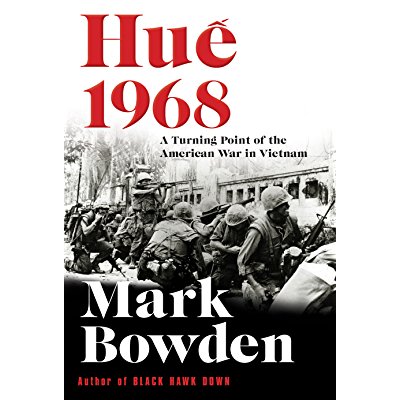
“Most American veterans were pleased to share their experiences with me,” says Bowden. “The sheer number of interviews gave me multiple perspectives on nearly every event described. I am indebted to previous accounts, Battle for Hue by Keith Nolan; Fire in the Streets by Eric Hammel; The Lost Battalion by Charles Krohn; The Siege of Hue by George Smith; and The Cat from Hue by Jack Lawrence.”
Bowden says he learned a great deal from journalist’s reports written at the time and even more from talking to reporters and photographers who produced them, particularly Gene Roberts, John Olson, and Mike Morrow.
Bowden lists several viewpoints shared by the hundreds of American veterans he interviewed: most were proud of having served; nearly all were angry over the betrayal of their youthful idealism, mostly at American leaders who sent them to fight a war that was judged unwinnable from the start; all felt sorrow for the friends they lost and the horror the war inflicted on everyone involved; many described their difficulties in adjusting to normal life after returning home.
There are also lessons for the present and the future. Urban warfare has become more common since the Battle of Hue as more of the world’s population leaves rural areas. Although untrained in urban warfare, the U.S. Marines — dispatched to reclaim Hue — soon adapted from the jungles and paddies they were used to in Vietnam.
Bowden describes in graphic detail the tactics of avoiding booby-trapped doors and instead smashing through the sides of buildings, clearing room to room, staying off the streets and open areas, hard lessons of the fighting in Hue that the U.S. Marines brought to Iraq in 2004 when they assaulted the city of Fallujah twice.
Today, with U.S.-backed forces battling ISIS militants in Mosul, Iraq, and Raqqah, Syria, the bloody lessons of Hue — and memories of the severe civilian casualties — are relevant again.
Don North is a veteran war correspondent who covered the Vietnam War and many other conflicts around the world. He is the author of Inappropriate Conduct, the story of a World War II correspondent whose career was crushed by the intrigue he uncovered.
The nuclear bomb is a weapon of crime and mass destruction
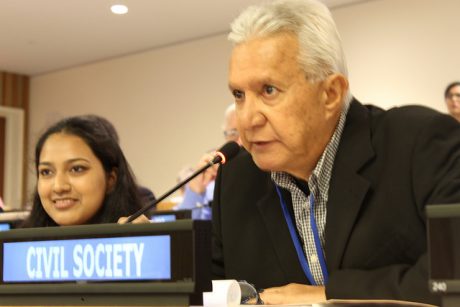
Roland Oldham, head of the nuclear test veterans organization Mururoa e tatou, addresses UN conference to negotiate the Treaty on the Prohibition of Nuclear Weapons on 21 June.
By Roland Oldham – International Physicians for the Prevention of Nuclear War – July 3, 2017
Moruroa e Tatou, Tahiti – The nuclear bomb is a weapon of crime and mass destruction.
We should all be well aware of the examples of Hiroshima and Nagasaki, where the consequences still today have effects across generations.
Like those in other places, nuclear tests in the Pacific by France, America and Britain were a crime towards indigenous people, and the defenceless people of the Pacific. It is a racist crime—nuclear racism. This destroyed and contaminated their environment, the natural resources that they depend on to live. The damages are irreversible.
Look at Moruroa for example—137 nuclear blasts underneath the coral atoll have severely fractured the atoll which is sinking down into the rising ocean, leaking radioactive gases and plutonium into the sea, risking disastrous damage for marine life. French authorities have assessed that there is a danger of a landslide of 670 million cubic meters of rock at Moruroa, creating a 15-20 meter tsunami.
The responsible governments used the Pacific as a dumping ground for nuclear waste—in the Marshall Islands, Moruroa, Fangataufa, Christmas Island, and elsewhere. Plutonium is in the lagoon of Moruroa and leaking from the 147 underground test explosion holes in Moruroa and Fangataufa. Not to mention the widespread radioactive fallout from atmospheric nuclear explosions.
There are thousands, millions of victims out there around the world—former test and weapons production site workers, military staff, civilians; women and children. They are invisible. They are voiceless. They have cancers: leukemia, thyroid, others…. Women in French Polynesia now have the highest rates of thyroid cancer and myeloid leukemia in the world. Their children through many generations will be affected by genetic mutations and damage.
It is a poisonous heritage that is left to humanity and future generations.
It is a crime against humanity.
I don’t see much of the word “crime” in the ban treaty: crime against our planet, crime against our environment, crime against humanity. The aim of the treaty is to stop all these crimes.
Why is there no word about these crimes.
Is there pressure from somewhere? Is there censorship?
Have we lost our morality?
But as victims we are not begging for favour, we are just standing up for our rights and our dignity.
There exists an obligation for the nuclear-armed states to compensate their victims, and to make reparation for the damage done to the environment.
There must be no more mushroom clouds producing untold numbers of new victims.
Roland Oldham, the head of the nuclear test veterans organization Mururoa e tatou, addressed the UN conference to negotiate the Treaty on the Prohibition of Nuclear Weapons on 21 June. The above piece is based upon his remarks, which he delivered in French on behalf of IPPNW and ICAN Australia.
US Raqqa offensive killing more civilians than claimed – airstrike monitor
RT | July 3, 2017
UN warnings of the “staggering” number of civilian casualties in Raqqa, Syria that were denied by coalition commanders are no exaggeration, a monitoring group insists.
Airwars, a UK-based group that monitors airstrikes and civilian casualties in Iraq, Libya and Syria, reports it has tracked 119 alleged civilian casualty events at Raqqa, claiming up to 770 deaths, between June 6-29.
The coalition began its assault on the so-called capital of the Islamic State (IS, formerly ISIS/ISIL) caliphate, Raqqa, on June 6. It has been accused of having no plan in place for civilian evacuations, and Airwars reports a number of civilians have been killed attempting to flee in boats.
The United Nations Commissioner for Human Rights warned at least 173 civilians have been killed by air and ground strikes in Raqqa since June 1, saying this is “likely a conservative estimate and the real death toll may be much higher.”
The coalition’s Combined Joint Task Force – Operation Inherent Resolve (CJTFOIR) – denies the coalition isn’t being careful enough, with coalition commander General Stephen Townsend saying, “show me some evidence of civilian casualties.”
In June, the UN’s chair of the Independent International Commission of Inquiry on Syria, Paulo Pinheiro, warned the UN Human Rights Council that the fight in Raqqa shouldn’t be “at the expense of civilians,” saying it is “gravely concerned with the mounting number of civilians who perish during airstrikes.”
Pinheiro said the airstrikes had resulted in a “staggering loss of life.”
Townsend called the UN’s concerns “hyperbolic,” saying the coalition is being, “careful as we need to be and as we can be.”
“I would challenge anyone to find a more precise and careful campaign in the history of warfare on this planet,” he told the BBC last week.
“The UN’s Commission of Inquiry is one of a number of international agencies, NGOs and monitors which have expressed significant concern in recent weeks at high numbers of reported civilian fatalities around Raqqa from Coalition actions,” Airwars’ Chris Woods told RT.
“Rather than attacking the messengers, the US and allies should urgently examine their tactics at Raqqa, improving where necessary protections for civilians on the ground.”
“Our present estimate is that around 370-450 civilians have been killed by Coalition airstrikes and artillery at Raqqa in just three weeks,” Airwars said. The group is still working through a significant number of cases to garner a final number of civilian casualties for the month.
“All local monitors, plus UN agencies, reporting high civilian casualties at Raqqa for months. Gen Townsend comments smack of complacency,” Airwars said in tweet, pointing to the additional 132 civilian casualties in both Iraq and Syria that the coalition itself reported in June.
According to Airwars and its sources, the coalition has been targeting boats which are carrying civilians fleeing the battle. The coalition refers to such strikes as hitting “ISIS boats.”
“Four June cases where (mostly named) civilians reportedly bombed as they fled Raqqa by boat. Cars also being bombed as civilians flee,” Airwars said in a Tweet.
The coalition says it has nearly sealed off Raqqa, as the Syrian Democratic forces fight on the ground. Two bridges on the northern bank of the Euphates River have been destroyed by the coalition, “and we shoot every boat we find,” Townsend told the New York Times.
“If you want to get out of Raqqa right now, you’ve got to build a poncho raft,” he added.
Townsend’s comments don’t bode well for civilians desperate to flee the battleground. Between 50,000-100,000 civilians are believed to be trapped in the city.
Raqqa is Being Slaughtered Silently (RIBSS), a group of journalists with alleged ties to Turkish authorities, says people have been trying to flee the bombardment with help from local smugglers, but that IS have already planted hundreds of landmines and banned people from leaving. It has reported 358 civilian casualties in Raqqa in June, with 177 coming from ‘warplane attacks’.
Between June 21-26 specifically, 88 civilians have died or are missing after coalition shelling or bombing. At least 18 of these were fleeing via car or boat, according to RIBSS, as cited by the Daily Beast.
Human rights groups have also criticized the coalition for its use of white phosphorus near civilians, which is against international law.
READ MORE:
Civilian death toll rises to 484 from US-led coalition strikes in Iraq & Syria
Iran remembers victims of passenger plane downed by US

A survivor reacting during a ceremony to commemorate the victims of USS Vincennes’ downing of an Iranian passenger plane on July 3, 1988. (File)
Press TV – July 3, 2017
Iran is commemorating the 29th anniversary of the downing of its passenger plane by a US Navy guided-missile cruiser in the Persian Gulf waters in 1988.
The civilian aircraft, an Airbus A300B2, was flying in Iranian airspace over the Strait of Hormuz from the port city of Bandar Abbas to Dubai, carrying 274 passengers and 16 crew members on July 3, 1988, when USS Vincennes fired two SM-2MR surface-to-air missiles at it.
One of the missiles hit the plane, killing all the 290 on board.
On Monday, the Iranian Foreign Ministry issued a statement to commemorate the victims and once again censure the US Navy’s “horrific crime.”
“A look at the precedence of the US inhumane behavior, which is manifested in massacring innocent people across the world, including the aggrieved people of Iran, indicates that such an attitude has been institutionalized in various US governments in pursuit of their own goals,” said the statement.
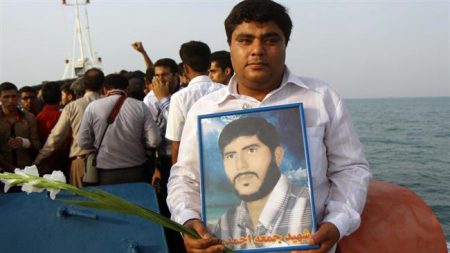
A survivor holding up a picture of victims of USS Vincennes’ downing of an Iranian passenger plane on July 3, 1988. (File)
US officials claimed the warship had mistaken Iran Air Flight 655 for a warplane. This is while the warship was equipped with highly sophisticated radar systems and electronic battle gear at the time of the attack.
A year later, the captain of the USS Vincennes, William C. Rogers, was cleared of any wrongdoing in the incident, and was even awarded America’s Legion of Merit medal by then President George Bush for his “outstanding service.”
The atrocity especially stoked anti-American sentiment as it coincided with the final year of the former Iraqi regime’s eight-year war, which had been waged against Iran with Washington’s all-out political and material support.
The statement added that the Iranian people hold to account the so-called advocates of human rights for ordering and perpetrating this atrocity, and for committing crimes and inhumane acts.
The Islamic Republic wants all those behind the tragedy to be held accountable for the crime, said the statement, adding that the Iranian nation will never “forgive the perpetrators.”
Israel’s attorney general okays controversial 1967 settlement order

Israeli Attorney General Avichai Mendelblit
Press TV – July 2, 2017
A newly released report says Israeli attorney general Avichai Mendelblit approved last year the use of a controversial 1967 order to legalize settler units built on private Palestinian land.
During a meeting attended by several Israeli judicial officials, Mendelblit said the “Order Concerning Government Property,” which was issued in July 1967, could be invoked to expropriate Palestinian land, the Israeli newspaper Haaretz reported on Sunday.
Clause 5 of the order states that “any transaction concluded in good faith between the authorities and another person … will not be struck down and is valid, even if it is proven that the asset was not government property at the time of its purchase.”
Mendelblit’s office said in a document that the clause had rarely been used in almost five decades, but “the need to make use of it has arisen now.”
It further set out a number of conditions for invoking the clause, such as purchase in good faith, the existence of a contract and payment having been made for the land.
“The use of Clause 5 should be limited as a rule to the built residential boundaries of the community, and to actual construction done before the parties to the transaction became aware that this was in fact not government property,” the document added.
Back in February, the Israeli parliament, known as the Knesset, passed a law on the expropriation of privately-owned Palestinian land in the West Bank, where Israeli settlements or outposts have been constructed.
However, Palestinians filed petitions to the Israeli High Court against the law.
Mendelblit proposed that the Israeli parliament suspend the land garb law until the court rules on the petitions and the Knesset accepted the bid.
Dror Etkes, Israeli anti-settlement activist, said the document by Mendelblit’s office seems to be “a parallel path being prepared … for the day after the High Court tosses the [expropriation] law into the garbage.”
“The purpose of this legal construction, rotten from the foundation, is to raise the claim of ‘good faith’ wherever Israel has stolen private Palestinian land and given it to settlers,” he said. “This is a situation in which lies, denial, violence and manipulation prevail – that is, everything except good faith.”
About 600,000 Israelis live in over 230 settlements built illegally since the 1967 occupation of the Palestinian territories.
The continued expansion of Israeli settlements is one of the major obstacles to the establishment of peace in the Middle East.
In recent months, Tel Aviv has stepped up its settlement construction activities in the occupied Palestinian territories in a blatant violation of international law and in defiance of United Nations Security Council Resolution 2334.
The resolution, which was passed last December, states that Israel’s establishment of settlements in the occupied territories, including East Jerusalem al-Quds, “had no legal validity” and urges the regime to immediately and completely cease all its settlement activities.
How Accidental are America’s Accidental Civilian Killings Across the Middle East?
By Peter Van Buren | We Meant Well | June 30, 2017
 U.S. Secretary of Defense James Mattis has said “civilian casualties are a fact of life in this sort of situation,” referring to America’s war against Islamic State.
How can America in clear conscience continue to kill civilians across the Middle East? It’s easy; ask Grandpa what he did in the Good War. Civilian deaths in WWII weren’t dressed up as collateral damage, they were policy.
Following what some claim are looser rules of engagement in place under the Trump administration, U.S.-led coalition air strikes in Iraq and Syria killed 1,484 civilians in March 2017 alone. Altogether some 3,100 civilians have been killed from the air since the U.S. launched its coalition war against Islamic State, according to the NGO Airwars. Drone strikes outside of the ISIS fight killed 3,674 other civilians. In 2015 the U.S. destroyed an entire hospital in Afghanistan, along with doctors and patients inside.
That all adds up to a lot of accidents — accidents created in part by the use of Hellfire missiles designed to destroy tanks employed against individual people, and 500 pound bombs that can clear a football-field sized area dropped inside densely inhabited areas. The policy of swatting flies with sledgehammers, surgical strikes with blunt instruments, does indeed seem to lead to civilian deaths, deaths that stretch the definition of “accident.”
Yet despite the numbers killed, the watchword in modern war is that civilians are never targeted on purpose, at least by our side. Americans would never intentionally kill innocents.
Except we have.
The good guys in World War II oversaw the rapid development of new weapons to meet the changing needs of killing entire cities’ worth of innocents. For example, in Europe, brick and stone construction lent itself to the use of conventional explosives to destroy cities. In Japan, however, given the prominence of wood construction, standard explosives tended to simply scatter structures over a limited area. The answer was incendiary devices.
To fine-tune their use, the U.S. Army Air Force built a full-size Japanese village in Utah. They questioned American architects who had worked in Japan, consulted a furniture importer, and installed tatami straw floor mats taken from Japanese-Americans sent off to internment camps. Among the insights gained was the need for incendiary devices to be made much heavier than originally thought. Japanese homes typically had tile roofs. The early devices tended to bounce right off. A heavier device would break through the tile and ignite inside the structure, creating a much more effective fire.
Far from accidental, firebombing Japan had been planned in War Plan Orange, written long before Pearl Harbor. As far back as the 1920s, U.S. General Billy Mitchell had said Japan’s paper and wood cities would be “the greatest aerial targets the world had ever seen.” Following the outline in War Plan Orange, the efforts were lead by Curtis “Bombs Away” LeMay, who expressed his goal as “Japan will eventually be a nation without cities, a nomadic people.”
LeMay also helped run the U.S. bombing campaign against North Korea during that war, claiming that American efforts killed some 20 percent of the civilian population. The man many call the architect of the Vietnam War, Robert McNamara, worked for LeMay during the WWII firebombing campaign. McNamara as Secretary of Defense went on to order the use of napalm in Vietnam, often against undefended civilian targets. The accidents of civilian deaths in war turn inside tight circles.
The skill with which America tuned its WWII firebombing into an exquisite way to destroy civilians reached its peak on March 10, 1945, when three hundred American B-29 bombers flew virtually unopposed over Tokyo’s most densely populated residential area. They dropped enough incendiary bombs to create a firestorm, a conflagration that burned the oxygen out of the air itself.
What was accomplished? One hundred thousand dead, a million people made homeless. The raid remains the single most destructive act of war ever committed, even after Hiroshima.
The problem, however, for the U.S. with such raids was their inefficiency in killing civilians. The logistics of sending off 300 planes were daunting, especially when an hour or two of unexpected wind or rain could negate much of effort. There was no question firestorms were the very thing to systematically commit genocide in Japan. But what was needed was a tool to create those firestorms efficiently, and to make them weather-proof.
It would only take science a few more months after the Tokyo firebombing to provide that tool. A single atomic bomb meant one plane could do the work of 300. And the bomb would create a fire so powerful and large and hot that weather would have no effect; it was foolproof. There could be no better weapon for destroying whole cities and all of the people in them, and it has only been used by one nation. Twice, because the 85,000 killed in Hiroshima were not enough.
These were tactics of vengeance matched with weapons designed to carry them out as horribly as possible. They worked well: the firebombing campaign over Japan, including the atomic bombings, purposely killed more than one million civilians in just five months in 1945.
It was only after WWII ended, when accurate descriptions from Hiroshima began finding their way back to America, that the idea of firebombing as a way to shorten the war, to spare lives in the long game, came into full flower. The myth, that the atomic bomb was in fact a reluctant instrument of mercy, not terror, was first published in Harper’s Magazine in February 1947 under the name of Secretary of War Henry Stimson. The actual writing was done by McGeorge Bundy, who later as National Security Adviser helped promote the American war in Vietnam that took several million civilian lives.
The majority of Americans, recovering their consciences post-war, were thus nudged into seeing what was actually a continuation of long-standing policy of civilian genocide in Japan as an unfortunate but necessary step toward Japan’s surrender, and thus saved innumerable lives that would have been lost had the war dragged on. This thinking lives on today on politically correct ground under the banner of great powers having to reluctantly put aside what is moral in peace for what is expedient in war. A “fact of life,” according to the U.S. Secretary of Defense.
So look deeper into history if you want to understand the morality-free rise in civilian deaths across America’s battlefields in the Middle East. We don’t like to think of ourselves as the kind of people who willfully kill innocents, but we were pleased by it only a skip back in history; your grandfather flew missions over Japan to burn children to death. Accidents of course happen in war, but there is a dark history of policy that demands skepticism each time such claims are made.
US court dismisses Yemen drone strike wrongful death suit
RT | July 1, 2017
A US appeals court has upheld a decision dismissing a lawsuit brought by a Yemeni man whose family was killed by a US drone strike. The plaintiff alleges that his family members were innocent bystanders when they were struck by the missile.
The US Court of Appeals for the DC Circuit, which consisted of a three-judge panel, came to an agreement with lower courts that stated they, too, did not have the authority to judge government military actions. An August 2012 drone strike in Yemen, which killed, among others, Salem bin Ali Jaber and Waleed bin Ali Jaber, is what this case is based upon.
Faisal bin Ali Jaber is a Yemeni engineer. He and his family sued the US government for the deaths of Salem, his brother-in-law, and Waleed, his nephew. Jaber made the claim that the deadly strike was in violation of the Torture Victim Protection Act and the Alien Tort Statute.
Jaber’s family members were killed by a “signature strike,” which target individuals through information and data obtained from electronic devices such as mobile phones.
In 2015, the families of the two deceased men brought a case against the US government, then-President Barack Obama and other US officials, for “wrongful deaths.”
Judge Janice Rogers Brown wrote a rare separate opinion, although she also wrote the decision in the case as the three-judge panel was unanimous.
“Of course this begs the question, if judges will not check this outsized power, then who will?”
The outcome that Jaber and his family wanted for the case was a declaratory judgement, which would make the court admit that the US violated international law governing the use of force when killing his family members with the drone strike.
Court documents from 2015 say the family made the claim that the hellfire missile attack by a US drone, which was deployed in the Yemeni village of Khashamir, which killed their family members, was unlawful.
Judge Brown didn’t hesitate to question some of the US government’s practices in the case.
“Of course this begs the question, if judges will not check this outsized power, then who will?” She continued, “the spread of drones cannot be stopped, but the US can still influence how they are used in the global community – including, someday, seeking recourse should our enemies turn these powerful weapons 180 degrees to target our homeland. The Executive and Congress must establish a clear policy for drone strikes and precise avenues for accountability,” Brown said in her opinion of the case.
Brown also stated that US congressional oversight is a “joke” and that “our democracy is broken.”
The other two judges on the panel did not join in Brown’s separate opinion, Reuters reported.
Read more:
$700bn Pentagon bill funds US presence in E. Europe & weapons for Ukraine
RT | June 29, 2017
A Senate committee proposal for the 2018 military budget would further boost Pentagon spending on troops and equipment, make the US presence in Eastern Europe a persistent feature, and supply lethal weapons to Ukraine, among other things.
Adopted in the Senate Armed Services Committee by a vote of 27-0, the 2018 National Defense Authorization Act (NDAA) would add $97 billion to the total military budget proposed by President Donald Trump last month.
Citing the need to “deter Russian aggression,” committee chairman John McCain (R-Arizona) shifted the funding for US deployments in Eastern Europe to the base Pentagon budget, and renamed it the European Deterrence Initiative (EDI). The NDAA also requires the Pentagon to submit future plans for the EDI, “including an assessment of permanently stationing troops in Eastern Europe.”
“In an unparalleled attack on our core interests and values, Russia engaged in an active, purposeful campaign to undermine the integrity of American democracy and affect the outcome of the 2016 presidential election,” said the summary version of the bill, published late on Wednesday. “The committee believes the United States must do more to deter Russian aggression, whether across its borders or in cyberspace.”
The $500 million earmarked for “security assistance” to the government of Ukraine includes “defensive lethal assistance.” However, half of this funding will be conditional on “substantial action” by Kiev to “make defense institutional reforms critical to sustaining capabilities developed using security assistance.” This would have to be certified by the US secretary of defense.
The 2018 NDAA extends the prohibition of military cooperation with Russia first imposed in 2014 – which, among other things, prevents the US-led coalition from coordinating operations against Islamic State (IS, formerly ISIS/ISIL) in Iraq and Syria. It also bans the Pentagon from using software developed by Kaspersky Lab, “due to reports that the Moscow-based company might be vulnerable to Russian government influence.”
Arguing that a massive increase in funding is necessary to “restore readiness, rebuild capacity, and modernize the force for future challenges,” the NDAA codifies a policy that the US Navy should have at least 355 ships of “the optimal mix” and calls for the construction of 13 ships next year, five more than in the White House request.
It also funds 94 new F-35 Lockheed Martin Joint Strike Fighters – 60 for the Air Force, 24 for the Marines and 10 for the Navy – altogether 24 more than Trump’s budget requested.
The Senate markup calls for an additional 15,000 soldiers and 1,000 marines over Trump’s budget request and authorizes a 2.1 percent across-the-board pay raise for members of the US Armed Forces.
By far the biggest increase in funding relates to cooperative missile defense programs between the US and Israel, which would get $558.5 million more than Trump requested for a total of $705 million.
An earlier markup released by the House Armed Services Committee was $4 billion less, but still higher than Trump’s original budget proposal of $603 billion. All three proposals are much higher than the $549 billion spending cap under the 2011 Budget Control Act, and will require a deal with the minority Democrats to get passed.
Moscow warns Washington against ‘incendiary, provocative action’ in Syria
RT | June 28, 2017
Moscow has warned the US against taking unilateral action in Syria, as there is no threat from the Syrian military, Russia’s Foreign Ministry said. The statement comes after the US accused Syria of preparing for a chemical attack, without giving any evidence.
Asked if Russia had warned the US administration against any unilateral action in Syria, Russia’s deputy foreign minister, Gennady Gatilov, replied that Russian officials have “always spoken about that, including in relation to their [US] latest strikes on Syrian armed forces.”
“We believe that it’s unacceptable and breaches Syria’s sovereignty, isn’t caused by any military need, and there is no threat to the US specialists from the Syrian Army. So it’s incendiary, provocative action,” Gatilov said, as cited by RIA Novosti.
On Monday evening, the White House claimed that Syrian President Bashar Assad was preparing a chemical attack and warned that the Syrian government would “pay a heavy price” if the attack was carried out, as cited by AP.
Hours later, the Pentagon said it had detected activity by the Syrian authorities in preparation for the attack. Pentagon spokesman Navy Captain Jeff Davis said that the US had seen “activity” at Shayrat airfield that showed “active preparations for chemical weapons use.”
The US government failed to provide any further details or proof of such claims, while the State Department’s spokesperson, Heather Nauert, said it was “an intelligence matter.”
When confronted by a journalist that Washington uses the phrase to justify anything that suits it, Nauert answered: “I’m not going to get into that one with you, but this is a very serious and great matter.”
On Wednesday, though, the US suggested that the Syrian leadership had swiftly changed its mind about planning an alleged attack. Defense Secretary Jim Mattis, as cited by Reuters, said: “it appears that they [Syria’s authorities] took the warning seriously. They didn’t do it.”
The Syrian government, as well as Russian authorities, have denied any allegations against them, with Russian President Vladimir Putin’s spokesman Dmitry Peskov saying that “such threats to Syria’s legitimate leaders are unacceptable.”
In the latest statement, Deputy Foreign Minister Gatilov said that Russia doesn’t rule out that “there may be provocations” following the announcement from Washington.
The statements by the US administration complicate the [peace] negotiations in Astana and Geneva, and Moscow believes such attempts to boost the tensions around Syria are unacceptable.
“The statements on Syrian armed forces getting ready to use chemical weapons is complete nonsense… These assumptions aren’t based on anything, no one provides any facts,” the Russian diplomat said.
“If the aim is to ramp up the spiral of tension, we think it’s unacceptable. It complicates the process of negotiations undertaken in Astana and Geneva,” Gatilov underlined.
“We’ve seen this in the past. Of course there are many ill-wishers, who want to undermine the process [of negotiations]. So any provocations are possible,” the deputy foreign minister added.
Earlier, Russia’s Foreign Ministry issued another official statement, saying: “We consider all these insinuations about chemical weapons which are being carried out in the worst traditions of the 2003 NATO intervention in Iraq as an ‘invitation’ for terrorists, extremists, and the armed opposition in Syria to carry out another large-scale provocation, which will result in the ‘unavoidable punishment’ of President Assad, according to Washington’s plans.”
In April, US President Donald Trump launched an attack on Syria with 59 Tomahawk missiles, which targeted Shayrat Airbase near the city of Homs. The strike was in response to what the US claimed was a chemical weapons attack in Khan Shaykhun, orchestrated by Syria’s government – something Damascus repeatedly denied.
Featured Video

Spain train disaster raises questions over Israeli-linked security contractors
or go to
Aletho News Archives – Video-Images
From the Archives
Are There 50,000 ‘Israeli-born’ Individuals Living in the UK?
By Professor David Miller | August 18, 2026
Recent disclosures by the Zionist regime show that some 2,069 British nationals were serving in the IDF as of March 2025, according to Freedom of Information (FoI) requests submitted to the occupation forces (1,686 dual British-Israeli, plus 383 multinational). We cannot tell from the figures how many of these were already settler colonists and intend to stay in the colony, and how many will return or have returned to the UK. Presumably, those returning to the UK will number far fewer than 2,000, since many are known to have become permanently residents of the colony.
Additionally, the IDF figures only provide a snapshot, and do not tell us how many have served in the Jewish supremacist military either before or after March 2025. One way into the question of how many genocidaires are living in Britain is to ask how many current British residents were born in the Zionist colony. There is data on that, as we shall see. … continue
Blog Roll
 Aletho News
- German CDU MPs Seek Climate “Misinformation” List
- The ‘Gaza Treatment’: How Media Headlines Obscure Who is Bombing Yemen
- Ro Khanna urges Democrats to strip Israel ‘integration’ provision from defense bill
- Why Iran designated British MI6, Royal Navy, and RAF as hostile, terrorist organizations
- Armenian opposition politician dies in custody
- US still trying to recycle failed hypersonic missile programs
- France’s ‘Cold War’: Paris blames Tehran for supermarket fridge hacks
- Psywar no more? 77th Brigade’s sudden death
- Ukraine Already Carved Up… Before Talks Begin? /Prof. Richard Sakwa
- The vindication of Marjorie Taylor Greene
- If Americans Knew
- An error has occurred; the feed is probably down. Try again later.
- No Tricks Zone
- German Authorities Start Initiative To Evaluate Public Register For Climate “Disinformation” Spreaders!
- Zonal Asymmetry of Temperature Change in the Antarctic Circumpolar Current
- New Study: The Net Fossil Fuel Contribution To Rising Atmospheric CO2 Has Been Zero For 500 Years
- Germany’s Green Energy Transition Becoming Increasingly Expensive…Another 6 Trillion Euros!
- Sudden Stratospheric Warming, Powerful El Niño Combination May Lead To Extreme Europe Cold, Energy Crisis!
- Two New Studies Find Thwaites Glacier Melt Cannot Be Driven By Human Activity Or A Warming Ocean
- E-Cars Reduce CO2 Emissions By Only 41% Compared To Internal Combustion Engine Vehicles
- Predictions Made By Renowned Climate Professor Over Past Decades Have Been Proven To Be Poor
- New Study Suggests Large Regions Of The Pacific Ocean Have Been Cooling For The Last 80 Years
- Germany’s Green Energy Debacle: High Energy Costs Force Kahla Porzellan to Close After 182 Years!

