Israel’s Liberty Attack Did Not Begin or End in 1967

USS Liberty Before Israeli Attack
By Free Palestine Movement | Dissident Voice | June 8, 2017
On June 8th, 1967, with cold-blooded mass murder as the objective, Israeli warplanes and warships made every effort to sink the USS Liberty, a mostly unarmed US intelligence vessel off the coast of Gaza, and to kill all 294 on board. Thanks only to the heroism of the Liberty crew and possibly a Soviet vessel’s offer of assistance (refused), the attack was called off before completion, although the attackers had plenty of reason to think that the sea would do the rest of the job for them.
Twice, US warplanes from the US Sixth Fleet responded to distress calls from the Liberty, only to be recalled by direct order of the White House and the US Department of Defense. In retrospect, it is clear that Lyndon Johnson and Robert McNamara in turn got their orders from the Israel Lobby and the Israeli leadership. 34 were killed and 174 wounded, with many permanently disabled.

USS Liberty Following Israeli Attack (US Navy Photo)
The subsequent coverup, the suppression of investigation, the falsification of evidence, the manipulation of history and the denial of justice to loyal US servicemen on board is now well documented and readily available to all who wish to see (which many do not). Nevertheless, the attack continues to this day, with Israeli and US resources devoted to maintaining a variety of false and often conflicting narratives to hide the truth.
Of course, Israel’s attack on liberty itself goes far beyond this one incident, however outrageous, arrogant, blatant and hideous it may be. Israel owes its very existence to Plan D, a detailed and carefully prepared military strategy for depopulating Palestine of its non-immigrant Palestinian population and replacing it with immigrants in order to create a majority (and ultimately exclusive) Jewish state, according to a racist agenda. Since late 1947 (and even before) and up to the present, Palestinians have had, and are still having, many Liberty incidents, without benefit of a Sixth Fleet, recalled or not. It is clearly Israel’s intention to continue until there are no Palestinians left in Palestine.
Liberty assaults are continuing in the US and other powerful countries, as well, as Israel and its Zionist interests in these countries wield sufficient power on their governments to bend military and political power to their ends. Thus it is no accident that US and western countries’ might has been used to destroy Israel’s potential enemies and rivals in the region, such as Iraq, Libya and Syria, and to bring to heel others, such as Jordan, Egypt, Saudi Arabia, Turkey and the Gulf monarchies. The people of half the world are paying the price for Israel’s ambitions, not least in countries like the US, whose military budgets swallow funds for infrastructure, health, and education, and create an ongoing supply of shattered veterans who are neglected by the very government they served.
But millions of people have also been killed and tens of millions made refugees in the wars for Israel, for the purpose of weakening Israel’s enemies, enabling Israel’s capture of territory, the ongoing ethnic cleansing of populations that Israel considers undesirable, and confiscation of resources. By allying itself with the most destructive elements in the US and other countries it wishes to influence and manipulate, Israel is able to multiply its destructive capability far beyond its own borders.
We are all Palestinians. Israel is crushing us all, robbing us of our resources, our livelihood and our liberty. Fifty years on, let us remember and honor the crew of the USS Liberty, who paid a high price for liberty, never receiving proper remuneration. Let us also remind ourselves that we continue to pay this price.
Free Palestine Movement is an accredited NGO of the United Nations whose purpose is to defend and advocate for the human rights of all Palestinians, and in particular the right of access to all of Palestine. Visit Free Palestine Movement’s website.
Lavrov: Deconfliction zones in Syria announced without Damascus’ consent illegitimate
RT | June 7, 2017
Russia considers the US-led coalition airstrike against pro-Damascus fighters in Syria an act of aggression and rejects the justification for the attack issued by the Pentagon, Russian Foreign Minister Sergey Lavrov said.
The Tuesday airstrike near the town of At Tanf in eastern Syria “was an aggressive act, that violated the sovereignty and territorial integrity of the Syrian Arab Republic and – deliberately or not – targeted the forces which are most effective in fighting terrorists on the ground,” the minister said on Wednesday.
The Pentagon justified the attack by saying that the pro-government forces “advanced inside the well-established deconfliction [sic] zone in southern Syria.”
The US claimed that it attacked the pro-Damascus convoy because it posed threat to “partner forces” based in At Tanf. The US military earlier stated that an area within 55km from the town was a designated “deconfliction zone,” where forces not allied with the US are apparently not allowed to enter.
Lavrov rejected that reasoning, saying that he is not familiar with the term.
“I don’t know anything about such zones. This must be some territory, which the coalition unilaterally declared [deconfliction zones] and where it probably believes to have a sole right to take action. We cannot recognize such zones,” he said.
Lavrov said Russia, Turkey and Iran have signed a deal, which has been endorsed by the UN Security Council, to establish so-called “de-escalation zones” in several parts of Syria. Damascus agreed to this approach and the exact borders and mechanisms for observing a truce inside those zones are currently being negotiated.
“This approach was agreed to by Syria. We consider illegitimate any unilateral declaration of ‘deconfliction zones’ not endorsed by Damascus. We hope the coalition will adhere to the agreement it has reached with us, which states that the de-escalation zones must be agreed to in detail by all stakeholders,” he said.
He added that, according to some reports, the force attacked by the coalition was being deployed to prevent Islamic State (IS, formerly ISIS) fighters from destroying two bridges and a road connecting Syria with Iraq, and that the intervention had allowed the terrorists to carry out their plan.
Someone has just declared war on Iran
By Adam Garrie | The Duran | June 7, 2017
Terrorist acts of brutality and terrorist attacks in the service of traditional war are two different things.
Differences between an act of terrorism and a terrorist act which serves as a declaration of war carry an important distinction.
Attacks throughout the west from 9/11 to the recent Salafist/ISIS attack on London are dictionary definitions of terrorism (false flag or otherwise). This means that they are acts of bestial savagery designed to kill as many as possible, sow fear into a civilian population and force governments into a state of either infighting or panic. The terrorists behind every major attack on the US or Europe over the last decades did not intend to overthrow any one let alone several regimes. They simply wanted to cause as much chaos and carnage as possible given the weapons at their disposal.
In this sense, the terrorists won and no amount of virtue signalling hashtags can refute this. They wanted to kill, sow terror and discord, and they manifestly succeeded.
The wars in Syria and Libya by contrast, are wars spearheaded by terrorist groups who technically do not represent a state but are funded by and serve the foreign policy objectives of states ranging from Saudi Arabia, Qatar, Israel the United States, Britain, France and Turkey. The assaults on Syria and Libya saw terrorists who perhaps are better described as NGO’s with heavy weapons, working with major regional and world powers with the clear objective of conquest and regime change.
In Libya, the result was mission accomplished. In Syria, the move has largely failed as the Syrian government remains in power and its allies Russia, Iran and other non-state groups have helped Syria in this respect.
In Iran, while things are not yet entirely clear, it would appear that today’s attack was an opening salvo in a wider war to destroy the very government and society of the Islamic Republic of Iran.
Although a few terrorists with guns and bombs cannot overthrow any nation, the objectives of regional players ranging from Saudi Arabia to Israel are well known. It is difficult to believe that this attack was not orchestrated at some level by at least one state actor which openly seeks illegal regime change in Iran.
Iran is a vast state with incredibly powerful and well equipped armed forces, so much so that it would still seem unlikely that any state, including the US would actually attempt to wage open war on Iran.
That being said, today’s terrorist atrocity, aimed at two important centres in Tehran has a clear message.
Those who seek war on Iran will not resist stooping to terrorist means in order to attempt to accomplish their goal.
Iran will almost certainly not end up like Syria or Libya, but the attack on Iran, at least at an ideological level, seeks that which was done in Libya and what many are still attempting to do in Syria.
This was not the act of lone loonies and of course unlike the west which funds Salafism, this was not blow-back. It was the opposite. Iran fights Salafism and Iran opposes Saudi Arabia and Israel. This was a terroristic declaration of war, one that Iran may not have necessarily expected but one which it is entirely prepared for.
Qatar is about to fall in one way or another. If others seek to change the government in Iran… get ready for regime change blow-back.
If this piece isn’t automatically censored in Riyadh, it ought to be read with seriousness.
Remembering the Naksa

Image of Israeli soldiers interrogating Palestinians during the 1967 Gaza war [Miren Edurne/facebook]
By Nasim Ahmed | MEMO | June 5, 2017
Fifty years ago this month, Israel launched a war against its neighbours and took control of the parts of Palestine which it had failed to capture during its 1948 “War of Independence”.
What: The Palestinian Naksa (“Setback”)
When: 5 June 1967
Where: Palestine
What Happened?
On 5 June 1967, Israel launched a pre-emptive strike against Egypt, Jordan, Iraq and Syria. After knocking out the air defences of these countries, it occupied East Jerusalem, the West Bank and the Gaza Strip, as well as the Syrian Golan Heights and Egypt’s Sinai Peninsula. Thus, it had taken control of the final 22 per cent of historic Palestine that it wasn’t able to occupy in 1948.
Nearly 400,000 Palestinians were added to the hundreds of thousands of refugees displaced in 1948 and their homes and villages were razed to the ground by the Israelis. Around half were being displaced for the second time in less than 20 years. Israel’s ethnic cleansing of Palestine was ongoing (as it is to this day).
The number of Palestinian refugees in the camps operated by the UN Relief and Works Agency (UNRWA) in the West Bank, Gaza Strip, Jordan, Syria and Lebanon grew.
The Naksa commemorates this tragic setback in the Palestinian struggle for freedom and self-determination.
What Happened Next?
The outcome of the war launched by Israel was, for many of its citizens and supporters, the fulfilment of God’s promise. Adding 44 per cent of the territory allocated by the 1947 UN Partition Plan for a Palestinian state, to the 56 per cent set aside for a Jewish state, marked a new beginning for both Israel and stateless Palestinians.
Within 20 years of being recognised as an independent state, Israel began an occupation that would become the longest in modern history, at 50 years and counting. Palestinians in the “occupied Palestinian territories” were subjected to a brutal Israeli military occupation as well as the activities of armed, right-wing Jewish settlers, for whom Israel’s victory was God’s handiwork and a licence to colonise the land which they believed was promised to them and them alone.
Israel’s already repressive military rule over Palestinians living within its undeclared borders was transferred to the West Bank and Gaza. Very soon, a matrix of control and domination, that included checkpoints, permits and home demolitions, was imposed on the lives of millions of Palestinians under Israeli occupation.
For the Palestinians, the combination of the Arab defeat during the “Six-Day War”, the repeated failure of the international community to protect their human rights, and Israel’s total colonisation of Palestine, prompted a serious re-evaluation of their situation. Having witnessed the futility of relying on others to end the indignity from which they had suffered for decades, they began to organise politically in an attempt to reverse the losses of 1948 and end their misery and statelessness.
In the years following the Naksa, Palestinian communities in the refugee camps and diaspora began to organise themselves politically and socially. A number of setbacks against the Palestine Liberation Organisation (PLO) did not deter them. Such civil society activities led to the formation of the Islamic Resistance Movement (Hamas) in the late eighties; the popular uprising now known as the First Intifada; and the PLO under the control of the secular Fatah movement gaining recognition by Israel and its allies as the “sole representative of the Palestinian people”. This phase of the political process ended with the signing of the Oslo Accords in 1994, providing the Palestinians in the West Bank and Gaza Strip with “interim self-governing arrangements”.
Staircase History and the Subprime Morality of the Nanking Massacre

The Great Nanjing Massacre, by Zi Jian Li, 1992
By Colin Liddell | Occidental Observer | June 2, 2017
The French have a term for it, L’esprit de l’escalier, or “staircase wit.” It means bright and witty sayings thought of too late as one is exiting a party. But history has its own “staircase” element as well, namely events that receive historical attention much later than they should if, as we are supposed to believe, they were so important to begin with.
A perfect example of this is the “Nanking Massacre” of 1937, now a much-contested historical event in the Sino-Japanese War (1937—45). The Chinese claim that the Japanese went on a brutal rampage resulting in 300,000 deaths. The Japanese claim they were responding to irregular troops in civilian clothing using guerrilla tactics, with a much lower death toll.
Even though this is now presented as a pivotal historical event and something that we are all supposed to know, the surprising thing is that, like the Jewish Holocaust from the same era (which began to be used to advance Jewish ethnic interests after the 1967 Arab-Israeli war and really only gained traction in the 1970s [here, p. 42ff]), it got off to a rather late start, becoming suddenly very, very important decades after it actually happened.
Not only had Clio the Muse of History descended the staircase before anything of importance had been written about this supposedly groundbreaking event, but she had climbed into her carriage, arrived home, and kicked off her shoes as well. If Nanking was so important surely it should have been broached at the first practical opportunity, say in the immediate post-war period. Of course it wasn’t, not by the Chinese nor by anyone else. As it was, the event had to wait until the publication of Iris Chang’s best seller The Rape of Nanking in 1997 to really get its historical marching boots on — a full 60 years after the event! Some staircase!
James Dao, writing in the New York Times in 1998, called attention to the sudden spurt of interest:
As recently as five years ago, the 1937 Rape of Nanking, in which up to 300,000 Chinese were massacred in six weeks by Japanese troops, was barely a footnote in American popular culture. Since then the event has inspired two novels, a documentary film, a book of photographs, several Internet Web sites and a dozen academic conferences. Another documentary on the Rape of Nanking for the History Channel and one on the Sino-Japanese War for public television are also in production.
As remarkable as this sudden interest was, it was perhaps even more remarkable that Chang’s book became the vehicle for this, as it had serious flaws as a work of history, the main ones being its lack of credible causation for what was supposed to be a particularly violent incident by Japanese troops. Essentially Chang ascribed it to the inherently violent nature of the Japanese, something I have yet to notice in decades spent living here. More importantly for a book that was presented as a serious academic work, she did zero research in Japan, laying her work open to the charge of being extremely one-sided.
Despite this, the book was lionized, with the author getting the full “instant celebrity” treatment of newspaper profiles, talk show appearances, honorary degrees, and invitations to the Clinton White House. No doubt, the racy title in conjunction with a young Chinese female author — she was 29 at the time — played some part in stimulating interest.
This saga reveals once again that history is never just about what happened in such-and-such a place at such-and-such at time. It’s much more about what certain groups choose to focus on and why. Personally, I’m not overly interested in the minutiae of the Nanking Massacre. Trainspotterly hairsplitting about numbers of victims or whether the victims were blameworthy can get boring extremely fast. People died, how many, how, and why, take your pick. What is more interesting is why “Nanking 1937” suddenly jumped to life as “history” in the late 1990s.
To answer this, you first need to understand why it wasn’t considered historically important much nearer to the time in which it happened, in the same way that, say, Dunkirk, Stalingrad, or Hiroshima were.
There are two reasons for this. Firstly, Nanking 1937 wasn’t particularly unique or special. Secondly, it was an event that had no effect on the actual outcome of events at the time. Ironically, the only unique thing about it was how particularly ineffectual it was on outcomes. This is because the whole point of the Japanese advance on the city of Nanking was to force Chang Kai-Chek’s Nationalist government to come to terms, something that the fall of the city signally failed to do.
Beaten at Nanking, the Nationalists just moved their capital to Hankow, and when that city also fell, they moved it again. Like Napoleon in 1812, the Japanese seemed to naively think that they just had to show up at the opposition’s capital to win, possibly because that is exactly what would have forced them to surrender if the boot had been on the other foot.
Also, terrible as it was, the Nanking Massacre was just one of many incidents of a similar nature. I believe this makes it what is sometimes called, a “mere detail” of history. The Sino-Japanese War lasted 8 years and covered most of the heavily populated parts of China. It was so vast and violent, with millions dying, that there are many other examples of horrific butchery/ tragic violence besides Nanking to develop historical narratives with.
Indeed, just a few months before Nanking, the Chinese themselves committed an act demonstrably much worse than the Nanking Massacre — even if we accept the highest estimate of 300,000 deaths — when they deliberately destroyed the Huayuankou Dyke on the south bank of the Yangtze River in a ruthless attempt to halt the Japanese advance. This act of demolition unleashed flood waters across a wide area of Henan, Anhui, and Jiangsu provinces. In order to avoid Japanese counter-measures, the civilian population was not warned, so the flooding resulted in a massive death toll from drowning, estimated at 800,000, with many millions more displaced and made homeless.
In the context of the wider war, we can say that Nanking 1937 was not unique and not decisive, and furthermore that it was dwarfed by the Chinese government’s atrocities against its own people. From this, you can see there was no immediate reason for Nanking to become a significant part of history. Why then was it subsequently presented as such?
The most obvious answer to this is that it proved useful to the Chinese government and to a lesser extent Western elites. Internally Nanking serves as a useful unifying device for the Chinese state, giving the Chinese people an external hate figure — Japan — while also reminding them that they need a strong centralized government to avoid similar outrages. Externally the Chinese use it as a stick to beat Japan with, and keep them on the defensive regarding their historical pride and identity. This serves to weaken their Asian rival, although, overusing the tactic can backfire. It could be argued that this is one factor that has pushed Japan in a more assertively nationalist direction in recent years.
But why did the Chinese wait so long before resorting to this tactic? Iris Chang’s book put it down to the economic weakness and isolation of Communist China, which sought economic benefits from trading with Japan. By the 1960s “Red China” was opposed not just by the West but also by the Soviet Union, with which it had fallen out. It was only with the collapse of the Soviet Union in 1991 and the success of Deng Xiaoping’s economic reforms that the country felt strong enough to use this stick to beat Japan. Interestingly, by that time, those same economic reforms were creating big inequalities within China that challenged social cohesion. China’s version of Japan bashing arrived at an opportune moment.
But what about Western elites? The benefit of the Nanking Massacre for these people is less obvious, especially as it is occasionally used to undermine Japan, a key Western ally. But maybe this is exactly what is wanted, namely a Japan that is regarded as somehow historically flawed and morally tainted, because this is a Japan that can operate less on its own terms and has an obvious need for a geopolitical intermediary. As Dutch journalist Ian Buruma, writing in the Guardian in 2010 said:
Most Japanese were happy to be pacifists and concentrate on making money. Japanese governments could devote their energy to building up the country’s industrial wealth, while the US took care of security, and by extension much of Japan’s foreign policy. It was an arrangement that suited everyone: the Japanese became rich, the Americans had a compliant anti-communist vassal state, and other Asians, even Communist China, preferred Pax Americana to a revival of Japanese military clout.
But, there could well be less obvious reasons, connected to the strangely moralizing purpose to which history is put these days. Victim narratives are an important part of the “power eco-system” in Western societies, where they are typically used to “de-privilege” the core populations of Western states through White guilt. This is done for a variety of reasons: (1) to facilitate the importation of cheap labor, (2) to create “diversity” as an end in itself, and (3) to justifying the “affirmative action” necessary to maintain social cohesion in societies characterized by very substantial racial differences and divisions. In the case of the Holocaust, Jewish activists have used it as a rationalization for Israel and its policies, to silence critics of immigration and multiculturalism, to portray the relatively wealthy and successful Jewish community as victims, and pad the coffers of Jewish organizations (here, p. lvi ff).
Western elites get benefits from victim narratives that feature Jews, Blacks, and other non-Whites as “victims” of Whites. But, what about a narrative presenting the Chinese as victims of the Japanese? Aside from the geopolitical benefits outlined above, there are two possible additional benefits. The first one emphasizes the Japanese side of the equation and the other the Chinese side.
The first possible benefit is that narratives of Japanese guilt play into the wider narrative of White guilt. Japan has often been viewed as “honorary White” nation in the past, and was described by President Theodore Roosevelt as “the only nation in Asia that understands the principles and methods of Western civilization.”
The second possible benefit is that persuading the Chinese to participate in a victim narrative helps to strengthen the institution of victimology itself. In the decades leading up to Chang’s book, victim narratives in general had already been overextended and overused to the extent that they were in danger of losing their value. The obvious analogy here is with currency notes or government bonds, which quickly depreciate if too many are issued.
By 1997, when Chang’s book came out, the global guilt industry had enjoyed its first big spurt and needed a fresh infusion of energy. Getting China to buy into its own victim narrative, not only served specific Chinese and Western elite goals, but it also helped to keep the global guilt market afloat. As with America’s overproduction of fiat currency in the Chimerica years, here too China picked up the slack.
Missing the Real Noriega Story
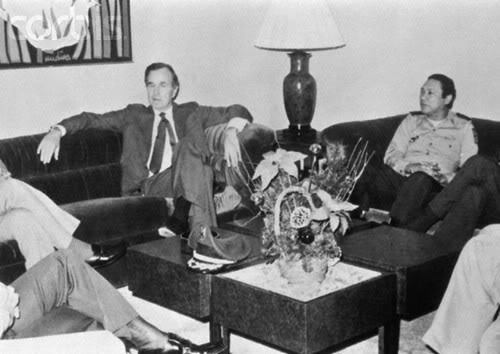
Vice President George H.W. Bush meeting with Panamanian Gen. Manuel Noriega in the mid-1980s when Noriega was considered a key ally in helping the Nicaraguan Contras wage a brutal guerrilla war to overthrow the leftist Sandinista government.
By Jonathan Marshall | Consortium News | June 1, 2017
The death of former Panamanian strongman Manuel Noriega on May 29 elicited few if any tears. But it should have sparked more reflection in the United States on his ugly history of service to the CIA, the hypocrisy of Washington’s sudden discovery of his abuses once Noriega became an unreliable ally against the Nicaraguan Sandinistas, and the George H.W. Bush administration’s bloody and illegal invasion of Panama in December 1989.
In fairness, many progressives and mainstream journalists have called attention to this troublesome history over the years. But few have dared to question the nearly universal condemnation of Noriega as a protector of international drug traffickers. That incendiary claim — first broadcast loudly by the unlikely trio of right-wing Sen. Jesse Helms, R-North Carolina; liberal Sen. John Kerry, D-Massachusetts; and investigative journalist Seymour Hersh — galvanized the American public to support his ouster.
After the U.S. invasion, which killed hundreds of Panamanians and 23 U.S. soldiers, Noriega was arrested on Jan. 3, 1990 by armed U.S. drug agents.
President George H. W. Bush declared that Noriega’s “apprehension and return to the United States should send a clear signal that the United States is serious in its determination that those charged with promoting the distribution of drugs cannot escape the scrutiny of justice.” U.S. Ambassador Deane Hinton called the invasion “the biggest drug bust in history.”
Convicted in 1992 on eight felony counts following what officials called the “trial of the century,” Noriega was sentenced to 40 years in jail. Although released early from U.S. incarceration, he spent the rest of his life in French and Panamanian prisons.
The resulting publicity created lasting myths about Noriega and drugs. Journalists who should know better have described Noriega as “one of the world’s biggest drug kingpins,” to quote Time magazine. In fact, Louis Kellner, the U.S. attorney who oversaw his Miami indictment and trial admitted, “Noriega was never a major player in the drug war.”
Indeed, at worst, he was a small fry compared to the military rulers of Honduras, whose epic protection of the cocaine trade was tolerated by Washington in return for using that country as a staging base for Contra operations against the Sandinista-led government of Nicaragua in the 1980s.
Deeply Flawed Trial
A few close observers of the long, expensive, and controversial trial believe it failed to prove Noriega’s guilt at all.
David Adams, who covered it extensively for the London Independent, said the government’s case was “marred by incompetent witnesses, false testimony, and poor presentation.”
Newsday’s Peter Eisner quoted Judge William Hoeveler, who presided over the trial, as saying “the outcome could have been different” if Noriega had been better represented.
Although the government put more than two dozen people on the stand, their testimony was not always relevant or credible.
Paul Rothstein, Georgetown University law professor and former chairman of the American Bar Association’s criminal evidence committee, said of the government’s witnesses, “What promised to be the trumpeting of elephants turned out to be the whimperings of mice.”
Big-time drug bosses enjoyed great rewards for telling the jury what the government wanted. Observed reporter Glenn Garvin, “To convict Noriega, the strike force had to make a flurry of deals with other accused narcotraffickers, bargaining a collective 1,435 years in prison down to 81.”
The fierce Noriega critic R. M. Kostner declared, “The prosecution was shameless in its bribery of witnesses. What co-defendants got for flipping made me sometimes wish that I had been indicted. The proceedings were almost totally politicized. It was clear long before they opened that, regardless of evidence, Noriega could not possibly be acquitted – a very sad thing for the United States.”
Other witnesses who never took the stand contradicted the government’s case years later. Retired Medellin cocaine lord Juan David Ochoa claimed in an interview with Frontline that “at no moment did [Noriega] protect us. . . . As far as I know he had nothing to do with the drug trade.”
Greg Passic, former head of financial operations for the DEA, said, “The Colombians I talked to in the drug transportation business said they didn’t deal with Noriega at all. To deal with him you would just have to pay him more money. They didn’t need it. It would be expensive.”
In fact, DEA officials repeatedly lauded Noriega’s cooperation with their anti-drug investigations, both in public letters of support and in private. Recalled Duane Clarridge, former head of Latin America operations for the CIA, “The DEA had told us that they were getting great support in Panama, and from Noriega in particular, in interdicting drugs.”
More than a year after the U.S. invasion, when it was absolutely impolitic to voice such sentiments, one “federal drug enforcement source” told a reporter, “Noriega was helping us, not ten percent, not twenty percent of the time, but in every instance we asked him to do so, one-hundred percent of the time. . . . These were key operations . . . that struck at both the Cali and Medellin cartels.”
Even the U.S. ambassador to Panama in the final years of Noriega’s rule, Arthur H. Davis Jr., said in an oral history interview, “all I know is that, all the time I was there, Noriega . . . cooperated one hundred percent with our people. Anytime we had a ship that we wanted to be interdicted on the high seas and we asked permission, they gave permission. . . . Anytime there was some prominent drug man coming up and we knew about it, Noriega would help us with it. And when we found out about things, the [Panamanian Defense Forces] would go over there and round them up and turn them over to us.”
Turning Against Noriega
One of the high points of Noriega’s cooperation was Operation Pisces, a three-year undercover probe that culminated in 1987. Attorney General Edwin Meese called it “nothing less than the largest and most successful undercover investigation in federal drug law enforcement history.”
Among those indicted were Medellin Cartel kingpins Pablo Escobar and Fabio Ochoa. Panama made 40 arrests and seized $12 million from accounts in 18 local banks. Said one U.S. prosecutor who helped direct the case, “The Panamanian officials we were dealing with were sincerely cooperative. . . . They could have breached security, and they didn’t.”
The operation may have pleased the DEA, but it angered the country’s financial elite, who directly profited from money laundering. One local banker warned, “this could end the Panamanian banking system, because people will no longer believe they can count on bank secrecy.”
Within two months, spooked investors withdrew up to $4 billion of the country’s $39 billion in bank deposits, triggering the most serious banking crisis in Panama’s history.
A Western diplomat said of Noriega, “The bankers can bring him down. They are complaining in Washington and they’ve got a lot of clout.” The demonstrations organized that summer by Panama’s business elite — and Noriega’s heavy-handed response to them — triggered his eventual slide from power
The bankers were joined by angry cartel leaders, who viewed Noriega as an “obstacle to the functioning” of their money laundering operations in Panama, in the words of drug policy expert Rensellaer Lee.
A lawyer for the bosses of the Cali Cartel complained that his clients were “frustrated by the problems” Noriega created for them in Panama.
Cali leaders later got their revenge when they paid $1.25 million to bribe a drug trafficker to become a key witness against Noriega in his Miami trial. In exchange for the testimony, eager U.S. prosecutors agreed to cut nine years off the sentence of an unrelated Cali trafficker — brother of one of that cartel’s senior leaders.
When Noriega’s defense team cried foul, a federal appeals court declined to order a new trial, but criticized the government for appearing “to have treaded close to the line of willful blindness” in its eagerness to win a conviction.
Medellin leaders were just as unhappy with Noriega as those in Cali. A pilot for one of the biggest Medellin smugglers described Pablo Escobar’s reaction after Noriega approved a raid on one of his cocaine labs in May 1984: “He was just really out of whack with Noriega. He was like, ‘This guy is dead. No matter what, he is dead.”’
It would be foolish to assert that Noriega, alone among all leaders in Central America, kept his hands clean of drugs. But much of his personal fortune is easily accounted for from other sources, such as the sale of Panamanian passports on the black market.
Whatever Noriega’s involvement with drug traffickers, as I have shown elsewhere, the Bush administration displayed unbelievable cynicism when, even before his capture, it swore in a new president of Panama who had sat on the board of one of the most notorious drug-money-laundering banks in the country. His attorney general, who unfroze the bank accounts of Cali traffickers, later became legal counsel for the Cali Cartel’s top smuggler in Panama.
Following Noriega’s ouster, not surprisingly, cocaine trafficking began surging in the country. A year and a half after his arrest, unnamed “U.S. experts” told Time magazine that “the unexpected result . . . is that the rival Cali cartel established a base in Panama and has since inundated the country, along with Mexico, Guatemala and the Caribbean, with vast quantities of cocaine destined for the U.S. and Europe.”
Today, though, all that is forgotten, along with the questionable course of justice during Noriega’s trial. Noriega, even in death, deserves no eulogies, but he does deserve a more balanced judgment of history.
Featured Video

The Search for Truth: Charlie Kirk’s Assassination One Year Later
or go to
Aletho News Archives – Video-Images
From the Archives
The 9/11 “Double-Cross” Conspiracy Theory
BY LAURENT GUYÉNOT • UNZ REVIEW • SEPTEMBER 6, 2022
Is it true that “9/11 was an inside job”? Yes, insofar as Israel is “inside” the U.S. But for the 9/11 truthers who have identified Israel as the main perpetrators, “9/11 was an inside job” is at best a half-truth, and at worst an integral part of the Zionist operation, like a secondary flag sewn as a lining under the false flag of Islamism. Victor Thorn (1963-2017) wrote in his book 9/11 made in Israel: The Plot Against America (2011): “In essence, the ‘9-11 truth movement’ was created prior to Sept. 11, 2001 as a means of suppressing news relating to Israeli complicity. . . . The slogan ‘9-11 was an inside job’ was quite possibly the greatest example of Israeli propaganda ever devised.” In milder terms, it is “controlled opposition”.
A genuine truth movement would have pointed to Israel as the prime suspect from the start. From day one, it was obvious who would benefit. … continue
Blog Roll
 Aletho News
- Europe’s mounting social chaos… chickens coming home to roost for proxy war against Russia
- US-Russia Diesel Deal Becomes Massive Defeat for Ukraine
- Hormuz and the Looming Economic Catastrophe
- Dhubab offensive, media blitz and the rapid unraveling of Saudi-backed coalition’s new gambit
- Putin Conveys to Trump Iran’s Vision on Possible Conflict Resolution – Kremlin
- The Search for Truth: Charlie Kirk’s Assassination One Year Later
- ‘Harsh reality’: Iran says France seeks monopoly on power and intimidation, not peace for all
- When Will This White House Madness End?
- Huckabee aide goes to ‘unusual lengths’ to portray ‘Israel’ positively
- Trump Announces Diesel Supply Deal With Putin Following Phone Call
- If Americans Knew
- Israeli forces kill another child in Gaza – Daily Update
- Gaza ceasefire exists in name only, say more than 100 organizations
- Nearly 2 Million in Gaza Need Urgent Shelter Assistance as Winter Looms: IOM Chief Warns
- Suppressing Palestinian resistance: US charity under fire for AI monitoring of Gaza classrooms
- Thousands Are Held in Israeli Torture Camps. This Is What Happens Inside
- Israel puts Gaza’s sick, injured, newborn in peril – Daily Update
- Report claimed Mark Levin used by Israeli government to influence Trump
- Over 2,000 Gazans have died awaiting medical evacuation amid Israel’s continued siege
- How a U.S. Diplomat Suppressed and Altered Reports Critical of Israel
- 5 Palestinians Die from Israeli Strikes in Gaza as Relentless Attacks Continue
- No Tricks Zone
- New Study: 50 Years Of The Most Aggressive ‘Net Zero’ Policies Can Only Affect The Global Climate By 0.03°C
- US September “Heat” Was No Record…Many Records Set Decades Ago
- Latest European Green Energy Debacle; Portugal’s Largest Flagship Solar Park Insolvent!
- Green Energy Debacle: German Expert Professor Fritz Vahrenholt Warns Of Severe Economic And Social Consequences
- Two More Paleo Reconstructions Affirm Meters-Higher Sea Levels Across Ireland, Brazil 7000-6000 Years Ago
- New Study: Earth And Venus Surface Warmth Largely Explained By Convection And Lapse Rate, Not CO2 Or Radiation
- 2025 Nature Paper Claiming Worsening Global Drought Gets RETRACTED …Heavily Flawed
- New Study: ‘Global Drought Shows No Detectable Recent Acceleration Under Climate Warming’
- Economic Masterminds: German Socialists Suggest Taxing Productivity Gains Stemming From Using AI
- The South China Sea Has Not Been Cooperating With The Climate Change Narrative

