Top US general in Europe urges arming Ukraine

RT | March 28, 2017
Washington must do more to deter “Russian aggression,” including sending lethal weapons to the government in Ukraine and engage in information warfare across the board, the top US commander in Europe told lawmakers.
“I personally believe that we need to consider lethal defensive weapons for Ukraine,” General Curtis M. Scaparrotti, head of the US European Command (EUCOM) told the House Armed Services Committee on Tuesday.
“I haven’t discussed that specific issue with most of our partners,” Scaparrotti admitted when he was asked about the NATO allies’ opinion on arming Kiev. The general is also the NATO Supreme Allied Commander in Europe (SACEUR).
“Russia seeks to undermine this international system and discredit those in the West who have created it,” Scaparrotti argued in his opening remarks, calling for “demonstrating strength in every area” when it comes to dealing with Moscow.
He also accused Russia of threatening every country in its vicinity, stoking ethnic tensions in the Balkans, “complicating” US operations against Islamic State (IS, formerly ISIS/ISIL) in Syria and violating the Intermediate-Range Nuclear Forces (INF) Treaty by deploying land-based cruise missiles.
For its part, Moscow has rejected insinuations it was violating the 1988 treaty.
“There have not been violations from our side,” Russian Foreign Minister Sergey Lavrov told Argumenty i Fakty weekly, answering accusations about the breach of the INF. “The United States claim the opposite, but they do not provide any information that could be verified in order to clarify the situation.”
At the hearing on Tuesday, however, Scaparrotti and the lawmakers were of the same mind that Russia was an adversary and a threat in every respect. In addition to arming the government in Ukraine and building up the US military presence in Europe, the general advocated information warfare as well.
“Going forward, we must bring the information aspects of our national power more fully to bear on Russia, both to amplify our narrative and to draw attention to Russia’s manipulative, coercive, and malign activities,” he said.
Scaparrotti’s predecessor, General Philip M. Breedlove, had worked for years with State Department and other Washington insiders to push the Obama administration to be more belligerent towards Russia, according to his private emails released by DCLeaks in July 2016, shortly after Breedlove’s retirement. Last week, Breedlove testified before the Senate Armed Services Committee, calling once again for arming the government in Kiev.
US-Led Coalition Destroyed Four Bridges, Interrupting Transportation in Raqqa
Sputnik – 28.03.2017
The US-led coalition destroyed four bridges in Syria, which interrupted the communication between the north and south of Raqqa, with 200 thousand people, head of the Main Operations Directorate of the General Staff of the Russian Armed Forces, Colonel-General Sergei Rudskoy stated.
“On February 3, the coalition’s aviation destroyed four bridges: two in Raqqa and two in the settlements of El-Calta and El-Abbara. As a result of these actions, the communication between the northern and southern parts of the city, with over 200 thousand inhabitants, has been completely interrupted. On February 18, a bridge in El Megle was completely destroyed in the vicinity of the city of Maadan, 60 kilometers east of Raqqa,” he said.
He also stated that the Russian General Staff was concerned by the strikes carried out by the international coalition on the dam in the Euphrates River in the area of Raqqa.
“Our greatest concern are the airstrikes performed by the coalition’s aviation forces on the dam on the Euphrates River west of Raqqa,” Rudskoy told journalists on Tuesday.
According to Rudskoy, as a result of the March 26 airstrikes, two dampers in the southern part of the dam were damaged, designed for the prevention of the reservoir’s overflow.
“These actions could lead to a large-scale environmental catastrophe, the flooding of vast areas and numerous victims among civilians,” Rudskoy stated.
He summarized by saying that the US-led coalition seems straining after the destruction of Syria’s critical infrastructure.
“It seems the international coalition has set itself the goal of completely destroying critical infrastructure in Syria, making it as difficult as possible to postpone the reconstruction of the country,” the general said.
Hamas: Lieberman’s statements prove Israel’s terrorist nature

Spokesman for Hamas Movement Sami Abu Zuhri
Palestine Information Center – March 27, 2017
GAZA – Spokesman for Hamas Movement Sami Abu Zuhri said Monday that Israel’s Army Minister Avigdor Lieberman’s recent threats to assassinate senior Hamas leader Ismail Haniyyah prove his government’s “terrorist nature”.
Abu Zuhri called in his Twitter account on all the free people around the world to unite their efforts in the face of “Israeli terrorism” and in support of the Palestinian people.
Earlier on Sunday, Lieberman renewed his earlier threats to assassinate Haniyyah before he leaves office.
In a live chat, Lieberman was asked about his promise before he was appointed Army Minister to eliminate senior Hamas leader Ismail Haneyyah. “It is wise to progress responsibly,” he answered.
“Speak with me about Haneyyah at the end of my term as Defense Minister,” he proclaimed.
Lieberman’s statements came only few days after the assassination of al-Qassam commander Mazen Fuqaha outside his house in Gaza city by six bullets to the head.
The World Faces a Historic Opportunity to Ban Nuclear Weapons
By Beatrice Fihn, Martin Butcher, and Rasha Abdul Rahim | Inter Press Service | March 24, 2017
Nuclear weapons are once again high on the international agenda, and experts note that the risk of a nuclear detonation is the highest since the Cold War.
As global tensions, uncertainty and risks of conflict rise amongst nuclear-armed states, nuclear weapons are treated as sabres to rattle, further heightening the risks of intentional or inadvertent use.
Nuclear weapons are the most destructive, inhumane and indiscriminate weapons ever created. Both in terms of the scale of the immediate devastation they cause and the threat of a uniquely persistent, pervasive and genetically damaging radioactive fallout, they would cause unacceptable harm to civilians.
But while the nuclear-armed states are implementing policies based on unpredictability, nationalism and weakening of international institutions, the majority of the world’s states are preparing to finally outlaw nuclear weapons.
Setsuko Thurlow, a survivor of Hiroshima, described the nuclear bombing as blinding the whole city with its flash, being flattened by a hurricane-like blast, and burned in the 4,000-degree Celsius heat. She said a bright summer morning turned to a dark twilight in seconds with smoke and dust rising from the mushroom cloud, and the dead and injured covering the ground, begging desperately for water, and receiving no medical care at all. The spreading firestorm and the foul stench of burnt flesh filled the air.
A single nuclear bomb detonated over a large city could kill millions of people and cause catastrophic and long-term damage to the environment. The use of tens or hundreds of nuclear bombs would be cataclysmic, severely disrupting the global climate and causing widespread famine.
Strikes of this kind would invariably violate international humanitarian law and international human rights law, yet, these weapons are still not explicitly and universally prohibited under international law. Nine states are known to possess them and many more continue to rely on them through military alliances.
The alarming evidence presented by physicians, physicists, climate scientists, human rights organisations, humanitarian agencies, and survivors of nuclear weapons attacks have been successful in changing the discourse, and opened space for greater engagement from civil society, international organisations, and states.
Because the humanitarian and environmental consequences of using nuclear weapons would be global and catastrophic, eliminating such dangers is the responsibility of all governments in accordance with their obligation to ensure respect for international humanitarian law.
The world is now facing a historic opportunity to prohibit nuclear weapons.
In October last year, a majority of the world’s states at the United Nations General Assembly agreed to start negotiations of a new legally binding treaty to prohibit nuclear weapons, in line with other treaties that prohibit chemical and biological weapons, landmines and cluster munitions.
As we’ve seen with these weapons, an international prohibition has created a strong norm against their use and speed up their elimination.
The negotiations will start at the United Nations in New York on 27-31 March, and continue on 15 June-7 July, with the aim of concluding a legally binding instrument to prohibit nuclear weapons.
Amnesty International, Oxfam and the International Campaign to Abolish Nuclear Weapons (ICAN) believe that it is time to negotiate a treaty that would prohibit the use, possession, production and transfer of nuclear weapons, given their indiscriminate nature. No state, including permanent members of the UN Security Council, should possess nuclear weapons.
This is the moment to stand up for international law, multilateralism and international institutions. All governments should seize this opportunity and participate actively in the negotiations of a treaty prohibiting nuclear weapons in 2017.
Iran announces sanctions on 15 US companies

Press TV – March 26, 2017
Iran has announced retaliatory sanctions on 15 American companies over their support for Israeli crimes and terrorism two days after Washington imposed bans on nearly a dozen foreign companies or individuals for aiding the Islamic Republic.
The Iranian Foreign Ministry said in a statement that these companies have directly and/or indirectly collaborated with the Israeli regime in committing its savage crimes in occupied Palestine, thrown their weight behind the regime’s terrorist acts or contributed to the expansion of illegal Israeli settlements in Palestinian territories in flagrant violation of UN Security Council Resolution 2334.
Therefore, any transactions with these companies and businesses shall be prohibited, their assets shall be subject to freezing, and no visas shall be issued for individuals holding positions in or associated with these corporations, the statement further noted.
The ministry also said Washington’s unilateral bans were imposed on Tehran “under fabricated pretexts,” censuring the restrictive measures as a violation of “international law” as well as the spirit and text of the 2015 nuclear deal, known as the Joint Comprehensive Plan of Action (JCPOA).
On Friday, the US State Department said Washington had sanctioned 30 foreign companies or individuals for transferring sensitive technology to Iran for its missile program or violating export controls on Iran, North Korea and Syria.
The statement further emphasized Iran’s resolve to develop its peaceful missile power as part of the nation’s “inalienable” right to enhance its deterrence and defense might in the face of threats.
The US sanctions targeted 11 companies or individuals from China, North Korea or the United Arab Emirates for transferring technology to Iran that it claimed could boost the country’s ballistic missile program.
Here is the list of the sanctioned US corporations:
– Beni Tal security company has collaborated with the Israeli military in the suppression of Palestinian people.
– United Technologies has sold Black Hawk military helicopters to the Israeli regime which have been used to bomb occupied territories and Palestinian refugee camps.
– Raytheon has supplied Israel with technologically advanced military weapons that have been used against Palestinian people during the Gaza war.
– ITT Corporation has provided the Israeli military with equipment it has used to stage nightly raids in Palestinian villages and refugee camps.
– Re/Max has been involved in illegal real estate transactions in Israeli settlements across occupied Palestinian territories.
– Oshkosh Corporation has been supplying the Israeli military with parts for armored vehicles used to restrain the Palestinian population.
– Magnum Research Inc. has collaborated with Israeli military industries in the manufacturing of firearms and military equipment.
– Kahr Arms has provided spare parts and developed light weapons used by the Israeli army in cooperation with the regime’s military industry.
– M7 Aerospace LP, purchased by US subsidiary of the Israeli military contractor Elbit Systems, has been active in the production and development of Israeli radar and missile systems.
– Military Armament Corporation has provided services and equipment linked to the weapons used by Israeli police.
– Lewis Machine and Tool Company has provided weapons spare parts and services to the Israeli military’s arms industry.
– Daniel Defense has provided the Israeli military’s arms industry with spare parts and services for weapons manufacturing.
– Bushmaster Firearms International has provided the Israeli military’s arms industry with spare parts and services for weapons manufacturing.
– O.F. Mossberg & Sons has supplied Israel with weapons, which are used by the regime’s military and police forces in the crackdown on Palestinian civilians.
– H-S Precision, Inc. has provided the Israeli regime with weapons manufacturing technology.
The Iranian Foreign Ministry stated that the list could expand to include more entities.
Israel threatens to destroy Syrian air defense systems
Press TV – March 19, 2017
Israel’s minister for military affairs, Avigdor Lieberman, has warned the Syrian government against launching ground-to-air missiles at Israeli warplanes carrying out strikes inside Syria, threatening to destroy Syrian air defense systems.
“The next time the Syrians use their air defense systems against our planes we will destroy them without the slightest hesitation,” Lieberman said on Israeli Public Radio on Sunday.
He added that the Israeli military will target any convoy of missiles or weapons destined for the Lebanese Hezbollah resistance movement.
“The Syrians must understand that they are held responsible for these arms transfers to Hezbollah and that if they continue to allow them then we will do what we have to do,” Lieberman pointed out.
The remarks came two days after the Syrian army announced in a statement that four Israeli fighter jets had violated the Arab country’s airspace, adding its air defense had shot down one of the military aircraft and hit another.
The Israeli warplanes entered the Syrian skies at 2:40 a.m. local time (0040 GMT) on Friday via Lebanese territory, and hit a target on the way to the ancient Semitic city of Palmyra.
“Our air defense engaged them and shot down one warplane over occupied territory, hit another one, and forced the rest to flee,” the Syrian army said, apparently referring to the Golan Heights.
The Syrian army also slammed Tel Aviv’s strikes as “an act of aggression” meant to assist the Takfiri Daesh terror group.
Israel’s aerial assaults are “a desperate attempt to raise their (Daesh terrorists’) deteriorating morale and divert attention away from the victories which Syrian Arab Army is making in the face of the terrorist organizations,” the statement read.
On Saturday, Israeli Prime Minister Benjamin Netanyahu said the Israeli regime will continue to conduct military attacks against Hezbollah targets inside Syria.
“When we identify attempts to transfer advanced weapons to Hezbollah and we have intelligence and it is operationally feasible, we act to prevent it,” Netanyahu alleged. “That’s how it was yesterday and that’s how we shall continue to act.”
Syria has been gripped by foreign-backed militancy since March 2011. United Nations Special Envoy for Syria Staffan de Mistura estimates that over 400,000 people have been killed in the conflict.
NDP Leadership Debate Fails to Mention Canadian Foreign Policy
By Yves Engler | Dissident Voice | March 18, 2017
Is the NDP establishment scared to have party members discuss Canada’s international posture?
At the party’s first leadership debate last weekend there wasn’t a single foreign policy question despite a host of contentious recent party positions on international affairs.
Certainly at a time when the mainstream media is giving prominence to militarist voices, many members would be keen to hear the four candidates’ positions on military spending. The party’s 2015 platform said an NDP government would “meet our military commitments by maintaining Department of National Defence budget allocations.” In addition to backing Stephen Harper’s budget allocations, the NDP aggressively promoted the National Shipbuilding Procurement Strategy, a $40 billion effort to expand the combat fleet over three decades (over its lifespan the cost is expected to top $100 billion). Defence critic Jack Harris bemoaned “Conservative delays” undermining “our navy from getting wanted equipment” and the platform said the NDP would “carry forward the National Shipbuilding Procurement Strategy to ensure Canada has the ships we need” even if this naval build-up strengthens Canadian officials’ capacity to bully weaker countries.
It would also be good to know the candidates’ views on the Trudeau government repeatedly isolating Canada from world opinion regarding Palestinian rights. In November, for instance, Canada joined the US, Israel, Marshall Islands, Nauru, Federated States of Micronesia and Palau in opposing UN motions titled “Israeli settlements in the Occupied Palestinian Territory, including East Jerusalem, and the occupied Syrian Golan” and “persons displaced as a result of the June 1967 and subsequent hostilities.” One hundred and fifty-six countries voted in favour of the motions, but the NDP stayed silent on the UN votes.
During the 2015 federal election the NDP responded to Conservative party pressure by ousting as many as eight individuals from running or contesting nominations because they defended Palestinian rights on social media. In the most high profile incident, Morgan Wheeldon was dismissed as the party’s candidate in a Nova Scotia riding because he accused Israel of committing war crimes in Gaza, when it killed 2,200 mostly civilians in the summer of 2014. Do leadership candidates plan to continue purging critics of Israel?
The grassroots would also be interested to know the candidates’ views on Ottawa ramping up its military presence on Russia’s doorstep. The NDP backed the 2014 coup in Kiev, war in eastern Ukraine and NATO military buildup in Eastern Europe. During a 2015 election debate party leader Tom Mulcair called for stronger sanctions against Russian officials and last summer NDP defence critic Randall Garrison expressed support for Canada leading a NATO battle group to Latvia as part of ratcheting up tensions with Russia. Alongside ongoing deployments in Poland and Ukraine, 450 Canadian troops will soon be deployed to Latvia while the US, Britain and Germany head missions in Poland, Lithuania and Estonia.
Are the candidates troubled by the protracted civil war in Libya that grew out of NATO’s bombing? In 2011 the NDP supported two House of Commons votes endorsing the bombing of Libya, which was justified based on exaggerations and outright lies about the Gaddafi regime’s human rights violations (see my The Ugly Canadian: Stephen Harper’s Foreign Policy for details). Additionally, the NATO forces explicitly contravened the UN resolutions sanctioning a no-fly zone by dispatching troops and expanding the bombing far beyond protecting civilians, while Ottawa directly defied the two Libya-related UN resolutions by selling drones to the rebels.
It would also be good to hear the candidates speak out against diplomatic efforts to promote mining interests abroad or Ottawa signing Foreign Investment Promotion and Protection Agreements (FIPAs) to protect mineral corporations in Africa.
But party insiders likely don’t want to discuss foreign policy because there is a substantial gap between members’ views on the issues and what the dominant media considers acceptable. The party’s grassroots would be open to reducing the $20 billion (plus) military budget and withdrawing from NATO. A good number would also be concerned about stoking tension with Russia and a new poll confirms that NDP members — and most Canadians — are critical of Israel and open to the Palestinian civil society’s call to boycott that country.
Fundamentally, party insiders do not want to rock the foreign policy status quo boat. The media backlash that would result from adopting progressive foreign policy positions terrifies the NDP establishment. Even debating the subjects mentioned above would drop the party’s stock in the eyes of the dominant media.
But maybe that’s a good thing. Maybe being perceived as outside the mainstream political consensus — fresh ideas and promoters of open debate — is exactly what the NDP needs.
If a leadership campaign is not a time for a rigorous foreign policy debate, when is?
Yves Engler is the author of A Propaganda System: How Canada’s Government, Corporations, Media and Academia Sell War and Canada in Africa: 300 years of aid and exploitation.
Netanyahu levels possible threat at Putin; Moscow summons Israeli ambassador
By Adam Garrie | The Duran | March 18, 2017
Israeli Prime Minsiter Benjamin Netanyahu has emerged after an illegal Israeli air strike on Syrian troops in Palmyra. In his statement, he predictably disregarded international law, but he also made what can only be described as a thinly veiled threat against Russia.
The Israeli leader claimed he was targeting Syrian allied Hezbollah fighters but in reality, it is almost certain the strike hit Syrian Arab Army regulars.
He went on to say,
Just who could ‘everyone’ imply. Could the Israeli leader be threatening Russia?
It seems that he is.
Russia has been a consistent ally of the Syrian Arab Republic in her war against terrorism. Israel, which has been an enemy of Syria since the 1940s, is deeply desirous for regime change in one of the few Arab states left, which still pursues an independent foreign policy, one which is openly pro-Palestine.
As a result of Netanyahu’s provocative remarks, Moscow summoned the Israeli Ambassador to Russia to clarify the remarks. Russia is in a unique position as a power that is an ally of Syria, a traditional friend of Palestine, but also a power that Israel listens to and does not want to overtly upset.
Indeed, Netanyahu was in Moscow just over a week ago. If Israel thinks it is in a position to provoke Russia and threaten Russia into changing its established policy in Syria, they really ought to think again.
One must remain hopeful that the Israeli Ambassador got a stern warning from Russia, something along the lines of, ‘stay out of Syria and stay out of our business in Syria as a legal partner of Damascus’.
Russia calls UNSC meeting, warns against Saudi raid on Yemeni city
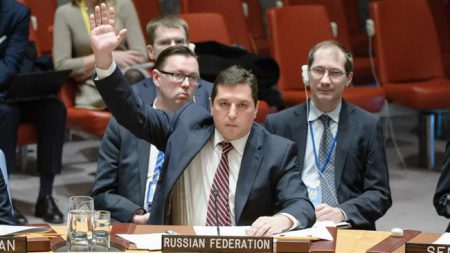
Russian Deputy Permanent Representative to the UN Vladimir Safronkov
Press TV – March 18, 2017
During a meeting of the UN Security Council convened by Russia, the Kremlin has warned about “grave humanitarian consequences” that would come if Saudi Arabia goes ahead with a plan to attack Yemen’s western port city of Hudaydah.
The attendants in the UNSC meeting discussed the grave humanitarian situation in Yemen and efforts toward a peaceful conclusion of the two-year-long war imposed by the Saudi regime on the Yemeni people, Russian Deputy Permanent Representative to the UN Vladimir Safronkov told reporters after the closed-door meeting in New York, which had been requested by Moscow on Wednesday.
Russia’s state news agency TASS quoted the Russian official as saying the meeting had been held in an attempt “to urge the UN to step up its efforts to establish a real diplomatic process.”
Elsewhere in his remarks, Safronkov said all the 15 member states of the council supported a non-military approach to the resolution of the crisis. It is, the Kremlin believes, “necessary to search for a political settlement,” Safronkov added.
Hudaydah is currently under the control of Yemen’s Houthi Ansarullah fighters, who have been defending the impoverished country against the Saudi aggression since March 2015. The city, Yemen’s fourth largest and its biggest port, served as a thoroughfare for the transit of about 70 percent of Yemen’s food imports in the pre-war years.
When the Saudi regime started pounding the crisis-hit country, Hudaydah turned into a primary entry point for humanitarian aid and fuel meant for areas inside Yemen, including the capital, Sana’a. If the city falls under the control of Saudi forces and mercenary soldiers, the flow of humanitarian assistance toward those areas would be blocked.
On March 13, Moscow also warned about the critical situation of the port city in providing its people with much-needed humanitarian aid.
The “plans to storm Yemen’s biggest port of Hudaydah give rise to serious concerns,” said Russian Foreign Ministry spokeswoman Maria Zakharova, adding that the fall of the city would cut Sana’a from “food and humanitarian aid supplies.” She also said the humanitarian situation in Yemen was “catastrophic.”
On Wednesday, the World Food Programme (WFP) said 60 percent of Yemenis, some 17 million people, faced a “crisis” and were in urgent need of food as a direct result of the Saudi war.
The Saudi campaign has so far killed over 12,000 Yemenis. The aggression was meant to reinstate Abd Rabbuh Mansur Hadi, Yemen’s president who has resigned and is a staunch ally of Riyadh. The campaign also sought to undermine Houthis. However, due to resistance from the Yemeni nation, the regime in Riyadh has so far failed to achieve success and suffered considerable human loss in its military.
Featured Video

The Search for Truth: Charlie Kirk’s Assassination One Year Later
or go to
Aletho News Archives – Video-Images
From the Archives
The 9/11 “Double-Cross” Conspiracy Theory
BY LAURENT GUYÉNOT • UNZ REVIEW • SEPTEMBER 6, 2022
Is it true that “9/11 was an inside job”? Yes, insofar as Israel is “inside” the U.S. But for the 9/11 truthers who have identified Israel as the main perpetrators, “9/11 was an inside job” is at best a half-truth, and at worst an integral part of the Zionist operation, like a secondary flag sewn as a lining under the false flag of Islamism. Victor Thorn (1963-2017) wrote in his book 9/11 made in Israel: The Plot Against America (2011): “In essence, the ‘9-11 truth movement’ was created prior to Sept. 11, 2001 as a means of suppressing news relating to Israeli complicity. . . . The slogan ‘9-11 was an inside job’ was quite possibly the greatest example of Israeli propaganda ever devised.” In milder terms, it is “controlled opposition”.
A genuine truth movement would have pointed to Israel as the prime suspect from the start. From day one, it was obvious who would benefit. … continue
Blog Roll
 Aletho News
- Europe’s mounting social chaos… chickens coming home to roost for proxy war against Russia
- US-Russia Diesel Deal Becomes Massive Defeat for Ukraine
- Hormuz and the Looming Economic Catastrophe
- Dhubab offensive, media blitz and the rapid unraveling of Saudi-backed coalition’s new gambit
- Putin Conveys to Trump Iran’s Vision on Possible Conflict Resolution – Kremlin
- The Search for Truth: Charlie Kirk’s Assassination One Year Later
- ‘Harsh reality’: Iran says France seeks monopoly on power and intimidation, not peace for all
- When Will This White House Madness End?
- Huckabee aide goes to ‘unusual lengths’ to portray ‘Israel’ positively
- Trump Announces Diesel Supply Deal With Putin Following Phone Call
- If Americans Knew
- Israeli forces kill another child in Gaza – Daily Update
- Gaza ceasefire exists in name only, say more than 100 organizations
- Nearly 2 Million in Gaza Need Urgent Shelter Assistance as Winter Looms: IOM Chief Warns
- Suppressing Palestinian resistance: US charity under fire for AI monitoring of Gaza classrooms
- Thousands Are Held in Israeli Torture Camps. This Is What Happens Inside
- Israel puts Gaza’s sick, injured, newborn in peril – Daily Update
- Report claimed Mark Levin used by Israeli government to influence Trump
- Over 2,000 Gazans have died awaiting medical evacuation amid Israel’s continued siege
- How a U.S. Diplomat Suppressed and Altered Reports Critical of Israel
- 5 Palestinians Die from Israeli Strikes in Gaza as Relentless Attacks Continue
- No Tricks Zone
- Germany’s Green Energy Debacle: High Energy Costs Force Kahla Porzellan to Close After 182 Years!
- New Study: 50 Years Of The Most Aggressive ‘Net Zero’ Policies Can Only Affect The Global Climate By 0.03°C
- US September “Heat” Was No Record…Many Records Set Decades Ago
- Latest European Green Energy Debacle; Portugal’s Largest Flagship Solar Park Insolvent!
- Green Energy Debacle: German Expert Professor Fritz Vahrenholt Warns Of Severe Economic And Social Consequences
- Two More Paleo Reconstructions Affirm Meters-Higher Sea Levels Across Ireland, Brazil 7000-6000 Years Ago
- New Study: Earth And Venus Surface Warmth Largely Explained By Convection And Lapse Rate, Not CO2 Or Radiation
- 2025 Nature Paper Claiming Worsening Global Drought Gets RETRACTED …Heavily Flawed
- New Study: ‘Global Drought Shows No Detectable Recent Acceleration Under Climate Warming’
- Economic Masterminds: German Socialists Suggest Taxing Productivity Gains Stemming From Using AI

