‘Saudi Arabian forces never once targeted ISIS militants in Yemen’
RT | August 29, 2016
The latest car bombing is most likely a personal vendetta, probably more of a gang problem inside Aden over who is going to take control, the rebels or Islamic State (IS, formerly ISIS/ISIL), political commentator Marwa Osman told RT.
Up to 60 people have been killed in a car bomb attack in the Yemeni city of Aden with dozens more injured. Most of the dead were pro-government troops.
ISIS has claimed responsibility for the attack.
RT: What is ISIS trying to achieve in this attack?
Marwa Osman: First, let’s tell people where ISIS targeted. They targeted a school compound which consists of the Popular Committee Forces who are allied with Abd Rabbuh Mansur Hadi, who was the president who resigned twice before the war in Yemen. So, they targeted these people who are already in war with “Ansar Allah” also known as the Houthis in the mainstream media. So, they are now targeting supposedly their own allies. And that is because there is a personal vendetta, probably more of a gang problem inside Aden over who is going to take control now. Is it the rebels who are actually backed by Saudi Arabia, who is still bombing and killing people in Saada and Sana’a? Or is it going to be ISIS which is also backed by Saudi Arabia which has been funneling money and arms by Saudi Arabia for the past seven or eight years in Yemen. Who is going to take control? That is the fight that is going on there. It is not a fight of fighting ISIS or fighting people who are there to try and liberate Yemen. No, because the actual thing is that both groups, these popular movements which are Hadi’s supporters and ISIS – they are both fighting “Ansar Allah” which is also getting beaten by the Saudi-led coalition. So, this is more of who is going to control the area.
RT: With this Saudi Arabian involvement you mentioned, is it possible that Saudi Arabia is using ISIS as some sort of proxy army to achieve its desires in that part of the world?
MO: It is not only possible, it is the only fact on the ground because up until now, since March 25, 2015 when the US coalition led by the Saudis ran… all over Yemen, they have never – not even once – targeted all of the Al-Qaeda-ISIS wilayat. They have eight wilayat inside of Yemen and not once have they targeted them. Why? Because they are actually there to run the on-ground incursion for the Saudis. And up until now they have not been able to do that; they were not able to go to Sana’a or to Saada for that matter. They only have been targeting Aden as we just saw today. It is obviously very devastating: 60 people dead because of the explosion. But these two proxy warriors for the war of Al-Saud, both rebels that supposedly represent Abd Rabbuh Mansur Hadi, the former president and also Al-Qaeda. It is the way it is going on in Syria, Iraq, Yemen and also Libya. So, when you talk about Saudi Arabia funding ISIS, it is the only way that it is going to gain any ground incursions on the Yemeni field. And yet this is not happening…
RT: Are you saying that ISIS is de facto a proxy army of mercenaries being used to achieve regime change?
MO: Yes, of course. And that what we have been saying since the beginning of 2010 and all 2011 when Al-Qaeda was changing into ISIS based on the ideology of Wahhabism, which is diffused and brought upon us by the monarchy of Al-Saud. Where they have got their weapons from, where they were funded from? It was obvious; we had all the reports and also the statements from both Qatar and Saudi Arabia. But then Qatar last year started to back off, but Saudi Arabia is still enraged by the incapability of their forces to take any control of Yemen. By God, Yemen is taking land inside of Saudi Arabia; it is that devastating for Al-Saud now. And when we talk about Iraq, Syria as well, it is also the same thing. They are still funding the same group that has the ideology of Al-Saud which is Wahhabism because they have no other choice. They are losing in Yemen; they obviously lost a lot in Syria and Iraq. There is no other place. The Iraqis are asking the Saudis to change their ambassador because he is the main person who is in contact with Al-Qaeda and ISIS inside of Iraq. So, when we talk about this, and talk about the role of Saudi Arabia, I don’t want to just demonize them. There are facts that demonize them. There are facts that Riyadh is still issuing a bloody campaign against Yemen. And there are US and UK so-called consultants inside of Riyadh in the control room of the war on Yemen. And we are still asking if they are funding ISIS or not. How did ISIS come to be if it were not for Al-Saud?
Read more:
At least 60 dead in Yemeni suicide bombing, ISIS takes responsibility
Hudson Institute Award to Netanyahu Named for Neocon Who Inspired Dr. Strangelove
By Richard Silverstein | Tikun Olam | August 28, 2016

Herman Kahn as featured in a Life Magazine profile
When Bibi Netanyahu comes to New York next month for the UN General Assembly, the Hudson Institute will bestow its Herman Kahn award on him. Kahn was an early neocon intellectual who advocated U.S. first-use of nuclear weapons. He propounded this theory in his provocatively titled 1960s book, Thinking the Unthinkable.
The Institute is a leading neocon think-tank based in Washington DC. It is a wonky version of the American Enterprise Institute or the Heritage Foundation. It’s senior vice-president is Scooter Libby, a man who barely escaped spending time in a federal prison.
The Hudson Institute is the primary funder (see Didi Remez’s post for a fuller discussion of the funding and relationships) of the far-right Israeli NGO, Institute for Zionist Strategies, which advocate purging “post-Zionist” material from Israeli academic curriculum. They’ve been so successful at pressuring academia to “Zionize” the curriculum that Tel Aviv University President Joseph Klafter promised he would personally examine individual course syllabi for tainted content.
Hudson is also the primary backer of Uzi Arad’s Atlantic Forum, a shadowy Israeli think tank founded by the former Mossad officer. The NGO’s mission is to strengthen Israel’s security relationship with NATO. He’s reputed to have “run” Larry Franklin, the former Defense Department analyst caught with Steven Rosen passing U.S. secrets to the Israelis. Rosen too came within a whisker or two of landing in federal prison. Luckily for him, the Israel Lobby came to his defense and the Justice Department dropped the case against him. Arad worked with Kahn at Hudson in the 1970s.
Bush-era neocon analyst, Meyrav Wurmser, runs Hudson’s Center for Middle East Policy. That explains Hudson’s love affair with Netanyahu and the award he is to receive. In many ways it seems fitting for the Israeli leader to receive an award named for Kahn. Israel is, after all, one of the most dangerous of the nuclear states. One of those most likely to engage in first-use of nuclear weapons would the circumstances arise. One may argue whether that distinction should rather belong to North Korea or Pakistan. But the Koreans don’t yet have the capacity to destroy western Asia as Israel does the Middle East. And Pakistan’s nuclear arsenal is child’s play compared to Israel’s estimated 200 nuclear warheads.

Herman Kahn (David Levine)
It may be worth hearing some words said about Kahn’s work. A reader summarized another of his books: “On Thermonuclear War, was ‘a moral tract on mass murder: how to plan it, how to commit it, how to get away with it, how to justify it.’” Some other words of wisdom from Kahn on nuclear deterrence:
“If it is not acceptable to risk the lives of the three billion inhabitants of the earth in order to protect ourselves from surprise attack, then how many people would we be willing to risk?”
Another critic said that the publication of that book “should properly have caused the sequestration of its author into psychiatric care.” A science reporter, reviewing Kahn’s book called him a contemporary version of the devil:
“Not the traditional devil, reeking of brimstone and tempting men to old-fashioned sins, but a slick, talcum-scented, contemporary Satan, rationalising hideous emotions by reference to strategic studies, electronic computers, contingency planning, and all the other gimmicks of paranoiac gamesmanship.”
The following comment by Kahn to a reporter surely served as the inspiration for Terry Southern’s screenplay for Dr. Strangelove: “I can be funny on the subject of thermonuclear war.” In fact, writing in the NY Times, Fred Kaplan says:
… The real model [for the Strangelove character] was almost certainly Herman Kahn, an eccentric, voluble nuclear strategist at the RAND Corporation, a prominent Air Force think tank. In 1960, Mr. Kahn published a 652-page tome called “On Thermonuclear War,” which sold 30,000 copies in hardcover.
… When Dr. Strangelove talks of sheltering people in mine shafts, President Muffley asks him, “Wouldn’t this nucleus of survivors be so grief-stricken and anguished that they’d, well, envy the dead?” Strangelove exclaims that, to the contrary, many would feel “a spirit of bold curiosity for the adventure ahead.”
Mr. Kahn’s book contains a long chapter on mine shafts. Its title: “Will the Survivors Envy the Dead?” One sentence reads: “We can imagine a renewed vigor among the population with a zealous, almost religious dedication to reconstruction.”
So it is altogether fitting that Bibi Netanyahu be enshrined along with Herman Kahn in a sort of Nuclear War Hall of Fame, as two men prepared to see their region (in Bibi’s case) or world (in Kahn’s) go up in flames in order to “save” their country.
It’s perfectly fitting that a past recipient of the award was Dick Cheney (especially considering his former protege, Scooter Libby works for Hudson).
Saudi Arabia Cries Foul Play in Yemen
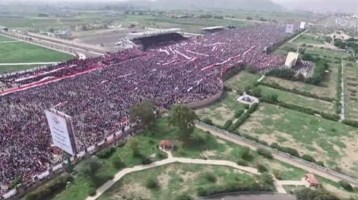
By Catherine Shakdam | New Eastern Outlook | August 27, 2015
As the Yemen International Conference in the Support of Yemen was in full swing in the British capital, London, Yemenis came in their hundreds of thousands to pledge their support to the Resistance movement this August 20, 2016 – yet another popular show of force, yet another grand display of sovereign political will in the face of foreign diktat.
To the sounds of explosions, and flying Saudi war planes it is Yemen which came to defy its invaders; a proud nation under unprecedented duress, a land united under the banner of its resistance.
“We won’t bow down to the House of Saud” chanted the crowd. “We will never bow down to the criminal House of Saud,” millions repeated in unison.
If Yemen remains in the throes of a brutal war of attrition for its dared ambition to live free under its skies, its people are quite determined to weather whatever storm Saudi Arabia will throw, so that their right to self-govern and resist oppression could be affirmed – never to be questioned again.
However one chooses to look at Yemen’s war, it would be foolish to deny still that those brave souls corporate media still label as “rebels” are in fact the carrier of a nation’s will; the very expression of a people’s inherent right to carve its own political future, regardless of what anyone else might think.
Let me be brutally honest here – Yemen neither needs foreign approval, nor does it require foreign vetting. Yemenis want what they want because they can! It is really that simple.
Yemen needs no liberating from the Houthis, for the Houthis are Yemen. Yemen is not being overrun by Shiites, Yemen is Zaidi country. There is no Iranian agenda at play either, only a desire to disappear the suffocating influence of the House of Saud.
Standing in opposition of the most violent, radical and reactionary theocracy ever to grace the pages of our history does not make Yemen an “Iranian agent”, it makes Yemen an expectant independent nation.
Media coverage of Yemen so far has been criminal at best, misleading always.
The public has been conned into a narrative which is devoid of all humanity, and democratic courtesy. The simple fact that media feel entitled to slap derogatory adjectives before the Houthis as to direct their readers’ self-righteous sense of political morality is despicable.
I read the terms Iran-backed Shia Houthis rebels too many times not take offense. How dare you define a people whom you know nothing about? How dare you speak over and at an entire nation because their will does align with yours?
Let’s play the adjective game shall we?
When have you ever read the following statement: Wahhabi-backed-Western-sold-out- twice-resigned-once-runaway-child-killer-Sunni President Abdo Rabbo Mansour Hadi? Likely never … Why? Because Saudi Arabia and its allies are still hiding behind this pale figure of a man to legitimize their odious genocidal military intervention against Yemen.
Let me tell you of this so-called legitimate political figure the West has canonised as Yemen’s forever president.
Hadi is a fraud and a traitor. Not only did he allow for the killing of his countrymen, he actually actively pursued their annihilation in the name of a chair he never truly was appointed to. Hadi was elected in a one-man election in 2012 for the duration of a 2-year’s mandate – not exactly what you call democratic.
Hadi was never the choice of the people, he was Riyadh’s choice through the GCC-brokered transition of power agreement (2011).
How can anyone speak of democracy and refuse Yemenis their own?
How can anyone still read corporate media and not deplore the stench of their abominable hypocrisy and bias?
Do not tell Yemen what it wants, but hear what it is telling you.
Hear what an entire nation is screaming from the top of its glorious lungs, and witness the rise of a Resistance which breadth will maybe crumble al-Saud tyranny.
“We won’t bow down to the House of Saud … We will never bow down to the criminal House of Saud!”
Can you hear them now? Can you not respect that a nation simply cannot bring itself to live the abomination which is Wahhabism? Can you not recognise that Yemen is the last line of defense for all free folks in Arabia?
Who will speak for democracy and political self-determination when radicalism will have nations at the mercy of their guns? Can you not see that what you refuse Yemen – free will, is exactly what you demand for yourself?
Do not tell me of the will of a people when under bombs millions have rallied before their appointed leaders.
Yemen is free today by the strength of its Resistance movement.
Yemen is dignified today for one man rose from the oppression of religious repression to reclaim pluralism his own coat of arms. Sheikh Abdel-Malek al-Houthi, one of the sons of Hamdan, Yemen’s very own legacy offered Yemen its Freedom to keep none for himself.
Sheikh al-Houthi liberated Yemen from al-Saud never to demand a seat at power’s table.
Do not speak of what you don’t know Mr corporate media. Do not define with your adjectives the nature of a land for which you have no respect for.
Yemen might be poor and battered but it is a grand and noble land.
Of course Saudi Arabia would want you to believe that Yemen’s political ambitions are illegitimate, unlawful and nefarious.
Have you ever bothered asking why? Have you even given the infamous “Houthis” the time of day before dismissing them under misapprehension?
I think not. What the public did is assume. What the public did is read those adjectives media associated ad nauseam to Yemen resistance movement, and automatically accept those labels as truths. Adjectives those days have become dangerous weapons of mass-destruction.
Adjectives have cost Yemen its freedom!
Yemenis this August 20, 2016 came to publicly offer their support to the new highest political council – and still Riyadh has cried foul play.
Millions took to the streets knowing full well that Saudi Arabia warplanes were up above to offer their voice and their arms to the Resistance, and still Western capitals have called for Hadi’s “restoration.”
What will it take for you to wake up?
Yemen has bled, burnt, exploded, pleaded, negotiated, mourned, cried and starved while you turned your nose up in disgust arguing what future a people should have instead of the one they want for themselves.
If you like the idea of a life spent in the shadow of Wahhabism why not book a ticket to Saudi Arabia and experience first-hand the type of democracy al-Saud have in mind for Yemen, you might find new respect then for the Houthis of Yemen.
One more thing before I go: no one said you had to love the Houthis, only that you respect that Yemenis do.
Catherine Shakdam is the Director of Programs of the Shafaqna Institute for Middle Eastern Studies and a political analyst specializing in radical movements.
US Okay With Surgical Strikes on Yemen Hospitals
By William Boardman | Reader Supported News | August 24, 2016
Nuremberg: “a war of aggression … is the supreme international crime”
Waging genocidal war on a defenseless country was never so baldly and honestly put on any agenda for talks among US secretary of state John Kerry, representatives of Saudi Arabia’s dictatorship, and their mutual allies, even though they are all engaged in an endless genocidal war on Yemen. This war is a war of aggression, started by Saudi Arabia in March 2015, with crucial US blessing, participation, personnel, and ordnance. The US has been a willing, guilty partner and enabler in 18 months of military atrocities in a one-sided war that everyone involved knew – or should have known – was a pure war crime based on a paranoid delusion.
American participation in this war of aggression was a war declared by press release from the National Security Council on March 25, 2015, another example of the imperial presidency’s ability to act by fiat without fear of serious objection from the public, the media, or even Congress:
President Obama has authorized the provision of logistical and intelligence support to GCC [Gulf Cooperation Council]-led military operations. [emphasis added]
The fundamental crime in Yemen is waging a war of aggression, which encompasses all the subsequent war crimes including bombing civilians, using cluster bombs, bombing hospitals, bombing food supplies, and trying to starve a population to submission or death. Yemen, with a population of 26 million people, was the poorest country in the region even before it was attacked. What the US supports and sanctions against Yemen makes any US complaint about Russian actions in Crimea sound like howling hypocrisy.
For all that the Saudis frame their war on Yemen as a defense against a threat from Iran, there has never been any credible evidence of any credible threat to Saudi Arabia from any element of the miniscule Iranian presence in Yemen. Yemen is fighting a civil war, a new version of the same old civil war Yemenis have been fighting for decades, both before and after Yemen was two separate countries. The Iran “threat” is the paranoid delusion supposedly justifying a merciless war on a civil population already beset by a four-sided civil war. There is no way that those who decided to wage this war of aggression could not have known the reality in Yemen if they had wanted to know it. Presumably they knew it all full well and chose a war of aggression anyway, recklessly, perhaps even thoughtlessly, but criminally all the same.
The Saudi goal was always to get rid of a longstanding threat on its southwestern border, where the tribal land of the Houthis lay both in Yemen and Saudi Arabia. When the long-oppressed Houthis, a Shia minority in a Sunni world, drove out the Sunni government of Yemen in 2015, the Saudis, without saying in so many words, decided on a course of action that could lead to a final solution. And everyone knew, at the time, and no one objected, according to this account by the highly reliable Andrew Cockburn on Democracy NOW! (whose piece in Harper’s Magazine for September 2016, ironically titled “Acceptable Losses,” provides an excellent exegesis of the war on Yemen, but with a more elegiac tone):
I was told, very early on in the war, Deputy Secretary of State Tony Blinken went to Riyadh to ask the—this is two weeks—yeah, it was two weeks into the war [mid-April 2015], when they had already been bombing away, using the U.S. bombs, U.S.-supplied bombs, using U.S. weapons, killing already dozens, if not certainly, you know, hundreds of civilians, destroying factories. And finally, Blinken turns up in Riyadh and asks, “By the way, what are you trying to accomplish here?” And the Saudis effectively said, or at least the Americans understood them to say, “Well, we basically want to wipe out the Houthis.” Well, they termed it as “end all Iranian influence in Yemen.” So, the Americans—Blinken was a bit shocked by that, so I’m told, and said, “Well, you know, that’s going a bit far. But it’s—you should certainly stop the Houthis taking over the country.” And that, effectively, gave the Saudis carte blanche to continue this kind of mindless carpet bombing….
By 2015, American hands were already bloody with the US drone assassination program that had killed not only innocent civilians, but American citizens, without a trace of due process of law. In effect, already enmeshed in its own nexus of war crimes in Yemen, the US green-lighted the Saudi-led war of aggression that would make American crimes pale by comparison. As American policy over the years would have it, American weapons have been dispersed all over Yemen since 2006.
Kerry to consult on terrorism, but not US or Saudi terrorism
Terror bombing, an example of which is Saudi pilots flying American planes dropping American bombs on defenseless Yemeni civilian targets, is probably not the terrorism Secretary Kerry wants to discuss – ever – with the Saudis and their allies, never mind other weapons suppliers like France and the United Kingdom. As the official State Department notice put it in deadly opaque prose:
Secretary Kerry will travel to Jeddah, Saudi Arabia, for a series of meetings with senior Saudi leaders, his counterparts from the Gulf Cooperation Council, the United Kingdom, and the United Nations Special Envoy for Yemen. His discussion will focus on the ongoing conflict in Yemen and efforts to restore peace and stability….
Those “efforts to restore peace and stability” notably include the destruction of two schools, another hospital, and a potato chip factory, along with the associated men, women, and children, especially at the schools. Perhaps the latest great military “victory” achieved by the war criminals known as the Saudi-led coalition is to drive the world’s leading medical crisis-zone organization out of Yemen by targeting its hospitals over and over and over and over since March 2015. Of course, America the Exceptional does not stand for this betrayal of human decency, and our presidential candidates of all parties have railed ceaselessly against this indiscriminate murder of patients, their families, their doctors and other medical personnel, forcing the White House to take action to bring to an end 17 months of aggressive war and other war crimes and crimes against humanity – no, wait, that’s not happening, is it?
Actually, if any presidential candidate of any political party has expressed the slightest objection to the Saudi-coalition’s genocidal war on Yemen, such evidence is so hard to come by that it may as well not exist. (In August 2015, Jill Stein of the Green Party mentioned in passing that the Saudis “are committing war crimes right now in Yemen,” and more recently she called for an end to US funding for Saudi Arabia and Israel because of their violations of human rights laws. She does not tend to make a point of the US support for a war of aggression in Yemen, but she’s better than any other candidate on Yemen.) At this point, a year and a half into our shared war of aggression, every candidate is complicit in this horrendous, unjustified war promoted and pursued with smug disdain for anything like peace by our peace prize winning President Obama. The blood drips from all their hands, their feet, their tongues and eyelashes, but most of all from every pore of our Nobel Laureate in the White House. (As the book Double Down reported in 2012: “Turns out I’m really good at killing people,” Obama said quietly, “Didn’t know that was gonna be a strong suit of mine.”)
With the US at war, Congress has nothing to say about any of it
The US is at war with Yemen, in support of the Saudi-led coalition that launched its undeclared war of aggression on March 26, 2015. US war-making includes, but is not limited to: US intelligence services providing intelligence to the aggressor nations; US military personnel participating in daily target planning and attack assessment; US tanker aircraft re-fueling aggressor nation aircraft bombing Yemen (46,500 acknowledged sorties in the first 11 months of war); US drones targeting and attacking under US control; US military contractors servicing the Saudi F-15s that bomb Yemen; US personnel training Saudi military; US military personnel operating in Yemen; and the US Navy reinforcing the Saudi blockade intent on starving Yemen into submission.
The US Congress has never debated, never authorized US participation in a war of aggression against Yemen. The US president has never asked Congress for such authorization of a war of aggression against Yemen. Neither house of Congress has acted on any bill that directly addresses the war of aggression against Yemen. More than a year after the war started, two Democratic members of Congress (joined by two Republicans) introduced identical bills intended to respond to the war. California congressman Ted Lieu (joined by Florida congressman Ted Yoho) and Connecticut senator Christopher Murphy (joined by Kentucky senator Rand Paul) asked their colleagues to address the horrors of the war (briefly enumerated in the bill), not by ending the war, but only by temporarily limiting US arms sales to Saudi Arabia. That’s it. They did not mention US participation in the war. Both their bills were referred to committee. At the time there was a spotty ceasefire in Yemen while peace talks proceeded in Kuwait (the talks were suspended in early August, leading to the Saudi escalation currently killing more civilians).
Incredibly, this non-response response to war crimes in Yemen has gotten Rep. Lieu some recent positive press coverage, in The Intercept of August 22 and elsewhere, even though his bill is designed to have no immediate impact on the carnage. Rep. Lieu is a colonel in the US Air Force Reserve. When he was on active duty he taught the law of war to other Air Force officers. His interview rhetoric, like most of his public action, is soft-edged even though he knows perfectly well his country is committing war crimes. He almost said as much in an August 15 statement objecting to the Saudi attack on a school in Haydan, Yemen, that killed 10 children:
The indiscriminate civilian killings by Saudi Arabia look like war crimes to me. In this case, children as young as 8 were killed by Saudi Arabian air strikes. By assisting Saudi Arabia, the United States is aiding and abetting what appears to be war crimes in Yemen. The Administration must stop enabling this madness now. [emphasis in original]
Rep. Lieu and others have also objected to the State Department’s certification of another arms sale to Saudi Arabia: this one is $1.15 billion for 153 tanks, hundreds of machine guns, and other war materiel. This is in addition to the record $100 billion in arms sales to the Saudis already made by the Obama administration. The latest arms deal suggested to Rep. Lieu “that the administration is, at best, callously indifferent to the mass amount of civilians dying as a result of the Saudi-led coalition’s bombing.” He did not openly consider whether 153 Abrams Main Battle Tanks and other weaponry might open the way for the air war of aggression to be matched by an escalation of the ground war of aggression as well. Twenty of those new US tanks are specifically designated as replacements for tanks lost in combat, some of them in Yemen. On the other hand, the official State Department notice of the Abrams Tank sale assures Congress: “The proposed sale of this equipment and support will not alter the basic military balance in the region.” That’s hardly reassuring in a region where wars of attrition and military quagmires are killing not only thousands of Yemenis, but Palestinians, Israelis, Lebanese, Syrians, Saudis, Turks, Kurds, Iraqis, Afghans, and god knows who else, more often than not with Made-in-USA weapons and munitions.
The proposed US tank sale has drawn the attention of several NGOs (non-governmental organizations) looking to wash American hands of the war on Yemen by blocking the sale, or at least having a debate about it in Congress. Human Rights Watch (HRW) wrote a letter to Secretary Kerry August 19, with temperate language of concern about several countries, including Yemen. HRW asked Secretary Kerry “to emphasize the potential consequences if Saudi Arabia fails to improve its conduct.” But it did not suggest what those consequences might be in light of the reality that the US has coordinated and condones all Saudi conduct to date. CODEPINK is supporting a petition to support the Congressional letter that urges President Obama to postpone the US tank sale to the Saudis.
Even The New York Times is expressing something shy of anguish over “American complicity” and “carnage” and targets that are not “legitimate” under international law as it supports efforts to block the tank sale in Congress. The Times doesn’t mention that this is the same Congress that in June – supporting a White House request – refused to block the sale of cluster bombs to Saudi Arabia for fear of “stigmatizing” cluster bombs. That’s a reflection of the American version of reality, since cluster bombs are already stigmatized by most countries of the world and using them on civilians, as US-Saudi forces do in Yemen, is widely understood to be a war crime. The solution, according to the Times :
Congress should put the arms sales on hold and President Obama should quietly inform Riyadh that the United States will withdraw crucial assistance if the Saudis do not stop targeting civilians and agree to negotiate peace.
That can’t happen in the real world, where the president and the Saudis all know they are war criminals and are, like Macbeth, so steeped in blood “that should I wade no more,/Returning were as tedious as go o’er.”
There is no reason to expect any good to come to Yemen until a whole lot more Americans face the reality of their country’s support for a genocidal war of aggression. When enough Americans recognize that, then they will have to do a lot more about it than stop selling tanks to the aggressors. Until then the US-sponsored atrocity of ethnic cleansing in a poverty-stricken country that threatens no one will continue unabated.
US drone attack kills 22 Afghan soldiers: Helmand council
Press TV – August 27, 2016
A US drone attack has killed 22 Afghan soldiers held by Taliban militants in the southern Helmand province, while Taliban have overrun a strategic district elsewhere.
Provincial officials announced the fatalities on Saturday. Taliban also confirmed the death toll, saying the airstrike had killed three of the group’s members in the Nad-e-Ali district on Thursday.
Helmand is a strategically important province for both the Afghan government and Taliban militants, who control or contest 10 of the 14 districts in the opium-rich province.
On Saturday, Taliban militants seized a strategic district in the eastern province of Paktia, from which they can surge towards several other provinces.
Officials said dozens of police and soldiers were killed as the militants captured the Jani Khel district after five days of siege.
Local governor Abdul Rahman Solamal said hundreds of militants attacked police check posts overnight, prompting security forces to flee the district.
Jani Khel sits at an intersection linking eight districts. It also connects Paktia with neighboring Khost province and Pakistan.
“If we do not retake it (Jani Khel) soon then Taliban can easily move from one province to another and can undermine security in at least three provinces,” Solamal warned.
More than 20 soldiers and police were killed and another 20 wounded in the fighting overnight, while some 200 Taliban insurgents were killed, he said.
In a statement, Taliban spokesman Zabihullah Mujahid said large amounts of equipment had been captured, including armored vehicles, light and heavy weapons and ammunition.
Taliban have regrouped since the death of former leader Mullah Akhtar Mansour earlier in the year and are reported to be currently in control of more than 65 percent of the country.
Fierce fighting is currently ongoing against the militants across the country, notably in Helmand and around the northern city of Kunduz, which they briefly seized last year.
Late last month, the United Nations Assistance Mission in Afghanistan (UNAMA) said it had recorded 1,601 civilian deaths and 3,565 injuries in Afghanistan in the first six months of 2016.
The mission warned that civilian casualties had hit a record high this year, describing them as “alarming and shameful.”
Russia-India oil deal at risk due to US sanctions – media
RT | August 26, 2016
US sanctions are threatening to derail Russian energy major Rosneft’s acquisition of a 49 percent stake in India’s Essar Oil, reports The Times of India.
The deal was curtailed by the US Treasury’s Office of Foreign Assets Control, according to the daily.
In July 2014, the Department of the Treasury included Rosneft on the list of sanctioned Russian companies after Washington accused Moscow of involvement in the military conflict in Eastern Ukraine and of annexing Crimea.
Indian banks, which invested over $5 billion into Essar Oil and currently hold 17 percent, expressed concerns over the deal due to fears of the potential consequences.
“We may have to review our exposure to Essar Oil if Rosneft comes on board,” said a top banker with a state-run lender, as quoted by The Times of India.
However, Essar Oil will reportedly try to push the deal with Rosneft through, allowing the Russian company to enter the Indian energy market.
Searching to expand cooperation with Russia beyond the traditional defense buyer-supplier relationship, New Delhi has invested over $5 billion in the Russian energy sector.
The Essar-Rosneft deal aims to open up India’s retail energy business to the world’s largest oil producer.
The deal was planned to be sealed by June. The Indian company had to reduce the share intended for sale by 25 percent, but the measure failed to change the situation.
Moreover, the sale of a 25 percent stake to the Dutch multinational trader Trafigura Group risks collapse due to the close ties with Rosneft. Trafigura handles much of the crude exported by Russia.
Whitewashing Israeli War Crimes, the NYT Turns its Back on Survivors and Critics
By Barbara Erickson | TimesWarp | August 26, 2016
So it’s settled, according to The New York Times: Israel was not at fault in a strike that killed 10 civilians near a United Nations school in the 2014 assault on Gaza, nor was it guilty of breaking the law in other instances that left innocent victims dead during that conflict.
This, at least, is what the Israeli military claims, and in a one-sided story in the Times this week, Isabel Kershner takes the Israeli military findings at face value, never questioning its conclusions or seeking commentary from outside sources.
She opens her piece with a summary of the military’s own account of the strike on the school, recounting it as established fact without attribution. Kershner goes on to say that the army also declared itself innocent of deliberately causing civilian deaths in two other attacks during the 51-day offensive: a strike on the Bureij refugee camp and the death of 12 members of one family in Rafah. The three cases were among seven closed without charges this week.
The school was hit, according to the army account, because militants targeted by an air-to-ground missile happened to pass by the site too late for the Israeli army to correct its aim; the Bureij bombing was “justified and legal” because the building hit was being used by Hamas as a control center; and the Rafah deaths were caused by “errant mortar fire” from Gaza militants.
Her story makes no mention of other instances that raised international outrage, such as the mortar attack that killed four boys playing soccer on a beach, the massacre in the Shujaiya neighborhood of Gaza City and the excessive and deadly bombardment of eastern Rafah after Palestinians captured an Israeli soldier.
The article likewise fails to include any comments by outsiders on the military decision to close seven cases. Kershner did not seek responses from Gaza residents or from human rights groups that have also investigated and documented the Israeli attacks.
Other media outlets, however, included these outside perspectives: The Guardian, for instance, sought reactions from Gaza residents affected by the strikes, and the International Business Times quoted extensively from an Amnesty International staff person.
But the Times finds no reason to look for sources beyond the Israeli military, which happens to be the entity under investigation. At the same time, it shows little concern for what the people of Gaza experience.
This week’s story, for example, concludes with two paragraphs about Israeli air and tank strikes on the beleaguered strip this week. A total of 50 bombardments hit the enclave after militants fired a single rocket toward the town of Sderot.
Kershner’s story tells us only what “Israeli analysts” have to say about the strikes. The targeted sites were “empty,” she reports, and “no deaths were reported.” Other news sources, however, state that four people were injured.
The Times insists that it provides full and fair accounts, that it is neutral and balanced, but its editors and reporters fail to follow even minimal journalistic standards in reporting on Israel. Those accused of war crimes are allowed to speak for themselves without the annoyance of outside observers to challenge any aspect of their claims. Those who bear the brunt of these alleged crimes have no voice at all.
Follow @TimesWarp on Twitter
Antiwar Coalition responds to attack by Terry Burke published in ‘In These Times’
Statement published on the United National Antiwar Coalition website, August 2016
In the past 15 years, the U.S. military machine has attacked 17 countries. The many peace and justice organizations and individuals attacked in Terry Burke’s In These Times article [article date August 15, 2016] have a long history of opposition to ALL U.S. wars, interventions, invasions, drone attacks, military coups, blockades, and sanctions on numerous countries around the world.[1]
The military aggression of the United States, the expansion of NATO, the efforts at encirclement of Russia and China with weapons shields, CIA destabilizations in Latin America and the massively destructive U.S. wars in Central Asia, West Asia, Middle East and North Africa, along with the massive arms deals with U.S. allies like Israel and Saudi Arabia, have created terrible destruction and millions of deaths and refugees. UNAC, a peace and justice coalition with organizations and individuals from different perspectives, seeks to counter the corporate media propaganda and politicians’ justifications for each of these wars and for expanding U.S. militarism.
These wars collectively, and each of them individually, are for U.S. economic and geopolitical domination. None of these wars have resulted in increased security or stability for the countries targeted or for the people of the U.S.
It is from this perspective that we oppose the U.S. war in Syria. We oppose the U.S. bombing that has ruined so much of the vital infrastructure, and we oppose the U.S.-coordinated arming and financing of numerous armed groups and the devastating sanctions that the U.S. has imposed on the people of Syria.
Terry Burke cites her past work in the Nicaragua Solidarity Committee as the basis of her position on Syria. However, this distorted reasoning would have led Terry and the antiwar movement to support the U.S. backed Contra forces in Nicaragua as “democratic and progressive forces”. The U.S. role in Central America was to covertly arm contra forces to impose regime change in Nicaragua while funding and arming Salvadoran and Guatemalan death squads. This destructive policy created millions of refugees from Central America in the 1980s, just as U.S. policies of regime change in the past 12 years of war in Iraq, Libya, Syria and elsewhere has created even more refugees.
The U.S. is coordinating Saudi, Israeli, Qatar, Turkish and EU efforts of bombing and of arming opposition groups. The stated goal from the beginning has been regime change in Syria. Regime change, as in Iraq and Libya, means the complete destruction of every secular state institution, including the very structures that provided full access to free education, free health care, electrification, potable water, modern infrastructure, irrigation and communication.
Years of U.S. sanctions against Iraq, Iran, Syria and Libya did not succeed in carrying out regime change, although they created great hardships and dislocations in each economy. Up to 1.5 million people died due to U.S. sanctions in Iraq alone.
Today, as we watch two candidates running for president who threaten increased and terrible interventions in Syria, we are seeing a big increase in U.S. propaganda. Take, for example, the August 11, 2016 article by Fair and Accuracy in Reporting (FAIR) on the breakdown of the [February 2016] ceasefire. FAIR, a media watchdog group, exposed the fact that it was groups supported by the U.S. fighting alongside the al Nusra Front – the al Qaida group in Syria – that actually broke the ceasefire, yet the media blamed the Syrian government and the Russians for the breakdown. Much of what we see in the U.S. media related to the situation in Syria is the same kind of propaganda with the goal of building greater support for war.
Terry Burke claims we are “U.S.-centric” for opposing our government’s attacks on Syria and attempts at regime change in that country. She claims that we have “ignored anti-Assad progressive Syrian voices.” But who has ignored what? Where in the U.S. corporate media are the voices of Syrians (both pro and anti-Assad) who want an end to the ISIS/Al-Qaida/U.S./NATO intervention in their country and have rallied to the side of their government to end it? The U.S. corporate media and some so-called progressives in the U.S. have focused on vilifying Assad rather than the U.S.-led war on Syria, which only leads to strengthening the forces who seek regime change and war. Should we add our voices to that chorus? Is that the best way to end U.S. intervention in Syria, which the overwhelming majority of Syrians oppose? We think not.
The March 13, 2016 UNAC protest, ‘A Day of Peace and Solidarity’ [Facebook], is the basis of Burke’s claims that “a dictator accused of monstrous war crimes is being given tacit support by major organizations in the peace movement.” Why? Because the “anti-war protest in New York City included people carrying the flag of the brutal Assad regime…”
It is true that Syrians came to that demonstration and carried the flag of their country. Do Syrians not have the right to carry their flag? Is it the place of the U.S. anti-war movement to tell people from any country that is under attack by the U.S. that they do not have the right to carry their country’s flag? That is not the role of our movement; we oppose our government’s illegal and immoral aggression against all countries and do not lecture the people of that country on whom they should support or not support.
If antiwar activists and organizations in the U.S. condemn U.S. bombings and aggression in Syria as our primary concern, rather than denouncing “Assad’s crimes”, we are branded “pro-Assad”. Burke attacks us for having signs like “U.S. Hands Off Syria” and “No U.S. War on Syria.” These she says are “U.S.-centric.” Were similar slogans used during the Vietnam War, Afghan War, and Iraq War also U.S.-centric? The U.S. is the most militarily aggressive country in the world. It has around 20 times the number of foreign military bases as all other countries in the world combined. We in the U.S. have an obligation to humanity to demand that our government stop the aggression and bring the troops home from Syria and all of the more than 130 countries where there are U.S. troops.
Burke accuses the antiwar movement of ignoring progressive Syrian voices but she is highly selective in identifying the “Syrian perspective” as those who are anti-Assad. We must ask her why she ignores the Syrian voices that seek to end the U.S./NATO/ISIS/Al-Qaida attacks on their country.
Burke believes that the primary feature of the Syrian conflict is fighting between two camps of Syrians. However, this is not the case. Syria has been invaded by extremists such as ISIS and al Nusra. Tens of thousands of mercenaries have poured into this small country to overthrow the government, a goal which the U.S. and NATO share. They have been supported by bombings, logistics and harsh sanctions against Syria from the U.S. and NATO. Though the U.S. has claimed it is there to attack the extremists, there had not been much damage to them until Russia entered the fighting– and then, in a matter of weeks, the tide turned. The oil that ISIS takes from Syria and uses to help fund their operations has been left untouched by the U.S and its allies until Russia started bombing their oil operations.
The antiwar movement can agree on non-intervention and self-determination. Aligning with those anti-Assad Syrians who support U.S. intervention in Syria can only divide and weaken our movement, which needs to be united today, perhaps more than ever.
We urge the antiwar movement to reject the ideas that Terry Burke presents in her article and demand that the U.S. and NATO stop the bombing, stop the sanctions, stop the flow of weapons and stop the funding. This will stop the extremist groups. Then the people of Syria can alone decide their fate.
[1] Organizations and people attacked by Terry Burke in her article in In These Times include United National Antiwar Coalition (UNAC), U.S. Peace Council, Syrian American Forum, Veterans for Peace, Manhattan Green Party, WarIsACrime.org, Voices for Creative Nonviolence, Syrian American Will Association, ANSWER Coalition, Anti-War Committee Chicago, Minnesota Anti-War Committee, Women Against Military Madness, Workers World Party, Freedom Road Socialist Organization, Mint Press News, AntiWar.com, Consortium News, Veteran Intelligence Professionals for Sanity including members William Binney, Coleen Rowley and Ray McGovern; dedicated activists like David Swanson and Kathy Kelly, as well as journalists Seymour Hersh, Robert Fisk, Patrick Cockburn, Robert Kennedy Jr., Gareth Porter and Robert Parry.
Signed,
The Administrative Committee of the United National Antiwar Coalition (UNAC):
Marilyn Levin – UNAC co-coordinator
Joe Lombardo – UNAC co-coordinator
Margaret Kimberley – Senior columnist, Black Agenda Report
Joe Iosbaker – Chicago Anti-war Committee
Sara Flounders – Co-director, International Action Center
Bernadette Ellorin – Chairperson, BAYAN, U.S.A
Judy Bello – Upstate Coalition to Ground the Drones and End the Wars
Abayomi Azikiwe – Michigan Emergency Committee Against War and Injustice
Phil Wilayto – Editor, The Virginia Defender
Jeff Mackler – Northern California UNAC
If you want to add your name to this statement, please email UNACpeace@gmail.com with your name and the name of your organization. If it is an organizational endorsement of the statement, please note that in your email or simply click here:
https://www.unacpeace.org/support-syria-statement.html
Featured Video

Spain train disaster raises questions over Israeli-linked security contractors
or go to
Aletho News Archives – Video-Images
From the Archives
Are There 50,000 ‘Israeli-born’ Individuals Living in the UK?
By Professor David Miller | August 18, 2026
Recent disclosures by the Zionist regime show that some 2,069 British nationals were serving in the IDF as of March 2025, according to Freedom of Information (FoI) requests submitted to the occupation forces (1,686 dual British-Israeli, plus 383 multinational). We cannot tell from the figures how many of these were already settler colonists and intend to stay in the colony, and how many will return or have returned to the UK. Presumably, those returning to the UK will number far fewer than 2,000, since many are known to have become permanently residents of the colony.
Additionally, the IDF figures only provide a snapshot, and do not tell us how many have served in the Jewish supremacist military either before or after March 2025. One way into the question of how many genocidaires are living in Britain is to ask how many current British residents were born in the Zionist colony. There is data on that, as we shall see. … continue
Blog Roll
 Aletho News
- Are There 50,000 ‘Israeli-born’ Individuals Living in the UK?
- German CDU MPs Seek Climate “Misinformation” List
- The ‘Gaza Treatment’: How Media Headlines Obscure Who is Bombing Yemen
- Ro Khanna urges Democrats to strip Israel ‘integration’ provision from defense bill
- Why Iran designated British MI6, Royal Navy, and RAF as hostile, terrorist organizations
- Armenian opposition politician dies in custody
- US still trying to recycle failed hypersonic missile programs
- France’s ‘Cold War’: Paris blames Tehran for supermarket fridge hacks
- Psywar no more? 77th Brigade’s sudden death
- Ukraine Already Carved Up… Before Talks Begin? /Prof. Richard Sakwa
- If Americans Knew
- An error has occurred; the feed is probably down. Try again later.
- No Tricks Zone
- German Authorities Start Initiative To Evaluate Public Register For Climate “Disinformation” Spreaders!
- Zonal Asymmetry of Temperature Change in the Antarctic Circumpolar Current
- New Study: The Net Fossil Fuel Contribution To Rising Atmospheric CO2 Has Been Zero For 500 Years
- Germany’s Green Energy Transition Becoming Increasingly Expensive…Another 6 Trillion Euros!
- Sudden Stratospheric Warming, Powerful El Niño Combination May Lead To Extreme Europe Cold, Energy Crisis!
- Two New Studies Find Thwaites Glacier Melt Cannot Be Driven By Human Activity Or A Warming Ocean
- E-Cars Reduce CO2 Emissions By Only 41% Compared To Internal Combustion Engine Vehicles
- Predictions Made By Renowned Climate Professor Over Past Decades Have Been Proven To Be Poor
- New Study Suggests Large Regions Of The Pacific Ocean Have Been Cooling For The Last 80 Years
- Germany’s Green Energy Debacle: High Energy Costs Force Kahla Porzellan to Close After 182 Years!

