The Israeli regime is under fire for a secret plan to renew the permission for the immigration of members of a Jewish tribe in northeastern India to the occupied Palestinian territories.
Earlier this week, Ksenia Svetlova, an opposition member of the Knesset (Israeli parliament), wrote a letter to Immigrant Absorption Minister Zeev Elkin denouncing Tel Aviv’s recent decision to bring 700 Indian nationals to Israel.
Svetlova said the move contradicts the regime’s latest measure to prevent the immigration of members of the Ethiopian Jewish community over budgetary considerations.
“It turns out there is a budget. While the Ethiopian Jews are being left behind, quietly and secretly hundreds of members of the Bnei Menashe community, who identify as descendants of one of the 10 lost tribes, are being brought over,” she said.
While the Ethiopian citizens are living in dire conditions, the Indians “whose Jewishness has yet to be clarified, are being brought over with urgency,” she said.
The newcomers will be settled in illegal settler units in the occupied West Bank settlements, the Knesset member said, adding, “And all this is happening away from the public eye.”
The Bnei Menashe say they have descended from Jews banished to India in the eighth century B.C.
A senior Israeli rabbi recognized the community as a lost tribe in 2005 and about 1,700 moved to Israel over the next two years before the regime stopped giving them visas.
A private organization called Shavei Israel, headed by American-born Michael Freund, a former aide to Israeli Prime Minister Benjamin Netanyahu, runs the campaign for the Bnei Menashe relocation.
Last month, the Israeli regime halted plans to bring over another 9,000 members of the Falash Mura community from Ethiopia. This is while Ethiopians have repeatedly complained about discrimination by Israeli authorities against Jews of African descent.
Iran has rejected recent US charges that alleged Iranian hackers conducted cyber attacks against American targets, saying Washington is not in a position to level such accusations.
“The Islamic Republic of Iran, which itself has suffered extensive damage from complex cyber attacks supported by certain governments, has always been the front-runner in collective international efforts to counter cyber crimes,” Foreign Ministry spokesman Hossein Jaberi Ansari said on Saturday.
“The Islamic Republic has never had dangerous measures in the cyber space on its agenda and does not support such activities,” he added.
On Thursday, the US government charged several alleged Iranian hackers in absentia with coordinating a campaign of cyber assaults on dozens of American banks and a dam in New York State between 2011 and 2013.
The US Justice Department announced the indictment of seven allegedly Iranian hackers, which was filed in a federal court in New York City.
The indictment described the suspects as “experienced computer hackers” and accused them of conspiracy to commit computer hacking while employed by two Iran-based private computer companies.
In his Saturday remarks, Jaberi Ansari said “the US government, which put millions of innocent people at the risk of an environmental disaster through cyber attacks against Iran’s peaceful nuclear facilities, is not in a position to level accusations against the citizens of other countries, including those of Iran, without substantiated evidence.”
He was referring to the 2010 cyber attacks on Iran’s nuclear energy facilities with the Stuxnet computer malware, jointly developed by the US and the Israeli regime.
Iran has always underlined the need for regulating the cyber space with the supervision of all governments, the Iranian official said.
Few Canadians are familiar with pre-colonial African cities and even fewer know a Canadian military leader helped sack one of West Africa’s great metropolises.
In the fifth installment of its Story of Cities series the Guardian recently focused on Benin City, the lost capital of an important precolonial state. At its height in the ‘Middle Ages’ Benin City and 500 interconnected settlements were the site of the largest earthworks carried out prior to the mechanical era. The walls built in what’s now southern Nigeria were “four times longer than the Great Wall of China” – 16,000 km in all.
Before most other cities Benin City had public lighting. In 1691 Portuguese ship captain Lourenco Pinto wrote that the city was “larger than Lisbon” and “so well governed that theft is unknown.”
Dating to the 11th century, Benin City faced growing pressure from European encroachment and the transatlantic slave trade. Finally, in 1897 a well-armed British force of 1,200 sacked the city, stealing or destroying its wealth. Today one is more likely to find remnants of the Benin City in the British Museum in London than in Nigeria.
And the Canadian connection? A star pupil of the Kingston, Ontario, based Royal Military College played a part in this little-known imperial history. Born in Sherbrooke, Quebec, William Heneker helped London conquer Benin City and surrounding territory. In his 1906 book Bush Warfare the RMC grad writes: “Savage nations have, as a rule, to be cowed, either by having their warriors severely beaten in action and made to suffer heavy losses, as, in the case of the taking of Benin City.”
During the Benin Expedition of 1897 Captain Heneker guarded an imprisoned chief, Oba. Not long thereafter Heneker helped capture Oba’s son. Benin Under British Administration explains, “The exiled Oba’s son, Aiguobasimwin, was also dislodged from Igbanke by troops under Captains Heneker and Sheppard.”
In May 1898 Heneker was part of a small force that conquered the town of Ehor and surrounding villages of the decaying Benin Empire. One account notes how British forces “seized the opportunity to utterly destroy it [Ehor], burning it and knocking down the walls.”
The next year Heneker was an intelligence and survey officer in the Benin Territories Expedition, which was the final destructive blow to Benin resistance. In Correspondence Relating to the Benin Territories Expedition, 1899 consul general Sir R. Moor mentioned Heneker leading a force that destroyed the towns of Udo and Idumere and a company under the RMC graduate’s command “burnt and completely destroyed the large town of Ugiami, including the king’s house.”
The invasions of Benin gave the British access to valuable commodities. Author William Geary remarks, “the results of the operations opened up 3000 or more square miles rich in rubber forests and other African produce.” After the expedition British capitalists intensified efforts to exploit the area’s rubber forests and the Royal Niger Company expanded deeper into Benin.
As he rose through the ranks of the Southern Nigeria Regiment, which was part of the West African Frontier Force, Heneker led ever more soldiers. With a force of more than 200 men, he commanded the Ulia and Ishan Expeditions. In Bush Warfare Heneker described the scorched-earth policy the Ishan Expedition employed: “A fighting column left camp every morning, and one after another each town in the country was attacked and taken. All the juju groves [sacred natural forests] were cut down, and stores of food either destroyed or carried back to camp.”
Heneker and other Canadians’ role in the region steadily grew. “Canadian participation in the pacification of West Africa,” notes Canadian Army Journal editor Andrew Godefroy, “appeared to climax in late 1901 when the British launched a substantial civil-military operation against the Aro group of the Ibo tribe.” At least a dozen Canadians were among the white officer corps who led a force of some 2,000 soldiers and 2,000 porters to open a 193 km wide and 144 km long area of today’s Eastern Nigeria to British directed commerce. Early planning for the Anglo-Aro War was actually initiated by the Royal Niger Company, which wanted a bigger piece of the area’s trade.
Canadian Militia Lieutenant J.L.R. Parry was “Mentioned in Dispatches” for his services during the Aro Expedition. So was Canadian Militia Lieutenant James Wayling. During a major battle at Edimma, wrote overall British commander A. F. Montanaro: “Lieutenant A.E. Rastrick, Canadian Militia … who was in command of the Maxim [gun], used it with great effect, and so good was the fire control and discipline that the enemy was forced to retreat.”
When U.S. President Barack Obama spoke in Argentina on Tuesday, it seemed like an opportune, if not essential, moment to acknowledge the U.S. role in the bloodbath that occurred 40 years ago.
In 1976 the U.S.-backed coup that overthrew Isabel Peron, would be the starting point of years of violence in which 30,000 Argentines were disappeared and countless others murdered and tortured under Operation Condor.
Throughout the communist-cleansing program condoned and funded by the U.S., with Henry Kissinger as Secretary of State, innumerable atrocities were committed by the military, including the practice of giving the children of the deceased and disappeared to more favorable families.
Campaign groups, like the Abuelas de Plaza de Mayo, still fight for justice and look for their stolen grandchildren.
But on the eve of this sensitive and commemorative day, when Argentines remember their lost ones, Obama did not apologize for the misery dished out by the U.S. in the 1970s and 1980s. Instead, the U.S. president was dismissive during a joint press conference with Argentine President Mauricio Macri.
“I don’t want to go through every action carried out by the U.S. in Latin America over the last 100 years. I suspect everybody here already knows,” President Obama stated in response to a question about the role of U.S. foreign policy during the Argentine dictatorship-era. He referred to the U.S. policy of backing regimes that tortured, murdered and disappeared tens of thousands as “counterproductive.”
Obama continued that he believed the U.S. administration had improved over the years due to engaging in “self-criticism.”
“There is no shortage of self-criticism in the United States. Certainly no shortage of criticism of its President or its government or its foreign policy,” he told reporters.
But, after the comment branded “insufficient” by Argentine Nobel Peace Prize winner Adolfo Perez Esquivel, Obama essentially told Argentina that the U.S. had learned from and washed its hands of its destructive history.
“And we have learned some of the lessons that we may not have fully learned at an earlier time. And I think our experiences with a country like Argentina helped us to develop that more mature and, ultimately, I think, more successful approach to foreign policy,” he said.
Just as the leader of the world’s most powerful country failed to acknowledge or apologize for the suffering caused by the illegal blockade on Cuba on his recent visit, Obama did not ask the Argentine people for forgiveness for the grief his country caused them. As a spokesperson for the U.S., on the eve of Argentina’s most painful day, there was an expectation that he would speak up.
Although the 2016 presidential election is still in the primaries phase, contenders have already brought up America’s failed foreign wars. Hillary Clinton is taking flak over Libya, and Donald Trump has irked the GOP by bringing up Iraq. But what of Kosovo?
The US-led NATO operation that began on March 24, 1999 was launched under the “responsibility to protect” doctrine asserted by President Bill Clinton and UK Prime Minister Tony Blair. For 78 days, NATO targeted what was then the Federal Republic of Yugoslavia – which later split into Serbia and Montenegro – over alleged atrocities against ethnic Albanians in the southern province of Kosovo. Yugoslavia was accused of “ethnic cleansing” and “genocide” as bombs rained on bridges, trains, hospitals, homes, the power grid and even refugee convoys.
NATO’s actions directly violated the UN Charter (articles 53 and 103), its own charter, the 1975 Helsinki Final Act and the 1980 Vienna Convention on the Law of Treaties. The war was a crime against peace, pure and simple.
Though overwhelmed, Yugoslavia did not surrender; the June 1999 armistice only allowed NATO to occupy Kosovo under UN peacekeeping authority, granted by Resolution 1244 – which the Alliance has been violating ever since.
US Secretary of State at the time, Madeleine Albright, was considered the most outspoken champion of the “Kosovo War.” She is now a vocal supporter of candidate Clinton, condemning women who don’t vote for her to a “special place in Hell.”
Clinton visited the renegade province in October 2012, as the outgoing Secretary of State. She stood with the ‘Kosovan’ government leaders – once considered terrorists, before receiving US backing – and proclaimed unequivocal US support for Kosovo’s independence, proclaimed four years prior.
“For me, my family and my fellow Americans this is more than a foreign policy issue, it is personal,” Clinton said. Given the Kosovo Albanians had renamed a major street in their capital ‘Bill Clinton Avenue’ and erected a massive gilded monument to Hillary’s husband, her comments were hardly a surprise.
She is unlikely to be condemned for those remarks by her rival for the Democratic presidential nomination, Vermont Senator Bernie Sanders. While arguing that Congress should have a say in authorizing the intervention, Sanders entirely bought into the mainstream narrative about the conflict, seeing it as a case of the evil Serbian “dictator” Slobodan Milosevic oppressing the unarmed ethnic Albanians. He saw “supporting the NATO airstrikes on Serbia as justified on humanitarian grounds.”
One Sanders aide, Jeremy Brecher, resigned in May 1999 arguing against the intervention as it unfolded, since the “goal of US policy is not to save the Kosovars from ongoing destruction.”
Trouble is there was no “destruction.” Contrary to NATO claims of 100,000 or more Albanians purportedly massacred by the Serbs, postwar investigators found fewer than 5,000 deaths – 1,500 of which happened after NATO occupied the province and the Albanian pogroms began.
Western media, eager to preserve the narrative of noble NATO defeating the evil Serbs, dismissed the terror as “revenge killings.” NATO troops thus looked on as their Albanian protégés terrorized, torched, bombed and pillaged across the province for years, forcing some 250,000 Serbs, Jews, Roma, and other groups into exile.
After George W. Bush was re-elected in 2004, his administration adopted the Clinton-era agenda for the Balkans, including backing an independent Albanian state in Kosovo. None of the Republicans, save 2012 contender Ron Paul, have criticized the Kosovo War since.
Billionaire businessman Donald Trump actually has been critical – though back in 1999, long before he became the Republican front-runner and the bane of the GOP establishment. In October that year, Trump was a guest on Larry King’s CNN show, criticizing the Clintons’ handling of the Kosovo War after a fashion.
“But look at what we’ve done to that land and to those people and the deaths that we’ve caused,” Trump told King. “They bombed the hell out of a country, out of a whole area, everyone is fleeing in every different way, and nobody knows what’s happening, and the deaths are going on by the thousands.”
The problem with Trump, then as now, is that he is maddeningly vague. So, these remarks could be interpreted as referring to the terror going on at that very moment – the persecution of non-Albanians under NATO’s approving eye – or the exodus of Albanians earlier that year, during the NATO bombing. Only Trump would know which, and he hasn’t offered a clarification.
Though he has the most delegates and leads in the national polls for the Republican nomination, the GOP establishment is furious with Trump because he dared call George W. Bush a liar and describe the invasion of Iraq as a “big fat mistake.” According to the British historian Kate Hudson, however, the 2003 invasion was just a continuation of the “pattern of aggression,” following the precedent set with Kosovo.
One might expect that only historians would care to revisit the 1948 war that created Israel. And yet the debate about what constitutes truth and myth from that period still provokes raw emotions.
Much rests on how those events are reconstructed, not least because the shock waves have yet to subside. Israelis fear, and Palestinians crave, a clearer picture of the past because it would powerfully illuminate the present. It might also influence the international community’s proposed solutions for the conflict.
That is why the unearthing of an Israeli soldier’s letter from 1948 detailing what was probably the war’s worst massacre – one long buried by Israel – is of more than historical significance.
It comes as Moshe Yaalon, the defence minister, this week accused Breaking the Silence, an Israeli organisation that exposes military abuses, of “treason” for collecting evidence from the army’s current whistle-blowers.
Western understandings of the 1948 war – what Palestinians term their Nakba, or catastrophe – are dominated by an enduring Israeli narrative. Israel’s army, it is said, abided by a strict moral code. Palestinians left not because of Israel’s actions but on the orders of Arab leaders.
In this rendering, the Palestinians’ mass dispossession was the fault of the Arab world – and a solution for the millions of today’s refugees lies with their host countries.
For decades Israel’s chief concession to the truth was an admission that a massacre took place just outside Jerusalem, at Deir Yassin.
Israel claimed the atrocity was the exception that proved the rule: a rogue militia killed more than 100 villagers, violating Israel’s ethical codes in the chaotic weeks before statehood was declared.
Palestinians have always known of dozens of other large massacres of civilians from 1948 carried out by the Israeli army. The barbarity, they say, was intended to terrorise the native population into flight. This account puts responsibility on Israel for taking the refugees back.
But history is written by the victor.
In recent decades a few brave Israeli scholars have chipped away at the official facade. In the late 1990s a Haifa University student collected testimonies from former soldiers confirming that over 200 Palestinians had been massacred at Tantura, south of Haifa. After the findings were made public, he was pilloried and stripped of his degree.
A decade ago, the historian Ilan Pappe wrote a groundbreaking book, The Ethnic Cleansing of Palestine, arguing that massacres like the one at Tantura were exploited to drive out Palestinians. He and others noted the suggestive titles of military operations such as “Broom” and soldiers’ orders to “clean” areas.
Pappe now lives in academic exile in the UK.
The biggest obstacle to shifting Israeli and western perceptions of 1948 has been the lack of a clear paper trail connecting the political leadership to the massacres. Israel locked away bundles of documentation precisely not to jeopardise the official narrative.
But things are changing slowly.
Last year a key deception was punctured: that Israel urged many of the war’s 750,000 Palestinian refugees to return. In a letter to Haifa’s leaders shortly after the city’s Palestinians were expelled, David Ben Gurion, Israel’s first prime minister, demanded that any return be barred.
Now another letter, located by Israeli historian Yair Auron and published last week for the first time in English by the Haaretz newspaper, trashes the idea of an ethical Israel army.
Written by Shabtai Kaplan, a soldier and journalist, the letter confirms long-held suspicions of a massacre – one that dwarfs Deir Yassin – at Dawaymeh, near Hebron. Soldiers executed hundreds of men, women and children who offered no resistance.
The massacre, near the end of the war, was carried out by elite troops under the command of Yitzhak Sadeh. He developed the Israeli army’s famous doctrine of “purity of arms”.
Kaplan argues that the Dawaymeh massacre was part of “a system of expulsion and destruction”, with a clear goal: “The fewer Arabs who remain, the better.”
Kaplan’s letter was consigned to the vaults, as were so many other documents from 1948 that officials considered too damaging.
Nearly seven decades later, in an age of 24-hour news and social media, Israel is still desperately trying to conceal its darkest episodes by bullying the army’s current whistle-blowers.
Last week Benjamin Netanyahu’s government launched an investigation into Breaking the Silence. On Sunday Netanyahu called the collection of soldiers’ testimonies “intolerable”, indicating that he may try to ban the group.
It is hard not to see parallels between the cover-ups of 1948 and those of today. Breaking the Silence’s disclosures, especially those relating to Israel’s series of attacks on Gaza, each of which has left hundreds of civilians dead, similarly give the lie to the army’s continuing claims of ethical behaviour.
In his 1948 letter, Kaplan observed of the failure by the political leadership to hold anyone to account for the massacres: “Inaction is in itself encouragement.”
Israel’s politicians hoped then that the Palestinians could be quickly terrorised from their lands. Decades later, the atrocities continue – and to the same end. But Israel must face facts: the days when such systematic brutality could be kept under wraps are now over.
A crucial problem in news media coverage of the Syrian civil war has been how to characterize the relationship between the so-called “moderate” opposition forces armed by the CIA, on one hand, and the Al Qaeda franchise Al Nusra Front (and its close ally Ahrar al Sham), on the other.
But it is a politically sensitive issue for U.S. policy, which seeks to overthrow Syria’s government without seeming to make common cause with the movement responsible for 9/11, and the system of news production has worked effectively to prevent the news media from reporting it fully and accurately.
The Obama administration has long portrayed the opposition groups it has been arming with anti-tank weapons as independent of Nusra Front. In reality, the administration has been relying on the close cooperation of these “moderate” groups with Nusra Front to put pressure on the Syrian government.
The United States and its allies – especially Saudi Arabia and Turkey – want the civil war to end with the dissolution of the government of Syrian President Bashar al-Assad, who is backed by U.S. rivals like Russia and Iran.
Reflecting the fact that Nusra Front was created by Al Qaeda and has confirmed its loyalty to it, the administration designated Nusra as a terrorist organization in 2013. But the U.S. has carried out very few airstrikes against it since then, in contrast to the other offspring of Al Qaeda, the Islamic State or ISIS (Daesh), which has been the subject of intense air attacks from the U.S. and its European allies.
The U.S. has remained silent about Nusra Front’s leading role in the military effort against Assad, concealing the fact that Nusra’s success in northwest Syria has been a key element in Secretary of State John Kerry’s diplomatic strategy for Syria.
When Russian intervention in support of the Syrian government began last September, targeting not only ISIS but also the Nusra Front and U.S.-supported groups allied with them against the Assad regime, the Obama administration immediately argued that Russian airstrikes were targeting “moderate” groups rather than ISIS, and insisted that those strikes had to stop.
The willingness of the news media to go beyond the official line and report the truth on the ground in Syria was thus put to the test. It had been well-documented that those “moderate” groups had been thoroughly integrated into the military campaigns directed by Nusra Front and Ahrar al Sham in the main battlefront of the war in northwestern Syria’s Idlib and Aleppo provinces.
For example, a dispatch from Aleppo last May in Al Araby Al-Jadeed (The New Arab), a daily newspaper financed by the Qatari royal family, revealed that every one of at least ten “moderate” factions in the province supported by the CIA had joined the Nusra-run province command Fateh Halab (Conquest of Aleppo). Formally the command was run by Ahrar al Sham, and Nusra Front was excluded from it.
But as Al Araby’s reporter explained, that exclusion “means that the operation has a better chance of receiving regional and international support.” That was an indirect way of saying that Nusra’s supposed exclusion was a device aimed at facilitating the Obama administration’s approval of sending more TOW missiles to the “moderates” in the province, because the White House could not support groups working directly with a terrorist organization.
A further implication was that Nusra Front was allowing “moderate” groups to obtain those weapons from the United States and its Saudi and Turkish allies, because those groups were viewed as too weak to operate independently of the Salafist-jihadist forces — and because some of those arms would be shared with Nusra Front and Ahrar.
After Nusra Front was formally identified as a terrorist organization for the purposes of a Syrian ceasefire and negotiations, it virtually went underground in areas close to the Turkish border.
A journalist who lives in northern Aleppo province toldAl Monitor that Nusra Front had stopped flying its own flag and was concealing its troops under those of Ahrar al Sham, which had been accepted by the United States as a participant in the talks. That maneuver was aimed at supporting the argument that “moderate” groups and not Al Qaeda were being targeted by Russian airstrikes.
But a review of the coverage of the targeting of Russian airstrikes and the role of U.S.-supported armed groups in the war during the first few weeks in the three most influential U.S. newspapers with the most resources for reporting accurately on the issue—the New York Times, Washington Post and Wall Street Journal– reveals a pattern of stories that tilted strongly in the direction desired by the Obama administration, either ignoring the subordination of the “moderate” groups to Nusra Front entirely or giving it only the slightest mention.
In an Oct. 1, 2015 article, Washington Post Beirut correspondent Liz Sly wrote that the Russian airstrikes were being “conducted against one of the few areas in the country where moderate rebels still have a foothold and from which the Islamic State was ejected more than a year and a half ago.”
To her credit, Sly did report, “Some of the towns struck are strongholds of recently formed coalition Jaish al Fateh,” which she said included Nusra Front and “an assortment of Islamist and moderate factions.” What was missing, however, was the fact that Jaish al Fateh was not merely a “coalition” but a military command structure, meaning that a much tighter relationship existed between the U.S.-supported “moderates” and the Al Qaeda franchise.
Sly referred specifically to one strike that hit a training camp in the outskirts of a town in Idlib province belonging to Suquor al-Jabal, which had been armed by the CIA.
But readers could not evaluate that statement without the crucial fact, reported in the regional press, that Suquor al-Jabal was one of the many CIA-supported organizations that had joined the Fateh Halab (“Conquest of Aleppo”), the military command center in Aleppo ostensibly run by Ahrar al Sham, Nusra Front’s closest ally, but in fact under firm Nusra control. The report thus conveyed the false impression that the CIA-supported rebel group was still independent of Nusra Front.
An article by New York Times Beirut correspondent Anne Barnard (co-authored by the Times stringer in Syria Karam Shoumali — Oct. 13, 2015) appeared to veer off in the direction of treating the U.S.-supported opposition groups as part of a new U.S./Russian proxy war, thus drawing attention away from the issue of whether the Obama administration support for “moderate” groups was actually contributing to the political-military power of Al Qaeda in Syria.
Under the headline “US Weaponry Is Turning Syria Into Proxy War With Russia,” it reported that armed opposition groups had just received large shipments of TOW anti-tank missiles that had to be approved by the United States. Quoting the confident statements of rebel commanders about the effectiveness of the missiles and the high morale of rebel troops, the story suggested that arming the “moderates” was a way for the United States to make them the primary force on one side of a war pitting the United States against Russia in Syria.
Near the end of the story, however, Barnard effectively undermined that “proxy war” theme by citing the admission by commanders of U.S.-supported brigades of their “uncomfortable marriage of necessity” with the Al Qaeda franchise, “because they cannot operate without the consent of the larger and stronger Nusra Front.”
Referring to the capture of Idlib the previous spring by the opposition coalition, Barnard recalled that the TOW missiles had “played a major role in the insurgent advances that eventually endangered Mr. Assad’s rule.” But, she added:
“While that would seem like a welcome development for United States policy makers, in practice it presented another quandary, given that the Nusra Front was among the groups benefiting from the enhanced firepower.”
Unfortunately, Barnard’s point that U.S.-supported groups were deeply embedded in an Al Qaeda-controlled military structure was buried at the end of a long piece, and thus easily missed. The headline and lead ensured that, for the vast majority of readers, that point would be lost in the larger thrust of the article.
The Wall Street Journal’s Adam Entous approached the problem from a different angle but with the same result. He wrote a story on Oct. 5 reflecting what he said was anger on the part of U.S. officials that the Russians were deliberately targeting opposition groups that the CIA had supported.
Entous reported that U.S. officials believed the Syrian government wanted those groups targeted because of their possession of TOW missiles, which had been the key factor in the opposition’s capture of Idlib earlier in the year. But nowhere in the article was the role of CIA-supported groups within military command structures dominated by Nusra Front even acknowledged.
Still another angle on the problem was adopted in an Oct. 12 article by JournalBeirut correspondent Raja Abdulrahim, who described the Russian air offensive as having spurred U.S.-backed rebels and the Nusra Front to form a “more united front against the Assad regime and its Russian and Iranian allies.” Adbulrahim thus acknowledged the close military collaboration with Nusra Front, but blamed it all on the Russian offensive.
And the story ignored the fact that those same opposition groups had already joined military command arrangements in Idlib and Aleppo earlier in 2015, in anticipation of victories across northeast Syria.
The image in the media of the U.S.-supported armed opposition as operating independently from Nusra Front, and as victims of Russian attacks, persisted into early 2016. But in February, the first cracks in that image appeared in the Washington Post and New York Times.
Reporting on the negotiations between Secretary of State John Kerry and Russian Foreign Minister Sergei Lavrov on a partial ceasefire that began on Feb. 12, Washington Post associate editor and senior national security correspondent Karen DeYoung wrote on Feb. 19 that an unresolved problem was how to decide which organizations were to be considered “terrorist groups” in the ceasefire agreement.
In that context, DeYoung wrote, “Jabhat al-Nusra, whose forces are intermingled with moderate rebel groups in the northwest near the Turkish border, is particularly problematic.”
It was the first time any major news outlet had reported that U.S.-supported armed opposition and Nusra Front front troops were “intermingled” on the ground. And in the very next sentence DeYoung dropped what should have been a political bombshell: She reported that Kerry had proposed in the Munich negotiations to “leave Jabhat al Nusra off limits to bombing, as part of a ceasefire, at least temporarily, until the groups can be sorted out.”
At the same time, Kerry was publicly demanding in a speech at the Munich conference that Russia halt its attacks on “legitimate opposition groups” as a condition for a ceasefire. Kerry’s negotiating position reflected the fact that CIA groups were certain to be hit in strikes on areas controlled by Nusra Front, as well as the reality that Al Qaeda-linked Nusra Front and Ahrar al Sham were central to the success of the U.S.-backed military effort against Assad.
In the end, however, Lavrov rejected the proposal to protect Nusra Front targets from Russian airstrikes, and Kerry dropped that demand, allowing the joint U.S./Russian announcement of the partial ceasefire on Feb. 22.
Up to that point, maps of the Syrian war in the Post and Times had identified zones of control only for “rebels” without showing where Nusra Front forces were in control. But on the same day as the announcement, the New York Times published an “updated” map, accompanied by text stating that Nusra Front “is embedded in the area of Aleppo and northwest toward the Turkish border.”
At the State Department briefing the next day, reporters grilled spokesman Mark Toner on whether U.S.-supported rebel forces were “commingled” with Nusra Front forces in Aleppo and northward. After a very long exchange on the subject, Toner said, “Yes, I believe there is some commingling of these groups.” And he went on to say, speaking on behalf of the International Syria Support Group, which comprises all the countries involved in the Syrian peace negotiations, including the U.S. and Russia:
“We, the ISSG, have been very clear in saying that Al Nusra and Daesh [ISIS] are not part of any kind of cease-fire or any kind of negotiated cessation of hostilities. So if you hang out with the wrong folks, then you make that decision. … You choose who hang out with, and that sends a signal.”
Although I pointed out the significance of the statement (Truthout, Feb. 24, 2016), no major news outlet saw fit to report that remarkable acknowledgement by the State Department spokesperson. Nevertheless, the State Department had clearly alerted the Washington Post and the New York Timesto the fact that the relationships between the CIA-supported groups and Nusra Front were much closer than it had ever admitted in the past.
Kerry evidently calculated that the pretense that the “moderate” armed groups were independent of Al Nusra front would open him to a political attack from Republicans and the media if they were hit by Russian airstrikes. So it was no longer useful politically to try to obscure that reality from the media.
In fact, the State Department now seemed interested in inducing as many of those armed groups as possible to separate themselves more clearly from the Nusra Front.
The twists and turns in the three major newspapers’ coverage of the issue of relations between U.S.-supported opposition groups and Al Qaeda’s franchise in Syria thus show how major news sources slighted or steered clear of the fact that U.S.-client armed groups were closely intertwined with a branch of Al Qaeda — until they were prompted by signals from U.S. officials to revise their line and provide a more honest portrayal of Syria’s armed opposition.
Gareth Porter, an independent investigative journalist and historian on US national security policy, is the winner of the 2012 Gellhorn Prize for Journalism. His latest book is Manufactured Crisis: The Untold Story of the Iran Nuclear Scare, published in 2014.
UK Labor Party Leader Jeremy Corbyn says the British government should halt its arms sales to Saudi Arabia over the kingdom’s deadly military aggression against neighboring Yemen.
Corbyn said in a statement on Wednesday that the bombing campaign has been “a human rights tragedy and a violation of international law.”
“The British government should halt arms supplies to Saudi Arabia, now being used for this assault on its neighbor, and it should end its diplomatic and military support for the Saudi intervention,” he added in the statement.
The Labor chief further stressed that London should instead focus on promoting peace in Yemen and providing assistance to the people in the country, which has been under military attack by Saudi Arabia since late March 2015.
At least 8,400 people, among them over 2,230 children, have been killed and 16,000 others injured since March 2015. The strikes have also taken a heavy toll on the impoverished country’s facilities and infrastructure, destroying many hospitals, schools, and factories.
Corbyn has previously challenged the UK government over the issue of arms supplies to the Saudi regime which has been accused of “widespread and systematic” targeting of civilians in its aerial campaign in Yemen.
However, London has stood defiant against calls to suspend its arms sales to Saudi Arabia. In January, Prime Minister David Cameron claimed that the UK has “the strictest rules for arms exports of almost any country anywhere in the world.”
According to Amnesty International, the British government has sold 2,400 missiles and 58 warplanes to Saudi Arabia last year alone, enabling the regime to continue its war against Yemen.
British media reports say that the UK government has licensed £6.7 billion ($9.4 billion) of arms to Riyadh since Cameron came to power in 2010, including £2.8 billion ($3.9 billion) since the bombing of Yemen began.
Meanwhile, a powerful cross-party committee on arms exports has launched a full-scale investigation into British arms sales to Saudi Arabia.
“We have launched this inquiry to understand what role UK-made arms are playing in the ongoing conflict in Yemen,” said the arms control committee’s chairman, Chris White.
The Campaign Against Arms Trade (CAAT) has also brought a high court case against the British government, urging London to suspend all current export licenses and refuse all new licenses to Saudi Arabia.
Andrew Smith of CAAT slammed the UK for standing “shoulder to shoulder” with the Saudis throughout its bloody campaign in Yemen.
Yemen financial and food crisis
The Britain-based international charity group Oxfam said on Thursday that Yemen, the Arab Peninsula’s poorest nation, is in the grip of a looming famine in the face of a domestic financial crisis.
Half of the nation’s residents, or nearly 14.4 million people, already struggle to buy food and need assistance in a crisis going largely unheeded in the international community, it said in a report.
The global charity said the possibilities of tightening credit and a currency devaluation threaten Yemen which imports nearly all its food and needs a functioning economic system to fund those shipments.
The warning was issued after reports said Yemen’s Central Bank might cut credit lines that guarantee payment for incoming wheat and rice cargoes.
The Yemeni riyal also runs the risk of devaluation, which could in turn contribute to a rise in food prices in a poor country that imports nearly 90 percent of its food.
Yemeni men receive food aid provided by the World Food Program (WFP) to help families affected by the ongoing conflict, in the Yemeni capital Sana’a on March 16, 2016. (AFP photo)
“An invisible food crisis … risks turning famine warnings into a reality over the coming months,” Oxfam said.
Sajjad Mohamed Sajid, Oxfam’s country director in Yemen, said Yemenis cannot endure the rising prices for food if importers are unable to trade.
Saudi Arabia began a military campaign in Yemen a year ago with the aim of restoring former president Abd Rubbuh Mansur Hadi to power.
“A catastrophe on top of catastrophe … has created one of the biggest humanitarian emergencies in the world today,” Sajid said. “Yet most people are unaware of it.”
The charity reported instances of people eating only a meal a day in Ta’izz city, which is a regular target of Saudi attacks, and empty market stalls with no vegetables on display.
The recent and historical record on US nuclear “signaling,” or flying nuclear armed aircraft over opposition nations, shows that it increases the risk of conflict and war.
In an editorial this week, military defense experts Adam Lowther and Chris Winklepleck argue that the strategic aircraft arm of the US nuclear triad provides unique “nuclear signaling” and serves a critical deterrence role in US military strategy.
Recent and historical evidence, however, shows that their claim lacks merit, as brandishing nuclear weapons only serves to exacerbate tensions and heighten the risk of conflict, former nuclear weapons expert at Los Alamos National Lab Jim Doyle writes for Defense News.
South Korea saw nuclear flyovers by the US in 2013 and 2016 using B-2 and B-52 aircraft, but the maneuvers have done nothing to diminish tensions on the Korean peninsula nor have they been a corrective to Pyongyang’s militaristic brinksmanship.
Recent North Korean missile launches and nuclear tests show that nuclear signaling does not achieve its desired effect. Reports out of Pyongyang suggest that US nuclear flyovers have been used instead by the Kim regime to increase domestic support for the dictatorship by confirming that a threat exists.
Specifically, the 2013 “long-range show of presence missions” by the US on the Korean peninsula was followed by North Korea’s restart of its Yongbyon nuclear reactor one month later. Following the second show of presence mission in 2016, DPRK conducted a fourth nuclear test explosion and expedited ballistic missile production and testing.
While military experts may write off aggressive North Korean military response as an anomaly, citing the country’s sometimes incoherent foreign policy, history points to the ineffectiveness of similar missions elsewhere.
On October 27, 1969, Doyle writes, the Nixon administration attempted to “signal” to the Soviet Union and the Viet Cong, in what became known as the “madman nuclear alert,” that Nixon was aggressive enough to launch a nuclear attack against North Vietnam if Moscow did not pressure the Hanoi government to seek peace. In that effort, 18 B-52s approached the USSR from the arctic. The posturing failed, heightening tensions with the Soviet Union, and doing nothing to resolve the Vietnam quagmire.
History shows that nuclear deterrence by means of mutually assured destruction is not an effective way to keep the peace, especially when global economic and political interests seek to end the threat of nuclear weapons. Research illustrates heightened tensions and conflict in the use of nuclear signaling. Nations seeking peace have no need to wield a larger club.
Republican presidential frontrunner Donald Trump previously indicated that, if elected, his administration would focus on non-interventionist policies. His list of foreign policy advisers, released on Monday, says otherwise.
As a businessman with no governing experience, foreign policy has always been an especially vulnerable aspect of the billionaire’s presidential campaign. As Trump inches closer to the Republican nomination, his campaign has begun to shift gears, as he will likely face-off against former US Secretary of State Hillary Clinton.
To distance himself from the Democratic frontrunner, he appears to have adopted an isolationist viewpoint. During an interview with the Washington Post on Monday, Trump questioned the need for the NATO alliance.
“We certainly can’t afford to do this anymore,” he said. “NATO is costing us a fortune, and yes, we’re protecting Europe with NATO, but we’re spending a lot of money.”
Trump stated a similar position with regards to US involvement on the Korean peninsula.
“South Korea is [a] very rich, great industrial country, and yet we’re not reimbursed fairly for what we do,” he said. “We’re constantly sending our ships, sending our planes, doing our war games – we’re reimbursed a fraction of what this is all costing.”
But while Trump may be voicing support for non-interventionism, his actions suggest otherwise. The billionaire provided the Post with the five-member list of his foreign policy team, and it includes a string of individuals deeply invested in the military industrial complex.
At the top of that list is Keith Kellogg, a retired Army lieutenant. Kellogg is a former employee of CACI International, a “multinational professional services and information technology company” that operates across the world.
In 2004, CACI was sued by 256 Iraqis over its alleged involvement in torture, war crimes, and crimes against humanity, in relation to the Abu Ghraib prison scandal.
Next on Trump’s list is Joe Schmitz, a former inspector general with the US Defense Department and, perhaps even more problematically for Trump’s isolationism, a former employee of security contractor Academi, when the company was still branded as Blackwater.
While Academi was still known as Blackwater, the contractor was vilified after its employees killed 17 Iraqi civilians in 2007. For his part, Schmitz once publicly argued that lawsuits regarding Blackwater’s actions in Afghanistan should be dismissed. He argued that any charges filed in Afghanistan should be subject to regional Sharia law, which, conveniently, does not hold companies responsible for the actions of its employees.
George Papadopoulos, Trump’s third adviser, is the director of the Center for International Energy and Natural Resources Law & Security at the London Center of International Law. While he doesn’t have as questionably hawkish a past as Schmitz and Kellogg, he was a foreign policy adviser to erstwhile presidential hopeful Ben Carson. Given that the neurosurgeon candidate struggled to differentiate “Hamas” from “hummus,” it doesn’t bode well for Trump.
Dr. Walid Phares, another Trump pick, is a professor at the National Defense University in Washington DC. Phares is a former adviser to a violent Christian militia group responsible for a number of human rights violations during the Lebanese Civil War. According to Adam Sewer, writing for Mother Jones, Phares has been described by his colleagues as “one of the group’s chief ideologists, working closely with the Lebanese Forces’ Fifth Bureau, a unit that specialized in psychological warfare.”
Phares served in 2012 as a top adviser to former presidential nominee Mitt Romney, who ran on a promise to “deter Russian ambitions.”
The last name on Trump’s list is Carter Page, a managing partner at private equity firm Global Energy Capital. A former fellow at the Council on Foreign Relations, Page worked on US-style “economic development” in the Caspian Sea region and in former Soviet states.
Trump may claim that he seeks to reign in US adventurism, but based on the records of his chosen advisers, a Trump presidency would likely mean business as usual.
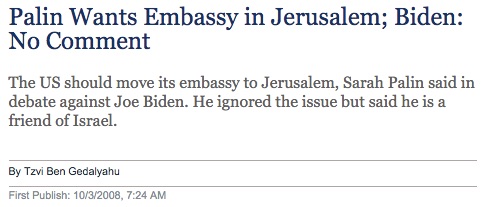
The news media is abuzz today with reports that, speaking before the American Israeli Public Affairs Committee (AIPAC) conference, an annual gathering of rabid right-wing Israel supporters, a presidential candidate vowed to move the U.S. Embassy in Israel from Tel Aviv to Jerusalem.
So who was it this time? Donald Trump.
So why is this news? It’s not.
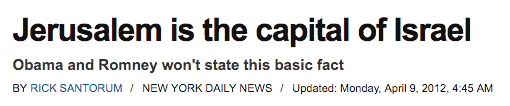
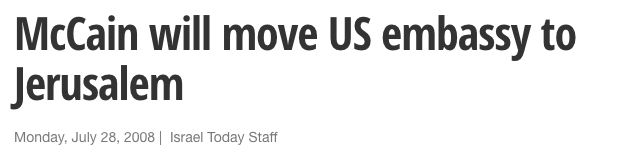
Promising to recognize Jerusalem as Israel’s undivided capital and to move the American embassy there is part of Pandering 101 for Oval Office hopefuls. Every candidate in the past few decades knows this. It’s an easy vow to make, and no one ever pays any political price for inevitably breaking it (since half of Jerusalem remains occupied territory and actually moving the embassy there would be a clear violation of international law, which doesn’t recognize Israel’s claim over the historic city). Making such an absurd promise plays well to the writhing masses at AIPAC confabs, establishes one’s Zionist bona fides, and is a quick and easy way to offend indigenous Palestinians living under occupation, apartheid and blockade without actually flipping them the bird.
Nevertheless, the press continues to report on this blustery promise, no matter who utters it, as if it actually merits attention.
(Supporters of moving the embassy were subsequently disappointed in Bush’s failure to act on his promise.)
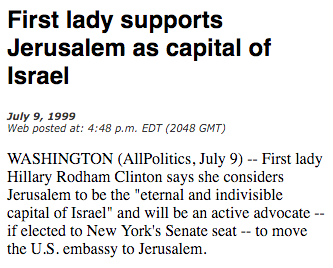
The year before, while beginning her campaign for New York’s Senatorial seat, the then-First Lady Hillary Clinton weighed in on the matter herself:
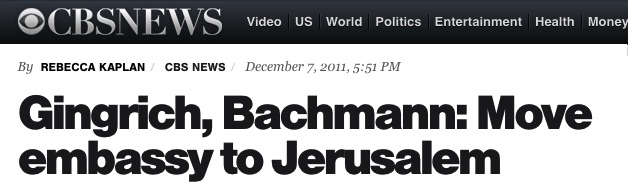
In the mid-1990s, Senate Majority Leader Bob Dole and House Speaker Newt Gingrich similarly pandered like pros:
Before that, in 1992, the Clinton/Gore campaign hit the incumbent Bush administration for balking at the official recognition of “Israel’s sovereignty over a united Jerusalem.” Their campaign promised voters that “Bill Clinton and Al Gore will… support Jerusalem as the capital of the state of Israel.”
Al Gore, who tried to win the Democratic nomination for president that year, reportedly said in September 1987 that “he would consider moving the U.S. embassy from Tel Aviv to Jerusalem.”
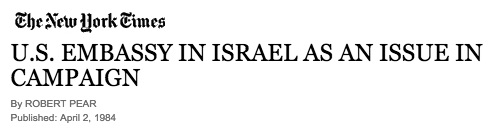
In April 1984, during a heated Democratic primary season, Walter Mondale and Gary Hart bent over backwards to assure voters in New York City that they too supported moving the U.S. Embassy from Tel Aviv to Jerusalem.
Walter F. Mondale said he had supported such a move for 20 years, and he asserted that Senator Gary Hart had changed his position on the issue five days ago. In the past two weeks, Mr. Hart has denied that he suddenly changed his position, but has said his position has ”evolved.” He has said firmly that if he became President, he would move the embassy to Jerusalem.
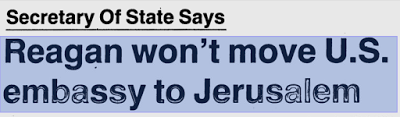
The Rev. Jesse Jackson is the only one of the three candidates who opposes moving the embassy. The Reagan Administration also opposes such a move because the status of Jerusalem has long been disputed and the United States does not support Israeli sovereignty over the city.
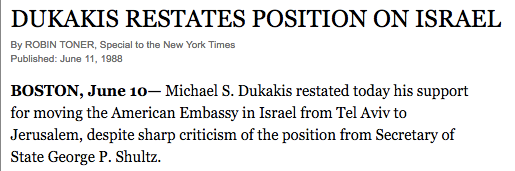
Despite efforts by New York Senator Daniel Moynihan and California Congressman Tom Lantos to introduce a bill mandating the move, Reagan was adamant about not moving the embassy, as such a divisive policy would, according to his Secretary of State George P. Shultz, “be very bad for the United States” and “damage our ability to be effective in the peace process.”
The pandering was so thick, however, that a month later the Reagan administration had to pretend to consider supporting the move in order to stave off losing votes in the upcoming election.
Though the bill eventually stalled, Los Angeles Times syndicated columnist Nick Thimmesch, who called the proposal “one of the dumbest ideas to be advanced in Congress this session,” lamented that “some of the election-year pandering in the Republic verges on the obscene” and credited the ill-conceived gambit to the lawmakers’ “blind obedience to the Israel lobby (American Israeli Public Affairs Committee).” That was October 3, 1984.
By 1986, another bill was introduced to move the embassy, this time brought to the Senate floor by Republican Jesse Helms.
But even in the mid-1980s, though, this was an old political ploy. The New York Timespointed out that the 1976 Democratic Party platform – on which Jimmy Carter and Walter Mondale ran for office – declared:
We recognize and support the established status of Jerusalem as the capital of Israel, with free access to all its holy places provided to all faiths. As a symbol of this stand, the U.S. Embassy should be moved from Tel Aviv to Jerusalem.
Before that, on March 17, 1972, Michigan Congressman Gerald Ford, then the Republican Minority Leader, told a Zionist Organization of America regional meeting in Cleveland that the Nixon Administration should transfer the U.S. Embassy to Jerusalem.
Two years later, after first replacing Spiro Agnew as Vice President and then becoming President himself following Nixon’s resignation, Ford backtracked on his previous position. “Under the current circumstances and the importance of getting a just and lasting peace in the Middle East, that particular proposal ought to stand aside,” Ford said at his very first presidential press conference on August 9, 1974.
It’s been nearly 42 years since then and, sadly, while Palestine remains under brutal occupation, Israeli colonies continue to expand with impunity, and Palestinians are subject to ongoing oppression and violence, election-year pandering in the United States has become more obscene than ever.
Less than a week before the terrorist attacks in Brussels, Turkish President Recep Tayyip Erdogan warned of possible bombings in European cities, including Brussels.
“There is no reason why the bomb that exploded in Ankara could not explode in Brussels, or in any other European city,” Erdogan declared during a ceremony commemorating the 101st anniversary of the Battle of Gallipoli in the coastal town of Canakkale on March 18.
It should be noted that Erdogan’s statement followed the deadly terrorist act of March 13, when a car bomb exploded at a bus stop near Ankara’s central Kizilay Square, leaving 37 dead and over 120 injured. The Turkish head of state blamed Kurdish radicals for the attack and berated European leaders for their refusal to recognize certain Kurdish organizations as terrorist groups.
“The snakes you are sleeping with can bite you at any time,” Erdogan added.
On Tuesday, March 22, the city of Brussels – capital of Belgium and administrative center for both NATO and the EU – was hit by a series of explosions, including two blasts in Brussels Airport in Zaventem, Belgium that left 13 people dead and over 35 injured. An additional 15 people were killed in Tuesday’s explosion at the Maalbeek metro station in central Brussels, local media reported.
By Stephen Sniegoski | My Catbird Seat | June 12, 2010
The claim that Israel serves as a valuable ally for the United States is made by both pro-Zionists and much of the anti-war and anti-Zionist Left that is influenced by Noam Chomsky. As a result of the Gaza flotilla massacre, which has caused a world-wide uproar against Israel, the value of Israel to the United States is being publicly questioned in more mainstream foreign policy forums. … continue
This site is provided as a research and reference tool. Although we make every reasonable effort to ensure that the information and data provided at this site are useful, accurate, and current, we cannot guarantee that the information and data provided here will be error-free. By using this site, you assume all responsibility for and risk arising from your use of and reliance upon the contents of this site.
This site and the information available through it do not, and are not intended to constitute legal advice. Should you require legal advice, you should consult your own attorney.
Nothing within this site or linked to by this site constitutes investment advice or medical advice.
Materials accessible from or added to this site by third parties, such as comments posted, are strictly the responsibility of the third party who added such materials or made them accessible and we neither endorse nor undertake to control, monitor, edit or assume responsibility for any such third-party material.
The posting of stories, commentaries, reports, documents and links (embedded or otherwise) on this site does not in any way, shape or form, implied or otherwise, necessarily express or suggest endorsement or support of any of such posted material or parts therein.
The word “alleged” is deemed to occur before the word “fraud.” Since the rule of law still applies. To peasants, at least.
Fair Use
This site contains copyrighted material the use of which has not always been specifically authorized by the copyright owner. We are making such material available in our efforts to advance understanding of environmental, political, human rights, economic, democracy, scientific, and social justice issues, etc. We believe this constitutes a ‘fair use’ of any such copyrighted material as provided for in section 107 of the US Copyright Law. In accordance with Title 17 U.S.C. Section 107, the material on this site is distributed without profit to those who have expressed a prior interest in receiving the included information for research and educational purposes. For more info go to: http://www.law.cornell.edu/uscode/17/107.shtml. If you wish to use copyrighted material from this site for purposes of your own that go beyond ‘fair use’, you must obtain permission from the copyright owner.
DMCA Contact
This is information for anyone that wishes to challenge our “fair use” of copyrighted material.
If you are a legal copyright holder or a designated agent for such and you believe that content residing on or accessible through our website infringes a copyright and falls outside the boundaries of “Fair Use”, please send a notice of infringement by contacting atheonews@gmail.com.
We will respond and take necessary action immediately.
If notice is given of an alleged copyright violation we will act expeditiously to remove or disable access to the material(s) in question.
All 3rd party material posted on this website is copyright the respective owners / authors. Aletho News makes no claim of copyright on such material.
 In an editorial this week, military defense experts Adam Lowther and Chris Winklepleck argue that the strategic aircraft arm of the US nuclear triad provides unique “nuclear signaling” and serves a critical deterrence role in US military strategy.








 Aletho News
